JIT: US Gas Pipelines Expanded
Some good news from EIA (US Energy Information Administration) that natural gas supplies will be enhanced Just In Time for the winter heating season.  The article is New natural gas pipeline capacity expands access to export and Northeast markets.  Excerpts in italics with my bolds.

In our recently updated Natural Gas Pipeline Projects Tracker, we estimate over 4 billion cubic feet per day (Bcf/d) of new natural gas pipeline capacity entered service in the third quarter of 2021, primarily supplying Gulf Coast and Northeast demand markets.

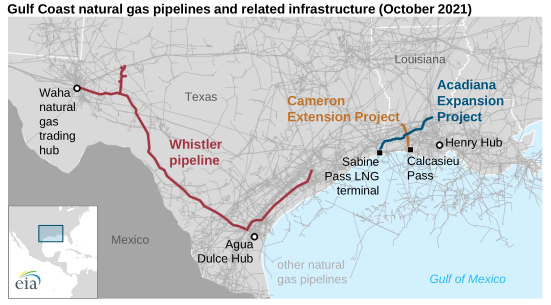
In the Gulf Coast, three projects either entered service in the third quarter or were partially completed, totaling 3.6 Bcf/d of additional pipeline capacity. These projects connect U.S. natural gas production to growing U.S. export markets. They include:

♦ The Whistler pipeline, completed on July 1, 2021. The new 2.0 Bcf/d pipeline, constructed by NextEra, connects Permian Basin production at the Waha Hub in West Texas to the Agua Dulce Hub in Southeast Texas. The Agua Dulce Hub serves as the supply point for several pipelines that cross the border to supply demand markets in Mexico.

♦ The Acadiana Expansion Project, partly completed as of August 6, 2021. This 894 million cubic feet per day (MMcf/d) expansion on the Kinder Morgan Louisiana intrastate pipeline increases takeaway capacity out of the Haynesville Basin, connecting it to the Sabine Pass LNG terminal. The project is expected to be completed in early 2022.

♦ The Cameron Extension Project, partly completed as of August 12, 2021. This 750 MMcf/d expansion on the Texas Eastern Transmission (TETCO) interstate pipeline delivers feedgas to the Calcasieu Pass LNG terminal, which is currently preparing to start commissioning activities. The project is expected to be completed by the end of this year.
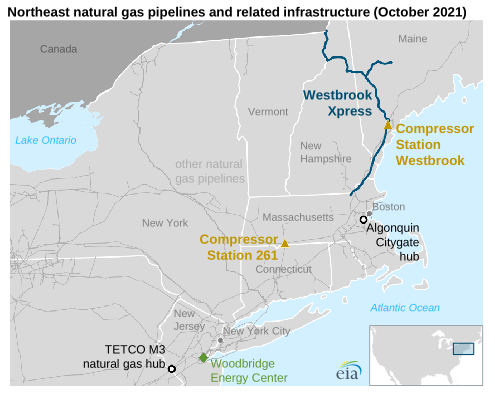
Several other projects have also entered service, increasing supplies to constrained demand markets in the Northeast. In New England, two projects will improve the region’s access to winter supplies of natural gas by over 100 MMcf/d:

♦ The 261 Upgrade Projects completed its second and final phase, entering service on October 6, 2021. With the new, upgraded compressor at Station 261, an estimated 20 MMcf/d of additional natural gas supply can be delivered by the Tennessee Gas Pipeline (TGP) into New England.

♦ Portland Natural Gas Transmission System’s (PNGTS) Westbrook Xpress Project, Phases 2 and 3, entered service on October 21, 2021, increasing natural gas pipeline import capacity from Canada at Pittsburg, New Hampshire, by 81 MMcf/d. The new Westbrook compressor station in Westbrook, Maine, will increase capacity on the co-operated Maritimes Northeast pipeline by 50 MMcf/d.

In addition, the Middlesex Expansion Project entered service in New Jersey on September 28, 2021. This 264 MMcf/d TETCO expansion delivers natural gas—via interconnections with other interstate pipelines—to the 724 megawatt (MW) Woodbridge Energy Center combined-cycle power plant in Woodbridge Township, New Jersey.

Some Bad News

The pipeline project tracker update also includes the cancellation of the 1.3 Bcf/d PennEast Pipeline, which was announced in late September. This 1.3 billion dollar project was designed to bring natural gas supplies from the Appalachia Basin into constrained demand markets in New Jersey and southeastern Pennsylvania.

In total, the Natural Gas Pipeline Projects Tracker includes updates to 25 interstate and intrastate natural gas pipeline projects, including announcements of new projects and estimated dates of completion. We update this resource quarterly; the next update is scheduled for late January 2022.

Footnote:

Background on PennEast cancelation at PA advocates laud cancelation of PennEast pipeline

The PennEast decision was a victory for the opponents that have waged a seven-year campaign against the project. “The announcement that the PennEast pipeline is effectively dead is a huge relief for PennFuture and the impacted communities across the Delaware River watershed who have been tirelessly working to defeat this terrible pipeline,” said Abigail M. Jones, vice president of legal and policy at the environmental advocacy group PennFuture.

Not everyone was pleased with the PennEast decision.

“We are disappointed, although not surprised, to hear that PennEast has decided to cancel the development of this important pipeline project in New Jersey,” Mark Longo, director of the Engineers Labor-Employer Cooperative, said in a statement. “The benefits of the project were clear: It would have provided New Jersey and the entire region with the clean, affordable energy needed to grow our economy. However, many policy makers and special interest groups shamefully fought hard to stop the project and ultimately succeeded, putting the future of our energy infrastructure at risk.”

The Pennsylvania Chamber of Business and Industry lamented the economic impact of the cancelation.

“Activists are cheering upon the recent news that the sponsors of the PennEast project, a more than $1 billion investment that would have delivered Pennsylvania-produced natural gas into markets in New Jersey, have cancelled the project. Let’s be clear: this is no victory — not for ratepayers, who are now lacking a reliable source of gas and electricity; not for the economy, which is now out several thousand well-paying construction jobs at a time when the economy continues to struggle; and not for the environment, as this obstruction results in the mid-Atlantic being more reliant on imported fuels from foreign nations that do not have our strict environmental standards,” said Chamber President and CEO Gene Barr.


European Clash Between Green Energy Realists and Purists

A previous series of posts here provided the case made by David Stockman against the IPCC hurryup agenda (David Stockman: Resist the GreenMageddon).  It is a dangerous delusion that you can convert in a decade an energy platform that evolved over 200 years.  And particularly wrongheaded to start by stopping energy supplies without anything replacing them. As put recently by Bill Blain (excerpts in italics with my bolds):
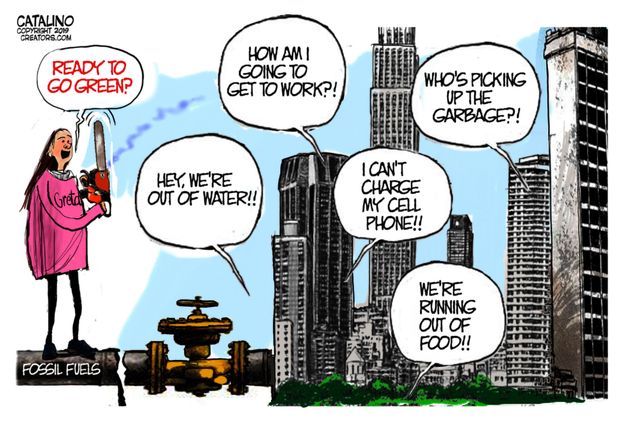
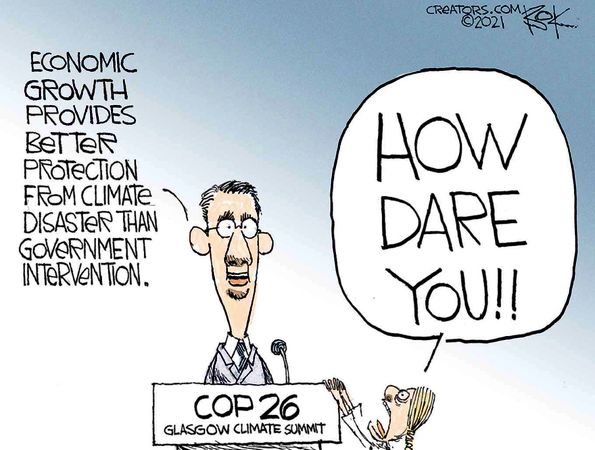
What COP26 protests highlights is how polarised Green politics are on collision course with the economy and growth. It’s going to take years to wean the economy off fossil fuels, but protestors will demand it happens now! Governments have politically committed themselves to a Green future, but are only just waking up to the reality of the need to transit from fossil fuels to renewables – which isn’t feasible without a long-term plan.

Much as I admire the passion of green campaigners, the current volatility of energy pricing demonstrates a massive underlying transition problem and political naivety.

We can’t fundamentally change energy provision overnight. Climate protesters furious this generation have “stolen” their futures will be even less happy if they succeed in reversing economic growth. The result will be to ensure billions of children as yet unborn don’t just face rising temperatures and sea-levels, but also chronic poverty, unemployment, starvation, migration and rising conflict over the environment – water being the primary threat.

While “democratic” western nations may embrace Degrowth populism – nations like China will not.

It doesn’t need to be a frying pan vs fire choice, but that’s not the way popular politics work.

In this context, a battle has been joined in Europe over the paradigm of the ‘Green Energy Transition.”  An article in Euractiv is LEAKED: Paper on gas and nuclear’s inclusion in EU green finance rules.  Excerpts in italics with my bolds.

A proposal to bring both nuclear power and natural gas into the bloc’s green finance taxonomy is circulating in Brussels. The paper has been branded as a “scientific disgrace” by campaigners who warned it would damage the EU’s credibility on green finance.

The so-called “non-paper”, obtained by EURACTIV, lays out detailed technical criteria for gas to qualify as a transitional activity under the EU’s sustainable finance rules.

To qualify as a “sustainable” investment, gas power plants or cogeneration facilities must not emit more than 100 grams of CO2 equivalent per kilowatt-hour, according to the draft paper.

It comes in the wake of declarations by European Commission President Ursula von der Leyen, who said the EU executive would soon table proposals on gas and nuclear as part of the bloc’s green finance rulebook.

“We need more renewables. They are cheaper, carbon-free and homegrown,” von der Leyen wrote on Twitter after an EU summit meeting two weeks ago where leaders debated the bloc’s response to rising energy prices.

“We also need a stable source, nuclear, and during the transition, gas. This is why we will come forward with our taxonomy proposal,” she added.

Gas as a ‘transitional activity’

The 100gCO2 emissions criteria is the same as earlier proposals circulated last year, which were rejected as too stringent by a group of 10 pro-gas EU countries who threatened to veto the proposal.

To assuage critics concerns, the paper lays out additional criteria for gas plants to qualify as a “transitional activity”, accompanied by a sunset clause (until 31 December 2030) for the commissioning of new plants.

For gas power plants, these are the criteria to qualify as a “transitional activity”:

  • Direct emissions are lower than 340gCO2/kWh, and
  • Yearly emissions are lower than 700 kgCO2/kW.

For cogeneration plants, these are the criteria to qualify as a “transitional activity”:

  • Life-cycle emissions are lower than [250-270] gCO2e per kWh, and
  • Primary energy savings of 10% compared with the separate production of heat and electricity.

Campaigners denounced those criteria as “radically weaker” than previous plans drafted by the European Commission.

“This proposal is a scientific disgrace that would deal a fatal blow to the taxonomy,” said Henry Eviston, spokesman on sustainable finance at WWF European Policy Office.

Campaigners were unsure about the origin of the non-paper. But diplomats who spoke to EURACTIV at an EU summit two weeks ago said France has been working behind the scenes to forge a compromise on the taxonomy that would satisfy supporters of gas and nuclear power.

At the initiative of Paris, representatives from like-minded EU countries held a meeting on 18 October to debate nuclear and natural gas in the context of the taxonomy, the EU diplomat said. The meeting was attended by Bulgaria, Cyprus, Czechia, Finland, France, Greece, Hungary, Malta, Poland, Romania, Slovakia, and Slovenia.

According to the same diplomatic source, participants discussed compromise proposals for technical criteria to assess the sustainability of gas and nuclear power plants.

Nuclear

On nuclear, the “non-paper” builds on the EU’s Joint Research Centre (JRC) recommendations, which concluded in a July report that nuclear power was safe and therefore eligible for a green label under the taxonomy.

The paper does not propose detailed sustainability criteria at this stage and merely divides nuclear power production activities into four categories:

  • Nuclear plant operation: Production of electricity, including the construction, commissioning, operation and decommissioning of nuclear power plants.
  • Storage or disposal of radioactive waste or spent nuclear fuel (enabling activity).
  • Mining and processing of uranium (enabling activity).
  • Reprocessing of spent nuclear fuel (enabling activity).

The “non-paper” comes in the wake of a meeting of EU energy ministers last week where twelve EU countries spoke in favour of nuclear’s inclusion in the taxonomy.

Footnote On Energy Transitions

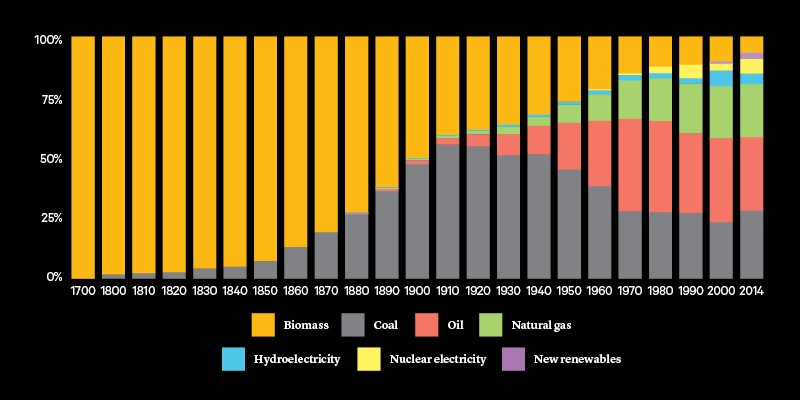
Thanks to Bill Gates we have this helpful graph showing the progress of human civilization resulting from shifts in the mix of energy sources.

Before the 19th century, it is all biomass, especially wood. Some historians think that the Roman Empire collapsed partly because the cost of importing firewood from the far territories exceeded the benefits. More recently, the 1800’s saw the rise of coal and the industrial revolution and a remarkable social transformation, along of course with issues of mining and urban pollution. The 20th century is marked first by the discovery and use of oil and later by natural gas. Since the chart is proportional, it shows how oil and gas took greater importance, but in fact the total amount of energy produced and consumed in the modern world has grown exponentially. So energy from all sources, even biomass has increased in absolute terms.

Decarbonists in Denial of History

Against this backdrop of imperatives against fossil fuels, we have Lessons from technology development for energy and sustainability by Cambridge Professor Michael J. Kelly (H/T Friends of Science). Excerpts in italics with my bolds.

Abstract: There are lessons from recent history of technology introductions which should not be forgotten when considering alternative energy technologies for carbon dioxide emission reductions. (Synopsis is at the Footnote red link)


The Creed for Pawns

Jeremy Carl lays out the catechism of beliefs required to be a US citizen, indeed a world citizen these days, in his American Mind article I Believe.   See how many boxes you can check to see if your citizenship passes muster. Excerpts in italics.

An affirmation of the national creed.

I believe Joe Biden, the Democrats, and the media. I have always believed them.

□  I believe them when they said they fortified the election, and I believe them when they said anyone wanting to look at whether they fortified the election was a racist and a conspiracy theorist. I believe that mass ballot harvesting and ballot curing are signs of the great health of American democracy. I believe that it is impossible for poor people to get voter IDs, and it is a mystery to me how India has had voter IDs for every voter since 1993.

□  I believe that, although just 44,000 votes in three states had to have switched in order for Trump to have won the election, there is zero chance that fraud could have provided Biden with his margin of victory.

□  I believe them when they say that it is totally normal for a Presidential candidate to conduct the latter stages of a general election campaign from his basement, and that it is ordinary for the media not to question that decision.

□  I believed them when they said that vaccinated people cannot get and spread COVID. And I believed them when they said vaccinated people can get and spread COVID. I believe that it was only because of the science, and not because of the interventions of the teachers unions, that tens of millions of kids were out of school for all of last year. I have no doubt that Randi Weingarten is primarily motivated by her desire to do right by my kids…strike that: our kids.

□  I believe them when they say our response to COVID was guided solely by the science. I believe that the public health establishment is non-political and interested only in tending to our common weal. They did not fund gain-of-function research in a lab in Wuhan.

□  I believe the science is settled.

□  I believe that natural immunity is a fraud and distraction. It is normal to attempt to mandate vaccination of children for a disease that mostly kills very old and very sick people.

□  I believe, along with more than 1,300 physicians and public health officials who agree, that racism is such an important crisis that Black Lives Matter protesters can gather for protests and riots with official sanction during the peak of a pandemic, but that someone attending their grandfather’s funeral or staying at a loved one’s bedside is an imminent danger to public health.

□  Like Joe Biden, I believe that white supremacist terrorism is the greatest threat to the U.S. security today. I believe that Michael Brown said “Hands up, don’t shoot” and that Jacob Blake is a good dad who was shot for no reason.

□  I believe millions of people of African and Asian descent have immigrated to America over the last 60 years despite knowing that America is systemically racist, and I believe they are owed something for their struggle.

□  I believe that there is no such thing as illegal immigration because no human being is illegal. I believe that migration to the country has nothing to do with President Biden’s open borders regime and their repeal of Trump-era border policies. I believe that stopping construction on the border wall, repealing “Remain in Mexico,” and expanding “catch and release” have nothing to do with increased entry to the United States.

□  I believe that Ilhan Omar absolutely did not commit marriage fraud and immigration fraud while marrying her brother.

□  I believe the “great replacement” is a racist conspiracy theory and that the white population of America will become marginalized through a natural process that should be celebrated.

□  I believe we didn’t leave one American citizen behind in Afghanistan and that there was no more strategic way to withdraw without leaving our enemies tens of billions of dollars of our military equipment.

□ I believe in the importance of our sacred norms and institutions, which is why I support Democrat plans to pack the Supreme Court, make DC and Puerto Rico states, and eliminate the electoral college. I believe the Senate is unjust and must be abolished.

□  I believe that billionaires are a threat to democracy unless they are billionaires who opposed Trump in which case they are heroes.

□  I believe that Joe Biden is mentally acute and that his persistent refusal to take cognitive tests or spontaneous questions from the media is only a sign of his supreme confidence in his abilities.

□  I believe that every January 6 defendant was intent on committing insurrection and none were prompted in any way by federal agents. And I believe it is totally normal in America for judges to demand political recantations before releasing people from pre-trial detention.

□  I believe that Donald Trump said that Nazis were “very fine people” and that he encouraged people to inject themselves with bleach.

□  I believe George Floyd is an American hero. American heroes often have eight criminal convictions and held a gun to the stomach of a pregnant woman during a home invasion. I believe the decision to memorialize him with statues in our major cities is the sign of a healthy body politic.

□  I believe that everyone in America always celebrated Juneteenth, frequently in secret and in fear, and that a majority of Americans were lying when they said they knew little or nothing about it.

□  I believe that it’s totally beneath comment that, in a country founded and governed overwhelmingly by white Protestants for its first 200 years, that the President has a 25-person cabinet without a single white person of Protestant origin.

□  I believe that Twitter is the free speech wing of the free speech party and that there is nothing at all dangerous to our democracy about banning the sitting President of the United States from using his preferred method of communicating with voters.

□  I am aware it is totally normal for social media and other influential outlets to suppress a potentially major story about the corruption of the son of a Presidential candidate, along with that candidate’s possible involvement in that corruption, in the days before a Presidential election.

□  I believe that Bill Kristol, Jennifer Rubin, Liz Cheney, the Lincoln Project, and other never-Trumpers opposed Trump solely because of their dedication to patriotism and integrity,

Especially the Lincoln Project.


Swiss Put Brakes on CO2 Emissions Policy

Hans Rentsch writes at Real Clear Energy Farewell to climate policy illusions after the successful referendum against the revised CO2 law. H/T zerohedge Excerpts in italics with my bolds.

On June 13th, the revised CO2 law failed at the Swiss ballot box. Judging from the rather confused debate following the rejection of the bill, one can hardly say that the shock in the politically competent circles had a beneficial effect in favor of more realism. Many commentators were surprised that the electorate put the brakes on climate policy, and many seemed puzzled about how to interpret the will of the people as expressed in the vote. In the referendum of May 2017, the revised Energy Act had been approved by a clear majority, but four years later a tight “no” to the revised CO2 Law followed.

The crucial point sounds almost trivial: The electorate that approved the Energy Act in May 2017 was not the same electorate that voted against the CO2 Act four years later – even disregarding the demographic shifts. The main difference lies in the much higher voter turnout for the CO2 Act – almost 60 percent, versus just 43 percent for the Energy Act. . . This high mobilization, well above the average of 46 percent, was due to the four other proposals that were voted on the same day, above all the two popular initiatives aiming at a reorientation of the agricultural policy.

The urban-rural divide only depicts the different political positions: urban Switzerland ticks left, rural Switzerland non-left. Instead of superficially complaining about a divide between town and country, it is worth looking at other ditches. It goes without saying that the differences between left and right are particularly great when it comes to issues that are as ideologically and morally charged as energy and climate policies. Supporters of the Green Party voted in favor of the Energy Act with a yes share of 94 percent, while only 16 percent of SVP party supporters voted in favor. Almost the same gap appeared in the referendum on the CO2 law: 93 percent versus 17 percent.

An orientation based on certain morally rewarding values is widespread among the materially privileged educated elite. Such attitudes are often used for personal image cultivation, but such behavior is associated with costs. Just think of the high prices for “ethical consumption.” In an article in the leading Swiss daily newspaper Neue Zürcher Zeitung, the cultural scientist Wolfgang Ullrich wrote that to orient one’s life towards higher values is the bliss only of elites. Their privileged social position enables the “new moral nobility” to implement a value-conscious lifestyle and thus to rise above other people. The fact that the support for the Energy and the CO2 bills was so strong in the university educated and the cultural milieus can primarily be explained with this value orientation and not with a superior technical or economic insight into the effects of the new legislation. The prominent American moral psychologist Jonathan Haidt said in a speech, only slightly exaggerating, that highly educated people are not, as they themselves would think, better informed than others, they are just more adept at justifying their prejudices.

The rough categorization “highly educated” also blurs an important fact. In terms of numbers, the predominant university degrees stem from “soft” subjects generally referred to as humanities (typically with female over-representation) such as languages, psychology, journalism, media, law, political science, sociology, history, geography, ethnology and medical-social subjects. In contrast to the political-ideological spectrum of the entire electorate, there is a pronounced left-green “value bias” among university graduates in the above-mentioned fields of study. Such orientation towards self-defined values also reflects a tendency towards illusory social goals and a massive overestimation of political will and ability in the sense of: all we want is also feasible.

In times of rising alarmist voices, nothing would be more useful than to engage in a sober analysis of the situation without prejudice and to part from all the illusions that shape current energy and climate policy. This applies in particular to the Fukushima-fueled Swiss Energiewende.

The 1.5 degree target from the Paris 2015 conference and agreement and the connected grandiose “zero carbon” oaths are the great basic illusions.

Unattainable goals are bound to make climate policy a constant failure. Why should the world state of 1850 at the end of the Little Ice Age with a CO2 concentration of 280 ppm represent a natural climate optimum for the environment, health, and nutrition? Furthermore, since the average global temperature has already increased by 1.1 degrees since then, and since the temperature reacts with a delay to today’s CO2 concentration of 415 ppm, the 1.5 degrees would probably also be exceeded, even if the human world were to stand still tomorrow.

The approval of the Energy Act in 2017 was primarily a vote in favor of phasing out nuclear energy. In the VOTO follow-up survey, four out of five respondents expressed a wish for a nuclear-free Switzerland. The images of the reactor explosion in Fukushima were still firmly imprinted on people’s minds. “Hard cases make bad law” is an old political adage that pops up here. We could have learned a lot from the Fukushima hard or even worst case, if we had analyzed the consequences more calmly, instead of announcing an “energy transition” two months after the disaster with the phasing out of nuclear energy. Winston Churchill is credited with observing that security lies in the multitude of variables that are available as options for action. If, based on costless wishes and on vague hopes, a county’s voting population restricts options for action, it must also be prepared to deal with a reality that might behave differently than hoped for.

A counter-experience to Fukushima that could stir up people’s mindset in a similar way favoring a more realistic energy policy, would be an electricity blackout provoking the failure of important systems. Such an event is not unrealistic under the pressures and constraints of the announced energy transition. Relevant warnings can be found in official risk scenarios for Switzerland. With the ongoing and increasing uncoupling from the European electricity network due to Switzerland’s rejection of an institutionally binding general agreement with the EU, these risks are rising. But as long as the perception and the media communication of accidents in the energy sector – not least thanks to the specters “Fukushima” and “Chernobyl” – are so distorted at the expense of nuclear energy, the prevailing opinions in the population should not be overestimated.

Perhaps in a few years we shall see a climate youth on strike who – in contrast to today’s ideologically blind Fridays for Future activists – is calling for an exit from the “nuclear exit.” All to the benefit of ambitious climate targets.

Footnote: Schiller Institute reaction to results:

The big surprise with the No vote over the new Swiss CO2 law was the fact that the majority of young people voted against it. According to the website 20 Minuten website, 54% of those over 65 — that is to say the Boomers — voted in favor of the new law, while 58% of those under 34 voted against it, according to a 20 Minuten and Tamedia survey of 16,249 participants. See report here.

The leading Swiss weekly Weltwoche wrote that the result signaled a “turning point in international climate policy,” a “popular uprising” in which the Swiss electorate rebelled “against the dictates of the elites…. The Swiss are going on a climate strike, just differently than what those in power intended. They want less government action against climate change instead of more.”

The claim that was circulating, that many people voted against the new law because it was not “strong enough” also seems to have not been decisive, according to the survey, since only 2% of the no voters claimed they cast their ballot against it for that reason. According to the survey, fear of higher costs was the main argument against the CO2 law, including among young people.


Climate Change is a Political Cop Out


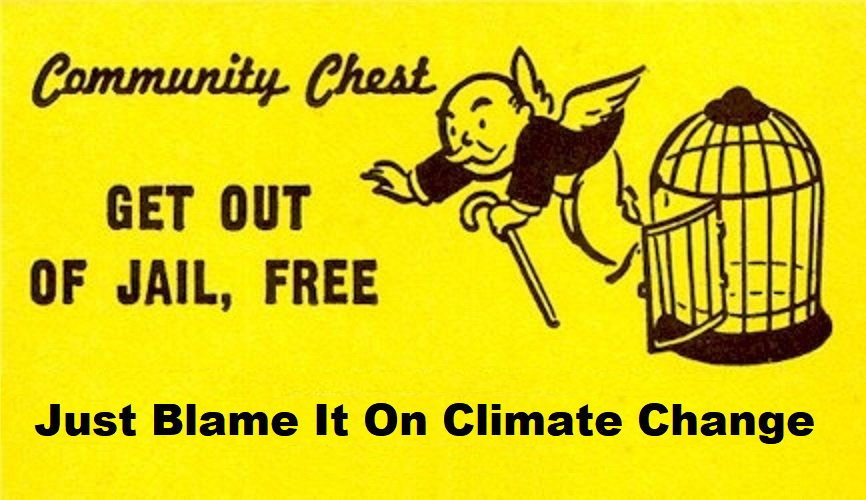
Jonathan Lesser writes at Real Clear Energy Climate Change Ate My Homework: Politicians Blame Climate Change for Bureaucratic Failures.  Excerpts in italics with my bolds and added images.

Never let a crisis go to waste, said Rahm Emanuel. True to form, politicians, including New York City Mayor DeBlasio, are conveniently claiming that last week’s flooding caused by the remnants of Hurricane Ida is clear evidence of climate change. “Unfortunately,” said the Mayor, “extreme weather events are becoming the norm.”

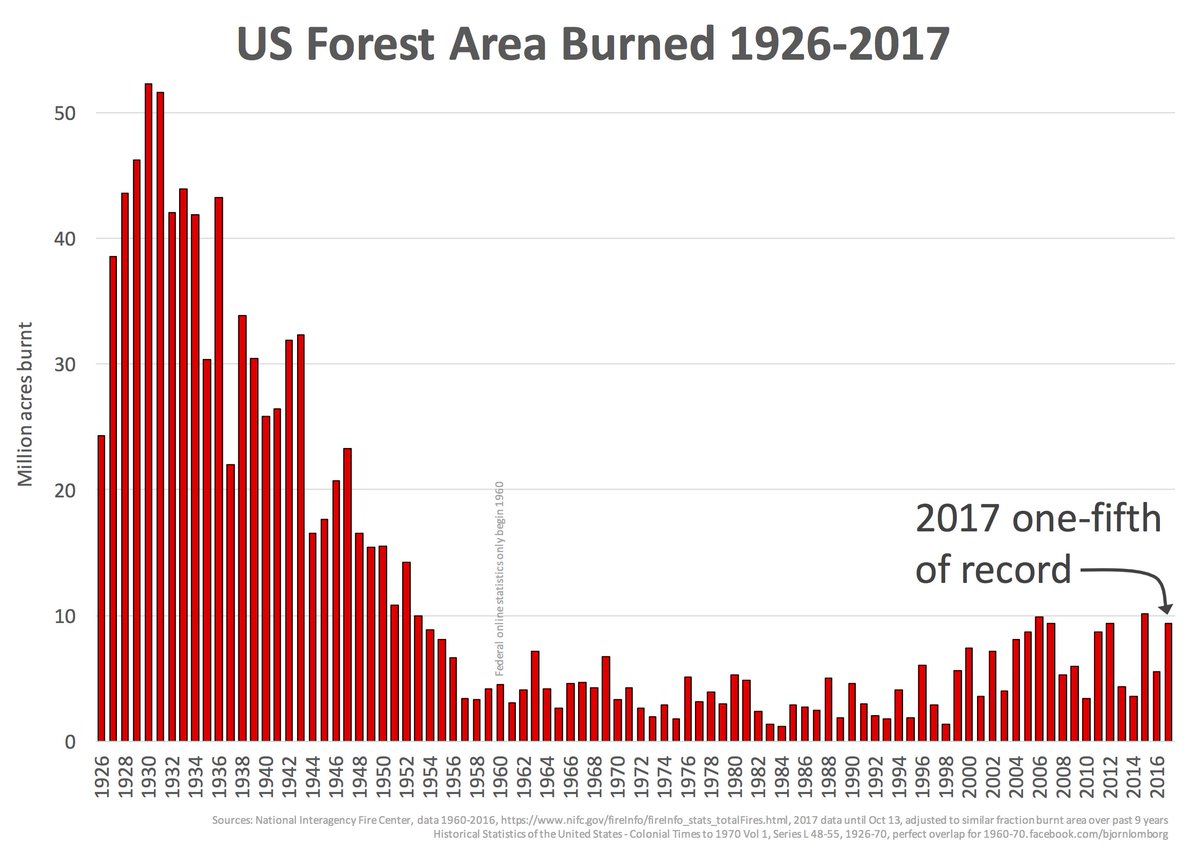
The data suggest it’s more complicated. Hurricanes are actually slightly less frequent today than they were a century ago. The average number of wildfires has not increased over the last thirty years and, over the past century, the total number of acres burned is far lower.

It may be hard to believe, but hurricanes hit the east coast even before Thomas Edison opened his Pearl Street Generating Station in the financial district in 1882. For example, the Coastal Hurricane of 1749 was estimated to have been one of the strongest hurricanes to hit the eastern seaboard.[1] Twin hurricanes hit North Carolina in August 1795. And the New England Hurricane of 1815 devastated Providence, Rhode Island.

Figure 2a shows Integrated Storm Activity Annually over the Continental U.S. (ISAAC) from 1900 through 2017, with a 10 year centered average in red. Source: Truchelut and Staehling (2017) Overlaid is atmospheric CO2 concentrations measured at Mauna Loa.

It’s true that damages caused by hurricanes and wildfires have increased. But the reasons are far from conclusive, and likely have far more to do with bureaucracy than with climate change.

Regardless, the rhetoric from our political class should be exposed for what it is: a thin attempt to shift blame away from their own bureaucratic failures.

Damages from hurricanes have increased because of far more development along the Gulf and east coasts. Furthermore, the federal government has subsidized flood insurance in these same areas and continues to do so. Not only have those subsidies encouraged coastal development, but also they provide an economic incentive for individuals, and state and local governments, to skimp on building more flood-resistant facilities. Vulnerable infrastructure—and more of it—will naturally yield greater infrastructural damage.

Similarly, damages from wildfires, especially in California, have resulted from a toxic combination of federal and state fire suppression policies, environmentalists’ demands that have prohibited removal of dead and diseased trees, restrictions on grazing that would remove dry grasses and, especially, poorly maintained power lines. Pacific Gas & Electric Company, for example, pleaded guilty to 85 counts of manslaughter because it failed to maintain power line equipment that caused the 2018 Camp Fire. To make matters worse, California’s restrictive development policies have forced homeowners to move farther away from cities and into mountainous areas where fire risk is greatest.

Climate change isn’t responsible for those policies.

Remember Superstorm Sandy? After it flooded New York City in October 2012, Governor Cuomo formed the “NYS 2100 Commission” to find ways to strengthen the state’s infrastructure. He also formed the “NYS Ready Commission,” which was to find ways to ensure that the state’s critical systems and services, including subways, are better prepared for disasters.

The 2100 Commission recommended hardening infrastructure, especially sewage treatment plants, strengthening dams and constructing levees, and even expanding wetlands protections in flood-prone areas.

Seven years later, in 2019, the City Council criticized the lack of preparation for the next storm because those preparations were mired in red tape and bureaucratic squabbling. [2] One notable project, for example, the $1.5 billion East Side Coastal Resiliency project, finally started earlier this year. It won’t be finished until at least 2026. Most of the other recommendations haven’t been implemented, either.

Climate change didn’t cause those delays.

Part of that “preparation” includes more stringent mandates for green energy. But even if New York was powered solely by green energy tomorrow, it wouldn’t eliminate bureaucratic delays.

Instead, it would inflict its own damage on New York’s beleaguered economy, with higher costs and more blackouts. Last month, for example, the New York State Reliability Council, which is tasked with preserving the reliability of the state’s electric power grid, issued a report regarding how to maintain that reliability while meeting the green energy and electrification mandates of former Governor Cuomo’s Climate Leadership and Community Protection Act.[3]

The Council concluded that, because of the inherent intermittency of wind and solar power, meeting those mandates will require “substantial clean energy and dispatchable resources, some with yet to be developed technology …” The Council estimated that, by 2040, New York will need 50,000 megawatts of generating capacity just in reserve – more than the state’s entire generating capacity today – and require generating technologies that don’t even exist.

Americans like to think they elect leaders who diligently prepare for the future. But if the preparation requires unknown technologies, and if concrete plans for resilience are going unfulfilled now, one man’s forward-thinking rhetoric can look an awful lot like another’s finger-pointing to eschew blame. It would be nice to think politicians would avoid using buzzwords and broad concepts to mask their own deficiencies. But the facts of bad incentives and poor planning are undeniable. When the lights go out, we can expect more of the same excuses.

 

How Medical Technocrats Subvert Medical Practice

Dr. Ted Noel explains the ways government institutional rot prevents doctors from caring for their patients. His article at American Thinker is Why Do Doctors Go Along with COVID Panic Porn and CDC Prescriptions? Excerpts in italics with my bolds.

I recently had a conversation with a reasonably well informed writer who simply missed the real reasons why most practicing physicians go along with the Fauci Fraud. As a public service, I will attempt to fill in a few gaps. But first, I must define the fraud.

There are two basic legs to the fraud. First is the idea that the Centers for Disease Control is in any way concerned with a mission related to its name.

The failure of the CDC to endorse any treatment that did not emanate from its exalted halls should give us our first glint of clarity. There are literally millions of physicians around the world, and the great bulk of them truly wish to treat their patients well. Among those are thousands of researchers, a number far in excess of those at the CDC, the NIH, and other alphabet soup government agencies. The very idea that outside researchers are incapable of discovering anything useful without the help of the bureaucrats in D.C. is hubris of the highest order. And it prevents the CDC, the FDA, or any other such agency from considering the idea that maybe, just possibly, there might be intelligent life down here. Mount Olympus cannot be threatened.

The second leg of the fraud is less visible to the naked eye but much more powerful. If I wrote this before I retired, I would be called before the Board of my group and told in no uncertain terms to shut up.

I might even be assessed a financial penalty with several zeroes after the one. That’s a serious impairment of my pursuit of happiness. The reason for my group’s dislike is more than the fact that I might be an irritant. They may actually agree with what I have to say. But they simply cannot afford for me to say it. That’s right: as a practicing physician in a group, my freedom of speech can become very expensive…to the group.

My group cared for patients of all descriptions, with roughly half of them on Medicare and another batch on Medicaid. Both programs are ultimately managed by the feds, one of the most humorless groups on the planet. They write a whole bunch of rules on how you have to document everything you do. If you didn’t document it correctly, it didn’t happen, and you won’t get paid. But that’s not the half of it.

Suppose you have one of those patients brought in by the ambulance from under the bridge. His only clothes are the ones he’s wearing, and he doesn’t have two nickels to rub together. It’s more than obvious that this surgery for bowel obstruction will be a charity case. Before Medicare, you’d simply write it off as your good neighbor duty. Now you don’t get a choice. CMMS (the actual administrative agency) requires you to send a bill. Twice. Or maybe three times. Whatever it takes to turn the bill into bad debt. Then you have to send it to a collection agency. Your only alternative is for your group to bring it up in its Board meeting and declare it a write-off that gets noted in the minutes.

All this rigmarole serves no purpose, and you knew that before you got to this sentence. But CMMS has a sinister side. If you do the case for free (which you did before you spent that useless money on billing and collection), CMMS will define that as your “usual and customary” bill for an exploratory laparotomy. Since your U&C is now zero, you can’t ever bill more than that for an ex lap in the future.

But what does that have to do with ivermectin? I’m glad you asked.

U&C bills are just one of hundreds of rules that CMMS enforces. Another is “Pay for Performance.” Basically, P-f-P requires you to check a host of boxes when taking care of patients. If you didn’t get that IV antibiotic in 20 minutes before the incision, you failed P-f-P and may not get paid. The hospital won’t get paid to take care of the patient if there’s a complication.

So let us suppose that you use ivermectin to treat a COVID patient as he arrives in the hospital. Ivermectin isn’t on the Medicare/Medicaid approved list of medications for COVID. Your hospital pharmacy will call you up and give you grief. After wasting a lot of time getting them to finally let you have it, you’ve had to cancel half of your office day. The next day, you’ll get a visit from a coder, who will tell you that you didn’t use the approved treatment protocol and put the hospital in jeopardy because you flunked P-f-P. By the way, that “coder” is the person who “helps” you use the proper ICD (billing) code for whatever the patient has in order for the hospital to make the most money. But that’s not the worst of it.

Because you flunked P-f-P, that waves a red flag in front of the CMMS bulls, and you’re about to get gored. They will wonder what other bad things you’ve done. As soon as they find one, it gets flagged as “Medicare fraud,” and they will bill you for twice what you got paid as a penalty. Can you guess how many other instances of fraud they’ll find if they look hard? Do you have to ask why my partners would get upset if I published while I was still in practice? By the way, CMMS can go two years back as they look for your crimes. They can ultimately take your house, your car, and your wife’s poodle while they’re at it.

Let’s change the scene. Suppose you’re in private practice. You can’t give ivermectin because the feds will key in on it if your patient’s on Medicare or Medicaid. So you decide to take care of him off the books. He pays you cash, and all is well. Not! You now took a private payment for Medicare-covered service. That will get you barred from seeing another Medicare patient for two years.

Let’s forget all the regulatory traps. You’re conscientious and try to do the best for your patients. But you’re busy, and you can’t keep up with the flood of papers on all the various COVID bits. So you wear a mask, have your patients wear masks, and do a lot of telemedicine. You keep up on the latest through Medscape and the Morbidity and Mortality Weekly Reporter. You should be good? Not! MMWR is put out by the CDC, and they won’t say the first good word about HCQ or ivermectin. Medscape is a little better, but not much.

And all the specialty societies are toeing the line. Can we guess why?

Any doctor who actually reads the studies, or follows any of the protocols published by the Association of American Physicians and Surgeons, will see a lot of peer pressure to stop. The financial risks may be extreme. It takes a spine of steel to stand up to the authoritarian orthodoxy.

Ted Noel, M.D. is a retired anesthesiologist/intensivist who posts on social media as DoctorTed and @vidzette.

For a deeper look into these issues, see:

Science Also a Pandemic Victim

Why Technocrats Deliver Catastrophes


Deeply Political Vaccine Mandates


Charles Lipson offers rich insights into the current controversy over proposed federal vaccine mandates.  Kudos for providing historical context and perspective in this confusing time.  His article at Real Politics is The Deep Politics of Vaccine Mandates.  Excerpts in italics with my bolds.

The debate over President Biden’s vaccine mandates has focused, understandably, on the tradeoff between individual rights to make medical choices and the potential harm the unvaccinated pose to others. That tradeoff is unavoidable. It is simply wrong for Biden to say, “It’s not about freedom.” It is. It is equally wrong for some Republican governors to say it is all about freedom. It’s also about the external effects of each person’s choice. To pretend that tradeoff doesn’t exist is demagoguery. But then, so is most American politics these days.

What’s missing or underappreciated in this debate?

The most important thing is that the Biden administration’s “mandate approach” is standard-issue progressivism. The pushback is equally standard. The mandates exemplify a dispute that has been at the heart of American politics for over a century, ever since Woodrow Wilson formulated it as a professor and then president. That agenda emphasizes deference to

    • Experts, not elected politicians,
    • Rational bureaucratic procedures,
    • Centralized power in the nation’s capital, not in the federal states, and
    • A modern, “living constitution,” which replaces the “old” Constitution of 1787 and severs the restraints it imposed on government power.

Implemented over several decades, this progressive agenda has gradually become a fait accompli, without ever formally amending the Constitution. The bureaucracies began their massive growth after World War II and especially after Lyndon Johnson’s Great Society initiatives of the mid-1960s (continued, with equal vigor, by Richard Nixon).

The judicial shackles were broken earlier, when Franklin Roosevelt threatened to pack the Supreme Court in 1937. Although FDR never followed through, his threat did the trick. The justices yielded to his pressure and began rubber-stamping New Deal programs that, until then, they had rejected as unconstitutional. Gradually, the older judges retired and Roosevelt picked friendly replacements. These judicial issues have reemerged now that progressives no longer dominate the Supreme Court. They are again threatening to pack the court and demanding that today’s justices stick with precedents set by their progressive predecessors (“stare decisis”).

The pushback against vaccine mandates is partly a debate about these progressive issues concerning the president’s authority and constitutional strictures. Mandate opponents say the federal government lacks the constitutional authority to impose these requirements, at least beyond its own workforce. They add that, if the president does wish to impose new rules, he and his executive agencies must go through the normal regulatory process. That process is slow — indeed, too slow to cope with an emergency.

Biden himself seemed to recognize these constitutional limitations before deciding to ignore them — the second time he’s done so in his brief presidency.

That’s a very troubling development, even if the courts overrule his decisions. The first time was his fiat decision to extend the moratorium on rent payments, which had been imposed during the worst days of the pandemic. Biden explicitly stated his unconstitutional rationale: It would take the courts time to rule against him and, until then, he could implement the policy. Of course, he also had a political rationale: to placate his party’s far left, which had mobilized over this issue.

Biden’s extension on the rent moratorium had a second, troubling dimension. It was promulgated by the Centers for Disease Control as a “public health issue.” That was a transparently false rationale in summer 2021 and dealt with housing issues far beyond the CDC’s expertise. The unintended consequence of the moratorium extension, beyond bankrupting small landlords, is to undermine the basic rationale for all progressive rulemaking: that the rules are being made by experts who know much more about their specialized area than do ordinary citizens or their elected representatives. What, pray tell, do experts on infectious disease know about the complexities of the U.S. housing market? Zero.

Progressive politics depends on public acceptance that experts really know what’s best and that their decisions will produce good outcomes. But trust in experts has collapsed alongside trust in all American institutions over the past half-century. The turning point was the disastrous war in Vietnam, advocated by LBJ’s Harvard advisers and the Whiz Kids in Robert McNamara’s Pentagon. Their failure was captured in the title of David Halberstam’s 1973 bestseller, “The Best and the Brightest.” The calamitous Afghan withdrawal underscored Halberstam’s sarcastic point.

So did the failure of so many Great Society programs, begun with such hope and fanfare.

The most painful experience was “urban renewal,” especially the massive program of building high-rise towers for welfare recipients. Before those towers were torn down, they had destroyed two or three generations of families. Part of the tragedy was that, like so many federal programs, the towers were built everywhere at once. If they had been tried out in a few cities, the problems would have been obvious, the failures remedied or the program abandoned. But Washington almost never does that. Congress funds and the bureaucracies implement mammoth, nationwide programs with no opportunity for feedback or mid-course corrections.

As public mistrust of institutions grew, a few institutions initially escaped the scorn. The military, for instance, was highly regarded until recently. It will take a heavy blow from the Afghan failure and the new, high-priority program of ideological training for troops. Government health officials were also highly regarded, at least until the botched rollout of Obamacare and the scandals at Veterans’ Affairs hospitals. Still, the public trusted the CDC and Dr. Anthony Fauci at the beginning of the pandemic. They trust them far less today, thanks to false and misleading statements, secrecy about funding the Wuhan virology lab, the absence of clear guidance on many issues, and blunt regulations that ignore important variations, such as natural immunity.

The effect of this growing mistrust was painfully apparent in President Biden’s mandate announcement. He didn’t rely on persuasion or trust in federal experts. He hectored, demonized, shamed, politicized, and threatened. That has become his routine, along with his refusal to answer the public’s pressing questions.

Biden’s political problem is that he faces real resistance from voters if he can’t solve the COVID problem, both because it is so serious and because he ran on being able to handle it better than Trump. Since Biden’s speech last week spent a lot of time attacking Republican governors, it was also an exercise in preemptive blame-shifting, in case the mandates fail.

His approach makes political sense, but it has at least two problems beyond the constitutional questions. One is that it politicizes vaccinations, which could have unintended consequences. Among the most obvious, it shifts the issue away from doctors and public health professionals and into the contentious political arena. Another is that it raises questions about the administration’s hypocrisy. Why do all federal employees, including those with natural immunity, need to get vaccinations but not the illegal immigrants arriving from Central America? That’s clearly a political decision, not a medical one, and it undermines the legitimacy of Biden’s whole approach, which stresses public health and medical experts.

The president’s speech had another major feature: It relied on vitriolic “wedge politics.” But Biden was elected partly because he promised to end the vitriol and divisiveness of the Trump years. He hasn’t done that. The poster child for his tendentious governing strategy is the second, $3.5 trillion “human infrastructure” bill. Not only does it have no Republican support, it has met serious resistance from centrist Democrats.

On his signature spending bills, like his vaccine mandates, Biden is pursuing a unilateral, aggressively partisan approach.

There’s no question the delta variant poses serious health risks and that, in general, vaccinations help both the individuals who get the jab and everyone around them. But there are serious questions about whether sticks or carrots are the best way to increase vaccination rates; how to convince people to get the vaccine now that trust in public-health experts has eroded; whether politicizing the issue is self-defeating; and what authority Washington has to impose mandates beyond its own workforce. The questions about the federal government’s authority — its effectiveness, its constitutionality, and its potential overreach — are among the most important in American politics. They have been for a century, and they won’t be resolved anytime soon.

Charles Lipson is the Peter B. Ritzma Professor of Political Science Emeritus at the University of Chicago, where he founded the Program on International Politics, Economics, and Security. He can be reached at charles.lipson@gmail.com.


Twitter an Unreliable Means of Discourse

Jack Butler writes an article The Myth of the Red Pill in the National Review.  I won’t go into all the nuances and various meanings attached to being redpilled, blue- or blackpilled, but want to reblog his discussion about how cyberspace is now awash with tweets from people, left and right, who believe they and they alone are “woke” in either the progressive, post-modern sense, or the opposite. Excerpts in italics with my bolds.

Adherents believe that their apparent online numbers, purportedly sophisticated ideas, and supposed influence in real-world politics point both to their being correct and the emerging conservative paradigm. All of these things are hard to measure, not just because of the amorphous quality of online interaction, but also because of the many layers of irony and memery in which believers conceal themselves. Still, it is undoubtedly true that none of this would have happened at all without the Internet. This fact is often interpreted favorably: The nature of physical reality, it is claimed, makes the kind of conversation they want to have ever harder, so anything worth saying is now being said digitally.

But the Internet is at least as much of a constrictor of thought for the redpilled as it is a facilitator, if not more so.

Many of the redpilled think of themselves as possessing a kind of unique energy, unavailable to the rest of the Right. It is quite easy to convince yourself of that if you spend all day marinating in carefully curated digital environments, associating mostly with people who agree with you, and letting your real-world interactions, such as they are, be flavored either actively or passively by your experiences online. Insularity is an ancient human temptation, one the Internet has, surprisingly, exacerbated.

The Internet may have begun with the promise of freewheeling sharing of information and interaction, but in the realm of the redpilled, Twitter is a place for collectivized, digital mass action. Believing that tweets are a serious and desirable form of political activism, they glory in the dopamine rush of likes and retweets, call for ratios of opinions they deem unacceptable, and take all of these things as signs that they are advancing their cause instead of adding tiny bits of ember to a fiery digital hellscape.

There are some things worth remembering about Twitter.

According to a 2019 Pew Research survey, 22 percent of Americans use Twitter daily. In 2021, Twitter itself measured 199 million daily active users on the site. This sounds like a lot, but only 38 million of those users are in the U.S. (11 percent of our population). By this measure, Twitter’s total active user base is about 2.5 percent of the world’s population. Pew’s 2019 estimate also says that 80 percent of tweets come from 10 percent of users. One study estimates that anywhere from 9 to 15 percent of Twitter users are bots; 66 percent of all links on Twitter come from bots. All of this speaks to a world that is not merely self-referential but also self-reinforcing. It sucks people in, convinces them that it is normal, and then brings out the worst in them as they engage in futile conversations that are hopelessly skewed by unrepresentative samples of human beings and disguised machines.

Like much of modern media, Twitter shrinks our attention spans while bombarding us with things we might not otherwise have ever known or cared about and on which we have no influence. This is to say nothing of the political slant of Twitter. As Brian Riedl put it (in a tweet; Twitter has its uses), “Twitter users are D+15 — which would tie HI & VT for the most liberal state . . . the 10% of Twitter users who post 92% of all tweets are D+43 — which would make it America’s 2nd most liberal House district.”

This skew can breed, in those who believe it to be representative, a highly agitated and combative posture.

It can make them think that America is already lost; this is called a “black pill” (the pill boxes of the redpilled are overflowing). It can make them believe that persuasion and workaday politics are inadequate to the moment, that only desperate action, often involving a departure from the constitutional order necessitated by the one already undertaken by opposing political forces, can bring any hope of salvation. It can make them believe that the political sphere is or should be a source of salvation — if only their enemies can be crushed. And so it can make them believe that only a countervailing force, similarly drawing strength from the online world and sharing many of its opponents’ attributes, can possibly contest it. In this way, the hyperpolarization and acute antagonisms of Twitter feed off each other, require each other, and may in fact reflect each other. Some of what happens on Twitter may be somewhat indicative of the real world. But there’s also the fact that Tay, Microsoft’s AI Twitter account whose personality was formed from Twitter interactions, within a day became a suicidal, sex-crazed, Nazi teenage girl. So much for reflecting reality.

The point of the original red pill in The Matrix was to escape an artificially created digital world. But now, redpilling is a phenomenon that depends on digital interactions. It also deceives its adherents about reality itself, discoloring or even discouraging their existence in the physical world. It is from this key inconsistency that so many of their fallacies flow — not least of which is their compulsive use of online platforms that they deem so pernicious they need to be regulated differently, broken up, or destroyed. Many of us nowadays struggle to restrain our use of technology. But that problem will not be solved by pretending that digital oversaturation is a virtue rather than a vice. Those who have trouble regulating themselves in this sphere make a curious authority for how to regulate it in society.

There is nothing magical about the online world. Like tools throughout mankind’s history, it can be used for good or evil ends. Facilitating communication, simplifying access to information — such things have their uses. But the test of something’s verity is not whether it goes viral. And as a digital form of gnosticism, redpilling has plenty of other defects that have weakened its utility. For one thing, as Shullenberger notes, it now exists in a kind of knowing game with its opponents: “The bluepilled regard the redpilled as deluded by misinformation, while the redpilled regard the bluepilled as dupes of the establishment.” Clearly, viewing the world as trapped in a digital binary is a dead end.

Whatever usefulness the red pill may once have had as a metaphor, it has now become a cliché at the same time that it has become a kind of twisted faith. It does not liberate its believers but rather constrains them, trapping them in digital worlds of their own creation. There are superior forms of conservatism, ones that appeal to reason and to more reliable forms of knowledge and authority. Curious minds would be better served letting the redpilled send themselves down endless rabbit holes, and instead pursue forms of learning and action that have a bit more to do with the world above the ground.


And Now There are Five “Common Cold” Coronaviruses

cg60a31a950a20d

Good news:  The Pandemic is over.  Next: Our immune systems will contend with one more coronavirus added to the other four we already live with.  Ross Pomeroy explains in Real Clear Science articles You Are (Probably) Going to Be Infected With the Coronavirus.  Excerpts in italics with my bolds.

SARS-CoV-2 joins the ranks of other coronaviruses to cause respiratory infections under the title of the “common cold”

It may not be today. It may not be tomorrow. It may not be next week. It may not be this month, when the rapid ascension of the Delta variant in the United States could send confirmed daily case counts spiking to 200,000 or more before settling down again. It may not even be next year. But someday, you will almost certainly be infected with the SARS-CoV-2 coronavirus.

This uncomfortable fact may come as a surprise to many Americans, particularly to those who have spent hours sanitizing surfaces and groceries, who have dutifully adorned a mask even when not required to do so, and who have made the simple, science-backed decision to get vaccinated. SARS-CoV-2 has already spread around the world, infecting hundreds of millions or more. The genie is out of the bottle, and it is not going back in.

“We will be dealing with this virus forever,” Dr. Michael Osterholm, the director of the Center for Infectious Disease Research and Policy (CIDRAP) at the University of Minnesota, said in an interview one year ago.

Osterholm has been a sage throughout the pandemic, and his words then remain prescient now.

“Effective and safe vaccines… will be very important, even critical tools, in fighting it,” he said. “But the whole world is going to be experiencing COVID-19 ‘til the end of time. We’re not going to be vaccinating our way out of this to eight-plus billion people in the world right now…. We’ve really got to come to grips with actually living with this virus, for at least my lifetime…”

Since speaking those words, Osterholm hasn’t changed his mind.

“Eradicating this virus right now from the world is a lot like trying to plan the construction of a stepping-stone pathway to the Moon. It’s unrealistic,” he told Nature in February of this year.

Olsterholm’s view now represents the consensus of scientific opinion. In January, Nature surveyed more than 100 experts working on the coronavirus about whether the virus could be eradicated. Nine out of ten said that it is “likely” or “very likely” that the coronavirus will continue to circulate amongst the human population as an endemic infection. Most see it becoming something like the flu, for which we will require yearly vaccinations to be protected, or joining the ranks of other coronaviruses to cause respiratory infections that collectively fit under the title of the “common cold”. In the latter scenario, people may get reinfected multiple times over their lives. This theory seems the most likely to play out.

“The virus sticks around, but once people develop some immunity to it — either through natural infection or vaccination — they won’t come down with severe symptoms… Scientists consider this possible because that’s how the four endemic coronaviruses, called OC43, 229E, NL63 and HKU1, behave,” Nicky Phillips wrote for Nature.

In either of these scenarios, it’s extremely likely that you will eventually be infected. Adults get the flu about once every five years. Many times they are unaware, because the infection is asymptomatic. By the time children are roughly three years old, 65% will have been infected with coronavirus 229E. It’s reasonable to predict that some years down the road, SARS-CoV-2 will be just as, if not more, prevalent. Even the vaccinated will likely be infected at some point, and that’s okay.

There was some hope that the incredibly effective vaccines we have, particularly BioNTech/Pfizer’s and Moderna’s mRNA shots, would grant sterilizing immunity, preventing infection altogether. And studies suggest that they do, surprisingly well. But it seems that this form of immunity wanes over time and lessens versus new variants, particularly the Delta variety that’s been all over the news of late. The good news is that the vaccines remain extremely protective against severe disease, hospitalization, and death. If and when booster shots are available, we’ll be able to refresh our immunity.

The knowledge that a SARS-CoV-2 infection is essentially inevitable might be, for some, panic-inducing, perhaps prompting a desire to live a bubbled life. It shouldn’t. That’s because we have the tools to be free from both fear and, for the vast majority, harm: America’s remarkable arsenal of safe and effective vaccines. Again, even if the vaccines don’t prevent infection, that’s okay! As of July 26th, less than 0.004% of fully vaccinated people experienced a breakthrough case resulting in hospitalization and less than 0.001% died from the disease, according to the latest data from the US Centers for Disease Control and Prevention.

As Dr. Osterholm said in May, “For vaccinated individuals, in a private home or wherever, party hard. Enjoy it. You’ve earned it. You can feel safe in doing that, and that’s what we need to help people understand.”

Footnote: 

Left out of the discussion were the anti-viral home treatment protocols to prevent serious illnesses.
See How They Dissed HCQ and Ivermectin

Dumb and Dumber Energy Advice from NYT

news-these-days
Benjamin Zycher at Real Clear Markets takes the NYT to task for its stupid article about fossil fuel infrastructure, awarding it The Dumbest New York Times Op-Ed of 2021.  Of course there are many months left for NYT to publish even worse inanities this year.  Excerpts in italics with my bolds. I have reorganized the content to juxtapose the wild claims with sober facts.

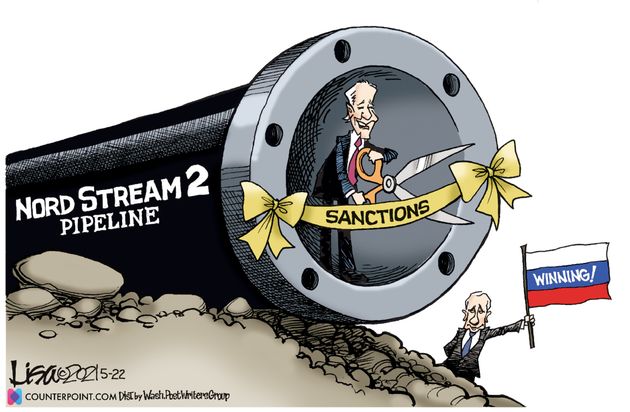
Lisa Benson cartoon

Summer still is weeks away, but already we have a winner in the fierce competition for the coveted title of “Dumbest New York Times opinion column of 2021.” The envelope please… and the winner is “Why Charles Koch Wins When Our Energy System Breaks Down,” by someone named Christopher Leonard. One really does have to read this column to grasp — actually, to marvel at — the inanity of Leonard’s argument, which can be summarized as follows.

Claim:
Our fossil-fuel infrastructure — pipelines in particular, and refineries as well — is “increasingly unreliable” and “dominated by a very small group of very profitable companies.”

Fact:  
Leonard does not tell us what he means in his assertion that U.S. pipelines are “increasingly unreliable” — it is easy to infer that he has no idea — but if we define “reliability” as the annual number of adverse pipeline incidents, there has been no trend since 2002, even as pipeline mileage increased almost 63 percent between 2004 and 2019.

Claim:
The Colonial Pipeline shut down in 2016, and again this month due to a cyberattack, but the five companies that own Colonial “profit handsomely off its operations and earn outsize profits in the face of the bottlenecks and supply squeezes caused by shutdowns.”

Fact:  
That is absurd: The pipeline generates revenue only when it is moving product; if it is not operational it is not generating revenue.

cb051921dapr20210518114504

Claim:
The 2016 shutdown “didn’t seem to hurt the owners’ earnings” in that afterward “Colonial boosted its annual dividends — at least in part because of the Trump administration’s 2017 tax cuts.”  The growth in Colonial’s investments in updating and protecting the pipeline have been “modest, while dividend payments have risen sharply.”

Fact:  
Apart from Leonard’s confusion about whether it is due to the 2016 shutdown or to the 2017 tax cut, he apparently has no concept of the factors addressed by corporate managers as they determine the appropriate dividend. In particular, a dividend change is driven by the evaluation of the after-tax return to shareholders from retaining more financial capital within the firm compared with that from distributing more to the shareholders. An increase in the dividend suggests that the latter has increased relative to the former, presumably in this case because of the nuances of the 2017 tax bill. Were the Kochs responsible for that?

Claim:
Charles Koch “has profited for years off similar energy bottlenecks in the upper Midwest” because of such infrastructure investments as the Pine Bend refinery, which “owes its profitability to its location in the middle of a broken fuel market.” Koch “buys cheap crude” in a market “oversupplied” with Canadian crude oil, after which “Koch then sells its finished fuel into an undersupplied gasoline market in the upper Midwest.”

Fact:  
And about that “oversupplied” (whatever that means) midwestern market for Canadian crude oil: The midwestern refinery market would be far less “oversupplied” had the Keystone XL pipeline been approved at long last, delivering heavy Canadian crude oil to the Gulf coast refineries designed to refine it. Did Charles Koch urge the Biden administration to reject the pipeline? Has Leonard criticized that decision? I can find no record of any such stance on his part.

And then there is Leonard’s assertion that the gasoline market in the upper Midwest is “undersupplied” (whatever that means). The Energy Information Administration divides the U.S. gasoline market into five regions (“PADDs”). As of May 24, Gulf Coast gasoline prices were the lowest, followed by the Midwest, and then (in ascending order) the East Coast, the Rocky Mountain states, and the West Coast, the last of which had the highest prices even excluding California. What is Leonard talking about?

Claim:
Regulatory hurdles have paved the way for these profits for decades.” “The Clean Air Act… made it nearly impossible for competitors to open a refinery near Pine  Bend” to increase competitive pressures.

Fact:  

The comedy highlight of Leonard’s column is the assertion that it is the Clean Air Act, regulatory obstacles to new pipeline investment, and general “regulatory stasis and dysfunction” that have yielded the “outsize profits” enjoyed by the Kochs. Leonard seems actually to believe this: “Just by letting the broken market limp along, Koch Industries reaps extraordinary profits from a broken system.” So the Kochs are vastly more powerful than anyone could imagine, responsible for the regulatory morass, for the ideological leftist political opposition to fossil infrastructure, for NIMBYism, and for allowing the “broken market” to “limp along.” Just as the pipeline owners win whether the pipelines are operating or not, Leonard clearly believes that they earn “outsize profits” whether the regulatory environment is light or dysfunctional. Who knew?

Claim: 
Regulatory fights benefit big refiners that can afford expensive legal experts and lobbyists: “Koch benefits from regulatory stasis and dysfunction.”

Fact:  

The utter stupidity of Leonard’s argument is illustrated by his assertion toward the end of the column that “new wind farms or solar installations could open up a whole new energy market.” Somehow, I was led to believe that Leonard’s argument was about pipelines and refineries and gasoline prices, and the ability of the Kochs to earn large profits no matter what. But no: An endorsement of unconventional electricity, expensive and environmentally destructive, just had to be shoehorned in as an exercise in virtue-signaling par excellence despite the reality that it has nothing to do with Leonard’s silly central argument. Or does he want to argue that more wind farms will reduce gasoline prices in the Midwest?

Conclusion

And so we arrive at the larger reality illustrated by the Leonard column. Misguided, illogical, and at odds with the facts, it is of a piece with the broad opposition of the environmental left to energy infrastructure generally, and pipeline investments in particular. Utter incoherence is the inevitable result of that ideological opposition to fossil fuels, one impervious to facts and analytic rigor, and dependent upon arguments fundamentally inconsistent. That opposition is anti-human at its core because it implies opposition to investment in human capital — education, training, health care, etc. — and the improved human well being that has the effect of increasing the demand for energy and its infrastructure. Forget the Kochs; they are a bogeyman and red herring the mere mention of which is intended to elicit a Pavlovian reaction from the enlightened invitees to the right cocktail parties.

The real bogeymen are the New York Times opinion editors who found such drivel fit to print, a measure of the intellectual depths to which they have sunk.

lb210522c20210521055437

See Also Shellenberger to NYT: Isn’t a correction merited?