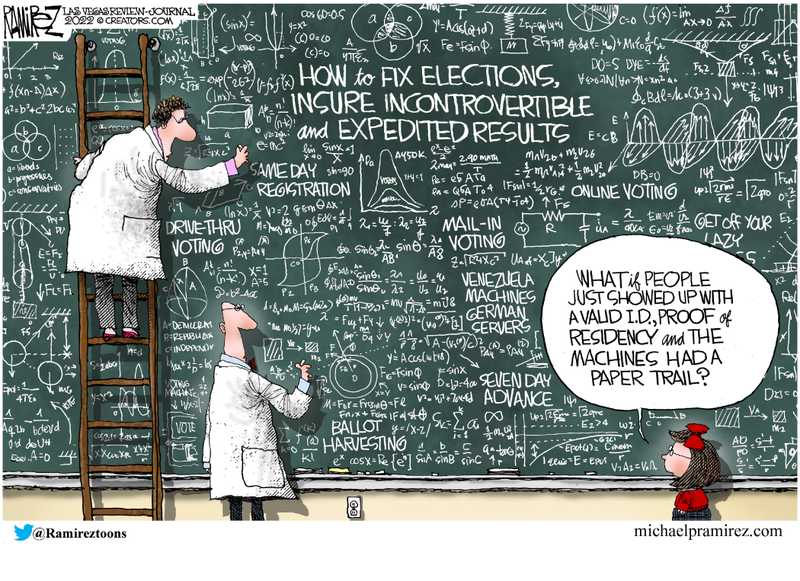
The image above gets it right on the basics: Eligible voters come to their voting station with valid ID and proof of residency, and paper trail exists to validate machine entry and processing. But there are some subtleties around the edges requiring management. For example, voter registration should be in advance of the voting process, and not on election day. Why? Because there’s no time to check for fake ID or residency. Later on is a post on why there must be an election day deadline, beyond which votes cannot be added to the count. But first a look at some international standards regarding elections and balloting.
A Practical Guide to Democratic Elections Best Practice from Office for Democratic Institutions and Human Rights (OSCE). Below is the section on Balloting.
Right:
To Universal Suffrage, To Equal Suffrage, To Secret Ballot, To Fair Elections
Which Guarantee the Free Expression of the Will of the People
Balloting Best Practices:
• Voting procedures must be understandable so that voters are able to vote without difficulty
• Voting should take place in a polling station; however, other means of voting are permissible for voters who are physically unable to attend a polling station, but only where there are safeguards in place to prevent fraudulent voting
• Observers and representatives of candidates and political parties must be permitted to observe the delivery of election materials, preparation of the polling place, voting, and counting of ballots
• Members of the military should vote in the place of their permanent residency, or in a polling station near their duty station
• Voting must be in person, by secret ballot
• Voters must present adequate identification information and sign register in order to vote
• Only the voter may mark a ballot, except that a voter who requires assistance for physical reasons may be assisted by another voter who is not a member of the election administration or an observer
• Ballots and voting materials must be securely maintained before, during, and for a sufficient period of time after an election
• The entire counting process must be conducted in a transparent manner in the presence of observers and representatives of candidates, political parties, and the media
• There must be procedures for, in the presence of observers, independent verification of all elements of the counting and tabulation
• All results of voting, tabulations, and protocols must be publicly posted at the polling station and copies given to representatives of observers, and transmitted to higher levels of election commissions in a transparent manner
• Intermediate tabulations and protocols must be publicly posted at intermediate election commissions and copies given to representatives of observers
• All final voting results must be published in media as soon as possible after elections in such a manner that voters are able to check results at their polling places
• Legal measures must be in place to deter electoral fraud in the voting, counting, and tabulation processes
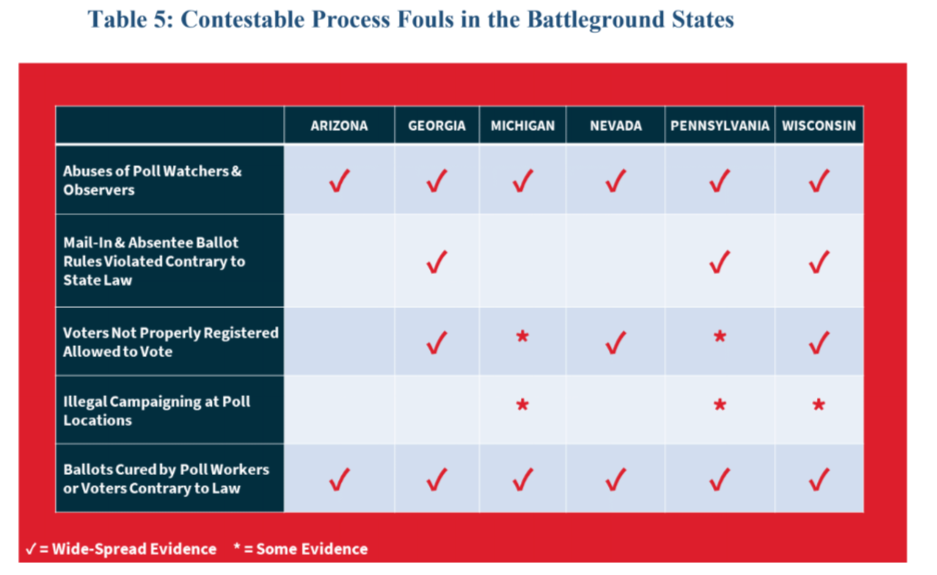
There is extensive evidence that the US 2020 election did not respect the above best practices. The 2021 Navarro Report (link in red above) provides the details summarized in this table:

The detailed report includes many documented events, including evidence under the heading Outright Voter Fraud:
Fake Ballot Manufacturing and Destruction of Legally Cast Real Ballots
Fake ballot manufacturing involves the fraudulent production of ballots on behalf of a candidate; and one of the most disturbing examples of possible fake ballot manufacturing involves a truck driver who has alleged in a sworn affidavit that he picked up large crates of ballots in New York and delivered them to a polling location in Pennsylvania. There may be well over 100,000 ballots involved, enough fake ballots alone to have swung the election to Biden in the Keystone State.
Likewise in Pennsylvania, there is both a Declaration and a photo that suggests a poll worker used an unsecured USB flash drive to dump an unusually large cache of votes onto vote tabulation machines. The resultant tabulations did not correlate with the mail-in ballots scanned into the machines.
Arguably the most flagrant example of possible fake ballot manufacturing on behalf of Joe Biden may have occurred at the State Farm Arena in Atlanta, Georgia. The possible perpetrators were caught in flagrante delicto on surveillance video. In one version of this story, poll watchers and observers as well as the media were asked to leave in the middle of the night after a suspicious water leak. Once the room was cleared, several election officials pulled out large boxes of ballots from underneath a draped table. They then proceeded to tabulate a quantity of fake manufactured ballots estimated to be in the range of tens of thousands
Finally, as an example of the possible destruction of legally cast real ballots there is this allegation from a court case filed in the United States District Court for the District of Arizona: Plaintiffs claim that over 75,000 absentee ballots were reported as unreturned when they were actually returned. These absentee ballots were then either lost or destroyed (consistent with allegations of Trump ballot destruction) and/or were replaced with blank ballots filled out by election workers or other third parties.
And so on, and so on. All of these worst practices were employed with impact because of a fundamental illegality that disqualifies any and all elections when it occurs. Jonathan Gault explains the problem in his American Thinker article Beware the ‘Long Count’. Excerpts in italics with my bolds.
Though barely campaigning, unable to speak, and drawing massive crowds, measured in dozens, waving to nobody, on the rare occasions when he was able to muster the energy to leave his basement, Joe Biden remarkably received the most votes of any candidate in US history. However, his historic popularity notwithstanding, his debatable victory nevertheless still required eking out miraculously close races in the hyper-partisan Democrat strongholds of Atlanta, Milwaukee, Philadelphia, Phoenix, and Las Vegas, each of which employed the Long Count.
The Long Count is defined as counting votes well past election day.
Long Counts took place in these cities (and others) because, said the Democrats, “every vote must be counted,” even though, in many jurisdictions, early voting was available for months prior to election day on November 3, 2020.
Even with modern technology, for some reason, 21st-century Americans are unable to count votes, even over a period of two months, so we now also count votes well past election day. Therein lies the rub… However, considering that we are dealing with modern-day Bolsheviks, for whom, in their quest for unbridled power, the end justifies the means, there may still be hope.
There are numerous explanations rationalizing the leftist zeal for mail-in voting. One is most certainly to capture the dead vote. It is common knowledge that, once deceased, even lifelong Republicans flip to Democrat upon entering the grave. Another is to capture the “almost dead” vote. Those in end-of-life care are certainly entitled to vote, but they mustn’t be included if no longer lucid (as, for example, our titular head of state).
Yet another is to “enfranchise the disenfranchised,” postulating that minorities who are able to acquire driver’s licenses, get to work, catch flights, make doctor’s appointments, etc., are somehow incapable of figuring out how to vote. More useful is harvesting as many unclaimed mail-in ballots as possible. These tend to go Democrat because the “bag men” executing the fraud understand that their “elected” representatives will not enforce voter fraud laws against the co-conspirators who keep them in power.
The aforementioned notwithstanding, the real reason for mail-in voting enthusiasm is that it creates chaos, and as the events of the past four years have shown, chaos is the Bolshevik goal, and the perception of chaos is all that is needed.
My goodness! How can all that paper possibly be counted by election day? If “every vote must be counted,” the final tally must extend long after the election has concluded until ballots cease to arrive. Two weeks, six weeks, “whatever it takes.”
This drive for chaos also explains why leftists despise in-person voting. When voting in person, the votes are tallied in real-time, the polls close at the pre-appointed time, and the tallies are certified by representatives from each party and transmitted to “election central” before the end of election day. There is no Long Count. And therefore, the “bogey” cannot be identified.
The bogey is the second part of the key to voter fraud, as it represents
the vote differential between the Republican candidate and the Democrat
at the time the in-person polls close.
Using the Long Count, poll closure merely serves to determine the bogey. Once determined, the counting then continues indefinitely until enough ballots are “received” (really created, retrieved, or recounted) in order to flip the result. This explains what happened in Atlanta, Las Vegas, Milwaukee, Philadelphia, and Phoenix twice (once in 2020, during the Presidential election, and again in 2022, in the Gubernatorial election, carried out both times under the aegis of Arizona “Governor” Katie Hobbs, who, as Arizona attorney general, carried out the fraud on her own behalf after testing it out in the 2020 Presidential election).
Pennsylvania “Governor” and former Attorney General Josh Shapiro did the same after infamously tweeting in 2020 that (and I paraphrase) “there was no way that Trump could win Pennsylvania.” One wonders how the person in charge of conducting the election could know that “fact” before conducting the election. Now you know why Attorneys General have a high success rate when running for Governor.
If the Long Count is the real election integrity issue,
what can be done about it?
In 1997, the Supreme Court unanimously ruled in Foster v. Love that, as one article carefully explains, “Elections Undecided by Midnight are Void & Preempted by Federal Law.” The Court’s clear ruling must be understood to nullify long counts. At the very least, the issue must be litigated, adjudicated, confirmed, and broadly publicized before the 2024 Election to ensure that the Federal Election Commission will void election results in any jurisdiction that engages in counting past election day, ensuring that it doesn’t again occur.
Only in that way can we be certain that our next election will be an honest one. We are onto them (“Fool me once shame on you, fool me twice…” ), and therefore a “shot across the bow” is required to act as a deterrent so that Democrats don’t attempt a reprise of 2020’s and 2022’s behavior in the upcoming election. We now understand very well what is happening.
I believe that President Trump had such a commanding lead at midnight on November 3, 2020, that, had the polls closed, and counting ended at 11:59:59 pm that evening, as per Foster v Love, with no bogeys calculated nor counted toward, he would have won. And if he had won, our society, country, and, indeed, the world would right now be far safer, happier, and better places for all of mankind, and most certainly Americans.
Footnote Regarding Candidates in a Free Election
From OSCE Best Election Practices:
Candidates and Political Parties and Campaigning Best Practices
• All candidates and political parties must be treated equally before the law and on a non-discriminatory basis
• Candidates must be permitted to stand individually or as representatives of political parties
• All candidates and political parties must be provided sufficient access to media in order for voters to become adequately informed of views, programs, and opinions of the electoral contestants
• The formula for allocating media access among candidates and political parties must be fair, understandable, and capable of objective application
• Coverage by state supported or sponsored media must be neutral, unbiased, and on non-discriminatory basis
• No unreasonable limitations may be placed on the right to freedom of speech or expression
• No unreasonable limitations may be placed on the right to freedom of assembly
• No unreasonable limitations may be placed on the right to freedom of association
• All candidates, political parties, supporters, and voters must be treated on a non-discriminatory basis















 Science Matters