The Superclass and Technocrats Busy Designing Our Future (Jacob Nordangård)

The plans and intentions are exposed in a Clintel article From the Polycrisis to a World Government. Climate Alarmism is part of a much bigger agenda driven by the UN, says Swedish scientist, author, and musician Jacob Nordangård. What is the real plan behind all this? The Swiss news outlet Transition News spoke with Nordangård. Excerpts below with my bolds and added images.

Transition News: Some believe that the recent crises and the associated profiteering are pure coincidence and that capitalism simply works this way: one thing leads to another, no one is planning a world government. However, in your book “The Digital World Control”, which has just been published in an updated and expanded German and English edition, you clearly demonstrate that some are following a specific plan, with the United Nations at its center. On what sources do you base your research?

Nordangård: I use original sources from the United Nations and all those organizations that prepared the UN’s Pact for the Future. This means, my research is primarily based on the statements of these institutions themselves. I also consult other sources, for example, the World Economic Forum (WEF), which has entered into a partnership with the United Nations.

The official signing of the agreement took place in June 2019, attended by former WEF CEO Klaus Schwab, then-WEF President Børge Brende, UN Secretary-General António Guterres, and UN Deputy Secretary-General Amina Mohammed. However, the UN and the WEF had already been cooperating prior to this. Mohammed, for example, served on the board of the Young Global Leaders program. This means that the United Nations and the WEF had been closely linked for about a decade before the official partnership.

When I wrote the Swedish edition of this book, I was focused on the UN’s Our Common Agenda. It was only with the release of the Epstein files that I realized how Epstein was deeply involved with some of the key figures of this UN agenda, such as Brende. Jeffrey Epstein was a member of the Trilateral Commission, which was established by David Rockefeller in 1973. Rockefeller brought Epstein into this group and also into the Council on Foreign Relations, another important think tank that primarily shapes American foreign policy.

Currently, the focus is primarily on sex trafficking and the minors involved. But Epstein was important for connecting people. For example, he befriended Brende, the former president of the World Economic Forum, and they discussed how the WEF could take on the role of the United Nations. He was therefore a key figure in these influential networks.

The modern concept of scientific dictatorship can be traced back to H. G. Wells. But Julian Huxley, a friend of Wells, and the Jesuit Pierre Teilhard de Chardin also held similar views on technological change and a technological society, a kind of techno-utopia.

The twelve proposals of the United Nations contained in Our Common Agenda was published in 2021 to establish commitments for implementing the 17 Sustainable Development Goals (SDGs). These commitments include, among other things: leave no one behind, build trust, and listen to young people. It all sounds quite reasonable. What does this have to do with a scientific dictatorship or a techno-utopia?

Such plans are always packaged in fine words. But we need to see the plans behind these well chosen words. Let’s take the slogan “Leave no one behind” and look at what the UN’s Our Common Agenda and Pact for the Future actually intend:

It’s about the digitization of more or less everything on this planet,
everything that can be recorded and monitored.

It is a perfectly ordered and controlled system. No one is to be left behind, as everyone must be part of the system. As a precaution, everyone is monitored.

And when “we” say they want to listen to people, according to “our shared agenda”, it’s about learning what people do and think. Not about giving citizens a real say. “We” have a vision and a pact for the future. And “our” plans are to be implemented, so “we” want to know how people react.

Pseudoscience as Religion

But everything is based on “their” science. I consider this to be pseudoscience. It’s not real science, but a political vision sold as science. I taught and researched at the university for many years—science means questioning everything in order to constantly improve. But here, “science”, which is largely based on model calculations and computer simulations, is being instrumentalized as a religion: If people follow “our” path, it leads to paradise; if not, it leads to hell. “We” must therefore convince people to choose the path “we” discuss at the United Nations. “We” have this one great goal.

Our Common Agenda and The Pact for the Future are
based on behavioral design and behavioral science
.

This behaviorism is used to steer people in the right direction. This corresponds to totalitarian thinking. It is not a particularly empathetic way of dealing with people, but rather turns them into objects that can be programmed to better conform to the visions of those behind these plans.

And when they say: “We want to listen to young people and work with them,” it basically means that young people are to be steered in a certain direction.

Young people can’t simply express their opinions freely. They are asked: “What do you think of climate policy? Should it be stricter or more lenient?” “I don’t believe in it” is not an acceptable answer. These “facts” must not be questioned. Questionnaires and focus groups serve only to justify the implemented measures.

Why is there such a focus on the year 2030? Because these 15-year plans exist. From 2000 onwards, there was this test run with the Millennium Development Goals until 2015 – few have heard of it or remember it – and the goals were not met. But this time, for the year 2030, everything has gained enormous importance and has been used for propaganda purposes since 2015. However, I suspect that the United Nations will no longer be able to successfully implement the Sustainable Development Goals as they are presented to the public by 2030.

So there will be new goals for 2045 – a crucial milestone. In future scenarios, the project is described as The Great Transition – the aim is to establish a world government by the UN’s 100th anniversary. The period leading up to it is a transitional phase, and we are currently in the first stage of this transformation. 2030 is simply a pivotal year on the path to achieving this goal.

Cyber-biological Systems

How does artificial intelligence (AI) contribute to implementing this one world government? I believe the elites of this world view AI as a perfect system because they previously relied on other people to carry out their orders – that is why totalitarian systems can never last in the long run.

If they use this AI-driven system instead, no one stands in the elites’ way: no one can destroy it from within. They can set rules and regulations and tell the autonomous AI system, the world’s control system, what they want to achieve, and it will be implemented.

From where does this idea that humanity could unite with machines and the financial system actually stem? This too is an old idea and closely linked to transhumanism. Eugenics, with its aim of changing and improving humanity, is part of this. Transhumanism has taken this to a new level by using technology to modify us, integrate us into the system, and digitize us.

This development took place at the beginning of the computer age, especially from the 1990s onward. Like many others, I simply considered it the pipe dreams of a few tech enthusiasts at the time. But now it’s ubiquitous and serves as the foundation of the Fourth Industrial Revolution. These transhumanist ideas found particularly fertile ground at the World Economic Forum.

And in 2019, the United Nations and the WEF entered into this very partnership, enabling the World Economic Forum to support the UN in implementing the 2030 Agenda. This is being achieved using the technologies of the Fourth Industrial Revolution, more precisely, cyber-biological systems. In this process, humans, machines, and the financial system are merging. This is a crucial aspect, as it leads to a complete transformation of the old, dying system. We will, therefore, integrate ourselves into the financial system.

From the WEF to an UN 2.0

In 2020, the member states of the United Nations adopted a resolution calling on Secretary-General Guterres to produce a document addressing the following question: How can we create a better, more effective UN that can respond to crises such as a pandemic?

Negotiations then took place, and eleven strategy papers were published. Parts of these were incorporated and supplemented in Our Common Agenda. This agenda is rather concise and only describes the desired goals. In addition, there were policy briefs that are considerably more comprehensive, discussing all topics in detail and developing concrete proposals for achieving the desired goals.

The member states then met to discuss these recommendations and thus develop a document that would serve as a Pact for the Future. There were therefore three successive phases. All states were required to agree to the UN’s Pact for the Future in advance in order to implement it more efficiently.

In 2024 the pact was agreed upon by all member states and adopted by the United Nations and the member states. Russia has stated that it will not implement all points. They intend to follow the points they consider sensible, particularly the digitalization agenda.

A multipolar system with regions is now being prepared. An organization called the Stimson Center has been significantly involved in drafting the recommendations for the UN Pact on the Future and repeatedly emphasizes this future world order with regions.

The geostrategist Zbigniew Brzezinski co-founded the Trilateral Commission with David Rockefeller and served for a time as Jimmy Carter’s national security advisor. In his book “The Grand Chessboard”, he developed proposals for how the American empire should function. His goal was to prepare for and shape a new world in which the United States would no longer be the dominant force, but rather the UN would assume this role: The world’s regions would cooperate under the umbrella of the United Nations—a modernized, effective organization capable of operating efficiently on a global scale and no longer merely an informal circle.

We only need to look back three decades to see that much has already been achieved – people are very adaptable. Here in Sweden, cash is hardly used anymore. Thirty years ago, everyone paid in cash; card payments were uncommon. The so-called pandemic or even wars serve to change systems without much fanfare because people are thinking about other things.

Wars are also being fought locally, like here in Sweden, in my hometown: We have bombings, shootings, and crime. At the same time, this agenda is being implemented: Surveillance cameras have been permitted in public streets for two years now, and they are now installed everywhere.

Two sides of the same coin.

Trump and the Polycrisis of the Superclass

In this context, what purpose do crises such as Covid-19, the energy and food crisis – the polycrisis – serve? These crises serve as a trigger. Because in 2024 something very important was not achieved with the UN’s Pact for the Future: the creation of a so-called emergency platform. Instead, we now find ourselves in this permanent crisis situation, which shows the world that we are unprepared and unable to solve these problems.

These events were considered necessary to introduce
new political measures and gain public approval.

And also the actions of US President Donald Trump are creating even more problems. This, too, is about gaining approval for the new world system in order to push through the emergency platform and a UN 2.0. The current multi-crisis will ultimately help those who developed these plans for modernizing the United Nations to obtain the necessary approval for their implementation.

I call him “Wreck-It Trump” because he’s razing the old structure to the ground. He’s destroying the existing system. The United Nations isn’t functioning as it should, and he’s paving the way for something new. Trump is the perfect candidate for it. Nothing will be left of the old system.

And when he’s finished and his time is up, they can simply take over with this new system. Everyone will then say: “Finally, reason prevails. A new system that will make the world safer again.” It’s not about reforms. It’s about power.

Who are these few who want to control the lives of billions of people? They belong to the superclass, as David Rothkopf calls them in his book. These are oligarchs who control the global financial world and the economy. They can be found, for example, in the World Economic Forum and in philanthropic organizations. I wrote about one of these families, and I show how the climate protection agenda came about and what lies behind it.

Here in Sweden, a family named Wallenberg is very powerful. Like the Rockefellers, they belong to the Bilderberg Group and the Trilateral Commission. These are extremely influential networks that shaped the old order and now want to gain control of the new one.

They also bring in people from other regions, such as multi-billionaires from India, South Africa, China, and Japan. This elite seems to think they are the chosen ones. Those who have the potential to be successful, to reach the highest positions of power, and to run successful companies consider themselves better than others.

The superclass comprises several thousand individuals worldwide. And among them, of course, there are hierarchies. Some are higher up. But who really knows who’s at the top?

One of the key players driving this agenda is Johan Rockström, who advised Greta Thunberg. Who is this man? Johan Rockström is an agronomist. He was selected by Bert Bolin for a position at the Stockholm Environment Institute. Bolin, in turn, was the first chairman of the Intergovernmental Panel on Climate Change (IPCC), and Rockström succeeded him. He is a key figure in climate policy and now heads the Potsdam Institute for Climate Impact Research (PIK) outside Berlin.

Previously, Rockström headed the Stockholm Resilience Centre. This center was founded with the goal of developing a system for “planetary boundaries”. This explanatory model is crucial for the worldview of the elites and their control system. Rockström and his network of scientists use it to define what we as human beings are even capable of doing on this planet.

He speaks regularly at the World Economic Forum. Furthermore, he is connected to several highly influential networks that advise not only the wealthy and powerful, but also governments worldwide. These include the Climate Governance Commission (CGC), which recommended, even before the 2024 Summit on the Future of Europe, that the UN General Assembly declare a climate emergency because humanity is exceeding planetary boundaries – of which there are nine.

The emergency platform is intended to serve as a means
of implementing the super-class’ plans worldwide.

Rockström belongs to the elite group of scientists who define our limits and determine how many resources we are allowed to use or what we can eat. He is also a member of the organization EAT which advocates for a transformation of the global food system.

This man is very influential, but he’s just one player. Before him, Hans Joachim Schellnhuber headed the Potsdam Institute for Climate Impact Research (PIK). He advised Angela Merkel, the European Commission, and even the Pope on climate issues. People like Rockström or Schellnhuber work on this topic until they retire, and then there’s a successor. They certainly play an important role in achieving the goals, but the real power brokers are the philanthropists, the super-rich.

What is Sweden’s role when it comes to creating a world government? Sweden acts, in a sense, as a mouthpiece for these influential forces, including the Trilateral Commission, the Council on Foreign Relations, and the Bilderberg Group. My home country assumed this role quite early, in the 1950s, and expanded it in the context of climate research and environmental protection.

Sweden hosted the first UN Conference on the Human Environment in 1972, and numerous key players driving this agenda originate from there. However, they are more or less merely proxies for these influential networks. As previously mentioned, the Wallenberg family largely holds the reins in Sweden and controls many large companies; they are very closely connected to the super-class. They have always had influence over the Swedish government—regardless of whether the Social Democrats or the Moderates are in power.

Furthermore, according to futurologist Graham Molitor, innovations are implemented particularly quickly in Sweden. We seem to simply adopt new technologies without questioning them because we are so progressive .

On the other hand, the Green Party in Sweden achieves about six percent of the vote. But that doesn’t matter. Because, if you look more closely at the climate and environmental agenda, you’ll find that it’s not genuine green policy, but rather digital policy. It doesn’t matter whether the country is governed by right or left leaning parties. When it comes to this global agenda, everyone agrees. The Greens are only the activist arm.

I have examined how these environmental organizations are financed and organized by elite networks to popularize these activists and their actions – ultimately, it’s about controlling the entire population, every single individual. That’s why we need these opposition parties and movements.

I also have a history with the Greens; I experienced all of this firsthand. Therefore, it was quite a shock for me when my research revealed that oil barons like the Rockefellers were behind the environmental movement. They were involved in developing precisely the kind of policies that we as Greens supported.

Via Berlin and Kyiv to Technocracy

What purpose does the climate agenda serve, if oil companies exploit this narrative? The Rockefellers and their philanthropists clearly dictate what “we” want to achieve. The climate agenda originated at a meeting with eugenicists in the 1950s. In 1952, John D. Rockefeller III and Detlev Bronk, then head of the National Academy of Sciences (NAS), met to discuss a population control plan. This led to the formation of the Population Council. Roger Revelle also attended the same meeting.

In the 1950s, Revelle made global warming a central concern and an important area of research. He also played a crucial role as an advisor to US President Lyndon Johnson in the 1960s. At that time, there was a project called the Special Studies Project with support from the Rockefeller Brothers Fund.

The Rockefeller Brothers Fund, in turn, was managed by the sons or grandsons of John D. Rockefeller. We have David and John D. III, and Lawrence and Winthrop. These brothers received money from the Standard Oil Corporation – oil money – and considered how they wanted to change the world. They came to the conclusion that science was a good way to transform society, given the scientific collaborations between countries. They themselves had established these collaborations, for example, through the Rockefeller Foundation, by providing funding to universities around the world.

The basic idea was that such problems cannot be solved by any one nation alone. They must be solved, more or less, by an international body. So, on the one hand, we have population control, and on the other hand, the idea of a kind of world authority that has to assume control. The other scientific problems were pandemics and the associated global health problems.

Diseases were recognized as a global lever as early as the 1950s. Everything happens quite openly. Why do so few people engage with this topic? Questioning these things comes at a price. After I uncovered these networks, it was very difficult to keep my job as a university lecturer.

When I defended my doctoral thesis – “Ordo ab Chao: The Political History of Biofuels in the European Union. Actors, Networks and Strategies” – in 2012, my opponent said right at the beginning: “You know, my institution has just received funding from the Rockefeller Foundation.” The chairman of the Club of Rome also tried to prevent my dissertation from being accepted at all.

But what surprised me most was this: I came from the environmental movement myself, but when I tried to warn my fellow activists that these oil companies were involved, some of them got really angry. The more we talked about sustainable development, the more cars and technologies were introduced. Nobody wanted to question that. Universities and environmental organizations alike receive funding from these foundations. In the end, it’s all about the money.

But I continued working as a lecturer after that, first for a few years at Linköping University and then at Stockholm University. But it became increasingly difficult. Because many, especially junior researchers, discovered that I don’t really subscribe to the climate dogma. And that makes you less trustworthy. We don’t want to tolerate such a “climate denier” at “our” institution.

Apparently, it was just one student who googled me and found out I had written a critical paper on climate change; he probably complained to the head of the institute. For me, this was no longer a pleasant working environment.

But after I wrote the book “The Global Coup-Etat” in the first year of the “pandemic” it became unbearable. Mainstream medicine and the Covid-19 mandates could not be criticized. That was morally unacceptable. The fraudulent scheme was more or less evident by March 2020.

In April 2019, I published my book about the Rockefeller family, describing how their plans for the world were to be achieved through the Fourth Industrial Revolution. While researching climate change, I also came across information related to the health sector. So, it was quite easy for me to put these pieces of the puzzle together.

The mainstream media reacted to my publication about the coup by simply considering it extremist at the time. Sweden was, of course, the better place to live during the “pandemic.” But the media stated, “anyone who doubts that is an idiot.” Alternative media outlets reported on my book, which was published in December 2020, and it quickly sold out.

In 2024, the WEF opened the Global Government Technology Center in Berlin. The goal is to build new systems for governance. These will not be controlled by humans, but by an agent AI. Stanley Milgram coined the term “agentic state” – a state in which someone simply follows the wishes and instructions of the authorities.

A white paper from the Global Government Technology Center bears precisely this title: “The Agentic State”. The agentic AI will be the authoritative body, issuing commands and carrying everything out efficiently, and is intended for use in the UN emergency response platform – without humans who could say: “No, I won’t do that.”

Another Global Government Technology Center is located in Kyiv, where these systems can be tested – this is easier to accomplish in a country at war. That’s why many WEF representatives are working with Ukraine.

How should humanity best respond to this technocratic threat? This attempt by the superclass to rebuild the Babylonian Tower will fail. As soon as the last piece of the puzzle is in place, everything will begin to crumble and collapse. Those building this system use lies and every possible manipulation technique to bring people under their total control. And while the truth lags behind, it is catching up. People see through this. The truth will come to light and wash everything away. So they are trying an impossible undertaking.

At the same time, I think such projects are inevitable. There have always been, and always will be, people who strive for power. When this tower collapses, someone will try to rebuild it. But perhaps we have some time in between to better prepare the world for these psychopaths.

Why Rescinding the Endangerment Finding May Survive Lawfare

Some thoughts from my browser AI.  My Question: What are the legal matters, such as major questions requiring congressional action, that favor ending EPA CO2 Endangerment Finding?

Search Assistant Reply:

The legal matters surrounding the repeal of the EPA’s CO2 Endangerment Finding involve the major questions doctrine, which suggests that significant regulatory authority should not be assumed by agencies without clear congressional authorization. This doctrine has been reinforced by recent Supreme Court rulings, indicating that the EPA may need explicit legislative backing to regulate greenhouse gases under the Clean Air Act, thus favoring the argument for ending the Endangerment Finding.

Legal Matters Surrounding the EPA CO2 Endangerment Finding

Major Questions Doctrine

The major questions doctrine is a legal principle that limits the authority of executive agencies, like the EPA, to make significant regulatory decisions without clear congressional authorization. This doctrine has been increasingly applied by the Supreme Court to ensure that major political or economic issues are addressed by Congress rather than delegated to agencies.

  • Definition: The doctrine asserts that agencies must have explicit congressional authorization to regulate matters of significant economic or political importance.
  • Recent Cases: The Supreme Court’s decision in West Virginia v. EPA (2022) emphasized that agencies must point to clear congressional authorization for their regulatory actions, particularly when those actions have broad implications.

Implications for the Endangerment Finding

The repeal of the EPA’s CO2 Endangerment Finding could be supported by arguments based on the major questions doctrine:

  • Lack of Clear Authorization: Opponents of the Endangerment Finding may argue that the Clean Air Act does not provide the EPA with the authority to regulate greenhouse gases based on global climate change concerns, as these gases are not traditional air pollutants.
  • Historical Context: The Endangerment Finding was established following the Massachusetts v. EPA (2007) ruling, which recognized greenhouse gases as pollutants. However, the current administration may argue that the regulatory framework established under this finding lacks explicit congressional backing for such extensive regulatory power. [Note:  AI got this wrong.  Mass v. EPA only ruled EPA could itself decide GHGs are pollutants subject to its regulation. That judgment by EPA regarding auto emissions in 2009 is now rescinded by EPA in 2026.]

Potential Legal Challenges

  • Court Challenges: Environmental groups are likely to challenge the repeal in court, arguing that the EPA’s authority to regulate greenhouse gases is well-supported by the Clean Air Act and previous Supreme Court rulings.
  • Future Regulations: If the Endangerment Finding is repealed, it could undermine existing regulations on vehicle emissions and other sources of greenhouse gases, leading to further legal disputes over the EPA’s regulatory scope.

The intersection of the major questions doctrine and the Endangerment Finding highlights the ongoing legal debates regarding the EPA’s authority and the role of Congress in environmental regulation.

From SCOTUS Blog June 30, 2022

The Supreme Court on Thursday truncated the Environmental Protection Agency’s power to regulate greenhouse gases. The ruling may hamper President Joe Biden’s plan to fight climate change and could limit the authority of federal agencies across the executive branch.

By a vote of 6-3, the court agreed with Republican-led states and coal companies that the U.S. Court of Appeals for the District of Columbia Circuit was wrong when it interpreted the Clean Air Act to give the EPA expansive power over carbon emissions. The decision, written by Chief Justice John Roberts, was handed down on the final opinion day of the 2021-22 term.

Turning to the merits of the case, Roberts wrote that the EPA’s effort to regulate greenhouse gases by making industry-wide changes violated the “major-questions” doctrine – the idea that if Congress wants to give an administrative agency the power to make “decisions of vast economic and political significance,” it must say so clearly.

Section 7411 of the Clean Air Act, Roberts reasoned, had been “designed as a gap filler and had rarely been used in the preceding decades.” But with the CPP, Roberts observed, the EPA sought to rely on Section 7411 to exercise “unprecedented power over American industry.” “There is little reason to think Congress assigned such decisions to” the EPA, Roberts concluded, especially when Congress had previously rejected efforts to enact the kind of program that the EPA wanted to implement with the CPP.

“Capping carbon dioxide emissions at a level that will force a nationwide transition away from the use of coal to generate electricity may be a sensible ‘solution to the crisis of the day,’” Roberts wrote. But only Congress, or an agency with express authority from Congress, can adopt a “decision of such magnitude and consequence.”

Roberts’ full-throated embrace of the major-questions doctrine – a judicially created approach to statutory interpretation in challenges to agency authority – likely will have ripple effects far beyond the EPA. His reasoning applies to any major policymaking effort by federal agencies.

In a concurring opinion that was joined by Justice Samuel Alito, Justice Neil Gorsuch emphasized that the dispute before the court involved “basic questions about self-government, equality, fair notice, federalism, and the separation of powers.” The major-questions doctrine, Gorsuch wrote, “seeks to protect against ‘unintentional, oblique, or otherwise unlikely’ intrusions on these interests” by requiring federal agencies to have “clear congressional authorization” when they address important issues. Whether coal- and gas-fired power plants “should be allowed to operate is a question on which people today may disagree, but it is a question everyone can agree is vitally important.”

Net Zero is a Downer, Choose the Way Up

In this Net Zero Watch video, Colin Brazier takes us on a journey through Britain’s energy transformation as he looks at how energy abundance spawned the modern world. For those who prefer reading, below is a transcript with my bolds and added images. H/T Not a Lot of People Know That.

How did Britain get to where it did? How did this damp little corner of northwestern Europe become the economic superpower of the Victorian age? A lot of people point to our temperament, our system of government, our heritage, our scientific tradition. But I’d offer a rival explanation. It’s because of this.

This battery, like coal before it, represents energy and Britain’s story is a story of energy, a story of how people climbed out of the cold and darkness and built a girdle around the earth. And it’s a story which began here.

This is Ironbridge Gorge, the Silicon Valley of the 18th century, where coke was first smelted with iron and where the industrial age really began.

For centuries, life was fragile. Families lived by candlelight, worked the land, subject to storm and famine. In this truly organic green economy, energy was provided by muscle, by wind, water and wood. And life was constantly on the brink of collapse.

Then came something extraordinary, coal. Dense, powerful, reliable. Unlike wood or wind, coal delivered more power, more consistently and with a surplus. That surplus transformed Britain. It wasn’t just fuel, it was freedom.

One of the early steam engine locomotives.

Coal powered factories, cities and ships. It broke the stranglehold of the aristocracy because land was no longer the source of all wealth. Energy abundance spread prosperity, dignity and opportunity far beyond the manor house.

Life expectancy rose, death rates fell, cities grew. Children left fields, found trades, found schools, found new futures. Coal wasn’t just about energy. It was the very beginning of the modern world. Energy abundance spread opportunity, dignity and choice. Energy is the fuel of civilisation.

Freedom requires means, the ability to travel, to act, to think, to choose. All of it depends on energy. Energy is not just another input to the economy. It is the foundation of every input. It’s the key to every human action. This was the way up.

But from the late 20th century onwards, something changed. A new philosophy took hold. Instead of celebrating energy as the lifeblood of prosperity, it was recast as the villain. Coal was demonised. Oil and gas became suspect.

Energy abundance, once a mark of progress,
was rebranded as a threat to the planet.

Net zero requires us to make big changes today. “Net zero is our best chance for a sustainable future.” The logic of net zero spreads into almost every aspect of daily life. What cars we drive, what we eat, how we heat our homes, even how many children we are encouraged to have. Petrol and diesel cars banned. Gas boilers ripped out. Smart meters to ration our use of power. Meat consumption cut. Families told to fly less, to travel less, to live with less.

This is not abundance. This is managed decline. Think about it. Not power when you need it, but when the state sees fit. That’s not freedom. That’s rationing. Net zero isn’t about emissions. It’s about control. It is central planning extended into every aspect of life.

The state tells you what you can and what you can’t eat, how to travel, when to use power. They call it green, but to me it feels like a command economy. And like all command economies across the world, it ends up in the same way, in poverty and in misery.

We cannot let it happen here. Claire Coutinho was Secretary of State for Energy Security and Net Zero and retains the brief in opposition. She knows just what effect such a policy will have on the country.  Claire, what does net zero mean for growth overall?

The problem with net zero is it’s making us all poorer. Every time a business leaves this country for another country with more polluting energy regime, we are losing jobs, we are losing growth. And for what? So we can become more reliant on other countries for the products that we used to make here.That means fewer jobs here, but higher carbon emissions. It simply doesn’t make sense. And if we carry on down the route that we’re currently travelling, what does the future from a pessimistic position begin to look like? Higher energy bills, fewer jobs. I mean, it simply is not the right path for this country.

Sometimes this whole conversation can be so steeped in declinism. What is the positive vision if we change direction on net zero?

Look, for the last 200 years, Britain has been at the forefront of every industrial revolution. And we can do that again, whether it’s AI, whether it’s robotics, whether it’s space. There are so many things that this country could do if we have access to cheaper energy. Britain is there. We can do this. But we need ministers and governments to focus on providing that cheap energy the country needs.

And here is the twist. Britain gets to make the sacrifice while others get to race ahead. Our emissions in the global scheme of things are negligible. China’s annual increase alone dwarfs our entire output.
We get to pay the cost. They get to enjoy the growth. What we’re left with is the worst of both worlds.
Economic decline at home. No meaningful effect on the climate abroad.

And yet we’re told this is virtuous. That living with less is noble. That accepting decline is moral. But ask yourself, is poverty moral? Is coldness in winter moral? Is telling working families they cannot afford to travel or eat moral? This is not morality. This is coercion dressed up as compassion.

And this is the way down. But decline is not inevitable. We can choose the way up again. Britain has the resources, the ingenuity and the history of leading the world in energy innovation. Coal, oil, gas, nuclear. These are not enemies. They are the foundation stones of modern life. And yes, new technologies can play a part. But they must serve freedom and prosperity, not restrict them.

We need energy abundance, not energy rationing.
Competition, not central planning.
Innovation, not authoritarian diktats.

Britain’s national story really is a story all about energy. Abundance built our freedom. Scarcity may well yet destroy it. We now face a choice. Energy prosperity the way up, or energy poverty the way down. Which future will we choose?


A German Sees WEF Itself Suffer Great Reset

Thomas Kolbe reports on a major turnabout in his American Thinker article Hour of the Opponents in Davos.  Excerpts in italics with my bolds and added images.

Machiavelli is dead, long live freedom.

Wednesday was the day of the opponents at the annual World Economic Forum gathering in Davos. Donald Trump and Argentina’s Javier Milei tore apart the WEF agenda. One declared globalism as officially failed, the other wielded an intellectual-ethical scalpel through the decayed body of the establishment.

Norwegian Børge Brende has been the chairman of the World Economic Forum since last year. He took over after a heated internal personnel debate from the WEF’s founder, Klaus Schwab, who for decades dominated the agenda of this shadowy institution for political will-shaping.

Schwab did so with undeniable success. The WEF has become an ideological melting pot of European politics, from which socialist concepts long proven costly in blood and failure continue to resurface — now repackaged as morally renewed, dressed in green.

Whether it’s the EU’s climate-socialist agenda, peculiar ideas like the 15-minute city to restrict individual mobility, or digital control currencies designed to make hidden capital controls palatable — the WEF has always been a source of centralist fantasies of political power.

Fleet of Teslas at WEF Forum

Take the vision of the digital identity of the new global citizen, who no longer exists as an individual but as a managed dataset — this too originates in Davos think tanks. Every person would possess a centralized, supranational digital existence where financial behavior, health status, and political reliability are consolidated into a controllable unit. The culmination of the “transparent citizen,” the final chapter of individual dignity and freedom.

Mobility, nutrition, housing — all are turned into moral tests. The CO2 footprint replaces personal judgment; deviation is social misconduct. Davos has grown in the haze of its control fetish into the symbol of a leadership claim by a detached pseudo-elite.

Hour of the Antagonists

Informal political organizations like the WEF live on media presence. Continuous coverage is their lifeblood, which makes inviting the most powerful political figures — like U.S. president Donald Trump or South America’s rising star, Argentina’s Javier Milei — practically inevitable.

Brende, Schwab, and the roughly one thousand invited guests
surely anticipated what the appearance of the two might bring.
And they were not disappointed.

 Trump, outside his MAGA orbit hardly known as a master orator of refined rhetoric, declared the World Economic Forum agenda officially failed in his own unmistakable way. He mocked European energy policy, spoke openly about the continent’s self-destructive migration policies, and presented an US economic record that made even seasoned technocrats sit up:

♦  5.4 percent growth in the last quarter,
♦  full deregulation of the energy sector, and
♦  a radical downsizing of the federal bureaucracy by 250,000 employees.

Advertisement

These were blows to the heart of central planners and declared friends of the “big state.” Heavy on main clauses and rich in imagery, Trump dismantled the Davosites’ fantasies of omnipotence one by one. Planning versus growth, moralism versus prosperity, control versus dynamism — every certainty was exposed like a warped political myth.

His ultimate checkmate came with the sober reminder of Europe’s total dependence on the American military apparatus. Those who cannot defend themselves, the unstated message implied, should be cautious in delivering moral lectures. Greenland salutes.

The outraged media response that followed proves one thing: he hit the mark. And, in essence, did nothing less than openly lay out the conditions of this system’s potential capitulation.

Milei Delivers an Ethical Bankruptcy

Where Trump brought a rhetorical sledgehammer, Milei immediately followed with the elegant intellectual foil. The organizers had clearly hoped to tone down the disruption of their feel-good gathering by seating the two opponents consecutively. But the double act only amplified the effect — and the message.

Milei opened with a jarring statement: “Machiavelli is dead.” Its meaning, however, was unmistakable. The politics of public manipulation and technocratic governance, which have become a guiding principle in EU Europe, do not lead to order but to their own crisis. The state, Milei insisted, must be guided by moral principles and make individual liberty the starting point of political action.

This was the maximum confrontation with the WEF agenda.
The gauntlet had been thrown.

He pressed further. One hundred fifty million people, he alleged, had lost their lives in the name of socialism over the past century; the survivors lived in poverty. Justice, he argued, belongs only to free-trade capitalism: voluntary exchange and the absolute respect for property rights, founded on meritocratic values. This is the recipe for a prosperous civilization.

These words carry weight. In two years, Milei literally turned the helm of his nation: he restored Argentina to growth, radically cut the bureaucracy, and brought inflation under control. Who would have expected that intellectual rigor and ethical grounding could one day inhabit the presidency of a nation as significant as Argentina?

Milei also answered the crucial question of our time:
How can the current cultural crisis be overcome?

Only by returning to the sources, he diagnosed — Greek philosophy as the inspiration of thought, Roman law, republican principles, and above all Judeo-Christian values. Together, these civilizational achievements form the recipe for a Western comeback.

Real wages for Argentina’s registered private sector workers reached 107 on the index (base 2023=100) in February 2025, the highest since August 2018, according to the Observatory of Employment and Business Dynamics.

Milei did not miss an opportunity to deliver a late retort to German chancellor Friedrich Merz. A year ago, Merz had called Milei a politician who tramples his own people and promotes a divisive agenda and continues to foster an anti-business climate. For Milei, however, entrepreneurs are precisely those who drive the innovation of a free-market economy. Politics must stop harassing those trying to build a better world.

In this light, Merz and his government are indeed a burden for anyone striving forward in life, living by values, and resisting the rhetorical trap of vulgar WEF-style socialism.

The Turning Point Has Arrived

Trump and Milei are merely the most visible representatives of an increasingly influential conservative turn. Even if the European press still portrays the American president as a deranged villain and destroyer of a socialist utopia, the message he and Milei deliver is gaining traction.

The cultural and economic crisis of our time is above all a crisis of statism and faith in the strong state. Its seductive arts inevitably lead to megalomania and scenarios of submission — with the civilizational fracture we see today as a consequence.

In Argentina and the United States, the repair work is already underway.
The open question is no longer whether a course correction is possible,
but when Europeans will follow the example of these two.


Canada Climate Policy Built on Corrupt Data

Tom Harris and Todd Royal explain why “official” temperature history from Canada government is distorted to invent warming where very little has actually ocurred.  Their article: Is Canada basing its climate policies on ‘decision-based evidence-making?’ Excerpts in italics with my bolds and added images.

Politicians want us to believe that they base their decisions on solid, verifiable evidence. “Evidence-based decision-making,” they call it. But what if the decision is made first and then the data is selected, or left uncorrected, in order to support the now politically correct decision? That would then be “decision-based evidence-making.” In other words, a complete corruption of honest decision-making.

It seems that Environment and Climate Change Canada (ECCC) is doing exactly that with the country’s temperature data in order to support the government’s mantra that Canada is “warming twice as fast as the global average.” For, if the one-degree anomalous spike in Canada’s “mean temperature” in 1998 is removed from the data, as even ECCC researchers themselves advocated previously should be done to preserve data integrity in cases like this, then Canada is not warming at all and much of the $200 billion spent on the climate file by the federal Liberal government since 2015 is a complete waste.

In 2021, Dr. Joseph Hickey, a data scientist with a PhD in Physics, specializing in complexity science, then an employee of the Bank of Canada, alerted ECCC to this one-degree jump in temperature data across much of Canada, and asked for an explanation. The below graphs of mean, maximum and minimum temperatures constructed with data from three Canadian cities—Moncton (on which Hickey illustrates the step change with red lines), Ottawa and Montreal—are samples of those created by Hickey using ECCC data downloaded on November 11, 2025, data that is the same as that he sent to ECCC researchers as an attachment to his email of June 24, 2021.


Ignoring their previous position about the need to remove such sudden discontinuities from the data, ECCC staff had little to say and left the anomaly in the record, asserting that it was “probably” a real sudden change in temperature.

Making matters worse, another Bank of Canada employee, economist Julien McDonald-Guimond, had already alerted ECCC by email on December 7, 2020, that he had found more than 10,000 instances of days for which the daily minimum temperature was greater than the daily maximum temperature. Again, ECCC staff had no reasonable justification.

With the Canadian government no longer his employer, so Hickey is now free to tell us all what has been going on behind the scenes. This Hickey did on December 23, 2025, when he published the blockbuster reportArtificial stepwise increases in homogenized surface air temperature data invalidate published climate warming claims for Canada.”

Dr. Hickey shows that, if you apply ECCC’s trend analysis method to their data, you find an increase of 1.74° C (which is statistically significant) from 1948 to 2018. And then, he tells us, if you correct for the one-degree step increase in 1998, you find only a 0.29°C rise. That small change “is indistinguishable from zero,” explains Hickey. “There is no evidence of warming.

Figure 7: Map showing Sr calculated using Tmean, for the break year 1998 with two five-year windows (1993-1997 and 1998-2002) for the 302 3rd generation AHCCD stations with sufficient data. Circle radius is proportional to the absolute value of Sr. Circle colour indicates Sr ranges as follows: blue: Sr < 0; black: 0 ≤ Sr ≤ 1; red: Sr > 1. Moncton, NB (Sr = 2.74) is indicated with a green circle, for reference.

In Figure 7, AHCCD stations with Sr < 0 are coloured blue, while black indicates 0 ≤ Sr ≤ 1, and red indicates Sr > 1. The AHCCD records with the largest stepwise increases at 1998 are located in Eastern and Central Canada (including the stations listed in Table A), and there are many records with discernible steps at 1998 in the Prairies (provinces of Manitoba, Saskatchewan, and Alberta) and the north of the country. British Columbia remains the main outlier, with most ofits AHCCD stations having no discernible steps at 1998.

Figure 8: Map of trend in Tmean over the period 1998-2018, for the 3rd generation AHCCD stations with sufficient data, calculated using linear least-squares fitting. Circle radius is proportional to the absolute value of the trend. Blue circles correspond to negative trends (trend < 0) and red circles to positive trends (trend > 0).

In Figure 8, the trend for a particular Tmean record is equal to the slope (°C/year) from a linear least-squares fit to its data for 1998-2018, times 21 years. An AHCCD station was considered to have sufficient data if its record had at least 350 days of non-missing daily data per year for every year from 1998 2018. Approximately two thirds of the AHCCD records with sufficient data have negative trends for 1998-2018 using linear least-squares fitting.

Summation

This report demonstrates Environment Canada’s dismissive response to being alerted to a large, apparently non-climatic artifact in its flagship temperature time-series product, an artifact which could, on its own, be responsible for essentially all of the calculated warming for many Canadian locations over the past six or seven decades. 

The said apparent artifact, referred to as the “1998 step-increase feature” in this report, is a stepwise increase of approximately 1°C in magnitude occurring at 1998 in the annual mean time-series of daily maximum, minimum, and mean temperatures for many stations across Canada in Environment Canada’s Adjusted and Homogenized Canadian Climate Data (AHCCD).

Canada’s Climate Wake up Call

Vijay Jayaraj writes at American Thinker Canada wakes up to climate reality Excerpts in italics with my bolds and added images.

Canadian fearmongering about a “climate emergency” served
only to empower a bureaucratic class intent on
controlling consumption and taxing lifestyles. 

A recent memorandum of understanding between Canadian prime minister Mark Carney and Alberta premier Danielle Smith represents the inevitable reassertion of economic necessity over the fantasy of “decarbonization” that has gripped Ottawa for the past decade.

Allowing for the construction of a pipeline to transport Albertan oil to a Pacific export terminal, the agreement prompted the resignation of one liberal member of parliament and celebration from the province’s leader. “This is a great day for Alberta,” declared Smith.

Alberta is a major vessel in Canada’s economic bloodstream. The province’s energy sector generates $88 billion in annual gross domestic product (GDP), which is 25% of the Alberta’s total economic output. This revenue flows east to the national capital to fund federal transfers that support public finances of other provinces, some of which oppose the oil production that provides them cash.

Global Warming survey of Canadians, twisted and ignored by Trudeau Liberals.

Atlantic Canada, parts of Quebec, and even Ontario benefit from royalties and tax revenues generated by hydrocarbons extracted thousands of miles away. So-called moral objections to oil sands development are often voiced by inhabitants of Halifax or Montreal, but rarely heard is a willingness to forgo the western revenue that keeps hospitals open and public payrolls funded.

So, it was financial reality that drove Carney to upend expectations established by countless government documents, climate pledges, and regulatory frameworks the previous government put in place to “save the planet” by discouraging the use of fossil fuels. 

Canada’s climate industrial complex had predicted that pipelines would become stranded assets and that Alberta would fade into irrelevance as net zero became federal policy. However, the deal signed by Carney moves in the opposite direction, making provisions for new infrastructure and signaling that even Canada’s most climate-obsessed federal leadership cannot govern without fossil fuels.

In technical terms, the federal cap on oil and gas emissions has been suspended. The Clean Electricity Regulation — a proposed constraint on Alberta’s ability to generate affordable power — has been loosened. Timelines for reducing methane emissions have been extended beyond 2030. Yes, there are caveats that appear to impose a soft form of anti-carbon sentiment, but the overall picture has changed. 

The Canadian Broadcasting Corporation (CBC), a publicly funded institution, has consistently parroted environmental advocates who treat fossil fuels as abominations rather than economic necessities. This messaging has convinced many Canadians that their government is committing a terrible sin by producing energy the world demands. Lost on them is the fact that Canadian oil and natural gas are produced under far more stringent standards than exist in the Middle East, Russia, or other regions.

Energy abundance underpins prosperity. Nations that constrain their energy supply impoverish themselves. Nations that produce reliable, affordable energy benefit their populations and the broader world. Canada should produce the energy for itself and export the surplus to global markets.

Advertisement

Beyond energy economics, there is another dimension to Canada’s economic future that the legacy climate orthodoxy dismisses: agriculture. Canada’s warming climate has extended growing seasons across the prairies and opened new agricultural possibilities. 

According to official data, “total wheat production rose 11.2% year over year to a record 40 million (metric tons) in 2025, surpassing the previous record set in 2013.” Canola production rose 13%, surpassing a record set in 2017. Barley and oat production rose 19% and 17%, respectively.

In all, the output for all principal field crops increased by 4% year-over-year. For the next crop year (2025-2026), total production is projected to reach near record levels, up 3% year-over-year and 8% above the previous five-year average.

Historical analysis demonstrates that climate conditions across Canadian agricultural regions have shifted toward longer growing seasons, with more frost-free days and expanded viable crop zones.

Critics will claim that allowing a new pipeline is a betrayal of future generations. But what truly endangers posterity? A fraction of a degree of warming that extends growing seasons? Or a future of energy scarcity, deindustrialization, and economic stagnation?

Fearmongering about a “climate emergency” served only to empower a bureaucratic class intent on controlling consumption and taxing lifestyles. It did nothing to change atmospheric physics or the needs of people who rely on affordable energy to survive.

 a


Happer & Wrightstone: Get Real and Stop Blaming CO2

The above interview was conducted by NTD news with CO2 Coalition founder William Happer (WH) and Executive Director Gregory Wrightstone (GW).  For those preferring to read, below is a transcript from the closed captions in italics with my bolds and added images.

NTD: The Environmental Protection Agency’s Lee Z eldin announced a proposal earlier this week to overturn a 16-year-old scientific finding from the Obama administration. It allowed three administrations to regulate greenhouse gas emissions like CO2. If successful, this would roll back climate rules on cars, undo $1 trillion in regulatory costs, and save over $54 billion each year. With the public comment period now open, here to break down what all of this means are two guests. William Happer, professor emeritus at Princeton University department of physics, and Gregory Wrightstone, geologist and executive director of the CO2 coalition. Thank you both so much for being here.

Now, first, how big of a deal would this be, repealing the 2009 endangerment finding? Who has benefited under it so far?

WH: Well, I’m not sure who you asked this question, but I will answer it and Greg can add to what I say. This is something that was long overdue. I mean, it was a ridiculous regulation that purported that carbon dioxide, which all of us breathe out, is a pollutant. I mean, I can’t think of anything dumber than that, but that’s what it was. And so finally there’s been an administration with the courage to tell the truth, that it isn’t a pollutant at all and it’s actually good for the earth to have more carbon dioxide.

NTD: What is the likely legal process of repealing this? And Gregory, this finding was the legal prerequisite used by the Obama and Biden administrations to regulate new car and engine emissions. What is the likely legal process of repealing this now?

GW: Well, this right now is just dealing with cars and light trucks and vehicles, but it’s sure to extend into the other things. Your viewers have had their freedom systematically eroded using the endangerment finding. With this endangerment finding, they’ve been able to tell you what car kind of car to drive. Look at the ceiling fan over your head, regulate that. All these electrical devices, your washer, dryer, dishwasher. the only ones you can buy today are government approved devices because of the endangerment finding. So what this does is to actually liberate Americans for freedom to choose what kind of appliances they want. If they want to buy a dishwasher that’s very efficient in terms of washing dishes, not in terms of how much electricity you use. That should be my choice and your choice and all of your viewers’ choices. So, this is really liberation day for America and restoring a lot of the freedoms that were lost based on this failed endangerment finding.

NTD: Expanding on that, William, what about the science needed to decide whether or not this will get repealed? Besides the legal angle, break down for us the science that’s needed to decide whether or not this will get repealed.

GW: Well, the science is quite clear. Understand what they did in 2009, they excluded any contrary science. By contrary science, anything that indicated that CO2 was not a pollutant. But the Supreme Court rulings in 2024 now say you have to consider all of the science. And there’s just a huge amount of of science right now that that disputes endangerment, that actually confirms carbon dioxide has hugely beneficial aspects. Greening the earth, vegetation growth, crop production is exploding. And Dr. Happer can perhaps talk about how the the greenhouse gas warming potential is not at all what they say it is.

NTD: Will CO2 cause dangerous warming? On that note, will you break down that aspect for us ?

WH: Well, as Greg said, the accusation against CO2 is that it would cause dangerous warming of the earth. And as usual there’s a grain of truth that CO2 will cause some warming, but the warming will be trivial. It will almost certainly be beneficial to most of the earth. The reason it warms is CO2 is a greenhouse gas. It lets sunlight come through and warm the surface of the earth. But it retards the cooling of the earth by infrared radiation to space. And it’s the balance of those two that determines the earth’s temperature.

But it’s a very inefficient greenhouse gas. It doesn’t much matter if you double CO2. You only change the cooling radiation into space by 1%, a tiny effect. And so, it’s amazing they’ve managed to blow up this molehill into this mountainous threat. It’s not a threat at all. It’s a benefit.

NTD: On that note, Gregory, in terms of how we got to the endangerment finding, was contradictory science a factor in that decision?

Well, actually, no. There was no contradictory science. And again, now bear in mind things are different today than they were even just two years ago. with two Supreme Court rulings last year. In Ohio vs. state farm case the US Supreme Court ruled that these regulatory agencies like the DOE, EPA, DOT, all of these alphabet soup regulatory bodies need to consider all significant science that affects their judgment which EPA in the endangerment finding did not do.

And the evidence we say is is entirely overwhelming. We see by almost every metric you look at, we find that Earth’s ecosystems are thriving and prospering, and the human conditions are improving because of increases in CO2. It’s really the greatest untold story of the 21st century, that of a thriving earth and the benefits to humanity. It’s a feel-good story, but they’ve turned this into fear-mongering where children can’t sleep at night because they’re being lied to by this the promoters we call the climate industrial complex.

Let’s get back to true science, the scientific method. Enough of this consensus science and group think. We support the scientific method and critical thinking which has been removed from many of these government agencies for 30 years or longer.

Climate models

NTD: And William, on that note, there is a big focus on climate change or climate alarm as some might say. Talk to us about some of the climate models that are used. What did these models get wrong?

WH: Well, I think the main thing the models get wrong is that they they know perfectly well that the direct effects of carbon dioxide will cause a very small warming of the earth if there are no other effects. If you double CO2 100% increase, which would take more than a century by the way, that would only warm the earth by a little less than one degree centigrade. It’s a trivial amount and we may never double it anyway.

So here’s what they’ve done. They’ve taken this trivial warming is agreed by most people who understand how this works, and they’ve multiplied it by factors three, four, five and saying that there’s these enormous positive feedbacks on the direct warming. That’s completely crazy because most feedbacks in nature are negative. With most other systems in nature, the first thing you calculate is usually too big, not too small. It’s even got a fancy name. It’s called Chatelier’s principle.

And so everything they’ve done violates Chatelier’s principle that works for everything else in nature, but it apparently doesn’t work for climate alarmists.

China

NTD: And staying with you, William, we often hear the US and Europe talking about cutting emissions, whether that’s in cars or cows even. But at the same time, the carbon brief notes that China is the world’s largest annual greenhouse gas emitter and leads in coal use. How should we look at this if the argument is global warming and not regional?

WH: Well, of course, China has built lots of very efficient new coal plants in the last 10 years. they’re ultra supercritical plants many of them. They’re really good plants and so they’ve raised the standard of living there. Part of their policy is is quite okay and the CO2 they’re emitting is good for the earth you know.

I’m not supporting any of the political things that they do but I don’t think there’s a thing wrong with releasing carbon dioxide. More power to them for that.

CO2 Coalition

NTD: On that note, Gregory, you’re the executive director of the CO2 coalition. Give us a sense of what this coalition does and how this fits in with environmental discussions.

GW: We’re 10 years old now. It was founded in 2015 by Dr. William Happer, our chair that was just on here. And we’re some 200 of the top experts and scientists in the world that don’t buy into the company line on climate change. We don’t believe that increases in human emissions of CO2 are leading to harmful warming. Rather just the opposite, we see huge benefits. Crop growth records are being broken year after year and they attribute 70% of that to increasing CO2. Crop growth and crop productivity is outpacing population growth. That’s a good thing, a really good thing.

We are in a warming trend. Yes, we are. It’s been warming for more than 300 years. But you know what that does? That means since 1900, our growing seasons in the continental United States have increased by more than two weeks. That’s a really good thing for agriculture. Your farmers will tell you they love that. So at the CO2 Coalition, our unofficial motto is: We love CO2 and so should you.

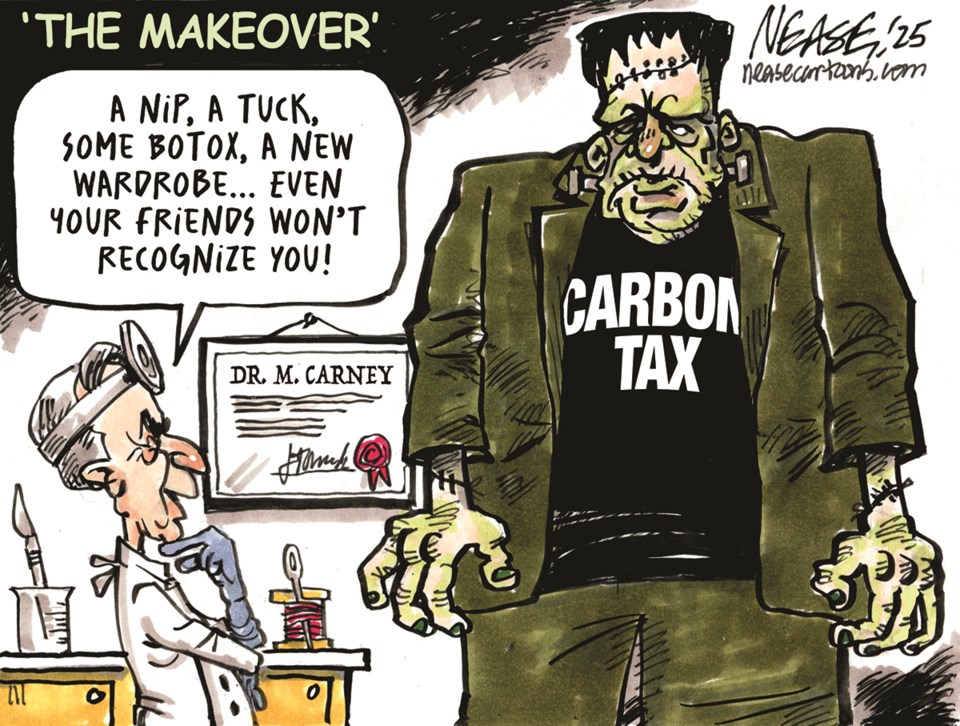
Carney Limits Canadians’ Access to News

Another blow against free speech in Canada reported in rightforcanada article Carney defends internet censorship bill, tells Canadians to rely on CBC for news.  Excerpts in italics with my bolds and added images.

PM Mark Carney dismissed concerns over Bill C-18’s restrictions on sharing news
on social media, promoting the Liberal-funded CBC as the primary news source.

During an August 5 press conference in Kelowna, British Columbia, Carney disregarded concerns that Bill C-18 limits Canadians’ ability to share news online, especially during crisis situations such as the wildfires. Instead, he declared that Canadians should get their news from the Liberal-funded CBC News.

“Bill C-18 stands in our way to get back onto Facebook and Instagram,” a reporter for Kelowna Now told Carney. “Are the Liberals looking for an alternative or rescinding that so we can get that news back on those important platforms?”

The question was increasingly relevant since Bill C-18 recently hindered local news outlets from sharing important updates regarding British Columbia wildfires. Carney responded:

One of the roles of CBC/Radio-Canada is to provide unbiased, immediate local information.  That’s one of the reasons why we’ve made the commitment to invest and reinforce and actually change the governance of CBC/Radio-Canada, to ensure they are providing those essential services.

Bill C-18 is one of many censorship bills introduced by former as Prime Minister Justin Trudeau. Passed in June 2023, the legislation aims to compel social media sites to share revenue with certain news outlets, something experts have warned could be the end of independent media.

In addition to his refusal to rescind Bill C-18, Carney promoted CBC News as a reliable news source despite the outlet being widely considered an arm of the Liberal Party that receives the vast majority of its funding from the Liberal government.

In January, the watchdog for the CBC ruled that the state-funded outlet expressed a “blatant lack of balance” in its coverage of a Catholic school trustee who opposed the LGBT agenda being foisted on children.

There have also been multiple instances of the outlet pushing what appears to be ideological content, including:

♦  the creation of pro-LGBT material for kids,
♦ tacitly endorsing the gender mutilation of children,
♦ promoting euthanasia, and even
♦ seeming to justify the burning of mostly Catholic churches throughout the country.

Carney revealed his loyalty to the CBC before he was even elected prime minister. In early April, ahead of the federal election, Carney promised another $150 million in funding for CBC on top of the $1.4 billion the outlet already receives annually.

Footnote

There was a time when CBC was not totally under the Liberal party thumb.

For those not familiar with the main characters:  1. Catherine McKenna, Minister of Environment and Climate Change, 2. Elizabeth May, MP and Leader of the Green Party, 3. Dr. David Suzuki, Environmental Scientist.

Chris Wright on Climate Change Chess

Last week Ben Shapiro interviewed Chris Wright concerning the latest moves by realists against the climatists and what’s at stake in this power struggle over humankind’s energy platform, not only for U.S but for the world. For those who prefer reading, I provide a transcript lightly edited from the closed captions, text in italics with my bolds and added images.

Ben: One of the biggest moves that has been made in modern history in the regulatory state has happened this week. The Environmental Protection Agency on Tuesday, according to the Wall Street Journal, declared liberation day from Climate Imperialism by moving to repeal the 2009 so-called endangerment finding for greenhouse gas emissions. So basically, the Clean Air Act, which was put into place in the 1970s, authorized the EPA to regulate pollutants like ozone, particulate matter, sulfur dioxide, and others that might reasonably be anticipated to endanger public health or welfare.

Well, the EPA suggested under Barack Obama that you could use the Clean Air Act in order to regulate carbon emissions, which is insane. That’s totally crazy. The kinds of stuff the Clean Air Act was meant to stop was again particulate matter. It was meant to stop ozone that was breaking down the ozone layer. It was not meant to deal with carbon and particularly carbon dioxide which is a thing that you know is a natural byproduct, for example breathing. Carbon dioxide in the environment is not a danger to human beings.

You may not like what it does in terms of global climate change, but the idea that the EPA has authority under the Clean Air Act is wrong. If Congress wants to give the EPA that authority, then it certainly could, but it never did. The Supreme Court found in 2007 that greenhouse gases could qualify as pollutants under an extraordinarily broad misreading of the law.

But now the EPA is walking that back. And the EPA is suggesting that this is not correct. The Supreme Court and the EPA under their 2009 ruling said, “There is some evidence that elevated carbon dioxide concentrations and climate changes can lead to changes in aeroallergens that could increase the potential for allergenic illnesses.” Well, the Energy Department has now walked that back. They published a comprehensive analysis of climate science and its uncertainties by five outside scientists. One of those is Steven Koonin, who served in the Obama administration.

The crucial point is that CO2 is different from the pollutants Congress expressly authorized the EPA to regulate. Those pollutants are “subject to regulatory control because they cause local problems depending on concentrations including nuisances, damages to plants, and at high enough exposure levels, toxic effects on humans. In contrast, CO2 is odorless, does not affect visibility, and it has no toxicological effects at ambient levels. So, you’re not going to get sick from CO2 in the air.

And so, the EPA administrator Lee Zeldin and Energy Secretary Chris Wright are taking this on. They have said in our interpretation the Clean Air Act no longer applies to greenhouse gases. Well, what does that mean? It means something extraordinary for the American economy, among other things, which is under a massive deregulatory environment.

The alleged cost of regulating greenhouse gas emissions under the Clean Air Act amounts to something like 54 billion per year. So if you multiply that out over the course of the last decade and a half, you’re talking about a cost of in excess of $800 billion based again on a regulatory agency radically exceeding its boundaries.

Well, joining us online to discuss this massive move by the Trump administration is the energy secretary Chris Wright. Secretary, thanks so much for taking the time. Really appreciate it. Thanks for having me, Ben.

Ben: So, first of all, why don’t we discuss what the EPA just did, what that actually means, how’s the energy department involved, and and what does it mean for sort of the future of things like energy developments in the United States?

The Poisonous Tree: Massachusetts v. EPA and the 2009 endangerment finding

Chris: Well, the endangerment finding, 2007 Supreme Court decision, Massachusetts and a bunch of environmental groups sued the EPA and said, “You must regulate greenhouse gas emissions.” Climate activists, basically. Unfortunately the Supreme Court decided five to four in 2007 that greenhouse gases could become endangerments, and if they were the EPA had the option but not the compulsion to regulate greenhouse gases. In 2009, as soon as the Obama administration came in, they did a tortured kind of process to say greenhouse gases endanger the lives of Americans. And that gave the regulatory state, the EPA, the ability to regulate greenhouse gases that the Obama administration and others had failed to pass through Congress. If you pass a law through the House and the Senate and the president signs it, then you can do that. But they just made it up. They just did it through a regulatory backdoor.

And now those those regulations just infuse everything we do, maybe most famously automobiles, the EV mandates, the continual increasing of fuel economy standards that brought us the SUV and everyone buying trucks because they don’t want to buy small cars. But it’s regulating your appliances and power plants and your and home hair dryers and outdoor heaters. So, it’s just been a huge entanglement into American life.

Big brother climate regulations from the government. They don’t do anything meaningful for global greenhouse gas emissions. They don’t change any health outcomes for Americans, but they massively grow the government. They increase costs and they grow the reach of the government. So, Administrator Lee Zeldin is reviewing that and saying, ” We don’t believe that greenhouse gases are a significant endangerment to the American public and they shouldn’t be regulated by the EPA. The EPA does not have authority to regulate them because Congress never passed such a law.

At the Department of Energy, sorry for the long answer, what we did was to reach out to five prestigious climate scientists that are real scientists in my mind; meaning they follow the data wherever it leads, not only if it aligns with their politics or their views otherwise. And we published a long critical overview of climate science and its impact on Americans. And that was released yesterday on the DOE website. I highly recommend everyone to give it a read in synopsis since it’s a big report obviously.

DOE Climate Team: Twelve Keys in Assessing Climate Change

Ben: What are the biggest findings from that report that you commissioned at the Department of Energy with regard to this stuff?

Chris: Maybe the single biggest one that everyone should be aware of is: The ceaseless repeating that climate change is making storms more frequent and more severe and more dangerous is just nonsense. That’s never been in the Intergovernmental Panel on Climate Change (IPCC) reports. It’s just not true. But media and politicians and activists just keep repeating it. And in fact, I saw The Hill had a piece right away when when our press release went out yesterday morning:

Despite decades of data and scientific consensus that climate change is increasing the frequency and intensity of storms, the EPA has reversed the endangerment finding.

Even the headlines are just wrong. One of my goals for 20 years, Ben, is for people to be just a little more knowledgeable of what is actually true with climate change, and what actually are the tradeoffs between trying to reduce greenhouse gas emissions by top- down government actions and what does that mean for the energy system?

We’ve driven up the price of energy, reduced choice to American consumers,
without meaningfully moving global greenhouse gas emissions at all.

And when I talk to activists or politicians about it, they’re not even that concerned about it. They don’t act as if their real goal is to incrementally reduce greenhouse gases in the atmosphere. Their real goal is for the government and them, you know, a small number of people to decide what’s appropriate behavior for all Americans.

Just creepy, top-down control sold in the name of protecting the future of the planet. If it was really about that, they’d know a little bit more about climate change, but they almost never do.

Ben: Well, this is the part that’s always astonishing to me. I get in a room with with climate scientists from places like MIT or Caltech, and we’ll discuss what exactly is going on. These are people who believe that there is anthropogenic climate change, that human activity is causing some sort of market impact on the climate. But when you discuss with them, okay, so what are the solutions? The solutions that that are proposed are never in line with the the kind of risk that they seek to prevent. I mean, the Nobel Prize winning economist William Nordhaus has made the point that there are certain things you could do economically that would totally destroy your economy and might save you an incremental amount of climate change on the other end. And then there are the things that we actually could do that are practical–things like building seawalls, things like hardening an infrastructure, moving toward nuclear energy would be a big one.

And to me, the litmus test of whether somebody is serious or not about climate change is what their feelings are about nuclear energy. If they’re anti-uclear energy, but somehow want to curb climate change, then you know, one of those things is false. It cannot be that you wish to oppose nuclear energy development, also your chief goal is to lower carbon emissions. That’s just a lie.

Chris: Exactly. I mean the biggest driver of reduced greenhouse gas emissions in the US by far has been natural gas displacing coal in the power sector. It’s about 60% of all the US reduction in emissions. But they hate natural gas, you know, because again they’re against hydrocarbons in order to move toward a society that somehow they think is better.

It is helping that more on the left become pro-nuclear. So, I’ll view that as one of the positive side effects of the climate movement and probably is going to help nuclear energy start going again. Of course, there are plenty that are anti-nuclear and climate crazies. So, there’s plenty of them still left. But, as you just mentioned, Nordhaus said in his lecture we should do the things where the benefits are greater than the cost. Sort of common sense. And in his proposed optimal scenario, you know, we reduce the warming through this century by about 20%. Not net zero, because that means you spend hundred trillion dollars and maybe you get $10 trillion of benefits. You know, that’s not good, and then people tell me, well, it’s an admirable goal. It’s aspirational. I’m saying, turning dollars into dimes is not aspirational. It’s human impoverishing.

And we can look over to the United Kingdom. They very proudly announced that they have the largest percent reduction in greenhouse gas emissions, 40%. They don’t tell you they’ve had an almost 30% reduction in energy consumption in the United Kingdom. So their dominant mechanism to drive down their greenhouse gas emissions is simply to consume less energy in England. That comes from two factors. The biggest one is their energy intensive industry is shut down in the country and all those jobs have gone overseas.

That stuff is now made in China, loaded on a diesel-powered ship,
shipped back to the United Kingdom, and they call that green.

And the other mechanism is they made energy so expensive that people don’t heat their houses as warm in the winter. They don’t travel as much. They don’t cool their houses as much in the hot summer days. They’ve impoverished their people so they can’t afford needed energy. This isn’t victory and this isn’t changing the global future of the world. We just need back some common sense around energy and climate change.

That’s where the Trump administration is headed across the administration, not just administer Zeldin and myself, but everyone in the administration. We just want Americans to have a government that follows basic common sense.

Ben: Now, Secretary Wright, we were discussing a little bit earlier on in the show this this excellent second quarter GDP number, some of which is being driven certainly by mass investment in technologies like AI. If you talk to folks who are in the capital intensive arenas, pretty much all the money right now is going into AI. That’s a race the United States must win. And one of the huge components there is the energy that is going to be necessary in order to pursue the sorts of processing that AI is going to require. The gigantic data centers that are now being built are going to require inordinate amounts of energy. Everybody knows and acknowledges this. China is producing energy at a rate that far outstrips the United States at this point. So if we wish to actually win the AI race, we have to unleash an all of the above strategy with regard to energy production. That’s obviously something you’re very focused on. And if we don’t win the AI race, in all likelihood China becomes the dominant economic power on planet Earth. So how important is AI to this? And what does it mean for the energy sector?

Chris: It’s massively important. As you just said, it’s what I called it Manhattan Project 2.0. Because in the Manhattan project when we developed an atomic bomb in World War II, we could not have come in second. If Nazi Germany had developed an atomic weapon before us, we would live in a different world now. It’s a similar risk here if China gets a meaningful lead on the US in artificial intelligence.

Because it’s not just economics and science, it’s national defense, it’s the military. Now we are under serious threat from China and we go into a very different world. We must lead in this area. We have the leading scientists. We have businesses. We have the ability to invest these huge amounts of capital again from private markets and private businesses, which a free market capitalist like myself loves.

The biggest limiter as you set up is electricity. The highest form and most expensive type of energy there is turning primary energy into electricity. And as you just said, China’s been growing their electricity production massively. Ours has barely grown in the last 20 years. In fact, it grew like two or 3% in the Obama years, but then during the Biden years, they got prices up over 25%. You could say they helped elect President Trump by just doing everything wrong on energy. And they certainly weren’t into all of the above. They were all about wind, solar, and batteries. And congratulations, they got them to about 3% of total US energy at the end of the Biden years.

The graph shows that global Primary Energy (PE) consumption from all sources has grown continuously over nearly 6 decades. Since 1965 oil, gas and coal (FF, sometimes termed “Thermal”) averaged 88% of PE consumed, ranging from 93% in 1965 to 81% in 2024. Source: Energy Institute

Hydrocarbons went from 82% in 2019, when Biden promised and guaranteed he would end fossil fuels, to 82% his last year in office. Zero change in market share. So they just believe and cling to too many silly things about energy. So today in the United States, the biggest source of electricity by far is natural gas. That will be the dominant growth that will enable us to build all these tens of gigawatts of data centers. It’s abundant, it’s affordable, and it works all the time. I’ve never been an all of the above guy because subsidizing wind and solar is problematic. You know, globally, a few trillions of dollars have gone into it, and if you get high penetration, the main result is expensive electricity and a less stable grid.

That’s not good. The crazy amount of money the United States government spent on wind and solar hasn’t grown our electricity production because they’re not there at peak demand time. Texas has the biggest penetration of wind and second biggest penetration of solar, 35% of the capacity on the Texas grid. But at peak demand with these cold or warm high-pressure systems the wind is gone. Peak demand time is after the sun goes down and you get almost nothing from wind and solar.

Parasites is what they really are. Just in the middle of the day when demand is low, and all the power
plants that are needed to supply at peak demand just all have to turn down. And then the sun goes behind a cloud and they got to turn up again. And then when peak demand comes, when it’s very cold at in the evening, all the existing thermal capacity and nuclear capacity has to run and drive the grid.

So if you don’t add to reliable production at peak demand time,
you’re not adding to the capacity of the grid. You’re
just adding to the complexity and cost of the grid.

I mean, if Harris had won the election, we would not only have no chance to win the AI race against China. We would have increasing blackouts and brownouts today, let alone with the the extra demand, some extra demand that would have come from AI, even if they had won the race. But because President Trump won, common sense came back in spades, and we’re allowing American businesses to invest and lead in AI, we’re in a very different trajectory.

Ben: A very different trajectory. Well, that’s US Energy Secretary Chris Wright doing a fantastic job over there. One of the big reasons that the Trump economy continues to churn along. Secretary Wright, really appreciate the time and the insight. Thanks so much for having me, Ben. Appreciate all you do.

EPA Proposal to Reconsider GHG Endangerment Finding

From Executive Summary

In this action, the EPA proposes to rescind all greenhouse gas (GHG) emission standards for light-duty, medium-duty, and heavy-duty vehicles and engines under CAA section 202(a). Upon review of the underlying actions and intervening legal and scientific developments, including recent decisions by the U.S. Supreme Court and the scientific information summarized in this preamble, the EPA no longer believes that we have the statutory authority and record basis required to maintain this novel and transformative regulatory program. We seek comment on all aspects of this proposal, including on the legal and scientific developments that are being subject to public comment for the first time in this rulemaking.

The EPA now proposes to rescind the Endangerment Finding and all resulting GHG emission standards for new motor vehicles and engines, including the light-duty, medium-duty, and heavy-duty vehicle and engine standards for model years (MY) 2012 to 2027 and beyond. The remainder of this section describes the need for regulatory action and the scope of the proposed action, including rescission of the Endangerment Finding, repeal of related GHG emission standards, and minor conforming adjustments to unrelated emission standards for new motor vehicles and engines that we are not proposing to alter as part of this rulemaking.

Section II of this preamble sets out relevant background, including the events leading up to the Endangerment Finding, the approach taken in the Endangerment Finding to analyzing the scientific record, and the regulations issued since 2009 in reliance on the Endangerment Finding. We also summarize the premises, assumptions, and conclusions in the Endangerment Finding and the scientific information, including empirical data, peer-reviewed studies, and real-world developments since 2009 that led the Administrator to develop concerns sufficient to initiate reconsideration of the ongoing validity and reliability of the Endangerment Finding.

Section III of this preamble describes our legal authority to rescind the Endangerment Finding and repeal the resulting GHG standards issued under CAA section 202(a). Because this proposed action would not impact fuel economy standards and emission standards for criteria pollutants and hazardous air pollutants regulated under the CAA, we explain the relationship between these regulations to set the outer bounds of amendments at issue in this rulemaking.

Section IV.A of this preamble describes our proposal to rescind these prior actions because the Endangerment Finding exceeded our statutory authority under CAA section 202(a). As explained further below, we propose that the term “air pollution” as used in CAA section 202(a) is best read in context as referring to local or regional exposure to dangerous air pollution, consistent with our longstanding practice before 2009. We further propose that CAA section 202(a) does not grant the Administrator “procedural discretion” to issue standalone findings that trigger a duty to regulate, or, conversely, to prescribe standards, without making the requisite findings for the particular air pollutant emissions and class or classes of new motor vehicles or engines at issue. We also propose that CAA section 202(a) does not authorize the Administrator to make separate findings for endangerment and causation or contribution. Rather, we propose that CAA section 202(a) requires the Administrator to find that the relevant air pollutant emissions from the class or classes of new motor vehicles or engines at issue cause, or contribute to, air pollution which endangers public health or welfare, without relying on emissions from stationary or other sources regulated by distinct CAA provisions. As the Supreme Court made clear in Loper Bright Enterprises v. Raimondo, 603 U.S. 369 (2024), we can no longer rely on statutory silence or ambiguity to expand our regulatory power. And because the Nation’s response to global climate change concerns is an issue of significant importance that Congress did not clearly address in CAA section 202(a), we propose that the major questions doctrine further reinforces and provides an additional basis for our proposed interpretations and actions.

The Agency did not have the benefit of the Court’s decisions in Loper Bright and West Virginia, among other applicable precedents, when issuing the Endangerment Finding in 2009. Finally, we explain that the EPA reached contrary conclusions in the Endangerment Finding by misconstruing the Supreme Court’s decision in Massachusetts v. EPA, 549 U.S. 497 (2007), which vacated our denial of a petition for rulemaking on distinct grounds. Read on its own terms, Massachusetts did not require the Agency to find that GHGs are subject to regulation under CAA section 202(a) and does not support our implementation of the statute since 2009.

The Administrator’s review of the relevant information, including scientific literature, gave rise to serious concerns that our actions taken to regulate GHG emissions from new motor vehicles and engines exceed our statutory authority under CAA section 202(a) and are otherwise inappropriate. Continuing to impose billions of dollars in regulatory costs on American businesses and consumers without an adequate legal basis would threaten to undermine public confidence in our activities and commitment to fulfilling the Agency’s core mission: protecting human health and the environment. The EPA has expended significant resources implementing the GHG regulatory program for mobile sources and attempting to expand its GHG regulatory program to stationary sources with limited success in the courts and no apparent real-world results, often at the expense of programs that fall squarely within our statutory authority. Prompt action is needed to address these concerns with the benefit of public participation.

Relatedly, the Administrator has serious concerns that many of the scientific underpinnings of the Endangerment Finding are materially weaker than previously believed and contradicted by empirical data, peer-reviewed studies, and scientific developments since 2009. This proposal seeks public comment on these developments for the first time. Prompt action is needed to address these concerns, and the Administrator requests stakeholder input on the continuing vitality of the assumptions, predictions, and conclusions animating the Endangerment Finding.