 Roy Spencer has published a study at Heritage Global Warming: Observations vs. Climate Models. Excerpts in italics with my bolds.
Summary
Warming of the global climate system over the past half-century has averaged 43 percent less than that produced by computerized climate models used to promote changes in energy policy. In the United States during summer, the observed warming is much weaker than that produced by all 36 climate models surveyed here. While the cause of this relatively benign warming could theoretically be entirely due to humanity’s production of carbon dioxide from fossil-fuel burning, this claim cannot be demonstrated through science. At least some of the measured warming could be natural. Contrary to media reports and environmental organizations’ press releases, global warming offers no justification for carbon-based regulation.
KEY TAKEAWAYS
- The observed rate of global warming over the past 50 years has been weaker than that predicted by almost all computerized climate models.
- Climate models that guide energy policy do not even conserve energy, a necessary condition for any physically based model of the climate system.
- Public policy should be based on climate observations—which are rather unremarkable—rather than climate models that exaggerate climate impacts.
For the purposes of guiding public policy and for adaptation to any climate change that occurs, it is necessary to understand the claims of global warming science as promoted by the United Nations Intergovernmental Panel on Climate Change (IPCC). When it comes to increases in global average temperature since the 1970s, three questions are pertinent:
- Is recent warming of the climate system materially attributable to anthropogenic greenhouse gas emissions, as is usually claimed?
- Is the rate of observed warming close to what computer climate models—used to guide public policy—show?
- Has the observed rate of warming been sufficient to justify alarm and extensive regulation of CO2 emissions?
While the climate system has warmed somewhat over the past five decades,
the popular perception of a “climate crisis” and resulting calls for economically
significant regulation of CO2 emissions is not supported by science.
Discussion Points
Temperature Change Is Caused by an Imbalance Between Energy Gain and Energy Loss.
Recent Warming of the Climate System Corresponds to a Tiny Energy Imbalance.
Climate Models Assume Energy Balance, but Have Difficulty Achieving It.
Global Warming Theory Says Direct Warming from a Doubling of CO2 Is Only 1.2°C.
Climate Models Produce Too Much Warming.
Climate models are not only used to predict future changes (forecasting), but also to explain past changes (hindcasting). Depending on where temperatures are measured (at the Earth’s surface, in the deep atmosphere, or in the deep ocean), it is generally true that climate models have a history of producing more warming than has been observed in recent decades.
This disparity is not true of all the models, as two models (both Russian) produce warming rates close to what has been observed, but those models are not the ones used to promote the climate crisis narrative. Instead, those producing the greatest amount of climate change usually make their way into, for example, the U.S. National Climate Assessment, the congressionally mandated evaluation of what global climate models project for climate in the United States.
The best demonstration of the tendency of climate models to overpredict warming is a direct comparison between models and observations for global average surface air temperature, shown in Chart 1.
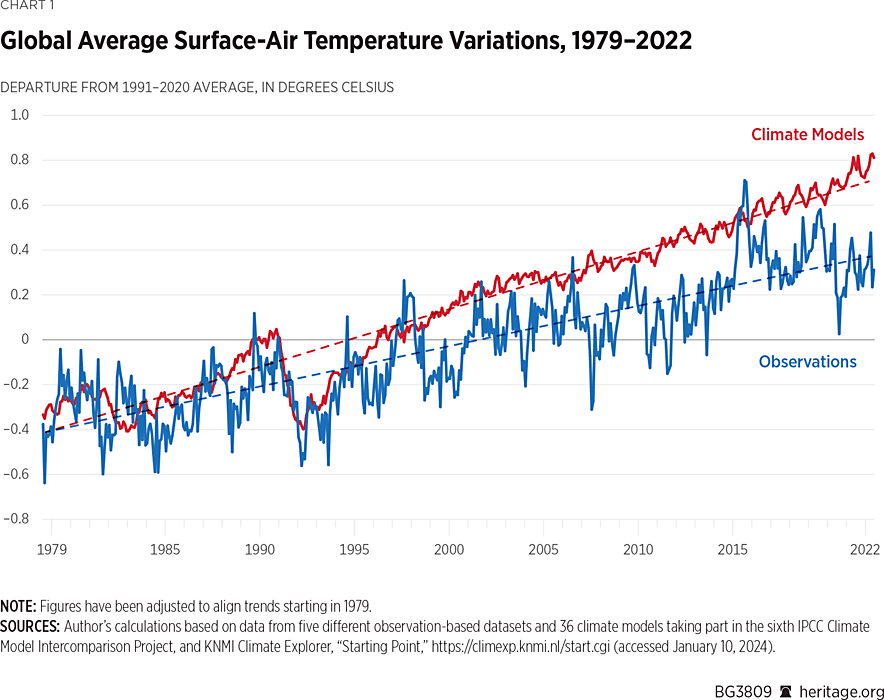
In this plot, the average of five different observation-based datasets (blue) are compared to the average of 36 climate models taking part in the sixth IPCC Climate Model Intercomparison Project (CMIP6). The models have produced, on average, 43 percent faster warming than has been observed from 1979 to 2022. This is the period of the most rapid increase in global temperatures and anthropogenic greenhouse gas emissions, and also corresponds to the period for which satellite observations exist (described below). This discrepancy between models and observations is seldom mentioned despite that fact that it is, roughly speaking, the average of the models (or even the most extreme models) that is used to promote policy changes in the U.S. and abroad.
Summertime Warming in the United States
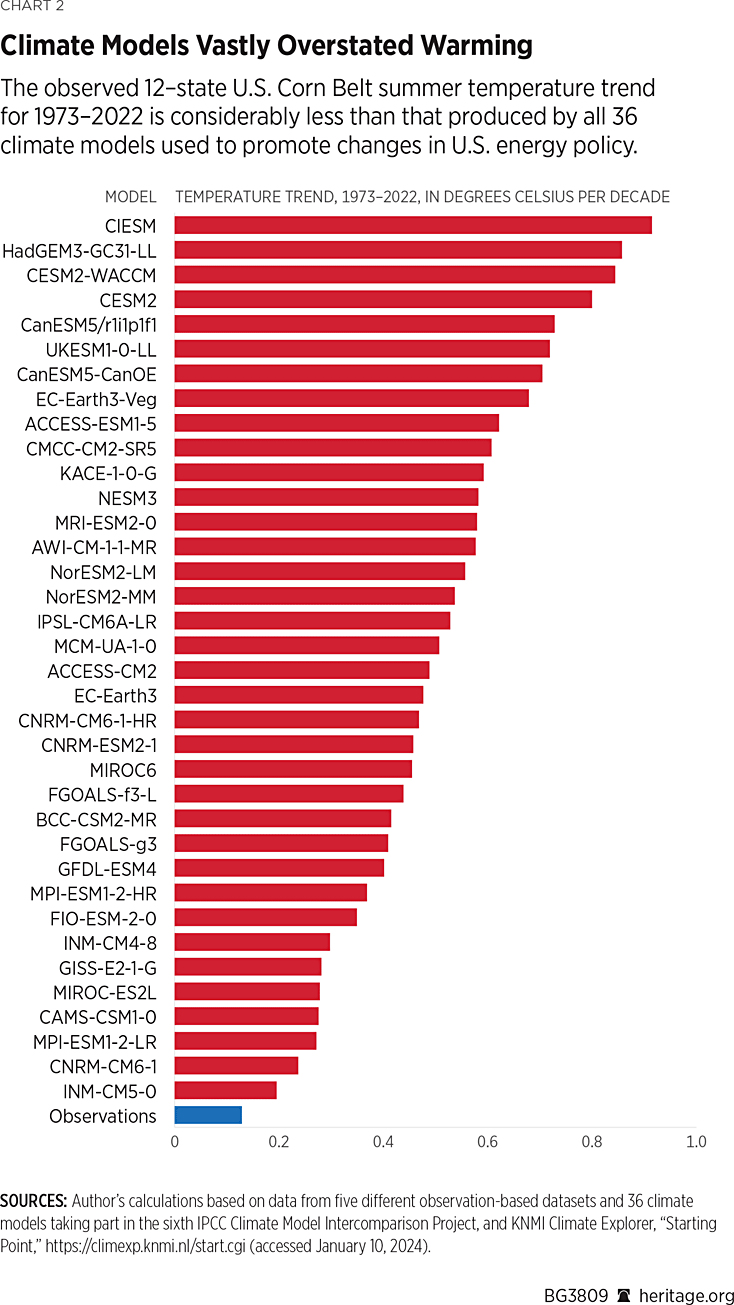
While global averages produce the most robust indicator of “global” warming, regional effects are often of more concern to national and regional governments and their citizens. For example, in the United States large increases in summertime heat could affect human health and agricultural crop productivity. But as Chart 2 shows, surface air temperatures during the growing season (June, July, and August) over the 12-state Corn Belt for the past 50 years reveal a large discrepancy between climate models and observations, with all 36 models producing warming rates well above what has been observed and the most extreme model producing seven times too much warming.
The fact that global food production has increased faster than population growth in the past 60 years suggests that any negative impacts due to climate change have been small. In fact, “global greening” has been documented to be occurring in response to more atmospheric CO2, which enhances both natural plant growth and agricultural productivity, leading to significant agricultural benefits.
These discrepancies between models and observations are never mentioned when climate researchers promote climate models for energy policy decision-making. Instead, they exploit exaggerated model forecasts of climate change to concoct exaggerated claims of a climate crisis.
Global Warming of the Lower Atmosphere
While near-surface air temperatures are clearly important to human activity, the warming experienced over the low atmosphere (approximately the lowest 10 kilometers of the “troposphere,” where the Earth’s weather occurs) is also of interest, especially given the satellite observations of this layer extending back to 1979.
Satellites provide the only source of geographically complete coverage of the Earth, except very close to the North and South Poles.
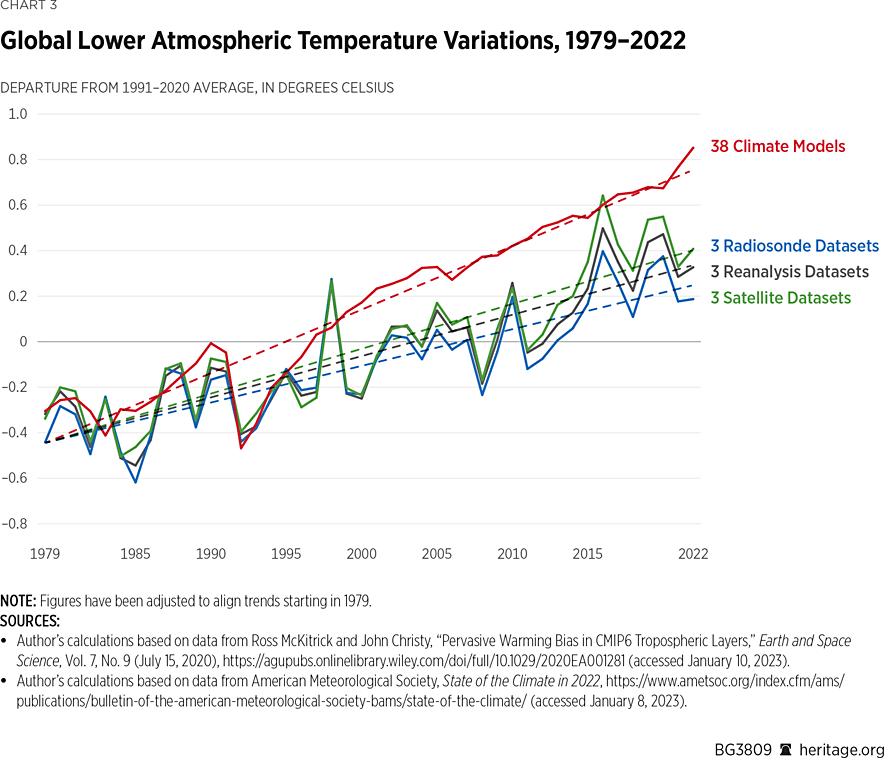
Chart 3 shows a comparison of the temperature of this layer as produced by 38 climate models (red) and how the same layer has been observed to warm in three radiosonde (weather balloon) datasets (green), three global reanalysis datasets (which use satellites, weather balloons, and aircraft data; black), and three satellite datasets (blue).
Conclusion
Climate models produce too much warming when compared to observations over the past fifty years or so, which is the period of most rapid warming and increases in carbon dioxide in the atmosphere. The discrepancy ranges from over 40 percent for global surface air temperature, about 50 percent for global lower atmospheric temperatures, and even a factor of two to three for the United States in the summertime. This discrepancy is never mentioned when those same models are used as the basis for policy decisions.
Also not mentioned when discussing climate models is their reliance on the assumption that there are no natural sources of long-term climate change. The models must be “tuned” to produce no climate change, and then a human influence is added in the form of a very small, roughly 1 percent change in the global energy balance. While the resulting model warming is claimed to prove that humans are responsible, clearly this is circular reasoning. It does not necessarily mean that the claim is wrong—only that it is based on faith in assumptions about the natural climate system that cannot be shown to be true from observations.
Finally, possible chaotic internal variations will always lead to uncertainty in both global warming projections and explanation of past changes. Given these uncertainties, policymakers should proceed cautiously and not allow themselves to be influenced by exaggerated claims based on demonstrably faulty climate models.
Roy W. Spencer, PhD, is Principal Research Scientist at the University of Alabama in Huntsville.
 Science Matters
One comment