Acidification Alarmists Forced to Fake Findings

The story of fake research findings was published at the journal Science entitled Star marine ecologist committed misconduct, university says.  Excerpts below in italics with my bolds.

Finding against Danielle Dixson vindicates whistleblowers
who questioned high-profile work on ocean acidification

A major controversy in marine biology took a new twist last week when the University of Delaware (UD) found one of its star scientists guilty of research misconduct. The university has confirmed to Science that it has accepted an investigative panel’s conclusion that marine ecologist Danielle Dixson committed fabrication and falsification in work on fish behavior and coral reefs. The university is seeking the retraction of three of Dixson’s papers and “has notified the appropriate federal agencies,” a spokesperson says.

Danielle Dixson, asistant professor at the University of Delaware, will explore coral reefs off Belize over the next three years. Here, she is diving on a reef in the Indo-Pacific. Courtesy of Danielle Dixson Source: delaware online

Dixson is known as a highly successful scientist and fundraiser. She obtained her Ph.D. at James Cook University (JCU),  Townsville in Australia, in 2012; worked as a postdoc and assistant professor at the Georgia Institute of Technology for 4 years; and in 2015 started her own group at UD’s marine biology lab in Lewes, a small town on the Atlantic Coast. She received a $1.05 million grant from the Gordon and Betty Moore Foundation in 2016 and currently has a $750,000 career grant from the National Science Foundation (NSF). She presented her research at a 2015 White House meeting and has often been featured in the media, including in a 2019 story in Science.

Together with one of her Ph.D. supervisors, JCU marine biologist Philip Munday, Dixson pioneered research into the effects on fish of rising CO2 levels in the atmosphere, which cause the oceans to acidify. In a series of studies published since 2009 they showed that acidification can disorient fish, lead them to swim toward chemical cues emitted by their predators, and affect their hearing and vision. Dixson’s later work focused on coral reef ecology, the subject of her Science paper.

The colorful diversity of coral found at One Tree Island. The structure and diversity of coral we see today is already at risk of dissolution from ocean acidification. Kennedy Wolfe University of Sydney

Among the papers is a study about coral reef recovery that Dixson published in Science in 2014, and for which the journal issued an Editorial Expression of Concern in February. Science—whose News and Editorial teams operate independently of each other—retracted that paper today.

The investigative panel’s draft report, which Science’s News team has seen in heavily redacted form, paints a damning picture of Dixson’s scientific work, which included many studies that appeared to show Earth’s rising carbon dioxide (CO2) levels can have dramatic effects on fish behavior and ecology. “The Committee was repeatedly struck by a serial pattern of sloppiness, poor recordkeeping, copying and pasting within spreadsheets, errors within many papers under investigation, and deviation from established animal ethics protocols,” wrote the panel, made up of three UD researchers.

Several former members of Dixson’s lab supported the whistleblowers’ request for an investigation. One of them, former postdoc Zara Cowan, was the first to identify the many duplications in the data file for the now-retracted Science paper. Another, former Ph.D. student Paul Leingang, first brought accusations against Dixson to university officials in January 2020. He left the lab soon after and joined the broader group of whistleblowers.

Leingang, who had been at Dixson’s lab since 2016, says he had become increasingly suspicious of her findings, in part because she usually collected her fluming data alone. In November 2019 he decided to secretly track some of Dixson’s activities. He supplied the investigation with detailed notes, chat conversations, and tweets by Dixson to show that she did not spend enough time on her fluming studies to collect the data she was jotting down in her lab notebooks.

The investigative panel found Leingang’s account convincing and singled him out for praise. “It is very difficult for a young scholar seeking a Ph.D. to challenge their advisor on ethical grounds,” the draft report says. “The Committee believes it took great bravery for him to come forward so explicitly. The same is true of the other members of the laboratory who backed the Complainant’s action.”

UD “did a decent investigation. I think it’s one of the first universities that we’ve seen actually do that,” says ecophysiologist Fredrik Jutfelt of the Norwegian University of Science and Technology, one of the whistleblowers. “So that’s really encouraging.” But he and others in the group are disappointed that the committee appears to have looked at only seven of the 20 Dixson papers they had flagged as suspicious. They also had hoped UD would release the committee’s final report and detail any sanctions against Dixson. “That is a shame,” Jutfelt says.

Inventing Facts to Promote an Imaginary Crisis

Legacy and social media are awash with warnings about hydrocarbon emissions making the oceans acidic and threatening all ocean life from plankton up to whales.  For example:

Ocean acidification: A wake-up call in our waters – NOAA

Canada’s oceans are becoming more acidic – Pêches et Océans Canada

The Ocean Is Getting More Acidic—What That Actually Means– National Geographic

What Is Ocean Acidification? – NASA Climate Kids

Ocean acidification: why the Earth’s oceans are turning to acid – OA-ICC

Etc, etc., etc.

With the climatism hype far beyond any observations, marine biologists have stepped up to make an industry out of false evidence.  They are forced to do so because reality does not conform to their beliefs.  A good summary of acidification hoaxes comes from Jim Steele Un-refutable Evidence of Alarmists’ Ocean Acidification Misinformation in 3 Easy Lessons posted at WUWT.  Points covered include:

♦  The Undisputed Science

♦  The Dissolving Snail Shell Hoax

♦  The Reduced Calcification Hoax

More detail on the bogus fish behavior studies is also found at WUWT: James Cook University Researchers Refuted: “Ocean Acidification Does not Impair” Fish behaviour

A brief explanation debunking the notion of CO2 causing ocean “acidification” is here:

Background Post Shows Alarmist Claims Not Supported in IPCC WG1 References

Headlines Claim, But Details Deny

Update Sept. 9 Response to Brian Catt

Below I note that claimed %s of increasing acidity involve changes in parts per billion for H ion in water.  Further, the relation between atmospheric CO2 and ocean pH needs to be understood.

Figure 1: pH of ocean water and rain water versus concentration of CO2 in the atmosphere. Calculated with (20); Ocean alkalinity [A] = 2.3 × 10⁻³ M. Rain alkalinity [A] = 0. Temperature T = 25 C.

The source is Cohen and Happer (2015), where these conclusions are written:

This minimalist discussion already shows how hard it is to scare informed people with ocean acidification, but, alas, many people are not informed. For example:

• The oceans would be highly alkaline with a pH of about 11.4, similar to that of household ammonia, if there were no weak acids to buffer the alkalinity. Almost all of the buffering is provided by dissolved CO2, with very minor additional buffering from boric acid, silicic acid and other even less important species.

• As shown in Fig. 1, doubling atmospheric CO2 from the current level of 400 ppm to 800 ppm only decreases the pH of ocean water from about 8.2 to 7.9. This is well within the day-night fluctuations that already occur because of photosynthesis by plankton and less than the pH decreases with depth that occur because of the biological pump and the dissolution of calcium carbonate precipitates below the lysocline.

• As shown in Fig. 2, doubling atmospheric CO2 from the current level of 400 ppm to 800 ppm only decreases the carbonate-ion concentration, [CO2−3], by about 30%. Ocean surface waters are already supersaturated by several hundred per cent for formation of CaCO3 crystals from Ca2+ and CO2−3. So scare stories about dissolving carbonate shells are nonsense.

• As shown in Fig. 7, the ocean has only absorbed 1/3 or less of the CO2 that it would eventually absorb when the concentrations of CO2 in the deep oceans came to equilibrium with surface concentrations. Effects like that of the biological pump and calcium carbonate dissolution below the lysocline allow the ocean to absorb substantially more than the amount that would be in chemical-equilibrium with the atmosphere.

• Over most of the Phanerozoic, the past 550 million years, CO2 concentrations in the atmosphere have been measured in thousands of parts per million, and life flourished in both the oceans and on land. This is hardly surprising, given the relative insensitivity of ocean pH to large changes in CO2 concentrations that we have discussed above, and given the fact that the pH changes that do occur are small compared to the natural variations of ocean pH in space and time.


UAH August 2024: Most Regions Cooler, Offset by SH Land Spike

The post below updates the UAH record of air temperatures over land and ocean. Each month and year exposes again the growing disconnect between the real world and the Zero Carbon zealots.  It is as though the anti-hydrocarbon band wagon hopes to drown out the data contradicting their justification for the Great Energy Transition.  Yes, there has been warming from an El Nino buildup coincidental with North Atlantic warming, but no basis to blame it on CO2.  

As an overview consider how recent rapid cooling  completely overcame the warming from the last 3 El Ninos (1998, 2010 and 2016).  The UAH record shows that the effects of the last one were gone as of April 2021, again in November 2021, and in February and June 2022  At year end 2022 and continuing into 2023 global temp anomaly matched or went lower than average since 1995, an ENSO neutral year. (UAH baseline is now 1991-2020). Now we have an usual El Nino warming spike of uncertain cause, unrelated to steadily rising CO2 and now moderating.
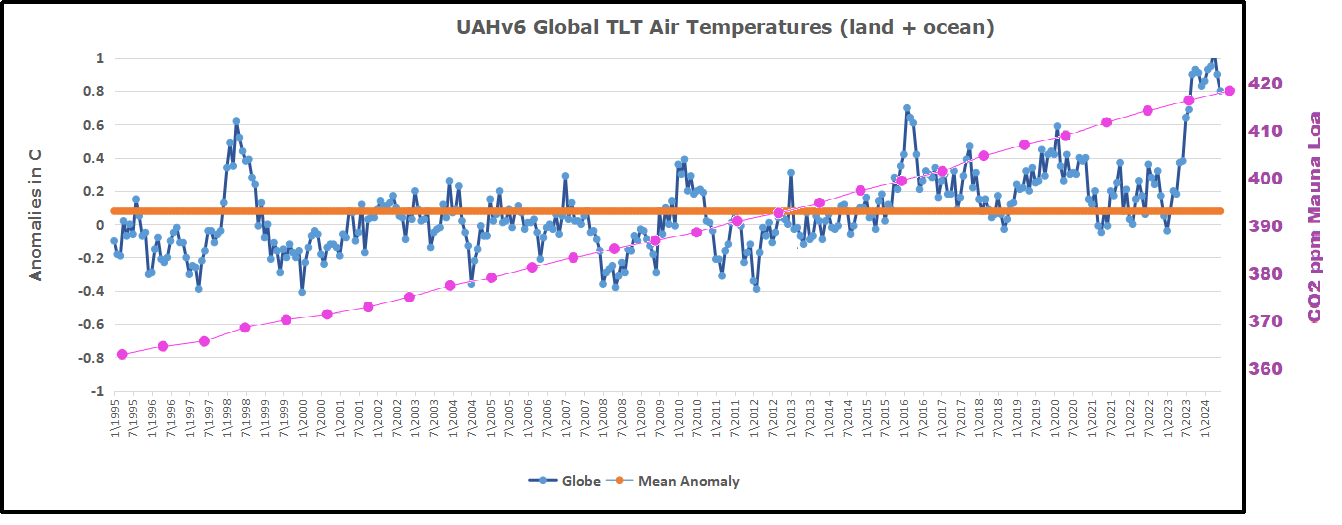
For reference I added an overlay of CO2 annual concentrations as measured at Mauna Loa.  While temperatures fluctuated up and down ending flat, CO2 went up steadily by ~60 ppm, a 15% increase.

Furthermore, going back to previous warmings prior to the satellite record shows that the entire rise of 0.8C since 1947 is due to oceanic, not human activity.
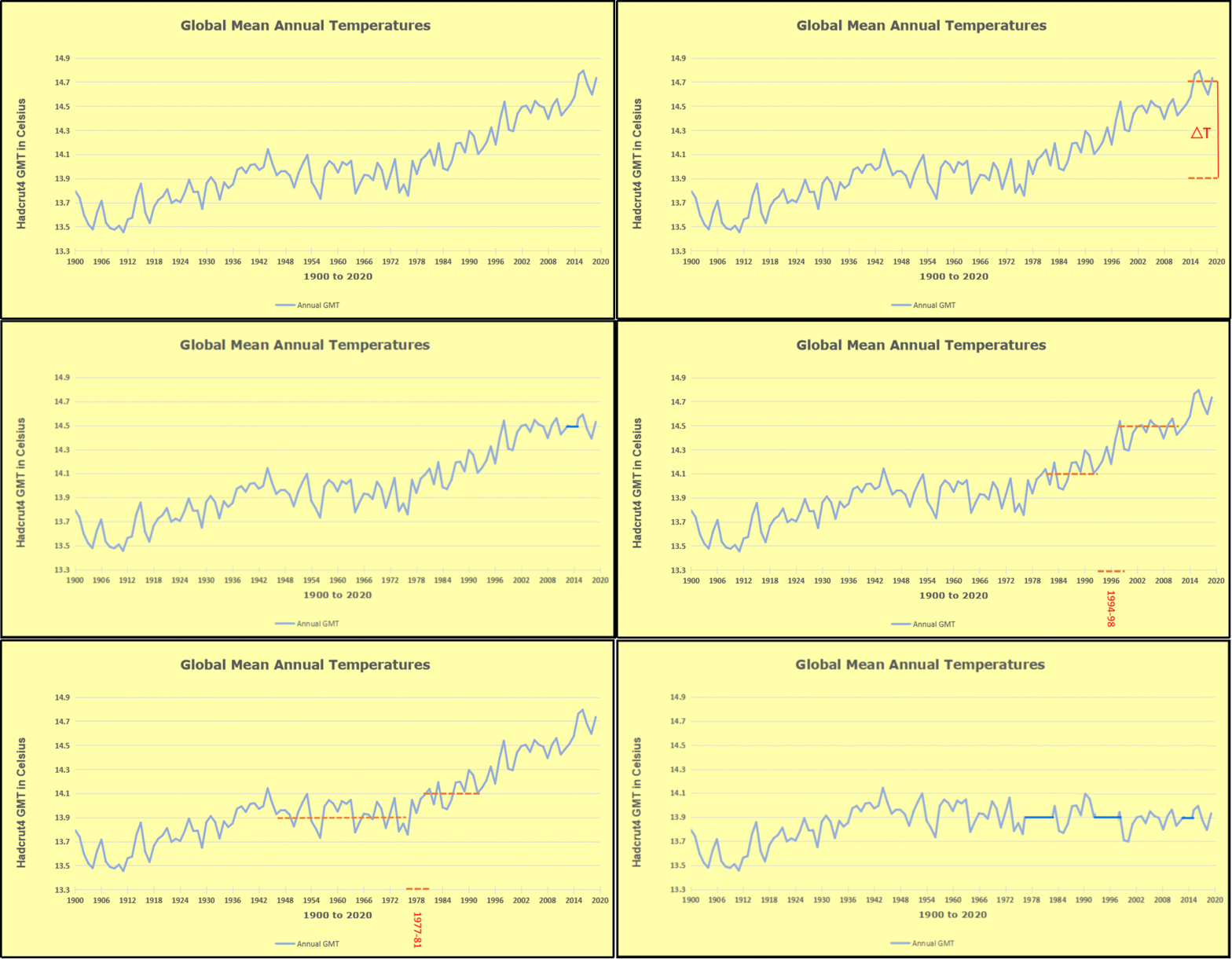
gmt-warming-events

The animation is an update of a previous analysis from Dr. Murry Salby.  These graphs use Hadcrut4 and include the 2016 El Nino warming event.  The exhibit shows since 1947 GMT warmed by 0.8 C, from 13.9 to 14.7, as estimated by Hadcrut4.  This resulted from three natural warming events involving ocean cycles. The most recent rise 2013-16 lifted temperatures by 0.2C.  Previously the 1997-98 El Nino produced a plateau increase of 0.4C.  Before that, a rise from 1977-81 added 0.2C to start the warming since 1947.

Importantly, the theory of human-caused global warming asserts that increasing CO2 in the atmosphere changes the baseline and causes systemic warming in our climate.  On the contrary, all of the warming since 1947 was episodic, coming from three brief events associated with oceanic cycles. And now in 2024 we have seen an amazing episode with a temperature spike driven by ocean air warming in all regions, along with rising NH land temperatures, now receding from its peak.

Chris Schoeneveld has produced a similar graph to the animation above, with a temperature series combining HadCRUT4 and UAH6. H/T WUWT
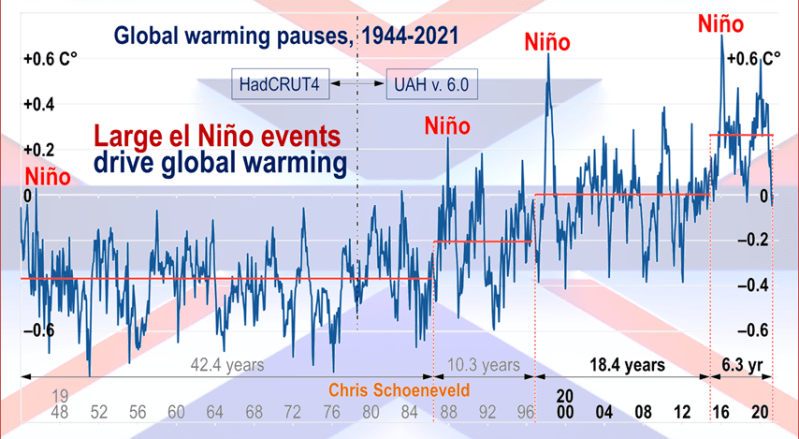
image-8


mc_wh_gas_web20210423124932

See Also Worst Threat: Greenhouse Gas or Quiet Sun?

August 2024 Most Regions Cooler Offset by SH Land Spike

 banner-blog

With apologies to Paul Revere, this post is on the lookout for cooler weather with an eye on both the Land and the Sea.  While you heard a lot about 2020-21 temperatures matching 2016 as the highest ever, that spin ignores how fast the cooling set in.  The UAH data analyzed below shows that warming from the last El Nino had fully dissipated with chilly temperatures in all regions. After a warming blip in 2022, land and ocean temps dropped again with 2023 starting below the mean since 1995.  Spring and Summer 2023 saw a series of warmings, continuing into October, followed by cooling. 

UAH has updated their tlt (temperatures in lower troposphere) dataset for August 2024. Posts on their reading of ocean air temps this month are ahead of the update from HadSST4.  I posted last month on SSTs using HadSST4 Oceans Warming Uptick July 2024. These posts have a separate graph of land air temps because the comparisons and contrasts are interesting as we contemplate possible cooling in coming months and years.

Sometimes air temps over land diverge from ocean air changes. Last February 2024, both ocean and land air temps went higher driven by SH, while NH and the Tropics cooled slightly, resulting in Global anomaly matching October 2023 peak. Then in March Ocean anomalies cooled while Land anomalies rose everywhere. After a mixed pattern in April, the May anomalies were back down led by a large drop in NH land, and a smaller ocean decline in all regions. In June all Ocean regions dropped down, as well as dips in SH and Tropical land temps. In July all Oceans were unchanged except for Tropical warming, while all land regions rose slightly. Now in August we see a warming leap in SH land, slight Land cooling elsewhere, a dip in Tropical Ocean temp and slightly elswhere. End result is a small upward bump.

Note:  UAH has shifted their baseline from 1981-2010 to 1991-2020 beginning with January 2021.  In the charts below, the trends and fluctuations remain the same but the anomaly values changed with the baseline reference shift.

Presently sea surface temperatures (SST) are the best available indicator of heat content gained or lost from earth’s climate system.  Enthalpy is the thermodynamic term for total heat content in a system, and humidity differences in air parcels affect enthalpy.  Measuring water temperature directly avoids distorted impressions from air measurements.  In addition, ocean covers 71% of the planet surface and thus dominates surface temperature estimates.  Eventually we will likely have reliable means of recording water temperatures at depth.

Recently, Dr. Ole Humlum reported from his research that air temperatures lag 2-3 months behind changes in SST.  Thus cooling oceans portend cooling land air temperatures to follow.  He also observed that changes in CO2 atmospheric concentrations lag behind SST by 11-12 months.  This latter point is addressed in a previous post Who to Blame for Rising CO2?

After a change in priorities, updates are now exclusive to HadSST4.  For comparison we can also look at lower troposphere temperatures (TLT) from UAHv6 which are now posted for August.  The temperature record is derived from microwave sounding units (MSU) on board satellites like the one pictured above. Recently there was a change in UAH processing of satellite drift corrections, including dropping one platform which can no longer be corrected. The graphs below are taken from the revised and current dataset.

The UAH dataset includes temperature results for air above the oceans, and thus should be most comparable to the SSTs. There is the additional feature that ocean air temps avoid Urban Heat Islands (UHI).  The graph below shows monthly anomalies for ocean air temps since January 2015.
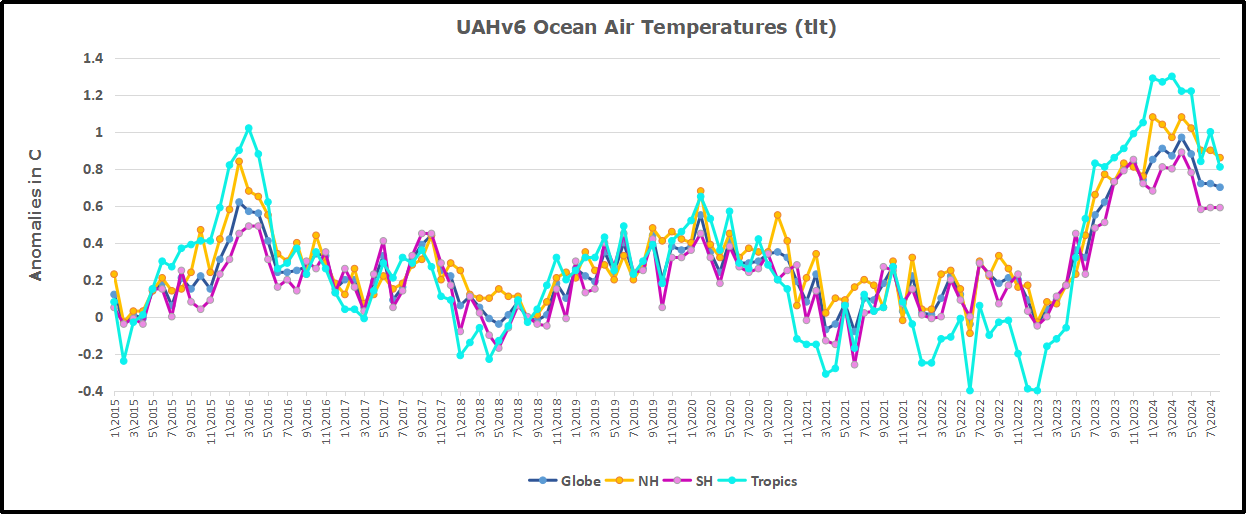
 

Note 2020 was warmed mainly by a spike in February in all regions, and secondarily by an October spike in NH alone. In 2021, SH and the Tropics both pulled the Global anomaly down to a new low in April. Then SH and Tropics upward spikes, along with NH warming brought Global temps to a peak in October.  That warmth was gone as November 2021 ocean temps plummeted everywhere. After an upward bump 01/2022 temps reversed and plunged downward in June.  After an upward spike in July, ocean air everywhere cooled in August and also in September.   

After sharp cooling everywhere in January 2023, all regions were into negative territory. Note the Tropics matched the lowest value, but since have spiked sharply upward +1.7C, with the largest increases in April to July, and continuing through adding to a new high of 1.3C January to March 2024.  In April and May that started dropping in all regions.   June showed a sharp decline everywhere, led by the Tropics down 0.5C. The Global anomaly fell to nearly match the September 2023 value. In July, the Tropics rose slightly while SH, NH and the Global Anomaly were unchanged. Now in August a drop in the Tropics, with little NH cooling and Global Ocean anomaly slightly lower.

Land Air Temperatures Tracking in Seesaw Pattern

We sometimes overlook that in climate temperature records, while the oceans are measured directly with SSTs, land temps are measured only indirectly.  The land temperature records at surface stations sample air temps at 2 meters above ground.  UAH gives tlt anomalies for air over land separately from ocean air temps.  The graph updated for August is below.
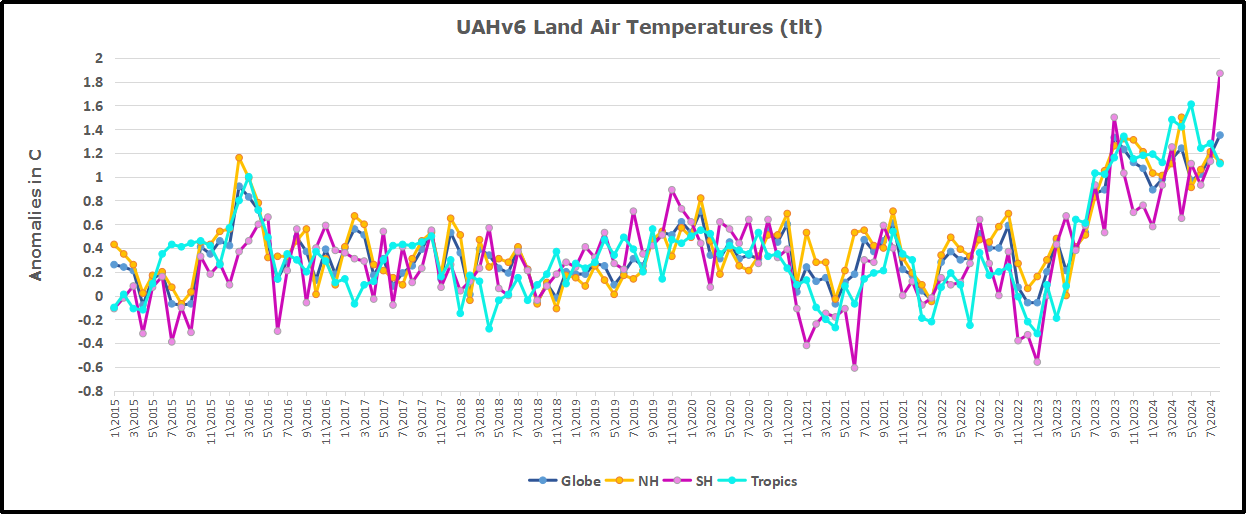
 

Here we have fresh evidence of the greater volatility of the Land temperatures, along with extraordinary departures by SH land.  Land temps are dominated by NH with a 2021 spike in January,  then dropping before rising in the summer to peak in October 2021. As with the ocean air temps, all that was erased in November with a sharp cooling everywhere.  After a summer 2022 NH spike, land temps dropped everywhere, and in January, further cooling in SH and Tropics offset by an uptick in NH. 

Remarkably, in 2023, SH land air anomaly shot up 2.1C, from  -0.6C in January to +1.5 in September, then dropped sharply to 0.6 in January 2024, matching the SH peak in 2016. Then in February and March SH anomaly jumped up nearly 0.7C, and Tropics went up to a new high of 1.5C, pulling up the Global land anomaly to match 10/2023. In April SH dropped sharply back to 0.6C, Tropics cooled very slightly, but NH land jumped up to a new high of 1.5C, pulling up Global land anomaly to its new high of 1.24C.

In May that NH spike started to reverse.  Despite warming in Tropics and SH, the much larger NH land mass pulled the Global land anomaly back down to the February value. In June, sharp drops in SH and Tropics land temps overcame an upward bump in NH, pulling Global land anomaly down to match last December. In July, all land regions rose slightly, and now in August a record spike up to 1.87 and pulling the Global land anomaly up by 0.17°C. Despite this land warming, the Global land and ocean combined anomaly rose only 0.03°C.

The Bigger Picture UAH Global Since 1980
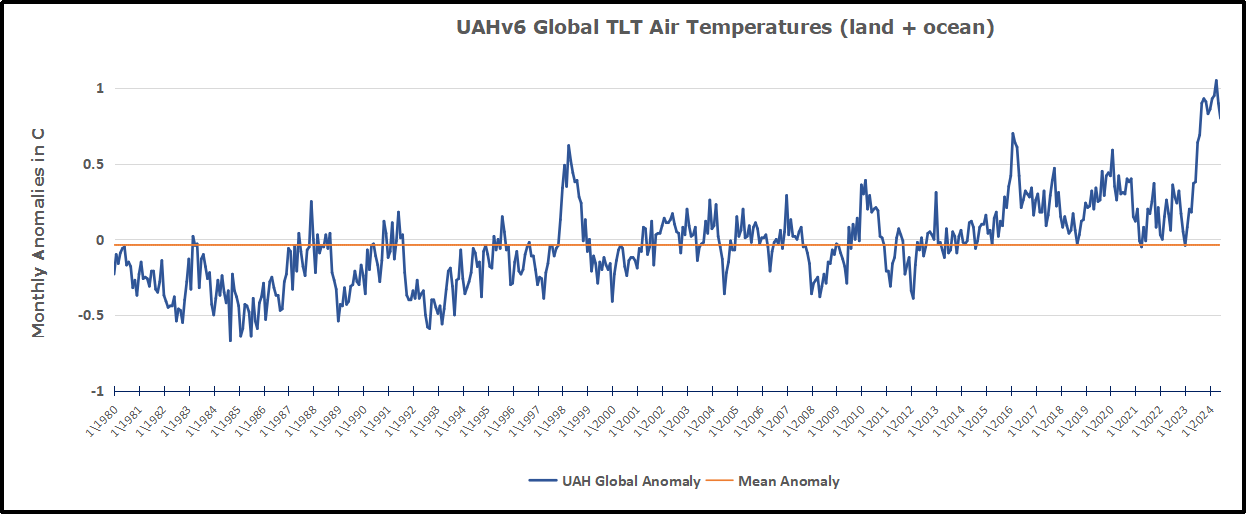
The chart shows monthly Global anomalies starting 01/1980 to present.  The average monthly anomaly is -0.04, for this period of more than four decades.  The graph shows the 1998 El Nino after which the mean resumed, and again after the smaller 2010 event. The 2016 El Nino matched 1998 peak and in addition NH after effects lasted longer, followed by the NH warming 2019-20.   An upward bump in 2021 was reversed with temps having returned close to the mean as of 2/2022.  March and April brought warmer Global temps, later reversed

With the sharp drops in Nov., Dec. and January 2023 temps, there was no increase over 1980. Then in 2023 the buildup to the October/November peak exceeded the sharp April peak of the El Nino 1998 event. It also surpassed the February peak in 2016. After March and April took the Global anomaly to a new peak of 1.05C.  The cool down started with May dropping to 0.90C, and in June a further decline to 0.80C.  Despite an uptick to 0.85 in July,   it remains to be seen whether El Nino will weaken or gain strength, and it whether we are past the recent peak.

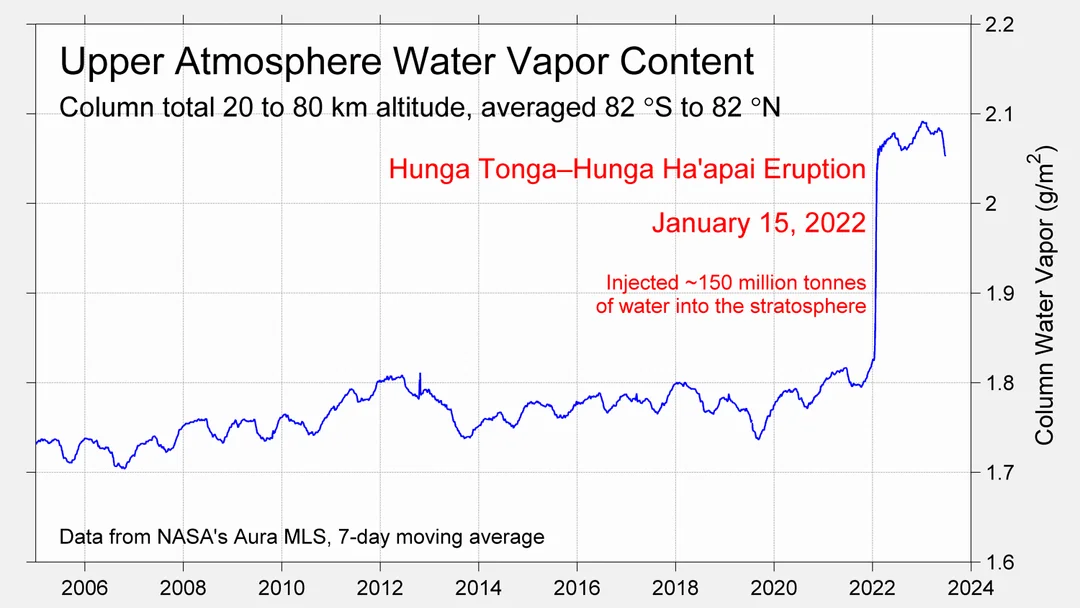
The graph reminds of another chart showing the abrupt ejection of humid air from Hunga Tonga eruption.
TLTs include mixing above the oceans and probably some influence from nearby more volatile land temps.  Clearly NH and Global land temps have been dropping in a seesaw pattern, nearly 1C lower than the 2016 peak.  Since the ocean has 1000 times the heat capacity as the atmosphere, that cooling is a significant driving force.  TLT measures started the recent cooling later than SSTs from HadSST4, but are now showing the same pattern. Despite the three El Ninos, their warming has not persisted prior to 2023, and without them it would probably have cooled since 1995.  Of course, the future has not yet been written.
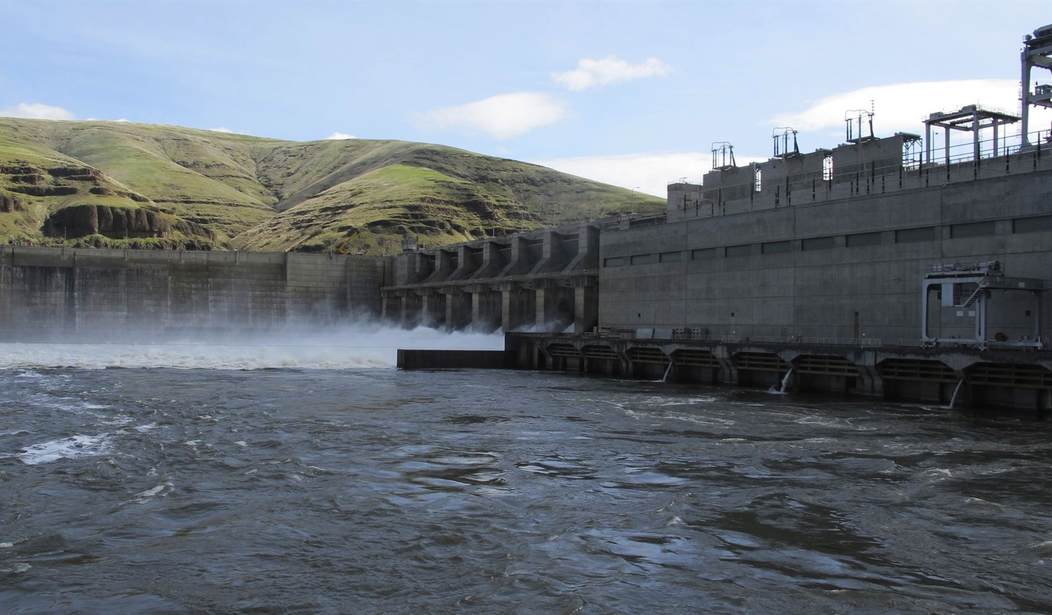
 

Fishy Activists Destroying Hydro Dams

AP Photo/Nicholas K. Geranios

John Stossel bring us up to date on the fishy case for removing hydroelectric dams on the Snake River in Washington state.  His Townhall article is A Dam Good Argument.  Excerpts in italics with my bolds.and added images.

Instead of using fossil fuels, we’re told to use “clean” energy: wind, solar or hydropower.  Hydro is the most reliable. Unlike wind and sunlight, it flows steadily.

But now, environmental groups want to destroy dams that create hydro power.

The Klamath River flows by the remaining pieces of the Copco 2 Dam after deconstruction in June 2023. |Located on Oregon/California border.Juliet Grable / JPR

“Breach those dams,” an activist shouts in my new video. “Now is the time, our fish are on the line!

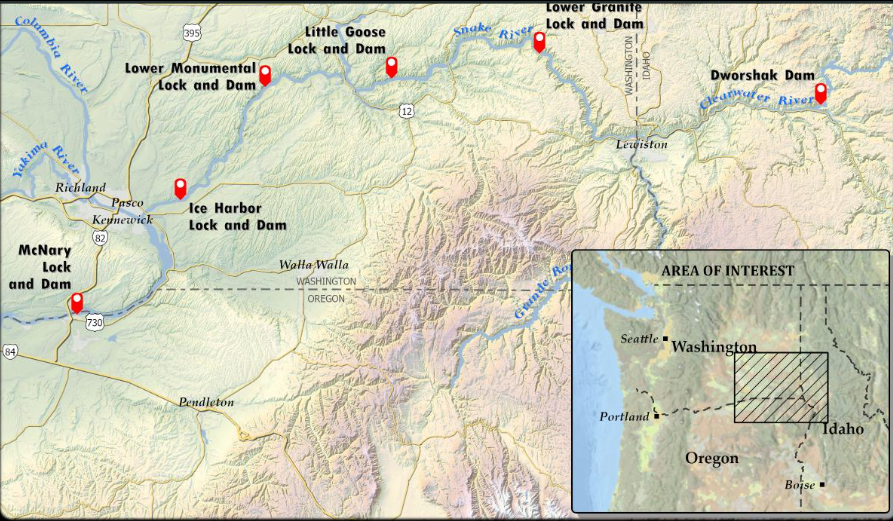
The activists have targeted four dams on the Snake River in Washington State. They claim the dams are driving salmon to extinction.

Walla Walla District Dams on the Snake & Columbia Rivers

It’s true that dams once killed lots of salmon. Pregnant fish need to swim upriver to have babies, and their babies swim downriver to the ocean.  Suddenly, dams were in the way. Salmon population dropped sharply.

But that was in the 1970s.Today, most salmon
make it past the dam without trouble.

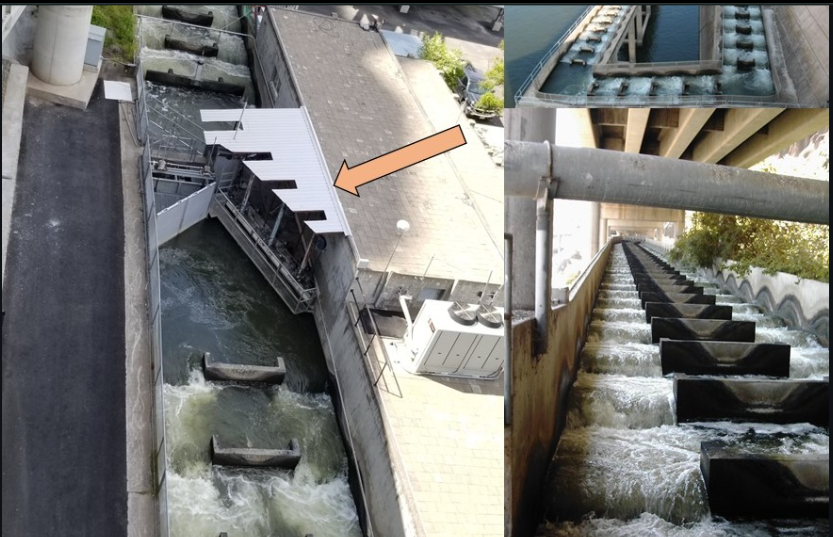
How?  Fish-protecting innovations like fish ladders and spillways guide most of the salmon away from the turbines that generate electricity.

Lower Granite fish count station & ladder (left, bottom right); Lower Monumental fish ladder (top right)  Source: Fish Passage Thru the Lower Snake & Columbia Rivers

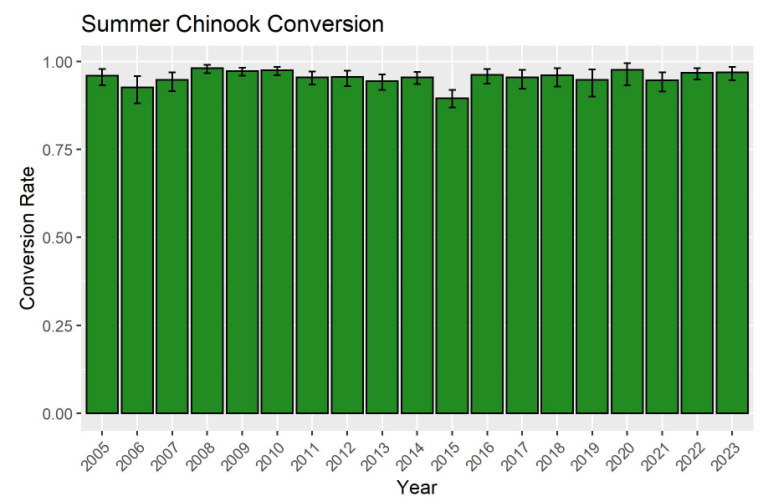
“Between 96% and 98% of the salmon successfully pass each dam,” says Todd Myers, Environmental Director at the Washington Policy Center.  Even federal scientific agencies now say we can leave dams alone and fish will be fine.

But environmental groups don’t raise money by acknowledging good news. “Snake River Salmon Are in Crisis,” reads a headline from Earthjustice.  Gullible media fall for it. The Snake River is the “most endangered in the country!” claimed the evening news anchor.

“That’s simply not true,” Myers explains. “All you have to do is look at the actual population numbers to know that that’s absurd.”  Utterly absurd. In recent years, salmon populations are higher than they were in the 1980s and 90s.

The fish passage report for 2023 (here) has many results like this for various species. Conversion refers to completing the Snake River run from Ice Harbor through Lower Granite.

“They make these claims,” Myers says, “because they know people will believe them … they don’t want to believe that their favorite environmental group is dishonest.”

But many are. In 1999, environmental groups bought an ad in the New York Times saying “salmon … will be extinct by 2017.” “Did the environmentalists apologize?” I ask Meyers. “No,” he says. “They repeat almost the exact same arguments today, they just changed the dates.

I invited 10 activist groups that want to destroy dams to come to my studio and defend their claims about salmon extinction. Not one agreed. I understand why. They’ve already convinced the public and gullible politicians.  Idaho’s Republican Congressman Mike Simpson says, “There is no viable path that can allow us to keep the dams in place.”

“We keep doing dumb things,” says Myers. “We put money into places where it doesn’t have an environmental impact, and then we wonder 10, 20, 30 years (later) why we haven’t made any environmental progress.”

Politicians and activists want to tear down Snake River dams
even though they generate tons of electricity.

“Almost the same amount as all of the wind and solar turbines in Washington state,” says Myers, “Imagine if I told the environmental community we need to tear down every wind turbine and every solar panel. They would lose their minds. But that’s essentially what they’re advocating by tearing down Snake River dams.”

I push back: “They say, ‘Just build more wind turbines.’”  “The problem is, several times a year, there’s no wind,” he replies. “You could build 10 times as many wind turbines, but if there’s no wind, there’s no electricity.”

Hydro, on the other hand, “can turn on and off whenever it’s needed. Destroying hydro and replacing it with wind makes absolutely no sense. It will do serious damage to our electrical grid.”

“It’s not their money,” I point out.”Exactly,” he says. “If you want to spend $35 billion on salmon, there’s lots of things we can do that would have a real impact.”  Like what?

Reduce the population of) seals and sea lions,” he says, “The Washington Academy of Sciences says that unless we reduce the populations, we will not recover salmon.” “People used to hunt sea lions,” I note. “Yeah, that’s why the populations are higher today.”

But environmentalists don’t want people to hunt sea lions or seals. Instead, they push for destruction of dams. “Because it’s sexy and dramatic, it sells,” says Myers. “It’s more about feeling good than environmental results.”

PostScript

Of course there is a political dimension to this movement.  Left coast woke progressives are targeting Lower Snake River dams located in Eastern Washington state.  Folks there and in Eastern Oregon would rather be governed by common sense leaders like those in Idaho.

The case against the dams is actually about climatism.  The fish are not at risk, as shown by many scientific reports. But climatists do not include hydro in their definition of “renewable.”  And they promote fear of methane, claiming dam reservoirs increase methane emissions.

So here’s the political solution.  Keep the dams open and the fish running to their spawning grounds.  And to appease climatists ban any transmission of electricity from those dams to Seattle and Western Washington state.  Deal?

Background Post

Left Coast Closes the Dam Lights

Antidote for Radiation Myopia

On a previous post a reader queried me about my position.  Taking him to be serious, I prepared a reply with resources that can serve anyone wanting to understand radiative GHG theory and reality.  The key is to escape radiation myopia, that is focusing on radiative energy transfers in earth’s climate system to the exclusion of the other transfers.  Energy in our world moves by conduction, convection and phase changes of H2O in addition to radiation.  And not surprisingly at any place and time, the most active mode is the one with the least resistance.

The post triggering the question was this one:

The Original Sin of GHG Theory

My Reply to Questioner

Thanks for your response. Your inital question sounded trollish, but I take your comment seriously.

Firstly, you said “I’ve never seen anyone outside of the anti-GHG crowd ever talk about “back-radiation”. Actually references to that notion are readily found since it is the primary way global warming/ climate change is explained to the public. Some examples:

“However, GHGs, unlike other atmospheric gases such as oxygen and nitrogen, are opaque to outgoing infrared radiation. As the concentration of GHGs in the atmosphere increases due to human-caused emissions, energy radiated from the surface becomes trapped in the atmosphere, unable to escape the planet. This energy returns to the surface, where it is reabsorbed.” UNEP

“Greenhouses gases are atmospheric gases such as carbon dioxide (CO2), methane (CH4), and water vapor (H2O) that absorb and re-radiate heat, which warms the lower atmosphere and Earth’s surface. This process of absorption and re-radiation of heat is called the greenhouse effect. Although greenhouse gases only make up a small percentage of the atmosphere, small changes in the amount of greenhouse gases can greatly alter the strength of the greenhouse effect, which in turn, affects the Earth’s average temperature and climate. UCBerkeley

“As CO2 soaks up this infrared energy, it vibrates and re-emits the infrared energy back in all directions. About half of that energy goes out into space, and about half of it returns to Earth as heat, contributing to the ‘greenhouse effect.’ ColumbiaU

The favored term now is “re-radiation” and it is central in the narrative everywhere, including among others, NASA, MIT and of course multiple UN agencies. So it is necessary to debunk the notion.

I know as well as you that back- or re-radiation is a caricature, and climate scientists make a different claim, namely raising the ERL which slows the cooling. That theory is also wrong for different empirical reasons. See:

Refresher: GHG Theory and the Tests It Fails

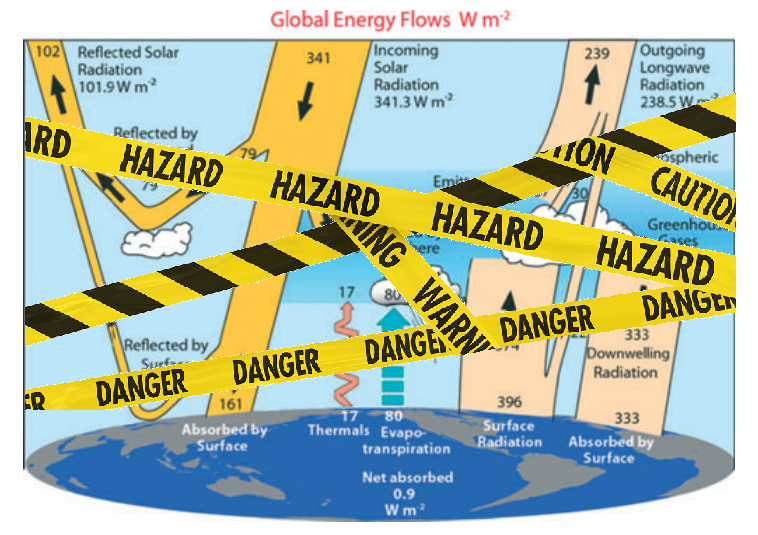
Secondly, the root issue is the abuse of Stefan-Boltzman law to create a fictious downward energy transfer, such as seen in energy balance cartoons, misleading and not funny. The equation calculates the transfer from the difference in temperature between two bodies in thermal contact, it does not attribute thermal radiation to each of them. Full explanation here:

Experimental Proof Nil Warming from GHGs

And regarding the failed energy balance diagrams:

Fatal Flaw in Earth Energy Balance Diagrams

For extra credit and insight, look at a Sabine Hosenfelder video to understand how current GHG theory goes astray. Link includes excerpts and critique.

Sabine’s Video Myopic on GHG Climate Role

Summary

“The Earth, a rocky sphere at a distance from the Sun of ~149.6 million kilometers, where the Solar irradiance comes in at 1361.7 W/m2, with a mean global albedo, mostly from clouds, of 0.3 and with an atmosphere surrounding it containing a gaseous mass held in place by the planet’s gravity, producing a surface pressure of ~1013 mb, with an ocean of H2O covering 71% of its surface and with a rotation time around its own axis of ~24h, boasts an average global surface temperature of +15°C (288K).

Why this specific temperature? Because, with an atmosphere weighing down upon us with the particular pressure that ours exerts, this is the temperature level the surface has to reach and stay at for the global convectional engine to be able to pull enough heat away fast enough from it to be able to balance the particular averaged out energy input from the Sun that we experience.

It’s that simple.”  E. M. Smith


See Also

New Wholistic Paradigm of Climate Change


August 2024 Arctic Ice, NOAA Missing Nearly Half a Wadham

The images above come from AARI (Arctic and Antarctic Research Institute) St. Petersburg, Russia. Note how the location of remaining ice at late August varies greatly from year to year.  The marginal seas are open water, including the Pacific basins, Canadian Bays (Hudson and Baffin), and the Atlantic basins for the most part.  Note ice extent fluctuations especially in Eurasian seas (lower right) and in Can-Am seas (upper right).  Notice the much greater ice extent in 2021 compared to 2018. As discussed later on, some regions retain considerable ice at the annual minimum, with differences year to year. [Note: Images prior to 2009 are in a different format.  AARI Charts are (here)

The annual competition between ice and water in the Arctic ocean is approaching the maximum for water, which typically occurs mid September.  After that, diminishing energy from the slowly setting sun allows oceanic cooling causing ice to regenerate. Those interested in the dynamics of Arctic sea ice can read numerous posts here.  This post provides a look at end of August from 2007 to yesterday as a context for anticipating this year’s annual minimum.  Note that for climate purposes the annual minimum is measured by the September monthly average ice extent, since the daily extents vary and will go briefly lowest on or about day 260. In a typical year the overall ice extent will end September slightly higher than at the beginning.

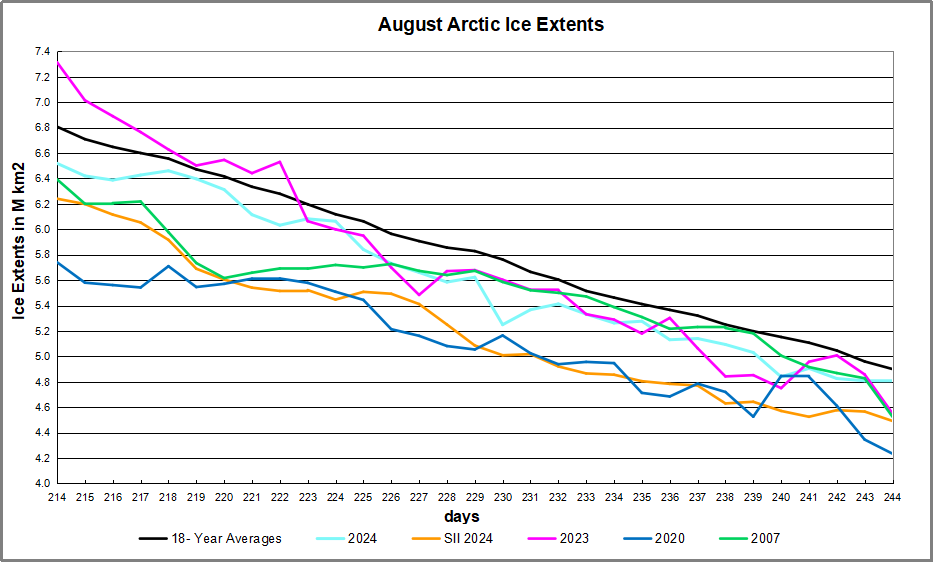
The melting season mid July to mid August shows 2024 melted at nearly the average rate, while retaining more ice extent at the end than some other recent years of note.

Firstly note that on average August shows ice declining 1.8M km2 down to 4.9M km2.  2024 started 288k km2 below average and on day 244 was only 98k km2 or 2% in deficit to average. The extents in Sea Ice Index in orange  were considerably lower during August, meaning that SII August 2024 monthly average will be ~400k km2 lower than MASIE., nearly half a Wadham.

The table for day 244 shows how large how the ice is distributed across the various seas comprising the Arctic Ocean.

Region 2024244 Day 244 ave 2024-Ave. 2007244 2024-2007
 (0) Northern_Hemisphere 4802455 4900416 -97962 4525136 277319
 (1) Beaufort_Sea 331017 568911 -237894 629454 -298437
 (2) Chukchi_Sea 508350 261504 246846 96232 412118
 (3) East_Siberian_Sea 476831 342187 134644 196 476635
 (4) Laptev_Sea 209967 163938 46029 245578 -35612
 (5) Kara_Sea 253 47999 -47746 74307 -74054
 (6) Barents_Sea 0 15867 -15867 11061 -11061
 (7) Greenland_Sea 101048 171695 -70647 288223 -187174
 (8) Baffin_Bay_Gulf_of_St._Lawrence 51428 26156 25272 32804 18624
 (9) Canadian_Archipelago 224943 301460 -76516 234389 -9445
 (10) Hudson_Bay 3868 19658 -15790 28401 -24533
 (11) Central_Arctic 2893622 2980244 -86622 2883200.58 10421

The largest deficit to average is in Beaufort Sea, followed by smaller losses in Greenland Sea, CAA and Central Arctic.   Hudson Bay and Barents Sea are mostly open water. The offsetting surpluses are in Chukchi, East Siberian and Laptev seas.

For context, note that the average maximum has been 15M, so on average the extent shrinks to 30% of the March high before growing back the following winter. Presently 2024 is at 32% of last March maximum.  In this context, it is foolhardy to project any summer minimum forward to proclaim the end of Arctic ice.

Resources:  Climate Compilation II Arctic Sea Ice

Warning! Trojan Horses Offshore (Wind Farms)

Gordon Hughes explains the analogy in his Real Clear Energy article Offshore Trojan Horses.  Excerpts in italics with my bolds and added images.

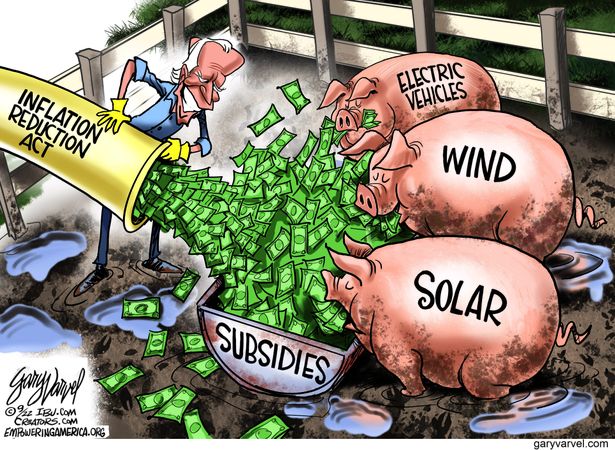
In July, the U.S. Department of Interior greenlighted large offshore wind farms in New Jersey and Maryland. Once the financial agreements are in place, New Jersey’s Atlantic Shores and Maryland’s MarWin and Momentum will join the two large wind farms in New York approved in June. These projects will receive huge, multibillion-dollar subsidies from the federal government and electricity ratepayers. What benefits will New Jersey and Maryland enjoy from this flood of money?   

To answer this question, it is best to recall the classic warning of the Trojan Horse legend,  “Beware of Greeks bearing gifts”—in other words, the hidden dangers of accepting something that seems too good to be true. New York State ignored that warning when it agreed to pay very high prices for the electricity to be supplied from its new offshore wind farms—Empire Wind 1 and Sunrise Wind—located off the coast of Long Island.

In announcing the final agreements, New York Governor Kathy Hochul triumphantly claimed that the new projects would create more than 800 jobs during the construction phase and deliver more than $6 billion in economic benefits for the state over 25 years. 

Rather less emphasis was given to the fact that New York will pay an average price of over $150 per MWh (megawatt hour) for the electricity generated by Empire Wind 1 and Sunrise Wind.That’s more than four times the average wholesale price of electricity in New York during 2023–24, $36 per MWh. The total annual premium over the wholesale market price for the power from these wind farms will be about $520 million per year at 2024 prices. Over 25 years, New York ratepayers will be paying about $13 billion for alleged benefits of $6 billion.

That is not all. Thanks to tax credits, U.S. taxpayers will cover at least 40% of the costs of constructing the wind farms. At a minimum cost of $5.5 million per MW (million watts) of capacity, the total federal subsidy for New York’s two wind farms will be at least $3.8 billion.

What about jobs and other economic benefits?  A study prepared for Equinor, the owner of Empire Wind 1, and submitted to the federal Bureau of Ocean Energy Management (BOEM) claimed that it would directly generate 180 annual jobs in New York during the six-year construction phase. The study estimated another 60 annual jobs due to the indirect employment effect, i.e., extra employment in the supply chain for the project. 

A more reasonable estimate for the two projects together would be 515 annual jobs, not 800. The total contribution to New York State’s gross value added (the equivalent of GDP at the state level) during the construction of both projects would be less than $450 million, based on the report submitted to BOEM. Similar calculations for annual operating and maintenance (O&M) costs suggest an annual contribution of about $24 million to gross value-added or about $600 million over 25 years.

Rather than the benefits of $6 billion over 25 years touted by Governor Hochul, a realistic assessment would be closer to $1.1 billion at 2024 prices. In any event, residents will be paying a cumulative premium of $13 billion for  the electricity these projects will generate. 

Moreover, the additional jobs claimed for the project are concentrated heavily in the final year of construction—and the largest share (47%) consists of professional services. Overwhelmingly, these are jobs for people who would otherwise be working on other assignments.

The economic benefits of the two offshore wind farms are much lower than claimed by the governor and the jobs are, in large part, temporary assignments for professional services staff. Promoting business for consulting firms may be considered a desirable outcome by Ms. Hochul. Still, the very high financial burden will be borne by almost the entire population of the state.

Stepping back from the New York projects, the Biden administration’s overall goal is to reach a target of 30 GW (billion watts) of offshore electricity generation capacity by 2030 or shortly thereafter. That is equivalent to 17 times the capacity of the combined Empire Wind 1 and Sunrise Wind projects. Detailed costs and financial arrangements vary, but the figures above suggest that the recurring premium paid by electricity ratepayers in states with offshore wind farms will be about $9 billion per year. The benefits of new job creation and incomes from capital and O&M expenditures are likely to be less than $800 million per year. 

In addition to the very large subsidies paid for from ultra-high electricity bills, federal taxpayers will contribute about $65 billion via tax credits if the Biden administration’s offshore wind target is met. While the subsidies for individual projects may not seem outrageous, the commitment of money to subsidize offshore generation is about $870 for every member of the country’s population. This may be spread over 25 years, but it is a huge liability for one very small element of U.S. programs to support renewable energy. 

PS  And it’s doubtul how many wind turbines will last 25 years

The Short Lives of Wind Turbines