
NY Post reports Biden admin brought unprecedented climate change prosecution against man for ‘smuggling greenhouse gases’ by transporting refrigerants. Excerpts in italics with my bolds and added images.
The Biden administration boasted in an Environmental Protection Agency (EPA) report released Thursday about the unprecedented prosecution of a California man for “smuggling greenhouse gases” across the border from Mexico and selling them online.
Michael Hart, 58, was arrested in March and pleaded guilty in September to charges related to transporting refrigerants into the US to peddle on Facebook Marketplace, OfferUp and other online vendors between June and December 2022.
Biden’s EPA touted the crackdown on Hart, the first-ever person charged for climate change-related bootlegging of refrigerants — namely, hydrochlorofluorocarbons (HFCs) — without the agency’s approval, in its report.
When charging the San Diego resident earlier this year, US Attorney Tara McGrath vowed “it will not be the last” case of its kind.
After some investigation it appears this “victory” in the fight
against climate change is a lot of puffery with very little substance,
and worse more overreach by the EPA.
Background
The Montreal Protocol, ratified in 1987, forced the industrialized world to switch from chlorofluorocarbons (CFCs) to hydrofluorocarbons (HFCs) on the theory that CFCs break down the ozone layer.
Both the formation and depletion of the ozone layer depend on ultraviolet light from the Sun. The theory was that UV splits chlorine atoms from the CFCs. The CFCs sat around all winter, moving into position, waiting … and then just as the Sun returned, the chlorine radicals chewed up the ozone as it was being formed, producing a brief downward spike in ozone at the start of the Antarctic summer. This is the famous ozone hole.
The actual measurements look very peculiar, which means there’s more going on than just a simple chain of free-radical reactions. But NASA and the climatologists were confident that the mystery was solved. As with the AGW debate, most agree that it could theoretically happen; the debate is over how big the effect is and how important it is.
Four popular HFCs in use today as refrigerants are R-410a, R-407c, R-143a, and R-134a. The average GWP of the HFCs currently in use, weighted by usage, is about 1600. Enviros are claiming that eliminating these so-called high-GWP HFCs will prevent up to 0.5°C of warming by 2100. Due to the huge variability in the predictions of the various models, this could be anywhere from 8 to 100% of what the models predict. What is remarkable is that absolutely nobody seems to have noticed any of this until the patents ran out.
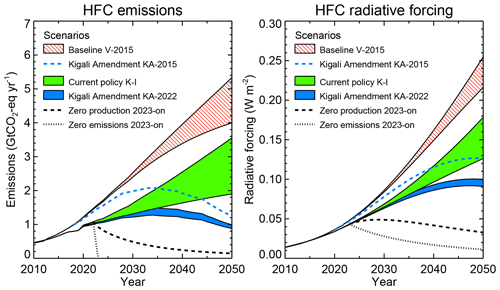
Global total HFC emissions (GtCO2eq.yr-1; left panel) and radiative forcing (right panel) from the V-2015 baseline scenarios developed in Velders et al. (2015) and the updated scenarios derived here (current policy Kigali independent (K-I) and KA-202. Figure: Velders et al., Atmospheric Chemistry and Physics, 2015
From  Chemical Sciences Laboratory
As substitutes for ozone-depleting substances, the emissions of HFCs have increased substantially over the past two decades as a result of the phaseout of ozone-depleting substances under the Montreal Protocol. Due to the growing climate impact of HFCs, the Kigali Amendment to the Montreal Protocol has scheduled a phase-down of their future production and consumption. The results show that total CO2 equivalent global HFC emissions derived from NOAA observations continue to increase through 2019, but are about 20% lower than previously projected for 2017-2019, mainly because of the lower global emissions of HFC-143a, which is one of the longer-lived HFCs in use today. Current policies reduce projected emissions in 2050 from 4.0-5.3 GtCO2eq.yr-1 in the absence of controls to 1.9-3.6 GtCO2eq.yr-1, and the added provisions of the Kigali Amendment reduce the projected emissions further to 0.9-1.0 GtCO2eq.yr-1. Without any controls, HFC emissions are projected to contribute 0.28-0.44 °C to global surface warming by 2100, compared to a contribution of about 0.04 °C by 2100 with Kigali Amendment controls.
Comment:
The HFC emissions in the left panel are on a scale of 1 to 5 GtCO2eq.yr-1. So HFCs are estimated to have a GHG effect in single digits compared to CO2 emissions which in 2022 were ~37 Gt. On the right panel, the warming effect is estimated to range between 0.05 and 0.25 W per m^2. Putting this into context, The energy budget of our climate system involves the absorption and reemission of about 200 watts per square meter. Doubling CO2 involves a 2% perturbation to this budget. HFCs are an order of magnitude less, taking IPCC estimates at face value. But there’s more.
Why would HFCs and CFCs cause global warming?
Most articles merely say that HFCs cause global warming because they possess a high GWP. This is a circular argument, because GWP simply means global warming potential.
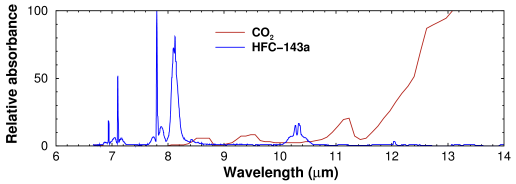
The real explanation is that they absorb thermal (mid-)infrared radiation at wavelengths that don’t overlap with carbon dioxide. The infrared spectra of HFC-125 and HFC-143a have three bands in the mid-infrared which have little overlap with carbon dioxide (CO2):
But look at the spectrum of absorption by H2O and other IR-active gases:
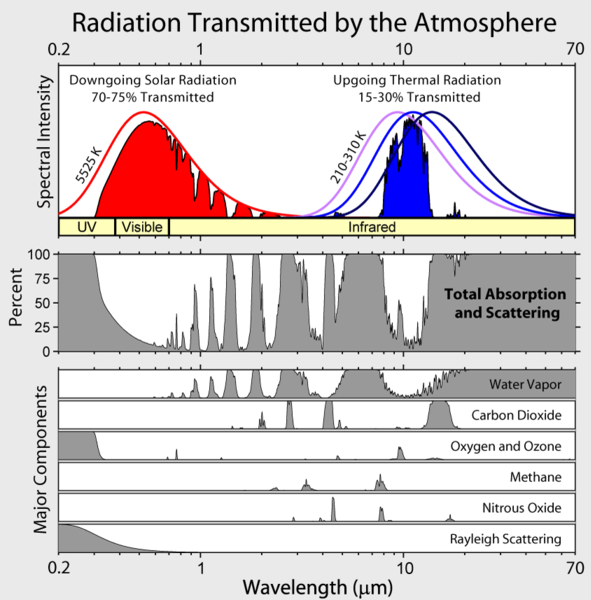
The absorption spikes by HFCs at 7 to 8 μm are already covered by the higher concentrations of H2O. There’s little radiation for HFCs to absorb, so the Global Warming Potential is hypothetical.

Footnote:
A major clarification in 2017 came from the DC Court of Appeals ordering EPA (and thus the Executive Branch Bureaucracy) to defer to Congress regarding regulation of substances claimed to cause climate change. While the issue and arguments are somewhat obscure, the clarity of the ruling was welcome. Basically, the EPA under Obama attempted to use ozone-depleting authority to regulate HFCs, claiming them as greenhouse gases. The judges decided that was a stretch too far.
However a 2020 law passed by Congress prohibits importation of HFCs without allowances issued by the EPA. The law is part of a global phaseout designed to slow climate change.
 Science Matters
One comment