Suddenly, climate media activists are proclaiming that doing away with hydrocarbon fuels will increase energy security for most nations. Headlines like these abound:
Decarbonization improves energy security for most countries, study finds, Phys.org
Ditching fossil fuels would improve energy security for most countries, new research finds, Euronews (English)
Decarbonization improves energy security for most countries, Science Daily
Decarbonization improves energy security for most countries, study finds, Stanford Report
The last one comes from Stanford, the source of the study being Stanford professor Steve Davis. The paper is Trade risks to energy security in net-zero emissions energy scenarios. The overview is:
Researchers analyzed trade-related risks to energy security across 1,092 scenarios for cutting carbon emissions by 2060. They found that shifting from dependence on imported fossil fuels to increased dependence on critical minerals for clean energy can improve security for most nations – including the U.S., if it cultivates new trade partners.
From Stanford Report:
As a first step, lead author Jing Cheng, a postdoctoral scholar in Davis’s Sustainable Solutions Lab at Stanford, built a database of countries with reserves of oil, gas, coal, uranium, biofuels, and any of 16 materials that are critical for clean energy technologies, along with the trade flows of these resources between countries.
The researchers calculated how much of these resources would be required to meet energy demand in each of 236 countries in 1,092 different scenarios for reaching net-zero carbon emissions globally by 2060. Modeled by the Intergovernmental Panel on Climate Change, or IPCC, the scenarios span a broad range of possible changes to the energy mix across the globe and within individual countries. Some are more dependent on nuclear energy, for example, while others incorporate more solar or wind power.
For the thousands of combinations of trade relationships and resource needs, the team estimated the level of risk in each country’s transportation and electricity sectors, and overall energy system. They quantified these risks using a new “trade risk index” based on the availability of domestic reserves, the share of demand for a given fuel or material met by imports, the economic value of the imports, and a measure of market concentration widely used to quantify energy security.
The researchers found that if all countries maintain their current networks, trade-related risks to energy security would decline on average by 19% in net-zero scenarios. If countries expand their networks and trade with all resource owners, then trade risks on average would fall by half.
Reducing the need for imported virgin materials – whether by making technologies last longer, ramping up recycling, or developing less material-intensive designs – is another way for mineral-poor countries to minimize trade risks while eliminating fossil fuels. According to the study, trade risks fall on average by 17% – and by more than 50% for the U.S. – with a quadrupling of today’s meager recycling rates for critical minerals such as lithium, nickel, and indium.
“Most people are focused on the new stuff that could be a problem, and not really considering the security benefits of moving away from fossil fuels.” Steve Davis, Professor of Earth System Science
A Look at the Realities that Refute the Imagined Security Benefits
1. Hydrocarbon fuels are available through a long established world-wide production and supply network. Renewables are dependent on critical minerals from a few sources, dominated by China.
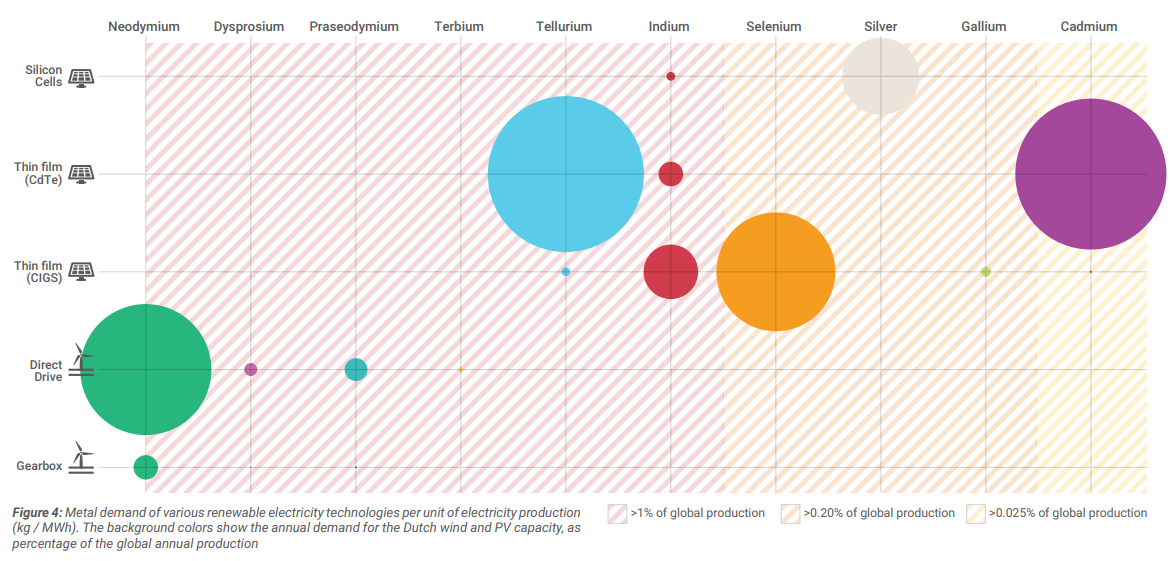
Metal demand per technology
There are various technologies available for the production of electricity through wind and solar. Each technology requires different amounts of critical metals. This figure shows the metal demand for the five most common technologies.
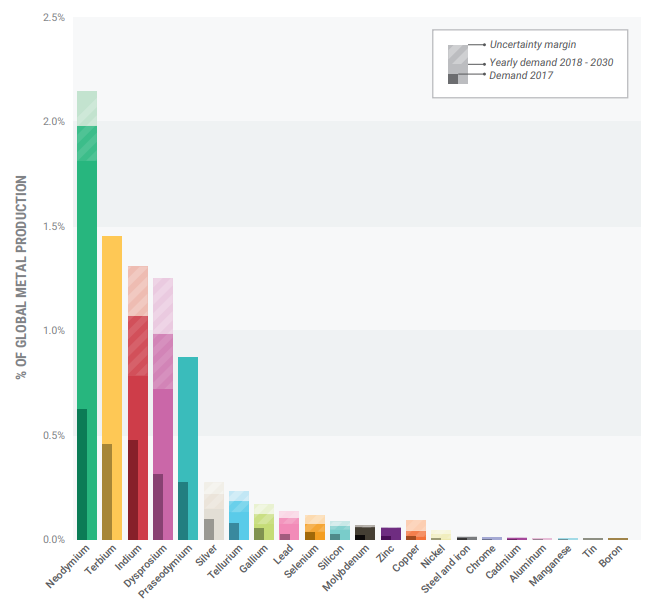
Metal demand for Dutch renewable electricity production
This chart shows the average annual metal demand (for 22 metals) required for the installation of new solar panels and wind turbines. This assumes a linear installation of capacity.
The annual metal demand is compared to the annual global production of these specific metals, resulting in an indicator for the share of Dutch demands for renewables in global production.
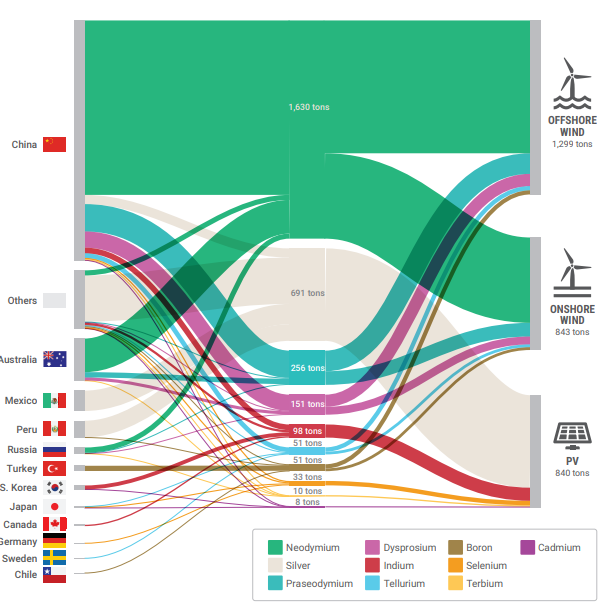
Origin of critical metals
This diagram shows the origin of the metals required for meeting the 2030 goals. The left side of the diagram shows the origin, based on today’s global production of metals. The right side shows the cumulative metal demand for wind and solar technologies until 2030.
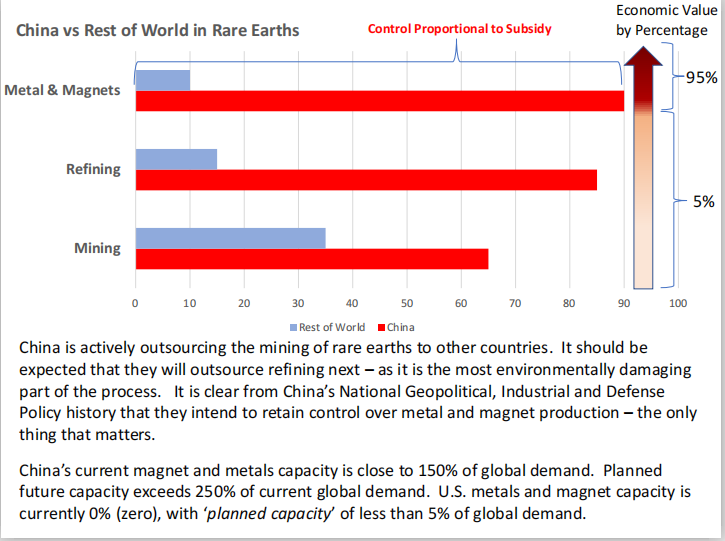
And there is another precious resource required for wind and solar power plants: Land in proximity to human settlements

Land required for wind turbines to power London UK.
2. Renewable Energy from Wind and Solar is Intermittent and Expensive


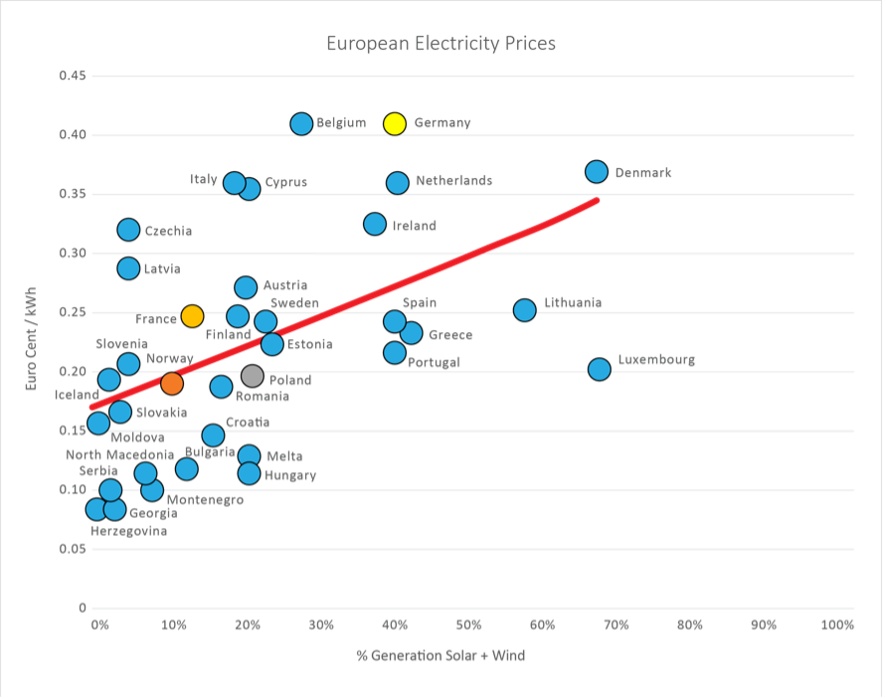
The high price of wind and solar deployed at society-scale illustrates an important cost of supply principle. Because everyone needs reliable energy—whether electricity, gasoline, or heating fuel—the higher the overall costs, the more damaging it is proportionally for those who can least afford it. High-cost energy policies are what economists call regressive. Ironically, some of the most “progressive” energy policies—i.e., incentivising and mandating solar, wind, and batteries, and forcing fossil fuels from the market—result in regressive economic impacts. Governments can subsidise such costs for the most disadvantaged, but such subsidies are unsustainable at society scales. A diverse portfolio of energy options, including primary use of conventional generation, is much healthier to meet the range and scales of demands. (Source: The Choices We Face | Energy for the 21st Century: A Declaration of Guiding Principles.)
3. What about all the other essentials we get from hydrocarbons, not from renewables?

See Also: World of Hurt from Climate Policies (four-part series)
This is a beginning post toward infographics exposing the damaging effects of Climate Policies upon the lives of ordinary people. And all of the pain is for naught in fighting against global warming/climate change, as shown clearly in the image above. This post presents graphics to illustrate the first of four themes:
- Zero Carbon Means Killing Real Jobs with Promises of Green Jobs
- Reducing Carbon Emissions Means High Cost Energy Imports and Social Degradation
- 100% Renewable Energy Means Sourcing Rare Metals Off-Planet
- Leave it in the Ground Means Perpetual Poverty
 Science Matters