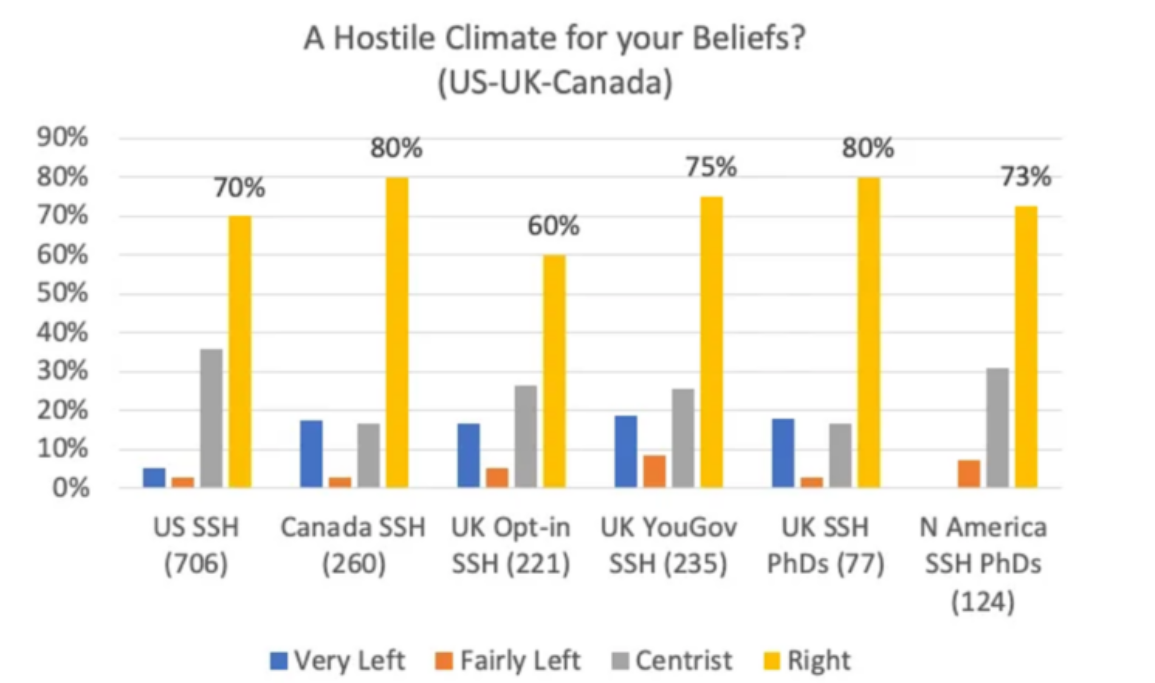
Research by U.K. politics professor Eric Kaufmann (top left) showed that 80 percent of Canada’s right-leaning academics report a hostile environment for their beliefs. The proportion was the same in the UK and was 70 percent in the U.S. In all three countries, the percentage of “very left” academics reporting hostility towards their beliefs was less than 20 percent.
James Piereson writes at City Journal Trump Is Likely to Win His Fight with Universities. Excerpts in italics with my bolds and added images.
The administration holds many cards,
and it seems determined to play them all.
The universities have compromised themselves with the alliance they have formed with the Democratic Party and their dependency on taxpayer funds provided by Democrats, Independents, and Republicans alike. Universities should not have let themselves become so attached to any political party or ideological point of view, lest they compromise the intellectual integrity of their institutions or jeopardize the taxpayer funding that they badly need. But that is precisely what has happened at Harvard, Columbia, Northwestern, and other leading institutions. It is something the Trump administration hopes to change.
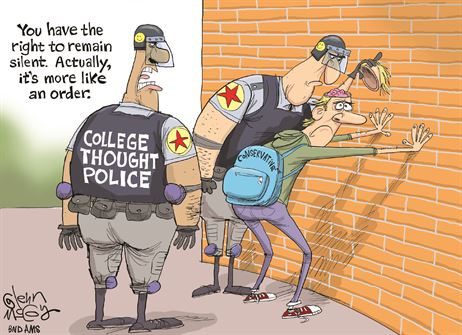
Trump has said that he wants to use the lever of federal funding to force university leaders to confront several issues: the lack of intellectual diversity on their campuses, with upward of 80 percent of faculty members identifying as liberals or progressives, and less than 2 percent as conservatives; the refusal to enforce race- and gender-blind civil rights laws, and the continued use of preferences in admissions and employment, in violation of the 2023 Supreme Court decision in Students for Fair Admissions v. Harvard University; the failure to protect the rights of Jewish students amid demonstrations on campus of anti-Semitism and hatred of Israel; administrative “bloat,” reflected in how college campuses today employ more administrators than professors teaching courses; tuition increases that far outpace inflation, leading to ever more student borrowing and debt underwritten by federal loan programs; and the continued presence of ideological departments and programs on campuses that do not allow for diversity of intellectual approaches.

The Trump administration has tried to influence institutions by freezing payment of federal funds, but there is a more effective way to do this—one less likely to cause mayhem in scientific programs and medical schools and less prone to being overturned by the courts: Trump should use the leverage of prospective grants to induce institutions to abide by federal law and begin reforming their internal operations.
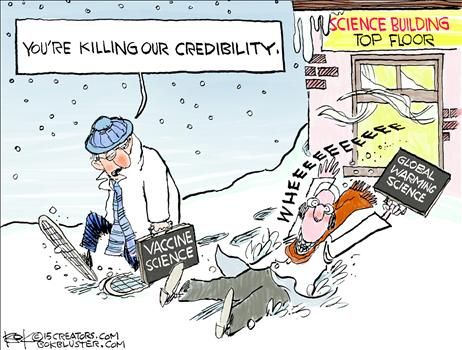
These institutions will come back to the federal government every year with proposals for new funding. The Trump administration is not required to make new awards to these institutions. These can be made on the condition that the institutions are taking concrete steps to reform themselves. If they thumb their noses at Trump, then the administration can decide that grants and contracts that have gone to Harvard, Columbia, and Johns Hopkins in the past might be given in the future to the University of Alabama, Ohio State, or the University of Montana. Such a redistribution of federal funds might even bring about a useful realignment in the scientific prestige of American universities, as some move down and others move up the reputational ladder.

Some of Trump’s goals in regard to higher-education reform are already subsumed under grant participation agreements that institutional representatives must sign before federal departments can sign off on grants and awards. Those agreements oblige recipients to comply with provisions of the Civil Rights Act (1964), the Title IX educational amendments (1972), and other regulations in regard to discrimination by age and handicap status. In light of the Supreme Court decision in the SFFA v. Harvard case, along with Trump’s executive orders in regard to civil rights, those agreements oblige recipient institutions to abandon all preference programs, including DEI programs created to advance preferences in university life. More than a few institutional representatives will have a hard time signing these agreements going forward because of lingering preference programs on their campuses. In any case, the administration can supplement those agreements with addenda that include other issues it wants universities to address.

The questions asked of institutional representatives might include:
Does the institution pledge to abide by federal civil rights laws that forbid group preferences in admissions and employment?
Has the institution taken steps to guarantee the rights of Jewish students against attacks arising out of anti-Semitism or hatred of Israel?
What steps has the institution taken to create greater intellectual diversity on its campus?
Has the institution adopted measures to reduce the number of administrators on campus and to eliminate administrative departments that try to enforce group preferences in violation of federal law?
Has the institution limited tuition increases to the level of inflation in order to reduce expenses for students?
These questions should clarify the choice Trump is asking these institutions to make:
either change current practices or forgo federal research funds.
Over the four years of this second Trump administration, such an approach might have genuine and constructive consequences for the operation of American universities. Will Johns Hopkins University spurn $3.3 billion in federal grants next year in order to preserve its DEI bureaucracy? Will NYU give up $879 million in research grants next year in order to maintain its gender studies programs, or programs in the law school that advocate for group preferences? Universities may have to make hard choices between future federal funding and ideological programs currently in place.

This is precisely what liberals, feminists, and other activists did in the 1970s when they forced universities to sign “affirmative action” pledges, which soon turned into agreements to enforce group preferences in faculty hiring and employment. That approach evolved into the campaign for diversity later in that decade, when the Supreme Court ruled that preferences might be used to advance diversity in colleges and universities, and more recently into the DEI crusade that emerged in the wake of the George Floyd incident. That crusade proved to many that the entire enterprise had gone way too far. After five decades, with much academic mischief to show for it, the approach has hit a wall with the Trump administration.
Harvard and other universities are likely to find that they
are fighting a losing battle against the federal government.
Harvard has an endowment of $53 billion, by far the largest among the nation’s universities, but that’s little more than a rounding error in the government’s $7 trillion budget. Here the government negotiates from a strong position because, while federal grants loom large in university budgets, they are only a small fraction of the government’s budget.

The government has other weapons at its disposal. There is the tax exemption, for starters, which, if lost, will mean that schools cannot receive tax-deductible donations.. The government can stop the flow of international students to the schools, a move that would be costly in terms of foregone tuition payments. Trump can also ask Congress to slap a hefty tax on university endowments, another step his administration is already considering. At some point, Harvard and other elite institutions will have to sue for peace rather than continue an argument they cannot win.
In any case, the Trump administration holds many cards in this showdown with the universities, and it seems ready to play them all.
 Science Matters