On May 29, 2025 SCOTUS ruled unanimously that NEPA (National Environmental Protection Act) can no longer be a tool for political activists against development projects. The report from MSN is US Supreme Court limits environmental reviews in Utah railway ruling. Excerpts in italics with my bolds and added images.
The U.S. Supreme Court dealt a setback to environmentalists on Thursday by allowing federal agencies to limit the scope of their reviews of the environmental impact of projects they regulate, as the justices bolstered a Utah railway project intended to transport crude oil.
The 8-0 ruling overturned a lower court’s decision that had halted the project and had faulted an environmental impact statement issued by a federal agency called the Surface Transportation Board in approving the railway as too limited in scope. The project was challenged by environmentalists and a Colorado county.
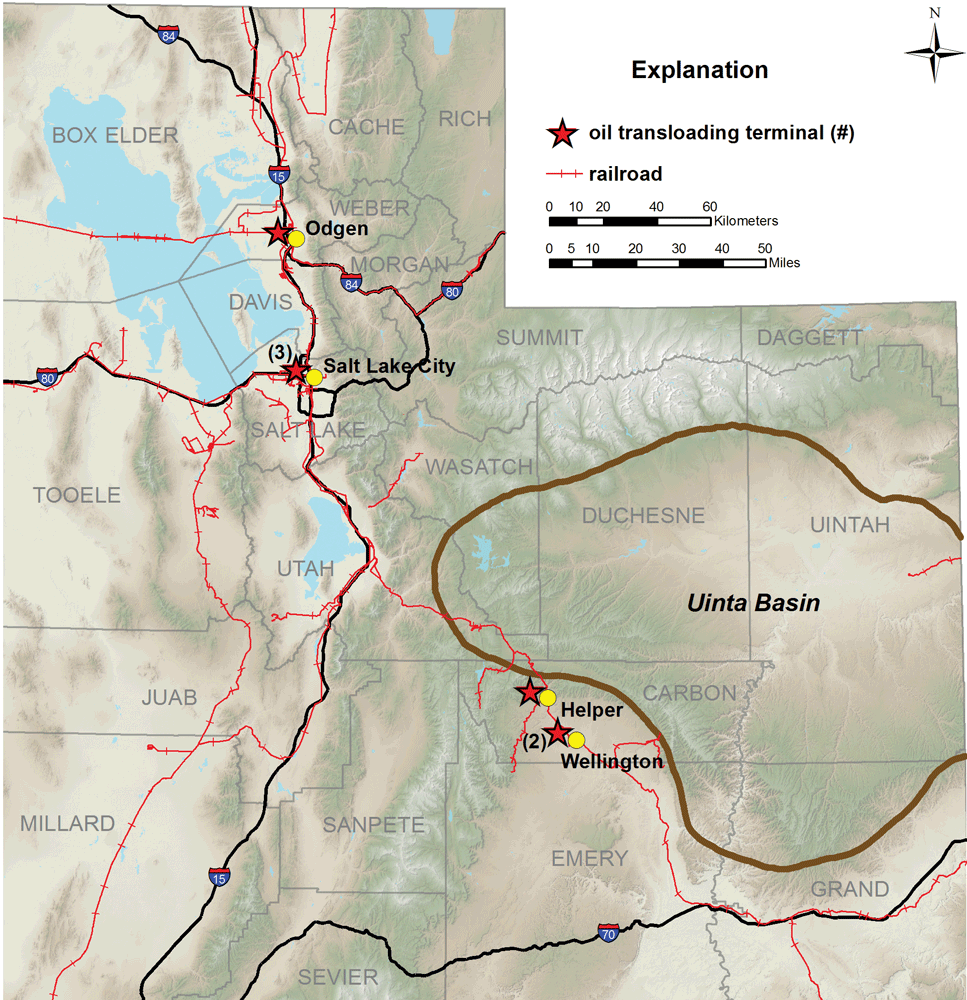
A coalition of seven Utah counties and an infrastructure investment group are seeking to construct an 88-mile (142-km) railway line in northeastern Utah to connect the sparsely populated Uinta Basin region to an existing freight rail network that would be used primarily to transport waxy crude oil.
The case tested the scope of environmental impact studies that federal agencies must conduct under a U.S. law called the National Environmental Policy Act (NEPA), enacted in 1970 to prevent environmental harms that might result from major projects. The law mandates that agencies examine the “reasonably foreseeable” effects of a project.
The ruling, authored by conservative Justice Brett Kavanaugh, was joined by four other conservative justices. The court’s three liberal justices filed a separate opinion concurring in the outcome.
Kavanaugh wrote that agencies need only consider environmental effects of a project at hand and not the “effects from potential future projects or from geographically separate projects,” and that courts must offer agencies “substantial deference” regarding the scope of these assessments.
“NEPA is a procedural cross-check, not a substantive roadblock. The goal of the law is to inform agency decision-making, not to paralyze it,” Kavanaugh wrote.
Background Post: US Supremes Hear Climate Lawfare Case to Stop Oil Railway
IER reports the news from December in article The Supreme Court Takes on a Case Involving the National Environmental Policy Act. Excerpts in italics with my bolds and added images.
Key Takeaways
1 The Supreme Court has heard a major NEPA case that could affect investment in energy and other infrastructure projects in America.
2 Seven County Infrastructure Coalition v. Eagle County, Colorado will decide whether permit applicants must anticipate far-flung speculative impacts over which federal agencies have no control.
3 The case involves an 88-mile railway accessing oil production in the Uinta Basin in Utah, allowing expansion of domestic oil production as well as access to essential minerals in the region.
4 Green advocates sued the Surface Transportation Board because it approved without considering alleged but inestimable impacts far from the project.
5 Lower courts have sided with the Greens, who oppose mineral and energy development.
6 SCOTUS is expected to clarify the burdens projects must face to comply with NEPA, which has become a tool of delay and denial by those opposing projects of all kinds in the United States.

Background
The case concerns a rail line to support oil development and mineral mining. In 2021, the federal Surface Transportation Board (STB) issued a 3,600-page environmental impact statement to comply with NEPA and approved the rail line. The NEPA mandates that federal agencies assess the environmental effects of projects within their authority. Any major initiative that is managed, regulated, or authorized by the federal government must undergo a NEPA evaluation, a process that can span years and frequently exposes projects to legal challenges.
The STB analyzed the railway’s potential effects on local water resources, air quality, protected species, recreation, local economies, the Ute Indian tribe, and other factors. Environmental groups, however, sued the agency, saying that it failed to examine sufficiently how the railway might affect the risk of accidents on connecting lines hundreds of miles away and to assess emissions in “environmental justice communities” on the Gulf Coast from increased oil shipments, among other supposed shortcomings.
According to the Wall Street Journal editorial board, “a D.C. Circuit Court of Appeals panel sided with the plaintiffs and told the STB it must consider the line’s upstream and downstream effects even if they were hard to predict and beyond the control of the agency and developers. This includes the effects of oil shipments on Gulf Coast refiners and their contributions to climate change.” The appeals court ruling found that the federal STB violated the Endangered Species Act and the Interstate Commerce Commission Termination Act when it permitted the project.
Furthermore, the editorial board also explained that lower court judges—those on the D.C. and Ninth Circuits—ignored the Supreme Court’s past rulings and imposed arbitrary permitting requirements with no limiting principle. The STB lacks authority over Gulf Coast refiners and cannot prevent climate change.

Court Rulings Regarding NEPA
The Supreme Court has heard other related cases and held that agencies need not consider indirect and unpredictable impact, most recently in a 2004 case, Department of Transportation v. Public Citizen. In that case, the Supreme Court held that agencies need only analyze environmental impact with “a reasonably close causal relationship” over which they have “statutory authority” and which they can prevent.
In 2020, the Supreme Court green-lit approval for permits for the Atlantic Coast Pipeline after nearly seven years of litigation, but the pipeline was scrapped due to legal delays that raised project costs significantly. It takes an average of 4.2 years to litigate a NEPA challenge, which adds to the four or more years to obtain a federal permit. These delays are what frustrate investment in new projects, slowing job creation and economic expansion in the United States.
A judge struck down a Montana coal mine permit because a federal agency did not consider the climate effects of coal combustion in Asia. Additionally, a 225-mile electric transmission line in Nebraska has been stuck in permitting for 10 years because a lower court invalidated a U.S. Fish and Wildlife permit.

Conclusion
The Supreme Court is tackling a case involving the scope of a federal environmental law, NEPA, that involves a rail line to move oil. In this case, lower courts agreed with environmental groups, who are challenging the government’s permit approval of the rail line. The case is instrumental to the issue of what should be considered when determining potential environmental damages. Congress recognizes that NEPA needs reform as delays over lawsuits have killed projects and dramatically increased their costs and it continues to debate ways to make federal permitting easier and quicker. Until that reform happens, however, Supreme Court Justices need to reign in the environmental limits of NEPA so that needed projects can progress in America.

 Science Matters
One comment