 Oren Cass writes at Commonplace Who Is Climate Policy For? Not workers. Excerpts in italics with my bolds and added images.
I mostly stopped writing about climate change in 2018, when actual analysis lost all relevance to the increasingly unmoored claims of climate activists. The frequently cited estimates of catastrophic cost, I showed in published reports and congressional testimony, were simply nonsensical. One prominent model relied upon by the EPA predicted that heat deaths in northern cities in the year 2100 would be 50 times higher than they had been in southern cities in the year 2000, despite the northern cities never reaching the temperatures that the southern cities were already experiencing. Another study, published in Nature, predicted that warming would boost Mongolia’s GDP per capita to more than four times America’s. But no one cared; no one was held accountable.
When subsequent research flipped the claims on their head, no one even flinched. Here’s the New York Times, four years apart:
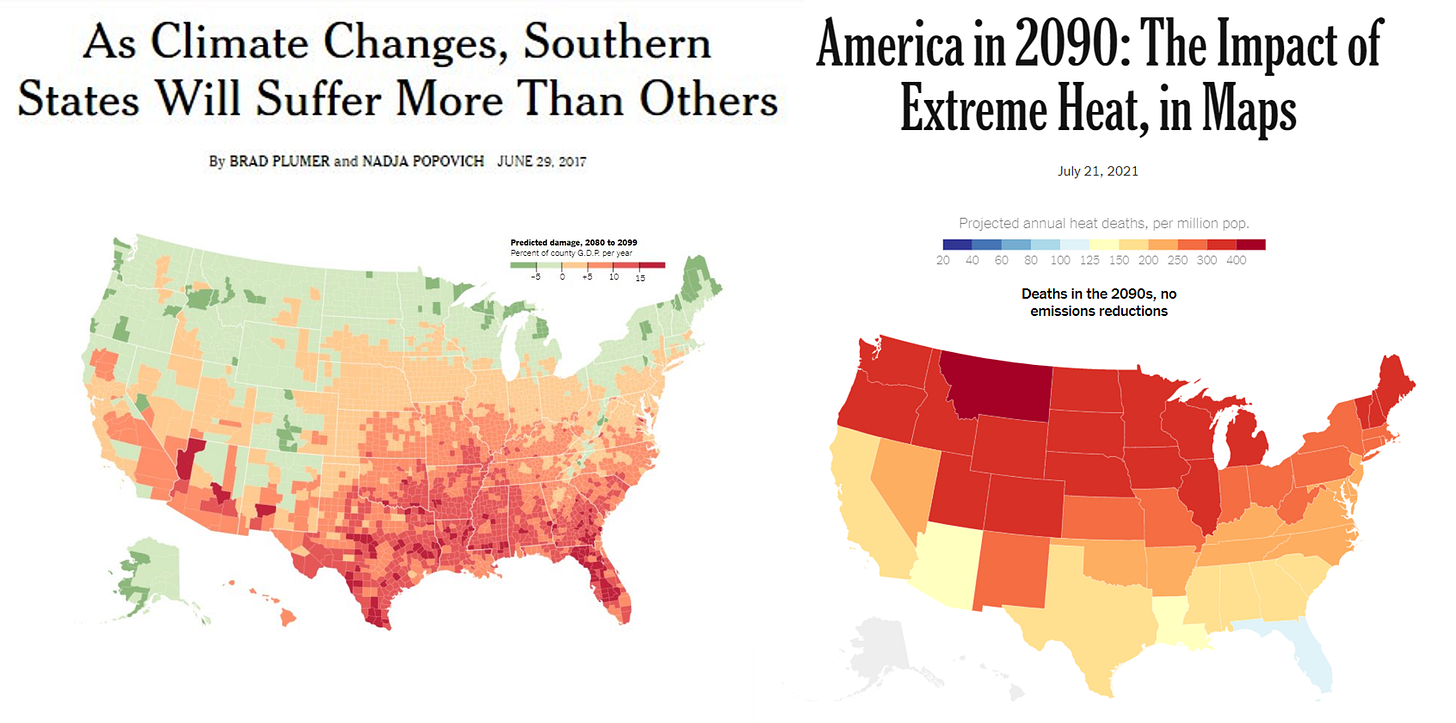
(Technically, the first chart is GDP loss, while the second is heat deaths. But as the Times explained, the main driver of GDP loss in that first chart is heat deaths: “The greatest economic impact would come from a projected increase in heat wave deaths as temperatures soared, which is why states like Alabama and Georgia would face higher risks while the cooler Northeast would not.”) [Note: Observations actually show a “warming hole” in Southeast US, perhaps due in part to reforestation efforts.]

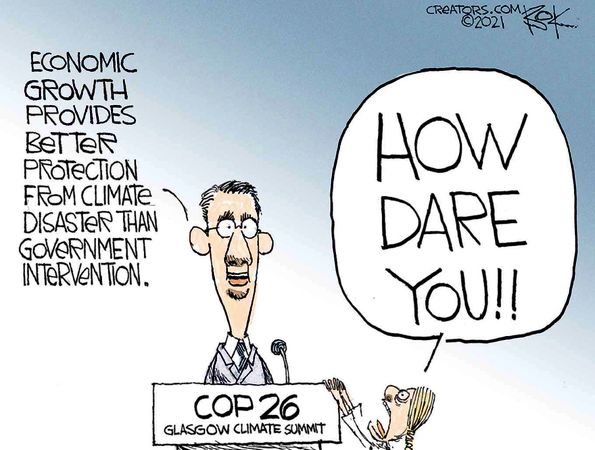
Discussion of solutions, meanwhile, became entirely performative. So many climate agreements were signed, none had the prospect of substantially shifting the trajectory of global emissions, which is driven overwhelmingly by growth in the developing world. The Biden administration spent four years trumpeting unprecedented investment in fighting climate change. Try to find a comment linking that action to a downward shift in future temperatures or a reduction in any of the purportedly existential harms repeated ad nauseum as the basis for the action. I’ll wait.

The climate lectures had become the equivalent of the parent telling his children to eat their vegetables, because children in Africa are starving.

So now I encounter climate change mostly in the context of discussions about how best to build a policy agenda that serves the interests of American workers, and the working class broadly. Along with the refusal to enforce immigration law and the passion for shoveling hundreds of billions of dollars into a higher education system that fails most young people, the obsession with fighting climate change is a quintessential tradeoff preferred by progressives that they are of course welcome to make, but that cannot be squared with a commitment to working-class interests.
Progressives tend not to appreciate this observation,
or the cognitive dissonance that it triggers.

As I wrote in The Once and Future Worker, “People know how they want society ordered and wish desperately for that same thing to be good for everyone else.” Our 20-year-old texter feels this strongly. Fighting the climate crisis and providing for working families are not mutually exclusive. But the belief in a mythological crisis goes forever unsubstantiated. What is the ongoing devastation of communities that Biden-style policy action will mitigate?
To be clear, when I say mythological crisis, I don’t mean that climate change is a myth. I think climate change is a very serious challenge with which the United States, and the world, must find ways to cope. I’d also like to see us pursuing aggressive public investment in next-generation nuclear technology, and in the industrial precursors to strong electric vehicle supply chains—both of which are smart industrial policy regardless of climate implications.
But in the broader scheme of a century of economic, technological,
and geopolitical changes and challenges, the gradual increase
in global temperatures does not rank high.
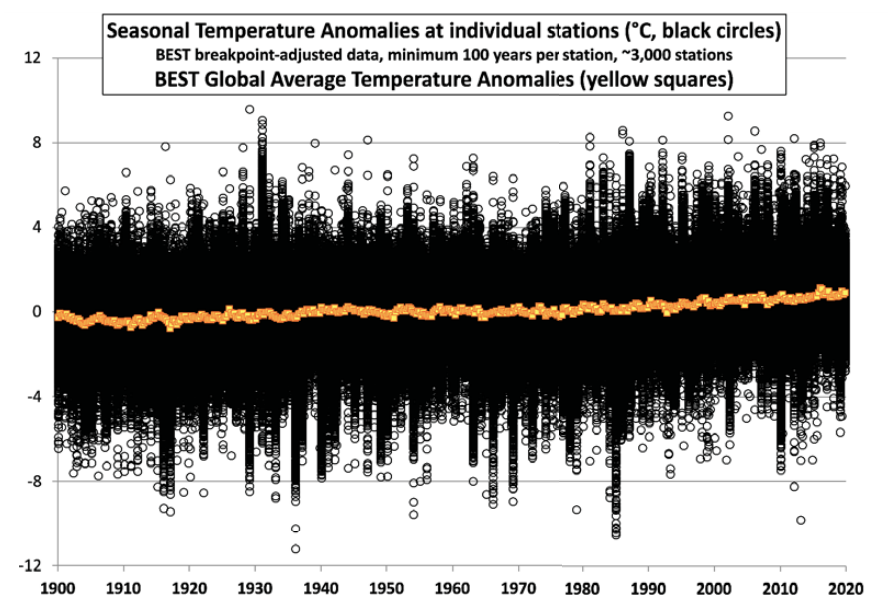
This is not my opinion, it is the conclusion of the climate models, the UN’s Intergovernmental Panel on Climate Change, and the analyses that attempt to translate these forecasts into economic impacts. Climate change is not one of the top challenges facing working families in America. Solving it, if we could, which we can’t, would do little to move the needle in helping them achieve middle-class security.
But what about the “Green New Deal”? It has “New Deal” right in the title, suggesting a clear commitment to improving economic opportunity! That’s true, as far as it goes. Indeed, we could launch a “Purple New Deal” dedicated to knocking down all buildings that are not purple and replacing them with purple ones, which would also have many jobs associated with it. Unfortunately, that’s not good economic policy.
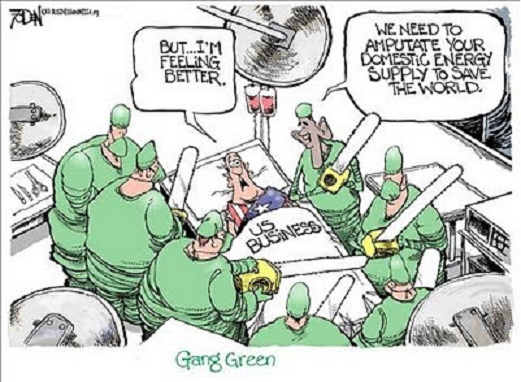
What the Green New Deal—and climate policy, generally—attempts to do is shut down the existing energy industry and much of the industrial economy that relies on cheap and reliable energy, and replace it all with new “green” jobs. This should not require saying, but apparently does: Supplanting an existing, robust energy sector and industrial economy that provides a lot of very good jobs outside of our knowledge economy and superstar cities, with a new set of industries that hopes to do the same, does not in fact deliver economic gains.

The stated goal of climate policy is to replace things we already have. Anything new it creates is an attempt to climb back out of a hole it has dug itself. And unfortunately, the new tends to be less good, economically speaking, than the old. That reality in the auto industry is what drove the UAW strike last year.
The best way to understand all this is with a simple hypothetical: Let’s say we didn’t have to worry about climate change. A neat little box sucked greenhouse gases out of the atmosphere for free; problem solved. Would anyone still propose the Green New Deal? No climate change to worry about, you need to propose an agenda to support working families, how high on the list is “spend trillions of dollars shutting down the industrial economy and attempting to replace it with a set of less efficient and unproven technologies in which the United States has a much weaker position”?
It’s nowhere on the list.
Because climate policy does not help the working class.
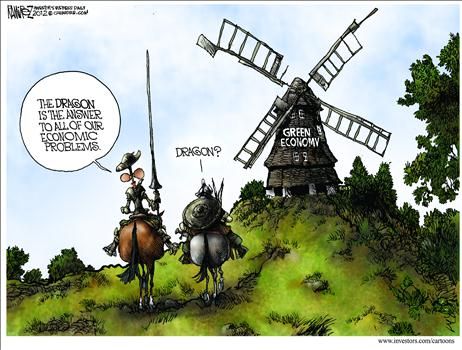
For whatever reason, the project of decarbonizing the economy captures the progressive mind like no other. Ezra Klein and Derek Thompson’s Abundanceopens with a paragraph about waking up in the year 2050 in a cool bedroom powered by clean energy sources—a bedroom no cooler than the one you would wake up in today. Their abundant future is, first and foremost, not a more abundant one at all—merely one whose energy system they have transformed. Discussing scarcities, they start with, “We say that we want to save the planet from climate change.” When they enthuse that “new technologies create new possibilities and allow us to solve once-impossible problems,” they are thinking first of greenhouse gas emissions. “We worry,” first, “over climate change.” And “this book is motivated in no small part by our belief that we need to decarbonize the global economy.”

In my podcast with Klein, I asked him whether combatting climate change might represent a tradeoff in his agenda, rather than item one for bringing abundance to America. “For most, certainly, liberals who think about this and have studied this,” he responded, “the decarbonization is just central to the idea of what it would mean for our descendants to live a flourishing life.” Pitched this way, it fits perfectly the ideological template of most neoliberal missteps of the past 30 years: a purported win-win that serves the priorities of highly educated, high-income elites, who then instruct everyone else that the same thing should be their priority too. Like globalization, and unrestricted immigration, and free college.
Fool me once… Climate policy imposes massive costs, and damages the industrial economy, in pursuit of a specific goal: reducing carbon dioxide emissions. And if that’s your goal, that’s fine. Fight for it! Make the case for the tradeoff. But don’t pretend there’s no tradeoff, and certainly don’t tell the people you’re trading off that you’re really doing it for them.
See Also

 Science Matters