 The best context for understanding decadal temperature changes comes from the world’s sea surface temperatures (SST), for several reasons:
- The ocean covers 71% of the globe and drives average temperatures;
- SSTs have a constant water content, (unlike air temperatures), so give a better reading of heat content variations;
- A major El Nino was the dominant climate feature in recent years.
Previously I used HadSST3 for these reports, but Hadley Centre has made HadSST4 the priority, and v.3 will no longer be updated. I’ve grown weary of waiting each month for HadSST4 updates, so this report is based on data from OISST2.1. This dataset uses the same in situ sources as HadSST along with satellite indicators. Importantly, it produces daily anomalies from baseline period 1982-2010. The data is available at Climate Reanalyzer (here). Product guide is (here). The charts and analysis below is produced from the current data.
The Current Context
The chart below shows SST monthly anomalies as reported in OISST2.1 starting in 2015 through July 2025. A global cooling pattern is seen clearly in the Tropics since its peak in 2016, joined by NH and SH cycling downward since 2016, followed by rising temperatures in 2023 and 2024 and cooling in 2025.
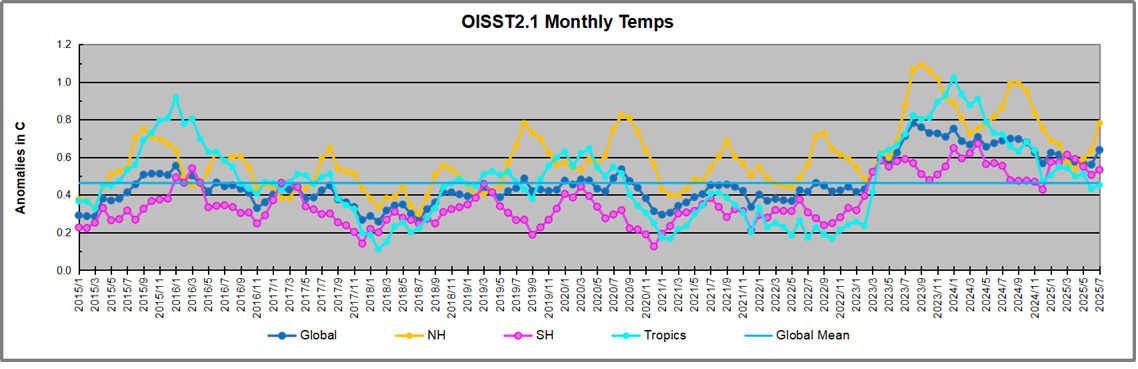
Note that in 2015-2016 the Tropics and SH peaked in between two summer NH spikes. That pattern repeated in 2019-2020 with a lesser Tropics peak and SH bump, but with higher NH spikes. By end of 2020, cooler SSTs in all regions took the Global anomaly well below the mean for this period. A small warming was driven by NH summer peaks in 2021-22, but offset by cooling in SH and the tropics, By January 2023 the global anomaly was again below the mean.
Then in 2023-24 came an event resembling 2015-16 with a Tropical spike and two NH spikes alongside, all higher than 2015-16. There was also a coinciding rise in SH, and the Global anomaly was pulled up to 0.8°C in 2023, ~0.2° higher than the 2015 peak. Then NH started down autumn 2023, followed by Tropics and SH descending 2024 to the present. During 2 years of cooling in SH and the Tropics, the Global anomaly came back down, led by NH cooling the last 12 months from its 1.0°C peak last August, down to 0.5C in April this year.. Further declines in Tropics and SH offset NH warming in May and June, and now in July 2025 a slight upward bump in Global anomaly over 0.6°C.
Comment:
The climatists have seized on this unusual warming as proof their Zero Carbon agenda is needed, without addressing how impossible it would be for CO2 warming the air to raise ocean temperatures. It is the ocean that warms the air, not the other way around. Recently Steven Koonin had this to say about the phonomenon confirmed in the graph above:
El Nino is a phenomenon in the climate system that happens once every four or five years. Heat builds up in the equatorial Pacific to the west of Indonesia and so on. Then when enough of it builds up it surges across the Pacific and changes the currents and the winds. As it surges toward South America it was discovered and named in the 19th century It iswell understood at this point that the phenomenon has nothing to do with CO2.
Now people talk about changes in that phenomena as a result of CO2 but it’s there in the climate system already and when it happens it influences weather all over the world. We feel it when it gets rainier in Southern California for example. So for the last 3 years we have been in the opposite of an El Nino, a La Nina, part of the reason people think the West Coast has been in drought.
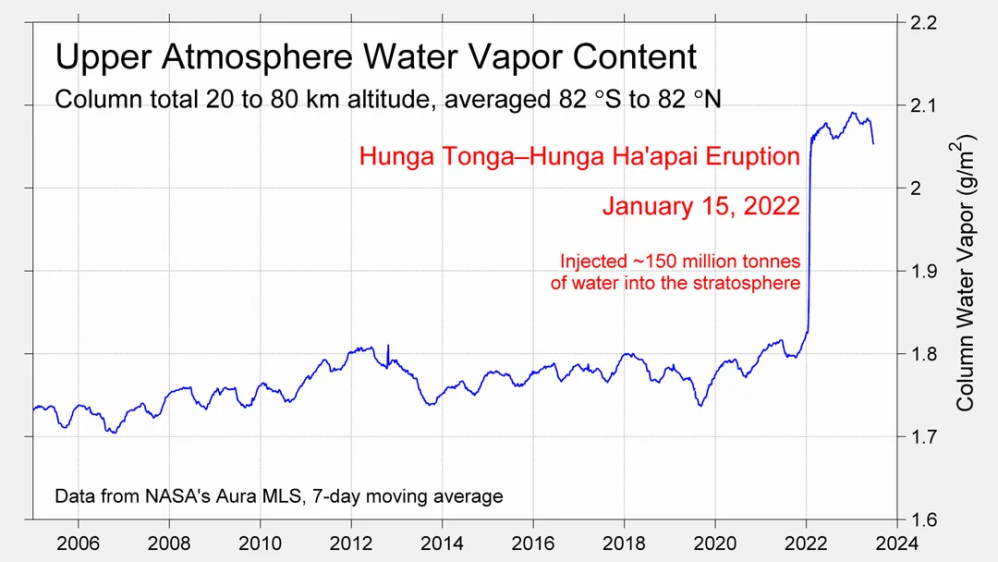
It has now shifted in the last months to an El Nino condition that warms the globe and is thought to contribute to this Spike we have seen. But there are other contributions as well. One of the most surprising ones is that back in January of 2022 an enormous underwater volcano went off in Tonga and it put up a lot of water vapor into the upper atmosphere. It increased the upper atmosphere of water vapor by about 10 percent, and that’s a warming effect, and it may be that is contributing to why the spike is so high.
A longer view of SSTs
To enlarge, open image in new tab.
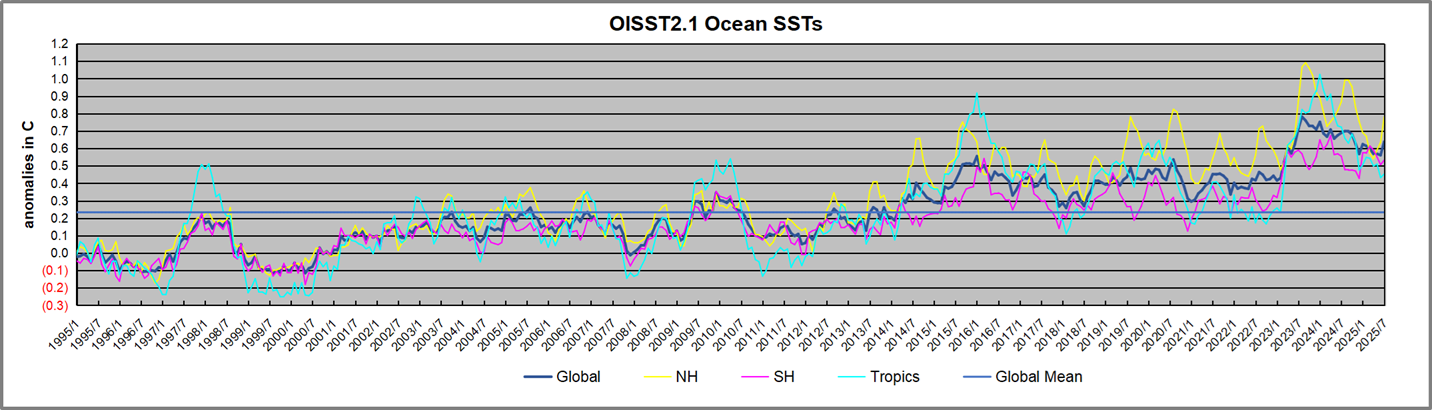
The graph above is noisy, but the density is needed to see the seasonal patterns in the oceanic fluctuations. Previous posts focused on the rise and fall of the last El Nino starting in 2015. This post adds a longer view, encompassing the significant 1998 El Nino and since. The color schemes are retained for Global, Tropics, NH and SH anomalies. Despite the longer time frame, I have kept the monthly data (rather than yearly averages) because of interesting shifts between January and July. 1995 is a reasonable (ENSO neutral) starting point prior to the first El Nino.
The sharp Tropical rise peaking in 1998 is dominant in the record, starting Jan. ’97 to pull up SSTs uniformly before returning to the same level Jan. ’99. There were strong cool periods before and after the 1998 El Nino event. Then SSTs in all regions returned to the mean in 2001-2.
SSTS fluctuate around the mean until 2007, when another, smaller ENSO event occurs. There is cooling 2007-8, a lower peak warming in 2009-10, following by cooling in 2011-12. Again SSTs are average 2013-14.
Now a different pattern appears. The Tropics cooled sharply to Jan 11, then rise steadily for 4 years to Jan 15, at which point the most recent major El Nino takes off. But this time in contrast to ’97-’99, the Northern Hemisphere produces peaks every summer pulling up the Global average. In fact, these NH peaks appear every July starting in 2003, growing stronger to produce 3 massive highs in 2014, 15 and 16. NH July 2017 was only slightly lower, and a fifth NH peak still lower in Sept. 2018.
The highest summer NH peaks came in 2019 and 2020, only this time the Tropics and SH were offsetting rather adding to the warming. (Note: these are high anomalies on top of the highest absolute temps in the NH.) Since 2014 SH has played a moderating role, offsetting the NH warming pulses. After September 2020 temps dropped off down until February 2021. In 2021-22 there were again summer NH spikes, but in 2022 moderated first by cooling Tropics and SH SSTs, then in October to January 2023 by deeper cooling in NH and Tropics.
Then in 2023 the Tropics flipped from below to well above average, while NH produced a summer peak extending into September higher than any previous year. Despite El Nino driving the Tropics January 2024 anomaly higher than 1998 and 2016 peaks, following months cooled in all regions, and the Tropics continued cooling in April, May and June along with SH dropping. After July and August NH warming again pulled the global anomaly higher, September through January 2025 resumed cooling in all regions, continuing February through April 2025, with little change in May,June and July despite upward bumps in NH.
What to make of all this? The patterns suggest that in addition to El Ninos in the Pacific driving the Tropic SSTs, something else is going on in the NH. The obvious culprit is the North Atlantic, since I have seen this sort of pulsing before. After reading some papers by David Dilley, I confirmed his observation of Atlantic pulses into the Arctic every 8 to 10 years.
Contemporary AMO Observations
Through January 2023 I depended on the Kaplan AMO Index (not smoothed, not detrended) for N. Atlantic observations. But it is no longer being updated, and NOAA says they don’t know its future. So I find that ERSSTv5 AMO dataset has current data. It differs from Kaplan, which reported average absolute temps measured in N. Atlantic. “ERSST5 AMO follows Trenberth and Shea (2006) proposal to use the NA region EQ-60°N, 0°-80°W and subtract the global rise of SST 60°S-60°N to obtain a measure of the internal variability, arguing that the effect of external forcing on the North Atlantic should be similar to the effect on the other oceans.” So the values represent SST anomaly differences between the N. Atlantic and the Global ocean.
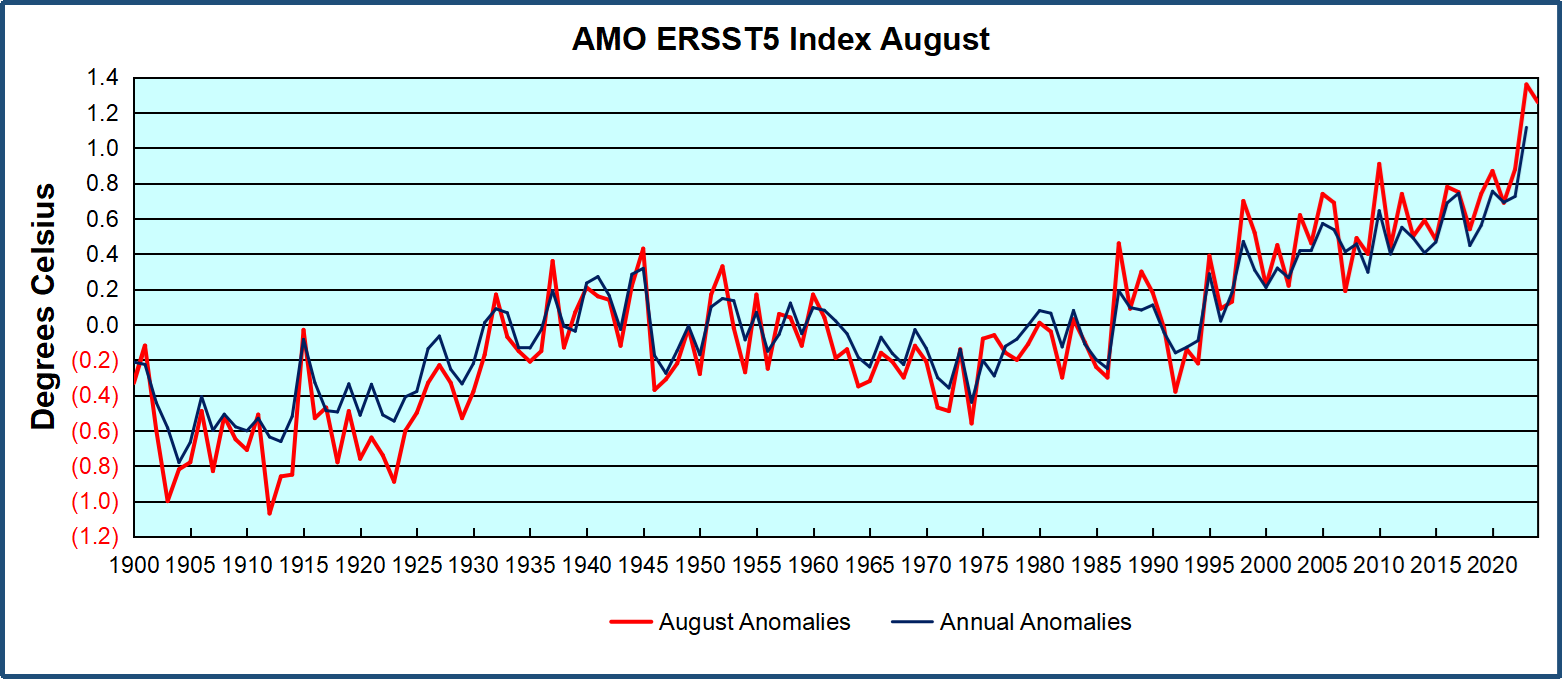
The chart above confirms what Kaplan also showed. As August is the hottest month for the N. Atlantic, its variability, high and low, drives the annual results for this basin. Note also the peaks in 2010, lows after 2014, and a rise in 2021. Then in 2023 the peak was holding at 1.4C before declining. An annual chart below is informative:
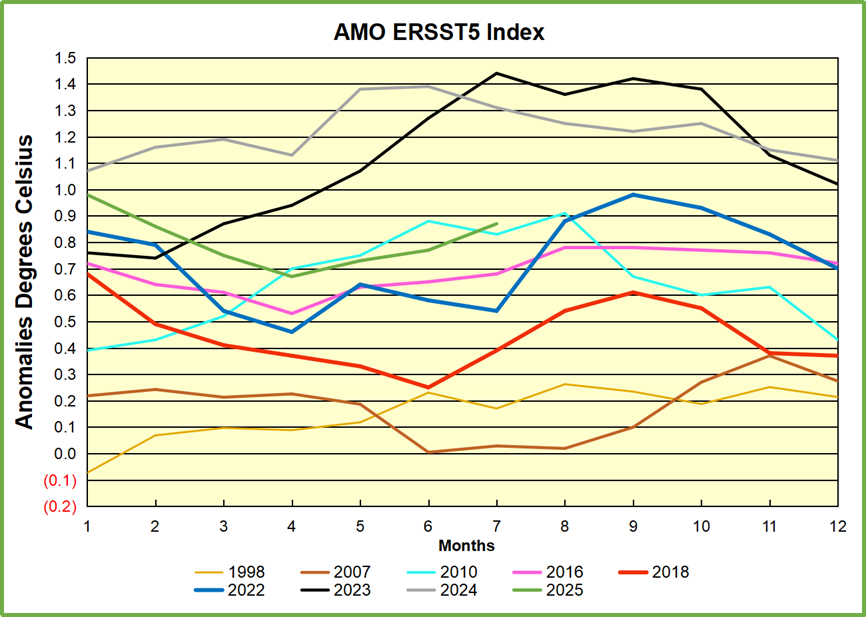
Note the difference between blue/green years, beige/brown, and purple/red years. 2010, 2021, 2022 all peaked strongly in August or September. 1998 and 2007 were mildly warm. 2016 and 2018 were matching or cooler than the global average. 2023 started out slightly warm, then rose steadily to an extraordinary peak in July. August to October were only slightly lower, but by December cooled by ~0.4C.
Then in 2024 the AMO anomaly started higher than any previous year, then leveled off for two months declining slightly into April. Remarkably, May showed an upward leap putting this on a higher track than 2023, and rising slightly higher in June. In July, August and September 2024 the anomaly declined, and despite a small rise in October, ended close to where it began. Note 2025 started much lower than the previous year and headed sharply downward, well below the previous two years, then in May, June and now July aligning with 2010.
The pattern suggests the ocean may be demonstrating a stairstep pattern like that we have also seen in HadCRUT4.
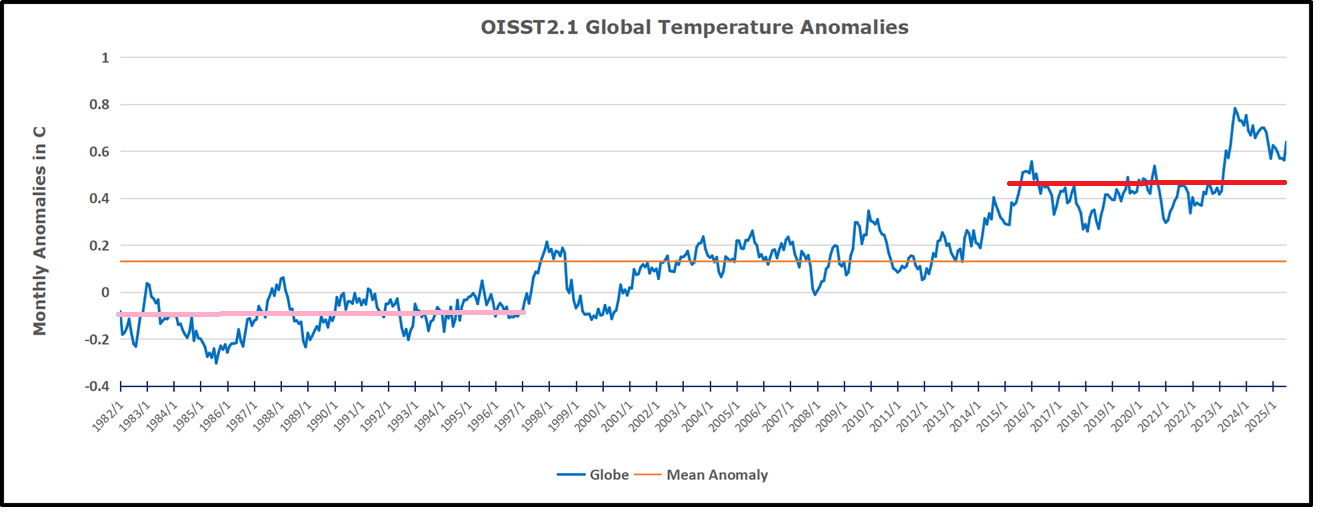
The rose line is the average anomaly 1982-1996 inclusive, value -0.10. The orange line the average 1982-2025, value 0.13, also for the period 1997-2012. The red line is 2015-2025, value 0.46. As noted above, these rising stages are driven by the combined warming in the Tropics and NH, including both Pacific and Atlantic basins.
Curiosity: Solar Coincidence?
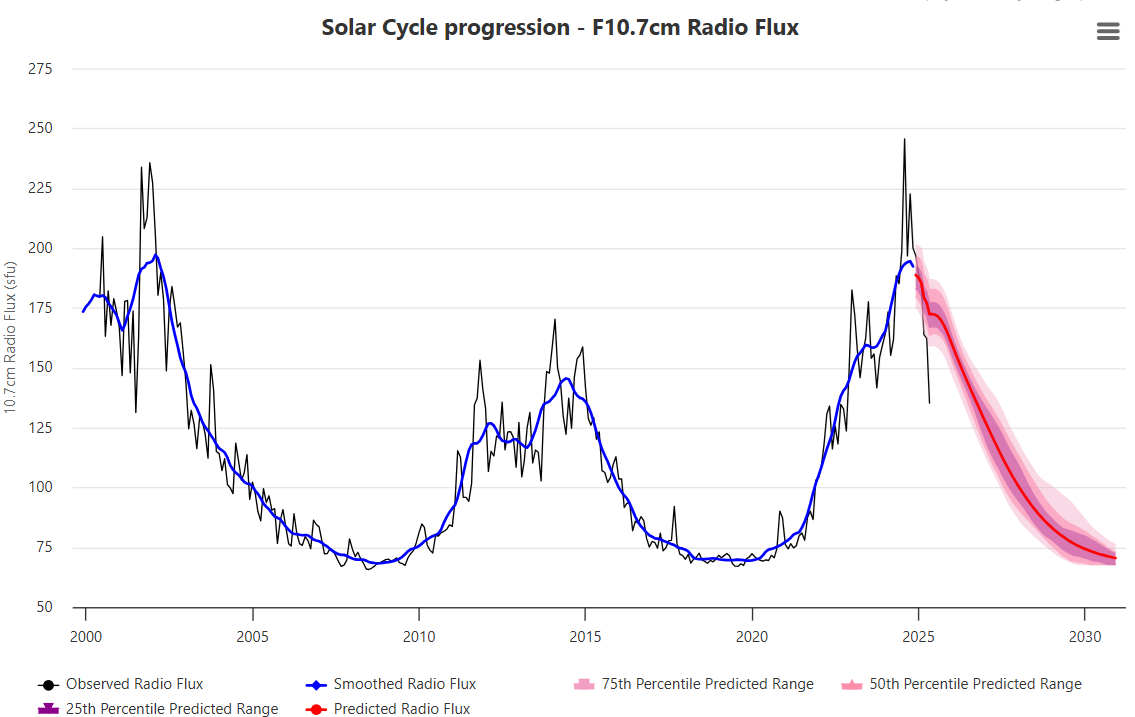
The news about our current solar cycle 25 is that the solar activity is hitting peak numbers now and higher than expected 1-2 years in the future. As livescience put it: Solar maximum could hit us harder and sooner than we thought. How dangerous will the sun’s chaotic peak be? Some charts from spaceweatherlive look familar to these sea surface temperature charts.
 Summary
The oceans are driving the warming this century. SSTs took a step up with the 1998 El Nino and have stayed there with help from the North Atlantic, and more recently the Pacific northern “Blob.” The ocean surfaces are releasing a lot of energy, warming the air, but eventually will have a cooling effect. The decline after 1937 was rapid by comparison, so one wonders: How long can the oceans keep this up? And is the sun adding forcing to this process?

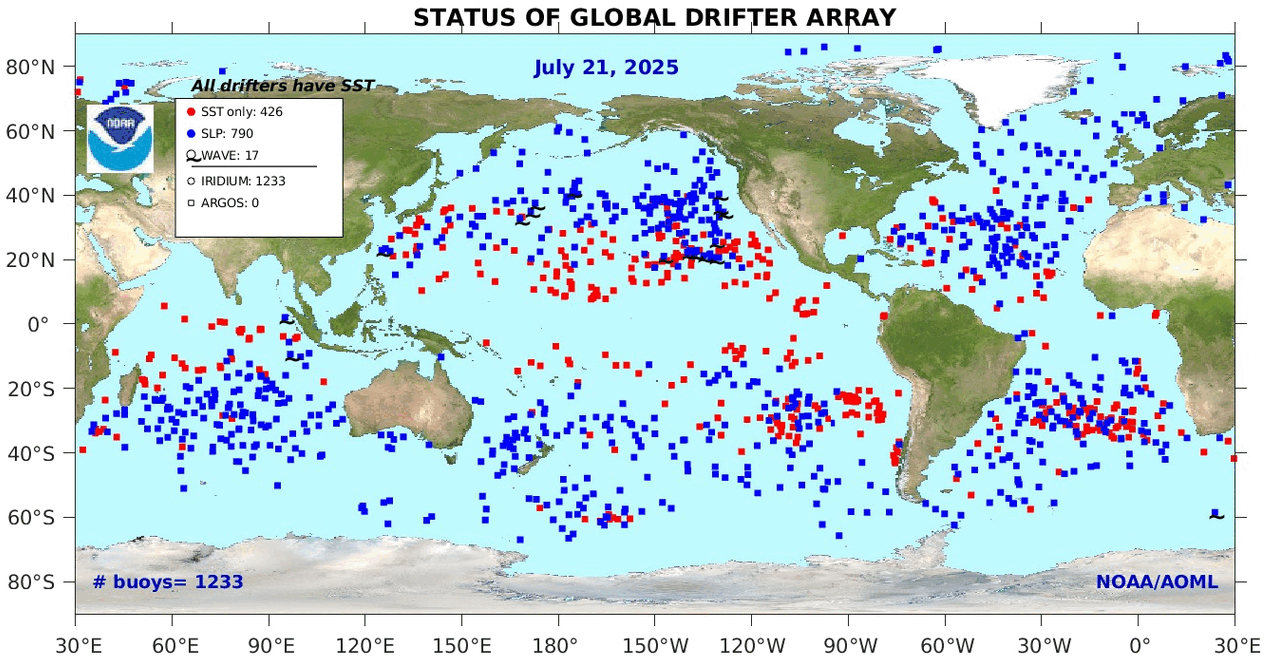
USS Pearl Harbor deploys Global Drifter Buoys in Pacific Ocean
 Science Matters
Dear M. Clutz,
Could you tell me where to download the time serie data on upper atmosphere water vapor content, if possible since 1980 ? If you also have a link for the global (or some regional) cloud fraction cover time serie, I would gladly take it because I don’t know yet how to deal with ISCCP NOAA MODIS many matrices daily files.
I also read somewhere that the Schumann frequencies where evolving. Do you have any idea about a long time measurement of the earth electric field ? I could not find any interesting link on Google excepted some meditationists…
I ask these questions to you because I’m starting to build a small time series database of some climate variables for my teen pupils in physics class, so that they can see the climate topic from a CO2 free perspective. Your blog is very inspiring for that.
Thank you and salutations from France !
LikeLike
Thanks anon for your interest and supportive comment. Perhaps already known to you, but if not, I suggest the ECAD (European Climate Assessment Dataset) has a great many metrics of interest to your mission. My introduction to that resource is:
Cloudiness is one of the variables, at least from ground observations. As for water vapor, I have no experience with the datasets,, but here’s a couple of links:
https://www.nature.com/articles/s41612-025-01056-2/figures/1
https://neo.gsfc.nasa.gov/view.php?datasetId=MYDAL2_M_SKY_WV
LikeLike
Anon, one more resource on water vapor is this one:
https://friendsofscience.org/assets/documents/Water_Vapor_Decline_Cools_the_Earth__NASA_Satellite_Data.htm
Finally, most importantly, here is where you create the time series:
https://psl.noaa.gov/cgi-bin/data/timeseries/timeseries1.pl
Results look like this:

This graph shows that the relative humidity has been dropping, especially at higher elevations allowing more heat to escape to space. The curve labelled 300 mb is at about 9 km altitude, which is in the middle of the predicted (but missing) tropical troposphere hot-spot. This is the critical elevation as this is where radiation can start to escape without being recaptured. The average annual relative humidity at this altitude has declined by 21.5% from 1948 to 2007.
LikeLike
Thank you very much, M. Clutz.
I didn’t know the ECAD tool and the NCEP time series generator. These will help a lot !
Reading the friendsofscience link and your last sentence, I realise how much I need to study heliophysics and aeronomy. The topic is very rarely cited in France. As for the jetstream meandering, meteo shows never talk about this.
Sincerely
LikeLike
Anon, one more resource. ETH Zurich hosts The Global Energy Balance Archive (GEBA). It’s a dataset from instruments recording fluctuations in SSR (Surface Solar Radiation), i.e. sunshine that makes it through atmospheric clouds and aerosols. More about this with links:
Do let me know of interesting discoveries in your work.
LikeLike
Sure !
I am currently preparing back-to-school stuff for September, but I shall spend time on the data during the next months.
I think I will start by following Vinos, Courtillot and Scafetta’s steps. It will be a fun session to make my pupils guess natural, short and long, solar, planetary, geological and climatic cycles, and link it with their history lessons.
Later, I shall study the recent climatic trends. This is where your work comes in, but as I told you, I need to study some textbooks before proposing anything new.
LikeLike