For those who prefer to read, below is a lightly edited transcript from the closed captions with my bolds and added images.
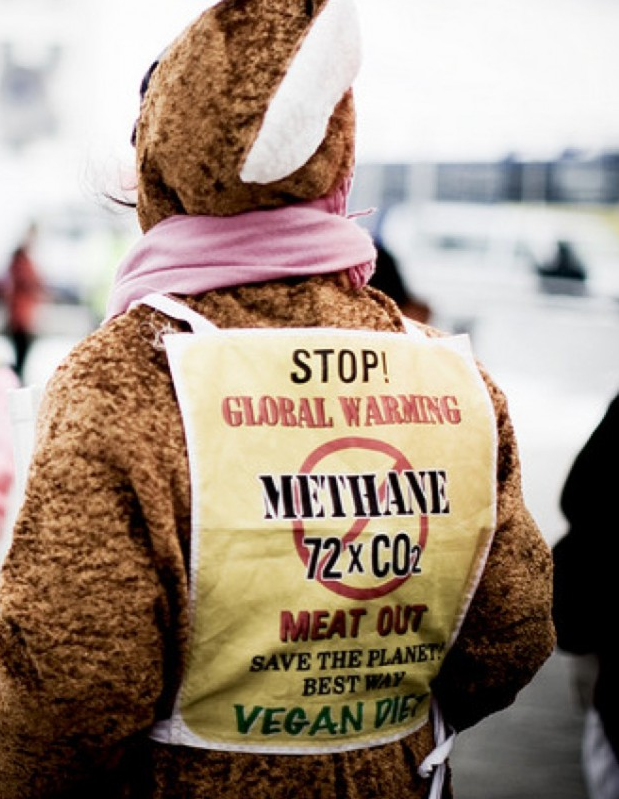
This is a short story about how the BBC and the UK Parliament turned the opinions of just ten people into the single voice of 66 million. At the centre of this story is our favourite food. Meat production has long bothered the environmental movement and climate campaigners, because it is at the centre of culture, and family and social life.
And this is where green ideology longs to be. Consequently, greens have urged us to give up meat, telling us of the harm done to nature by our diets. They have urged us to cut down, to become vegetarian or vegan. Or to switch to other forms of protein. No thanks! Green attempts to control our diets have been met with resistance.
But UK politicians have now decided to tackle the problem of the public’s lack of interest in the green agenda.
“Dear resident. Dear resident. Dear resident.
You could be one of over 100 people selected to take part in the UK-wide Citizens’ Assembly on how should the UK tackle climate change.” They believe that they can change our behaviour by focusing their interventions on the things which the public will find least unacceptable. Parliament believes that by convening a Climate Assembly, the government, politicians, and civil servants can find out what level of regulation of their lifestyles the wider public will accept.
“The UK government has legally committed to reach Net Zero greenhouse gas emissions by 2050. To help inform how we’re going to reach Net Zero, 108 members of the public were brought together by the UK parliament in our first ever Citizens’ Assembly on climate change. They discussed the impact of what we eat and how we used the land.”

But what recommendations did the Climate Assembly make? Reduce our meat and dairy consumption by 20-40%, but with no bans or taxes.” The Climate Assembly provided Parliament with this information and it has now been used as the basis for policies. “The fact that you’ve given up time to come here and take this seriously is of the greatest importance.” But what really happened in the Climate Assembly? Did it really recommend that the government should find ways to make us eat less meat?
The findings of the Climate Assembly, which met over six weekends, were published in a 500-page report. The reduction of meat and dairy consumption does appear in the key recommendations of the report, in a section on “what we eat and how we use the land”. But this was not the view of the whole Assembly.
On the weekend during which the Assembly discussed this question, it was divided into three groups, only one of which was tasked with a discussion on “what we eat and how we use the land”. Just 35 Assembly members, out of 108, were in this group. They heard from just one academic’s views on meat, Rosie Green:
“We know that red and processed meat is associated with a number of health conditions. So it’s linked to heart disease, it’s linked to strokes, it’s linked to particular types of cancer, like bowel cancer, and it’s also linked to diabetes.Whereas on the other hand, eating fruit and vegetables is linked to prevention of all those conditions. So if you eat the more fruit and vegetables you eat, there’s less likely you are to suffer from those diseases.”

There was no debate or criticism of these questionable scientific claims made by an academic, who has manifestly strayed into political activism. “Meat will never ever be banned. It will never be banned.” “I don’t like the idea of controlling things at all.”

But the Climate Assembly were not fools. When they were asked to vote on what they believed the government should prioritize from a list of eight options available to them, just 29 per cent chose reducing meat as a priority. It was the second least popular option prioritized by the group. And 29% of 35 just people is ten people.
Nonetheless, the report claimed that ‘assembly members tended to express support for” the idea. On the available evidence, that claim simply isn’t true. The report emphasizes reducing meat and dairy in our diets, despite this underwhelming support for it, because the report was not written by the Assembly itself. It was written by the academic activists and green campaigning organizations that ran the event.
The claim has now been used by politicians and civil servants designing the UK’s climate policies, to meet the Net Zero target. They had already decided that changing people’s diets will be part of the Net Zero agenda. In 2019, The Climate Change Committee produced a report on Net Zero, which proposed interventions to produce behaviour change, including the reduction of meat and dairy consumption.
In their new Net Zero policy report launched last week, the Committee claim that they have incorporated the Climate Assembly’s recommendations in their analysis, including the reduction of meat and dairy consumption.
“The Climate Assembly said they would be happy with a 20 to 40 per cent reduction in meat consumption. We’ve looked really carefully at the Climate Assembly’s recommendations, and actually we were quite engaged in the process as well. If you take the time to guide people through this, to explain why the changes are needed, to explain the sorts of things that need to happen, they’re really supportive of action. And actually we were surprised how supportive they were of lots of the things that we were thinking of already. What we’ve done is we’ve taken their advice, and we’ve constructed our scenarios to align to it.”
But though these civil servants seem to have enthusiastically embraced what the public think, as represented by what the Climate Assembly seemed to tell them, they have forgotten that the recommendation came from just ten people. The views of these ten people is now at the centre of the Climate Change Committee’s advice to Parliament, which they are almost certain to adopt.
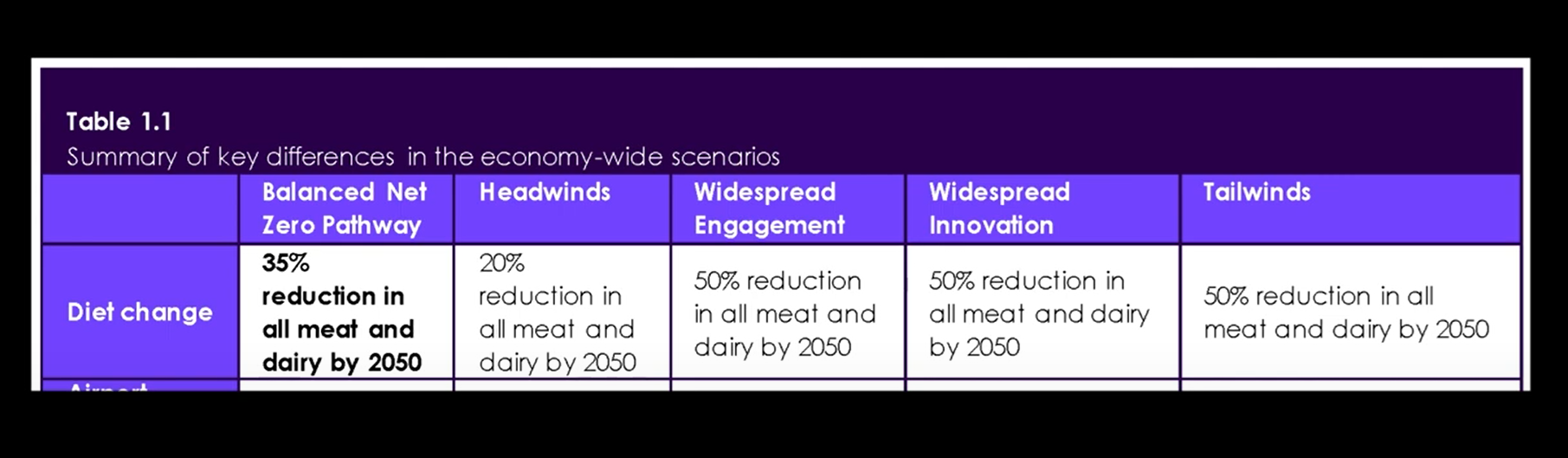
From the Sixth Carbon Budget–The UK’s path to Net Zero
But what the authors of the Climate Assembly report could not ignore, was the Assembly’s insistence that changes to diets should be voluntary, not compulsory. How will the government legislate for voluntary behavioral change? It has turned to the UK’s defacto state broadcaster, the BBC.
The BBC presents itself as a news broadcaster, but this BBC video on meat consumption and climate change shows that it has a role engineering the social values and behavioral changes that government policy requires.
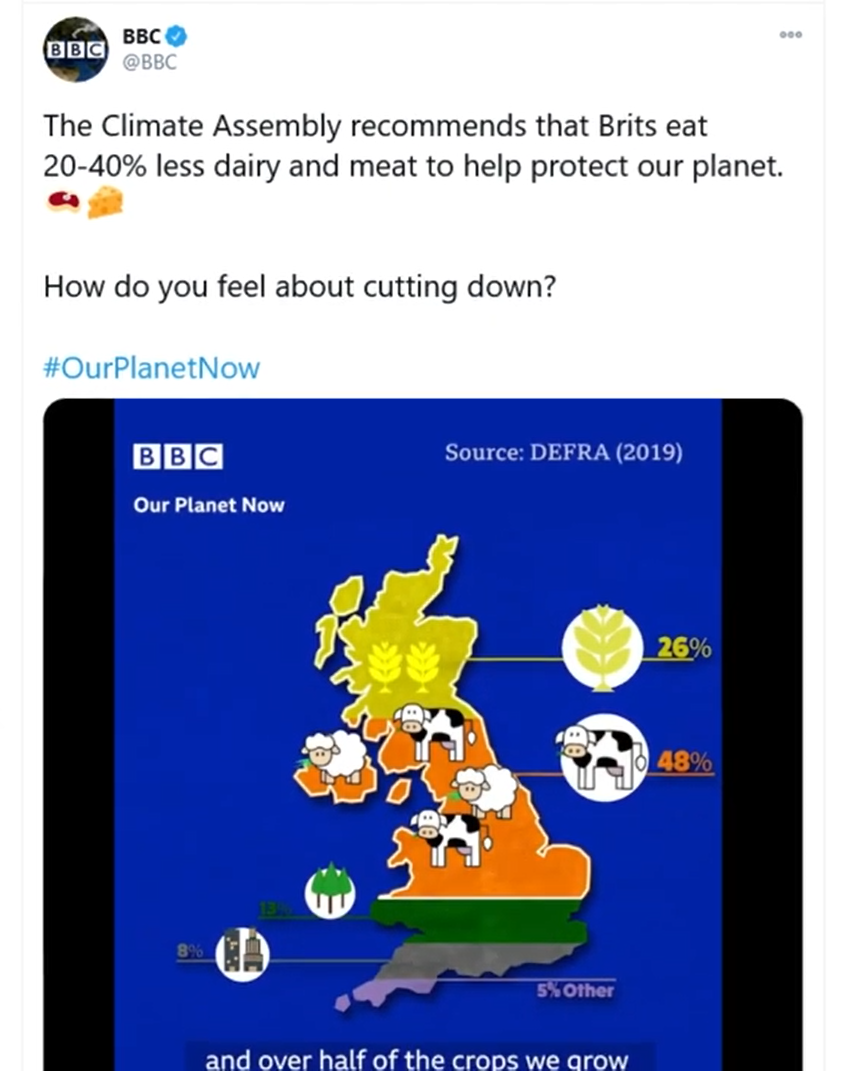
“The average Brit eats meat twice a day. And we’re eating much more protein than we need. Would more of us change our diet, if we knew it was also better for the planet?”
Rather than investigating the claims seemingly produced by the Climate Assembly, but which were just the views of ten of its members, the BBC uncritically reports them. It shows the views of one Assembly member’s concerns about his own meat consumption, and its damaging effect on the environment: a seventeen-year-old boy, who has decided to give up meat.
“After the second weekend of the Assembly I became pescatarian. When I was able to see right there on the graph that beef had a big proportion of higher CO2 emissions than fish, I knew that if I carried on eating beef then I know I’d be making the wrong sort of choice for the environment”.“So Max decided to give up his beloved beef steak…”

And rather than challenging a young person about how he formed such a view of the world, and asking questions about the ideology and one-sided view that was presented to the Climate Assembly, the BBC uses him, to encourage its audience to change their diets and behaviour.
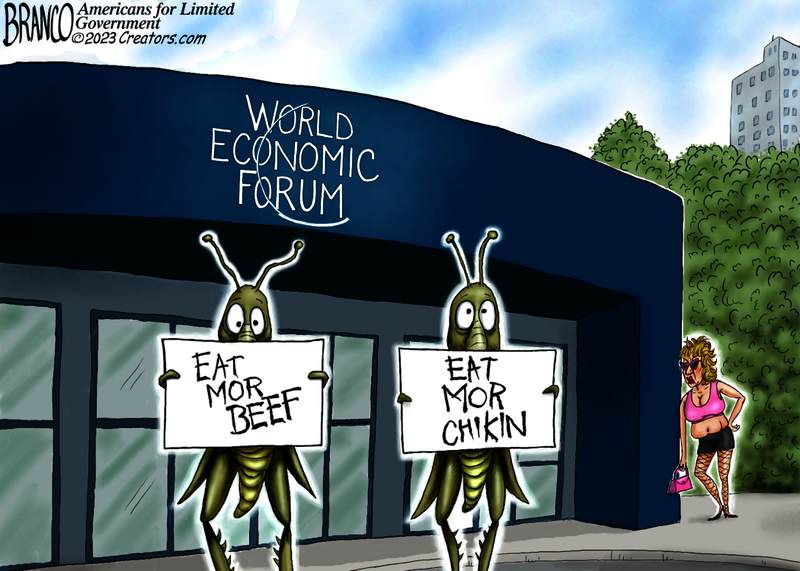
In this way, the BBC, turns ten into 66 million. It forgets the views that many of us may have about politicians’ and civil servants’ designs for our lives and lifestyles for the next decades. The public has once again been excluded from debates about climate policy.
Just in: Beyond Meat stock tanks to $1 after debt swap deal dilutes company shares
Beyond Meat’s stock collapsed to near $1 a share on Tuesday after the embattled plant-based meat maker finalized a debt exchange deal that handed bondholders hundreds of millions of new shares — effectively wiping out most existing investors. In the summer of 2019, the stock neared $240 a share — its peak price. Since then, the stock has lost more than 99% of its value.

 Science Matters
One comment