
The arctic ice extents are now reported through mid-February 2026, showing rising refreezing rates bringing Arctic ice extents within 200k km2 of the 20-year average. Remarkably, the last two days virtually matched the 2025 annual extent maximum of 14.48M km2 on day 80 of that year, compared to 14.44 on day 43 in 2026.
The chart below shows the 20-year averages for Arctic ice extents mid-Febrauary along with 2026 and 2025, as well as SII v.4.
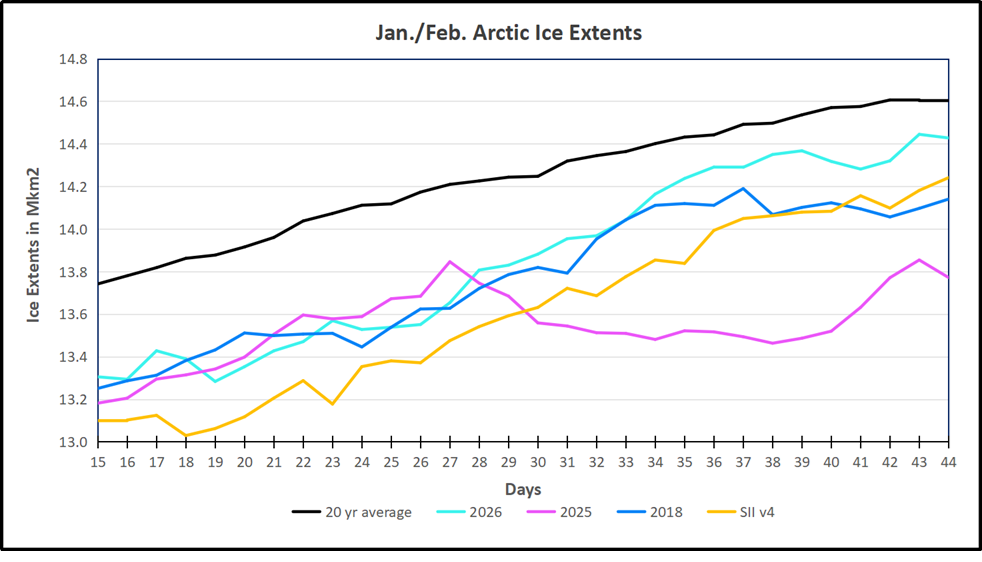
As stated previously, likely due to a wavy polar vortex, MASIE 2026 refroze slowly in January reaching a deficit of 622k km2 on day 26. Since then ice grew at a higher rate, ending this period 176k km2 below average, or 1% down. Note that compared to day 44 last year, 2026 ice is more than half a Wadham greater, 656k km2. And as mentioned above, 2025 will not match yesterday until day 80. Note SII v.4 tracks lower than MASIE throughout, on average in deficit by 242K km2.
| Region | 2026044 | Average day 44 | 2026-Ave. | 2025044 | 2026-2025 |
| (0) Northern_Hemisphere | 14427481 | 14603337 | -175856 | 13771518.64 | 655962 |
| (1) Beaufort_Sea | 1071070 | 1070384 | 686 | 1071000.73 | 69 |
| (2) Chukchi_Sea | 966006 | 965785 | 222 | 965989.12 | 17 |
| (3) East_Siberian_Sea | 1087137 | 1087132 | 5 | 1087137.23 | 0 |
| (4) Laptev_Sea | 897845 | 897838 | 7 | 897844.8 | 0 |
| (5) Kara_Sea | 935023 | 909437 | 25586 | 911762.37 | 23261 |
| (6) Barents_Sea | 649606 | 566421 | 83185 | 434920.5 | 214686 |
| (7) Greenland_Sea | 772110 | 625671 | 146439 | 635758.41 | 136351 |
| (8) Baffin_Bay_Gulf_of_St._Lawrence | 1040295 | 1429059 | -388764 | 1335264.28 | -294969 |
| (9) Canadian_Archipelago | 854931 | 853531 | 1399 | 854877.96 | 53 |
| (10) Hudson_Bay | 1260870 | 1260595 | 276 | 1260903.34 | -33 |
| (11) Central_Arctic | 3235930 | 3204874 | 31056 | 3195022.33 | 40907 |
| (12) Bering_Sea | 689769 | 671512 | 18256 | 333643.58 | 356125 |
| (13) Baltic_Sea | 155657 | 88990 | 66666 | 35593.84 | 120063 |
| (14) Sea_of_Okhotsk | 742439 | 914421 | -171982 | 720462 | 21977 |
The table shows that most regions are close to or above the 20-year average. Two major deficits are in Baffin Bay and Sea of Okhotsk, partly offset by several smaller surpluses, mostly in Greenland Sea, Barents and Bering seas.


 Science Matters