
Chris Morrison reported at Daily Sceptic Shock New Evidence Showing No Link Between CO2 and Temperature Over Last Three Million Years Stumps Net Zero Activists. Excerpt in italics with my bolds and added images.
The assumed level three million years ago of CO2 was around 400 ppm, a convenient mark that has been used to explain the subsequent ice age and a drop to 250 ppm. Due to the recently published paper, this explanation has become more problematic and natural climate variation is correctly noted to have occurred with the temperature changes. Alas, similar explanations are mostly ignored in discussing today’s climate changes in the interests of promoting the Net Zero fantasy. Some cling desperately to a dominant CO2 role, including one of the authors of the findings published in Nature. The co-author states that the results suggest even greater climate sensitivity to the warming effect of CO2. In short, there is a great deal of applying the laws of physics and chemistry to one era, but failing to extend the same courtesy to another.
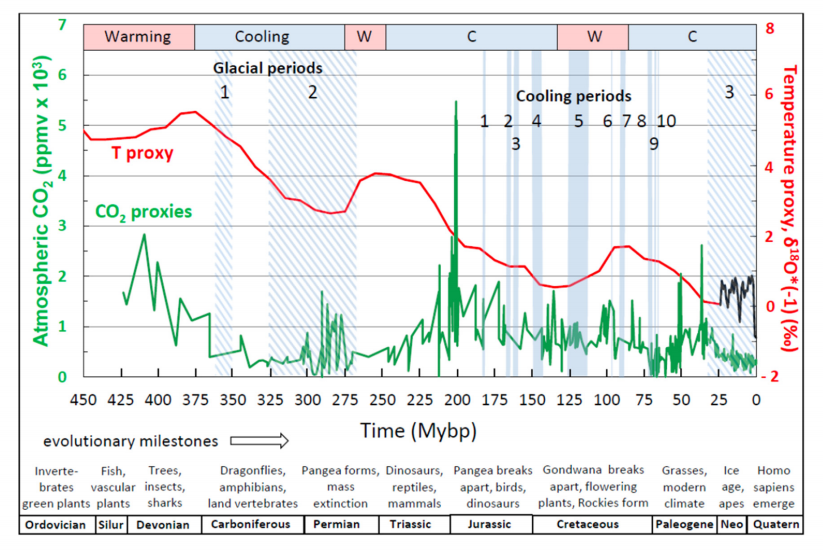
Critics seeking to downplay ice core evidence often suggest it is too imprecise to provide a wholly accurate record of gas levels and temperature. But it is accurate enough to give a broad cyclical insight. It remains the source of some of the best data we have on the past climate. It is undoubtedly more accurate than most proxy evidence from millions of years ago. But whatever the evidence used, it is hard to detect any obvious and continuous link between CO2 and temperature across the entire geological record going back 600 million years to the start of abundant life on Earth. Certainly none to justify the political notion that humans control the climate thermostat by burning hydrocarbons.
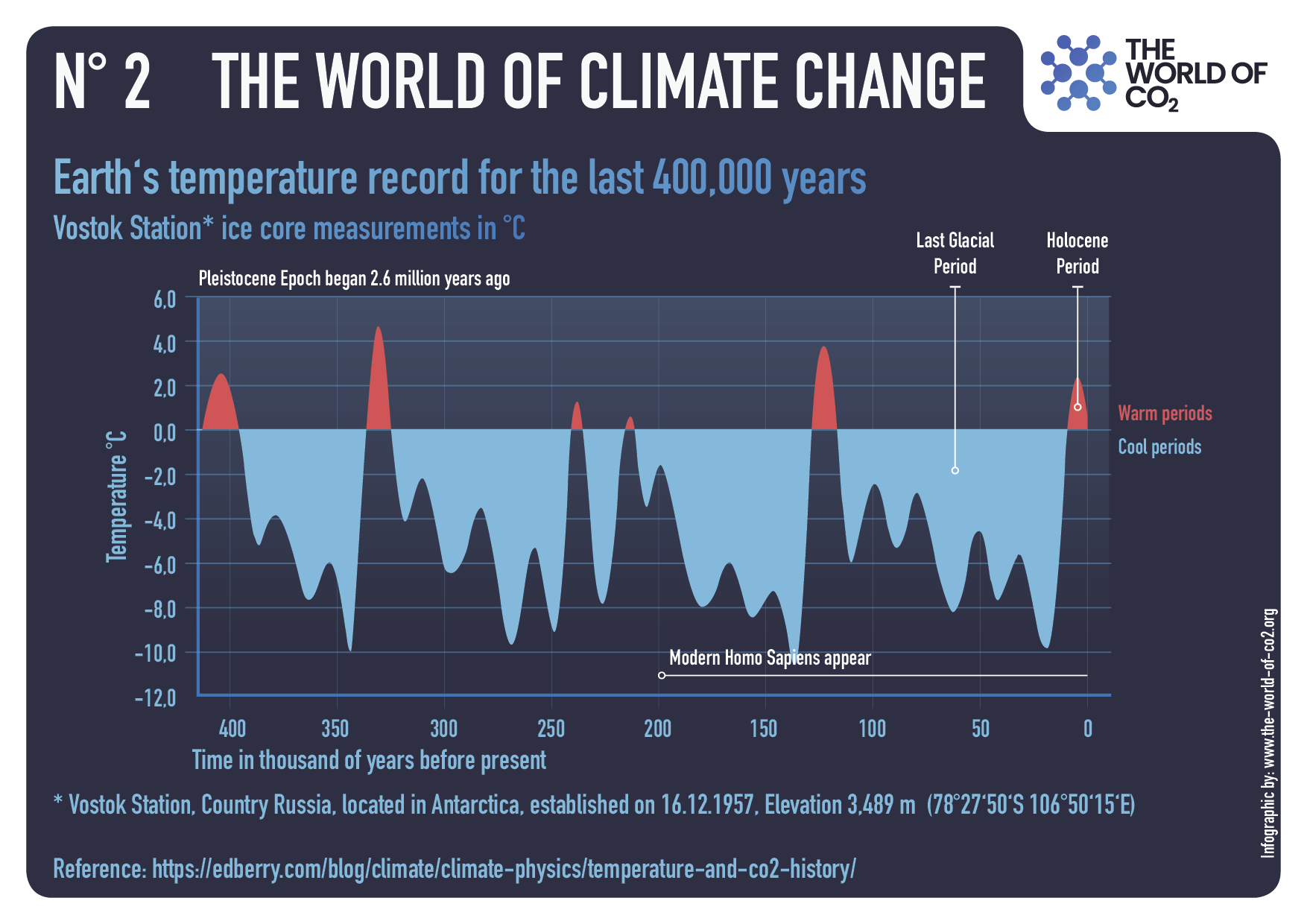
In fact the evidence is so slim that Les Hatton, Emeritus Professor in Computer Science at Kingston University, was recently able to determine from ice core records that 100-year rises of 1.1°C in the current interglacial, which started 20,000 years ago, have occurred in one in six centuries. Going back 150,000 years, the frequency was around one in six to one in 20 centuries.
None of these findings suggest that current warming is either unusual or
primarily caused by human activity. Needless to say, none of these findings
trouble the headline writers in narrative-addicted mainstream media.
Hatton’s paper: Is a 1.1°C Rise in a Century Unusual? A Study of Interglacials in the Epica-Vostok Dataset Excerpts in italics with my bolds and added images.
Abstract
Much public discourse in global warming centres around the oft-quoted rise in temperature of
approximately 1.1°C in global average temperature in the post-industrial period. This is considered in some quarters to constitute a “Climate Emergency” demanding “Climate Action”. In this
paper we first dissect the background behind this number and what it means. Second, we use the
Epica-Vostok Ice core dataset, a single proxy dataset for temperature data sampled every century
for the last 800,000 years or so.
And ask the question “Is a 1.1°C temperature rise in a century
unusual in this dataset?” The answer is surprising.
By considering interglacial onsets and decays as well as intermediating Ice Ages, it turns out that a rise of this amount would have been considered unusual more than 200,000 years ago, but this rise is not unusual in the current interglacial which started some 20,000 years ago with around 16% of all centuries since the last Ice Age exhibiting a temperature rise of at least 1.1°C. None of these could have anthropogenic components as they pre-dated the industrial era.
This result suggests that attempts to partition the current rise
into anthropogenic and nonanthropogenic components
are questionable given that it is not even unusual.
The last 20,000 years
It is important to note that we live in an Interglacial rise, a period of generally rising temperature.
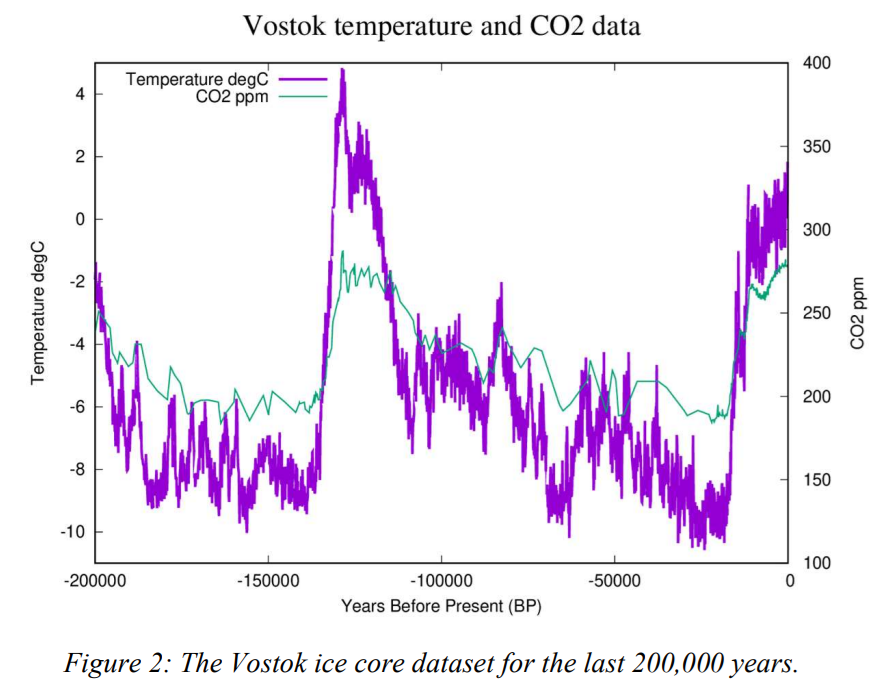
As can be seen in Fig. 2, temperatures have climbed by about 12°C since we emerged from the
last Ice Age some 20,000 years ago. In other words, on average they have increased by about 12/200 = 0.06°C per century. Just after the Ice Age ended, the rate of increase was almost twice as high at around 0.1°C per century. Since then it has continued to rise but more slowly although with considerable century on century variability.
Conclusions
The Vostok Ice Core data contains numerous interesting features which can be confirmed by anybody as the data is open. We can conclude the following:
♦ A rise of 1.1°C in a century is not unusual in the current interglacial. In fact 16% of the
centuries since the end of the last Ice age show a rise at least as big as the current century and
none of these could have been affected by anthropogenic action.
♦ A rise of 1.1°C in a century would have been considered unusual any time more than 200,000 years ago. For some unknown reason nothing to do with us, the temperature has become more volatile in century on century changes in the last 200,000 years. Whether this is a physical effect or an artifact of isotopic smoothing with time is unknown although there is no evidence for the latter on the peaks of the last four interglacials and there is an abrupt change in magnitude of about 4°C in between the last 5 interglacials and the preceding 4 which is atypical of a continuous smoothing process.
♦ The current interglacial is nothing special. It is currently still more than 3°C cooler than the
peak of the last one about 130,000 years ago (which was by assumption entirely free of anthropogenic effect) and the degree of variability in this data is much the same now as then.
Given then that a rise of 1.1°C is quite commonplace in this current interglacial and that none of the earlier occurrences could have been affected by anthropogenic activity, this raises the question of why we are trying to attribute the current rise to anthropogenic effects as if it was unusual.
See Also

 Science Matters