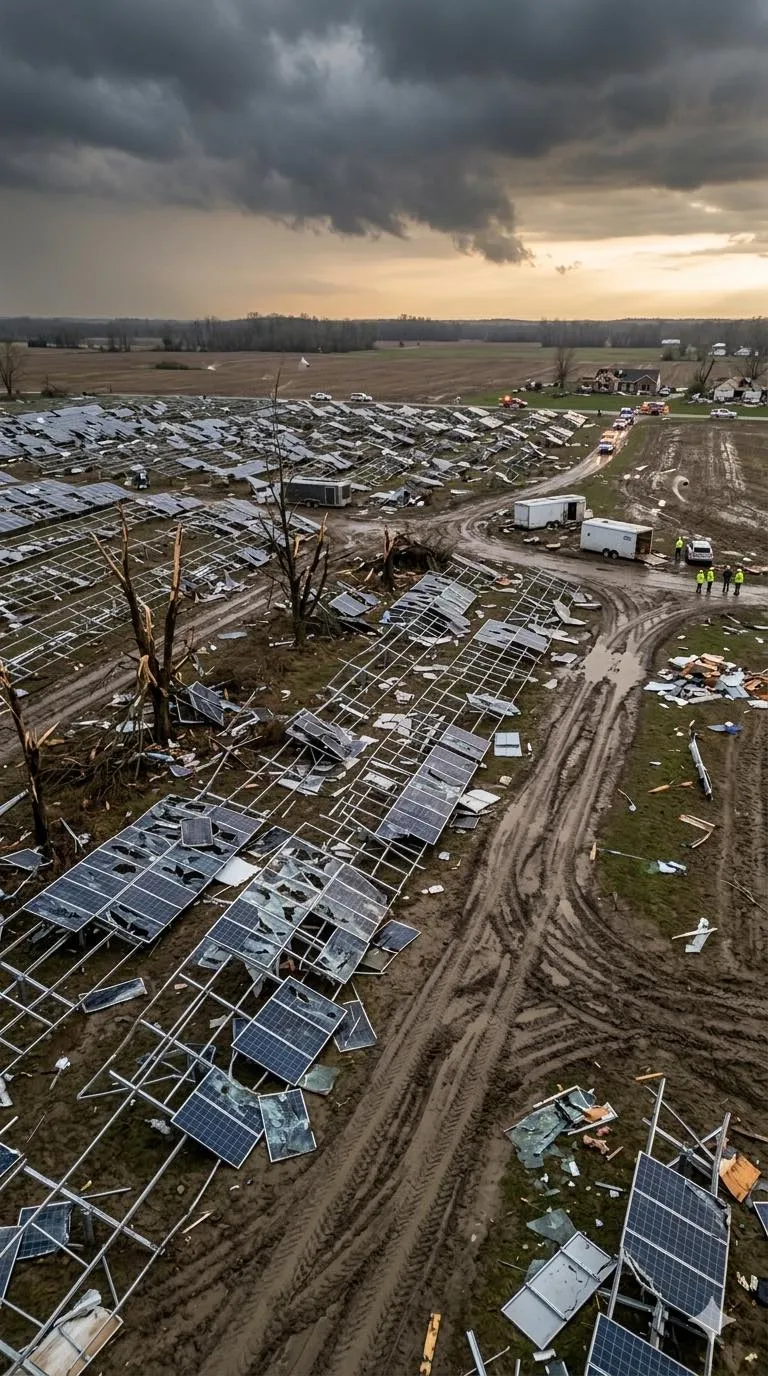
Drone footage shows hundreds of solar panels ripped apart and scattered across farmland after a powerful tornado tore through Wheatfield overnight. Homes in the area also suffered heavy damage as the violent storm carved a path of destruction. Photo credit Joemar Sombero
Energy Bad Boys draw the lessons from an Indiana tornado impacting power supply in their blog article Solar Scattered, Coal Still Standing. Excerpts in italics with my bolds and added images.
What an Indiana tornado revealed about the cost of fragile power
On Tuesday, March 10th, an EF-1 tornado destroyed the Dunns Bridge Solar I and II facilities owned by the Northern Indiana Public Service Company (NIPSCO). The facilities, located outside of Wheatfield, Indiana, had 2.4 million solar panels, totaling 700 megawatts (MW) of power capacity, and reportedly cost $1 billion to construct—a little over $1,400 per kilowatt (kW).
The Chief Deputy of Jasper County Sheriff’s Department, Brandon Napier, noted, “Just the path of the tornado that came through, we have several large solar fields to the east of the town here it went right through the solar field and just ripped a lot of them out.”
While the solar panels were damaged by the tornado, we are not aware of any reports of damage at the nearby R.M. Schahfer Generating Station, a 950 MW coal facility that NIPSCO was planning to retire at the end of 2025. However, it is still running thanks to a 202(C) order issued by the U.S. Department of Energy (DOE) requiring the plant to continue operations. Click on the map below to explore the custom Google Map we made this week of the facilities.
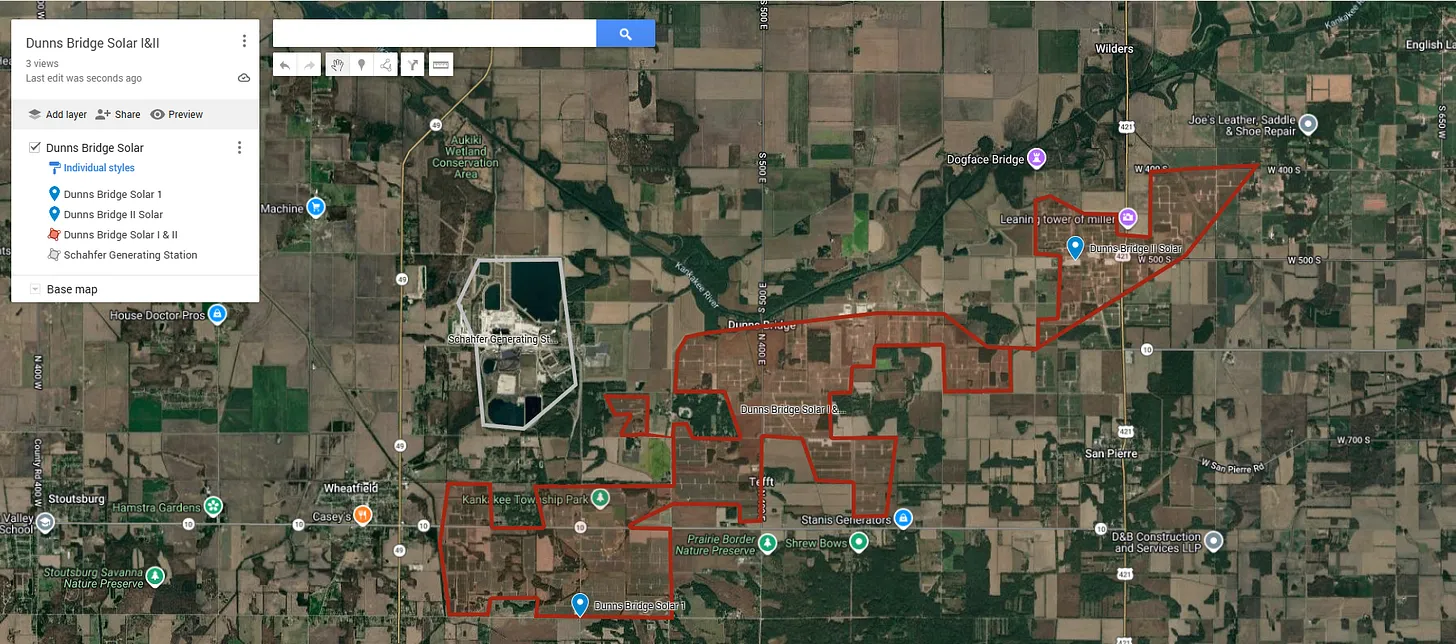
To enlarge, open in new tab.
This article will explore the cost of the destroyed solar facility compared to the nearby R.M. Schahfer Plant, and explore how energy costs have changed in the NIPSCO service territory in response to changes in the company’s generation fleet, using some cool data from S&P Global.
According to S&P Global, the Dunns Bridge solar projects were built to “support Northern Indiana Public Service’s goal of becoming coal-free by 2028, reducing carbon emissions by more than 90 percent by 2030, compared to a 2005 baseline, according to the utility.”
The situation begs several questions:
- If climate change is going to make the weather more extreme, how does it make any sense to shut down coal plants and build energy generation facilities, like solar, that are destroyed by extreme weather?
- Are the company’s coal-free and emissions reduction goals increasing the company’s exposure to costs associated with weather events, and why should ratepayers be saddled with these additional costs?
- Was there any damage to the R.M. Schahfer coal plant or the onsite battery storage facility at Dunns Bridge?
- What type of insurance policy is in place for the solar facility, and what deductible would the company be required to pay, if any?
- What liability, if any, does the company have for the cleanup of the site and surrounding areas?
- How is any of this in the best interests of ratepayers?
The Cost of Tornado-Truncated Solar Facility
Let’s be incredibly uncharitable and look at the anticipated levelized cost of energy (LCOE) of the solar facility over its projected 25-year useful lifetime, and its actual, tornado-truncated lifetime.
Dunns Bridge I began generating power in June of 2023, producing a total of 1.3 million megawatt hours (MWh) up until December of 2025, the most recent month for which data are available. Dunns Bridge II began generating power in January of 2025, and through December, it produced 812,439 MW of power, which is good for a 21.3 percent capacity factor.
We calculated the LCOE over two time periods: a 25-year lifecycle, a standard assumption in the industry, and a 2-year lifecycle to account for the facility being destroyed very early in its lifecycle. The results are about what we would expect. Our estimated subsidized costs over 25 years are approximately equal to S&P Global’s reported PPA cost for the facilities, including subsidies.
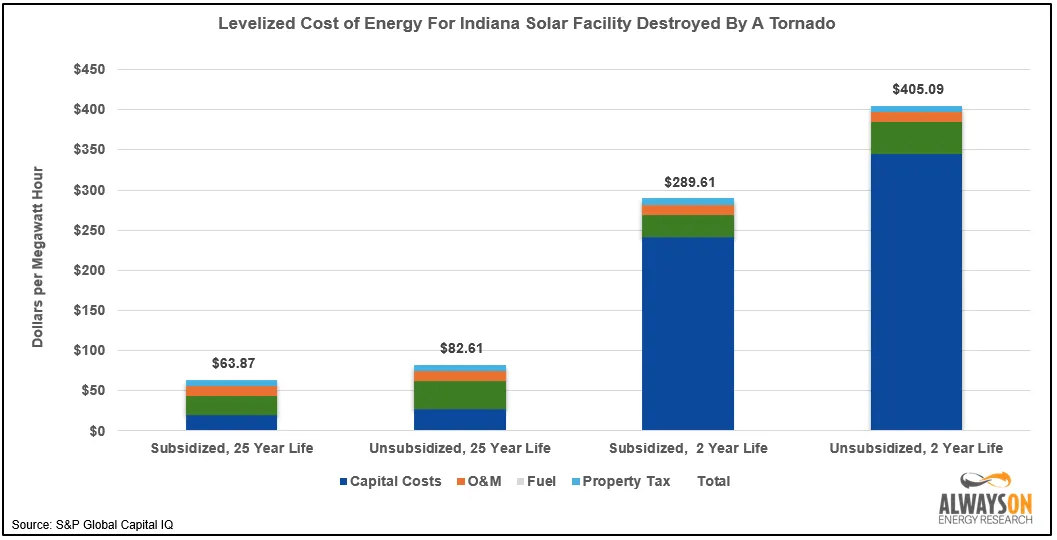
Is this a fair comparison? Probably not, because the solar facility was almost certainly insured and will likely be rebuilt after the site is remediated. The question is: how much are the cleanup and replacement costs, and what is the insurance deductible for the damaged facility, and who has to pay them?
The Cost of the Nearby Coal Plant
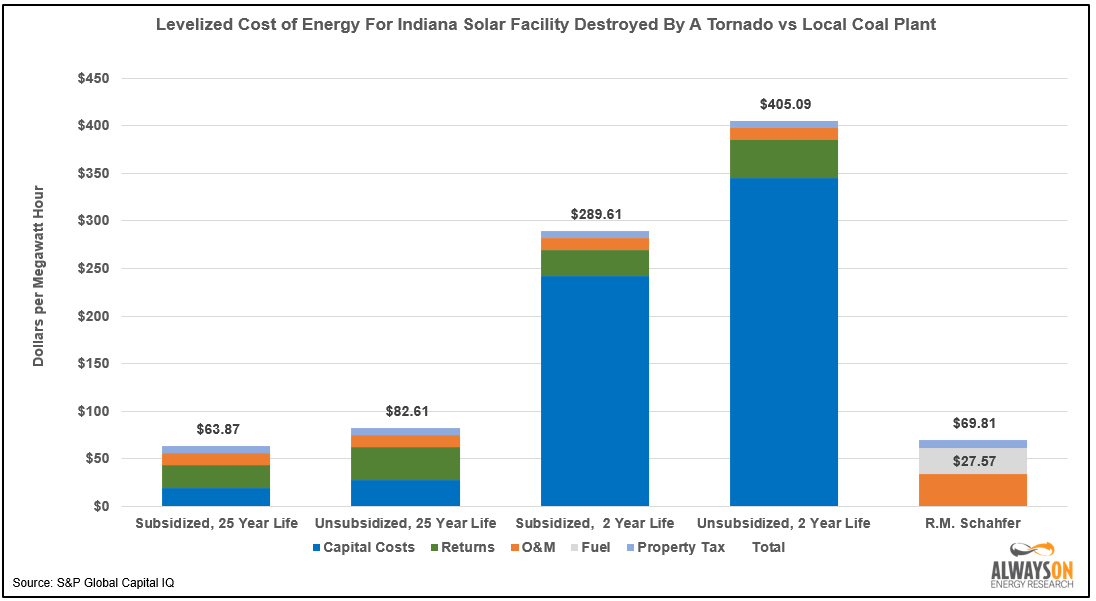
In our upcoming LCOE study for Reliable Energy Inc. in Indiana, we found that the R.M. Schahfer plant was the most expensive coal plant in the state, due primarily to very high delivered fuel costs at the plant ($50 per MWh).
However, the December 2025 data from S&P Global, the most recent available, show the delivered fuel cost was about $27 per MWh, which substantially improves the economics of the plant, although this could possibly be the result of the company assuming the plant would retire at the end of the year, rather than being required to stay open.
At $70 per MWh, the Schahfer plant is competitive with subsidized solar
over a 25-year lifespan, cheaper than the unsubsidized cost over 25 years,
and a bargain compared with our admittedly uncharitable comparison
to the facility’s actual 2-year lifespan.
NIPSCO’s Changing Generation Profile
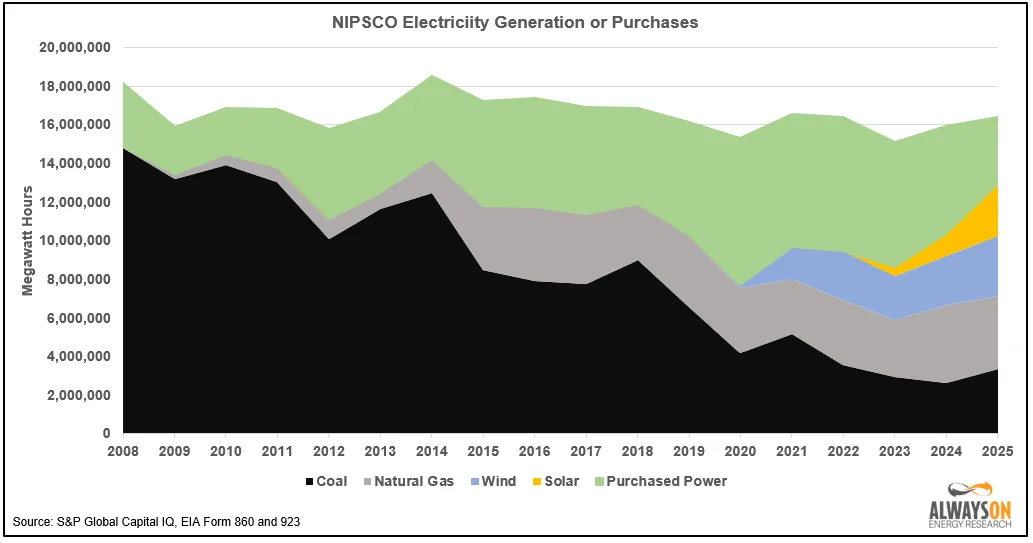
NIPSCO’s Dunns Bridge solar facilities are part of a larger trend away from coal-fired power generation toward natural gas, MISO market purchases, and increasingly, wind and solar ownership or power purchase agreements (PPAs).
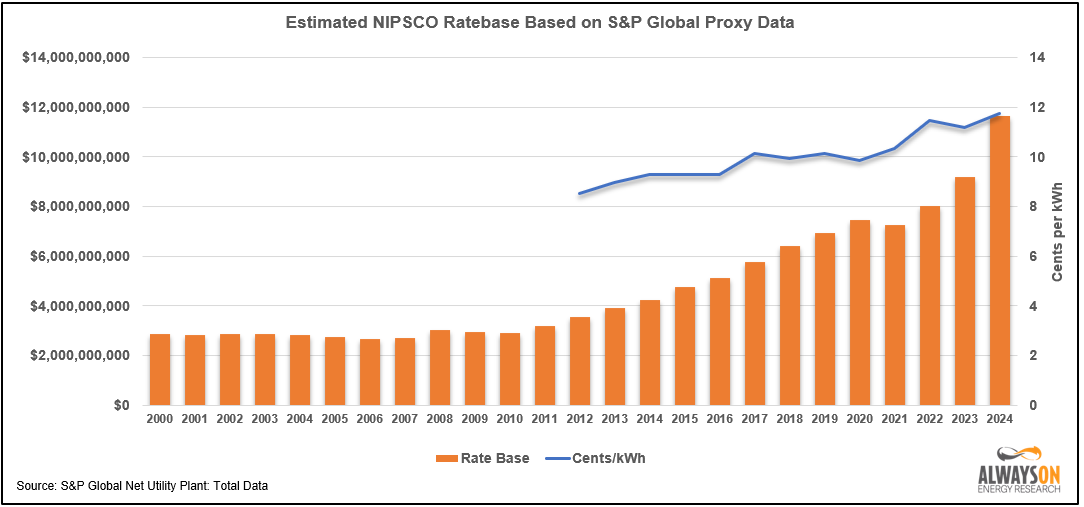
This trend has coincided with a massive increase in the utilities’ estimated rate base. Data from S&P Global show NIPSCO’s rate base has more than doubled since 2016. You’ll notice that the rate base was essentially flat from 2000 to 2010 in non-inflation-adjusted terms. This is because electric companies are supposed to see their rate bases stabilize as their assets depreciate over time.
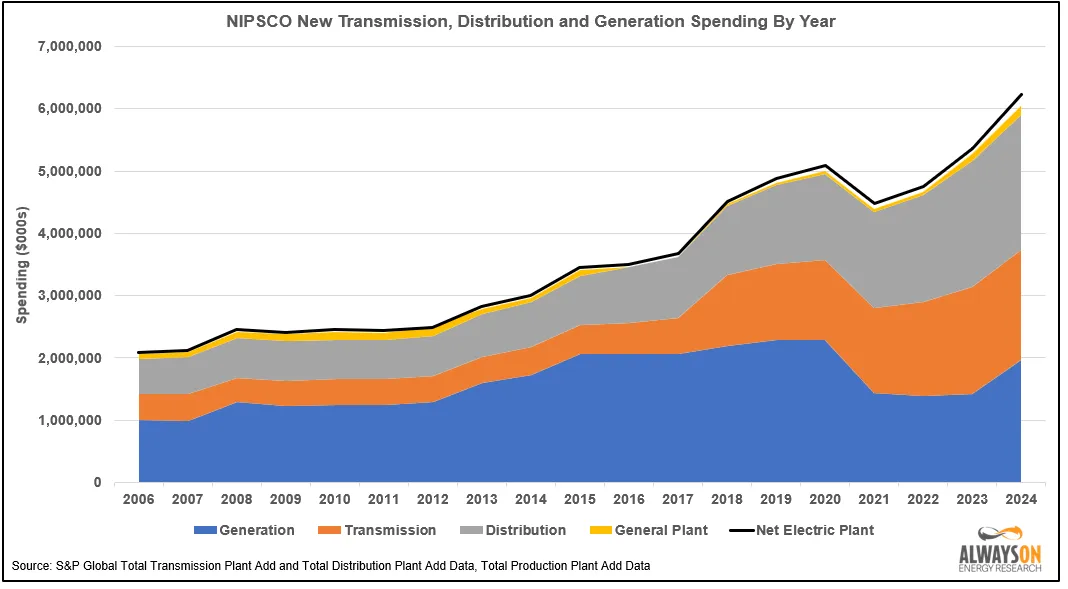
It’s also interesting to look at what’s causing the rate base growth. In the mid 2000s and 2010s, the growth in NIPSCO’s spending was driven by generation spending. However, transmission and distribution spending began to increase around 2018, and generation spending fell in 2021, but rebounded slightly in 2024.
Conclusion
There are lots of things that break when they get hit by a tornado,
but our power plants shouldn’t be one of them.
The demise of the Dunns Bridge I & II solar facilities by one of the weakest classifications of tornado should be a nudge to Indiana policymakers and utility regulators that shutting down dispatchable thermal plants in favor of flimsier wind and solar facilities is not a prudent course of action.
Frankly, the Trump administration should be lambasting companies like NIPSCO for continuing to pursue their voluntary decarbonization pledges when electricity bills are rising, and demand is soaring due to data centers. A few mean tweets might go a long way toward helping utility executives and their Wall Street investors understand they can no longer Green Plate the grid at the expense of everyday Americans.

Solar panels in field with the sun reflecting on the panels creating a glare. Source: Northern Indiana Public Service Company LLC (NIPSCO),
 Science Matters