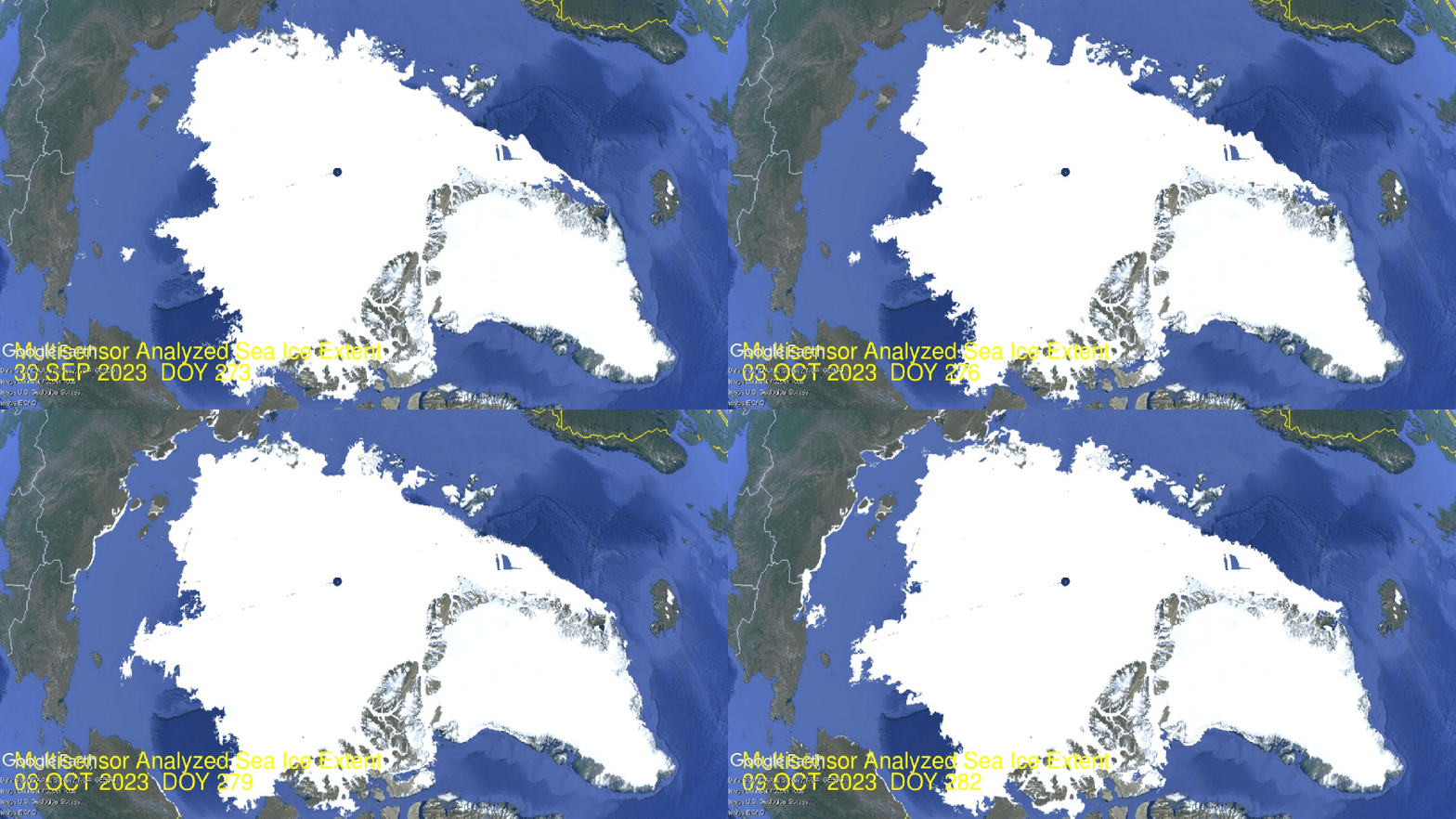
Mid October 2023 Arctic Ice Recovering Rapidly


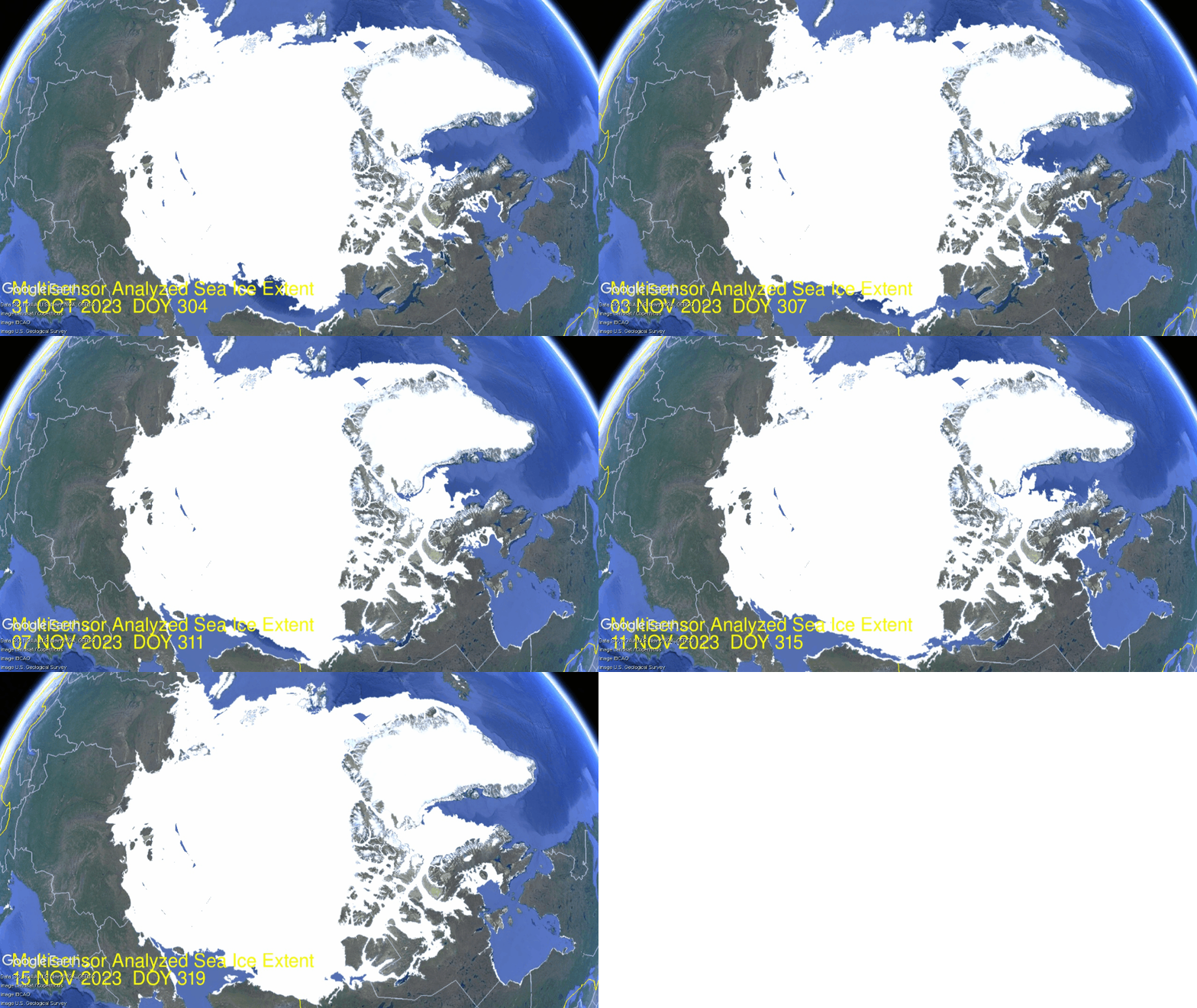
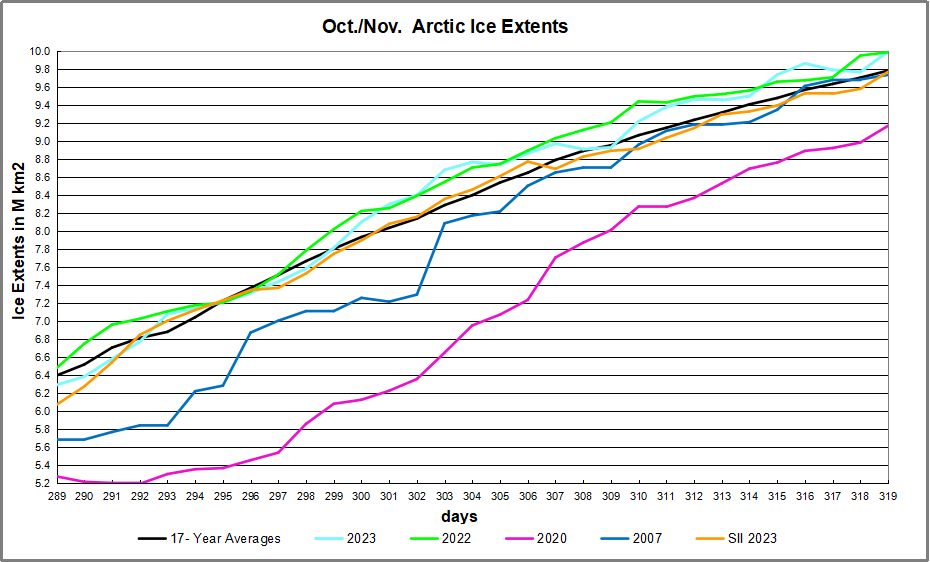
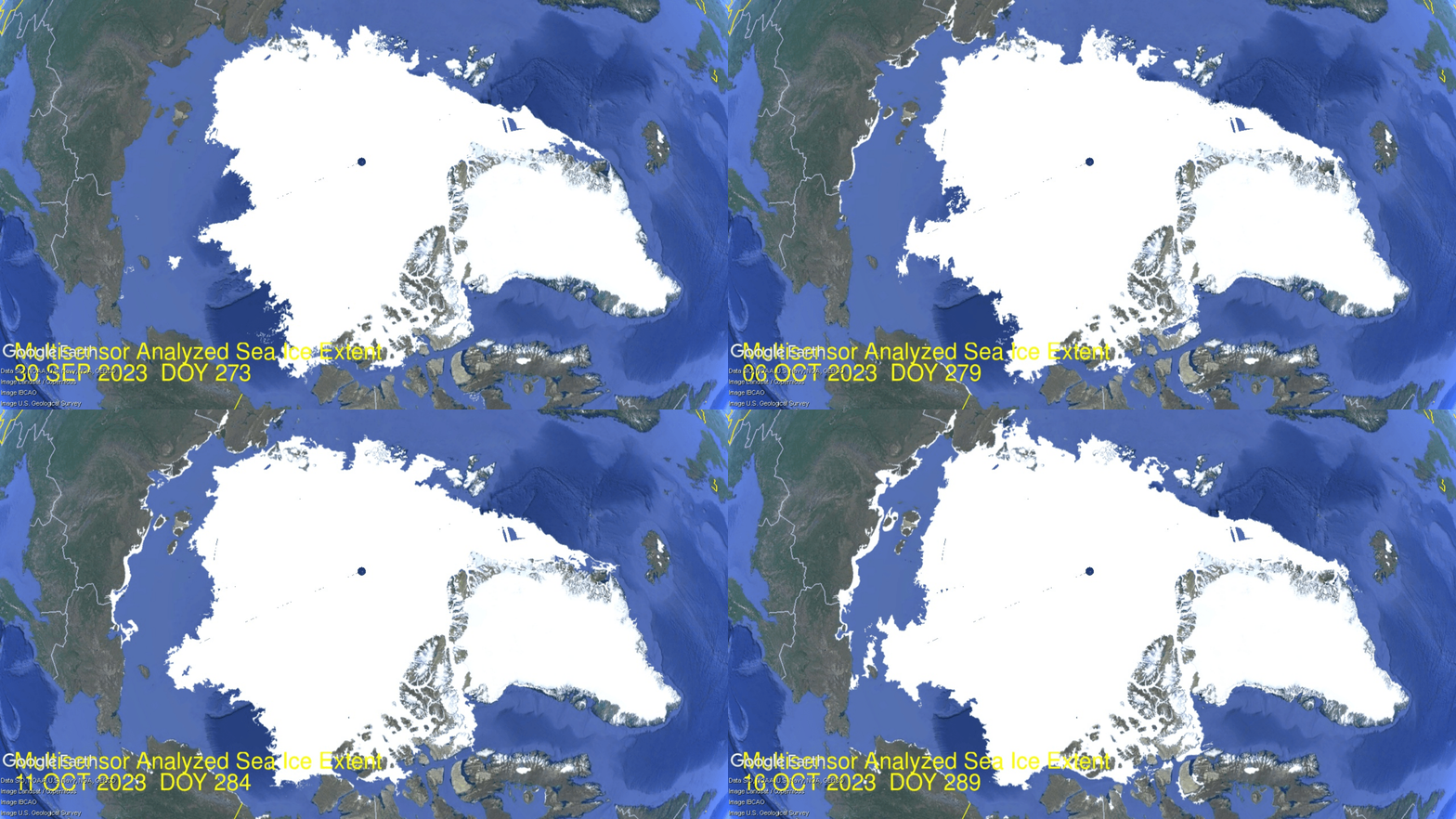
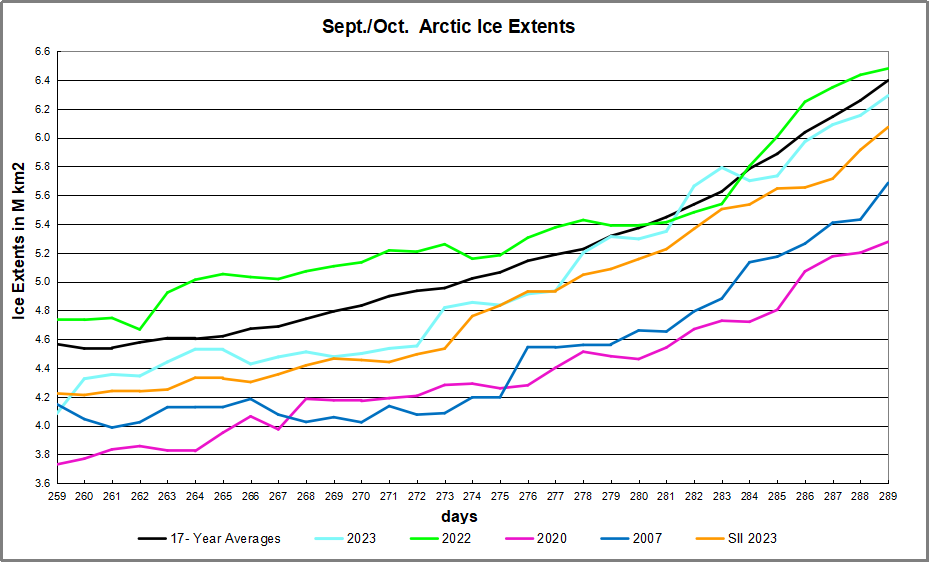
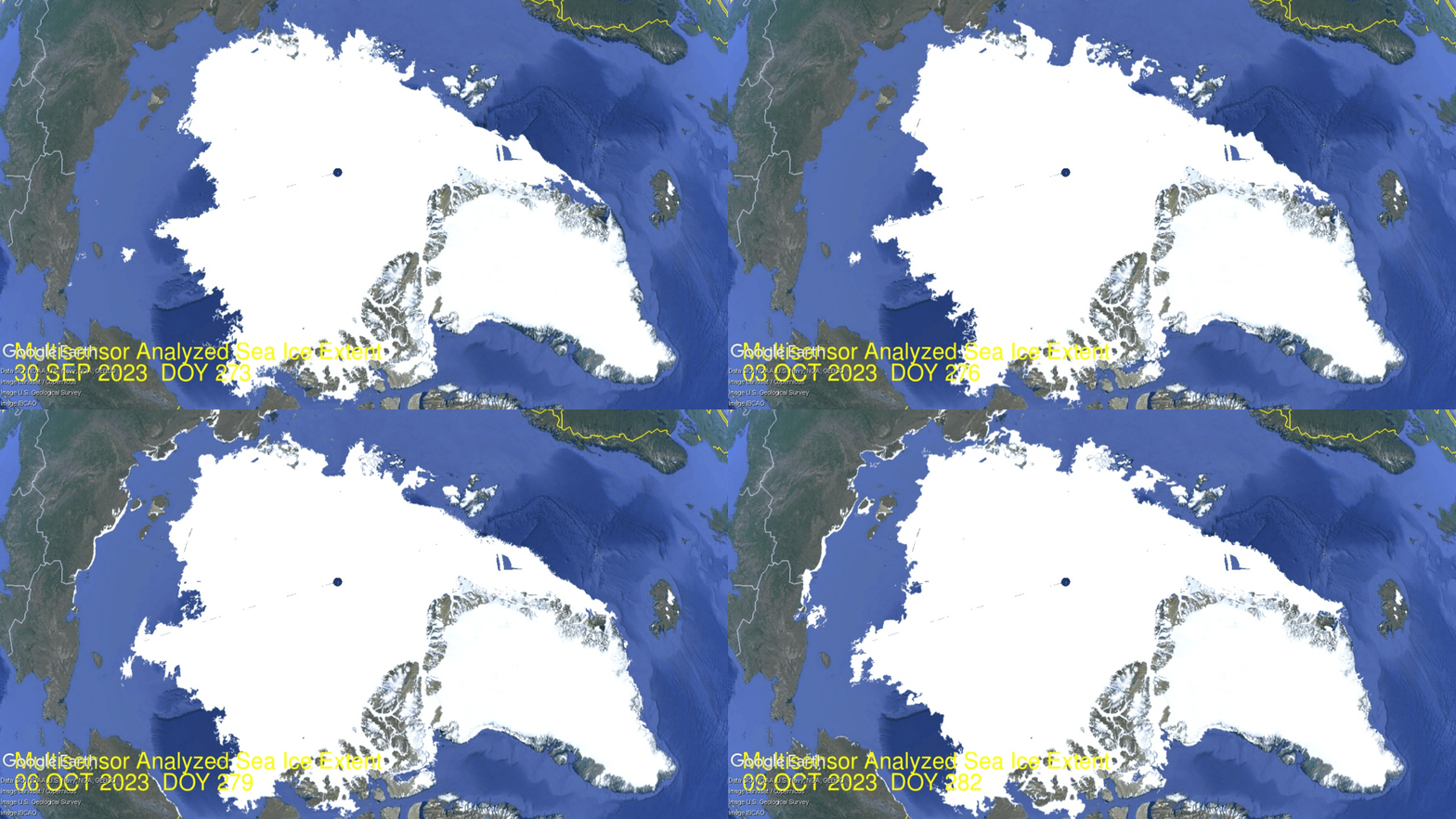
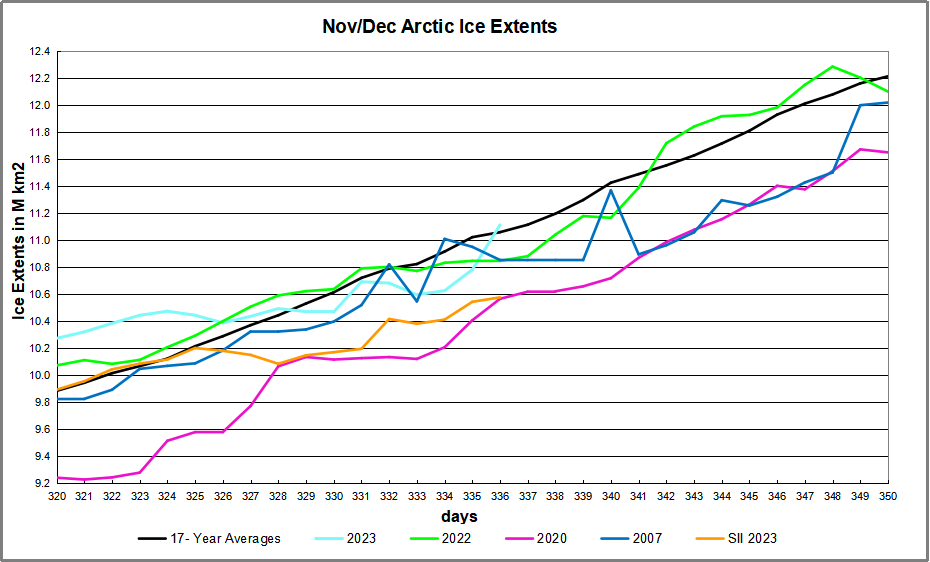
The animation shows Arctic ice rapidly growing from September 30 to yesterday October 16.  Despite much ado about September minimums, in fact the ice recovers quickly from its annual low extent.  Several days exceeded the 17 year average with yesterday slightly in deficit. The graph below shows the distribution of ice across the Arctic Regions with 2023 compare to average, to some notable years and to estimates from SII (Sea Ice Index)

Note that refreezing starts mid September and accelerates upward.  October has already added 1.4M km2 and will likely end up 3M higher than end of September. As the table below shows, the ice extents are tracking the 17 year average and 600k km2 greater than 2007.

Region 2023289 Day 289 2023-Ave. 2007289 2023-2007
 (0) Northern_Hemisphere 6291575 6397434  -105859  5685365 606210 
 (1) Beaufort_Sea 545048 740358  -195309  815519 -270471 
 (2) Chukchi_Sea 399345 309528  89817  98615 300730 
 (3) East_Siberian_Sea 495351 569412  -74061  32547 462804 
 (4) Laptev_Sea 578928 453308  125620  553919 25009 
 (5) Kara_Sea 178575 148145  30430  170928 7647 
 (6) Barents_Sea 22291 42524  -20233  25377 -3086 
 (7) Greenland_Sea 422335 341130  81206  446006 -23670 
 (8) Baffin_Bay_Gulf_of_St._Lawrence 103295 100033  3262  92878 10416 
 (9) Canadian_Archipelago 362514 583556  -221042  502605 -140091 
 (10) Hudson_Bay 208 10894  -10686  1936 -1729 
 (11) Central_Arctic 3179853 3096957  82896  2943760 236093 

Yesterday the overall extent was ~6.30M km2, ~100k km2 below average (2%).  Deficits were mostly in Beaufort Sea and CAA, offset by surpluses in Chukchi,Laptev, and Greenland seas, along with Central Arctic.

Previous post:  2023 September Arctic Outlook and Results Not Scary

The graph above shows the monthly averages for September Arctic ice extents including 2023 compared to previous years back to 2007.  This year is slightly below the 17 year average of 4.63M km2;  MASIE shows 4.43M and SII shows 4.37.  For comparison the 2007 September values were 4.30M for MASIE and 4.27M for SII.  The predictions below refer to the SII value.

2023: August Report from Sea Ice Prediction Network

The August median forecasted value for pan-Arctic September sea-ice extent is 4.60 million square kilometers with interquartile values of 4.35 and 4.80 million square kilometers, while individual forecasts range from 2.88 to 5.47 million square kilometers. We note that the lowest two forecasts predict a new record September sea-ice extent value (current record is September 2012, with a sea-ice extent of 3.57 million square kilometers), but these forecasts are outliers relative to the other contributions.

These are predictions for the September 2023 monthly average ice extent as reported by NOAA Sea Ice Index (SII). This post provides a look at the 2023 Year To Date (YTD) based on monthly averages comparing MASIE and SII datasets. (17 year average is 2006 to 2022 inclusive).

The graph puts 2023 into recent historical perspective. Note how 2023 was slightly below the 17-year average for the first 5 months, then recovered to match average in May and has maintained or exceeded average through August. September was below average slightly and above 2007. The outlier 2012 provided the highest March maximum as well as the lowest September minimum, coinciding with the Great Arctic Cyclone that year.  2007 began the period with the lowest minimum except for 2012.  SII 2023 was running below MASIE except for May/June and is currently just below MASIE and above 2007 and 2012.


October 2023 Arctic Ice Flash Freezing

The animation shows the rapid refreezing of Arctic ice from September 30 to yesterday October 9.  Despite much ado about September minimums, in fact the ice recovers quickly from its annual low extent.  As of yesterday, Day 282, this year has again exceeded the 17 year average.

Previous post:  2023 September Arctic Outlook and Results Not Scary

The graph above shows the monthly averages for September Arctic ice extents including 2023 compared to previous years back to 2007.  This year is slightly below the 17 year average of 4.63M km2;  MASIE shows 4.43M and SII shows 4.37.  For comparison the 2007 September values were 4.30M for MASIE and 4.27M for SII.  The predictions below refer to the SII value.
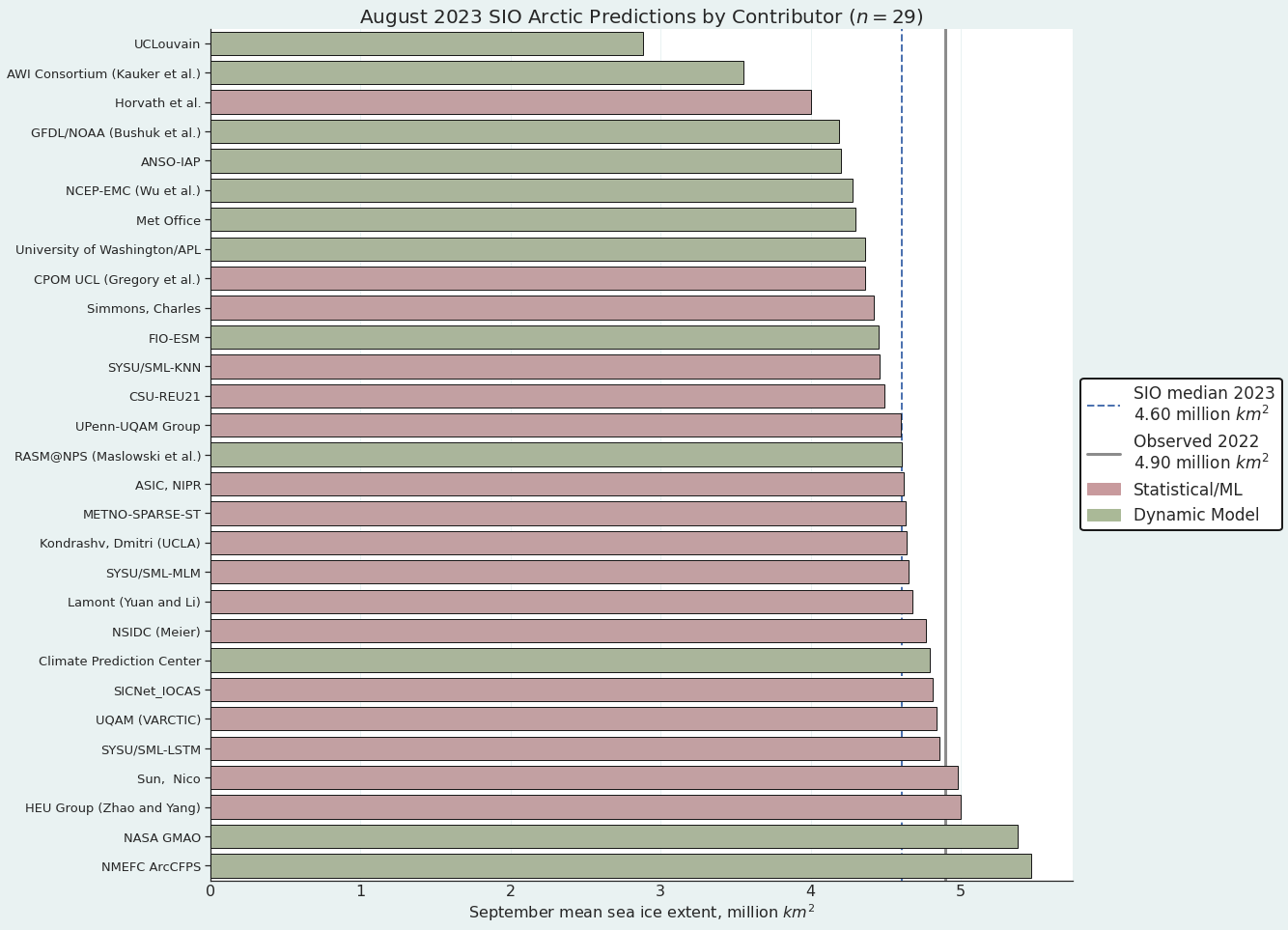
2023: August Report from Sea Ice Prediction Network

The August median forecasted value for pan-Arctic September sea-ice extent is 4.60 million square kilometers with interquartile values of 4.35 and 4.80 million square kilometers, while individual forecasts range from 2.88 to 5.47 million square kilometers. We note that the lowest two forecasts predict a new record September sea-ice extent value (current record is September 2012, with a sea-ice extent of 3.57 million square kilometers), but these forecasts are outliers relative to the other contributions.

These are predictions for the September 2023 monthly average ice extent as reported by NOAA Sea Ice Index (SII). This post provides a look at the 2023 Year To Date (YTD) based on monthly averages comparing MASIE and SII datasets. (17 year average is 2006 to 2022 inclusive).
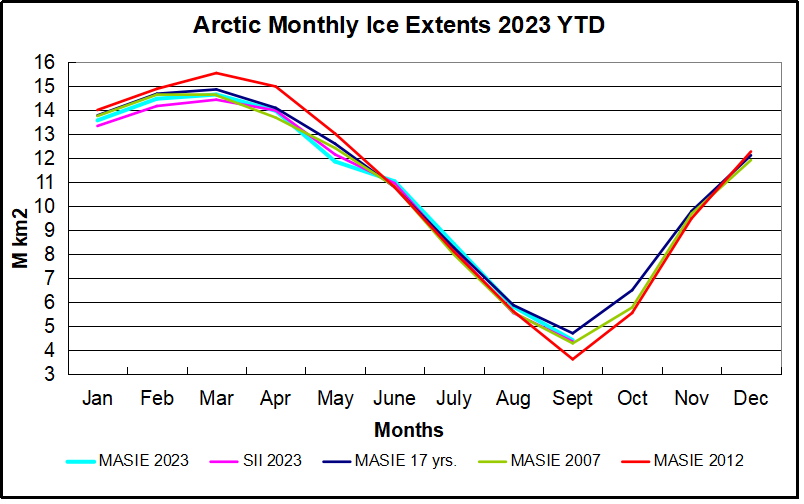
The graph puts 2023 into recent historical perspective. Note how 2023 was slightly below the 17-year average for the first 5 months, then recovered to match average in May and has maintained or exceeded average through August. September was below average slightly and above 2007. The outlier 2012 provided the highest March maximum as well as the lowest September minimum, coinciding with the Great Arctic Cyclone that year.  2007 began the period with the lowest minimum except for 2012.  SII 2023 was running below MASIE except for May/June and is currently just below MASIE and above 2007 and 2012.

The table below provides the numbers for comparisons (all are M km2)

Monthly MASIE 2023 SII 2023 MASIE -SII MASIE 2023-17 YR AVE SII 2023-17 YR AVE MASIE 2023-2007
Jan 13.579 13.347 0.232 -0.207 -0.250 -0.183
Feb 14.481 14.177 0.304 -0.207 -0.292 -0.171
Mar 14.655 14.440 0.215 -0.212 -0.248 0.032
Apr 13.979 13.992 -0.013 -0.120 -0.025 0.283
May 11.866 12.159 -0.293 -0.742 -0.492 -0.561
June 11.044 10.963 0.081 0.242 0.099 0.218
July 8.431 8.183 0.248 0.152 0.150 0.439
Aug 5.825 5.561 0.264 -0.062 -0.083 0.241
Sept 4.430 4.371 0.059 -0.285 -0.360 0.132

The first two columns are the 2023 YTD shown by MASIE and SII, with the MASIE surpluses in column three.  Column four shows MASIE 2023 compared to MASIE 17 year average, while column five shows SII 2023 compared to SII 17 year average.  YTD September both MASIE and SII ~300k km2 below average. The last column shows MASIE 2023 holding a September surplus of 132k km2 over 2007.

Summary and Update

The experts involved in SIPN were expecting SII 2023 September to be higher than 2007 and somewhat lower than 2022.  The way it came out MASIE September was 285k km2 below average and 132 above 2007.  The Chart below shows the October ice recovery is well under way, now exceeding the average. 
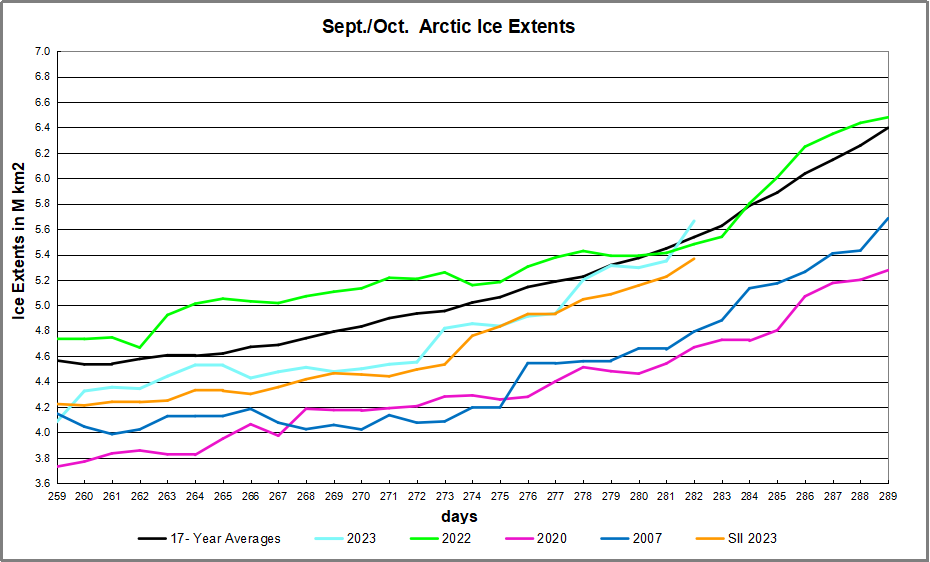
The table shows Day 282 (October 9) ice extents for NH overall and the regions, comparing 2023 to average and several years.

Region 2023282 Day 282 2023-Ave. 2007282 2023-2007
 (0) Northern_Hemisphere 5663965 5537300  126665  4794178 869787 
 (1) Beaufort_Sea 473472 641789  -168317  639935 -166464 
 (2) Chukchi_Sea 323215 255140  68075  14061 309154 
 (3) East_Siberian_Sea 257832 407159  -149327  35 257797 
 (4) Laptev_Sea 471460 252642  218818  340943 130518 
 (5) Kara_Sea 117555 66310  51245  82407 35148 
 (6) Barents_Sea 29729 22272  7457  12933 16796 
 (7) Greenland_Sea 424861 289801  135061  400747 24115 
 (8) Baffin_Bay_Gulf_of_St._Lawrence 90677 67480  23197  73481 17195 
 (9) Canadian_Archipelago 305206 485343  -180137  424350 -119144 
 (10) Hudson_Bay 104 5030  -4926  4163 -4059 
 (11) Central_Arctic 3167292 3043182  124110  2799828 367464 

On Day 282 Arctic ice was 127k km2 above average and nearly 870k km2 above 2007. The major deficits were in Beaufort, East Siberian seas and Canadian Archipelago.  They were more than offset by surpluses in Laptev, Greenland sea and Central Arctic as well as smaller surpluses elsewhere.  From previous years we can expect that October 2023 will gain more than 3M km2 of ice extent over the ending extent in September.

 

2023 September Arctic Outlook and Results Not Scary

The graph above shows the monthly averages for September Arctic ice extents including 2023 compared to previous years back to 2007.  This year is slightly below the 17 year average of 4.63M km2;  MASIE shows 4.43M and SII shows 4.37.  For comparison the 2007 September values were 4.30M for MASIE and 4.27M for SII.  The predictions below refer to the SII value.

2023: August Report from Sea Ice Prediction Network

The August median forecasted value for pan-Arctic September sea-ice extent is 4.60 million square kilometers with interquartile values of 4.35 and 4.80 million square kilometers, while individual forecasts range from 2.88 to 5.47 million square kilometers. We note that the lowest two forecasts predict a new record September sea-ice extent value (current record is September 2012, with a sea-ice extent of 3.57 million square kilometers), but these forecasts are outliers relative to the other contributions.

These are predictions for the September 2023 monthly average ice extent as reported by NOAA Sea Ice Index (SII). This post provides a look at the 2023 Year To Date (YTD) based on monthly averages comparing MASIE and SII datasets. (17 year average is 2006 to 2022 inclusive).

The graph puts 2023 into recent historical perspective. Note how 2023 was slightly below the 17-year average for the first 5 months, then recovered to match average in May and has maintained or exceeded average through August. September was below average slightly and above 2007. The outlier 2012 provided the highest March maximum as well as the lowest September minimum, coinciding with the Great Arctic Cyclone that year.  2007 began the period with the lowest minimum except for 2012.  SII 2023 was running below MASIE except for May/June and is currently just below MASIE and above 2007 and 2012.

The table below provides the numbers for comparisons (all are M km2)

Monthly MASIE 2023 SII 2023 MASIE -SII MASIE 2023-17 YR AVE SII 2023-17 YR AVE MASIE 2023-2007
Jan 13.579 13.347 0.232 -0.207 -0.250 -0.183
Feb 14.481 14.177 0.304 -0.207 -0.292 -0.171
Mar 14.655 14.440 0.215 -0.212 -0.248 0.032
Apr 13.979 13.992 -0.013 -0.120 -0.025 0.283
May 11.866 12.159 -0.293 -0.742 -0.492 -0.561
June 11.044 10.963 0.081 0.242 0.099 0.218
July 8.431 8.183 0.248 0.152 0.150 0.439
Aug 5.825 5.561 0.264 -0.062 -0.083 0.241
Sept 4.430 4.371 0.059 -0.285 -0.360 0.132

The first two columns are the 2023 YTD shown by MASIE and SII, with the MASIE surpluses in column three.  Column four shows MASIE 2023 compared to MASIE 17 year average, while column five shows SII 2023 compared to SII 17 year average.  YTD September both MASIE and SII ~300k km2 below average. The last column shows MASIE 2023 holding a September surplus of 132k km2 over 2007.

Summary and Update

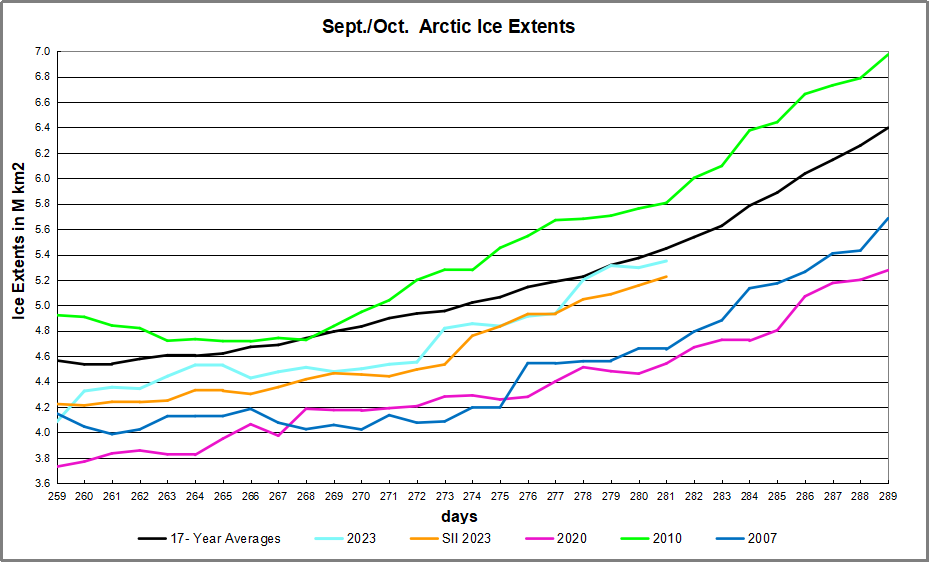
The experts involved in SIPN were expecting SII 2023 September to be higher than 2007 and somewhat lower than 2022.  The way it came out MASIE September was 285k km2 below average and 132 above 2007.  The Chart below shows the October ice recovery is well under way, reaching average briefly.

The table shows Day 281 (October 8) ice extents for NH overall and the regions, comparing 2023 to average and several years.

Region 2023281 Day 281 2023-Ave. 2007281 2023-2007
 (0) Northern_Hemisphere 5349225 5448341 -99116 4653544 695681
 (1) Beaufort_Sea 429938 633800 -203862 618242 -188304
 (2) Chukchi_Sea 301437 249878 51559 27562 273875
 (3) East_Siberian_Sea 180747 397106 -216358 311 180436
 (4) Laptev_Sea 423091 235120 187971 302924 120168
 (5) Kara_Sea 97994 54598 43396 22717 75277
 (6) Barents_Sea 15003 21167 -6164 3580 11423
 (7) Greenland_Sea 414298 285893 128405 414576 -278
 (8) Baffin_Bay_Gulf_of_St._Lawrence 74944 64730 10214 71399 3545
 (9) Canadian_Archipelago 266487 468946 -202459 408841 -142354
 (10) Hudson_Bay 744 4166 -3423 1936 -1193
 (11) Central_Arctic 3142582 3031785 110797 2780181 362401

On Day 281 Arctic ice was 100k km2 below average and nearly 700k km2 above 2007. The major deficits were in Beaufort, East Siberian seas and Canadian Archipelago.  Offsetting were surpluses in Laptev, Greenland sea and Central Arctic as well as smaller surpluses elsewhere.  From previous years we can expect that October 2023 will gain more than 3M km2 of ice extent over the ending extent in September.
 

Arctic Ice Recovery Starts Sept. 2023

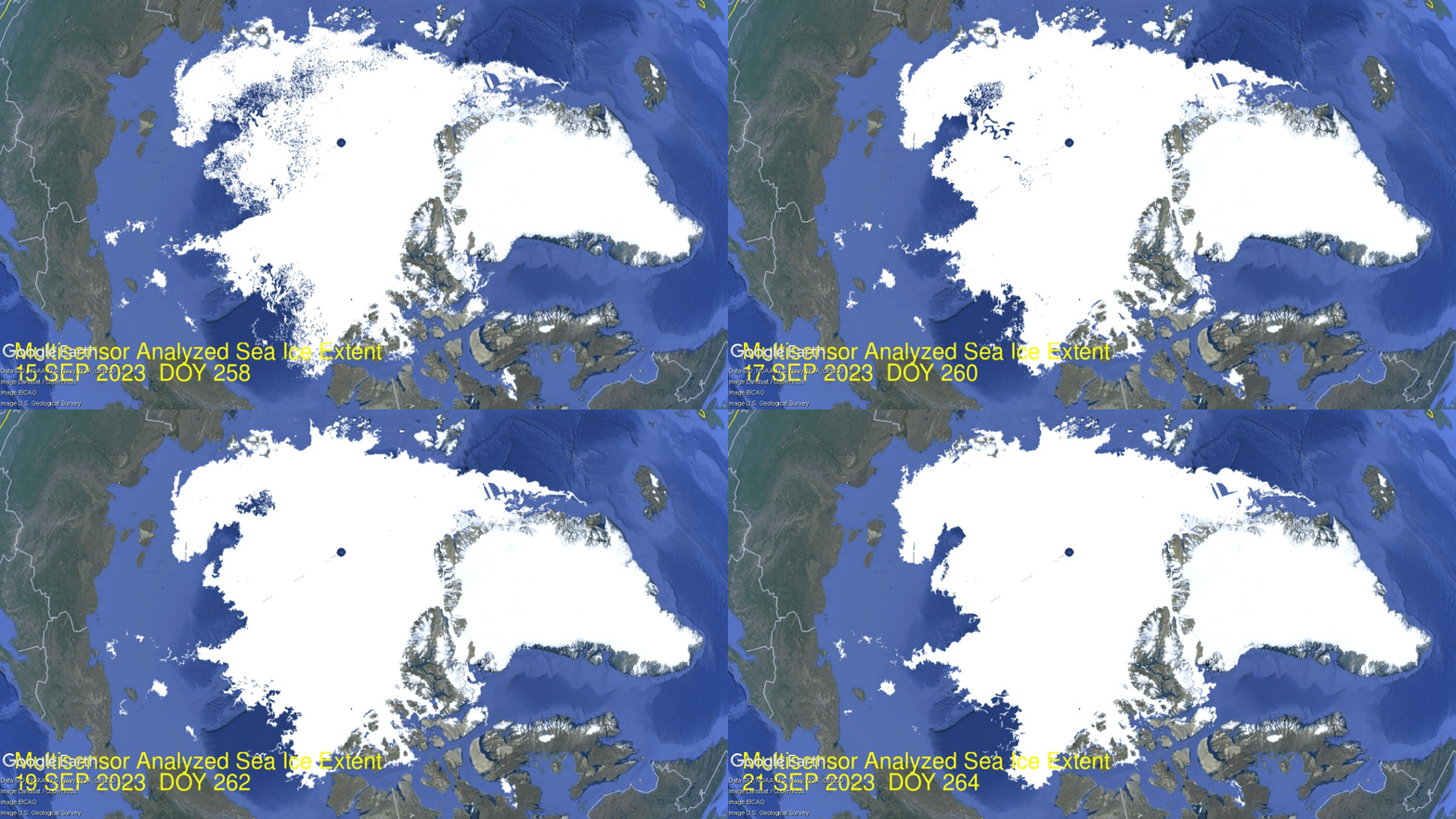
The animation above shows the minimum daily extent for 2023 occurred on September 15.  In the next six days ~450k km2 of ice extent was added (nearly half a Wadham). The Arctic ice extent yesterday was 4.53M km2 approaching the 17 year average for the day.

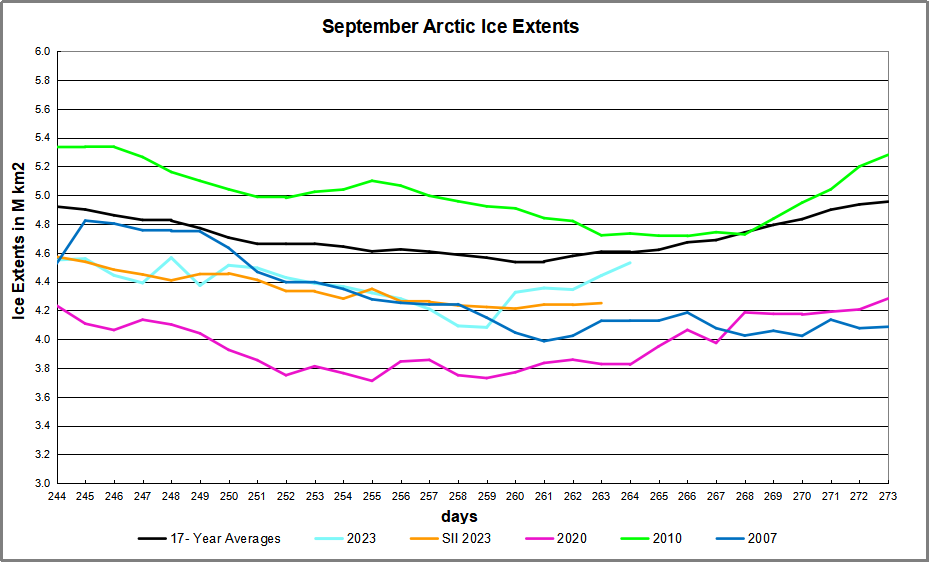
The graph for September shows the first two weeks 2023 was well below the average and tracking with 2007. After hitting bottom day 258, a sharp recovery lifted extents close to average and much higher than 2007.  (SII  has not yet posted a value for day 264).

Note that typically September ends the month slightly higher than it begins, though 2023 is already matching its Sept. 1 value.  If this year’s ice growth continued at the same rate of losses during the first two weeks of September (50k per day), the extent would reach  ~5M km2 at month end.  That would result in a 2023 September monthly average of 4.5M km2.  Such extent would be close to the median prediction, somewhat lower than 2022, but much higher than 2007 or 2020, and 800k km2 higher than 2012 (the year of the great August Cyclone.)

The table for day 264 shows how the ice extent is distributed across the Arctic regions, in comparison to 17 year average and 2007.

Region 2023264 264 Average 2023-Ave. 2007264 2023-2007
 (0) Northern_Hemisphere 4530862 4603044  -72183  4129308 401554 
 (1) Beaufort_Sea 353539 514036  -160497  507235 -153697 
 (2) Chukchi_Sea 135936 167774  -31839  30316 105620 
 (3) East_Siberian_Sea 48471 262691  -214220  311 48160 
 (4) Laptev_Sea 381662 127644  254018  223595 158067 
 (5) Kara_Sea 43989 34853  9136  27950 16038 
 (6) Barents_Sea 2394 14654  -12260  4851 -2457 
 (7) Greenland_Sea 273632 202253  71379  336388 -62756 
 (8) Baffin_Bay_Gulf_of_St._Lawrence 66853 34768  32085  31731 35122 
 (9) Canadian_Archipelago 177101 302976  -125875  237555 -60454 
 (10) Hudson_Bay 0 4119  -4119  2270 -2270 
 (11) Central_Arctic 3046145 2936249  109896  2725832 320313 

The table shows the main deficits are in Beaufort, East Siberian seas and CAA.  Offsetting surpluses are in Laptev, Greenland and Central Arctic seas. The total deficit on this day is 72k km2 or 1.6%.  Note that 2007 did not add more ice as September ended.

Illustration by Eleanor Lutz shows Earth’s seasonal climate changes. If played in full screen, the four corners present views from top, bottom and sides. It is a visual representation of scientific datasets measuring Arctic ice extents and snow cover.

September Outlook Arctic Ice 2023

2023: August Report from Sea Ice Prediction Network

The August median forecasted value for pan-Arctic September sea-ice extent is 4.60 million square kilometers with interquartile values of 4.35 and 4.80 million square kilometers, while individual forecasts range from 2.88 to 5.47 million square kilometers. We note that the lowest two forecasts predict a new record September sea-ice extent value (current record is September 2012, with a sea-ice extent of 3.57 million square kilometers), but these forecasts are outliers relative to the other contributions.

These are predictions for the September 2023 monthly average ice extent as reported by NOAA Sea Ice Index (SII). This post provides a look at the 2023 Year To Date (YTD) based on monthly averages comparing MASIE and SII datasets. (17 year average is 2006 to 2022 inclusive).


The graph puts 2023 into recent historical perspective. Note how 2023 was slightly below the 17-year average for the first 5 months, then recovered to match average in May and has maintained or exceeded average through August. The outlier 2012 provided the highest March maximum as well as the lowest September minimum, coinciding with the Great Arctic Cyclone that year.  2007 began the period with the lowest minimum except for 2012.  SII 2023 was running below MASIE except for May/Juneand is currently just below MASIE 2007 and 2012.

The table below provides the numbers for comparisons (all are M km2)

Monthly MASIE 2023 SII 2023 MASIE -SII MASIE 2023-17 YR AVE SII 2023-17 YR AVE MASIE 2023-2007
Jan 13.579 13.347 0.232 -0.207 -0.250 -0.183
Feb 14.481 14.177 0.304 -0.207 -0.292 -0.171
Mar 14.655 14.440 0.215 -0.212 -0.248 0.032
Apr 13.979 13.992 -0.013 -0.120 -0.025 0.283
May 11.866 12.159 -0.293 -0.742 -0.492 -0.561
June 11.044 10.963 0.081 0.242 0.099 0.218
July 8.431 8.183 0.248 0.152 0.150 0.439
Aug 5.825 5.561 0.264 -0.062 -0.083 0.241

The first two columns are the 2023 YTD shown by MASIE and SII, with the MASIE surpluses in column three.  Column four shows MASIE 2023 compared to MASIE 17 year average, while column five shows SII 2023 compared to SII 17 year average.  YTD August both MASIE and SII are very slightly below average. The last column shows MASIE 2017 holding an August surplus of 241k km2 over 2007.

Summary

The experts involved in SIPN are expecting SII 2023 September to be higher than 2007 and somewhat lower than 2022.  The way MASIE is going, this September looks to be nearly average unless some bad weather intervenes.  While the daily minimum for the year occurs mid September, ice extent on September 30 is typically slightly higher than on September 1.

Footnote:

Some people unhappy with the higher amounts of ice extent shown by MASIE continue to claim that Sea Ice Index is the only dataset that can be used. This is false in fact and in logic. Why should anyone accept that the highest quality picture of ice day to day has no shelf life, that one year’s charts can not be compared with another year? Researchers do this, including Walt Meier in charge of Sea Ice Index. That said, I understand his interest in directing people to use his product rather than one he does not control. As I have said before:

MASIE is rigorous, reliable, serves as calibration for satellite products, and continues the long and honorable tradition of naval ice charting using modern technologies. More on this at my post Support MASIE Arctic Ice Dataset

MASIE: “high-resolution, accurate charts of ice conditions”
Walt Meier, NSIDC, October 2015 article in Annals of Glaciology.

Arctic Ice Surprise in East Siberia

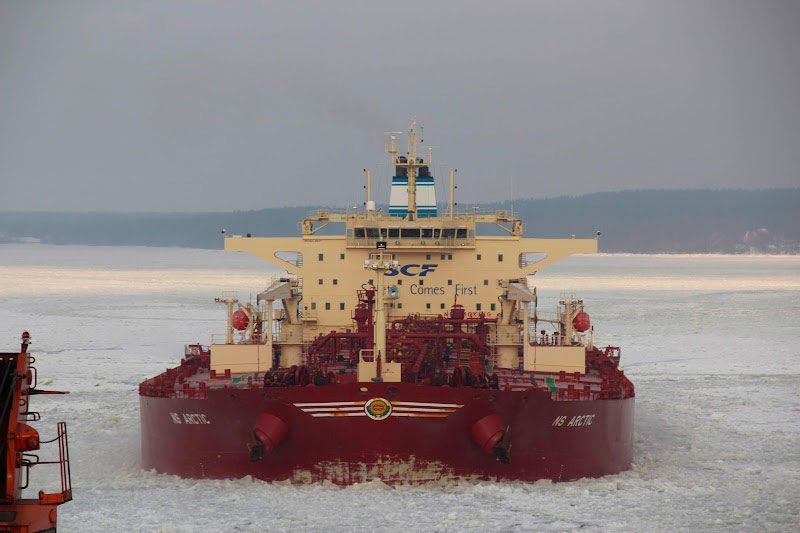
Oil tanker NS Arctic sailing in icy waters. Photo: Dmitry Lobusov, icebreaker captain for Rosatomflot

With the warmer water temperatures in the North Atlantic this summer, we can expect lower Arctic sea ice extents.  But maybe not.  Barents Observer reports A month after they set out on Arctic voyage, two Russian oil tankers still battle with sea-ice.  Excerpts in italics with my bolds.

The ships that are loaded with more than 200,000 tons of oil
might have been surprised by ice pack in the East Siberian Sea.

The Primorsky Prospect and NS Arctic on the 12th and 14th of July respectively set out from St.Petersburg with course for the Chinese ports of Dalian and Rizhao. They were to arrive at destinations by the middle of August.  That schedule is now significantly postponed. Shipping data show that the ships will make it to the Chinese ports no earlier than 26th of August.

Although the tankers both have ice classification Arc3, their voyage across the Laptev Sea and East Siberian Sea have been marred with troubles with the sea-ice.   For several days, the tankers were at standstill off the New Siberian Islands, and later also in the southern part of the East Siberian Sea.

Nevertheless, the long and icy voyage of the two oil tankers raises new questions about the actual benefits of sailing on the Northern Sea Route, as well as security in the area.

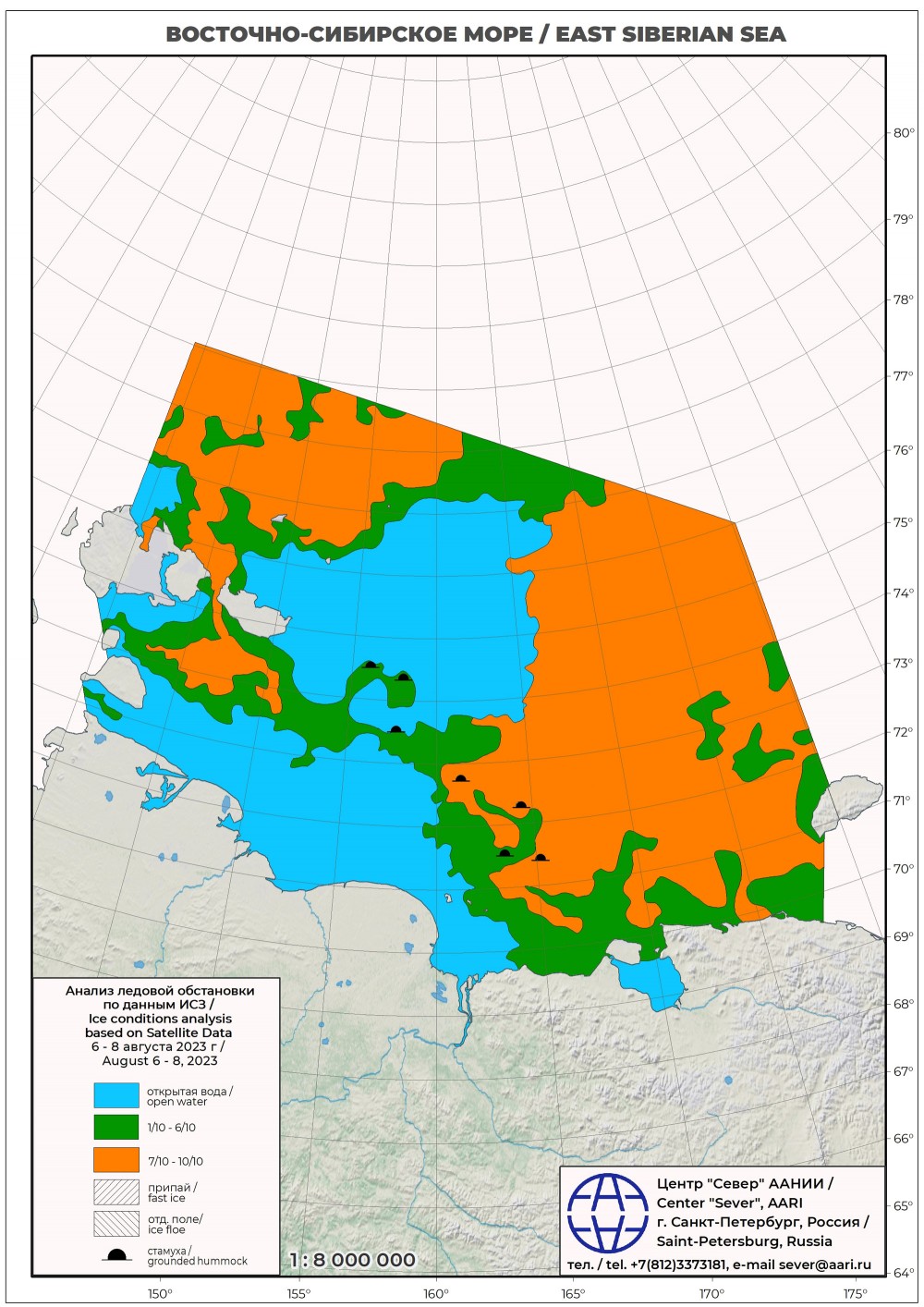
Sea-ice in thee East Siberian Sea in period 6-8th of August 2023. Map by Arctic and Antarctic Research Institute

Both the NS Arctic and Primorsky Prospect have ice classification Arc3, but neither of them have permission to sail independently through the most complex parts of the Northern Sea Route in anything but light ice conditions.  Growing parts of the East Siberian Sea are ice-free. But changes can quickly occur in this region and a sudden emergence of ice pack might have taken the ships by surprise.

But in medium ice conditions, the ships are obliged to hire icebreaker escort. It is not clear to what extent the tankers have made it into medium ice conditions. But ice maps from the Russian Arctic and Antarctic Research Institute show that major parts of the East Siberian Sea have a white sheet.

“Perhaps the wind has pushed the ice pack towards the coast, increasing the concentration locally so that there’s no longer continuous green strip along the coast?” an anonymous industry expert says to the Barents Observer.

According to the expert, there appears to be no imminent risk for a dangerous situation.

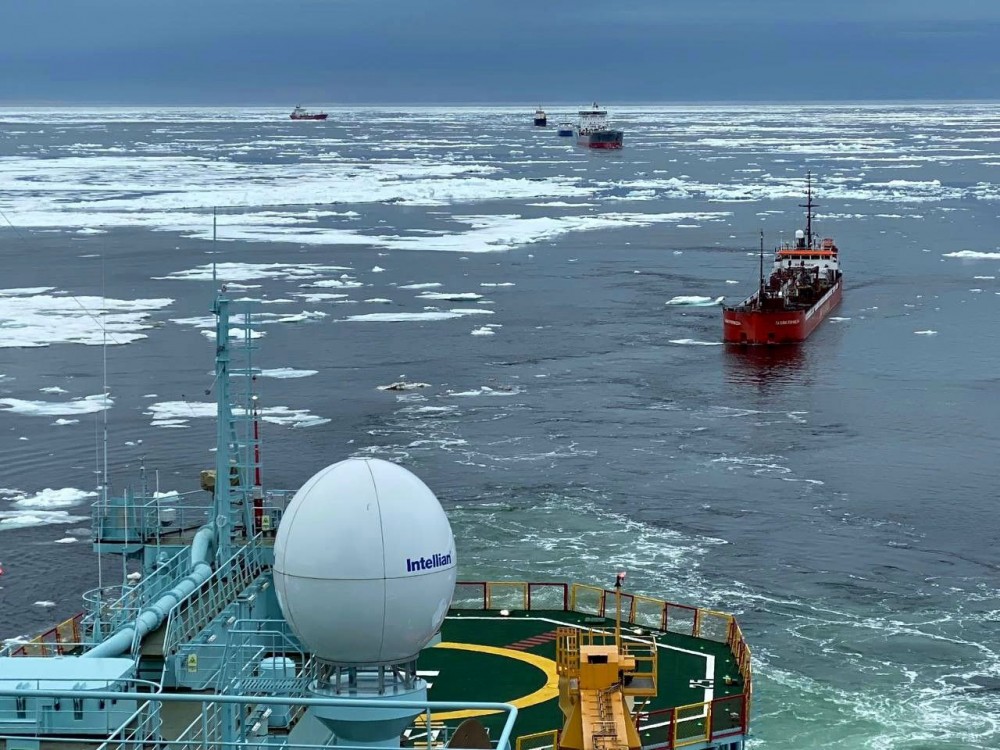
Nuclear icebreaker Sibir escorts ships through the Vilkitsky Strait. Photo: Rosatom/Kirill Razin

Arctic Ice Surplus Wiped Out in 5 Days? Mid August 2023


An incredible turn of events in Arctic Ice extent reporting in the last five days.  As the chart above shows, it is not unusual in August to have sharp downturns in ice extents.  However, the 2023 drop is unprecedented and looks suspiciously like an adjustment to bring MASIE in line with SII.  Note that for 25 days, MASIE showed much more ice than SII, ranging as much as +622k km2 on August 1 and +572k km2 on day 222. Moreover, those two days were in surplus to MASIE 17 year average:  +460k km2, and + 265k km2 respectively.

Then on day 223 MASIE dropped 466k km2, unprecendented for a single day.   And further declines resulted a five day total loss exceeding 1 Wadham, 1.05M km2.  In just five days, a surplus of  +265k turned into a deficit of -448k.  And MASIE is now 170k lower than SII. 

I have asked for an explanation and am awaiting a reply from NSIDC.

The table for day 227 shows a distribution of ice extent across the Arctic regions, in comparison to 17 year average and 2007.  2023 was 448k km2 below average, or 8% of total extent.

Region 2023227 Day 227 Average 2023-Ave. 2007227 2023-2007
 (0) Northern_Hemisphere 5483921 5932184  -448263  5673110 -189189 
 (1) Beaufort_Sea 508614 724117  -215503  770413 -261799 
 (2) Chukchi_Sea 477947 429182  48765  260048 217899 
 (3) East_Siberian_Sea 336549 569134  -232585  172718 163831 
 (4) Laptev_Sea 327171 238108  89064  292592 34579 
 (5) Kara_Sea 149411 95286  54126  201115 -51703 
 (6) Barents_Sea 10737 24019  -13282  17324 -6587 
 (7) Greenland_Sea 221710 229025  -7315  316155 -94445 
 (8) Baffin_Bay_Gulf_of_St._Lawrence 50784 58004  -7220  86165 -35380 
 (9) Canadian_Archipelago 289715 418748  -129033  375984 -86268 
 (10) Hudson_Bay 44528 67445  -22917  91653 -47125 
 (11) Central_Arctic 3066518 3077985  -11466  3087687 -21168 

The table shows the bulk of the deficit appears in Beaufort and East Siberian seas and CAA, with smaller surpluses in Chukchi, Laptev and Kara seas.

Illustration by Eleanor Lutz shows Earth’s seasonal climate changes. If played in full screen, the four corners present views from top, bottom and sides. It is a visual representation of scientific datasets measuring Arctic ice extents and snow cover.

Arctic Ice Surplus End July 2023

The animation above shows the Arctic sea ice extent on day 212 (end of July) from 2007 to yesterday 2023. Unsurprisingly the distribution varies, most notably there being less open water 2023 along the Russian shelf seas on the left side.  OTOH, Hudson Bay in most years still has some ice, but this year not.  Overall, Arctic ice this year is in surplus to the 17-year average and to 2007.

The graph above shows the July monthly average ice extent for the last 17 years for both MASIE and SII datasets.  Most years SII is slightly lower with the MASIE average at 8.279M km2 and SII at 8.033 (not shown).  Note that 2007 was near the lowest in the period and 2023 among the highest.

The graph for the last 30 days shows the normal melt is 2.7M km2 down to 6.9M km2.  2023 was tracking average for 2 weeks, and well above average after that.  SII tracked the MASIE average throughout, and sllghtly lower the second half. 2007 was average mid-July, but dropped much lower toward the end.

The table for day 212 shows how the ice extent is distributed across the Arctic regions, in comparison to 17 year average and 2007.  2023 was ~300k km2 above average, or 4% of total extent.

Region 2023212 Day 212 Average 2023-Ave. 2007212 2023-2007
 (0) Northern_Hemisphere 7232358 6936889  295469  6344860 887498 
 (1) Beaufort_Sea 723443 799968  -76525  760576 -37133 
 (2) Chukchi_Sea 659025 540756  118269  382350 276675 
 (3) East_Siberian_Sea 675190 756025  -80835  445385 229805 
 (4) Laptev_Sea 474071 371485  102587  314382 159689 
 (5) Kara_Sea 265568 161953  103615  239232 26336 
 (6) Barents_Sea 54417 29804  24612  23703 30714 
 (7) Greenland_Sea 328529 296824  31705  324737 3792 
 (8) Baffin_Bay_Gulf_of_St._Lawrence 243516 144525  98991  94179 149337 
 (9) Canadian_Archipelago 514780 555079  -40299  510063 4717 
 (10) Hudson_Bay 79485 143888  -64403  93655 -14170 
 (11) Central_Arctic 3213192 3134907  78285  3154837 58355 

The table shows earlier than average melting in Beaufort and East Siberian seas and Hudson Bay.  Surpluses are everywhere else, especially in Chukchi, Laptev and Kara Seas, as well as Baffin Bay and Central Arctic.  2007 was nearly a full Wadham less than 2023 yesterday.

Illustration by Eleanor Lutz shows Earth’s seasonal climate changes. If played in full screen, the four corners present views from top, bottom and sides. It is a visual representation of scientific datasets measuring Arctic ice extents and snow cover.

Normal Arctic Ice Mid July 2023


The previous June Arctic ice update showed that shallow basins on the Pacific side lost their ice rapidly.  The animation above shows in the last 15 days how Hudson Bay (bottom right) is nearly all open water. And Baffin Bay (center right) is down to 22% of its March max. The images also show CAA (Canadian Arctic Archipelago–center bottom) is still blocking the Northwest Passage, despite open water in Baffin Bay and in Beaufort Sea to the west.  Also the Russian shelf seas (left) are starting to open. This is all normal melting of Arctic drift ice, presently at 56% (8.4 M km2) of last March maximum, heading toward the September minimum.

The graph for the last 30 days shows the normal melt is ~2.5M km2 down to 8.3 M km2.  2023 was above average for 3 weeks, and matching average the last week.  SII tracked the MASIE average throughout, as did 2007 in June, but dropped lower toward the end.

The table for day 197 shows how the ice extent is distributed across the Arctic regions, incomparison to 17 year average and 2007.

Region 2023197 Day 197 Average 2023-Ave. 2007197 2023-2007
 (0) Northern_Hemisphere 8356350 8252843  103507  7963047 393303 
 (1) Beaufort_Sea 843873 864156  -20283  825810 18063 
 (2) Chukchi_Sea 736044 627024  109019  550547 185496 
 (3) East_Siberian_Sea 891273 909597  -18324  729250 162022 
 (4) Laptev_Sea 632760 547279  85481  525724 107036 
 (5) Kara_Sea 313437 331825  -18389  401874 -88438 
 (6) Barents_Sea 64976 54022  10954  60637 4339 
 (7) Greenland_Sea 433035 394327  38708  434750 -1715 
 (8) Baffin_Bay_Gulf_of_St._Lawrence 397917 292326  105591  314783 83134 
 (9) Canadian_Archipelago 649440 710624  -61184  711889 -62449 
 (10) Hudson_Bay 165147 348600  -183452  183962 -18814 
 (11) Central_Arctic 3227307 3169018  58289  3222022 5284 

The table shows that Hudson Bay is the anomaly, melting out early, but will soon be matched by the average there.  CAA is also in slight deficit to average, while surpluses appear in Chukchi, Laptev, Baffin Bay and Central Arctic.  2007 was nearly 400k km2 lower than yesterday.

Illustration by Eleanor Lutz shows Earth’s seasonal climate changes. If played in full screen, the four corners present views from top, bottom and sides. It is a visual representation of scientific datasets measuring Arctic ice extents and snow cover.

Ten Days Melt in Hudson & Baffin Bays


The previous June Arctic ice update suggested that shallow basins on the Atlantic side will now lose their ice rapidly.  The animation above shows in the last 10 days how much open water has appeared in Hudson Bay (bottom right) and Baffin Bay (center right).  Just those two regions combined lost ~500k km2 of ice in 1.5 weeks and are now holding ~30% of their maximums.  The images also show little change elsewhere.  This is all normal melting of Arctic drift ice, presently at 63% ( 9.5 M km2) of last March maximum, heading toward the September minimum.


Illustration by Eleanor Lutz shows Earth’s seasonal climate changes. If played in full screen, the four corners present views from top, bottom and sides. It is a visual representation of scientific datasets measuring Arctic ice extents and snow cover.