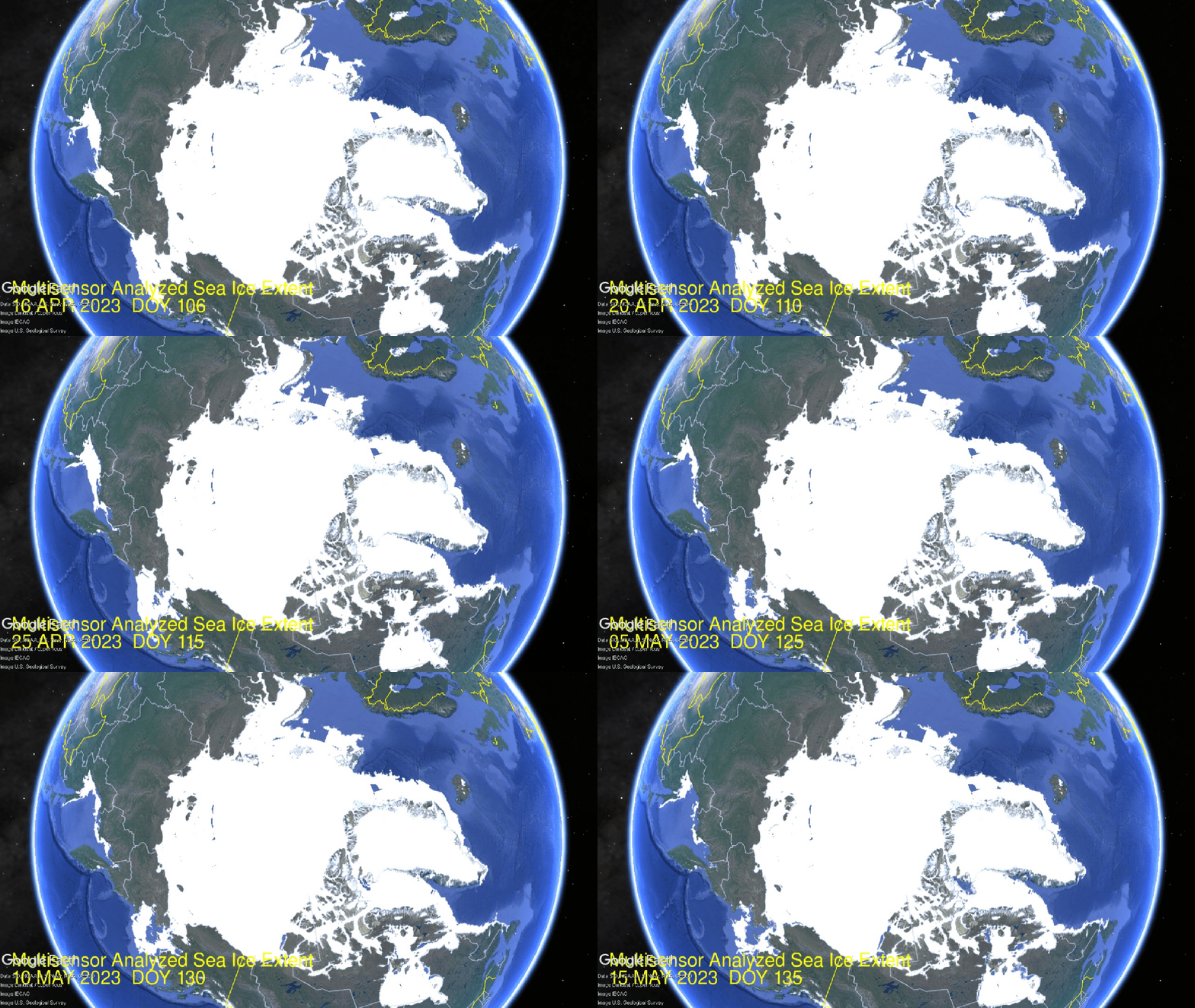
Arctic Ice in Surplus June 2023

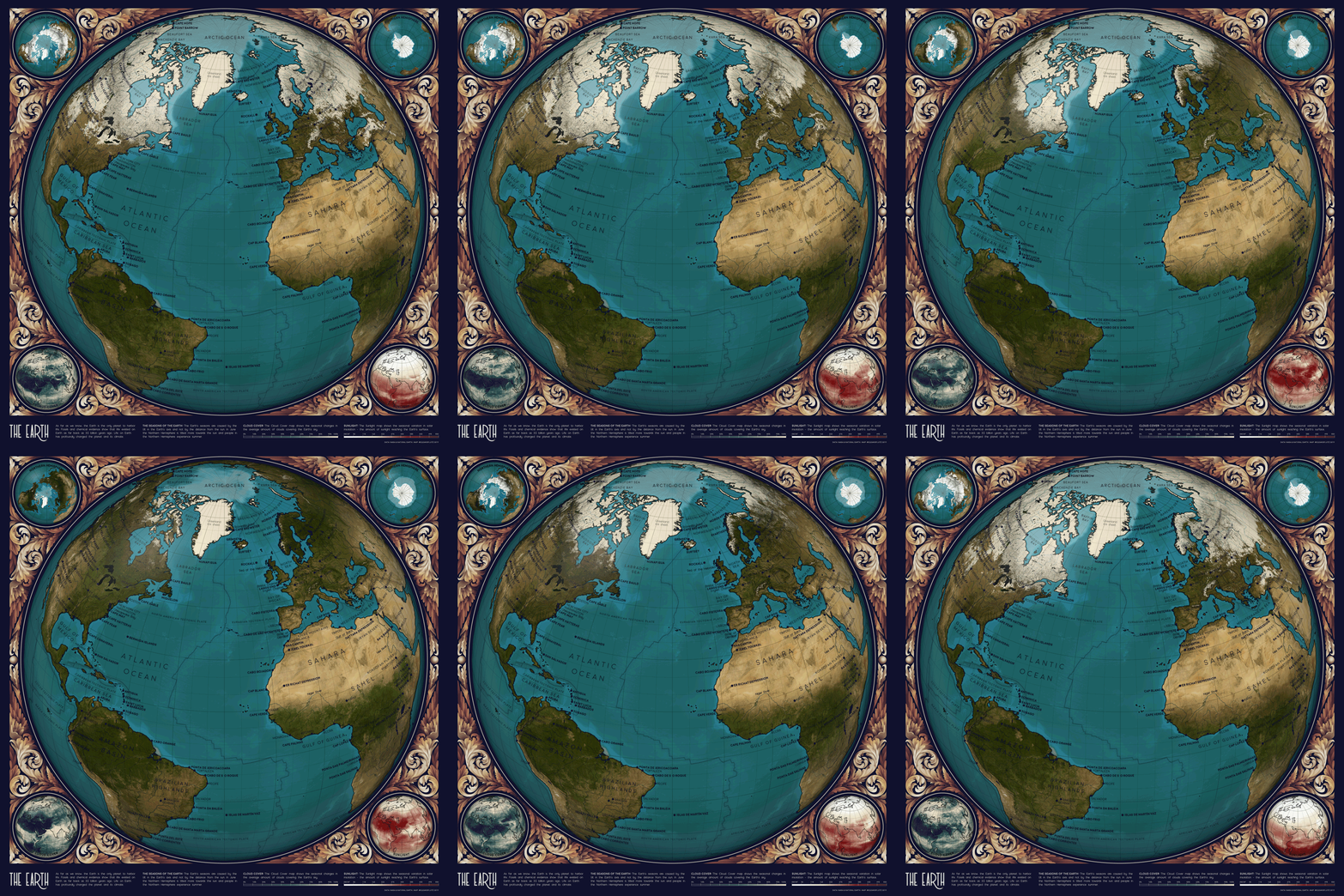
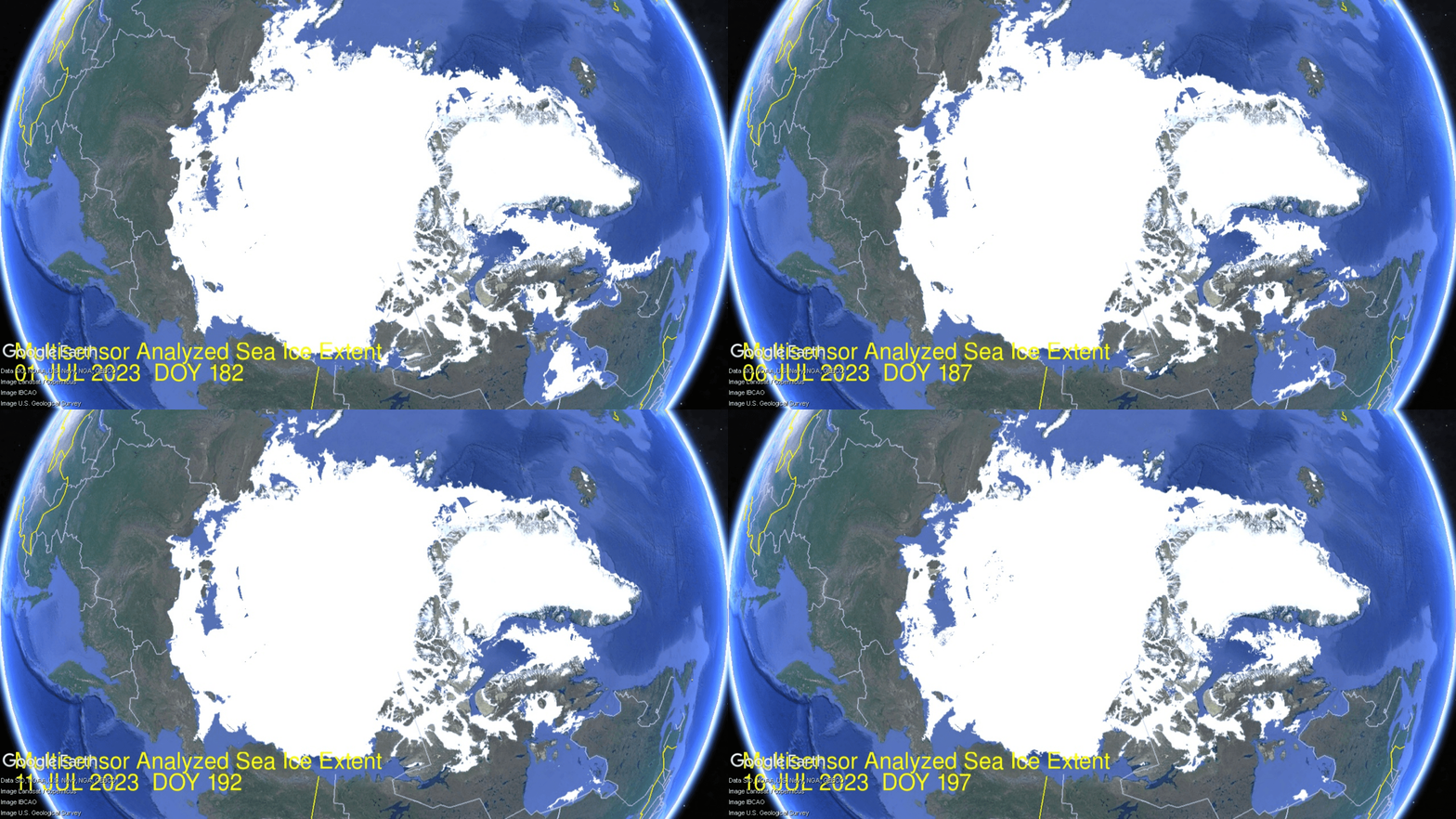
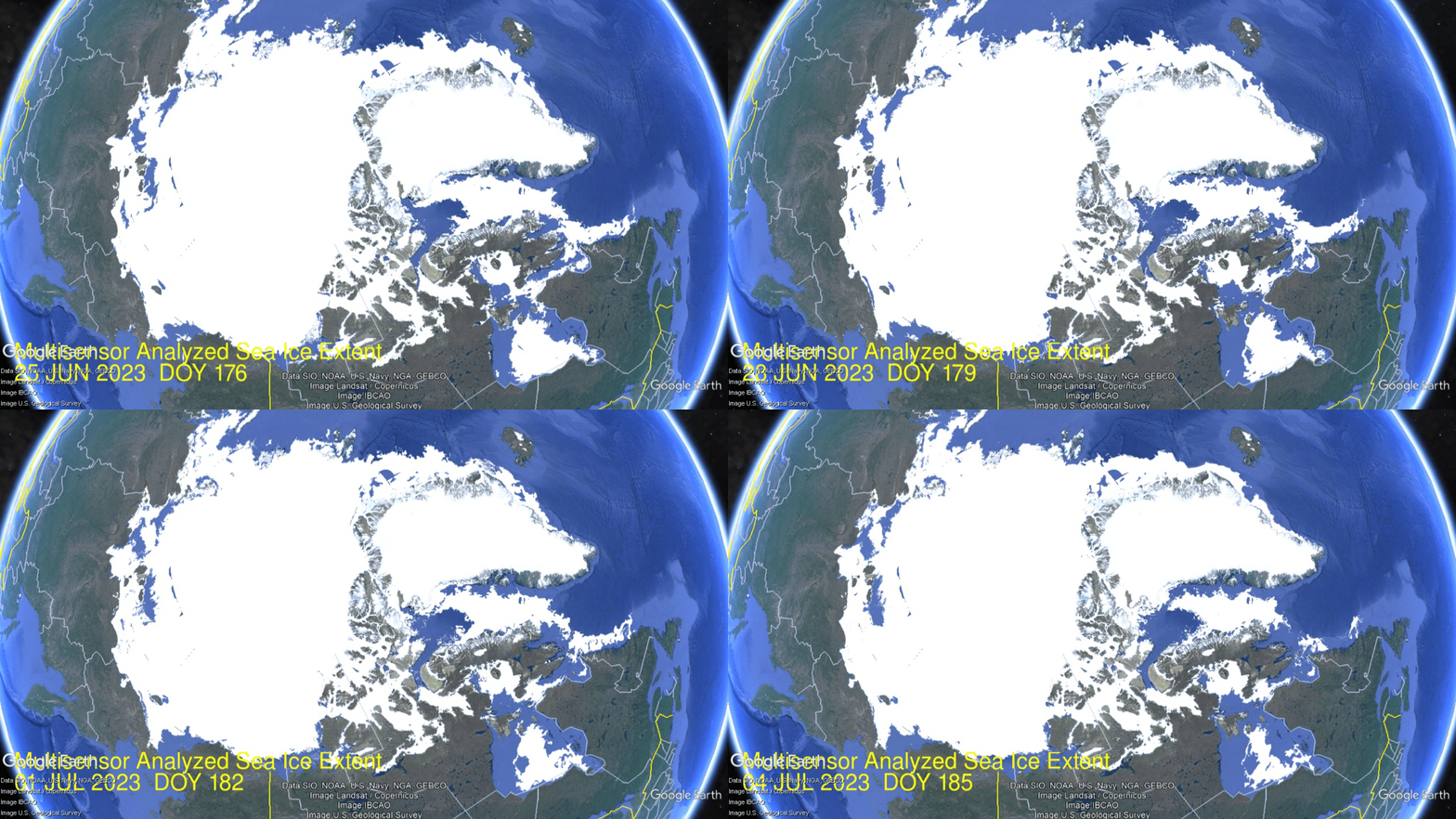
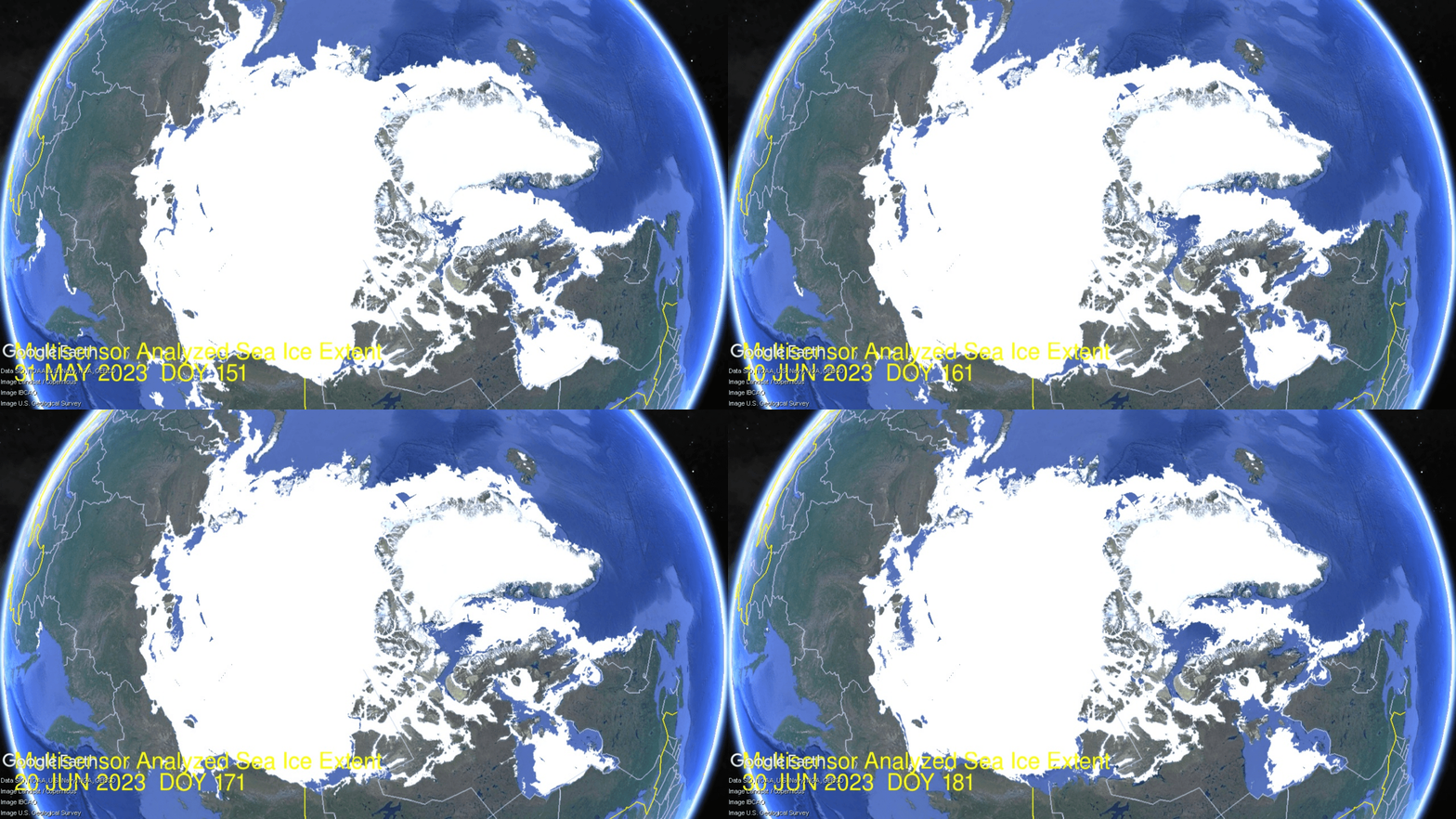
The animation shows Arctic ice extents on day 151 (end of May) through yesterday June 30, 2023  As usual, the Pacific basins Bering and Okhotsk (far left) became ice-free and are no longer included in these updates. Years vary as to which regions retain more or less ice.  For example, this year Hudson Bay (bottom right) lost half its ice by June 30, earlier than average.  That is a shallow basin and can quickly lose its ice in coming days.  Despite this early melting, the NH Ice extent remains greater than the 17 year average.

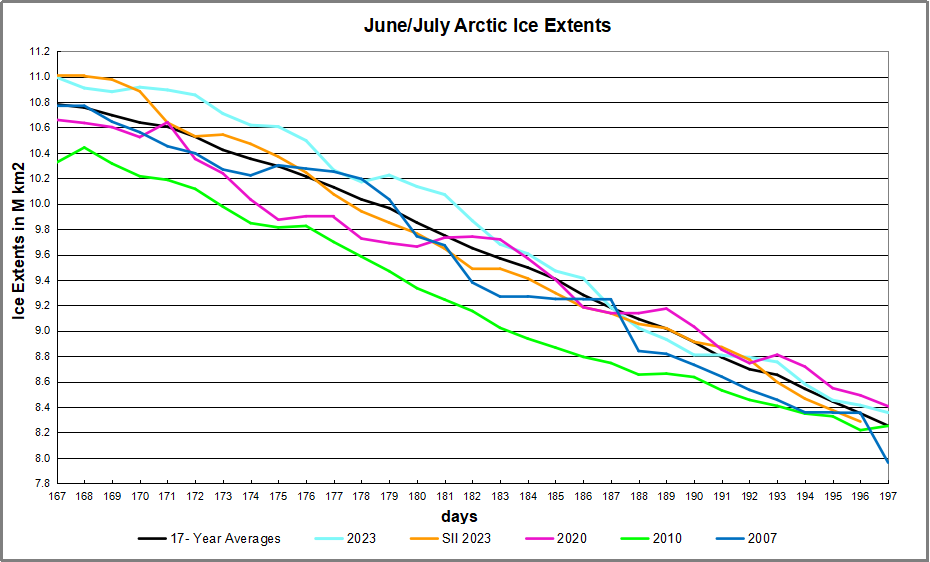
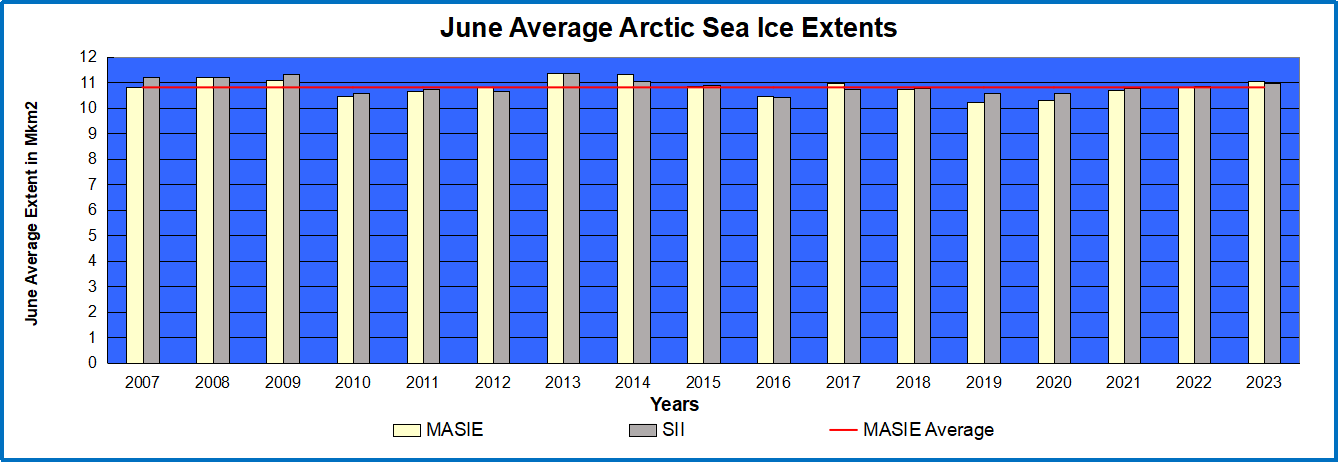
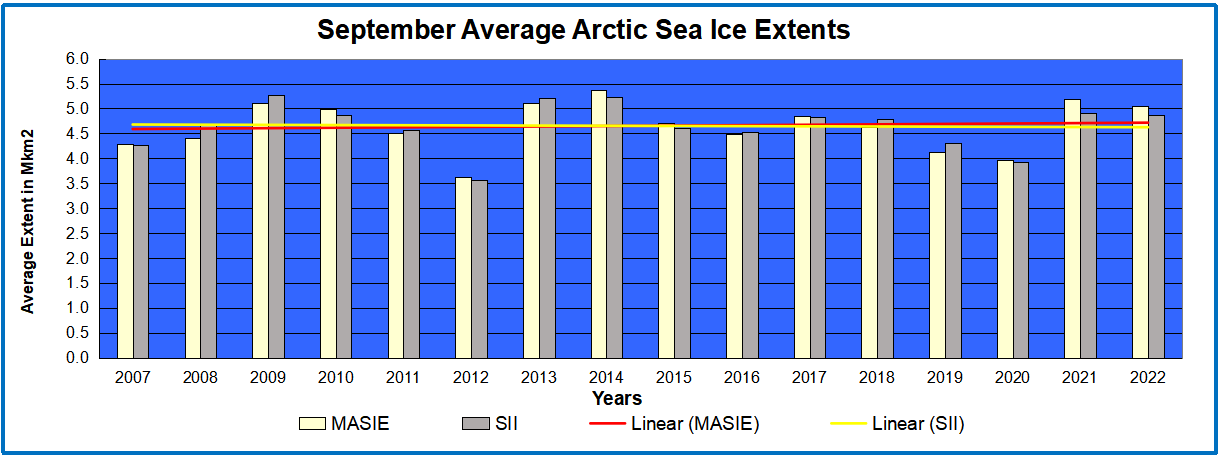
The graph below compares the June monthly ice extents 2007 to 2023 and compared to the 17 year average.

Clearly June ice appears as a plateau, and most years MASIE shows greater extents than SII, with differences of only a few 100k km2.  Previously 2019-20 were in deficit to average, but June 2022-3 have returned to surplus years.  More on MASIE dataset at the end.

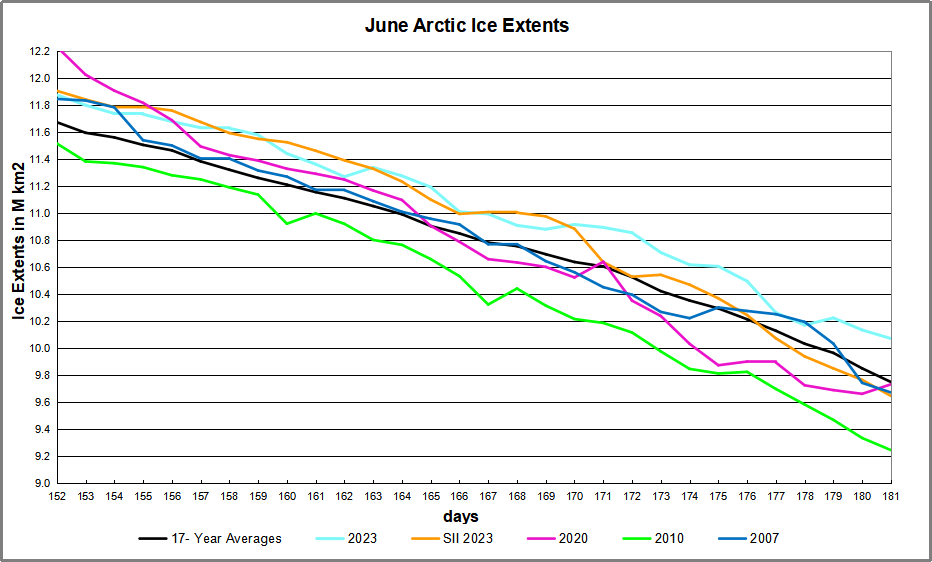
The graph shows the melting pattern during June 2023 remained above average all month, and greatly exceeded 2007 and 2020, especially in the last 2 weeks.  June 30, 2023 was 322k km2 in surplus, and exceeded 2007 by 0.4 Wadhams (M km2).

The table below shows ice extents by regions comparing 2023 with 17-year average (2006 to 2022 inclusive) and 2007.

Region 2023181 Day 181 Average 2023-Ave. 2007181 2023-2007
 (0) Northern_Hemisphere 10072140 9750262 321878 9672969 399171
 (1) Beaufort_Sea 919937 927608 -7671 939209 -19272
 (2) Chukchi_Sea 804545 723247 81299 670088 134457
 (3) East_Siberian_Sea 1021758 1010088 11669 901963 119795
 (4) Laptev_Sea 738148 699906 38242 658742 79406
 (5) Kara_Sea 568642 542617 26025 657478 -88836
 (6) Barents_Sea 99262 117038 -17776 130101 -30839
 (7) Greenland_Sea 650550 499950 150600 548399 102152
 (8) Baffin_Bay_Gulf_of_St._Lawrence 703359 513540 189819 450461 252898
 (9) Canadian_Archipelago 743003 780546 -37543 773611 -30607
 (10) Hudson_Bay 577518 707353 -129835 718441 -140923
 (11) Central_Arctic 3241230 3204305 36925 3218999 22231

2023 is 322k km2 above average (3.3%). The main deficit is in Hudson Bay, more than offset by large  surpluses in Baffin Bay and Greenland Sea, along with additonal ice elsewhere.

Footnote on MASIE Data Sources:

MASIE reports are based on data primarily from NIC’s Interactive Multisensor Snow and Ice Mapping System (IMS). From the documentation, the multiple sources feeding IMS are:

Platform(s) AQUA, DMSP, DMSP 5D-3/F17, GOES-10, GOES-11, GOES-13, GOES-9, METEOSAT, MSG, MTSAT-1R, MTSAT-2, NOAA-14, NOAA-15, NOAA-16, NOAA-17, NOAA-18, NOAA-N, RADARSAT-2, SUOMI-NPP, TERRA

Sensor(s): AMSU-A, ATMS, AVHRR, GOES I-M IMAGER, MODIS, MTSAT 1R Imager, MTSAT 2 Imager, MVIRI, SAR, SEVIRI, SSM/I, SSMIS, VIIRS

Summary: IMS Daily Northern Hemisphere Snow and Ice Analysis

The National Oceanic and Atmospheric Administration / National Environmental Satellite, Data, and Information Service (NOAA/NESDIS) has an extensive history of monitoring snow and ice coverage.Accurate monitoring of global snow/ice cover is a key component in the study of climate and global change as well as daily weather forecasting.

The Polar and Geostationary Operational Environmental Satellite programs (POES/GOES) operated by NESDIS provide invaluable visible and infrared spectral data in support of these efforts. Clear-sky imagery from both the POES and the GOES sensors show snow/ice boundaries very well; however, the visible and infrared techniques may suffer from persistent cloud cover near the snowline, making observations difficult (Ramsay, 1995). The microwave products (DMSP and AMSR-E) are unobstructed by clouds and thus can be used as another observational platform in most regions. Synthetic Aperture Radar (SAR) imagery also provides all-weather, near daily capacities to discriminate sea and lake ice. With several other derived snow/ice products of varying accuracy, such as those from NCEP and the NWS NOHRSC, it is highly desirable for analysts to be able to interactively compare and contrast the products so that a more accurate composite map can be produced.

The Satellite Analysis Branch (SAB) of NESDIS first began generating Northern Hemisphere Weekly Snow and Ice Cover analysis charts derived from the visible satellite imagery in November, 1966. The spatial and temporal resolutions of the analysis (190 km and 7 days, respectively) remained unchanged for the product’s 33-year lifespan.

As a result of increasing customer needs and expectations, it was decided that an efficient, interactive workstation application should be constructed which would enable SAB to produce snow/ice analyses at a higher resolution and on a daily basis (~25 km / 1024 x 1024 grid and once per day) using a consolidated array of new as well as existing satellite and surface imagery products. The Daily Northern Hemisphere Snow and Ice Cover chart has been produced since February, 1997 by SAB meteorologists on the IMS.

Another large resolution improvement began in early 2004, when improved technology allowed the SAB to begin creation of a daily ~4 km (6144×6144) grid. At this time, both the ~4 km and ~24 km products are available from NSIDC with a slight delay. Near real-time gridded data is available in ASCII format by request.

In March 2008, the product was migrated from SAB to the National Ice Center (NIC) of NESDIS. The production system and methodology was preserved during the migration. Improved access to DMSP, SAR, and modeled data sources is expected as a short-term from the migration, with longer term plans of twice daily production, GRIB2 output format, a Southern Hemisphere analysis, and an expanded suite of integrated snow and ice variable on horizon. Source:  Interactive Multisensor Snow and Ice Mapping System (IMS)

My May Arctic Ice Report Gets Fact Checked

Apparently someone posted on Facebook that Arctic ice extent is presently surplus to average, which triggered the fact checking agency employed by the platform.  The content below is from The Cable Fact Check No, short time data can’t determine overall decline of arctic sea ice.  In italics with my bolds and comments in parentheses.

Facebook post has claimed that arctic ice is neither declining nor disappearing.

Attached to the post was an article showing a graph for arctic ice for mid-April through mid-May in 2007, 2018, 2021 and 2023. 

The article was titled: “Arctic Ice Plentiful Mid May 2023”.

The graph indicated that the area of the ocean covered by a certain percentage of ice is higher in 2023 than in the other listed years and similar to the 17-year average.

“The ice is not disappearing,” says the Facebook post, which claimed that data for the month of April and May 2023 shows that the arctic sea ice is not declining. [consistent with “similar to the 17-year average”]

RECORDS SHOW THAT SEA ICE IS DECREASING

According to the National Aeronautics and Space Administration (NASA), a US agency responsible for aeronautics and space research, the volume of ice has significantly reduced. [Note the switch to the volume metric which is model estimated with considerable uncertainty]

The US agency has also reported that the average age of sea ice is becoming shorter.

Citing far back as the late 1970s, when satellite recording commenced, NASA says most of the ice covering the arctic ocean at that time was greater than 4 years old.

Presently, most of the ice covering the ocean is first-year ice, formed during winter, and very unlikely to withstand a single melt season during summer.  [Really, how about this:
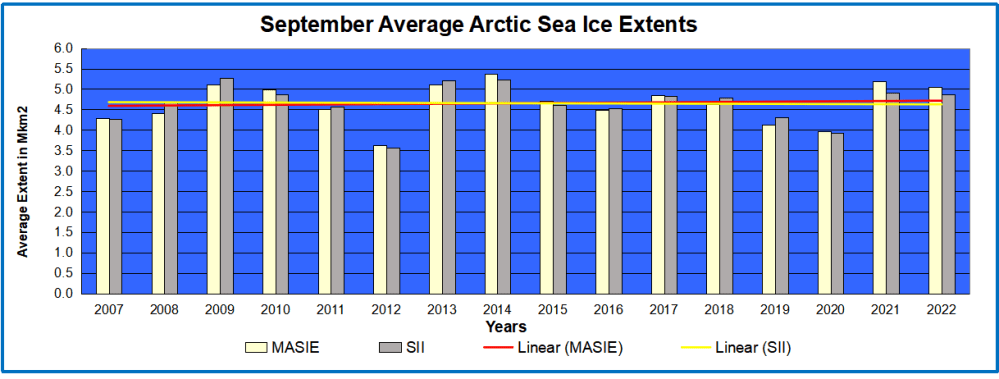
Also, data released by the National Snow and Ice Data Centre, explains that the size of the arctic sea has declined since the 1970s. [size of the sea itself?]

Although the 2023 sea ice extents were slightly higher for the period under review – mid-April through mid-May than in 2007, 2018 and 2021 – just like the Facebook post stated. However, the sea ice varies by year and season despite that it is experiencing an overall decline. [Varies, yes, but the decline stopped in 2007:
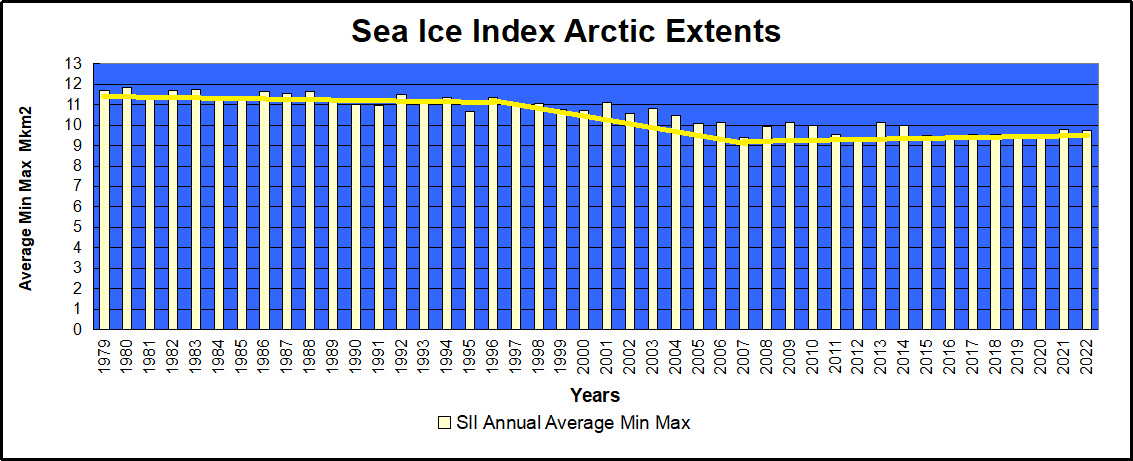
Sea ice extent is the area of ice that covers the arctic ocean at a given time.

Climate experts have also reported that compiling or analysing short-term data is inadequate for making accurate climatological inferences.

Olusola Ayantobo, a hydro-climatologist and research associate at China’s Tsinghua University, had told TheCable that “station data shouldn’t be used to predict climate change conditions over a particular region”.

The climate expert added that: “Short-term datasets can only be used for weather prediction while a long dataset is appropriate for climate change predictions.” [Note that both their preferred Sea Ice Index (SII) and MASIE the best current condition dataset, validated from 2006 forward, show the same lack of decline in sea ice extent]

Experts say that though two decades might look quite long, however, it is short when studying long-term climate trends[True, but the same people predicted an ice-free arctic based on the decline from 1997 to 2007.]

MELTING SEA ICE AGGRAVATES GLOBAL WARMING

The albedo effect explains why the rapid melting of sea ice aggravates climate change. The theory says that the bright surface of the ice reflects solar energy, which has a cooling effect. Also, ocean water, which is darker, absorbs more solar energy, causing more warming. 

The loss of sea ice warms the arctic, hence, contributing to a phenomenon referred to as arctic amplification, a process through which the arctic warms at a faster rate than lower latitudes.

VERDICT

The claim that the sea ice is neither melting nor disappearing is false.

Long-term studies dating back to 1970 show that arctic sea ice has declined significantly. Climate experts have also warned that only long-term data analysis can provide accurate inferences when studying climate trends. [Note: Does that mean ignoring the last 17 years of ice stability?]

This fact check was produced by TheCable with support from Code for Africa’s PesaCheck, International Fact-Checking Network, and African Fact Checking Alliance network. [Code For Africa is funded by 2 investors. Omidyar Network and Bill & Melinda Gates Foundation are the most recent investors.]

[Comment:  As usual, they are checking a narrative, rather than facts.  And then cherry-pick other facts or statements favoring their preferred narrative.]

Regarding Arctic “Amplification”

An artifact of using anomalies, which are highly variable at higher latitudes:

The Original Post:  Arctic Ice Plentiful Mid May 2023

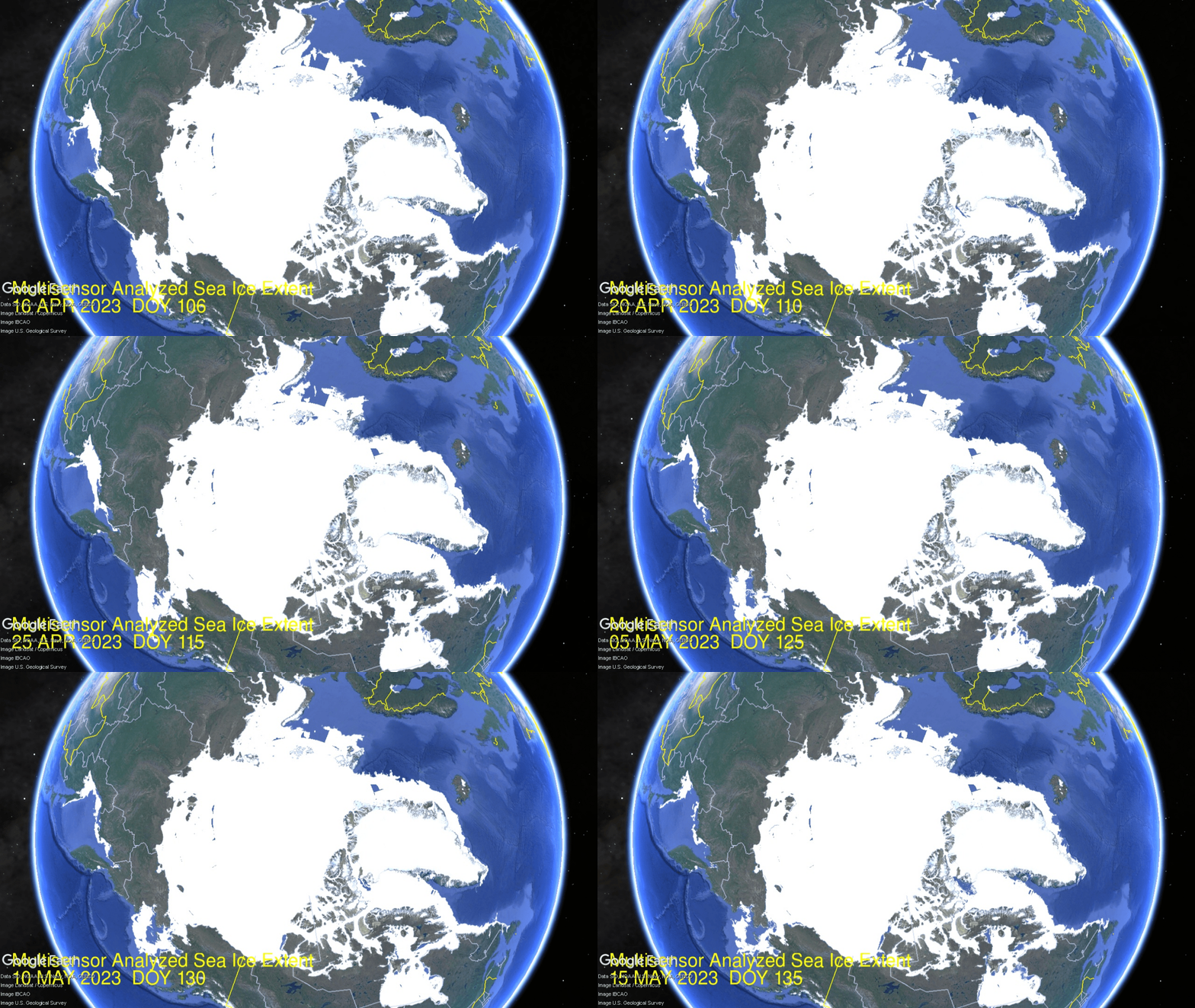
The image above shows 2023 Arctic ice extents from Mid April (day 106) to Mid May (day 135). As usual, the LIFO pattern is observed: ice that is Last In is the First Out.  The Pacific basins of Okhotsk (top left) and Bering (bottom left) rapidly turn to open water.  Baffin Bay (lower right) melts more slowly. Barents Sea (top center loses ice extent steadily.  Note Hudson Bay (bottom) keeps its ice, and Canadian Archipelago (lower center) retains most of its ice. On the left center, the Eurasian coastline remains frozen.

The graph below shows 2023 compared to 17 year average and some recent years for this time period.
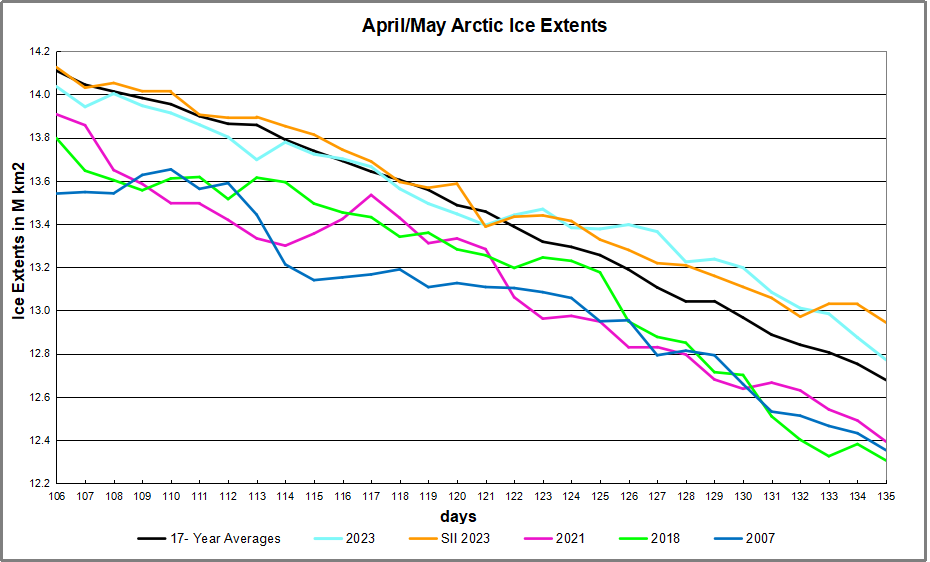
Firstly, on average this period shows ice declining 1.44 M km2 down to 12.68M km2,  Note that  2023 matched the average in April, then retained more ice than usual during first two weeks of May. Sea Ice Index (SII) was close to MASIE throughout..  The other years, including 2007, were ~300k km2 lower than average.

Region 2023135 Day 135 Average 2023-Ave. 2007135 2023-2007
 (0) Northern_Hemisphere 12771477 12677903 93574 12431928 339549
 (1) Beaufort_Sea 1050531 1046418 4113 1057649 -7118
 (2) Chukchi_Sea 943942 926464 17478 953491 -9549
 (3) East_Siberian_Sea 1085822 1081321 4501 1075314 10508
 (4) Laptev_Sea 897060 881069 15991 828738 68322
 (5) Kara_Sea 919027 879799 39228 876053 42974
 (6) Barents_Sea 407569 418431 -10862 351553 56016
 (7) Greenland_Sea 730714 619664 111050 564865 165849
 (8) Baffin_Bay_Gulf_of_St._Lawrence 979333 1076523 -97190 1018780 -39447
 (9) Canadian_Archipelago 841610 839708 1902 830604 11006
 (10) Hudson_Bay 1153016 1186552 -33536 1167310 -14294
 (11) Central_Arctic 3247995 3223255 24740 3234305 13690
 (12) Bering_Sea 296036 301878 -5842 298268 -2231
 (13) Baltic_Sea 6134 7668 -1534 6368 -234
(14) Sea_of_Okhotsk 211027 186778 24249 164833 46194

The table shows the distribution of ice in the Arctic basins.  The main deficits to average are Baffin and Hudson Bays, more than offset by surpluses in Kara and Greenland Seas. Most other regions are surplus with a few slightly negative.

Resources:  Climate Compilation II Arctic Sea Ice
Surplus Arctic Ice Mid June 2023

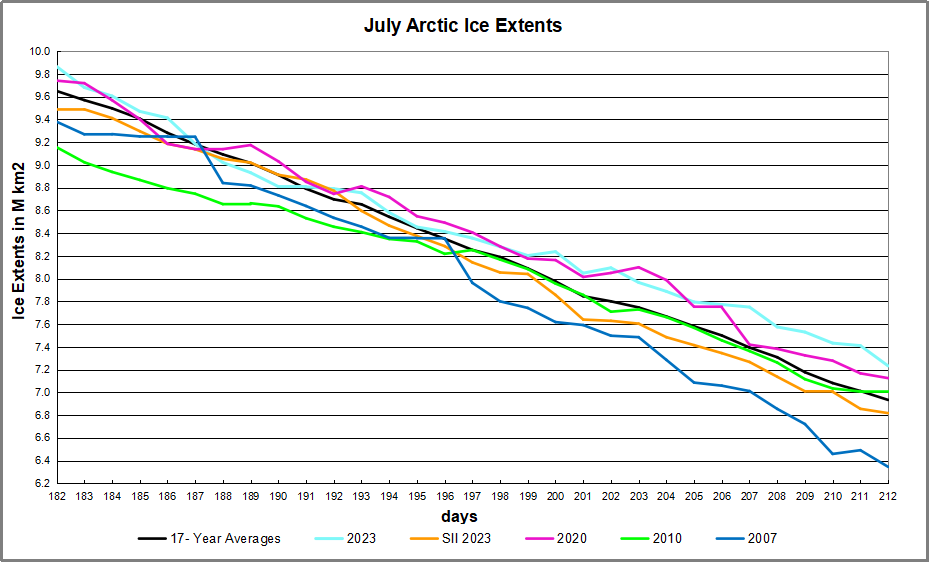
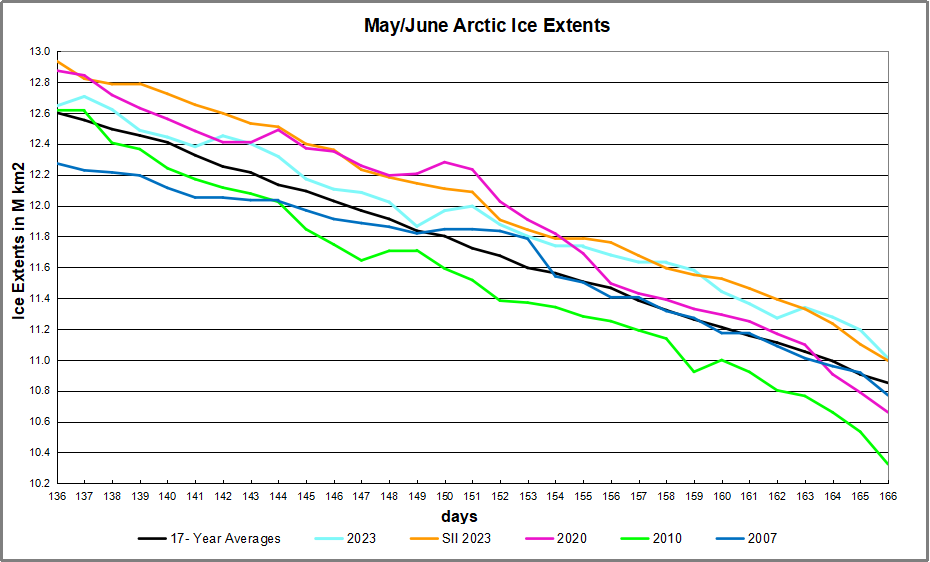
The graph for the last four weeks shows that 2023 Arctic ice continues to exceed the 17 year average from mid April to mid May. SII (Sea Ice Index) tracked MASIE with higher extents most of this period, while ending nearly the same.  Meanwhile, other years, especially 2010 and 2020 were losing ice much more rapidly than average.  

Why is this important?  All the claims of global climate emergency depend on dangerously higher temperatures, lower sea ice, and rising sea levels.  The lack of additional warming is documented in a post Satellite Temps Hit Bottom: February 2023.

The lack of acceleration in sea levels along coastlines has been discussed also.  See USCS Warnings of Coastal Floodings

Also, a longer term perspective is informative:

post-glacial_sea_level
The table below shows the distribution of Sea Ice across the Arctic Regions, on average, this year and 2010.

Region 2023166 Day 166 Average 2023-Ave. 2010166 2023-2010
 (0) Northern_Hemisphere 11010785 10850760  160025  10534077 476708 
 (1) Beaufort_Sea 1004738 970162  34577  933194 71545 
 (2) Chukchi_Sea 866965 797144  69820  839873 27092 
 (3) East_Siberian_Sea 1045863 1050728  -4865  1068901 -23038 
 (4) Laptev_Sea 806824 768140  38684  772185 34639 
 (5) Kara_Sea 638316 715045  -76730  717539 -79224 
 (6) Barents_Sea 114873 199057  -84184  138264 -23391 
 (7) Greenland_Sea 811202 565292  245910  524612 286589 
 (8) Baffin_Bay_Gulf_of_St._Lawrence 849180 711581  137599  667457 181723 
 (9) Canadian_Archipelago 792429 798400  -5971  766642 25787 
 (10) Hudson_Bay 802506 984719  -182214  826781 -24275 
 (11) Central_Arctic 3239185 3220413  18772  3206453 32732 
 (12) Bering_Sea 9490 35600  -26110  21317 -11827 
 (13) Baltic_Sea 0 243  -243  0
(14) Sea_of_Okhotsk 28074 95869  -67795  49697 -21623 

Overall, the extent is above average by 160k km2, or 1.5%.  The main deficits are in Barents, Kara, Hudson Bay and Okhotsk, more than offset by surpluses especially in Baffin Bay, Greenland and Chukchi seas. Note that Arctic extent will now go below 11 Wadhams heading toward its August minimum.  2010 was nearly 1/2 Wadham below average on day 166.


Slowly Melting Arctic Ice May 2023

The image above shows 2023 Arctic ice extents from May 1 (day 121) to May end (day 151).  The Pacific basins of Okhotsk (center left) and Bering (bottom left) rapidly turn to open water.  Baffin Bay (center right) melts more slowly. Barents Sea (top center steadily loses ~200k km2 ice extent.  Note Hudson Bay (bottom) mostly keeps its ice, ending the month with 86% of its March max.  And Canadian Archipelago (lower center) retains 97% of its ice. On the left center, the Eurasian coastline remains mostly frozen.

The graph below shows 2023 compared to 17 year average and some recent years for this time period.

Firstly, on average this period shows ice declining 1.73 M km2 down to 11.72 M km2,  Note that  2023 matched the average May 1,  then retained more ice than usual during May, ending with a decline of 1.24 M km2.  Most of May Sea Ice Index (SII) tracked higher than MASIE, an average 100 km2 extra ice extent..  The other years, including 2006, were 200 to 300k km2 lower than average.

Region 2023151 Day 151 Average 2023-Ave. 2006151 2023-2006
 (0) Northern_Hemisphere 11996164 11720243 275920 11425616 570548
 (1) Beaufort_Sea 1050178 1007125 43053 1063879 -13700
 (2) Chukchi_Sea 926367 866851 59516 907609 18758
 (3) East_Siberian_Sea 1058013 1065740 -7727 1073889 -15876
 (4) Laptev_Sea 840340 827727 12614 856108 -15768
 (5) Kara_Sea 761159 832280 -71121 848172 -87013
 (6) Barents_Sea 214069 313115 -99046 180906 33163
 (7) Greenland_Sea 785442 568692 216750 522040 263402
 (8) Baffin_Bay_Gulf_of_St._Lawrence 958973 902385 56588 721606 237367
 (9) Canadian_Archipelago 831728 813589 18138 800561 31167
 (10) Hudson_Bay 1079040 1091081 -12041 989550 89490
 (11) Central_Arctic 3243187 3218357 24830 3188696 54491
 (12) Bering_Sea 131130 115713 15417 179378 -48248
 (13) Baltic_Sea 0 243 -243 720 -720
(14) Sea_of_Okhotsk 115156 95869 19287 89739 25417

The table shows the distribution of ice in the Arctic basins.  The main deficits to average are Kara and Barents Seas, more than offset by surpluses in Beaufort, Chukchi, and Greenland Seas, along with Baffin Bay. Most other regions are surplus with a few slightly negative.  Note that 2023 exceeds May 2006 by  more than half a Wadham (1M km2 ice extent).

Resources:  Climate Compilation II Arctic Sea Ice

Arctic Ice Plentiful Mid May 2023

The image above shows 2023 Arctic ice extents from Mid April (day 106) to Mid May (day 135). As usual, the LIFO pattern is observed: ice that is Last In is the First Out.  The Pacific basins of Okhotsk (top left) and Bering (bottom left) rapidly turn to open water.  Baffin Bay (lower right) melts more slowly. Barents Sea (top center loses ice extent steadily.  Note Hudson Bay (bottom) keeps its ice, and Canadian Archipelago (lower center) retains most of its ice. On the left center, the Eurasian coastline remains frozen.

The graph below shows 2023 compared to 17 year average and some recent years for this time period.

Firstly, on average this period shows ice declining 1.44 M km2 down to 12.68M km2,  Note that  2023 matched the average in April, then retained more ice than usual during first two weeks of May. Sea Ice Index (SII) was close to MASIE throughout..  The other years, including 2007, were ~300k km2 lower than average.

Region 2023135 Day 135 Average 2023-Ave. 2007135 2023-2007
 (0) Northern_Hemisphere 12771477 12677903 93574 12431928 339549
 (1) Beaufort_Sea 1050531 1046418 4113 1057649 -7118
 (2) Chukchi_Sea 943942 926464 17478 953491 -9549
 (3) East_Siberian_Sea 1085822 1081321 4501 1075314 10508
 (4) Laptev_Sea 897060 881069 15991 828738 68322
 (5) Kara_Sea 919027 879799 39228 876053 42974
 (6) Barents_Sea 407569 418431 -10862 351553 56016
 (7) Greenland_Sea 730714 619664 111050 564865 165849
 (8) Baffin_Bay_Gulf_of_St._Lawrence 979333 1076523 -97190 1018780 -39447
 (9) Canadian_Archipelago 841610 839708 1902 830604 11006
 (10) Hudson_Bay 1153016 1186552 -33536 1167310 -14294
 (11) Central_Arctic 3247995 3223255 24740 3234305 13690
 (12) Bering_Sea 296036 301878 -5842 298268 -2231
 (13) Baltic_Sea 6134 7668 -1534 6368 -234
(14) Sea_of_Okhotsk 211027 186778 24249 164833 46194

The table shows the distribution of ice in the Arctic basins.  The main deficits to average are Baffin and Hudson Bays, more than offset by surpluses in Kara and Greenland Seas. Most other regions are surplus with a few slightly negative.

Resources:  Climate Compilation II Arctic Sea Ice
2023 April Arctic Ice Melt Abates

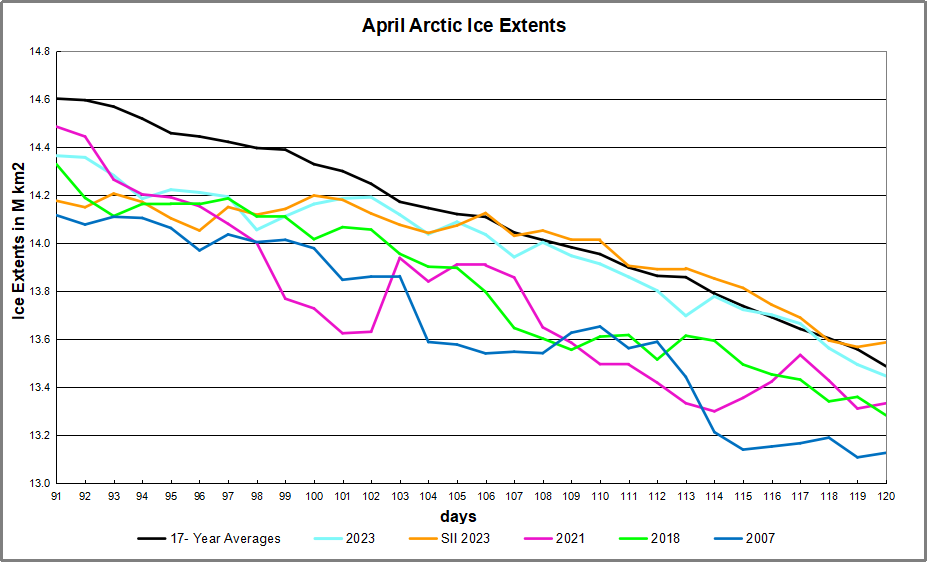
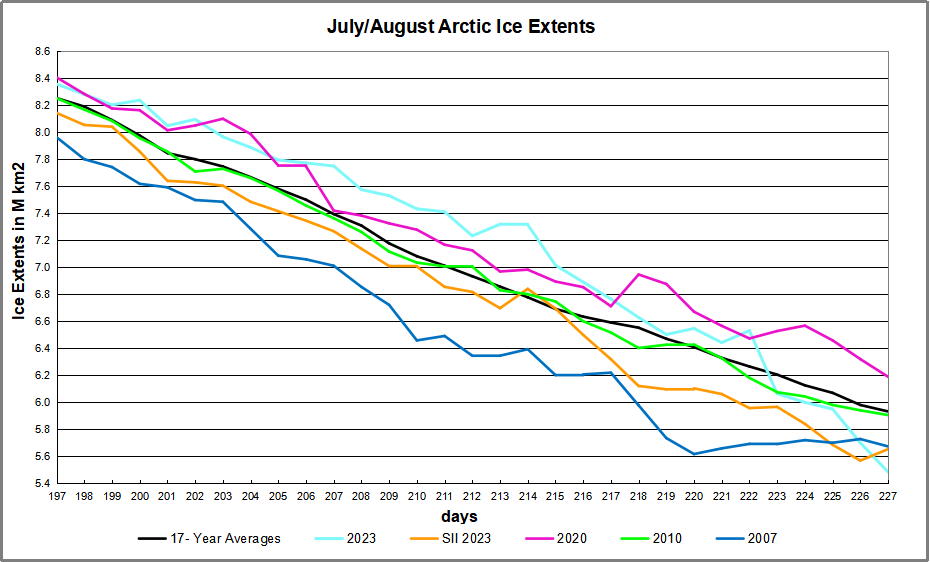
The graph shows that coming out of the annual March maximum, April 2023 began 238k km2 lower than the 17 year average.  SII even showed extents ~200k km2 lower than MASIE on April 1.  However, after two weeks both indices tracked with the average until month end.  According to MASIE, the typical April loses 1100 km2, but this year lost only 918k km2.  SII shows a loss of only 590k km2 during April. Meanwhile, other years, especially 2007 were losing ice much more rapidly than average.  

Why is this important?  All the claims of global climate emergency depend on dangerously higher temperatures, lower sea ice, and rising sea levels.  The lack of additional warming is documented in a post Satellite Temps Hit Bottom: February 2023.

The lack of acceleration in sea levels along coastlines has been discussed also.  See USCS Warnings of Coastal Floodings

Also, a longer term perspective is informative:

post-glacial_sea_level
The table below shows the distribution of Sea Ice across the Arctic Regions, on average, this year and 2007.

Region 2023120 Day 120 Average 2023-Ave. 2007120 2023-2007
 (0) Northern_Hemisphere 13446987 13514506  -67519  13108068 338919 
 (1) Beaufort_Sea 1070966 1067918  3048  1059189 11777 
 (2) Chukchi_Sea 966006 956111  9895  949246 16760 
 (3) East_Siberian_Sea 1087137 1085582  1555  1080176 6961 
 (4) Laptev_Sea 897845 890425  7420  875661 22184 
 (5) Kara_Sea 933170 912998  20172  864664 68506 
 (6) Barents_Sea 415992 553986  -137994  396544 19449 
 (7) Greenland_Sea 761413 648178  113235  644438 116975 
 (8) Baffin_Bay_Gulf_of_St._Lawrence 1123308 1207572  -84264  1147115 -23807 
 (9) Canadian_Archipelago 854843 848924  5918  838032 16810 
 (10) Hudson_Bay 1249469 1238384  11085  1222074 27396 
 (11) Central_Arctic 3239670 3230693  8977  3241034 -1364 
 (12) Bering_Sea 491550 473366  18184  475489 16061 
 (13) Baltic_Sea 32086 20744  11342  14684 17402 
(14) Sea_of_Okhotsk 321714 376553  -54840  295743 25971 

Overall, the extent is slightly below average by 68k km2, or 0.5%.  The main deficits are in Barents, Baffin and Okhotsk, partly offset by a surplus in Greenland Sea.


Mid April Arctic Ice Recovery


The animation compares Arctic ice extents for day 105 for some years between 2007 and 2023.  2011 was close to the 17-year average, while 2007 was one of the lowest in the record.  The images show extensive variation in the Pacific (left) basins of Bering and Okhotsk, where typically the most open water appears. There are also fluctuations on the Atlantic side, Barents (top right) as well as Greenland Sea and Baffin Bay.  Overall there was recovery from 2007 to 2011, then some years of lesser extents before 2023 returns to the 17 year average, as shown in the table later below.

Over the last 30 days, there were gains and then losses, mostly in the Pacific basins.  The effect on NH total ice extents is presented in the graph below.  

The average ice loss is 787k km2 for this period.  While 2023 started 235k km2 in deficit, yesterday it nearly matched the 17-year average. SII showed even lower ice extents in mid March, before matching MASIE at the end.

The table below shows the distribution of sea ice across the Arctic regions.

Region 2023105 Day 105 Average 2023-Ave. 2007105 2023-2007
 (0) Northern_Hemisphere 14088856 14121549  -32693  13588722 500134 
 (1) Beaufort_Sea 1070966 1069753  1214  1068692 2274 
 (2) Chukchi_Sea 966006 964603  1403  961638 4369 
 (3) East_Siberian_Sea 1087137 1085478  1659  1078666 8471 
 (4) Laptev_Sea 897845 893275  4570  843501 54344 
 (5) Kara_Sea 933845 922316  11529  890594 43251 
 (6) Barents_Sea 609466 608807  659  439904 169562 
 (7) Greenland_Sea 716828 649460  67368  673585 43243 
 (8) Baffin_Bay_Gulf_of_St._Lawrence 1212523 1283822  -71300  1215526 -3003 
 (9) Canadian_Archipelago 854843 852840  2002  848812 6031 
 (10) Hudson_Bay 1260903 1246319  14585  1208588 52315 
 (11) Central_Arctic 3247017 3232496  14521  3235648 11369 
 (12) Bering_Sea 642984 647468  -4484  600281 42703 
 (13) Baltic_Sea 35258 45036  -9779  23534 11723 
(14) Sea_of_Okhotsk 550081 614303  -64222  491121 58960 

Overall NH extent March 31 was below average by 33k km2, or 0.2%.  The two largest deficits are Sea of Okhotsk and Baffin Bay, partly offset by a surplus in Greenland Sea.  The onset of spring melt is as usual in most regions, with slight surpluses nearly everywhere.


Beware the Ice of March 2023

Previous posts showed 2023 Arctic Ice did break the 15M km2 ceiling early March peaking just two days after the 17 year average. So there is plenty of Arctic drift ice for sailers to be aware. The graph above shows that the March monthly average has varied little since 2007, typically around the SII average of 14.7 M km2.  Of course there are regional differences as described later on.

Dr. Judah Cohen at AER summarizes the situation:

If you can believe it, the major disruption of the polar vortex (PV) and is referred to as a major sudden stratospheric warming (SSW) from mid-February is still influencing the weather even into April. Relatively cold temperatures have become more widespread across Northern Europe and should continue. Northern Asia has been surprisingly quite mild but colder temperatures are predicted across Siberia for April (see Figures 6 and 9). Across North America it seems to be more what you see is what you get, no end in sight of the pattern that began in November – cold west and mild east.

The High pressure areas were forecast to warm over the Pacific Arctic basins, and extending over to the European side, while the cold Low area is presently extending down into North America, bringing some snow and freezing rain on April 1 in Montreal (no joke). There’s also ice for Montrealers to beware. The effect on Arctic Ice extents is shown in the animation below:

Over the last 31 days, there were gains and then losses, mostly in the Pacific basins.  Okhotsk upper left lost 360k km2 (now at 90% of max) while Bering lower left lost 135k m2 to be 60% of max.  Baffin Bay lower right lost 420k km2 over the same period.  Meanwhile, Greenland Sea center right gained 70k km2 to reach 105% of its max.  The effect on NH total ice extents is presented in the graph below.

The graph above shows ice extent through March comparing 2023 MASIE reports with the 17-year average, other recent years and with SII.  After surpassing average on day 64, 2023 ice extents dropped sharply and at March end matched both 2018 and 2021.  SII showed lower extents throughout, but ended with a small deficit to MASIE.

The table below shows the distribution of sea ice across the Arctic regions.

Region 2023090 Day 90 Average 2023-Ave. 2018090 2023-2018
 (0) Northern_Hemisphere 14393146 14613608  -220462  14456459 -63313 
 (1) Beaufort_Sea 1070966 1070154  812  1069836 1131 
 (2) Chukchi_Sea 966006 964029  1977  964121 1885 
 (3) East_Siberian_Sea 1087137 1086163  974  1087137
 (4) Laptev_Sea 897845 897010  835  897845
 (5) Kara_Sea 933984 919079  14905  934790 -806 
 (6) Barents_Sea 718169 651091  67078  790204 -72034 
 (7) Greenland_Sea 816301 650261  166039  533694 282607 
 (8) Baffin_Bay_Gulf_of_St._Lawrence 1202833 1402909  -200077  1380945 -178112 
 (9) Canadian_Archipelago 854843 853082  1760  853109 1734 
 (10) Hudson_Bay 1260903 1254610  6293  1259857 1047 
 (11) Central_Arctic 3248013 3233036  14977  3202650 45363 
 (12) Bering_Sea 505101 724369  -219269  277469 227632 
 (13) Baltic_Sea 60959 62776  -1818  99317 -38359 
(14) Sea_of_Okhotsk 763690 834337  -70647  1097524 -333834 

Overall NH extent March 31 was below average by 220k km2, or 1.5%.  The two major deficits are Bering Sea and Baffin Bay, partly offset by a surplus in Greenland Sea.  The onset of spring melt is as usual in most regions.


Arctic Ice Moment of Truth 2023

For ice extent in the Arctic, the bar is set at 15M km2. The average peak in the last 17 years occurs on day 62 at 14.986M km2 before descending, though some years the extent can be above 15M much later.  Ten of the last 17 years were higher than 15M, and recently 2020, 2022 and now 2023 ice extents cleared the bar at 15M km2. The actual day of annual peak ice extent varied between day 59 (2016) to day 82 (2012).

All of this means that 2023 peaked while passing the 15M km2 threshold two days later than average.  The graph below shows the situation evolving over the last four weeks anticipating the annual maximum.

The NH ice extent gap on day 77 is at 269k km2, or 1.8%.  After the day 62 peak, 2023 extents declined sharply until day 71 before recovering to reduce the deficit. (Note that ice extent is affected also by winds piling up drift ice, as well as melting from intrusions of warmer air or water.) SII has shown lower extents throughout this period, averaging 250k km2 less than MASIE.

March monthly average extents in recent years have been below average. While average extents will decline furher, we shall see what this year does with only two weeks left to make a difference.

Region 2023077 Day 77 Average 2023-Ave. 2018077 2023-2018
 (0) Northern_Hemisphere 14649553 14918812 -269258 14528206 121348
 (1) Beaufort_Sea 1070966 1070266 700 1070445 521
 (2) Chukchi_Sea 966006 965801 206 966006 0
 (3) East_Siberian_Sea 1087137 1087109 29 1087137 0
 (4) Laptev_Sea 897845 897837 7 897845 0
 (5) Kara_Sea 934539 922767 11771 934807 -268
 (6) Barents_Sea 605659 637818 -32159 689702 -84043
 (7) Greenland_Sea 835991 617943 218048 514678 321313
 (8) Baffin_Bay_Gulf_of_St._Lawrence 1249789 1546282 -296493 1399951 -150162
 (9) Canadian_Archipelago 854843 853118 1724 853109 1734
 (10) Hudson_Bay 1260903 1259573 1330 1257207 3696
 (11) Central_Arctic 3243341 3217827 25514 3131403 111939
 (12) Bering_Sea 739914 760728 -20814 445480 294434
 (13) Baltic_Sea 67881 80745 -12864 127449 -59568
(14) Sea_of_Okhotsk 822356 982054 -159698 1136990 -314633

The main deficit to average is in Baffin Bay and Sea of Okhotsk, partly offset by a surplus in Greenland Sea. Smaller pluses and minuses are found in other regions.

Typically, Arctic ice extent loses 67 to 70% of the March maximum by mid September, before recovering the ice in building toward the next March.

What will the ice do this year?  Where will 2023 rank in the annual Arctic maximum competition?

Drift ice in Okhotsk Sea at sunrise.

For more on the Pacific basins see post Meet Bering and Okhotsk Seas

Normal Arctic Ice End of Feb. 2023

With the end of February, nearly all of the Arctic ocean basins are frozen over, so the growth of ice extent slows down, reaching its annual maximum mid-March.  According to MASIE February on average adds 500k km2, and this year the growth was 880k km2, erasing a starting deficit and matching the month end average. The few basins that can grow ice this time of year tend to fluctuate and alternate waxing and waning, which appears as a see saw pattern in these images.  For example, this year the two Pacific basins combined were slightly above average, but Okhotsk is 33% in surplus, while Bering is 26% in deficit to their last March maximums.

The month of February 2023 was remarkable for a wobbly Polar vortex, which cycles freezing polar air south, replacing it with incursions of warmer air into the Arctic, and then reverses the effect. This results in rising and falling freezing rates.  The graph below shows the ice recovery for February 2023, the 17-year average and some recent years.

The graph (cyan) shows February 2023 starting with a 284k km2 deficit to average, several up and downs in the growth rate, until matching average at month end. 2020 also ended average with a steady refreezing rate.   SII (Sea Ice Index) tracked well below MASIE this month showing 400k km2 lower extent than MASIE yesterday.

February Ice Growth Despite See Saws in Atlantic and Pacific

As noted above, this time of year the Arctic adds ice on the fringes since the central basins are already frozen over.  The animation above shows the Okhotsk (upper left) and Bering (lower left) see saw.  Okhotsk grew steadily to reach 133% of its last maximum, while Bering waffled up and down, ending the month ~100k km2 higher and 74% of its max.

On the right, Atlantic side Barents at the top fluctuated and added little ice ending at 56% of its max.  On the lower right, Baffin Bay, and Greenland Sea (center right) show another see saw.  Greenland Sea waffled adding`80k km2, ending  at 96% of max, while Baffin Bay steadily added 300k km2 to reach 90% of maximum.

The table below presents ice extents in the Arctic regions for day 31 (Jan. 31) compared to the 17 year average and 2018.

Region 2023059 Day 59 Average 2023-Ave. 2018059 2023-2018
 (0) Northern_Hemisphere 14878631 14899627 -20996 14485052 393579
 (1) Beaufort_Sea 1070966 1070314 652 1070445 521
 (2) Chukchi_Sea 966006 965374 632 965971 35
 (3) East_Siberian_Sea 1087137 1087106 32 1087120 18
 (4) Laptev_Sea 897845 897836 9 897845 0
 (5) Kara_Sea 884398 926234 -41836 922905 -38507
 (6) Barents_Sea 442032 631999 -189967 544938 -102906
 (7) Greenland_Sea 745952 611275 134677 473064 272889
 (8) Baffin_Bay_Gulf_of_St._Lawrence 1624859 1519162 105697 1786606 -161747
 (9) Canadian_Archipelago 854843 853331 1511 853109 1734
 (10) Hudson_Bay 1260903 1260417 487 1260838 66
 (11) Central_Arctic 3185508 3213856 -28349 3065181 120326
 (12) Bering_Sea 627138 664021 -36884 336065 291073
 (13) Baltic_Sea 81571 98009 -16437 123280 -41709
(14) Sea_of_Okhotsk 1132332 1058413 73919 1069898 62433

The table shows the only major deficit to average appears in Barents seas, more than offset by surpluses in Greenland Sea and Baffin Bay. These few peripheral basins are the only remaining regions with additional ice extent to add.

The polar bears have a Valentine Day’s wish for Arctic Ice.

welovearcticicefinal

And Arctic Ice loves them back, returning every year so the bears can roam and hunt for seals.

Footnote:

Seesaw accurately describes Arctic ice in another sense:  The ice we see now is not the same ice we saw previously.  It is better to think of the Arctic as an ice blender than as an ice cap, explained in the post The Great Arctic Ice Exchange.