Texans, Don’t Mess With Emissions Reductions

Gregory Wrightstone writes at Lone Star Standard; Texans should stop spending on fake climate crisis.  Excerpts in italics with my bolds and added images.

Boasting that Texas “has built more wind power than any state and is a top contender for the most solar power,” Texas Tribune article bemoans a decline in federal subsidies for such energy sources and a potential loss of “billions in investments and thousands of jobs.”
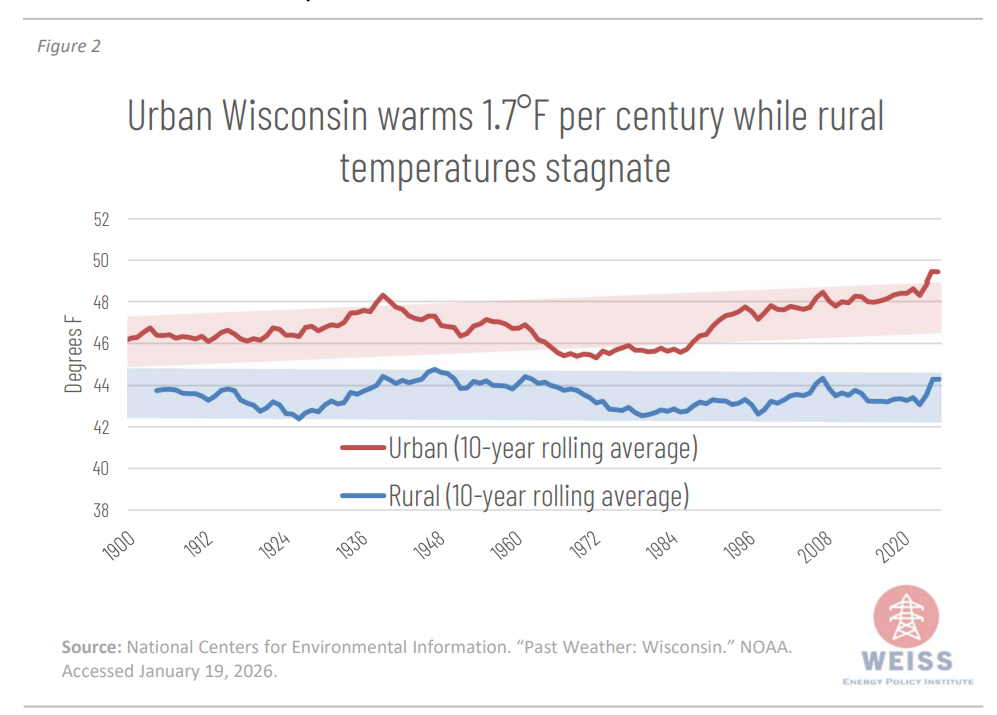
Interestingly, the writers focus on business interests of the climate industrial complex and ignore the stated reason for subsidies – to avoid supposed catastrophic global warming. Planetary health – purported to be threatened by industrial emissions of carbon dioxide (CO2) – was not even an afterthought in the handwringing over wind and solar financial fortunes.

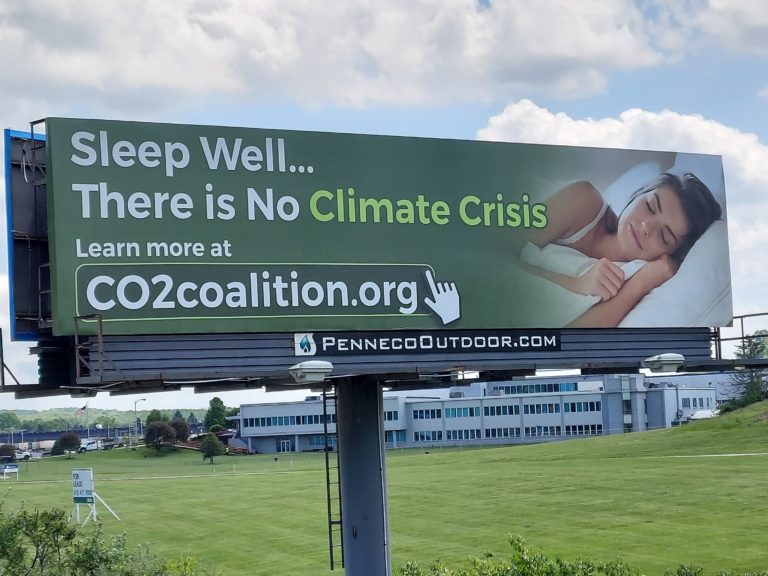
Regardless, Texans face no such peril and the billions already spent on “green” obsessions in the Lone Star State are for naught. “There is no evidence of a climate crisis in Texas and none can be reasonably expected,” says a report, “Texas and Climate Change,” recently published by the CO2 Coalition, Fairfax, Virginia.
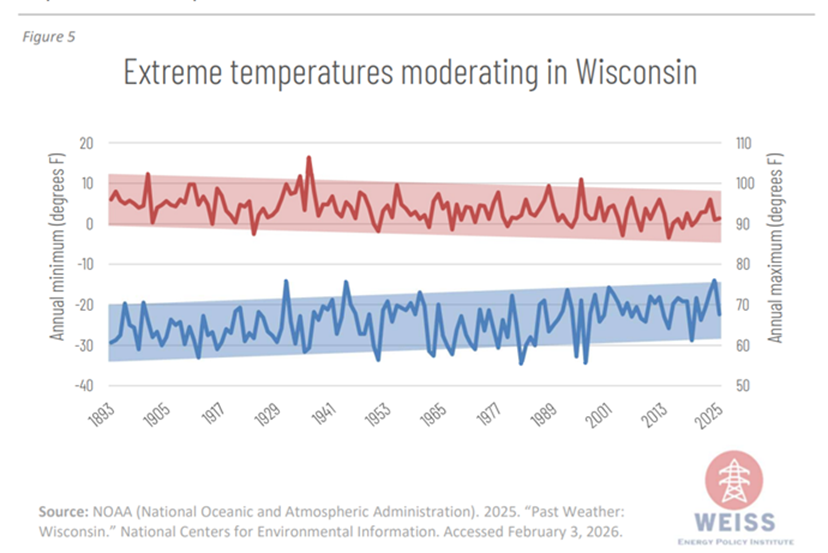
Both the Fifth National Climate Assessment (NCA5) and a Texas A&M University report predict harm to Texans from human-induced warming. Climate change is “putting us at risk from climate hazards that degrade our lands and waters, quality of life, health and well-being, and cultural interconnectedness,” according to NCA5.

In contradicting those findings, the CO2 Coalition analyzed data from the National Oceanic and Atmospheric Administration (NOAA), U.S. Environmental Protection Agency (EPA), NASA, U.S. Department of Agriculture, reports published in peer-reviewed journals and others.

“The temperature in Texas has shown no unprecedented or unusual warming, despite increasing atmospheric carbon dioxide,” says the CO2 Coalition report. “Recent temperatures in Texas are similar to those found more than 100 years ago.”

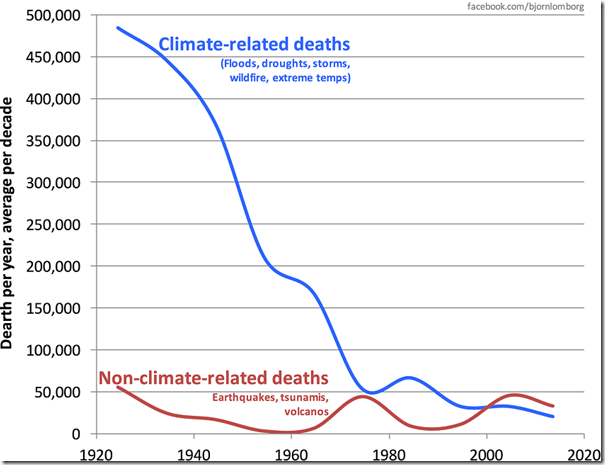
In fact, the annual number of 100-degree days in Texas has an overall decreasing trend.

While some have claimed a connection between climate change and July’s tragic flooding in central Texas, no scientific basis for such a link exists. Though extreme, the flooding was not a first.

According to Harris County meteorologist Jeff Lindner, the July 4th flood of the Guadalupe River at Kerrville peaked at 34.29 feet, making it the third-highest flood on record for the city. The 2025 flood crest trails the 39.0-foot flood crest from 1932 and the 37.72-foot flood crest from in 1987.

“Over the last 28 years, flash floods, while varying greatly from year to year, have actually been in slight decline,” the CO2 Coalition report found.

Precipitation data from the U.S. Historical Climatology Network indicate that Texas has experienced a very slight increase (1 to 2 inches annually) in precipitation since 1895, which is contrary to the predictions of significant increases in rainfall from climate alarmists. If anything, the modest increase in Texas precipitation should have beneficial effects on the state’s agricultural yields.

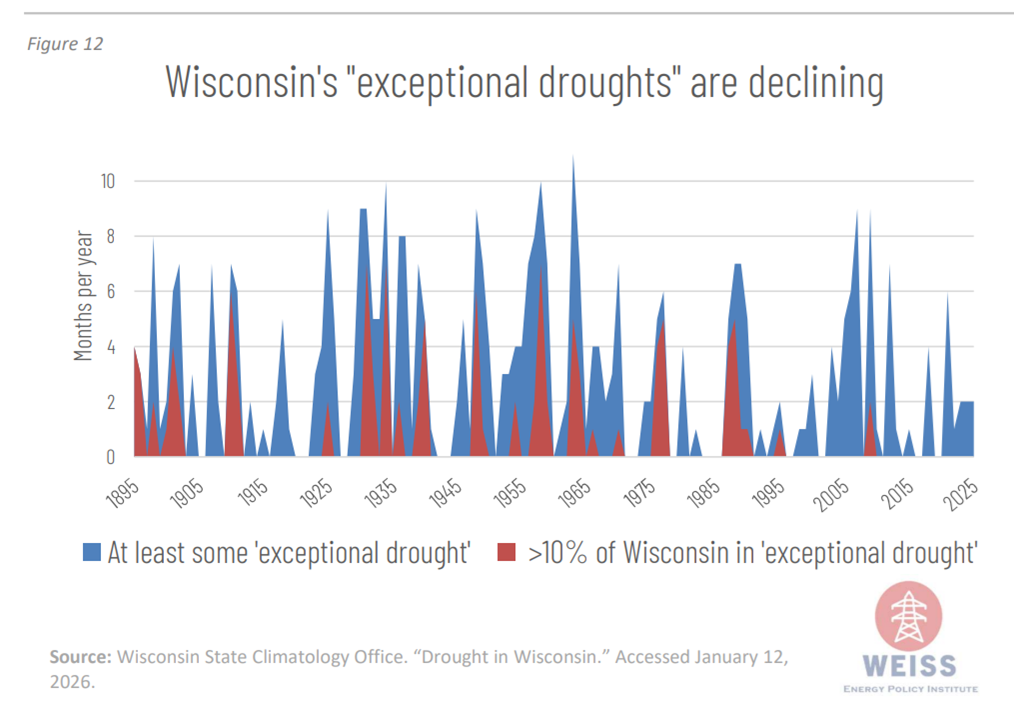
As for drought – the primary scourge of crops throughout the world – government data show no discernable trend in the severity of arid spells in Texas, which is a direct contradiction to claims of increasing drought by both the Texas A&M report and NCA5.

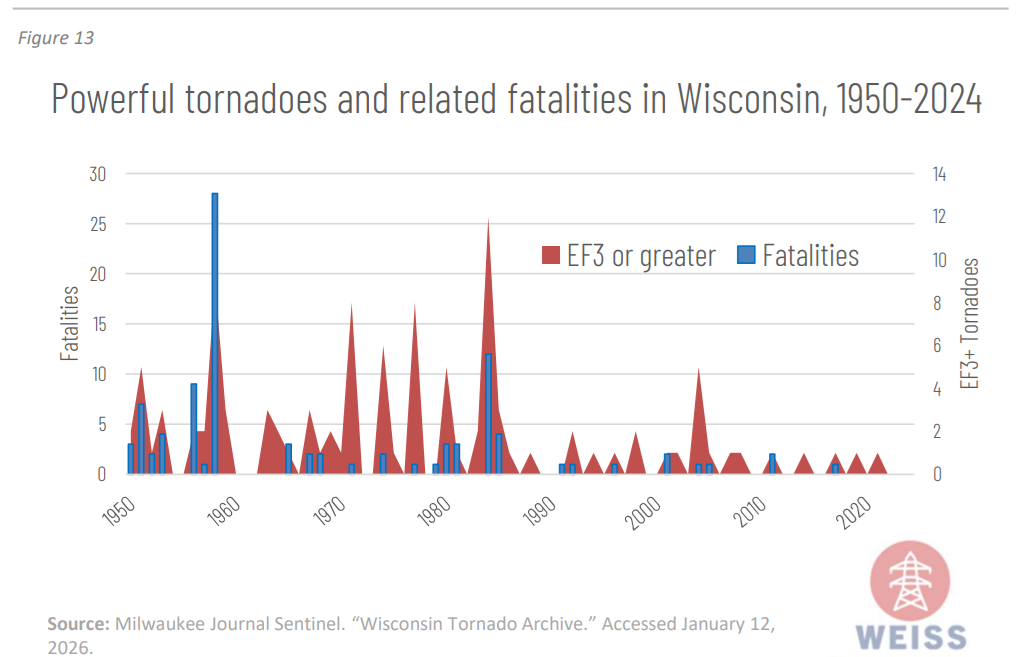
Similarly rebutting the fearmongering of alarmists, the CO2 Coalition report found no increasing trends for wildfires, hurricanes and tornadoes.

With respect to tornadoes, the U.S., including Texas, has seen a decades-long decline in the most violent of twisters. The likely reason is a warming Earth – a natural phenomenon following the end of the Little Ice Age – reduces the temperature differentials between regions inside and outside equatorial regions that drive storms.

Like the rest of the world, Texas has experienced record-breaking growth in crop production over the last several decades. This is no coincidence, as research shows every increase of 1 part per million (ppm) in CO2 concentration boosts yields of corn and wheat by 0.4% and 1%, respectively. Based on these metrics, the 140-ppm increase in CO2 since the beginning of the Industrial Revolution has led to increases of 56%, 84% and 140% in corn, soybeans and wheat, respectively.

CO2 is necessary for life on Earth, and reducing emissions of the gas would be harmful to vegetation, including forests, grasslands and agricultural crops.

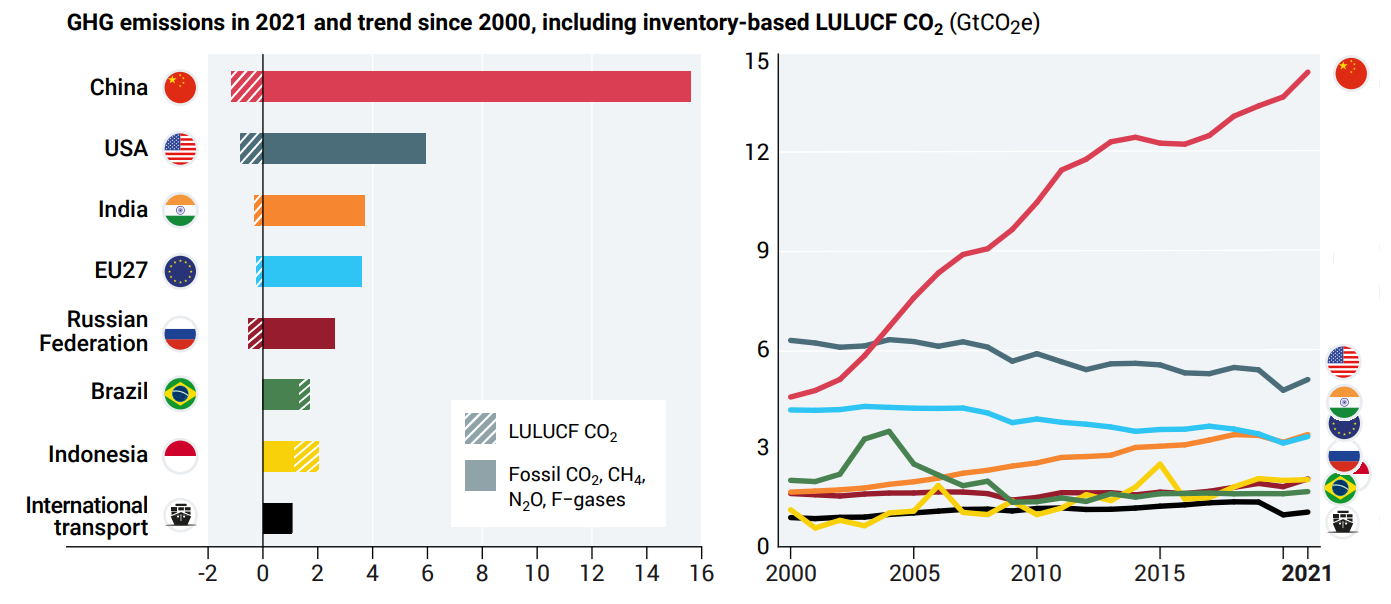
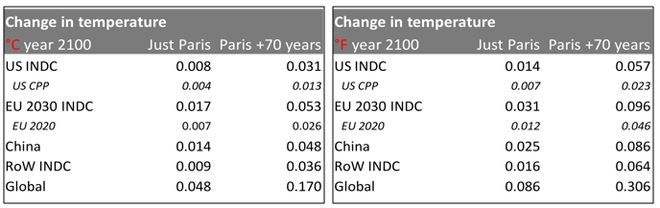
Even if Texas could stop emitting CO2, the amount of atmospheric warming averted would be only 0.0093 degrees and 0.0237 degrees by 2050 and 2100, respectively. These changes are negligible and cannot be felt or measured.

If the reason for spending on Texas climate policy were to enrich wind and solar developers, then, yes, lamentations over the demise of subsidies are understandable. However, there is no basis for spending a cent on a fake crisis – and certainly not on technologies that offer no benefit.

Anti-Tornado Tech Better Than Mitigation?

Gregory Wrightstone is a geologist; executive director of the CO2 Coalition, Fairfax, Va.; author of “Inconvenient Facts: The Science That Al Gore Doesn’t Want You to Know” and “A Very Convenient Warming: How modest warming and more CO2 are benefiting humanity.”

CO2 Coalition Texas Report is here.  My snyopsis is :

No Climate Crisis in Texas

An Insider’s Story How Climatism Subverted Reason

Mark Keenan explains in his American Thinker article The Climate Creed: How Fear Replaced Science.  Excerpts in italics with my bolds and added images.

For decades, politicians and pundits have told us that “the science is settled.” Those four words have become a shield for power and a sword against dissent. But real science thrives on inquiry and investigation; not the suppression of it. What has emerged instead is not science at all, but a kind of secular faith — one that demands belief in man-made CO2-induced climate catastrophe and punishes heresy. Yet, many scientists, including scientists that have worked within the climate bureaucracy, know how fragile the claim that “climate change is caused by CO2” really is.

As a former scientist with the UK Department of Energy and Climate Change and later a technical expert for United Nations Environment, I saw firsthand how the modern climate narrative was shaped — not by evidence, but by politics. Uncertainty wasn’t treated as a question to investigate; it was treated as a threat to suppress. Entire careers and institutions came to depend on preserving a preordained conclusion: that carbon dioxide, the same gas that feeds plant life, is destroying the planet.

What began as environmental concern has hardened into climate orthodoxy — a moral creed enforced by bureaucrats, bankers, and media alike. It is a belief system that demands faith rather than understanding, obedience rather than inquiry. None of this means the climate isn’t changing. It means that the conversation about why and how has been systematically narrowed — not by discovery, but by decree.

The Rise of Climate Bureaucracy

By the 1990s, climate science had morphed from an academic discipline into a vast global bureaucracy. The Intergovernmental Panel on Climate Change (IPCC), founded in 1988, became the central authority — linking governments, corporations, and NGOs under a single mission: to define and manage “the problem.”

But the IPCC’s reports were never neutral. The “Summary for Policymakers” — the only section most journalists ever read — was often written before the science was finalized. Conclusions drove the evidence, not the other way around. Scientists who emphasized natural climate drivers such as solar cycles or ocean oscillations were quietly pushed aside. The institution that once claimed to study the climate became invested in proving a single narrative.

The Other Consensus

While the UN promotes its “consensus,” thousands of scientists disagree. In 2019, more than 2,000 experts signed the Climate Intelligence (CLINTEL) Declaration, stating bluntly:

“There is no [CO₂-induced] climate emergency. The geological record shows Earth’s climate has always varied naturally.”

CO2 is not pollution — it is plant food, essential for life and photosynthesis. Yet the UN’s focus on carbon rather than true pollutants such as heavy metals or industrial toxins has diverted environmentalism from its original mission into politics.

I witnessed this distortion firsthand while working within the UN system. My role involved servicing the Pollution Release and Transfer Register Protocol — a multinational agreement that monitors pollutants to air, land, and water. Real pollution exists, and it’s severe. But CO2 is not the problem. Confusing the two has served political and financial ends, not ecological ones.

When Science Becomes Statecraft

The line between scientific advice and political advocacy blurred long ago. Governments needed crisis to justify regulation and taxation. NGOs needed fear to justify funding. And so “consensus science” — a contradiction in terms — entered the lexicon and became the new norm.

Real science advances through dissent and enquiry; consensus is a political construct. But once the term took hold, it became a weapon. Questioning it marked one as a heretic. The language of faith — belief, denial, salvation — replaced the language of analysis. What began as environmental concern hardened into a kind of secular theology: the carbon creed.

Complexity was the enemy. Climate models that showed alarming forecasts were amplified, while those showing uncertainty were ignored. What followed was the moralization of data. The language of faith replaced the language of evidence: belief, denial, salvation, catastrophe. Dissenters weren’t debated — they were denounced. What began as environmental concern hardened into an ideology — one that rewards fear over reason.

Scientists Who Broke Ranks

Many respected scientists have spoken out. Professor John R. Christy, Director of Atmospheric and Earth Sciences, University of Alabama, stated: “The established global warming theory significantly misrepresents the impact of extra greenhouse gases.” MIT’s Richard Lindzen observed, “In Earth’s long history, there’s been almost no correlation between climate and CO₂.” Dr. Nils-Axel Mörner, once with the IPCC, called the carbon narrative “a wonderful way to control taxation and people.” Greenpeace co-founder Patrick Moore declared the crisis “fake science” hijacked by ideology.

Such voices are rarely heard in mainstream media, not because their credentials lack merit, but because they challenge the most politically valuable story of the century.

The Money Behind the Mandate

Follow the money, and the picture becomes clearer. The financialization of carbon—
through emissions trading, carbon credits, and “green investment” funds
— transformed moral urgency into a trillion-dollar industry.

Governments pour billions into renewable subsidies, enriching banks and corporations far more than benefiting the planet. If the climate crisis were truly existential, would its management really be entrusted to those who profit from it?

In my book Climate CO₂ Hoax – How Bankers Hijacked the Environmental Movement, I detail how the 1992 UN Earth Summit in Rio marked the turning point — when financial elites effectively captured global environmental policy. Reports and whistleblower accounts later suggested that key policies adopted at the summit were drafted without open debate — policies that subordinated national sovereignty to global ‘sustainability’ goals.”

Net Zero: The Mirage of Green Energy

The world’s economies are being restructured around “net zero,” but the irony is glaring. Building the infrastructure for so-called “green energy” — from solar panels to EV batteries — requires massive fossil-fuel use and destructive rare-earth mining.

Electric cars rely on lithium and cobalt extracted through environmentally devastating processes. The energy required to mine and refine these materials often exceeds what the vehicles save over their lifetimes.

In Germany, the green energy transition has turned a once-stable, low-cost energy grid into one of the most expensive in the industrial world. In Ireland, plans to close the coal-fired Moneypoint power station were reversed in 2022 as the government quietly converted it to burn oil instead — an unspoken admission that “renewables” can’t power modern economies.

Silencing Dissent

In this new orthodoxy, questioning the narrative is treated as blasphemy. Scientists who deviate from the CO2 script face censorship, ostracism, and blacklisting. The term “denier” — borrowed from the lexicon of moral condemnation — equates disagreement with depravity, and scepticism with sin

Dr. Roger Pielke Jr. of the University of Colorado revealed how the IPCC relies on the RCP 8.5 model — one he described as “fantasy land,” completely detached from real-world data. Yet it remains the foundation of global policy and countless policy papers and media headlines.

When truth becomes heresy, science itself collapses.

The Moralization of Carbon

CO2 has been transformed from a molecule into a moral symbol — the embodiment of human guilt. Citizens are told to measure their “carbon footprint” as if it were a sin ledger, redeemable only through “green” consumption. Yet many of these same products — from electric cars to solar infrastructure — depend on the same industrial extraction that environmentalism once opposed.

This framing serves a purpose. Instead of questioning the powerful institutions that profit from pollution and its supposed cure, individuals are encouraged to internalize blame. The message: You are the problem — not the system. It’s an old strategy of control — rule through guilt rather than force.

The Politics of Fear

No ideology survives without fear. Apocalyptic imagery — burning forests, flooded cities, “ticking clocks” — has replaced empirical evidence as the main instrument of persuasion. Yet forest fires and floods are as old as the Earth itself.

Children now grow up believing the planet will collapse before they reach adulthood. Politicians invoke “existential threat” rhetoric to justify sweeping economic and social controls. What was once a challenge to power has become a tool of it.

The New Creed

Modern climate orthodoxy is not science but ideology — a sociopolitical construct — a fusion of fear, money, and power that rewards conformity and punishes doubt. Science must never serve politics. When data becomes dogma, truth dies — and with it, freedom. If we truly wish to “save the planet,” we must first save science itself.

Mark Keenan is a former scientist at the UK Department of Energy and Climate Change and a former Environmental Affairs Officer with United Nations Environment. 

About Sea Surface Temperatures

Background from NOAA Climate.gov

Q:  What’s the temperature of water at the ocean’s surface?
A:  Colors on the map show the temperature of water right at the ocean’s surface. The darkest blue shows the coldest water: floating sea ice is usually present in these areas. Lighter shades of blue show temperatures of up to 80°F. White and orange areas show where surface temperatures are higher than 80°F, warm enough to fuel tropical cyclones or hurricanes.

Q:  Where do these measurements come from?
A:  Satellite instruments measure sea surface temperature—often abbreviated as SST—by checking how much energy comes off the ocean at different wavelengths. Computer programs merge sea surface temperatures from ships and buoys with the satellite data, and incorporate information from maps of sea ice. To produce the daily maps, programs invoke mathematical filters to combine and smooth data from all three sources.

Q:  Why do these data matter?
A:  While heat energy is stored and mixed throughout the depth of the ocean, the temperature of water right at the sea’s surface—where the ocean is in direct contact with the atmosphere—plays a significant role in weather and short-term climate. Where sea surface temperatures are high, relatively large amounts of heat energy and moisture enter the atmosphere, sometimes producing powerful, drenching storms downwind. Conversely, lower sea surface temperatures mean less evaporation. Global patterns of sea surface temperatures are an important factor for weather forecasts and climate outlooks.

Q:  How did you produce these snapshots?
A:  Data Snapshots are derivatives of existing data products: to meet the needs of a broad audience, we present the source data in a simplified visual style. NOAA’s Climate Data Records Program produces the Opitimum Interpolated Sea Surface Temperature files. To produce our images, we run a set of scripts that access the source files, re-project them into desired projections at various sizes, and output them with a custom color bar.

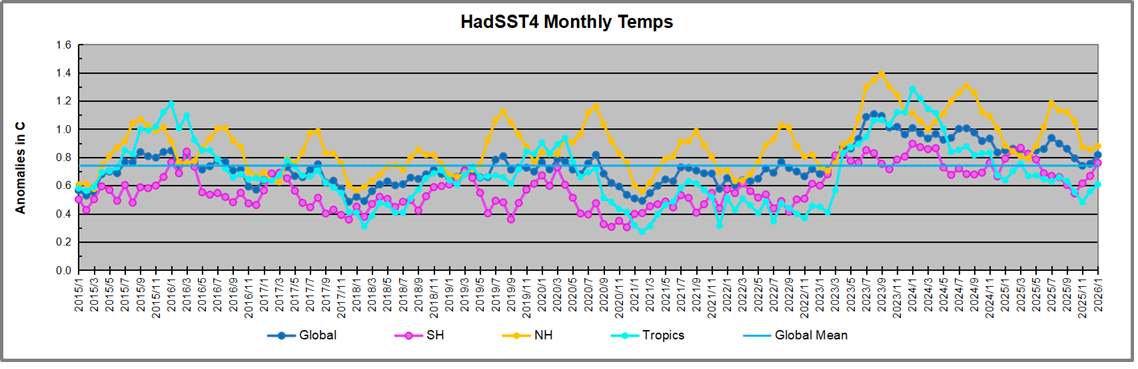
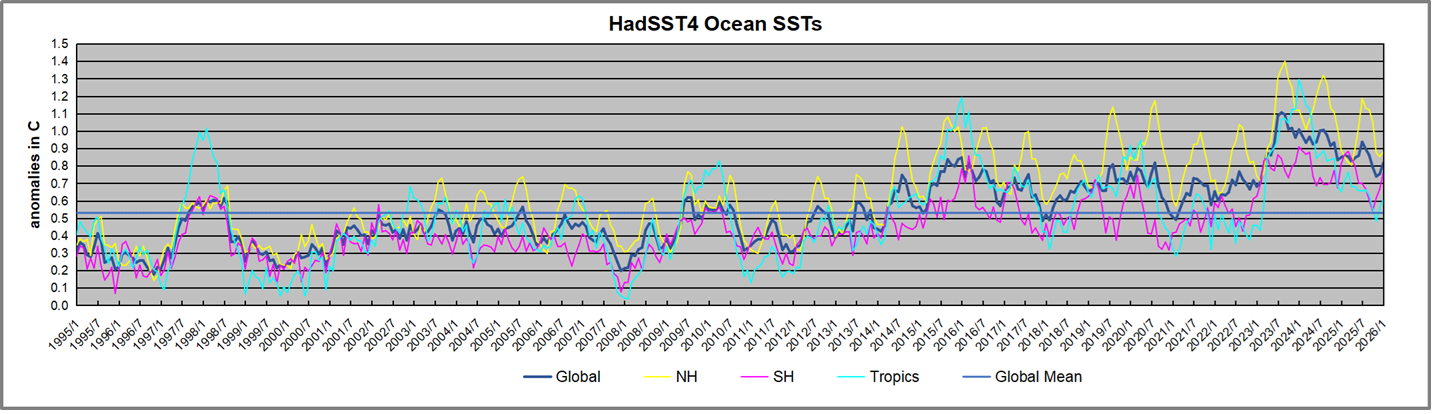
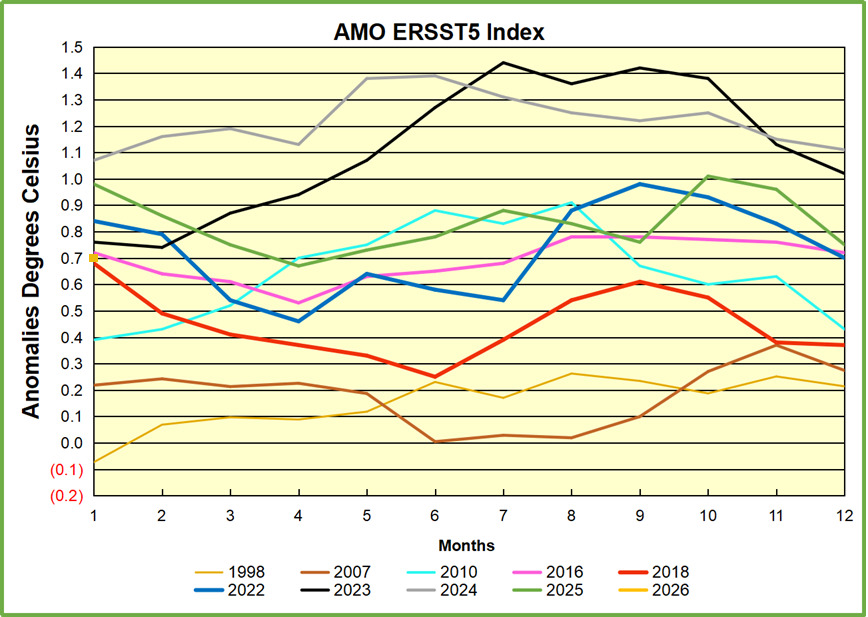
With the federal government shutdown, dataset updates are uncertain, but OISST is current and shows how presently the ocean is cooling down from it’s 2024 high temperatures.

Note: Daily SST Ocean Temperature Graphic, 1982-2025

Use the options below to generate graphics of daily sea surface temperatures since 1982 using data from NOAA’s Optimum Interpolation Sea Surface Temperature (OISST) v2.1 dataset. [The chart above defines Global as 60°N to 60°S.]  These graphics will update daily, or as data becomes available on the Climate Reanalyzer website. Note the most recent two weeks of data are considered preliminary. Specific information about the data can be found here.

My Comment:

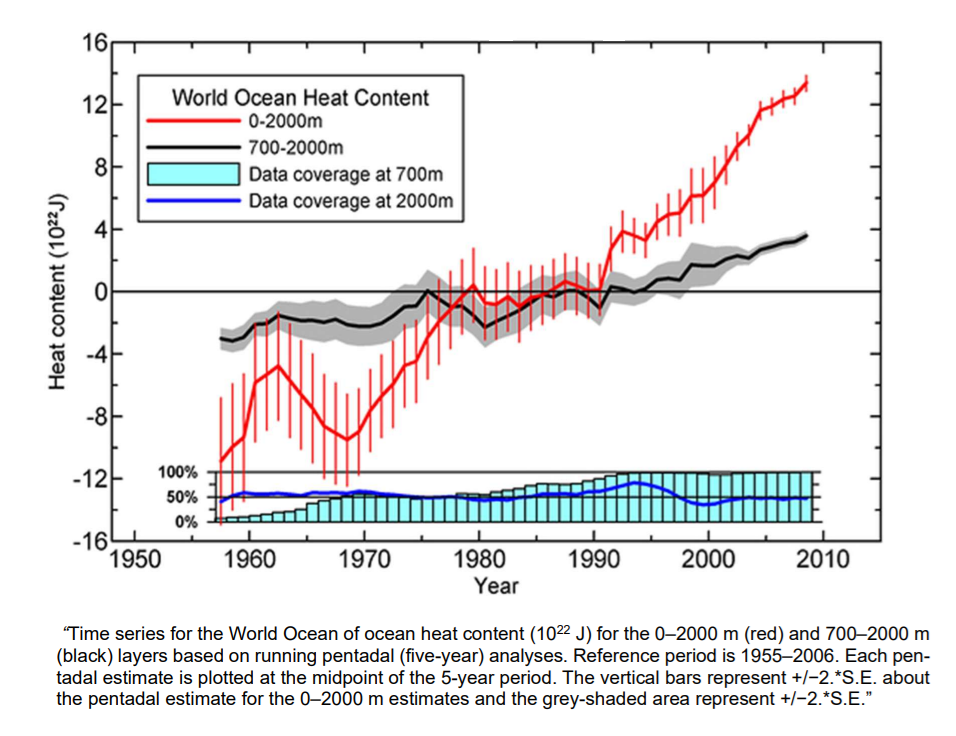
The chart shows how 2025 is tracking ~half a degree F cooler than 2024. That may not seem significant, except that the ocean covers 71% of the Earth’s surface, and any SST warming is reported in numbers of zettajoules.  This is explained at the EPA website Climate Change Indicators: Ocean Heat:

The top 700 meters of the ocean contain 63% of the ocean’s heat content. The data shows that ocean layer has warmed about a zettajoule (1×10^22 joules) yearly since 1990.

For reference, an increase of 1 unit on this graph (1 × 10^22 joules) is equal to approximately 17 times the total amount of energy used by all the people on Earth in a year (based on a total global energy supply of 606 exajoules in the year 2019, which equates to 6.06 × 10^20 joules).

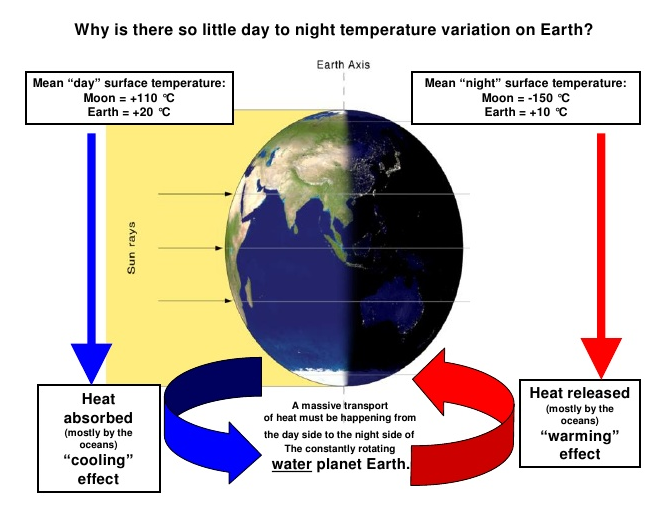
It appears that presently we may be about to lose that amount of energy through oceanic cooling.  And  the sun could be to blame:

Scare du jour Marine Heat Waves

If you watch legacy media, you must also be wondering after seeing all the current headlines about Marine Heat Waves raising the ocean to its boiling point.

Ocean heatwaves are breaking Earth’s hidden climate engine, Science Daily

The Pacific Ocean is overheated, making fall feel like summer, CBC

The ‘blob’ is back — except this time it stretches across the entire north Pacific, CNN

Record marine heatwaves may signal a permanent shift in the oceans, New Scientist

Global warming drives a threefold increase in persistence and 1 °C rise in intensity of marine heatwaves, PNAS

Etc., etc. etc.

The last one is the paper driving this recent clamor over Ocean SSTs Marcos et al. 2025 From the abstract:

We determine that global warming is responsible for nearly half of these extreme events and that, on a global average, it has led to a three-fold increase in the number of days per year that the oceans experience extreme surface heat conditions. We also show that global warming is responsible for an increase of 1 °C in the maximum intensity of the events. Our findings highlight the detrimental role that human-induced global warming plays on marine heatwaves. This study supports the need for mitigation and adaptation strategies to address these threats to marine ecosystems.

The coordinated media reports are exposed by all of them containing virtually the same claim:

As climate change causes our planet to warm, marine heatwaves are
becoming more frequent, more intense, and longer lasting. 

Animation shows locations of moderate to severe MHWs mid-month 2025 January to October. A marine heatwave is defined as one where the measured temperature is within 10% of the maximum values observed (i.e., above the Threshold (90th quantile) , for at least 5 consecutive days. For this, the intensity is compared to the difference between the climatological mean and the 90th percentile value (threshold). A marine heatwave intensity between 1 and 2 times this difference corresponds to a heatwave of moderate category; between 2 and 3 times, to a strong category; between 3 and 4 times, to a severe category; and a difference greater than 4 times corresponds to an extreme category.

First some background context on the phenomena (in italics with my bolds).

Background from perplexity.ai How Do Warm and Cool Ocean Blobs Circulate?

Warm and cool ocean blobs circulate through distinct oceanic and atmospheric processes, often linked to major currents and atmospheric patterns.

Warm ocean blobs, such as the “warm blob” in the northeast Pacific, form due to atmospheric circulation changes triggered by factors like Arctic warming. This leads to a high-pressure system over the region, weakening westerly winds and reducing ocean heat loss, causing surface waters to warm and creating persistent warm anomalies. The formation of these warm blobs involves a feedback loop between weakened winds, reduced ocean-atmosphere heat exchange, and ocean circulation, which retains heat in the mixed layer of the ocean.

Cool ocean blobs, like the North Atlantic “cold blob,” are influenced by weakening of the Atlantic Meridional Overturning Circulation (AMOC). This circulation moves warm, salty water northward, which cools, sinks, and then the cooler deep water travels southward in a conveyor-belt style flow. The cold blob forms when excess freshwater from ice melt dilutes the salty water, reducing its density and sinking ability, weakening this circulation and causing cooler surface water to persist. This cooling also affects the atmosphere by reducing water vapor, which decreases greenhouse effect locally and amplifies the cold anomaly, creating a coupled ocean-atmosphere feedback loop.

In summary, warm and cool ocean blobs circulate through a combination of ocean current dynamics and atmospheric interactions. Warm blobs form where atmospheric changes reduce ocean heat loss and circulation shifts retain heat, while cool blobs occur where circulation weakens, allowing cooler, less dense waters to persist and affect atmospheric conditions as well.

Then a summary of the issues undermining the alarmists’ claim.

From perplexity.ai What are reasons to doubt climate change is increasing marine heatwaves?

There are several reasons to doubt that climate change is definitively increasing the frequency, intensity, duration, and spatial extent of marine heatwaves, based on some ongoing scientific debates and uncertainties.

Natural Variability and Other Factors

♦  Marine heatwaves are influenced by natural climate variability, such as El Niño, Pacific Decadal Oscillation (PDO), and other oceanic and atmospheric processes. These phenomena can cause fluctuations in sea surface temperatures independent of long-term climate change, leading to periods of warmer ocean conditions that may be mistaken for climate-driven trends.

♦  Some studies emphasize the role of internal ocean variability, which can cause significant short-term temperature anomalies without requiring a direct link to anthropogenic climate change.

Complexity of Attribution

♦  The attribution of marine heatwave trends specifically to climate change involves complex modeling and statistical analysis, which can have uncertainties. Certain models suggest that long-term temperature increases are the primary driver, but the contribution of natural variability remains significant and sometimes difficult to separate clearly from climate signals.

♦  Regional differences and localized oceanic processes can obscure the global patterns, leading some scientists to argue that not all observed phenomena are directly attributable to climate change, particularly in areas with strong natural variability.

Limitations of Climate Models

♦  Climate models predicting future marine heatwave conditions depend heavily on assumptions about greenhouse gas emissions and other factors. These models often have limitations in resolution and in capturing small-scale processes, which could lead to overestimations or underestimations of climate change impacts.

Data Gaps and Uncertainties

♦  Although current observations show increasing trends in marine heatwaves, data gaps exist, especially in remote or deep-sea regions, making comprehensive global assessments challenging. These gaps contribute to uncertainty regarding the full extent and causality of observed changes.

♦  The precise long-term ecological impacts and possible adaptation or resilience mechanisms of marine ecosystems also remain uncertain, complicating the understanding of climate change’s role versus natural variability.

Summary

While a considerable body of evidence supports the role of climate change in increasing marine heatwaves, skepticism persists due to the influence of natural variability, model limitations, regional differences, and data gaps. These factors suggest that attribution is complex, and ongoing research continues to refine our understanding of the relative contributions of human influences and natural climate fluctuations.

Finally, a discussion of a specific example revealing flawed methods supposedly connecting CO2 emissions to marine heatwaves.

Much Ado About Marine Heat Waves

The promotion of this scare was published in 2022 at Nature by Barkhordarian et al. Recent marine heatwaves in the North Pacific warming pool can be attributed to rising atmospheric levels of greenhouse gases.  This post will unpack the reasons to distrust this paper and its claims.  First the Abstract of the subject and their declared findings in italics with my bolds.

Abstract

Over the last decade, the northeast Pacific experienced marine heatwaves that caused devastating marine ecological impacts with socioeconomic implications. Here we use two different attribution methods and show that forcing by elevated greenhouse gases levels has virtually certainly caused the multi-year persistent 2019–2021 marine heatwave. There is less than 1% chance that the 2019–2021 event with ~3 years duration and 1.6 ∘C intensity could have happened in the absence of greenhouse gases forcing. We further discover that the recent marine heatwaves are co-located with a systematically-forced outstanding warming pool, which we attribute to forcing by elevated greenhouse gases levels and the recent industrial aerosol-load decrease. The here-detected Pacific long-term warming pool is associated with a strengthening ridge of high-pressure system, which has recently emerged from the natural variability of climate system, indicating that they will provide favorable conditions over the northeast Pacific for even more severe marine heatwave events in the future.

Background on Ocean Warm Pools

Wang and Enfield study is The Tropical Western Hemisphere Warm Pool Abstract in italics with my bolds.

Abstract

The Western Hemisphere warm pool (WHWP) of water warmer than 28.5°C extends from the eastern North Pacific to the Gulf of Mexico and the Caribbean, and at its peak, overlaps with the tropical North Atlantic. It has a large seasonal cycle and its interannual fluctuations of area and intensity are significant. Surface heat fluxes warm the WHWP through the boreal spring to an annual maximum of SST and areal extent in the late summer/early fall, associated with eastern North Pacific and Atlantic hurricane activities and rainfall from northern South America to the southern tier of the United States. SST and area anomalies occur at high temperatures where small changes can have a large impact on tropical convection. Observations suggest that a positive ocean-atmosphere feedback operating through longwave radiation and associated cloudiness is responsible for the WHWP SST anomalies. Associated with an increase in SST anomalies is a decrease in atmospheric sea level pressure.

Chou and Chou published On the Regulation of the Pacific Warm Pool Temperature:

Abstract

Analyses of data on clouds, winds, and surface heat fluxes show that the transient behavior of basin-wide large-scale circulation has a significant influence on the warm pool sea surface temperature (SST). Trade winds converge to regions of the highest SST in the equatorial western Pacific. The reduced evaporative cooling due to weakened winds exceeds the reduced solar heating due to enhanced cloudiness. The result is a maximum surface heating in the strong convective and high SST regions. The maximum surface heating in strong convective regions is interrupted by transient atmospheric and oceanic circulation. Regions of high SST and low-level convergence follow the Sun. As the Sun moves away from a convective region, the strong trade winds set in, and the evaporative cooling enhances, resulting in a net cooling of the surface. We conclude that the evaporative cooling associated with the seasonal and interannual variations of trade winds is one of the major factors that modulate the SST distribution of the Pacific warm pool.

Comment:

So these are but two examples of oceanographic studies describing natural factors driving the rise and fall of Pacific warm pools.  Yet the Nature paper claims rising CO2 from fossil fuels is the causal factor, waving away natural processes.  Skeptical responses were already lodged upon the first incidence of the North Pacific marine heat wave, the “Blob” much discussed by west coast US meteorologists.  One of the most outspoken against the global warming attributionists has been Cliff Mass of Seattle and University of Washington.  Writing in 2014 and 2015, he observed the rise and fall of the warming blob and then posted a critique of attribution attempts at his blog.  For example, Media Miscommunication about the Blob.  Excerpts in italics with my bolds.

Blob Media Misinformation

One of the most depressing things for scientists is to see the media misinform the public about an important issue.

During the past few days, an unfortunate example occurred regarding the warm water pool that formed over a year ago in the middle of the north Pacific, a.k.a., the blob. Let me show how this communication failure occurred, with various media outlets messed things up in various ways.

The stimulant for the nationwide coverage of the Blob was a very nice paper published by Nick Bond (UW scientist and State Climatologist), Meghan Cronin, Howard Freeland, and Nathan Mantua in Geophysical Research Letters.

This publication described the origin of the Blob, showing that it was the result of persistent ridging (high pressure) over the Pacific. The high pressure, and associated light winds, resulted in less vertical mixing of the upper layer of the ocean; with less mixing of subsurface cold water to the surface. Furthermore, the high pressure reduced horizontal movement of colder water from the north. Straightforward and convincing work.

The inaccurate press release then led to a media frenzy, with the story going viral. And unfortunately, many of the media got it wrong.

There were two failure modes. In one, the headline was wrong, but the internal story was correct. . . In the second failure mode, the story itself was essentially flawed, with most claiming that the Blob off of western North America was the cause of the anomalous circulation (big ridge over West Coast, trough over the eastern U.S.). (The truth: the Blob was the RESULT of the anomalous circulations.) That the Blob CAUSED the California drought or the cold wave in the eastern U.S. These deceptive stories were found in major outlets around the country, including the Washington Post, NBC News, and others.

Blob Returns,  Attribution Misinformation

When the Blob returned 2020-2021, Cliff Mass had cause to again lament how the public is misled.  This time misdirection instigated by activist scientists using flawed methods.  His post Miscommunication in Recent Climate Attribution Studies.  Excerpts in italics with my bolds.

This attribution report, and most media stories that covered it, suggested a central role for global warming for the heatwave. As demonstrated in my previous blog, their narrative simply does not hold up to careful examination.

This blog will explain why their basic framing and approach is problematic, leading readers (and most of the media) to incorrect conclusions.

For the heatwave, the attribution folks only examine the statistics of temperatures hitting the record highs (108F in Seattle), but avoid looking at the statistics of temperature exceeding 100F, or even the record highs (like 103F in Seattle). There is a reason they don’t do that. It would tell a dramatically different (and less persuasive) story.

In the attribution studies, the main technology for determining changed odds of extreme weather is to use global climate models. First, they run the models with greenhouse gas forcing (which produces more extreme precipitation and temperature), and then they run the models again without increased greenhouse gases concentrations. By comparing the statistics of the two sets of simulations, they attempt to determine how the odds of extreme precipitation or temperature change.

Unfortunately, there are serious flaws in their approach: climate models fail to produce sufficient natural variability (they underplay the black swans) and their global climate models don’t have enough resolution to correctly simulate critical intense, local precipitation features (from mountain enhancement to thunderstorms). On top of that, they generally use unrealistic greenhouse gas emissions in their models (too much, often using the RCP8.5 extreme emissions scenario) And there is more, but you get the message. ( I am weather/climate modeler, by the way, and know the model deficiencies intimately.)

Vaunted Fingerprinting Attribution Is Statistically Unsound

From Barkhordarian et al.

Unlike previous studies which have focused on linking the SST patterns in the North Pacific to changes in the oceanic circulation and the extratropical/tropical teleconnections2,12,17,18,20,24,26, we here perform two different statistical attribution methodologies in order to identify the human fingerprint in Northeast Pacific SST changes both on multidecadal timescale (changes of mean SST) and on extreme SST events on daily timescale (Marine Heatwaves). Evidence that anthropogenic forcing has altered the base state (long-term changes of mean SST) over the northeast Pacific, which is characterized by strong low-frequency SST fluctuations, would increase confidence in the attribution of MHWs27, since rising mean SST is the dominant driver of increasing MHW frequency and intensity, outweighing changes due to temperature variability1,2.

In this study, we provide a quantitative assessment of whether GHG forcing, the main component of anthropogenic forcings, was necessary for the North Pacific high-impact MHWs (the Blob-like SST anomalies) to occur, and whether it is a sufficient cause for such events to continue to repeatedly occur in the future. With these purposes, we use two high-resolution observed SST datasets, along with harnessing two initial-condition large ensembles of coupled general circulation models (CESM1-LE28,29 with 35 members, and MPI-GE30 with 100 members). These large ensembles can provide better estimates of an individual model’s internal variability and response to external forcing31,32, and facilitate the explicit consideration of stochastic uncertainty in attribution results33. We also use multiple single-forcing experiments from the Detection and Attribution Model Intercomparision Project (DAMIP34) component of Coupled Model Intercomparison Project phase 6 (CMIP635).

From Barkhordarian et al. References


The IPCC’s attribution methodology is fundamentally flawed

The central paper underpinning the attribution analysis was assessed and found unreliable by statistician Ross McKitrick’s published evaluation. Excerpts in italics with my bolds.

One day after the IPCC released the AR6 I published a paper in Climate Dynamics showing that their “Optimal Fingerprinting” methodology on which they have long relied for attributing climate change to greenhouse gases is seriously flawed and its results are unreliable and largely meaningless. Some of the errors would be obvious to anyone trained in regression analysis, and the fact that they went unnoticed for 20 years despite the method being so heavily used does not reflect well on climatology as an empirical discipline.

My paper is a critique of “Checking for model consistency in optimal fingerprinting” by Myles Allen and Simon Tett, which was published in Climate Dynamics in 1999 and to which I refer as AT99. Their attribution methodology was instantly embraced and promoted by the IPCC in the 2001 Third Assessment Report (coincident with their embrace and promotion of the Mann hockey stick). The IPCC promotion continues today: see AR6 Section 3.2.1. It has been used in dozens and possibly hundreds of studies over the years. Wherever you begin in the Optimal Fingerprinting literature (example), all paths lead back to AT99, often via Allen and Stott (2003). So its errors and deficiencies matter acutely.

Abstract

Allen and Tett (1999, herein AT99) introduced a Generalized Least Squares (GLS) regression methodology for decomposing patterns of climate change for attribution purposes and proposed the “Residual Consistency Test” (RCT) to check the GLS specification. Their methodology has been widely used and highly influential ever since, in part because subsequent authors have relied upon their claim that their GLS model satisfies the conditions of the Gauss-Markov (GM) Theorem, thereby yielding unbiased and efficient estimators.

But AT99:

  • stated the GM Theorem incorrectly, omitting a critical condition altogether,
  • their GLS method cannot satisfy the GM conditions, and
  • their variance estimator is inconsistent by construction.
  • Additionally, they did not formally state the null hypothesis of the RCT nor
  • identify which of the GM conditions it tests, nor
  • did they prove its distribution and critical values, rendering it uninformative as a specification test.

The continuing influence of AT99 two decades later means these issues should be corrected. I identify 6 conditions needing to be shown for the AT99 method to be valid.

In Conclusion,  McKitrick:

One point I make is that the assumption that an estimator of C provides a valid estimate of the error covariances means the AT99 method cannot be used to test a null hypothesis that greenhouse gases have no effect on the climate. Why not? Because an elementary principle of hypothesis testing is that the distribution of a test statistic under the assumption that the null hypothesis is true cannot be conditional on the null hypothesis being false. The use of a climate model to generate the homoscedasticity weights requires the researcher to assume the weights are a true representation of climate processes and dynamics.

The climate model embeds the assumption that
greenhouse gases have a significant climate impact.

Or, equivalently, that natural processes alone cannot generate a large class of observed events in the climate, whereas greenhouse gases can. It is therefore not possible to use the climate model-generated weights to construct a test of the assumption that natural processes alone could generate the class of observed events in the climate.

October Arctic Ice Grows After Pope’s Blessing

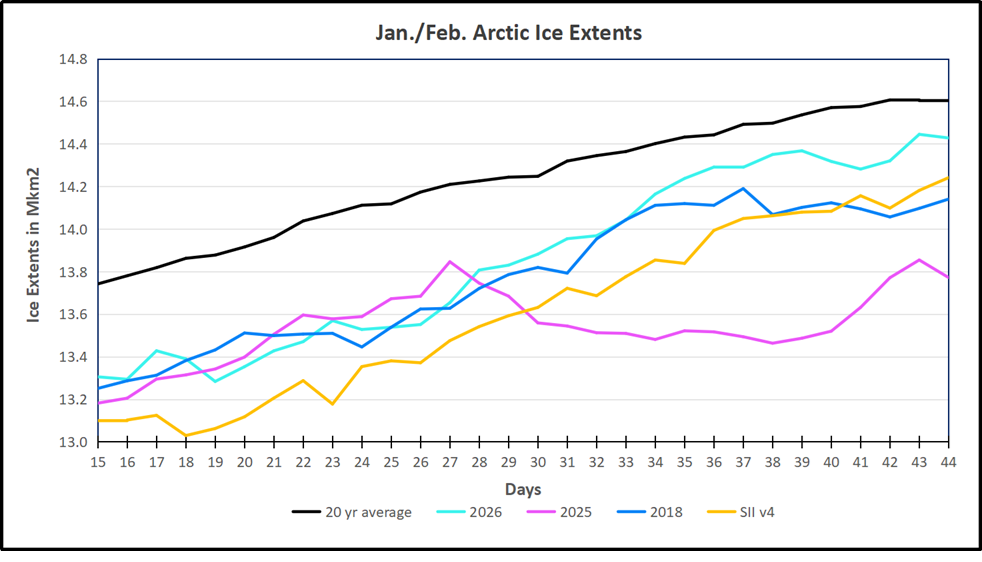
Last Wednesday Pope Leo spoke before a slowly melting chunk of glacial ice in Vatican City in his first address on climate change.  The pontiff addressed a crowd of roughly 1,000 attendees and called on people all over the world to demand action on climate from their governments. This post presents evidence the Arctic is already heeding his call, growing by leaps and bounds. /sarc

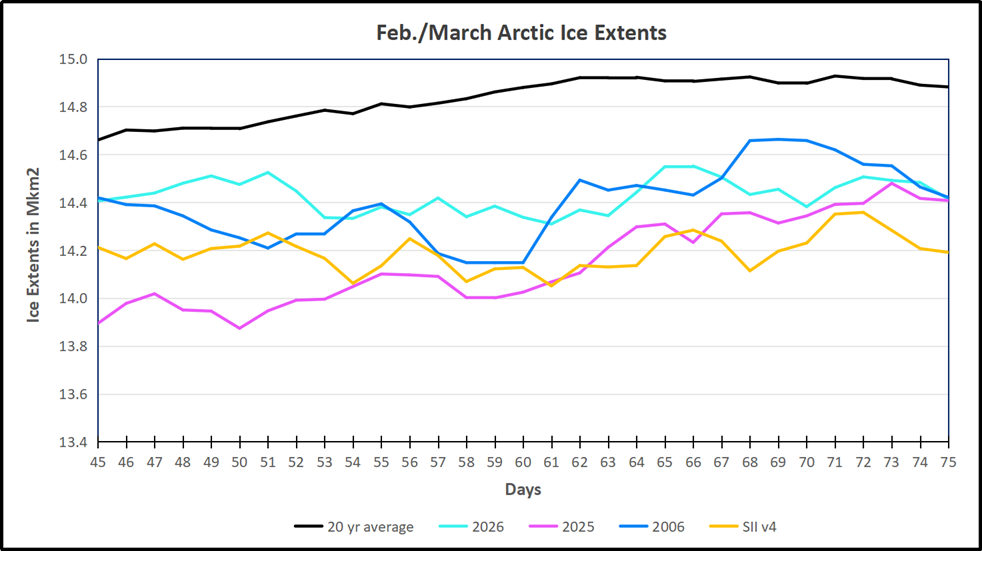
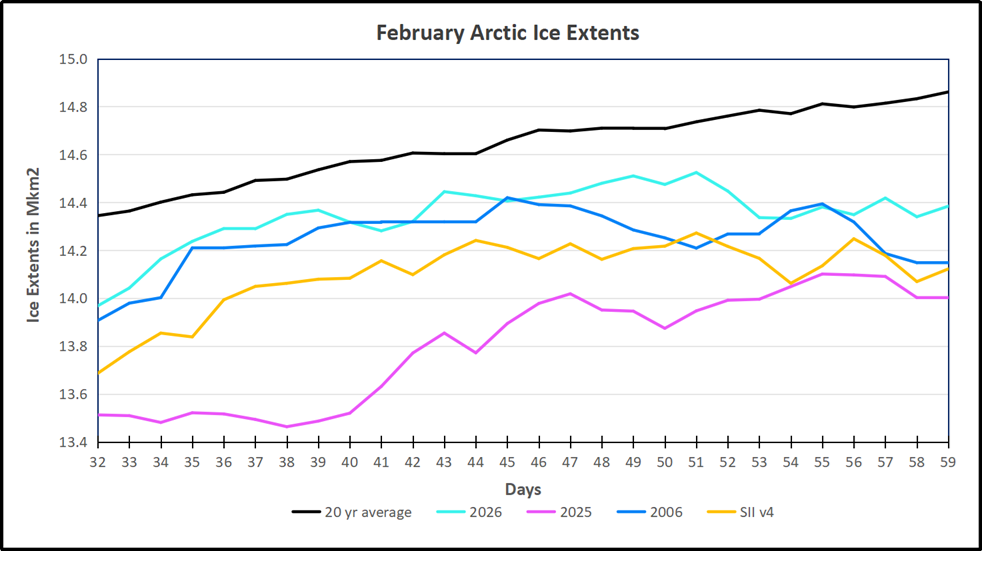
The graph above shows Sept./Oct. daily ice extents for 2025 compared to 19 year averages, and some years of note. Day 260 has been the lowest daily ice extent on average for the last 19 years. Note how in just the last five days, Arctic ice extent has grown by half a wadham or ~0.5M km2!

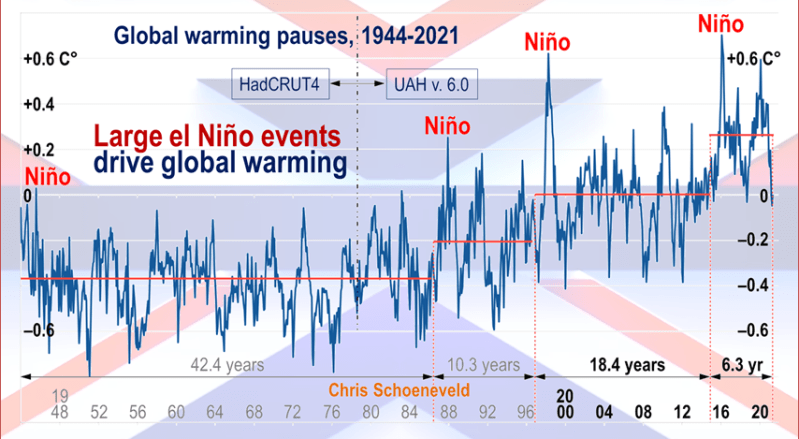
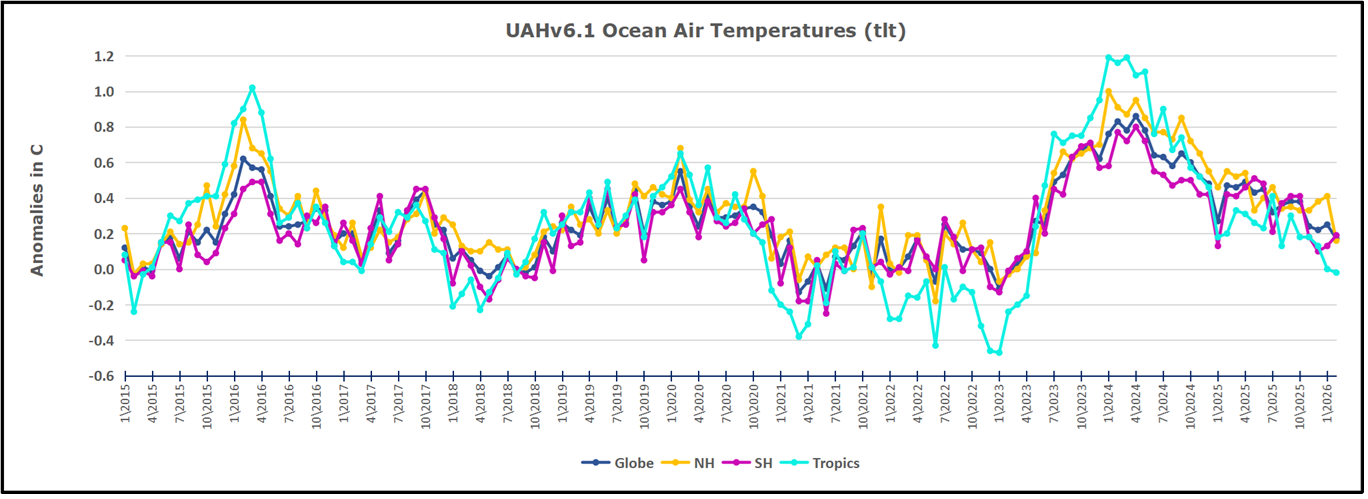
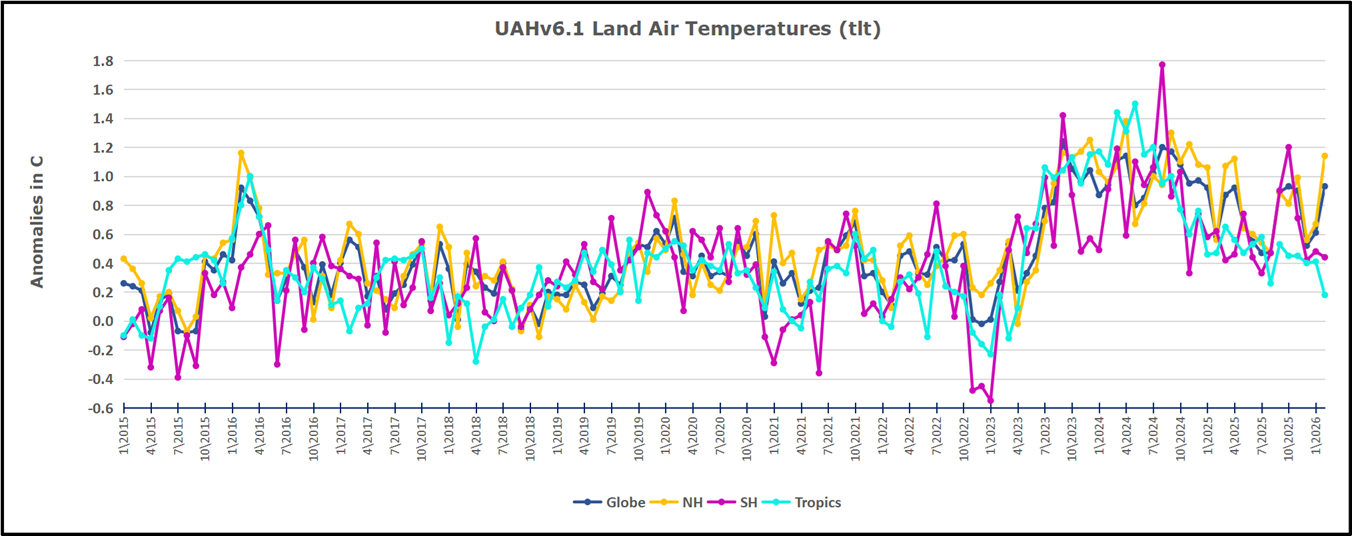
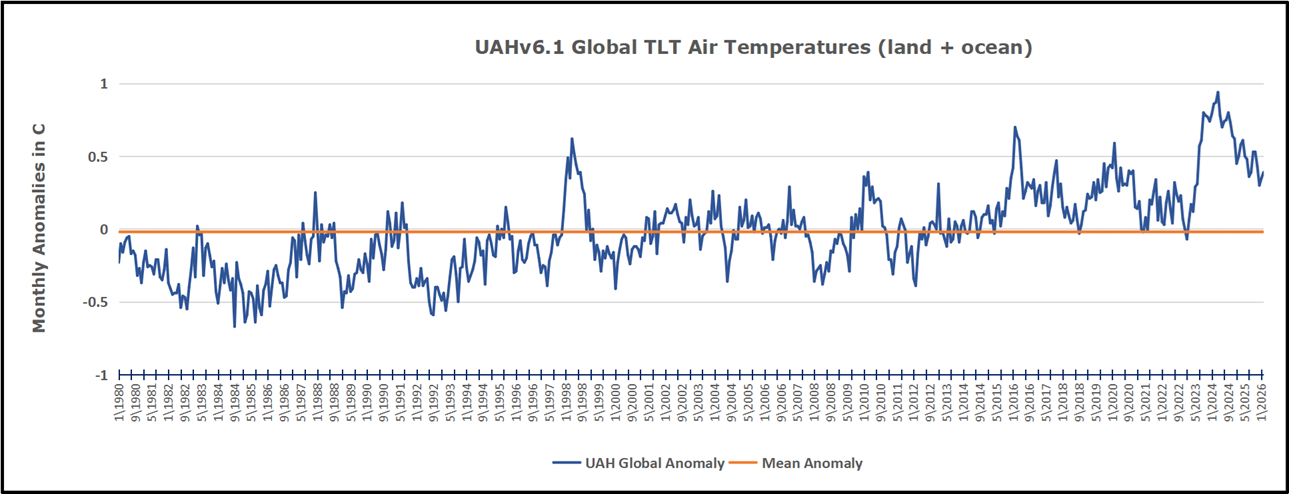
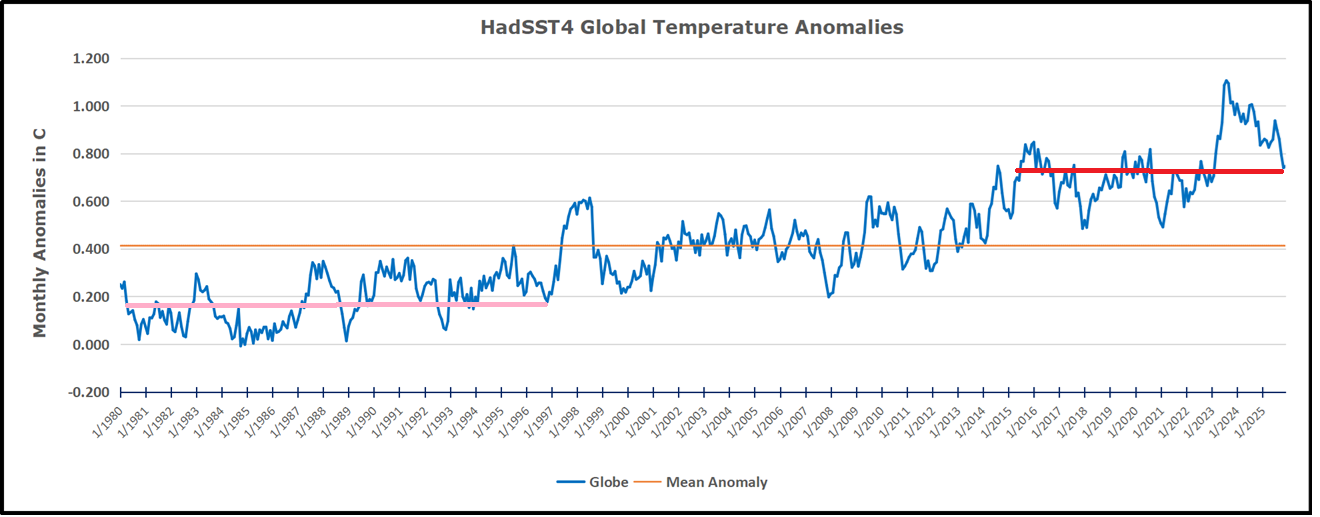
Why is this important?  All the claims of global climate emergency depend on dangerously higher temperatures, lower sea ice, and rising sea levels.  The lack of additional warming prior to 2023 El Nino, which is now receding, is documented in a post Tropics UAH Temps Cooler August 2025.

The lack of acceleration in sea levels along coastlines has been discussed also.  See Observed vs. Imagined Sea Levels 2023 Update.

Also, a longer term perspective is informative:

post-glacial_sea_levelThe table below shows the distribution of Sea Ice on day 260 across the Arctic Regions, on average, this year and 2007. At this point in the year, Bering and Okhotsk seas are open water and thus dropped from the table. The has grown to 5.64M km2 from 5.14 and the overall surplus to average is 447k km2, ( 9 %). The 2025 ice extent exceeds 2007 by a full wadham.

Region 2025278 Day 278 ave. 2025-Ave. 2007278 2025-2007
 (0) Northern_Hemisphere 5643927 5196640 447286 4560836 1083091
 (1) Beaufort_Sea 781758 582635 199123 590267 191490
 (2) Chukchi_Sea 474277 232765 241512 25934 448343
 (3) East_Siberian_Sea 558888 329424 229465 311 558577
 (4) Laptev_Sea 299904 208865 91039 305220 -5316
 (5) Kara_Sea 1026 45918 -44892 22717 -21691
 (6) Barents_Sea 0 17669 -17669 3580 -3580
 (7) Greenland_Sea 175128 271377 -96248 404376 -229248
 (8) Baffin_Bay_Gulf_of_St._Lawrence 81997 63374 18623 72162 9835
 (9) Canadian_Archipelago 355462 410626 -55164 349687 5775
 (10) Hudson_Bay 1172 2333 -1161 1936 -764
 (11) Central_Arctic 2912747 3030507 -117760 2783370 129376

bathymetric_map_arctic_ocean

Illustration by Eleanor Lutz shows Earth’s seasonal climate changes. If played in full screen, the four corners present views from top, bottom and sides. It is a visual representation of scientific datasets measuring ice and snow extents.

How Sun and Cosmic Rays Make Our Climate Change


Dr. Henrik Svensmark: Sun and Cosmic Rays Drive Climate, Not CO₂

Danish astrophysicist Henrik Svensmark explains how the changes in solar activity and cosmic rays can influence cloud formation and therefore our climate on Earth. Title above is link to podcast video at Freedom Research.  Below is the transcript lightly edited with my bolds and added images. FR refers to Freedom Research interviewer Hannes Sarv, and HS refers to Henrik Svensmark.

Hello, welcome. This is the Freedom Research Podcast and my name is Hannes Sarv. My guest today is a researcher from Denmark, an astrophysicist, Henrik Svensmark. He’s well known for his research on the relationship between cosmic rays and Earth’s climate. He has proposed that the variations in cosmic radiation influence cloud formation and consequently global temperature and biodiversity. Of course, we’re going to talk about climate change, cosmic rays and supernovas and how they affect Earth’s climate and biodiversity well here on Earth. So first of all, thank you, Henrik, for taking the time for this interview.

Firstly, I would actually like to ask a question. Simple, simple question, which can be puzzling, at least to a lot of people. I mean, if you’re being told that you’re living in a constant climate crisis, then probably most of the people probably fear it or they might get afraid. So if someone says to you that today there is a climate crisis. What is your answer to that?

HS: Well, it’s a very political subject and the idea that the climate is in a crisis, I don’t think that that’s actually the case. It’s much less I mean, the climate disasters and so on, I mean, they’re not really increasing at all. And, of course, the temperature has gone up a little bit, but it has not, you know, made a serious crisis that we cannot handle. So, I actually think the idea that we are in a crisis is actually not correct.

FR: So you think, probably It depends on where you live, right? If the temperature goes up, it gets warmer and well, as I have understood most of the places or the larger part of the population actually benefits from higher temperatures.  What is your take?

HS: Certainly, there are places where you actually benefit from it. And in many cases, it’s not because it actually gets warmer. It’s more like it’s climate’s getting milder, meaning that it’s the colder temperatures, you know, at night and in the winter that goes slightly up, which is actually a good thing.  I mean, here in Denmark, we haven’t had very severe winters for a long time. which is also good. It’s good for the economy. It’s good for many things because a cold climate is much, much worse than a warmer climate. I think that, I mean, you also know that You also talk about people, you can have people dying from warm weather, but we know that it’s mainly cold weather that is the real killer of people. I think there’s almost a factor of 10 in difference. So slightly milder weather is not a problem. I mean, it’s certainly not a disaster.

FR:This is kind of puzzling also to many people, if they’re being told that the planet is going to be inhabitable.  Then there’s talk of sea level rise and all those other apocalyptic things that make good movies. But the actual truth there is at least a bit more complex, would you say?

HS: Yes, there’s been so many claims. I think also people should get tired of all the predictions that are wrong. I mean, that there would be no ice in the Arctic and Greenland is melting and so on. And, you know, the islands in the Pacific should be subsiding because of the rising sea levels.  And it’s not really happening, any of these things. And all these predictions, which I mean, it gets everybody’s attention, of course, because we are sort of prone to react when we hear about disasters, or coming disasters. They are not really happening fortunately. I mean, it’s actually a good thing that it’s actually not occurring.

FR: So when we look at a longer time frame, it should be brought out that there have been many such crises that have threatened all life and human life. So can you just maybe make a comparison here to today’s climate?

HS: When we talk about global warming, we say that the temperature might have got up by one degree or something like that. But if we look at geological time scales, the climate changes are much, much more severe. I mean, you have periods where you have glaciations, that is, ice almost down to the equator, and perhaps even most of the Earth is covered by ice, and you have periods where there’s no ice caps at all, and the temperature is much, much higher.  I mean, you have had… Beobab trees in Antarctica, and you had alligators at the latitude of Greenland.

So you have had much, much warmer, at least 10 degrees warmer climate back in time. So if we look at geological timescales, we have had enormous changes in climate. And of course, all of this is completely natural. And the question is, why did we have such big climate changes? And this is some of my work trying to understand why we have such large climate changes even back in time.

FR: So let’s talk about that. This is interesting that we’ve been told that the climate change today is anthropogenic. So let’s talk about your perspective on that and what does your research show?

HS: There’s no doubt that CO2 is a greenhouse gas and it has some effect on the temperature.The issue has to do with climate sensitivity. How big is the climate sensitivity? And it turns out that it’s probably around one degree if you double CO2.  So it’s a relatively benign effect of CO2. So, I’ve been working trying to understand why there are climate changes. When you look at climate changes, for instance, over the last 10,000 years, you can actually see that if you compare the climate changes with changes in solar activity, you actually find a very nice correlation.

Fig. (3). (Color online) Upper panel: Global record G7 (grey), running 31 year average of G7 (blue), sine representation of G7 with three sine functions of the periods 1003, 463, and 188 years (green), with four sine functions including the period ~60 years (red), continued to AD 2200. The parameters of the sine functions are given in Table 3. The Pearson correlation between the 31 year running average of G7 and the three-sine representation (green) is 0.84, for the four-sine representation (red) 0.85. Lower panel: G7 (grey) together with the sine functions of 1003, 463, and 188 – year periods continued until AD 2200 (equal sine amplitudes for clarity) Source: Ludecke & Weiss 2019

There are so many studies that show that you had, for instance, the Little Ice Age And you have the medieval warm period. And the medieval warm period is when you had a high solar activity. The little ice age is when the solar activity was low. And the question is, why should there be such a correlation?
How can the solar activity actually affect climate? And the simplest idea that has been put forward was that the output from the sun in the form of radiation, I mean the sunlight, that is changing. But it turns out that these changes are probably too small to explain what the climate changes you’re seeing.

So something else is going on, something is amplifying the solar activity and the idea that I came up with this now, actually 30 years ago, was that maybe solar activity is somehow regulating the Earth’s cloud cover. And initially, I took data from satellites that looked at the Earth’s cloud cover and I looked at it over a solar cycle that’s about 11 years and compared the changes in the solar cycle with changes in the Earth’s cloud cover. There seems to be a correlation between the two. So one can say that the idea, I mean, it looked as if it was something worth pursuing. But of course, it was just a correlation at that time.

Cosmic rays interacting with the Earth’s atmosphere producing ions that helps turn small aerosols into cloud condensation nuclei — seeds on which liquid water droplets form to make clouds. A proton with energy of 100 GeV interact at the top of the atmosphere and produces a cascade of secondary particles who ionize molecules when traveling through the air. One 100 GeV proton hits every m2 at the top of the atmosphere every second.

And I couldn’t say why there should be such a connection. So the general idea has to do with the formation of clouds. How are you actually forming clouds? And it turns out it’s the ionization that is happening in the atmosphere.  There’s typically about a thousand ions per cubic centimeter. So if you have a small cubic centimeter, you might have on the order of a thousand ions per cubic centimeter. And these ions are in general mainly produced because of very energetic particles that come from the Milky Way that is outside our solar system.

And they move in through the solar wind and then enter into the top of the atmosphere, where they then ionize the atmosphere. And the story is these small ions help stabilizing small molecular clusters. So you get what we call aerosols. These very small aerosols, which then grow up to a certain size. In order to make a cloud droplet, you have to have some kind of surface on which water vapor can condense. These small aerosols are actually providing these surfaces.

Cosmic Ray, Aerosol, Cloud Link

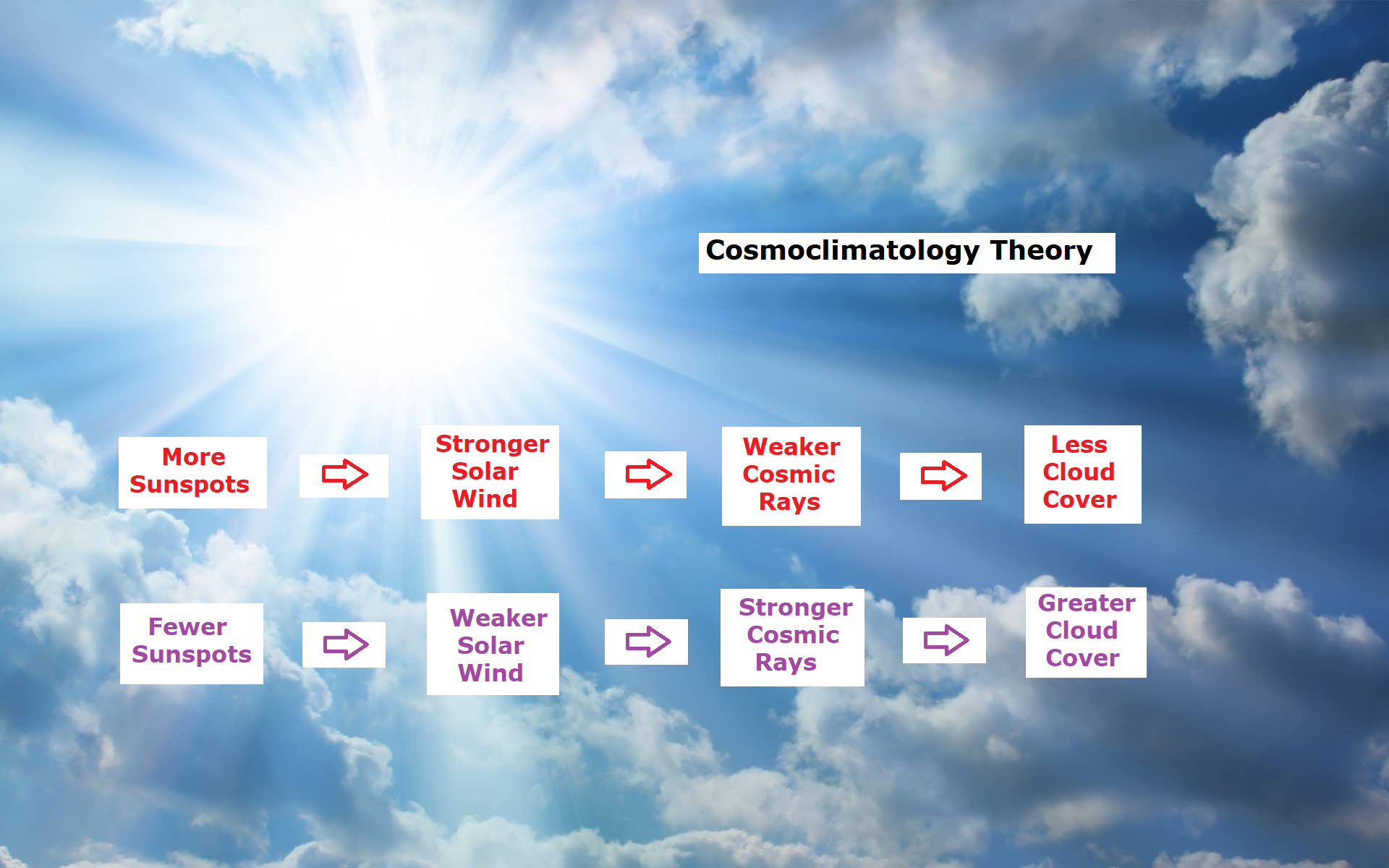
The idea is that if you have more cosmic rays coming into the atmosphere, you’re producing more of the small aerosols. They grow to become what we call cloud condensation nuclei, so they can affect the clouds, so water waves can condense and become cloud droplets. So if you have more cloud droplets, you have a more white cloud. And a more white cloud actually reflects the sunlight out to space again.
That is, of course, extremely important for the Earth’s energy balance. So that is the main idea behind the theory that I have been working on.

FR: Okay. And so if there is more clouds and reflect the sunlight back to space, I’m just gonna ask, I’m a lay person, not a scientist. Maybe I’m not, you know, a bit stupid question in that sense. But if it reflects more sunlight out, then well, logically, we get the cooler climate, right?

HS: Yes, exactly. Observations are one of the ways we can verify that it works. So on relatively rare occasions, there are some explosions at the sun. They’re called coronal mass ejections. It’s when the magnetic field lines sort of open up and the sun is throwing out a large magnetic plasma. And this magnetic plasma works more or less like an umbrella or a shield against the cosmic rays. So within a week, the cosmic rays are dropping, and they can drop maybe up to 30% or something like that. And that is like a natural experiment with the whole Earth.

And so you can actually then see if anything is happening with the Earth’s cloud cover. And this is something that we have investigated. So, for instance, we can also look at the aerosols that are produced after these events, and we can see that there is a big drop in the aerosols. And then we see a drop in the clouds following these events. And it’s not just the cloud fraction, it’s also the optical properties of clouds. So we can actually see changes in the cloud’s microphysics under these events.

So in some sense, we see the whole chain from the explosive events and the sun to changes in the cosmic rays to changes in the aerosols and then changes in the clouds. And there is a slight delay on a few days in the reaction. That’s simply because it takes about five days for the small aerosols to grow to become cloud condensation nuclei. So everything seems to be fitting very beautifully with respect to this idea.

FR: Okay. But, well, how frequently does it happen, what’s the correlation here? I mean, how frequently it happens to change the climate in that sense?

HS: I talked about this event with the explosions at the sun, which is something that happens during a week. So it’s too much too short to affect climate. But the solar activity modulates the cosmic rays. And that’s simply because the solar activity translates into changes in the solar wind. And the solar wind is covering the whole solar system and all the planets. That works like it’s a magnetic shield that screens against the cosmic rays.

So when the solar activity is high, you can say that it’s screening better against the cosmic rays. That means you get fewer cosmic rays in to the atmosphere. So solar activity can regulate the amount of cosmic rays that comes into the atmosphere. So that regulates in the cloud cover. And we can then estimate, I mean, how much it changes the cloud cover during an 11-year cycle.

And from that, we can calculate what would be the effect on the temperature in the oceans. And there you actually see that we get about on the order of one to one and a half watt per square meter more energy in when you have a solar maximum than when you have a solar minimum.

And you can actually observe that in the ocean’s temperatures. You can see that in the heat content of the ocean. And you can even see it in the volume, because the heat goes in and out of the ocean. So when you get heat into the ocean, it expands a little bit.  So in the sea level, you can actually see an 11-year cycle in the sea level. And all of this, you can quantify how much energy goes in and out of the ocean.

And it fits very beautifully with what you expect from changes in the cloud cover over a solar cycle. And it’s interesting that the solar irradiance is almost a factor of 10 too small to explain it. So there is some kind of amplification mechanism. And the idea is that it’s clouds that are responsible for this. And this is something that you should takeway with respect to the ocean temperatures and the energy that goes in and out of the ocean he has been looking at.

FR: Okay. But how does it fit this idea? How does it fit the historical records?

Figure 4. The millennial solar-climate cycle over the past 2000 years. The anomaly in 14C production levels (black curve), a proxy for solar activity, is compared to iceberg activity in the North Atlantic (dashed blue curve), a climate proxy. The pink sine curve shows the millennial frequency. It defines two warm and two cold periods, supported by a large amount of evidence, some of which are represented by red and blue bars (see main text). Source: Javier Vinos

HS: Well,If you look at solar activity going back in time, we talked about the Little Ice Age, which is from around 1300 to 1850. And then you had the medieval warm period for 900 until maybe 1200. that these changes, they fit very beautifully with changes in cosmic rays. So when it’s cold, you have more cosmic rays coming in. And when it’s warm, you have less cosmic rays entering into the atmosphere. And we know these changes in cosmic rays because when cosmic rays enter the atmosphere, They are actually producing new elements like carbon-14, which is a radioactive form of carbon. It’s slightly heavier than carbon-12.

I guess many people know that you can use carbon-14 for dating things. But this carbon becomes CO2, the heavy form from carbon, and it goes into trees. And then you can look at the annual rings of the tree rings and measure how much carbon-14 you have relative to carbon-12.  And you can then measure that for all the tree rings going back in time and you can actually reproduce solar activity almost 20,000 years back in time. And if you look at these changes and you compare with how climate has been changing over that period, there is beautiful correlations again.

So it is near certain that there is a connection between solar activity and climate. And you can also quantify some of these changes and they are relatively big and it seems as if that, you know, changes in clouds is a very good candidate for explaining this. And when we look about the last 10,000 years, then the modulation of the cosmic rays, it’s caused by solar activity.

FR: Okay. Let me just ask you about those cosmic rays again. You did say, but again, I’m not that bright in your field. You did say it comes from Milky Way. Okay. Why does it come from there? Or what is it? What sends it here?

HS: Cosmic rays are very energetic particles. It’s mainly atomic nuclear, 90% is protons. So that’s the core of the hydrogen atom. So the energetic particles that we are interested in are mainly produced in what we call supernova. And a supernova, the case that we are interested in, is when you have a massive star that is maybe eight times or more massive than the sun. It only lives a relatively short period of time, you know, from maybe three million years to 40 million years.

So it’s a large star and it’s very heavy, and then in the process of burning, it burns so fast and it ends its life in a very, very violent explosion, which is called a supernova. And this supernova, when it explodes, it produces a shock front that is moving out from where the star was located. And this shock front, it works as, you can call it, a cosmic accelerator.

So it accelerates particles that move back and forth over this shock front and move them to extremely high energies. And the energies that you can obtain by this process is much higher than we can produce in any accelerator here on Earth artificially. And these particles, they are then moving in the interstellar space in the Milky Way.

And they are moving in the magnetic fields that are in between stars. So they are sort of moving like what we call diffusion. They are sort of randomly moving around, being bent by the magnetic fields. And then some of them will be outside, you know, arrive outside our solar system.

We have the heliosphere and then they move in and they feel the magnetic field from the sun. And some of them will then enter into the top of the atmosphere. And then you have maybe one proton that comes in with extremely high energy. And then it works a little bit like billiard ball where you have one particle hitting the molecules or the atoms in the atmosphere and it makes a shower, sort of a cascade of particles that goes down through the atmosphere. And these particles are called secondary particles. And so you can have one particle coming in that becomes millions and even billions of particles that move down through the atmosphere.

These particles are completely invisible to our naked eye.  While we are sitting here, we are penetrated by these secondary particles that go through my body and your body all the time. And so every 24 hours, maybe 20 million particles will go through your body and you don’t really experience this.  This is something that has happened since the formation of our galaxy. And of course, here on Earth, we have been showered with these particles for four and a half million years.

FR: Well, since you can explain past events with solar activity and how many cosmic rays are coming towards Earth, probably you can basically model what will happen as well, right? So, I mean, the question is, where are we now in terms of changing climate? Because I’ve also talked, for example, to Professor Zharkova. She said to me that we are entering another ice age soon.

HS: There’s no doubt that we will get an ice age. We have had a number of ice ages back in time. I don’t know if you’re talking about a real ice age or you’re talking about a little ice age, which is just a colder period.

FR: She was talking about the little ice age. I understood.

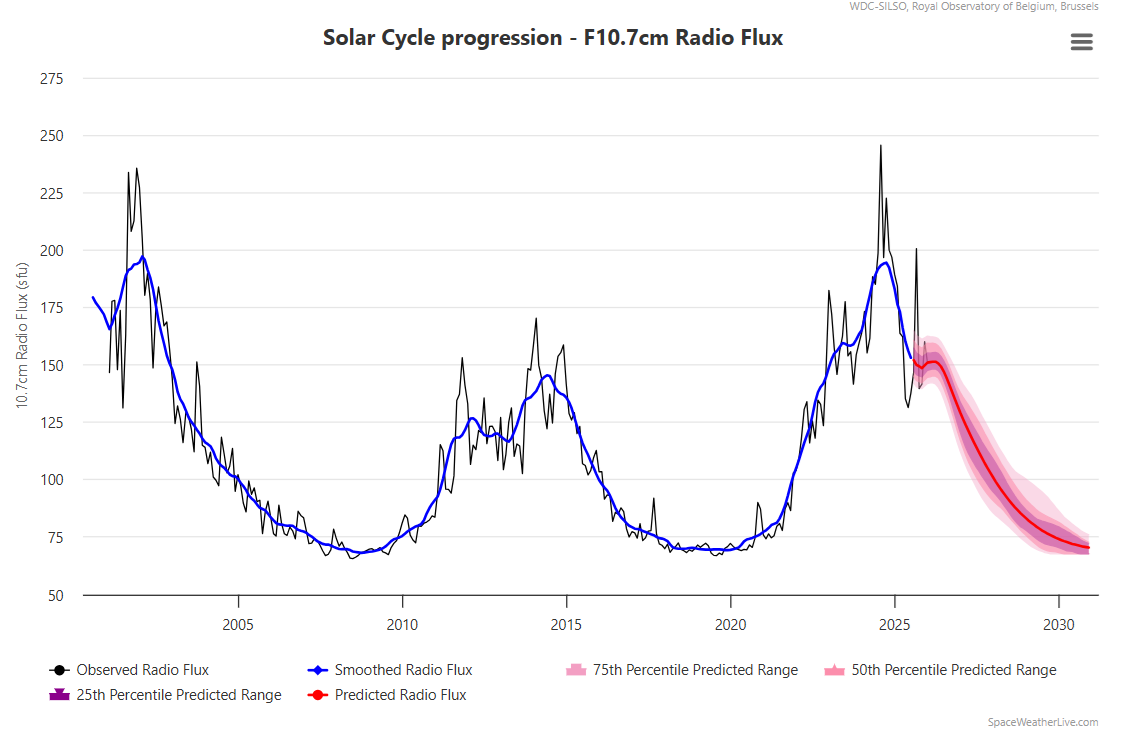
HS: So a little ice age. I know there are some predictions that the solar activity will go down and we might get a slightly colder period. I’m not sure it will be a little ice age, but it’s not something that I have looked at in any details. At the same time, of course we have had some heating from the CO2 increase in CO2. And then solar activity would then go the opposite way if the solar activity goes down. The problem with these predictions is that it’s extremely difficult to predict solar activity in the future.

Source: spaceweatherlive

We can’t even predict the next solar cycle, whether it’s going to be high or low. There are some really amazing examples where this last solar cycle was predicted and the predictions were sort of all over the place. So it is really difficult to know because we don’t understand solar activity in a detail where we can predict what the next solar cycle will be. But that might come at some point. So something special has to happen. I think if we’re going to have a real cold period where the temperature drops by one or two degrees, that would be very special. I’m not sure that we’re going to see that, but I know that Zharkova is predicting that.

FR: Okay, yes. Anyhow, the thing is that still almost, well, all of it indicates that climate change is, there are some other factors than humans leading the climate change. But what is your opinion? What is the role of us on climate?

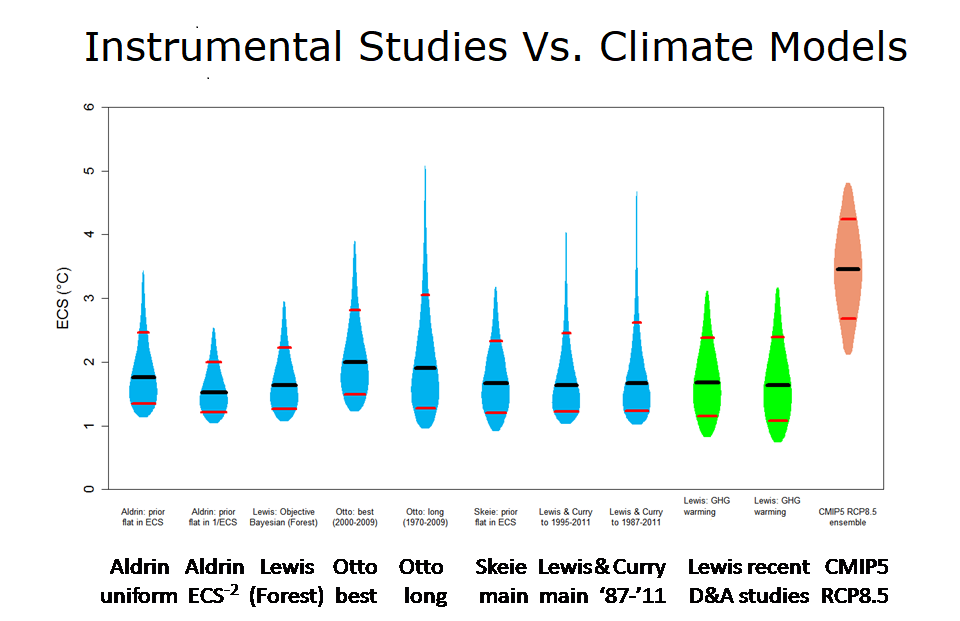
HS:  Oh, the anthropogenic CO2? Yeah. So as I said, it is a greenhouse gas. So you can see if you look at the outgoing long-wave spectrum, you can actually see there is a drop in the outgoing long-wave spectrum, which has to do with CO2, which means that it is a greenhouse gas.  The question is, how important is it? Is it so important that it’s changing temperature, you know, in a dramatic way? And I think there’s so much research now that seems to indicate that the climate sensitivity is on the order of, you know, one, maybe a little more than one degree for a doubling of CO2.

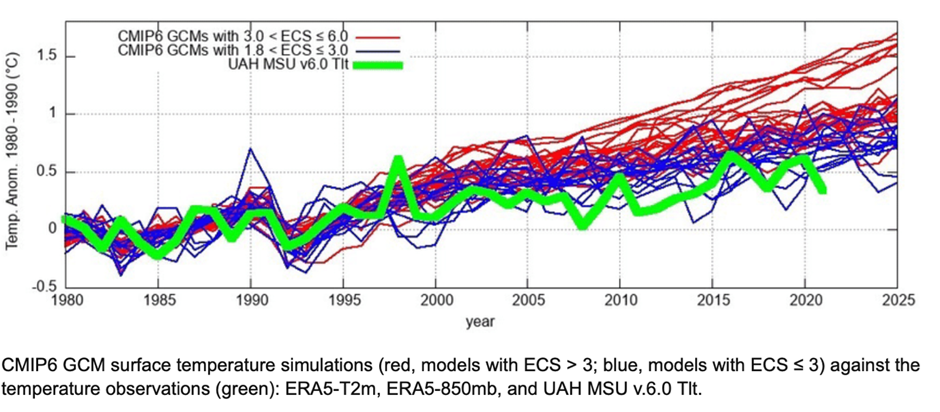
And that is much smaller than what you get from these climate models, which gives you between three and four degrees of that order, but at least a few times larger than what you get just from CO2 alone. Because in the climate models, the reason they get between three and four degrees is because they assume that it would be less cloudy, for instance, in the future climate. So you might have one degree from CO2, but then you get on the order of one or two degrees extra from what we call positive feedbacks. And that is something like more water vapour in the atmosphere or less clouds in a future climate.

And the problem is that water vapour and clouds are really the most uncertain thing about any prediction of climate. Clouds and aerosols are really what makes climate predictions so extremely difficult. And it’s because it’s all happening at length scales that are much, much smaller than what you can resolve in climate models.  You have to remember that you have maybe, you know, 50 to 100 kilometers between two grid points in a global numerical model.

And that means that, you know, if we just take Denmark, you have maybe one or two grid points over Denmark. And in each of these grid points, you have to determine, you know, what are the clouds actually just from temperature, humidity and pressure. So you have to do some kind of a parameterization of all the physics. So you’re not resolving clouds at all, but you are trying to use, you know, temperature and pressure to say what will the cloud look like for these variables. And this is basically impossible. I mean, it’s pure guesswork.

FR: So what do you think about those climate models? I mean, are they useful then at all?

HS: Of course, they’re useful for some things, but they’re not useful to say if the climate is going up by some fractions of degrees. And I don’t think you can use them for predicting future climate.

FR: But this is what they are used for, isn’t it?

HS: Yes, but I think also that there are some kind of a consensus that climate models are not doing well, I mean, that they have real problems in predicting and saying what is going to happen in the future. So they are not a crystal ball that can tell us about the future with very much accuracy.  Well, it depends on how you ask the questions, of course, but I think just recently there were some statements from people who are doing these models saying that they were running too warm.

So they are, you know, exaggerating the warmth. And I think in one of them, there was because they updated their cloud scheme. So they changed the perameters of clouds. And all of a sudden, it was running slightly warmer than before. So again, it just points to the severe problem of clouds.  I should also say that if you take out clouds of the models, then the model results start agreeing with each other. Whereas when you have all the clouds in the models, then you get very different results from various models. I mean, it’s not like in particle physics where you have a standard model that you can use.

I mean, here you have a whole ensemble of the different models and they all give slightly different results. And then you make an ensemble average of all these models and try to say that that is the future. It’s, of course, not really satisfying.

FR: Of course. So what do you think about the reports that the UN IPCC puts forward, the scientific reports? Are they something that are, you know, accurate?

HS: I looked at it with respect to the things that I’m doing. One of the things that, you know, struck me was that if you look at the effect of the sun over the last hundred years, there is no effect whatsoever. I mean, it is so small that, I mean, they’re saying essentially that there’s no effect of changes in solar activity. really a shame in the sense that I mean, for instance, we see in the present climate that we’ve had over the last 50 years, you can see solar cycle variations in the ocean heat content and so on, which we talked about just before.

So the solar activity seems to be 10 times larger than what you get from solar irradiance. And in The reason that they get such a small effect of the sun is because they are only considering changes in solar irradiance, which has to do with the solar constant. The solar constant is changing, you know, about one tenth of one percent.  So that is so, so small that it does not have any effect on climate. However, the changes in… In clouds, if we take the ideas that I have been working with Nir Shaviv we will get that over the last century, over 120 years, I think at least one watt per square meter has entered because of solar activity.

Solar activity does not seem to have been completely negative as well. over the last 10 years.
So when we think about how the issue is approached, the issue of climate change in society now, well now there’s the new administration in the United States that actually approaches it somewhat different, but in the EU, for example, Mrs. von der Leyen said that she’s still determined to go to net zero and so on.

So what I mean here is the somewhat hysterical tone that this issue is approached with and also the predictions of doom. So my question is if it’s the same in the academia or not. I mean scientists are in my opinion, at least, they seem very rational and fact-based.  So, is it somewhat different in the inside, I mean, if you talk to your peers?

HS:  I usually say that climate science is not normal science. There’s so much politics involved, even in academia. There is a sort of self-censorship. It’s a bad career move to go against the idea that CO2 is the main driver or to say what i’m saying right now so it’s not good for your career to to do that it has implications, I mean first of all it’s the only research that is being financed that can be done, if you don’t get a grant or anything, you cannot do any research.

And that’s also why I think many people will not rock the boat, because it’s a good way of getting financing for the research that you want to do. However, if you try to do things which I have done, which is perceived as controversial and not according to the general ideas, it becomes very, very difficult to obtain funding and to survive in this system. And people are very emotional about this because some people think that they are trying to save the world from a disaster. And, you know they think everybody else has really bad motives, maybe hidden motives, your multinational oil companies or something like that.

So it’s really difficult to be in opposition to these ideas. So that it’s very, very difficult for me to obtain any funding. Some people are very upset, you know, if you have been invited for giving a talk and some people find out who you are. and so on. So there’s many, many strange things happening.

FR: It’s really happening, right? I mean, it has happened to you that you’re invited to give a talk to talk about your research and there are activists who are coming to cancel you. Did I understand correctly?

Antifa thugs outside Munich Conference Center at 2019 Climate Meeting.

HS: Yes. I’ve also given talks in Germany, where the whole conference had to have police protection because of the demonstrators that tried to storm the place. Another time, on the building, they printed that we were Nazis and they put glue in the locks and so on.  Yes, so one couldn’t get in. I mean, it’s just sometimes it’s very, very, very strange how emotional it is. And there’s nothing rational about it because it’s not something that you can have a discussion about. I mean, you also heard people saying that, you know, the science has been done. Now it’s only action that is needed.

FR: Yes, yes. Well, it’s being parroted all the time. I don’t know, is it 100% already or last time I checked it was 99% of climate scientists agree on something.

HS: But all of these things are simply propaganda of some kind. It has no sort of basis in reality. It’s just some talking points that are being spread out. And some people believe them and other people know that they’re not entirely correct. And that’s how it is.

But the good thing is that I tried to survive in this system. Then I started to look at very, very long timescales. And I think, I mean, maybe we should I should tell you just a few words about that, because I think it’s a completely fascinating result that has come out. Absolutely.

So we talked about these supernovas that goes off, and they are producing the cosmic rays. So you can say supernovas are the source of cosmic rays. And the interesting thing is that our solar system it is actually moving around the Milky Way galaxy. So we are in a spiral galaxy, so it’s like a flat thing.
And we are moving around the center of the galaxy, the whole solar system, within 240 million years or 230 million years it takes. Our Milky Way is a spiral galaxy. And in these spiral arms, that’s actually where you have a lot of star formation. And star formation is where you also produce the large, heavy stars that explode.

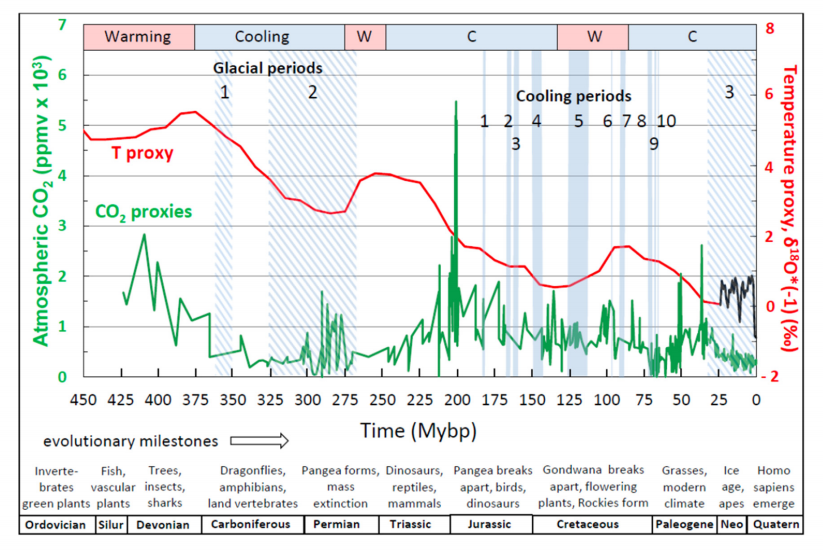
Cosmic radiation and temperature through Phanerozoic according to Nir Shaviv and Jan Veizer. Blue columns refer to Milky Way Spiral arms.

So that means that when the solar system goes through a spiral arm, it actually in an area with much higher cosmic rays, Whereas when you are in between spiral arms, you have much lower. And the changes are not 10, 20% like we have from solar activity.

Now we are talking about several hundred percent of changes in the cosmic rays. So you can say that this is a completely independent way of testing the cosmic ray climate mechanism. Because if these changes in cosmic rays are important for climate, as we see in the present time, maybe they should also be important when we go back in time. It’s something that Nir Shviv actually looked at around 2001.

And what you find is that when you are in a spiral arm, it tends to be extremely cold on Earth. So the glaciations that we have had on Earth on cold periods fit beautifully when we were in spiral arms. And when we were in between the spiral arms, it was extremely warm. The temperature changes and the climate changes we are talking about are now, you know, from what we call an ice house, that is the glaciation, very severe glaciations, that is the large ice sheets on the Earth, to where they are completely melted and, you know, the sea level has gone up maybe by 100 meters or something like that. So it’s enormous changes.

What I looked for was to see if it has implications for life on Earth. And it turns out that you can actually indirectly look at how big the biomass has been at certain times in the ocean. And that is because you can look at organic material. So when you have the ocean and you have organic material, some of the dead material falls down at the bottom. And you can actually say something about the fraction of organic carbon relative to inorganic carbon in sediments.

So when you have sedimented mountains, you can go and measure this ratio of organic carbon to inorganic carbon. And it says something about the fraction of organic material that has been buried in sediments. And it turns out when you look at this fraction as a function of time, It fits beautifully with changes in reconstructed changes in supernovae.

And you can actually see it in fairly high details over the last 500 million years. And it turns out that you can actually extend it. So from geology, you have this fraction of organic material almost four and a half billion years back in time. And even here, it fits beautifully with the changes in the cosmic rays that have happened over the whole history of the Earth. It’s completely astounding that you have this correlation over four and a half billion years. So it says that the biomass seems to have been following things which are thousands of light years away from our solar system.

So this star formation has actually influenced the conditions for life. And it’s even more interesting because when you bury organic material, the organic material is made because of photosynthesis. And photosynthesis, that is, you know, the algaes, the green algaes produce oxygen.  So you have CO2 and water and sunlight that becomes, you know, sugar and oxygen. But in order for the reaction not to go back again, so the oxygen becomes CO2, you actually have to take the organic material and then have the oxygen and you bury the organic material in the sediments.

That’s the way you get the oxygen. So these variations in the organic material, these variations, they are actually also the production of oxygen that we have had over the whole history of the Earth. So supernovas have therefore indirectly produced or been responsible for changing the oxygen at Earth and all complex life.  I mean, in order to get complex life, we need oxygen. So it’s really been a very important part. So it seems to say that the Earth is really a part of an ecosystem, you know, where it really involves most of the galaxy. So here we see that it fits beautifully with the changes in cosmic rays or supernova frequency over most of the history of the Earth.

Source: Phanerozoic_Biodiversity.png Author: SVG version by Albert Mestre

I did another thing where I looked at the diversity of life, and just to cut the thing relatively short, it turns out that there’s a beautiful signal of the supernova frequency, even in the frequency, in the diversity of life, where you can see a very, very beautiful correlation over the last 500 million years. So it suggests that somehow the changes in the supernova  change the climate. And by changing the climate, if it’s colder, you have a larger temperature difference between equator and polar regions.

That means you have stronger winds. And if the wind is stronger, then you have more mixing in the oceans. And what it is mixing is the nutrients that life actually needs. I mean, a lot of the nutrients, they run out from rivers because of rain. And you have, you know, phosphorus and iron and oxygen. and other important elements for life. But they are then transported so life can uptake these nutrients. And the idea is that when you have more nutrients, then you can also have a higher diversity and you also get the higher biomass and you get more sediments. So everything seems to be connected in that way. I hope this was not too complicated.

FR: Well, I mean, yes, I think it wasn’t too complicated, but it’s really interesting to actually hear about the research, yes, and to think about the connections that you pointed out there. So, the only thing I would like to ask here is that, so it’s a hypothesis, of course, and again, how… how it is welcomed in your circles? I mean, is there any discussion about it or how it is approached?

HS: I think in geology and geologists, there’s a lot of geologists that really like it because many of them, they have seen how climate is changing over these long timescales and, you know, some of them, they know that CO2 does not appear to be the driver of climate changes on these long timescales. But I should also say that even in geology, there are people who are promoting that everything should be CO2, that CO2 is also driving climate on these very long timescales. But there are many places where it simply does not fit. So I don’t think that… I don’t think it’s a good theory.

I mean, you typically hear about, for instance, having extremely high CO2 levels at the same time that you had an ice age. And there are some problems also within the last 30 million years where CO2 actually dropped a lot. There are periods where temperature actually goes up and so you don’t have this correlation over many million years and some of it is called a climate paradox. There are some problems.

FR: Yes, of course, of course. Yes. So, I mean, it has been really nice talking to you, but I can see that our time for today is almost running out. I mean, thank you really for this interesting conversations and for the insights and for talking about your research in detail.  I hope my audience also listens and can hear some, well, good ideas, but they’re not only ideas because, well, this is what science actually must look like, ask questions and try to find answers, correct?

HS: Yes, I agree, that’s what we try to do.


Arctic Ice Aplenty at Annual Dip September 2025

After a sub-par March maximum, by end of May 2025 Arctic ice closed the gap with the 19-year average.  In mid-August MASIE showed the Arctic ice extent matching the 19-year average.  Mid month Arctic ice went above average and remained in surplus, ranging from a high of +231k km2 to +160k km2 at end of August. Now during the annual minimum month of September 2025 there is  Arctic ice aplenty.

During the annual dip in Arctic ice extent, the average year since 2006 is lowest on day 260 at 4.53M km2.  It then rises to 4.8M km2 ten days later.  The cyan line shows 2025 above average throughout, its lowest extent at 4.85M km2 on day 265, and now up to 5.07M km2.  SII v.4 was lower than MASIE throughout, but has drawn closer in recent days.  So far MASIE September average is 5.0M and SII is 4.7M, with 4 more days remaining in the month. Note 2007 was ~800k km2 in deficit, 2020 ~600k down at day 270, while last year was ~300k below average.

The regional distribution of ice extents is shown in the table below. (Bering and Okhotsk seas are excluded since both are now virtually open water.)

Region 2025270 Day 270 ave. 2025-Ave. 2007270 2025-2007
 (0) Northern_Hemisphere 5074777 4798758 276018 4023569 1051207
 (1) Beaufort_Sea 483527 520730 -37203 482030 1497
 (2) Chukchi_Sea 332213 210352 121861 214 331999
 (3) East_Siberian_Sea 499915 280923 218992 311 499604
 (4) Laptev_Sea 273431 152794 120636 238340 35091
 (5) Kara_Sea 4906 33680 -28774 15113 -10207
 (6) Barents_Sea 0 12945 -12945 4851 -4851
 (7) Greenland_Sea 165160 225916 -60756 339720 -174560
 (8) Baffin_Bay_Gulf_of_St._Lawrence 70284 47480 22804 43624 26660
 (9) Canadian_Archipelago 302771 336303 -33533 280360 22410
 (10) Hudson_Bay 2415 2252 163 1936 479
 (11) Central_Arctic 2938588 2974115 -35527 2615795.38 322792

The table shows large surpluses in Eurasian basins  Laptev, Chukchi and E. Siberian, more than offsetting smaller deficits in Central Arctic, CAA and Greenland seas. Hudson Bay is mostly open water at this time of year. 2025 exceeds the average ice extents by 276k km2, or 6%, and is over 1 wadham greater than 2007 or a surplus of 1.05M km2 of ice extent.

September monthly average ice extent is considered the annual minimum for climate purposes.  Note also that typically the lowest daily value occurs mid September, with a small positive gain between the end of August and end of September.

Why is this important?  All the claims of global climate emergency depend on dangerously higher  temperatures, lower sea ice, and rising sea levels.  The lack of additional warming prior to 2023 El Nino is documented in a post SH Drives UAH Temps Cooler July 2025.

The lack of acceleration in sea levels along coastlines has been discussed also.  See Observed vs. Imagined Sea Levels 2023 Update

Also, a longer term perspective is informative:

post-glacial_sea_level

Footnote Regarding  SII v.4

NSDIC acknowledged my query regarding the SII (Sea Ice Index) dataset. While awaiting an explanation I investigated further. My last download of the SII Daily Arctic Ice Extents was on July 30, meaning that the most recent data in that file was day 210, July 29. The header on that file was Sea_Ice_Index_Daily_Extent_G02135_v3.

Then on August 1, the downloaded file had the heading Sea_Ice_Index_Daily_Extent_G02135_v4. So it appears that these are now the values from a new version of SII. As I wrote in my query, since March 14 all of the values for Arctic Ice Extents are lower in this new record. The graph above shows the implications for August as an example of estimates from SIIv.4.

In the past, SIIv.3 tracked MASIE with slightly lower values.  But with v.4, larger monthly average deficits to MASIE were reported in July 2025 ( -282k km2) and in August (-440k km2).

The change started in January 2025 and will be the basis for future reporting.  The logic for this is presented in this document: Sea Ice Index Version 4 Analysis

In June 2025, NSIDC was informed that access to data from the Special Sensor Microwave
Imager/Sounder (SSMIS) onboard the Defense Meteorological Satellite Program (DMSP)
satellites would end on July 31 (NSIDC, 2025). To prepare for this, we rapidly developed version
4 of the Sea Ice Index. This new version transitions from using sea ice concentration fields
derived from SSMIS data as input to using fields derived from the Advanced Microwave
Scanning Radiometer 2 (AMSR2) sensor onboard the Global Change Observation Mission – W1
(GCOM-W1) satellite.  On 29 July 2025, we learned that the Defense Department decision to terminate access to DMSP data had been reversed and that data will continue to be available until September 2026.

We are publishing Version 4, however, for these reasons:

• The SSMIS instruments are well past their designed lifespan and a transition to
AMSR2 is inevitable. Unless the sensors fail earlier, the DoD will formally end the
program in September 2026.
• Although access of SSMIS will continue through September 2026, the Fleet
Numerical Meteorology and Oceanography Center (FNMOC), where SSMIS data
from the DMSP satellite are downloaded, made an announcement that “Support
will be on a best effort basis and should be considered data of opportunity.” This
means that SSMIS data will likely contain data gaps.
• We have developer time to make this transition now and may not in the future.
• We are confident that Version 4 data are commensurate in accuracy to those
provided by Version 3.

Advance Briefing for COP30 Belém 2025


Overview from E Co. A summit at the crossroads

When the world gathers in Belém, Brazil, in November 2025 for COP30, it won’t be just another climate conference. It will be the first major summit after the Paris Agreement’s initial Global Stocktake at COP28, and the moment where climate ambition must decisively shift from words to delivery.

As many observers have begun to remark in the run-up to COP30, “Belém is where the climate community will be asked to prove that promises can become practice.”

What’s at stake at COP30

The Brazilian presidency has laid out a clear mandate: COP30 must focus on implementation, inclusion, and innovation. In practical terms, that means:

♦  A ‘Belém Package’ of outcomes across forests, finance, adaptation, just transition, and gender.
♦  The formal launch of the Tropical Forest Forever Facility (TFFF), a proposed $125 billion results-based finance mechanism to incentivise forest conservation.
♦  Progress on a roadmap to mobilize $1.3 trillion annually in climate finance by 2035, building on the ‘Baku to Belém’ finance commitments made at COP29.
♦  New modalities for inclusive governance, such as Brazil’s proposed ‘Global Mutirão’, bringing Indigenous peoples, local governments, and civil society closer to the heart of climate decision-making .

COP30 will not be judged by the number of new pledges it produces. As several analysts have argued, it will be remembered “for whether the world found the tools to finally deliver on them.”

The main challenges Brazil faces

While Brazil has bold ambitions for COP30, turning them into concrete outcomes will not be easy. The presidency faces several challenges:

  1. Domestic contradictions: Despite progress under President Lula, agribusiness and mining interests remain powerful drivers of deforestation. Balancing economic pressures with climate leadership will test political resolve.
  2. Financing the transition: Brazil is pushing for massive climate finance scaling, but securing commitments for the $1.3 trillion annual target will be politically contentious, especially given donor fatigue and fiscal constraints in developed economies.
  3. Geopolitical polarisation: COP30 is the first climate summit taking place without strong U.S. engagement, given Washington’s announced withdrawal from the Paris Agreement in 2026 . This leaves Brazil trying to mediate between the EU, China, BRICS, and vulnerable countries, all with diverging agendas.
  4. Institutional fragility: While Brazil champions new governance ideas like a UN Climate Change Council, consensus on reforming multilateral processes is difficult. Many countries remain wary of ceding more authority to new structures.
  5. Logistics and credibility: Hosting COP30 in Belém is symbolically powerful but practically challenging. The Amazonian city faces infrastructure constraints, raising concerns about logistics, inclusivity, and whether Brazil can deliver an event of this scale smoothly.

“Brazil has set the bar high. But if expectations outpace deliverables, COP30 risks being remembered as another missed opportunity.”

My Comments

Since there is a big push on climate funding, maybe they could get to the bottom of this.

Maybe donors are put off by no one knowing who gets the money and for what it is spent.  And while they are investigating, how about understanding Energy Return on Investment (EROI): you know, the notion that an energy project is worth doing if the energy produced is greater than energy spent.  The poster at the top reminds of people dreaming of a world free of fossil fuels.

Why a COP Briefing?

Actually, climate hysteria is like a seasonal sickness.  Each year a contagion of anxiety and fear is created by disinformation going viral in both legacy and social media in the run up to the annual autumnal COP.  Since the climatists are especially desperate with the US outspokenly against the climate movement, we can expect the public will be hugely hosed with alarms over the next few weeks.  Before the distress signals go full tilt, individuals need to inoculate themselves against the false claims, in order to build some herd immunity against the nonsense the media will promulgate. This post is offered as a means to that end.

Media Climate Hype is a Cover Up

Back in 2015 in the run up to Paris COP, French mathematicians published a thorough critique of the raison d’etre of the whole crusade. They said:

Fighting Global Warming is Absurd, Costly and Pointless.

  • Absurd because of no reliable evidence that anything unusual is happening in our climate.
  • Costly because trillions of dollars are wasted on immature, inefficient technologies that serve only to make cheap, reliable energy expensive and intermittent.
  • Pointless because we do not control the weather anyway.

The prestigious Société de Calcul Mathématique (Society for Mathematical Calculation) issued a detailed 195-page White Paper presenting a blistering point-by-point critique of the key dogmas of global warming. The synopsis with links to the entire document is at COP Briefing for Realists

Even without attending to their documentation, you can tell they are right because all the media climate hype is concentrated against those three points.

Finding: Nothing unusual is happening with our weather and climate.
Hype: Every metric or weather event is “unprecedented,” or “worse than we thought.”

Finding: Proposed solutions will cost many trillions of dollars for little effect or benefit.
Hype: Zero carbon will lead the world to do the right thing.  Anyway, the planet must be saved at any cost.

Finding: Nature operates without caring what humans do or think.
Hype: Any destructive natural event is blamed on humans burning fossil fuels.

How the Media Throws Up Flak to Defend False Suppositions

The Absurd Media:  Climate is Dangerous Today, Yesterday It was Ideal.

Billions of dollars have been spent researching any and all negative effects from a warming world: Everything from Acne to Zika virus.  A recent Climate Report repeats the usual litany of calamities to be feared and avoided by submitting to IPCC demands. The evidence does not support these claims. An example:

 It is scientifically established that human activities produce GHG emissions, which accumulate in the atmosphere and the oceans, resulting in warming of Earth’s surface and the oceans, acidification of the oceans, increased variability of climate, with a higher incidence of extreme weather events, and other changes in the climate.

Moreover, leading experts believe that there is already more than enough excess heat in the climate system to do severe damage and that 2C of warming would have very significant adverse effects, including resulting in multi-meter sea level rise.

Experts have observed an increased incidence of climate-related extreme weather events, including increased frequency and intensity of extreme heat and heavy precipitation events and more severe droughts and associated heatwaves. Experts have also observed an increased incidence of large forest fires; and reduced snowpack affecting water resources in the western U.S. The most recent National Climate Assessment projects these climate impacts will continue to worsen in the future as global temperatures increase.

Alarming Weather and Wildfires

But: Weather is not more extreme.


And Wildfires were worse in the past.
But: Sea Level Rise is not accelerating.

post-glacial_sea_level

Litany of Changes

Seven of the ten hottest years on record have occurred within the last decade; wildfires are at an all-time high, while Arctic Sea ice is rapidly diminishing.

We are seeing one-in-a-thousand-year floods with astonishing frequency.

When it rains really hard, it’s harder than ever.

We’re seeing glaciers melting, sea level rising.

The length and the intensity of heatwaves has gone up dramatically.

Plants and trees are flowering earlier in the year. Birds are moving polewards.

We’re seeing more intense storms.

But: Arctic Ice has not declined since 2007.

But: All of these are within the range of past variability.In fact our climate is remarkably stable, compared to the range of daily temperatures during a year where I live.

And many aspects follow quasi-60 year cycles.

The Impractical Media:  Money is No Object in Saving the Planet.

Here it is blithely assumed that the UN can rule the seas to stop rising, heat waves to cease, and Arctic ice to grow (though why we would want that is debatable).  All this will be achieved by leaving fossil fuels in the ground and powering civilization with windmills and solar panels.  While admitting that our way of life depends on fossil fuels, they ignore the inadequacy of renewable energy sources at their present immaturity.

An Example:
The choice between incurring manageable costs now and the incalculable, perhaps even irreparable, burden Youth Plaintiffs and Affected Children will face if Defendants fail to rapidly transition to a non-fossil fuel economy is clear. While the full costs of the climate damages that would result from maintaining a fossil fuel-based economy may be incalculable, there is already ample evidence concerning the lower bound of such costs, and with these minimum estimates, it is already clear that the cost of transitioning to a low/no carbon economy are far less than the benefits of such a transition. No rational calculus could come to an alternative conclusion. Defendants must act with all deliberate speed and immediately cease the subsidization of fossil fuels and any new fossil fuel projects, and implement policies to rapidly transition the U.S. economy away from fossil fuels.

But CO2 relation to Temperature is Inconsistent.

But: The planet is greener because of rising CO2.

But: Modern nations (G20) depend on fossil fuels for nearly 90% of their energy.

But: Renewables are not ready for prime time.

People need to know that adding renewables to an electrical grid presents both technical and economic challenges.  Experience shows that adding intermittent power more than 10% of the baseload makes precarious the reliability of the supply.  South Australia is demonstrating this with a series of blackouts when the grid cannot be balanced.  Germany got to a higher % by dumping its excess renewable generation onto neighboring countries until the EU finally woke up and stopped them. Texas got up to 29% by dumping onto neighboring states, and some like Georgia are having problems.

But more dangerous is the way renewables destroy the economics of electrical power.  Seasoned energy analyst Gail Tverberg writes:

In fact, I have come to the rather astounding conclusion that even if wind turbines and solar PV could be built at zero cost, it would not make sense to continue to add them to the electric grid in the absence of very much better and cheaper electricity storage than we have today. There are too many costs outside building the devices themselves. It is these secondary costs that are problematic. Also, the presence of intermittent electricity disrupts competitive prices, leading to electricity prices that are far too low for other electricity providers, including those providing electricity using nuclear or natural gas. The tiny contribution of wind and solar to grid electricity cannot make up for the loss of more traditional electricity sources due to low prices.

These issues are discussed in more detail in the post Climateers Tilting at Windmills

The Irrational Media:  Whatever Happens in Nature is Our Fault.

An Example:

Other potential examples include agricultural losses. Whether or not insurance
reimburses farmers for their crops, there can be food shortages that lead to higher food
prices (that will be borne by consumers, that is, Youth Plaintiffs and Affected Children).
There is a further risk that as our climate and land use pattern changes, disease vectors
may also move (e.g., diseases formerly only in tropical climates move northward).36 This
could lead to material increases in public health costs

But: Actual climate zones are local and regional in scope, and they show little boundary change.

But: Ice cores show that it was warmer in the past, not due to humans.

The hype is produced by computer programs designed to frighten and distract children and the uninformed.  For example, there was mention above of “multi-meter” sea level rise.  It is all done with computer models.  For example, below is San Francisco.  More at USCS Warnings of Coastal Floodings

In addition, there is no mention that GCMs projections are running about twice as hot as observations.

Omitted is the fact GCMs correctly replicate tropospheric temperature observations only when CO2 warming is turned off.

Figure 5. Simplification of IPCC AR5 shown above in Fig. 4. The colored lines represent the range of results for the models and observations. The trends here represent trends at different levels of the tropical atmosphere from the surface up to 50,000 ft. The gray lines are the bounds for the range of observations, the blue for the range of IPCC model results without extra GHGs and the red for IPCC model results with extra GHGs.The key point displayed is the lack of overlap between the GHG model results (red) and the observations (gray). The nonGHG model runs (blue) overlap the observations almost completely.

In the effort to proclaim scientific certainty, neither the media nor IPCC discuss the lack of warming since the 1998 El Nino, despite two additional El Ninos in 2010 and 2016, plus an unexplained spike in 2023-24, now cooling off.

Further they exclude comparisons between fossil fuel consumption and temperature changes. The legal methodology for discerning causation regarding work environments or medicine side effects insists that the correlation be strong and consistent over time, and there be no confounding additional factors. As long as there is another equally or more likely explanation for a set of facts, the claimed causation is unproven. Such is the null hypothesis in legal terms: Things happen for many reasons unless you can prove one reason is dominant.

Finally, advocates and IPCC are picking on the wrong molecule. The climate is controlled not by CO2 but by H20. Oceans make climate through the massive movement of energy involved in water’s phase changes from solid to liquid to gas and back again. From those heat transfers come all that we call weather and climate: Clouds, Snow, Rain, Winds, and Storms.

Esteemed climate scientist Richard Lindzen ended a very fine recent presentation with this description of the climate system:

I haven’t spent much time on the details of the science, but there is one thing that should spark skepticism in any intelligent reader. The system we are looking at consists in two turbulent fluids interacting with each other. They are on a rotating planet that is differentially heated by the sun. A vital constituent of the atmospheric component is water in the liquid, solid and vapor phases, and the changes in phase have vast energetic ramifications. The energy budget of this system involves the absorption and reemission of about 200 watts per square meterDoubling CO2 involves a 2% perturbation to this budget. So do minor changes in clouds and other features, and such changes are common. In this complex multifactor system, what is the likelihood of the climate (which, itself, consists in many variables and not just globally averaged temperature anomaly) is controlled by this 2% perturbation in a single variable? Believing this is pretty close to believing in magic. Instead, you are told that it is believing in ‘science.’ Such a claim should be a tip-off that something is amiss. After all, science is a mode of inquiry rather than a belief structure.

Summary:  From this we learn three things:

Climate warms and cools without any help from humans.
Warming is good and cooling is bad.
The hypothetical warming from CO2 would be a good thing.


Climate Medical Quackery Exposed

The following 65 page report was Submitted September 19, 2025 by physicians Dr. D. Weston Allen, Dr. Jan Breslow, and Dr. Daniel Nebert CO2 Coalition Comment on Reconsideration of 2009 Endangerment Finding and Greenhouse Gas Vehicle Standards  Excerpts in italics with my bolds and added images.

Table of Contents
Climate Change and Health …………………………………………………………………………………… 3
Introduction……………………………………………………………………………………………………. 3
Warmth, Wealth and Health……………………………………………………………………………….. 3
Temperature, Morbidity and Mortality ………………………………………………………………….. 6
Future Warming ……………………………………………………………………………………………. 10
Temperature Extremes…………………………………………………………………………………….. 12
Temperature and Disease Vectors………………………………………………………………………. 15
Extreme Weather Events………………………………………………………………………………….. 24
Food, Famine, Climate and CO2 ………………………………………………………………………….. 33
Mental Health……………………………………………………………………………………………….. 37
Energy Sources and Health……………………………………………………………………………….. 39
Conclusion……………………………………………………………………………………………………. 44
References……………………………………………………………………………………………………. 45

Some examples of Climate Medical Mischief

Introduction

Human health, morbidity, mortality and longevity are significantly impacted by climate. This review examines the evidence for past, present and possible future human health impacts of climate change and its ramifications. It will also examine the health impacts of different energy sources and climate actions. It will not examine every link in the literature to a range of conditions where attribution is implausible or tenuous, or where association assumes causation.

Warmth, Wealth and Health

Davis et al (2003)23 found a 74.4% decline in heat-related mortality in 28 of the largest U.S. cities from 1964 to 1998 and estimated that another 1⁰C increase would further reduce the net mortality rate.24 Analyzing over 74 million deaths in 384 locations across 13 countries, Gasparrini et al (2015)25 found that cold weather was over 17 times more lethal than hot weather: 7.3% of all deaths due to cold and 0.42% from heat. Masselot et al (2023) found cold weather to be ten times more lethal than hot weather across Europe and forty times more so in northern Europe.26 Their visual display of this difference (Fig. 1) was camouflaged by making the X-axis for heat-related deaths 5.6 times greater than the X-axis for cold-related deaths!

Figure 1: Temperature-related mortality in European cities from Masselot et al. 2023 (A) As depicted in the Lancet (B) Identical X-axis for heat and cold, corrected by the CO2 Coalition

Temperature and Diseases

Cholera, which afflicts 3-5 million people and kills about 100,000 annually,76 is now confined to developing countries in the tropics and subtropics (Fig. 5). When an epidemic broke out in London in 1848, Dr. John Snow performed the world’s first epidemiological studies in linking itto contaminated water. Nearly a century and a half later, a paper in the prestigious journal Science77 linked a 1991 outbreak in South America to climate change. The real cause, however, was a failure of the Peruvian authorities to properly chlorinate water supplies.78 Climate change can be a convenient scapegoat for government failure!

Temperature Extremes

Deadly heatwaves such as the European one in 2003 are often attributed to climate change.93
Temperatures elsewhere across the globe at the time, however, were normal or below normal (Fig.
7).94

Figure 7: Global tropospheric temperature anomalies, June-August 2003. Source: Chase et al. (2006)

The 1936 North American heatwave during the Dust Bowl decade set record temperatures across 14 states, reaching 49⁰C in Steele, North Dakota, and killed at least 5,000 people.99 The 1954 summer-long heatwave across the Midwest, reaching 117⁰F (47.2⁰C) in East St Louis, ranks as the hottest in 11 states (Fig. 8) based on an analysis of Midwest temperature records from 1845 to 2009.100 Nancy Westcott (2011) also found a reducing trend of heatwaves over the 20th century.

Figure 8: Rank of the June–September 1954 heat wave based on National Climatic Data Center (NCDC) climate division temperature data for the years 1895–2009. Source: Westcott (2011)

Temperature and Disease Vectors

West Nile Virus (WNV) was first identified in a West Nile district of Uganda in 1937. It is asymptomatic in 80% of infected people but can cause severe encephalitis or meningitis in about 1 in 150 infected persons, especially the elderly or immunocompromised. It is transmitted by a Culex species of mosquito that has bitten an infected bird (not human). Appearing in New York in 1999 and spreading across the states taking hundreds of lives, it was soon linked to climate change. 173 174 But its rapid spread from northeast to the south and west (Fig. 12) and its decline despite warming (Figs. 13 and 14) indicates that the vector was already there and climate change had nothing to do with that.

Figure 12: Progress of WNV in the U.S. 1999-2003. White 0, Blue <1%, Green1-5%, Yellow 5-10%, Red >10%

Food, Famine, Climate and CO2

In his 1968 book The Population Bomb, Paul Ehrlich predicted widespread famine with hundreds of millions starving to death in the 1970s, but the death toll declined as the population grew
(Fig. 27).

The U.S. National Bureau of Economic Research matched satellite-based observations of outdoor CO2 levels across the U.S. with county-level agricultural output data and other economic variables and concluded that CO2 emissions had boosted U.S. crop production since 1940 by 50 to 80%, much larger than previous estimations using FACE experiments, and found that every ppm of increase in CO2 boosts corn yields by 0.5%, soybeans by 0.6%, and wheat by 0.8 % (Fig. 29).305

Figure 29: U.S. average CO2 levels and yields of corn, soy and wheat all normalized so 1940=100. Source: Taylor and Schlenker (2023)

Mental Health

Dire predictions are often based on flawed models, exaggerations, wild imaginations and a failure to factor in human ingenuity.335 Predictions made in the 1970s of an impending ice age, falling crop yields, increasing global famine, advancing deserts, a pesticide-induced cancer epidemic, of oil, gas and other resources rapidly running out, were not only wrong but the very opposite has happened.

More recent predictions of malaria spreading across the globe, Arctic ice disappearing by 2013, increasing droughts and tropical cyclones have all failed to materialize. Indeed, the world has never been safer than now (Fig. 30).

The academic left first quarreled with science339 before capturing, corrupting and politicizing it. They then ignored quantitative uncertainties343 to contrive a catastrophic climate change consensus, calling sceptics deniers and inventing a climate crisis and global boiling to foster fear, funding and a rush to renewables. Anthropocentric purists prohibit alternative diagnoses, prognoses, priorities or remedies and suspect fossil fuel funding behind anyone challenging “The Science”. Climate change does impact the poorest the most but, as we shall see in the next section, a lucrative climate industry makes them even poorer and more vulnerable.

Conclusion

Warmth is good for human health and prosperity. Fossil fuels have played a vital role in providing the wealth essential for health and environmental protection. They have also boosted atmospheric CO2 and added a little warmth, both being hitherto beneficial overall for plants and people. The ingenuity of Homo sapiens at adapting to climate has permitted people to populate almost the entire globe from the freezing Arctic to the steamy tropics. If we stick to doing what we do best – adaptation – we will continue to thrive.

We must be prepared not only for global warming, but also for global cooling,
which will surely occur as our present warm Holocene draws to its inevitable end.

Human health and that of the planet depends on balancing productivity and development with conservation and environmental protection. Only developed countries with people lifted out of poverty can afford to produce clean energy, protect the environment, put power lines underground, construct buildings with 5-star energy ratings and use efficient lighting/appliances to minimize energy and water use, provide adequate safe water supplies and effective public health measures to control communicable diseases. It is vital that governments focus on real pollutants, not imagined ones, and that they avoid using climate change as a scapegoat for failure to implement sound public health policies and proven preventive measures. Misguided climate action can be worse than unmitigated climate change.

The 2014 IPCC Summary for Policymakers nicely summed it up:

“The most effective vulnerability reduction measures for health in the near term are programs that implement and improve basic public health measures such as provision of clean water and sanitation, secure essential health care including vaccination and child health services, increase capacity for disaster preparedness and response, and alleviate poverty (very high confidence).”


No Right to Stable Climate in Our Holocene Epoch

Leszek Marks explains how warming and cooling alternated throughout the last 12,000 years and how our modern period is no different in his paper Contemporary global warming versus climate change in the Holocene.  Excerpts in italics with my bolds and added images.  H/T No Tricks Zone

Leszek Eugeniusz Marks is a Polish geologist, professor ordinarius, currently at the Warsaw University, Department of Climate Geology; and the Polish Geological Institute-National Research Institute, president of Committee for Quaternary Research of the Polish Academy of Sciences. At present, member of editorial boards of scientific journals Boreas, “Litosfera”, “Geography and Geology”, and Studia Quaternaria.

Abstract

Cyclical climate change is characteristic of the Holocene, with successive warmings and coolings. A solar forcing mechanism has steered Holocene climate change, expressed by 9 cooling phases known as Bond events. There is reliable geological evidence that the temperatures of most warming phases in the Holocene were globally higher or similar to that of the current warming period, Arctic sea ice was less extensive and most mountain glaciers in the northern hemisphere either disappeared or were smaller.
During the African Humid Period in the Early and Middle Holocene, much stronger summer monsoons made the Sahara green with growth of savanna vegetation, huge lakes and extensive peat bogs. The modern warming is part of a climatic cycle with a progressive warming after the Little Ice Age, the last cold episode of which occurred at the beginning of the 19th century. Successive climate projections of the Intergovernmental Panel on Climate Change are based on the assumption that the modern temperature rise is steered exclusively by the increasing content of human-induced CO2 in the atmosphere. If compared with the observational data, these projected temperatures have been highly overestimated.

Overview

This paper presents the current state of knowledge of the climate change in the Holocene. The geological record of the climate change in this epoch has been verified by the results of archaeological, historical and meteorological investigations (Marks, 2016). Determination of the steering forces of modern warming is among the current scientific priorities in the world and, therefore, geological input is an important contribution to the discussion about human impact on the climate.

The current interglacial of the Holocene started 11.7 ka cal BP (Walker et al., 2018), with progressively increasing human impact on the Earth’s environment, especially strong during the past decades (Gibbard et al., 2021). Geological examination of past climate changes is crucial to distinguish the natural and the human-induced factors of the current climate change. The most important climate-steering factor is solar radiation, subjected to cyclical changes caused by the Sun’s activity that supplies with over 99% of the energy that is responsible for the climate of the Earth. Geological reconstructions show that rises and falls in the temperature on the Earth are dependent on the sunspot cycles (Table 1; Easterbrook, 2011; Usoskin et al., 2016; Usoskin,2023), and these in turn respond to the varying magnetic activity of the Sun.

The natural input of solar energy is transformed by different external and internal factors to modulate climate on the Earth. Latitudinal insolation in the Holocene depended on the Earth’s orbital parameters (Milankovič cycles). In comparison with the present values, summer temperatures in the northern hemisphere were higher in the Early and Middle Holocene (Beer, Van Geel, 2008; Beer, Wanner, 2012). Winter temperatures in the southern hemisphere were higher in the Middle Holocene, followed by higher temperatures in the northern hemisphere in the Late Holocene. In the coming 3 ka, lower temperatures are expected everywhere, except for the intertropical zone where higher winter temperatures are expected (Marks, 2016).

The natural rhythm of climate change during the Holocene was disturbed by large volcanic eruptions. Emission of dust into the atmosphere was responsible for a couple of cold events during the Holocene (Shindell et al., 2003). Such eruptions can be detected by concentrations of SO2 in polar ice core records (Zielinski et al., 1994; Castellano et al., 2004). The extent of the vegetation cover had an important, but very complex, effect on the climate (Foley et al., 2003), because the evaporative cooling by a forest mitigated warmings and limited dust mobilisation (Bonan, 2008). The atmospheric CO2 concentration decreased in the Early Holocene and started to increase since 7 ka, being independent of temperature variations (Palacios et al., 2024a). Ocean-atmosphere interchange was the main source of CO2 until the recent decades when the anthropogenic emission of CO2 became significant (Brovkin et al., 2019).

Fig. 1. Climate change in the Holocene, adapted from Palacios et al. (2024a) and modified: warm periods are in yellow and less warm in pale yellow, and cold in blue; Bond Events are after Bond et al. (1997, 2001) and geochronology after Walker et al. (2019).

Climate change after the Holocene Thermal Maximum

The temperature deduced from the oxygen isotope curve in the Greenland ice core GISP2 shows that several warmings occurred after the Holocene Thermal Maximum (Fig. 1; Drake, 2012). These were periods during which great progress in the development of human societies occurred: Late Bronze Age, Roman Warm Period and the MWP.  The separating cold Bond Events, named the Iron Age and Dark Ages Cold Periods respectively, were expressed by economic, intellectual and cultural decline. The temperature history since 900 CE was based firstly on the estimated climate history of central England (Lamb, 1977; IPCC, 1990). This showed a distinct warming of ~1.3°C when compared with the LIA (Moberg et al., 2005; D’Arrigo et al., 2006; Mann et al., 2009). This warming was a result of natural processes, because human activity could not have had any significant effect on temperature changes before 1900 CE. The Roman Warm Period (250 BC–450 CE), the MWP (950–1250 CE) and the Modern Warming Period reflect 1000-cycles with high solar radiation (Table 1; Vahrenholt, Lüning, 2014).

Discussion

The claim of the IPCC (2021) that ‘…the latest decade was warmer than any multi-century period after the Last Interglacial, around 125,000 years ago’ ignores all the knowledge about reconstructed temperatures in the Holocene, based on multi-proxy palaeoclimatic data.

Despite the extensive northern ice sheets, the increased summer insolation in the northern hemisphere caused a warming trend from the beginning of the Holocene and lasting until the Middle Holocene (Palacios et al., 2024a).  This warming trend was reversed from 6–5 ka onwards, due to decreased summer insolation in the northern hemisphere. Such general warming or cooling trends in the Holocene were interrupted by short periods with opposite and abrupt temperature changes (Fig. 1).

The modern warming represents a part of the cyclical climate change after the LIA, the last cold episode of which occurred at the beginning of the 19th century. The LIA with low temperatures is named the pre industrial period by the advocates of global anthropogenic warming and such an approach helps them to promote the idea that an increased human emission of CO2 (especially in the 20th century) is the only reason for rising temperatures on Earth. They do not bother with the evidence that the mutual time relations of global temperature and contents of CO2 in the atmosphere in 1980–2019 indicate a leading role of temperature, a rise of which was followed in that time by a 6-month delay in the rise of CO2 (Humlum et al., 2012; Koutsoyiannis, Kundzewicz, 2020).

The official curve of the global mean annual temperature anomalies based on regular measurements (https://data.giss.nasa.gov/gistemp/graphs_v4/) overlaps slightly with the temperature projections in reports of the IPCC (1990, 1995, 2001, 2007, 2014, 2021). These IPCC projections were created by climate models, based on the assumption that the modern temperature rise is steered exclusively by the increasing content of human-induced CO2 in the atmosphere while the role of water vapour as the main greenhouse gas is neglected (cf. Hołyst, 2020). Such an approach makes the IPCC-projected temperature highly overestimated if compared with the observational data (Fig. 3). Despite the lockdowns during the Covid-19 pandemic in 2020–2021, connected with large cutbacks in transport, travel, industrial production and energy generation, no reduction in atmospheric CO2 was noted. This fact suggests that the proposed reductions in global energy use would be most probably highly ineffective in limiting the level of atmospheric CO2.

Fig. 3. Global estimates of mean annual temperature anomalies (1880–2023), based on land and ocean data (https://data.giss.nasa.gov/gistemp/graphs_v4/) and temperature projections to AD 2100 in the successive IPCC reports (1990, 1995, 2001, 2007, 2014, 2021)

Conclusions

The Holocene climate change was characterized by cyclical warmings (such as: Holocene Thermal Maximum, Late Bronze Age, Roman Warm Period, MWP) and coolings (Bond Events: including Iron Age Cold Period, Dark Ages Cold Period and LIA). The IPCC claims that current warming is unprecedented in the last 2000 or even the last 125,000 years; this statement is very unconvincing and it is not supported by the geological data. There is good evidence that both in the last 2000 years as well during the Holocene Thermal Maximum, temperatures were higher or broadly similar to the ones in the current warming period, the Arctic sea ice was less extensive and most mountain glaciers (especially in the northern hemisphere) either disappeared or were smaller. Much stronger summer monsoons in the Early and Middle Holocene made the Sahara green with savanna vegetation, huge lakes and extensive peat bogs. The terms ‘the Holocene Thermal Maximum’ and ‘the Holocene Climatic Optimum’ are avoided by the IPCC (2021), and its popularized statements making the current warming look ‘unprecedented’ and therefore ‘unique’ are false and flatten the climate history (cf. Marcott et al., 2013).

The climate is a product of complicated interdependence of many factors that have not been yet sufficiently recognized qualitatively and quantitatively. It is a great scientific challenge that requires an extensive interdisciplinary research. There is a crucial need to make climate science less political and climate policy more scientific.