Strange Sea Ice Data July End 2025

Before presenting the MASIE and SII results for July, a note about a strange thing in today’s Sea Ice Index report.  I have sent a note to them requesting an explanation for why the values have been altered from those in the dataset just two days ago.  When attempting to add into my spreadsheets the final two July days, I noticed that all the previous values were now different.  Exploring further, going back to beginning of 2024 all values had changed, some showing larger extents and many showing smaller ice extents than previous recorded.

For 2024 the new values added ice extents with the average day gaining slightly (47k km2).  But in 2025 so far, the average day lost (-57k km2) compared to the values two days ago.  Curiously, since March 14, 2025 all days had lower values at a daily rate of -75k km2.  In sum, the altered values in 2025 removed ~11M km2 of ice extents so far, and 10M km2 of that since March 14.  In the report below, I excluded the altered SII values awaiting news from NSIDC.

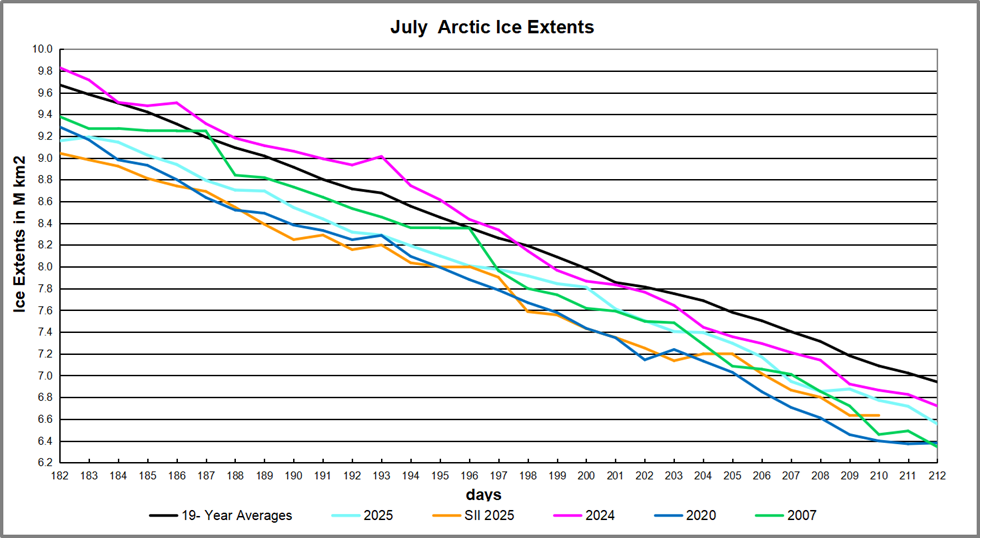
After a sub-par March maximum, by end of May 2025 Arctic ice closed the gap with the 19-year average. Then in June the gap reopened and in July the melting pace matched the average, abeit four days in advance of average. The chart shows the July Arctic ice extents on average decline from 9.7M to 6.9M km2. MASIE started July ~5M km2 in deficit to average and ended the month ~4M km2 down, continuing to melt about four days in advance of the average decline. SII matched MASIE the first half of July, then tracked slightly lower the second half.

The regional distribution of ice extents is shown in the table below. (Bering and Okhotsk seas are excluded since both are now virtually open water.)

Region 2025212 Day 212 2025-Ave. 2020212 2025-2020
 (0) Northern_Hemisphere 6555733 6941055 -385322 5880746 674988
 (1) Beaufort_Sea 944231 793206 151025 875454 68777
 (2) Chukchi_Sea 621236 555019 66217 533748 87488
 (3) East_Siberian_Sea 683122 751512 -68390 329453 353669
 (4) Laptev_Sea 329581 370847 -41266 61979 267602
 (5) Kara_Sea 32436 166826 -134390 95539 -63103
 (6) Barents_Sea 1131 29555 -28424 23940 -22808
 (7) Greenland_Sea 228078 296681 -68603 282403 -54325
 (8) Baffin_Bay_Gulf_of_St._Lawrence 117170 150751 -33581 35368 81801
 (9) Canadian_Archipelago 460908 547942 -87034 515499 -54592
 (10) Hudson_Bay 73633 139798 -66165 92861 -19228
 (11) Central_Arctic 3062678 3137162 -74483 3033706.07 28972

The table shows  most regions in deficit with Kara the largest, and Canadian Archipelago and Central Arctic also sizable.  Hudson Bay and Greenland Sea will lose the rest of their ice in upcoming weeks. Surpluses in Beaufort and Chukchi offset about 220k km2 of losses elsewhere.

Why is this important?  All the claims of global climate emergency depend on dangerously higher  temperatures, lower sea ice, and rising sea levels.  The lack of additional warming prior to 2023 El Nino is documented in a post NH and Tropics Lead UAH Temps Lower May 2025.

The lack of acceleration in sea levels along coastlines has been discussed also.  See Observed vs. Imagined Sea Levels 2023 Update

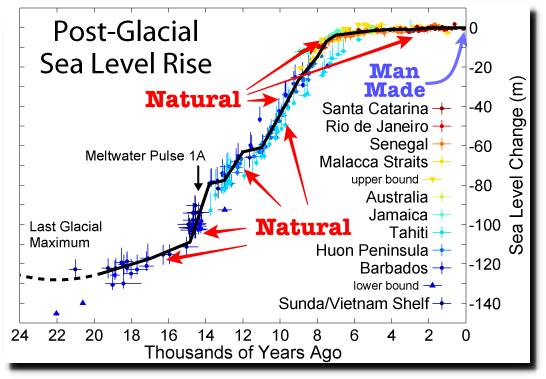
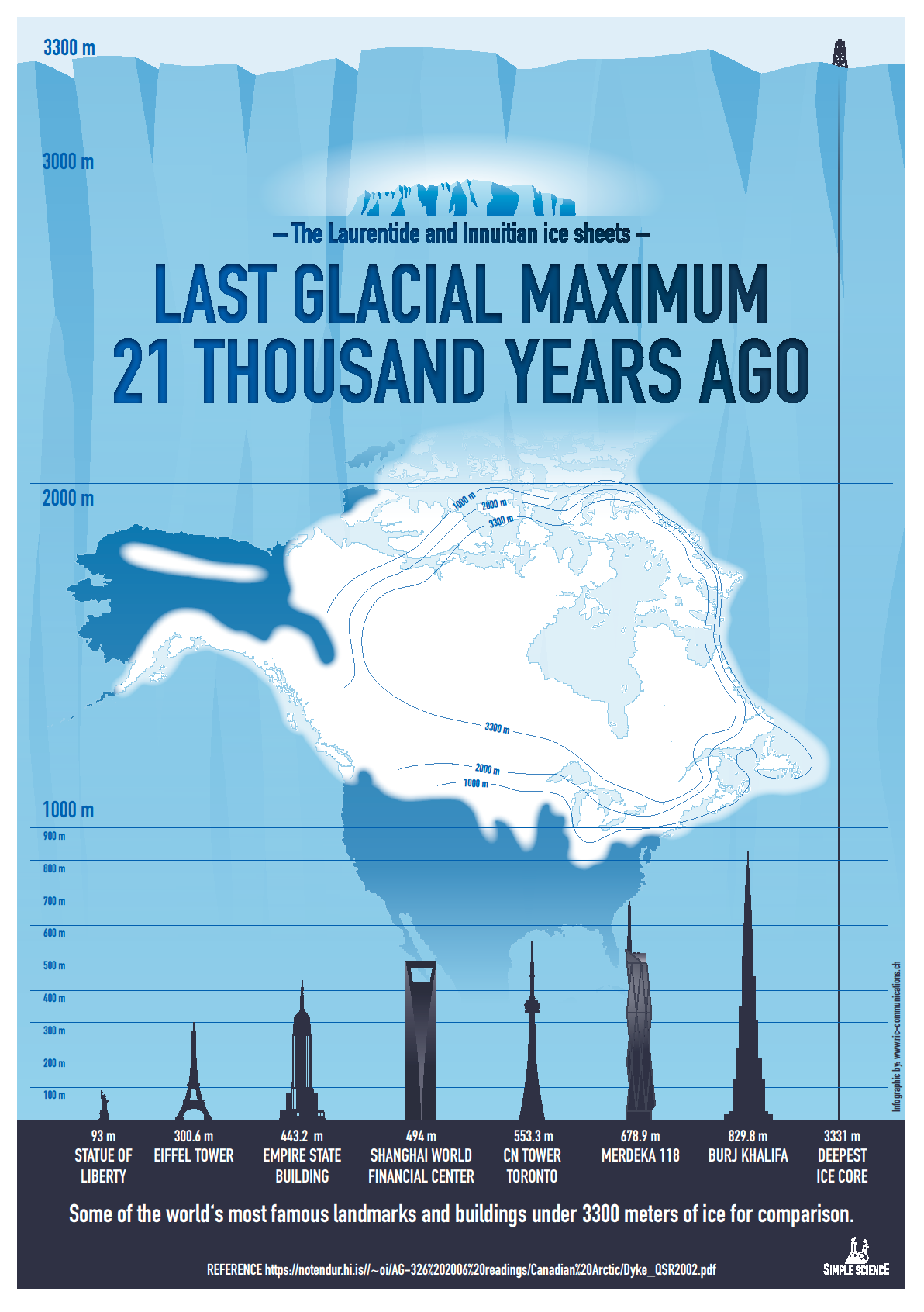
Also, a longer term perspective is informative:

post-glacial_sea_level

Illustration by Eleanor Lutz shows Earth’s seasonal climate changes. If played in full screen, the four corners present views from top, bottom and sides. It is a visual representation of scientific datasets measuring Arctic ice extents and NH snow cover.

DOE Climate Team: Twelve Keys in Assessing Climate Change

Last week saw the release of  A Critical Review of Impacts of Greenhouse Gas Emissions on the U.S. Climate by the U.S. DOE Climate Working Group. This post provides the key points from the twelve chapters of the document, comprised of the chapter summaries plus some salient explanations.  This is a synopsis and readers are encouraged to access additional detailed information at the link in red above. I added some pertinent images along with some from the report.

Report to U.S. Energy Secretary Christopher Wright  July 23, 2025
Climate Working Group:
John Christy, Ph.D.
Judith Curry, Ph.D.
Steven Koonin, Ph.D.
Ross McKitrick, Ph.D.
Roy Spencer, Ph.D.

Introduction

This report reviews scientific certainties and uncertainties in how anthropogenic carbon dioxide (CO2) and other greenhouse gas emissions have affected, or will affect, the Nation’s climate, extreme weather events, and selected metrics of societal well-being. Those emissions are increasing the concentration of CO2 in the atmosphere through a complex and variable carbon cycle, where some portion of the additional CO2 persists in the atmosphere for centuries.
Chapter 1 Carbon Dioxide as a Pollutant

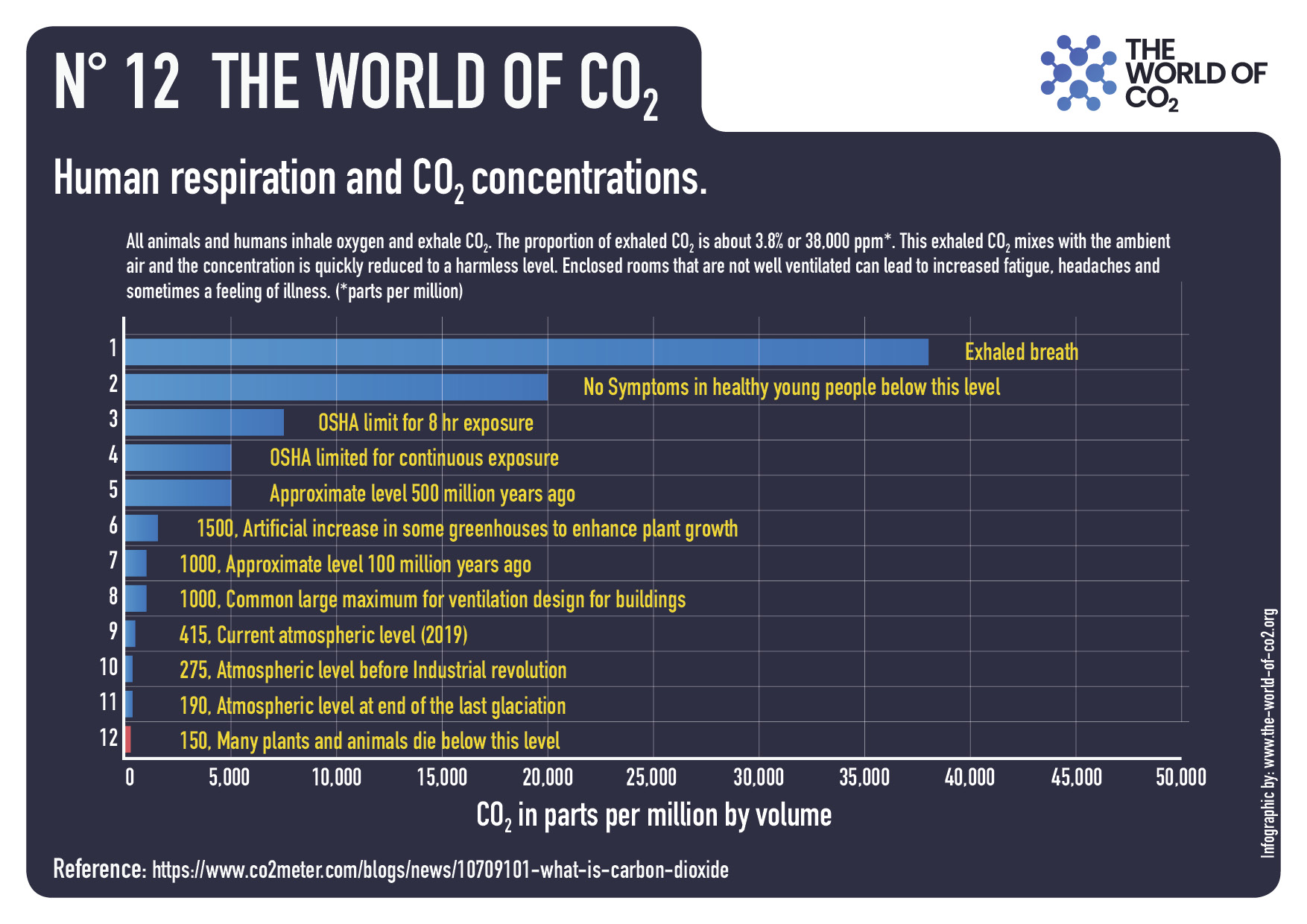
Carbon dioxide (CO2) differs in many ways from the so-called Criteria Air Pollutants. It does not affect local air quality and has no human toxicological implications at ambient levels. The growing amount of CO2 in the atmosphere directly influences the earth system by promoting plant growth (global greening), thereby enhancing agricultural yields, and by neutralizing ocean alkalinity. But the primary concern about CO2 is its role as a greenhouse gas (GHG) that alters the earth’s energy balance, warming the planet. How the climate will respond to that influence is a complex question that will occupy much of this report.

Chapter 2 Direct impact of CO2 on the Environment

CO2 enhances photosynthesis and improves plant water use efficiency, thereby promoting plant growth. Global greening due in part to increased CO2 levels in the atmosphere is well-established on all continents. The growing CO2 concentration in the atmosphere has the important positive effect of promoting plant growth by enhancing photosynthesis and improving water use efficiency. That is evident in the “global greening” phenomenon discussed below, as well as in the improving agricultural yields discussed in Chapter 10.
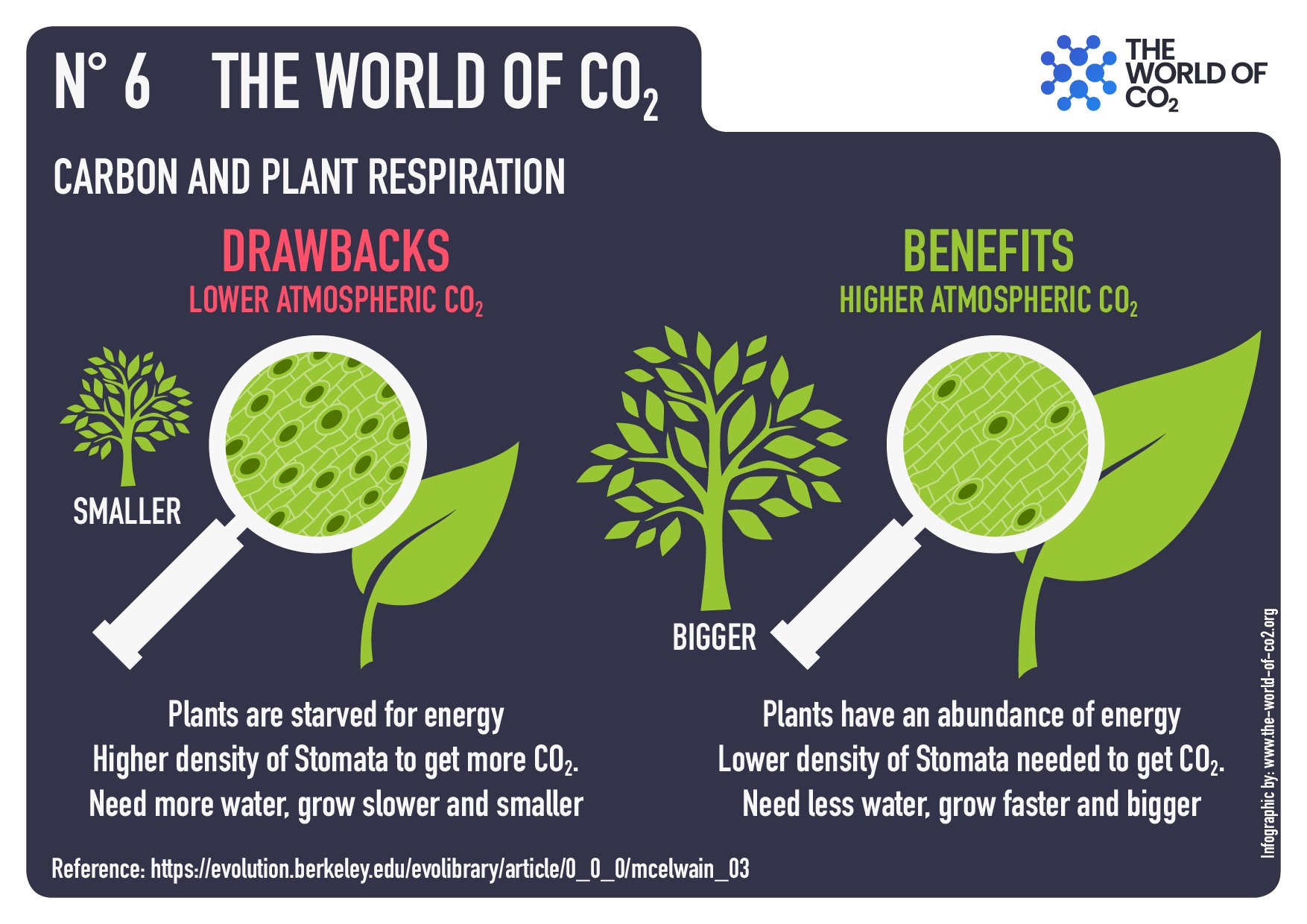
The IPCC has only minimally discussed global greening and CO2 fertilization of agricultural crops. The topic is briefly acknowledged in a few places in the body of the IPCC 6th and earlier Assessment Reports but is omitted in all Summary documents. Section 2.3.4.3.3 of the AR6 Working Group I report, entitled “global greening and browning,” points out that the IPCC Special Report on Climate Change and Land had concluded with high confidence that greening had increased globally over the past 2-3 decades.
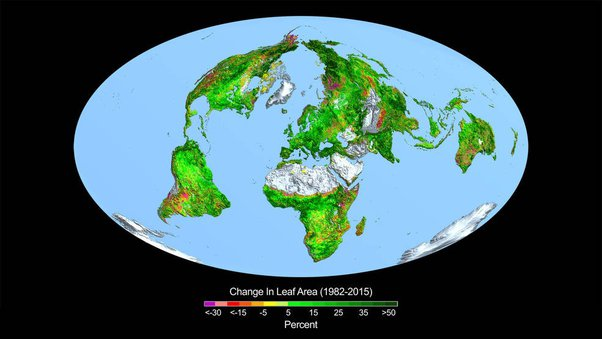
It then discusses that there are variations in the greening trend among data sets, concluding that while they have high confidence greening has occurred, they have low confidence in the magnitude of the trend. There are also brief mentions of CO2 fertilization effects and improvements in water use efficiency in a few other chapters in the AR6 Working Groups I and II Reports. Overall, however, the Policymaker Summaries, Technical Summaries, and Synthesis Reports of AR5 and AR6 do not discuss the topic.

CO2 absorption in sea water makes the oceans less alkaline. While this process is often called “ocean acidification”, that is a misnomer because the oceans are not expected to become acidic; “ocean neutralization” would be more accurate. Even if the water were to turn acidic, it is believed that life in the oceans evolved when the oceans were mildly acidic with pH 6.5 to 7.0 (Krissansen-Totton et al., 2018).
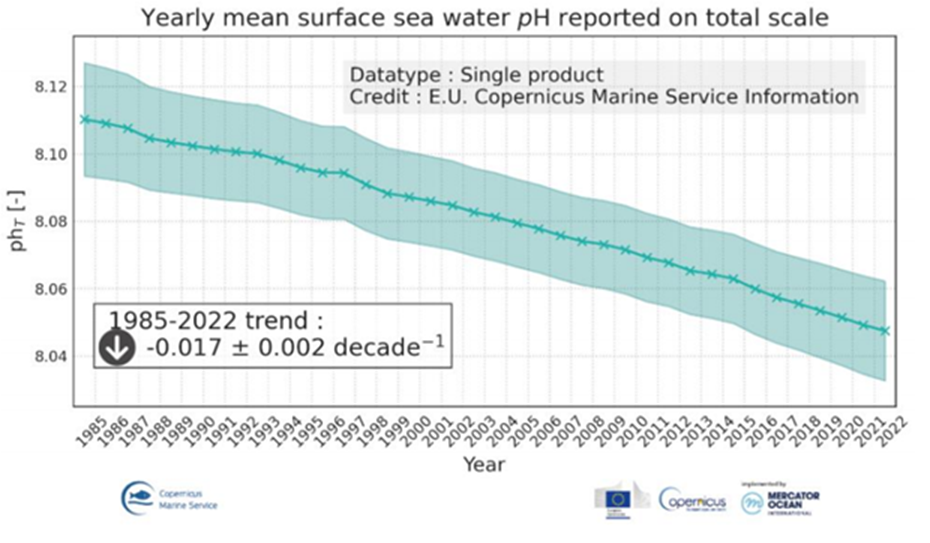
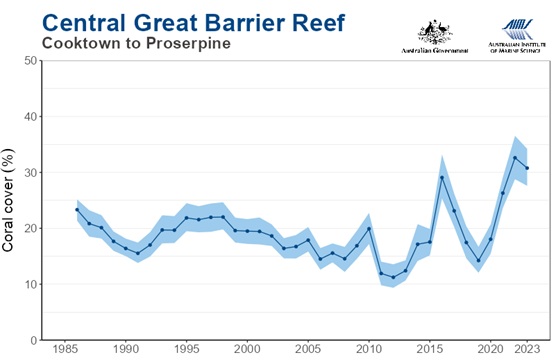
The recent decline in pH is within the range of natural variability on millennial time scales. Most ocean life evolved when the oceans were mildly acidic. Decreasing pH might adversely affect corals, although the Australian Great Barrier Reef has shown considerable growth in recent years.
It is being increasingly recognized that publication bias (alarming ocean acidification results preferred by high-impact research publications) exaggerates the reported impacts of declining ocean pH. An ICES Journal of Marine Science Special Issue addressed this problem with an article entitled, Towards a Broader Perspective on Ocean Acidification Research. In the Introduction to that Special Issue, H. I. Browman stated, “As is true across all of science, studies that report no effect of ocean acidification are typically more difficult to publish.” (Browman, 2016).

In summary, ocean life is complex and much of it evolved when the oceans were acidic relative to the present. The ancestors of modern coral first appeared about 245 million years ago. CO2 levels for more than 200 million years afterward were many times higher than they are today. Much of the public discussion of the effects of ocean “acidification” on marine biota has been one-sided and exaggerated.

Chapter 3 Human Influences on the Climate

  • The global climate is naturally variable on all time scales. Anthropogenic CO2 emissions add to that variability by changing the total radiative energy balance in the atmosphere.
  • The IPCC has downplayed the role of the sun in climate change but there are plausible solar irradiance reconstructions that imply it contributed to recent warming.
  • Climate projections are based on IPCC emission scenarios that have tended to exceed observed trends.
  • Most academic climate impact studies in recent years are based upon the extreme RCP 8.5 scenario that is now considered implausible; its use as a business-as-usual scenario has been misleading.
  • Carbon cycle models connect annual emissions to growth in the atmospheric CO2 stock. While models disagree over the rate of land and ocean CO2 uptake, all agree that it has been increasing since 1959.
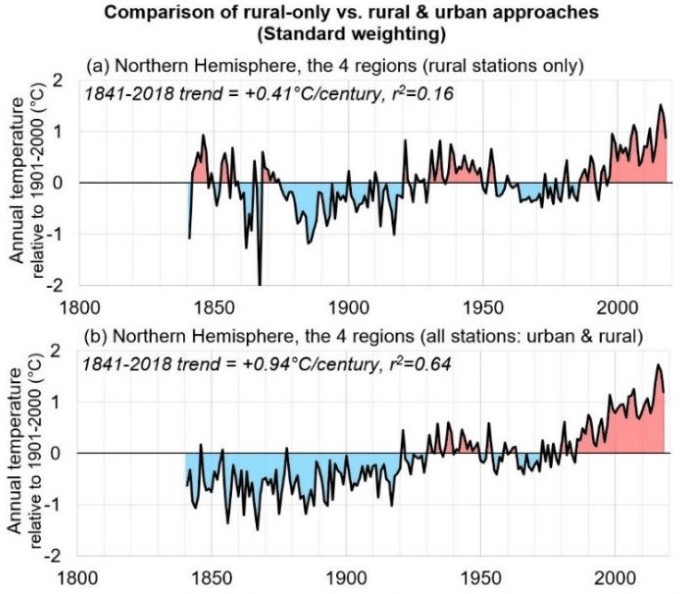
  • There is evidence that urbanization biases in the land warming record have not been completely removed from climate data sets.

There are about 850 Gt of carbon (GtC) in the Earth’s atmosphere, almost all of it in the form of CO2. Each year, biological processes (plant growth and decay) and physical processes (ocean absorption and outgassing) exchange about 200 GtC of that carbon with the Earth’s surface (roughly 80 GtC with the land and 120 GtC with the oceans). Before human activities became significant, removals from the atmosphere were roughly in balance with additions. But burning fossil fuels (coal, oil, and gas) removes carbon from the ground and adds it to the annual exchange with the atmosphere. That addition (together with a much smaller contribution from cement manufacturing) amounted to 10.3 GtC in 2023, or only about 5 percent of the annual exchange with the atmosphere.

The carbon cycle accommodates about 50 percent of humanity’s small annual injection of carbon into the air by naturally sequestering it through plant growth and oceanic uptake, while the remainder accumulates in the atmosphere (Ciais et al., 2013). For that reason, the annual increase in atmospheric CO2 concentration averages only about half of that naively expected from human emissions. The historical near constancy of that 50 percent fraction means that the more CO2 humanity has produced, the faster nature removed it from the atmosphere.

While land vegetation has been responding positively to more atmospheric CO2, uptake of extra CO2 by ocean biological processes remains too uncertain to be measured reliably.

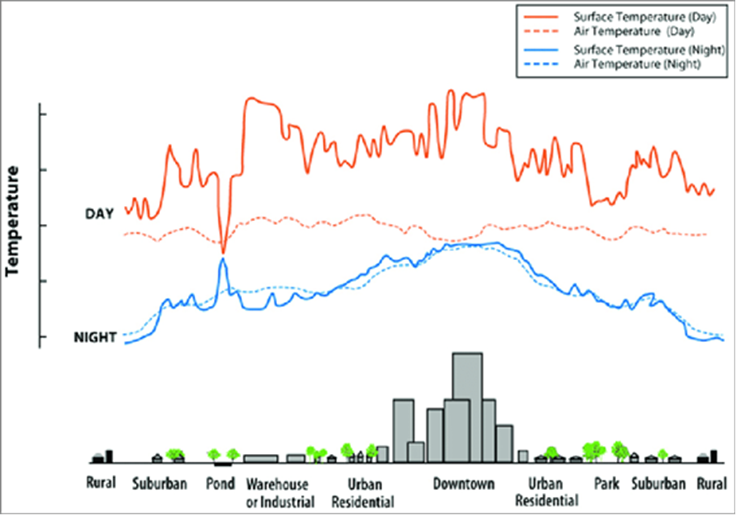
Historical temperature data over land has been collected mainly where people live. This raises the problem of how to filter out non-climatic warming signals due to Urban Heat Islands (UHI) and other changes to the land surface. If these are not removed the data might over- attribute observed warming to greenhouse gases. The IPCC acknowledges that raw temperature data are contaminated with UHI effects but claims to have data cleaning procedures that remove them. It is an open question whether those procedures are sufficient.

The challenge in measuring UHI bias is relating local temperature change to a corresponding change in population or urbanization, rather than to a static classification variable such as rural or urban. Spencer et al. (2025) used newly available historical population archives to undertake such an analysis and found evidence of significant UHI bias in U.S. summertime temperature data.

In summary, while there is clearly warming in the land record, there is also evidence that it is biased upward by patterns of urbanization and that these biases have not been completely removed by the data processing algorithms used to produce climate data sets.
Chapter 4 Climate Sensitivity to CO2 Forcing

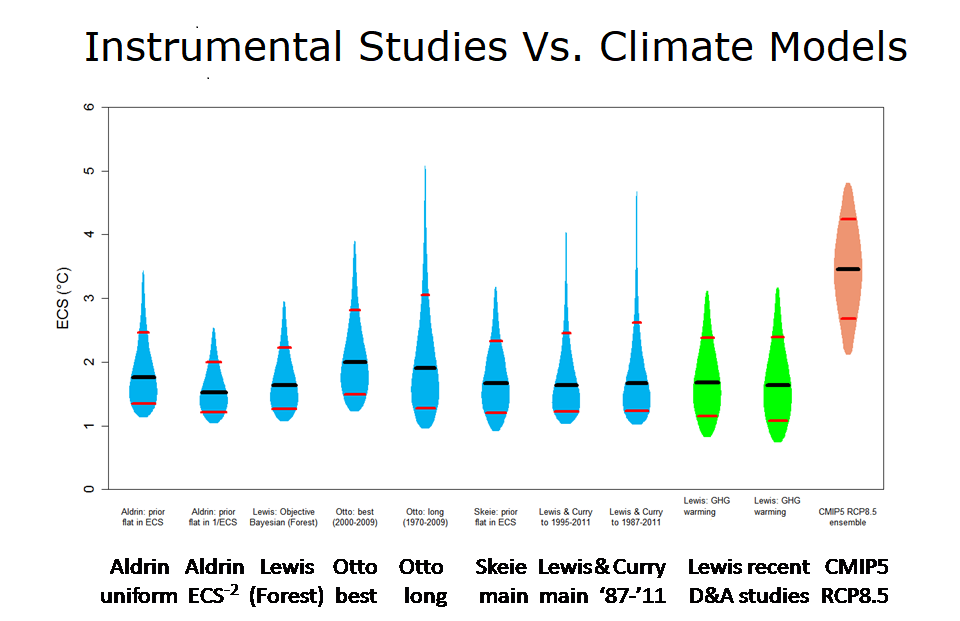
There is growing recognition that climate models are not fit for the purpose of determining the Equilibrium Climate Sensitivity (ECS) of the climate to increasing CO2. The IPCC has turned to data driven approaches including historical data and paleoclimate reconstructions, but their reliability is diminished by data inadequacies.

Data-driven ECS estimates tend to be lower than climate model-generated values. The IPCC AR6 upper bound for the likely range of ECS is 4.0°C, lower than the AR5 value of 4.5°C. This lowering of the upper bound seems well justified by paleoclimatic data. The AR6 lower bound for the likely range of ECS is 2.5°C, substantially higher than the AR5 value of 1.5°C. This raising of the lower bound is less justified; evidence since AR6 finds the lower bound of the likely range to be around 1.8°C.

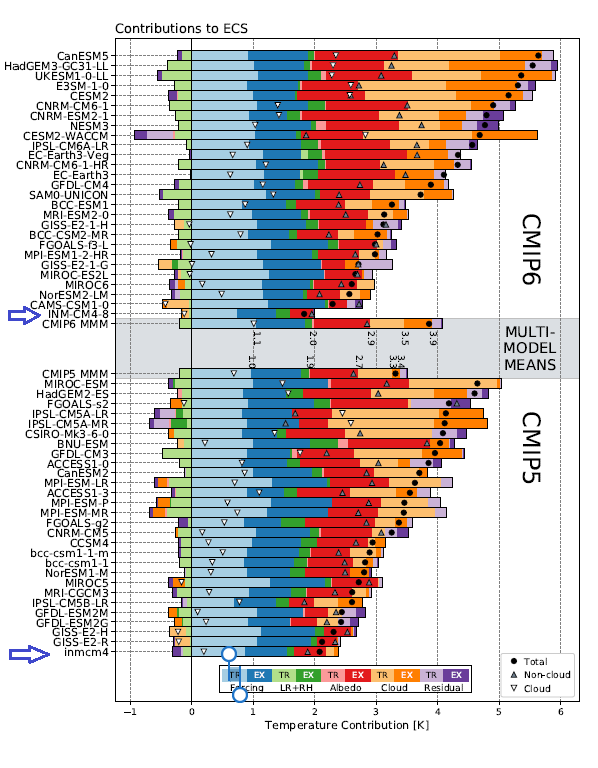
In principle, ECS is an emergent property of GCMs—that is, it is not directly parameterized or tuned but rather emerges in the results of the simulation. Otherwise plausible GCMs and parameter selections have been discarded because of perceived conflict with an expected warming rate, or aversion to a model’s climate sensitivity being outside an accepted range (Mauritsen et al. 2012). This practice was commonplace for the models used in AR4; modelers have moved away from this practice with time. However, even in a CMIP6 model, the MPI (Max Planck Institute) modelers chose an ECS value of 3°C and then tuned the cloud parameterizations to match their intended result.
The Transient Climate Reponse (TCR) provides a more useful observational constraint on climate sensitivity. TCR is the global temperature increase that results when CO2 is increased at an annual rate of 1 percent over a period of 70 years (i.e., doubled gradually). Relative to the ECS, observationally determined values of TCR avoid the problems of uncertainties in ocean heat uptake and the fuzzy boundary in defining equilibrium arising from a range of timescales for the longer-term feedback processes (e.g., ice sheets). TCR is better constrained by historical warming, than ECS. AR6 judged the very likely range of TCR to be 1.2–2.4°C. In contrast to ECS, the upper bound of TCR is more tightly constrained. For comparison, the TCR values determined by Lewis (2023) are 1.25 to 2.0°C, showing much better agreement with AR6 values than was seen in a comparison of the ECS values.
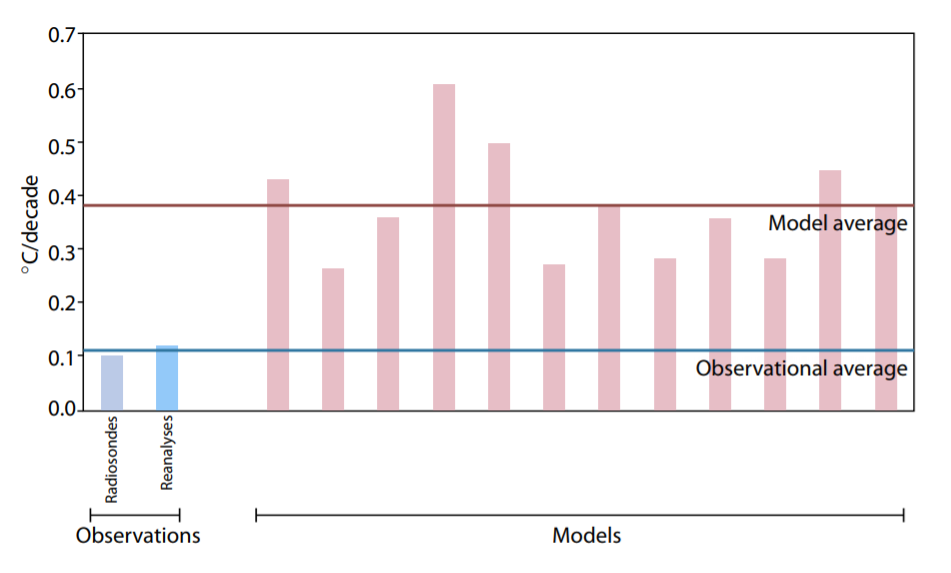
Figure 8: Warming in the tropical troposphere according to the CMIP6 models.
Trends 1979–2014 (except the rightmost model, which is to 2007), for 20°N–20°S, 300–200 hPa.

Chapter 5 Discrepancies Between Models and Instrumental Observations

Climate models show warming biases in many aspects of their reproduction of the past several decades. In response to estimated changes in forcing they produce too much warming at the surface (except in the models with lowest ECS), too much warming in the lower-and mid-troposphere and too much amplification of warming aloft.

Climate models also produce too much recent stratospheric cooling, invalid hemispheric albedos, too much snow loss, and too much warming in the Corn Belt. The IPCC has acknowledged some of these issues but not all.

The wide range of choices made by modelers to characterize the physical processes in the models (see Box: Climate Modeling in Section 5.1 above) is seen by the large spread of trends in the middle troposphere, ±40 percent about the median (Figure 5.6). This vividly illustrates the uncertainties in attempts to model (parameterize) a complex system involving turbulence, moist thermodynamics, and energy fluxes over the full range of the tropical atmosphere’s time and space scales. The atmosphere’s temperature profile is a case where models are not merely uncertain but also show a common warming bias relative to observations. This suggests that they misrepresent certain fundamental feedback processes.
The IPCC AR6 did not assess this issue.

An important element of the expected general “fingerprint” of anthropogenic climate change is simultaneous warming of the troposphere and cooling of the stratosphere. The latter feature is also influenced by ozone depletion and recovery. AR6 acknowledged that cooling had been observed but only until the year 2000. The stratosphere has shown some warming since, contrary to model projections.

The climate models were found to poorly explain the observed trends [in Northern Hemisphere snow cover]. While the models suggest snow cover should have steadily decreased for all four seasons, only spring and summer exhibited a long-term decrease, and the pattern of the observed decreases for these seasons was quite different from the modelled predictions. Moreover, the observed trends for autumn and winter suggest a long-term increase, although these trends were not statistically significant.

Beyond the models’ ability to reproduce features of today’s climate, the critical issue for society is how well they predict responses to subtle human influences, such as greenhouse gas emissions, aerosol cooling, and landuse changes. The most crucial aspect that models must capture correctly is “feedbacks.” These occur when climate changes either amplify or suppress further warming. In general, the modeled net effect of all feedbacks doubles or triples the direct warming impact of CO₂.
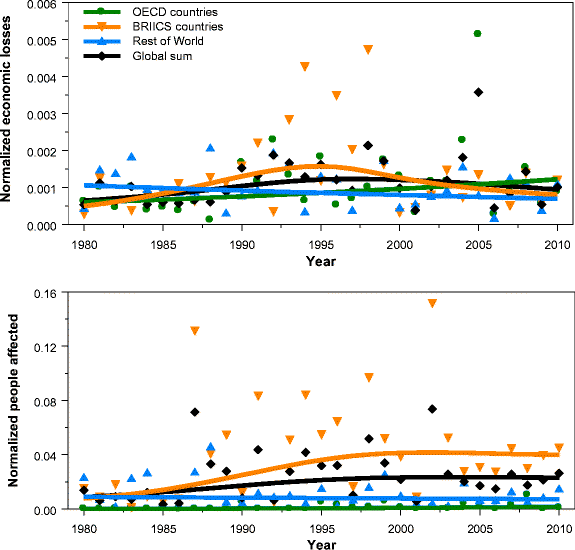
Economic losses normalized for wealth (upper panel) and the number of people affected normalized for population size (lower panel). Sample period is 1980–2010. Solid lines are IRW trends for the corresponding data. EM-DAT database.

Chapter Six Extreme Weather

This chapter is concerned with detection of trends in extreme weather, while Chapter 8 considers causal attribution, with Section 8.4 specifically addressing extreme weather. If no trend is detected, then clearly there is no basis for attribution. But even where a trend is observed, attribution to human-caused warming does not necessarily follow.

With these caveats in mind, we examine the evidence for changes in selected weather and climate extremes. A recurring theme is the wide gap between public perceptions and scientific evidence. It has become routine in media coverage, government and private sector discussions, and even in some academic literature to make generalized assertions that extreme weather of all types is getting worse due to GHGs and “climate change.” Yet expert assessments typically have not drawn such sweeping conclusions and instead have emphasized the difficulty both of identifying specific trends and establishing a causal connection with anthropogenic forcing.

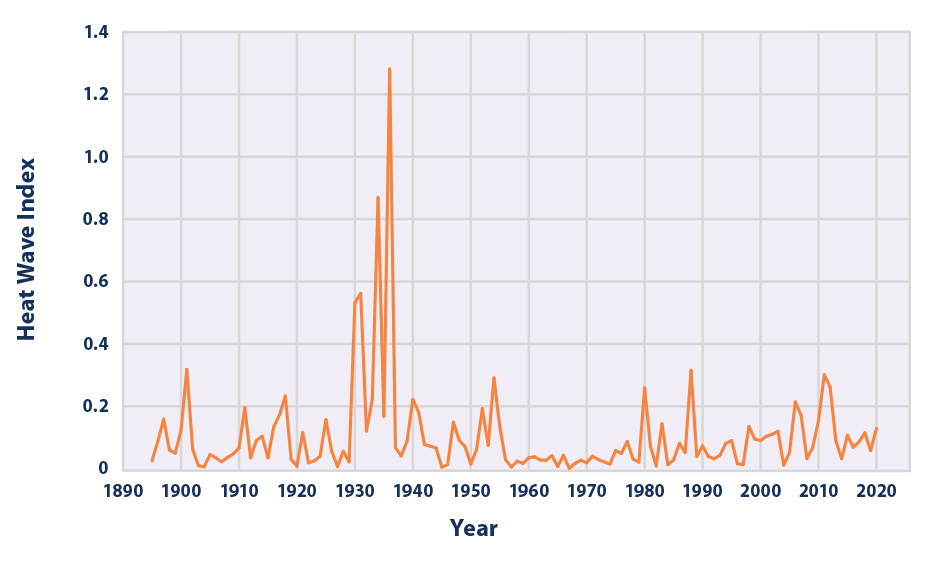
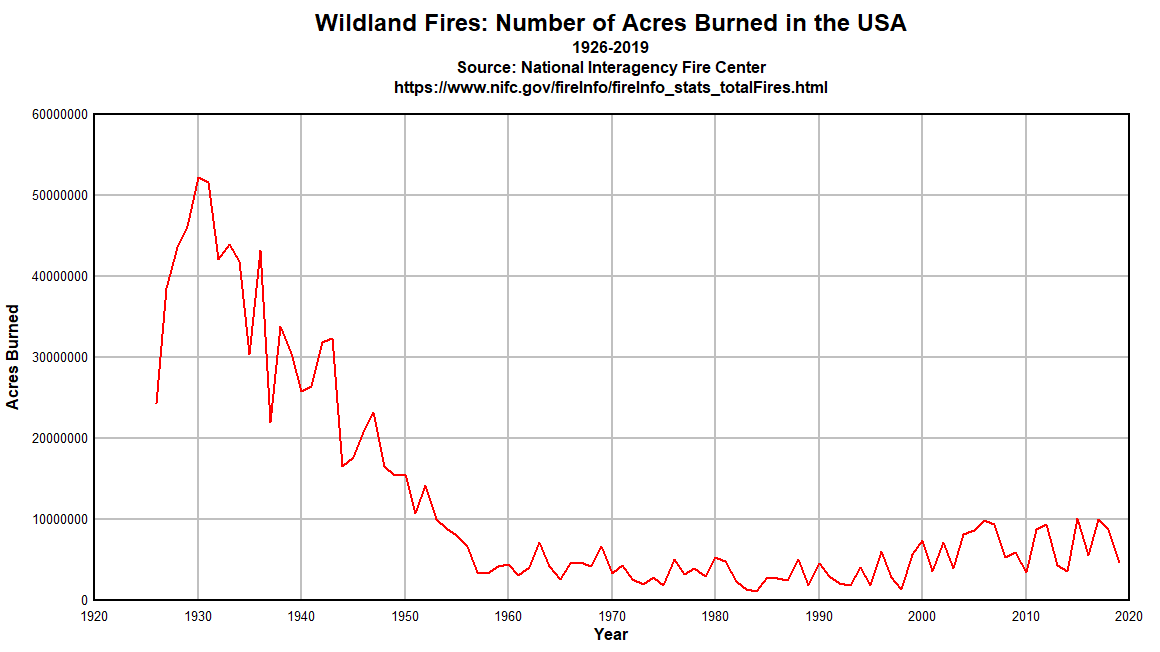
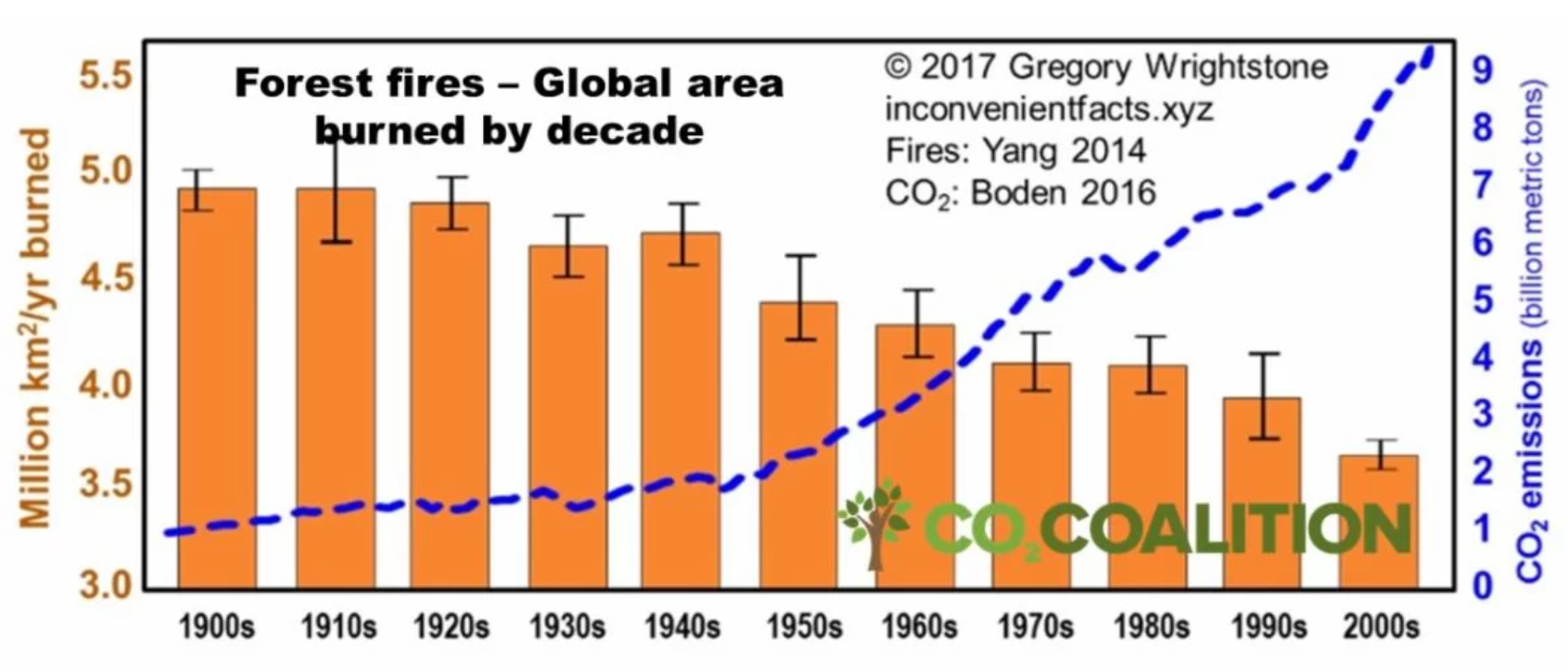
Most types of extreme weather exhibit no statistically significant long-term trends over the available historical record. While there has been an increase in hot days in the U.S. since the 1950s, a point emphasized by AR6, numbers are still low relative to the 1920s and 1930s. Extreme convective storms, hurricanes, tornadoes, floods and droughts exhibit considerable natural variability, but long-term increases are not detected. Some increases in extreme precipitation events can be detected in some regions over short intervals, but the trends do not persist over long periods and at the regional scale. Wildfires are not more common in the U.S. than they were in the 1980s. Burned area increased from the 1960s to the early 2000’s, however it is low compared to the estimated natural baseline level. U.S. wildfire activity is strongly affected by forest management practices.

Chapter 7 Changes in Sea Level

Since 1900, global average sea level has risen by about 8 inches. Sea level change along U.S. coasts is highly variable, associated with local variations in processes that contribute to sinking and also with ocean circulation patterns. The largest sea level increases along U.S. coasts are Galveston, New Orleans, and the Chesapeake Bay regions – each of these locations are associated with substantial local land sinking (subsidence) unrelated to climate change.

Extreme projections of global sea level rise are associated with an implausible extreme emissions scenario and inclusion of poorly understood processes associated with hypothetical ice sheet instabilities. In evaluating AR6 projections to 2050 (with reference to the baseline period 1995-2014), almost half of the interval has elapsed by 2025, with sea level rising at a lower rate than predicted. U.S.tide gauge measurements reveal no obvious acceleration beyond the historical average rate of sea level rise.

The concern over sea level rise is not about the roughly eight inches of global rise since 1900. Rather,it is about projections of accelerated rise based upon simulations of a warming climate through the 21st century. . .There is deep uncertainty surrounding projections of sea level rise to 2100 owing to uncertainties in ice sheet instabilities, particularly for the higher emissions scenarios.
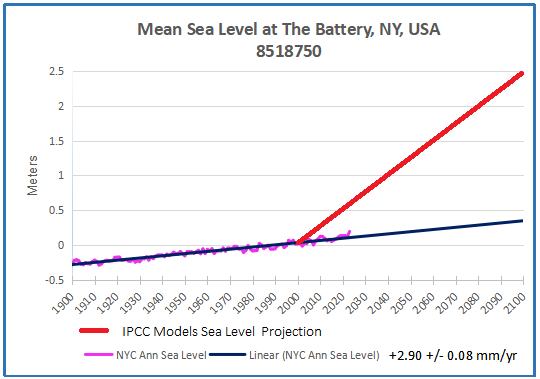
In February 2022, NOAA issued its projections of sea level rise for various sites along the U.S. coast (Sweet et al., 2022). They claim that by 2050, the sea will have risen one foot at The Battery in Manhattan (relative to 2020). A one-foot rise in thirty years would be more than twice the current rate and about three times the average rate over the past century. In that historical context, NOAA’s projection is remarkable—as shown in Figure 7.6, it would require a dramatic acceleration beyond anything observed since the early 20th century. But even more noteworthy is that Sweet et al. (2022) say this rise is “locked in”—it will happen no matter what future emissions are. We should know in a decade or so whether that prediction has legs.
Chapter 8 Uncertainties in Climate Change Attribution

“Attribution” refers to identifying the cause of some aspect of climate change, specifically with reference to anthropogenic activity. There is an ongoing scientific debate around attribution methods, particularly regarding extreme weather events. Attribution is made difficult by high natural variability, the relatively small expected anthropogenic signal, lack of high-quality data, and reliance on deficient climate models. The IPCC has long cautioned that methods to establish causality in climate science are inherently uncertain and ultimately depend on expert judgement.

Substantive criticism of the main IPCC assessments of the role of CO2 in recent warming focus on inadequate assessment of natural climate variability, uncertainties in measurement of solar variability and in aerosol forcing, and problems in the statistical methods used for attribution.

As discussed in Chapter 6 natural variability dominates patterns of extreme weather systems and simplistic assertions of trend detection are frequently undermined by regional heterogeneity and trend reversals over time. Table 8.1 makes the related point that it is not currently possible to attribute changes in most extreme weather types to human influences. Taking wind as an example, the IPCC claims that an anthropogenic signal has not emerged in average wind speeds, severe windstorms, tropical cyclones or sand and dust storms, nor is one expected to emerge this century even under an extreme emissions scenario. The same applies to drought and fire weather.

The IPCC does not make attribution claims for most climate impact drivers related to extreme events. Statements related to statistics of global extremes (e.g. event probability or return times, magnitude and frequency) are not generally considered accurate owing to data limitations and are made with low confidence. Attribution of individual extreme weather events is challenging due to their rarity. Conflicting claims about the causes of the 2021 Western North America Heatwave illustrate the perils of hasty attribution claims about individual extreme events.

There are three areas of substantive criticism of the IPCC’s assessment of the causes of the recent warming: inadequate assessment of natural climate variability, inappropriate statistical methods, and substantial discrepancies between models and observations. The last is discussed in Chapter 5, while this chapter discusses the first two factors. All of these criticisms are relevant to the IPCC’s attribution of the recent warming, which also underpins extreme event attribution.

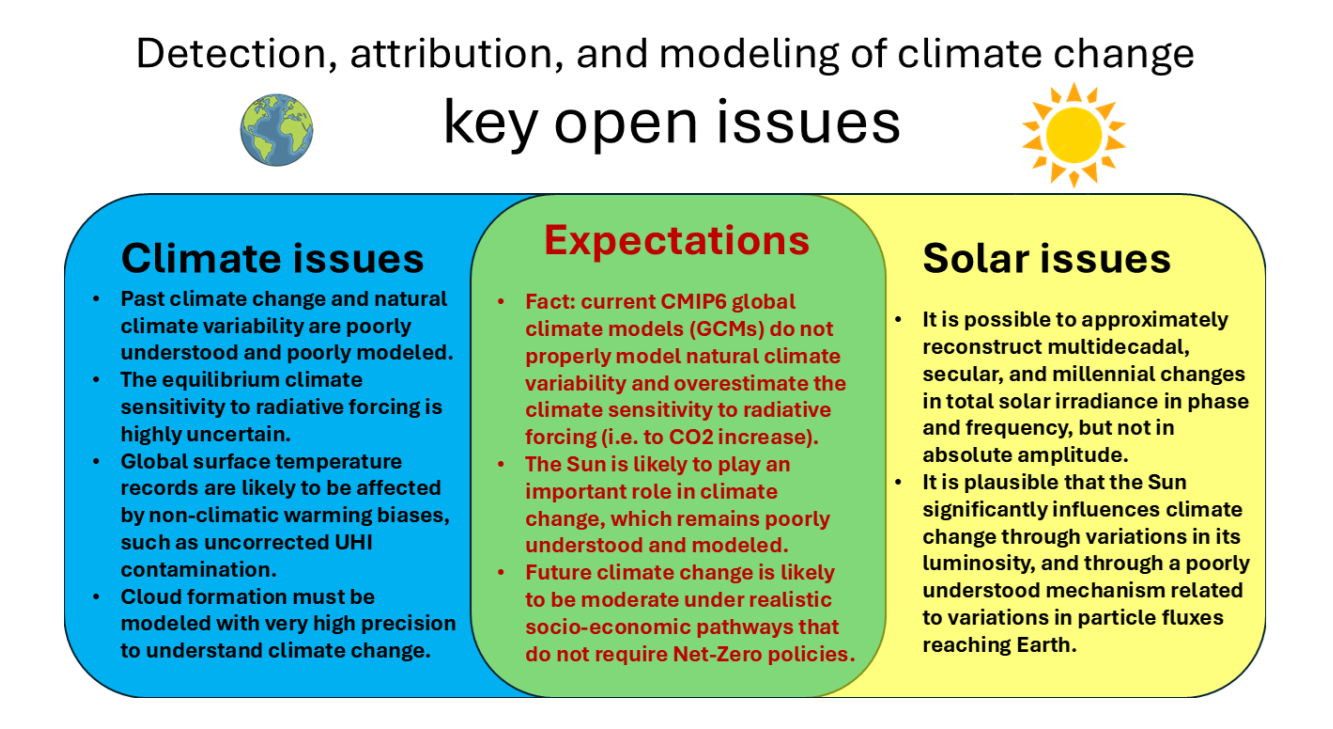
A sharp recent increase in global average temperatures has raised the question of short-term drivers of climate. One such candidate is the fraction of absorbed solar radiation which has also increased abruptly in recent years. The question is whether the change is an internal feedback to warming caused by greenhouse gases, or whether something else increased the fraction of absorbed radiation which then caused the recent warming.
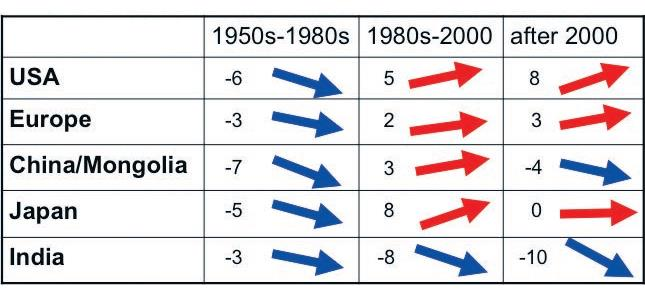
Fig. 1. Qualitative tendencies in decadal SSR (Surface Solar Radiation) changes over the periods 1950s to 1980s, 1980s to 2000, and post-2000 in different world regions that are well covered by historic SSR records.

Arguably the most striking change in the Earth’s climate system during the 21st century is a significant reduction in planetary albedo since 2015, which has coincided with at least two years of record global warmth. Figure 8.2 shows the planetary albedo variations since 2000, when there are good satellite observations. The 0.5 percent reduction in planetary albedo since 2015 corresponds to an increase of 1.7 W/m2 in absorbed solar radiation averaged over the planet (Hansen and Karecha, 2025). For comparison, Forster et al. (2024) estimate the current forcing from the increase in atmospheric CO2 compared to preindustrial times to be 2.33 W/m2.

Changes in surface characteristics cannot explain this decrease in planetary albedo since 2015:

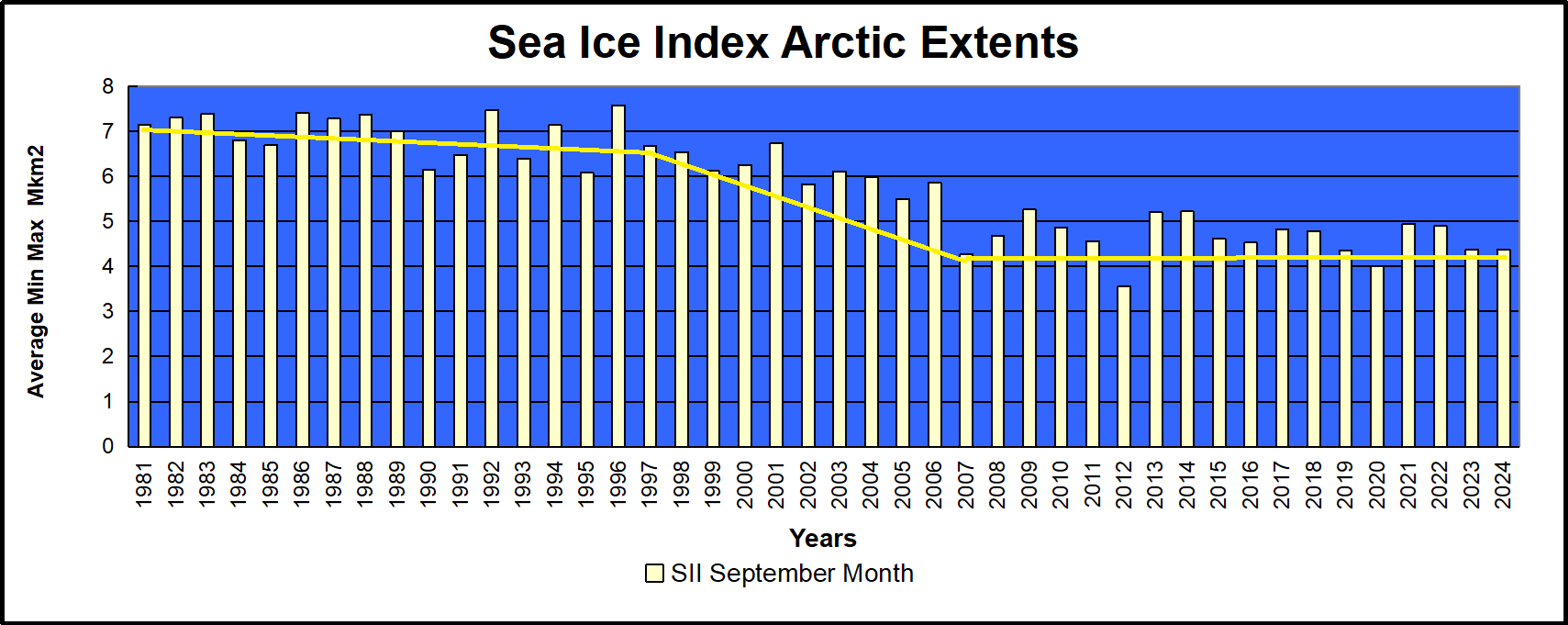
• Arctic sea ice extent has declined by about 5 percent since 1980, although following 2007 there has been a pause in the Arctic sea ice decline (England et al., 2025)

• Regarding Antarctic sea ice, the IPCC AR6 concludes that “There has been no significant trend in Antarctic sea ice area from 1979 to 2020 due to regionally opposing trends and large internal variability.” (Summary for Policymakers, A.1.5)

• Northern hemispheric annual snow cover has been slowly declining since 1967, with barely
significant trends. The data show the Northern Hemisphere has snowier winters, accompanied by more rapid melt in spring and summer.

• Global greening (Chapter 2) is contributing to the decrease in planetary albedo, as forests have a lower albedo than open lands or snow. However, there is some evidence that forests increase cloud cover (high reflectivity), which counteracts the direct albedo decrease associated with increasing forested area.
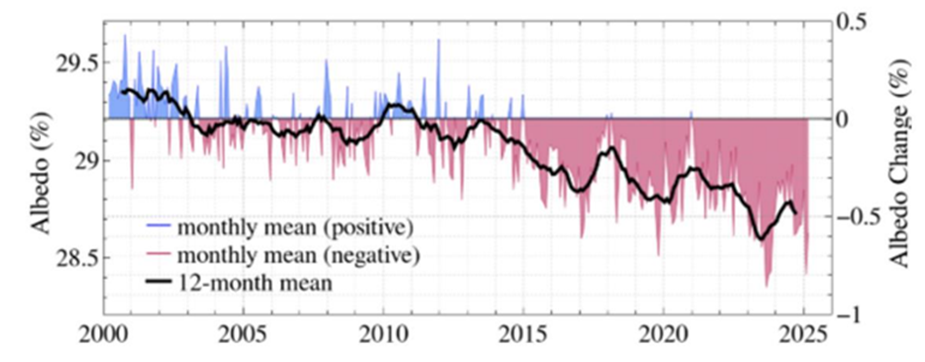
Figure 8.2. Earth’s albedo (reflectivity, in percent), with seasonality removed. From Hansen and Karecha (2025)

In summary, the decline in planetary albedo and the concurrent decline in cloudiness have emphasized the importance of clouds and their variations to global climate variability and change. A change of 1- 2 percent in global cloud cover has a greater radiative impact on the climate than the direct radiative effect of doubling CO2. While it is difficult to untangle causes of the recent trend, the competing explanations for the cause of the declining cloud cover have substantial implications for assessing the Equilibrium Climate Sensitivity and for the attribution of the recent warming. An additional 10 years of data should help clarify
whether this is a strong positive cloud feedback associated with warming or a temporary fluctuation driven by natural variability.
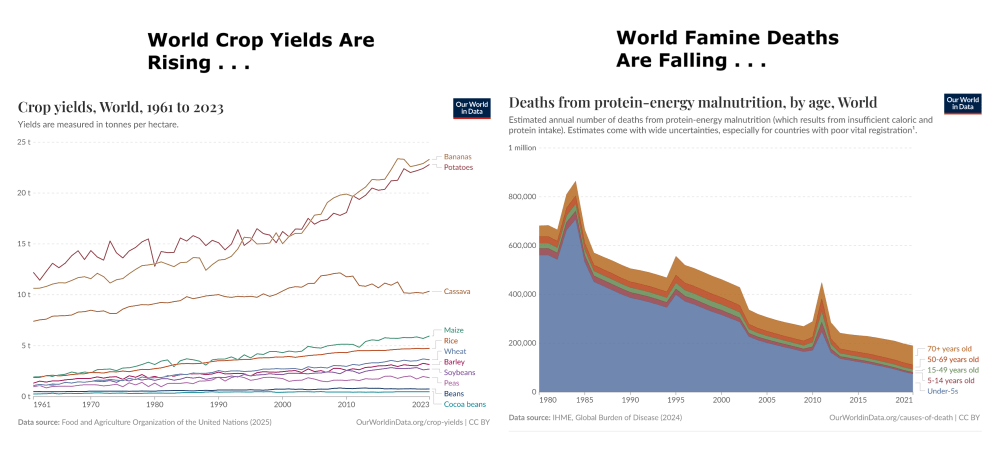
Chapter 9 Climate Change and US Agriculture

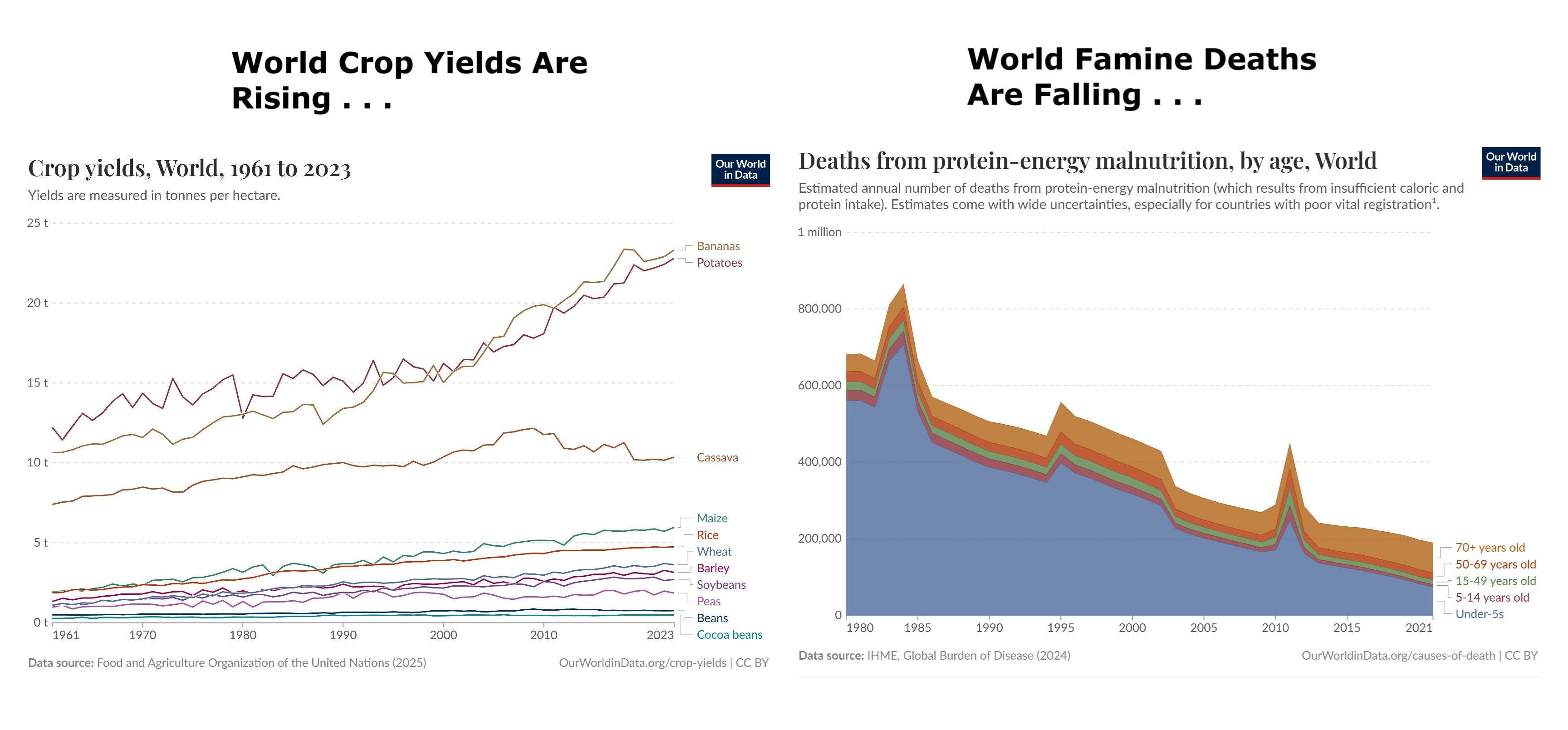
There has been abundant evidence going back decades that rising CO2 levels benefit plants, including agricultural crops, and that CO2-induced warming will be a net benefit to U.S. agriculture. The increase in ambient CO2 has also boosted productivity of all major U.S. crop types. There is reason to conclude that on balance climate change has been and will continue to be neutral or beneficial for most U.S. agriculture.
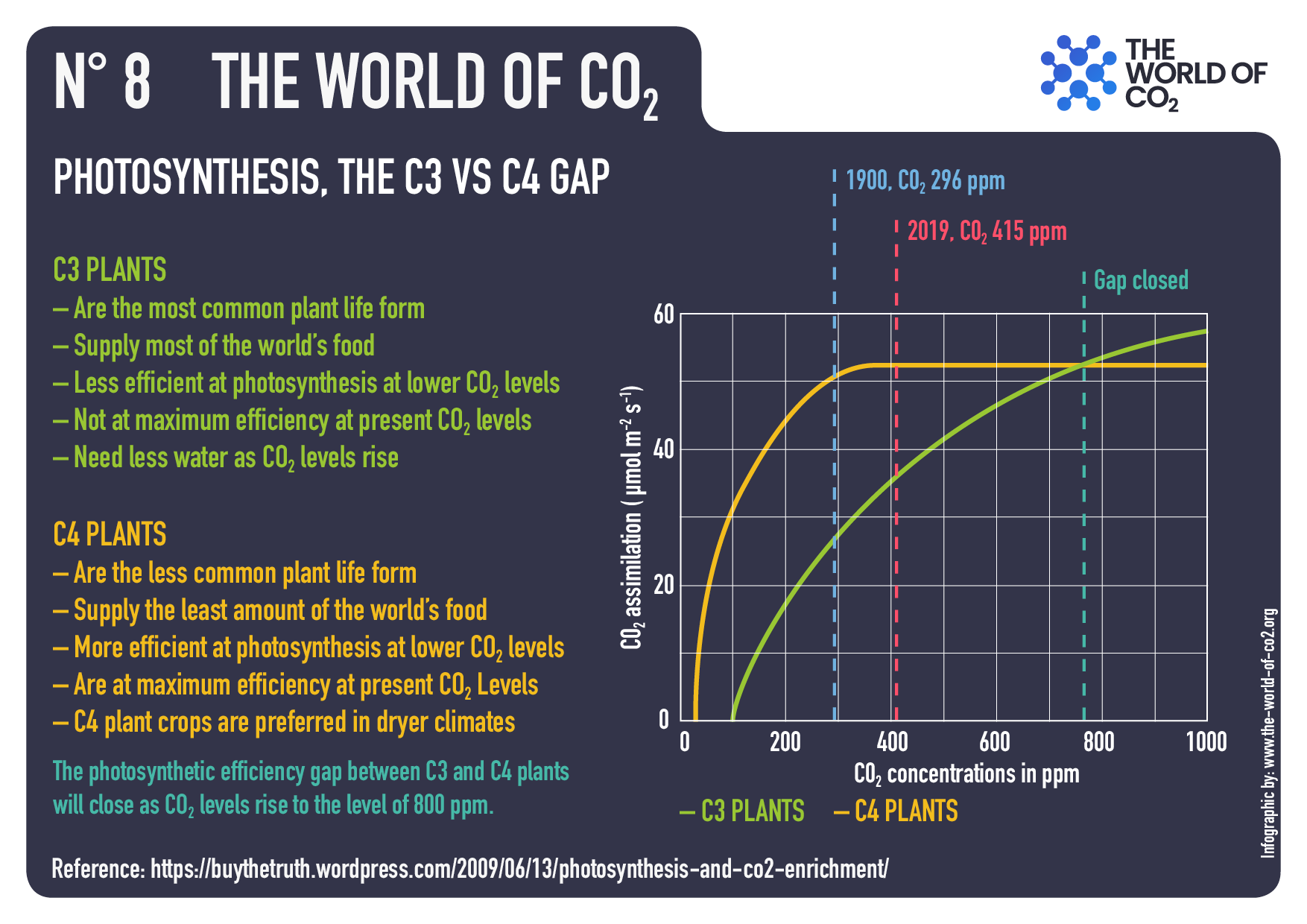
A major deficiency of all these [econometric] studies is that they omit the role of CO2 fertilization. Climate change as it relates to this report is caused by GHG emissions, chiefly CO2. The econometric analyses referenced above focus only on temperature and precipitation changes and do not take account of the beneficial growth effect of the additional CO2 that drives them. As explained in Chapter 2, CO2 is a major driver of plant growth, so this omission biases the analysis towards underestimation of the benefits of climate change to agriculture.
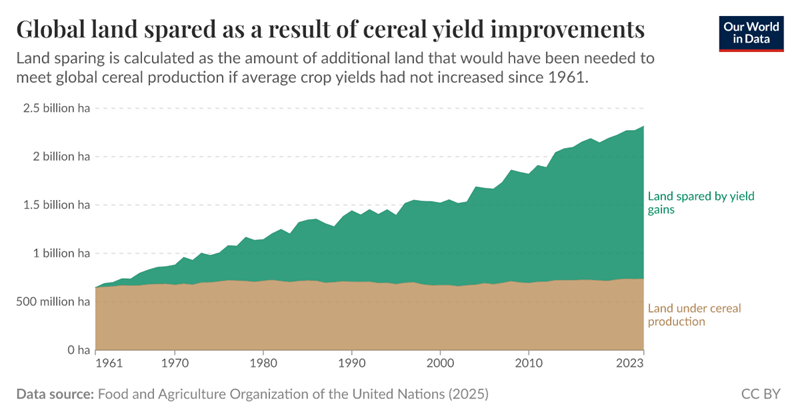
A 2021 report from the U.S. National Bureau of Economic Research (Taylor and Schlenker 2021) used satellite-measured observations of outdoor CO2 levels across the United States, matched to county-level agricultural output data and other economic variables. After controlling for the effects of weather, pollution and technology the authors concluded that CO2 emissions had boosted U.S. crop production since 1940 by 50 to 80 percent, attributing much larger gains than had previously been estimated using FACE experiments. They found that every ppm of increase in CO2 concentration boosts corn yields by 0.5 percent, soybeans by 0.6 percent, and wheat by 0.8 percent.

Notwithstanding the abundant evidence for the direct benefits of CO2 and of CO2-induced warming on crop growth, in 2023 the U.S. Environmental Protection Agency (EPA 2023) boosted its estimate of the Social Cost of Carbon (SCC) about five-fold based largely on a very pessimistic 2017 estimate of global agricultural damages from climate warming (Moore et al., 2017). One of the two damage models used by the EPA attributed nearly half of the 2030 SCC to projected global agricultural damages based on the Moore et al. (2017) analysis. This study was a meta-analysis of crop model studies simulating yield changes for agricultural crops under various climate warming scenarios. Moore et al. projected declining global crop yields for all crop types in all regions due to warming.

In summary, there is abundant evidence going back decades that rising CO2 levels benefit plants,including agricultural crops, and that CO2-induced warming will be a net benefit to U.S. agriculture. To the extent nutrient dilution occurs there are mitigating strategies available that will need to be researched and adapted to local conditions.

Chapter 10 Managing Risks of Extreme Weather

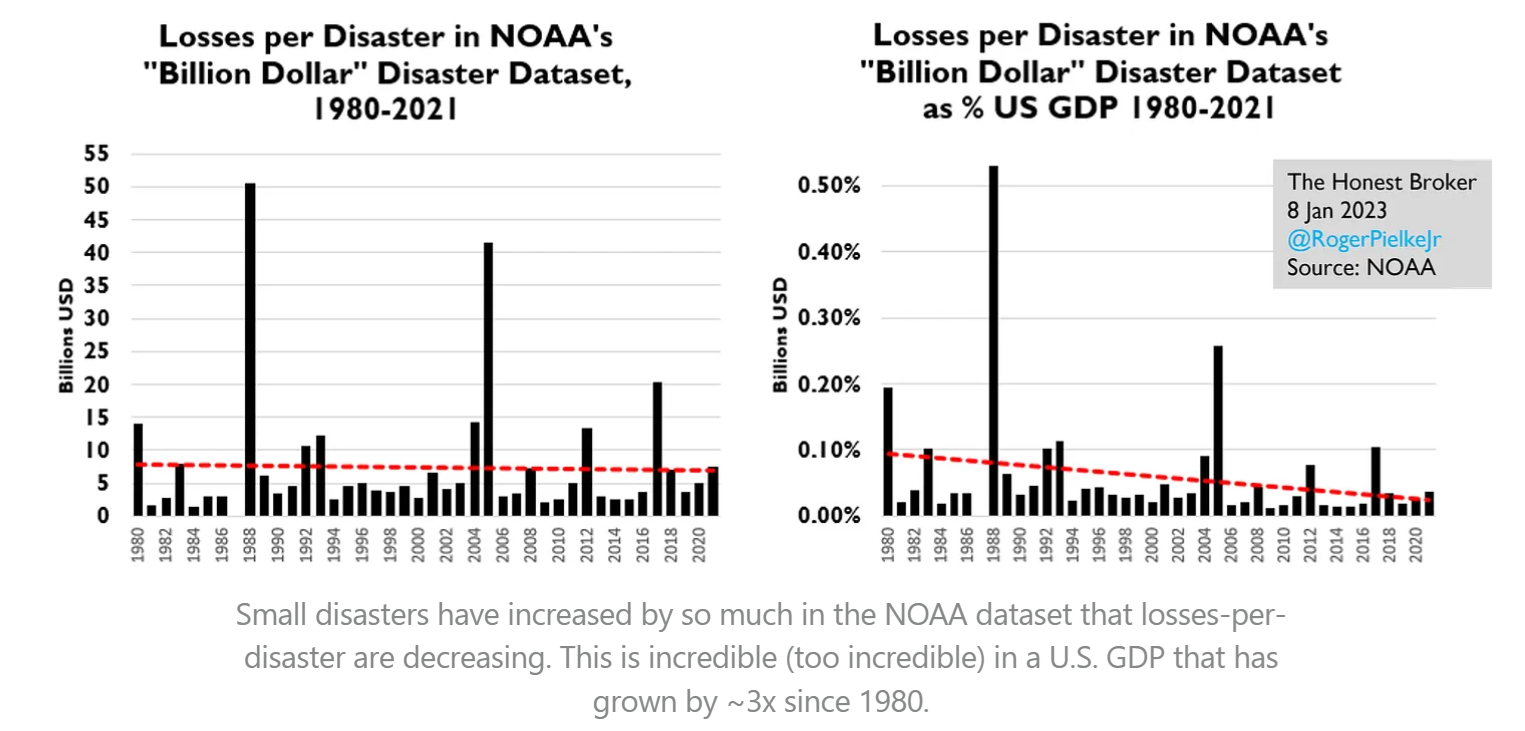
Trends in losses from extreme weather and climate events are dominated by population increases and economic growth. Technological advances such as improved weather forecasting and early warning systems have substantially reduced losses from extreme weather events. Better building codes, flood defenses, and disaster response mechanisms have lowered economic losses relative to GDP. The U.S. economy’s expansion has diluted the relative impact of disaster costs, as seen in the comparison of historical and modern GDP percentages. Heat-related mortality risk has dropped substantially due to adaptive measures including the adoption of air conditioning, which relies on the availability of affordable energy. U.S. mortality risks even under extreme warming scenarios are not projected to
increase if people are able to undertake adaptive responses.
There is strong evidence that people adapt to weather risks. Lee and Dessler (2023) reported that 86 percent of temperature-related deaths across 40 cities in the U.S. were due to cold-related mortality, and that due to adaptation the relative risk of death declined in hot and cold cities alike as seasonal temperatures increased. Allen and Sheridan (2018) found that short, early-season cold events were 2 to 5 times deadlier than hot events, but the mortality risk of both cold and hot extremes drops to nearly zero if the events occur late in the season.

In the context of large declines in heat-related mortality, rising temperatures are associated with a net saving of lives since they reduce mortality from cold events. AR6 Working Group 2 Chapter 16.2.3.5 (O’Neill et al. 2022) acknowledges that heat-related mortality risk is declining over time:

Heat-attributable mortality fractions have declined over time in most countries owing to general improvements in health care systems, increasing prevalence of residential air conditioning, and behavioral changes. These factors, which determine the susceptibility of the population to heat, have predominated over the influence of temperature change.
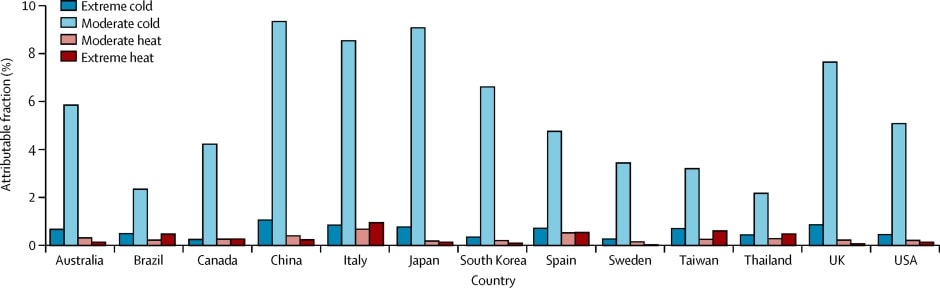
Yet the IPCC misrepresents the overall situation in its AR6 Synthesis report. Section A.2.5 of that document states: “In all regions increases in extreme heat events have resulted in human mortality and morbidity (very high confidence).” But it is silent on the larger decline of deaths during extreme cold events.

Chapter 11 Climate Change, the Economy, and Social Cost of Carbon

Economists have long considered climate a relatively unimportant factor in economic growth, a view echoed by the IPCC itself in AR5. Mainstream climate economics has recognized that CO2-induced warming might have some negative economic effects, but they are too small to justify aggressive abatement policy and that trying to “stop” or cap global warming even at levels well above the Paris target would be worse than doing nothing. An influential study in 2012 suggested that global warming would harm growth in poor countries, but the finding has subsequently been found not to be robust. Studies that take full account of modeling uncertainties either find no evidence of a negative effect on global growth from CO2 emissions or find poor countries as likely to benefit as rich countries.
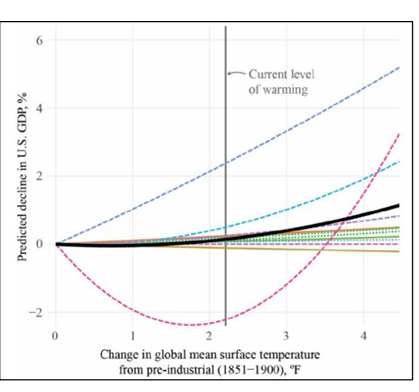
Figure 11.2: Decline in U.S. GDP per degree of warming. Source: CEA-OMB (2023)

Social Cost of Carbon (SCC) estimates are highly uncertain due to unknowns in future economic growth, socioeconomic pathways, discount rates, climate damages, and system responses. The SCC is not intrinsically informative as to the economic or societal impacts of climate change. It provides an index connecting large networks of assumptions about the climate and the economy to a dollar value. Some assumptions yield a high SCC and others yield a low or negative SCC (i.e. a social benefit of emissions). The evidence for or against the underlying assumptions needs to be established independently; the resulting SCC adds no additional information about the validity of those assumptions. Consideration of potential tipping points does not justify major revisions to SCC estimates.
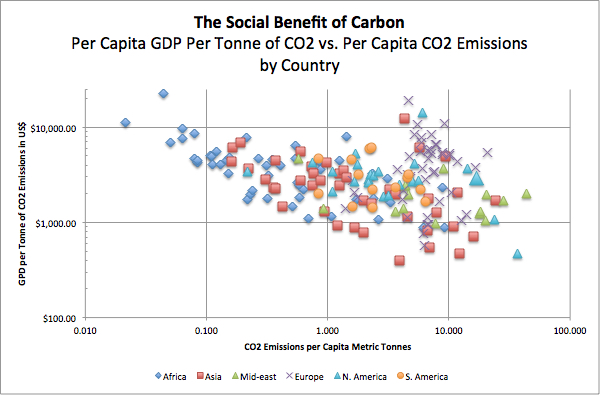
Although the literature refers to “estimates” of the SCC, it is not estimated in the way other economic statistics are estimated. For instance, data on market transactions including prices and quantities can be used to estimate the current inflation rate or the growth rate of per capita real Gross Domestic Product, and there are well-understood uncertainties associated with these quantities. But there are no market data available to measure many, if not most, of the marginal damages or benefits believed to be associated with CO2 emissions, so these need to be imputed using economic models.

For example, an influential component of some SCC calculations is the perceived social cost associated with a changed risk of future mortality due to extreme weather. There is no market in which people can directly attach a price to that risk. At best economists can try to infer such values by looking at transactions in related markets such as real estate or insurance, but isolating the component of price changes attributable to atmospheric CO2 levels is very difficult.

It is increasingly being argued that the SCC is too variable to be useful for policymakers. Cambridge Econometrics (Thoung, 2017) stated it’s “time to kill it” due to uncertainties. The UK and EU no longer use SCC for policy appraisal, opting for “target-consistent” carbon pricing (UK Department for Energy Security and Net Zero 2022, Dunne 2017). However, the uncertainty of SCC estimates doesn’t mean that other regulatory instruments are inherently better or more efficient. Many emissions regulations (such as electric vehicle mandates, renewable energy mandates, energy efficiency regulations and bans on certain types of home appliances) cost far more per tonne of abatement than any mainstream SCC estimate, which
is sufficient to establish that they fail a cost-benefit test.
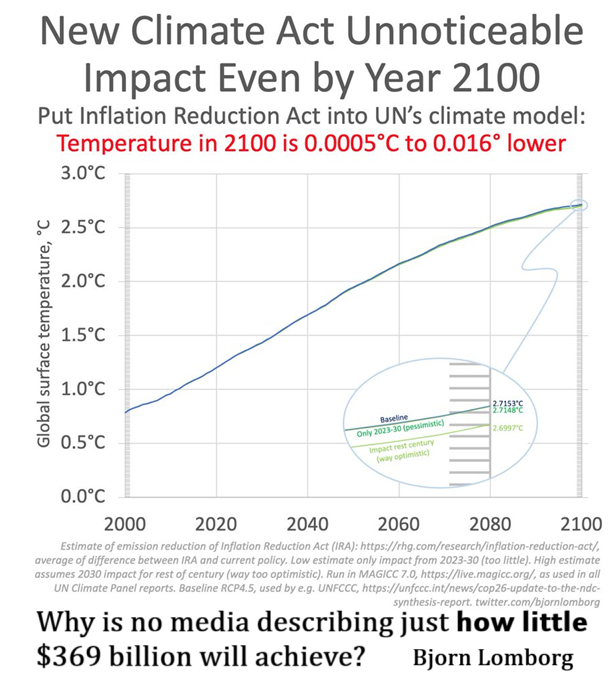
Chapter 12 Global Climate Impact of US Emissions Policies

U.S. policy actions are expected to have undetectably small direct impacts on the global climate and any effects will emerge only with long delays.

The emissions rates and atmospheric concentrations of criteria air contaminants are closely connected because their lifetimes are short and their concentrations are small; when local emissions are reduced the local pollution concentration drops rapidly, usually within a few days. But the global average CO2 concentration behaves very differently, since emissions mix globally and the global carbon cycle is vast and slow. Any change in local CO2 emissions today will have only a very small global effect, and only with a long delay.

Consequently, any reduction in U.S. emissions would only modestly slow, but not prevent, the rise of global CO2 concentration. And even if global emissions were to stop tomorrow, it would take decades or centuries to see a meaningful reduction in the global CO2concentration and hence human influences on the climate. The practice of referring to unilateral U.S. reductions as “combatting climate change” or “taking action on climate” on the assumption we can stop climate change therefore reflects a profound misunderstanding of the scale of the issue.

Concluding thoughts

This report supports a more nuanced and evidence-based approach for informing climate policy that explicitly acknowledges uncertainties. The risks and benefits of a climate changing under both natural and human influences must be weighed against the costs, efficacy, and collateral impacts of any “climate action”, considering the nation’s need for reliable and affordable energy with minimal local pollution. Beyond continuing precise, un-interrupted observations of the global climate system, it will be important to make realistic assumptions about future emissions, re-evaluate climate models to address biases and uncertainties, and clearly acknowledge the limitations of extreme event attribution studies. An approach that acknowledges both the potential risks and benefits of CO2, rather than relying on flawed models and extreme scenarios, is essential for informed and effective decision-making.
Supreme Screw-up: Climate Fallacies Embraced by Canada’s Highest Court

Canadian Supreme Court justices rendered an opionion regarding climate change that does not bear up under scrutiny.  Former government litigator Jack Wright exposes the errors in his C2C Journal article Supreme Screw-up: How Canada’s Highest Court Got Climate Change Wrong.  Excerpts in italics with my bolds and added images.

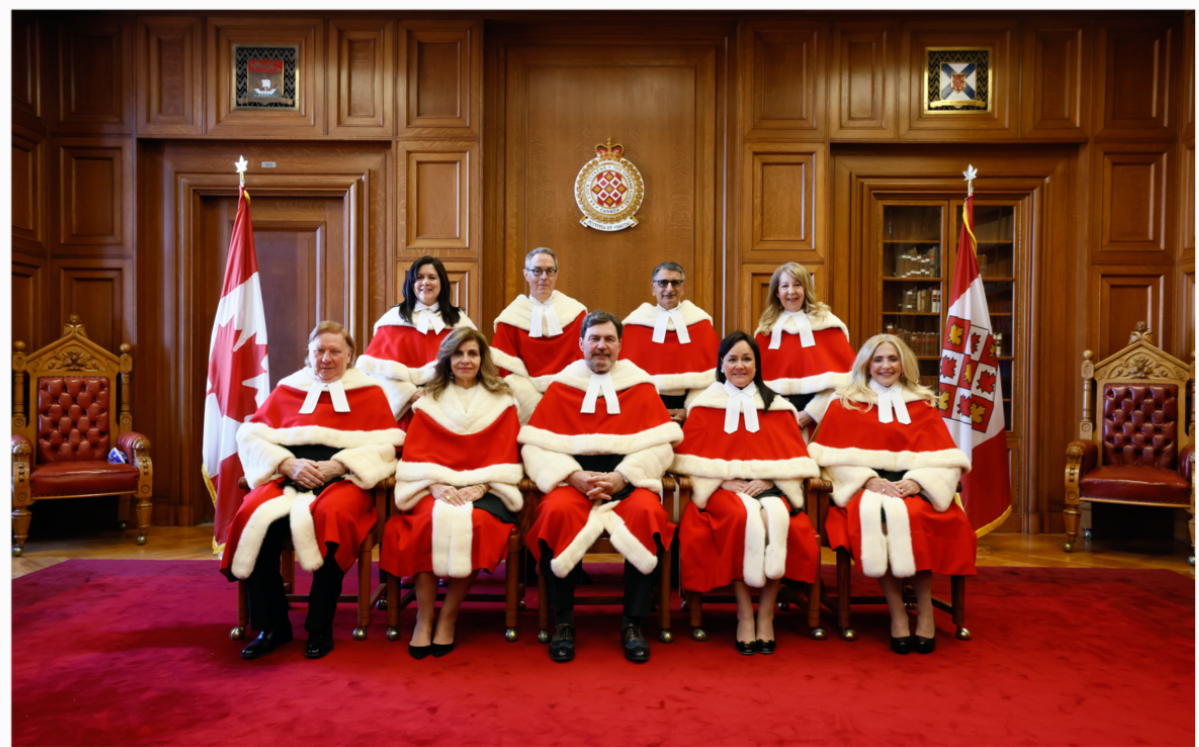
Many Canadians think of the Supreme Court as a wise and august body that can be trusted to give the final word on the country’s most important issues. But what happens when most of its justices get it wrong? Former government litigator Jack Wright delves into the court’s landmark ruling upholding the federal carbon tax and uncovers mistakes, shoddy reasoning and unfounded conclusions. In this exclusive legal analysis, Wright finds that the key climate-related contentions at the heart of the court’s decision were made with no evidence presented, no oral arguments and no cross-examination – and are flat wrong. Now being held up as binding judicial precedent by climate activists looking for ever-more restrictive regulations, the decision is proving to be not just flawed but dangerous.

The Supreme Court of Canada sits at the apex of the Canadian judicial ladder. But like any group of humans, the reasoning of its nine justices isn’t always right. What happens if the court’s reasons for decision include some mistakes and some confusing or inconsistent comments? Are all of Canada’s lower courts bound by these “precedents”? The short answer is no: a court’s decision is only precedent-setting for what it actually decided, and not concerning all of the detailed explanations for how the court got there. Still, erroneous reasoning at the top can create major problems as it often triggers unnecessary and harmful litigation that treats errors as binding precedents. That has proved to be the case with the errors in a crucial case that has profound economic, political and social implications affecting all Canadians.

Advocates for ever-increasing climate action have pounced on the decision in the case known as Reference re Greenhouse Gas Pollution Pricing Act, 2021 as precedent to justify further climate-related litigation, as if the courts or Parliament could stabilize the global climate. Such “lawfare”, as these kinds of tactics have come to be known, continues largely because of the non-binding comments in Greenhouse Gas. But the motivating claim – that these explanatory comments are binding precedents – is wrong.

They also misunderstand the special nature of a reference case.

In Canadian law a reference case is a submission by the federal or a provincial government to the courts asking for an advisory opinion on a major legal issue, usually the constitutionality of particular legislation. The opinion given by the Supreme Court is in the form of a judicial decision; strictly speaking, it is not legally binding, although no government has ever ignored such an opinion.

In Greenhouse Gas, the provinces of Ontario, Saskatchewan and Alberta sought the Supreme Court’s opinion on the constitutionality of the federal carbon tax, with all arguing that it is unconstitutional. In March 2021, a 7-2 majority upheld as constitutional Ottawa’s imposition of “backup” federal carbon pricing in any province which has no equivalent provincial measures. It did so based on the national concern doctrine (under the “peace, order and good government” clause in Canada’s Constitution).

In doing so, the majority unusually delved into the wisdom of climate and energy policy, which requires complicated scientific knowledge and resolving conflicting political priorities. The majority assumed – without any evidence – some crucial scientific facts about the causes and effects of climate change. There was no such evidence because a reference case is initiated at the appellate level and, unlike lower trial courts, appellate courts normally have no fact-finding function.

The majority made two important scientific assumptions. First, it assumed that climate change poses a threat to the survival of humanity. Second, it assumed that Canada’s climate is substantially controlled by Canada’s own emissions of greenhouse gases, chiefly carbon dioxide (CO2). Based on these assumptions, it would follow that Canada can avert the harms of climate change to Canadians by reducing Canadian COemissions through a carbon tax.

Suffice it to say that the high court’s two critical premises around which the whole reference case hinged were not proven material facts because there was no evidence before the Court. They were merely the untested assumptions of the seven justices. The first of these key assumptions is highly arguable; the second is outright fallacious. I will address the second of these assumptions first.

The Fantasy of a “Carbon Wall” Around Canada and its Provinces

The majority’s written decision, authored by Chief Justice Richard Wagner, contains a crucial assumption about the physics and chemistry of climate change. . . It held that severely harmful effects of emissions will mostly be caused by – and affect – people situated closest to the geographical origin of the emissions. This is a fallacy which I have termed the “Carbon Wall”.

The Carbon Wall fallacy leads to the error that the federal government can more easily control what the majority termed “grievous” interprovincial impacts caused by CO2 emissions from adjacent provinces. In essence, that government action can “wall off” the effects of greenhouse gas emissions around their area of origin. In fact, there is no CO2 “wall” around any country, nor can one ever be placed around a province by judicial finding or bureaucratic regulation. Unlike local pollutants, CO2 molecules emitted in the United States or China can flow over Canada and all around the planet, and vice-versa. Weather may be largely local, but climate is ultimately global, and so is the movement (and any climate effects) of CO2.

The “Carbon Wall” fallacy: The idea that local CO2 emissions cause local climate change is a common misunderstanding; Canada’s top justices accepted it, envisioning CO2 as akin to traditional pollution that might flow down rivers and cross provincial boundaries, and whose damage can therefore be locally controlled. (Sources of photos: (top) Shutterstock; (bottom) Daveography.ca, licensed under CC BY-NC-SA 2.0)

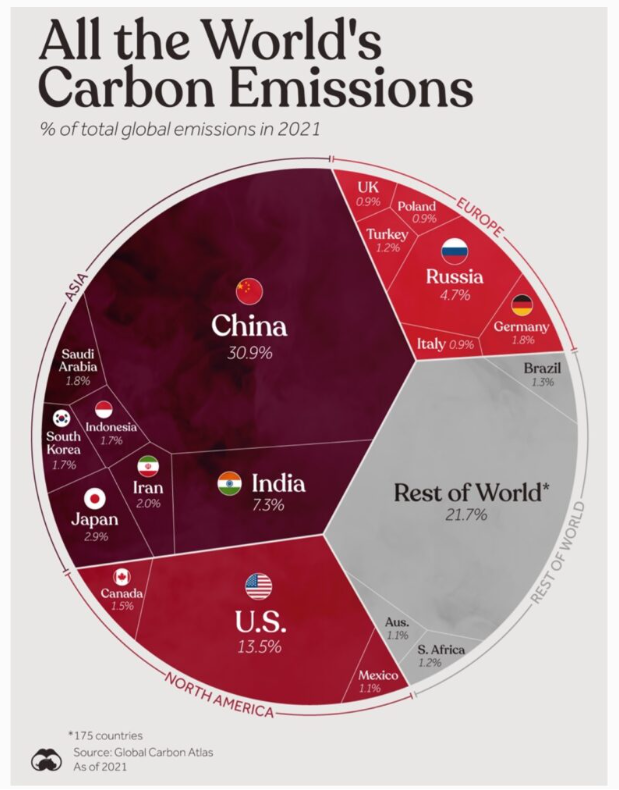
Thus, the majority assumed that climate change consists of CO2, following its emission, having a direct noxious climate impact upon geographically contiguous areas. We are not told, however, what particular form that harm takes, how it is caused or on what evidence it is based. But if Canada’s senior-most justices truly understood the basic mechanics of climate, they would have realized that virtually the entire impact of which they speak must come from outside the country, since Canada generates only 1.5 percent of global CO2 emissions, making each province only a tiny contributor to total global emissions.

Other Fallacious or Unsupported “Carbon Wall” Thinking

The majority also incorrectly suggested (para. 10) that, “The effects of climate change have been and will be particularly severe and devastating in Canada.” There is no evidence to support this assumption. While basic climatology holds that the Earth’s polar regions will warm more than lower latitudes, this is not unique to Canada. And rising levels of CO2 have also generated benefits through increasing agricultural productivity and forest and plant growth.

The good news: The Supreme Court said climate change would be “particularly severe and devastating in Canada”, an assumption for which there is no evidence; rising levels of atmospheric CO2 have actually led to a “greening” of the Earth, increasing agricultural productivity and forest and plant growth. (Source of photos: Pexels)

All that the Supreme Court’s ‘twice as fast’ alarm about Canadian warming shows is that Canadians live on land and not the ocean. The statement, while technically true, communicates nothing of significance. But it is highly misleading.

Canada is not bound in any meaningful way by the Paris Agreement, its contents should not influence decisions by Canadian courts, and the Supreme Court majority in Greenhouse Gas found nothing from the Paris Agreement that would be meaningfully precedential for those seeking to save themselves from ‘climate damage’.

The Assumption of an Existential Threat to Humanity

Climate change, Greenhouse Gas declares emphatically (para. 167), is “an existential challenge…a threat of the highest order to the country, and…[an] undisputed threat to the future of humanity [that] cannot be ignored.” It would seem to follow from this resounding pronouncement that the planet requires rapid decarbonization, with a massive and very costly diversion of resources to do so, and without regard to the cost trade-offs for other important human needs such food, housing and transportation or for such matters as safety and security.

Weighing such competing human needs is a political process, not a judicial judgment. Yet the Supreme Court’s assertions of catastrophe stand alone in mid-judgment, devoid of expert sources, of any investigation of facts, or of any reasoning from facts. This is unfortunate, because the court majority’s seemingly unqualified belief is anything but “undisputed”.

Many experts specifically dispute that humanity’s survival is at stake. Nobel Laureate William Nordhaus, the Yale University economist who is considered the “father” of the carbon tax, does so in his book The Climate Casino (page 134). Nor does the IPCC itself make such a claim.

“For most economic sectors, the impact of climate change will be small relative to the impacts of other drivers. Changes in population, age, income, technology, relative prices, lifestyle, regulation, governance, and many other aspects of socioeconomic development will have an impact on the supply and demand of economic goods and services that is large relative to the impact of climate change.” IPCC Report, Working Group 2, 2014

As Greenhouse Gas involved no evidentiary procedures, then what could have been the source of the Supreme Court’s ‘existential threat’ declaration? A search of the court files shows that this was assembled from an affidavit in Canada’s Record by a federal manager, John Moffet, an assistant deputy minister with Environment and Climate Change Canada.

Suffice it here to note that Canadian evidentiary rules do not allow for reliance upon a federal government manager’s affidavit for dispositive proof of an existential threat to an entire nation and indeed the whole planet. Moffet was neither disinterested in the dispute nor an expert on any aspect of climate science or any related scientific discipline that would qualify him as an independent expert witness.

The Unfolding Danger in the Supreme Court’s Climate Assumptions

There is no sense in parsing each of the assertions made by the majority in the Background, quite a few of which are highly questionable. But there is no existential threat inference to be drawn even if all are accepted. Climate change may be a serious problem, but it is only one among many other serious and resource-consuming human problems to be weighed and balanced.

If the Supreme Court of Canada chooses to evaluate complex climate policy in future (which the Court really lacks the institutional capacity to do), it should at least make arrangements for a full evidentiary record. For climate change, that would be enormous and would take months of hearings. A Royal Commission would be better placed to handle such a mission.

But judgments like Greenhouse Gas are wholly inadequate. It contains no true factual findings of an existential threat to humanity, or of a Carbon Wall around Canada, or of a possible Carbon Wall controllable by federal regulation around each of our provinces. There is no federal claim to be saving Canadians from interprovincial climate “pollution” and only a diffuse and very insignificant Canadian contribution to overall planetary climate change. Thus, the majority’s assumptions cannot serve as authority for the lower courts to adjudicate the cases that come before them under the guise of saving Canadians from climate change.

We cannot allow single-issue adherents (often wielding generous federal funding)
to repurpose our courts on pretextual bases and achieve goals
that they were denied through the ballot box.


SH and Tropics Lead UAH Cooling June 2025

The post below updates the UAH record of air temperatures over land and ocean. Each month and year exposes again the growing disconnect between the real world and the Zero Carbon zealots.  It is as though the anti-hydrocarbon band wagon hopes to drown out the data contradicting their justification for the Great Energy Transition.  Yes, there was warming from an El Nino buildup coincidental with North Atlantic warming, but no basis to blame it on CO2.

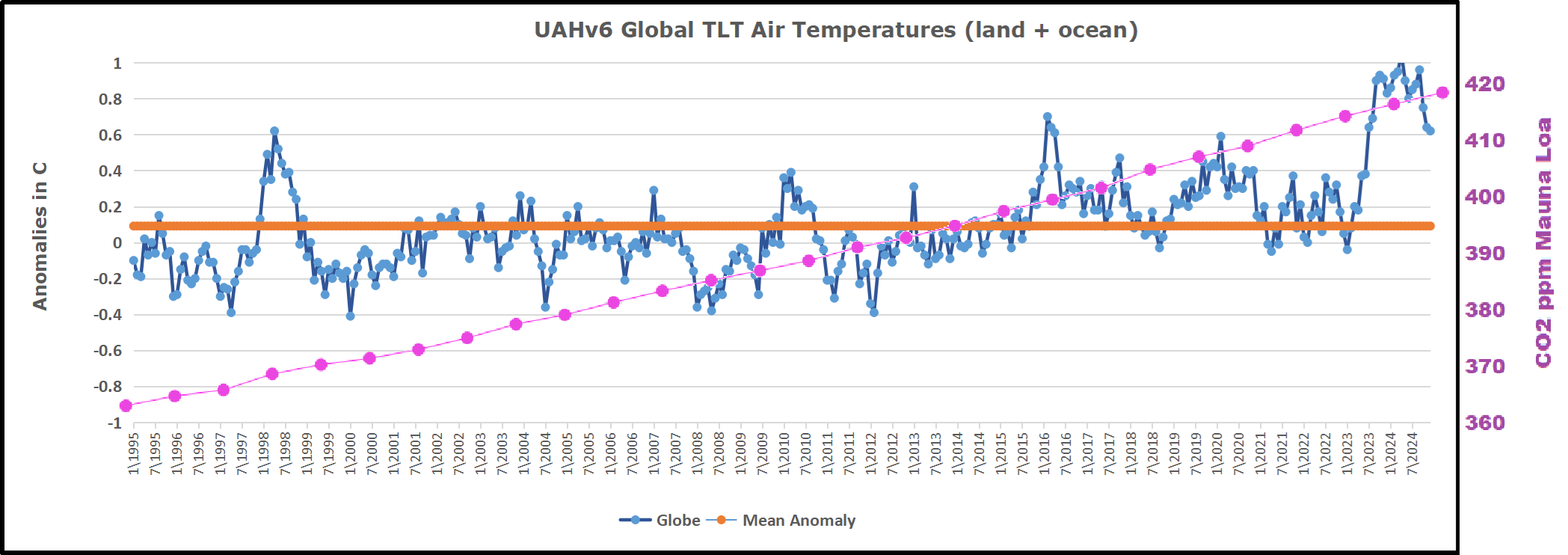
As an overview consider how recent rapid cooling  completely overcame the warming from the last 3 El Ninos (1998, 2010 and 2016).  The UAH record shows that the effects of the last one were gone as of April 2021, again in November 2021, and in February and June 2022  At year end 2022 and continuing into 2023 global temp anomaly matched or went lower than average since 1995, an ENSO neutral year. (UAH baseline is now 1991-2020). Then there was an usual El Nino warming spike of uncertain cause, unrelated to steadily rising CO2 and now dropping steadily.

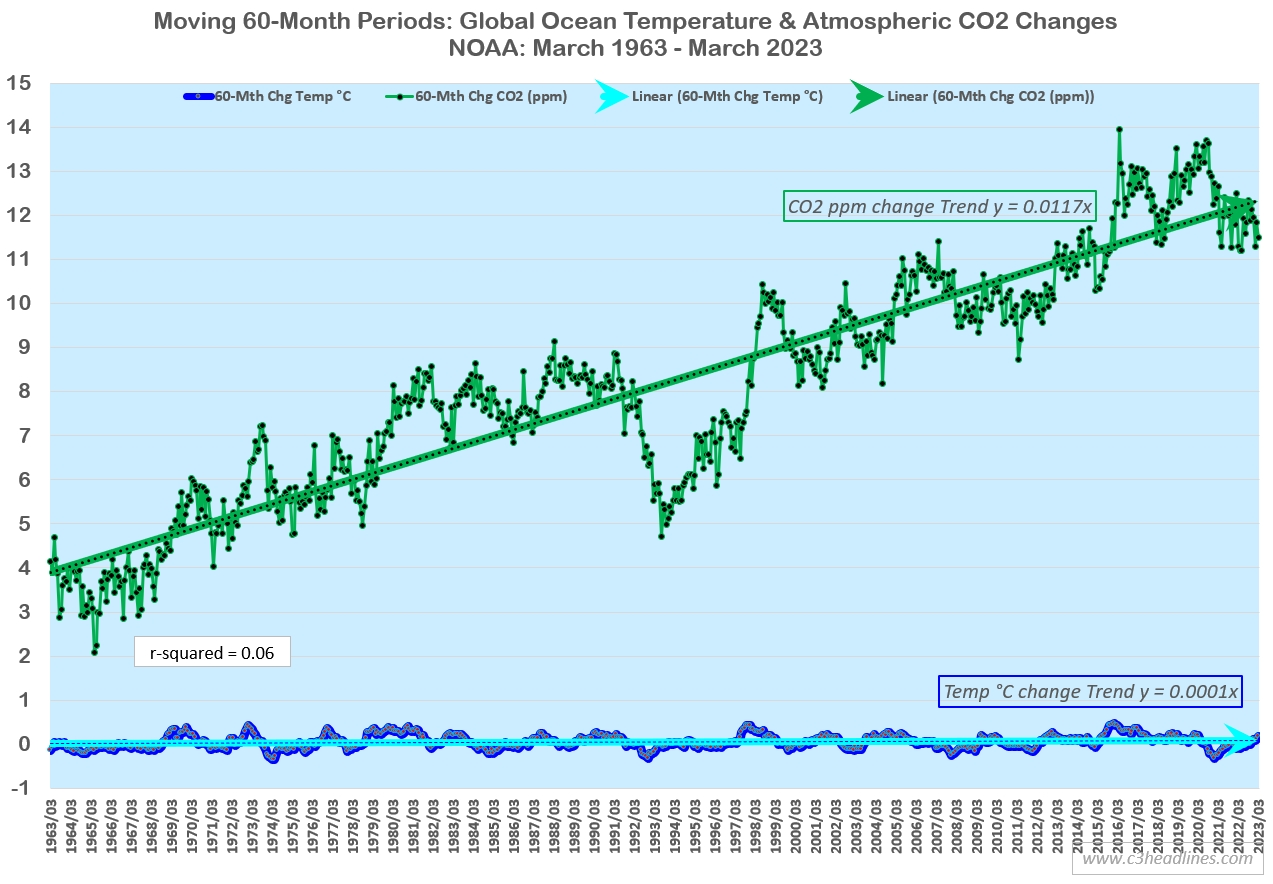
For reference I added an overlay of CO2 annual concentrations as measured at Mauna Loa.  While temperatures fluctuated up and down ending flat, CO2 went up steadily by ~60 ppm, a 15% increase.

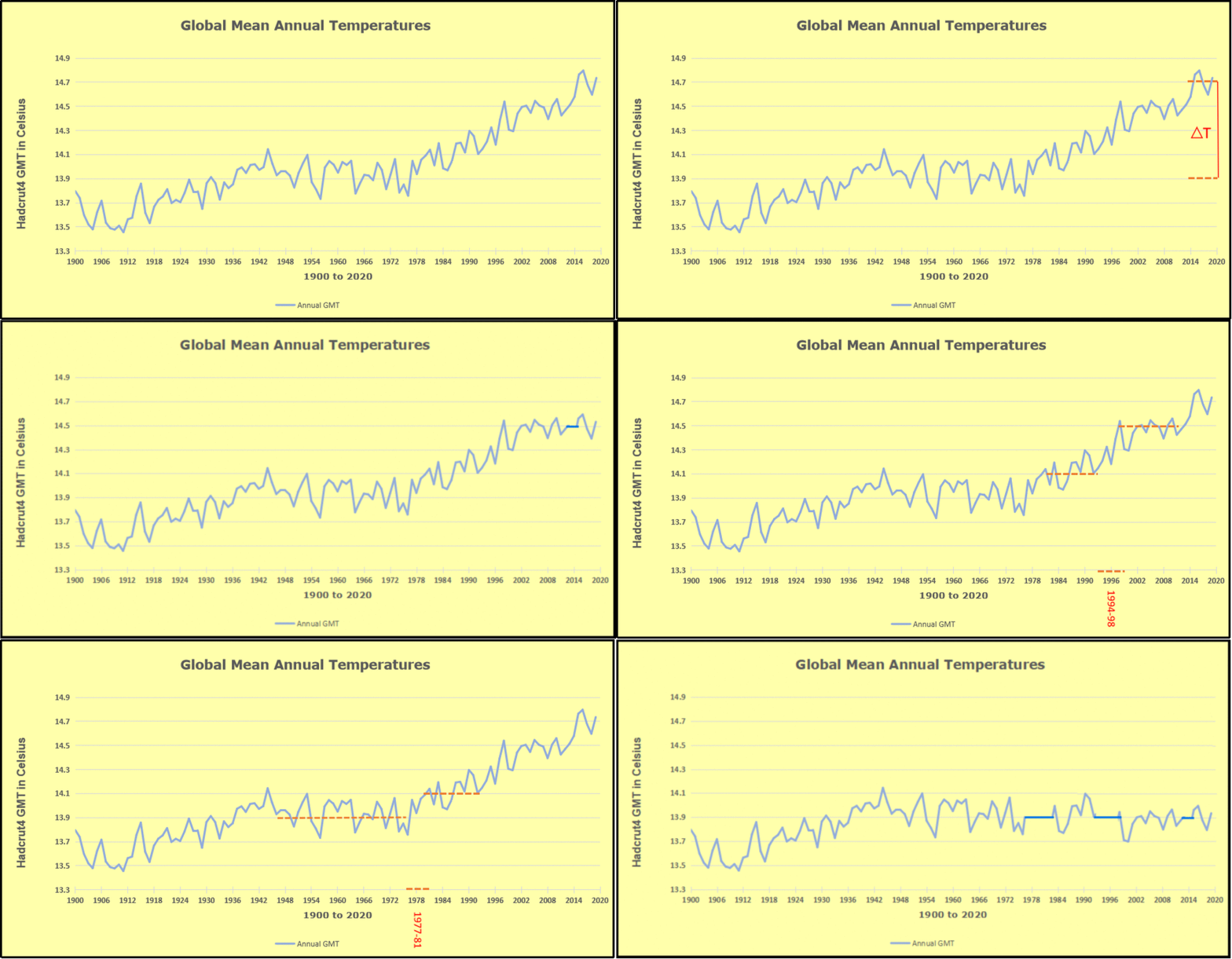
Furthermore, going back to previous warmings prior to the satellite record shows that the entire rise of 0.8C since 1947 is due to oceanic, not human activity.

gmt-warming-events

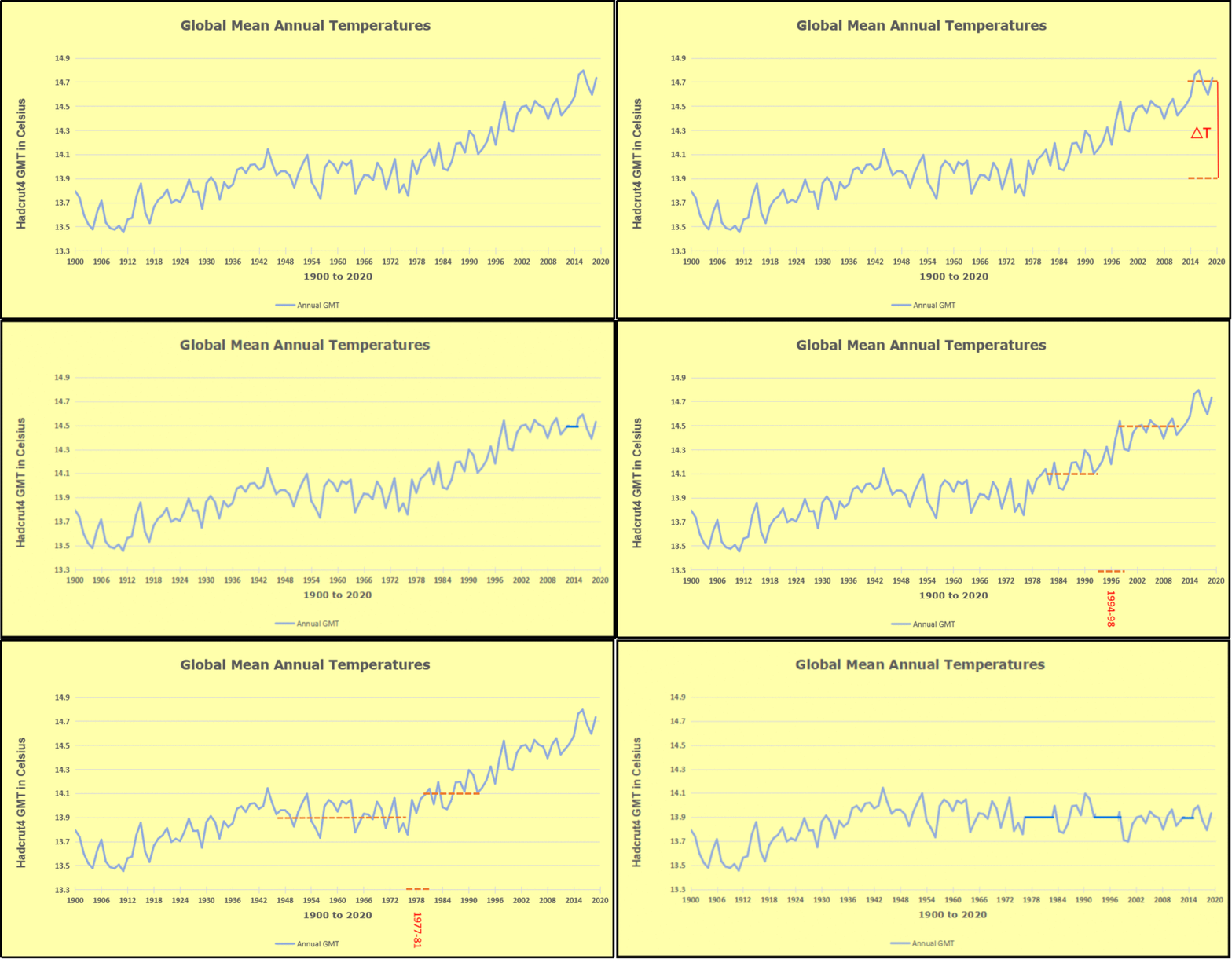
The animation is an update of a previous analysis from Dr. Murry Salby.  These graphs use Hadcrut4 and include the 2016 El Nino warming event.  The exhibit shows since 1947 GMT warmed by 0.8 C, from 13.9 to 14.7, as estimated by Hadcrut4.  This resulted from three natural warming events involving ocean cycles. The most recent rise 2013-16 lifted temperatures by 0.2C.  Previously the 1997-98 El Nino produced a plateau increase of 0.4C.  Before that, a rise from 1977-81 added 0.2C to start the warming since 1947.

Importantly, the theory of human-caused global warming asserts that increasing CO2 in the atmosphere changes the baseline and causes systemic warming in our climate.  On the contrary, all of the warming since 1947 was episodic, coming from three brief events associated with oceanic cycles. And in 2024 we saw an amazing episode with a temperature spike driven by ocean air warming in all regions, along with rising NH land temperatures, now dropping below its peak.

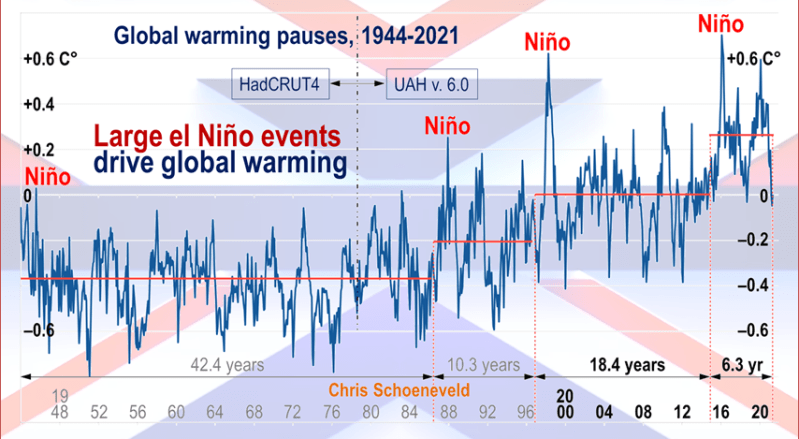
Chris Schoeneveld has produced a similar graph to the animation above, with a temperature series combining HadCRUT4 and UAH6. H/T WUWT

image-8

See Also Worst Threat: Greenhouse Gas or Quiet Sun?

June 2025 SH and Tropics Lead UAH Temps Lower banner-blog

With apologies to Paul Revere, this post is on the lookout for cooler weather with an eye on both the Land and the Sea.  While you heard a lot about 2020-21 temperatures matching 2016 as the highest ever, that spin ignores how fast the cooling set in.  The UAH data analyzed below shows that warming from the last El Nino had fully dissipated with chilly temperatures in all regions. After a warming blip in 2022, land and ocean temps dropped again with 2023 starting below the mean since 1995.  Spring and Summer 2023 saw a series of warmings, continuing into 2024 peaking in April, then cooling off to the present.

UAH has updated their TLT (temperatures in lower troposphere) dataset for June 2025. Due to one satellite drifting more than can be corrected, the dataset has been recalibrated and retitled as version 6.1 Graphs here contain this updated 6.1 data.  Posts on their reading of ocean air temps this month are behind the update from HadSST4.  I posted recently on SSTs June 2025 Ocean SSTs: NH Warms, SH Cools.These posts have a separate graph of land air temps because the comparisons and contrasts are interesting as we contemplate possible cooling in coming months and years.

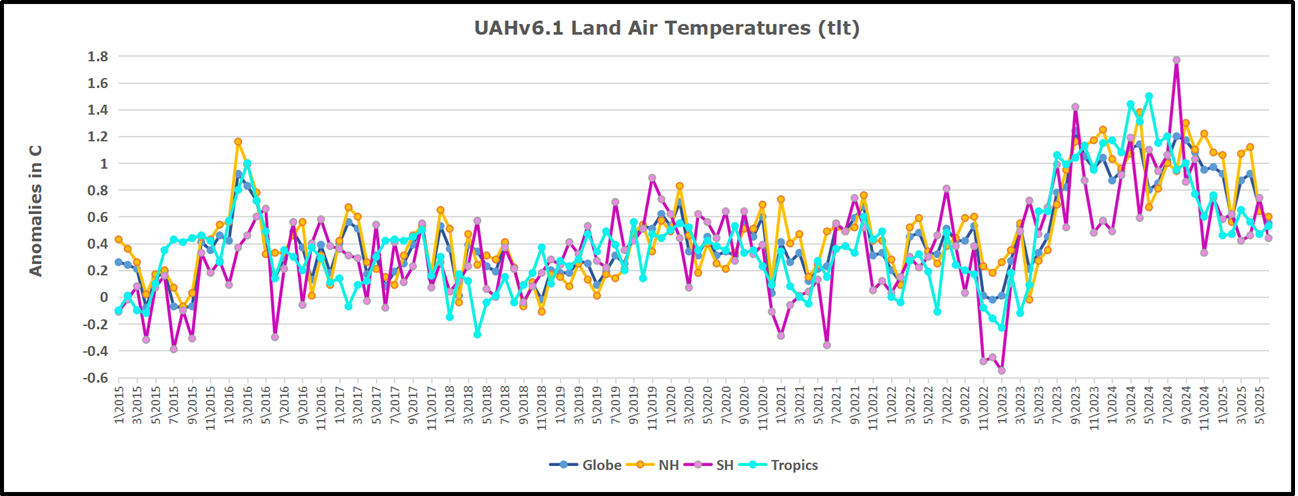
Sometimes air temps over land diverge from ocean air changes. In July 2024 all oceans were unchanged except for Tropical warming, while all land regions rose slightly. In August we saw a warming leap in SH land, slight Land cooling elsewhere, a dip in Tropical Ocean temp and slightly elsewhere.  September showed a dramatic drop in SH land, overcome by a greater NH land increase. 2025 has shown a sharp contrast between land and sea, first with ocean air temps falling in January recovering in February.  Then land air temps, especially NH, dropped in February and recovered in March. Now in June SH land dropped markedly and NH land down slightly, while ocean air temps rose slightly in NH, offset by cooling in SH and Tropics.

Note:  UAH has shifted their baseline from 1981-2010 to 1991-2020 beginning with January 2021.   v6.1 data was recalibrated also starting with 2021. In the charts below, the trends and fluctuations remain the same but the anomaly values changed with the baseline reference shift.

Presently sea surface temperatures (SST) are the best available indicator of heat content gained or lost from earth’s climate system.  Enthalpy is the thermodynamic term for total heat content in a system, and humidity differences in air parcels affect enthalpy.  Measuring water temperature directly avoids distorted impressions from air measurements.  In addition, ocean covers 71% of the planet surface and thus dominates surface temperature estimates.  Eventually we will likely have reliable means of recording water temperatures at depth.

Recently, Dr. Ole Humlum reported from his research that air temperatures lag 2-3 months behind changes in SST.  Thus cooling oceans portend cooling land air temperatures to follow.  He also observed that changes in CO2 atmospheric concentrations lag behind SST by 11-12 months.  This latter point is addressed in a previous post Who to Blame for Rising CO2?

After a change in priorities, updates are now exclusive to HadSST4.  For comparison we can also look at lower troposphere temperatures (TLT) from UAHv6.1 which are now posted for June 2025.  The temperature record is derived from microwave sounding units (MSU) on board satellites like the one pictured above. Recently there was a change in UAH processing of satellite drift corrections, including dropping one platform which can no longer be corrected. The graphs below are taken from the revised and current dataset.

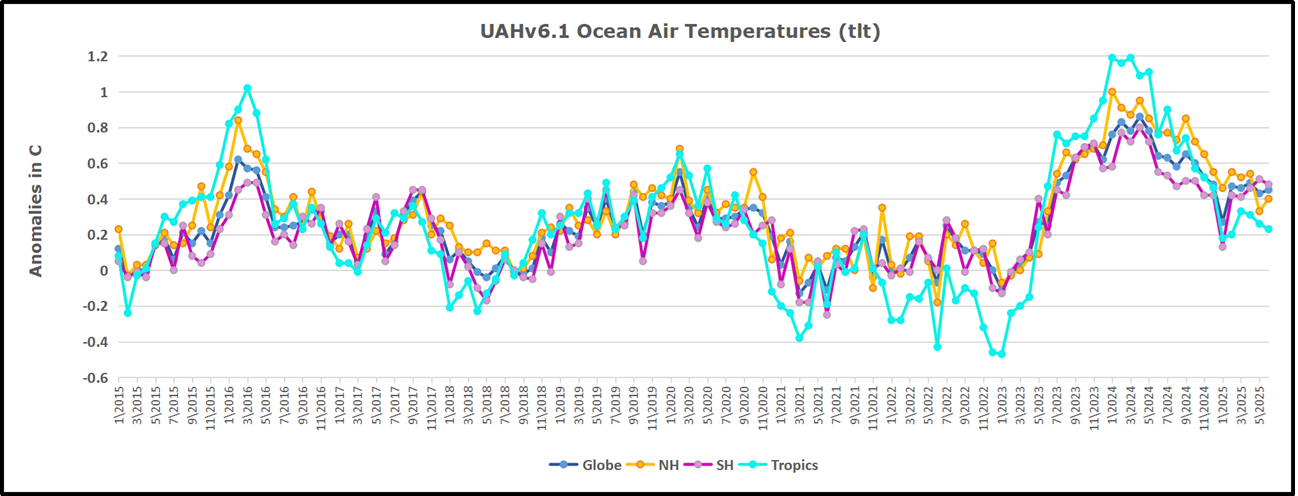
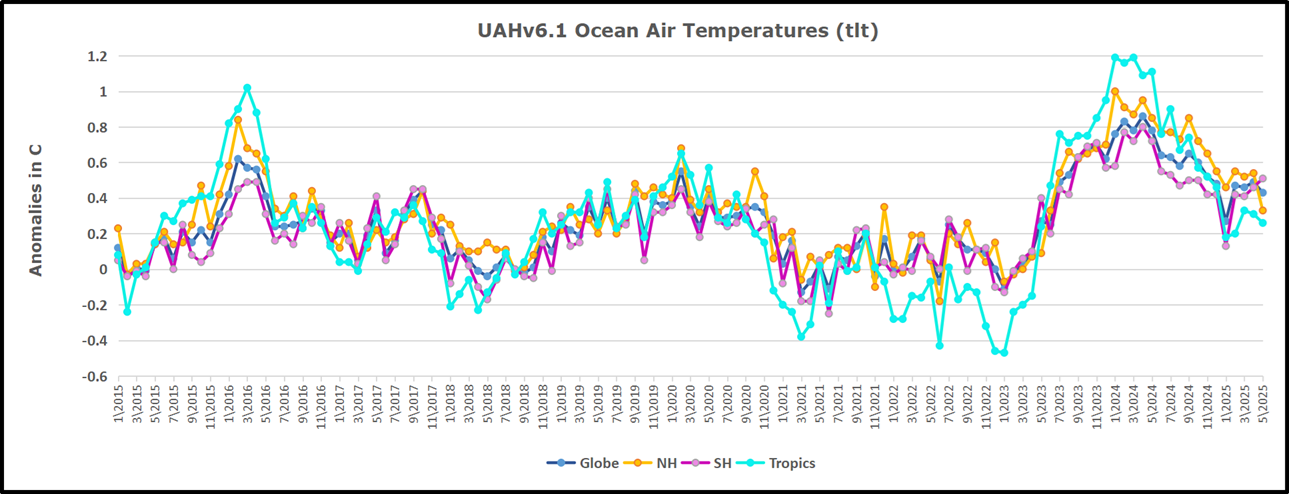
The UAH dataset includes temperature results for air above the oceans, and thus should be most comparable to the SSTs. There is the additional feature that ocean air temps avoid Urban Heat Islands (UHI).  The graph below shows monthly anomalies for ocean air temps since January 2015.

In 2021-22, SH and NH showed spikes up and down while the Tropics cooled dramatically, with some ups and downs, but hitting a new low in January 2023. At that point all regions were more or less in negative territory.

After sharp cooling everywhere in January 2023, there was a remarkable spiking of Tropical ocean temps from -0.5C up to + 1.2C in January 2024.  The rise was matched by other regions in 2024, such that the Global anomaly peaked at 0.86C in April. Since then all regions have cooled down sharply to a low of 0.27C in January.  In February 2025, SH rose from 0.1C to 0.4C pulling the Global ocean air anomaly up to 0.47C, where it stayed in March and April. In May drops in NH and Tropics pulled the air temps over oceans down despite an uptick in SH. At 0.43C, ocean air temps were similar to May 2020, albeit with higher SH anomalies. Now in June Global ocean air anomaly is little changed despite a slight rise in NH.

Land Air Temperatures Tracking in Seesaw Pattern

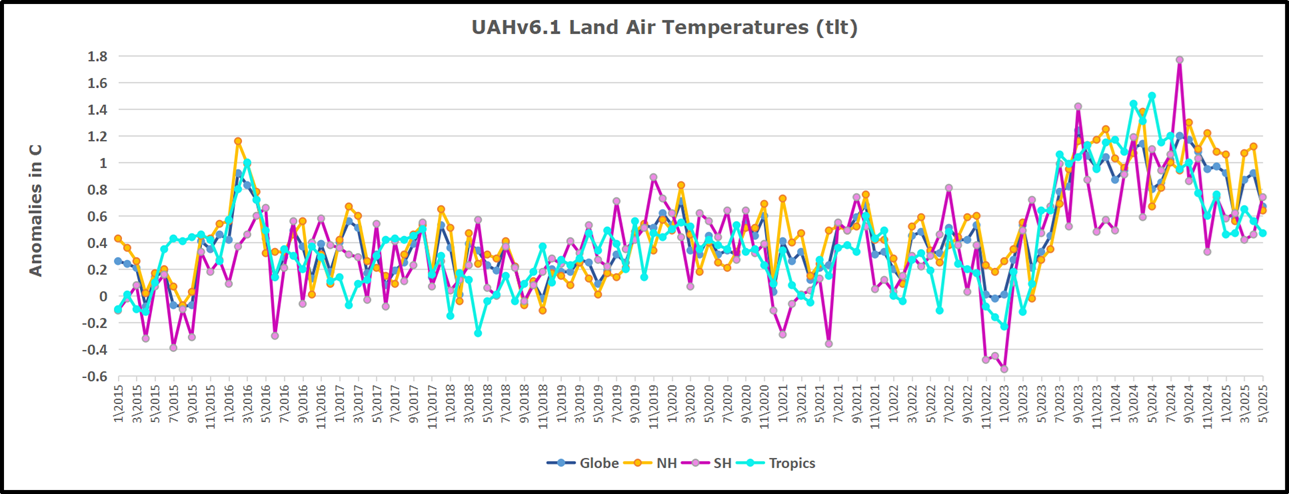
We sometimes overlook that in climate temperature records, while the oceans are measured directly with SSTs, land temps are measured only indirectly.  The land temperature records at surface stations sample air temps at 2 meters above ground.  UAH gives tlt anomalies for air over land separately from ocean air temps.  The graph updated for June is below.

Here we have fresh evidence of the greater volatility of the Land temperatures, along with extraordinary departures by SH land.  The seesaw pattern in Land temps is similar to ocean temps 2021-22, except that SH is the outlier, hitting bottom in January 2023. Then exceptionally SH goes from -0.6C up to 1.4C in September 2023 and 1.8C in  August 2024, with a large drop in between.  In November, SH and the Tropics pulled the Global Land anomaly further down despite a bump in NH land temps. February showed a sharp drop in NH land air temps from 1.07C down to 0.56C, pulling the Global land anomaly downward from 0.9C to 0.6C. In March that drop reversed with both NH and Global land back to January values, holding there in April.  In May sharp drops in NH and Tropics land air temps pulled the Global land air temps back down close to February value. In June the Global land air drop was significant, down from 0.67C to 0.55C despite a small rise in the Tropics.

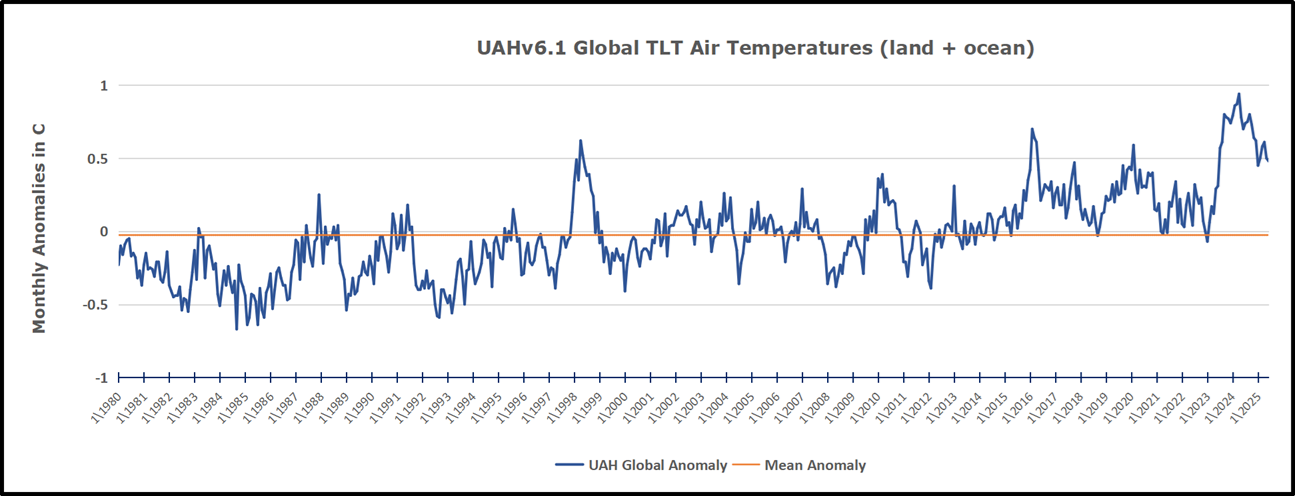
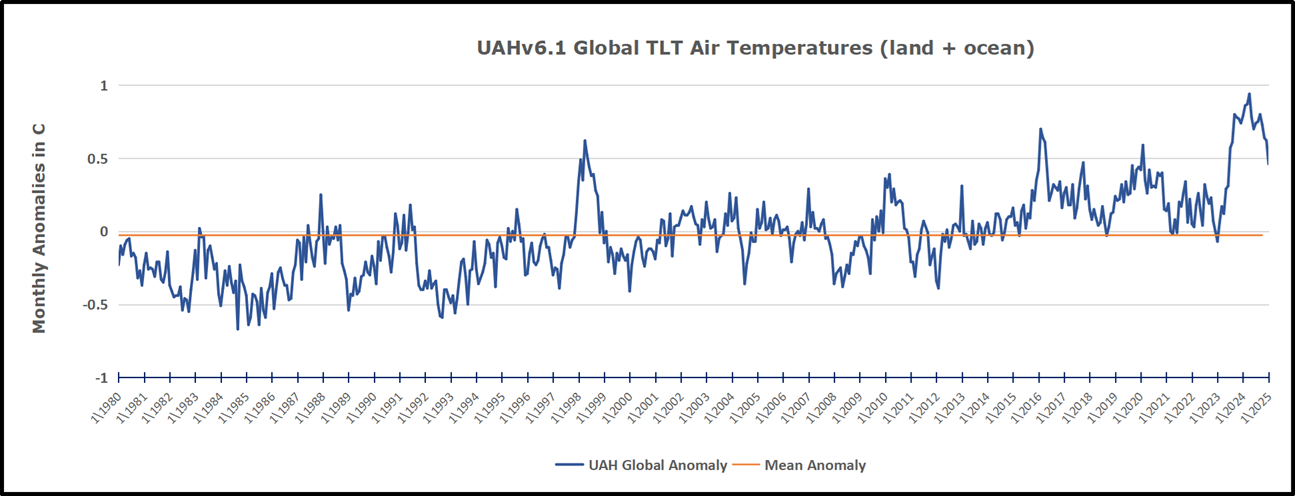
The Bigger Picture UAH Global Since 1980

The chart shows monthly Global Land and Ocean anomalies starting 01/1980 to present.  The average monthly anomaly is -0.03, for this period of more than four decades.  The graph shows the 1998 El Nino after which the mean resumed, and again after the smaller 2010 event. The 2016 El Nino matched 1998 peak and in addition NH after effects lasted longer, followed by the NH warming 2019-20.   An upward bump in 2021 was reversed with temps having returned close to the mean as of 2/2022.  March and April brought warmer Global temps, later reversed

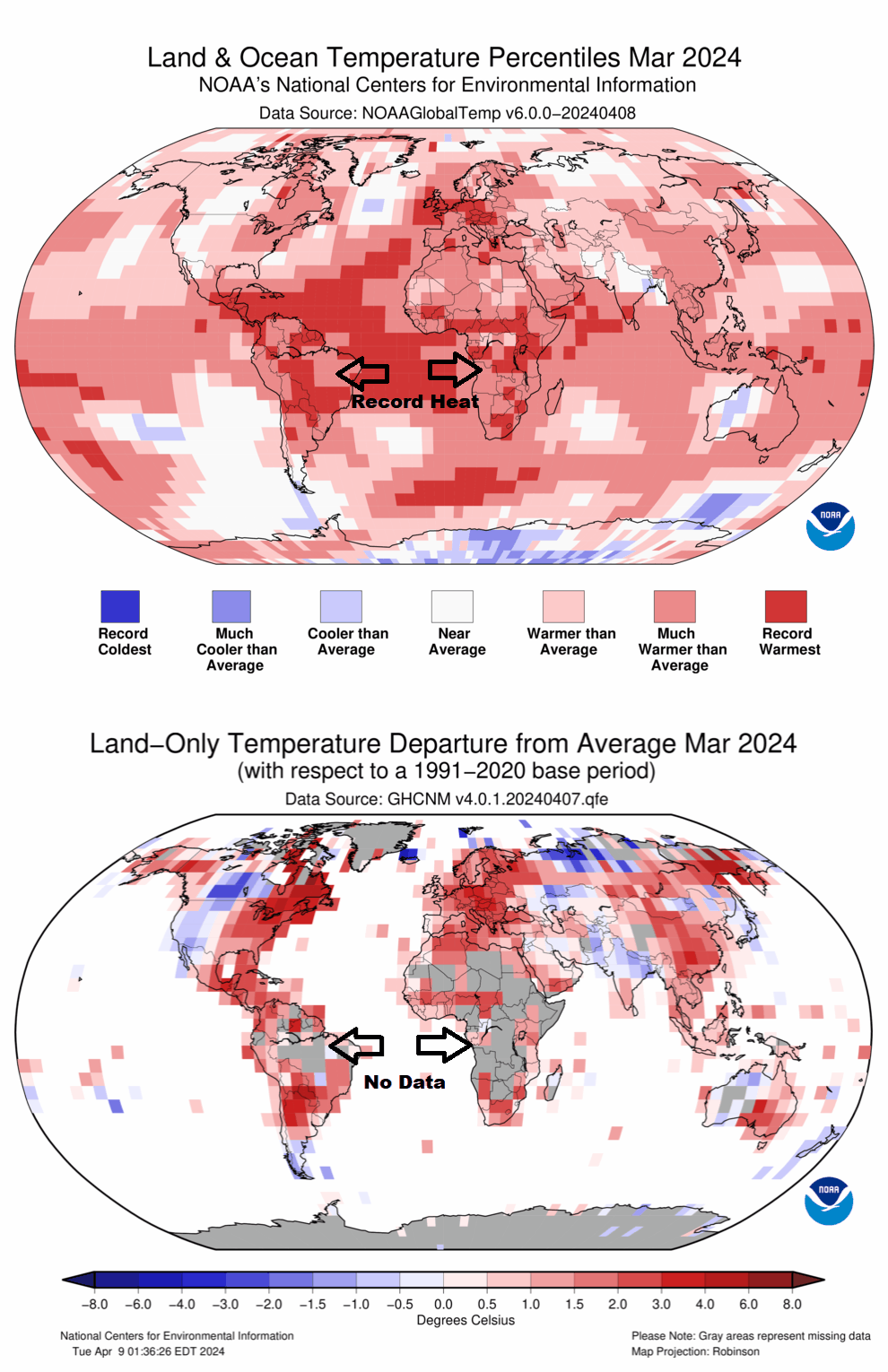
With the sharp drops in Nov., Dec. and January 2023 temps, there was no increase over 1980. Then in 2023 the buildup to the October/November peak exceeded the sharp April peak of the El Nino 1998 event. It also surpassed the February peak in 2016. In 2024 March and April took the Global anomaly to a new peak of 0.94C.  The cool down started with May dropping to 0.9C, and in June a further decline to 0.8C.  October went down to 0.7C,  November and December dropped to 0.6C. February went down to 0.5C, then back up to 0.6C in March and April driven by the bounce in NH land air temps, followed by May’s return to 0.5C, and June slightly lower at 0.48C.

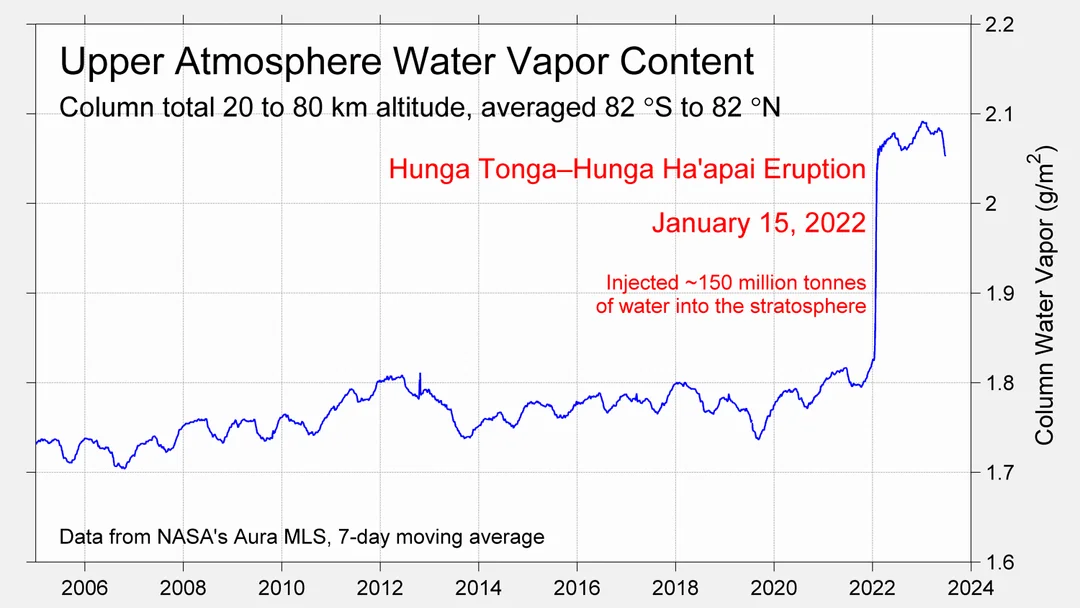
The graph reminds of another chart showing the abrupt ejection of humid air from Hunga Tonga eruption.

Note on Ocean Cooling Not Yet Fully Appearing in UAH Dataset

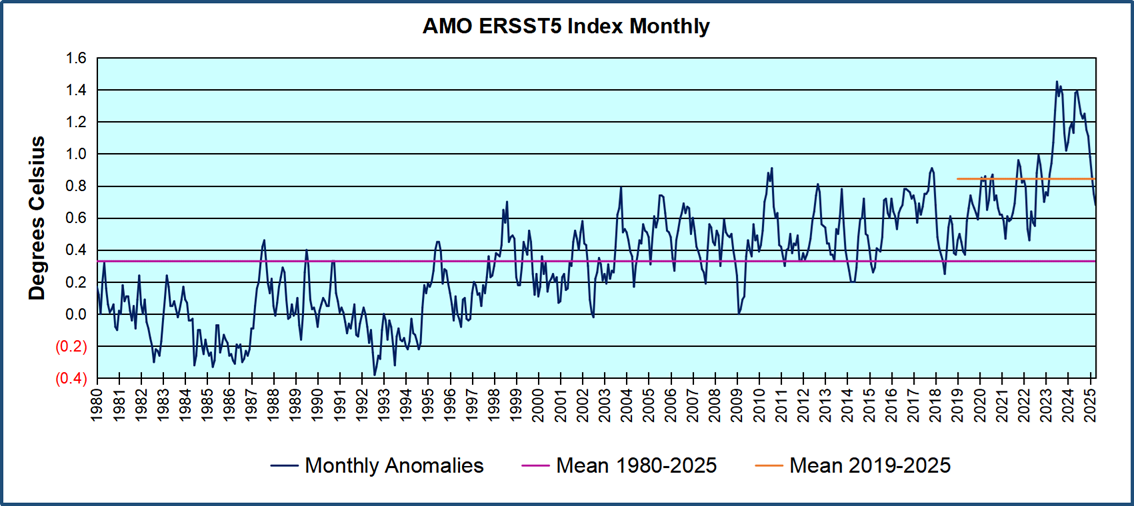
The above chart shows sea surface temperature anomalies (SSTA)  in the North Atlantic 0 to 60N.  The index is derived from ERSSTv.5 by subtracting the global anomalies from the North Atlantic anomalies, the differences as shown in the chart. The baseline of  0.0C is the average for the years 1951 to 1980.  The mean anomaly since 1980 is in purple at 0.33C, and persisted throughout up to 2018. The orange line is the average anomaly in the the last six years, 2019 to 04/2025 inclusive, at 0.84C. The remarkable spikes in 2023 and 2024 drove that rise to exceed 1.4C, which has been cut in half over the last 10 months.  As Dr. Humlum observed, such oceanic changes usually portend air temperature changes later on.

TLTs include mixing above the oceans and probably some influence from nearby more volatile land temps.  Clearly NH and Global land temps have been dropping in a seesaw pattern, nearly 1C lower than the 2016 peak.  Since the ocean has 1000 times the heat capacity as the atmosphere, that cooling is a significant driving force.  TLT measures started the recent cooling later than SSTs from HadSST4, but are now showing the same pattern. Despite the three El Ninos, their warming had not persisted prior to 2023, and without them it would probably have cooled since 1995.  Of course, the future has not yet been written.

Arctic Ice Melting 4 Days Faster Mid-July 2025

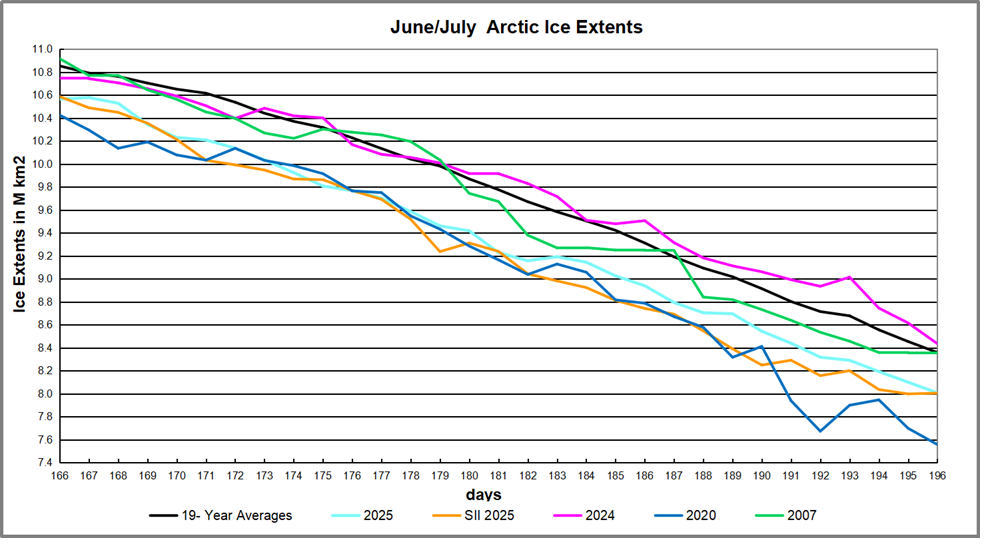
After a sub-par March maximum, by end of May 2025 Arctic ice closed the gap with the 19-year average. Then in June the gap reopened and in July the melting pace matched the average, abeit four days in advance of average.

During this period the average year loses ~2.5M km2 of ice extent.   MASIE on day 166 was ~300k km2 down, and the gap increased to almost 550k km2 by June 30 (day 181). The deficit to average then reduced to ~350k km2, which persisted over the last 12 days

including yesterday, day 196. The graph shows MASIE 2025 matching the average on day 192, four days in advance.

The regional distribution of ice extents is shown in the table below. (Bering and Okhotsk seas are excluded since both are now virtually open water.)

Region 2025196 Day 196 2025-Ave. 2020196 2025-2020
 (0) Northern_Hemisphere 8007061 8358377 -351316 7556873 450188
 (1) Beaufort_Sea 1022304 866531 155773 931056 91248
 (2) Chukchi_Sea 718615 643869 74745 612932 105683
 (3) East_Siberian_Sea 976061 921340 54721 659117 316945
 (4) Laptev_Sea 645741 559270 86471 174286 471454
 (5) Kara_Sea 153545 360645 -207100 159679 -6134
 (6) Barents_Sea 14342 56080 -41738 39446 -25105
 (7) Greenland_Sea 387402 402761 -15359 400498 -13096
 (8) Baffin_Bay_Gulf_of_St._Lawrence 268783 311662 -42878 232167 36616
 (9) Canadian_Archipelago 630633 711293 -80660 733866 -103233
 (10) Hudson_Bay 155460 349275 -193815 520027 -364567
 (11) Central_Arctic 3032353 3171652 -139299 3093040.21 -60687

The table shows  the two largest deficits, the Atlantic Kara basin combined with Hudson Bay, exceed the total difference from average. In addition are lower ice extents in Central Arctic and Canadian Archipelago, offset by surpluses in Beaufort Sea and other Eurasian shelf basins.  Note that Hudson Bay with 350k km2 average ice extent yesterday will have less than 100k in three weeks.

Why is this important?  All the claims of global climate emergency depend on dangerously higher  temperatures, lower sea ice, and rising sea levels.  The lack of additional warming prior to 2023 El Nino is documented in a post NH and Tropics Lead UAH Temps Lower May 2025.

The lack of acceleration in sea levels along coastlines has been discussed also.  See Observed vs. Imagined Sea Levels 2023 Update

Also, a longer term perspective is informative:

post-glacial_sea_level

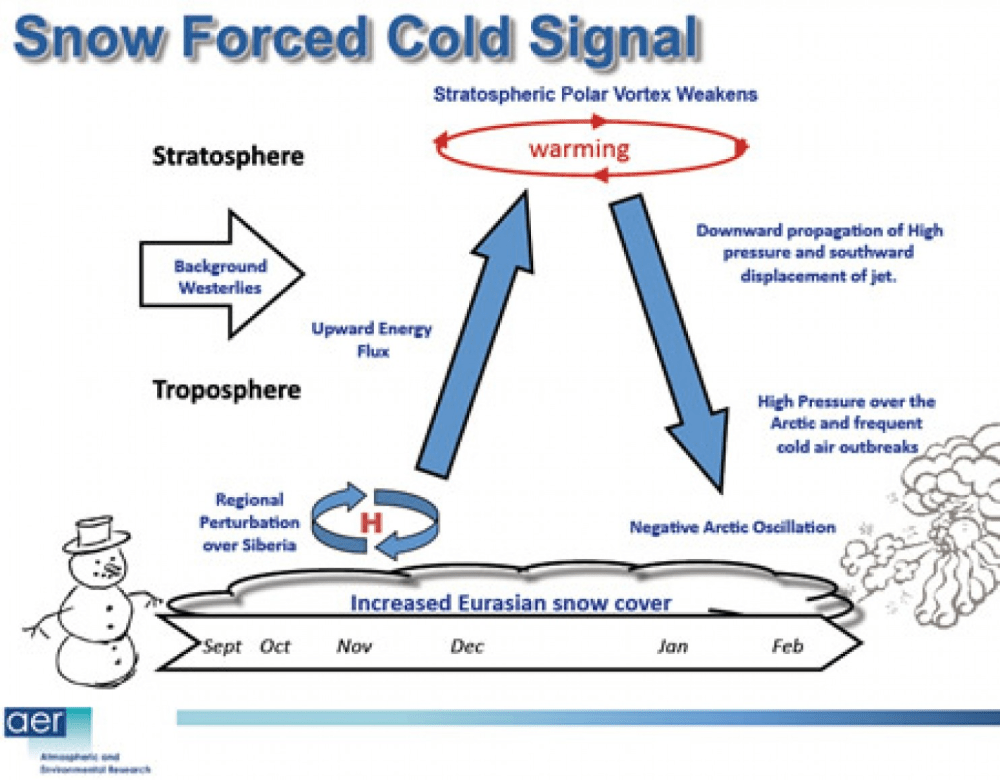
2025 Update: No, CO2 Doesn’t Drive the Polar Vortex

July 2025 Update

Linnea Lueken published this week at Climate Realism Thanks, NewScientist, for Admitting Climate Change Isn’t Making the Jet Stream More Erratic.  Excerpts in italics with my bolds and added images.

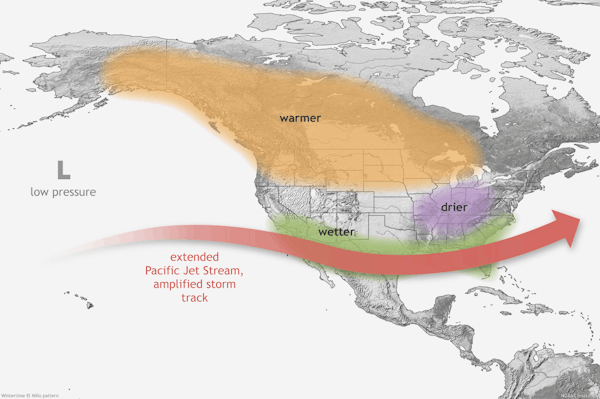
NewScientist, a publication dedicated to popularizing science, recently published a post titled “Extreme winter weather isn’t down to a wavier jet stream,” reporting on a new study that shows, the jet stream is not getting wavier in winter months due to climate change. NewScientist writes that “[i]ncreasingly erratic winter weather in the northern hemisphere isn’t a result of the polar jet stream getting more wavy, according to new research . . ..”

This is true, and it has been evident for some time, but runs counter
to assertions commonly made by climate alarmists.

Although the vast bulk of the article is devoted to insisting that climate change is causing worsening winter and summer weather, claims regularly debunked at Climate Realism, the publication deserves some credit for reporting the study’s results concerning the jet stream, which was, in fact, the focus of the research itself.

The new reports findings are not actually that “new,” in the sense that Climate Realism has reported on research that came to the same conclusion several times in the past few years, herehere, and here, for instance. There is copious evidence showing that not only are cold snaps not uncommon, but that the jet stream’s (and more specifically, polar vortex) influence on extreme winter weather has been acknowledged since at least 1853. Years of studies looking at the frequency of and intensity of polar vortex events have found no consistent trends. As pointed out by my colleague Anthony Watts in this post on the subject:

“a 2021 study in the journal Geophysical Research Letters found no statistically significant increase in jet stream waviness or meandering in recent decades,”

and he explains there has never been a consensus among scientists when it comes to the issue of polar vortex/jet stream behavior.

The post at NewScientist goes on to explain the new study, saying “recent erratic behaviour isn’t out of the ordinary,” and that the jet stream has been both wavier and less wavy than it is today.  Unfortunately, that is where the NewScientist and the authors of the paper it was discussing ceased to follow the evidence. One of the study’s authors reassured NewScientist that climate change is still “affecting extreme weather events in all sorts of really important ways,” and that the jet stream is actually becoming wavier in the summertime, “where it is getting slower, with bigger waves, which leads to things like big heatwaves, drought, and wildfires.”

This would be compelling if existing data backed up the claim,
but, in fact, big heatwaves, drought, and wildfires have not
become more frequent or severe in recent decades. 

Heatwaves were much more severe in the earlier decades of the 20th century, and overall drought has been declining while precipitation increases. Now that it is summer, many outlets are attempting to claim that hot weather is driven by climate change. In doing so they almost always ignore where heat records are being set, as it is often at airports and other heat-absorbing locations, and ignore historical records that show hot summers are not unprecedented.

Similarly, data shows that wildfires were worse in the past with research from NASA and the European Space Agency showing that acreage lost to wildfires has declined markedly over the past few decades.

The NewScientist, and the AGU study it references, should have quit when they were ahead. They should have published their unalarming findings about climate change’s lack of an impact on the winter jet stream without then assuring people that despite their study’s findings, they really are true believers and climate change is making weather worse. The latter point is refuted by real world data.

Simulation of jet stream pattern July 22. (VentuSky.com)

Background from Previous Post

We are heading into winter this year at the bottom of a solar cycle, and ocean oscillations due for cooling phases. The folks at Climate Alarm Central (CAC) are well aware of this, and are working hard so people won’t realize that global cooling contradicts global warming. No indeed, contortionist papers and headlines are warning us all that CO2 not only causes hothouse earth, overrun with rats and other vermin. CO2 also causes ice ages when it feels like it.

Update Nov. 26, 2019: Much ado about the polar jet stream recently with a publication by Tim Woolings  A battle for the jet stream is raging above our heads.  The Claims are not new:

The jet has always varied – and has always affected our weather patterns. But now climate change is affecting our weather too. As I explore in my latest book, it’s when the wanderings of the jet and the hand of climate change add up that we get record-breaking heatwaves, floods and droughts – but not freezes.

The same supposition was made last year in an article by alarmist Jason Samenow at Washington Post.  Study: Freak summer weather and wild jet-stream patterns are on the rise because of global warming. Excerpts in italics with my bolds

In many ways, the summer of 2018 marked a turning point, when the effects of climate change — perhaps previously on the periphery of public consciousness — suddenly took center stage. Record high temperatures spread all over the Northern Hemisphere. Wildfires raged out of control. And devastating floods were frequent.

Michael Mann, climate scientist at Pennsylvania State University, along with colleagues, has published a new study that connects these disruptive weather extremes with a fundamental change in how the jet stream is behaving during the summer. Linked to the warming climate, the study suggests this change in the atmosphere’s steering current is making these extremes occur more frequently, with greater intensity, and for longer periods of time.

The study projects this erratic jet-stream behavior will increase in the future, leading to more severe heat waves, droughts, fires and floods.

The jet stream is changing not only because the planet is warming up but also because the Arctic is warming faster than the mid-latitudes, the study says. The jet stream is driven by temperature contrasts, and these contrasts are shrinking. The result is a slower jet stream with more wavy peaks and troughs that Mann and his study co-authors ascribe to a process known as “quasi-resonant amplification.”

The altered jet-stream behavior is important because when it takes deep excursions to the south in the summer, it sets up a collision between cool air from the north and the summer’s torrid heat, often spurring excessive rain. But when the jet stream retreats to the north, bulging heat domes form underneath it, leading to record heat and dry spells.

The study, published Wednesday in Science Advances, finds that these quasi-resonant amplification events — in which the jet stream exhibits this extreme behavior during the summer — are predicted to increase by 50 percent this century if emissions of carbon dioxide and other greenhouse gases continue unchecked.

Whereas previous work conducted by Mann and others had identified a signal for an increase in these events, this study for the first time examined how they may change in the future using climate model simulations.

“Looking at a large number of different computer models, we found interesting differences,” said Stefan Rahmstorf from the Potsdam Institute for Climate Impact Research and a co-author of the study, in a news release. “Distinct climate models provide quite diverging forecasts for future climate resonance events. However, on average they show a clear increase in such events.”

Although model projections suggest these extreme jet-stream patterns will increase as the climate warms, the study concluded that their increase can be slowed if greenhouse gas emissions are reduced along with particulate pollution in developing countries. “[T]he future is still very much in our hands when it comes to dangerous and damaging summer weather extremes,” Mann said. “It’s simply a matter of our willpower to transition quickly from fossil fuels to renewable energy.”

Mann has been leading the charge to blame anticipated cooling on fossil fuels, his previous attempt claiming CO2 is causing a slowdown of AMOC (part of it being the Gulf Stream), resulting in global cooling, even an ice age. The same idea underlay the scary 2004 movie Day After Tomorrow.

day-after-tomorrowOther scientists are more interested in the truth than in hype. An example is this AGU publication by D.A Smeed et al. The North Atlantic Ocean Is in a State of Reduced Overturning Excerpts in italics with my bolds.

Figure 3

Indices of subsurface temperature, sea surface height (SSH), latent heat flux (LHF), and sea surface temperature (SST). SST (purple) is plotted using the same scale as subsurface temperature (blue) in the upper panel. The upper panel shows 24 month filtered values of de‐seasonalized anomalies along with the non‐Ekman part of the AMOC. In the lower panel, we show three‐year running means of the indices going back to 1985 (1993 for the SSH index).

Changes in ocean heat transport and SST are expected to modify the net air‐sea heat flux. The changes in the total air‐sea flux (Figure S4, data obtained from the National Centers for Environmental Prediction‐National Center for Atmospheric Research reanalysis; Kalnay et al., 1996) are almost all due to the change in LHF. The third panel of Figure 3 shows the changes in LHF between the two periods. There is a strong signal with increased heat loss from the ocean over the Gulf Stream. That the area of increased heat loss coincides with the location of warming SST indicates that the changes in air‐sea fluxes are driven by the ocean.

Whilst the AMOC has only been continuously measured since 2004, the indices of SSH, heat content, SST, and LHF can be calculated farther back in time (Figure 3, bottom). Over this longer time period, all four indices are strongly correlated with one another (Table S5; correlations were calculated using the nonparametric method described in McCarthy et al., 2015). These data suggest that measurement of the AMOC at 26°N started close to a maximum in the overturning. Prior to 2007 the indices show variability on a time scale of 8 to 10 years and no trend is evident, but since 2014 all indices have had values lower than any other year since 1985.

Previous studies have shown that seasonal and interannual changes in the subtropical AMOC are forced primarily by changing wind stress mediated by Rossby waves (Zhao & Johns, 2014a, 2014b). There is growing evidence (Delworth et al., 2016; Jackson et al., 2016) that the longer‐term changes of the AMOC over the last decade are also associated with thermohaline forcing and that the changed circulation alters the pattern of ocean‐atmosphere heat exchange (Gulev et al., 2013). The role of ocean circulation in decadal climate variability has been challenged in recent years with authors suggesting that external, atmospheric‐driven changes could produce the observed variability in Atlantic SSTs (Clement et al., 2015). However, the direct observation of a weakened AMOC supports a role for ocean circulation in decadal Atlantic climate variability.

Our results show that the previously reported decline of the AMOC (Smeed et al., 2014) has been arrested, but the length of the observational record of the AMOC is still short relative to the time scales of important decadal variations that exist in the Atlantic. Understanding is therefore constantly evolving. What we identify as a changed state of the AMOC in this study may well prove to be part of a decadal oscillation superposed on a multidecadal cycle. Overlaying these oscillations is the impact of anthropogenic change that is predicted to weaken the AMOC over the next century. The continuation of measurements from the RAPID 26°N array and similar observations elsewhere in the Atlantic (Lozier et al., 2017; Meinen et al., 2013) will enable us to unravel and reveal the role of ocean circulation in the changing Atlantic climate in the coming decades.

Regarding the more recent attempt to link CO2 with jet stream meanderings, we have this paper providing a more reasonable assessment.  Arctic amplification: does it impact the polar jet stream?  by Valentin P. Meleshko et al.  Excerpts below in italics with my bolds.

Analysis of observation and model simulations has revealed that northward temperature gradient decreases and jet flow weakens in the polar troposphere due to global climate warming. These interdependent phenomena are regarded as robust features of the climate system. An increase of planetary wave oscillation that is attributed to Arctic amplification (Francis and Vavrus, 2012; Francis and Vavrus, 2015) has not been confirmed from analysis of observation (Barnes, 2013; Screen and Simmonds, 2013) or in our analysis of model simulations of projected climate. However, we found that GPH variability associated with planetary wave oscillation increases in the background of weakening of zonal flow during the sea-ice-free summer. Enhancement of northward heat transport in the troposphere was shown to be the main factor responsible for decrease of northward temperature gradient and weakening of the jet stream in autumn and winter. Arctic amplification provides only minor contribution to the evolution of zonal flow and planetary wave oscillation.

It has been shown that northward heat transport is the major factor in decreasing the northward temperature gradient in the polar atmosphere and increasing the planetary-scale wave oscillation in the troposphere of the mid-latitudes. Arctic amplification does not show any essential impact on planetary-scale oscillation in the mid and upper troposphere, although it does cause a decrease of northward heat transport in the lower troposphere. These results confound the interpretation of the short observational record that has suggested a causal link between recent Arctic melting and extreme weather in the mid-latitudes.

There are two additional explanations of factors causing the wavy jet stream, AKA Polar Vortex.  Dr Judah Cohen of AER has written extensively on the link between Autumn Siberian snow cover and the Arctic oscillation.  See Snowing and Freezing in the Arctic  for a more complete description of the mechanism.

Finally, a discussion with Piers Corbyn regarding the solar flux effect upon the jet stream at Is This Cold the New Normal?

Video transcript available at linked post.

The Real Climate Science Crisis: CAGW Hypothesis Lacks Scientific Evidence

From C3 headlines The Real Climate Science Crisis: The Catastrophic Anthropogenic Global Warming (CAGW) Hypothesis Is Without Scientific Evidence.  Excerpts in italics with my added images.

For a hypothesis to reach the status of being a legit theory, it requires withstanding the onslaught of observed empirical evidence. The CAGW hypothesis is no such animal.

Known by its more contemporary aliases, such as ”climate crisis,” “climate emergency,” “climate collapse,” or “existential threat,” the CAGW has zero empirical evidence to support it.

Unlike the related hypothesis regarding greenhouse gases (GHG) and global warming, at least the GHG hypothesis has warming global temperature data that somewhat coincides with increasing atmospheric CO2 levels, putting aside the growing possibility that the purported cause-and-effect direction is probably the reverse.

In order to reach a CAGW climate disaster, global warming
temperatures must change rapidly in an accelerating manner
that will initiate a ‘tipping point’ for the climate.

The rapid acceleration would present its occurrence in a continuous increasing of the slope, i.e., trend, of temperatures, such as monthly temperatures. Each subsequent month would represent a greater temperature magnitude increase than the month before, hypothetically.

But those tipping point precursors are not occurring in the real-world climate.

For example, it is agreed by all climate scientists that oceans play a very major role in the world’s climate and its global temperatures due to their being both the world’s largest carbon sink and its largest heat content storage.

However, despite these characteristics, in totality, the global oceans HAVE NOT warmed since the year 2014. And certainly, there is no empirical evidence that oceans exhibit constant temperature increases of magnitude.

Quite the contrary, combined oceans exhibit a regular pattern of temperature decreases and increases, as the adjacent plot of NOAA’s monthly ocean data indicates.

Specifically, this is a plot (dark blue) of moving 5-year temperature changes ending each month of the 60-year period from March 1963 through March 2023.

[Explanation: the first data point is the temperature change for the 60 months ending on March 30, 1963; and the chart’s last temperature change data point is for the five 5 years (i.e. 60 months) ending on March 2023.]

The chart also includes a plot (green) of the moving 60-month CO2 level changes over the same sixty year period, plus a linear trend for both CO2 changes and ocean temperature changes.

The trend of the 60-month CO2 changes significantly exceeds the slight positive trend of ocean temperature changes by a factor of 117x. This huge differential undercuts the belief that global warming is primarily the result of GHGs. Which is confirmed by the paltry R^2 of +0.06 – an almost non-existent relationship between 5-year atmospheric CO2 changes and 5-year changes in ocean temperature.

Not only are the large increases in CO2 levels not causing a concerning uptick of temperature change magnitude, it also has not lead to any type of acceleration, per the linear trend since 1963.

Specifically, with a trend of a tiny +0.0001°C, that would project out 20 years to be an increase of 5-year temperature changes to an insignificant amount of +0.024°C – definitely not an existential threat of ‘runaway warming’ or a CAGW ‘climate crisis’ as portrayed by bureaucrats, politicians and Hollywood celebrities.

So, if 5 years of increasing amounts of CO2 in the atmosphere barely influence 5-year changes in temperature over a 60-year span, either in magnitude or acceleration rate, then it is highly unlikely that this trace gas would cause a catastrophic climate disaster or an extinction event.

Thus, it is fair to state that for all those scientists pushing a narrative of an imminent climate change catastrophe from CO2 without the requisite empirical evidence, this has become the real climate science crisis facing society.

It’s Summertime, Hottest Year Claims Ensue

Matthew Wielicki explains the scientific malpractice in his Financial Post article Junk Science Week: The hottest year ever?.  Excerpts in italics wtih my bolds and added images

Advocates and the media claim 2024 was the hottest year ever.
Archeological data suggest it wasn’t,
while modern data suffer from biases

An image produced by NASA and used when it declared 2024 as the warmest year on record. Photo by NASA

In 2024, mainstream media and political leaders aggressively promoted the alarming narrative that Earth had just experienced its hottest year ever recorded. National Geographic dramatically proclaimed, “2024 was the hottest year ever … and the coldest year of the rest of your life,” while the Vancouver Sun declared unequivocally, “Scientists confirm 2024 was Canada’s and world’s hottest year on record.” Canadian political figures reinforced this narrative, with prime minister Justin Trudeau characterizing the year’s warmth as an urgent call for immediate climate action.

I’m an earth science professor-in-exile. Claims such as these
immediately provoke critical skepticism.

This persistent narrative, relentlessly advanced by a powerful climate-industrial complex comprising governments, activist organizations and the media, is designed not merely to inform, but to generate a state of perpetual urgency. As global greenhouse gas (GHG) emissions continue to rise despite decades of climate policy interventions, the need to claim climate conditions are increasingly severe becomes a strategic imperative, regardless of scientific accuracy or historical context. This approach not only distorts genuine scientific inquiry but fosters anxiety and despair, particularly affecting young people already inundated with predictions of catastrophe.

The answers to four fundamental questions expose the weaknesses and biases inherent in the mainstream climate narrative:

1. Can we accurately measure historical global temperatures?

Claims about unprecedented global heat depend heavily on comparing modern temperature records, which are gathered by instrument and capture annual or monthly fluctuations, to historical temperature estimates derived from proxy data such as ice cores, tree rings, sediment layers and coral reefs. But proxy data inherently smooths out short-term fluctuations, providing generalized temperature estimates spanning centuries or millennia. This mismatch between high-resolution modern data and low-resolution historical proxies inevitably exaggerates the perceived severity of contemporary warming.

For example, widely cited reconstructions and favourites of The Intergovernmental Panel on Climate Change (IPCC) explicitly acknowledge their inability to capture temperature variability occurring over periods shorter than 300 years. The rapid temperature changes of recent decades appear unprecedented when put side by side with these smoothed historical averages. This methodological flaw significantly undermines the credibility of claims asserting that current global temperatures are historically unique or alarming.

2. Was 2024 really unprecedentedly warm?

Extensive historical and geological evidence demonstrates significant natural warming vastly exceeding modern temperatures. The Holocene Thermal Maximum (five to nine thousand years ago) saw temperatures significantly warmer than today, including in Canada. Archeological evidence, such as ancient forests revealed by retreating glaciers in the Rockies, conclusively supports periods of substantial natural warmth.

During the Eemian interglacial period (115-130 thousand years ago), Greenland experienced temperatures three to five degrees C warmer than now, despite substantially lower CO₂ concentrations in the atmosphere. These scientifically documented periods confirm that Earth’s climate naturally experiences considerable variability, rendering claims of unprecedented modern warmth scientifically untenable and historically uninformed.

3. Are we measuring the effects of CO₂ or urban heat islands

Most modern temperature records fuelling alarmist headlines originate from urban areas influenced by the Urban Heat Island Effect (UHIE). UHIE results from urban infrastructure, such as concrete, asphalt and buildings, retaining and radiating heat, significantly increasing local temperatures independent of broader climate trends. Toronto’s significant infrastructure growth has noticeably raised local temperatures, heavily skewing data. Similarly, Las Vegas’ highest recorded temperatures coincided with significant expansion around Harry Reid International Airport, illustrating the dominant role of urbanization rather than atmospheric CO₂ emissions.

Recent research indicates that up to 65 per cent of urban warming is from local urbanization rather than global greenhouse gas increases. Attributing urban heat predominantly to CO₂ emissions significantly misrepresents the true dynamics of local temperature increases.

4. Do rising CO2 levels really heat the oceans?

Recent alarmist coverage in outlets like the Financial Times highlights near-record ocean temperatures, linking them directly to rising CO₂ levels. The EU’s Copernicus programme noted that May 2025 ocean temperatures were the second highest ever recorded, with scientists raising concerns about the oceans’ diminishing capacity to absorb CO₂ and excess heat.

But this narrative critically overlooks fundamental scientific facts. Oceans possess a heat capacity orders of magnitude greater than the atmosphere. The notion that atmospheric CO₂ significantly heats ocean water directly is scientifically unfounded, as infrared radiation from CO₂ penetrates mere millimetres into the ocean’s surface, not nearly deep enough to meaningfully alter ocean temperature. Ocean temperature fluctuations are primarily driven by natural phenomena such as El Niño.

Furthermore, going back to previous warmings prior to the satellite record shows that the entire rise of 0.8C since 1947 is due to oceanic, not human activity.

Moreover, historical data on ocean temperatures is highly uncertain, relying predominantly on sparse measurements and indirect proxies. Claiming near-record ocean temperatures without acknowledging these substantial uncertainties misleads the public about the robustness and reliability of these measurements.

Critical conclusion: One thing remains certain: it will never be “too hot” in Canada, despite alarmist rhetoric suggesting otherwise. The exaggerated claims that 2024 was “the hottest year ever” are not grounded in rigorous scientific analysis but serve primarily as political and ideological propaganda. This relentless propagation of fear fosters anxiety, despair, and nihilism, especially among young people — serious consequences largely ignored by climate alarmists.

The scientific community, policy-makers and the public at large need to insist on transparency, rigour and honesty in climate discourse. Recognizing the motivations behind alarmist claims is essential to ensuring public trust and effective policy. Climate science should strive to educate, not frighten, promoting balanced understanding rather than catastrophic narratives disconnected from historical context and scientific rigour.

Matthew Wielicki, Ph.D. in geochemistry from UCLA, publishes the Substack site Irrational Fear, which provides data-driven critiques aimed at fostering a balanced and scientifically grounded understanding of climate science.

Climatists’ Childish Reading of Polar Ice

Vijay Jayaraj  explains in his Cornwall Alliance article Climate-obsessives’ Infantile Reading of Polar Ice. Excerpts in italics with my bolds and added images.

Whenever “experts are shocked” they usually have marginalized or ignored altogether factors wrongly assumed to have no influence over their hypotheses, theories or beliefs.

Nowhere is this more evident than in climate science where changes in geophysical phenomenon continue to defy assumptions and forecasts presented by some of the most highly paid and influential scientists on the planet.

Among the most infamous examples is the failure of computer climate models to accurately predict real-world temperatures. This is predominantly due to the unscientific exaggeration of carbon dioxide’s (CO2’s) potency in warming the atmosphere.

Charts showing annual gains and losses of Surface Mass Balance (SMB) of Greenland Ice Sheet GIS. Note accumulations above the mean in these years. Note also that each year starts from zero, not showing additions from the previous year.

Now scientists have encountered more “shocks” as polar sea ice is refusing to behave as expected. Since September 1, 2024, an astonishing 579 billion tons of fresh snow and ice have blanketed the Greenland ice sheet, marking the most significant accumulation for that date in at least eight years—far surpassing the 1981-2010 average.

Meanwhile, both the North and South Poles are defying expectations, piling on more ice despite, as reported in hyperbolic headlines, “record-breaking” global heat. It’s a breathtaking, almost surreal twist in the story of our planet’s climate!

According to NASA, “Arctic sea ice reaches its minimum extent (the area in which satellite sensors show individual pixels to be at least 15% covered in ice) each September.”

In the post-2010 era, the September minimum extent of Arctic sea ice occurred in 2012, which was also the lowest since satellite measurements began in 1980. But ever since 2012, ice has been increasing or oscillating well above that year’s mark.

Likewise, the volume of sea ice has not significantly dropped since 2012 and there has been a nominal increase in volume since a low point of 2020.

So, why is the minimum coverage of Arctic sea ice holding above the level of 2012?

One of the most obvious reasons could be that CO2 is not as powerful a temperature control knob as claimed, which is a possibility that many well-funded scientists refuse to even take into consideration.

Also, remember that we are in the Holocene epoch, a warm geological phase between two glacial advances – one that ended about 10,000 years ago and the next expected to occur some number of thousand years hence. An upward tick in Arctic temperatures shouldn’t surprise us regardless of whether we emit CO2 or not. In fact, Arctic ice levels witnessed in the 17th century during the Little Ice Age were among the highest since continental glaciers blanketed Canada and extended into the lower 48 states to create the Great Lakes.

At one point, news media were abuzz with the unexpected gain in Antarctica’s ice mass. Antarctica gained ice from 2021 to 2023, with studies showing nearly 108 gigatons per year added, mainly due to increased snowfall in East Antarctica.

Data from Vostok and Concordia stations in East Antarctica indicate extremely cold temperatures in early May, with minimums of minus 106.6 degrees Fahrenheit at Concordia on May 12. With winter just beginning, the temperatures are likely to dive further.

As recently as 2023, Concordia station recorded one of its lowest temperatures for the current decade, a brutal minus 117.76 degrees. Similarly, at Western Antarctica’s Byrd Station, a likely all-time low of almost minus 50 degrees was recorded as recently as 2023. These numbers may be surprising, but they are in tune with the unpredictability of climate – and of nature in general. Let’s just admit it. Things are not as “straightforward” as crisis-obsessed scientists are making them out to be. The climate system is complex, and the science is not settled. Our understanding of climatic dynamics is in its infancy. And to suggest that changes –whatever the direction – in polar ice presage a catastrophe is infantile.


NH and Tropics Lead UAH Temps Lower May 2025

The post below updates the UAH record of air temperatures over land and ocean. Each month and year exposes again the growing disconnect between the real world and the Zero Carbon zealots.  It is as though the anti-hydrocarbon band wagon hopes to drown out the data contradicting their justification for the Great Energy Transition.  Yes, there was warming from an El Nino buildup coincidental with North Atlantic warming, but no basis to blame it on CO2.

As an overview consider how recent rapid cooling  completely overcame the warming from the last 3 El Ninos (1998, 2010 and 2016).  The UAH record shows that the effects of the last one were gone as of April 2021, again in November 2021, and in February and June 2022  At year end 2022 and continuing into 2023 global temp anomaly matched or went lower than average since 1995, an ENSO neutral year. (UAH baseline is now 1991-2020). Then there was an usual El Nino warming spike of uncertain cause, unrelated to steadily rising CO2 and now dropping steadily.

For reference I added an overlay of CO2 annual concentrations as measured at Mauna Loa.  While temperatures fluctuated up and down ending flat, CO2 went up steadily by ~60 ppm, a 15% increase.

Furthermore, going back to previous warmings prior to the satellite record shows that the entire rise of 0.8C since 1947 is due to oceanic, not human activity.

gmt-warming-events

The animation is an update of a previous analysis from Dr. Murry Salby.  These graphs use Hadcrut4 and include the 2016 El Nino warming event.  The exhibit shows since 1947 GMT warmed by 0.8 C, from 13.9 to 14.7, as estimated by Hadcrut4.  This resulted from three natural warming events involving ocean cycles. The most recent rise 2013-16 lifted temperatures by 0.2C.  Previously the 1997-98 El Nino produced a plateau increase of 0.4C.  Before that, a rise from 1977-81 added 0.2C to start the warming since 1947.

Importantly, the theory of human-caused global warming asserts that increasing CO2 in the atmosphere changes the baseline and causes systemic warming in our climate.  On the contrary, all of the warming since 1947 was episodic, coming from three brief events associated with oceanic cycles. And in 2024 we saw an amazing episode with a temperature spike driven by ocean air warming in all regions, along with rising NH land temperatures, now dropping below its peak.

Chris Schoeneveld has produced a similar graph to the animation above, with a temperature series combining HadCRUT4 and UAH6. H/T WUWT

image-8

See Also Worst Threat: Greenhouse Gas or Quiet Sun?

May 2025 NH and Tropics Lead UAH Temps Lower banner-blog

With apologies to Paul Revere, this post is on the lookout for cooler weather with an eye on both the Land and the Sea.  While you heard a lot about 2020-21 temperatures matching 2016 as the highest ever, that spin ignores how fast the cooling set in.  The UAH data analyzed below shows that warming from the last El Nino had fully dissipated with chilly temperatures in all regions. After a warming blip in 2022, land and ocean temps dropped again with 2023 starting below the mean since 1995.  Spring and Summer 2023 saw a series of warmings, continuing into 2024 peaking in April, then cooling off to the present.

UAH has updated their TLT (temperatures in lower troposphere) dataset for May 2025. Due to one satellite drifting more than can be corrected, the dataset has been recalibrated and retitled as version 6.1 Graphs here contain this updated 6.1 data.  Posts on their reading of ocean air temps this month are ahead of the update from HadSST4.  I posted recently on SSTs April 2025 Two Years Ocean Warming Gone These posts have a separate graph of land air temps because the comparisons and contrasts are interesting as we contemplate possible cooling in coming months and years.

Sometimes air temps over land diverge from ocean air changes. In July 2024 all oceans were unchanged except for Tropical warming, while all land regions rose slightly. In August we saw a warming leap in SH land, slight Land cooling elsewhere, a dip in Tropical Ocean temp and slightly elsewhere.  September showed a dramatic drop in SH land, overcome by a greater NH land increase. 2025 has shown a sharp contrast between land and sea, first with ocean air temps falling in January recovering in February.  Then land air temps, especially NH, dropped in February and recovered in March. Now in May both land and sea temps are down in NH and Tropics, overwhelming slight rises of both in SH.

Note:  UAH has shifted their baseline from 1981-2010 to 1991-2020 beginning with January 2021.   v6.1 data was recalibrated also starting with 2021. In the charts below, the trends and fluctuations remain the same but the anomaly values changed with the baseline reference shift.

Presently sea surface temperatures (SST) are the best available indicator of heat content gained or lost from earth’s climate system.  Enthalpy is the thermodynamic term for total heat content in a system, and humidity differences in air parcels affect enthalpy.  Measuring water temperature directly avoids distorted impressions from air measurements.  In addition, ocean covers 71% of the planet surface and thus dominates surface temperature estimates.  Eventually we will likely have reliable means of recording water temperatures at depth.

Recently, Dr. Ole Humlum reported from his research that air temperatures lag 2-3 months behind changes in SST.  Thus cooling oceans portend cooling land air temperatures to follow.  He also observed that changes in CO2 atmospheric concentrations lag behind SST by 11-12 months.  This latter point is addressed in a previous post Who to Blame for Rising CO2?

After a change in priorities, updates are now exclusive to HadSST4.  For comparison we can also look at lower troposphere temperatures (TLT) from UAHv6.1 which are now posted for May 2025.  The temperature record is derived from microwave sounding units (MSU) on board satellites like the one pictured above. Recently there was a change in UAH processing of satellite drift corrections, including dropping one platform which can no longer be corrected. The graphs below are taken from the revised and current dataset.

The UAH dataset includes temperature results for air above the oceans, and thus should be most comparable to the SSTs. There is the additional feature that ocean air temps avoid Urban Heat Islands (UHI).  The graph below shows monthly anomalies for ocean air temps since January 2015.

In 2021-22, SH and NH showed spikes up and down while the Tropics cooled dramatically, with some ups and downs, but hitting a new low in January 2023. At that point all regions were more or less in negative territory.

After sharp cooling everywhere in January 2023, there was a remarkable spiking of Tropical ocean temps from -0.5C up to + 1.2C in January 2024.  The rise was matched by other regions in 2024, such that the Global anomaly peaked at 0.86C in April. Since then all regions have cooled down sharply to a low of 0.27C in January.  In February 2025, SH rose from 0.1C to 0.4C pulling the Global ocean air anomaly up to 0.47C, where it stayed in March and April. Now in May drops in NH and Tropics pulled the air temps over oceans down despite an uptick in SH. At 0.43C, ocean air temps are similar to May 2020, albeit with higher SH anomalies.

Land Air Temperatures Tracking in Seesaw Pattern

We sometimes overlook that in climate temperature records, while the oceans are measured directly with SSTs, land temps are measured only indirectly.  The land temperature records at surface stations sample air temps at 2 meters above ground.  UAH gives tlt anomalies for air over land separately from ocean air temps.  The graph updated for May is below.

 Here we have fresh evidence of the greater volatility of the Land temperatures, along with extraordinary departures by SH land.  The seesaw pattern in Land temps is similar to ocean temps 2021-22, except that SH is the outlier, hitting bottom in January 2023. Then exceptionally SH goes from -0.6C up to 1.4C in September 2023 and 1.8C in  August 2024, with a large drop in between.  In November, SH and the Tropics pulled the Global Land anomaly further down despite a bump in NH land temps. February showed a sharp drop in NH land air temps from 1.07C down to 0.56C, pulling the Global land anomaly downward from 0.9C to 0.6C. In March that drop reversed with both NH and Global land back to January values, holding there in April.  Now in May, sharp drops in NH and Tropics land air temps pulled the Global land air temps back down close to February value.

The Bigger Picture UAH Global Since 1980

The chart shows monthly Global Land and Ocean anomalies starting 01/1980 to present.  The average monthly anomaly is -0.03, for this period of more than four decades.  The graph shows the 1998 El Nino after which the mean resumed, and again after the smaller 2010 event. The 2016 El Nino matched 1998 peak and in addition NH after effects lasted longer, followed by the NH warming 2019-20.   An upward bump in 2021 was reversed with temps having returned close to the mean as of 2/2022.  March and April brought warmer Global temps, later reversed

With the sharp drops in Nov., Dec. and January 2023 temps, there was no increase over 1980. Then in 2023 the buildup to the October/November peak exceeded the sharp April peak of the El Nino 1998 event. It also surpassed the February peak in 2016. In 2024 March and April took the Global anomaly to a new peak of 0.94C.  The cool down started with May dropping to 0.9C, and in June a further decline to 0.8C.  October went down to 0.7C,  November and December dropped to 0.6C. February went down to 0.5C, then back up to 0.6C in March and April driven by the bounce in NH land air temps, followed by May’s return to 0.5C.

The graph reminds of another chart showing the abrupt ejection of humid air from Hunga Tonga eruption.

Note on Ocean Cooling Not Yet Fully Appearing in UAH Dataset

The above chart shows sea surface temperature anomalies (SSTA)  in the North Atlantic 0 to 60N.  The index is derived from ERSSTv.5 by subtracting the global anomalies from the North Atlantic anomalies, the differences as shown in the chart. The baseline of  0.0C is the average for the years 1951 to 1980.  The mean anomaly since 1980 is in purple at 0.33C, and persisted throughout up to 2018. The orange line is the average anomaly in the the last six years, 2019 to 04/2025 inclusive, at 0.84C. The remarkable spikes in 2023 and 2024 drove that rise to exceed 1.4C, which has been cut in half over the last 10 months.  As Dr. Humlum observed, such oceanic changes usually portend air temperature changes later on.

TLTs include mixing above the oceans and probably some influence from nearby more volatile land temps.  Clearly NH and Global land temps have been dropping in a seesaw pattern, nearly 1C lower than the 2016 peak.  Since the ocean has 1000 times the heat capacity as the atmosphere, that cooling is a significant driving force.  TLT measures started the recent cooling later than SSTs from HadSST4, but are now showing the same pattern. Despite the three El Ninos, their warming had not persisted prior to 2023, and without them it would probably have cooled since 1995.  Of course, the future has not yet been written.