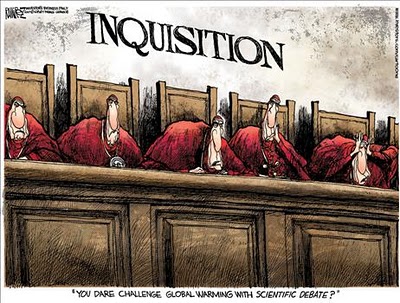
Climate Hysteria is a Global Psy-Op

Iron triangle Crisis

Iron Triangle of Public Crises

Alasdair Macleod writes at Goldmoney The problem with climate change politics. Excerpts in italics with my bolds.

Climate change bears all the hallmarks of a state-sponsored crisis, useful to shift attention from other political failures. But the absence of financial accountability which characterises government actions also introduces behavioural errors.

The absence of a profit motive in any state action exposes the relationship between governments and their electors to psychological factors. We all know that governments use propaganda and other tools to manage crowd psychology and influence their electorates. What is less understood is that governments themselves are misled by a crowd psychology in its own ranks which contributes to policy failure.

This article does not question the climate change debate itself. Instead, it examines the debate in the context of the psychology driving it. The release of government-sponsored propaganda on climate change in the form of a unanimous IPCC report predicting the end of the world as we know it is the latest example of a political and bureaucratic phenomenon, making the timing of this article highly relevant.

Six psychological factors

 In Chapter 6 of Desrochers & Szurmak’s work, they identify six distinct psychological factors which we will take in turn to enhance our understanding of the psychology of climate change. I list them under the following headings:

♦ The iron triangle of crisis
♦ The psychology of entrenched arguments
♦ Motivated reasoning
♦ The core theoretical theme
The anointed elite and
♦ Optimism and pessimism

The Desrocher and Szurmak reference is to their book Population Bombed.  My synopsis with links is Control Population, Control the Climate. Not.

The iron triangle of crisis

Even from before the time of Malthus, there have been political influencers and activists who have promoted pessimistic assumptions about uncontrolled population expansion, and the ability of the planet’s resources to feed them. Despite these fears being subsequently proved to be unfounded they continue to prevail among those who don’t need to pursue profits for a living. It is a bias to which politicians and their advisers are especially vulnerable.

The public naturally expects its elected representatives’ unbiased endeavours when bringing national threats to its attention. After all, it is arguably a primary function of government to protect its population from dangers, real and potential. There are government departments tasked with assessing dangers to society, their likelihood, and in their event how government should respond. These are tasks that require unbiased research. But political guidance from the top is rarely neutral, seeking to influence outcomes.

And we now find that climate change science has become heavily politicised.

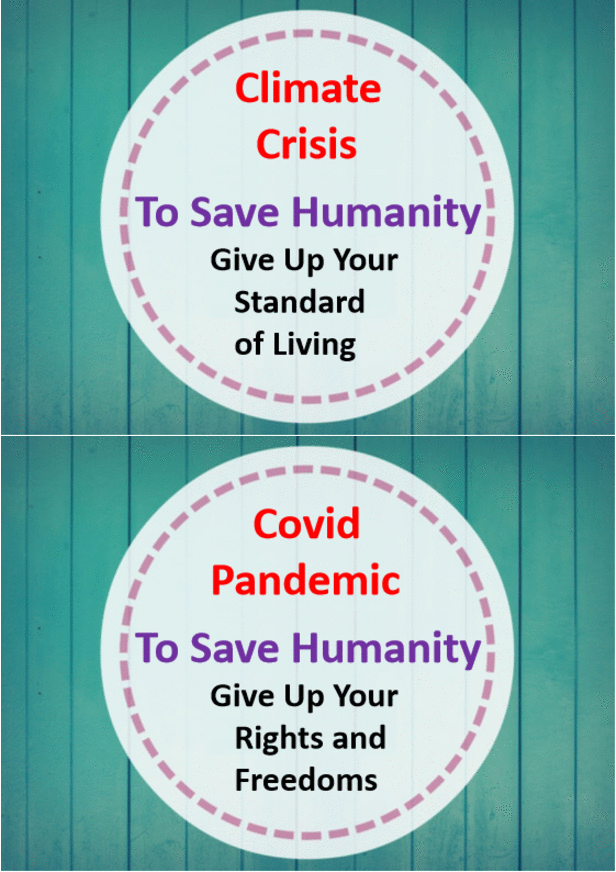
Climate change is the gift that goes on giving to politicians. It creates an impression of tackling the big issue of our times. And it is a source of crisis giving cover for failings over lesser priorities. Observing how Boris Johnson maintains his popularity through a combination of leading the world in the battle against climate change while seeking every photo opportunity possible and at the same time presiding over the Covid disaster has been a masterclass in practical politics. One is left wondering how vacuous his politics would appear without the prop of climate change.

On his watch, the politics of climate disaster have taken on a new life in the UK. Government spending plans angled at reducing carbon emissions has accelerated, as has the support and credibility given by state-funded scientists producing alarming forecasts. Radical environmentalism is not only embraced, but actively promoted through the media.

This trinity, this iron triangle of crisis as Desrochers and Szurmak put it, is therefore comprised of establishment interests, the promotion of fear, and media management. It focuses the public’s mind on a specific threat to the exclusion of others. It is a feedback loop of career and protectionism driven by the psychology of entrenched arguments, which is our next topic.

The psychology of entrenched arguments

A rational approach to absorbing and understanding new information would be to address it logically and without bias. Clearly, this does not happen. Our brains are still wired as they were in our hunter-gatherer days when our decisions were based on a choice of fight or flight. We therefore have a natural tendency to hold onto a protected position after it becomes untenable.

Imagine being part of a community of primitive cave-dwellers and fight or flight becomes a group decision. We will support each other in uncertainty well after a crisis point has passed, breaking ranks after flight has become the only option. It is survival by inward-looking mutual defence, not attack. It is the deep psychology behind groupthink, or the psychology of entrenched arguments. It leads to the cliff-edge of crisis.

Researchers from Cornell University have examined the phenomenon.[iii] They found that “participants prefer to learn information from in-group sources and agree more with in-group members on moral and political issues”. This takes groupthink into persistence territory after the flight option has long passed, and existing views become defensively entrenched. Awareness of the true situation becomes compromised through self-ignorance of the flaws in the group’s knowledge and judgement. It even has a name: the Dunning-Kruger effect.[iv]

To this self-ignorance can be added a group’s overestimation of its understanding of controversial issues, leading to the illusion of “understanding bias”. The more members of a group who debate an issue, the more understanding bias is reinforced. You see evidence of understanding bias in wider politics, particularly when opinions coalesce over time into different political ideologies. In America, the Democrats are as intellectually capable as the Republicans, yet the two parties have retreated into sharply differing understanding biases.

Entrenched arguments are reinforced by naïve realism. A naïve realist assumes he or she personally is both rational and unbiassed in the assimilation and assessment of the facts, and further assumes that those who do not reach the same conclusions are ignorant, biased or both. Naïve realism is the product of a false consensus, under which those that agree with the naïve realist are seen to be more rational than those that do not. Entrenched arguments and naïve realism become the driving force behind motivated reasoning.

Motivated reasoning

We naturally believe in scientific research, on the incorrect assumption that all those PhDs from top universities conduct experiments for the same reasons as we were taught at school in chemistry lessons. Unfortunately, the scientific community’s motivation, in both the natural and social sciences, is not so pure. Scientists are human and need to earn a living, which is far easier to do if they go with the general confirmation bias. In the post-education world, a scientist needs a paid position, recognition and to publish frequently in respected journals. Good ideas become suppressed and poor data to back bad ideas are too frequently the result of this motivated reasoning.[v]

It was best summed up by John Ioannidis, a professor of medicine at Stanford University:

“Scientists in a given field may be prejudiced purely because of their belief in a scientific theory or commitment to their own findings… Prestigious investigators may suppress via the peer review process the appearance and dissemination of findings that refute their findings, thus condemning their field to perpetuate false dogma. Empirical evidence on expert opinion shows that it is extremely unreliable.”[vi]

Admittedly, Professor Ioannidis was writing about research in the natural sciences, but the methods and empirical evidence extends to the social sciences as well. It describes well the research papers published by central banks and the economist professors in universities. It is also characteristic of the opinion silos in government departments.

Motivated reasoning, such as on climate change and political correctness, is all about building a core theoretical theme.

The core theoretical theme

One way in which experts refute opposing evidence is by sticking to a core theoretical theme. I recall email correspondence I had with a well-known financial journalist in 2016, which ground to a halt when he declared,

“In my view, the record global savings rate (27pc) is the root cause of our problems. Some way must be found to rotate this into consumption to rebalance the global economy.”

In other words, he adhered to a core theoretical theme common to neo-Keynesian economists. By expressing it as his view, he was obviously not prepared to debate why he held that the record global savings rate was the root cause of our problems. We are not judging whether it is correct, only that he holds it, he assumes it. He was signalling he will not be shifted, so further debate is pointless. This is true of all state-funded economics, which this opinion reflects. Numerous papers have been written to justify this stance. We have lived with this view since Keynes published his General Theory in 1936. As in Keynesian economics, a core theoretical theme has emerged in the climate change debate

But if Professor Ioannidis is right about empirical evidence showing expert opinion is extremely unreliable, and which appears to be confirmed in the fields of economics and monetary theory, it explains the closed minds to balanced debate in fields such as climate change. So long as a core theoretical theme is adhered to, it becomes almost impossible to overturn.

A determination to stick to the core Keynesian theme on the savings paradox is my journalist friend’s membership card for the anointed elite.

The anointed elite

Many of us want to belong, to make a difference, to enhance society. We know that to do so we must have influence and the best way to do that is to join and promote a cause that has the establishment’s support. And there is nothing like that comforting feeling of an open invitation into the parlours of the great and the good. Well-known figures in the media with this access use their fame and position to anoint themselves alongside the elite and continue to have a career for so long as they play the elite’s game.

The anointed elite was the description of the economist and political theorist, Thomas Sowell, Senior Fellow at the Hoover Institution, Stanford University. He came up with it in his pithily named 1995 book, The Vision of the Anointed: Self-congratulation as a basis for social policy.

Even though we may not recognise it at the time, we have all come across it: the independent expert frequently called on by the media for comment in a specialist field. These experts rely on being informed by government insiders. They adopt the expert mantle, but it is never made clear that they owe their media status almost entirely to their membership of a government-anointed elite and their support of the elite’s objectives. But if they are stupid enough to turn critic, they will be immediately unanointed and they know it.

It applies to ex-politicians and media correspondents alike. If, say, a correspondent for a national newspaper doesn’t play along, he risks being dropped from background briefings by the elite, while his confrères at other journals continue to be invited. “That journalist from the Daily Screech is unreliable. Best not include him in our off-the-record briefings.” The threat of exclusion is the surest way for the elite to ensure that its message is the one that prevails.

Optimists v. pessimists

The glass-half-full optimists and the glass-half-empty pessimists are not split evenly across two sides of an issue. In practice, the establishment and those with a position in society are protective and pessimistic about change because it is a threat to their established position, while commercially minded outsiders tend to take a more positive view.

Psychologists tell us that as humans we have two personalities. One half of us protects what we have, giving us a sense of location, property, and home. The other half is a traveller in search of new vistas, foreign relationships, and trade. Journalist and activist Jane Jacobs (of New York City and then Toronto) identified and described these two patterns of moral precepts as guardian and commercial syndromes.[vii]

According to Jacobs, we have a different mix of these characteristics as individuals, communities and even at national levels. The two syndromes show different characters, which is why some of us are adventurers and others home birds. Commercial relationships are outgoing, and honesty in business is rewarded, while guardians are protective, favour loyalty and support the establishment. Commercials shun force and come to voluntary agreements, while guardians shun trading and exert prowess. Commercials are collaborative, competitive and respect contracts, while guardians are exclusive, take vengeance and respect hierarchy. Commercials are open to inventiveness and novelty, while guardians expect obedience and discipline. And so on.

The commercials’ activities encompass work in making and trading, while the guardians are political leaders, administrators, educators, and upholders of the law. The two syndromes are a neat explanation for the different mindsets and social duties of the private sector compared with governments.

The consequences of climate change politics

The purpose of this article is not to enter the climate change debate but to examine the flaws in the process. Realistically, it is too late to question the line being pursued, having gone beyond any influencer’s control. It is common knowledge that the science is politically influenced by state funding. But it is not widely appreciated that the process of hyping up climate change into a full-blown crisis has become the consequence of a crowd psychology rather than a pursuit of the facts.

The political advantages of introducing legislative targets for climate policies in 2030 or 2040 is that they are sufficiently far away for current politicians to have dumped the problem onto their successors. Without carbon fuels and having subsidised unreliable wind and solar energy to the point where other energy sources, notably nuclear, are uneconomic, the cost of climate change politics threatens to be ruinous for economic activity in the future, threatening the tax base and therefore the expenditure of the governments which have thoughtlessly promoted it.

brain on climate alarm

This is your brain on climate alarm.  Just say NO!

Punishing Climate Policies to Fix What’s Not Broken

barrel-poison-7388531rev

Ben Pile writes at Spiked Climate policy, not climate change, poses the biggest risk to our daily lives.  Excerpts in italics with my bolds.

Firstly, Ben provides evidence for a reasonable person to conclude the weather and climate is doing nothing out of the ordinary.  Drawing on this year’s UK State of the Climate report:

But how significant are these changes really? Take, for example, the claim that the UK’s temperatures have increased. Leaving aside the possibility that land-use change thanks to the UK’s economic development might influence temperatures, the report offers this chart depicting 140 years of anomalies in UK and global annual temperatures:

graph-1-960x440-1

Though the chart clearly shows that UK temperatures have risen, there is substantial year-to-year variability – far greater in the UK than for the world as a whole – that might make us wonder how impactful this extra warmth really is.

The point is shown more clearly by the report’s chart which shows temperature anomalies in each season:

graph-2-960x476-1

Over the past 370 years, winters appear to have become substantially warmer. Really what this means is that they have become substantially less cold, rather than actually warm. Autumn and spring also seem to have become milder, whereas the summer has warmed the least.

What’s more, each season shows remarkable changes over the decades and even centuries – showing large-scale change was occurring long before manmade climate change became an issue. The temperature changes of the 1990s are not unprecedented in their degree or speed.

Pile goes on to discuss the absence of facts for other claims regarding precipitation, storms, heatwaves. etc.  Then comes the meat of his argument.

casper-landfill-2-e1624827835334

Climate is Not the Problem:  It’s the so-called “solutions”

But the climate, again, is not the real issue here. An even more uncomfortable truth for environmentalists is that cheap, abundant and easy-to-use energy – ie, gas – has done and could continue to do far more to keep older and infirm people alive in the winter than milder weather ever could. In other words, fossil fuels save lives.

It is climate policy not climate change that wants to deny people the right to heat or cool their homes cheaply and efficiently. Just look at the exorbitant costs to households of Boris’s planned boiler ban. The weather itself does not play any significant role in daily life in historically wealthy, industrialised and liberal societies.

This fact is seen even more clearly in that other preoccupation of climate doomsayers: floods. The environmentalist argument is that warmer air carries more water, and so rainfall events have become more intense, leading to more flash flooding in particular. ‘The higher global warming, the more rainfall’, climate academic Friederike Otto told the Independent, in an article which tried to pin blame for the recent floods in Germany on climate change.

Floods certainly are disruptive. Unsurprisingly, this captures the news media’s attention. But proving a link to climate change is much harder than the media have made out. The most recent IPCC report, for instance, has ‘low confidence’ in the claim ‘that anthropogenic climate change has affected the frequency and the magnitude of floods’. Meanwhile, it has ‘high confidence’ that ‘streamflow trends since 1950 are not statistically significant in most of the world’s largest rivers’. Similarly, other research suggests that there is little evidence of flash floods getting worse in the UK.

What causes floods, then? In the recent case of the tragic floods in Germany, flood warnings were ignored by civil planners and politicians.

Floods in Britain are rarely fatal. But when horrendous flooding does occur, it should be seen as a result not of an altered climate, but of engineering, planning and policy failures. As the nearly three-centuries-long record in the Met Office’s possession clearly shows, various parts of the UK, from time to time, suffer periods of intense rainfall, causing floods. Any urban or infrastructure design that fails to take account of the likelihood of flooding makes flooding inevitable.

In other words, flooding is a manmade event – but not one caused by climate change. There is no such thing as a ‘natural disaster’ in a country as wealthy as the UK. Even if adverse weather events are made ‘more likely’ or even ‘more intense’ by CO2 emissions in the future, as the Met Office report argues, we already know what kind of policies and infrastructure we need to deal with this. There is no excuse for not building this infrastructure: warmer, wetter, colder and drier conditions all existed in the past, and so will likely appear again in the future. What’s past is prologue.

Ironically, it is environmentalism that makes the climate actually dangerous.

Green austerity will deny people the resources and technology they need and deserve to keep warm in winter and cool in summer. And it is environmentalism, with its promise to make the weather ‘safe’ and unchanging if we follow its agenda, that is selling us false hope. That is a much greater threat than climate change or extreme weather could ever be.

b45fee974eb5b959a6718fbac960afbc

See also my series World of Hurt from Climate Policies 

World of Hurt from Climate Policies-Part 4

CO2 and COPs

Leave it in the Ground Means Perpetual Poverty


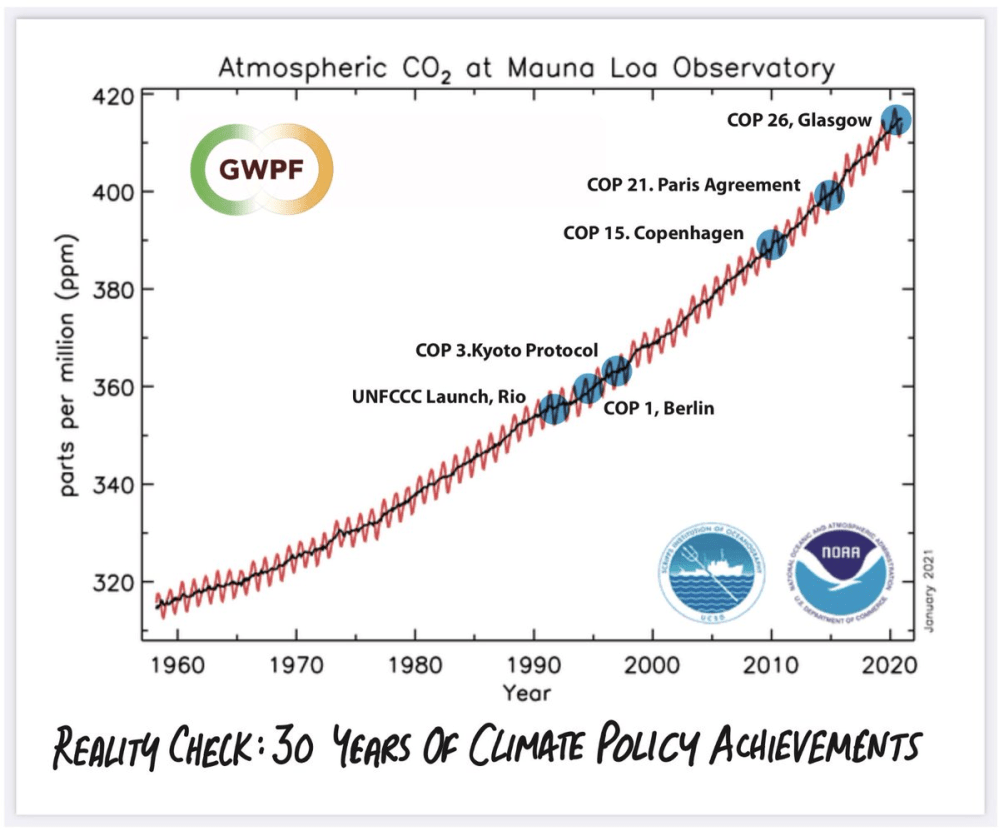
This is a fourth post toward infographics exposing the damaging effects of Climate Policies upon the lives of ordinary people.  (See World of Hurt Part 1Part 2, and Part 3 )  And all of the pain is for naught in fighting against global warming/climate change, as shown clearly in the image above.  This post presents graphics to illustrate the fourth of four themes:

  • Zero Carbon Means Killing Real Jobs with Promises of Green Jobs
  • Reducing Carbon Emissions Means High Cost Energy Imports and Social Degradation
  • 100% Renewable Energy Means Sourcing Rare Metals Off-Planet
  • Leave it in the Ground Means Perpetual Poverty
The War Against Carbon Emissions Diminishes Efforts to Lift People Out of Poverty

world-population-in-extreme-poverty-absolute
The OurWorldinData graph shows how half a billion people have risen out of extreme poverty in recent decades.  While much needs to be done, it is clear that the world knows the poverty factors to be overcome.

wellbeing improves

That comprehensive diagram from CGAP shows numerous elements that contribute to rising health and prosperity, but there is one resource underlying and enabling everything:  Access to affordable, reliable energy.  From Global Energy Assessment: 

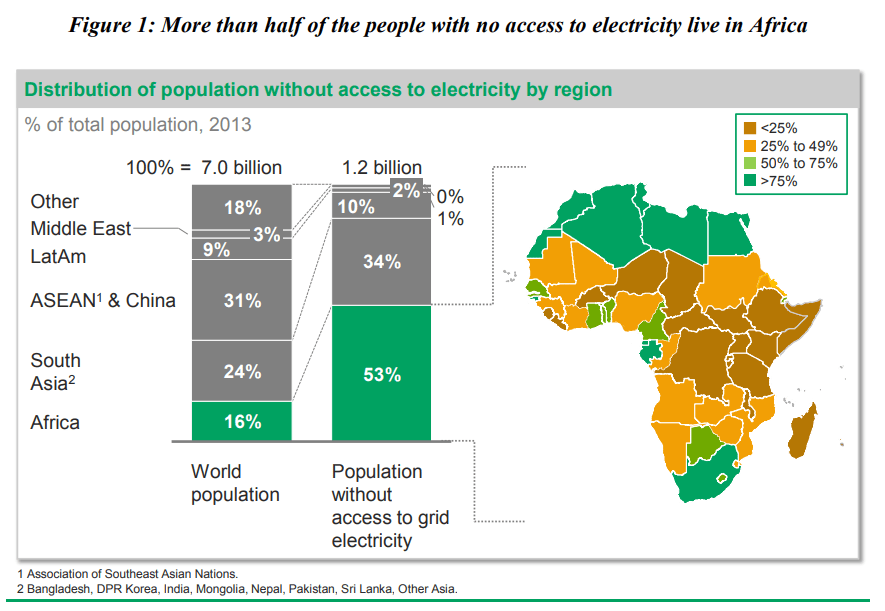
“Access to cleaner and affordable energy options is essential for improving the livelihoods of the poor in developing countries. The link between energy and poverty is demonstrated by the fact that the poor in developing countries constitute the bulk of an estimated 2.7 billion people relying on traditional biomass for cooking and the overwhelming majority of the 1.4 billion without access to grid electricity. Most of the people still reliant on traditional biomass live in Africa and South Asia.

The relationship is, in many respects, a vicious cycle in which people who lack access to cleaner and affordable energy are often trapped in a re-enforcing cycle of deprivation, lower incomes and the means to improve their living conditions while at the same time using significant amounts of their very limited income on expensive and unhealthy forms of energy that provide poor and/or unsafe services.”

The moral of this is very clear. Where energy is scarce and expensive, people’s labor is cheap and they live in poverty. Where energy is reliable and cheap, people are paid well to work and they have a better life.

adb fig.1
adb fig.2
adb fig.3
adb fig.4
adb fig.5
adb fig.7

How Climate Policies Keep People Poor

Note that the vision for 100% access to electric power was put forward by the African Development Bank in 2016.  (Above slides come from The Bank Group’s Strategy for The New Deal on Energy for Africa 2016 – 2025).  Instead of making finances available for such a plan, an International Cabal organized to deny any support for coal, the most available and inexpensive way to electrify Africa.
ieefa coal restrictionsThis is an organized campaign to deny coal-fired power anywhere in the world, despite coal being the starting point in the development pathway for every modern society, and currently the success model for Asia, and China in particular.  [Note in Figure 3 above that South Africa, the most advanced of African nations gets the majority of its power from coal.] The chart above comes from IEEFA 2019 report Over 100 Global Financial Institutions Are Exiting Coal, With More to Come.  Their pride in virtue-signaling is expressed in the subtitle:
Every Two Weeks a Bank, Insurer or Lender Announces New Restrictions on Coal.

How Climate Policies Waste Resources that could Improve Peoples’ Lives

The Climate Crisis Industry costs over 2 Trillion US dollars every year, and is estimated to redirect 30% of all foreign aid meant for developing countries into climate projects like carbon offsets and off-grid wind and solar. 

A much better plan is put forward by the Copenhagen Consensus Center.  A panel of social and economic development experts did cost/benefit analyses of all the Millenium Goals listed by the UN working groups, including climate mitigation and adaption goals along with all the other objectives deemed desirable. They addressed the question: 

What are the best ways of advancing global welfare, and particularly the welfare of developing  countries, illustrated by supposing that an additional $75 billion of resources were at their disposal  over a 4‐year initial period?

These challenges were examined:

  1. Armed Conflict
  2. Biodiversity
  3. Chronic Disease
  4. Climate Change
  5. Education
  6. Hunger and Malnutrition
  7. Infectious Disease
  8. Natural Disasters
  9. Population Growth
  10. Water and Sanitation

CCC budget

Imagine how much good could be done by diverting some of the trillions wasted trying to bend the curve at the top of the page?


World of Hurt from Climate Policies-Part 3

CO2 and COPs

100% Renewable Energy Means Sourcing Rare Metals Off-Planet


This is a third post toward infographics exposing the damaging effects of Climate Policies upon the lives of ordinary people.  (See World of Hurt Part 1 and Part 2)  And all of the pain is for naught in fighting against global warming/climate change, as shown clearly in the image above.  This post presents graphics to illustrate the third of four themes:

  • Zero Carbon Means Killing Real Jobs with Promises of Green Jobs
  • Reducing Carbon Emissions Means High Cost Energy Imports and Social Degradation
  • 100% Renewable Energy Means Sourcing Rare Metals Off-Planet
  • Leave it in the Ground Means Perpetual Poverty
Part 3:  Wind and Solar Infrastructure Consumes Rare Metals Far Beyond World Supplies

WHCP3 Rare Metals Demand by techMetal demand per technology

There are various technologies available for the production of electricity through wind and solar. Each technology requires different amounts of critical metals. This figure shows the metal demand for the five most common technologies.

Conclusions
• Newer technologies are often more efficient and cheaper, however, they rely on the properties of critical metals to achieve this.
• Thin film cadmium-tellurium solar PV cells have the best performance in terms of CO2 -emissions and energy payback times. They do however require large quantities of tellurium and cadmium, and tellurium is one of the rarest metalloids.
Direct-drive wind turbines use neodymium-dysprosium based permanent magnets. They are more expensive to produce, but cheaper in their exploitation phase. Gearbox turbines require less critical metals, but are generally understood to have higher maintenance costs because they have more moving parts. Gearbox turbines also have a shorter energy payback time.

Method The average metal demand per unit of electricity is calculated based on load hours in the Netherlands.7–9 The entire lifespan of the specific technologies has been taken into account.WHCP3 Rare Metals Dutch DemandMetal demand for Dutch renewable electricity production

This chart shows the average annual metal demand (for 22 metals) required for the installation of new solar panels and wind turbines. This assumes a linear installation of capacity.

The annual metal demand is compared to the annual global production of these specific metals, resulting in an indicator for the share of Dutch demands for renewables in global production.

Conclusions
• For five of the metals, the required demand for renewable electricity production capacity is significant: neodymium, terbium, indium, dysprosium, and praseodymium.
• If the rest of the world would develop renewable electricity capacity at a comparable pace with the Netherlands, a considerable shortage will arise.
• When other applications (such as electric vehicles) are also taken into consideration, the required amount of certain metals would further increase.

Method The renewable electricity targets for 2030 serve as the starting point for the calculations. Based on these targets, the annual installed capacity is calculated. The metals required for this capacity are shown as a percentage of the annual global production.
WHCP3 Rare Metals FlowsOrigin of critical metals

This diagram shows the origin of the metals required for meeting the 2030 goals. The left side of the diagram shows the origin, based on today’s global production of metals. The right side shows the cumulative metal demand for wind and solar technologies until 2030.

Conclusions
• The Netherlands is entirely dependent on countries outside of Europe – and mainly on China – for its critical metals.
• Not only is the main share of current production located in China, the country also hosts refinery facilities for many metals.
• Australia and Turkey are also important countries for the extraction of specific metals, particularly neodymium (Australia) and boron (Turkey).

Method The renewable electricity capacity required is calculated from the goals in the Climate Agreement outlines. This capacity is then translated to a metal demand. The ratio of world production is based on the annual production statistics of 2017.
WHCP3 Rare Metals Supply DemandGlobal critical metal demand for wind and PV 

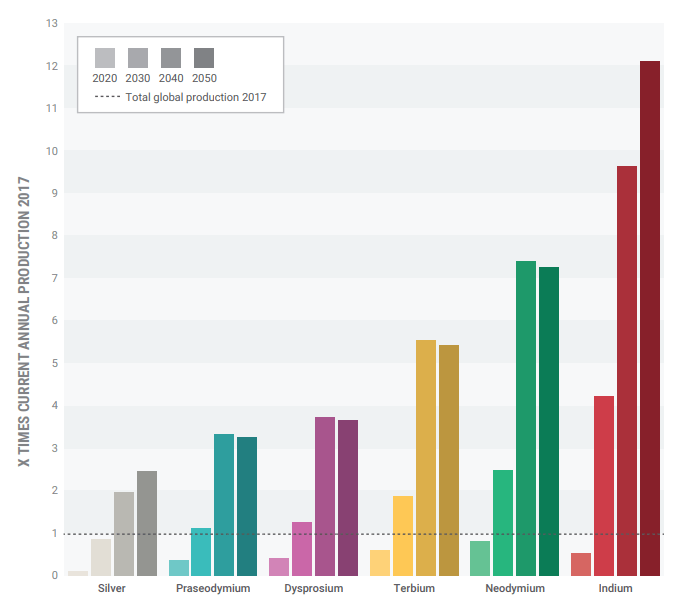
When considering a global perspective, the critical metal demand for our future renewable electricity production is significant. This graph shows the annual metal demand for the six most critical metals, compared to the annual production. The dotted line represents present-day annual production.  

Conclusions
Future annual critical metal demands of the energy transition surpass the total annual critical metal production.
• An exponential growth in renewable energy production capacity is not possible with present-day technologies and annual metal production. As an illustration: in 2050, the annual need for Indium (only for solar panel application) will exceed the present-day annual global production twelvefold.
• To be able to realize a renewable energy system, there is a need to both dematerialize renewable electricity production technologies and increase global annual production.

Source: Metal Demand for Renewable Electricity Generation in the Netherlands.

[Note:  The US consumes 30 times more energy than the Netherlands.]

And there is another precious resource required for wind and solar power plants:  Land in proximity to human settlements

Wind Farms Area for LondonThe gray area would be required for a wind farm large enough to power London UK.  The yellow area would be required for solar panels.

Albany and Indian Point2

Just to replace the now closed Indian Point nuclear plant will require a wind farm the size of Albany County New York.


World of Hurt from Climate Policies-Part 2

CO2 and COPs

Reducing Carbon Emissions Means High Cost Energy Imports and Social Degradation

This is a second post toward infographics exposing the damaging effects of Climate Policies upon the lives of ordinary people.  (See World of Hurt Part 1)  And all of the pain is for naught in fighting against global warming/climate change, as shown clearly in the image above.  This post presents graphics to illustrate the second of four themes:

  • Zero Carbon Means Killing Real Jobs with Promises of Green Jobs
  • Reducing Carbon Emissions Means High Cost Energy Imports and Social Degradation
  • 100% Renewable Energy Means Sourcing Rare Metals Off-Planet
  • Leave it in the Ground Means Perpetual Poverty

Part 2:  California Exemplifies Ruination from Self-imposed Climate Policiesca-oil-supplies-source-700x507-1For the past 25 years the amount of oil supplied to California’s refineries has essentially held steady at around 660 million barrels per year, but the source of the supply has changed drastically. In 1995, nearly all of that oil came from within California’s borders and Alaska. Today, the majority of the oil comes from foreign imports as data from the state’s Energy Commission shows.WHCP2 Cal oil productionWHCP2 Cal oil leasesBy blocking domestic production through permit denials, California is playing a shell game with emissions. Overall use of petroleum products has held steady but shifted from energy produced within the state – where the industry is subject to U.S. environmental regulations and supports local workers and companies – to overseas.

California isn’t reducing its dependence on oil; it’s just adding a higher carbon footprint to get it.ca-oil-foreign-source-768x500-1Californians pay one of the highest electricity rates in the United States. In 2015, the average resident spent 2.7 percent of their salary on electricity and paid approximately $1,700 annually to keep their lights on. This percentage has been increasing since 2008 Prices have climbed 30 percent over the last decade as successive governors have mandated that an increasing share of electricity is sourced from renewables.cg5b8ded55e8c77aga-energy-transferDespite natural gas rates being at their lowest levels since 1999, several municipalities across California have proposed or implemented bans on the use of the resource in homes and businesses. 

As individuals leave the gas grid, the poor will face higher prices on the grid and higher electricity prices when they switch. They will be threatened with a higher cost of living that could force them from their homes. Lower income individuals are priced out of neighborhoods where they could build equity because of higher electric costs. Middle class and wealthy individuals pay four times more for electricity, diminishing disposable income, while still paying for a gas grid they are unable to connect to through municipal law.

The result of California’s efforts? A reduction of global emissions by less than half of one percent.5db36b3ee25b2.image_Sources:  EnergyInDepth:  California

See also:  California on the Road to Ruin


World of Hurt from Climate Policies-Part 1

CO2 and COPs

This is a beginning post toward infographics exposing the damaging effects of Climate Policies upon the lives of ordinary people.  And all of the pain is for naught in fighting against global warming/climate change, as shown clearly in the image above.  This post presents graphics to illustrate the first of four themes:

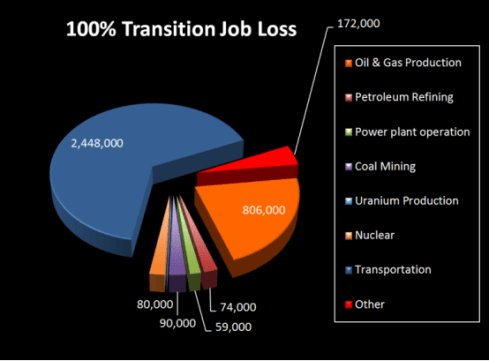
Part 1:  Zero Carbon will Decimate US Workforce

WHCP fig1r

WHCP fig1ar

WHCP fig2ar

WHCP fig3a

WHCP fig3

Tables of Oil and Natural Gas Employment and Economic Impact come from API Price Waterhouse Cooper  Impacts of the Oil and Natural Gas Industry on the US Economy in 2019    As for Coal, EIA estimates the industry lost 75% of its workforce down to 53,000 employees (2019) working in coal mines, and the number has stabilized with exports offsetting declines in domestic consumption.  The losses of jobs in oil and gas come from EID (Energy in Depth) CLIMATE ACTIVISTS PUSH STUDY SHOWING 3.8 MILLION LOST JOBS FROM RENEWABLE ENERGY TRANSITION.

“While many experts dispute the feasibility of Jacobson’s plan for a renewables-only energy grid, the severe job losses are far more difficult to dispute, given that they come directly from Jacobson’s research. Those job losses would undoubtedly be devastating for millions of American families.”

cb020621dapc20210206014624

And about Those Promised Green Jobs to replace the lost ones:  

In February 2009, the last time Democrats controlled the White House and both chambers of Congress, President Barack Obama and Vice President Joe Biden flew to Colorado to sign their $787 billion stimulus package into law.

The plan was to invest $150 billion over 10 years that would advance a “clean energy” economy built around biofuels, hybrid cars, low-emission coal plants, and renewable sources such as solar and wind. Obama and Biden promised to create five million green jobs that would specifically benefit low-income earners, claiming that the stimulus package included “help for those hit hardest by our economic crisis.”

mrz041312dapr20120413044622

A decade later, we now know that the 2009 green jobs program was a complete failure. The Department of Labor (DoL) and the Bureau of Labor Statistics (BLS) issued several reports on the green jobs program. Each report was an indictment on the program, as job placement met only 10 percent of the targeted level, and many of those who were hired remained employed for less than six months.

Even the new, redefined green jobs did not reach the five million promised in February 2009. According to a study by the Brookings Institution, the Obama–Biden administration identified nearly 2.7 million green jobs, but most were bus drivers, sewage workers, and other types of work that do not match the “green jobs of the future” that the administration promised. Most of them were preexisting jobs, which were simply re-characterized by the government, apparently in an effort to boost the numbers.  Source: If at First You Don’t Succeed, Try ‘Green Jobs’ Again

See also Green Energy Failures Redux

picture-9

o

Better to do nothing than try to reach UN climate targets

economics-literature-does-not-support-1.5c-climate-goal

Lorrie Goldstein writes a review of a new Fraser Institute study by McKitrick and Murphy.  The study is Off Target: The Economics Literature Does Not Support the 1.5C Climate Ceiling.  Excerpts from Goldstein’s article in italics with my bolds.

Trying to achieve the United Nations’ target of limiting global temperature increases to 1.5 C above pre-industrial levels will do more social and economic harm than good, says a new study by the Fraser Institute released Tuesday.

“Although advocacy of aggressive climate-change policies is often draped with the mantel of science … the popular 1.5C policy target will pose costs that far exceed the benefits,” the study says.

“Emission reductions flowing from strict adherence to the 1.5C target would be worse for the world than doing nothing at all.”

Study authors Ross McKitrick and Robert P. Murphy argue in Off Target: The Economics Literature Does Not Support the 1.5C Climate Ceiling, that the 1.5C target “did not arise … from formal cost-benefit analysis.”

In fact, a 2018 report by the UN’s Intergovernmental Panel on Climate Change that argued there would be net societal benefits to achieving the 1.5C target — used by Canada and other countries to justify the public cost of lowering greenhouse gas emissions — “expressly stated” it did not do a cost-benefit analysis.

The 2018 UN study, Global Warming of 1.5°C — An IPCC Special Report, said because the calculations were so complex, “standard cost–benefit analyses become difficult to justify and are not used as an assessment tool in this report.”

Instead, the UN report cited a range of studies that have estimated the global cost of carbon pricing (expressed here in current Canadian dollars) to meet the UN’s target of limiting global temperature increases to 1.5C above pre-industrial levels by 2100.

They went from a low of $170 per tonne of emissions, to a high of $6,900 per tonne by 2030; $307 per tonne to $16,300 per tonne by 2050; $527 to $21,955 by 2070 and $865 to $33,873 by 2100.  Given such numbers, Murphy argues in the Fraser report, “it would be better if governments did nothing at all about climate change than to try to achieve the 1.5C target because the costs so outweigh the estimated benefits.

(Prime Minister Justin Trudeau’s current carbon price is $40 per tonne of emissions, rising to $170 per tonne in 2030.)

In the real world, no government is going to impose a carbon tax/price of up to $6,900 per tonne of emissions by 2030 — with more hikes after that — because it would be political and economic suicide.

No one knows what global temperatures are going to be in 2100, nor what the global carbon price on emissions would have to be by then to meet the UN’s target of limiting warming to 1.5C above pre-industrial levels.

What we do know for a fact today is that global emissions are steadily rising. The only exceptions in the modern era occurred in 2008-09 and 2020, when they fell dramatically not because of carbon pricing, but because of global recessions, before resuming their upward climb the following year.

We also know that as of 2021, we are so far behind the UN’s target of reducing emissions to 45% below 2010 levels by 2030, that achieving that goal would require lowering emissions globally by 7.6% annually every year between now and 2030.

And finally, we know that, since almost all goods and services consume fossil fuel energy, a 7.6% annual reduction in emissions every year from now until 2030, would provoke an unprecedented global recession in which the social and economic costs would far outweigh the benefits.

economics-literature-does-not-support-1.5c-climate-ceiling-infographic

Deception: Climate Financial Risk

Carney GQ

John H. Cochrane writes at Project Syndicate The Fallacy of Climate Financial Risk.  Excerpts in italics with my bolds.

The idea that climate change poses a threat to the financial system is absurd, not least because everyone already knows that global warming is happening and that fossil fuels are being phased out.
The new push for climate-related financial regulation is not really about risk; it is about a political agenda.

In the United States, the Federal Reserve, the Securities and Exchange Commission, and the Department of the Treasury are gearing up to incorporate climate policy into US financial regulation, following even more audacious steps in Europe. The justification is that “climate risk” poses a danger to the financial system. But that statement is absurd. Financial regulation is being used to smuggle in climate policies that otherwise would be rejected as unpopular or ineffective.

“Climate” means the probability distribution of the weather – the range of potential weather conditions and events, together with their associated probabilities. “Risk” means the unexpected, not changes that everyone knows are underway. And “systemic financial risk” means the possibility that the entire financial system will melt down, as nearly happened in 2008. It does not mean that someone somewhere might lose money because some asset price falls, though central bankers are swiftly enlarging their purview in that direction.

Bomb of money hundred dollar bills with a burning wick. Little time before the explosion. Concept of financial crisis

In plain language, then, a “climate risk to the financial system” means a sudden, unexpected, large, and widespread change in the probability distribution of the weather, sufficient to cause losses that blow through equity and long-term debt cushions, provoking a system-wide run on short-term debt. This means the five- or at most ten-year horizon over which regulators can begin to assess the risks on financial institutions’ balance sheets. Loans for 2100 have not been made yet.

Such an event lies outside any climate science. Hurricanes, heat waves, droughts, and fires have never come close to causing systemic financial crises, and there is no scientifically validated possibility that their frequency and severity will change so drastically to alter this fact in the next ten years. Our modern, diversified, industrialized, service-oriented economy is not that affected by weather – even by headline-making events. Businesses and people are still moving from the cold Rust Belt to hot and hurricane-prone Texas and Florida.

insurance-exclusions

If regulators are worried even-handedly about out-of-the-box risks that endanger the financial system, the list should include wars, pandemics, cyberattacks, sovereign-debt crises, political meltdowns, and even asteroid strikes. All but the latter are more likely than climate risk. And if we are worried about flood and fire costs, perhaps we should stop subsidizing building and rebuilding in flood and fire-prone areas.

Climate regulatory risk is slightly more plausible. Environmental regulators could turn out to be so incompetent that they damage the economy to the point of creating a systemic run. But that scenario seems far-fetched even to me. Again though, if the question is regulatory risk, then even-handed regulators should demand a wider recognition of all political and regulatory risks. Between the Biden administration’s novel interpretations of antitrust law, the previous administration’s trade policies, and the pervasive political desire to “break up big tech,” there is no shortage of regulatory danger.

Climate Piggy Bank

To be sure, it is not impossible that some terrible climate-related event in the next ten years can provoke a systemic run, though nothing in current science or economics describes such an event. But if that is the fear, the only logical way to protect the financial system is by dramatically raising the amount of equity capital, which protects the financial system against any kind of risk.

Risk measurement and technocratic regulation of climate investments, by definition, cannot protect against unknown unknowns or un-modeled “tipping points.”

What about “transition risks” and “stranded assets?” Won’t oil and coal companies lose value in the shift to low-carbon energy? Indeed they will. But everyone already knows that. Oil and gas companies will lose more value only if the transition comes faster than expected. And legacy fossil-fuel assets are not funded by short-term debt, as mortgages were in 2008, so losses by their stockholders and bondholders do not imperil the financial system.

“Financial stability” does not mean that no investor ever loses money.

Moreover, fossil fuels have always been risky. Oil prices turned negative last year, with no broader financial consequences. Coal and its stockholders have already been hammered by climate regulation, with not a hint of financial crisis.

More broadly, in the history of technological transitions, financial problems have never come from declining industries. The stock-market crash of 2000 was not caused by losses in the typewriter, film, telegraph, and slide-rule industries. It was the slightly-ahead-of-their-time tech companies that went bust. Similarly, the stock-market crash of 1929 was not caused by plummeting demand for horse-drawn carriages. It was the new radio, movie, automobile, and electric appliance industries that collapsed.

If one is worried about the financial risks associated with the energy transition, new astronomically-valued darlings such as Tesla are the danger. The biggest financial danger is a green bubble, fueled as previous booms by government subsidies and central-bank encouragement. Today’s high-fliers are vulnerable to changing political whims and new and better technologies. If regulatory credits dry up or if hydrogen fuel cells displace batteries, Tesla is in trouble. Yet our regulators wish only to encourage investors to pile on.

Climate financial regulation is an answer in search of a question. The point is to impose a specific set of policies that cannot pass via regular democratic lawmaking or regular environmental rulemaking, which requires at least a pretense of cost-benefit analysis.

These policies include defunding fossil fuels before replacements are in place, and subsidizing battery-powered electric cars, trains, windmills, and photovoltaics – but not nuclear, carbon capture, hydrogen, natural gas, geoengineering, or other promising technologies. But, because financial regulators are not allowed to decide where investment should go and what should be starved of funds, “climate risk to the financial system” is dreamed up and repeated until people believe it, in order to shoehorn these climate policies into financial regulators’ limited legal mandates.

Climate change and financial stability are pressing problems. They require coherent, intelligent, scientifically valid policy responses, and promptly. But climate financial regulation will not help the climate, will further politicize central banks, and will destroy their precious independence, while forcing financial companies to devise absurdly fictitious climate-risk assessments will ruin financial regulation. The next crisis will come from some other source. And our climate-obsessed regulators will once again fail utterly to anticipate it – just as a decade’s worth of stress testers never considered the possibility of a pandemic.

John H. Cochrane is a senior fellow at the Hoover Institution.

global-warming-al-gore-wheel-650


Four Blunders in EU Climate Plan

theherculeantaskofkeepingco2emissionsdown_800x533_l_1626765909

Pieter Cleppe writes at Real Clear Energy Four Flaws With the EU’s New Climate Plans Excerpts in italics wtih my bolds and images.

Last week, the European Commission presented its so-called Fit for 55 proposals, a raft of legislative initiatives intended to adapt EU law to the 2030 target of reducing CO2 emissions by 55 percent from 1990 levels. The idea is to adapt legislation originally intended to achieve a 40% reduction.

This undertaking, however, is marked by serious shortcomings. Herewith, I summarize what’s wrong with it, listing four main flaws.

  1.  The European Commission is employing a top-down approach, riddled with taxes and spending

The European Commission seems to take former U.S. president Ronald Reagan’s characterization of “government’s view of the economy” as a manual, rather than as a warning. As Reagan summarized government’s approach: “If it moves, tax it. If it keeps moving, regulate it. And if it stops moving, subsidize it.”

2615928-milton-friedman-quote-the-big-problem-for-a-democratic-government

Most remarkable here is the Commission’s intention to impose a de facto ban on gasoline and diesel cars by 2035, even if France seems keen to extend this until 2040. When even France is less restrictive, you’re not in a good place. Feeling the need to resort to outright prohibition, the Commission is clearly not putting great trust in innovation to come up with economically efficient, CO2-neutral cars.

A notable change is the expansion of the EU’s cap and trade scheme, which puts a price on emitting CO2 but allows companies to buy and sell their right to do so. The Commission wants to expand this so-called Emissions Trading System (ETS) – set up 16 years ago and covering power plants, intra-EU aviation, and energy-intensive industries – to include buildings, road transport, and shipping. The expansion would start gradually in 2023 and be phased in over three years, as the emission-rights regime for aviation is being tightened up and sectors not covered by ETS are made subject to emission-reduction targets, with binding targets per member state. EU minimum excise-duty rates on various energy sources, like motor or heating fuel, would also need to be increased, and a jet-fuel tax would need to be introduced on intra-EU flights, on top of a tax on maritime fuel.

taxcartoon

Opponents of the proposals, which still need to be approved by both EU member states and the European Parliament, include the shipping industry, which hasn’t exactly welcomed its inclusion into the ETS system. The International Chamber of Shipping described the proposal as “an ideological revenue raising exercise, which will greatly upset the EU’s trading partners,” as it would involve “non-EU shipping companies to be forced to pay billions of euros to support EU economic recovery plans.”

This doesn’t even account for another part of Fit for 55, whereby the Commission intends to create the world’s first carbon border tariff, to be levied on imports of goods including steel, cement, and aluminum, to be phased in from 2026. This step is deemed necessary because two-thirds of CO₂-emissions are likely to continue, only now outside of the EU, causing “carbon leakage” – a phenomenon notably hard to estimate, although we know that China has long outpaced the U.S. and the EU in terms of carbon emission.

border-carbon-taxes

In response, Belgian employer federation VBO-FEB issued a warning about this “carbon border adjustment mechanism,” stating that “policy makers must be careful that (…) this will not cause other countries to impose countermeasures or cause supply chain distortions, leading us to import more finished products than raw resources.” The question remains as to whether this is not a protectionist measure in violation of the WTO agreement – especially when certain European producers would be exempt. In any case, it will unleash lots of extra bureaucracy, especially for small companies.

Also in line with Reagan’s description of government thinking is the European Commission’s plan to spend billions of euros to compensate for the damage done by its own measures – such as its proposal for a new “social climate fund” “to prevent fuel poverty,” using one-fifth of ETS revenue, on top of another fund, the €100 billion Just Transition Mechanism to help coal-dependent countries like Poland make the transition away from coal. Combined with the Commission’s demand to get at least 50% of the income derived from the new ETS transport and buildings revenue, this would mean that the ETS system would morph into an outright EU tax – a dream eurocrats have been pursuing for years.

2.  The proposed measures disproportionately hurt the poor

The European Commission itself has admitted that measures like putting a carbon price on heating fuels “will not affect households equally, but would likely have a regressive impact on disposable income, as low-income households tend to spend a greater proportion of their income on heating.” It is testimony to how divided opinion is even within the Commission, where many are questioning the rather extreme approach of EU Climate Commissioner Frans Timmermans.

fuel_poverty

The predicted hardship for the poor then serves as yet another excuse to spend money – now to alleviate the damage done by the measures. The Commission is seemingly unaware that to finance spending, taxes are needed, and even corporate taxes are ultimately disproportionately borne by low-skilled workers. There is no free lunch, even when paying tribute to the Climate Gods.

Over the last few years, as exemptions for the CO2 emission-trading system have been reduced, this scheme has put upward pressure on energy prices, so it can be feared that this will cause more damage to the economy, particularly hurting the poor. The Commission thinks that CO2 prices in Europe will increase by 50 percent by 2030 if its plans are implemented – but some hedge funds already project an increase of almost 100% by the end of this year, with the more modest current arrangement in place.

france3

Pascal Canfin, chair of the European parliament’s environment committee, who started his career with the greens but is now a key ally of French president Emmanuel Macron, has called the plan to create an emissions trading system (ETS) for transport and buildings “politically suicidal” and “a huge political mistake.” He stated: “It’s a very bad idea,” adding that the Commission was “going to trap” lower middle-class families, noting that those hit the hardest would be people in regions with poor public transport and residents who could not pay for energy-efficiency upgrades to their homes. This follows the French government’s experience with the “gilets jaunes” (yellow vest) protesters, who managed to get Macron to abandon a fuel-tax hike in 2018.

France will take over the EU’s rotating presidency in 2022; let’s see how much then remains of the European Commission’s grand plans.

473193-14713695863266695_origin

Germany’s automobile industry has also warned that the proposed measures may have a “substantial” impact on jobs at auto suppliers – so even if the greens form part of the new German government, this may not all sail through so smoothly.

3.  The European Commission is not respecting the idea of “tech neutrality”

It’s one thing to impose a target to reduce CO2 emissions. It is quite another to try to micromanage how this can be achieved. Nevertheless, that is what the European Commission is doing with its so-called “EU taxonomy for sustainable activities,” a classification system meant to clarify which investments are environmentally sustainable, in the context of the “European Green Deal,” of which Fit for 55 forms a part.

5595539040_f33f4eb050_b

Several MEPs (mainly Greens) hold up anti-nuclear posters at the debate.

Despite all the evidence that nuclear power is CO2 neutral, the Commission refuses to acknowledge this reality. This denialism is the result of pressure by Germany, which decided to shut down all its nuclear plants, a policy that has driven energy prices in that country to record levels while also supporting the coal-energy sector. Germany thereby goes against the in-house scientific body of the European Commission, the Joint Research Centre, which declared earlier this year that nuclear power is a safe and climate-friendly energy source and should be considered as “green” under the EU’s classification system.
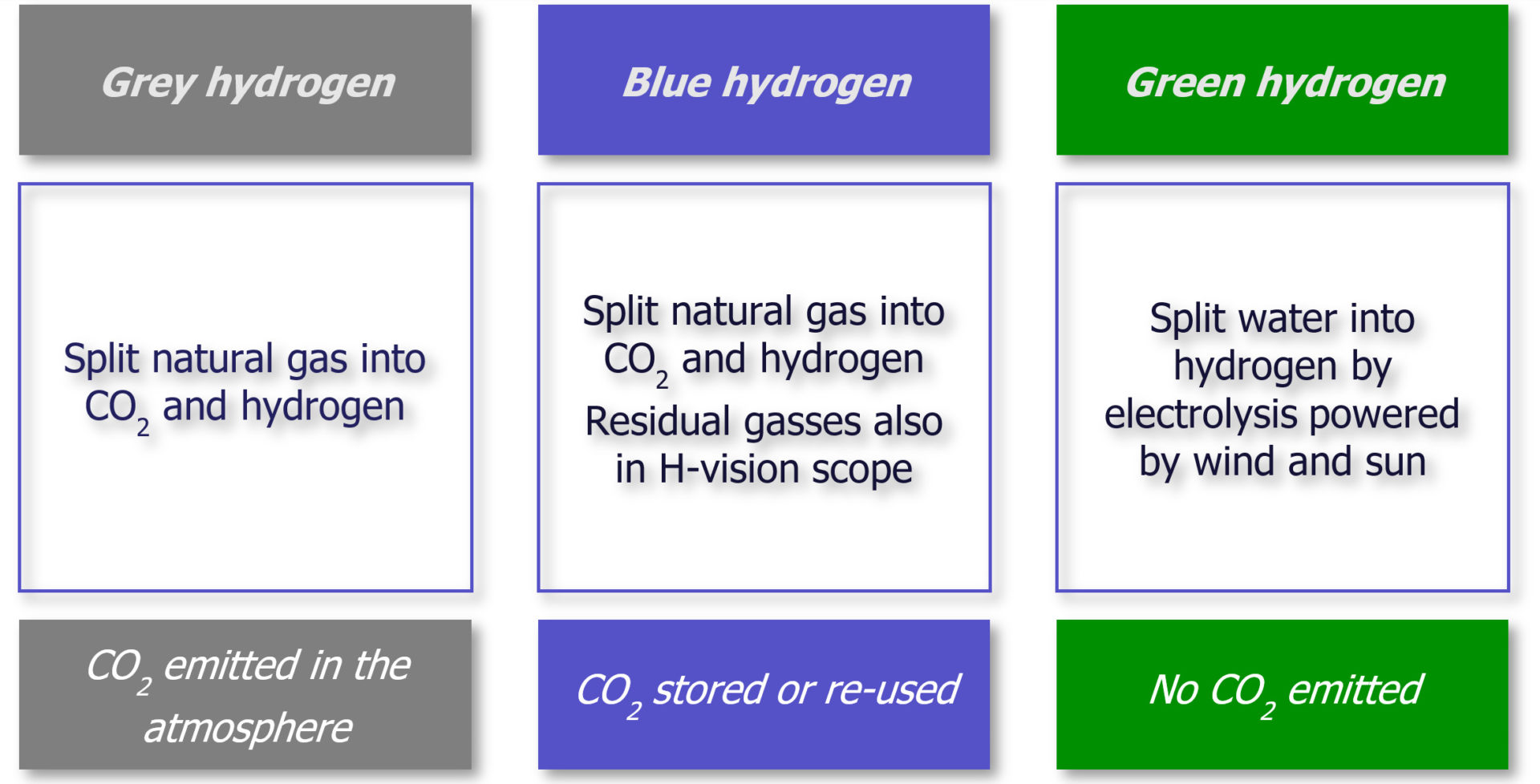
To add insult to injury, the Commission considers biomass a renewable energy – despite the fact that burning wood for energy, which is what biomass is ultimately all about, typically emits 1.5 times more CO2 than coal and three times more than natural gas. The EU is the world’s largest net importer of wood pellets; the main net exporters are the United States, Canada, and Russia.
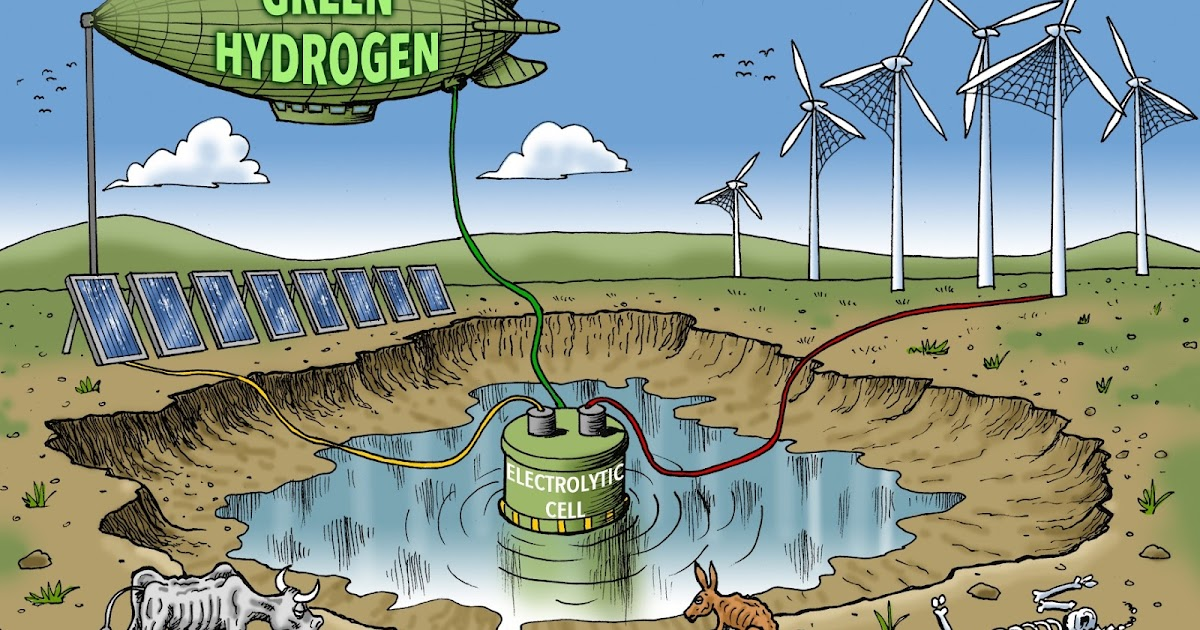
MoS2 Template Master

Green campaigners have been complaining about EU member states like Estonia that allow intensive clear-cutting of trees in forests protected under EU Natura 2000 rules. One NGO, the Estonian Fund for Nature, has also pointed out there is a direct connection between the subsidized growth in the biomass industry and EU renewable-energy policies.

More than 500 scientists have urged the EU to stop treating biomass as carbon-neutral. Even if one disagrees, and believes that biomass can be sustainable and renewable, it still doesn’t make sense to privilege biomass over nuclear power.

Biomass represents almost 60% of renewable-energy consumption in the EU, so the implications of no longer considering it as renewable energy would be grave: wind and solar power contribute only marginally to the EU’s energy provision, irrespective of their environmental downsides. Changing biomass’s renewable status would make it almost unavoidable to recognize nuclear power, which would be embarrassing for the likes of German chancellor Angela Merkel, who has been putting so much political capital into defending Germany’s nuclear exit.

4.  The EU’s grand plans may not do that much for climate change

At the end of the day, the goal of all this is to counter CO2 emissions in a bid to halt climate change.

Here, an interesting contrarian view comes from Danish economist Bjørn Lomborg, author of the bestseller “The Skeptical Environmentalist.”

Lomborg has highlighted UN Climate Panel estimates that the negative impact of climate change in the 2070s would be equivalent to reducing the average income between 0.2% and 2% – meaning that global incomes would increase only by 356% by then, and not by 362%. He then contrasts this with the enormous cost of EU climate policies, which would “quadruple electricity wholesale prices in just a decade,” and he cites academic studies showing the real costs of EU climate policies to be four times higher than optimistic EU estimates, ultimately amounting to a whopping €4 trillion to €5 trillion.

Lomborg estimates that the new EU target of 55% carbon-emission reduction will reduce the global temperature by the end of the century by an immeasurable 0.004°C – “equivalent to postponing global warming by six weeks in 2100.”

Surely we can agree that it is hard for both proponents and skeptics of expensive climate policies to provide hard proof that they are right in their arguments. But these estimates should make even the most committed EU Commission climate fanatic pause for reflection.

msfig7-1

screenshot-2019-09-24-09.03.15-768x266-1

Global warming is in our mental models.

Gruesome Climate Crisis Talk at Davos

the-great-reset-by-the-world-economic-forum-prism-ua-world-economic-forum-great-resetMichelle Stirling explains what is terribly wrong about their train of thinking in the video below.  For those who prefer reading a transcript, I have provided one below, in italics with my bolds along with some images.

Davos climate crisis talk is disturbing and inaccurate

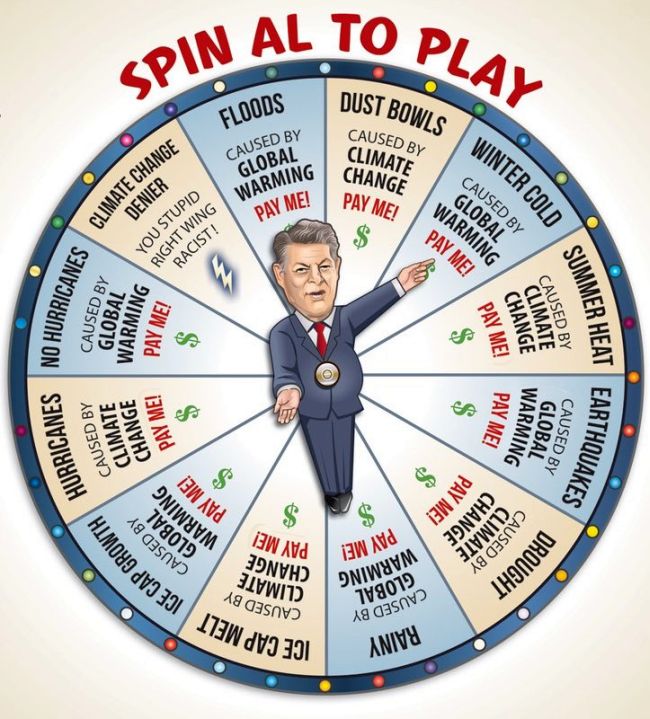
Hi, I’m Michelle Stirling for Friends of Science Society. I love life, I enjoy this beautiful world and I think being alive is a wonderful gift. That’s why it’s so disturbing to read some of the comments from the recent World Economic Forum in Davos. The conference concluded leaving some commentators concerned about depopulation talk from high profile individuals like Jane Goodall and misinterpreted IPCC SR 1.5 findings by Greta Thunberg, and talk of doomsday battles by Al Gore.

MSfig-2

Goodell’s statement shocked many people when she said all these environmental things we talk about wouldn’t be a problem if there was the size of population that there was 500 years ago. The world’s population is estimated to have been about 500 million people then, or 6.7 billion less than today. Depopulation notions stem from apocalyptic climate visions but Roger Pielke jr. explains in a January 2nd, 2020, article in forbes that climate science has been corrupted by the influential risky business report of 2014. This report was funded by green billionaires and proliferated into the media and scientific domains by powerful environmental groups. Pielke jr. says the report misattributes the proposed pathways, focusing on the most extreme scenario called the representative concentrated Pathway 8.5, something that is far from a business-as-usual case relevant to the Davos set of bankers and billionaires.

MSfig0

Mark Carney’s infamous speech to Lloyd’s of London of 2015 breaking the tragedy of the horizon that Also invoked the risky business report that Pielke jr. says has corrupted climate Science. RCP 8.5 is used in an influential graph on page 105 in the IPCC SR 1.5 report that Greta Thunberg refers to in her speeches at Davos. Greta referred to a table on page 108 of theIPCC SR 1.5 report for her crisis comments, but most of the scientific papers referred to in that table were published in or before 2013. And in 2013 the IPCC AR 5 report in box 9.2 chapter 9 stated there had been a hiatus in warming since before Kyoto. That’s like 15 years despite a dramatic rise in carbon dioxide concentration from human industry and activity.

MSfig2

Dr Judith Curry testified to the US Senate on January 16, 2014, that based on that IPCC AR-5 evidence, carbon dioxide is not the control knob that can fine-tune climate. Curry noted that the science of climate change is not settled and evidence reported by the IPCC AR-5 weakens the case for human factors dominating climate change.

Nevertheless well-known climate scientists like professor Katherine Hayhoe continue to present proposed mitigation pathways as she did at the University of Calgary wherein she stated that she considered China to be a leader in climate mitigation.

MSfig1

We are just starting now to curve off the higher scenario if you notice here we’re almost here we’re just starting to curve off the higher scenario. When I say we I actually mean it’s mostly, get this, it’s mostly good in China. China has more wind and solar energy than any other country in the world. And you know I’m not a hundred percent confident in their emission estimates, so keep this with a bit of a grain of salt. But at least what we’re working with in the global level suggests that we’re starting to peel off the higher scenario, but not fast enough to get down to a lower scenario or meet the pair of targets. That’s absurd: a month of China’s emissions equal a whole year of emissions by Canada.

MSfig3

World Primary Energy consumed in 2020 was 567 Exajoules (BP Statistics)

Hayhoe advocated for rapid decarbonization referring to the RCP 8.5 versus a lower RCP. But a chart from the original report from Van Viren et al shows that no RCP scenario is fossil fuel free, debunking the notion that net zero 2050 should even be part of public policy or that rapid decarbonization is necessary. Roger Pielke jr. says these RCP models cannot be compared to each other, and even the RCP authors state they’re not meant to be used in this way. For instance all the RCP pathways other than 8.5 represent a world with billions fewer people.

MSfig-1

Another highlight at Davos was Al Gore’s fear-infested closing as noted by Hans Rosling and family in their book Factfulness. In 2009 Rosling met Al Gore who told him then we have to create fear, an approach that that medical doctor and international public health policy expert Rosling rejected. Rosling wrote that fear plus urgency makes for stupid drastic decisions with unpredictable side effects. And contrary to the doom and gloom of Davos, Factfulness shows how the world is improving for all people despite certain inequities, contrary to the doom and gloom of Davos. A decade later Al Gore continues with his apocalyptic approach, and at Davos he claimed the climate crisis was equivalent to historic wars even invoking 9 /11 again.

MSfig4

As Roger Pielke jr. notes in an earlier Forbes article, this is nothing but climate porn and is not supported by the scientific evidence in IPCC reports But fortunately there is a global pushback on this damaging depopulation and doom and gloom fear-mongering. CLINTEL, the climate intelligence organization based in the Netherlands, representing more than 800 global scientists, sent a letter to the World Economic Forum stating there’s no climate emergency and insisting that we do have time.

MSfig6

And pointing out the uncertainties of climate models that Greta and Al Gore use for their apocalyptic statements. A commentary has been posted on CFACT that summarizes the CLINTEL manifesto and Friends of Science Society. We’ve published the CLINTEL document and videos on our blog.

It is deeply disturbing that depopulation talk has become part of mainstream climate policy discussions with even a Quebec politician suggesting that medically assisted suicide could be available to those who want to die to save the planet. We were given this gift of life in a beautiful world, one that has problems, but I believe we are up to the challenge. There’s no climate emergency so let us live with hope and joy.

For Friends of Science Society, I’m Michelle Stirling

MSfig7

My Summary

Clearly, the 1% are fearful of losing their planetary playground because the other 99% of us consume too much.  So they want there to be fewer of us and to constrain our personal mobility and choices.  Not so long ago, Romanians has strict quotas for their daily calorie intake.  Several countries plan to scrap gasoline autos and affordable air travel. This is the driving force behind the Great Reset.  Who knows how this mindset translates into actions on the ground?

jimbob 15M people

See also Resist the Great Reset

gdundvquwzb21