Apocalypse Not

Joakim Book shines considerable light into modern doomsday darkness, writing his AIER article Unlimited Growth, Forever.  Book exposes how fundamental human positive aspiration, proven by historical progress and innovation, has been perverted by those nowadays claiming to be progressive, when all they preach is hell and damnation.  Excerpts in italics with my bolds and added images.

It is often said that only a madman — or economist — could believe that we can have infinite growth on a finite planet. Resources are scarce and dwindling, we’re told. Day in and day out, we seem poised to use up some civilization-critical ingredient, or we might overuse materials to the point of our own downfall. 

The mindset that makes people believe that we’re perennially on the cusp of some disaster is on display everywhere from the big screen to the big assembly halls. It has been humanity’s plague since we first broke free of the Malthusian constraints that govern every non-human ecology. And never once do we seem to consider that maybe, just maybe, the madmen/economists know something the rest of us don’t. 

We’re routinely given hyperbolic predictions about our doom, and no matter whether those predictions come true, they’re renewed in the same or slightly altered form a few years later. In the meantime, individuals, businesses, workers, investors, tinkerers, and all the others that make up the world economy solve much of the “problem.”

Every popular scare of the past has been side-stepped, improved,
or solved, by one or another human effort, usually serendipitously
and rarely at all with well-meaning bureaucrats directing the process. 
 

New York University economist Paul Romer, whose work on economic growth rewarded him the Nobel Prize in 2018, explains that “non-economists have said that [his article] helped them understand why unlimited growth is possible in a world with finite resources.” He credits that conclusion to his work on the proliferation of ideas, which he condenses into the following two statements: 

    1. “we can share discoveries with others,” and 
    2. “there are incomprehensibly many discoveries yet to be found.”

The basic rationale is thus simple: “Although we live in a world of a limited number of atoms,” as Marian Tupy and Gale Pooley say in their masterful creation Superabundance, “there are virtually infinite ways to arrange those atoms. The possibilities for creating new value are thus immense.”

Economic growth itself, said University of Mississippi economist Josh Hendrickson in an interchange with The Guardian’s George Monbiot a few years ago, is about “finding more efficient uses of resources.” It’s about observing how market prices and the profit motive urge entrepreneurs and businesses to economize on production while producing more value for consumers. We can visibly see this in the products that technology has merged into one (smartphones displacing a dozen or more physical appliances), or the thinner cans or more efficient engines that innovation routinely delivers. 

Economists aren’t just playing word games when they say that growth can keep going forever. We can always make more stuff since the physical atoms under our command right now are far from all the physical atoms on our planet (or solar system). By growth, economists mean value-creation exchanged in the marketplace, a market that can change in the types of value we exchange, and the growing portion of our economies can involve fewer atoms than what came before.

“Resource” which the general public think of as physical collections of elements in the ground, economists define much more broadly. Nothing becomes a resource until the human mind makes it so, i.e., “there are no resources until we find them, identify their possible uses, and develop ways to obtain and process them” to quote Julian Simon, whose pioneering work in resource economics prompted Tupy and Pooley to launch their Superabundance project. 

The boundaries between dirt, mineral resource, and mineral reserve can therefore shift with technology, economic circumstances, or legal rules regarding their extraction — subject to the “degree of geological certainty” and “feasibility of economic recovery.”

My Mind is Made Up, Don’t Confuse Me with the Facts. H/T Bjorn Lomborg, WUWT

What’s even more incredible is that material abundance (how economically accessible certain minerals or agricultural products are) has historically speaking increased with population. Instead of individually starving when there are more humans on our supposedly finite planet, we seem to be collectively producing more, having better access to raw materials and the goods and services we produce with them. 

Take almost any foodstuff, meat or cerealfruit or vegetable, for almost any country over any period and the numbers go up and to the right: For eight centuries (probably more), an English laborer has been able to afford more and more foodstuffs for their labor; yet there’s more food production today than at any point in the past.

The counterintuitive conclusion follows naturally from Romer’s work: More humans give us more chances for ideas that exponentially “make material progress possible.” Human society is dynamic, not zero-sum.

Illustration: oil. Thirteen years ago, Camilla Ruz for The Guardian enumerated six natural resource scares to pay attention to, of which oil was one. Dire predictions like these are a dime a dozen in the environmentalist world, and no matter how publicly or unequivocally they are disconfirmed by reality, they pop up with renewed vigor a few years later. At the time we had some 46 years’ worth of oil reserves left; that is, at the prices, consumption rate, and technology of 2011, humanity would run out of oil by the late 2050s. 

With a billion more people on the planet since then, having suitably burned some 386 billion barrels of oil in the intervening years, we now have… drumroll…48 years’ usage in global proven reserves; Humanity will now last until the 2070s before its (supposedly limited) reserves of oil run dry. Disaster avoided. 

The price system, profit-hungry entrepreneurs, and optimizing consumers are pretty good at remedying scarcities when they emerge. If there isn’t enough oil, gas, wheat, gold, nickel, or copper for current human processes, the (real) price of those commodities rise; extracting businesses dig deeper or explore further, and consumers substitute away from the expensive commodity, or we recycle the metals that forever remain with us into something new. Higher prices mean that lower-quality ores are now worth mining, more inaccessible sources and geologists’ best guesses for where we could find more worth exploring. The outcome over decades and centuries is that “prices of resources are declining because more people means more ideas, new inventions and innovations,” according to Tupy and Pooley.

That we do not run out is the powerful lesson of both the history of resources and the theory behind their economic uses: Our minds and the black box of nifty ways to improve the world aren’t limited. We don’t run out; We simply find more.

The recurring “we’re running out of X!” outrage therefore seems so peculiar, so out of touch with even a semblance of reality. 194 years ago, before having seen but a tiny fraction of the improvements humanity would make over the following decades and centuries, British historian and poet Thomas Babington (raised to the peerage as Lord Macaulay) wrote

though in every age everybody knows that up to his own time progressive improvement has been taking place, nobody seems to reckon on any improvement during the next generation. We cannot absolutely prove that those are in error who tell us that society has reached a turning point […] but so said all who came before us, and with just as much apparent reason.

He then ended his colloquy with the sentence that human progress-types know by heart:

“On what principle is it that, when we see nothing but improvement behind us, we are to expect nothing but deterioration before us?”

That was a reasonable enough question in 1830,
and a terribly relevant one in 2024.


Wind Power for Beginners

H/T maxyhoge

Robert Bryce explains the basics at his substack blog Build It, And The Wind Won’t Come.  Excerpts in italics with my bolds and added images.

Weather-dependent generation sources are…weather dependent:
Last year, despite adding 6.2 GW of new capacity,
U.S. wind production dropped by 2.1%.

Three years ago, in the wake of Winter Storm Uri, the alt-energy lobby and their many allies in the media made sure not to blame wind energy for the Texas blackouts. The American Clean Power Association (2021 revenue: $32.1 million) declared frozen wind turbines “did not cause the Texas power outages” because they were “not the primary cause of the blackouts. Most of the power that went offline was powered by gas or coal.”

Damaged wind turbines at the Punta Lima wind project, Naguabo, Puerto Rico, 2018. Photo: Wikipedia.

NPR parroted that line, claiming, “Blaming wind and solar is a political move.” The Texas Tribune said it was wrong to blame alt-energy after Winter Storm Uri because “wind power was expected to make up only a fraction of what the state had planned for during the winter.” The outlet also quoted one academic who said that natural gas was “failing in the most spectacular fashion right now.” Texas Tribune went on to explain, “Only 7% of ERCOT’s forecasted winter capacity, or 6 gigawatts, was expected to come from various wind power sources across the state.”

In other words, there was no reason to expect the 33 GW of wind capacity that Texas had to deliver because, you know, no one expected wind energy to produce much power. Expectations? Mr. October? Playoff Jamal? Who needs them?

But what happens when you build massive amounts of
wind energy capacity and it doesn’t deliver —
not for a day or a week, but for six months, or even an entire year?

That question is germane because, on Wednesday, the Energy Information Administration published a report showing that U.S. wind energy production declined by 2.1% last year. Even more shocking: that decline occurred even though the wind sector added 6.2 GW of new capacity!

A hat tip to fellow Substack writer Roger Pielke Jr., who pithily noted on Twitter yesterday, “Imagine if the U.S. built 6.2 GW new capacity in nuclear power plants and after starting them up, overall U.S. electricity generation went down. That’d be a problem, right?”

Um, yes. It would. And the EIA made that point in its usual dry language. “Generation from wind turbines decreased for the first time since the mid-1990s in 2023 despite the addition of 6.2 GW of new wind capacity last year,” the agency reported. The EIA also explained that the capacity factor for America’s wind energy fleet, also known as the average utilization rate, “fell to an eight-year low of 33.5%.” That compares to 35.9% capacity factor in 2022 which was the all-time high. The report continued, “Lower wind speeds than normal affected wind generation in 2023, especially during the first half of the year when wind generation dropped by 14% compared with the same period in 2022.”

Read that again. For half of last year, wind generation was down by a whopping 14% due to lower wind speeds. Imagine if that wind drought continued for an entire year. That’s certainly possible. Recall that last summer, the North American Electric Reliability Corporation warned that U.S. generation capacity “is increasingly characterized as one that is sensitive to extreme, widespread, and long duration temperatures as well as wind and solar droughts.”

According to Bloomberg New Energy Finance, corporate investment in wind energy between 2004 and 2022 totaled some $278 billion. In addition, according to data from the Treasury Department, the U.S. government spent more than $30 billion on the production tax credit over that same period. Thus, over the last two decades, the U.S. has spent more than $300 billion building 150 GW of wind capacity that has gobbled up massive amounts of land, garnered enormous (and bitter) opposition from rural Americans, and hasn’t gotten more efficient over time.

Wednesday’s EIA report is a stark reminder that all of that generation capacity is subject to the vagaries of the wind. Imagine if the U.S. had spent that same $300 billion on a weather-resilient form of generation, like, say, nuclear power. That’s relevant because Unit 4 at Plant Vogtle in Georgia came online on Monday. With that same $300 billion, the U.S. could have built 20, 30, or maybe even 40 GW of new nuclear reactors with a 92% capacity factor that wouldn’t rely on the whims of the wind. In addition, those dozens of reactors would have required a tiny fraction of the land now covered by thousands of viewshed-destroying, bat-and-bird-killing wind turbines.

If climate change means we will face more extreme weather in the years ahead — hotter, colder, and/or more severe temperatures for extended periods — it’s Total Bonkers CrazytownTM to make our electric grid dependent on the weather. But by lavishing staggering amounts of money on wind and solar energy, and in many cases, mandating wind and solar, that’s precisely what we are doing.


Bogus Math for Climate “Reparations”

Paul Mueller does the analysis in his AIER article Climate “Reparations” Numbers Are Rigged.  Excerpts in italics with my bolds and added images.

Nobel Prize–winning economist Esther Duflo thinks rich countries should pay poor countries $500 billion in compensation each year for climate-change damages. It is our “moral debt.” She proposes an international 2-percent wealth tax on the ultra-rich and an increase in the global minimum corporate tax rate to fund this $500 billion transfer.

You and I may be shocked by such a suggestion but don’t worry: “It’s really necessary. And it’s reasonable. It’s not that hard.” Only someone in an elite, progressive bubble could say something like that. Let’s check her reasoning.

Duflo claims that climate change creates costs, specifically through “excess” deaths due to excessive heat. Poorer countries from the global south near the equator will see more days of extreme heat, and so will see a disproportionate increase in excess deaths.

Other economists translated those deaths into an externality cost of $37 per ton of CO2. Multiply that by the roughly fourteen billion tons of CO2 emitted by the US and Europe and voila, wealthy countries generate $500 billion in externality costs per year.

She proposes paying for this by increasing the global minimum corporate tax rate from 15 percent to 18 percent and introducing an international 2-percent wealth tax on the ultra-rich, which she defines as the 3000 richest billionaires. We can’t go into the many problems and obstacles to such funding mechanisms here — suffice it to say such ideas will be nearly impossible to implement.

But Duflo’s back-of-the-envelope calculations, besides missing the bigger picture, are so speculative as to require playing make-believe. Let’s play along for a moment to see why. We’ll start by reverse-engineering her $500 billion number into a measure of harm.

Regulatory agencies and insurance companies use the concepts of “statistical value of life” or the “statistical value of a life-year” to do cost-benefit analysis on risk and the monetary value of life. These concepts are slippery, however, and calculated in a variety of ways with a wide range of estimates.

To keep things simple, let’s assume that the value of one life-year is $200,000. The $500 billion number proposed by Duflo suggests that the cost imposed by wealthy countries burning fossil fuels is the loss of roughly 2.5 million life-year” in poor countries per year.  That sounds like a staggering number!

But what about the benefits that have accrued to developing
countries from activities that generate CO2 emissions?

Important advances in medicine, such as antibiotics and vaccines, were developed in modern industrialized countries. So, too, were refrigeration, cars, the internet, smart phones, radar; modern agricultural methods with herbicides, pesticides, and fertilizers; improvements in plumbing, building materials, manufacturing, and much more. “Polluting” activities in industrialized countries improved nutrition and safety around the world. These advances, and many others, significantly increased people’s life expectancies — especially in poor countries.

Surely the value of these improvements should weight the opposite side of the scale from the expected harm of climate change — especially since the crusade against fossil fuels and carbon emissions will assuredly slow economic growth and innovation. Let’s consider the case of India for a moment.

Life expectancy in India has basically doubled from about 35 years in 1950 to about 70 years in 2024. If you consider that India has just over a billion people living in it, modern technology developed by rich CO2-emitting countries has added 35 billion life-years in India alone. 

Translating life-years back into dollars, 35 billion life-years times $200,000 per life-year means that the benefits from greater life expectancy in India over the past 75 years is the equivalent of $7 quadrillion dollars — or in annualized terms, an annual benefit of about $93 trillion dollars. In other words, the benefits to India alone are over a hundred times larger than Duflo’s estimate of costs!

Nor is India cherry-picked. China has a similar story with life expectancy rising from 43.45 years to 77.64 years. Similar improvements in life expectancy occur across the global south.

Of course, one could argue that developed industrial countries are not solely responsible for increases in life expectancy around the world. But one could just as easily say the same about whether developed industrial countries are solely responsible for global CO2 emissions, climate change, or harm to people in the global south due to hotter weather. Connecting these two issues makes perfect philosophical sense, because the production of CO2 has historically been directly associated with increases in economic growth; which in turn is necessary for all the developments increasing longevity around the world.

Even if we massage the assumptions in Duflo’s favor, the results remain favorable to industrialization. Suppose western technology and industrial activities contribute 50 percent to improvements in life expectancy. That’s still a $46 trillion annualized benefit to India. Reduce the value of a statistical life-year to $100,000 — that’s still a $23 trillion/year benefit from industrialization in the west. Exclude India from the analysis and cut the population we focus on down to 500 million people — that’s still over $12 trillion/year in benefits. Reduce the improvement in life-expectancy by six years — that still leaves about $10 trillion/year in benefits.

So, even after making tons of assumptions to reduce their size,
the estimated benefits of industrialization are still about twenty
times larger than Duflo’s estimate of its costs. 

Worrying about hypothetical, indirect costs of CO2 emissions when it comes to human well-being is like scrounging for pennies while ignoring $100 bills lying on the sidewalk. Actually, it is worse than that. It is like lighting $100 bills on fire to help you search a dark alley for some pocket change of human welfare.

Economic development, driven largely by Adam Smith’s dictum “peace, easy taxes, and a tolerable administration of justice which includes strong private property rights and limited government intervention, has improved human living standards in unprecedented ways over the past 300 years. These remarkable improvements in human welfare are not limited to wealthy, developed economies but are enjoyed around the world. 

Duflo talks about the (external) costs of industrialization on certain countries without considering the truly massive (external) benefits of industrialization to those same countries.

If anything, with a proper accounting, developing countries owe rich countries gratitude for the benefits they have received from industrialization and the corresponding CO2 emissions.


Britain’s Royal Society Defies the Green Blob

News comes from Financial Times that the prestigious scientific Royal Society is honoring it’s motto:  “Take Nobody’s Word For It” (translation of Latin phrase above.) Of course, a great many UK academics were outraged at the refusal to take for granted their claim that “Climate Science is Settled.” The article by Kenza Bryan is Royal Society and academics clash over influence of oil and gas industry.  Excerpts in italics with my bolds and added images.

Three-centuries-old institution rebuffs call to
declare fossil fuel companies culpable for global warming

A clash between Britain’s 363-year-old Royal Society and more than 2,000 UK academics has escalated over the national academy of scientists’ refusal to attribute the role of oil and gas companies in climate change.

The academics had expressed their concerns about the influence of fossil fuel companies on scientific research in a letter last year to the Royal Society, founded in 1660 as a fellowship that included the likes of Isaac Newton.

But the Royal Society has now rebuffed their request to issue an “unambiguous statement about the culpability of the fossil fuel industry in driving the climate crisis”.

Treasurer Jonathan Keating wrote in reply last week that it would “not be appropriate” to do so, as there was a need for “multiple actors” to engage with the complexity of the climate crisis.

The academics’ concerns about the influence of oil and gas companies extend to separate allegations that ties to BP were not disclosed by a Cambridge professor in a Royal Society policy briefing document produced by a working group that he chaired in 2022.

Professor Andy Woods held the title of head of the BP Institute, a research arm that it funds, which was renamed the Institute for Energy and Environmental Flows by Cambridge last year. He also has the formal title of BP professor, a position endowed by the oil and gas company. These affiliations were not included in the reference in the document.

The Royal Society briefing document called for an “enormous and continued investment” into geological carbon capture and storage, a technology promoted by the fossil fuel industry as a way to keep expanding while storing the emissions.

A CO₂ storage adviser to BP and a director for CO₂ storage at the Norwegian Petroleum Directorate also contributed to the report. Woods’s expertise in geophysical fluid flows and the BP affiliation are listed elsewhere by the Royal Society in its fellowship directory. BP and Woods did not respond to a request for comment. The Royal Society said the document gave “clear affiliations” for contributors and that it publishes a wide range of research.

The tensions reflect the discord in academia about funding or
participation in research by oil and gas companies, as well as
rising activism on campuses among the student body and staff.

The Royal Society’s decision not to call out the industry was described as “moral cowardice” by James Dyke, earth system science professor at Exeter university.

Another signatory to the original letter, Bill McGuire, professor of geophysical and climate hazards at University College London, said it was “mind-boggling” that a respected scientific organisation would not attribute the role of fossil fuel groups in climate change.

Student campaigners at Oxford university have also targeted the author of a set of green principles used by the university to help guide decisions on whether to invest in or receive grants from oil and gas companies.

Under freedom of information provisions, the student campaigners identified Myles Allen, the university’s head of atmospheric, oceanic and planetary physics, as having had 18 meetings where a representative was present from one of the major oil and gas groups, including either BP, Shell, Exxon or Equinor.

Those meetings in 2021 and 2022 included five occasions organised by Shell, three of which focused on the oil and gas group’s strategy and climate scenarios, according to the freedom of information response.

Allen, who was head of the Oxford Net Zero research initiative until earlier this year, told the Financial Times he had used the meetings to highlight the need for fossil fuel companies to pay for carbon capture and storage technologies.

It is a solution to the reduction of future carbon dioxide emissions that he has long advocated. “We all have a duty to help the fossil fuel industry not make the problem worse but to fix it,” he said.

Oxford said its “partnerships and collaborations with industry” allow for research on pressing global issues, including climate-related ones.

The campaigners called on Oxford to conduct an independent assessment about its approach to fossil fuel sector donations and investment. Cambridge university in March temporarily stopped accepting grants and donations from the sector in response to similar concerns.


Climatism Substitutes for Solving Problems

Cambridge professor Mike Hulme explains in an interview with Daily Mail Why climate change ISN’T going to end the world and why we need to stop obsessing about net-zero.  Excerpts in italics with my bolds and added images.  H\T John Ray

Young people are terrified that climate change will destroy Earth by the time they grow up, but the world is not actually ending, argues Cambridge professor Mike Hulme.

Humanity is not teetering on a cliff’s edge, he says,
at risk of imminent catastrophe if we don’t reach
net-zero carbon emissions by a certain date.

And he has made it his mission to call out the people who claim we are. In his most recent book, Climate Change Isn’t Everything, Hulme argued that belief in the urgent fight against climate change has shot far past the territory of science and become an ideology.

Hulme, a professor of human geography at the University of Cambridge, dubs this ideology ‘climatism,’ and he argues that it can distort the way society approaches the world’s ills, placing too much focus on slowing Earth from warming.

The problem, he said, is this narrow focus takes attention away from
other important moral, ethical, and political objectives –
like helping people in the developing world rise out of poverty.

DailyMail.com spoke with Hulme about why he thinks climatism is a problem, how it should be balanced out, and what keeps him hopeful about the future of humanity.

As with other ‘isms’ – like cubism or romanticism – ideologies provide a way of thinking about things, explained Hulme.  ‘They’re like spectacles that help us to make sense of the world, according to a predefined framework or structure,’ he said

To be clear, Hulme does not claim that all ideologies are wrong.  ‘We all need ideologies, and we all have them – whether you’re a Marxist or a nationalist, you’re likely to hold an ideology of some form or other,’ he added.

As Hulme sees it, many journalists, advocates, and casual observers of climate change have become devotees of climatism, inaccurately attributing many events that happen in the world as being caused by climate change.

He gives the examples of a fire, flood, or damaging hurricane.  ‘No matter how complex a particular causal chain might be, it’s a very convenient shorthand to say, ‘Oh, well, this was caused by climate change,” Hulme said.

‘It’s a very shallow and simplistic way, I would argue,
to try to describe events that are happening in the world.’

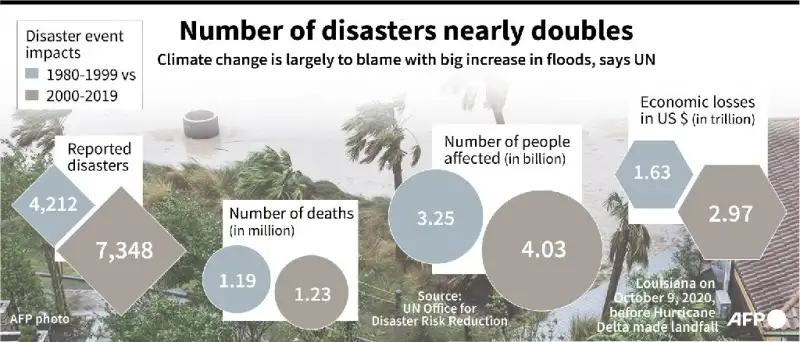
Researchers have shown that warming oceans do lead to more frequent and more severe storms: Twice as many cyclones now become category 4 or 5 as they did in the 1970s, scientists have found, and Atlantic storms are three times as likely to become hurricanes.

Hulme doesn’t argue that the effects of climate change are not happening, though, just that stopping climate change won’t stop disasters from happening altogether.

‘Fundamentally, we’re going to have to deal with hurricanes, and
we’re not going to deal with them just by cutting our carbon emissions.’ 

The solutions, he argues, will include better forecasting, better early warning systems, better emergency plans, and better infrastructure.  ‘There are all sorts of things that we can do to minimize the risks and dangers of hurricanes, that are way more effective in the short term than trying to cut our carbon emissions,’ said Hulme.

The danger of climatism, he pointed out, is that it leads people down a false chain of events: If all of these things happening in the world are caused by climate change, then all we have to do is stop climate change, and all the other things will stop themselves.

‘And that clearly is a very inadequate way of thinking about the complexities of most of the problems we we face in the world today.’  This distorted thinking can make people forget about other important concerns, he argues.

As an example, Hulme points to the UN Sustainable Development Goals (SDGs): 17 areas that the world’s governments have identified as top priorities for humanity.  The SDGs include building peace and justice, eradicating poverty, reducing child mortality, and ensuring clean sanitation and water for billions of people on the planet.

If society were to put climate change priorities into their proper proportions then, Hulme said it would still be on the list.  It just wouldn’t be the only item on the list, and it wouldn’t be at the top.  ‘There’s 17 SDGs, and two of them are related to climate. So that begins to rebalance, or re-proportion, the amount of effort and attention we might wish to pay,’ said Hulme.

Beyond these mixed up priorities, Hulme also takes issue with what he sees as an obsession with deadlines: ‘There’s this idea of the ticking clock counting down to Ground Zero – we’ve only got five years, 10 years, two years – however long different commentators put the deadline.’

Doomsday was predicted but failed to happen at midnight.

Hulme disputed the idea that he is over-egging the pudding on climatism – after all, the whole basis of his argument is that climatists are the ones making a bigger deal out of it than they should be.  ‘I’ve been observing concerns about how climate change is talked about, framed, and reacted to in public for many, many years.’  And this public framing has led to a phenomenon called ‘eco-anxiety,’ which Hulme said he sees among his students at Cambridge University

‘They have absorbed these claims of tipping points, and they take these things literally, and feel that there is no future for them because the climate is going to go out of control,’ he said. ‘They feel that it will be too late, and everything will collapse.’

See Also Climate Delusional Disorder

Climate Delusional Disorder (CDD) 2021 Update

May Day: Appeals Court Rules Against Kids’ Climate Lawsuit

Update May 1, 2024

Ninth Circuit Court of Appeals grants Federal government’s petition for writ of mandamus in the case of Juliana v. United States, originally filed in 2015.  Ruling excerpts are below in italics with my bolds. 20240501_docket-24-684_order

In the underlying case, twenty-one plaintiffs (the Juliana plaintiffs) claim that—by failing to adequately respond to the threat of climate change—the government has violated a putative “right to a stable climate system that can sustain human life.” Juliana v. United States, No. 6:15-CV-01517-AA, 2023 WL 9023339, at *1 (D. Or. Dec. 29, 2023). In a prior appeal, we held that the Juliana plaintiffs lack Article III standing to bring such a claim. Juliana v. United States, 947 F.3d 1159, 1175 (9th Cir. 2020). We remanded with instructions to dismiss on that basis. Id. The district court nevertheless allowed amendment, and the government again moved to dismiss. The district court denied that motion, and the government petitioned for mandamus seeking to enforce our earlier mandate. We have jurisdiction to consider the petition. See 28 U.S.C. § 1651. We grant it.

In the prior appeal, we held that declaratory relief was “not substantially likely to mitigate the plaintiffs’ asserted concrete injuries.” Juliana, 947 F.3d at 1170. To the contrary, it would do nothing “absent further court action,” which we held was unavailable. Id. We then clearly explained that Article III courts could not “step into the[] shoes” of the political branches to provide the relief the Juliana plaintiffs sought. Id. at 1175. Because neither the request for declaratory relief nor the request for injunctive relief was justiciable, we “remand[ed] th[e] case to the district court with instructions to dismiss for lack of Article III standing.” Id. Our mandate was to dismiss.

The district court gave two reasons for allowing amendment. First, it concluded that amendment was not expressly precluded. Second, it held that intervening authority compelled a different result. We reject each.
The first reason fails because we “remand[ed] . . . with instructions to dismiss for lack of Article III standing.” Id. Neither the mandate’s letter nor its spirit left room for amendment. See Pit River Tribe, 615 F.3d at 1079.

The second reason the district court identified was that, in its view, there was an intervening change in the law. District courts are not bound by a mandate when a subsequently decided case changes the law. In re Molasky, 843 F.3d 1179, 1184 n.5 (9th Cir. 2016). The case the court identified was Uzuegbunam v. Preczewski, which “ask[ed] whether an award of nominal damages by itself can redress a past injury.” 141 S. Ct. 792, 796 (2021). Thus, Uzuegbunam was a damages case which says nothing about the redressability of declaratory judgments. Damages are a form of retrospective relief. Buckhannon Bd. & Care Home v. W. Va. Dep’t of Health & Human Res., 532 U.S. 598, 608–09 (2001). Declaratory relief is prospective. The Juliana plaintiffs do not seek damages but seek only prospective relief. Nothing in Uzuegbunam changed the law with respect to prospective relief.

We held that the Juliana plaintiffs lack standing to bring their claims and told the district court to dismiss. Uzuegbunam did not change that. The district court is instructed to dismiss the case forthwith for lack of Article III standing, without leave to amend.

Background July 2023: Finally, a Legal Rebuttal on the Merits of Kids’ Climate Lawsuit

As reported last month, the Oregon activist judge invited the plaintiffs in Juliana vs US to reopen that case even after the Ninth Circuit shot it down.  Now we have a complete and thorough Motion from the defendant (US government) to dismiss this newest amended complaint.  Most interesting is the section under the heading starting on page 30.  Excerpts in italics with my bolds and added images.

Plaintiffs’ Claims Fail on the Merits

Because Plaintiffs’ action fails at the jurisdictional threshold, the Ninth Circuit never reached—and this Court need not reach—the merits of the claims. . . Plaintiffs’ second amended complaint, which supersedes the first amended complaint, asserts the same claims that were brought in the first amended complaint, which this Court addressed in orders that the Ninth Circuit reversed. Defendants thus renew their objection that Plaintiffs’ claims fail on the merits and should be dismissed pursuant to Fed. R. Civ. P. 12(b)(6).

A. There is no constitutional right to a stable climate system.

The Supreme Court has repeatedly instructed courts considering novel due process claims
to “‘exercise the utmost care whenever . . . asked to break new ground in this field,’… lest the liberty protected by the Due Process Clause be subtly transformed” into judicial policy preferences. More specifically, the Supreme Court has “regularly observed that the Due Process Clause specially protects those fundamental rights and liberties which are, objectively, ‘deeply rooted in this Nation’s history and tradition.’”  Plaintiffs’ request that this Court recognize an implied fundamental right to a stable climate system contradicts that directive, because such a purported right is without basis in the Nation’s history or tradition.

The proposed right to a “stable climate system” is nothing like any fundamental right ever recognized by the Supreme Court. The state of the climate is a public and generalized issue, and so interests in the climate are unlike the particularized personal liberty or personal privacy interests of individuals the Supreme Court has previously recognized as being protected by fundamental rights.  “[W]henever federal courts have faced assertions of fundamental rights to a ‘healthful environment’ or to freedom from harmful contaminants, they have invariably rejected those claims.”. Plaintiffs’ First Claim for Relief must be dismissed.

B.  Plaintiffs fail to allege a cognizable state-created danger claim.

The First Claim for Relief must also be dismissed because the Constitution does not impose an affirmative duty to protect individuals, and Plaintiffs have failed to allege a cognizable claim under the “state-created danger” exception to that rule.
As a general matter:

[The Due Process Clause] is phrased as a limitation on the State’s power to act, not as a guarantee of certain minimal levels of safety and security. It forbids the State itself to deprive individuals of life, liberty, or property without “due process of law,” but its language cannot fairly be extended to impose an affirmative obligation on the State to ensure that those interests do not come to harm through other means.

Thus, the Due Process Clause imposes no duty on the government to protect persons from harm inflicted by third parties that would violate due process if inflicted by the government.

Plaintiffs contend that the government’s “deliberate actions” and “deliberate indifference” with regard to the dangers of climate change amount to a due process violation under the state-created danger exception.

First, Plaintiffs have identified no harms to their “personal security or bodily integrity” of the kind and immediacy that qualify for the state-created danger exception. . . But here, Plaintiffs allege that general degradation of the global climate has harmed their “dignity, including their capacity to provide for their basic human needs, safely raise families, practice their religious and spiritual beliefs, [and] maintain their bodily integrity” and has prevented them from “lead[ing] lives with access to clean air, water, shelter, and food.”  Those types of harm are unlike the immediate, direct, physical, and personal harms at issue in the above-cited cases.

Second, Plaintiffs identify no specific government actions—much less government actors—that put them in such danger. Instead, Plaintiffs contend that a number of (mostly unspecified) agency actions and inactions spanning the last several decades have exposed them to harm. This allegation of slowly-recognized, long-incubating, and generalized harm by itself conclusively distinguishes their claim from all other state-created danger cases recognized by the Ninth Circuit.

Third, Plaintiffs do not allege that government actions endangered Plaintiffs in particular. . . As explained above, Plaintiffs’ asserted injuries arise from a diffuse, global phenomenon that affects every other person in their communities, in the United States, and throughout the world.

For all these reasons, there is no basis for finding a violation of Plaintiffs’ due process right under the state-created danger doctrine, and Plaintiffs’ corresponding claim must be dismissed.

C. No federal public trust doctrine creates a right to a stable climate system.

Plaintiffs’ Fourth Claim for Relief, asserting public trust claims, should be dismissed for two independent reasons. First, any public trust doctrine is a creature of state law that applies narrowly and exclusively to particular types of state-owned property not at issue here. That doctrine has no application to federal property, the use and management of which is entrusted exclusively to Congress. . .Consequently, there is no basis for Plaintiffs’ public trust claim against the federal government under federal law.

Second, the “climate system” or atmosphere is not within any conceivable federal public trust.

1. No public trust doctrine binds the federal government.

Plaintiffs rely on an asserted public trust doctrine for the proposition that the federal government must “take affirmative steps to protect” “our country’s life-sustaining climate system,” which they assert the government holds in trust for their benefit.  But because any public trust doctrine is a matter of state law only, public trust claims may not be asserted against the federal government under federal law. . . The Supreme Court has without exception treated public trust doctrine as a matter of state law with no basis in the United States Constitution.

2. Any public trust doctrine would not apply to the “climate system” or the atmosphere.

Independently, any asserted public trust doctrine does not help Plaintiffs here. Public trust cases have historically involved state ownership of specific types of natural resources, usually limited to submerged and submersible lands, tidelands, and waterways. . . The climate system or atmosphere is unlike any resource previously deemed subject to a public trust. It cannot be owned and, due to its ephemeral nature, cannot remain within the jurisdiction of any single government. No court has held that the climate system or atmosphere is protected by a public trust doctrine. Indeed, the concept has been widely rejected.

For all these reasons, the Court should dismiss Plaintiffs’ Fourth Claim for Relief.

Background Post Update on Zombie Kids Climate Lawsuits: (Juliana vs. US) (Held vs Montana)

The Herd Shuns Climate Lunatics

Charles MacKay: “Men, it has been well said, think in herds; it will be seen that they go mad in herds, while they only recover their senses slowly, and one by one.”

Conrad Black writes at National Post Washing away the climate lunatics.  Excerpts in italics with my bolds and added images.

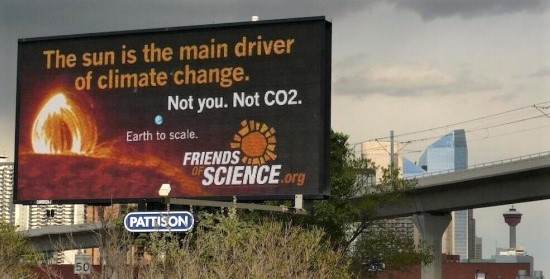
I have written here and elsewhere countless times before of the dangers of responding prematurely to alarmist concerns about climate change. Dr. Benny Peiser of the British Global Warming Policy Foundation spoke to the Friends of Science Society in Calgary earlier this month, warning that Europe’s extremist net zero carbon emission policies may get to Canada even though they are now running into extreme problems in Europe. The North American media has not much reported on the widespread and often violent farmer protests in Europe, which has caused every government that has been put to the test to scale back their aggressive climate change policies.

Tractors stand on a street during a protest by Belgian farmers over price pressures, taxes and green regulation, on the day of an EU agriculture ministers’ meeting in Brussels, Belgium March 26, 2024. REUTERS/Yves Herman/File Photo

For a long time, it was a political free lunch: everybody loves the environment, and the climate change issue was very skillfully transformed by the left into an assault on the capitalist system from a new angle in the name of saving the planet. As long as the heavy costs of displacing fossil fuels by so-called renewable energy were carefully disguised and diffused, everybody could wallow in collective self-praise for doing the healthy and environmentally responsible thing.

The burden of subsidized wind and solar farms didn’t appear on peoples’ energy bills, though eventually they were placed on the back of the taxpayer. Now, however, net zero policies are directly eating into the earnings and savings of the public and in most of Europe, the taxpayer rebellion is exploding, and the advantages of democracy are being reaffirmed as elected governments scamper to the rear, explaining that there has been a misunderstanding. When the German government tried to compel the people of that country to change their gas boilers for heat pumps at a cost of thousands of dollars per home, what critics called “boilergeddon,” it produced a so-called green-lash.

Another political disaster has befallen the western European governments that had rolled over like poodles in front of the climate change alarmists: once they had fully committed themselves to the boondoggle of electric vehicles (EV’s), and forced the powerful automobile industries of Germany, France, and Italy into conversion of gas powered vehicles to EV’s, sales of EV’s plummeted after the customary faddish start, just as much cheaper Chinese EV’s flooded into Europe. Germany and Italy forced the European Union into delaying its ill-considered ban on internal combustion engine vehicles past 2035. Those who jubilantly imagined that Europe would commit industrial suicide by destroying its own automobile industry, will have to revise their plans. There are now thousands of cheap Chinese EV’s parked at the main ports of Europe with no buyers in sight. As Dr. Peiser pointed out in Calgary, “If this was really about climate change, wouldn’t you want the cheapest EV’s, the cheapest wind, and solar, all from China?”

China’s Abandoned EV Graveyard: Thousands Of Cars Rot In Huge Fields

It is now clear in Europe, as it long has been in the private sector of the United States, that with whole industries and millions of jobs at stake, implementation of net zero policies in the West would make China the dominant economic and industrial power of the world. Even our most naïve and insipid global warming crusaders are unenthused by that bone-chilling prospect. Although Germany has finally acted to protect its auto industry, it is not yet doing the same for the public. It is still officially planning to ban weekend driving to meet climate targets. If the federal German government proceeds with such an insane plan, it will sink without a ripple at the next election.

There have even been some murmurings of emulation of this course in Canada; on Sept. 14, 2021, Journal Metro of Quebec proposed pre-emptively moving against a climate crisis by lockdown measures, an emulation of the Covid lockdown then ending, but including rations and limitations on personal travel. This proposal comes from the same sort of thinking that seeks to eliminate meat by a war on bovine flatulence.

Placid and docile toward virtue-posturing though Canadians are,
insane measures like these to mitigate climate change would surely
prove to be the funeral pyre of the coercive climate change terrorists.

For notorious historic reasons, Europe is always vulnerable to the madnesses and outrages of the left. The senior human rights court in Europe ruled three weeks ago in a lawsuit brought by 2000 elderly Swiss women against the Swiss government that it had violated the human rights of the plaintiffs by insufficiently mitigating climate change. Switzerland is a very small country but is responsible for between two and three per cent of global carbon dioxide emissions, while Canada, a huge country with a much larger population, emits only 1.5 per cent of global emissions, compared to 27 percent for China. The European Court of Human Rights crossed the jurisdictional Rubicon by overruling the voters of a democratic country.

The rationale for hurling millions of auto workers into unemployment and
shutting down Europe’s greatest industry in order to profit the Chinese
is a case that even the most ardent climate-zealots will find challenging.

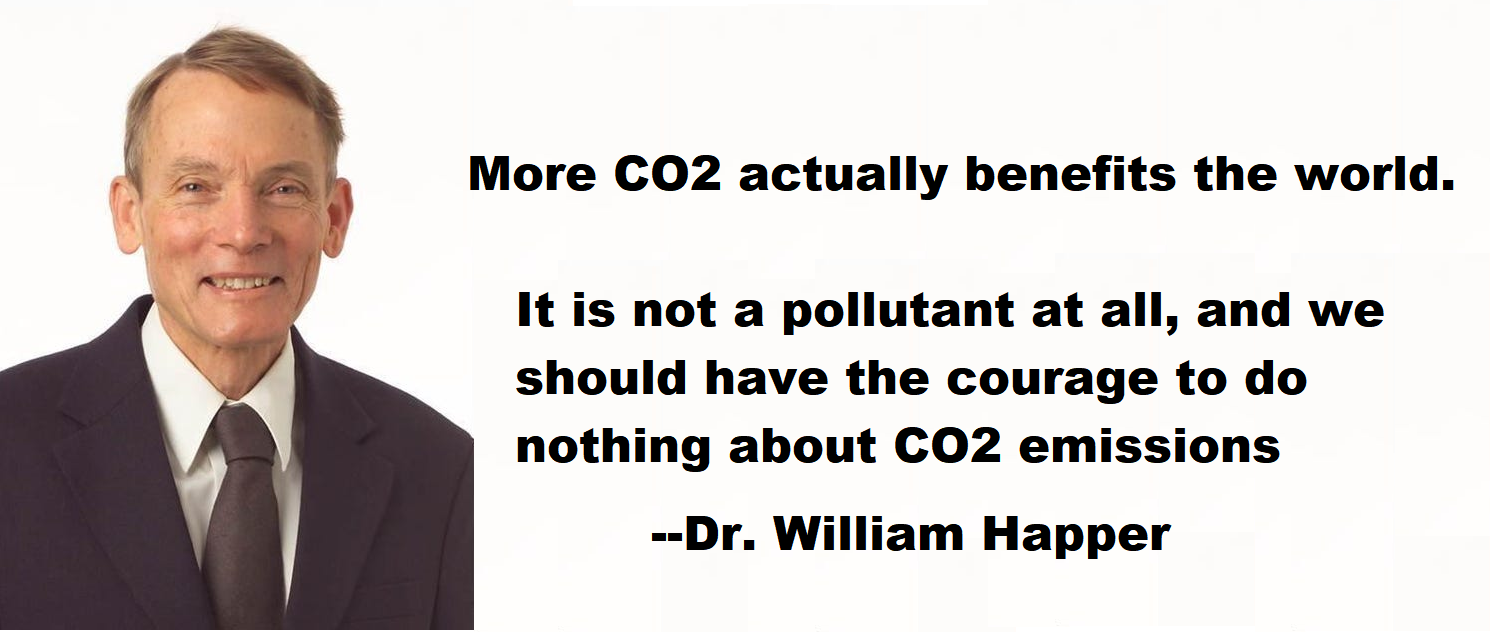
At the same time that the climate fanatics are encountering irresistible political headwinds, the intellectual arguments of the climate skeptics are becoming steadily more unanswerable. A brief filed with the court of appeals in The Hague in November by three eminent, American climate-related academics, Richard Lindzen of MIT, William Happer of Princeton, and Steven Koonin of New York University, the Hoover Institute, and former climate adviser to President Obama, challenged the finding of a lower court and held that scientific analysis, as opposed to an aggregation of “government opinion, consensus, peer review, and cherry-picked or falsified data,” shows that “Fossil fuels and CO2 will not cause dangerous climate change, there will be disastrous consequences for people worldwide if fossil fuels in CO2 emissions are reduced to net zero, including mass starvation.” They assert that the poor, future generations, and the entire West will suffer profoundly from any such policy. which “will undermine human rights and cripple the realization of the first three UN sustainable development goals-no poverty, zero hunger, and good health and well-being.”

The three experts warn against equating “the state of climate science with the reports of the Intergovernmental Panel on Climate Change,” which “have no value as science, because the IPCC is government-controlled and represents only government opinions, not science.” It also denounced the lower court verdict that “dangerous climate change and extreme weather are caused by CO2 emissions from fossil fuels… We demonstrate that these conclusions are contradicted by the scientific method, and only supported by the unscientific methods mentioned. Hundreds of research papers confirm the highly beneficial effects of the increased concentration of atmospheric CO2, especially in dry farming areas.”

They go on to represent the CO2 as essential to food, and thus to life on earth, and that the more there is of CO2, the more food there will be, especially in drought-stricken areas. They also make the case that greenhouse gases prevent us from freezing to death, that there are “enormous social benefits to fossil fuels and that net zero will expand human starvation by eliminating nitrogen fertilizer.”

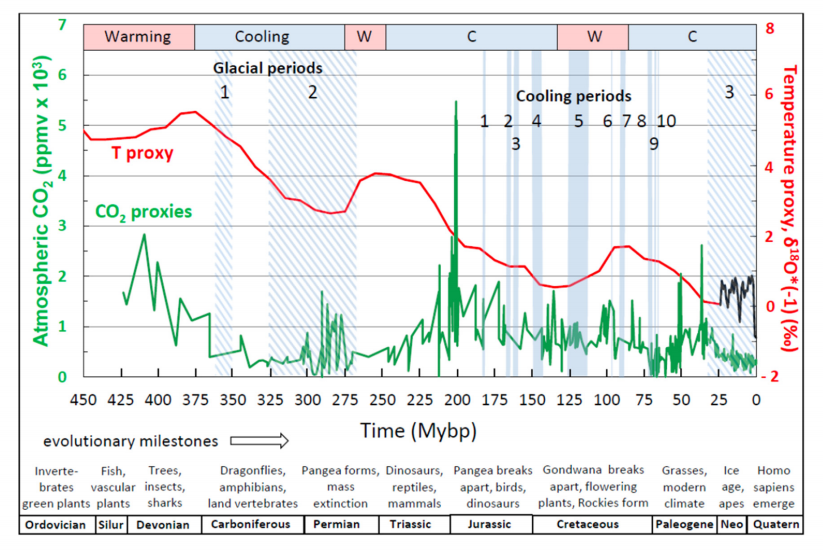
This highly recondite and meticulously documented paper states that “600 million years of carbon dioxide in temperature data contradict the theory of catastrophic global warming being caused by high levels of CO2, and that the atmospheric CO2 is now heavily saturated, which means that more will have little warming effect.” Up until recently, the zealots pretended that such opinions are held only by the uninformed, or the paid lobbyists of the oil industry, but they are not going to be able to get away with this much longer The ranks of the critics are swelling every week with aggrieved members of the voting public distressed by completely unnecessary skyrocketing costs generated by the fear-mongering climate zealots.

With any luck, the tide of logical evidence will wash away the
climate lunatics of this country before the damage becomes irreparable.

Addendum:  Contents of Brief Filed at the Hague

Shell v. Milieudefensie et al. – Expert Opinion

I. THERE WILL BE DISASTROUS CONSEQUENCES FOR THE POOR, PEOPLE
WORLDWIDE, FUTURE GENERATIONS AND THE WEST IF FOSSIL FUELS AND
CO2 EMISSIONS ARE REDUCED TO “NET ZERO”

A. CO2 is Essential to Our Food, and Thus to Life on Earth
B. More CO2, Including CO2 from Fossil Fuels, Produces More Food.
C. More CO2 Increases Food in Drought-Stricken Areas.
D. Greenhouse Gases Prevent Us from Freezing to Death
E. Enormous Social Benefits of Fossil Fuels
F. “Net Zeroing” Fossil Fuels Will Cause Massive Human Starvation by
Eliminating Nitrogen Fertilizer

II. THE IPCC IS GOVERNMENT CONTROLLED AND THUS ONLY ISSUES
GOVERNMENT OPINIONS, NOT SCIENCE, THUS PROVIDES NO SCIENTIFIC
BASIS FOR THE COURT’S OPINION

III. SCIENCE DEMONSTRATES FOSSIL FUELS AND CO2 WILL NOT CAUSE
DANGEROUS CLIMATE CHANGE AND EXTREME WEATHER

A. Reliable Science is Based on Validating Theoretical Predictions With Observations,
Not Consensus, Peer Review, Government Opinion or Cherry-Picked or Falsified
Data
B. The Models Predicting Catastrophic Warming and Extreme Weather Fail the Key
Scientific Test: They Do Not Work, and Would Never Be Used in Science.
C. 600 Million Years of CO2 and Temperature Data Contradict the Theory That High
Levels of CO2 Will Cause Catastrophic Global Warming.
D. Atmospheric CO2 Is Now “Heavily Saturated,” Which in Physics Means More CO2
Will Have Little Warming Effect.
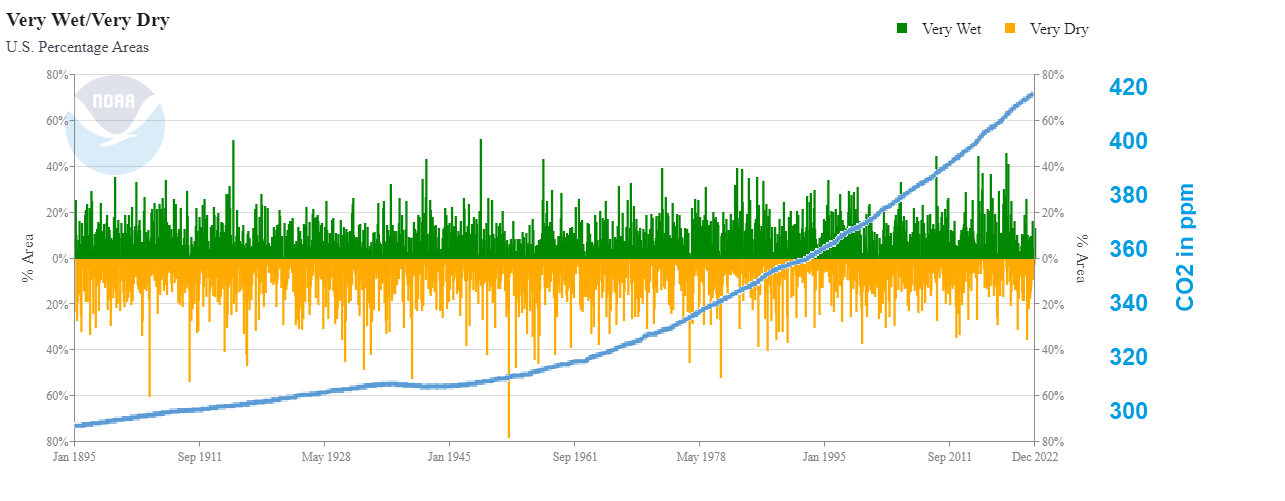
E. The Theory Extreme Weather is Caused by Fossil Fuels and CO2 is Contradicted by
the Scientific Method and Thus is Scientifically Invalid

Pope Francis Speaks as Climate Bigot

Thomas D. Williams, Ph.D. reports at Climate Change Dispatch Unchristian: Pope Francis Says Climate Deniers Are ‘Stupid’, Skepticism ‘Perverse’.  Excerpts in italics with my bolds and added images.

Pope Francis told CBS News this week that climate change deniers are “stupid” to refute compelling evidence of a climate emergency. [emphasis, links added]

“Some people are stupid (necios), and stupid even if you show them research, they don’t believe it,” the pontiff told CBS Evening News anchor Norah O’Donnell when asked what he would say to the deniers of climate change.  “Why? Because they don’t understand the situation, or because of their interests, but climate change exists,” the 87-year-old pope asserted.

Pope Francis had never before sat down for an extensive interview, one-on-one, with a U.S. television network during his 11-year pontificate.

Pope Francis has been a vocal enthusiast for the war on climate changecalling global warming “one of the most serious and worrying phenomena of our time” and urging “drastic measures” to combat climate change.

He has expressed his opinion that any skepticism regarding an alleged “climate emergency” is “perverse.”

The pope has also singled out the United States as particularly to blame for the “climate emergency,” even though it is one of the countries with the cleanest air in the world.

“If we consider that emissions per individual in the United States are about two times greater than those of individuals living in China and about seven times greater than the average of the poorest countries, we can state that a broad change in the irresponsible lifestyle connected with the Western model would have a significant long-term impact,” he stated last October.

Among the “fools” denounced by the pope for their “perverse” skepticism of the climate crisis are a group of over 1,600 prominent scientists, including two Nobel Prize winners, who issued the “World Climate Declaration” last August, refuting the existence of a so-called “climate emergency.”

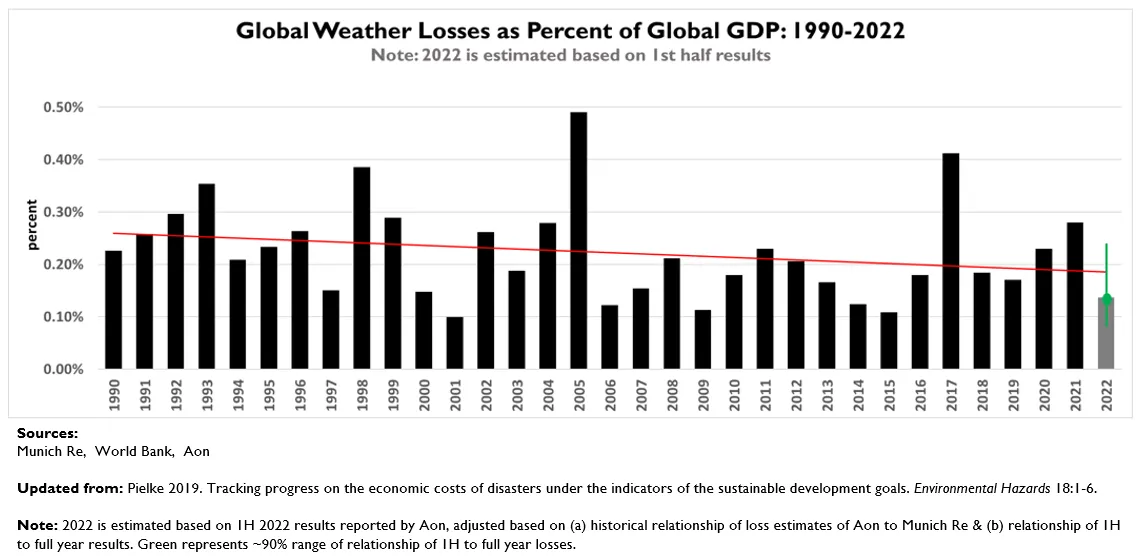
Among other things, the Declaration asserted that climate models have proven inadequate for predicting global warming, that carbon dioxide (CO2) is not a pollutant, and that climate change has not increased natural disasters.

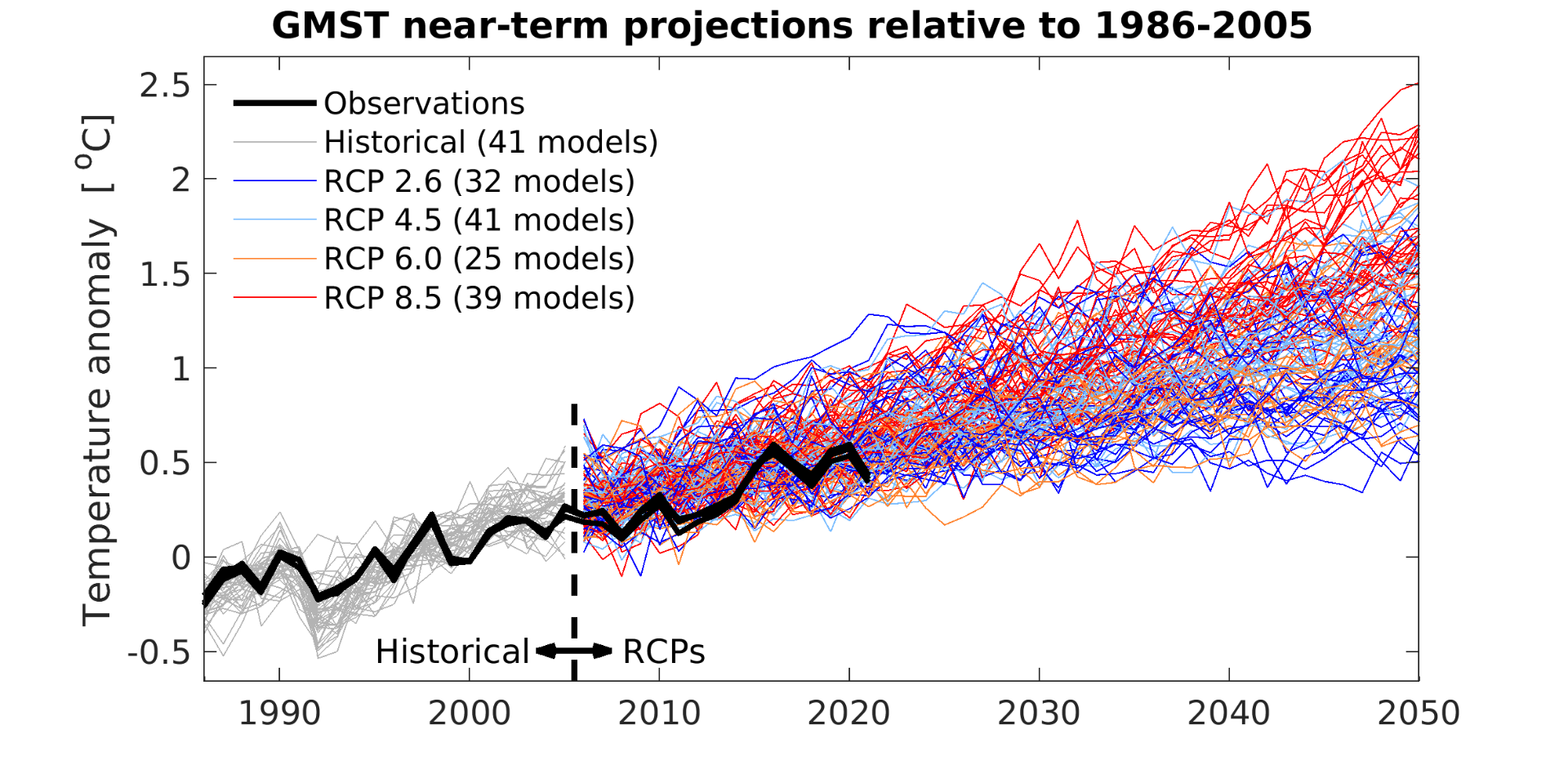
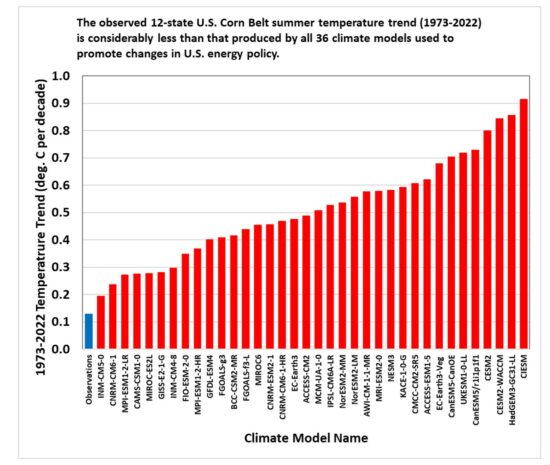
The world has warmed “significantly less than predicted by IPCC on the basis of modeled anthropogenic forcing,” the text states, and the gap between the real world and the modeled world “tells us that we are far from understanding climate change.”

There is no statistical evidence that global warming is intensifying hurricanesfloodsdroughts, and such like natural disasters, or making them more frequent,” the document declared. “However, there is ample evidence that CO2-mitigation measures are as damaging as they are costly.”

“There is no climate emergency,” it concluded. “Therefore, there is no cause for panic and alarm.

“We strongly oppose the harmful and unrealistic net-zero CO2 policy proposed for 2050. Go for adaptation instead of mitigation; adaptation works whatever the causes are,” it added.

Earth Day 2024: Plastics Miracle Saving People and the Planet

Benjamin Zycher celebrates how plastics benefit humans and the environment, in case this earth saver be overlooked by the Greens.  His Real Energy article is Earth Day 2024: How Plastic Can the Enviros Get?
Excerpts in italics with my bolds and added images.

It is Earth Day 2024, an annual exercise in self-applause that always is too much fun because of the inanities, hypocrisies, mendacities, and sheer stupidity of the Earth Day slogans, arguments, propaganda, and exhortations. And also because of the embarrassing spectacle of long queues of corporate officials and public relations gasbags desperate to advertise their environmental bona fides so that the green alligators might eat them last.

The Earth Day slogan for this year is “Planet vs Plastics,” and the list of horror stories is staggering. Plastics “flow through our blood stream, adhere to our internal organs, and carry with [them] heavy metals known to cause cancer and disease.” They “transmit hormone-disrupting chemicals.” They “can starve birds and suffocate sea life.” They “are a dangerous blight.”

One would think that this horror parade would have made life on earth ever more sickly, disease-ridden, and short. And one would be wrong: human life expectancy at birth now is 73.33 years, an increase of over 61% from the life expectancy of 45.51 years in 1950. Has the production of plastics  declined? Of course not: From 2 million metric tons in 1950, production in 2019 was 459.8 million metric tons. Why else would the environmental left find plastics worthy of its annual screaming?

Such as: “More plastic has been produced in the last ten years than in the entire 20th century, and the industry plans to grow explosively for the indefinite future.” “More than 500 billion plastic bags … were produced worldwide last year.” “100 billion plastic beverage containers were sold last year in the United States.”

One would think that such massive output just might lead the Earth Day sloganeers to hypothesize that plastics offer real benefits for ordinary people. Again one would be wrong. And if you think that the wreckage wrought by plastics is limited to such direct effects, think again. According to Earth Day 2024 propaganda — remember the slogan is Planet vs. Plastics — the fashion industry produces over 100 billion garments per year, 85% of which “end up in landfills or incinerators,” people buy 60% more clothing than was the case fifteen years ago, and over two-thirds of clothing is made “from” (that is, with the use of) crude oil, that evil of evils. The clothing industry is characterized by “exploitative working conditions, low wages, and widespread child labor.”

What does this have to do with plastics? The Earth Day 2024 rant about garments — inserted amid the larger rant about plastics — fails to mention plastics at all, a curiosity fully consistent with the disinterest on the part of the environmental left in rigorous thinking.

What is not so curious is the deafening Earth Day sermonizing about the evils of plastics, the importance of wind and solar power, and the worsening climate crisis, even as the scientific literature increasingly challenges the central Earth Day assumptions. Nonetheless, the Earth Day proponents applaud themselves for their devotion to science, that is, Science! So what does actual scientific research tell us about the relative greenhouse gas emissions engendered by plastics and the important alternatives? In brief:

We assess 16 applications where plastics are used across five key sectors: packaging, building and construction, automotive, textiles, and consumer durables. These sectors account for about 90% of the global plastic volume. Our results show that in 15 of the 16 applications a plastic product incurs fewer GHG emissions than their alternatives. In these applications, plastic products release 10% to 90% fewer emissions across the product life cycle. Furthermore, in some applications, such as food packaging, no suitable alternatives to plastics exist.

Maybe ensuing research will yield different conclusions — although the common argument that GHG emissions have created a crisis is supported by no evidence whatever — but the Earth Day cacophony ignores such subtleties, because Earth Day is the central religious holiday of modern left-wing environmentalism. But it reverses the traditional introspection, repentance, self-improvement, service to others, and faith in the moral requirements imposed by a higher authority. Instead, under the religious dogma of modern left-wing environmentalism generally and on Earth Day in particular, it is others who must examine their lifestyles, repent, purify themselves, suffer economically, and answer to the ideological demands of elite superiors. As I have noted many times, Dogbert perceived matters correctly: “You can’t save the Earth unless you’re willing to make other people sacrifice.”

Just as the pagans for millennia attempted to prevent destructive weather by worshiping golden idols, so do modern left-wing environmentalists now attempt to prevent destructive weather by bowing down before recycling bins. And so the Earth Day 2024 environmentalist Book of Genesis now begins as follows: “In the beginning, Earth was the Garden of Eden. But Mankind, having consumed the forbidden fruit of the Tree of Technological Knowledge, has despoiled it. After all, Plastics! And only through Repentance and economic suffering can Mankind return to the loving embrace of Mother Gaia.”

That loving embrace is fundamentally totalitarian. Reject it and Earth Day and all that it represents.

See Also 

Insane War on Plastics Resumes


Teens Impaired by Social Tech

Smartphones and social media have taken a toll on young people’s development. But one man has an idea about how to fix Gen Z. In his new book, “The Anxious Generation,” social psychologist Jonathan Haidt (JH) investigates the sudden collapse of mental health among adolescents. The author joins Hari Sreenivasan (HS) to discuss ways for parents to head off the damage.  Below is a transcript from the closed captions in italics with my bolds and added images.

HS: Jonathan thanks so much for joining us. Your latest book is called the anxious generation, How the great rewiring of childhood is causing an epidemic of mental illness. You and I have talked before and you have been very careful about not seeming alarmist. This book is fascinating to me in that you supplement so much of your ideas with empirical data and research that is proving this point. What is the epidemic of mental illness and where do we find the data for that?

JH: When you and I first spoke about this it might have been back in 2019 I was not as alarmist because we weren’t sure it was clear that something was going wrong with Teen Mental Health. We had graphs showing that around 2013 rates of anxiety depression and self harm began rising rapidly. But there was an academic debate and there still is academic debate about whether it’s caused by social media. It’s correlated with girls who use it heavily, who are three times as likely to be depressed. But you know scientists are going to debate is it causal or is it just a correlation.

Since then I have learned a lot; I’ve gathered all the studies I can find including experiments. There are now a lot of experiments showing that when you randomly assign people to different conditions, it causes them to get more depressed or less depressed. So we have experimental research. But the really shocking thing that made me an alarm ringer, not an alarmist, is the discovery that the exact same thing that what happened to us in America also happened in Canada, Britain, Australia, New Zealand and Scandinavia.

At the same time, in the the same way, it was
hitting girls hardest and young girls even harder.

So it became clear this is an international epidemic of Teen Mental Illness and it began in the early 2010s. It’s hitting girls hardest, although the boys’ story is really interesting and different but is also very bad. That’s why as you say I’m leaving my old self behind and saying we need to act now, not waiting for 2025. We need to really make changes this year because otherwise another year of kids is going to be consigned to this phone-based childhood which interferes with development.

HS: So your argument is that it’s not the technology that’s bad or the internet that’s bad. You actually try to draw kind of a timeline from getting one of these supercomputers in your pocket to the front-facing selfie camera to broadband and then social media. What have each of these kind of technological evolutions done to how our brains evolve?

JH: So the technology is great, the internet is great, but things really change in the early 2010s. I really go into this in detail in the book, but let me briefly walk you through it. In 2010 only about 20% of American teens had a smartphone, kids were still using flip phones. They did not have high-speed internet. Most of did not have unlimited data plans. You used your flip phone to text or call your friends to get together and that was it. Kids were still seeing other kids in 2010.

The beginning of what I call the great rewiring happened over the next few years. The smartphone gets a front-facing camera in 2010, Instagram comes out in 2010 but becomes super popular in 2012 when Facebook buys it. So that’s when the girls really rush on, they move their social lives on to Instagram in particular also Tumbler and a few others. So you get these super viral social media platforms, it wasn’t like that in 2005. So with front facing camera and high-speed data, you get notifications. The original iPhone didn’t interrupt you; you pulled it out when you wanted it.

So in 2010 there is no sign of a mental health crisis everything’s fine so we were all super optimistic in 2011 even up to 2012. But that’s when the mental illness crisis begins and all the numbers go way up for girls and also up substantially for boys. By 2015 we have the Millennials who just barely made it through puberty before they got this. So the Millennials were in college or late high school when they adopted this phone based life. Because we’re all doing it, we’re all dominated by our our technology.

HS: Walk us through the actual harms that’s now scientifically connected to kids use and increased use of screens and social media specifically on smartphones.

JH: First we have to establish the numbers here which are stunning. The latest data from Gallup is around 9 hours a day that they spend on their phones and screens. Of that, five hours a day is social media, another 3 to five is all the other stuff that they do. So imagine if you take nine or 10 hours out of your child’s day every single day, where’s it going to come from? They spend less time sleeping, less time with other kids, less time outside, less time exercising, a lot more time just being sedentary and solitary.

For all those reasons, and oh, very little reading of books, no Hobbies, there’s no time for anything. So that’s the first thing: it pushes out all the good things of childhood that we want our kids to have. When you give a kid a smartphone it’s likely to move to the center of her life, and that’s what she’s going to do for the rest of her life. That’s one of the main ways of harm it just deprives you of everything else.

Another thing it does is to fragment your attention. Probably you and I know we can pay attention to things, we can do our work, but it’s harder now than it was 10 years ago. There’s constant interruptions, we’re still able to do it, but it’s a struggle. A teenager just starting puberty age 10, 11, 12, the prefrontal cortex is has not yet rewired for the adult configuration. They’re not very good at paying attention and early puberty is when that skill really develops. Imagine having them trying to develop that skill while being interrupted every few minutes. One study found the average teen now gets 257 notifications a day, 257 interruptions every day. It’s very hard to focus on anything, so you get fragmented attention, and we don’t know how permanent this is.

Another harm is addiction. The brain adapts to that constant level of stimulations so that when you’re not getting it, you’re in a deficit mode: you’re irritable, you’re unhappy and feel terrible. So these devices are designed to grab hold of our kids attention and never let go, and they’re very effective at that. I could go on there are so many other avenues of harm, but those are some of the big ones that I cover in the book.

HS: Can we talk a little bit about also the data and how it forks on the impacts to girls versus boys?

JH: When I started writing the book I thought it was going to be a story primarily about what social media is doing to girls, because I’ve got a lot of data on that, and because the graphs as you said are like hockey sticks. It’s like they’re going along, nothing is happening and then all of a sudden one day in 2013 they all start shooting upwards.

The hospitalizations for self harm are the most stunning,
and they’re the same in Britain, Canada, Australia.
It’s absolutely stunning what’s happened to girls since 2013.

For boys I couldn’t find a Smoking Gun. I couldn’t say oh well it’s video games or it’s social media for boys. The rise in mental illness is slower, and the key thing about boys: It’s not so much that this Modern Age is giving them diagnosable mental illness. Working with my research partner Zach Rausch we finally figured out that for boys the issue is they’ve been withdrawing from the Real World really since the 80s and 90s. They’ve been spending much more time online, they don’t go outside, they don’t wrestle. So boys are basically blocked in their development; they’re not turning into men, they’re dropping out of school, dropping out of the workforce. We’re losing a generation of boys.

It’s not as clear when you look at wealthy educated groups, there the gender gap is not so big. Once you get to middle class and below, the girls are doing okay in terms of school and work and the boys are just not. So the problems are more diffuse but they’re extremely serious for boys now.

HS: So many parents that will tell you that if you take a smartphone away from a child that it’s almost like that you’ve broken this tractor beam that they’ve had this lock on. And they’re generally speaking really aggressive. It’s a very strange equation. If it was any other kind of an addictive substance or drug, a parent would probably say: Well, let’s get that out of the house and not use it.

JH The most powerful argument a kid can make: “Mom, I have to have a smartphone because everyone else has one, and I’ll be left out. I have to have Instagram because everyone else has it and I’ll be left out.” That’s what’s called a collective action problem; it’s hard for us as parents because everyone else is doing this. So I’m proposing that we coordinate to set some Norms. Norms that would be hard to do on our own but much easier to do if we do them together.

Go back to the the parent struggling to put limits on use or to maybe give a warning. You were describing actually quintessential withdrawal symptoms from any drug. When brain circuits are used to getting this stimulation, whether from cocaine, heroin, slot machines or or social media. If that happens every day, when you take the kid off they feel horrible for a couple of weeks. It takes three or four weeks actually to detox for the brain to reset. So it’s vital that we delay the entry into this craziness and that we give our kids time away.

HS: Let’s deal with some of the reservations that I’m sure you’ve heard. Besides my kid is going to miss out, parents are concerned about giving their kids devices to be able to get in touch with them in an emergency. What are ways to do that without necessarily giving them a full smartphone loaded with social media?

JH: As a parent of two high school kids I totally understand the desire to be able to reach your children and the desire for them to reach you if something goes wrong. So first thing, we’re not saying cut them off and don’t communicate. We’re saying don’t give them the most powerful distraction device ever invented to have in their pocket all the time, including when they’re going to sleep, when they’re in class etc. So give them a flip phone; the Millennials had flip phones and they turned out fine.

My second point though is school security experts say there are procedures in place to deal with a school shooting, and and they involve listening and cooperating and working together with the teacher and the administration. So I would ask any parents who have this concern, and we all have the concern, would you rather send your kid to a school in which when there’s when there’s a potential problem everyone stays silent, they follow directions, they do what they’re supposed to do and follow the procedure. Or would you rather have one where at the first sign of a serious problem everyone pulls out their phone. They’re crying to their parents, they’re making a lot of noise, they’re not listening.  I understand the human urge to talk to your kid if there’s a crisis. But the teacher has a phone as do all the administrators. We have to let th professionals do their job and not interfere as parents.

HS: What about the idea that there are so many different types of communities who have found each other over social media? In a section of your book you talk about how ironically some of these communities that might find the most benefit are also the ones susceptible to the largest negative effects by being on social media. Please explain that.

JH: Yes. You know we often confuse the internet and social media. You’ve described a problem that the internet largely solved. Kids who were isolated in the 90s they could find you know if you’re gay if you’re bi if you’re trans, they could find other kids beginning in the 90s the internet is amazing for that. Once you start getting communities on social media, what often happens is a move to the extreme. Look at mental health Tumblr or mental health Instagram or mental health Tik Tok. You might think if a person has a particular disorder it’s great that they can interact with other people to share their disorder. I don’t think that’s true.

There’s increasing amounts of research that social media is spreading mental illness. It’s just not a good idea to have teenagers hanging out with influencers who are motivated to be more extreme to get followers. So I don’t buy the argument that this is somehow good for members of historically marginalized communities. As I report in the book, studies show that while most kids recognize that these platforms are bad for them, LGTBQ kids are even more vociferous in saying these platforms are bad for us. These platforms lead to bullying and harassment. So the internet is amazing but social media does far more harm to kids than whatever shreds of benefit you can find from it.

HS: You have taken this message to social media companies directly. Are they getting it?

JH: Well there’s been no response certainly. I think they’re kind of hemmed in. Meta did try a small thing, they tried hiding the like counter. That didn’t work to have an effect. I’ve spoken with their research staff and with leadership there. I do believe that if they could make it healthier and not lose any users they would do it. But Meta in particular has shown it’s always prioritized growth over everything else.

Many internal whistleblowers have pointed out problems, and they generally don’t respond. They don’t do the things that would be effective. For example kicking off underage users is possible, they know how old everybody is. But you when most 11 and 12 year olds have an Instagram account they should be kicked off but meta won’t do that. Snapchat won’t do that because they’d lose most of their users. So they know what are the problems. There have been many internal reports and they don’t act. And they don’t have to because Congress gave them immunity from lawsuits. This is one of the most insane things about our country. We have this environment that is incredibly toxic for our kids development, and we can’t sue them.

HS: At a senate hearing CEO of meta Mark Zuckerberg said: “the existing body of scientific work has not shown a causal link between using social media and young people having worse mental health.” Is he misinformed by his lawyers?

JH: No he’s properly informed by his lawyers. He can point to studies that support that conclusion, such a few Meta analyses and a study by the National Academy of Science that came to that conclusion. But there is so much evidence on the other side, so they’re cherry-picking. Even that National Academy’s report that claimed that there’s not enough evidence to prove causation, in that very report people should read chapter 4. It’s an amazing catalog of of the research that shows causality. So it’s a bizarre report which itself documents dozens and dozens of avenues of harm and dozens and dozens of experiments, but yet for some reason they said well we can’t prove that it’s causal.

If you go to my substack after babel.com I’ve gone through all of the studies, we itemize them, we show how the correlational studies come out, how the longitudinal studies come out, how the experimental studies come out.

There is a ton of evidence and the preponderance of the evidence
shows it’s not just a Correlation, it’s a Cause.

Zuckerberg was pointing to the few studies he could, but in the long run I believe they’re going to lose that case because the evidence keeps mounting and by now everybody sees it, including the teachers and the parents. We saw all those parents at that Senate hearing testifying that their that their kid is dead because of something that happened on social media. Were they all wrong about that? At this point in time it just defies belief that social media isn’t contributing to this Mental Health crisis.

HS: Do you think that legislation like what Ron DeSantis is proposing in Florida or other states are thinking about doing to try to delay or ban the use of social media by a certain age will work?

JH: I think the DeSantis bill, the Florida bill is great. We have to delay the age at which they get into social media. I think 16 is the right age; I mean for health reasons it should be 18, but realistically we’re not going to get 18. I think 16 is a reasonable compromise at which we can begin treating kids like adults on the internet. Right now current law says 13. At 13 companies can do whatever the hell they want to your kids. They can take their data, they can do anything, they don’t need your permission, they can treat them like adults. That’s current law and there’s zero enforcement as long as they don’t know your kid is 10. they can do whatever they want to your kid.

So the current law is horrible: it’s not enforced, the age of 13 is too low. We need to raise that to 16 and enforce it, and that’s what the Florida bill is going to do. They have a little carve out so that if parents really want their kid to be on at 14 and 15 they can specifically sign a permission. That’ll be interesting to see how the tech companies Implement that but I’m a big fan of the Florida bill. I hope all 50 states do it because there is no way to make social media safe for middle school children.

Author and Professor Jonathan Haidt, thanks so much for joining us.