Removing the Copco 2 Dam takes deconstruction crews one step closer
to drawdowns of the remaining three reservoirs next January.
The first of four hydroelectric dams along the Oregon-California border has been removed from the main stem of the Klamath River. All that remains of the dam known as Copco 2 in Siskiyou County, California, is the headworks of a diversion tunnel adjacent to the now free-flowing river.
When complete, the overall project will be the biggest dam removal in U.S. history and will reopen 400 miles of fish habitat that was cut off for more than a century. Deconstruction activities on Copco 2 will continue until September. Getting this first dam out of the way takes deconstruction crews one step closer to drawdowns of the remaining three reservoirs next January.
From CBS News: The project, estimated at nearly $450 million, would reshape the Klamath River and empty giant reservoirs, and could revive plummeting salmon populations by reopening habitat that has been blocked for more than a century. The proposal fits into a trend in the U.S. toward dam demolition as these infrastructure projects age and become less economically viable. More than 1,700 dams have been dismantled nationwide since 2012.
The structures at the center of the debate are the four southernmost dams in a string of six constructed in southern Oregon and far northern California beginning in 1918. They were built for power generation, and none has “fish ladders,” concrete chutes fish can pass through.
Two dams to the north are not targeted for demolition. They have fish passage and are part of a massive irrigation system that straddles the Oregon-California border and provides water to more than 300 square miles (777 square kilometers) of crops.
Those farmers won’t be directly affected but worry the demolition will set a precedent.
Good for the Salmon and Indigenous Fishermen, but what about the Lost Power?
A statement highlighting the importance of hydropower energy in the West
and opposing the removal of the four Klamath hydroelectric dams.
“Hydropower is the oldest source of renewable energy in the United States and accounts for nearly a third of total U.S. renewable electricity generation. Hydroelectric dams play a critical role in the resiliency of the West’s electrical grid, the preservation of our landscape, flood control, the creation of space for outdoor recreational activities, and many of these dams assist in the delivery of water to farms for agriculture production. Hydropower is a win for the environment, domestic energy production, and economic development in rural areas.
So why is hydropower under attack? Because some outlier environmental groups have claimed that dam removal is necessary for fish health, even though these dams provide stored water for fish in low water years and the needed cold water for fish in hot summers.
Residents in the Klamath Basin in Southern Oregon and Northern California know about this struggle because of the proposed Klamath River dam removal – the largest dam removal project in U.S. history. For decades, PacifiCorp (the owner of the dams), local municipalities, tribes, agriculture producers, and conservationists have gone back and forth arguing the benefits and drawbacks of the four Klamath Dams – Copco #1, Copco #2, Iron Gate, and J.C. Boyle.
Dam removal advocates claim the dams block salmon and steelhead spawning and rearing habitat in the Upper Basin, even though their only science is a questionable Master’s thesis. These advocates have conveniently avoided discussions of other factors that have caused salmon and steelhead populations to decline, such as overfishing, pollution from forest fires, a marginal population in a warm river, and disease.
They irresponsibly ignore the immense amount of sediment behind each dam, and how releasing it will impact water quality and river health, including the years long decimation of the very salmon runs they claim to want to protect. Nor have they considered how dam removal will affect other wildlife species who reside near the river and in the reservoirs, such as Canada Geese, sandpipers, Western Pond Turtles, and crayfish. It is essential that the conversation regarding dam removal consider the big picture, how this action will affect the Basin’s entire ecosystem and the people who live there, rather than base solutions solely on hypothetical scenarios for salmon.
Those who support keeping the dams know the true benefits they bring to the area. The Klamath River Hydroelectric Project generates, annually, enough low-cost, reliable power for 70,000 households. The dams provide good-paying, technical jobs and are the largest single private taxpayer in the county of Siskiyou. The reservoirs created by each dam are critical to the area’s firefighting efforts, ground water recharge, pulse flows for clearing debris, and flood control.
Removing hydroelectric dams from our energy grid will drive up energy costs,
decimate local jobs, and increase dependency on oil and natural gas
– something both California and Oregon have opposed.
The proper and best position on these dams is crystal clear: hydropower provides renewable, cheap energy to our power grid around the clock. It’s unconscionable that so-called environmental advocates are forcing dam removals across the West without the scientific evidence to back up their ideas, and no acknowledgement of the catastrophic consequences that could occur from these actions.
As the Federal Energy Regulatory Commission advances the removal of four dams on the Klamath, and elsewhere across the West, we must continue the fight to protect these engines of energy and economic reliability.”
Summary
The zero carbon juggernaut rumbles on, chewing up pieces of modern society’s energy platform. Even dams are removed despite their essential baseload power stabilizing the grid, with no carbon emissions. Meanwhile, gas and coal supply infrastructure is constrained and allowed to decay, with no chance wind and solar will make up the difference in reliable affordable power.
Wildfires raging outside Athens this summer are just one reason environmentalists are raising alarms louder than ever — even as many activists insist their messages lack the proper resonance with voters. AP
We are hearing even more than usual about climate change this summer and that is not surprising — not with dog-days news cycles driven by record-setting heat waves, torrential rains and widespread Canadian wildfires.
Some climate activists think we are not hearing enough about the issue: Writing in The Guardian, columnist Jonathan Freedland insists that the problem is one of marketing. “The climate movement has devoted relatively few resources to reaching or persuading the public,” he writes, preposterously.
He quotes progressive p.r. man David Fenton — “We’re in a propaganda war, but only one side is on the battlefield” — and cites former United Nations climate grandee Christiana Figueres, who claims “the climate community has recoiled from marketing.” Why? Because, Figueres says, it is “sort of tainted. It’s icky. You know, ‘We’re too good for marketing. We’re too righteous’. . . Hopefully we’re getting over it.”
Of all the dumb and dishonest things that have been written and said in the climate debate, the notion that climate-change activists just can’t get their message out — that they won’t stoop to marketing — may be the very dumbest and most dishonest.
Billions of dollars have been spent on climate-change advocacy,
to say nothing of money devoted to actual climate policies.
Raging wildfires in Eastern Canada have sent vast plumes of smoke across North America this summer. Environmentalists loudly suggest the smoke is proof of a changing planet, even as progressives insist their agenda is being silenced. via REUTERS
The government leaders of practically every democratic country speak about the issue constantly.
In the intergovernmental sector, you have everybody from the United Nations to the International Monetary Fund ringing the climate alarm bells, while in the private sector you can count on the likes of BlackRock, Goldman Sachs and other corporate titans to do the same.
ESG rules have pushed the climate issue onto the corporate agenda in a big way—companies are spending billions in total (as much as $1.4 million per company) on climate-reporting costs alone.
Even the supposed villains in the story — big energy companies such as ExxonMobil — spend billions of dollars a year advertising the green agenda. “In the past ten years we have reduced greenhouse gas emissions in our operations by more than 7 million metric tons,” ExxonMobil boasts, “which is the equivalent of taking about 1.4 million cars off the road.” You may not think they are sincere, but they are far from silent about the issue.
Companies such as private equity biggie BlackRock are spending billions on ESG programs, which link their investment strategies with left-wing social goals. REUTERS
Climate activists have the commanding heights. What do the so-called deniers have? A few of my cranky libertarian friends. . . And voters.
The real issue with climate policy isn’t that voters don’t know about the issue — it is that they disagree.Climate policy touches everything from big tech to farming to economic growth, everything from the homes we live in to the cars we drive, and, as such, an ambitious climate program will necessarily impose big costs.
The Alexandria Ocasio-Cortezes of the world can pretend that green policies will pay for themselves, but no serious person believes that.
One of the clearest ways to reduce our reliance on fossil fuels is to expand access to nuclear energy, which requires major investment in new infrastructure. Getty Images
Sure, Guardian headline writers can straight-up declare “The beauty of a Green New Deal is that it would pay for itself” — this is nothing more than that “marketing” to which our green friends supposedly are so averse.
American voters do care about climate issues, but not as intensely as activists would like. Climate routinely polls in the single digits when it comes to voters’ top concerns, far behind (surprise!) the economy and health care. Independents rate immigration a more pressing issue than climate change.
Maybe you think the US government is under the heel of the oil barons, but no democratic country has undertaken the kind of economic transformation climate activists advocate.
The signatories of the Paris Agreement are far from meeting their climate obligations; the $100 billion a year in climate-finance commitments promised at the UN climate summit in Glasgow have not been fully funded; even in the European Union, the leaders of which take a much stronger climate line than their US counterparts, there has been no radical change.
A coal excavator in Germany, which boosted coal mining in the wake of gas shortages caused by the Ukraine crisis. AP
European voters rank climate a higher priority than Americans do, but it typically polls behind economic growth and immediate issues such as the invasion of Ukraine.
That is not oil-drenched propaganda at work— that is, for better and for worse,
democratic politics at work.
While there has been piecemeal progress, countries across the globe are moving at a glacial pacewhen it comes to the one policy that can reliably reduce greenhouse-gas emissions at a reasonable cost: rapidly expanding nuclear power, which has an operational carbon footprint of approximately zero.
The state government in Pennsylvania got that collapsed interstate overpass reopened in record time by waiving all sorts of planning and permitting rules, but no such urgency exists in the case of nuclear power or other needful energy infrastructure.
Christiana Figueres, who leads the UN’s climate change campaign, contends that environmental issues suffer from a lack of proper marketing. Many would certainly disagree. LightRocket via Getty Images
That, unfortunately, is democracy, too. What is needed is not more marketing — more propaganda, more hysteria. What is needed is a more attractive set of trade-offs.
But finding better trade-offs means admitting that there are trade-offs, which climate activists — hostage to their marketing departments — have too often refused to do.
Promises made at major multi-national climate conferences such as the Paris Accords remain unmet as liberal democracies appear unable to overhaul their energy strategies. Getty Images
It isn’t that climate activists aren’t selling their agenda — it is that
voters in democratic countries around the world are not buying it.
Andy Puzder explains how bogus and damaging is ESG investing. Perhaps others are getting the memo. WSJ reports with a sad tone what is actually good news that investors are pushing back against ESG political correctness. Their article is: ESG Blowback: Exxon, Chevron Investors Reject Climate Measures Excerpts in italics with my bolds.
An investor-driven climate change push at some of the world’s largest oil companies has stalled out.
On Wednesday, Exxon Mobil and Chevron’s shareholders struck down a raft of proposals urging the companies to cut greenhouse-gas emissions derived from fuel consumption, put out new reports on climate benchmarks and disclose certain oil-spill risks, among other initiatives.
The votes were abysmal for climate activists. All but two of the 20 shareholder proposals for the two companies garnered less than 25% of investors’ vote, according to preliminary results, with some performing much worse than similar proposals put forward last year.
Zero Carbon zealots attacking ExxonMobil, here seen without their shareholder disguises.
Among the most controversial proposals were those that would have had the companies adopt targets for reducing emissions including those from third-party consumption of their products, such as when drivers burn gasoline in their cars, also known as Scope 3 emissions. Those received only 11% and 10% of the vote among Exxon and Chevron investors, respectively, compared with 27% and 33% for similar proposals last year.
In recent weeks, similar climate proposals failed to win over most shareholders
at annual meetings of British oil and gas giants BP and Shell in London.
Investment strategies linked to ESG, short for environmental, social and corporate-governance issues, had gained momentum in recent years, particularly following the onset of the pandemic in 2020. Investors pressed oil companies to show how they were working to reduce their climate footprint, set long-term environmental goals and curtail the flaring of unwanted natural gas.
In 2021, investment firm Engine No. 1 prevailed in a historic proxy battle against Exxon, winning three board seats at the company’s annual meeting with the backing of investment firms, Vanguard, State Street and BlackRock. The firm argued that Exxon needed to form a better strategy to prepare for the world’s anticipated energy transition.
After the defeat, Exxon adopted a so-called net zero commitment — a goal to reduce or offset greenhouse-gas emissions from its operations to zero by 2050.
But Wednesday’s votes demonstrated how some shareholders have backed off pushing major oil companies to embrace certain climate goals. Investors said many voices pushing ESG measures have been drowned out following Russia’s war in Ukraine, which caused oil and gas prices to skyrocket as global supplies were crimped.
Mark van Baal, founder of environmental activist group Follow This, said shareholders missed an opportunity at the annual votes. Investors know that avoiding climate disaster will require global emissions to fall by almost half by 2030, he said, but many are focused on short-term profits. [Note: van Baal is wrong about disaster–see Even 3°C Warming Can’t Stop World Prosperity. ]
The industry and its allies have said some countries, particularly in Europe, were too quick to move away from fossil fuels toward clean energy sources such as solar and wind. A movement against climate activism has gained political traction in the U.S., particularly among Republican voters. Entrepreneur Vivek Ramaswamy, a candidate for the Republican presidential nomination, has made anti-ESG policies a central plank of his campaign.
The pushback against ESG measures has also hit investment firms such as BlackRock,
which have faced potential boycotts in Texas and other red states.
Republican officials in Florida, Texas, Louisiana and South Carolina pulled more than $4 billion in pension and investment funds from BlackRock starting last year. BlackRock brought in $230 billion from U.S. clients in 2022.
It wasn’t immediately clear how BlackRock, State Street and Vanguard voted at the meetings this week. State Street and BlackRock declined to comment. Vanguard didn’t immediately respond to a request for comment.
Investments in fossil fuels pushed many oil companies to record profits last year, which lured back some investors who had fled after years of meager returns from the industry. Exxon Chief Executive Darren Woods said Wednesday the company had benefited from investing in fossil fuels when others pulled back.
Even in Europe, energy executives have shown a willingness to alienate clean-energy investors to tailor strategies to the thirst for fossil fuels. BP and Shell’s record full-year 2022 profits and hefty returns to investors have attracted new investors, and won back some who were dubious of their energy-transition strategies, executives said.
Shell and BP executives have said their strategies are consistent with targets to lower global emissions, while also helping supply the oil and gas still demanded in coming years globally. Exxon and Chevron have said they support the emissions targets set by the Paris climate accords and reducing emissions from their operations.
But Woods and other industry executives have argued some climate-related proposals would backfire or leave the economy worse off. Woods said several proposals rejected Wednesday would have required the company to assume the world will cut carbon emissions at a much faster pace than observers have projected.
“Some [would] go so far as to force us to decrease oil and gas development,” he said. “This would do nothing to reduce global demand.”
What is actually beyond debate is not that we are in a climate crisis but that if we don’t stop destroying our conventional energy economy, we are going to be in a civilizational crisis.
Jay Valentine explains how to block the fraudulent ballots intended for the 2024 election in his American Thinker article The Achilles Heel of Mail-In Ballot Fraud. Excerpts in italics with my bolds and added images.
The difference between the Republican ballot operation and that of the leftists is that the leftists manufacture ballots, whereas Republicans only collect them.
Elections are for big stakes. Pretty much everything is political, and thus, who controls the Legislature gets the goodies.
If you are a government pro, you live or die according to whether your team is in power. You do what the pros do — you make sure you control your food source.
The laughable RNC “out-ballot-harvest the left” plan is one any sentient adult knows cannot work. That of course leaves out Republican state operatives, for whom hope exceeds common sense.
Leftists learned early that running out of ballots to cast on election day is like running out of beer on July 4. They took that lesson and improvised in ingenious ways.
Ballot-manufacturing appears pretty easy at first but has lots of little complexities. Mastering those complexities gives our leftist pals unlimited numbers of ballots to handle any surging MAGA candidate.
Manufacturing ballots requires two ingredients: an address and a person.
On the person side, leftists do all the obvious stuff: register college kids in droves, do voter drives in homeless shelters where vagrants come in and out, build apps and pay anyone who will sign up a few dozen new voters (Wisconsin) with no regard to whether these are eligible voters.
With these and scores of other techniques, the inventory of names aggregates.
That burgeoning list is permanent — voter integrity teams in most states report they cannot get many of these people off voter rolls even when they prove that those people are long gone. Leftists control most of the voter commission apparatus, so that inventory remains safe.
Try to get those names off the voter list, and you will be attacked by leftist press, threatened by the Justice Department, or doxed on social media.
The other ingredient for ballot-manufacturing is the address.
Addresses and voters have fundamentally different characteristics.
Addresses can be misspelled in innumerable ways yet still be considered correct. Addresses do not move — they are a plot of dirt with a number. Addresses do not have lawyers, and they do not have 40 years of leftist court opinions to protect someone challenging their authenticity.
Addresses cannot be manufactured. Voters can.
Leftists can create all the voters they want from homeless shelter lists, but they face a constraint: every voter must tie to an address. It is this constraint — fixed addresses — that is the Achilles heel for mail-in voter fraud.
Addresses conveniently have the world’s singularly most accurate, current database maintained in every county in America — the real estate property tax record. These records are consulted daily by real estate agents doing comps. Tax authorities review them monthly, ensuring they squeeze every dollar from the citizen for any improvement.
Addresses, dear reader, are the key to stopping ballot-manufacturing.
Addresses have not been analyzed at scale in granular detail — down to the square footage, the number of bedrooms, baths, year built — because the tools to do so were not there. They are now.
The Fractal team was asked by some state legislatures to compare voter rolls with real estate tax rolls. They couldn’t do it themselves — they did not have the compute power — in a major state. That is why it has never been done before.
Two adjacent counties may report similar real estate data in different fields. Each county may use different nomenclature for the same record. Records are stored in relational databases with the address field broken into multiple segments — almost impossible to easily resurrect in real time with traditional tech.
These systems were built to be accessed one file at a time, not comparing the entire database with another. Comparing detailed property tax records — think 120 columns of info — against voter files lights up where a ballot will be mailed but not meet an eligible voter.
This week, the Fractal team ran a test. We used current relational SQL technology, of which we are masters, and Fractal to ingest the property tax roll for a major county. The Fractal system was able to finish in hours — with a real-time system giving answers in seconds. After several days, the SQL team reported the originating data from the county — in a SQL relational file — was so complicated that it would take them several weeks to prepare for real-time retrieval.
We were also able to project response times. The property tax records with Fractal were instantaneous. With SQL, complete database comparisons would take days, perhaps a full week.
Leftists continue to pad voter rolls with vagrants and other transients, but
they must tie them to an address. That is a pretty hard card to hide.
When voters are added to large apartment buildings, leftists cannot add the apartment number, or the legit resident will probably get that ballot. The trick is to mail the ballot to the main address, where it collects, and the Postal Service retrieves it for the bad guys.
Another strategy is to create an address. 126 Chestnut Street and 130 Chestnut street are contiguous properties. Our leftists create 128 Chestnut, which does not exist, and will generate a floating ballot.
Often, college dorms are used to send thousands of ballots to students who left years ago. We recounted many stories about 106-year-old voters in frat houses still casting a ballot.
Then there are the construction sites, where leftists have 224 registered voters in an apartment building — under construction. No roof, no walls, no electricity, but 224 solid votes.
In Florida, our leftist pals created an entire fake street — then moved real voters there — and when ballots were sent out, they accumulated. Innovation! Never ceases to impress!
These and hundreds of other schemes fail in a single click when the real-time real estate property rolls come into play. With that one click, one can see every address that does not exist in the property roll — yet has voters.
Another click shows every apartment building, compared with every voter record, kicking out the list, by street, of every person without that unit number — thus ineligible.
One more click, and every voter registered at a location with more than four people per 500 square feet of living space — thus challenging the county health regs — pops out.
What we have here is something of true beauty: one government database showing the nonsense in another government database. When leftists say “show me the fraud,” one needs only to do one click — “voters who voted in 2022, who the government tax records note are ineligible.”
In 2024, the leftists are pulling out all the stops. Hundreds of thousands of American voters will wake up in the 90 days before the election with strangers living in their homes, apartment buildings, the local 7-11, or the vacant field. Those are the Trump anti-votes.
The difference between 2020 and 2024 is that they will become visible months before the election. They will be challenged the week they register. Press conferences will be held on that construction site lawn, next to the cement mixer, noting that this address houses “224 real voters.”
Dare the Justice Department to intervene — the real estate tax rolls are challenging
an address, not a person. Meet the Undeliverable Ballot Database™.
Now that Fractal makes every address in any county visible, across every of those 120 or more columns, and compares them with voter rolls in seconds, from a phone, our 2024 pal Achilles may find us grabbing him by the heel — or maybe somewhere where it hurts even more!
The term “culture shock” was introduced by Kalvero Oberg in 1954 to refer to an “abrupt loss of the familiar” or the “shock of the new.” Culture shock is caused by the anxiety that is associated with the loss of familiar signs and symbols that permeated one’s life before reaching the new environment. For years the term has appeared in titles of books written for disoriented newcomers moving to different parts of the world. In the video interview Konstantin Kisin doesn’t use that term, but it certainly applies to the experience of one’s own society losing its social norms and values. Culture shock is also witnessing alien behavior by those (many?) you thought members of your tribe.
For those who prefer reading I provide an excerpted synopsis from the closed captions. I also took the liberty of lacing the text with Jimbob and other cartoons and images that come at contemporary culture shock from different angles.
Introducing Konstantin Kisin
I’m looking forward to my conversation today with Konstantin Kisin. This will be the third time we’ve talked and I’ve come to regard him as a good friend and a very spirited and insightful man who grew up in Russia. He’s known Britain and recently wrote a book An Immigrant’s Love Letter to the West, which I thoroughly recommend. It’s a powerful reminder of why we should not take for granted the good things we have. He’s also a co-host of the very popular social commentary podcast Trigonometry which I know has many viewers in my own home country as well as here in Britain.
So Konstantin thanks for making it back over here and since we last talked you’ve become a dad with Nikolai just after we were together last time.
How has that experience affected your view of the world?
KK: First of all it’s awesome it’s just awesome, Fatherhood is the best thing ever. True, I haven’t slept that well for 11 months now as I did on the trip over. So not getting a lot of sleep but I love it.
Has it changed me yeah, I think it’s it’s softened me a little bit actually, it’s taken some of the edges off. It’s made me aware that it’s really really important to try and communicate in a way that makes it easier for other people to hear. Because before I likely felt the most important thing is to get my opinion out in a way that draws attention. Whereas now I really feel it’s about persuading people.
Part of it is when you see a baby you kind of realize that all human beings were that way once, and they’ve been shaped and morphed into different things by the experiences that they have. But they once were all that pure innocence. So it’s made it easier for me to connect with people as human beings I think.
Parenting in the age of social media.
Tell me about Parenting in the age of social media. It won’t be long he’ll get a bit older and he’ll notice his friends using social media and he’s going to want to use it too. How are you going to handle that what will your attitude be?
The idealistic version of me says he’s not getting the smartphone until at least 16. Oh good luck with that which is what everyone says. The truth is we’ll find out.
We just had you on trigonometry and we talked about the impact social media is having on us. I genuinely think this isn’t a mission for me but anyone who invents a smartphone that allows children to use certain apps and not others is going to make a killing. Because there’s going to be a huge demand from parents for a way that their children are able to still be connected to the world because that’s important you know. We’ve got a a guy that works for us who’s 17 years old and he’s incredible at understanding social media and YouTube and so on. So you don’t want to cut your children off from this new technology and being able to use it for for work and for their lives.
It’s going to be essential on the other hand I think there’s so much darkness and misery and addiction frankly that comes with with being on a phone particularly when your brain is not fully formed. That is definitely something that we have to protect our children against as well. So I guess the truth is we’ll find out.
How women have been brainwashed
You recently said that and I’m quoting: One of the biggest unspoken truths of modern Western Society is that women have been brainwashed into acting in ways that are fundamentally against their own long-term happiness and well-being, in order to maintain the myth that men and women are the same.
You’ll be surprised I’ve got quite a lot of hostile attention online but it got a lot of very positive attention as well. I’m only joking of course, but we all know that I’m not saying anything that people don’t know. And it was sparked by a conversation I had with somebody.
There are different ways to slice that particular statement; I probably regret using the word brainwashed just because that made it harder for people to hear what I was saying. Even people who agree with me generally. But look at what dating on social media or dating on apps has done to the way that men and women connect and have sex and all of these things. Women are increasingly now encouraged to have sex in the way that we think of men being more naturally leaning towards–which is transactional, you know,one-night stands no attachment. The fact is, it doesn’t actually make men happy either, but it really makes women unhappy if you talk to women about it. We’ve had a number of guests on the show particularly Louise Perry and Mary Harrington.
Also what really sparked that was a couple of conversations I had with women and one of which was after my Oxford Union speech. I was invited to do a number of things and one of them was unherd hosting an evening that I was a part of. Freddie who hosts that show told me: There’s something different about you since you since you had a son, something is going on. And I said, The future is no longer an abstraction. He has a face and it has a name and we talked about that and how my view of the world has changed and you know that that’s generally what I think.
And then I was standing outside and a woman came over to me she said thank you so much for that. It’s really changed the way I think about things particularly about children. I never thought about children, never thought that’s what I wanted, but this is what I want now. And I said how old are you and she said 43. Wow. And I hope to God that they’re able to to have a child and and get what they want, but the truth is that’s unlikely. There are many many people who are in that position in our world who’ve been, maybe brainwashed is the wrong word, but who’ve been encouraged to forget about the things that actually matter.
I’m not saying every woman should have a child. There are no shoulds in what I’m saying. And actually I think that’s one of the places people often have gone wrong and one of the reasons people resist “Traditional Values” is that they’ve been imposed with a sort of Iron Will. That’s instead of being told that if you want meaning and fulfillment in life, that’s what everybody wants, the path to that for you, not for everybody but for most people, is going to involve family and children.
Just you know I have so many conversations with women who don’t want to say this in public because it’s uncomfortable and you get attacked and whatever. Who say, you know I was obsessed with my career the whole time and then I had a child and it literally changes your brain, it literally changes you. And it does and I I think we’ve got to start talking about it. You know as well as I do, we are demographically speaking in a really dark place and if we continue down this path it’s not going to end well.
But more importantly, it’s not about asking people to have children for the sake of the nation. What we can do is say to people what do you actually want, that meaning that you crave that every human being craves, that purpose that fulfillment, human beings have known for Millennia where that comes from.
You know this existence that we live in now has necessarily put a lot of people into a mental health crisis. Well the answer to mental health is quite often meaning and purpose. And for some people that is going to be work, for others it will be the contribution they make to others. For many people it’s going to be their own family.
The depopulation bomb
Some people are now referring to the depopulation bomb because we’ve had decades since the club of Rome saying, echoing Malthus earlier saying the world can’t support this population. We’ve got to cut it back and not many people have really realized that outside of Africa or some parts of the Middle East what’s happening is actually a depopulation bomb. China is leading the way and it won’t be long; The maths are fascinating on this. Before long it will be unusual for somebody to have siblings and aunts and uncles, so that most basic of family communities is contracting.
And I suspect we’re starting to see the beginnings of a different pandemic, a pandemic of loneliness. We’re already live in this atomized society, and you know it’s not just about culture. There’s an economic Dimension to it as well, which is how hard it is for young people to pair up and get together. It’s not by any means the only reason but that’s also part of it.
Look at the bunch of atomized individuals on their cell phones, on the internet, on social media. That’s not a recipe for a happy society and so the downstream impacts of that way of being are going to be tremendous and not in a good way.
Modern dating and the problems with dating apps
So let’s trace that through. Firstly the impact of social media on the way we date now. There’s a bit of research around showing actually that it’s disastrous. You’ve got a narrow group of men who are very attractive via social media dating apps, much more attractive than they might be if you’ve met them at the pub or you know in the park the way you might have once. And they get all the attention and that’s not good for them, and then when they’re bored will cruelly just dump somebody in the ways you can with social media. So it’s not working for women either
What impact is that sort of social media role now in people meeting and forming relationships?
Well they’re not forming relationships, a lot of them. And you say dump cruelly when actually a lot of them don’t need to because that very top strand of men quite openly are saying to women now: Oh I want an open relationship, you know, I don’t want to commit. And women are in a position where because they want a guy who is you know attractive, successful and high status, financially secure and all of that. They will hope that they are the one girl that can convince this guy to settle down with her.
But he’s got no incentive to do that, and the impact on that is bad for both men and women by the way. This isn’t good for men in many different ways. For a start most men actually also feel the same disgust after a one night stand that women do. But on top of that it’s not good for men because a stable relationship is something that makes you ten times the man that you are. that’s certainly been my experience you and I wouldn’t be sitting here if it wasn’t for my wife.
I wouldn’t be half the man I am if it wasn’t for my wife and that’s because we built a life together in which she had a massive stake in my success and I had a massive stake in her success. A series of transactional relationships isn’t going to do that for you. It also strikes me that for the boys and girls, if I can put it this way, who are not terribly appealing via social media if that makes sense. So if you meet someone in the pub you get the full sort of feel for their relationships so maybe they’re somebody who doesn’t look particularly interesting on social media but when you meet them there’s a great sense of humor, there’s chemistry, there’s warmth it’s a very different thing. And they potentially can miss out good decent honest people who are looking for a respectful and meaningful relationship missing out all together.
Maybe that’s partly why we’ve now got this extraordinary thing right across the West with men on their own not forming relationships living at home late into their lives with their own parents. And on top of that we have a whole series of things that give men an opportunity to experience the illusion of success without actually having to work for it.
I’m someone who’s who spent a lot of my childhood playing video games and I’m not someone who thinks video games as the root of all evil or whatever. What they do is they give you a fake sense of accomplishment and if you’re not properly socialized, if you don’t spend time around other people, if you’re stuck in that world, you can get the sense that you’re doing well that doesn’t match up to how other other people actually perceive you.
The link between housing and conservatism
Back on the loneliness and the family formation side of it, it’s one of the economic problems that in my view are rising out of the economic mismanagement of most western economies over the last 15 years. Namely that young people can’t get a start on the economic ladder, they can’t get into a house which are two obvious amongst many other implications. It delays relationship and family formation and it also means that those young people don’t have an investment in our culture.
You know the old saying that if you’re not a socialist at 18 you’ve got no heart if you’re still a socialist at 30 you’ve got no brains, But there’s evidence showing that now through their 20s and 30s they’re drifting further to the left because they don’t feel invested in the system. This isn’t a terribly Happy story and you know this is a particular problem here in the UK where people are locked out of the opportunity to live in a home that they can call their own. We see that the average age of a house purchase I think is mid-30s onwards, the first time you buy your own place. Of course a lot of people who don’t buy their own place are stuck renting probably now forever because they’re just never going to catch up.
The average age of having the first child for a woman is going up at the same time. A good example is my wife and I having our first child, our son at 39 and it’s partly for many of the same reasons. You know it was only when we had our own place and it took my wife a few years to settle down and to feel comfortable before that conversation opened up. I think if we’d if we’d done that earlier we would have had children earlier and we would have had more children by now.
So yeah it’s a big big problem and people don’t seem to understand the reason this issue isn’t getting solved is like the fact that we’re endlessly printing money to indebt our children and grandchildren. The housing problem isn’t getting solved in this country because too many middle class people who are already on the housing ladder are invested in the price of housing always going up. And they will refuse and punish any politician who offers to solve the housing problem. Part of solving it is reducing the price of housing, there’s no way around that, It is a real social, political and economic problem that is not going away.
We also know that vast numbers of people in the west will say: My only chance of ever having a home, a roof over my head, is through inheritance. I think that sets up unhelpful family Dynamics as well. Since the parents are dying later now, you might be in your 50s or 60s by the time that happens. Do we want to have a generation of people who are still sort of children because they’re not fully an adult until they have something that they’re really responsible for. And your house, your family are things that really force you to mature quickly. A generation of people in their 50s who’ve never had that? I don’t think that’s a recipe for a good Society.
The west? A mixed bag
I know you’ve written a book called a love letter to the West. So you enjoy your life here, while at the same time I must say you make a great contribution to the community. And you’ve seen the alternative because you grew up in Russia. We’ll come back to this later in terms of what’s happening in Russia and the Ukraine. But in the short term you’ve got a particularly clear vision of all of this because you had difficulties imposed from on top. What we’re doing in the west, we’re doing to ourselves; it doesn’t have to be like this. It must strike you as a great irony.
it is I I think I always try to caution people I think those of us who are frustrated with many of the things that are happening in the West can sometimes overdo the comparison with the Soviet Union in which I grew up in. It’s important to have a sense of perspective. I talk about some of the issues that we’ve got going on because they they need to be addressed. But we are still the freest. most prosperous, most comfortable, stable most safe and secure Societies in the world.
I worry and you also worry that if we don’t appreciate that, and don’t celebrate that, we can throw it away. And that’s really why we’re talking about these young people who are locked out of Housing and so on. If you don’t have a stake on your Society why would you appreciate it, why would you celebrate it, why defend it you know.
So of course it’s important to remind people not to throw away the baby with the bath water when it comes to criticizing our societies. But of course we have a lot to do as well to understand now.
Adults are afraid of children
You put together some very very convincing words in an Oxford Union debating performance. It was quite recent yet I understand it’s been viewed over a hundred million times online, and maybe a lot more we don’t really know. Why do you think what you said had such an incredible impact because you did it quite sympathetically actually; you were careful in the way that you assertively attack the comment.
I think that’s one of the reasons why is that we live in a society in which adults are afraid of children. So when you see someone speaking to young people on their turf at a college or a university and who’s prepared to speak truth to them, but do it in a way that’s got a bit of humor, a bit of levity that tries to meet them where they’re at. It’s saying: Look I know this is what you think, here are some things you probably haven’t thought about. I think that’s quite appealing to people because as I say we live in a society where we’re fearful of telling young people what we think and what perhaps they need to hear.
That’s another of the reasons I tackle very directly the Doomsday narrative about climate change and Net Zero. And I explained to people the reality of that issue and how that isn’t isn’t going to be addressed, The fact no one has ever told these people in the UK who glue themselves to roads and throw soup on paintings and whatever, that this country produces one percent of global emissions and is responsible for another one percent so two percent. The idea of killing pensioners every winter with fuel poverty doesn’t seem as appealing if you recognize that it has absolutely no impact on global warming whatsoever.
Hopefully if I say so myself, someone trying to use logic along with some sensitivity to other people , we don’t have a lot of that going on lately. But to say look here are some things, here’s some rational arguments where you may want to modify your thinking.
That’s actually one of the most gratifying things that has happened since. I’ve had a lot of contact with a lot of people who reach out to me and say: I can see that you’re trying to win people over. Let’s talk. I’m really really keen to get past the culture war we’ve got ourselves locked into. Once you start calling something a war, it’s very difficult to see the humanity of people on the other side. I always try to make this point: I don’t know about you, maybe this isn’t true for you, but I know that when I was 20 years old I was stupid and arrogant and thought I knew everything and I had the solutions to everything. So we’ve got to remember that you know young people are like that and some of them are persuadable, some of them not all of them of course. But let’s try and persuade them.
It does tell you something about the way we now raise and educate our young people. In a sense you put up an alternative moral proposition. You’re really saying: if you pursue policies single-mindedly thinking the only challenge before us is climate change and we’ve got to turn ourselves inside out. Well what happens if that results in people in the rest of the world starving, becaus that’s a moral Dimension as well, but it’s also a practical one isn’t it. Because starving people won’t care about the environment.
That’s one aspect of it. There are alternative moral perspectives for young people who are idealistic and care about moral issues but then there’s a very hard-nosed practical one. If you really want to ensure that climate change policy is demolished break down the liberal Global Order and allow the autocrats what they want which is domination of global politics.
I mean if the Russians and, now meaning the Russian people and the Chinese people, but the people who run those countries; if they have say well you’re not going to advance arguments about climate change very effectively and that is at stake now because they are plainly seeing us as degenerate as lost as ineffective divided ill-disciplined and they’re right we should be aware that.
Thomas Sowell – “There are no solutions, there are only trade-offs”
Why it’s important but in terms of the the moral Frameworks and all of that I think it’s really much simpler than that in some ways. The the single line that has made the greatest impact to my understanding of the world is from Thomas Sowell who to me is one of the greatest modern thinkers. “There are no Solutions, only trade-offs. You’re not gonna solve climate change, you’re not going to solve anything. You can make adjustments, and you know this much better than I do from being in government, every policy has a trade-off and very often the reason that issues become difficult and controversial is precisely because the trade-offs are as bad as the solution. So you have to pick very carefully how exactly you calibrate your solution to avoid causing a lot more damage than you’re trying to prevent. We’ve completely lost the ability to see that Nuance yeah
You know we have this conversation in this country all the time: if labor is in the reason the NHS is broken is because Labor’s broken it; if the conservatives are in it’s because the conservatory Tory Cuts or whatever. No one seems to understand that like all of these problems are Eternal they’re gonna go on forever they’re not solvable no one’s going to solve the NHS, no one’s going to solve climate change. What we can do is Tinker at the edges and improve certain aspects of it at the cost of others.
You and I talked exactly about this last time what happened over covid. People forgot that safety has trade-offs, freedom has trade-offs. No one wants to say, yes freedom of speech has the consequence that some guy is gonna be insulting to someone else online and someone might get upset. But that is the price we’re willing to pay because we want to live in a free Society. Yes not locking down the country may, we don’t know, may have caused more people to die, but locking down the country also caused more people to die. So which one of those do we want? How do we calibrate that policy?
We’ve completely lost the ability to have those conversations, which is why I think it’s really important that we we try to bring that idea back: There are no Solutions there just aren’t.
The other great problem though is that a good government reflecting a good Society recognizes not just that there’s no absolute answer to anything, but that you actually have to be able to manage many difficult issues at any given time. You and I have to do that in our own personal lives and so do governments. Instead we’re reducing politics to a series of one-trick Pony shows, where there’s a crisis here and that’s the only thing we’ll talk about. It’s not just that there are trade-offs, we’re ignoring a whole lot of other problems which will swamp that one.
Why you should express your opinions
You talk about how we communicate and as I understand it, you got a lot of opportunity to communicate, I’m guessing, it was overwhelmingly on conservative shows because others don’t want to engage.
That proved to be a bit of a problem and now I’d like to break out of it because what I’m saying isn’t only conservative. I certainly have some conservative views but it’s frustrating to me because I’m just trying to express my opinion, The only left-wing publication that did interview me about it was a guy who came in here and then lied about me repeatedly to the point that they had to take whole chunks out of his article afterwards. That was the only left Winger, well he I don’t even know he’s left wing. He writes for electron publication and everybody else was somewhere in the center or right leaning and that’s because they’re afraid of what will happen if they “platform” someone who who said the things that I said. It’s a sad State of Affairs, but that’s what it is.
You came from a country where there must have been a lot of fear because Russia was autocratic for so long and people’s lives were closely surveilled and you could get into a lot of trouble saying the wrong thing. it seems to me that we’re becoming surprisingly bound up by fear in our culture now as well.
You know people say to me, oh you’re so brave. And I’m thinking, what are you talking about? What is brave about expressing your opinion in public. I don’t get it, I don’t understand why people are so afraid. And look it’s easy for me to say because when Francis and I started trigonometry for example we didn’t have a huge amount to lose; we were two comedians operating on the British comedy circuit you know there was not a huge amount for us to lose even though if it may have felt like it. There are other people, JK Rowling is a good example of somebody who had a lot potentially to lose. She’s not going to lose her wealth or status or whatever, but you’re gonna end up you know getting a bunch of death threats and hate stuff and whatever else that’s unpleasant.
But I just I just think we give way too much importance to other people’s words and opinions. We’ve got to a point where people are fearful of a Twitter backlash. Well turn your phone off, you know, it’s not real that stuff. Sometimes people will introduce me as controversial. Yet in my entire life not one person has ever come up to me on the street other than to say, Well done congratulations keep going.
Now that’s a really interesting point because there’s that disconnect. They try to box you in with the idea that they’ll be fearful consequences but we’ve been talking about this and now find friendly people everywhere wanting to engage you. People very much they need to strap on a pair; it’s not as scary as you think, not as dangerous as you think now
Look I understand some people work in in institutions and organizations where if they do say something they’re going to lose their job, but that in itself is horrendous. And that’s why woke corporations are not good. They were once leaders in defending our values, yet so often now they’re pursuing values that turn out to be very narrow and inappropriate.
Employers are scared of their employees
I made earlier a point about being a society as in which adults are afraid of children because that’s really what’s happening in corporations. It’s the 50 60 something white straight male CEOs who are afraid of either their grandchildren or their kids at home or the people at the lower rungs of their own organizations. And frankly I understand it because we you know we’re trigonometry we now employ people who are great, but nonetheless you know young people now expect to have the input on many things from a fairly low level position within the organization. If I had the cheek to try getting involved in high level stuff at their age like that, I wouldn’t have had a very easy career, let’s put it that way. We tolerate a lot from young people and I think that’s part of it as well. People are scared of their own employees which I I you know I don’t think that’s the way it should be I think people need to show a bit of metal.
Elon Musk, Bill Maher and journalists running out of questions
I understand there was a very interesting conversation between a BBC journalist and Elon Musk recently.
Yes, the journalist said that Twitter had a hate speech problem but when he was challenged by Musk couldn’t name a single example. It seems to me this strikes at this very problem now. Where people will put up a feelings based, prejudice-based perspective and not worry about whether it’s backed by the evidence. Moreover this is particularly true in journalism where I think there’s more than just that going on. If I’m honest I think what you have now is journalists increasingly playing to the crowd of other journalists. They have stopped trying to seek the truth or to cover the issues fairly. Instead they’re trying to make sure that other journalists see them having asked the right questions. So if you are the tech editor of the BBC and you’re interviewing Elon Musk, you have to be seen to challenge him. Because in the BBC’s conception Elon Musk is this evil right-wing billionaire who’s ruined Twitter. And so you have to ask that question.
The other thing it shows is how terrible they have become at their jobs. The worst thing about that interview isn’t even what you’ve just raised. What then happened was the guy ran out of questions. How do you run out of questions when you’re interviewing the guy who says that he wants to preserve Humanity by extending it over several planets. How do you run out of questions when you’re interviewing a guy who’s built one of the most successful breakthrough Innovative companies in the world in Tesla. No questions for a guy who spent a huge fortune and overpaid in order to buy Twitter because he believes that changing the way we’re having our conversations is essential to changing the way our society is going. Running out of questions in that situation is a dereliction of Duty.
Is curiosity declining?
Richard Dawkins said he was distressed and expressed dismay at the lack of curiosity amongst young people, and made the comment that it’s only these pesky Christians amongst young people that seem to have any great interest in exploring ideas. Have we lost our curiosity.
I think some people have. You and I still have it I think and the fact that people listen to your show and to mine shows that a lot of people still have it. No one can measure any of these things really. I could sit here and make a very strong argument for how our society’s lost its curiosity or could make a very good argument for why it hasn’t. It’s the glass half full half empty thing.
America and the Culture War
How do you feel about America? What are your key observations about the future of the so-called culture wars there? Because it seems like a nation divided from top to bottom although maybe the upside of that is that at least they are engaged in a full throttled exchange of ideas whereas I sometimes think in other Western countries the battle’s over
It’s interesting I think there’s truth to that. I also think there’s truth to the argument that they’re not actually engaged in the Battle of ideas. Now it feels like it’s not ideas that are being lobbed over the barricades anymore, there’s a kinetic element starting to come through. We were in DC and our team actually were out and about and they were filming stuff and they went to a protest about trans rights. There were a lot of people shouting and our guys couldn’t tell which side of the argument people were on. One of the people who was most profoundly present, let’s say shouting and whatever, and they asked can you tell us what this is about what you’re doing, and he said no. How if you’re protesting for something why wouldn’t you want to persuade a single person what you actually believe in.
It’s become very tribal and so you know, here’s my placard and here’s your placard. I feels like there’s not much of a Battle of ideas going on, only a Battle of power. I wrote a piece on my sub stack actually on the plane back I couldn’t sleep so I just typed it out on my phone. It’s called the American anti-woke Coalition, and I talk about the split between the conservatives and the old school liberals about some of these issues. The dynamic is very interesting because I think the the the path to addressing many of these radical Progressive ideas lies through uniting conservatives and the old-school liberals around the things that they all agree on.
The conservatives in America know America is a very radical country. When we spoke to Ben Shapiro actually he made this point and I think he’s absolutely right. People there are pretty intense about what they believe, and so it makes it difficult for them to work with others where there’s disagreement. The trans debate for example is a very good example of this where many conservatives have taken the position which alienates a lot of people. Namely, that the libs are transing the kids and everything else follows from that. And a lot of the old school liberals who also are concerned about gender ideology in schools, the transitioning of children, the medicalization of children. They’re quite uncomfortable with all this stuff. So what you see is a rather precarious temporary Alliance that’s not really as strong as it could be.
But America is a beautiful place, I think I am really inspired by the mindset there. There isn’t a tall poppy syndrome in America you know. If you say to somebody in Britain, I want to build a great business or I want to create a massive YouTube channel or I want to be you know hugely successful in this or that, there’s look like who do you think you are? In America it isn’t like that at all, it’s more like great go for it what can I do for you, how can we work together? And that’s inspiring for someone like me who always wanted to do great things and build things and employ people and create opportunities for others and make an impact in the world.
It’s fascinating, it also has a shadow, as anything does, there are no Solutions only trade-offs. But it’s it’s a wonderful place in many ways. When I’m in America it gives me like fuel for the rocket in in a way that no other country I’ve ever been to does.
Regarding full throated American exchange of cultural ideas,
here is the current #1 Itunes song in USA:
Free speech only gets us so far
Those who are not “Progressive” (the perverted term progressives apply to themselves) need to positively stand for something. You get the impression that people are just interested in fighting a battle to win some points rather than build towards a more coherent Society where there are greater opportunities for freedom and human flourishing.
In that context appeals to preserve free speech and to talk about freedom and liberty and so forth are not enough. I’ve always said that freedom of speech is a defensive value. It’s like saying: please can I have a fair playing field for my ideas. It’s not unimportant but it’s not something you can really unite around. Once you’ve got free speech, a Level Playing Field for ideas, What ideas do you believe in?
And that’s where everyone falls out. What is the positive vision of the future that we’re offering people? That’s why hope is so important, All of us who believe free speech is important to achieve our objective: Where’s the hope since in and of itself it just means we can now have a conversation or at least we’re now allowed to speak now.
Increasingly ‘m asking people: What is it that you want to say? Because we have to start thinking about what we’re offering people. Why should you be one of us other than the fact that you’re not allowed to say what you want at work or at school or whatever.
Trying to work this for myself, I can chart one or two things that I think are going to be part of that. Jordan Peterson and I talked about the most important one. First and foremost it has to be Invitational. We have to say to them what is it that you want. what are the things that are going to give you meaning and fulfillment.
We talked about it already, for many people there’s going to be family. For a lot of people even before you get there is it’s going to be about things like mental resilience. is it good for you to think that you’re a victim?
Why we need a positive narrative
Even if you are a victim, let’s say you’ve experienced difficult things and you and I both have and so has everybody else by the way. Is it good for you to say I’m a victim, but you’ve you’ve had it easy? Because it’s often simply not true. The vast majority of people you meet, if you actually talk and listen to them, you’ll find out that everybody’s experienced some things that were really difficult for them. And by the way for some people growing up in a really wealthy privileged environment with parents who didn’t care about them, which often happens, is just as traumatic as growing up in poverty. People don’t want to admit that but that is true.
Most people have experienced some kind of trauma or difficulty or challenge. Then what is the right approach if you want meaning and fulfillment, purpose and happiness. I don’t believe being a victim works especially if you’ve had a hard life. This is why I’m so frustrated with this ideology because the worst thing you can teach people who are victims of life is to wallow in their victimhood.
Part of giving people a path to resilience is telling them that that’s the destination you want. Everybody should be trying to get there, to subfamily resilience. and then you have to you know
Look around look around for the Societies in the world that actually offer you an opportunity to do those things: to be successful, to be free and be prosperous. It’s Western societies it’s the anglo-sphere and a portion of Europe. That’s got something to do with their values. So which of those values do we need to preserve and celebrate? We should be focusing on that, which is way bigger than different political perspectives. If we can agree on that framework we can offer people that meaning and purpose and then we can say to them this is what we believe in come and join the team.
Russia-Ukraine war
What are your views on why Russians supported their president in the special military operation? Don’t call it War otherwise you’ll get arrested in Russia and put into prison for 10 years.
Well I’ve said from literally day one what the likely outcome will be. There are a lot of people understandably in Ukraine who are not necessarily that happy about me saying it this way, even though I’ve obviously been a big supporter of their cause. Likewise there are lots of people in Russia who wouldn’t be happy hearing this eithe.
Look, what Ukraine needs is to make sure this never happens again. Of course coming from a Ukrainian perspective particularly, you’ve got to remember 2022 wasn’t the beginning of this process. This started in 2014 when Russia bit off chunks of Ukraine with no repercussions. Ukraine wasn’t given long-term Security in the way that it needed and so it happened again. And if the war ends somehow without Ukraine having long-term security, this will happen again in the future.
So there’ll be people who disagree but the number one goal for Ukraine in my opinion, is not actually to preserve every tiny bit of land. A much better outcome for Ukraine would be long-term security and there are only two ways to do that:NATO membership or UN peacekeeping force on the border. Personally I don’t see U.N peacekeepers there, it could happen but unlikely. So that means one thing only: Ukraine needs NATO membership now.
On the other hand, what do you have to do to get there with minimum casualties, because Ukraine is losing a lot of its people and a lot of its economic base is being destroyed even though they are fighting extremely well and courageously and I have huge admiration for them. The solution would be in my view likely that Russia gets to keep Crimea and pieces of the Donbass, NATO accepts Ukraine and this essentially ends that standoff. Because Russia is not going to invade NATO and Ukraine becomes NATO so that’s the end goal. Obviously Putin isn’t going to be happy with Ukraine joining NATO, given that the very reason he claims to have started this war. His goal is to prevent Ukraine becoming a hostile NATO force on its border.
But if ukrainians can can continue to give Russia a bloody noise which is what I’ve said from the beginning that will be in my opinion the most likely outcome. We’re sitting here on the 9th of May Victory Day as as we call it in Russia and the ukrainians are about to mount a counter-offensive which no one knows how that will go. So far Russia has lost a huge number of men wounded and killed in this war. So has Ukraine, though probably not as many. And this has been a serious blow to Russia’s military and clearly to the reputation of its military as well.
And so in terms of the end goal we we have to wait and see how the counter-offensive plays out and where that takes us. Frankly it depends on what happens and then the response from from both sides
How fatherhood has changed Kisin
To round this out, you’re now dad and obviously enjoying it immensely. It gives you great drive to try and make sure he’s got a secure future. What’s taking priority in your mind in terms of trying to ensure he can enjoy a secure and good life?
We talk a lot about societal issues and they are very important. But the the more I go through this journey of my life, the more I realize how the personal is essential. So the number one goal for me is to be the best man that I can be. The best guarantee of my son having a good life is me being the best husband, the best father. And to the extent that I am a public figure being the best version of that that I can be, to try and bring people over, to let go of my natural tendency to enjoy irritating people. These are parts of life but I’m trying and I hope to be more responsible with the way that I communicate.
So first and foremost you have to start the change within yourself and then in terms of society. Look , I stand for the things that I believe and support. I believe the the West is great, I believe it it’s worth preserving. I believe that we are in a good place still but presently we are moving in the wrong direction. Maybe my son has come along at a time when he’ll still have a good life, but you know is Western civilization in a terminal decline. I mean it remains to be seen and it also depends on what people do. I mean there there is always the hope that we can change the downward trajectory, but it remains to be seen.
More than anything I’ve let go of the attachment to societal outcomes because I know that I can’t change them. I can do my best I can to shape somewhat the conversation that happens in this area. And I’m I’m doing my best but that’s really all that anyone can do. Maybe if you were Deputy Prime Minister of a country, you’ve had more impact directly in that way. But even so I don’t imagine you feel like you you were able to revolutionize Australia in in the image that John Anderson would want it to be or to change Western Society for the better.
We’re just small people, all of us trying to do our best and I think for my son the best thing I can be is just a good example, Trying to be that is a noble aspiration.
How can GOP candidates admit that 2020 was rigged against Trump voters,
and then ask those voters to abandon Trump?
You might have noticed a media narrative taking shape the last few days about how Florida Gov. Ron DeSantis’ presidential campaign has “stalled.” A Politico Playbook item over the weekend described it as a “failure to launch,” noting that polling for DeSantis peaked in January at 40.5 percent and has since settled in the low 20s amid a barrage of attacks from former President Donald Trump.
Playbook also cited other news outlets recently casting doubt on the DeSantis operation, from fundraising struggles to lack of endorsements to difficulties distinguishing himself from Trump on policy. DeSantis super PAC official Steve Cortes added fuel to the narrative fire in an interview Sunday night, bemoaning the polls and admitting, “clearly Donald Trump is the runaway frontrunner.”
One could of course object that it’s only July, that polls don’t mean much this far out from the primaries, and that corporate media want nothing more than to push a DeSantis-is-stalled narrative whether it’s true or not, because they hate and fear him just as they hate and fear Trump.
But maybe there’s something else going on here. If enthusiasm for DeSantis seems lacking, maybe it has little or nothing to do with DeSantis or his campaign. Perhaps what we’re seeing is less about him and still less about 2024 or the upcoming GOP primary scrum, and more about what happened in 2020. Put bluntly, maybe what we’re seeing now is an early sign that what Democrats, Big Tech, and corporate media did in 2020 was inject poison into our political system, and the 2024 election cycle is going to show us just how deadly that poison is.
Recall that 2020 was unlike any election in American history.
One need not declare that it was “stolen” to admit that it was obviously rigged. After all, the people and institutions that rigged it havefreely admitted what they did. They suppressed the Hunter Biden laptop story, censored what Americans could say on social media, introduced unprecedented changes to our voting system under the pretext of pandemic precautions, and poured hundreds of millions of dollars into putatively nonpartisan local election offices through Mark Zuckerberg-connected nonprofits for the sole purpose of turning out Democrat voters in swing states.
Nothing like that has ever happened in American history. And it was all done
for the singular purpose of ensuring that Trump would not serve a second term.
What’s more, all of that came after four years of the permanent regime in Washington discarding every political norm, bending every rule, and breaking more than a few laws in a failed effort to oust Trump from office during his first term.
Now, maybe you think that’s all nonsense, or just water under the bridge. What’s done is done, we can’t go back, and even if the 2020 election wasn’t on the level we all just need to move on and go about the 2024 primary season like it’s business as usual. There’ll be debates and a deluge of political ads and campaign shenanigans. There’ll be a chaotic, rambunctious primary full of zingers and debate moderator tomfoolery, and at the end of it Republicans will have their nominee and we can all get on with the general election.
Sorry, but that’s not going to happen. It won’t happen because Trump supporters are understandably not willing to forget 2020 and just trundle along through 2024 like none of it happened. Plenty of them will always believe, not without reason, that 2020 was stolen outright. Many millions more believe, with even more reason, that it was rigged unfairly against Trump and that the same forces are at work now to rig it against whomever the GOP nominee turns out to be.
Does that mean Trump is somehow entitled to the nomination, or even to another term in the White House? Not necessarily. To the extent that 2020 was stolen, it wasn’t strictly speaking stolen from Trump but from the American people, the voters who cast their ballots for Trump in good faith, trusting that our elections were free and fair.
Now that their faith has proved misplaced, do you think they’re going to line up for a GOP primary and consider each candidate on his or her merits, giving them all a fair hearing? Of course not. As far as they’re concerned, they were robbed of their votes in the last election by a corrupt cabal of powerful elites who are still in control.
Indeed, we know more today about the astounding level of corruption
and election-rigging in 2020 than we did at the time.
None of the problems have been fixed, and no reparations have been made. You can’t expect these voters to simply move on and act like 2024 is going to be a free and fair election, and accept whatever result the machine coughs up.
To win over GOP primary voters who supported Trump in the past two cycles, these candidates have to speak to the injustice that was done in 2020, they have to admit what happened, name who did it, and affirm that we cannot have a self-governing republic if that’s how our elections are going to be.
And therein lies the problem for a candidate like DeSantis — to say nothing of such winsome and meritorious gunners like Vivek Ramaswamy or Tim Scott. How can you decry what they did to Trump in one breath and in the next proclaim that you’re the best person to redress those grievances? That Trump should stand aside and let you, Nikki Haley, restore faith in American elections and put Democrats in their place.
Maybe it can be done, maybe they can come up with a rationale for their candidacies that will appeal to Trump supporters. It certainly would be a neat trick.
But if you’re trying to explain why an otherwise popular figure like DeSantis isn’t gaining traction among GOP primary voters, the answer has less to do with Trump and more to do with what Democrats did in 2020. No one should expect Trump voters to forgive and forget.
Democrats and their accomplices might have thought they were
getting rid of Trump once and for all, and maybe they will
get rid of him in the end. But right now, it looks like they sowed the wind.
NYC going after pizza oven emissions. You’d have to burn a pizza stove 849 years to equal one year of John Kerry’s private jet
In his Master Resource article Energy Appliance Victory! (DC Circuit vs. DOE), Mark Krebs explains the DOE agency machinations targeting boilers as a case in point of government bureaucrats attacking everyone’s economic well-being in the name of saving the planet. First, a contextual piece describes the game plan behind all this. Later on, a synopsis of Kreb’s analysis of the tactics on the ground.
Authored by Kevin Stocklin at The Epoch Times, published at Planet Today. Excerpts in italics with my bolds and added images.
The Biden administration announced in December 2022 its pledge to take “more than 100 actions” to impose significantly tighter environmental standards on consumer goods is now becoming reality. And consumer groups are predicting a future in which Americans pay more for products that do less, while manufacturers warn of shortages and supply chain breakdowns.
“You’re seeing, just in the last few months, new rules from the Biden administration about clothes washers, dishwashers, and other kinds of kitchen appliances, and in every case, you’re talking about a tightening of already very, very tight standards,” O.H. Skinner, executive director of the Alliance for Consumers, told The Epoch Times. “That will make it so that nearly the majority of the current products on the market don’t meet the standards and have to be redesigned or removed from the market,” Skinner said.
“Everyday things that people actually want are going to get more expensive
or disappear, and the products that will be available will be more expensive
but not better. People are going to wonder why life is worse.”
The announcement touted 110 new regulations enacted by federal agencies on “everything from air conditioners and furnaces, to clothes washers and dryers, to kitchen appliances and water heaters—as well as commercial and industrial equipment.” According to the Biden administration: “Once finalized, these standards will reduce greenhouse gas emissions by an estimated 2.4 billion metric tons, equivalent to the carbon emissions from 10 million homes, 17 million gas cars, or 21 coal-fired power plants over 30 years. The projected consumer savings from these standards would be $570 billion cumulatively, and for an average household this will mean at least $100 in annual savings.”
The stoves are just the thin end of the wedge.
These actions follow a familiar pattern: rumors of new directives, followed by official denials, followed by draconian diktats. For example, reports that the Consumer Product Safety Commission would ban gas stoves over alleged safety concerns sparked a public outcry in January, which was met with denials by the Commission, together with media ridicule, that any such thing was being contemplated. This was then followed by new environmental standards from the DOE that would ban the manufacturing of 50 percent of the gas stoves available on the market today.
Case in Point: DOE Rule on Boilers Vacated by DC Circuit Court
“The ‘wheels of justice turn slowly,’ but they indeed turned, even within the District of Columbia’s ‘uni-party.’ As for holding on to this victory, it is far from a slam-dunk for preserving consumer choice and free markets. I expect the struggle to escalate in Biden’s all-of-government war against natural gas and other fossil fuels.”
Beleaguered energy consumers were just handed a far-reaching victory by the United States Court of Appeals for the District of Columbia (DC Circuit). The ruling vacated a Final Rule from the U.S, Department of Energy (DOE) that would have banned the manufacture and sale of non-condensing boilers for use in commercial applications. DOE’s rule was challenged several years ago by natural gas interests–and later joined with a separate but similar case brought by the Air-Conditioning, Heating, and Refrigeration Institute (AHRI).
DOE’s failures were major and numerous. Previously, the Court had afforded DOE ample opportunities to rectify them, but they didn’t. Ultimately (reading in between the lines), it appears that the Court lost its patience with “the Agency” (DOE). One of the far-reaching results of this victory is that it undermines a veritable super-weapon of the administrative state: the Chevron Deference. This aspect will be discussed in more detail further down.
DC Circuit has set a precedent that illustrates how DOE routinely bends the rules to achieve its “administrative state” objectives. Consequently, DOE should exercise more care and transparency going forward with both present and future developments of appliance minimum efficiency standards. However, it is probably more likely that DOE will find ways to get around it; perhaps drastically.
The end-result of this (amid many other analytical biases discussed in the Court ruling) is fatally skewed economic “determinations” that almost always favor stricter standards, regardless of the true economics.. As a result of this Court Order, such routine biases are now on public display to demonstrate the full intent of regulatory failures that occur within the intentionally opaque bureaucratic processes to ostensibly overcome so-called market failures.
Most important of all, fossil fuel industries should exploit this victory to illustrate just how fallible government agencies can be. This decision goes far beyond the particulars of packaged commercial boilers. It goes to the heart of the question of government agency standing relative to actual stakeholders.
Ever since the “Chevron Deference” was put in place in 1984, federal courts have deferred to an agency’s ostensibly unique “subject matter expertise” for interpretating ambiguous statutes. Such is clearly the case when reviewing regulatory actions like promulgating rulemaking for mandating minimum energy efficiency standards for appliances. On May 1, 2023, the U.S. Supreme Court granted review in Loper Bright Enterprises v. Raimondo, No. 22-451, on whether to overturn or limit Chevron Deference.
Subsequently, perhaps the most important victory in this case is that it becomes a “poster child” for why the administrative state’s abuse of the Chevron Deference should end. At least in this instance, the Courts found DOE to be not worthy of deference. Perhaps SCOTUS will follow their lead.
The clean fuel standard on top of an escalating carbon tax and onerous emissions
targets will make everything more expensive
Canada is in an affordability crisis. Despite the pain felt by Canadians every day at the till or the gas pump, the federal government’s passion for world-leading carbon taxes and regulations is driving up the cost of everything while making us collectively poorer.
Tax advocates say it is a small % of GDP. But it is still $10 Billion extracted from Canadian households.
Canada Day saw the Clean Fuel Standards (CFS) regulation come into effect. A week earlier they passed a “Sustainable Jobs Act” that seeks to help transition workers away from highly productive jobs in oil, gas and related industries despite growing global demand for these energy sources.
The Parliamentary Budget Officer projects that by 2030 the net CFS cost will be over $1,100 per household in Alberta and Saskatchewan. While it will add roughly 17 cents on a litre of fuel (in addition to the carbon tax, of course) most of the costs will be on Canadian businesses, which means less jobs, less tax revenue and higher prices, making life more expensive with less ability to pay for it.
The fact is the world will need oil for the next 20-30 years at least. Canada is the responsible, reliable supplier many in the world would already prefer to get their energy from. With Canadian oilsands producers aggressively pursuing net zero operations by 2050, there is no better place to get oil from.
The demand for Liquefied Natural Gas (LNG) is booming globally. It should be vocally supported by anyone concerned with emissions since Canadian exports off our west coast would drive down the need for all the coal plants being built and planned in China and India. It also features an unprecedented level of Indigenous partnerships, offering an unparalleled opportunity for the economic self-sufficiency of countless communities.
Why would we “transition” these high-paying, unsubsidized jobs?
And transition them to what?
Well, the federal government seems to know that our oil and gas sector will have to shrink despite growing world demand. This is because in addition to steadily rising carbon taxes and the new CFS, they’ve arbitrarily demanded a 42 per cent reduction in emissions for the oil and gas sector in seven short years.
Requiring this drastic reduction by 2030 will force hasty and frantic changes as well as production cuts that will drive up energy prices for everyone while decreasing jobs and government revenues. That means more debt and more tax burden for Canadians, while hurting our economy and increasing our reliance on foreign oil.
An escalating carbon tax was supposed to let the economy decarbonize in an efficient way, but the federal government keeps piling on. This is crushing Canada’s competitiveness generally, especially after our American neighbours decided to go along with most of the rest of the world and not implement a carbon tax at all.
The fact that every manufacturer, farmer, trucker, and even commercial business owner on this side of the border has to pay these taxes on their fuel, heat, and power means everything is more expensive and will keep going up. Lower wages and job opportunities means we will be less and less able to afford it.
The government either says we must make these sacrifices for the planet, or that the green jobs they will transition to will be just as profitable and more sustainable. Their most recent example: the Volkswagen battery plant. There will be 3,000 jobs created, but the government will subsidize the plant with an estimated $13 billion. Does $4.3 million in taxpayer dollars per job sound sustainable to you?
As for our sacrifices saving the planet, carbon emissions are global. As Asia grows its economy, emissions are steadily rising. Canada can certainly “do its part” but other than massive LNG export to Asia, nothing we do with our declining 1.6 per cent share can meaningfully reduce overall global emissions.
There’s one more major federal policy being pursued that might be the most expensive of them all: the demand that every province’s electrical grid get to net zero by 2035. Canadian ratepayers spent billions to convert coal plants to gas and subsidize solar and wind projects. Now they are forcing us to get off natural gas entirely — a fuel source even the EU considers green.
Trying to do this in 12 years will cost an estimated $52 billion to achieve in Alberta alone, driving up power bills by 40 per cent. Nothing complements renewables like natural gas. If we want to keep the lights on when there’s no sun or wind, the only technology right now up to the task is natural gas plants — but the government seems to think higher power bills and less reliability is the way to go.
Canadians care about reducing emissions and it is happening. Canadians also care about affordability. We need to demand our governments find a balance between the two. If Canada recalibrates our carbon policies to be part of the global parade instead of driving off an economic cliff, we can have both.
In June, my son’s teacher asked his class, “What does transgender mean?” A student answered, “A transgender is someone who decided to change their gender.” The teacher said:
That’s not true. They were always that gender, but now they are able to express themselves and are taking certain actions to be the gender they always were.
The words above are from Gamaliel Isaac writing at American Thinker The Identity Lie. Excerpts in italics with my bolds and added images.
The current travesty of giving estrogen to boys and testosterone to girls and of cutting off their genitalia has its roots in a lie that was promoted by the homosexual community. It is the identity lie. It is the lie that people are born gay, that they have no choice, and that they are not responsible for their behavior. This lie is told by the media. It is told in our schools. It is everywhere.
Robin Goodspeed is an ex-lesbian. She wrote the following:
I was not born a homosexual. I was not ‘born that way.’ There is no scientific proof, or proof of any kind, that there is a homosexual gene or that homosexuals are ‘born that way.’ I was sexually molested at the age of 2 and I began making choices at that age that led to a life of homosexuality. I chose that life and I clung desperately to the lie that I was ‘born that way’ so I would never be held accountable for my choices.
Walt Heyer, a former transgender, was asked if transgenders are born that way. He answered:
There is no evidence that transgenders are born that way. There is, however, evidence that they are suffering from untreated mental disorders such as bipolar disorder, dissociative disorder, separation anxiety, schizophrenia, and personality disorder.
There is a popular TV show called Say Yes to the Dress. With the help of experts, brides search for the perfect dress. On October 26, 2012, there was an episode in which the woman getting married was heterosexual, and her bridesmaid was a lesbian. What was unusual was that the bridesmaid was her identical twin. How can one be born a lesbian and the other be born a heterosexual if they are identical twins? There are other examples of identical twins in which one is gay and one is not.
The fact that there are many ex-homosexuals also speaks against the genetic argument. If they were born homosexual, and they can’t help being homosexual, then how did they stop being homosexual?
The blogger John Aravosis was one of many critics who pounced on Nixon. “Every religious right hatemonger is now going to quote this woman every single time they want to deny us our civil rights.” Aravosis leveled the same accusations against Brandon Ambrosino in 2014, when Brandon wrote a piece for The New Republic saying his gay behavior was a choice. Calling Brandon “idiotic” and “patently absurd,” Aravosis wrote, “The gay haters at the religious right couldn’t have written it any better.”
John Aravosis is showing us why many gays insist that they are born that way. They believe that if they don’t say that gays are born that way, it helps make the case of people who disapprove of homosexual behavior. The idea is that people who disapprove of homosexuals can’t fault them if homosexuals can’t help it and are born that way, but if gays have a choice, then they are responsible for their actions.
Jane Ward, a professor of feminist studies at UCAL Santa Barbara, wrote:
People who challenge the Born This Way narrative are often cast as homophobic, and their thinking is considered backward — even if they are themselves gay.
That’s why so few have had the courage to speak the truth the way Cynthia Nixon and Brandon Ambrosino did. Ex-homosexuals who have suggested that gays are not born that way have even been threatened by homosexual activists.
Although promotion of the identity lie has not helped homosexuals, it has hurt a lot of people, and that number is increasing. According to the 2020 Plastic Surgery Statistics provided by the American Society of Plastic Surgeons, females had 6,368 “gender confirmation surgeries” performed in the US in 2020 compared to 5,616 in 2019.
Are transgender people individuals with another gender trapped in the wrong body? Do they have a different identity? In June, my son’s teacher asked his class, “What does transgender mean?” A student answered, “A transgender is someone who decided to change their gender.” The teacher said:
That’s not true. They were always that gender, but now they are able to express themselves and are taking certain actions to be the gender they always were.
There are many people who “de-transitioned” who have testified that they were persuaded by teachers, peers, and social media that they were a different gender and that they would be a lot happier if they transitioned. Then reality hit, and they de-transitioned. They were able to stop taking hormones, but they couldn’t undo the damage or get the organs back that “gender-affirming” surgeons had cut off.
People who have nothing to do with the identity lie pay a price with higher insurance premiums, because if insurance doesn’t pay for transgender surgery, that is considered discrimination and so is illegal. Women and young girls are forced to share bathrooms and locker rooms with males. Women locked up in prison are locked up with male criminals who claim to be female. Innocent children are brainwashed into ruining their lives.
And all this because they were persuaded to believe the identity lie.
As reported last month, the Oregon activist judge invited the plaintiffs in Juliana vs US to reopen that case even after the Ninth Circuit shot it down. Now we have a complete and thorough Motion from the defendant (US government) to dismiss this newest amended complaint. Most interesting is the section under the heading starting on page 30. Excerpts in italics with my bolds and added images.
Plaintiffs’ Claims Fail on the Merits
Because Plaintiffs’ action fails at the jurisdictional threshold, the Ninth Circuit never reached—and this Court need not reach—the merits of the claims. . . Plaintiffs’ second amended complaint, which supersedes the first amended complaint, asserts the same claims that were brought in the first amended complaint, which this Court addressed in orders that the Ninth Circuit reversed. Defendants thus renew their objection that Plaintiffs’ claims fail on the merits and should be dismissed pursuant to Fed. R. Civ. P. 12(b)(6).
A. There is no constitutional right to a stable climate system.
The Supreme Court has repeatedly instructed courts considering novel due process claims to “‘exercise the utmost care whenever . . . asked to break new ground in this field,’… lest the liberty protected by the Due Process Clause be subtly transformed” into judicial policy preferences. More specifically, the Supreme Court has “regularly observed that the Due Process Clause specially protects those fundamental rights and liberties which are, objectively, ‘deeply rooted in this Nation’s history and tradition.’” Plaintiffs’ request that this Court recognize an implied fundamental right to a stable climate system contradicts that directive, because such a purported right is without basis in the Nation’s history or tradition.
The proposed right to a “stable climate system” is nothing like any fundamental right ever recognized by the Supreme Court. The state of the climate is a public and generalized issue, and so interests in the climate are unlike the particularized personal liberty or personal privacy interests of individuals the Supreme Court has previously recognized as being protected by fundamental rights. “[W]henever federal courts have faced assertions of fundamental rights to a ‘healthful environment’ or to freedom from harmful contaminants, they have invariably rejected those claims.”. Plaintiffs’ First Claim for Relief must be dismissed.
B. Plaintiffs fail to allege a cognizable state-created danger claim.
The First Claim for Relief must also be dismissed because the Constitution does not impose an affirmative duty to protect individuals, and Plaintiffs have failed to allege a cognizable claim under the “state-created danger” exception to that rule. As a general matter:
[The Due Process Clause] is phrased as a limitation on the State’s power to act, not as a guarantee of certain minimal levels of safety and security. It forbids the State itself to deprive individuals of life, liberty, or property without “due process of law,” but its language cannot fairly be extended to impose an affirmative obligation on the State to ensure that those interests do not come to harm through other means.
Thus, the Due Process Clause imposes no duty on the government to protect persons from harm inflicted by third parties that would violate due process if inflicted by the government.
Plaintiffs contend that the government’s “deliberate actions” and “deliberate indifference” with regard to the dangers of climate change amount to a due process violation under the state-created danger exception.
First, Plaintiffs have identified no harms to their “personal security or bodily integrity” of the kind and immediacy that qualify for the state-created danger exception. . . But here, Plaintiffs allege that general degradation of the global climate has harmed their “dignity, including their capacity to provide for their basic human needs, safely raise families, practice their religious and spiritual beliefs, [and] maintain their bodily integrity” and has prevented them from “lead[ing] lives with access to clean air, water, shelter, and food.” Those types of harm are unlike the immediate, direct, physical, and personal harms at issue in the above-cited cases.
Second, Plaintiffs identify no specific government actions—much less government actors—that put them in such danger. Instead, Plaintiffs contend that a number of (mostly unspecified) agency actions and inactions spanning the last several decades have exposed them to harm. This allegation of slowly-recognized, long-incubating, and generalized harm by itself conclusively distinguishes their claim from all other state-created danger cases recognized by the Ninth Circuit.
Third, Plaintiffs do not allege that government actions endangered Plaintiffs in particular. . . As explained above, Plaintiffs’ asserted injuries arise from a diffuse, global phenomenon that affects every other person in their communities, in the United States, and throughout the world.
For all these reasons, there is no basis for finding a violation of Plaintiffs’ due process right under the state-created danger doctrine, and Plaintiffs’ corresponding claim must be dismissed.
C. No federal public trust doctrine creates a right to a stable climate system.
Plaintiffs’ Fourth Claim for Relief, asserting public trust claims, should be dismissed for two independent reasons. First, any public trust doctrine is a creature of state law that applies narrowly and exclusively to particular types of state-owned property not at issue here. That doctrine has no application to federal property, the use and management of which is entrusted exclusively to Congress. . .Consequently, there is no basis for Plaintiffs’ public trust claim against the federal government under federal law.
Second, the “climate system” or atmosphere is not within any conceivable federal public trust.
1. No public trust doctrine binds the federal government.
Plaintiffs rely on an asserted public trust doctrine for the proposition that the federal government must “take affirmative steps to protect” “our country’s life-sustaining climate system,” which they assert the government holds in trust for their benefit. But because any public trust doctrine is a matter of state law only, public trust claims may not be asserted against the federal government under federal law. . . The Supreme Court has without exception treated public trust doctrine as a matter of state law with no basis in the United States Constitution.
2. Any public trust doctrine would not apply to the “climate system” or the atmosphere.
Independently, any asserted public trust doctrine does not help Plaintiffs here. Public trust cases have historically involved state ownership of specific types of natural resources, usually limited to submerged and submersible lands, tidelands, and waterways. . . The climate system or atmosphere is unlike any resource previously deemed subject to a public trust. It cannot be owned and, due to its ephemeral nature, cannot remain within the jurisdiction of any single government. No court has held that the climate system or atmosphere is protected by a public trust doctrine. Indeed, the concept has been widely rejected.
For all these reasons, the Court should dismiss Plaintiffs’ Fourth Claim for Relief.

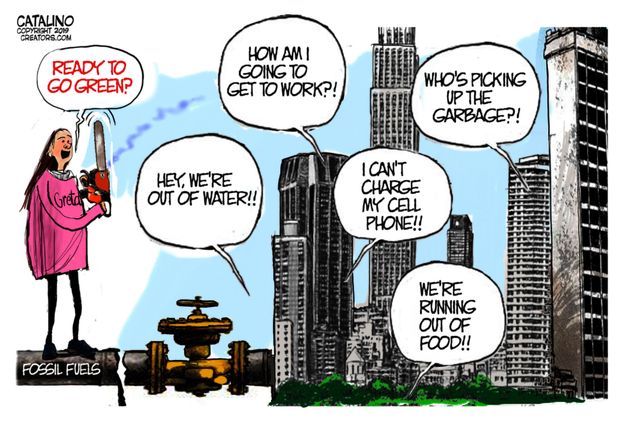




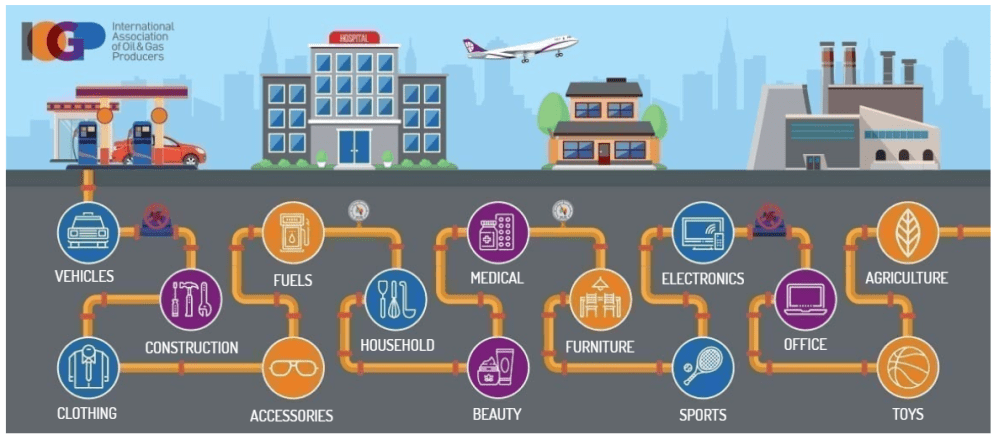


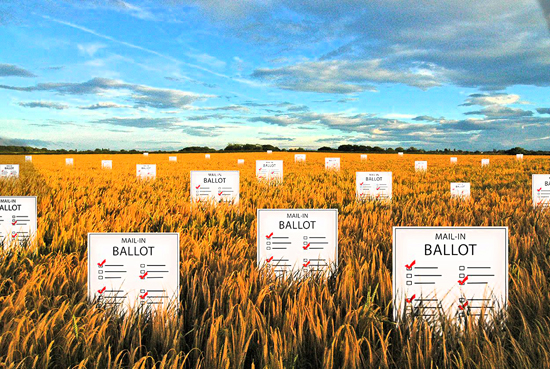 When voters are added to large apartment buildings, leftists cannot add the apartment number, or the legit resident will probably get that ballot. The trick is to mail the ballot to the main address, where it collects, and the Postal Service retrieves it for the bad guys.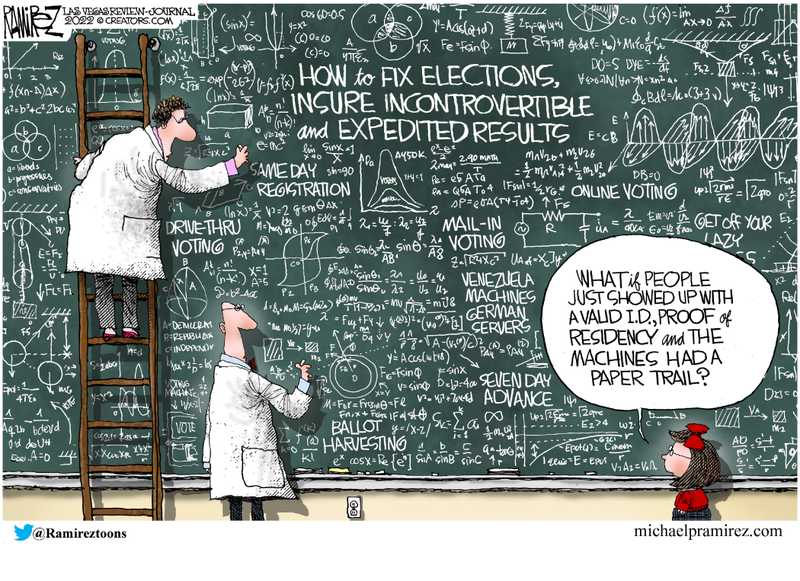






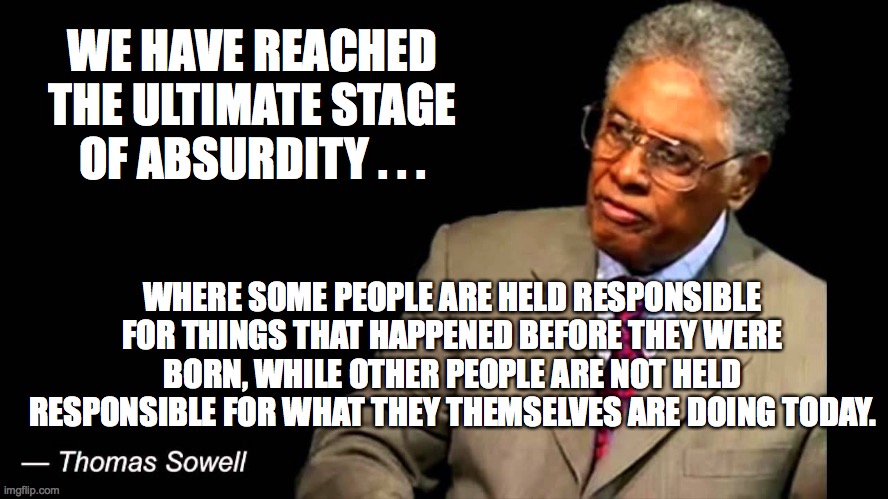







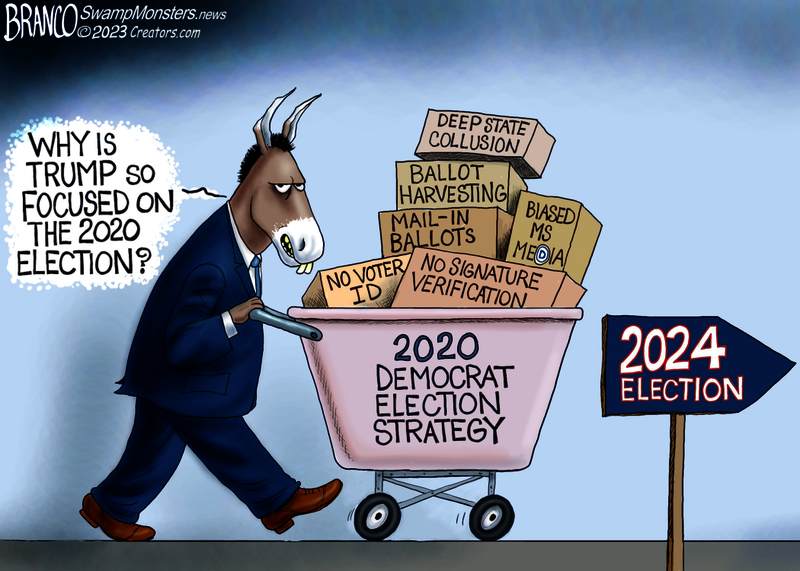



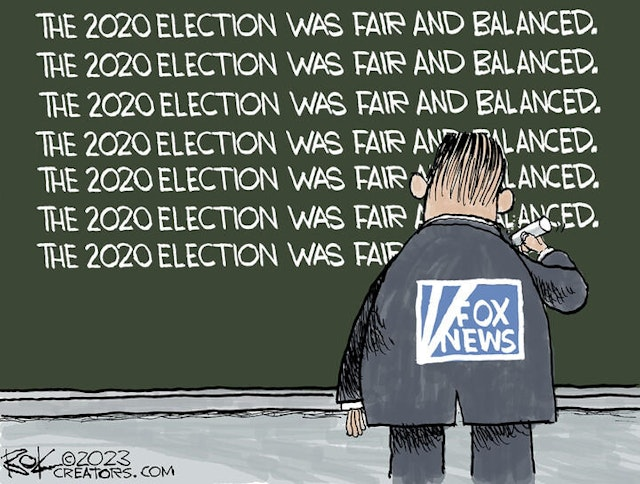




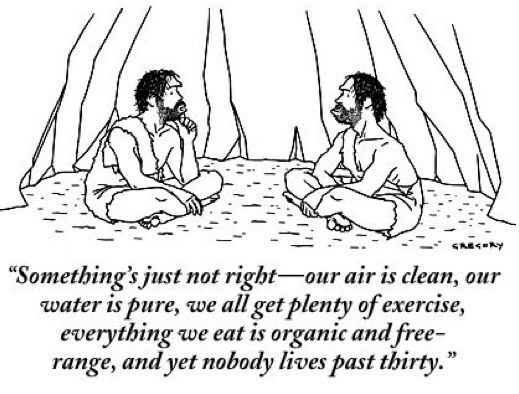


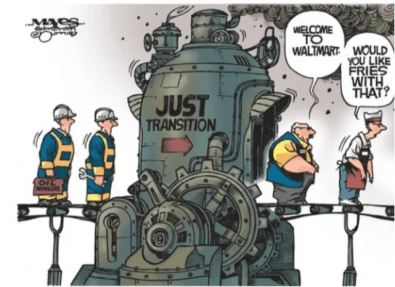


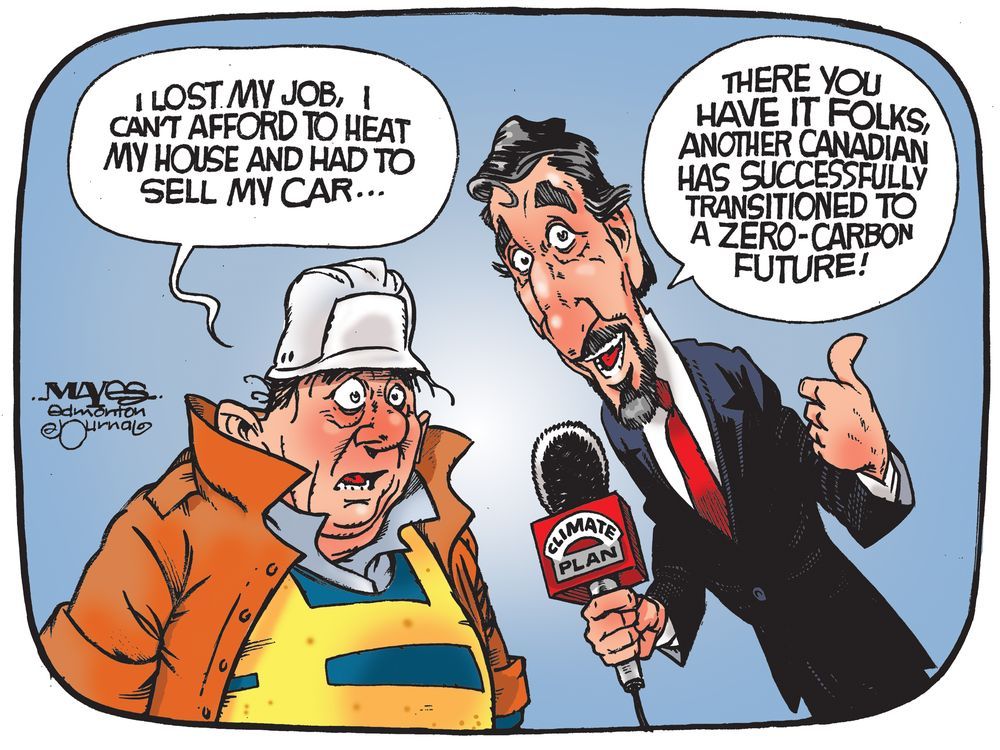




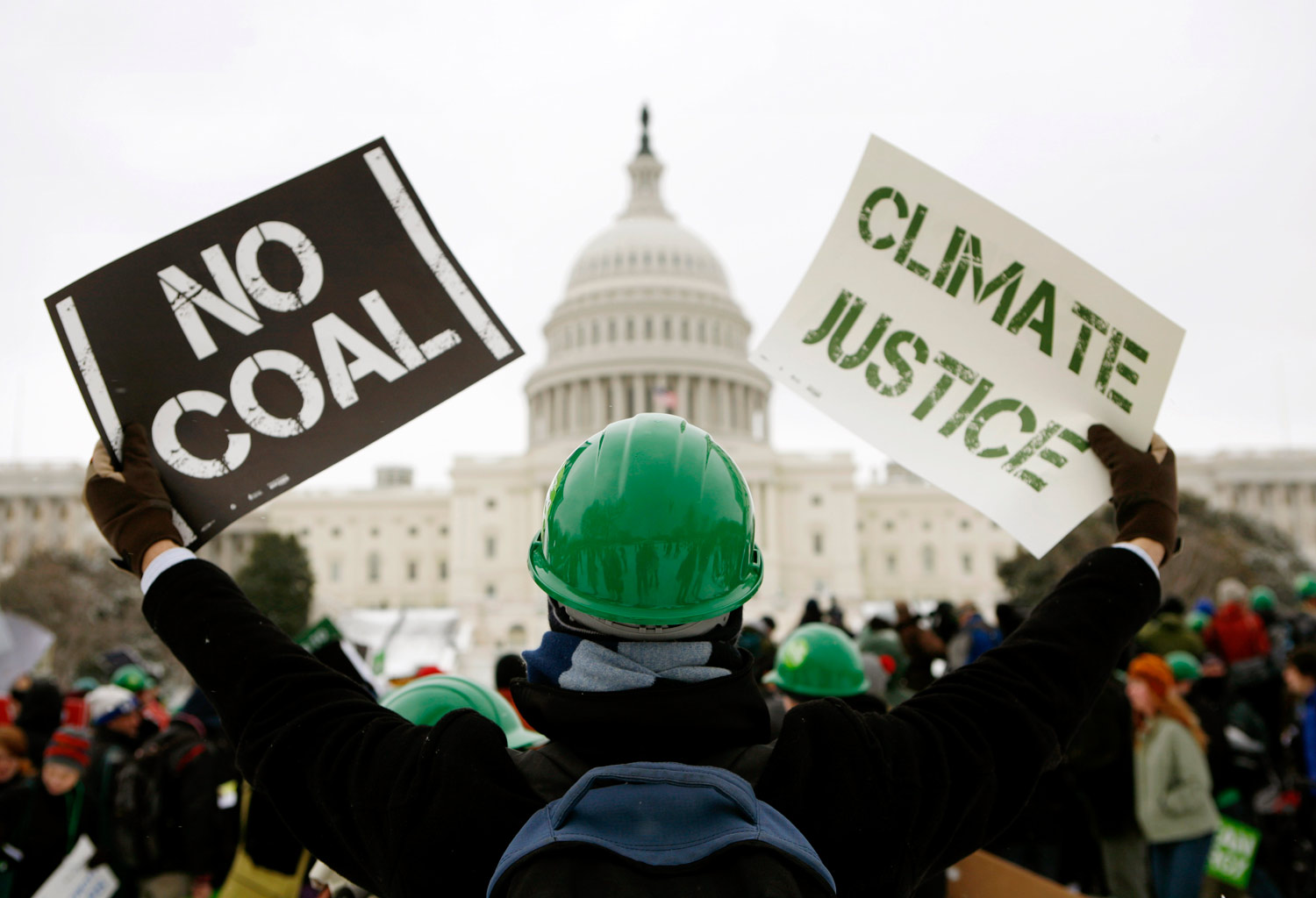

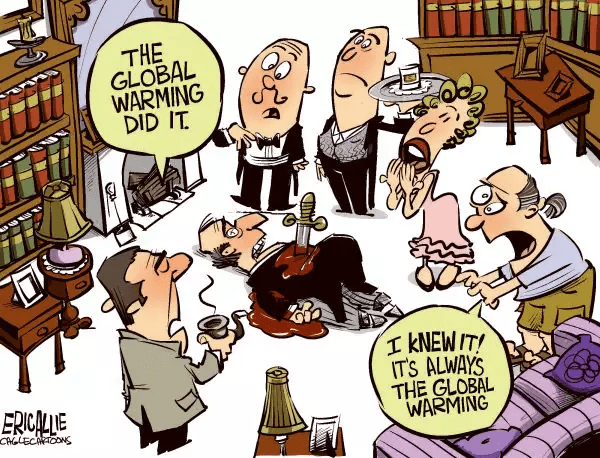


 Science Matters