
Net Zero Fails Science, Math and People

in the video above, Ron Barmby joins Angela Wheeler to discuss Sunset on Net Zero and the why green energy schemes fail.  He questions the scientific, economic, and engineering basis of global net-zero policies. Drawing on physics, real-world observations, and decades of experience, he argues that CO2’s warming effect is small and diminishing. He also challenges climate models that rely on unverified assumptions.  Barmby warns that many green energy solutions are impractical and that net-zero policies disproportionately harm the poor.

For those preferring to read, I provide below a lightly edited transcript in italics with added images.  AW refers to Angela Wheeler and RB to Ron Barmby.  H/T Climate Change Dispatch.
I think [Net Zero] is insane. It is pointless to pursue it because it will make no difference to the climate or to climate change. The climate will change as it wants to change, no matter how much CO2 we put in the air. So it’s a pointless thing to do. It is unachievable. And in the end, as always, it’s the poorest among us that will pay the highest price proportionally.

AW:  This is Climate Debrief, brought to you by the CO2 Coalition. I’m Angela Wheeler. There’s a recently published book, Sunset on Net Zero, a heretics guide to the futile CO2 target.  You’re going to hear from the author, CO2 Coalition member Ron Barmby. Ron is a professional engineer with a master’s degree from the University of Alberta and a four-decade career that’s taken him to over 40 countries across five continents. Ron’s adventures have shown him firsthand how societies really are adaptable to shifting climates.

Thank you for taking the time, Ron. Thank you for having me, Angela. Part one of your recent book is titled How I Learned to Stop Worrying and Love Carbon Dioxide.  Did you have a moment of clarity where this all made sense or did this happen over a period of time?

RB: It sort of happened over a period of time when the Al Gore movie came out. At first, I was impressed with it and I thought, well, this all makes sense. And then as other writers started pointing out the flaws in that movie, I decided I should look into this more too.

Al Gore with a version of the Hockey Stick graph in the 2006 movie An Inconvenient Truth

And as an engineer, I have a background in physics and I realized that a lot of the physical characteristics that Al Gore was talking about simply aren’t true. So it developed over time. And as it developed over time, some of my friends said, Ron, you should write this down. And so I did. And that was my first book. The second book, the one that you just mentioned, is sort of an update of what’s happened since 2020 when the first book was published.

AW: What is your analysis of this global effort to reach net zero?

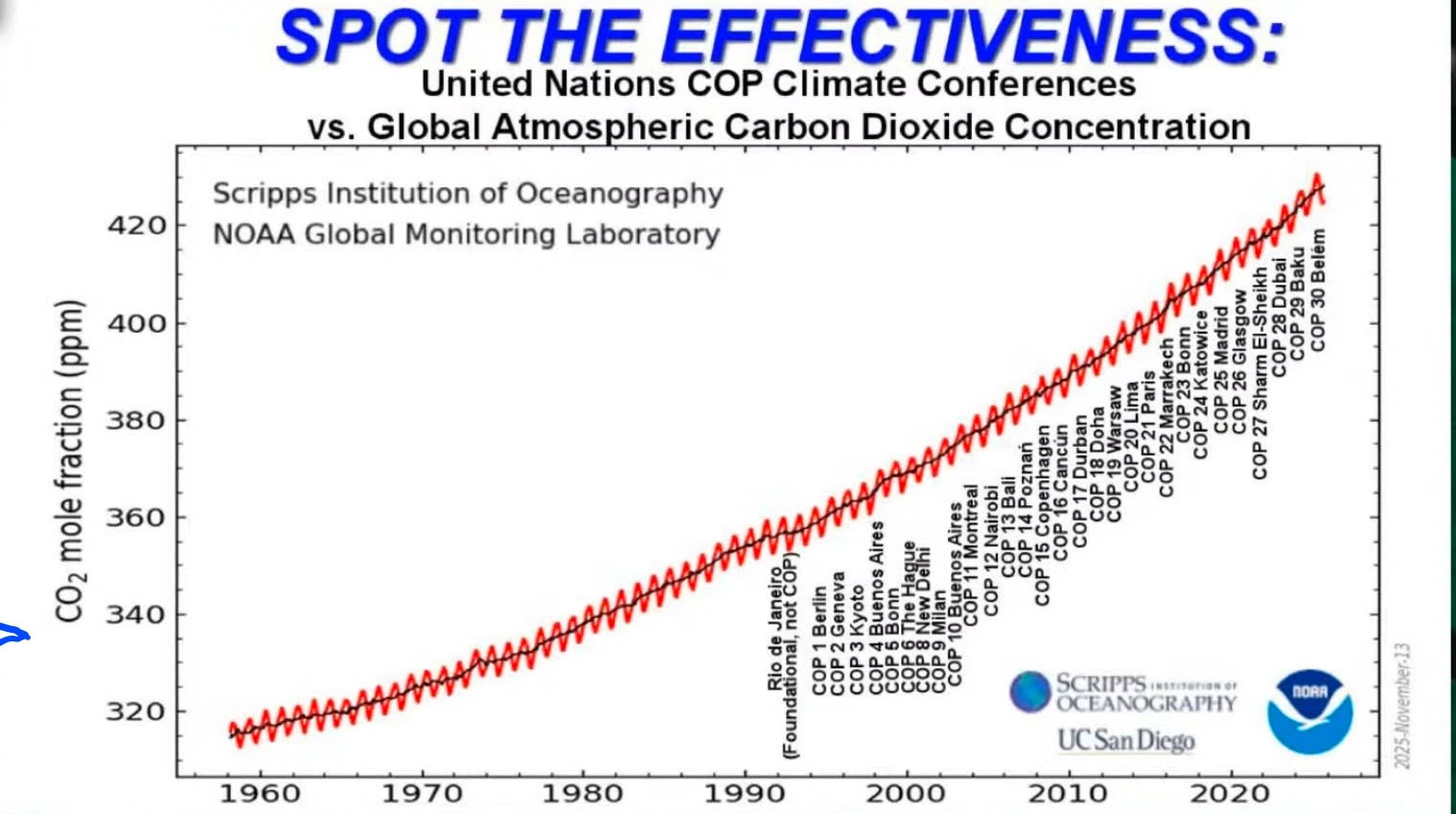
RB: Well, I think it’s insane. That’s what I think. It is pointless to pursue it because it will make no difference to the climate or to climate change.

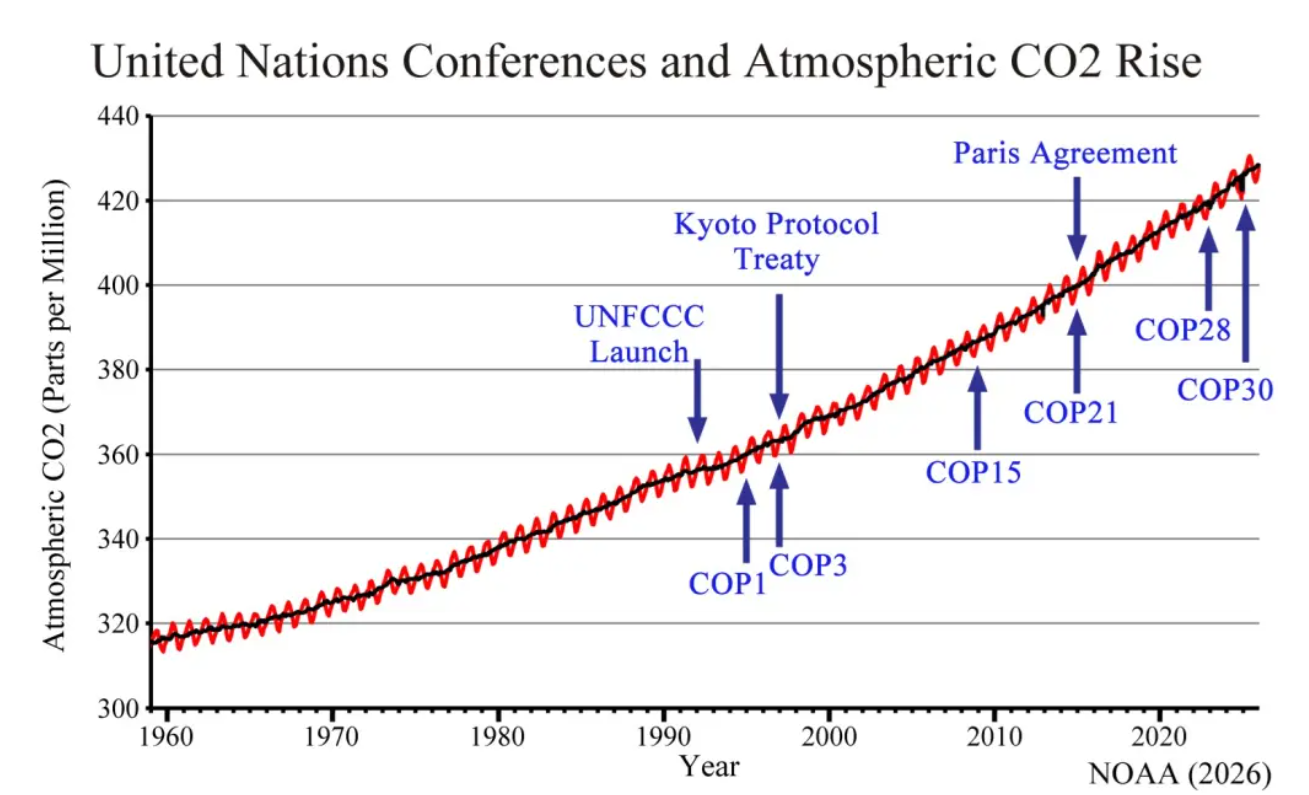
I now declare the Paris Agreement for Climate Change open for signature. More than 170 countries signed the Paris Agreement. They are pledging to take steps to limit the rise of global temperatures to well below two degrees Celsius.
–Ban Ki-moon, UN Secretary-General

The climate will change as it wants to change, no matter how much CO2 we put in the air. So it’s a pointless thing to do. The second part of it, it is unachievable.

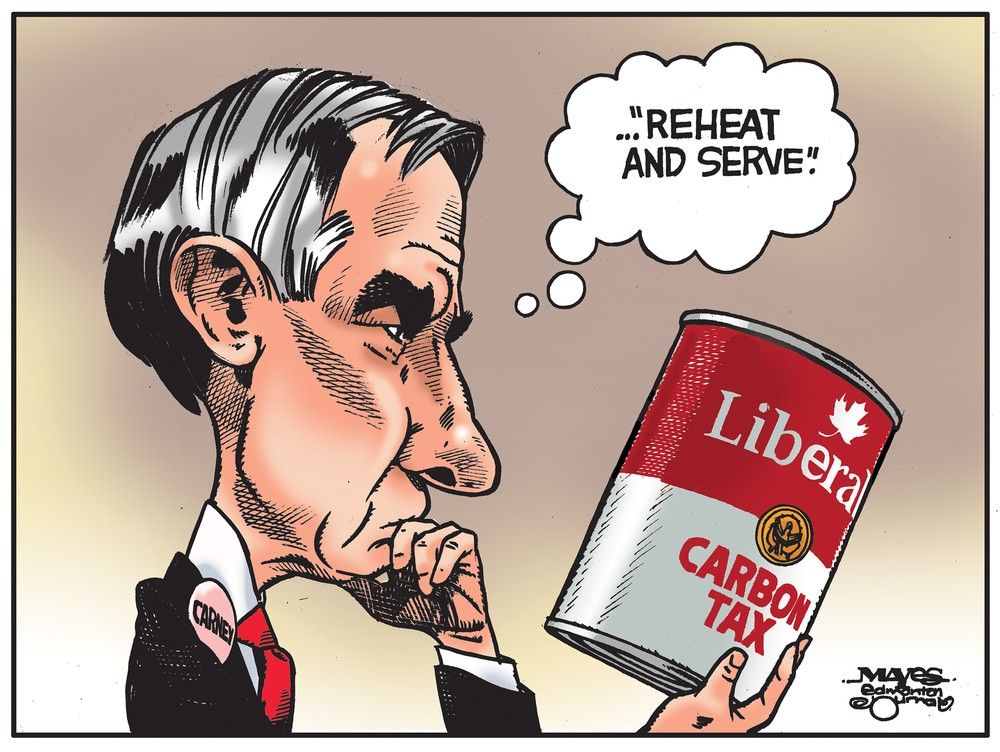
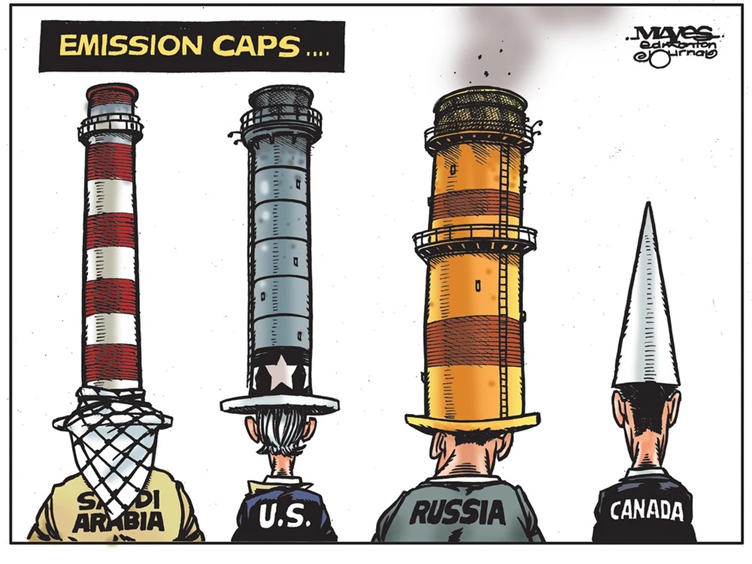
And that’s where my engineering background comes in and many of the engineers that are part of the CO2 coalition. What they want to achieve simply can’t be done in a reasonable time frame at a reasonable cost, and it can’t be done globally. And the third thing about it is the whole thing is unfair because it punishes those that are trying to reduce CO2 emissions to the benefit of those who are only paying lip service to CO2 emissions. And in the end, as always, it’s the poorest among us that will pay the highest price proportionally.

AW: Your book sums it up well in stating that warming from future CO2 is too trivial and too gradual to justify drastic policy. Could you explain that?

RB: Well, there was a paper written in 2019 by two coalition members, Dr.  Wijngaarden and Dr. Happer.
That paper explained from physicist to physicist how we can actually measure the amount of CO2 warming that has happened. And by measuring that amount, it confirmed the equations that would predict what would happen if we doubled the CO2 emissions again, or came to a complete doubling. And looking into that paper, I tried to explain in everyday terms how valid it is and what it means. And so in that investigation, I came to the conclusion that this is understandable by many, many people. And if we got the word out, that might help shift the view on the alarmism of carbon dioxide induced global warming.

[From Wijngaarden and Happer study: My synopsis is Climate Change and CO2 Not a Problem

“Right in the middle of these curves, you can see a gap in spectrum. The gap is caused by CO2 absorbing radiation that would otherwise cool the Earth. If you double the amount of CO2, you don’t double the size of that gap. You just go from the black curve to the red curve, and you can barely see the difference. The gap hardly changes.”]
AW: Is it your position that the push for net zero stems from political exaggeration, followed by media amplification and not empirical science? Is that a fair assessment?

RB: I think that’s a fair assessment. And Margaret Thatcher is one person that I like to quote on that. Many people don’t realize that Margaret Thatcher was trained in Oxford as a chemist, as a research chemist. So she was one of the big people behind pushing for the Paris Agreement. And she wanted to reduce CO2 emissions because she was concerned. But she knew how the scientific method worked because she was trained in it. And when she saw the first reports come out, she changed her mind.

And she said, kind of paraphrasing Hamlet, that there isn’t method in their madness, there is actually madness in their method. And what Margaret Thatcher pointed out was that the desire to control CO2 emissions worldwide is something that would require a worldwide organization to organize and enforce. And so she saw it in that perspective, that it was a grand multinational global socialist effort to control the economy.

She was not far off. But I do think that on the other end of the spectrum, capitalists have found a way to exploit this energy transition and make money that they would otherwise not be able to make.

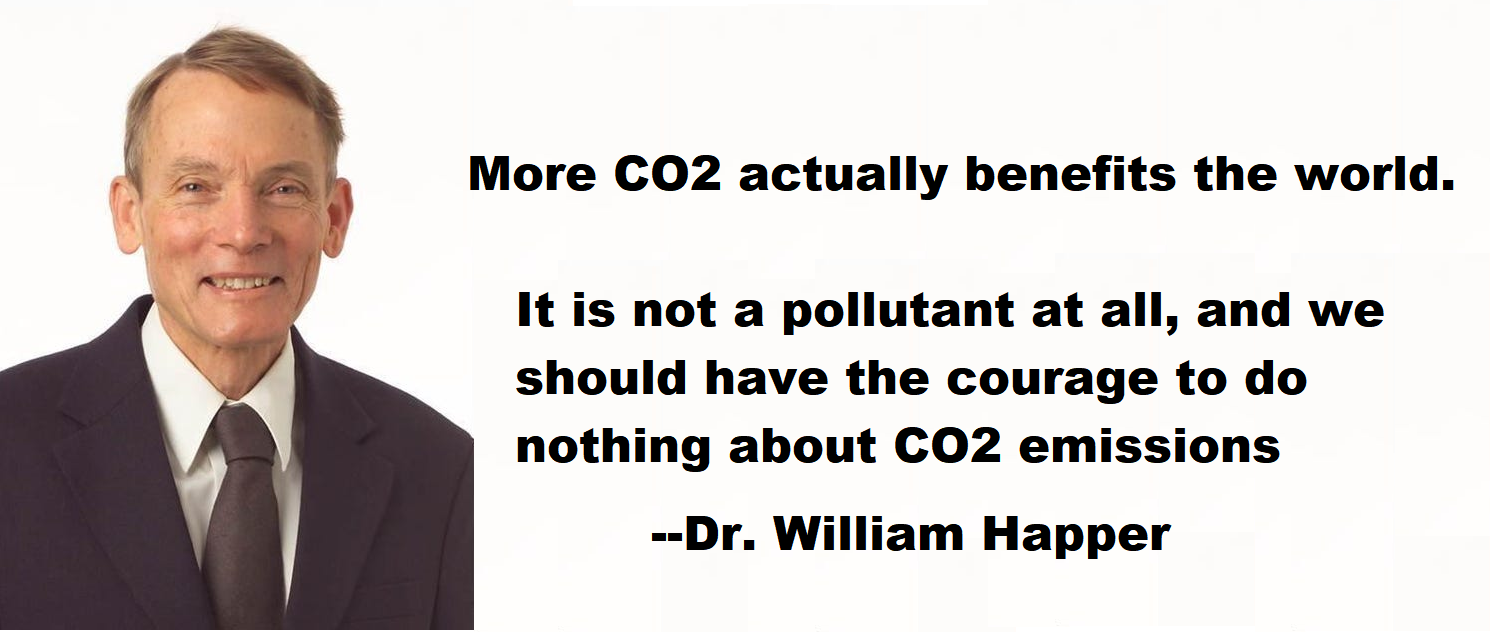
AW: Regarding net zero, your compelling argument cites the work of two other CO2 coalition members, our chairman, Dr. William Happer, and Dr. William Don Wingarden. Their work, as you mentioned, initially a series of academic papers by physicists for physicists, focuses on measuring thermal radiation transfer and had a truly profound effect because it undermines net zero. For one, they use real observations, not models. Can you please explain the difference and why is it worth noting?

RB: The scientific method is a way to make sure that we’re not fooling ourselves, that we think we understand something that we don’t really understand. And it was one thing that another CO2 member, Dr. Clauser, pointed out in his talk to Korean physicist students a couple of years ago. You have to go into science with an open mind and an unbiased mind. And you have to report faithfully what you observe. And it’s the observations of physical reality that is the link to truth in science.

So the computer models that the IPCC relies on aren’t based on observations that are linked to reality. They’re based on biases that the computer programmers put into their own models. And the brilliance behind the Van Wingarden and Happer study is that they found an existing public domain database that contained the observations needed to show that the effect of CO2 warming was very small and it’s diminishing rapidly.  Another important thing to mention is that Dr. Happer and Dr. Van Wingarden’s math matches real world data from space. This follows the scientific method, observe, predict, test, repeat.

AW: What you’re saying, and especially in your book, that the scientific method is so important, do you feel it is being neglected and perhaps not followed at the university level today?

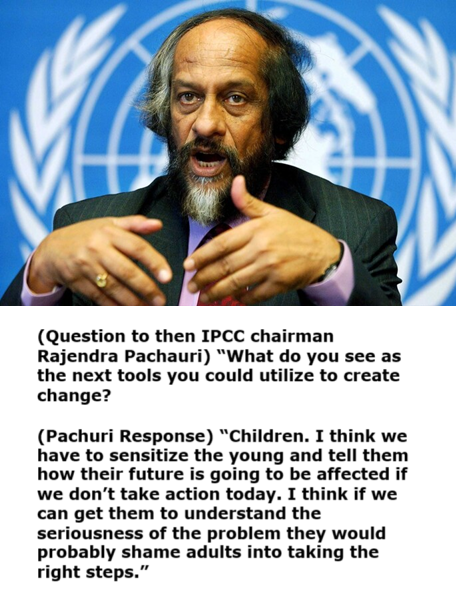
RB: Unfortunately, I think, Angela, it’s worse than that. It’s not followed, maybe not at the university level, but I think it’s the elementary, junior high, and high school level where it needs to be brought back into the curriculum and taught. It’s when 10 and 12 year old students come home and they’re convinced that CO2 is something to be afraid of. That’s where the problem starts.  And I think that’s where the problem has to be fixed.

AW: Regarding the paper by Dr. Happer and Dr. Van Wingarden, they didn’t just claim CO2 impact is small. They measured it, verified it, and anyone can check their data. They replaced alarmist models with hard, observable facts. How can anyone argue that?

RB:  Angela, I don’t think anyone has argued with that. I think the mainstream media and the IPCC have simply ignored it. They haven’t addressed it. Coming out in the United States is a presidential directive that all science backed by the federal government must meet the scientific method standards. And I think that’s going to be a huge change worldwide when organizations, both federal and international organizations, when they are held to the standard of the scientific method, I think their karmic alarmism is just going to melt away.

AW: As a former teacher and also as a mother and now a GG, I was gratified to see your chapter Stop Scaring the Children. What compelled you to write this chapter?

RB: I’m a grandfather, and my grandkids are very concerned about CO2. And so it takes me a long time to explain to them that there’s nothing to worry about. And unfortunately, in a more of a millennial generation, there’s been a lot of extreme anxiety among that generation about climate change. And unfortunately, there’s been some tragedies that have resulted because of that. So I think it’s important to stop scaring the children. If you want to deal with a scientific methodology or a proposition you want to promote, bring it forward to trained people who can discuss it intelligently with you. Don’t bring it into the classroom of an elementary school and scare children with it.

AW: Ron, the second part of your book is Engineering 101 is the doomsday book for net zero. Why is that?

RB: Well, because there are all of the green energy sources and the green machines that run on them, and many of them just simply fail when you try to build them. And I think I quote in my book, it was James Michener who said scientists dream of great things, but engineers build them. Well, you can have great dreams. You can dream of creating a solar guidance star like Dr. Hapur did, but it’s up to the engineers to build them. And everyone is crossing their fingers until the thing actually works.

And a lot of the propositions that are out in the mainstream media, how we can avoid or reduce our CO2 emissions are either uneconomic or they hurt the environment more than they help, or they simply don’t work. And that’s my engineering perspective coming into play.

AW: I see. And that makes me think of models, climate models. For example, you can create the model, but from an engineering standpoint, and with regard to net zero, is it impossible to come up with the conclusions that they do with models?

RB: In the case of climate, yes, it is. Now in engineering we use models for a number of things, because we have verified that the equations we’ve put into the model are correct, and they can predict what might happen. And you can see that in flight simulators.

In my own background, reservoir engineering models are based on the Darcy equation, and they’re quite good at predicting what will happen, because those equations stand up to the scientific method. And so when your equations can predict what happens in the future, and it actually happens, then you verified the equation, then you verified the model. The IPCC models, they have equations in there and assumptions that simply aren’t verified, and they don’t predict accurately.

One thing that came out of the Van Wintergaarden and Happer paper, and other papers that are associated with members of the CO2, is that the CO2 warming from the IPCC models has to be at least doubled, and some would claim quadrupled, in order to get the alarmist levels of warming that they predict. And so that factor of two or four just thrown in to cause more anxiety, that’s not science, that’s scare tactics. And it’s important to point out that the IPCC is a government organization, it’s not a science organization.

AW: And the other thing is, they say carbon dioxide is the control knob for temperature, and that’s not the case, correct?

RB: You’re absolutely correct. We run on an energy balance, and that energy balance coming from the sun has part to do with the climate on earth. And as Gregory Wrightstone pointed out in his book, 90% of the global warming effect of CO2 is already behind us. So the next 10% is going to be minimal. So the next 10% is not the control knob of temperature on earth. Now, if there was no CO2 on earth, as there is no CO2 on the moon, the first amounts of CO2 added would have a dramatic effect on temperature. But that’s way, way behind us.

AW: Well, in concluding our conversation, I would like to let our viewers and listeners know that they can get your new book, Sunset on Net Zero, A Heretic’s Guide to the Futile CO2 Target at Amazon. Ron, there are many excellent points in your book we didn’t get to. I hope you will join us again soon on Climate Debrief. I’d love to, Angela. Thank you very much.


Wind and Solar Ruin Grid Transformers

Reported in South China Morning News US transformers are ageing. Renewable energy could make things worse, China study finds.  Excerpts in italics with my bolds and added images

Team in China finds that high renewable energy integration
could make power transformers age nearly a quarter faster

As US President Donald Trump continues to wage war against renewable energy, a new Chinese study revealing the strain that renewable integration places on power transformers could give him fresh technical ammunition.
The researchers discovered that high renewable energy integration could make power transformers, vital
components that regulate voltage in electricity grids, age faster than previously thought.  High levels of wind and solar energy increased bidirectional power flow switching – the movement of electricity in both directions – causing additional stress that current standards did not account for, the Chongqing-based team found.

In a world grappling with transformer shortages and surging energy demand from electrification and the growth of artificial intelligence data centres, the findings suggest that renewables could place even greater strain on ageing grids, like those in the United States and Europe.

When testing their new proposed model, the team found that two-way flow caused transformers to age 23 per cent faster than accounted for by current standards, according to a paper published in the Chinese-language journal Power System Technology on January 16.

Aerial footage shows damage to burnt out power transformers near Heathrow

“This paper focuses, for the first time, on the impact of frequent bidirectional power flow switching caused by high‐penetration wind and solar integration on the operational characteristics and insulation lifespan of power transformers,” the team said.

The researchers, from the Chongqing University of Posts and Telecommunications and the State Grid Chongqing Electric Power Company, also built a “long-term lifetime loss accumulation calculation framework” – which could be used to assess the condition of transformers and guide operation and maintenance.

Speaking before the UN General Assembly in September, Trump said that renewable energy options were a “joke” and that wind turbines were “so pathetic and so bad” and expensive to operate.  In January, in his address before the World Economic Forum in Davos, Trump said: “China makes almost all of the windmills, and yet I haven’t been able to find any wind farms in China.  “They make them, they sell them for a fortune. They sell them to the stupid people that buy them.”

Hitachi Energy Chongqing Transformer Co. Ltd. is located in Chongqing City. As one of the largest transformer factories worldwide within Hitachi Energy, the company focuses on the design and manufacture of power transformer, shunt reactor and HVDC transformer (High Voltage Direct Current).

Traditional energy grids had a centralised, one-way flow of power from the producers to the consumers. This is shifting towards a two-way system where electricity can also flow back from solar, wind and energy storage sources into the grid.

Transformers are a basic and critical component of electric grids, adjusting the voltage of electricity so it can travel efficiently through the grid.  They can either “step up” or increase the voltage so electricity can travel long distances through power lines without losing strength, or “step down” the voltage once it reaches its destination so it can be safely used by appliances.

Power transformers are large units which transmit high-voltage electricity over long distances, while distribution transformers are smaller units that help supply local areas.

As transformers age, their components can degrade, which can lead to higher maintenance demand, limit efficiency and reliability, and increase the risk of a major grid failure.  The average age of power transformers in use worldwide is around 40 years, according to electrical equipment supplier Reinhausen.

In the US and Europe – home to the oldest power grids in the world – some transformers date back even further. Much of the US electric grid infrastructure was built 50 to 75 years ago, and nearly 70 per cent of power transformers in the country are over 25 years old, according to a report from the University of Wisconsin-Madison last May.

More than half of the transformers in this country are becoming too old to reliably function and can fail at any time.  We not only need to build new transformers, but we also need to replace the ones that are ageing out.     — US Department of Energy in 2024

But expanding and replacing transformer infrastructure is not only expensive, it could even be impossible in the short term due to long delivery times and a global shortage of power transformers, according to Reinhausen.

Average lead times for large power transformers had almost doubled since 2021, with securing transformers taking up to four years, the International Energy Agency (IEA) said in a report last February.

According to the IEA, the production of power transformers is technically complex and requires advanced facilities. China, South Korea, Turkey, and Italy accounted for 50 per cent of total global power transformer trade in 2023, it said, with China alone representing half that share.

Top 10 Power Transformer Manufacturers In The World

Both the US and Europe have more than doubled their import trade value for power transformers since 2018. The US primarily sources transformers from Mexico, Europe and South Korea, while China now accounts for over 60 per cent of the European Union’s imports, according to the IEA.

Imports account for an estimated 80 per cent of the US power transformer supply, and 50 per cent of the distribution transformer supply, according to a report by energy research and consultancy group Wood Mackenzie in August.

In the US, the supply shortage for power transformers hit 30 per cent in 2025,
while the shortage for distribution transformers hit 10 per cent, the report said.

Finland Regrets Its Green Grid

“Imagine an argument so airtight about science so settled
over technology so reliable that you have to use censorship
to make sure nobody gives a dissenting opinion.”  @ProctorZ

Tyler Durden reports at zerohedge “Electricity Market Is Fubar”: Finland Wind Turbine Blades Freeze, Curbing Green Power Output.  Excerpts in italics with my bolds and added images.

Fingrid infographic

Finland has prided itself as a global leader in decarbonization, boasting the second-highest share of renewables in final energy consumption across the EU.

But the green utopia narrative has cracked under the strain of a brutal winter,
as cold weather has brought wind power generation to a near standstill.

Most of the country’s wind capacity is concentrated in western Finland, where temperatures are well below freezing, and these adverse weather conditions have led to dangerous ice buildup on turbine blades. According to Bloomberg, this forced the grid operator Fingrid Oyj to curtail wind power output.

Primary energy sources in Finland 2017. All fossil fuels should be replaced by clean energy sources.

“There are low fog clouds in Finland’s main wind power production area, roughly at the height of turbine blades, which are causing new ice to form,” Pia Isolähteenmäki, an adviser at industry consultant Kjeller Vindteknikk Oy, told the outlet.

Much of Finland’s wind fleet lacks blade-heating systems for extreme cold weather. How is that even possible, considering it’s a Nordic country? Even the thinnest ice buildup risks equipment damage and has led to shutdowns this week.

Bloomberg data show that Finnish wind output is expected to remain very low for the next two weeks. Meteorologists at MetDesk forecast that Nordic wind generation will remain as much as 20% below normal through at least the midpoint of the month.

The result of the green utopia pushed by Europe’s climate alarmists,
not based in reality whatsoever, is soaring power prices
that are crushing working poor households
.

Wind tubine defrosting in Sweden

Helsinki Times wrote on Sunday:

“Electricity prices in Finland rise to the highest level of the winter on Monday, driven by severe cold, weak wind conditions and rising weekday demand,”

Finnish folks on X are questioning the government’s questionable decarbonization push:

Dana X post:

News from the “green garden”. In Finland, the blades of wind turbines froze.  The electricity production of wind power stations in Finland fell from 9433 MW to about 430 MW. Thus, they produced no less than 5% of the nominal power.  The culprit turned out to be Russian frosts, the possibility of which European energy companies did not take into account when implementing the “green” transition.

Zeaqi X post:

Finland literally has to use nuclear power to MELT frozen wind turbines and we live in darkness most of the year. How about focusing on reliable power like nuclear instead?

Mari Luukkainen X post:

Our electricity bill was 45 EUR yesterday alone.
Finland: nuclear power, hydroelectric, wind farms, one of the most technically advanced countries in the world.
Also Finland: people burning firewood because the electricity market is fucked. I am sitting next to the fireplace shitposting on LinkedIn (that’s why shitposting is very intense today). This is my energy strategy.

In the US, a historic cold snap in the eastern half of the country led to increased fossil-fuel power generation to prevent power grid collapse.

Across the West, years of grid mismanagement by climate alarmist policymakers have transformed what were once reliable grids into fragile messes where working poor households bear the brunt of some of the highest electricity costs in the world.

It is time to get back to basics and expand natural gas generators and nuclear power, the only proven large-scale source of clean and reliable electricity. And it is also time to hold accountable the climate alarmists whose policy decisions pushed power grids toward the edge of collapse while promising a green utopia that was never going to arrive. And one can only wonder whether the move to push power grids to the brink of collapse was intentional.

Shortage of Climate Comedians

Chris Morrison provides examples of malarky from alarmist Jim Dale in his Daily Sceptic article Treasure Climate Comedian Jim Dale While You Can: We May Never See His Like Again.  Exerpts in italics with my bolds.  H/T Climate-science.press.

Climate comedy turn Jim Dale continues to tour the Gaiety Halls of broadcast media, delighting audiences with his own word-salad English and his knack for getting most facts wrong. Fans were not disappointed by an extended performance, here, start around 2hr 38 mins, last week on Mark Dolan’s TalkTV show when he falsely claimed Costa Rica had reached Net Zero and the polar ozone hole had closed. Readers might be advised not to organise drinking parties around Jim’s much-cherished appearances. If a shot is taken every time the great entertainer gets a climate or Net Zero fact wrong, you’d be Brahms and Liszt quicker than you could say Julia Hartley-Brewer.

A number of countries are already at Net Zero carbon emissions, claimed Dale, and he gave Costa Rica as an example. Sorry Jim, treble Guaro Sours all round: Costa Rica is nowhere near Net Zero. In fact, the Carbon Action Tracker notes that the current government is sending “worrying signals that the full implementation of the climate policies and measures necessary to meet Costa Rica’s own targets could be deferred”. Key electric public transport projects have been paused or downscaled, while the current President has announced his opposition to an oil moratorium, along with an intention to explore Costa Rica’s hydrocarbon reserves. For some time, Costa Rica has presented itself as a poster country for eco-tourism and sustainability, but it was never near Net Zero. There comes a time when all the virtue signalling has to stop.

Hard reality seems to have bitten the territory, as it has every other country
taking a serious look at the stupidity of the Net Zero fantasy.

Put down the liquor bottle (just for a very short while): our climate clot got it partly right when he said two or three countries had hit Net Zero. One country often mentioned is Bhutan, a landlocked territory the size of Belgium in the eastern Himalayas. Mountains give Bhutan huge hydroelectric power, while 93% of the land is covered in carbon-dioxide-absorbing forest. Meanwhile, about half the population of 800,000 is involved in subsistence farming. As a future model for Net Zero, it leaves a lot to be desired.

Perhaps Jim could explain on his next much-awaited guest slot why Bhutan, a Net Zero country seemingly perfect in every respect, requires foreign aid of $13.7 billion over the next decade for “mitigation” costs to keep it on the straight and narrow Net Zero path. Sustaining its contribution and ambitions are said in its third Nationally Determined Contribution report to the UN to require “continued and predictable” international financial support.

Of course it does. Not a bad little earner for a country with an annual GNP of just over $3 billion. The cynical might be forgiven for reading into its words a threat along the lines of: cough up or the trees get it.

Time to refresh our glasses again, as our comedic clown then told Mark Dolan that the South Pole ozone hole had closed or, to put it in Jim’s word-salad English: “The ozone layer was a perfectly tenable thing that occurred and the hole closed because we got out of aerosols that managed that actually.” Alas, the hole has not closed, despite a 35-year ban on aerosol-using chlorofluorocarbons (CFC) gases. The thinning, rather than a hole, appears to be a largely natural event that changes thickness on an annual, seasonal basis.

A recently published science paper by three New Zealand-based scientists noted that the three years 2020–2023 witnessed the re-emergence of large, long-lived holes over Antarctica. The scientists observed that in the eight years to 2022, five showed similarly large temporary holes occurring in the spring months. In 2023, the European Space Agency said the hole was one of the biggest ever recorded, measuring 26 million sq kms. Perish the thought that banning CFCs didn’t make much difference – surely all those Nobel science prizes were not handed out in vain for a totemic environmental scare that proved such an inspiration for all the subsequent attempts to induce mass climate panic? Except when Jim unwisely brings it up, you don’t hear much about the ozone hole these days, with activists quietly extending its supposed disappearance to around 2060.

The ozone over Antarctica is recovering. Here, the four globes show monthly-averaged total ozone over Antarctica in October. The graph shows each year’s October average minimum (white dots) over Antarctica. The red curve represents a smoothed version of the white dots. NASA qzonewatch

Your correspondent has a few tips to offer if readers ever need to handle Jim in a public debate. The first task is to stop him constantly interrupting and shouting over you. This is best done by first listening to what he has to say and, at the first sign of trouble, demanding the same courtesy be extended when it is your turn to speak. Last May, I found myself with him on TalkTV with the excellent ringmaster Ian Collins – here, the entertainment starts at around 35m 30s. It worked reasonably well, despite the overwhelming temptation at one point to burst out laughing when Jim claimed the source of his climate information was NASA, “who send people to the Moon and Mars”. Extra fun can be inserted into the proceedings by noting that Dale is on record as wanting to jail climate ‘deniers’. At my prompting, Ian Collins asked him if this was true and the ensuing word-salad explanation was a pure delight. Only Jim can explain in his special language that it is not quite like that, while at the same time suggesting that it is precisely like that.

The market for data-free climate scares is starting to dry up across mainstream media. Gone are the days when the BBC’s Esme Stallard could give us her “climate change could make beer taste worse”. No more shall we see Georgina Rannard make the obvious mistake of putting a date on impending doom as she did in 2023 with a ‘scientists say’ article warning that the Gulf Stream warm currents “could collapse as early as 2025”.

Perish the thought, but soon only Jim Dale might be left to keep the nation
amused with his carry on climate catastrophising routine.

Curtain Falls on Climate Drama

Vijay Jayaraj makes the curtain call in his Townhall article Trump’s Withdrawal From Collapsing Climate Narrative.  Excerpts in italics with my bolds and added images.

The curtain is falling on the world’s most expensive soap opera. For decades, a cast of unelected bureaucrats and subsidized academics fought to keep the production alive, but the audience has finally walked out. The climate-crisis clown show is over.

In early January, President Donald Trump formally withdrew the United States from the 1992 United Nations Framework Convention on Climate Change and severed ties with over 60 associated UN organizations. By ending support for the Intergovernmental Panel on Climate Change – the self-anointed arbiter of planetary truth – the U.S. stopped bankrolling the institutions that have long conspired to dismantle the economic sovereignty of nations.

Mainstream commentators are scrambling to frame this as a retreat into isolationism. But this represents a rational, economic calculation rooted in evidence rather than the hysteria of doomsday cults.

What deserves attention, however, is that Trump is merely doing openly
what Asia’s energy superpowers have been doing quietly for years.

Beijing long ago stopped pretending to care about the sensibilities of European climate activists. The Chinese Communist Party understands that power – both electrical and geopolitical – comes from hydrocarbons. China is outpacing the rest of the world in building coal-fired power plants at an unprecedented pace.

China is also securing energy lifelines beyond its borders. China National Chemical Engineering signed construction contracts worth $20 billion for the Ogidigbon Gas Revolution Industrial Park in Nigeria. Beijing-based Sinopec committed $3.7 billion to construct an oil refinery in Sri Lanka. Chinese financial institutions have lent $52 billion to Africa’s energy sector, with about half going to fossil fuel projects since the early 2000s.

China’s construction of the Kyaukphyu deep-sea port and Special Economic Zone in Myanmar serves as another telling indicator. Valued at approximately $7.3 billion for the port itself and $1.3 billion for an adjacent economic zone, this project will be a strategic bypass around the congested Malacca Strait – a chokepoint through which over 70 percent of China’s oil and gas trade passes.

The signal is unmistakable: China is not preparing for a post-hydrocarbon
world.  It is ensuring reliable, diversified supply chains
for energy resources, especially oil and natural gas.

India, too, has quietly ended its flirtation with Western green agendas. Indian consumption of petrochemicals is set to grow by 6-7 percent annually. To meet this demand, India is aggressively expanding oil and gas exploration and refining capacity. In November alone, Indian processing of crude oil grew to 22.3 million metric tons, a 2.3 percent increase from the previous year.

Late last year, the Indian government auctioned blocks of coal with combined geological reserves of over 3 billion metric tons. India’s planning documents ignore natural gas as a “bridge fuel” and identify coal as the nation’s mainstay fuel.

Worldwide, there are 460 coal plants under construction. Another 500 have been permitted or are about to be, with an additional 260 new plants expected to be announced. The vast majority of all this activity is in China and India.

These nations are not “transitioning” from coal; they are cementing its dominance. Even Indonesia, which was once the poster child for the West’s “Just Energy Transition Partnerships,” has faced reality as it canceled the early retirement of the massive Cirebon coal-fired plant.

Trump’s withdrawal from the UN’s climate tyranny and the parallel actions of Asian energy giants are a recalibration of global priorities. Governments and businesses are investing billions in extracting and transporting hydrocarbons. Ports, pipelines, and refineries designed to function for decades are being built..

Nations are reasserting the right to pursue policies rooted in their own
economic interests rather than follow “international” edicts of a favored few.

The Trump administration has simply ended American participation in a system that was already irrelevant to the actual decisions being made by the world’s major energy consumers.

In part, the narrative of an “energy transition” survived by being presented as inevitable. That sham has been exposed. A transition will likely occur someday, but only when new technologies prove to be affordable and reliable.

In the meantime, expect more exits, more quiet defiance, more recalibration.
Climate rhetoric will continue to diminish as investments in hydrocarbons accelerate.

Davos Ditches Climate, Focuses on Economy

Ward Clark reports the course correction in his RedState article Davos Ditches Climate: Elites Now Eyeing Economy Instead.  Excerpts in italics with my bolds and added images.

Turns out that concern for mankind’s effect on the global climate isn’t much of a concern at Davos this year. It is, after all, the meeting of the World Economic Forum, not the World Climate Forum – the United Nations already has a forum for climate change, and it drew a lot of ignoring this year, too. This year in Davos, Switzerland, though interest in all things climate seemed to be nearing an all-time low.

A recent article at Climate Change News discussing this week’s 2026 World Economic Forum (WEF) meeting in Davos, Switzerland worries that climate change is no longer a high priority for the attending global elites, while also attempting to reassure readers that the topic hasn’t disappeared entirely. It is true that climate change is dropping on the list of elites’ concerns, but it is not a bad thing. The attendees’ concerns are still wildly out of step with the concerns of average people who are impacted the most by the policies discussed and pushed at Davos.

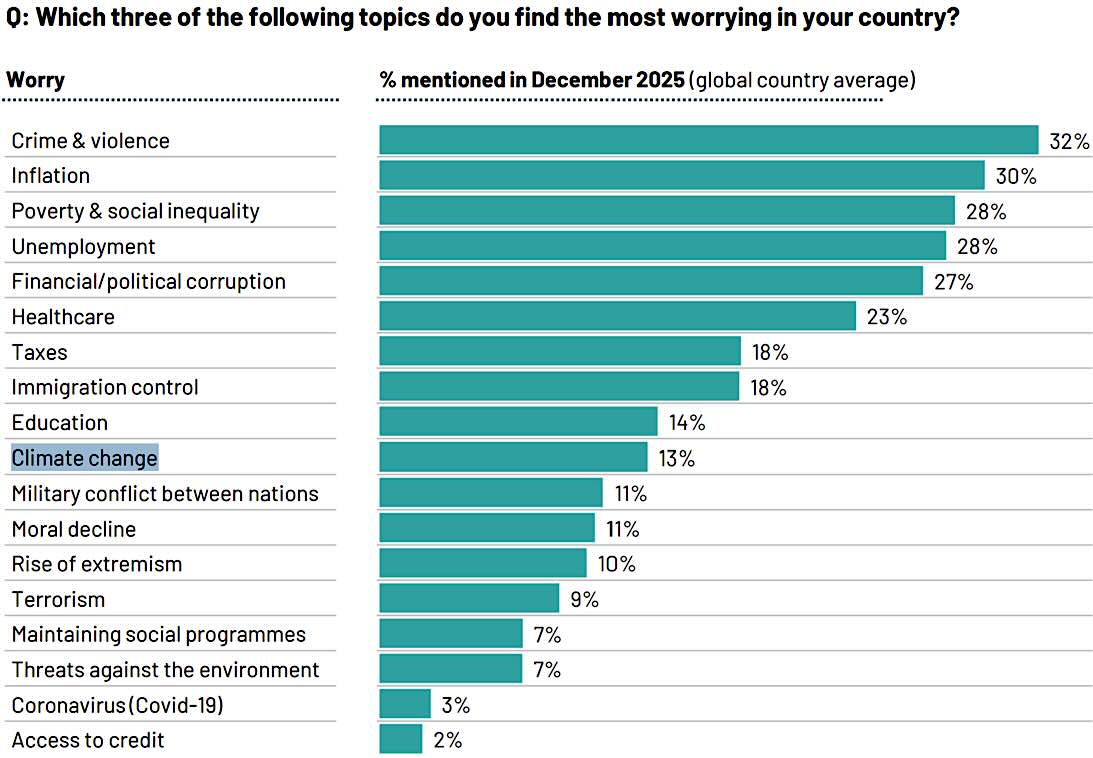
The article, titled “Ahead of Davos, climate drops down global elite’s list of pressing concerns,” was written before the Davos event kicked off Monday, January 19, and focuses on a survey conducted by the WEF’s Global Risks Perception Survey of “experts” and leaders in advance of the meeting. This year, the survey found that for the first time in years, “climate change, pollution, and biodiversity loss have dropped down an international ranking of short-term concerns for high-profile business leaders, academics, and politicians,” as priorities shifted towards more concern over “economic risks like geoeconomic confrontation, economic downturn, inflation, and asset bubbles bursting.” (See the graph, below, from the WEF).

That’s a novel notion. An economic forum worried about economics.

Oh, the climate can have an effect on economics; there’s little doubt about that. A real humdinger of a climate crisis, like a major volcanic eruption, can have dramatic effects on everything from agriculture to fisheries, and if people can’t eat, they have little time to worry about anything other than keeping their belly buttons from rubbing a hole in their backbones.

As far as possible reasons for the shift, a polling form often used by the WEF found that this year the general run of citizens – you know, the people who elect a lot of the “elites” at Davos – are a lot more worried about the price of eggs than their carbon footprints.

Personally, I’d prefer to think that people are just figuring it out. Unless a government is willing to go full Great Britain and tell the subjects – the Brits, we remind you, are not citizens, not as we think of the word – and say, “You’ll have your electric cars and heat pumps, and you’ll bloody well like it or else,” then people just aren’t seeing the point.   Giving up the gas stove, the SUV, and the comfortable, gas-heated home, just to keep the Earth’s mean temperature from rising by a degree and a half over the next century? Plenty of regular folks aren’t buying the hype. They just don’t see what the big worry is, and the people at Davos must be wetting their fingers and holding them aloft, because it sure seems like they know which way the wind is blowing.

That’s a good thing.


A German Sees WEF Itself Suffer Great Reset

Thomas Kolbe reports on a major turnabout in his American Thinker article Hour of the Opponents in Davos.  Excerpts in italics with my bolds and added images.

Machiavelli is dead, long live freedom.

Wednesday was the day of the opponents at the annual World Economic Forum gathering in Davos. Donald Trump and Argentina’s Javier Milei tore apart the WEF agenda. One declared globalism as officially failed, the other wielded an intellectual-ethical scalpel through the decayed body of the establishment.

Norwegian Børge Brende has been the chairman of the World Economic Forum since last year. He took over after a heated internal personnel debate from the WEF’s founder, Klaus Schwab, who for decades dominated the agenda of this shadowy institution for political will-shaping.

Schwab did so with undeniable success. The WEF has become an ideological melting pot of European politics, from which socialist concepts long proven costly in blood and failure continue to resurface — now repackaged as morally renewed, dressed in green.

Whether it’s the EU’s climate-socialist agenda, peculiar ideas like the 15-minute city to restrict individual mobility, or digital control currencies designed to make hidden capital controls palatable — the WEF has always been a source of centralist fantasies of political power.

Fleet of Teslas at WEF Forum

Take the vision of the digital identity of the new global citizen, who no longer exists as an individual but as a managed dataset — this too originates in Davos think tanks. Every person would possess a centralized, supranational digital existence where financial behavior, health status, and political reliability are consolidated into a controllable unit. The culmination of the “transparent citizen,” the final chapter of individual dignity and freedom.

Mobility, nutrition, housing — all are turned into moral tests. The CO2 footprint replaces personal judgment; deviation is social misconduct. Davos has grown in the haze of its control fetish into the symbol of a leadership claim by a detached pseudo-elite.

Hour of the Antagonists

Informal political organizations like the WEF live on media presence. Continuous coverage is their lifeblood, which makes inviting the most powerful political figures — like U.S. president Donald Trump or South America’s rising star, Argentina’s Javier Milei — practically inevitable.

Brende, Schwab, and the roughly one thousand invited guests
surely anticipated what the appearance of the two might bring.
And they were not disappointed.

 Trump, outside his MAGA orbit hardly known as a master orator of refined rhetoric, declared the World Economic Forum agenda officially failed in his own unmistakable way. He mocked European energy policy, spoke openly about the continent’s self-destructive migration policies, and presented an US economic record that made even seasoned technocrats sit up:

♦  5.4 percent growth in the last quarter,
♦  full deregulation of the energy sector, and
♦  a radical downsizing of the federal bureaucracy by 250,000 employees.

Advertisement

These were blows to the heart of central planners and declared friends of the “big state.” Heavy on main clauses and rich in imagery, Trump dismantled the Davosites’ fantasies of omnipotence one by one. Planning versus growth, moralism versus prosperity, control versus dynamism — every certainty was exposed like a warped political myth.

His ultimate checkmate came with the sober reminder of Europe’s total dependence on the American military apparatus. Those who cannot defend themselves, the unstated message implied, should be cautious in delivering moral lectures. Greenland salutes.

The outraged media response that followed proves one thing: he hit the mark. And, in essence, did nothing less than openly lay out the conditions of this system’s potential capitulation.

Milei Delivers an Ethical Bankruptcy

Where Trump brought a rhetorical sledgehammer, Milei immediately followed with the elegant intellectual foil. The organizers had clearly hoped to tone down the disruption of their feel-good gathering by seating the two opponents consecutively. But the double act only amplified the effect — and the message.

Milei opened with a jarring statement: “Machiavelli is dead.” Its meaning, however, was unmistakable. The politics of public manipulation and technocratic governance, which have become a guiding principle in EU Europe, do not lead to order but to their own crisis. The state, Milei insisted, must be guided by moral principles and make individual liberty the starting point of political action.

This was the maximum confrontation with the WEF agenda.
The gauntlet had been thrown.

He pressed further. One hundred fifty million people, he alleged, had lost their lives in the name of socialism over the past century; the survivors lived in poverty. Justice, he argued, belongs only to free-trade capitalism: voluntary exchange and the absolute respect for property rights, founded on meritocratic values. This is the recipe for a prosperous civilization.

These words carry weight. In two years, Milei literally turned the helm of his nation: he restored Argentina to growth, radically cut the bureaucracy, and brought inflation under control. Who would have expected that intellectual rigor and ethical grounding could one day inhabit the presidency of a nation as significant as Argentina?

Milei also answered the crucial question of our time:
How can the current cultural crisis be overcome?

Only by returning to the sources, he diagnosed — Greek philosophy as the inspiration of thought, Roman law, republican principles, and above all Judeo-Christian values. Together, these civilizational achievements form the recipe for a Western comeback.

Real wages for Argentina’s registered private sector workers reached 107 on the index (base 2023=100) in February 2025, the highest since August 2018, according to the Observatory of Employment and Business Dynamics.

Milei did not miss an opportunity to deliver a late retort to German chancellor Friedrich Merz. A year ago, Merz had called Milei a politician who tramples his own people and promotes a divisive agenda and continues to foster an anti-business climate. For Milei, however, entrepreneurs are precisely those who drive the innovation of a free-market economy. Politics must stop harassing those trying to build a better world.

In this light, Merz and his government are indeed a burden for anyone striving forward in life, living by values, and resisting the rhetorical trap of vulgar WEF-style socialism.

The Turning Point Has Arrived

Trump and Milei are merely the most visible representatives of an increasingly influential conservative turn. Even if the European press still portrays the American president as a deranged villain and destroyer of a socialist utopia, the message he and Milei deliver is gaining traction.

The cultural and economic crisis of our time is above all a crisis of statism and faith in the strong state. Its seductive arts inevitably lead to megalomania and scenarios of submission — with the civilizational fracture we see today as a consequence.

In Argentina and the United States, the repair work is already underway.
The open question is no longer whether a course correction is possible,
but when Europeans will follow the example of these two.


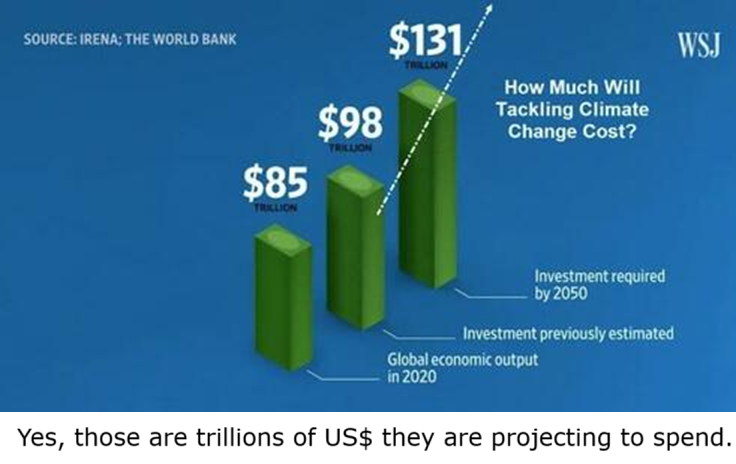
The $20 Trillion Question

The above images put into perspective the scale of William Murray’s issue in his Real Clear Energy article regarding energy investments The $20 Trillion Question: How to Spend It and How Not To.  Excerpts in italics with my bolds and added images.

$20 trillion is a lot of money. One would expect a big bang to follow the spending of twenty-thousand billion dollars. It’s a lot of money! It’s pretty much the total present value of America’s GDP.

This is the sum that was globally spent — largely by Europe and the United States — in a coordinated effort by the developed world to decarbonize the global economy. China, in contrast, sold the world windmills and solar panels while it opened a new coal-fired power plant per month.

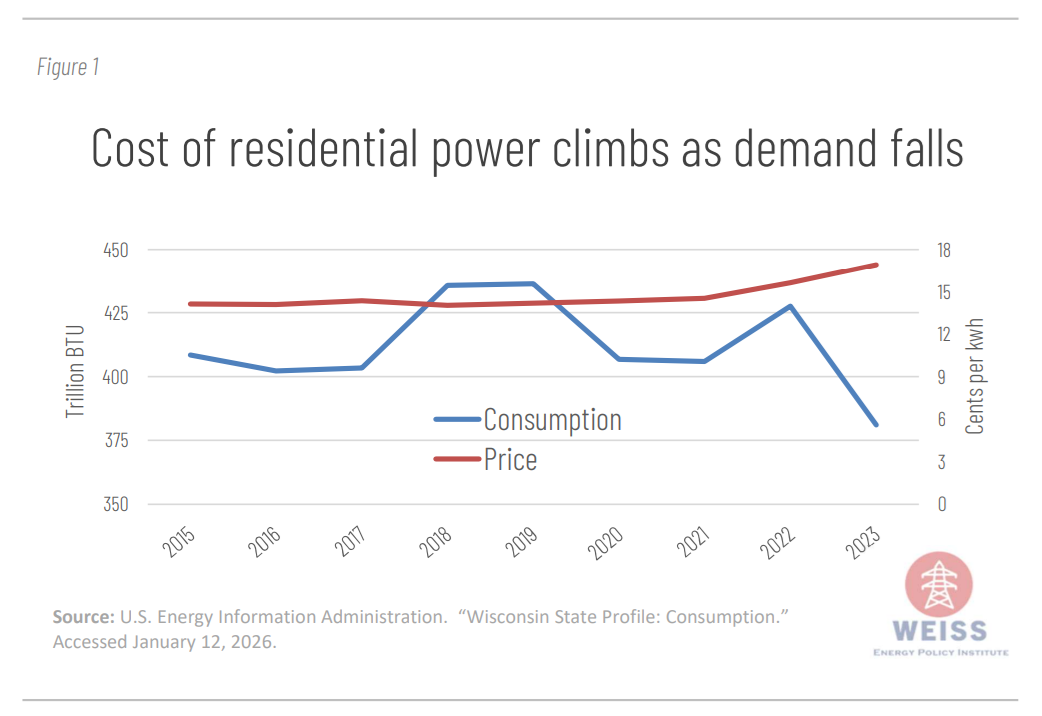
What was the net effect of this “Green” Marshall Plan? Hydrocarbon consumption continued to increase anyway. All that was achieved was a tiny reduction, just 2%, in the share of overall energy supplied by hydrocarbons. Put simply, as the energy pie got bigger and all forms of energy supply increased, hydrocarbons ended up with a slightly smaller share of a larger pie.

We also saw the de-industrialization of the European and American economies — not just with higher prices at the gas pump and on electric bills, but a stealth green tax that was passed on to consumers on everything. This is the culprit of our American and global affordability crisis.

So much treasure and pain for a 2 percent reduction in the share of hydrocarbons.

What a tilting-at-windmills waste. The worst bang for the public and private buck ever. Yet, the Chicken Little believers of the Church of Settled Science and the grifters who profited from it will still sing in unison that it failed because they did not go far enough. If only the global community spent and regulated more!

In contrast, the actual Marshall Plan (which ran from 1948 to 1951) rebuilt a decimated Europe into an industrial, interconnected, peaceful powerhouse. It was a great success by any measure. At the time, its price tag was huge: $13.3 billion in nominal 1948-1951 dollars, which is the equivalent of approximately $150 billion in today’s dollars.

Since a trillion is such a large number, let’s divide $20 trillion by an inflation-adjusted Marshall plan of $150 billion and we have 133 Marshall opportunities. Money was not the problem. To give a sense of the comparative bang-for-buck, by the Marshall program’s end, the aggregated Gross National Product (GDP) of the participating nations rose by more than 32 percent, and industrial output increased by a remarkable 40 percent.

President Trump has been on the global-funding rounds and has secured upwards of $18 trillion in investments. He has secured the equivalent of 120 Marshall Plans — just 2 shy of $20 trillion — to be invested here and nowhere else.

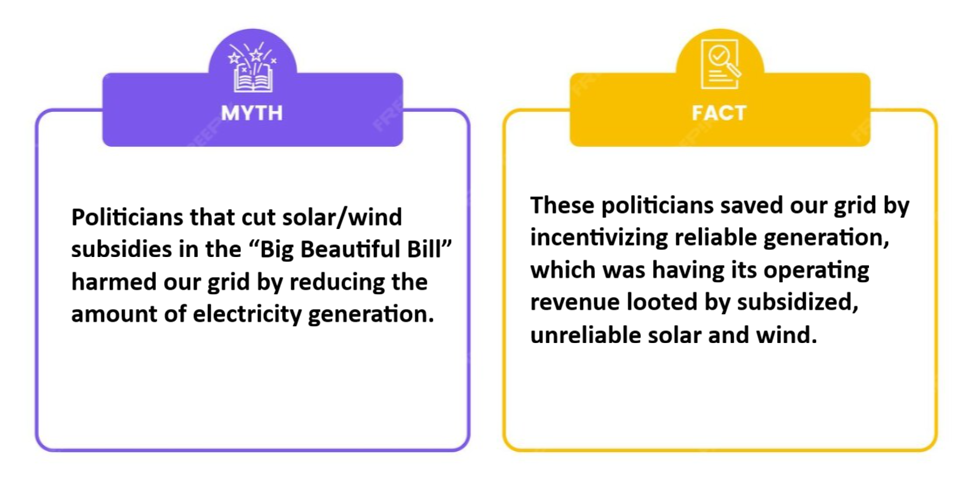
Unlike NAFTA — where the rich got richer under the banner of free markets and in exchange America’s underemployed families got cheaper goods — Trump’s is a recipe for prosperity for all Americans.

Making these investments an American reality will require a growing army of blue- and white-collar workers. With the wealth that it creates, our debt could be paid down and, finally, off. Social Security and Medicare would be placed on a solid footing for time immemorial. All our public obligations to each other would be paid from ever-growing prosperity and not from borrowed money and strangling debt service.

Nothing approaching this level of intentional investment in one country has ever been done. Yes, a similar tranche of greenbacks was burnt to no noticeable environmental benefit and great economic hardship for all. And yes, the American economy under the guise of comparative advantage sent trillions to our south and east — putting America second, hollowing out the American middle class, and neutering the American dream.

Trump’s Plan is the opposite of both failed experiments. Like the original Marshall plan, Trump’s is a recipe for the re-industrialization of the American economy and military, and it is not going to be fueled by windmills and solar farms but with hydrocarbons and uranium. That’s the Trump Plan. It has merit.

Yet, if we look at the polls, Trump is underwater and his base show signs of stress fractures. You bring peace to the Middle East, stop 6 other wars, and bring in some $20 trillion in America First-investments within your first year, and you come home to find yourself underwater and called a lame duck. Democracies — even Democratic Republics — are known to be fickle and hard to please, but this is still rich — and it will result in poverty, which is the opposite of affordability if it continues.

Without the use of tariffs and his deal making, there would not be $20 trillion looking to onshore to the United States. You can blame Trump for higher costs on bananas and coffee. But it’s the cost of electricity and healthcare — not the cost of coffee and bananas — that are roiling kitchen-table economics.

Vice President JD Vance recently made the right call for popular and populist patience. Those who are impatient should look at the offsets already passed, like no taxes on social security, tips, and overtime. That helps pay for bananas and coffee and then some.

My fellow Americans, these sovereign wealth funds that are presently lining up on our water’s edge are coming here based on promises made from a can-do president speaking for a can-do nation. While Trump is a can-do guy, are “We the People” presently a can-do people? Or, do we at least want to return to becoming a can-do people again? The “can’t do” forces are legion and they are the ones now championing the affordability crisis that they caused.

When America was a can-do nation, we built the Empire State Building
in a year. Today, it would take years to get a permit.

Those willing to invest such money will require some certitude that the power they’ll need will be there to “build, baby, build.” If not, the money and the opportunity will pass before it has the possibility to take needed root.

And what about us, the American family, worker, and business that continues to struggle under the legacy of throttling energy privation? In short, we all have a common good — a shared interest — in righting the wrongs that control our grid and our nation’s future.

The good news is that a bill was introduced in the House during the government shutdown. It’s called the Affordable, Reliabile, Clean Energy Security Act.” Unlike Obamacare, which clocked in at 903 pages, this bill is a lean 763 words, that, if it became law — and it should — would change everything for the better. (Unlike Obamacare, which is recipe for un-affordability).

Mr. President, your one beautiful bill was missing this one thing. Your short- and long-term, America First ambitions are dramatically increased by making this bill into law before the midterm elections. Connect the state siting of these investments to Democrat support of the bill and you will find it on your desk before the midterms. Executive orders don’t offer the energy security that these investors require and that the American people deserve.

$20 trillion is a lot of money. Coming to our shores is a new lease on the American experiment as we enter our 250th birthday hopelessly divided and broke. Let us come together and solve not just the affordability crisis but set the conditions of greatness for the next 250 years.


See also:

How Wasteful is Green Energy? Count the Ways


Net Zero and British Grid: Dire Straits (Kathryn Porter)

Kathryn Porter’s recent article on the plight of UK’s electrical grid at her blog: Electrification – can the grid cope? The excerpt below provides findings from her new research paper, available at the link above.

Electrification has become the default answer to almost every energy and climate question. Heat? Electrify it. Transport? Electrify it. Industry? Electrify it. In policy circles, electrification is often treated as a frictionless substitute for fossil fuels: cleaner, simpler, and largely inevitable. In this new report I take a look at what electrification would mean for the GB power grid, if it went ahead as planned. I also consider the impact of additional demand from AI data centres.

Electrification policy rests on optimistic assumptions

Across heating, transport and industry, electrification targets rely on a similar set of assumptions:

♦  that consumers will change behaviour rapidly,
♦  that costs will fall quickly and predictably, and
♦ that electricity infrastructure will expand smoothly to accommodate new demand.

The report tests these assumptions sector by sector and finds them wanting.

The good news is that electrification targets are unlikely to be met without some form of compulsion. In heating, rapid deployment of heat pumps is implausible under current conditions. Consumer resistance remains high, installer numbers are growing too slowly, and both capital and running costs are materially higher than for gas heating. Even where heat‑pump subsidies reduce upfront costs, households still face additional expenditure on larger emitters, pipework and insulation, as well as higher ongoing energy bills because electricity prices remain far above gas prices. These are not marginal issues – they are fundamental barriers to mass adoption.

Transport electrification faces a similar gap between ambition and delivery. Mandates for electric vehicles are running ahead of public willingness to adopt them, while grid and charging‑infrastructure constraints remain severe. These problems are magnified for larger vehicles. There is currently no credible fast‑charging solution for HGVs, and electrifying buses outside dense urban centres is far more challenging than policy documents typically acknowledge, particularly where vehicles do not return regularly to a single depot.

In industry, the constraint is both technical feasibility and economic viability. High electricity prices have driven deindustrialisation across large parts of the UK economy, reducing electricity demand far more quickly than electrification can increase it. In practice, deindustrialisation is the dominant trend, and a stronger driver of demand than electrification across the economy as a whole.

Across all three sectors, the modelling used by both NESO and the Climate Change Committee depends on behavioural and technological assumptions that are optimistic, weakly evidenced, and often inconsistent across scenarios. My report does not assume electrification will fail entirely, but it does find that current targets are unlikely to be met without significant compulsion, which brings its own political and social risks.

The system is under strain even without electrification

The bad news is that, even without electrification, the electricity grid is likely to struggle unless action is taken. One of the most important findings of my report is that the GB electricity system is already heading towards a serious adequacy problem even if large‑scale electrification largely fails.

Renewables cannot provide security of supply during prolonged low‑wind winter events, and reliance on interconnectors is risky when neighbouring systems face similar weather patterns. Meanwhile, just under 5 GW of nuclear generation is scheduled to close by 2032 at the latest, and around 12 GW of CCGT capacity is at risk of closure due to age and declining utilisation.

While Hinkley Point C and perhaps a small amount of new open‑cycle gas capacity may come online over the next five to seven years, this does not come close to offsetting expected closures. Under plausible assumptions, the system could face a capacity shortfall of around 12 GW on cold, low‑wind winter days.

In such conditions, meeting demand without rationing would be impossible.

Replacing or upgrading ageing gas generation is constrained by long lead times. New rotors typically require around 5 years, and entirely new gas turbines 7-8 years, reflecting global supply‑chain bottlenecks. These are physical constraints that cannot be resolved by market reform or policy ambition alone.

Britain is not alone in facing a potential problem with system adequacy. Norway, the Netherlands and Germany were all considered as part of the report and in each case, possible shortages are identified. Norway assumes that flexibility, demand response, or batteries will full the gap. The Dutch are less confident and intend to monitor the generation mix in neighbouring countries in the hope of persuading them to maintain enough firm generation to secure the Dutch grid on low wind days. Only Germany has explicitly identified a need to build more gas generation, although its target is likely inadequate.

Europe at night from space NASA 2016

Flexibility helps, but does not replace firm capacity

One of the report’s central findings is that electrification does not increase demand evenly. Heat pumps, EV charging, and industrial electrification all tend to concentrate demand in time (cold evenings, post‑work charging windows), and concentrate demand in space (residential feeders, urban substations, motorway corridors).

Annual energy numbers hide this  – a system can look comfortable
on a terawatt‑hour basis while becoming acutely
stressed for a few hundred hours a year.

Flexibility features heavily in electrification plans with smart charging, demand response, batteries, and thermal storage. While flexibility can shave peaks, this only works where consumers tolerate loss of convenience. In many cases, policymakers ignore real-world constraints such as fire risks associated with overnight operation of domestic appliances, and noise restrictions within multi-occupancy residential buildings. Batteries are energy‑limited and cannot cover prolonged stress events. Many flexibility services depend on digital systems that introduce new operational and cyber risks. Flexibility may reduces costs at the margin, but it does not eliminate the need for firm capacity, resilient networks, or system strength.

Infrastructure challenges present further risks

In addition to the issues with reliable generation capacity, there are further difficulties with distribution and transmission constraints which arrive earlier and are also hard to fix quickly. Key points from the report include:

  • Local distribution networks were not designed for mass electrification of heat and transport
  • Reinforcement timelines are measured in years, and often a decade or more
  • Connection queues and “paper capacity” obscure real‑world deliverability

The report also identifies risks with aging grid infrastructure and the recently identified risks that premature closure of offshore gas pipelines may constrain gas supplies to the grid on cold winter days, limiting the gas available for electricity generation.

What this means in practice

Taken together, the findings point to an uncomfortable conclusion. The GB electricity system is likely to struggle to maintain today’s level of demand reliably, let alone accommodate the additional 7–10 GW of load in 2030 implied by current electrification agendas. AI data centres are therefore likely to pursue off‑grid solutions, not because of technological failure but because the grid is no longer perceived as sufficiently reliable for mission‑critical loads.

Large‑scale electrification of heat and industry before 2030 appears improbable, and likely remains so for several years thereafter. Without decisive policy action, the probability of regional rationing, blackouts and cascading grid failures rises materially.

To restore Britain’s energy security, government must
pivot from aspirational modelling to credible planning.

This means:

♦  supporting life extension of ageing gas generation,
♦  accelerating procurement of new dispatchable capacity,
♦  reforming network investment incentives to prioritise resilience, and
  reassessing electrification timelines.

Net zero targets cannot be allowed to override public safety.
Security of supply must once again become
the foundational principle of UK energy policy.

UN Climatists Organized Assault Upon Dissenters

Susan Quinn reports in her American Thinker article Climate change advocates at the UN launch new organized assault against free speech and information.  Excerpts in italics with my bolds and added images.

For years, climate change “deniers” have been attacked and ridiculed because we don’t believe in the “science” of the left. Yet, invented “science” isn’t science, and too many scientists have cowed to it, incentivized by money or fear of being cancelled, and have climbed on the bandwagon.

More and more people, however, are realizing the scam
that’s been perpetrated and are speaking out.

And now, those who defend climate change caused by humans are furious and alarmed. To discourage dissenters to the progressive narrative, the UN stepped up to stop the “disinformation”, intending to ramp up the war against climate change “deniers”:

At the United Nations Climate Change Conference (COP30), held in Brazil in November 2025, several states endorsed the UN’s ‘Declaration on Information Integrity on Climate Change, an initiative recognizing and trying to combat the rise in climate disinformation in media and politics.’

The UN Declaration is professedly a pledge to ‘fight false information’ about climate change.

At first glance, the Declaration seems fairly innocuous. But if you read it carefully, it clearly condemns those who don’t agree with the UN agenda, demanding censorship of the opposition, largely through the media. Here is one of the listed commitments:

Promote and support the sustainability of a diverse and resilient media ecosystem through adequate policies to enable and ensure accurate and reliable coverage, specially, within this context, on climate and environmental issues, as well as policies on advertising transparency and accountability….

It is not the place of the UN to determine a limitation on discussion of climate change, or create a media network to censor opposing viewpoints or findings. And yet they persist in pursuing this agenda and insist that everyone fall in line. Desiree Fixler, an expert in sustainable finance and investment banking and a former member of the WEF’s Global Future Council on Responsible Investing turned whistleblower, identified the climate change crisis as a hoax:

Fixler, a whistleblower, used to work as a sustainability officer for Deutsche Bank, until she exposed their ‘greenwashing’ and was fired for it. Since then, she has been exposing the climate change narrative and the ‘net zero’ agenda as a scam. In a recent podcast, she explained how the UN and WEF agendas of net zero emissions and ‘stakeholder capitalism’ – a WEF concept – are means to gain control and implement socialism. ‘They’re lying to the public,’ Fixler recently said on the Winston Marshall podcast.

‘They’ve manufactured a climate crisis. There is climate change, but there is no climate crisis… asset managers, consultants, and governments… they’re all in on it because they all profit from it.’

Last year, Stanford University reported on a “rise” in new organizations pushing back against the left’s “climate change crisis” claims:

New Stanford-led research in PLOS One reveals a growing constellation of think tanks, research institutes, trade associations, foundations, and other groups actively working to oppose climate science and policy. The number of countries with at least one such ‘counter climate change organization’ has more than doubled over the past 35 years.

The researchers, in a roundabout way, recognize the aggressiveness of the left’s climate change policies in action to be a major factor for the pushback:

According to the Jan. 22 study, the two factors most closely linked to the formation of at least one counter climate change organization are the strength of a country’s commitment to protecting the natural environment and the level of formal organization in its social sector.

(As it turns out, people are less concerned with some unobservable boogeyman than they are with their utility bills and whether or not they can afford a car.)

An especially frustrating part of this story is that climate change adherents mischaracterize the position of the “deniers” who don’t deny that the climate is changing, but that there is inadequate scientific evidence to suggest that human beings are the source of those changes. This is a critical issue:

How can we consider stopping climate change when
we don’t have scientific data about what causes it?

All the warming since 1940s followed oceanic cyclical events.

Well-known scientists are finally speaking out against the UN censorship initiative:

Prominent voices, including Bjorn Lomborg, have criticized the UN’s stance, insisting that taxpayer-funded climate policies warrant thorough scrutiny, not censorship.

Lomborg contends that the UN’s agenda is not only misguided but runs the risk of economically damaging the very countries it claims to help, as evidenced by countries like Germany facing high energy costs amid aggressive climate goals.

We must take seriously the efforts of the UN to censor scientific debate, because the consequences could be dire:

The implications of this censorship extend far beyond the realm of energy policy, as it threatens foundational principles of democracy and free expression, calling into question the very nature of scientific and academic inquiry.

The controversy and debate must continue!