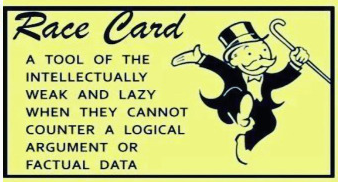
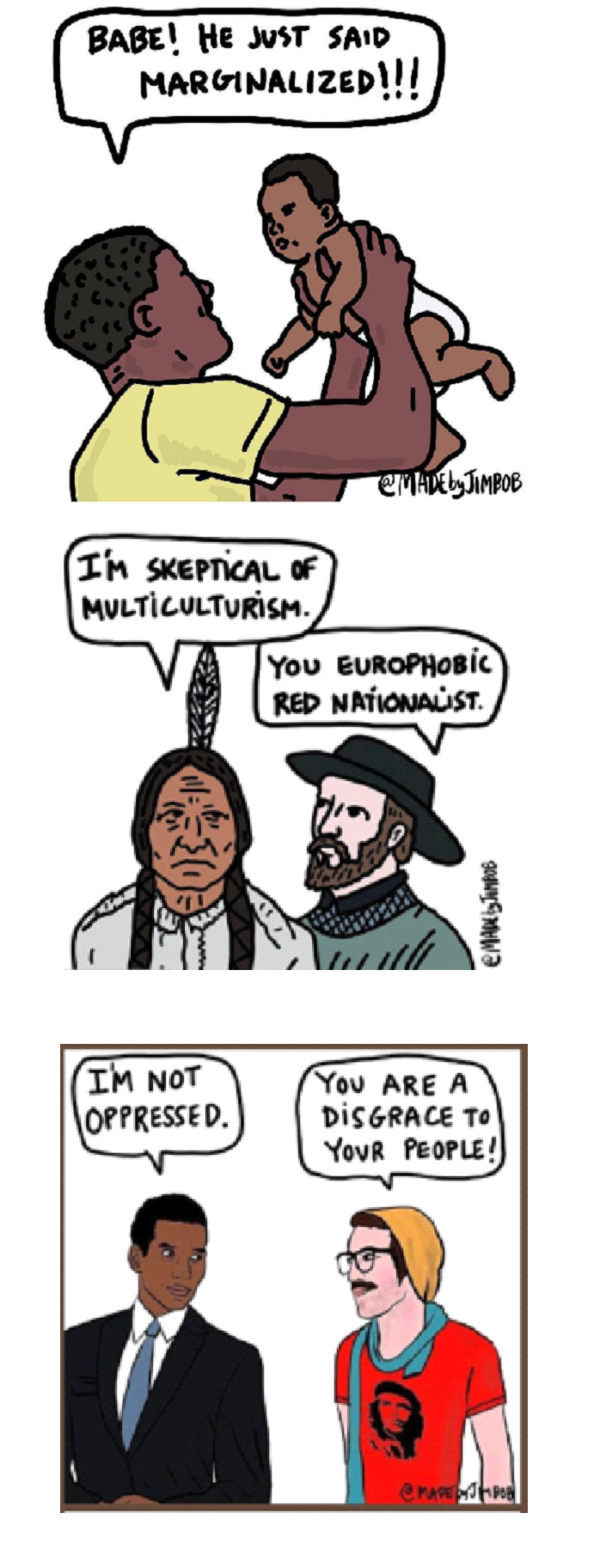
“I am Non-racial”

How to stop the new “anti-racism racism”:

I am non-racial.  When you call me “X” (white, black, yellow, red or whatever) that is just a social construct. 
I do not identify as “X”.  I am not a member of that or any category.

Lynn Uzzell writes at Real Clear Politics Three Words to Defeat CRT: ‘I Am Non-Racial’.  Excerpts in italics with my bolds.  

Their apparent political success notwithstanding, foes of CRT warn that the only way to defeat the menace is through political activism, fundraising, and a cascade of litigation. And even then, they fear, the juggernaut that is CRT has become too powerful a force to be overcome in our public schools.

But there is a far simpler solution, and one that promises better success in the long run. It can be achieved through three simple words: “I am non-racial.”

For the past 20 years, CRT has achieved enormous success in placing race at the center of public discourse and convincing otherwise rational people that their race is the most important facet of their identity. If a substantial mass of Americans refused to identify as any race, the whole project would collapse.

Identifying as non-racial is morally right, politically expedient, socially advantageous, and it has the added benefit of conforming one’s identity to the racial reality of America.

The Morality of Being Non-Racial

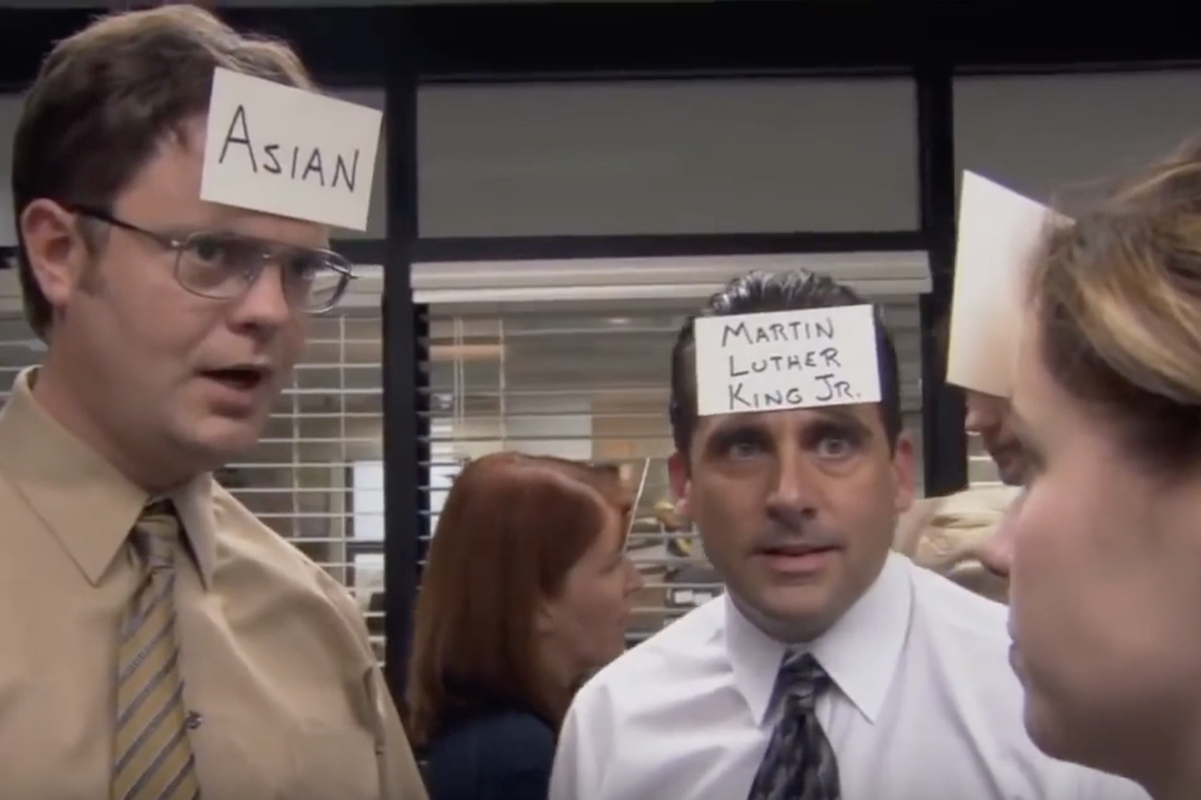
Most of us, when we were little, were taught to believe that it was immoral to judge people according to their race. We were urged to share Martin Luther King’s famous dream, “that my four little children will one day live in a nation where they will not be judged by the color of their skin, but by the content of their character.” We understood that the dream was not fully realized in America, but nearly everyone felt committed to working toward that goal.

Critical race theory teaches a contrary vision of morality. It deliberately rejects the goal of a race-blind society. Authors of one textbook on CRT express their “deep dissatisfaction with traditional civil rights discourse.” They wish to replace it with an “explicit embrace of race-consciousness,” especially “among African-American and other peoples of color.”

This particular feature of the theory—the deliberate heightening of race consciousness—has been the most prominent aspect of CRT in schools today. One school district in Oregon has developed a “white identity development” strategy, because, after all, what could go wrong when white people are segregated from others and trained to view themselves as a unique interest group?

CRT has been remarkably successful in encouraging greater race-consciousness throughout America’s institutions. Use of the terms “racist” and “racism” have skyrocketed in the mainstream media in the last 15 years, especially in leading newspapers such as the Washington Post and the New York Times.

The moral choice is clear: Either we are aiming for a society where race no longer matters, or we are aiming for a society where race consciousness predominates. If the lessons we imbibed when we were young were correct, then refusing to identify as any race is the next logical step toward achieving true racial justice and harmony.

The Political Expedience of Being Non-Racial

American policy and public discourse have been focused on race for so long that it is easy to forget that it doesn’t have to be this way. France has long maintained an official stance of color-blindness: a law passed in 1978 explicitly bans most collections and computerized storage of race-based data.

In America, the collection of racial data is still voluntary, though it has become ubiquitous. But the march of CRT would be stopped dead in its tracks if Americans would stop volunteering any answer to the question of racial identity beyond “non-racial.” Imagine how transformative that option would be.

Schoolchildren could not be taught that they are “oppressors” on the basis of their “whiteness” if parents insist that their family opposes categorizing people by race and that their children do not identify as white.

Currently, the “Asian American penalty” means that Asians are significantly less likely to be accepted into elite universities than any other race, and it’s getting worse. California’s recent decision to do away with admissions tests for its UC schools is a barely disguised effort to reduce the number of “overrepresented” Asians admitted there. But the Asian American penalty would instantly evaporate if these students chose to be non-racial instead.

Seattle would not be able to hold training sessions exclusively for “city employees who identify as white” in order to teach them about their “complicity in the system of white supremacy,” if city employees, and all employees, would instead identify as non-racial.

Obviously, not everyone would benefit in the short term from the “non-racial” category. Currently, students, applicants, and workers who officially identify as historically marginalized races reap tangible benefits in admission, hiring, and professional advancement. And it is too much to ask that everyone would be willing to give up those privileges immediately. But in the long run, even those who now stand to benefit from the current brand of racialism will begin to see the benefits of working towards a truly post-racial society.

The Social Advantages of Being Non-Racial

Over the same period that CRT has achieved institutional hegemony in America, race relations have gotten much worse. As Charles Murray has shown, in just seven years—between 2013 and 2020—“Americans’ perceptions of race relationships had gone from solidly optimistic to solidly pessimistic.”

Correlation is not always causation, but in this case it is. Racial discord is not an unintended consequence of CRT; it is its lifeblood. As reductionist history, CRT teaches that America’s past and its essence are tethered to the unremitting march of white supremacy. As a reductionist political agenda, CRT teaches that underprivileged races must seize and redistribute the property and power hitherto accumulated by whites.

This teaching not only stokes racial competition, enmity, and grievance. It cannot survive without them. Just as Marxism is sustained by class conflict, CRT feeds off of racial conflict. If total racial harmony were ever achieved in this country—if all Americans of every race were ever to clasp hands in brotherly love—CRT would wither away and die.

The more that this hyper-racialized theory takes hold in our country, the more it drives a wedge between us and our in-laws, nephews, nieces, and neighbors.

Renouncing racial identities does not mean renouncing other social, religious and political identities that can actually draw us closer together. Those who choose to be non-racial do not have to give up celebrating Chinese New Year, St. Patrick’s Day, Cinco de Mayo, or Ethiopian Timkat. It simply means refusing to be subsumed under a contrived category that has always been more divisive than cohesive in America.

The Reality of Being Non-Racial

Although there is much to criticize in CRT, it contains some kernels of truth. In particular, it recognizes that race is “socially constructed (the idea of biological race is ‘false’)”; nevertheless, race has always been very “real” as an instrument of power.

Indeed, whatever scant biological reality might once have been attached to the idea of dividing humanity by races centuries ago, when peoples were divided by continents, race has never been a scientific way of categorizing the people who inhabit the United States. Take, as Exhibit A, the uniquely American and invidious “one-drop rule,” whereby a single ancestor from Africa could condemn a person to chattel slavery or to a subordinate caste. Racial categories in America have never been anything more than cynical attempts to advance one group’s interests over others.

Yet this acknowledgement of the unnaturalness of racial distinctions potentially posed a problem for CRT. Did it not follow that “it is theoretical and politically absurd to center race as a category of analysis or as a basis for political action,” if that category was nothing more than an artificial construct?

It is on this question that CRT takes a sharp turn against the traditional liberal order. Believing that systems ostensibly founded on the rule of law or meritocracy are actually blinds for consolidating and protecting structures of racial privilege (even if the racial categories benefiting from that privilege are arbitrary and artificial), CRT openly advocates distributing wealth, power, and privileges according to race (even if the newly privileged racial categories are based on no less arbitrary and artificial distinctions).

Hence, according to this logic, it makes perfect sense for Harvard to claim blue-eyed Sen. Elizabeth Warren as a diversity hire—even if her racial identity is based on no more than family lore and DNA evidence showing that her bloodlines can boast between 1/64 and 1/1032 indigenous ancestry. Today, we’re seeing one-drop redux in America. But now that single drop is being used to confer social, political, and economic advancement instead of stigma and exclusion.

According to this logic, even Rachel Dolezal’s choice to pass as black makes sense. If something as meaningless as a single drop can determine one’s racial status, why insist even on that single drop?

By refusing to identify as any race, we can stop this madness.

Choosing to be non-racial conforms to racial reality in this country. Most Americans, looking backwards toward their ancestors, see a mélange of nationalities, ethnicities, and races. Looking sideways, our own families are more racially diverse than ever before. And peering into the future, racial categorizations in America will become ever more absurd with every generation. It’s high time that our self-identities matched our objective reality.

Of course, we can expect that the same people who agree that race lacks any objective reality will also resist any attempts to banish self-identifications by race. And won’t it be ironic if the folks who insist that individuals be given the option to select “non-binary” when asked to choose between male and female are the same folks who object to the choice of “non-racial” when asked to choose a mere social construct?

Being Non-Racial in Practice

Our local school district’s anti-racism policy is just one example of the sort of policies being adopted across the country. It requires staff to “collect, review, and provide an annual report to the School Board on data regarding racial disparities in … student achievement.” The report must “also include evidence of growth” in reducing “equity gaps.”

Obviously, one way to reduce disparities between racial groups is to improve the academic achievement of historically under-performing races. However, parents beware: This aim can be achieved equally well—and at much less cost and effort—by diminishing the academic achievement of historically “over-performing” races. The goal of boosting one or more races’ standing—not in absolute terms, but only relative to the standing of other races—is wholly unrelated to, and potentially at odds with, the vocation of educating all children.

It may seem unfair to suppose that teachers and administrators might try to meet their “equity” goals by sacrificing the educational achievement of any portion of their students. Then again, it seems even more unfair that teachers—who have a hard enough job educating our youth—are now expected to single-handedly fix entrenched social problems that no one else has been able to solve.

Forcing schoolchildren to confess to “white privilege” is the poisonous fruit of CRT, and it’s understandable that such ripe, juicy stories receive the most notice. But the noxious weed invading our schools spreads underground, and parents could cut it off at the roots if they took the simple expedient of refusing to allow their children to be classified by race from the outset.

The beginning of the school year is an excellent opportunity to make this change.

Parents, remember, whenever you are asked to identify a race for you or your children, the most ethical and judicious answers are “Decline to answer,” “Other,” or “Non-racial.” Teach your children while they are yet babes: You are non-racial. Inoculate them early against the disease of racialism that has infected the schools, the universities, and the workplace. Don’t let anyone else saddle them with a racialized identity that will haunt them throughout their lives.

Lynn Uzzell is Visiting Assistant Professor of Politics at Washington and Lee University. She specializes in the Constitutional Convention of 1787 and the political thought of James Madison.


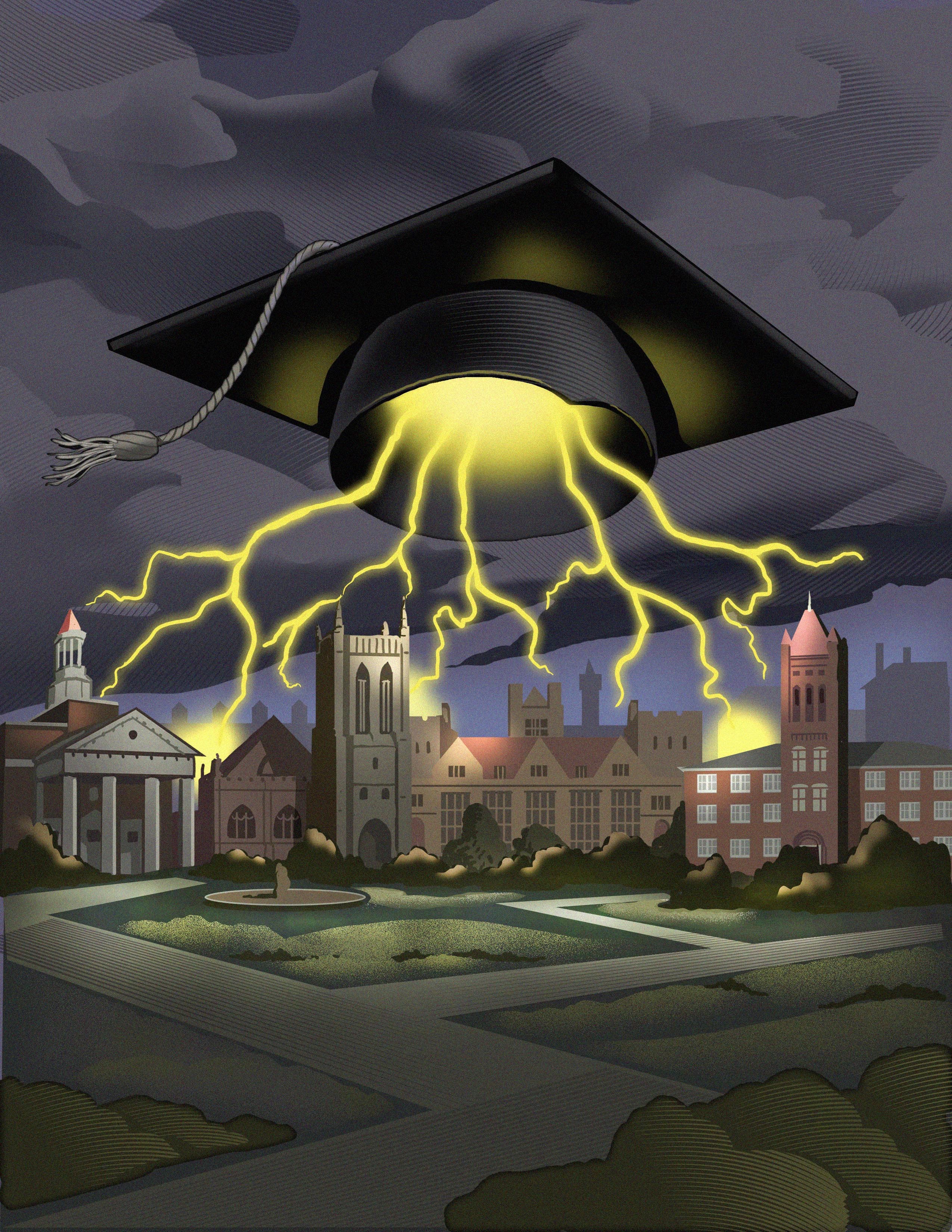
Wokeness Worms Eating Science Academies

J. Scott Turner writes at American Mind The Brainworms Come For Big Science.  Excerpts in italics with my bolds.

pri_80176924
The parasite leucochloridium paradoxum, shown here infecting a snail, is a flatworm that takes over the brains of gastropods and forces them into self-destructive behaviors. As this essay demonstrates, woke social teaching has been known to do the same with academic departments.

Woke grievance is eating expert inquiry from the inside out.

A large gathering of scientists and engineers was brought together by the National Science Foundation (NSF). We were there to compete for a very large sum of money.

At stake was funding for a “research center,” something akin to national laboratories like Brookhaven Labs or Livermore Labs. Research centers are built around a strategic theme, like nuclear physics, and are intended to provide a venue for scientists nationwide to come together to explore that theme. Research centers are high-stakes competitions, involving tens of millions of dollars doled out over a term of ten years or so. The prizes are big, and the prestige immense. They are intended to go to the best of the best.

If a team is awarded a planning grant, the next step is a “planning meeting,” where the NSF gathers the successful teams together to provide detailed guidance on what might make for a successful proposal. I was on one of those teams, and that is how I came to be in that hotel ballroom.

At the opening session, we were told that proposals would be judged on four “foundational components,” or “pillars,” as they were styled in the PowerPoints. A successful proposal would be strong on all four: weakness in one would cast the proposal into the abyss, we were told, no matter how strong the other pillars might be. At the planning meeting, each pillar was to have a dedicated panel discussion, just to make clear to us what the NSF’s expectations were. Three of the four pillars were conventionally scientific and academic: innovation, training, etc. The remaining pillar was “Diversity and Culture of Inclusion” (DCI).

That was where things took a bizarre turn.

The DCI panel consisted of bureaucrats from the NSF’s Office of Diversity and Inclusion (ODI). Naturally, there were many questions from the floor about what the criteria for a strong DCI pillar would be. We are talking about engineers, remember, whose culture is: “give us ‘the specs’ and we will solve any problem.” The assembled engineers were looking for “the specs” they needed to build that DCI pillar.

I remember the scene. Each team was seated at its own round table on the ballroom floor. The DCI panel was seated on a raised platform, looking down on us, as from thrones on high. 

One engineer at a neighboring table kept trying to pin the DCI panel down on those DCI specs. They kept deflecting the question. We’ll know it when we see it, was the blithe answer, issued with the monotonous imperiousness of the entitled ruler indulging inconvenient questioning from the proles. Engineering is too white and too male, was one panelist’s message to us, and that needed to be corrected. Irony alert: the engineer pressing the point was not white, but an Indian immigrant.

It became clearer with every question that the specs not only would not be laid out: they would in any event change according to inscrutable whim of the ODI bureaucrats. Foolish engineers, one might imagine Jabba chortling, the “specs” are not to help you solve a problem: they are there to keep you off-balance, uncertain, and in my power. It is enough for you to know you depend upon my mercy for funding.

How the Parasite Takes Over

All are familiar with the Left’s “long march” through the institutions. What might not be so well known is just how thorough the conquest has been. Evidence of this sometimes pops up into prominent public view, as in the recent exposure of “critical race theory” training in federal agencies (including places like Sandia National Labs, where one would expect such hokum to be laughed out the door). Such incidents, though quite frequent, are only the tips of a very large iceberg.

In the academic sciences, where I have spent my career, “diversity, inclusion, and equity” (DIE) has become as pervasive as one might expect it to be in any grievance studies department.

How did this happen? More to the point, how could it happen to the supposedly sensible people that scientists are generally thought to be?

The concept of “zombie parasites” provides an apt metaphor for how things got to this point. These are parasites that colonize the brains and nervous systems of their hosts, taking the controls, so to speak, over the host’s behavior. One striking example of a zombie parasite is a worm that infects the brains of snails, which normally crawl around stealthily at night. A snail infected with the parasite crawls out onto a grass stalk during the day, where it is now visible to birds that gobble them up. The parasite then breeds in the bird’s digestive tract and deposits its eggs in the bird’s feces. When uninfected snails eat the feces, the parasite’s life cycle is completed.

DIE has spread into the academic sciences as a kind of zombie parasite. It is not a real worm at work, of course, but a metaphorical “brainworm”—three of them, in fact, that together spread a kind of altered cognitive reality through any institution that is infected by them.

The route of infection usually starts with a “study” that identifies a “problem” that no one knew existed: the overwhelming whiteness of, say, fishery science. Once an unwitting host takes the bait, the next phase of the infection kicks in: all are invited to contemplate with horror the dark future that awaits should fishery scientists not take immediate steps to correct the “problem.” In the final stage of the infection, the brainworm plants its “diversity is our strength” meme in the host’s nervous system. The infected now babble about solving the impending crisis through a crash outreach program to “under-represented” or “marginalized” groups, who, by virtue of their class membership, think differently about fisheries, and so can save the field from stultifying white maleness.

As in those parasitized snails, the DIE brainworm induces a cognitive disconnect in the infected. None of the assertions planted by the DIE zombie parasite have a sound basis in fact or reason. The accusation of too much whiteness usually is based upon a simple observation that the ethnic, gender, and sexual orientation mix in, say, fishery science, departs from the statistical distributions found in the general population. Why this should be, where it is considered at all, is usually buried under a panoply of repetitive charts and diagrams of dubious critical value.
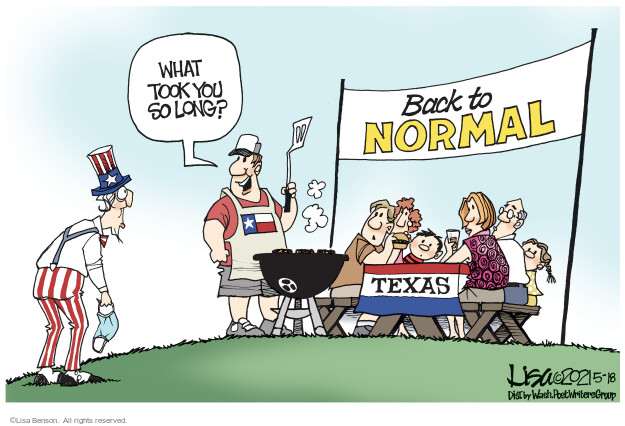

What makes the DIE brainworm a zombie parasite is how it hijacks the host’s behavior to facilitate its spread, to the host’s ultimate detriment. Universities, where future scientists are trained, are a common target. Incubating a future scientist has traditionally involved a very close relationship between a professor and a student (“mentor” and “mentee,” in today’s clumsy parlance).

Fishery scientists, to trot them out again, become fishery scientists because, well, they love fish. They want to devote their lives to getting to know fish better. The same may be said of nearly every scientific endeavor in academia: at the vital core is a love that can verge into obsession. The genius of the academy is that it provides a place where that love can give value to the society that supports it. Disrupt that elemental drive, and you degrade the real social value of the sciences.
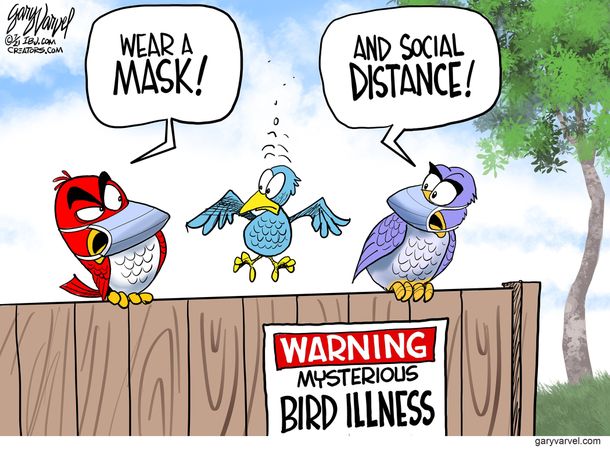
This almost primitive love provides a kind of immunity to the DIE brainworm, which makes it a particular target. To spread, the parasite must plant the idea that the familial network of relationships cloaks a hostile and dangerous climate, propped up by cronyism, privilege, racism, sexism, and hostility to the non-binary. The only way to make science “safe” for the marginalized, or excluded, or under-represented, is to disrupt the traditional mentoring family. Students and new faculty who are members of “under-represented” or “marginalized” groups are drawn from their intellectual families into self-referential bubbles of grievance: support groups, safe spaces, counseling services, etc., where the normal stresses of academic life can be transformed into evidence of the hostile climate without.

At some point, earnest administrators, who know nothing about science and understand even less how it works, are brought in to “listen” to the newly aggrieved. At that point, discontent is turned into actionable grievance: committees and study groups are appointed, action plans formulated. Excluded from all this, of course, are the keepers of the academic traditions which, inconveniently for them, have already been condemned in absentia as the problem.

Pressure is brought on these erstwhile traditionalists to conform, to “listen” to other voices, to “check your privilege,” to be “open” to different “perspectives.” If the brainworm has spread far enough to implant a DIE bureaucracy on campus, penalties for non-conformity will be quietly placed in a corner of the room, a visible reminder of the consequences of resistance to the brainworm. Once that happens, the path is open for the entire academic institution to become infected, triggering the next, and most dangerous, stage of the infection.

Follow the Money

Parasites do not simply invade a host: they require fertile ground and food. For the DIE brainworm, the mother’s milk is money. And it is the academic sciences, not the humanities, where the ground is lushest. Compare two sources of federal funds that are often tied to woke ideology on campuses: the National Endowment for the Arts (NEA) and the National Endowment for the Humanities (NEH). These are NSF-style agencies that fund academic work in the arts and humanities, and in similar ways. Artists and scholars submit proposals, these are scrutinized by peers, and funds are doled out to the successful proposals.

How much money? The NEA presently enjoys an annual appropriation of about $150 million. For the NEH, it is about $160 million. In contrast, the federal money directed to academic science in 2017 stood at around $40 billion: 250 times more. Over the course of the 50 years of its existence, the NEH has funded a cumulative total of roughly $4.7 billion dollars in grants. The cumulative tally of federal support of academic research over the same time span has been nearly $900 billion: about 200 times more.

It is to the sciences, then, that the DIE brainworm has gone to feed, and there it has spread as if it were an epidemic. Evidence for this can be ferreted out from the NSF’s searchable databases of its grant awards, by searching for keywords such as “under-represented,” “minority,” or “marginalized” in the grant documents. Prior to 2010, no award carried these keywords. The first to do so was in 2010, when the NSF awarded a large research center grant to MIT, which contained within it a significant program of outreach to marginalized groups.

Since that year, NSF expenditures on research grants containing the “woke” keywords have risen exponentially, doubling at a rate of about 50% each year, just as a novel virus would when spreading through a new population. In 2018, the last year for which a complete picture can be discerned, the NSF funded nearly a thousand research grants devoted in whole or part to DIE aims, to the tune of more than $1.3 billion. From 2010 to 2018, a total of more than $4 billion have been awarded to more than 2,200 DIE-oriented grants.

Which is how we get to that scene in the Arlington hotel ballroom, where DIE now holds the trump card in deciding what science is worthy of funding. No matter how stellar the science, the message is clear: gobble up the DIE brainworm, or your funding will dry up, and your career along with it.

Footnote:  The DIE acronym reminded me of this poem by e.e. cummings
nobody loses all the time

i had an uncle named
Sol who was a born failure and
nearly everybody said he should have gone
into vaudeville perhaps because my Uncle Sol could
sing McCann He Was A Diver on Xmas Eve like Hell Itself which
may or may not account for the fact that my Uncle

Sol indulged in that possibly most inexcusable
of all to use a highfalootin phrase
luxuries that is or to
wit farming and be
it needlessly
added

my Uncle Sol’s farm
failed because the chickens
ate the vegetables so
my Uncle Sol had a
chicken farm till the
skunks ate the chickens when

my Uncle Sol
had a skunk farm but
the skunks caught cold and
died and so
my Uncle Sol imitated the
skunks in a subtle manner

or by drowning himself in the watertank
but somebody who’d given my Uncle Sol a Victor
Victrola and records while he lived presented to
him upon the auspicious occasion of his decease a
scruptious not to mention splendiferous funeral with
tall boys in black gloves and flowers and everything and
i remember we all cried like the Missouri
when my Uncle Sol’s coffin lurched because
somebody pressed a button
(and down went
my Uncle
Sol

and started a worm farm)


To Break the Spell (Climate of Fear)

moviescreen

Julius Reuchel writes at substack The Emperor Has No Clothes: Finding the Courage to Break the Spell.  Excerpts in italics with my  bolds.

To all the silent good people watching our society tear itself in two, this essay is for you.

Those in charge have long since signalled that they have no intention of returning to a liberal democracy founded on the recognition of inalienable individual rights and freedoms. If data were the ingredient required to confront them, they would have folded long ago. They are impervious to data. This isn’t about a virus. This is a psychological game and it’s all about power and control.

In this Brave New World, the regime will grant temporary conditional privileges tied to virus seasonality, good behaviour, or whatever other conditions they choose to set to achieve the social engineering agenda of the day. Once they opened Pandora’s Box to a society based on conditional rights, there is no limit to where their imaginations will take them.

How do we stop this neo-feudal re-imagining of society? How do we play chicken with a regime that appears to hold all the cards? At this point it is clear that regaining our freedom depends entirely on the government losing the support of the crowd. To use the words of Hans Christian Andersen’s timeless folktale from 1837, we need to shake our frightened fellow citizens out of their stupor by getting them to see that “the emperor has no clothes” but, more importantly, we need everyone who sees it to be willing to say it out loud.

So, in this essay, I am going to dissect the psychology of dissent.

Winning Hearts and Minds – How to Open the Mind to Doubts

Data plays an important role in changing hearts and minds, but only as a secondary ingredient.
We are fighting a psychological battle, not an intellectual one.

Data will help those who start to ask questions, but first they need to ask their first question. First there needs to be a seed of doubt. Data will not plant that seed of doubt. Data does not have the power to break the spell.

A frightened mind seeks certainty because certainty feels safe, which is why a frightened mind rejects anything that undermines the feeling of certainty. Uncertainty is scary. This desire for certainty makes people savagely hostile to conflicting data and capable of entertaining the wildest of logical fallacies. The facts simply do not matter to their feelings. People only begin to seek out data after the spell begins to break. Something else must first plant that initial seed of doubt.

Uncertainty is uncomfortable so if it cannot be pushed aside, then and only then will the mind enlist rational thought processes to work through the dilemma in order to regain a sense of certainty. That is the psychological game we need to play. We need to create the sense of uncertainty that forces our frightened peers to enlist their rational minds. Once doubt sets in, the data will take them the rest of the way.

Thus, the willingness to look at data is merely the second step along each individual person’s journey to recognizing that the emperor has no clothes. Much of our effort in this battle for our freedom has been focused on that second step. More data. But the first step along that path requires planting the initial seed of doubt. How do you seed doubt without data?

The simple reality is that this first step is fought with symbolism, with herd psychology, and with the courage to bear the cost of speaking out when others will not. Navigating this first step is the focus of this essay because that is where we are falling short.

To plant a seed of doubt, to help people take that first step, it is not what you say that matters so much as being seen to say it, out loud, in public, in a way that allows you to be identified and counted, and being willing to face the music when the world can see what you really think. And saying it over and over again, relentlessly, until enough voices join in, until the counter chorus can no longer be dismissed as fringe.

Doubt is created by breaking the illusion of consensus.

This first seed of doubt happens on a deeply subconscious emotional level. There are three different ways that it can happen:

Many only start to ask questions after getting their first COVID vaccination. As they begin to feel safe, they regain their ability to think, which gives rise to questions and doubts. It is why the regime is creating a hyperventilating drumbeat about “variants” and stoking hysteria about the unvaccinated. The regime is trying to keep the vaccinated in fear in order to prevent them from regaining their ability to see clearly and think independently.

Doubt can also be created when someone’s personal experience doesn’t match the propaganda that they’ve been fed. The regime is fighting that part of the battle for us. When someone is injured by a vaccine, sees a loved one trapped in isolation in a nursing home, or is at risk of losing their business to lockdowns, doubt in the narrative begins to creep in. There is only so much pain that anyone can bear before their certainty in the regime begins to waiver.

And doubt can be created simply by depriving someone of the illusion of consensus. Remember Hans Christian Andersen’s folk tale. It was a child that broke the illusion because it was unafraid to say out loud that the emperor’s fine gown didn’t exist, that he was wearing nothing at all. Data didn’t break the illusion. All it took was a pointed finger, a well-timed laugh, and the courage to speak out.

Doubt creates conflicting emotions that can only be resolved by enlisting the rational mind. Doubt leads the mind to seek out data, not the other way around. The regime is doing everything it can to prevent the fearful from thinking. This is a psychological war.

This is a war about the role of government. It is about your freedom to think, to speak, and to ask questions, and about whether your individual autonomy is downgraded to a conditional privilege or whether it remains a right. It is a war about whether you are to remain a citizen or become a subject. It is about who owns you, you or the state.

The question at the forefront of this psychological battle, accelerated by the lens of COVID, is about whether we will remain a society based on legal equality and inalienable rights or whether, in the name of safety, equity, and political correctness, we will allow ourselves to be reduced to a society of masters and servants, as was the norm throughout much of human history, with the masters granting or withdrawing conditional privileges to pursue whatever they perceive as the greater good.

To have a psychological impact, you have to voice your dissent in person, out there in the real world where the risk of repercussions is real. Where you can make eye contact while you are doing it. At work, at home, at school, at church, at the gym, at the mall, and out on the street. You have to say it where those who disagree with you can see you saying it. You have to be the little boy who stood in front of the crowd and pointed at the emperor’s lack of clothes. That is how democracy works in its rawest form when the institutions of liberal democracy cease to function.

Words are not violence. Words are 100% peaceful, no matter how much you disagree with them or how much you are offended by them. But censorship in any form is a form of implied violence because, without your voice, you are held hostage by your censor and have no peaceful means of self-defence.

A liberal democracy cannot function in an atmosphere of censorship. Brute force begins with censorship. Allowing yourself or others to be silenced ushers in a world where the only means of self defense is through brute force. That is what is currently being normalized under the guise of saving the world from COVID.

History shows that once the norms of a liberal democracy give way to brute force politics, even if the regime does change hands, those that emerge on top are themselves rarely champions of freedom and tolerance. The only way to prevent brute force politics from becoming normalized is if the good people refuse to shut up. So, this is not just a war against bad people with bad ideas, it is equally a war to defend the only system ever invented that gives citizens autonomy over their own bodies, minds, and voices, along with the mechanism to defend that autonomy through peaceful means.

Our opponents are well aware of the power of conformity and are using it to their advantage. Do not mistake their feigned ignorance about basic medical facts as stupidity. Do not mistake the media’s blockade of dissenting views as ignorance. They all know the game they are playing. Why do you think they are so careful to avoid any debate about the data?

The desire for conformity is one of the most powerful emotions in the human species. It is our natural herd instinct – our hive mind – asserting itself. We are a social creature. Safety lies in numbers. Our herd instinct is so strong that when the dominoes line up just right, it can lead us into blind groupthink, cults, and mass hysterias in defiance of all rational logic. The rational mind is a thin crust perched precariously on a much larger, highly emotional, subconscious neurological tool kit. Conformity is the subconscious search for safety. We are wired to seek safety at the center of the herd even when that conformity is leading us straight over a cliff.

If you have never seen the videos of the Asch Conformity Experiments, take the time to watch this brief clip before reading further. It is one of the keys to fighting the psychological battle to regain our freedoms.

Currently the regime is manufacturing an illusion of consensus to use herd instinct as a means of control. But the moment we deprive the herd of the comfort of consensus, we will be in the driver’s seat. Breaking the illusion of consensus is what will give us the power to force the herd to think for itself. That is why it is so important that the silent good people speak out.

We don’t need to agree with one another to challenge the regime. We don’t need to speak with one voice. To break the illusion, we simply need enough people to speak out in disagreement of the “consensus”.

The Ash Conformity Experiments taught us that even a single person standing up in a room will give others with doubts the courage to speak out. Breaking the illusion begins with a single voice. But for a phenomenon as global as the current mass hysteria, it will take more than a few voices to create a loud enough counter-chorus to break the spell.

As the counter-chorus becomes more visible, the regime has no choice but to ramp up or lose the illusion of consensus it has manufactured. This traps the regime in a catch-22 in which doing nothing allows the counter-chorus to reach that 10% tipping point but doing something increases the pain so quickly that it erodes its support base. Visibility puts us in the driver’s seat because it traps the regime in that untenable catch-22.

A slow consolidation of power allows the regime to strip our freedoms slowly enough that the crowd becomes accustomed to its own subjugation. That is why they keep letting off a little pressure after a period of control. They are teaching us to accept the bridle of our serfdom.

The actions taken by our government made it clear, “if you want to practice medicine or pursue an academic career in Canada, toe the line by self-censoring or we will destroy your reputation and come after your career.” If this is allowed to go unchallenged, it will mark the end of academic freedom and professional discretion in Canada. The regime is watching, waiting to gauge the response.

Publishing more data won’t fix this. The regime doesn’t care about data. And frightened members of the crowd will never look at it. In this game, more data is the equivalent of silence. More data is the nod of consent.

The only way to confront this is for the silent good doctors, medical professionals, and academic professionals to publicly stand up and speak out, on principle, to break the illusion of consensus that has been cultivated by our public health authorities and media. The silent good doctors must speak out to signal that the censorship of Dr. Christian was wrong, that they will not be cowed by the regime’s treatment of Dr. Christian, that scientific questions should be settled through debate and not through sanctions, and that they have lost faith in our public health authority’s ability to function as an evidence-based policymaking institution.

I hear rumors that up to 50% of medical professionals are not okay with the public health response. I also hear rumors that outspoken doctors who faced a deluge of ridicule and chastisement from peers in the early days of the pandemic are now rapidly seeing that criticism fade away. I have no way of gauging if those rumors are correct, but it suggests that the tide is turning in the medical community and that the numbers have long since crossed the 10% threshold needed to break the illusion. If only they were all willing to step out from behind a veil of anonymity and say it out loud.

The Soft Underbelly of the Regime Is Exposed

In Quebec, the healthcare system is already on the brink of collapse (see my Twitter thread) because of a mass exodus of staff quitting the system during COVID. Some hospitals have already lost over 50% of their staff.

Anecdotal reports from other provinces show they are not far behind. There has never been a time when medical professionals have had more leverage to force a revival of scientific debate and evidence-based policymaking. And there has never been a better time speak out in defense of Dr. Christian.

Public health officials cannot afford to alienate more doctors and nurses. They cannot afford alienating or firing a horde of outspoken disgruntled medical professionals. The soft underbelly of the regime is exposed.

In short, as long as enough medical professionals speak out, now is the time that they have the upper hand in this game of brinksmanship. Now is the time that they can throw off both bridle and saddle and take back their professional and academic freedoms. The window of opportunity to rescue the system from itself is now. But only if enough of silent good doctors break their silence.

[Note Reuchel is focused on the Covid tyranny, but there are three cudgels beating on free enterprise democracies:  Covid, Climate and Racism. See also: Climate Reductionism]

Biden’s Record Worse than We Feared

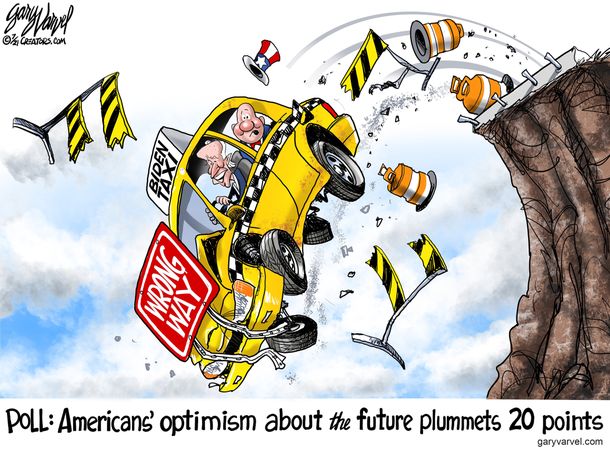
gv072721dapr20210727064505

The Editorial Board presents at Issues and Insights Biden’s ‘Accomplishments’ So Far: A Troubling Tale In 8 Charts.  Excerpts in italics with my bolds.

Months after President Joe Biden supposedly “rescued” the country from the COVID-19 pandemic and promised that he’d bring the country together, how is the nation doing? Well, there are several indicators on the rise. Unfortunately, they are all indicators of trouble.

The news Thursday that the GDP gained 6.5% in the second quarter (the first full quarter since Biden signed his American Rescue Plan) is good. But it is well below economists’ forecasts. The Blue Chip Consensus forecast was above 9%, and other surveys pegged Q2 growth at 8.5%. It was also just barely above the gain in Q1 — which was before any of Biden’s policies had taken effect.

Still, other things are on the rise under Biden, too, many of them well above expectations.

The misery index is up, for example, so is inflation, pessimism, and financial stress. Illegal border crossings are up and murders are way up. Oh, and cases of COVID-19 — the disease Biden said he would slay — are increasing again.

Naturally, while taking credit for the good GDP number, the Biden administration is trying to pin the blame for all these other things on President Donald Trump. But how convincing can that be, when Biden ostentatiously broke with just about every one of Trump’s policies and did so in ways that had an immediate effect?

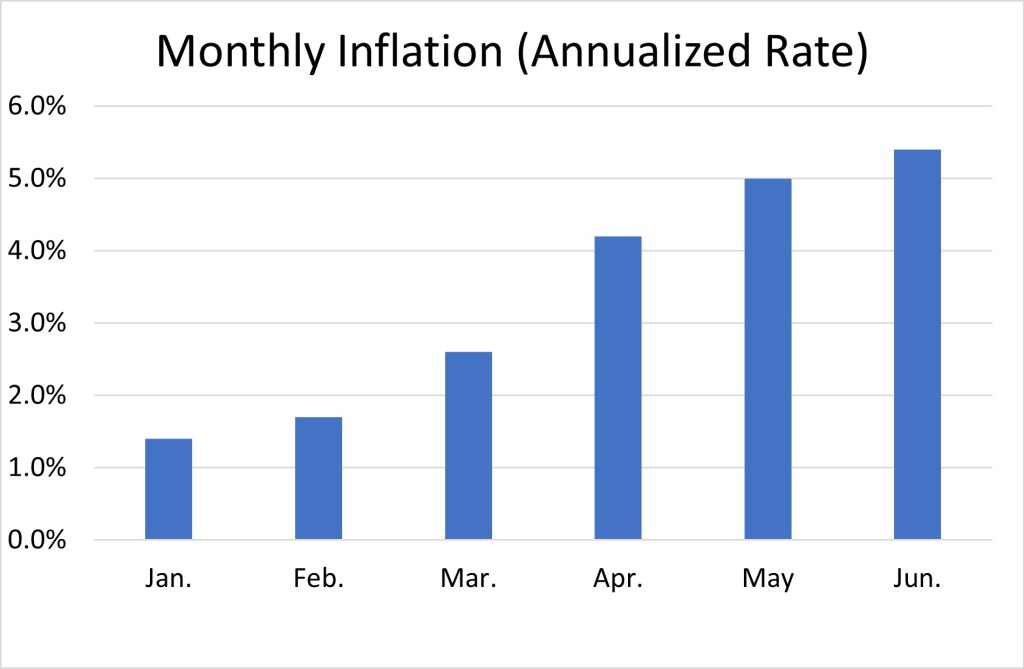
We’ve put together eight charts that help tell this story, starting with the inflation rate.

Even liberal economists were warning that Biden’s spending spree — coming after two historically large stimulus bills under Trump and long after the COVID recession had ended — would set off an inflation spiral. And what do you know? Energy costs, food costs, and the costs of most everything else are climbing at a rapid clip, despite promises from Biden that the current spike is transitory.

inflation-rate-under-biden

While prices are rising, Biden’s unemployment bonuses and other payments to non-workers have kept people from taking jobs. Biden himself all but admitted as much when at a recent town hall, but told employers just to raise their wages. As a result, after falling rapidly under Trump, the unemployment rate has held steady since the beginning of the year.

lb210728cd20210727060246

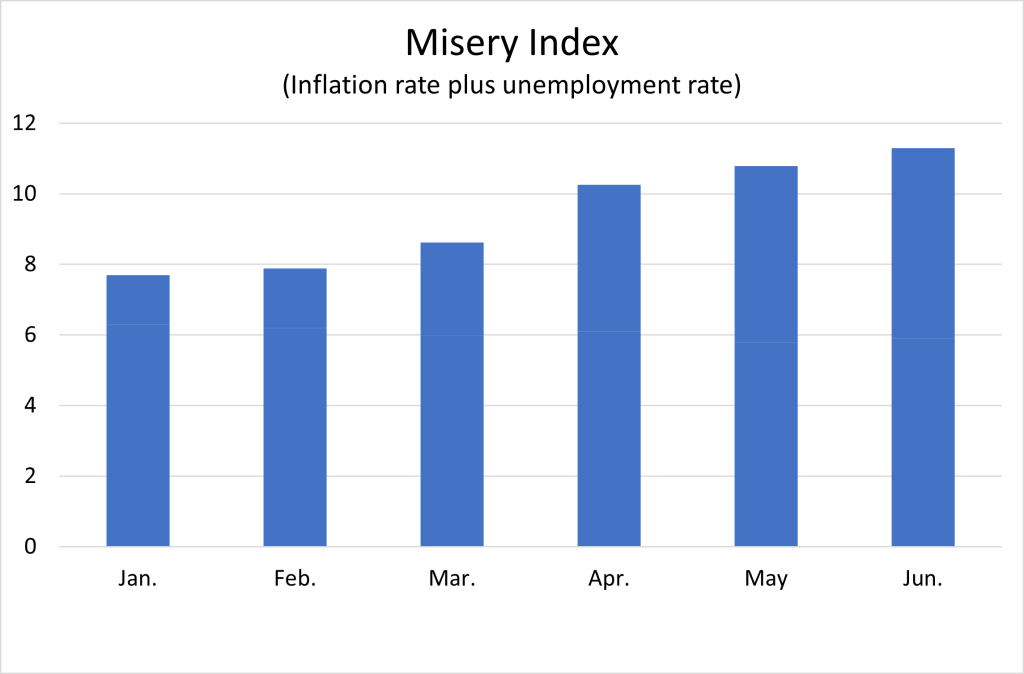
The combination of high unemployment and soaring prices back in the 1960s gave rise to the Misery Index, which is derived simply by adding the inflation rate to the unemployment rate. As we reported recently, the Misery Index has climbed every month since Biden took office.

misery-index-under-biden-1

Despite the fact that the recession ended more than a year ago, and the economy had already made up most of the ground it lost during the lockdown when he took office, Biden talks endlessly about how he’s “rescued” an economy that was “on the brink.” He then rattles off lots of seemingly cheery statistics, crediting his $1.9 trillion “American Rescue Plan” and other government largesse for them all.

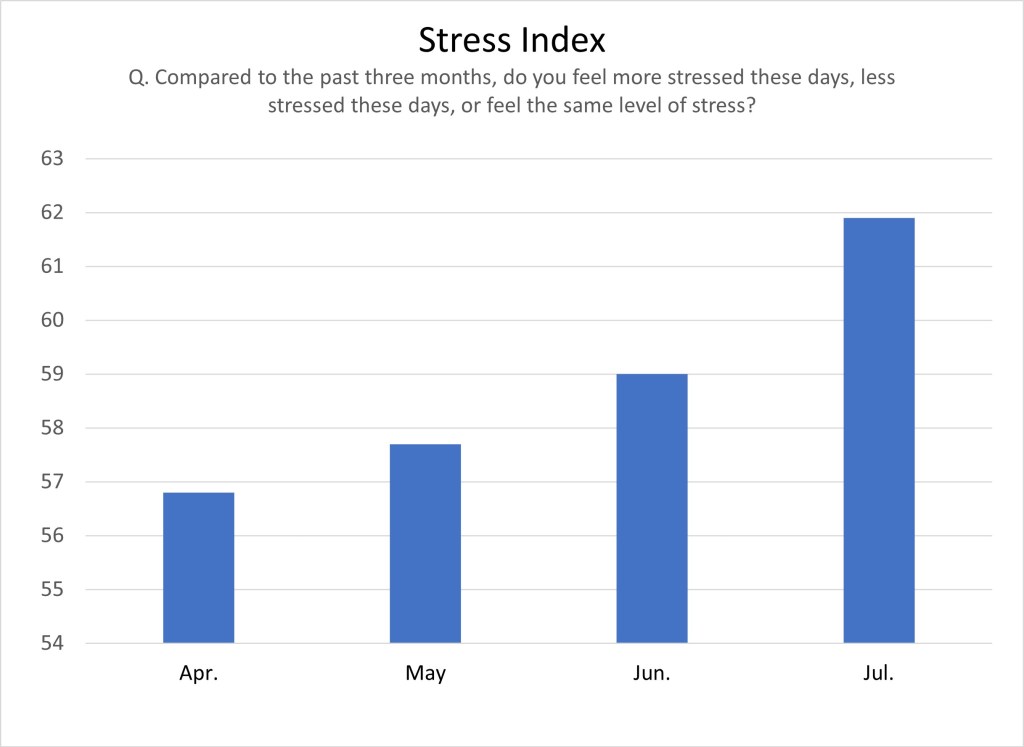
We’ve already detailed how this boast is based on a series of lies. But more to the point, if handing money out willy-nilly was supposed to rescue the economy and make families whole, why are people feeling more financial stress now than they were a few months ago? The IBD/TIPP Financial Stress Index has been on the rise since April.

stress-index-under-biden

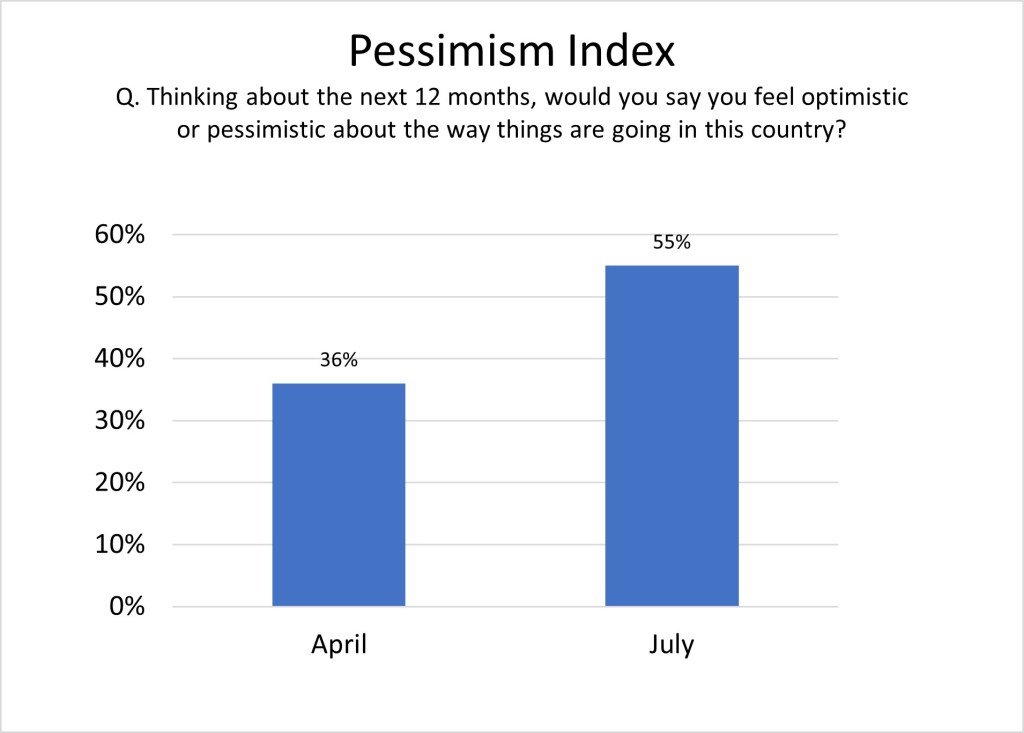
Not only are people worried about their current financial condition, but they are also more pessimistic about their prospects for the coming year. An ABC News/Ipsos poll found pessimism about the way things are going shot up from April to July of this year.

pessimism-index-biden

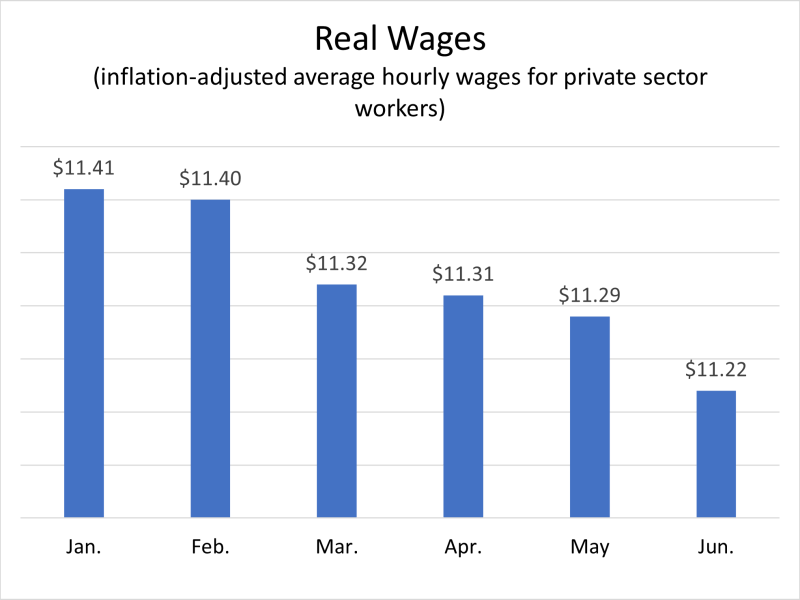
The increase in pessimism and stress could be the result of the fact that wages haven’t been keeping up with inflation. The chart below shows the inflation-adjusted average hourly earnings for private-sector workers so far this year. Notice that this trend is not up.

real-wages-biden

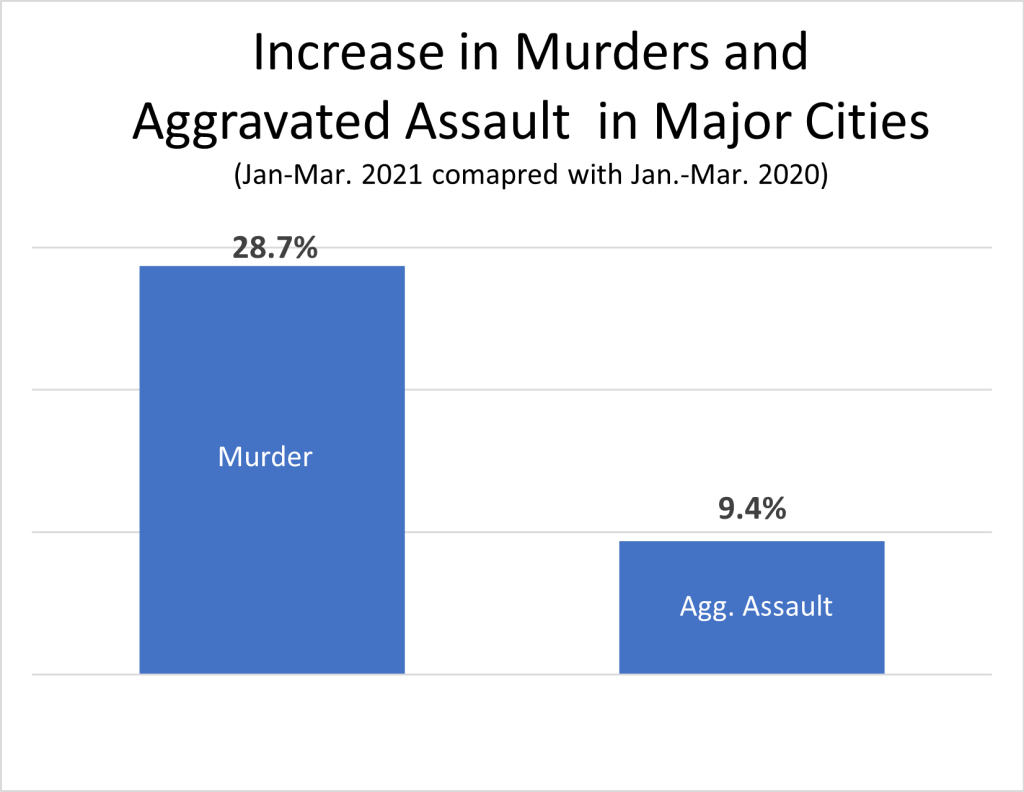
Biden can hardly blame Trump for the sharp rise in violent crime, either, although he and his fellow Democrats keep insisting that it’s all because of insufficiently strict gun control laws. The real cause, of course, has been the demonization of the police by Democrats (up to and including Biden), and the often successful attempts to cut police department funding while hamstringing officers. The result has been a huge increase in murder and assaults in the nation’s major cities.

murders-under-biden

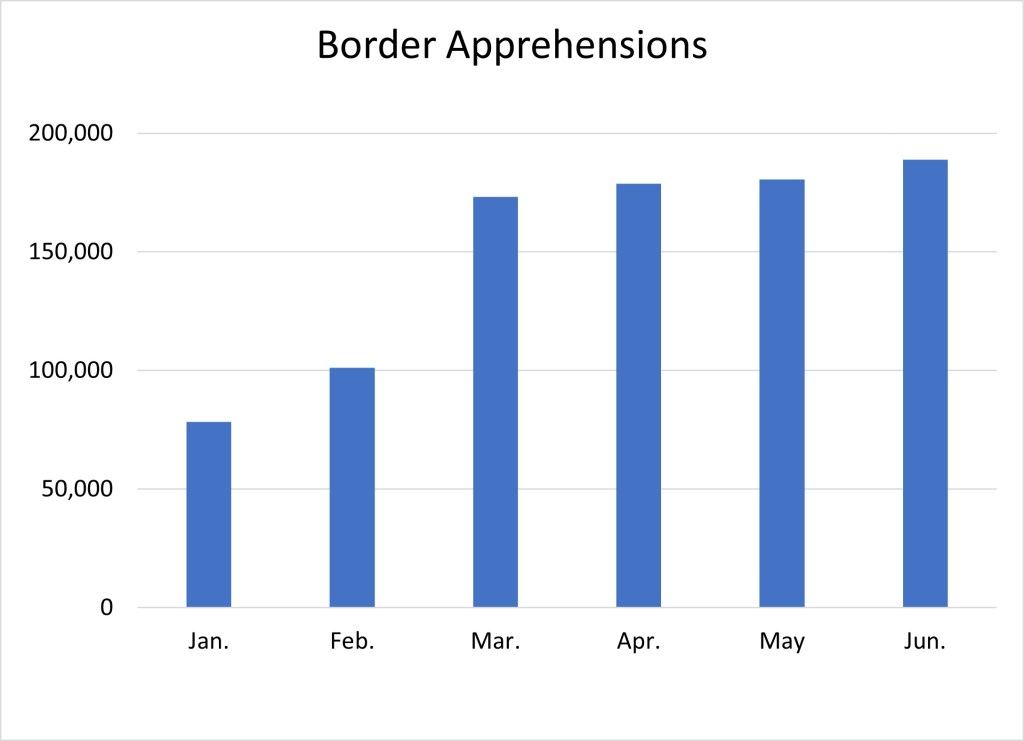
Biden also blames Trump for the crisis at the southern border. But as we’ve written about in this space already, Biden created a crisis where none existed by promising to throw open the border and grant citizenship to millions of people here illegally. Then he put Vice President Kamala Harris in charge of “fixing it,” and started blathering on about “root causes.” The results speak for themselves: an unprecedented flood of illegal immigrants, including unaccompanied children, many of whom are being released into the country.

illegals-under-biden

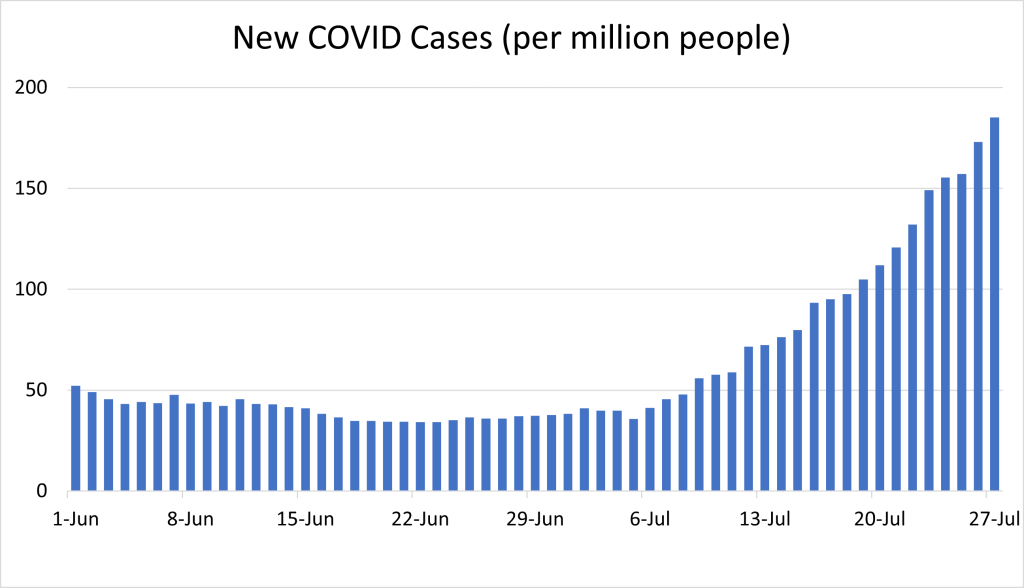
And to top it off, the one thing people apparently trusted Biden to do was tackle the COVID-19 virus. He said he had a plan. He and his fellow Democrats rushed through a massive new spending bill to carry it out. But now vaccination rates have stalled and new cases are growing again thanks to the Delta variant.

Biden and Co. have been busy trying to pin the blame for this on Republicans, but as we reported recently, it’s minority groups and other Democratic constituencies who are least likely to be vaccinated. And, because Biden has spent so much time raising the hysteria level about COVID, he can’t just admit that this virus will be with us forever and tell people to “live with it,” as Trump once (correctly) advised. Instead, he’s pointing fingers and fumbling about with new mask mandates, forced vaccinations, and other draconian measures.

covid-cases-under-biden

It is true that Biden has been in office for only six months. It’s also true things could turn around. But we don’t see that happening unless Biden changes course.

235762

We have no doubt that Biden was very much hoping one day to tell the public how he killed COVID and saved the economy (just as he once bragged that “Osama bin Laden is dead and General Motors is alive” while he and President Barack Obama where in the White House).

The way things are going right now, Biden might one day have to admit that “the economy is dead, but COVID is alive.”

payn_c18393920210723120100

Footnote:  How to Speak Bidenese

Better to do nothing than try to reach UN climate targets

economics-literature-does-not-support-1.5c-climate-goal

Lorrie Goldstein writes a review of a new Fraser Institute study by McKitrick and Murphy.  The study is Off Target: The Economics Literature Does Not Support the 1.5C Climate Ceiling.  Excerpts from Goldstein’s article in italics with my bolds.

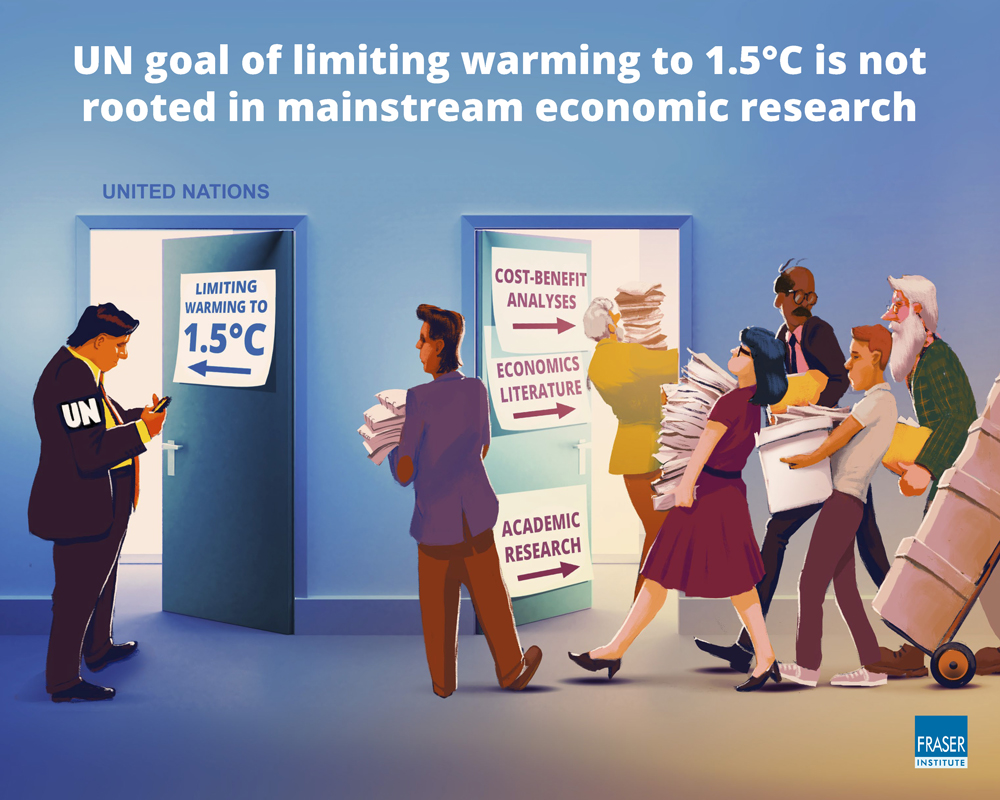
Trying to achieve the United Nations’ target of limiting global temperature increases to 1.5 C above pre-industrial levels will do more social and economic harm than good, says a new study by the Fraser Institute released Tuesday.

“Although advocacy of aggressive climate-change policies is often draped with the mantel of science … the popular 1.5C policy target will pose costs that far exceed the benefits,” the study says.

“Emission reductions flowing from strict adherence to the 1.5C target would be worse for the world than doing nothing at all.”

Study authors Ross McKitrick and Robert P. Murphy argue in Off Target: The Economics Literature Does Not Support the 1.5C Climate Ceiling, that the 1.5C target “did not arise … from formal cost-benefit analysis.”

In fact, a 2018 report by the UN’s Intergovernmental Panel on Climate Change that argued there would be net societal benefits to achieving the 1.5C target — used by Canada and other countries to justify the public cost of lowering greenhouse gas emissions — “expressly stated” it did not do a cost-benefit analysis.

The 2018 UN study, Global Warming of 1.5°C — An IPCC Special Report, said because the calculations were so complex, “standard cost–benefit analyses become difficult to justify and are not used as an assessment tool in this report.”

Instead, the UN report cited a range of studies that have estimated the global cost of carbon pricing (expressed here in current Canadian dollars) to meet the UN’s target of limiting global temperature increases to 1.5C above pre-industrial levels by 2100.

They went from a low of $170 per tonne of emissions, to a high of $6,900 per tonne by 2030; $307 per tonne to $16,300 per tonne by 2050; $527 to $21,955 by 2070 and $865 to $33,873 by 2100.  Given such numbers, Murphy argues in the Fraser report, “it would be better if governments did nothing at all about climate change than to try to achieve the 1.5C target because the costs so outweigh the estimated benefits.

(Prime Minister Justin Trudeau’s current carbon price is $40 per tonne of emissions, rising to $170 per tonne in 2030.)

In the real world, no government is going to impose a carbon tax/price of up to $6,900 per tonne of emissions by 2030 — with more hikes after that — because it would be political and economic suicide.

No one knows what global temperatures are going to be in 2100, nor what the global carbon price on emissions would have to be by then to meet the UN’s target of limiting warming to 1.5C above pre-industrial levels.

What we do know for a fact today is that global emissions are steadily rising. The only exceptions in the modern era occurred in 2008-09 and 2020, when they fell dramatically not because of carbon pricing, but because of global recessions, before resuming their upward climb the following year.

We also know that as of 2021, we are so far behind the UN’s target of reducing emissions to 45% below 2010 levels by 2030, that achieving that goal would require lowering emissions globally by 7.6% annually every year between now and 2030.

And finally, we know that, since almost all goods and services consume fossil fuel energy, a 7.6% annual reduction in emissions every year from now until 2030, would provoke an unprecedented global recession in which the social and economic costs would far outweigh the benefits.

economics-literature-does-not-support-1.5c-climate-ceiling-infographic

Democrats Need Four Illusions to Sleep

man-sleeping-counting-sheep-dream-man-sleeping-sheep-117145178

John Ellis writes at his blog Four Illusions.  Excerpts in italics with my bolds and images.

Illusion #1: Biden is not too old.

People who have been around American politics for a long time know Joe Biden well. The eldest among them have known Joe Biden for nearly five decades. What they will tell you is that he didn’t seem to age during his two terms as vice president. If you look at video of Biden 2016 and Biden 2008, you’re taken by how little he appears to have aged. Biden at 74 seems every bit as alert and physically vigorous as Biden at 66.

That’s no longer the case. Somewhere along the way of the last few years, Biden transitioned from “young old” to “old.” Veteran reporters describe the transition in code. “He’s lost a step or two.” Or: “he’s lost something off his fastball.”

alg072321dapr20210723034504

You’re not supposed to talk about it. If you do, and you’re a Democrat, you’re scolded for aiding and abetting the enemy. If you do, and you’re a Republican or (God forbid) a MAGA voter, you’re a horrible hate-mongerer, trying to overturn the results of a free and fair election (and you probably watch Fox News to boot).

mrz070221dapr20210702054513

The problem is that it’s there for all to see. Pretending not to see it is untenable. It’s a bit like being the first car in a line of cars at a stop light and pretending that the light hasn’t turned green. Eventually, the cars behind you honk.

sk071821dapc20210716084507

Illusion #2: Harris “has what it takes.”

The widely shared assessment of Kamala Harris’s performance (so far) as vice president also comes in code: she’s “not ready for primetime,” she needs to “step up her game,” and “she’s off to a rocky start.” Few if any of the political cognoscenti think she is (a) “presidential timber” and/or (b) capable of winning the 2024 presidential election, should it come to that.

alg070521dapr20210705034505

These two truths — Biden is old, Harris isn’t ready — haunt Democrats and their media allies. When they imagine the 2024 presidential election without Biden or Harris, they notice another truth: there’s no bench. Gavin Newsom? Not. Andrew Cuomo? Not. Tim Kaine? Not. There’s a long list of superb military officers that would be formidable (and admirable) candidates, but the chances of a Democratic Convention nominating, say, Admiral William McRaven, are similar to my chances of buying the winning $1 billion Powerball ticket.

stg070621dapr20210705054507

Illusion #3: Trump is done.

Where in the world did this come from? Wishful thinking explains part of it. Maybe all of it. But it’s clearly not true. The amazing thing is that he’s not done, given his disgraceful post-election conduct and evident disdain for long-established, essential norms of American democracy; “consent of the losers” chief among them. It’s August (almost) and he still maintains that he won an election that he lost. That’s the dictionary definition of “delusional.”

stg071921dapc20210718064517

And yet it hasn’t hurt him. He remains the front-runner for the 2024 GOP presidential nomination. Republican elected officials at the federal, state and local level genuflect at the mention of his name. Would-be rivals for the 2024 nomination pledge their allegiance, and not just to Trump’s “populism” but to Trump personally. And then there’s Fox News.

mrz062321dapr20210623054504

The 2024 Republican presidential nomination campaign will “happen” on Fox News. It will also “happen” on right-wing talk radio and on right-wing websites and in right-wing chat rooms, but Fox will frame the choice; controlling who gets exposure (and in what time slots) and who sets the agenda. Those decisions are driven by one consideration and one consideration only: Does it rate?

Trump rates. The others don’t. End of story.

And lest anyone think that Fox will ignore the ratings, turn on Trump and do what it can to bring to the fore the next generation of GOP leaders, please call me and I will sell you my winning Powerball ticket. For $1 million.

Illusion #4: Trump can’t win.

Can’t win what? The GOP nomination? Really? Want to bet? Who’s going to beat him? Josh Hawley? Marco Rubio? Ron DeSantis? Nikki Haley? Take your pick.

My guess is that none of them will run if Trump announces his candidacy in, say March of 2023. Would you? You’d be signing a political death warrant if you did; forever alienating vast swaths of the Trump coalition by challenging their champion. You’d be asking your major donors to invite Trump’s wrath. You’d be asking Republican elected officials at every level to risk ruin by endorsing your candidacy. It’s a non-starter from the start.

gv062521dapr20210625074502

Well, you say, Trump can’t possibly win the general election, can he? On paper, probably not. Fifty-two percent of the country would eat nails to vote against him.

But as we learn again and again, the national popular vote isn’t evenly distributed across the Electoral College. State-by-state, the Electoral College is almost perfectly distributed to make GOP victories possible, even when the party loses the national popular vote by a substantial margin. (Biden beat Trump by 7 million votes in the 2020 general election.)

mrz062721dapc20210626064506

It’s also the case that Trump enjoys an advantage over, say, Biden (or Harris or any Democrat, for that matter) on “cultural issues.” In the key Electoral College states (like Michigan, Pennsylvania, Wisconsin, to name three) general election voters align more comfortably with Trump’s views on cultural issues; on immigration especially, but also on crime, “defund the police,” the undoing of welfare reform, and the rise of Woke.

That’s enough to make him competitive, but probably not enough to put him over the top. He’s so toxic, he hits a ceiling. And the Democrats (and their media allies) will do everything in their power to make Toxic Trump the issue, above all others. They’ll borrow a line from the Reagan re-election campaign: “Why would we ever want to return to where we were, less than four short years ago?”

cb072021dapr20210720054517

But what happens if Trump is not the issue? What happens if inflation is the issue? That would bring to mind the Carter re-election campaign, the one that ended in a GOP landslide at the state and local level and a 10-point win for Ronald Reagan (who received 50% of the national vote). Inflation destroyed Jimmy Carter’s presidency. It literally kicked him out of office.

What if Larry Summers is right and inflation is ready for launch and will likely take off next year? If Biden Administration policies are seen as the proximate cause of inflation, will “swing voters” view the administration as the best option for bringing inflation back under control? Probably not. Is inflation the kind of issue that can render Trump’s toxicity less salient? Yes it is.

The light is green. Let the honking begin.

afb062221dapr20210622054527

They Worried Us Sick

cfarmafoto1275521

John Tierney writes at City Journal The Panic Pandemic.  

The first part of the article is a refresher on how it happened that all those who talked reasonably in the face of the panic narrative, were silenced and banished from public discourse.  Included are many recognizable names:  John Ioannidis, Jay Bhattacharya, Thomas Benfield, Stefan Baral, Martin Kulldorff, Sunetra Gupta,  and the most reviled heretic, Scott Atlas.  The excerpts below in italics (with my bolds and images) express Tierney’s conclusions to take away from this sorry mess.

Fearmongering from journalists, scientists, and politicians did more harm than the virus.

The United States suffered through two lethal waves of contagion in the past year and a half. The first was a viral pandemic that killed about one in 500 Americans—typically, a person over 75 suffering from other serious conditions. The second, and far more catastrophic, was a moral panic that swept the nation’s guiding institutions.

Instead of keeping calm and carrying on, the American elite flouted the norms of governance, journalism, academic freedom—and, worst of all, science. They misled the public about the origins of the virus and the true risk that it posed. Ignoring their own carefully prepared plans for a pandemic, they claimed unprecedented powers to impose untested strategies, with terrible collateral damage. As evidence of their mistakes mounted, they stifled debate by vilifying dissenters, censoring criticism, and suppressing scientific research.

cb111720dapr20201116084505

One in three people worldwide lost a job or a business during the lockdowns, and half saw their earnings drop, according to a Gallup poll. Children, never at risk from the virus, in many places essentially lost a year of school. The economic and health consequences were felt most acutely among the less affluent in America and in the rest of the world, where the World Bank estimates that more than 100 million have been pushed into extreme poverty.

The leaders responsible for these disasters continue to pretend that their policies worked and assume that they can keep fooling the public. They’ve promised to deploy these strategies again in the future, and they might even succeed in doing so—unless we begin to understand what went wrong.

But neither the plague nor Trump explains the panic. Yes, the virus was deadly, and Trump’s erratic pronouncements contributed to the confusion and partisanship, but the panic was due to two preexisting pathologies that afflicted other countries, too.

The first pathology is what I have called the Crisis Crisis, the incessant state of alarm fomented by journalists and politicians.

It’s a longstanding problem—humanity was supposedly doomed in the last century by the “population crisis” and the “energy crisis”—that has dramatically worsened with the cable and digital competition for ratings, clicks, and retweets. To keep audiences frightened around the clock, journalists seek out Cassandras with their own incentives for fearmongering: politicians, bureaucrats, activists, academics, and assorted experts who gain publicity, prestige, funding, and power during a crisis.

lb210717c20210716065818

Unlike many proclaimed crises, an epidemic is a genuine threat, but the crisis industry can’t resist exaggerating the danger, and doomsaying is rarely penalized. Early in the 1980s AIDS epidemic, the New York Times reported the terrifying possibility that the virus could spread to children through “routine close contact”—quoting from a study by Anthony Fauci. Life magazine wildly exaggerated the number of infections in a cover story, headlined “Now No One Is Safe from AIDS.” It cited a study by Robert Redfield, the future leader of the CDC during the Covid pandemic, predicting that AIDS would soon spread as rapidly among heterosexuals as among homosexuals. Both scientists were absolutely wrong, of course, but the false alarms didn’t harm their careers or their credibility.

Journalists and politicians extend professional courtesy to fellow crisis-mongers by ignoring their mistakes, such as the previous predictions by Neil Ferguson. His team at Imperial College projected up to 65,000 deaths in the United Kingdom from swine flu and 200 million deaths worldwide from bird flu. The death toll each time was in the hundreds, but never mind: when Ferguson’s team projected millions of American deaths from Covid, that was considered reason enough to follow its recommendation for extended lockdowns. And when the modelers’ assumption about the fatality rate proved too high, that mistake was ignored, too.

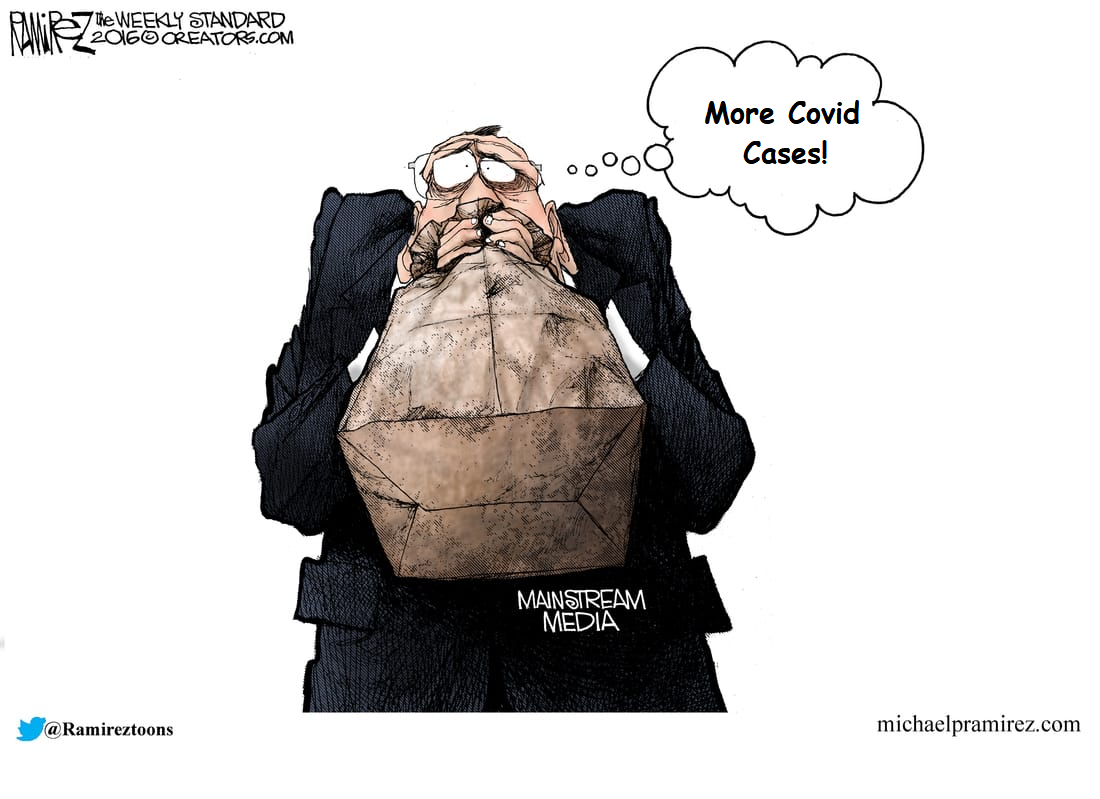
More Covid Cases

Journalists kept highlighting the most alarming warnings, presented without context. They needed to keep their audience scared, and they succeeded. For Americans under 70, the probability of surviving a Covid infection was about 99.9 percent, but fear of the virus was higher among the young than among the elderly, and polls showed that people of all ages vastly overestimated the risk of being hospitalized or dying.

The second pathology underlying the elite’s Covid panic is the politicization of research—what I have termed the Left’s war on science, another long-standing problem that has gotten much worse.

Just as the progressives a century ago yearned for a nation directed by “expert social engineers”—scientific high priests unconstrained by voters and public opinion—today’s progressives want sweeping new powers for politicians and bureaucrats who “believe in science,” meaning that they use the Left’s version of science to justify their edicts. Now that so many elite institutions are political monocultures, progressives have more power than ever to enforce groupthink and suppress debate. Well before the pandemic, they had mastered the tactics for demonizing and silencing scientists whose findings challenged progressive orthodoxy on issues such as IQ, sex differences, race, family structure, transgenderism, and climate change.

lb210708c20210707102628

And then along came Covid—“God’s gift to the Left,” in Jane Fonda’s words. Exaggerating the danger and deflecting blame from China to Trump offered not only short-term political benefits, damaging his reelection prospects, but also an extraordinary opportunity to empower social engineers in Washington and state capitals. Early in the pandemic, Fauci expressed doubt that it was politically possible to lock down American cities, but he underestimated the effectiveness of the crisis industry’s scaremongering. Americans were so frightened that they surrendered their freedoms to work, study, worship, dine, play, socialize, or even leave their homes. Progressives celebrated this “paradigm shift,” calling it a “blueprint” for dealing with climate change.

This experience should be a lesson in what not to do, and whom not to trust.

Do not assume that the media’s version of a crisis resembles reality. Do not count on mainstream journalists and their favorite doomsayers to put risks in perspective. Do not expect those who follow “the science” to know what they’re talking about. Science is a process of discovery and debate, not a faith to profess or a dogma to live by. It provides a description of the world, not a prescription for public policy, and specialists in one discipline do not have the knowledge or perspective to guide society. They’re biased by their own narrow focus and self-interest. Fauci and Deborah Birx, the physician who allied with him against Atlas on the White House task force, had to answer for the daily Covid death toll—that ever-present chyron at the bottom of the television screen—so they focused on one disease instead of the collateral damage of their panic-driven policies.

cg60a31a950a20d

“The Fauci-Birx lockdowns were a sinful, unconscionable, heinous mistake, and they will never admit they were wrong,” Atlas says. Neither will the journalists and politicians who panicked along with them. They’re still portraying lockdowns as not just a success but also a precedent—proof that Americans can sacrifice for the common good when directed by wise scientists and benevolent autocrats. But the sacrifice did far more harm than good, and the burden was not shared equally. The brunt was borne by the most vulnerable in America and the poorest countries of the world. Students from disadvantaged families suffered the most from school closures, and children everywhere spent a year wearing masks solely to assuage the neurotic fears of adults. The less educated lost jobs so that professionals at minimal risk could feel safer as they kept working at home on their laptops. Silicon Valley (and its censors) prospered from lockdowns that bankrupted local businesses.

cb020621dapc20210206014624

Luminaries united on Zoom and YouTube to assure the public that “we’re all in this together.” But we weren’t. When the panic infected the nation’s elite—the modern gentry who profess such concern for the downtrodden—it turned out that they weren’t so different from aristocrats of the past. They were in it for themselves.

gv070821dapr20210708054514


Gruesome Climate Crisis Talk at Davos

the-great-reset-by-the-world-economic-forum-prism-ua-world-economic-forum-great-resetMichelle Stirling explains what is terribly wrong about their train of thinking in the video below.  For those who prefer reading a transcript, I have provided one below, in italics with my bolds along with some images.
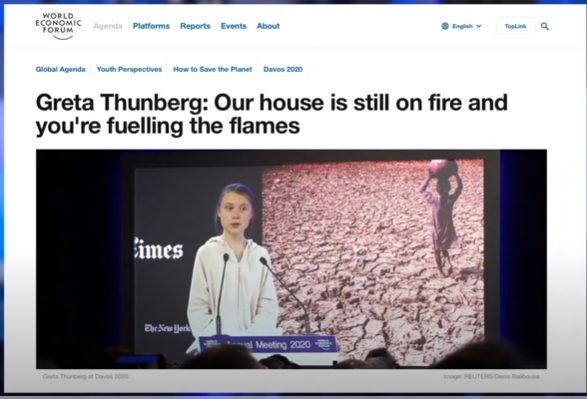

Davos climate crisis talk is disturbing and inaccurate

Hi, I’m Michelle Stirling for Friends of Science Society. I love life, I enjoy this beautiful world and I think being alive is a wonderful gift. That’s why it’s so disturbing to read some of the comments from the recent World Economic Forum in Davos. The conference concluded leaving some commentators concerned about depopulation talk from high profile individuals like Jane Goodall and misinterpreted IPCC SR 1.5 findings by Greta Thunberg, and talk of doomsday battles by Al Gore.

MSfig-2

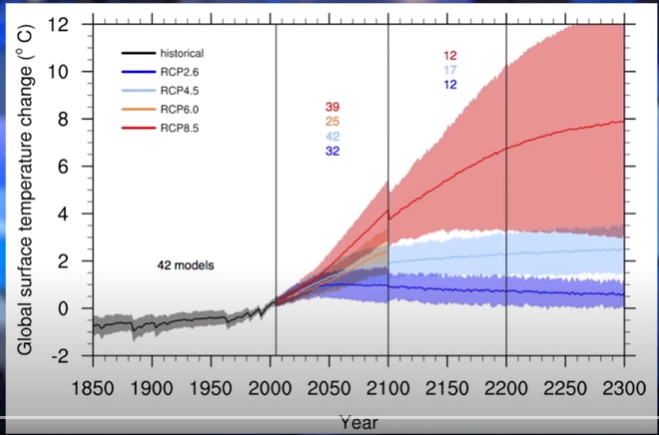
Goodell’s statement shocked many people when she said all these environmental things we talk about wouldn’t be a problem if there was the size of population that there was 500 years ago. The world’s population is estimated to have been about 500 million people then, or 6.7 billion less than today. Depopulation notions stem from apocalyptic climate visions but Roger Pielke jr. explains in a January 2nd, 2020, article in forbes that climate science has been corrupted by the influential risky business report of 2014. This report was funded by green billionaires and proliferated into the media and scientific domains by powerful environmental groups. Pielke jr. says the report misattributes the proposed pathways, focusing on the most extreme scenario called the representative concentrated Pathway 8.5, something that is far from a business-as-usual case relevant to the Davos set of bankers and billionaires.

MSfig0

Mark Carney’s infamous speech to Lloyd’s of London of 2015 breaking the tragedy of the horizon that Also invoked the risky business report that Pielke jr. says has corrupted climate Science. RCP 8.5 is used in an influential graph on page 105 in the IPCC SR 1.5 report that Greta Thunberg refers to in her speeches at Davos. Greta referred to a table on page 108 of theIPCC SR 1.5 report for her crisis comments, but most of the scientific papers referred to in that table were published in or before 2013. And in 2013 the IPCC AR 5 report in box 9.2 chapter 9 stated there had been a hiatus in warming since before Kyoto. That’s like 15 years despite a dramatic rise in carbon dioxide concentration from human industry and activity.

MSfig2

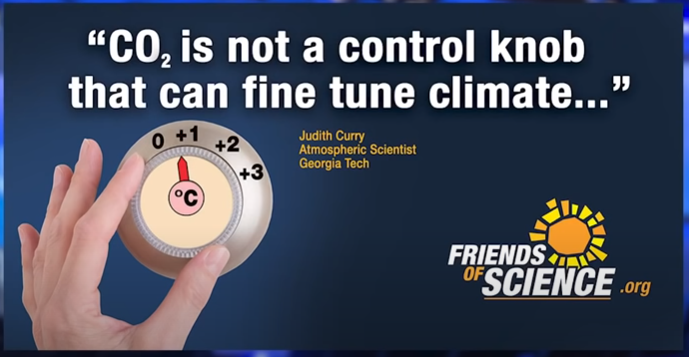
Dr Judith Curry testified to the US Senate on January 16, 2014, that based on that IPCC AR-5 evidence, carbon dioxide is not the control knob that can fine-tune climate. Curry noted that the science of climate change is not settled and evidence reported by the IPCC AR-5 weakens the case for human factors dominating climate change.

Nevertheless well-known climate scientists like professor Katherine Hayhoe continue to present proposed mitigation pathways as she did at the University of Calgary wherein she stated that she considered China to be a leader in climate mitigation.

MSfig1

We are just starting now to curve off the higher scenario if you notice here we’re almost here we’re just starting to curve off the higher scenario. When I say we I actually mean it’s mostly, get this, it’s mostly good in China. China has more wind and solar energy than any other country in the world. And you know I’m not a hundred percent confident in their emission estimates, so keep this with a bit of a grain of salt. But at least what we’re working with in the global level suggests that we’re starting to peel off the higher scenario, but not fast enough to get down to a lower scenario or meet the pair of targets. That’s absurd: a month of China’s emissions equal a whole year of emissions by Canada.

MSfig3

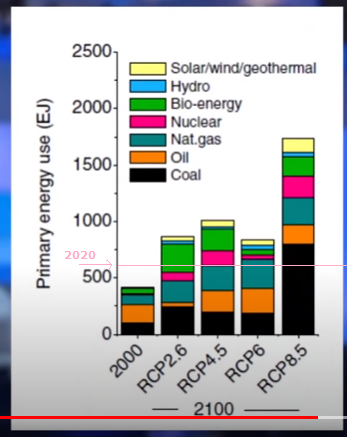
World Primary Energy consumed in 2020 was 567 Exajoules (BP Statistics)

Hayhoe advocated for rapid decarbonization referring to the RCP 8.5 versus a lower RCP. But a chart from the original report from Van Viren et al shows that no RCP scenario is fossil fuel free, debunking the notion that net zero 2050 should even be part of public policy or that rapid decarbonization is necessary. Roger Pielke jr. says these RCP models cannot be compared to each other, and even the RCP authors state they’re not meant to be used in this way. For instance all the RCP pathways other than 8.5 represent a world with billions fewer people.

MSfig-1

Another highlight at Davos was Al Gore’s fear-infested closing as noted by Hans Rosling and family in their book Factfulness. In 2009 Rosling met Al Gore who told him then we have to create fear, an approach that that medical doctor and international public health policy expert Rosling rejected. Rosling wrote that fear plus urgency makes for stupid drastic decisions with unpredictable side effects. And contrary to the doom and gloom of Davos, Factfulness shows how the world is improving for all people despite certain inequities, contrary to the doom and gloom of Davos. A decade later Al Gore continues with his apocalyptic approach, and at Davos he claimed the climate crisis was equivalent to historic wars even invoking 9 /11 again.

MSfig4

As Roger Pielke jr. notes in an earlier Forbes article, this is nothing but climate porn and is not supported by the scientific evidence in IPCC reports But fortunately there is a global pushback on this damaging depopulation and doom and gloom fear-mongering. CLINTEL, the climate intelligence organization based in the Netherlands, representing more than 800 global scientists, sent a letter to the World Economic Forum stating there’s no climate emergency and insisting that we do have time.

MSfig6

And pointing out the uncertainties of climate models that Greta and Al Gore use for their apocalyptic statements. A commentary has been posted on CFACT that summarizes the CLINTEL manifesto and Friends of Science Society. We’ve published the CLINTEL document and videos on our blog.

It is deeply disturbing that depopulation talk has become part of mainstream climate policy discussions with even a Quebec politician suggesting that medically assisted suicide could be available to those who want to die to save the planet. We were given this gift of life in a beautiful world, one that has problems, but I believe we are up to the challenge. There’s no climate emergency so let us live with hope and joy.

For Friends of Science Society, I’m Michelle Stirling

MSfig7

My Summary

Clearly, the 1% are fearful of losing their planetary playground because the other 99% of us consume too much.  So they want there to be fewer of us and to constrain our personal mobility and choices.  Not so long ago, Romanians has strict quotas for their daily calorie intake.  Several countries plan to scrap gasoline autos and affordable air travel. This is the driving force behind the Great Reset.  Who knows how this mindset translates into actions on the ground?

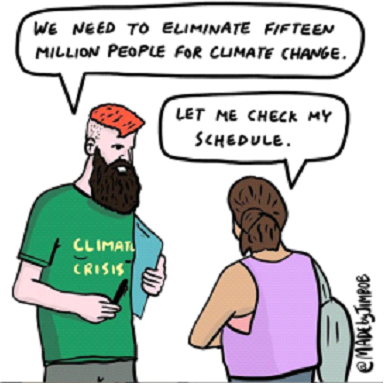
jimbob 15M people

See also Resist the Great Reset

gdundvquwzb21

Systemic Election Malpractice in Maricopa County

On the technical operations of election processing, the audit in Maricopa County, AZ, has provided this overview published at Gateway Pundit Cyber Ninjas Found So Many Issues with the Voting Machines and Processes in Maricopa County It’s a Wonder the Previous Auditors Didn’t Find These Issues Too.  Excerpts in italics with my bolds.

Ben Cotton’s team is auditing the IT-related practices and policies in the 2020 Election in Maricopa County. He shared some important items during his presentation last week that any good IT auditor would find.  We pointed out previously that the Maricopa County Board of Supervisors hired two election firms because they knew these firms would give them a clean bill of health.

But Ben Cotton and his team were selected by the Cyber Ninjas to address the IT work related to Maricopa County’s results in the 2020 Election.  Investigator Cotton from CyFIR performed work that the previous auditors should have covered.

It’s a difficult task for these auditors because Maricopa County has been completely uncooperative, even with basic questions, referring auditors to lawyers.  This all provides more support that the subjects under audit, the auditees, are guilty and doing everything they can to postpone the evaluation.

Dominion has two full-time staff onsite servicing the Maricopa County election system. The current Dominion software was installed in August 2019. Since that date, there have been no antivirus updates, no operating system updates, or any security patches. Administrator accounts were also created on that date, each having the exact same password. These are actions of a ‘worst in class’ IT Department and it is a deliberate subterfuge of an election system.  Common practice is to update patches on a much more regular basis.

Below is a list of items addressed by Cotton during his presentation to the Arizona Senate last Thursday.

  1. Auditors have collected over 2,000 Terabytes of data, the vast majority is video footage.
  2. What Maricopa County has told the public is often drastically different than their response to the legal subpoena.
  3. Maricopa didn’t use a forensically secure process to clone drives. Dates and times were altered by their cloning process.
  4. On March 11th, 2021 someone with Admin access to the (EMS) election management system ran a script that produced 37,646 queries looking for blank passwords. The system has only 8 user accounts. (see below)
  5. Windows Security Event Logs before February 5th, 2021 are missing.
  6. Every election Administrator account, no matter the user, all have the same password.
  7. When the Dominion software was installed in August 2019, Administrative passwords were created, and haven’t been changed since.
  8. The vulnerabilities that exist on the Maricopa election systems would take an average script kiddie less than 10 minutes to gain access to these systems.
  9. Maricopa’s election system uses ibutton key fobs as the 2nd step in logins. Maricopa and Dominion have refused to provide these fobs to auditors. (see below).
  10. It’s become readily apparent there are severe cybersecurity problems with the way the election management system and network was maintained.
  11. We are seeing anonymous logins at the system level that do not follow that pattern of normal Windows behavior.
  12. After both sides agreed on a solution, Maricopa County then refused to release that router data.
  13. Maricopa can’t check the configuration of its own election system without relying on Dominion employees.
  14. The two EAC audits hired by Maricopa earlier in the year appear not to have addressed cybersecurity aspects, not even shared passwords.
  15. Not a single bit of data was changed on any device in the auditor’s possession. Use of a “write block” device prevented this. Images were made bit by bit, then an MD5 hash value was applied. There is no need to purchase new machines.
  16. There have been no antivirus updates, operating system updates, or security patches applied to the election system since August 2019, the date Dominion software was installed.

Maricopa repeatedly told the public the election system did not touch the internet but this was not true. If so the system could not have comingled with other Maricopa County department’s data. To prevent the release of router information, the Board of Supervisors and Sheriff then said election router data DID mingle with critical information from other county departments. By using EAC auditors, Maricopa told the public election machines were safe and secure. They now say those same auditors can’t be hired to test the same machines. This week they approved the purchase of new Dominion machines at $3 million.

The use of ibuttons is unusual for PC logins, and is very old technology. These ibuttons are typically used to verify a location or for access control. For instance, a security guard touches his ibutton to various doors to verify he walked his patrol. In Maricopa County, after you login as an election Admin, you must also use a preprogrammed ibutton to obtain access to the Dominion election system. Maricopa County stated only Dominion staff have the Admin ibuttons and both organizations have refused to help the auditors obtain them.

Overall, the IT-related observations of control practices to date are horrible. In some cases, the County is using old technology. In other cases, the processes are broken or even non-existent. With such as mess, how did the IT election auditors hired by the county not notice them?

A Brief History of the Diversity Industry

screen-shot-2021-07-09-at-12.17.46-am
Heather Mac Donald explains the origins and preoccupations of Diversity, Inclusion and Equity (DIE).  Whoops, I mean Diversity, Equity and Inclusion (DEI)  which is now an academic degree you can acquire.  Her Quillette article is Almost Four Decades After Its Birth, The Diversity Industry Thrives on Its Own Failures.

The diversity business originated in 1984, when R. Roosevelt Thomas, a Harvard business school graduate, founded the American Institute for Managing Diversity at Morehouse College. Corporations had been practicing affirmative action for years, but the women and minorities whom employers had hired to meet equal-opportunity obligations weren’t advancing up the career ladder in acceptable numbers. Thomas came up with a novel explanation. The problem wasn’t that preferentially admitted recruits were underqualified; the problem was that their supervisors didn’t know how to “manage diversity.” It was those supervisors who needed remedial training—lots of it—not the affirmative-action beneficiaries themselves.

Managerial expectations about merit and performance often reflected cultural prejudices, Thomas and the consultants who followed him insisted. “‘Qualifications’ is a code word in the business world with very negative connotations,” a consultant with the professional-services firm of Towers Perrin (as it was then called) said in 1993. If minorities don’t meet existing employment criteria, then corporations need to expand their definition of what it means to be employable, said Alan Richter, creator of the 1991 board game, The Diversity Game. Promptness, precision, and a cogent communications style were among the attributes that diversity advisors deemed likely expendable.

A lucrative new consulting practice was born, its growth driven by a constant churn in terminology. “Valuing diversity” was different from “managing diversity.” Each newly spawned phrase came with a cadre of high-priced tutors. Lewis Griggs currently offers video trainings in such subjects as “Communicating Across Differences,” “Supervising and Managing Differences,” and “Creating, Managing, Valuing, and Leveraging Diversity,” with each video purporting to contain specialized content appropriate for different parts of an organization.

“Diversity” was eventually joined by “inclusion.” “Equity” was then added, thus yielding today’s DEI (Diversity, Equity, and Inclusion) triumvirate (sometimes also going as “EDI”). The most cutting-edge organizations have lately appended a “B” (for Belonging), as at the Juilliard School in New York City. Distinguishing these terms is a core function of diversity training—and now, at Bentley, of diversity scholarship. The university’s new DEI major, the Chronicle of Higher Education reports, will help graduates understand the “nuances of and differences between diversity, equity, inclusion, and justice.”

Even by 1993, half of Fortune 500 companies had a designated diversity officer, and 40 percent of American companies had instituted diversity training. Diversity conferences were occurring regularly, attracting government and business attendees. And yet many reporters, academics, corporate consultants, and activists still insist that managers not only fail to “value diversity,” but remain complicit in creating a dangerous environment for women and racial minorities.

Example: Levi Strauss & Co., which was recognized on Forbes’s list of “Best Employers for Diversity” in 2019. The company itself boasts: “In the 1960s, we integrated our factories a decade before it was required by law. In the early 1980s, we joined the fight against HIV/AIDS early on. Furthermore, our president and CEO, Chip Bergh, was one of the first company leaders to join the CEO Action for Diversity & Inclusion™ [in 2017], and has been on the front lines of efforts to protect Dreamers knowing that diversity and inclusivity makes our company better and our country stronger (after all, Levi Strauss himself was an immigrant).”

And yet the situation for minority employees at Levi Strauss is still so dire that the company has been hosting racially segregated healing sessions with professional mental health experts. As the Washington Free Beacon recently reported, its chief executive for DEI is trying to provide a “safe space for employees to express themselves” without feeling “triggered.”

Bentley University itself has yet to yield dividends from its longstanding diversity efforts. The school has been “working for decades on issues, challenges, and opportunities” pertaining to diversity, according to its Office of Diversity and Inclusion. Over 900 faculty and administrators have attended two-day diversity retreats; numerous committees, departments, and offices have focused on improving the school’s “diversity climate.” Bentley even has its own diversity consulting outfit, the Center for Women and Business, which advises employees and managers on such diversity pitfalls as being a mere “performative ally” of oppressed colleagues (as opposed to an active ally).

And yet, despite this effort, a Bentley Racial Justice Task Force recently found that the campus still did not understand how “race and racism” operate at the university. So difficult is it to be a diverse member of Bentley that the task force, formed in July 2020, began with a moment of “restoration,” providing to all “those who had been traumatized” at the school a “time to heal” and a time to “process the pain of racial injustice.”

One of Bentley’s biggest failings, according to the task force, has been its “false confidence” in “objectivity and meritocracy.” These are the norms of a “historically and predominantly white institution (HWI/PWI),” per the task force members. Typical of HWIs/PWIs, Bentley does not pay sufficient attention to the “systemic inequality” that such white norms engender. Equally dismaying, many students and professors apparently would rather study subjects other than racism, the task force lamented, thereby betraying their “lack of understanding about why the study of race is critical to the creation of a full academic experience.”

Diversity industry proponents would argue that white supremacy is simply too ingrained in America’s institutions to be rooted out within a mere three to four decades of diversity work.

But another possible reason why diversity training has not met its stated goals is that the field is intellectually bankrupt: Its practitioners peddle empty verbiage to fix a problem that is largely imaginary. I asked Bentley’s press office what the difference is between “diversity, equity, and inclusion.” The answer was a dodge: “Rather than give students one particular view of diversity, equity, inclusion and justice, Bentley’s DEI major encourages students to compare and contrast approaches to diversity, equity, inclusion and justice from across disciplines and perspectives and show how they intersect with one another.” Other questions—how the school defines a “real discipline,” what are the core texts of this new discipline, and why Bentley’s decades of diversity work have not lessened the school’s purported racism—were ignored entirely.

Bentley sociologist Gary David says that “more and more studies have shown” that diversity training and DEI perspectives make “good business sense.” But this oft-asserted claim rests on a few studies of dubious experimental design, lacking control groups. The one thing diversity trainees reliably learn is how to answer post-training survey questions “in the way the training said they ‘should,’” reports sociologist Musa al-Gharbi. As for actually changing behaviors in a diversity-approved direction, the training is not only ineffective, it is often counterproductive, according to al-Gharbi.

race-card

Far from being institutionally racist, Bentley University, like virtually every other American college today, is filled with well-meaning adults who want all their students to succeed. Corporations, law firms, Big Tech, and government agencies are bending over backwards to hire and promote as many underrepresented minorities (i.e., blacks and Hispanics) as possible. If the number of those minorities in a college or business organization is not proportional to their population share, that underrepresentation is due first and foremost to the academic skills gap. Mention of the skills gap is taboo in diversity circles, but it is real—repeatedly documented by the National Assessment of Educational Progress exams, the SAT, the LSAT, the GREs, the GMAT, and the MCAT—and it is consequential.

Hiring based on any extraneous selection criterion inevitably lowers the average qualifications of the resulting employee group. Hiring based on race entails a particularly significant deviation from a meritocratic ideal, since the only reason why color-conscious hiring is implemented in the first place is that merit hiring often fails to produce a critical mass of black and Hispanic employees. In essence, the diversity conceit is a perpetual motion machine: If underqualified diversity hires are promoted out of diversity pressure, resentment and obfuscation follow. If they hit a glass ceiling, accusations of bias are inevitable. In either situation, a diversity consultant is waiting in the wings to teach managers that their expectations and standards are racist.

The increasing power of college diversity bureaucrats over academic affairs since the 1990s has been stunning. Diversity vice-chancellors oversee faculty hiring searches, mandate quotas regarding whom search committees may interview, and sometimes even mandate quotas regarding whom they must hire. Chief inclusion officers track departmental race and sex demographics, pressuring department chairs to correct diversity deficits. Associate provosts for diversity coordinate campaigns for required courses on identity and grievance within the curriculum. Deans of inclusion teach students to recognize their place on the great totem pole of victimization. Vice presidents for equity monitor campus speech, on the lookout for punishable microaggressions. Senior advisors on race and community lead crusades against faculty who have allegedly threatened the safety of campus victim groups through non-orthodox statements regarding race and sex.

Now that the fictions underpinning this enterprise are being enshrined as an academic discipline, the possibility that the university will return to its status as an institution dedicated to the unfettered search for knowledge—and even, dare one say it, objectivity and meritocracy—will grow yet more remote.

university lightening