About Canadian Warming: Just the Facts

Just in time for the Trudeau carbon tax taking effect, we have all the media trumpeting “Canada Warming Twice as Fast as Global Rate–Effectively Irreversible.”  That was written by some urban-dwelling climate illiterates who are woefully misinformed.  Let’s help them out with some facts surprising to people who don’t get out much.  Unfortunately ignored this week was an informative CBC publication that could have spared us “fake news” spewing across the land, from Bonavista to Vancouuver Island, as the song says.

Surprising Facts About Canada are presented in a CBC series 10 Strange Facts About Canada’s Climate  Excerpts below provide highlights in italics with my bolds.

Through blistering cold winters to hot muggy summers; torrential rain, blinding snowstorms, deadly tornados and scorching drought, Canadians experience some of the planet’s most diverse weather systems.  [ Uh oh, averaging all of that could be a problem]

Canada is as tall as it is wide, creating a wide range of climate conditions.

Canada has the largest latitude range of any country on the planet. Our southern border lies at the same latitude as northern California, while our northern edge reaches right to the top of the world. It’s rarely the same season in the same place at the same time. In early April, the Arctic may still be in the throes of a frigid winter, while the south can experience summer-like temperatures. No doubt, our weather forecasters are the busiest in the world!

Canada has an ‘iceberg alley’.

Pieces of glaciers from the coast of Greenland are picked up by the Labrador Current, a counter-clockwise vortex of waters in the North Atlantic Ocean. Those broken pieces become icebergs that float in the sea off northeast Newfoundland where Fogo Island lies. Navigating the area is risky for ships; in fact this is where the mighty Titanic sank in 1912. But it’s a boon to tourism. Iceberg seekers flock to the area to watch (safely) from the shore and boast about drinking 10,000-year-old fresh water taken from an iceberg floating in the ocean.

Cold Weather Niagara Falls

Niagra Falls (the Canadian side)

Canada is (really) cold.

It’s certainly not surprising to most Canadians that we are tied with Russia for the title of ‘coldest nation in the world.’ Over our vast country, we have an average daily temperature of -5.6C. This is deadly cold. More of us — about 108 — die from exposure to extreme cold than from any other natural event. And that’s not counting Canadian wildlife who are more susceptible to Canada’s icy climate than we are.

Calgary Golfer February 9, 2016.

Every winter, southern Alberta is the ‘Chinook’ capital.

For six months — from November to May — warm dry winds rush down the slope of the Rocky Mountains towards southern Alberta. Often moving at hurricane-force speeds of 120 km per hour, they can bring astonishing temperature changes and melt ice within a couple of hours. In 1962 Pincher Creek saw a record temperature rise of 41C, from -19 to 22 in just one hour. Chinook is also known as the ‘ice-eater’ among locals who appreciate the break from winter that the winds provide.

Newfoundland is the foggiest place in the world.

At the Grand Banks off Newfoundland, the cold water from the Labrador Current from the north meets the warmer Gulf Stream from the south. The result is a whopping 206 days of fog a year. In the summer, it’s foggy 84 per cent of the time! It’s also the richest fishery in the world, the fog is a serious hazard to ships in the region.

View of the Haughton-Mars Project Research Station (HMPRS) on Devon Island, Nunavut, Arctic Canada

Canada’s North is actually a desert

Canada’s North is very cold and dry with very little precipitation, ranging from 10-20 cm a year. Temperatures average below freezing most of the year. Together, they limit the diversity of plants and animals found in the North. And it’s huge: this polar desert covers one seventh of Canada’s total land mass.

In 1816, Canada didn’t have a summer.

If winter in Canada weren’t bad enough, in 1816 the country’s eastern population were sledding in June and thawing water cisterns in July. Trees shed their leaves and there were reports of migratory birds dropping dead in the streets.

Over in Europe, the weird weather stoked anti-American sentiment. People opposed to emigration said that North America was inhospitable and getting colder every year.

Representation of Mount Tambora 1815 eruption in Indonesia.

Ironically, as eastern Canada stayed cool, the Arctic warmed, creating flotillas of icebergs off the coasts of Nova Scotia and Newfoundland. At the time, it was thought that the icebergs were the cause of the cooling, like a giant glass of iced lemonade. What was the real reason? In 1815, the Tambora volcano erupted in Indonesia, spewing tonnes of ash and dust into the air. Less sunlight reached the earth and this caused the planet’s surface to cool. The volcanic eruption changed the climate in different ways around the world, but Eastern Canadians were treated to the summer that just didn’t come.

The Prairies face brutal temperature extremes.

It’s no surprise that Regina, Saskatchewan — which lies smack in the middle of Canada’s prairies — lays claim to both the country’s lowest recorded temperature, -50C on January 1, 1885 and the highest, 43.3C on July 5, 1937. Without the moderating effects of a large body of water, Canada’s Prairies are vulnerable to some of the worst weather Canada has to offer.

Hopewell Rocks at the Bay of fundy. Photo: gregstokinger

The Bay of Fundy has the largest tides in the world.

Twice each day, 160 billion tonnes of seawater flow in and out of this small area in Nova Scotia — more than the combined flow of the world’s freshwater rivers. The tides reach a peak of 16 metres (as high as a five-storey building) and take about six hours to come in. The most extreme tides in the Bay occur twice each month when the earth, moon and sun are in alignment and together they create a larger-than-usual gravitational pull on the ocean, creating a “spring tide” (not to be confused with the season spring).

Lightning over Lake St. Clair Photo: seebest

Windsor is the thunderstorm capital of Canada.

Hot, humid air from the Gulf of Mexico funnels up through Windsor and the Western Basin of Lake Erie creating the perfect conditions for thunderstorms. About 251 lightning flashes per 100 square kilometres happen every year when small pieces of frozen raindrops collide within thunderclouds. The clouds fill with electrical charges that are eventually funnelled to the ground as lightning.

Summary

With all that going on, all the variety of temperature, precipitation, weather events and seasonalities, no one noticed it had warmed much, and would be grateful if it had.  With all the alarms sounding about the Arctic meltdown in the last decades, let’s consider the best long-service stations in the far north.

According to the “leaked report”, Canada’s annual average temperature over land has warmed 1.7 C when looking at the data since 1948. But that claim is misleading when recent data is considered.

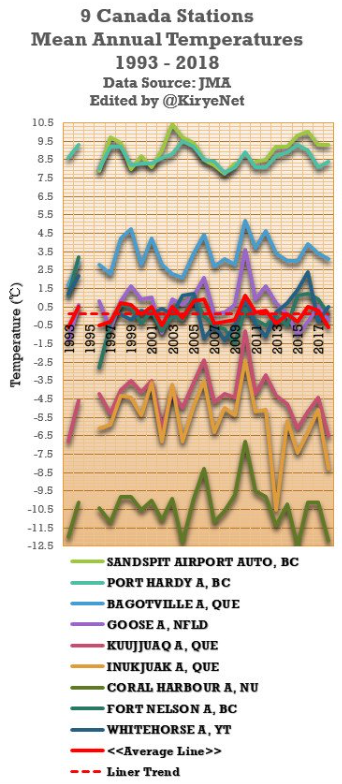
Over the past 25 years, since scientists began to warn that the planet was warming in earnest, there has not been any warming when one looks at the untampered data provided by the Japan meteorology Agency (JMA) that were measured by 9 different stations across Canada. These 9 stations have the data dating back to around 1983 or 1986, so I used their datasats.

Looking at the JMA database and plotting the stations with longer term recording, we have the following chart:

Though temperatures over Canada no doubt have risen over the past century, there has not been any real warming in over 25 years. Rather, there’s been slight cooling, though not statistically significant. Clearly there hasn’t been any Canadian warming recently.

So it is misleading — to say the least — to give the impression that Canada warming has been accelerating. Thanks to Kirye for posting this at No Tricks Zone

See also Cold Summer in Nunavut

N. Atlantic Starts Cold in 2019

RAPID Array measuring North Atlantic SSTs.

Update April 10, 2019  March AMO Results now available and included in Decadal graph below.

For the last few years, observers have been speculating about when the North Atlantic will start the next phase shift from warm to cold. Given the way 2018 went, this may be the onset.  First some background.

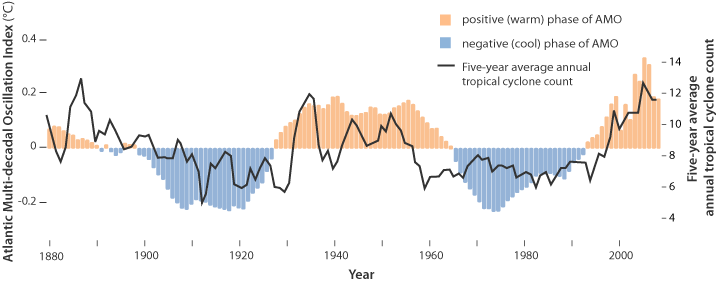
Source: Energy and Education Canada

An example is this report in May 2015 The Atlantic is entering a cool phase that will change the world’s weather by Gerald McCarthy and Evan Haigh of the RAPID Atlantic monitoring project. Excerpts in italics with my bolds.

This is known as the Atlantic Multidecadal Oscillation (AMO), and the transition between its positive and negative phases can be very rapid. For example, Atlantic temperatures declined by 0.1ºC per decade from the 1940s to the 1970s. By comparison, global surface warming is estimated at 0.5ºC per century – a rate twice as slow.

In many parts of the world, the AMO has been linked with decade-long temperature and rainfall trends. Certainly – and perhaps obviously – the mean temperature of islands downwind of the Atlantic such as Britain and Ireland show almost exactly the same temperature fluctuations as the AMO.

Atlantic oscillations are associated with the frequency of hurricanes and droughts. When the AMO is in the warm phase, there are more hurricanes in the Atlantic and droughts in the US Midwest tend to be more frequent and prolonged. In the Pacific Northwest, a positive AMO leads to more rainfall.

A negative AMO (cooler ocean) is associated with reduced rainfall in the vulnerable Sahel region of Africa. The prolonged negative AMO was associated with the infamous Ethiopian famine in the mid-1980s. In the UK it tends to mean reduced summer rainfall – the mythical “barbeque summer”.Our results show that ocean circulation responds to the first mode of Atlantic atmospheric forcing, the North Atlantic Oscillation, through circulation changes between the subtropical and subpolar gyres – the intergyre region. This a major influence on the wind patterns and the heat transferred between the atmosphere and ocean.

The observations that we do have of the Atlantic overturning circulation over the past ten years show that it is declining. As a result, we expect the AMO is moving to a negative (colder surface waters) phase. This is consistent with observations of temperature in the North Atlantic.

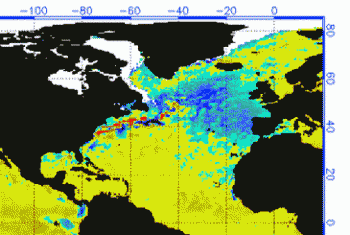
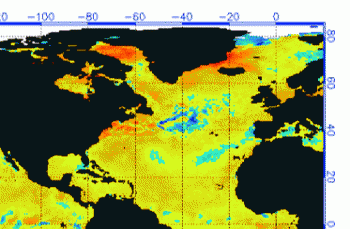
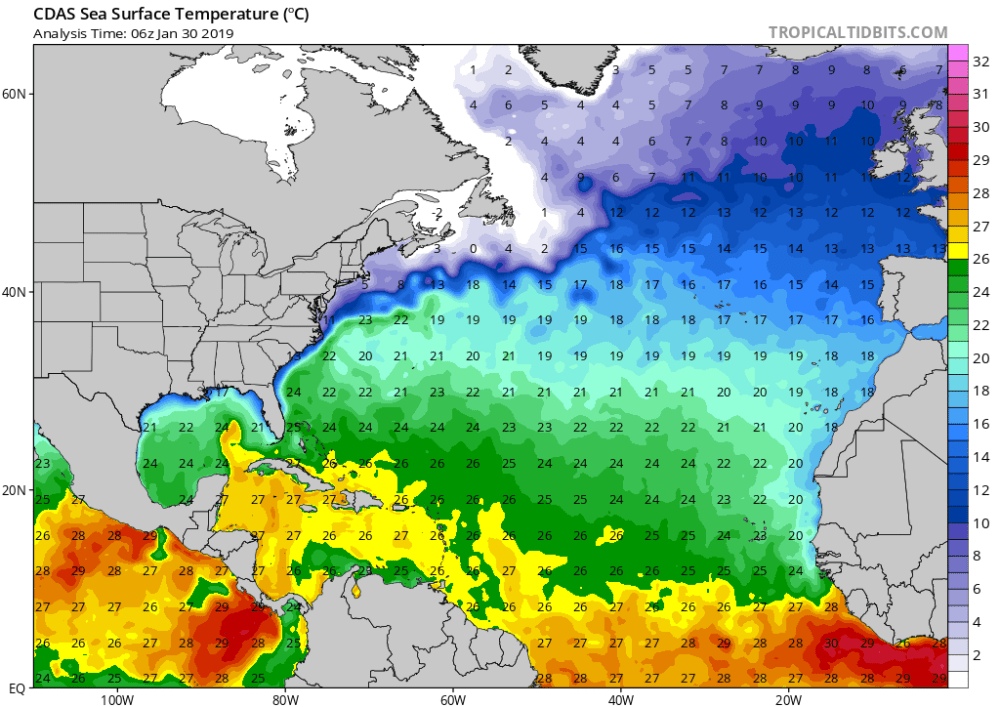
Cold “blobs” in North Atlantic have been reported, but they are usually winter phenomena. For example in April 2016, the sst anomalies looked like this

But by September, the picture changed to this

And we know from Kaplan AMO dataset, that 2016 summer SSTs were right up there with 1998 and 2010 as the highest recorded.

As the graph above suggests, this body of water is also important for tropical cyclones, since warmer water provides more energy.  But those are annual averages, and I am interested in the summer pulses of warm water into the Arctic. As I have noted in my monthly HadSST3 reports, most summers since 2003 there have been warm pulses in the north atlantic.
amo december 2018
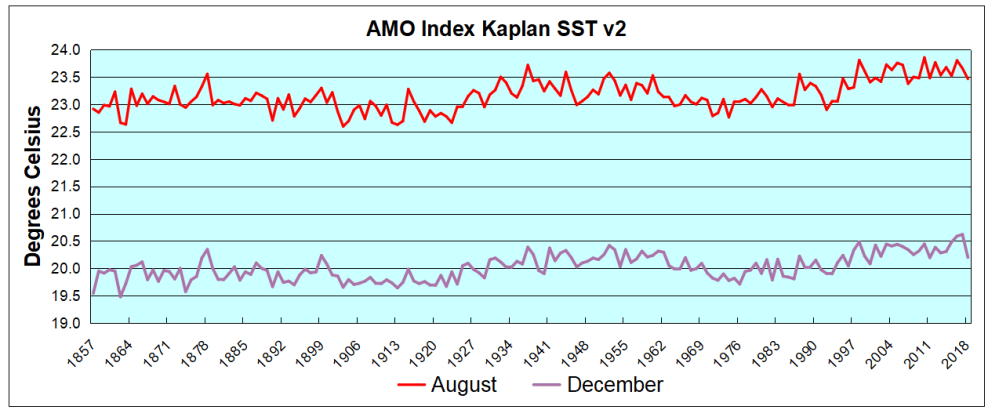
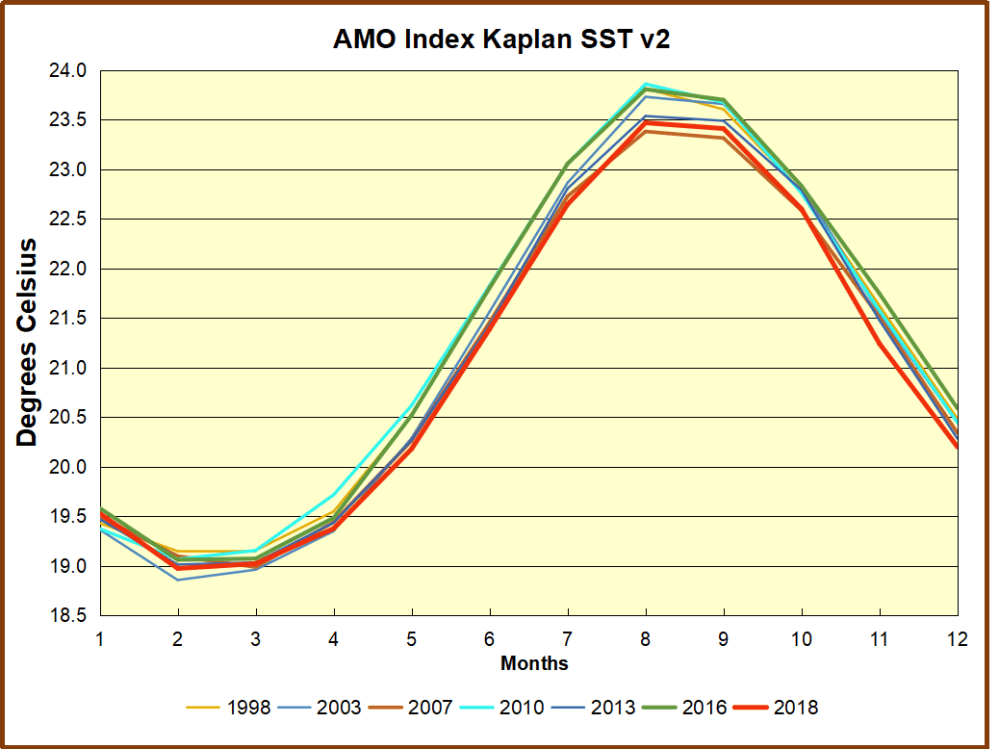
The AMO Index is from from Kaplan SST v2, the unaltered and not detrended dataset. By definition, the data are monthly average SSTs interpolated to a 5×5 grid over the North Atlantic basically 0 to 70N.  The graph shows the warmest month August beginning to rise after 1993 up to 1998, with a series of matching years since.  December 2016 set a record at 20.6C, but note the plunge down to 20.2C for  December 2018, matching 2011 as the coldest years  since 2000.  Because McCarthy refers to hints of cooling to come in the N. Atlantic, let’s take a closer look at some AMO years in the last 2 decades.

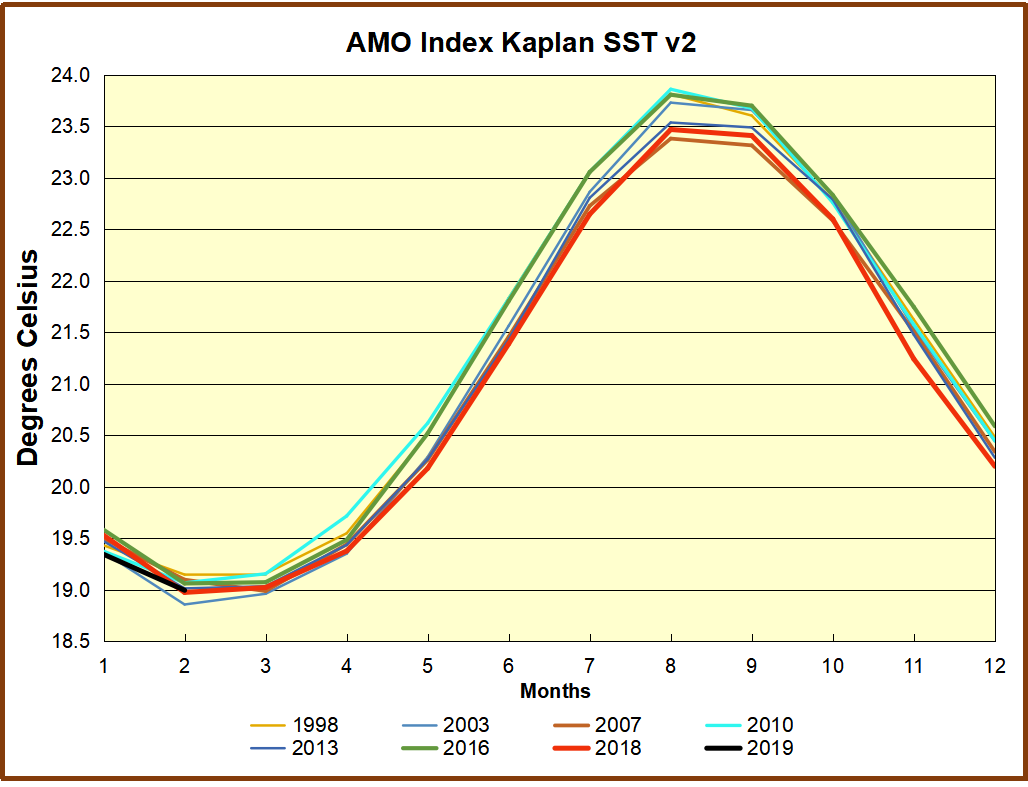
This graph shows monthly AMO temps for some important years. The Peak years were 1998, 2010 and 2016, with the latter emphasized as the most recent. The other years show lesser warming, with 2007 emphasized as the coolest in the last 20 years. Note the red 2018 line is at the bottom of all these tracks.  The short black line shows that 2019 began slightly cooler than January 2018  The February average AMO matched the low SST of the previous year, 0.14C lower than the peak year February 2017. March 2019 is also slightly lower than 2018  and 0.06C lower than peak year March 2016.

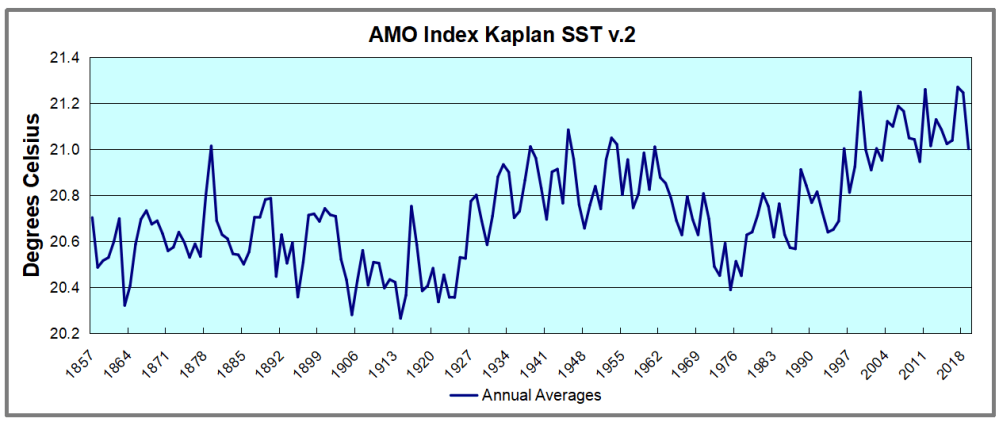
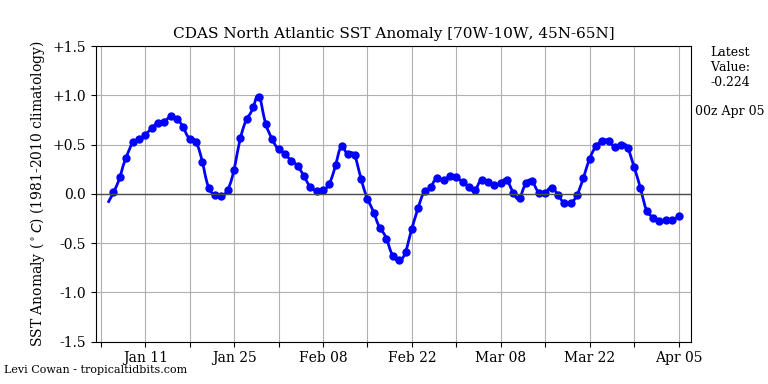
With all the talk of AMOC slowing down and a phase shift in the North Atlantic, it seems the annual average for 2018 confirms that cooling has set in.  Through December the momentum is certainly heading downward, despite the band of warming ocean  that gave rise to European heat waves last summer.

amo annual122018

natlssta

cdas-sflux_sst_atl_1


De Nada Ocean SSTs in February

The best context for understanding decadal temperature changes comes from the world’s sea surface temperatures (SST), for several reasons:

  • The ocean covers 71% of the globe and drives average temperatures;
  • SSTs have a constant water content, (unlike air temperatures), so give a better reading of heat content variations;
  • A major El Nino was the dominant climate feature in recent years.

HadSST is generally regarded as the best of the global SST data sets, and so the temperature story here comes from that source, the latest version being HadSST3.  More on what distinguishes HadSST3 from other SST products at the end.

The Current Context

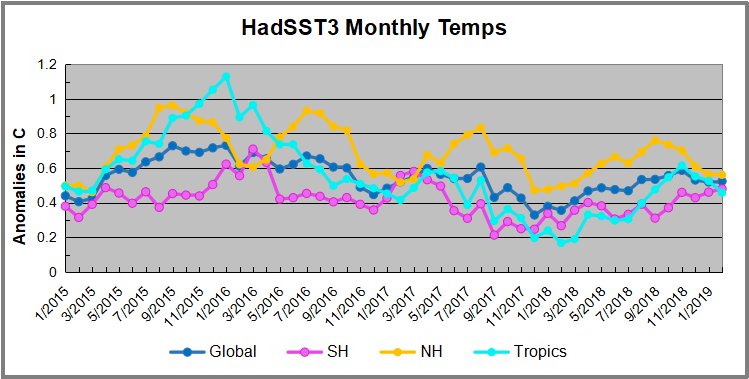
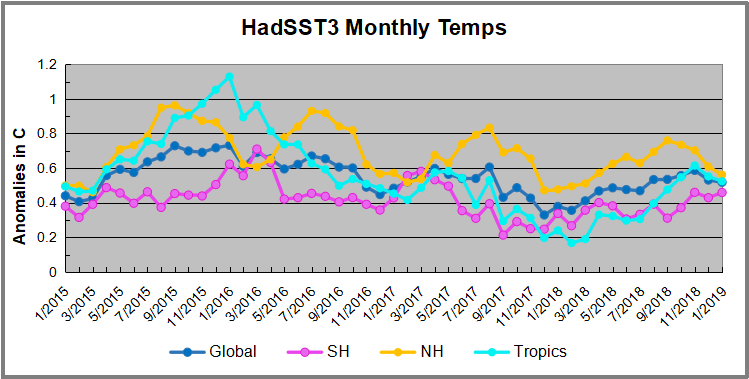
The chart below shows SST monthly anomalies as reported in HadSST3 starting in 2015 through February 2019. For some reason, it took almost a whole month to publish the updated dataset.

A global cooling pattern is seen clearly in the Tropics since its peak in 2016, joined by NH and SH cycling downward since 2016.  2018 started with slow warming after the low point of December 2017, led by steadily rising NH, which peaked in September and cooled since.  The Tropics rose steadily until November, and are now cooling as well.  With a little warming in SH, the Global anomaly is virtually unchanged last month.

All regions are about the same as 02/2017 and 02/2015, but much cooler than 02/2016.  The February Global anomaly is 0.09 lower than 2016;  NH is 0.06 lower, SH is 0.09 lower and the Tropics  are down 0.43, or 50% from 02/2016. The rise in the Tropics had suggested a possible El Nino, but is now cooling down and better described as De Nada.

Note that higher temps in 2015 and 2016 were first of all due to a sharp rise in Tropical SST, beginning in March 2015, peaking in January 2016, and steadily declining back below its beginning level. Secondly, the Northern Hemisphere added three bumps on the shoulders of Tropical warming, with peaks in August of each year.  A fourth NH bump was lower and peaked in September 2018.  Also, note that the global release of heat was not dramatic, due to the Southern Hemisphere offsetting the Northern one.

The annual SSTs for the last five years are as follows:

Annual SSTs Global NH SH  Tropics
2014 0.477 0.617 0.335 0.451
2015 0.592 0.737 0.425 0.717
2016 0.613 0.746 0.486 0.708
2017 0.505 0.650 0.385 0.424
2018 0.480 0.620 0.362 0.369

2018 annual average SSTs across the regions are close to 2014, slightly higher in SH and much lower in the Tropics.  The SST rise from the global ocean was remarkable, peaking in 2016, higher than 2011 by 0.32C.

A longer view of SSTs

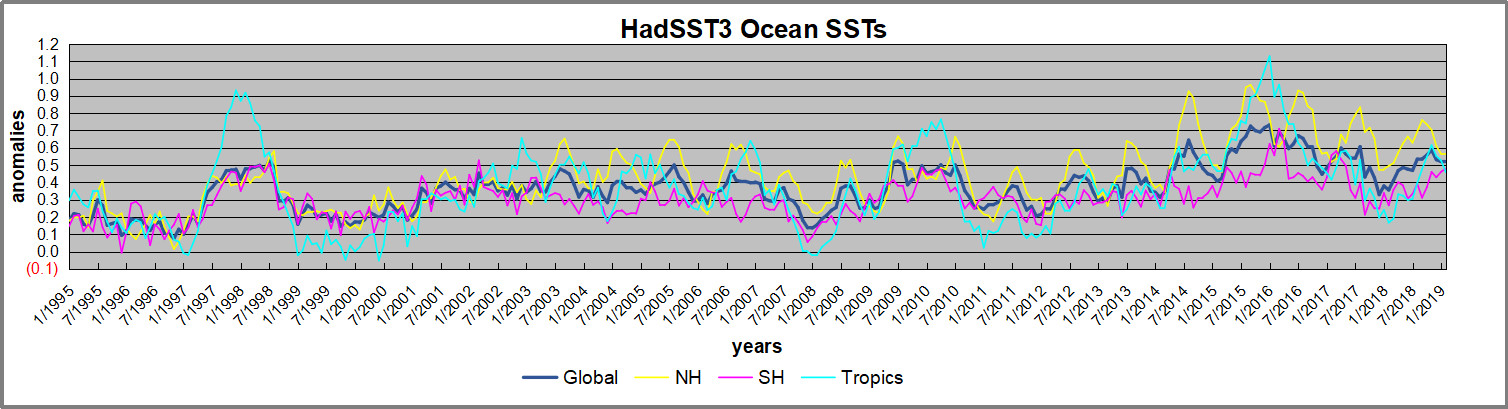
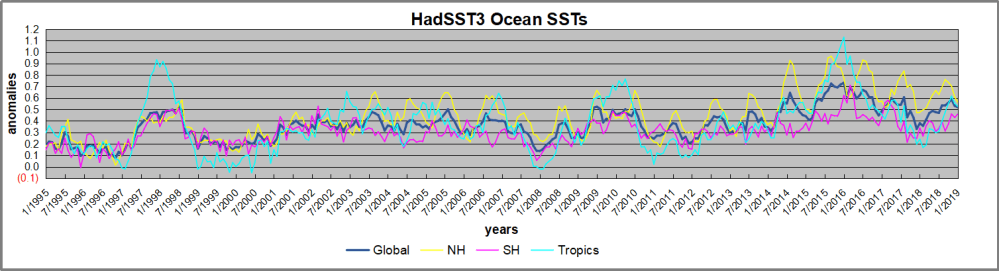
The graph below  is noisy, but the density is needed to see the seasonal patterns in the oceanic fluctuations.  Previous posts focused on the rise and fall of the last El Nino starting in 2015.  This post adds a longer view, encompassing the significant 1998 El Nino and since.  The color schemes are retained for Global, Tropics, NH and SH anomalies.  Despite the longer time frame, I have kept the monthly data (rather than yearly averages) because of interesting shifts between January and July.

Open image in new tab to enlarge.

1995 is a reasonable starting point prior to the first El Nino.  The sharp Tropical rise peaking in 1998 is dominant in the record, starting Jan. ’97 to pull up SSTs uniformly before returning to the same level Jan. ’99.  For the next 2 years, the Tropics stayed down, and the world’s oceans held steady around 0.2C above 1961 to 1990 average.

Then comes a steady rise over two years to a lesser peak Jan. 2003, but again uniformly pulling all oceans up around 0.4C.  Something changes at this point, with more hemispheric divergence than before. Over the 4 years until Jan 2007, the Tropics go through ups and downs, NH a series of ups and SH mostly downs.  As a result the Global average fluctuates around that same 0.4C, which also turns out to be the average for the entire record since 1995.

2007 stands out with a sharp drop in temperatures so that Jan.08 matches the low in Jan. ’99, but starting from a lower high. The oceans all decline as well, until temps build peaking in 2010.

Now again a different pattern appears.  The Tropics cool sharply to Jan 11, then rise steadily for 4 years to Jan 15, at which point the most recent major El Nino takes off.  But this time in contrast to ’97-’99, the Northern Hemisphere produces peaks every summer pulling up the Global average.  In fact, these NH peaks appear every July starting in 2003, growing stronger to produce 3 massive highs in 2014, 15 and 16.  NH July 2017 was only slightly lower, and a fifth NH peak still lower in Sept. 2018.  Note also that starting in 2014 SH plays a moderating role, offsetting the NH warming pulses. (Note: these are high anomalies on top of the highest absolute temps in the NH.)

What to make of all this? The patterns suggest that in addition to El Ninos in the Pacific driving the Tropic SSTs, something else is going on in the NH.  The obvious culprit is the North Atlantic, since I have seen this sort of pulsing before.  After reading some papers by David Dilley, I confirmed his observation of Atlantic pulses into the Arctic every 8 to 10 years.

But the peaks coming nearly every summer in HadSST require a different picture.  Let’s look at August, the hottest month in the North Atlantic from the Kaplan dataset.
AMO August 2018

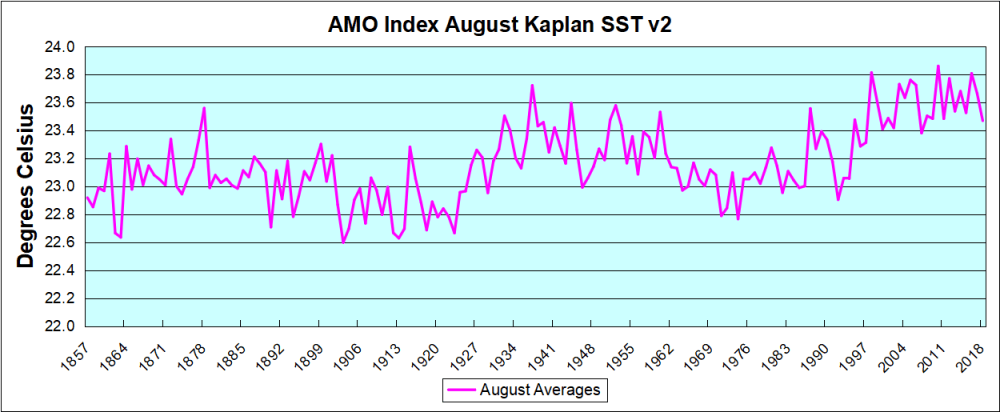
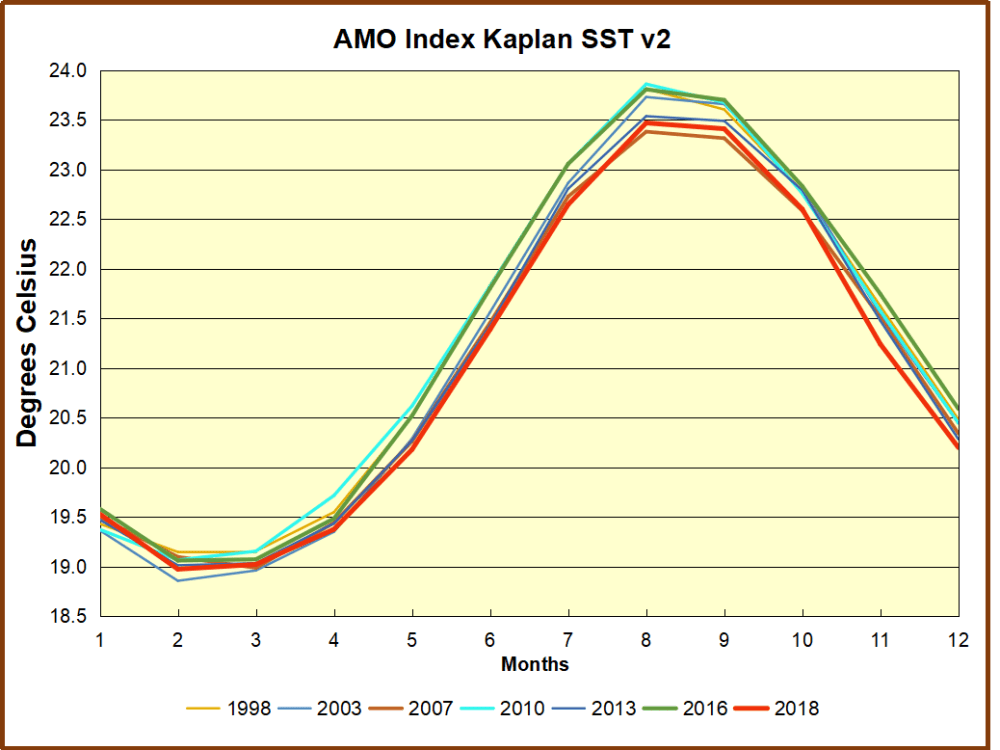
The AMO Index is from from Kaplan SST v2, the unaltered and not detrended dataset. By definition, the data are monthly average SSTs interpolated to a 5×5 grid over the North Atlantic basically 0 to 70N. The graph shows warming began after 1992 up to 1998, with a series of matching years since. Because the N. Atlantic has partnered with the Pacific ENSO recently, let’s take a closer look at some AMO years in the last 2 decades.

This graph shows monthly AMO temps for some important years. The Peak years were 1998, 2010 and 2016, with the latter emphasized as the most recent. The other years show lesser warming, with 2007 emphasized as the coolest in the last 20 years. Note the red 2018 line is at the bottom of all these tracks. The short black line shows that 2019 began slightly cooler than January 2018,  and in February matched the low SST of the previous year.

Summary

The oceans are driving the warming this century.  SSTs took a step up with the 1998 El Nino and have stayed there with help from the North Atlantic, and more recently the Pacific northern “Blob.”  The ocean surfaces are releasing a lot of energy, warming the air, but eventually will have a cooling effect.  The decline after 1937 was rapid by comparison, so one wonders: How long can the oceans keep this up? If the pattern of recent years continues, NH SST anomalies will likely cool in coming months.  Once again, ENSO will probably determine the outcome.

Postscript:

In the most recent GWPF 2017 State of the Climate report, Dr. Humlum made this observation:

“It is instructive to consider the variation of the annual change rate of atmospheric CO2 together with the annual change rates for the global air temperature and global sea surface temperature (Figure 16). All three change rates clearly vary in concert, but with sea surface temperature rates leading the global temperature rates by a few months and atmospheric CO2 rates lagging 11–12 months behind the sea surface temperature rates.”

Footnote: Why Rely on HadSST3

HadSST3 is distinguished from other SST products because HadCRU (Hadley Climatic Research Unit) does not engage in SST interpolation, i.e. infilling estimated anomalies into grid cells lacking sufficient sampling in a given month. From reading the documentation and from queries to Met Office, this is their procedure.

HadSST3 imports data from gridcells containing ocean, excluding land cells. From past records, they have calculated daily and monthly average readings for each grid cell for the period 1961 to 1990. Those temperatures form the baseline from which anomalies are calculated.

In a given month, each gridcell with sufficient sampling is averaged for the month and then the baseline value for that cell and that month is subtracted, resulting in the monthly anomaly for that cell. All cells with monthly anomalies are averaged to produce global, hemispheric and tropical anomalies for the month, based on the cells in those locations. For example, Tropics averages include ocean grid cells lying between latitudes 20N and 20S.

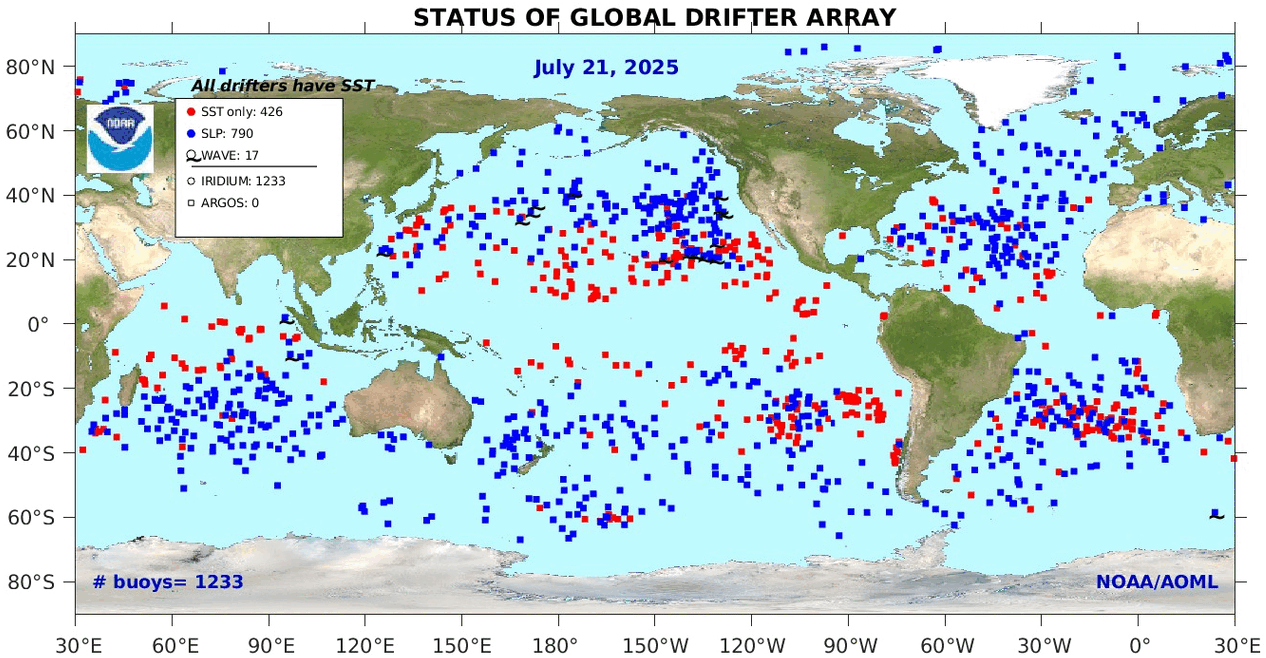
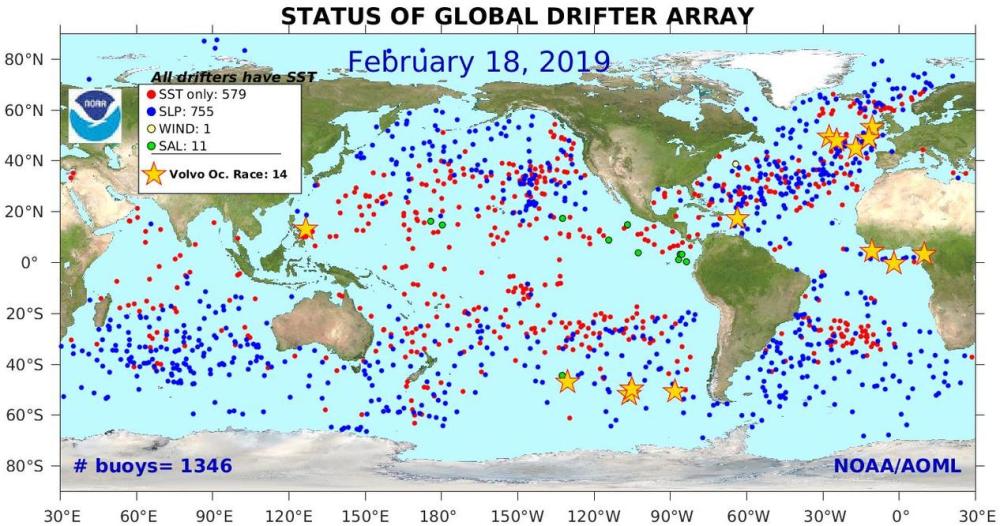
Gridcells lacking sufficient sampling that month are left out of the averaging, and the uncertainty from such missing data is estimated. IMO that is more reasonable than inventing data to infill. And it seems that the Global Drifter Array displayed in the top image is providing more uniform coverage of the oceans than in the past.

uss-pearl-harbor-deploys-global-drifter-buoys-in-pacific-ocean

USS Pearl Harbor deploys Global Drifter Buoys in Pacific Ocean


On Climate “Signal” and Weather “Noise”

Discussions and arguments concerning global warming/climate change often get into the issue of discerning the longer term signal within the shorter term noisy temperature records. The effort to separate natural and human forcings of estimated Global Mean Temperatures reminds of the medieval quest for the Holy Grail. Skeptics of CO2 obsession have also addressed this. For example the graph above from Dr. Syun Akasofu shows a quasi-60 year oscillation on top of a steady rise since the end of the Little Ice Age (LIA). Various other studies have produced similar graphs with the main distinction being alarmists/activists attributing the linear rise to increasing atmospheric CO2 rather than to natural causes (e.g. ocean warming causing the rising CO2).

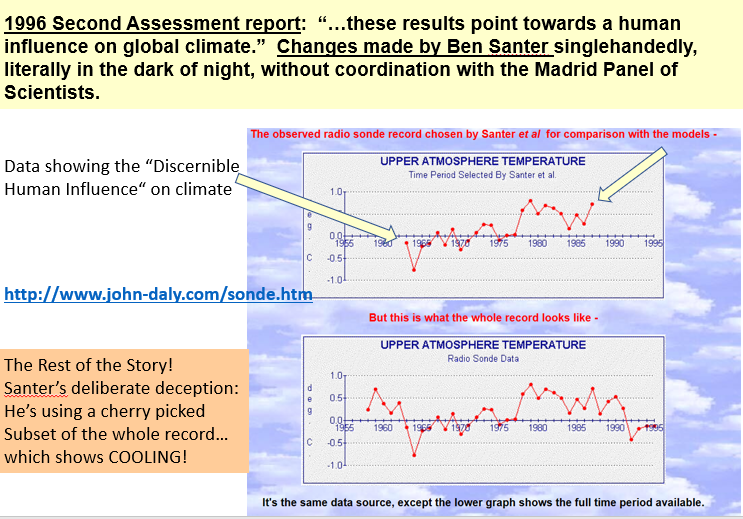
This post features a comment by rappolini from a thread at Climate Etc. and Is worth careful reading. The occasion was Ross McKitrick’s critique of Santer et al. (2019) that claimed 5-sigma certainty proof of human caused global warming. Excerpts from rappolini in italics with my bolds

Ben Santer was searching for a human footprint back in 2011. Apparently, he is still searching.

Most recent global climate models are consistent in depicting a tropical lower troposphere that warms at a rate much faster than that of the surface. Thus, the models would predict that the trend for warming of the troposphere temperature (TT) would be at a higher rate than the surface.

Douglass and Christy (2009) presented the latest tropospheric temperature measurements (at that time) that did not show this warming. (Since then, this continued lack of warming has continued for another ten years without much change, but that is getting ahead of ourselves).

Hence, in keeping with recent practice over the past few years in which alarmistsj promptly publish rebuttals to any papers that slip through their control of which manuscripts get accepted by climate journals, it was necessary for the alarmists to publish such a rebuttal.

Ben Santer took on this responsibility and the result was Santer et al. (2011). It is interesting, perhaps, that Santer included 16 co-authors in addition to himself; yet the nature of the work is such that it is difficult to imagine how 16 individuals could each contribute significant portions to the work. In other words, many names were added to give the paper political endorsement? In fact, when I redid all their work, it took me about one day!


Santer et al. (2011) were concerned with a very basic problem in climatology: how to distinguish between long-term climate change and short-term variable weather in regard to TT measurements? They treated the problem in terms of signal and noise: the signal is assumed to be a long-term linear trend of rising temperatures due increasing greenhouse gas concentrations, that is obfuscated by short-term noise. However, the climate-weather problem is innately different from a classical signal/noise problem such as a radio signal affected by atmospheric activity. In that case, if the radio signal has a sufficiently narrow frequency band, and the noise has a wider frequency spectrum, the signal-to-noise ratio (S/N) can be improved with a narrow-band receiver tuned to the frequency of the radio signal. The radio signal and the noise are separate and distinct. By contrast, in the climate-weather problem, the instantaneous weather is the noise, and the signal is the long-term trend of the noise. The noise and signal are coupled in a unique way. Furthermore, there is no evidence that it is even meaningful to talk about a “trend” since there is no evidence that the variation of TT with time is linear.

Santer et al. (2011) were primarily concerned with estimating how many years of data are necessary to provide a good estimate of the putative underlying linear trend. They were also intent on showing that short periods with no apparent trend do not violate the possibility that over a longer term, the trend is always there. They derived signal-to-noise (S/N) ratios for both the temperature data and the model average by means that are not exactly clear to this writer.

As Santer et al. (2011) showed, one can pick any starting date and any duration length and fit a straight line to that portion of the curve of TT vs. time. They did this for various 10-year and 20-year durations. In each case, depending on the start date, they derived a best straight-line fit to the TT data for that time period. They found that the range of trends for 10-year periods was greater (-0.05 to +0.44°C/decade) than the range for 20-year periods (+0.15 to +0.25°C/decade).

The trend line was steepest for a start date around 1988 (ending in the giant El Niño year of 1998). Prior to 1988 and after 1998, the trends were minimal.

Santer et al. described use of longer durations as “noise reduction”, which it is, provided that one assumes the overall signal is linear in time. It still was problematic that the trend was nil after 1998 that they rationalized by saying:

The relatively small values of overlapping 10-year TT trends during the period 1998 to 2010 are partly due to the fact that this period is bracketed (by chance) by a large El Niño (warm) event in 1997/98, and by several smaller La Niña (cool) events at the end of the … record”.

However, as Pielke pointed out, the period after 1998 was 13 years, not 10, and furthermore, the period after 1998 had roughly equal periods of El Niño and La Niña and was not dominated by La Niñas as Santer et al. claimed. What Santer et al. (2011) implied was that an unusual conflux of a large El Niño early on and multiple La Niñas later on caused the trend to minimize for that unique period as a statistical quirk. However, that is like a baseball pitcher saying that if the opponents hadn’t hit that home run, he would have won the game.

In simplistic terms, the signal-to-noise ratio can be estimated as follows. For either 10-year or 20-year durations, the signal was the mean trend derived by a straight-line fit to the TT data over that duration. The noise was the range of trends for different starting dates. For ten-year durations, the trend was 0.19 ± 0.25°C/decade. For twenty-year durations, the trend was 0.20 ± 0.05°C/decade. The signal in each case is taken as the mean trend. The distribution of trends within these ranges was similar to a normal distribution. Thus, we can roughly estimate the noise as ~ 0.7 times the full width of the range. Hence, the S/N ratio for ten-year durations can be crudely estimated to be S/N ~ 0.19/(0.7  0.5) = 0.5 and for twenty-year durations is S/N ~ 0.2/(0.7  0.1) = 2.9. Santer et al. obtained S/N = 1 for ten-year durations and S/N = 2.9 for twenty-year durations. If it can be assumed that the signal varies linearly with time, one can then estimate what level of precision for the estimated trend can be obtained for any chosen duration. Santer et al. obviously believe that the signal is linear with time for all time. By some logic that escapes me, Santer et al. concluded that

“Our results show that temperature records of at least 17 years in length are required for identifying human effects on global-mean tropospheric temperature”.

This conclusion seems to be grossly exaggerated. A more proper statement might be as follows:

Assuming that the variability of TT is characterized by a long-term upward linear trend caused by human impact on the climate, and that variability about this trend is due to yearly variability of weather, El Niños and La Niñas, and other climatological fluctuations, the recent data suggest that the trend can be estimated for any 17-year period with a S/N ratio of roughly 2.5.

Finally, we get to the nub of the paper by Santer et al. that asserted:

“Claims that minimal warming over a single decade undermine findings of a slowly-evolving externally-forced warming signal are simply incorrect”.

Here is where Santer et al. attempted to dispel the notion that minimal warming for a period contradicts the belief that underneath it all, the long-term signal continues to rise at a constant rate. Pielke Sr. argued that this was an overstatement and he concluded:

“If one accepts this statement by Santer et al. as correct, then what should have been written is that the observed lack of warming over a 10-year time period is still too short to definitely conclude that the models are failing to skillfully predict this aspect of the climate system”

However, I would go further than Pielke Sr. First of all, the period of minimal temperature rise was longer than 10 years. Second, there is no cliff at 17 years whereby trends derived from shorter periods are statistically invalid and trends derived from longer periods are valid. According to Santer et al. a trend derived from a 13-year period is associated with a S/N ~ 1.5 which though not ideal, is good enough to cast some doubt on the validity of models.

The continued almost religious belief by alarmists that the temperature always rises linearly and continuously is evidently refuted. If the alarmists would only reduce their hyperbole and argue that rising greenhouse gas concentrations produce a warming force that is one of several factors controlling the Earth’s climate, and there are periods during which the other factors overwhelm the greenhouse forces, perhaps we would have a rational description. Instead, the alarmists continue to find linear trends over various time periods, in some cases when they are not there.

Santer, B. D., C. Mears, C. Doutriaux, P. Caldwell, P. J. Gleckler, T. M. L. Wigley, S. Solomon, N. P. Gillett, D. Ivanova, T. R. Karl, J. R. Lanzante, G. A. Meehl, P. A. Stott, K. E. Taylor, P. W. Thorne, M. F. Wehner, and F. J. Wentz (2011) “Separating Signal and Noise in Atmospheric Temperature Changes: The Importance of Timescale” Journal of Geophysical Research (Atmospheres) 116, D22105.

PS.
There may not be human fingerprint on tropospheric temperatures since 1978, but there very certainly is an El Nino fingerprint. Occurrence of El Ninos dominated over La Ninas from 1978 to 1998, a period when there was more global warming than any other period in the past 150 years. After the great El Nino of 1997-8, global temperatures have meandered in consonance with the Nino 3.4 Index, rising to a new height in the great El Nino of 2015-6, only to fall back after that to about the “pause”.


January Ocean SSTs Cooling

volvo_globpopThe best context for understanding decadal temperature changes comes from the world’s sea surface temperatures (SST), for several reasons:

  • The ocean covers 71% of the globe and drives average temperatures;
  • SSTs have a constant water content, (unlike air temperatures), so give a better reading of heat content variations;
  • A major El Nino was the dominant climate feature in recent years.

HadSST is generally regarded as the best of the global SST data sets, and so the temperature story here comes from that source, the latest version being HadSST3.  More on what distinguishes HadSST3 from other SST products at the end.

The Current Context

The chart below shows SST monthly anomalies as reported in HadSST3 starting in 2015 through January 2019.

Hadsst012019

A global cooling pattern is seen clearly in the Tropics since its peak in 2016, joined by NH and SH cycling downward since 2016.  2018 started with slow warming after the low point of December 2017, led by steadily rising NH, which peaked in September and cooled the last 4 months.  The Tropics rose steadily until November, and are now cooling as well.  With little change in SH, the Global anomaly cooled further.

All regions are slightly warmer than 01/2015, but much cooler than 01/2016.  The January Global anomaly is 0.2 lower than 2016;  NH is 0.22 lower, SH is 0.16 lower and the Tropics  are down 0.52 from 01/2016. The rise in the Tropics had suggested a possible El Nino, but is now cooling down.

Note that higher temps in 2015 and 2016 were first of all due to a sharp rise in Tropical SST, beginning in March 2015, peaking in January 2016, and steadily declining back below its beginning level. Secondly, the Northern Hemisphere added three bumps on the shoulders of Tropical warming, with peaks in August of each year.  A fourth NH bump was lower and peaked in September 2018.  Also, note that the global release of heat was not dramatic, due to the Southern Hemisphere offsetting the Northern one.

The annual SSTs for the last five years are as follows:

Annual SSTs Global NH SH  Tropics
2014 0.477 0.617 0.335 0.451
2015 0.592 0.737 0.425 0.717
2016 0.613 0.746 0.486 0.708
2017 0.505 0.650 0.385 0.424
2018 0.480 0.620 0.362 0.369

2018 annual average SSTs across the regions are close to 2014, slightly higher in SH and much lower in the Tropics.  The SST rise from the global ocean was remarkable, peaking in 2016, higher than 2011 by 0.32C.

A longer view of SSTs

The graph below  is noisy, but the density is needed to see the seasonal patterns in the oceanic fluctuations.  Previous posts focused on the rise and fall of the last El Nino starting in 2015.  This post adds a longer view, encompassing the significant 1998 El Nino and since.  The color schemes are retained for Global, Tropics, NH and SH anomalies.  Despite the longer time frame, I have kept the monthly data (rather than yearly averages) because of interesting shifts between January and July.

Hadsst1995 to 012019

Open image in new tab to enlarge.

1995 is a reasonable starting point prior to the first El Nino.  The sharp Tropical rise peaking in 1998 is dominant in the record, starting Jan. ’97 to pull up SSTs uniformly before returning to the same level Jan. ’99.  For the next 2 years, the Tropics stayed down, and the world’s oceans held steady around 0.2C above 1961 to 1990 average.

Then comes a steady rise over two years to a lesser peak Jan. 2003, but again uniformly pulling all oceans up around 0.4C.  Something changes at this point, with more hemispheric divergence than before. Over the 4 years until Jan 2007, the Tropics go through ups and downs, NH a series of ups and SH mostly downs.  As a result the Global average fluctuates around that same 0.4C, which also turns out to be the average for the entire record since 1995.

2007 stands out with a sharp drop in temperatures so that Jan.08 matches the low in Jan. ’99, but starting from a lower high. The oceans all decline as well, until temps build peaking in 2010.

Now again a different pattern appears.  The Tropics cool sharply to Jan 11, then rise steadily for 4 years to Jan 15, at which point the most recent major El Nino takes off.  But this time in contrast to ’97-’99, the Northern Hemisphere produces peaks every summer pulling up the Global average.  In fact, these NH peaks appear every July starting in 2003, growing stronger to produce 3 massive highs in 2014, 15 and 16.  NH July 2017 was only slightly lower, and a fifth NH peak still lower in Sept. 2018.  Note also that starting in 2014 SH plays a moderating role, offsetting the NH warming pulses. (Note: these are high anomalies on top of the highest absolute temps in the NH.)

What to make of all this? The patterns suggest that in addition to El Ninos in the Pacific driving the Tropic SSTs, something else is going on in the NH.  The obvious culprit is the North Atlantic, since I have seen this sort of pulsing before.  After reading some papers by David Dilley, I confirmed his observation of Atlantic pulses into the Arctic every 8 to 10 years.

But the peaks coming nearly every summer in HadSST require a different picture.  Let’s look at August, the hottest month in the North Atlantic from the Kaplan dataset.
AMO August 2018

The AMO Index is from from Kaplan SST v2, the unaltered and not detrended dataset. By definition, the data are monthly average SSTs interpolated to a 5×5 grid over the North Atlantic basically 0 to 70N. The graph shows warming began after 1992 up to 1998, with a series of matching years since. Because the N. Atlantic has partnered with the Pacific ENSO recently, let’s take a closer look at some AMO years in the last 2 decades.

amo-decade-122018

This graph shows monthly AMO temps for some important years. The Peak years were 1998, 2010 and 2016, with the latter emphasized as the most recent. The other years show lesser warming, with 2007 emphasized as the coolest in the last 20 years. Note the red 2018 line is at the bottom of all these tracks. Most recently December 2018 is 0.4C lower than December 2016, and is the coolest December since 2000.

Summary

The oceans are driving the warming this century.  SSTs took a step up with the 1998 El Nino and have stayed there with help from the North Atlantic, and more recently the Pacific northern “Blob.”  The ocean surfaces are releasing a lot of energy, warming the air, but eventually will have a cooling effect.  The decline after 1937 was rapid by comparison, so one wonders: How long can the oceans keep this up? If the pattern of recent years continues, NH SST anomalies will likely cool in coming months.  Once again, ENSO will probably determine the outcome.

Postscript:

In the most recent GWPF 2017 State of the Climate report, Dr. Humlum made this observation:

“It is instructive to consider the variation of the annual change rate of atmospheric CO2 together with the annual change rates for the global air temperature and global sea surface temperature (Figure 16). All three change rates clearly vary in concert, but with sea surface temperature rates leading the global temperature rates by a few months and atmospheric CO2 rates lagging 11–12 months behind the sea surface temperature rates.”

Footnote: Why Rely on HadSST3

HadSST3 is distinguished from other SST products because HadCRU (Hadley Climatic Research Unit) does not engage in SST interpolation, i.e. infilling estimated anomalies into grid cells lacking sufficient sampling in a given month. From reading the documentation and from queries to Met Office, this is their procedure.

HadSST3 imports data from gridcells containing ocean, excluding land cells. From past records, they have calculated daily and monthly average readings for each grid cell for the period 1961 to 1990. Those temperatures form the baseline from which anomalies are calculated.

In a given month, each gridcell with sufficient sampling is averaged for the month and then the baseline value for that cell and that month is subtracted, resulting in the monthly anomaly for that cell. All cells with monthly anomalies are averaged to produce global, hemispheric and tropical anomalies for the month, based on the cells in those locations. For example, Tropics averages include ocean grid cells lying between latitudes 20N and 20S.

Gridcells lacking sufficient sampling that month are left out of the averaging, and the uncertainty from such missing data is estimated. IMO that is more reasonable than inventing data to infill. And it seems that the Global Drifter Array displayed in the top image is providing more uniform coverage of the oceans than in the past.

uss-pearl-harbor-deploys-global-drifter-buoys-in-pacific-ocean

USS Pearl Harbor deploys Global Drifter Buoys in Pacific Ocean


January Cooling by Land, A Surprise by Sea

banner-blog

With apologies to Paul Revere, this post is on the lookout for cooler weather with an eye on both the Land and the Sea.  UAH has updated their tlt (temperatures in lower troposphere) dataset for January.   Previously I have done posts on their reading of ocean air temps as a prelude to updated records from HADSST3. This month I will add a separate graph of land air temps because the comparisons and contrasts are interesting as we contemplate possible cooling in coming months and years.

Presently sea surface temperatures (SST) are the best available indicator of heat content gained or lost from earth’s climate system.  Enthalpy is the thermodynamic term for total heat content in a system, and humidity differences in air parcels affect enthalpy.  Measuring water temperature directly avoids distorted impressions from air measurements.  In addition, ocean covers 71% of the planet surface and thus dominates surface temperature estimates.  Eventually we will likely have reliable means of recording water temperatures at depth.

Recently, Dr. Ole Humlum reported from his research that air temperatures lag 2-3 months behind changes in SST.  He also observed that changes in CO2 atmospheric concentrations lag behind SST by 11-12 months.  This latter point is addressed in a previous post Who to Blame for Rising CO2?

The January update to HadSST3 will appear later this month, but in the meantime we can look at lower troposphere temperatures (TLT) from UAHv6 which are already posted for January. The temperature record is derived from microwave sounding units (MSU) on board satellites like the one pictured above.

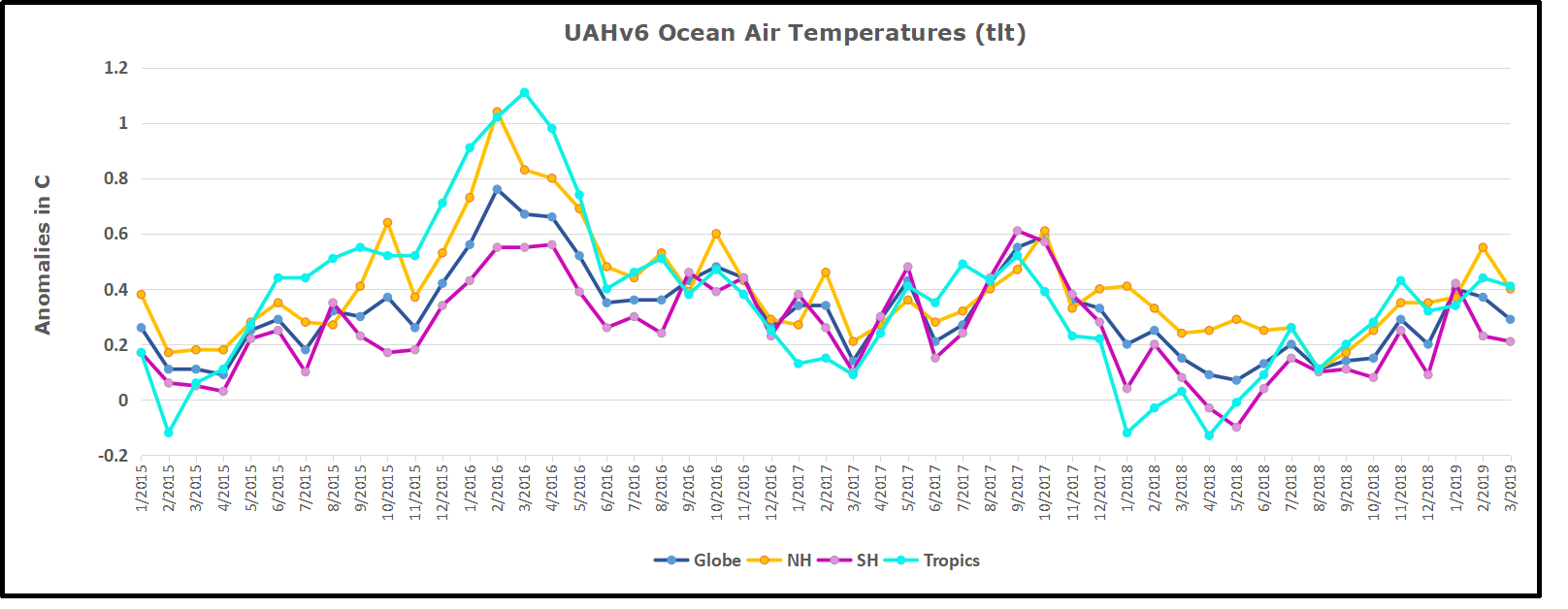
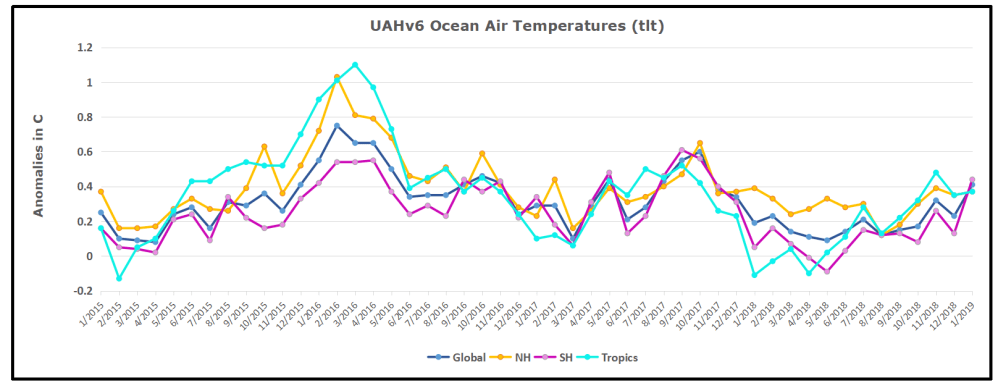
The UAH dataset includes temperature results for air above the oceans, and thus should be most comparable to the SSTs. There is the additional feature that ocean air temps avoid Urban Heat Islands (UHI).  The graph below shows monthly anomalies for ocean temps since January 2015.

UAH Oceans 201901The anomalies over the entire ocean dropped to the same value, 0.12C  in August (Tropics were 0.13C).  Warming in previous months was erased, and September added very little warming back. In October and November NH and the Tropics rose, joined by SH.  In December 2018 all regions cooled resulting in a global drop of nearly 0.1C. Now in January an upward jump in SH overcame slight cooling in NH and the Tropics, pulling up the Global anomaly as well.  While the trajectory is not yet set, it is the highest ocean air January since 2016.

Land Air Temperatures Tracking Downward in Seesaw Pattern

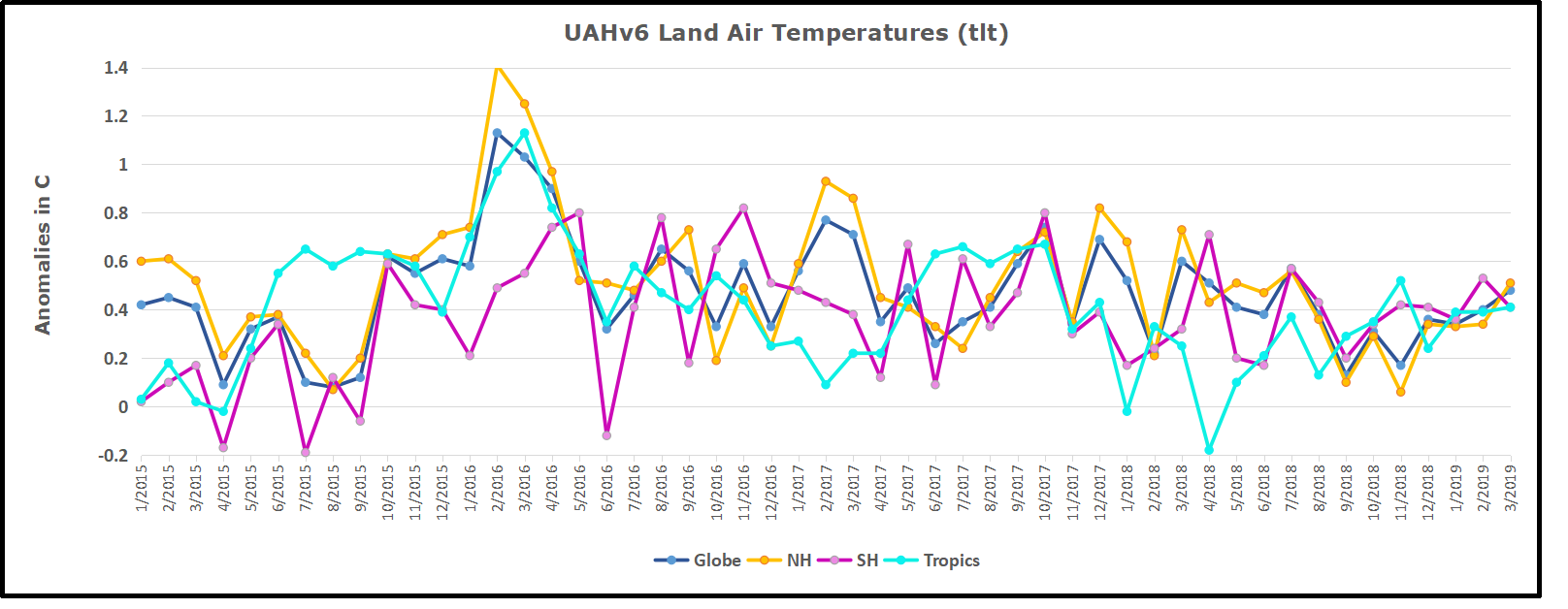
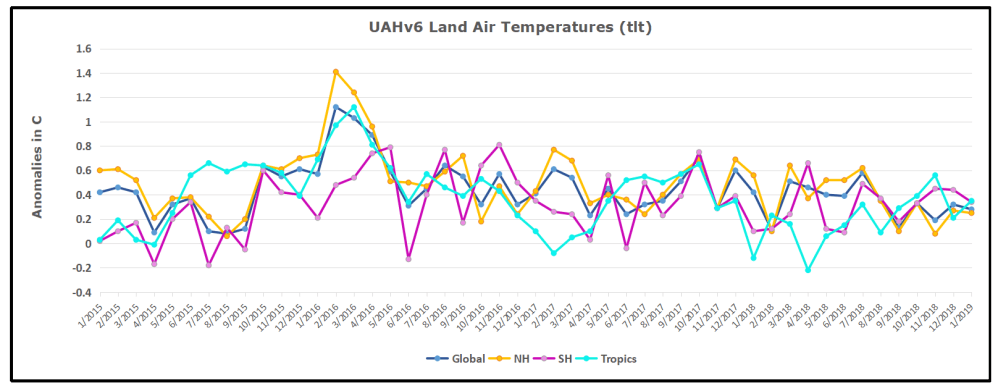
We sometimes overlook that in climate temperature records, while the oceans are measured directly with SSTs, land temps are measured only indirectly.  The land temperature records at surface stations record air temps at 2 meters above ground.  UAH gives tlt anomalies for air over land separately from ocean air temps.  The graph updated for January is below.UAH Land 201901

The greater volatility of the Land temperatures is evident, and also the dominance of NH, which has twice as much land area as SH.  Note how global peaks mirror NH peaks.  In December air over Tropics fell sharply, SH slightly, while the NH land surfaces rose, pulling up the Global anomaly for the month.  In January  both NH and SH cooled slightly, pulling the Global anomaly down despite some Tropical warming. Presently, air temps over land were the lowest January since 2014 both Globally and for the NH, despite warmer temps over SH and Tropical land areas.

Summary

TLTs include mixing above the oceans and probably some influence from nearby more volatile land temps.  Clearly NH and Global land temps have been dropping in a seesaw pattern, now more than 1C lower than the peak in 2016.  TLT measures started the recent cooling later than SSTs from HadSST3, but are now showing the same pattern.  It seems obvious that despite the three El Ninos, their warming has not persisted, and without them it would probably have cooled since 1995.  Of course, the future has not yet been written.


N. Atlantic’s Cold Year

RAPID Array measuring North Atlantic SSTs.

For the last few years, observers have been speculating about when the North Atlantic will start the next phase shift from warm to cold. Given the way 2018 went, this may be the onset.  First some background.

Source: Energy and Education Canada

An example is this report in May 2015 The Atlantic is entering a cool phase that will change the world’s weather by Gerald McCarthy and Evan Haigh of the RAPID Atlantic monitoring project. Excerpts in italics with my bolds.

This is known as the Atlantic Multidecadal Oscillation (AMO), and the transition between its positive and negative phases can be very rapid. For example, Atlantic temperatures declined by 0.1ºC per decade from the 1940s to the 1970s. By comparison, global surface warming is estimated at 0.5ºC per century – a rate twice as slow.

In many parts of the world, the AMO has been linked with decade-long temperature and rainfall trends. Certainly – and perhaps obviously – the mean temperature of islands downwind of the Atlantic such as Britain and Ireland show almost exactly the same temperature fluctuations as the AMO.

Atlantic oscillations are associated with the frequency of hurricanes and droughts. When the AMO is in the warm phase, there are more hurricanes in the Atlantic and droughts in the US Midwest tend to be more frequent and prolonged. In the Pacific Northwest, a positive AMO leads to more rainfall.

A negative AMO (cooler ocean) is associated with reduced rainfall in the vulnerable Sahel region of Africa. The prolonged negative AMO was associated with the infamous Ethiopian famine in the mid-1980s. In the UK it tends to mean reduced summer rainfall – the mythical “barbeque summer”.Our results show that ocean circulation responds to the first mode of Atlantic atmospheric forcing, the North Atlantic Oscillation, through circulation changes between the subtropical and subpolar gyres – the intergyre region. This a major influence on the wind patterns and the heat transferred between the atmosphere and ocean.

The observations that we do have of the Atlantic overturning circulation over the past ten years show that it is declining. As a result, we expect the AMO is moving to a negative (colder surface waters) phase. This is consistent with observations of temperature in the North Atlantic.

Cold “blobs” in North Atlantic have been reported, but they are usually a winter phenomena. For example in April 2016, the sst anomalies looked like this

But by September, the picture changed to this

And we know from Kaplan AMO dataset, that 2016 summer SSTs were right up there with 1998 and 2010 as the highest recorded.

As the graph above suggests, this body of water is also important for tropical cyclones, since warmer water provides more energy.  But those are annual averages, and I am interested in the summer pulses of warm water into the Arctic. As I have noted in my monthly HadSST3 reports, most summers since 2003 there have been warm pulses in the north atlantic.
amo december 2018The AMO Index is from from Kaplan SST v2, the unaltered and not detrended dataset. By definition, the data are monthly average SSTs interpolated to a 5×5 grid over the North Atlantic basically 0 to 70N.  The graph shows the warmest month August beginning to rise after 1993 up to 1998, with a series of matching years since.  December 2016 set a record at 20.6C, but note the plunge down to 20.2C for  December 2018, matching 2011 as the coldest years  since 2000.  Because McCarthy refers to hints of cooling to come in the N. Atlantic, let’s take a closer look at some AMO years in the last 2 decades.

amo decade 122018

This graph shows monthly AMO temps for some important years. The Peak years were 1998, 2010 and 2016, with the latter emphasized as the most recent. The other years show lesser warming, with 2007 emphasized as the coolest in the last 20 years. Note the red 2018 line is at the bottom of all these tracks.  Most recently December 2018 is 0.4C lower than December 2016, and is the coolest December since 2000.

With all the talk of AMOC slowing down and a phase shift in the North Atlantic, it seems the annual average for 2018 confirms that cooling has set in.  Through December the momentum is certainly heading downward, despite the band of warming ocean  that gave rise to European heat waves last summer.

amo annual122018

cdas-sflux_sst_atl_1


Update Jan.22: Hot Ocean False Alarm

What is Argo? Argo is a global array of 3,800 free-drifting profiling floats that measures thetemperature and salinity of the upper 2000 m of the ocean. This allows, for the first time, continuous monitoring of the temperature, salinity, and velocity of the upper ocean, with all data being relayed and made publicly available within hours after collection. Positions of the floats that have delivered data within the last 30 days :

Scientists deploy an Argo float. For over a decade, more than 3000 floats have provided near-global data coverage for the upper 2000 m of the ocean.

Update January 22, 2019

In a post at GWPF Nic Lewis critiques the Cheng et al. study and points in detail to the errors and misleading findings.  His short analysis: Is ocean warming accelerating faster than thought? – An analysis of Cheng et al (2019), Science . Excerpt in italics with my bolds.

Contrary to what the paper indicates:
Contemporary estimates of the trend in 0–2000 m depth ocean heat content over 1971–2010 are closely in line with that assessed in the IPCC AR5 report five years ago
Contemporary estimates of the trend in 0–2000 m depth ocean heat content over 2005–2017 are significantly (> 95% probability) smaller than the mean CMIP5 model simulation trend.

lewis fig.1

Figure 1: Updated 0–2000 m OHC linear trend estimates compared with AR5 and the CMIP5 mean. Error bars are 90% confidence intervals; black lines are means. Units relate to the Earth’s entire surface area.

falsealarm02

Previous Post:  Scare of the Day:  Ocean Heat Content (January 11, 2019)

Here is a sample of yesterday’s coordinated reports from CCN- Climate Crisis Network captured by my news aggregator, listed by the most recent first. Note the worldwide scope and editorial poetic license on the titles.

Ocean warming accelerating to record temperatures, scientists warn Engineering and Technology Magazine
Scalding seas? Oceans boil to hottest temp on record USA Today EU
World’s oceans heating up at quickening pace: study Egypt Independent
Ocean warming ‘accelerating’ The London Economic
Oceans warming faster than we thought: Study AniNews.in
Ocean temperatures rising faster than thought in ‘delayed response’ to global warming, scientists say The Japan Times
Oceans warming much faster than previously thought: Study The Hindu Business Line
The Oceans Are Warming Faster Than We Thought, a New Study Says TIME
Oceans Warming Even Faster Than Previously Thought Eurasia Review
The Ocean Is Warming Much Faster Than We Thought, According To A New Study BuzzFeed
Pacific: New research proves ocean warming is accelerating ABC Online – Radio Australia
We’re Boiling the Ocean Faster Than We Thought New York Magazine
Oceans warming faster than expected SBS
Ocean temperatures are rising far faster than previously thought, report says TVNZ
Ocean Temps Rising Faster Than Scientists Thought: Report HuffPost (US)
World’s oceans are heating up at a quickening pace Bangkok Post
The Warming of the World’s Oceans Is Set to Increase Dramatically Over the Next 60 Years Pacific Standard
New Climate Change Report Says Ocean Warming Is Far Worse Than Expected Fortune
Oceans Are Warming Faster Than Expected, Research Says Geek.com
World’s oceans are heating up at a quickening pace: study AFP
Oceans Warming Faster Than Predicted, Scientists Say gCaptain

So the message to the world is very clear: Ocean Heat Content is rising out of control, Be Very Afraid!
The trigger for all of this concern comes from this paper How fast are the oceans warming? by Lijing Cheng, John Abraham, Zeke Hausfather, Kevin E. Trenberth. Science 11 Jan 2019 Excerpts from paper in italics with my bolds.

Climate change from human activities mainly results from the energy imbalance in Earth’s climate system caused by rising concentrations of heat-trapping gases. About 93% of the energy imbalance accumulates in the ocean as increased ocean heat content (OHC). The ocean record of this imbalance is much less affected by internal variability and is thus better suited for detecting and attributing human influences (1) than more commonly used surface temperature records. Recent observation-based estimates show rapid warming of Earth’s oceans over the past few decades (see the figure) (1, 2). This warming has contributed to increases in rainfall intensity, rising sea levels, the destruction of coral reefs, declining ocean oxygen levels, and declines in ice sheets; glaciers; and ice caps in the polar regions (3, 4). Recent estimates of observed warming resemble those seen in models, indicating that models reliably project changes in OHC.

The Intergovernmental Panel on Climate Change’s Fifth Assessment Report (AR5), published in 2013 (4), featured five different time series of historical global OHC for the upper 700 m of the ocean. These time series are based on different choices for data processing (see the supplementary materials). Interpretation of the results is complicated by the fact that there are large differences among the series. Furthermore, the OHC changes that they showed were smaller than those projected by most climate models in the Coupled Model Intercomparison Project 5 (CMIP5) (5) over the period from 1971 to 2010 (see the figure).

Since then, the research community has made substantial progress in improving long-term OHC records and has identified several sources of uncertainty in prior measurements and analyses (2, 6–8). In AR5, all OHC time series were corrected for biases in expendable bathythermograph (XBT) data that had not been accounted for in the previous report (AR4). But these correction methods relied on very different assumptions of the error sources and led to substantial differences among correction schemes. Since AR5, the main factors influencing the errors have been identified (2), helping to better account for systematic errors in XBT data and their analysis.

Multiple lines of evidence from four independent groups thus now suggest a stronger observed OHC warming. Although climate model results (see the supplementary materials) have been criticized during debates about a “hiatus” or “slowdown” of global mean surface temperature, it is increasingly clear that the pause in surface warming was at least in part due to the redistribution of heat within the climate system from Earth surface into the ocean interiors (13). The recent OHC warming estimates (2, 6, 10, 11) are quite similar to the average of CMIP5 models, both for the late 1950s until present and during the 1971–2010 period highlighted in AR5 (see the figure). The ensemble average of the models has a linear ocean warming trend of 0.39 ± 0.07 W m−2 for the upper 2000 m from 1971–2010 compared with recent observations ranging from 0.36 to 0.39 W m−2 (see the figure).

MISSION ACCOMPLISHED: “The recent OHC warming estimates are quite similar to the average of CMIP5 models.”

What They are Not Telling You

The Sea Surface Temperature (SST) record is a mature dataset, not without issues from changing measurement technologies, but providing a lengthy set of observations making up 71% of the surface temperature history.  Sussing out temperatures at various depths in the ocean is a whole nother kettle of fish.

The Ocean Heat Content data is sparse, both in time and space.

The Ocean is vast, 360 million square kilometers with an average depth of 3700 meters, and we have 3900 Argo floats operating for 10 years. In addition we have some sensors arrayed at depths in the North Atlantic. As the text above admits, there are lots of holes in the data, and only a short history of the recently available reliable data. Other publications by some of the same authors admit: Large discrepancies are found in the percentage of basinal ocean heating related to the global ocean, with the largest differences in the Pacific and Southern Ocean. Meanwhile, we find a large discrepancy of ocean heat storage in different layers, especially within 300–700 m in the Pacific and Southern Oceans. Source: Consensuses and discrepancies of basin-scale ocean heat content changes in different ocean analyses, Gongjie Wang, Lijing Cheng, John Abraham.

Modelers Make OHC Reconstructions by Adding Guesstimates to Observations

Again climate science alarms are raised after “reanalysis” of the data. No one should be surprised that after computer manipulations and data processing, the “reanalyzed” data has changed and now favors warming and confirms the climate models. The Argo data record by itself is too short to make any such claim. In previous studies, scientists were more circumspect and refrained from “jumping the shark.” Apparently, with the Paris Accord on the ropes in 2019, caution and nuance has been thrown to the wind, as witnessed by the recent SR15 horror show, and now this.

Methodological Problems Bedevil These Reconstructions

One of the studies cited in support of revising OHC upward is the study Quantification of ocean heat uptake from changes in atmospheric O2 and CO2 composition, L. Resplandy et al. Published in Nature 31 October 2018.  From the Media Release:

The world’s oceans have absorbed far more heat than we realized, shortening our timeline to stop the causes of global warming, and foreboding some of the worst case scenarios put forth by climate experts, according to new findings.

A novel study by researchers from Scripps Institution of Oceanography at the University of California San Diego and Princeton University, published on Wednesday in Nature, implies that officials have underestimated the amount of heat retained by Earth’s oceans.

Between 1991 and 2016, oceans warmed an average 60 percent more than estimates by the Intergovernmental Panel on Climate Change (IPCC) originally calculated, the study claims. That amount equalled 13 zettajoules, or eight times the world’s annual energy consumption.

Something didn’t look right to climate statistician Nic Lewis so he deconstructed the study, finding several methodological mistakes along the way. He explained and communicated with the authors in a series of 4 posts at Climate Etc. Nov. 6 through 23, 2018.

Nic Lewis, Nov. 6 (here):

The findings of the Resplandy et al paper were peer reviewed and published in the world’s premier scientific journal and were given wide coverage in the English-speaking media. Despite this, a quick review of the first page of the paper was sufficient to raise doubts as to the accuracy of its results. Just a few hours of analysis and calculations, based only on published information, was sufficient to uncover apparently serious (but surely inadvertent) errors in the underlying calculations.

Moreover, even if the paper’s results had been correct, they would not have justified its findings regarding an increase to 2.0°C in the lower bound of the equilibrium climate sensitivity range and a 25% reduction in the carbon budget for 2°C global warming.

Because of the wide dissemination of the paper’s results, it is extremely important that these errors are acknowledged by the authors without delay and then corrected.

Authors Respond:

On November 14, 2018 this paper’s authors announced key errors to the two week-old study that made claims about the amount of heat that Earth’s oceans have absorbed. The errors stem from “incorrectly treating systematic errors in the O2 measurements and the use of a constant land O2:C exchange ratio of 1.1,” co-author Ralph Keeling said in an update from Scripps Institution of Oceanography, which is affiliated with the study. More simply, the team’s findings are too uncertain to conclusively support their statement that Earth’s oceans have absorbed 60 percent more heat than previously thought. Keeling claims the errors “do not invalidate the study’s methodology or the new insights into ocean biogeochemistry on which it is based.”

Subsequent posts by Lewis found other differences between the stated method and the analysis actually applied, adding to the uncertainty of the study and its finding. Lewis is not done yet, and the paper has not been reissued. Unfortunately, it has not been retracted and is still cited in reference to unsupported claims of runaway ocean heat content.

Meanwhile, other measurements, such as those in North Atlantic and Indian Ocean show slight cooling rather than warming, with researchers suspecting natural cyclical activity.

Summary

So anxious are alarmists/activists to cry wolf that they are running the computers flat out to manipulate and extrapolate from precious but incomplete limited data to confirm their suppositions.  All to keep alive a deflating narrative that the public increasingly finds offensive.

Footnote:

Oceanographers know that deep ocean temperatures can vary on centennial up to millennial time scales, so if some heat goes into the depths, it is not at all clear when it would come out.

Beware getting sucked into any model, climate or otherwise.

More at Putting Climate Models in Their Place

Scare of the Day: Ocean Heat Content

What is Argo? Argo is a global array of 3,800 free-drifting profiling floats that measures thetemperature and salinity of the upper 2000 m of the ocean. This allows, for the first time, continuous monitoring of the temperature, salinity, and velocity of the upper ocean, with all data being relayed and made publicly available within hours after collection. Positions of the floats that have delivered data within the last 30 days :

Scientists deploy an Argo float. For over a decade, more than 3000 floats have provided near-global data coverage for the upper 2000 m of the ocean.

Here is a sample of yesterday’s coordinated reports from CCN- Climate Crisis Network captured by my news aggregator, listed by the most recent first. Note the worldwide scope and editorial poetic license on the titles.

Ocean warming accelerating to record temperatures, scientists warn Engineering and Technology Magazine
Scalding seas? Oceans boil to hottest temp on record USA Today EU
World’s oceans heating up at quickening pace: study Egypt Independent
Ocean warming ‘accelerating’ The London Economic
Oceans warming faster than we thought: Study AniNews.in
Ocean temperatures rising faster than thought in ‘delayed response’ to global warming, scientists say The Japan Times
Oceans warming much faster than previously thought: Study The Hindu Business Line
The Oceans Are Warming Faster Than We Thought, a New Study Says TIME
Oceans Warming Even Faster Than Previously Thought Eurasia Review
The Ocean Is Warming Much Faster Than We Thought, According To A New Study BuzzFeed
Pacific: New research proves ocean warming is accelerating ABC Online – Radio Australia
We’re Boiling the Ocean Faster Than We Thought New York Magazine
Oceans warming faster than expected SBS
Ocean temperatures are rising far faster than previously thought, report says TVNZ
Ocean Temps Rising Faster Than Scientists Thought: Report HuffPost (US)
World’s oceans are heating up at a quickening pace Bangkok Post
The Warming of the World’s Oceans Is Set to Increase Dramatically Over the Next 60 Years Pacific Standard
New Climate Change Report Says Ocean Warming Is Far Worse Than Expected Fortune
Oceans Are Warming Faster Than Expected, Research Says Geek.com
World’s oceans are heating up at a quickening pace: study AFP
Oceans Warming Faster Than Predicted, Scientists Say gCaptain

So the message to the world is very clear: Ocean Heat Content is rising out of control, Be Very Afraid!
The trigger for all of this concern comes from this paper How fast are the oceans warming? by Lijing Cheng, John Abraham, Zeke Hausfather, Kevin E. Trenberth. Science 11 Jan 2019 Excerpts from paper in italics with my bolds.

Climate change from human activities mainly results from the energy imbalance in Earth’s climate system caused by rising concentrations of heat-trapping gases. About 93% of the energy imbalance accumulates in the ocean as increased ocean heat content (OHC). The ocean record of this imbalance is much less affected by internal variability and is thus better suited for detecting and attributing human influences (1) than more commonly used surface temperature records. Recent observation-based estimates show rapid warming of Earth’s oceans over the past few decades (see the figure) (1, 2). This warming has contributed to increases in rainfall intensity, rising sea levels, the destruction of coral reefs, declining ocean oxygen levels, and declines in ice sheets; glaciers; and ice caps in the polar regions (3, 4). Recent estimates of observed warming resemble those seen in models, indicating that models reliably project changes in OHC.

The Intergovernmental Panel on Climate Change’s Fifth Assessment Report (AR5), published in 2013 (4), featured five different time series of historical global OHC for the upper 700 m of the ocean. These time series are based on different choices for data processing (see the supplementary materials). Interpretation of the results is complicated by the fact that there are large differences among the series. Furthermore, the OHC changes that they showed were smaller than those projected by most climate models in the Coupled Model Intercomparison Project 5 (CMIP5) (5) over the period from 1971 to 2010 (see the figure).

Since then, the research community has made substantial progress in improving long-term OHC records and has identified several sources of uncertainty in prior measurements and analyses (2, 6–8). In AR5, all OHC time series were corrected for biases in expendable bathythermograph (XBT) data that had not been accounted for in the previous report (AR4). But these correction methods relied on very different assumptions of the error sources and led to substantial differences among correction schemes. Since AR5, the main factors influencing the errors have been identified (2), helping to better account for systematic errors in XBT data and their analysis.

Multiple lines of evidence from four independent groups thus now suggest a stronger observed OHC warming. Although climate model results (see the supplementary materials) have been criticized during debates about a “hiatus” or “slowdown” of global mean surface temperature, it is increasingly clear that the pause in surface warming was at least in part due to the redistribution of heat within the climate system from Earth surface into the ocean interiors (13). The recent OHC warming estimates (2, 6, 10, 11) are quite similar to the average of CMIP5 models, both for the late 1950s until present and during the 1971–2010 period highlighted in AR5 (see the figure). The ensemble average of the models has a linear ocean warming trend of 0.39 ± 0.07 W m−2 for the upper 2000 m from 1971–2010 compared with recent observations ranging from 0.36 to 0.39 W m−2 (see the figure).

MISSION ACCOMPLISHED: “The recent OHC warming estimates are quite similar to the average of CMIP5 models.”

What They are Not Telling You

The Sea Surface Temperature (SST) record is a mature dataset, not without issues from changing measurement technologies, but providing a lengthy set of observations making up 71% of the surface temperature history.  Sussing out temperatures at various depths in the ocean is a whole nother kettle of fish.

The Ocean Heat Content data is sparse, both in time and space.

The Ocean is vast, 360 million square kilometers with an average depth of 3700 meters, and we have 3900 Argo floats operating for 10 years. In addition we have some sensors arrayed at depths in the North Atlantic. As the text above admits, there are lots of holes in the data, and only a short history of the recently available reliable data. Other publications by some of the same authors admit: Large discrepancies are found in the percentage of basinal ocean heating related to the global ocean, with the largest differences in the Pacific and Southern Ocean. Meanwhile, we find a large discrepancy of ocean heat storage in different layers, especially within 300–700 m in the Pacific and Southern Oceans. Source: Consensuses and discrepancies of basin-scale ocean heat content changes in different ocean analyses, Gongjie Wang, Lijing Cheng, John Abraham.

Modelers Make OHC Reconstructions by Adding Guesstimates to Observations

Again climate science alarms are raised after “reanalysis” of the data. No one should be surprised that after computer manipulations and data processing, the “reanalyzed” data has changed and now favors warming and confirms the climate models. The Argo data record by itself is too short to make any such claim. In previous studies, scientists were more circumspect and refrained from “jumping the shark.” Apparently, with the Paris Accord on the ropes in 2019, caution and nuance has been thrown to the wind, as witnessed by the recent SR15 horror show, and now this.

Methodological Problems Bedevil These Reconstructions

One of the studies cited in support of revising OHC upward is the study Quantification of ocean heat uptake from changes in atmospheric O2 and CO2 composition, L. Resplandy et al. Published in Nature 31 October 2018.  From the Media Release:

The world’s oceans have absorbed far more heat than we realized, shortening our timeline to stop the causes of global warming, and foreboding some of the worst case scenarios put forth by climate experts, according to new findings.

A novel study by researchers from Scripps Institution of Oceanography at the University of California San Diego and Princeton University, published on Wednesday in Nature, implies that officials have underestimated the amount of heat retained by Earth’s oceans.

Between 1991 and 2016, oceans warmed an average 60 percent more than estimates by the Intergovernmental Panel on Climate Change (IPCC) originally calculated, the study claims. That amount equalled 13 zettajoules, or eight times the world’s annual energy consumption.

Something didn’t look right to climate statistician Nic Lewis so he deconstructed the study, finding several methodological mistakes along the way. He explained and communicated with the authors in a series of 4 posts at Climate Etc. Nov. 6 through 23, 2018.

Nic Lewis, Nov. 6 (here):

The findings of the Resplandy et al paper were peer reviewed and published in the world’s premier scientific journal and were given wide coverage in the English-speaking media. Despite this, a quick review of the first page of the paper was sufficient to raise doubts as to the accuracy of its results. Just a few hours of analysis and calculations, based only on published information, was sufficient to uncover apparently serious (but surely inadvertent) errors in the underlying calculations.

Moreover, even if the paper’s results had been correct, they would not have justified its findings regarding an increase to 2.0°C in the lower bound of the equilibrium climate sensitivity range and a 25% reduction in the carbon budget for 2°C global warming.

Because of the wide dissemination of the paper’s results, it is extremely important that these errors are acknowledged by the authors without delay and then corrected.

Authors Respond:

On November 14, 2018 this paper’s authors announced key errors to the two week-old study that made claims about the amount of heat that Earth’s oceans have absorbed. The errors stem from “incorrectly treating systematic errors in the O2 measurements and the use of a constant land O2:C exchange ratio of 1.1,” co-author Ralph Keeling said in an update from Scripps Institution of Oceanography, which is affiliated with the study. More simply, the team’s findings are too uncertain to conclusively support their statement that Earth’s oceans have absorbed 60 percent more heat than previously thought. Keeling claims the errors “do not invalidate the study’s methodology or the new insights into ocean biogeochemistry on which it is based.”

Subsequent posts by Lewis found other differences between the stated method and the analysis actually applied, adding to the uncertainty of the study and its finding. Lewis is not done yet, and the paper has not been reissued. Unfortunately, it has not been retracted and is still cited in reference to unsupported claims of runaway ocean heat content.

Meanwhile, other measurements, such as those in North Atlantic and Indian Ocean show slight cooling rather than warming, with researchers suspecting natural cyclical activity.

Summary

So anxious are alarmists/activists to cry wolf that they are running the computers flat out to manipulate and extrapolate from precious but incomplete limited data to confirm their suppositions.  All to keep alive a deflating narrative that the public increasingly finds offensive.

Footnote:

Oceanographers know that deep ocean temperatures can vary on centennial up to millennial time scales, so if some heat goes into the depths, it is not at all clear when it would come out.

Beware getting sucked into any model, climate or otherwise.

More at Putting Climate Models in Their Place

December Cooling by Sea, More than by Land

banner-blog

With apologies to Paul Revere, this post is on the lookout for cooler weather with an eye on both the Land and the Sea.  UAH has updated their tlt (temperatures in lower troposphere) dataset for December.   Previously I have done posts on their reading of ocean air temps as a prelude to updated records from HADSST3. This month I will add a separate graph of land air temps because the comparisons and contrasts are interesting as we contemplate possible cooling in coming months and years.

Presently sea surface temperatures (SST) are the best available indicator of heat content gained or lost from earth’s climate system.  Enthalpy is the thermodynamic term for total heat content in a system, and humidity differences in air parcels affect enthalpy.  Measuring water temperature directly avoids distorted impressions from air measurements.  In addition, ocean covers 71% of the planet surface and thus dominates surface temperature estimates.  Eventually we will likely have reliable means of recording water temperatures at depth.

Recently, Dr. Ole Humlum reported from his research that air temperatures lag 2-3 months behind changes in SST.  He also observed that changes in CO2 atmospheric concentrations lag behind SST by 11-12 months.  This latter point is addressed in a previous post Who to Blame for Rising CO2?

The December update to HadSST3 will appear later this month, but in the meantime we can look at lower troposphere temperatures (TLT) from UAHv6 which are already posted for December. The temperature record is derived from microwave sounding units (MSU) on board satellites like the one pictured above.

The UAH dataset includes temperature results for air above the oceans, and thus should be most comparable to the SSTs. There is the additional feature that ocean air temps avoid Urban Heat Islands (UHI).  The graph below shows monthly anomalies for ocean temps since January 2015.

uah oceans 201812The anomalies over the entire ocean dropped to the same value, 0.12C  in August (Tropics were 0.13C).  Warming in previous months was erased, and September added very little warming back. In October and November NH and the Tropics rose, joined by SH last month.,  In December 2018 all regions cooled resulting in a global drop of nearly 0.1C.

Taking a longer view, we can look at the record since 1995, that year being an ENSO neutral year and thus a reasonable starting point for considering the past two decades.  On that basis we can see the plateau in ocean temps is persisting. Global ocean temps are the lowest December since 2014.  It also appears that the NH Autumn upward bump is over and temps will likely trend downward.

Land Air Temperatures Plunged in September, then Rose in October

We sometimes overlook that in climate temperature records, while the oceans are measured directly with SSTs, land temps are measured only indirectly.  The land temperature records at surface stations record air temps at 2 meters above ground.  UAH gives tlt anomalies for air over land separately from ocean air temps.  The graph updated for December is below.uah land 201812

The greater volatility of the Land temperatures is evident, and also the dominance of NH, which has twice as much land area as SH.  Note how global peaks mirror NH peaks.  In December air over Tropics fell sharply, SH slightly, while the NH land surfaces rose, pulling up the Global anomaly for the month.  Despite the warming, air temps over land were the lowest December since 2013 both Globally and for the Tropics.  And all regions are cooler than December 2015 when the El Nino was starting in earnest.

Summary

TLTs include mixing above the oceans and probably some influence from nearby more volatile land temps.  It is striking to now see NH and Global land temps dropping rapidly.  TLT measures started the recent cooling later than SSTs from HadSST3, but are now showing the same pattern.  It seems obvious that despite the three El Ninos, their warming has not persisted, and without them it would probably have cooled since 1995.  Of course, the future has not yet been written.