Man Made Warming from Adjusting Data

trends and strings

Roger Andrews does a thorough job analyzing the effects of adjustments upon Surface Air Temperature (SAT) datasets. His article at Energy Matters is Adjusting Measurements to Match the Models – Part 1: Surface Air Temperatures. Excerpts of text and some images are below.  The whole essay is informative and supports his conclusion:

In previous posts and comments I had said that adjustments had added only about 0.2°C of spurious warming to the global SAT record over the last 100 years or so – not enough to make much difference. But after further review it now appears that they may have added as much as 0.4°C.

For example, these graphs show warming of the GISS dataset:

Figure 2: Comparison of “Old” and “Current” GISS meteorological station surface air temperature series, annual anomalies relative to 1950-1990 means

The current GISS series shows about 0.3°C more global warming than the old version, with about 0.2°C more warming in the Northern Hemisphere and about 0.5°C more in the Southern. The added warming trends are almost exactly linear except for the downturns after 2000, which I suspect (although can’t confirm) are a result of attempts to track the global warming “pause”. How did GISS generate all this extra straight-line warming? It did it by replacing the old unadjusted records with “homogeneity-adjusted” versions.

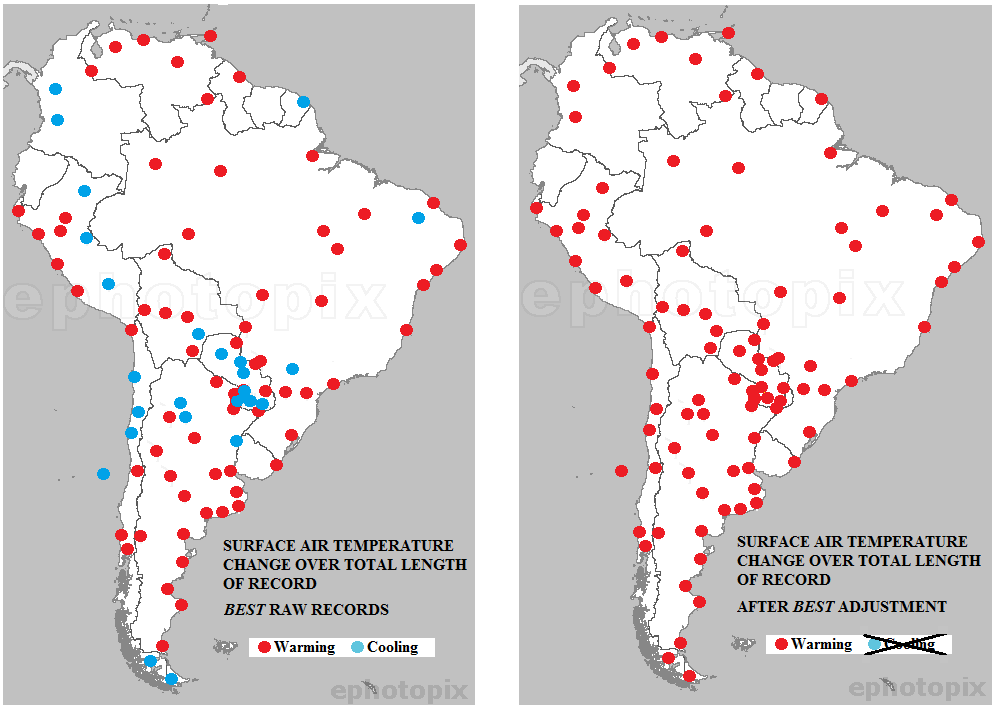
The homogenization operators used by others have had similar impacts, with Berkeley Earth Surface Temperature (BEST) being a case in point. Figure 3, which compares warming gradients measured at 86 South American stations before and after BEST’s homogeneity adjustments (from Reference 1) visually illustrates what a warming-biased operator does at larger scales. Before homogenization 58 of the 86 stations showed overall warming, 28 showed overall cooling and the average warming trend for all stations was 0.54°C/century. After homogenization all 86 stations show warming and the average warming trend increases to 1.09°C/century:

Figure 3: Warming vs. cooling at 86 South American stations before and after BEST homogeneity adjustments

The adjusted “current” GISS series match the global and Northern Hemisphere model trend line gradients almost exactly but overstate warming relative to the models in the Southern (although this has only a minor impact on the global mean because the Southern Hemisphere has a lot less land and therefore contributes less to the global mean than does the Northern). But the unadjusted “old” GISS series, which I independently verified with my own from-scratch reconstructions, consistently show much less warming than the models, confirming that the generally good model/observation match is entirely a result of the homogeneity adjustments applied to the raw SAT records.


Summary

In this post I have chosen to combine a large number of individual examples of “data being adjusted to match it to the theory” into one single example that blankets all of the surface air temperature records. The results indicate that warming-biased homogeneity adjustments have resulted in current published series overestimating the amount by which surface air temperatures over land have warmed since 1900 by about 0.4°C (Table 1), and that global surface air temperatures have increased by only about 0.7°C over this period, not by the ~1.1°C shown by the published SAT series.

Land, however, makes up only about 30% of the Earth’s surface. The subject of the next post will be sea surface temperatures in the oceans, which cover the remaining 70%. In it I will document more examples of measurement manipulation malfeasance, but with a twist. Stay tuned.

Footnote:

I have also looked into this issue by analyzing a set of US stations considered to have the highest CRN rating.  The impact of adjustments was similarly evident and in the direction of warming the trends.  See Temperature Data Review Project: My Submission


Ocean Cools and Air Temps Follow

June Sea Surface Temperatures (SSTs) are now available, and we can see ocean temps dropping further after a short pause and resuming the downward trajectory from the previous 12 months.

HadSST is generally regarded as the best of the global SST data sets, and so the temperature story here comes from that source, the latest version being HadSST3.

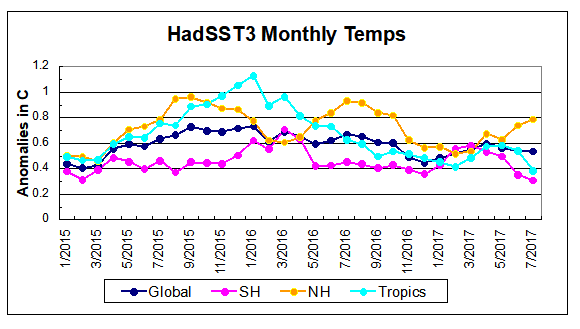
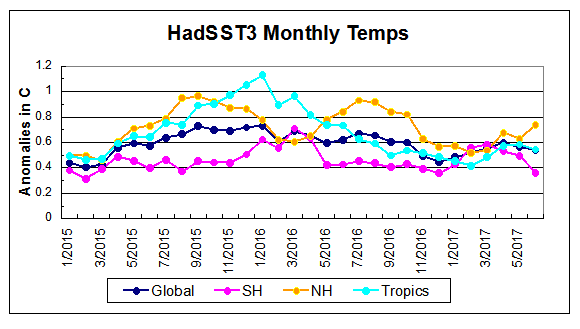
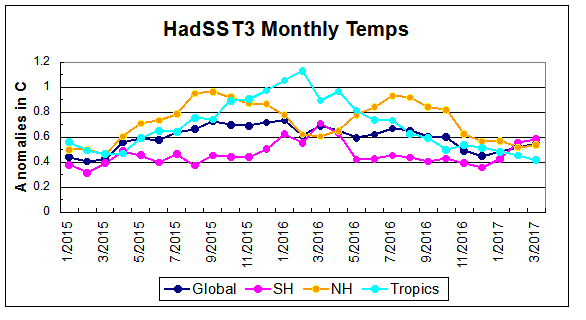
The chart below shows the last two years of SST monthly anomalies as reported in HadSST3 including June 2017.

In May despite a slight rise in the Tropics, declines in both hemispheres and globally caused SST cooling to resume after an upward bump in April.  Now in June a large spike upward in NH was overcome by an even larger drop in SH, now three months into a cooling phase. The Tropics also cooled off so the Global anomaly continued to decline.  Presently NH and SH are both changing strongly but in opposite directions.

Note that higher temps in 2015 and 2016 were first of all due to a sharp rise in Tropical SST, beginning in March 2015, peaking in January 2016, and steadily declining back to its beginning level. Secondly, the Northern Hemisphere added two bumps on the shoulders of Tropical warming, with peaks in August of each year. Also, note that the global release of heat was not dramatic, due to the Southern Hemisphere offsetting the Northern one. Note that June 2017 matches closely to June 2015, with almost the same anomalies for NH, SH and Global.  The Tropics are lower now and trending down compared to an upward trend in 2015.

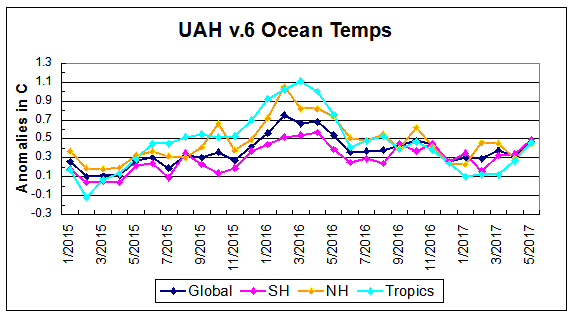
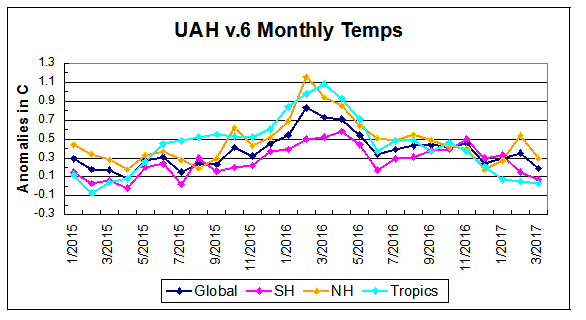
June satellite measures of air over the land and oceans also shows a sharp drop.  The graph below provides UAH vs.6 TLT (lower troposphere temps) confirming the general impression from SSTs.

In contrast with SST measurements, air temps in the TLT upticked in May with all areas participating in the rise of almost 0.2C.  Then in June SH dropped 0.4C, NH down 0.2C while the Tropics declined slightly. The end result has all areas back to March values except for the Tropics.  June 2017 compares closely with July 2015 but with no signs of an impending El Nino.

We have seen lots of claims about the temperature records for 2016 and 2015 proving dangerous man made warming.  At least one senator stated that in a confirmation hearing.  Yet HadSST3 data for the last two years show how obvious is the ocean’s governing of global average temperatures.

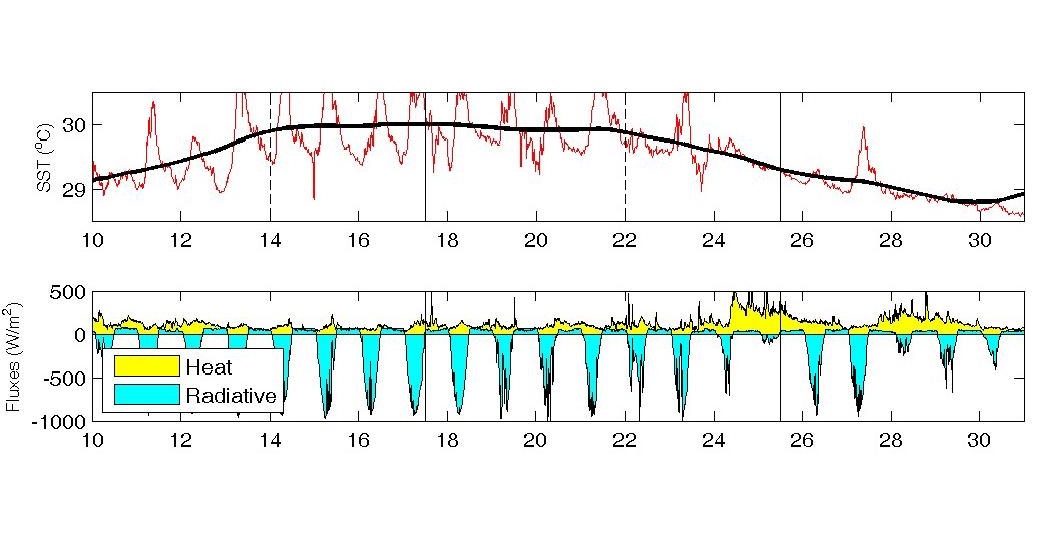
USS Pearl Harbor deploys Global Drifter Buoys in Pacific Ocean

The best context for understanding these two years comes from the world’s sea surface temperatures (SST), for several reasons:

  • The ocean covers 71% of the globe and drives average temperatures;
  • SSTs have a constant water content, (unlike air temperatures), so give a better reading of heat content variations;
  • A major El Nino was the dominant climate feature these years.

Solar energy accumulates massively in the ocean and is variably released during circulation events.


Climate Compilation Part I Temperatures

Background

When first investigating the global warming/climate change issue (beginning around the Copenhagen COP in 2008), my interest arose from reading various claims repeated ad nauseum without any other viewpoints expressed. Searching on the web revealed that indeed other researchers had different, sometimes nuanced and sometime outright contradictory findings.

In 2015 while signing up on WordPress to be able to comment on Climate Etc., I was surprised to find that the process left me with my own blogsite. So I began to put up posts of researches I had done, some were data analyses of my own, and others were discussions of analyses done by others. It has always been a niche project intending to provide information and a broader context related to climate science claims, for the sake of others who might be interested but lacked the time or energy to dig in the weeds for the all-important details.

Lately we have a sea change in the discourse around global warming/climate change. The Paris accord and the subsequent US withdrawal from it, along with the tumult around Trump’s presidency, Brexit, the broken electricity grid in Australia, have all shifted the focus from scientific discrepancies to policy questions.

It pleases me that in this current media setting, diverse and skeptical voices are more easily heard by those with inquiring minds who want to know. For example, Master Resource blog provides expert analyses on energy issues such as subsidies and renewables challenges. Other well-known blogs such as WUWT and Notalotofpeopleknowthat are actively addressing exaggerations and bogus claims by activists.

It also looks more likely that we will be treated to an official investigation into the EPA case for CO2 endangerment. Some studies by prominent skeptics are appearing as resources in that context.

So, there are many others rebutting unfounded claims, and less need for me to write such posts. It is also the case that this blog already contains multiple posts on almost all the issues that continue to be raised. This is the first of a series pointing out resources compiled here.

1.Temperature Trend Analysis

This category of posts (title above is link to posts) started some years ago when Dave from California commented on a thread at WUWT:  “I am an actuary not a climate scientist, but it seems to me if you want to know about temperature changes, you should study the changes not the temperatures.”  That rang my bell and suddenly things came together. JR Wakefield studied the change derivatives (slopes) of temperature changes at individual weather stations in Ontario. Lubos Motl did a similar analysis using monthly trends over station lifetimes as a basis for compiling global trends–no anomalies, no adjustments or homogenization.

I termed this technique Temperature Trend Analysis (TTA) and applied it to a set of station records in Kansas and the report was published at WUWT in 2014 with the title Do-It-Yourself Climate Analysis

Richard Mallet and I then collaborated on a study of the 25 best stations in the world (longest continuous records) also published at WUWT as Analyzing Temperature Changes Using World Class Stations. Later on I applied TTA to US stations classified as CRN #1 and then assessed the differences between adjusted and unadjusted datasets. The results were published at No Tricks Zone and then posted as Temperature Data Review Project-My Submission.

Just this week we have a thorough and professional report on the systematic corruption of the land station records by climate authorities:  On the Validity of NOAA, NASA and Hadley CRU Global Average Surface Temperature Data & The Validity of EPA’s CO2 Endangerment Finding  From the Report:

This research sought to validate the current estimates of Global Average Surface Temperature (GAST) using the best available relevant data. The conclusive findings were that the three GAST data sets are not a valid representation of reality. In fact, the magnitude of their historical data adjustments which removed their cyclical temperature patterns are totally inconsistent with published and credible U.S. and other temperature data.  Thus, despite current claims of record setting warming, it is impossible to conclude from the NOAA, NASA and Hadley CRU GAST data sets that recent years have been the warmest ever.

Additional studies included an analysis of Temperatures According to Climate Models

One post provided a visual synopsis why global warming claims are not supported by temperature records. See The Climate Story (Illustrated)

Climate Roller Coaster

Behemoth, Canada’s Wonderland, Ontario   Behemoth’s bright yellow-and-blue steel stands out against the Ontario landscape. At one point the roller coaster, which opened in 2008, drops 230 feet at a 75-degree angle and hits speeds of 77 mph. Its open-air seating gives every rider a front seat to the action.

Roller coasters came to mind when reading recent studies addressing the global warming hiatus this century. For example: The global warming hiatus – a natural product of interactions of a secular warming trend and a multi-decadal variability by Shuai-Lei Yao, Gang Huang, Ren-Guang and WuXia Qu.

Abstract:

The globally-averaged annual combined land and ocean surface temperature (GST) anomaly change features a slowdown in the rate of global warming in the mid-twentieth century and the beginning of the twenty-first century. Here, it is shown that the hiatus in the rate of global warming typically occurs when the internally generated cooling associated with the cool phase of the multi-decadal variability overcomes the secular warming from human-induced forcing.

We provide compelling evidence that the global warming hiatus is a natural product of the interplays between a secular warming tendency due in a large part to the buildup of anthropogenic greenhouse gas concentrations, in particular CO2 concentration, and internally generated cooling by a cool phase of a quasi-60-year oscillatory variability that is closely associated with the Atlantic multi-decadal oscillation (AMO) and the Pacific decadal oscillation (PDO). We further illuminate that the AMO can be considered as a useful indicator and the PDO can be implicated as a harbinger of variations in global annual average surface temperature on multi-decadal timescales.

Our results suggest that the recent observed hiatus in the rate of global warming will very likely extend for several more years due to the cooling phase of the quasi-60-year oscillatory variability superimposed on the secular warming trend.

CO2 sceptics have proposed similar explanations for the global temperature pattern, but were ignored heretofore. For example Syun-Ichi Akasofu,
Two Natural Components of the Recent Climate Change:
(1) The Recovery from the Little Ice Age  (A Possible Cause of Global Warming) and
(2) The Multi-decadal Oscillation  (The Recent Halting of the Warming):
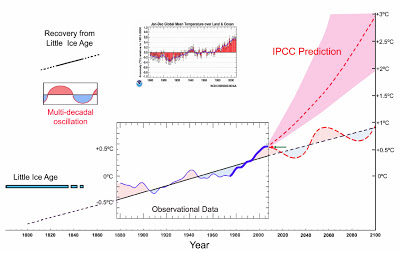
Note that the hypothesis is virtually the same, except for the leap of faith to attribute the secular background rise to CO2, rather than to a steady recovery from the Little Ice Age (LIA).  Finally climate modelers are admitting that natural variability is strong enough to offset warming from any other means.  And by extension the rise in temperatures late last century was due in large measure to a warming natural phase.

(Aside: “Secular” has two main meanings:
a : of or relating to the worldly or temporal secular concerns, not overtly or specifically religious
b : of or relating to a long term of indefinite duration, existing or continuing through ages or centuries
How ironic that some climate scientists use the term “secular” while applying a faith-based attribution.)

Nicola Scafetta is another scientist asserting a solar-lunar cyclical climate pattern based on oscillations within the solar system. More at Scaffetta vs. IPCC: Dueling Climate Theories
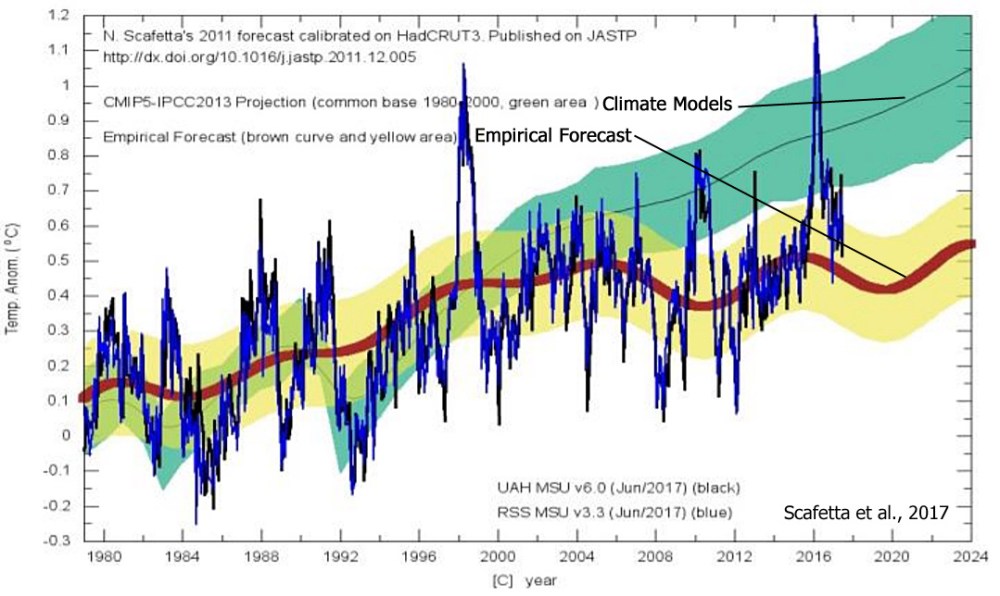
cooling-vs-warming-forecasts-scafetta-2017

The Thrill of Riding the Climate Roller Coaster

The original amusement park roller coasters had a single ratcheting up an incline to the top, with gravity pulling the train down to the bottom through a series of curving sine wave peaks and valleys. Newer rides like the one at Wonderland have more than one ratcheting upward to start a new decline. A recent paper explains how this additional excitement operates in our climate system.

Reconciling the signal and noise of atmospheric warming on decadal timescales by Roger N. Jones and James H. Ricketts Victoria University, Melbourne, Australia was published March 16, 2017 in Earth System Dynamics. From the abstract:

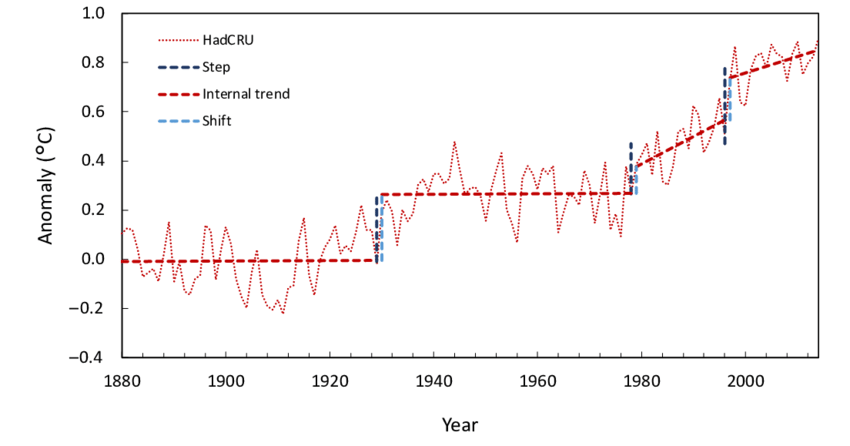
Interactions between externally forced and internally generated climate variations on decadal timescales is a major determinant of changing climate risk. Severe testing is applied to observed global and regional surface and satellite temperatures and modelled surface temperatures to determine whether these interactions are independent, as in the traditional signal-to-noise model, or whether they interact, resulting in step-like warming. The multistep bivariate test is used to detect step changes in temperature data. The resulting data are then subject to six tests designed to distinguish between the two statistical hypotheses, hstep and htrend.
record-of-mean-annual-surface-temperature-anomalies-1880-2014-from-the-hadley-centre-and

Figure 1. Record of mean annual surface temperature anomalies 1880–2014 from the Hadley Centre and Climate Research Unit (HadCRU), showing step changes (p < 0.01) and internal trends and shifts taken from the end of one internal trend to the start of the next across a step.

Test 1: since the mid-20th century, most observed warming has taken place in four events: in 1979/80 and 1997/98 at the global scale, 1988/89 in the Northern Hemisphere and 1968–70 in the Southern Hemisphere. Temperature is more step-like than trend-like on a regional basis. Satellite temperature is more step-like than surface temperature. Warming from internal trends is less than 40 % of the total for four of five global records tested (1880–2013/14).

Test 2: correlations between step-change frequency in observations and models (1880–2005) are 0.32 (CMIP3) and 0.34 (CMIP5). For the period 1950–2005, grouping selected events (1963/64, 1968–70, 1976/77, 1979/80, 1987/88 and 1996–98), the correlation increases to 0.78.

Test 3: steps and shifts (steps minus internal trends) from a 107-member climate model ensemble (2006–2095) explain total warming and equilibrium climate sensitivity better than internal trends.

Test 4: in three regions tested, the change between stationary and non-stationary temperatures is step-like and attributable to external forcing.

Test 5: step-like changes are also present in tide gauge observations, rainfall, ocean heat content and related variables.

Test 6: across a selection of tests, a simple stepladder model better represents the internal structures of warming than a simple trend, providing strong evidence that the climate system is exhibiting complex system behaviour on decadal timescales.

This model indicates that in situ warming of the atmosphere does not occur; instead, a store-and-release mechanism from the ocean to the atmosphere is proposed. It is physically plausible and theoretically sound. The presence of step-like – rather than gradual – warming is important information for characterising and managing future climate risk. (my bold)

Summary

The climate roller coaster is thrilling because we can’t see the track ahead for certain. Are we coming off a major peak and heading down into a deep valley? (Scafetta) Or is this a small dip before heading up again? (Yao et al.) Or are we hitting the top of the recovery from 1850 and starting into the next (hopefully little) ice age as signaled by the quiet sun (Akasofu, Abdussamatov)?

Daily sun June 27, 2017 with sunspot 2664.

See Also: Wave Drowns CO2 Warming
Ocean Cooling Resumes

May Sea Surface Temperatures (SSTs) are now available, and we can see ocean cooling resuming after a short pause from the downward trajectory during the previous 12 months.

HadSST is generally regarded as the best of the global SST data sets, and so the temperature story here comes from that source, the latest version being HadSST3.

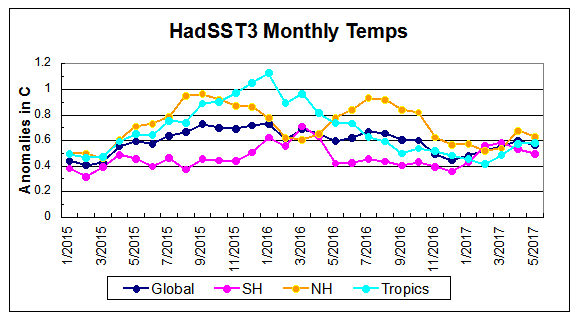
The chart below shows the last two years of SST monthly anomalies as reported in HadSST3 including May 2017.


After an upward bump in April 2017 due to the Tropics and NH, the May SSTs show the average declining slightly.  Note the Tropics recorded a rise, but not enough to offset declines in both hemispheres and globally.  SH is now two months into a cooling phase. The present readings compare closely with April 2015, but currently with no indication of an El Nino event any time soon.

Note that higher temps in 2015 and 2016 were first of all due to a sharp rise in Tropical SST, beginning in March 2015, peaking in January 2016, and steadily declining back to its beginning level. Secondly, the Northern Hemisphere added two bumps on the shoulders of Tropical warming, with peaks in August of each year. Also, note that the global release of heat was not dramatic, due to the Southern Hemisphere offsetting the Northern one.

Satellite measures of the air over the oceans give a slightly different result.  The graph below provides UAH vs.6 TLT (lower troposphere temps) over the oceans confirming the general impression from SSTs.

In contrast with SST measurements, air temps in the TLT over the oceans upticked in May with all areas participating in the rise of almost 0.2C.  In the satellite dataset, it is quite noticeable that land air temps rose quite strongly and may have caused air temps in the May TLT over oceans to show higher anomalies than the SSTs.

We have seen lots of claims about the temperature records for 2016 and 2015 proving dangerous man made warming.  At least one senator stated that in a confirmation hearing.  Yet HadSST3 data for the last two years show how obvious is the ocean’s governing of global average temperatures.

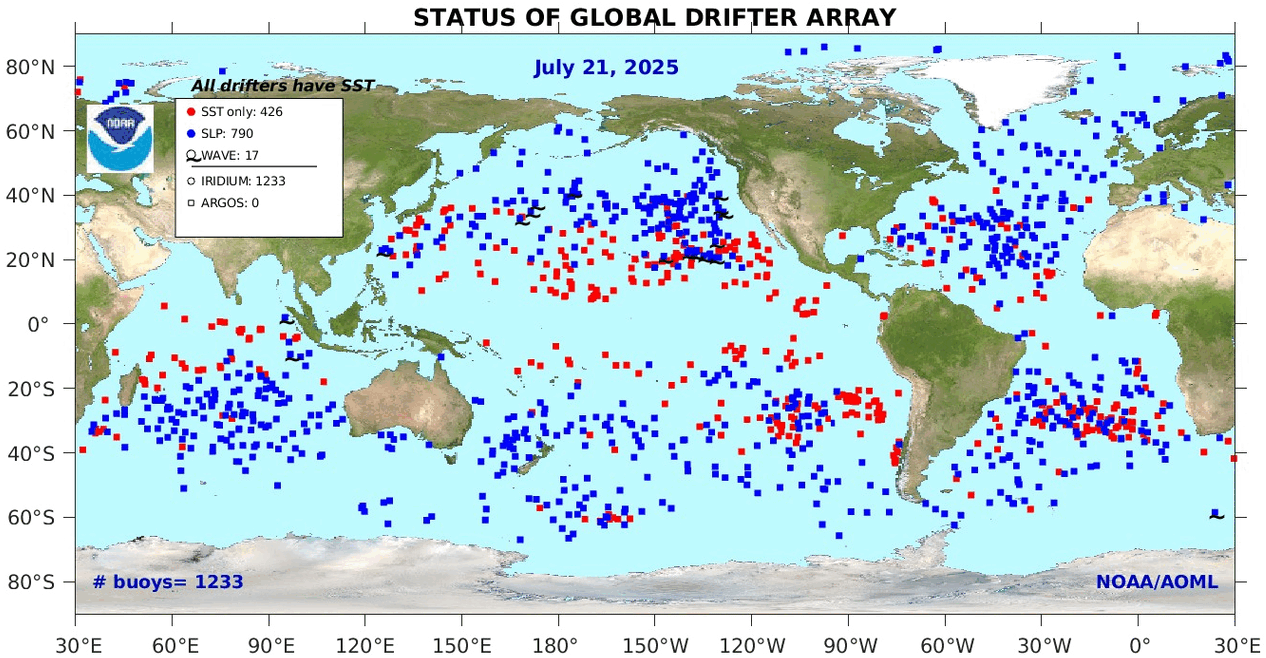
USS Pearl Harbor deploys Global Drifter Buoys in Pacific Ocean

The best context for understanding these two years comes from the world’s sea surface temperatures (SST), for several reasons:

  • The ocean covers 71% of the globe and drives average temperatures;
  • SSTs have a constant water content, (unlike air temperatures), so give a better reading of heat content variations;
  • A major El Nino was the dominant climate feature these years.

Solar energy accumulates massively in the ocean and is variably released during circulation events.


April Pause in Ocean Cooling


Ocean temperature measurements come from a global array of 3,500 Argo floats and other ocean sensors. Credits: Argo Program, Germany/Ifremer

April Sea Surface Temperatures are now available, and we can see a pause in the downward trajectory over the previous 13 months.

HadSST is generally regarded as the best of the global SST data sets, and so the temperature story here comes from that source, the latest version being HadSST3.

The chart below shows the last two years of SST monthly anomalies as reported in HadSST3 including April 2017.

In April 2017, the SH appears to be entering its cooler phase, while both the tropics and NH ticked upward from March, causing the Global anomaly to rise for the fourth month in a row.  The downward momentum has stopped, except now the SH (mostly ocean) has started down from a lower peak than a year ago.  It was the SH that was pulling up the Global average the previous three months.   The Tropics and NH may or may not start a new warming cycle, depending upon the appearance of El Nino.

Note that higher temps in 2015 and 2016 were first of all due to a sharp rise in Tropical SST, beginning in March 2015, peaking in January 2016, and steadily declining back to its beginning level. Secondly, the Northern Hemisphere added two bumps on the shoulders of Tropical warming, with peaks in August of each year. Also, note that the global release of heat was not dramatic, due to the Southern Hemisphere offsetting the Northern one.

Satellite measures of the air over the oceans give a similar result.  The graph below provides UAH vs.6 TLT (lower troposphere temps) over the oceans confirming the impression from SSTs.

Once again it is the Tropical and NH oceans that drove the warming that peaked a year ago.  SH  moderated the Global averages, though the air temps over the oceans are more synchronized than is the case with SSTs. Note how in April all anomalies converged on 0.3C.

We have seen lots of claims about the temperature records for 2016 and 2015 proving dangerous man made warming.  At least one senator stated that in a confirmation hearing.  Yet HadSST3 data for the last two years show how obvious is the ocean’s governing of global average temperatures.

The best context for understanding these two years comes from the world’s sea surface temperatures (SST), for several reasons:

  • The ocean covers 71% of the globe and drives average temperatures;
  • SSTs have a constant water content, (unlike air temperatures), so give a better reading of heat content variations;
  • A major El Nino was the dominant climate feature these years.

Solar energy accumulates massively in the ocean and is variably released during circulation events.


Fossil Fuels ≠ Global Warming

Previous posts addressed the claim that fossil fuels are driving global warming. This post updates that analysis with the latest numbers from BP Statistics and compares World Fossil Fuel Consumption (WFFC) with three estimates of Global Mean Temperature (GMT). More on both these variables below.

WFFC

2015 statistics are now available from BP for international consumption of Primary Energy sources. Statistical Review of World Energy.  H/T  Euan Mearns

The reporting categories are:
Oil
Natural Gas
Coal
Nuclear
Hydro
Renewables (other than hydro)

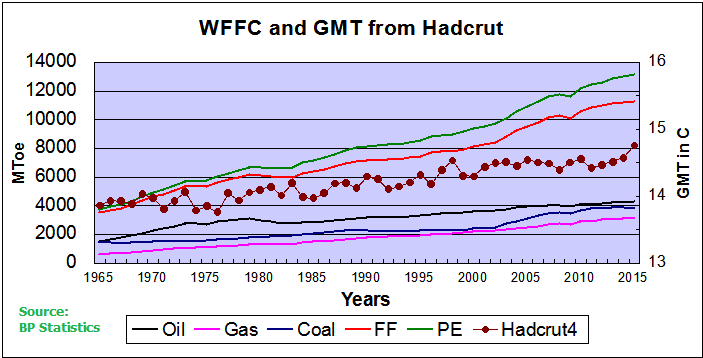
This analysis combines the first three, Oil, Gas, and Coal for total fossil fuel consumption world wide. The chart below shows the patterns for WFFC compared to world consumption of Primary Energy from 1965 through 2015.

The graph shows that Primary Energy consumption has grown continuously for 5 decades. Over that period oil, gas and coal (sometimes termed “Thermal”) averaged 90% of PE consumed, ranging from 94% in 1965 to 86% in 2015.  MToe is millions of tons of oil equivalents.

Global Mean Temperatures

Everyone acknowledges that GMT is a fiction since temperature is an intrinsic property of objects, and varies dramatically over time and over the surface of the earth. No place on earth determines “average” temperature for the globe. Yet for the purpose of detecting change in temperature, major climate data sets estimate GMT and report anomalies from it.

UAH record consists of satellite era global temperature estimates for the lower troposphere, a layer of air from 0 to 4km above the surface. HadSST estimates sea surface temperatures from oceans covering 71% of the planet. HADCRUT combines HadSST estimates with records from land stations whose elevations range up to 6km above sea level.

Both GISS LOTI (land and ocean) and HADCRUT4 (land and ocean) use 14.0 Celsius as the climate normal, so I will add that number back into the anomalies. This is done not claiming any validity other than to achieve a reasonable measure of magnitude regarding the observed fluctuations.

No doubt global sea surface temperatures are typically higher than 14C, more like 17 or 18C, and of course warmer in the tropics and colder at higher latitudes. Likewise, the lapse rate in the atmosphere means that air temperatures both from satellites and elevated land stations will range colder than 14C. Still, that climate normal is a generally accepted indicator of GMT.

Correlations of GMT and WFFC

The first graph compares to GMT estimates over the five decades from 1965 to 2015 from HADCRUT4, which includes HadSST3.

Over the last five decades the increase in fossil fuel consumption is dramatic and monotonic, steadily increasing by 220% from 3.5B to 11.3 B oil equivalent tons.  Meanwhile the GMT record from Hadcrut shows multiple ups and downs with an accumulated rise of 0.9C over 50 years, 6% of the starting value.

The second graph compares to GMT estimates from UAH6, and HadSST3 for the satellite era from 1979 to 2015, a period of 36 years.

In the satellite era WFFC has increased at a compounded rate of nearly 2% per year, for a total increase of 84% since 1979. At the same time, SSTs and  lower troposphere warming amounted to 0.5C, or 3.4% of the starting value.  The temperature rate of change is 0.1% per year, an order of magnitude less.  Even more obvious is the 1998 El Nino peak and flat GMT since.

Summary

The climate alarmist/activist claim is straight forward: Burning fossil fuels makes measured temperatures warmer. The Paris Accord further asserts that by reducing human use of fossil fuels, further warming can be prevented.  Those claims do not bear up under scrutiny.

It is enough for simple minds to see that two time series are both rising and to think that one must be causing the other. But both scientific and legal methods assert causation only when the two variables are both strongly and consistently aligned. The above shows a weak and inconsistent linkage between WFFC and GMT.

In legal terms, as long as there is another equally or more likely explanation for the set of facts, the claimed causation is unproven. The more likely explanation is that global temperatures vary due to oceanic and solar cycles. The proof is clearly and thoroughly set forward in the post Quantifying Natural Climate Change.

Background context for today’s post is at Claim: Fossil Fuels Cause Global Warming.

March Air and Sea Temps

The Pause that Refreshes!

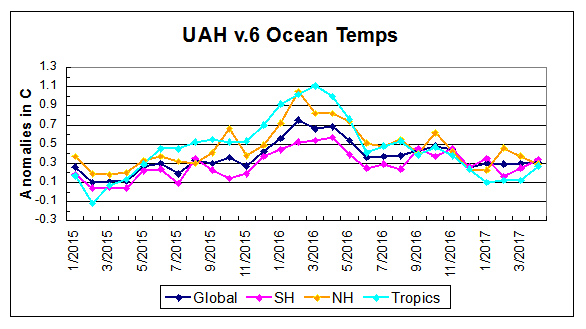
The recent El Nino is cooling down as shown clearly in both sea surface temperatures and lower troposphere air temperatures. The two relevant data sets are UAH v.6 and HadSST v3.1, both now providing averages for the month of March 2017.

The cooling pattern continues in the tropical seas while ocean temperatures in the Northern Hemisphere (NH) are  flat.  Southern Hemisphere (SH) oceans appear to be peaking and pulled the Global SST up a bit, but both are slightly below last March.

Air temperatures in the lower troposphere tell much the same story.  The greater volatility of air temperatures is evident, and we also see that the tropics (20N to 20S) and the NH (0 to 90N) are more closely aligned than are the comparable SSTs.  The downward trajectory of air temps is clear after an upward blip in the NH in February.

Enjoy the pause in warmer temperatures while we watch to see how cool it will get.

Ocean Surface Temps–How Low Will They Go?


Ocean temperature measurements come from a global array of 3,500 Argo floats and other ocean sensors. Credits: Argo Program, Germany/Ifremer

We have seen lots of claims about the temperature records for 2016 and 2015 proving dangerous man made warming.  At least one senator stated that in a confirmation hearing.  Now that HadSST3 data is complete through February 2017, let’s see how obvious is the ocean’s governing of global average temperatures.

The best context for understanding these last two years comes from the world’s sea surface temperatures (SST), for several reasons:

  • The ocean covers 71% of the globe and drives average temperatures;
  • SSTs have a constant water content, (unlike air temperatures), so give a better reading of heat content variations;
  • A major El Nino was the dominant climate feature the last two years.

HadSST is generally regarded as the best of the global SST data sets, and so the temperature story here comes from that source, the latest version being HadSST3.

The chart below shows the last two years of SST monthly anomalies as reported in HadSST3, along with the first two months of 2017.

Note that higher temps in 2015 and 2016 are first of all due to a sharp rise in Tropical SST, beginning in March 2015, peaking in February 2016, and steadily declining back to its beginning level. Secondly, the Northern Hemisphere added two bumps on the shoulders of Tropical warming, with peaks in August of each year. Also, note that the global release of heat was not dramatic, due to the Southern Hemisphere offsetting the Northern one.

Finally, the oceans are starting 2017 only slightly lower than a year ago, but this year with much cooler Tropics.  Notice that both the Tropics and also the Northern Hemisphere continue to cool.  The Global average warmed slightly, pulled upward by the Southern Hemisphere which reaches its summer peak at this time.

March may repeat 2016 when NH bottomed and SH peaked, or maybe both will rise or both will drop.  In the latter case, perhaps we will see the long-awaited La Nina.

H/T to Global Warming Policy Forum for adding this informative graphic:
|floatcyclescaled

Much ado has been made of this warming, including claims of human causation, despite the obvious oceanic origin. However, it is unreasonable to claim CO2 functions as a global warming agent, yet the two hemispheres respond so differently.  Moreover, CO2 warming theory expects greater warming in the higher latitudes, while this event was driven by heating in the Tropics, contradicting alarmist warming theory.

Solar energy accumulates massively in the ocean and is variably released during circulation events.


Fact: Future Will be Flatter Not Hotter

Another powerful post by Clive Best on how earth’s surface temperatures change by means of changing meridional heat transfers. Meridional Warming.

The key point for me was seeing how the best geological knowledge proves beyond the shadow of a doubt how the earth’s climate profile shifts over time, as presented in the diagram above.  It comes from esteemed paleoclimatologist Christopher Scotese.  His compete evidence and analysis can be reviewed in his article Some thoughts on Global Climate Change: The Transition from Icehouse to Hothouse (here).

In that essay Scotese shows where we are presently in this cycle between icehouse and hothouse.

As of 2015 earth is showing a GMT of 14.4C, compared to pre-industrial GMT of 13.8C.  According to the best geological evidence from millions of years of earth’s history, that puts us in the category “Severe Icehouse.”  So, thankfully we are warming up, albeit very slowly.

Moreover, and this is Clive Best’s point, progress toward a warming world means flattening the profile at the higher latitudes, especially the Arctic.  Equatorial locations remain at 23C throughout the millennia, while the gradient decreases in a warmer world.

The previous post explained what is wrong with averaging temperature anomalies.  See Temperature Misunderstandings

Conclusion:

We have many, many centuries to go before the earth can warm up to the “Greenhouse” profile, let alone get to “Hothouse.”  Regional and local climates at higher latitudes will see slightly warming temperatures and smaller differences from equatorial climates.  These are facts based on solid geological evidence, not opinions or estimates from computer models.

It is still a very cold world, but we are moving in the right direction.  Stay the course.

Meanwhile, keep firing away Clive.

damaged-ship3