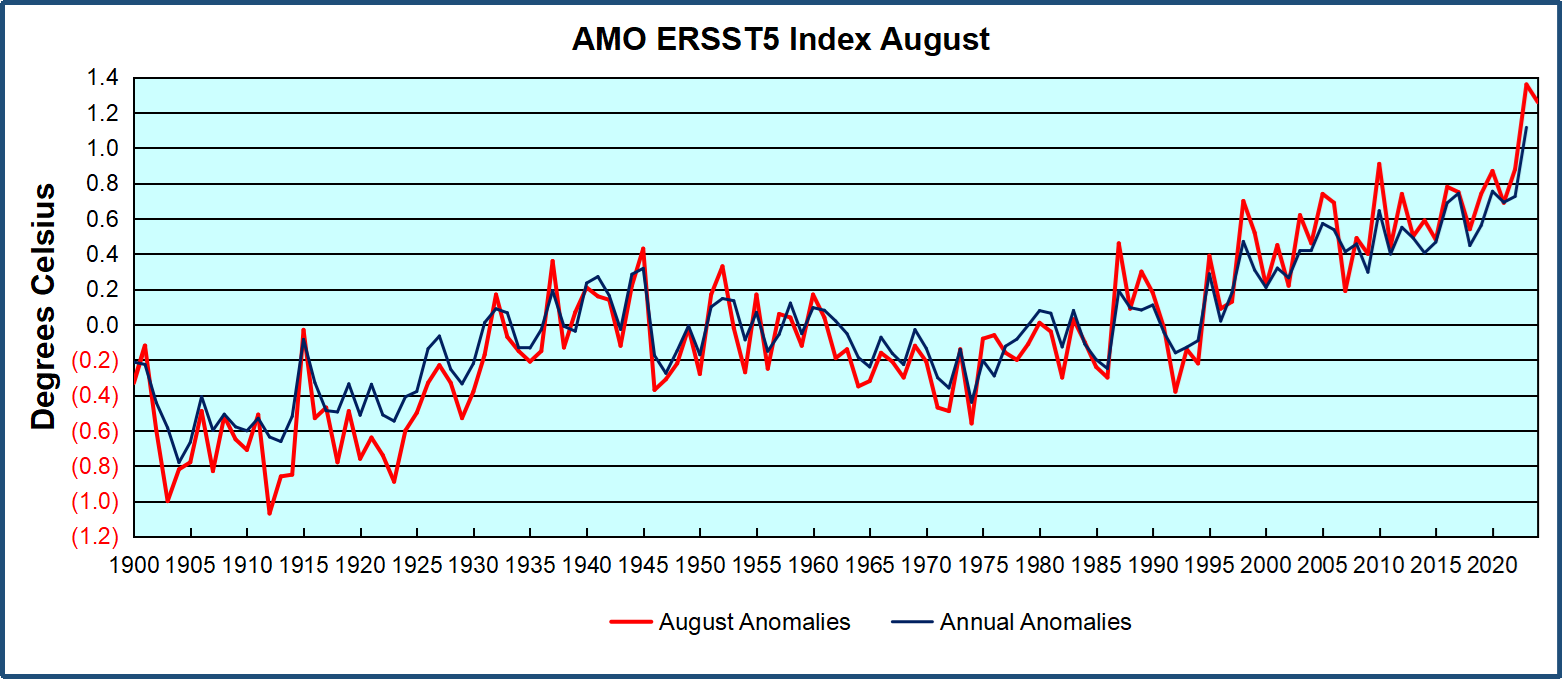
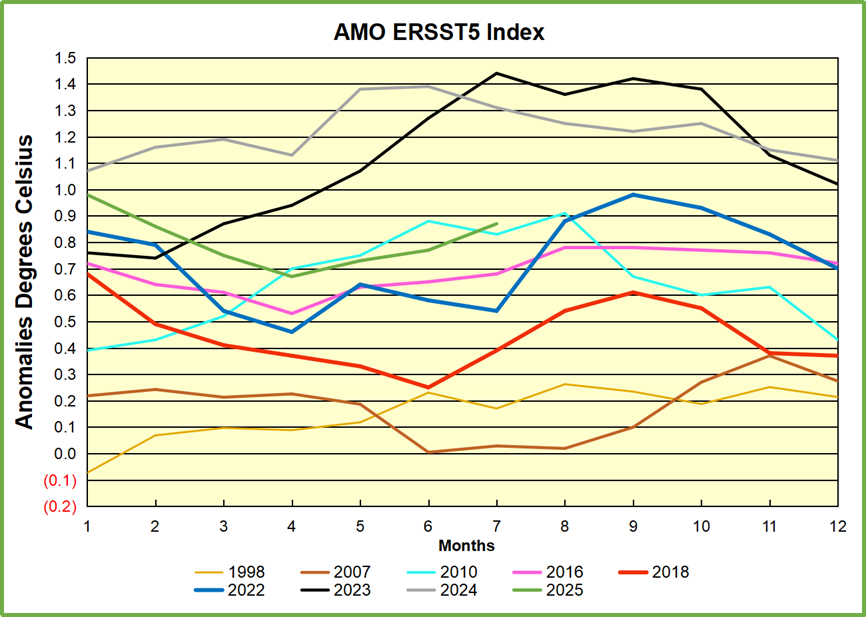
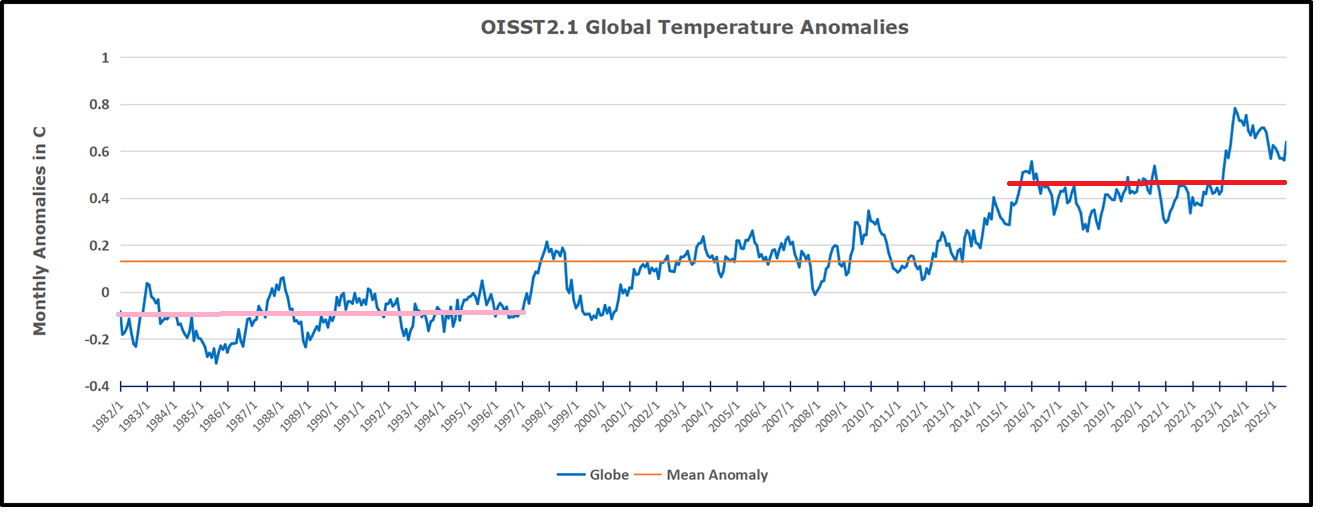
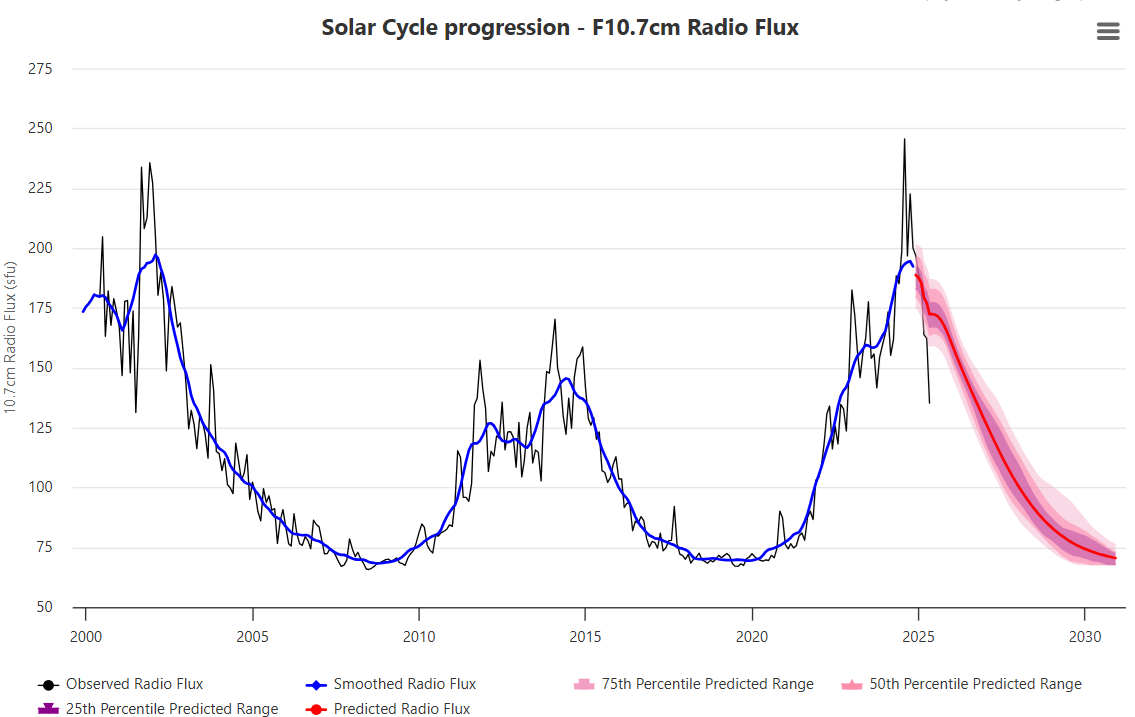
June 2025 Update–Temperature Falls, CO2 Follows

Previously I have demonstrated that changes in atmospheric CO2 levels follow changes in Global Mean Temperatures (GMT) as shown by satellite measurements from University of Alabama at Huntsville (UAH). That background post is reprinted later below.

My curiosity was piqued by the remarkable GMT spike starting in January 2023 and rising to a peak in April 2024. GMT has declined steadily, and now 14 months later, the anomaly is 0.48C down from 0.94C.  I also became aware that UAH has recalibrated their dataset due to a satellite drift that can no longer be corrected. The values since 2020 have shifted slightly in version 6.1, as shown in my recent report NH and Tropics Lead UAH Temps Lower May 2025.  The data here comes from UAH record of temperatures measured in the lower troposphere (TLT).

In this post, I test the premise that temperature changes are predictive of changes in atmospheric CO2 concentrations.  The chart above shows the two monthly datasets: CO2 levels in blue reported at Mauna Loa, and Global temperature anomalies in purple reported by UAHv6.1, both through June 2025. Would such a sharp increase in temperature be reflected in rising CO2 levels, according to the successful mathematical forecasting model? Would CO2 levels decline as temperatures dropped following the peak?
The answer is yes: that temperature spike resulted
in a corresponding CO2 spike as expected.
And lower CO2 levels followed the temperature decline.

Above are UAH temperature anomalies compared to CO2 monthly changes year over year.

Changes in monthly CO2 synchronize with temperature fluctuations, which for UAH are anomalies referenced to the 1991-2020 period. CO2 differentials are calculated for the present month by subtracting the value for the same month in the previous year (for example February 2025 minus February 2024).  Temp anomalies are calculated by comparing the present month with the baseline month. Note the recent CO2 upward spike and drop following the temperature spike and drop.

The final proof that CO2 follows temperature due to stimulation of natural CO2 reservoirs is demonstrated by the ability to calculate CO2 levels since 1979 with a simple mathematical formula:

For each subsequent year, the CO2 level for each month was generated

CO2  this month this year = a + b × Temp this month this year  + CO2 this month last year

The values for a and b are constants applied to all monthly temps, and are chosen to scale the forecasted CO2 level for comparison with the observed value. Here is the result of those calculations.

In the chart calculated CO2 levels correlate with observed CO2 levels at 0.9988 out of 1.0000.  This mathematical generation of CO2 atmospheric levels is only possible if they are driven by temperature-dependent natural sources, and not by human emissions which are small in comparison, rise steadily and monotonically.  For a more detailed look at the recent fluxes, here are the results since 2015, an ENSO neutral year.

For this recent period, the calculated CO2 values match well the annual highs, while some annual generated values of CO2 are slightly higher or lower than observed at other months of the year. Still the correlation for this period is 0.9939.

Key Point

Changes in CO2 follow changes in global temperatures on all time scales, from last month’s observations to ice core datasets spanning millennia. Since CO2 is the lagging variable, it cannot logically be the cause of temperature, the leading variable. It is folly to imagine that by reducing human emissions of CO2, we can change global temperatures, which are obviously driven by other factors.

Background Post Temperature Changes Cause CO2 Changes, Not the Reverse

This post is about proving that CO2 changes in response to temperature changes, not the other way around, as is often claimed.  In order to do  that we need two datasets: one for measurements of changes in atmospheric CO2 concentrations over time and one for estimates of Global Mean Temperature changes over time.

Climate science is unsettling because past data are not fixed, but change later on.  I ran into this previously and now again in 2021 and 2022 when I set out to update an analysis done in 2014 by Jeremy Shiers (discussed in a previous post reprinted at the end).  Jeremy provided a spreadsheet in his essay Murray Salby Showed CO2 Follows Temperature Now You Can Too posted in January 2014. I downloaded his spreadsheet intending to bring the analysis up to the present to see if the results hold up.  The two sources of data were:

Temperature anomalies from RSS here:  http://www.remss.com/missions/amsu

CO2 monthly levels from NOAA (Mauna Loa): https://www.esrl.noaa.gov/gmd/ccgg/trends/data.html

Changes in CO2 (ΔCO2)

Uploading the CO2 dataset showed that many numbers had changed (why?).

The blue line shows annual observed differences in monthly values year over year, e.g. June 2020 minus June 2019 etc.  The first 12 months (1979) provide the observed starting values from which differentials are calculated.  The orange line shows those CO2 values changed slightly in the 2020 dataset vs. the 2014 dataset, on average +0.035 ppm.  But there is no pattern or trend added, and deviations vary randomly between + and -.  So last year I took the 2020 dataset to replace the older one for updating the analysis.

Now I find the NOAA dataset starting in 2021 has almost completely new values due to a method shift in February 2021, requiring a recalibration of all previous measurements.  The new picture of ΔCO2 is graphed below.

The method shift is reported at a NOAA Global Monitoring Laboratory webpage, Carbon Dioxide (CO2) WMO Scale, with a justification for the difference between X2007 results and the new results from X2019 now in force.  The orange line shows that the shift has resulted in higher values, especially early on and a general slightly increasing trend over time.  However, these are small variations at the decimal level on values 340 and above.  Further, the graph shows that yearly differentials month by month are virtually the same as before.  Thus I redid the analysis with the new values.

Global Temperature Anomalies (ΔTemp)

The other time series was the record of global temperature anomalies according to RSS. The current RSS dataset is not at all the same as the past.

Here we see some seriously unsettling science at work.  The purple line is RSS in 2014, and the blue is RSS as of 2020.  Some further increases appear in the gold 2022 rss dataset. The red line shows alterations from the old to the new.  There is a slight cooling of the data in the beginning years, then the three versions mostly match until 1997, when systematic warming enters the record.  From 1997/5 to 2003/12 the average anomaly increases by 0.04C.  After 2004/1 to 2012/8 the average increase is 0.15C.  At the end from 2012/9 to 2013/12, the average anomaly was higher by 0.21. The 2022 version added slight warming over 2020 values.

RSS continues that accelerated warming to the present, but it cannot be trusted.  And who knows what the numbers will be a few years down the line?  As Dr. Ole Humlum said some years ago (regarding Gistemp): “It should however be noted, that a temperature record which keeps on changing the past hardly can qualify as being correct.”

Given the above manipulations, I went instead to the other satellite dataset UAH version 6. UAH has also made a shift by changing its baseline from 1981-2010 to 1991-2020.  This resulted in systematically reducing the anomaly values, but did not alter the pattern of variation over time.  For comparison, here are the two records with measurements through December 2023.

Comparing UAH temperature anomalies to NOAA CO2 changes.

Here are UAH temperature anomalies compared to CO2 monthly changes year over year.

Changes in monthly CO2 synchronize with temperature fluctuations, which for UAH are anomalies now referenced to the 1991-2020 period.  As stated above, CO2 differentials are calculated for the present month by subtracting the value for the same month in the previous year (for example June 2022 minus June 2021).   Temp anomalies are calculated by comparing the present month with the baseline month.

The final proof that CO2 follows temperature due to stimulation of natural CO2 reservoirs is demonstrated by the ability to calculate CO2 levels since 1979 with a simple mathematical formula:

For each subsequent year, the co2 level for each month was generated

CO2  this month this year = a + b × Temp this month this year  + CO2 this month last year

Jeremy used Python to estimate a and b, but I used his spreadsheet to guess values that place for comparison the observed and calculated CO2 levels on top of each other.

In the chart calculated CO2 levels correlate with observed CO2 levels at 0.9986 out of 1.0000.  This mathematical generation of CO2 atmospheric levels is only possible if they are driven by temperature-dependent natural sources, and not by human emissions which are small in comparison, rise steadily and monotonically.

Comment:  UAH dataset reported a sharp warming spike starting mid year, with causes speculated but not proven.  In any case, that surprising peak has not yet driven CO2 higher, though it might,  but only if it persists despite the likely cooling already under way.

Previous Post:  What Causes Rising Atmospheric CO2?

nasa_carbon_cycle_2008-1

This post is prompted by a recent exchange with those reasserting the “consensus” view attributing all additional atmospheric CO2 to humans burning fossil fuels.

The IPCC doctrine which has long been promoted goes as follows. We have a number over here for monthly fossil fuel CO2 emissions, and a number over there for monthly atmospheric CO2. We don’t have good numbers for the rest of it-oceans, soils, biosphere–though rough estimates are orders of magnitude higher, dwarfing human CO2.  So we ignore nature and assume it is always a sink, explaining the difference between the two numbers we do have. Easy peasy, science settled.

What about the fact that nature continues to absorb about half of human emissions, even while FF CO2 increased by 60% over the last 2 decades? What about the fact that in 2020 FF CO2 declined significantly with no discernable impact on rising atmospheric CO2?

These and other issues are raised by Murray Salby and others who conclude that it is not that simple, and the science is not settled. And so these dissenters must be cancelled lest the narrative be weakened.

The non-IPCC paradigm is that atmospheric CO2 levels are a function of two very different fluxes. FF CO2 changes rapidly and increases steadily, while Natural CO2 changes slowly over time, and fluctuates up and down from temperature changes. The implications are that human CO2 is a simple addition, while natural CO2 comes from the integral of previous fluctuations.  Jeremy Shiers has a series of posts at his blog clarifying this paradigm. See Increasing CO2 Raises Global Temperature Or Does Increasing Temperature Raise CO2 Excerpts in italics with my bolds.

The following graph which shows the change in CO2 levels (rather than the levels directly) makes this much clearer.

Note the vertical scale refers to the first differential of the CO2 level not the level itself. The graph depicts that change rate in ppm per year.

There are big swings in the amount of CO2 emitted. Taking the mean as 1.6 ppmv/year (at a guess) there are +/- swings of around 1.2 nearly +/- 100%.

And, surprise surprise, the change in net emissions of CO2 is very strongly correlated with changes in global temperature.

This clearly indicates the net amount of CO2 emitted in any one year is directly linked to global mean temperature in that year.

For any given year the amount of CO2 in the atmosphere will be the sum of

  • all the net annual emissions of CO2
  • in all previous years.

For each year the net annual emission of CO2 is proportional to the annual global mean temperature.

This means the amount of CO2 in the atmosphere will be related to the sum of temperatures in previous years.

So CO2 levels are not directly related to the current temperature but the integral of temperature over previous years.

The following graph again shows observed levels of CO2 and global temperatures but also has calculated levels of CO2 based on sum of previous years temperatures (dotted blue line).

Summary:

The massive fluxes from natural sources dominate the flow of CO2 through the atmosphere.  Human CO2 from burning fossil fuels is around 4% of the annual addition from all sources. Even if rising CO2 could cause rising temperatures (no evidence, only claims), reducing our emissions would have little impact.

Atmospheric CO2 Math

Ins: 4% human, 96% natural
Outs: 0% human, 98% natural.
Atmospheric storage difference: +2%
(so that: Ins = Outs + Atmospheric storage difference)

Balance = Atmospheric storage difference: 2%, of which,
Humans: 2% X 4% = 0.08%
Nature: 2% X 96 % = 1.92%

Ratio Natural : Human =1.92% : 0.08% = 24 : 1

Resources
For a possible explanation of natural warming and CO2 emissions see Little Ice Age Warming Recovery May be Over
Resources:

CO2 Fluxes, Sources and Sinks

Who to Blame for Rising CO2?

Fearless Physics from Dr. Salby

2025 Update: No, CO2 Doesn’t Drive the Polar Vortex

July 2025 Update

Linnea Lueken published this week at Climate Realism Thanks, NewScientist, for Admitting Climate Change Isn’t Making the Jet Stream More Erratic.  Excerpts in italics with my bolds and added images.

NewScientist, a publication dedicated to popularizing science, recently published a post titled “Extreme winter weather isn’t down to a wavier jet stream,” reporting on a new study that shows, the jet stream is not getting wavier in winter months due to climate change. NewScientist writes that “[i]ncreasingly erratic winter weather in the northern hemisphere isn’t a result of the polar jet stream getting more wavy, according to new research . . ..”

This is true, and it has been evident for some time, but runs counter
to assertions commonly made by climate alarmists.

Although the vast bulk of the article is devoted to insisting that climate change is causing worsening winter and summer weather, claims regularly debunked at Climate Realism, the publication deserves some credit for reporting the study’s results concerning the jet stream, which was, in fact, the focus of the research itself.

The new reports findings are not actually that “new,” in the sense that Climate Realism has reported on research that came to the same conclusion several times in the past few years, herehere, and here, for instance. There is copious evidence showing that not only are cold snaps not uncommon, but that the jet stream’s (and more specifically, polar vortex) influence on extreme winter weather has been acknowledged since at least 1853. Years of studies looking at the frequency of and intensity of polar vortex events have found no consistent trends. As pointed out by my colleague Anthony Watts in this post on the subject:

“a 2021 study in the journal Geophysical Research Letters found no statistically significant increase in jet stream waviness or meandering in recent decades,”

and he explains there has never been a consensus among scientists when it comes to the issue of polar vortex/jet stream behavior.

The post at NewScientist goes on to explain the new study, saying “recent erratic behaviour isn’t out of the ordinary,” and that the jet stream has been both wavier and less wavy than it is today.  Unfortunately, that is where the NewScientist and the authors of the paper it was discussing ceased to follow the evidence. One of the study’s authors reassured NewScientist that climate change is still “affecting extreme weather events in all sorts of really important ways,” and that the jet stream is actually becoming wavier in the summertime, “where it is getting slower, with bigger waves, which leads to things like big heatwaves, drought, and wildfires.”

This would be compelling if existing data backed up the claim,
but, in fact, big heatwaves, drought, and wildfires have not
become more frequent or severe in recent decades. 

Heatwaves were much more severe in the earlier decades of the 20th century, and overall drought has been declining while precipitation increases. Now that it is summer, many outlets are attempting to claim that hot weather is driven by climate change. In doing so they almost always ignore where heat records are being set, as it is often at airports and other heat-absorbing locations, and ignore historical records that show hot summers are not unprecedented.

Similarly, data shows that wildfires were worse in the past with research from NASA and the European Space Agency showing that acreage lost to wildfires has declined markedly over the past few decades.

The NewScientist, and the AGU study it references, should have quit when they were ahead. They should have published their unalarming findings about climate change’s lack of an impact on the winter jet stream without then assuring people that despite their study’s findings, they really are true believers and climate change is making weather worse. The latter point is refuted by real world data.

Simulation of jet stream pattern July 22. (VentuSky.com)

Background from Previous Post

We are heading into winter this year at the bottom of a solar cycle, and ocean oscillations due for cooling phases. The folks at Climate Alarm Central (CAC) are well aware of this, and are working hard so people won’t realize that global cooling contradicts global warming. No indeed, contortionist papers and headlines are warning us all that CO2 not only causes hothouse earth, overrun with rats and other vermin. CO2 also causes ice ages when it feels like it.

Update Nov. 26, 2019: Much ado about the polar jet stream recently with a publication by Tim Woolings  A battle for the jet stream is raging above our heads.  The Claims are not new:

The jet has always varied – and has always affected our weather patterns. But now climate change is affecting our weather too. As I explore in my latest book, it’s when the wanderings of the jet and the hand of climate change add up that we get record-breaking heatwaves, floods and droughts – but not freezes.

The same supposition was made last year in an article by alarmist Jason Samenow at Washington Post.  Study: Freak summer weather and wild jet-stream patterns are on the rise because of global warming. Excerpts in italics with my bolds

In many ways, the summer of 2018 marked a turning point, when the effects of climate change — perhaps previously on the periphery of public consciousness — suddenly took center stage. Record high temperatures spread all over the Northern Hemisphere. Wildfires raged out of control. And devastating floods were frequent.

Michael Mann, climate scientist at Pennsylvania State University, along with colleagues, has published a new study that connects these disruptive weather extremes with a fundamental change in how the jet stream is behaving during the summer. Linked to the warming climate, the study suggests this change in the atmosphere’s steering current is making these extremes occur more frequently, with greater intensity, and for longer periods of time.

The study projects this erratic jet-stream behavior will increase in the future, leading to more severe heat waves, droughts, fires and floods.

The jet stream is changing not only because the planet is warming up but also because the Arctic is warming faster than the mid-latitudes, the study says. The jet stream is driven by temperature contrasts, and these contrasts are shrinking. The result is a slower jet stream with more wavy peaks and troughs that Mann and his study co-authors ascribe to a process known as “quasi-resonant amplification.”

The altered jet-stream behavior is important because when it takes deep excursions to the south in the summer, it sets up a collision between cool air from the north and the summer’s torrid heat, often spurring excessive rain. But when the jet stream retreats to the north, bulging heat domes form underneath it, leading to record heat and dry spells.

The study, published Wednesday in Science Advances, finds that these quasi-resonant amplification events — in which the jet stream exhibits this extreme behavior during the summer — are predicted to increase by 50 percent this century if emissions of carbon dioxide and other greenhouse gases continue unchecked.

Whereas previous work conducted by Mann and others had identified a signal for an increase in these events, this study for the first time examined how they may change in the future using climate model simulations.

“Looking at a large number of different computer models, we found interesting differences,” said Stefan Rahmstorf from the Potsdam Institute for Climate Impact Research and a co-author of the study, in a news release. “Distinct climate models provide quite diverging forecasts for future climate resonance events. However, on average they show a clear increase in such events.”

Although model projections suggest these extreme jet-stream patterns will increase as the climate warms, the study concluded that their increase can be slowed if greenhouse gas emissions are reduced along with particulate pollution in developing countries. “[T]he future is still very much in our hands when it comes to dangerous and damaging summer weather extremes,” Mann said. “It’s simply a matter of our willpower to transition quickly from fossil fuels to renewable energy.”

Mann has been leading the charge to blame anticipated cooling on fossil fuels, his previous attempt claiming CO2 is causing a slowdown of AMOC (part of it being the Gulf Stream), resulting in global cooling, even an ice age. The same idea underlay the scary 2004 movie Day After Tomorrow.

day-after-tomorrowOther scientists are more interested in the truth than in hype. An example is this AGU publication by D.A Smeed et al. The North Atlantic Ocean Is in a State of Reduced Overturning Excerpts in italics with my bolds.

Figure 3

Indices of subsurface temperature, sea surface height (SSH), latent heat flux (LHF), and sea surface temperature (SST). SST (purple) is plotted using the same scale as subsurface temperature (blue) in the upper panel. The upper panel shows 24 month filtered values of de‐seasonalized anomalies along with the non‐Ekman part of the AMOC. In the lower panel, we show three‐year running means of the indices going back to 1985 (1993 for the SSH index).

Changes in ocean heat transport and SST are expected to modify the net air‐sea heat flux. The changes in the total air‐sea flux (Figure S4, data obtained from the National Centers for Environmental Prediction‐National Center for Atmospheric Research reanalysis; Kalnay et al., 1996) are almost all due to the change in LHF. The third panel of Figure 3 shows the changes in LHF between the two periods. There is a strong signal with increased heat loss from the ocean over the Gulf Stream. That the area of increased heat loss coincides with the location of warming SST indicates that the changes in air‐sea fluxes are driven by the ocean.

Whilst the AMOC has only been continuously measured since 2004, the indices of SSH, heat content, SST, and LHF can be calculated farther back in time (Figure 3, bottom). Over this longer time period, all four indices are strongly correlated with one another (Table S5; correlations were calculated using the nonparametric method described in McCarthy et al., 2015). These data suggest that measurement of the AMOC at 26°N started close to a maximum in the overturning. Prior to 2007 the indices show variability on a time scale of 8 to 10 years and no trend is evident, but since 2014 all indices have had values lower than any other year since 1985.

Previous studies have shown that seasonal and interannual changes in the subtropical AMOC are forced primarily by changing wind stress mediated by Rossby waves (Zhao & Johns, 2014a, 2014b). There is growing evidence (Delworth et al., 2016; Jackson et al., 2016) that the longer‐term changes of the AMOC over the last decade are also associated with thermohaline forcing and that the changed circulation alters the pattern of ocean‐atmosphere heat exchange (Gulev et al., 2013). The role of ocean circulation in decadal climate variability has been challenged in recent years with authors suggesting that external, atmospheric‐driven changes could produce the observed variability in Atlantic SSTs (Clement et al., 2015). However, the direct observation of a weakened AMOC supports a role for ocean circulation in decadal Atlantic climate variability.

Our results show that the previously reported decline of the AMOC (Smeed et al., 2014) has been arrested, but the length of the observational record of the AMOC is still short relative to the time scales of important decadal variations that exist in the Atlantic. Understanding is therefore constantly evolving. What we identify as a changed state of the AMOC in this study may well prove to be part of a decadal oscillation superposed on a multidecadal cycle. Overlaying these oscillations is the impact of anthropogenic change that is predicted to weaken the AMOC over the next century. The continuation of measurements from the RAPID 26°N array and similar observations elsewhere in the Atlantic (Lozier et al., 2017; Meinen et al., 2013) will enable us to unravel and reveal the role of ocean circulation in the changing Atlantic climate in the coming decades.

Regarding the more recent attempt to link CO2 with jet stream meanderings, we have this paper providing a more reasonable assessment.  Arctic amplification: does it impact the polar jet stream?  by Valentin P. Meleshko et al.  Excerpts below in italics with my bolds.

Analysis of observation and model simulations has revealed that northward temperature gradient decreases and jet flow weakens in the polar troposphere due to global climate warming. These interdependent phenomena are regarded as robust features of the climate system. An increase of planetary wave oscillation that is attributed to Arctic amplification (Francis and Vavrus, 2012; Francis and Vavrus, 2015) has not been confirmed from analysis of observation (Barnes, 2013; Screen and Simmonds, 2013) or in our analysis of model simulations of projected climate. However, we found that GPH variability associated with planetary wave oscillation increases in the background of weakening of zonal flow during the sea-ice-free summer. Enhancement of northward heat transport in the troposphere was shown to be the main factor responsible for decrease of northward temperature gradient and weakening of the jet stream in autumn and winter. Arctic amplification provides only minor contribution to the evolution of zonal flow and planetary wave oscillation.

It has been shown that northward heat transport is the major factor in decreasing the northward temperature gradient in the polar atmosphere and increasing the planetary-scale wave oscillation in the troposphere of the mid-latitudes. Arctic amplification does not show any essential impact on planetary-scale oscillation in the mid and upper troposphere, although it does cause a decrease of northward heat transport in the lower troposphere. These results confound the interpretation of the short observational record that has suggested a causal link between recent Arctic melting and extreme weather in the mid-latitudes.

There are two additional explanations of factors causing the wavy jet stream, AKA Polar Vortex.  Dr Judah Cohen of AER has written extensively on the link between Autumn Siberian snow cover and the Arctic oscillation.  See Snowing and Freezing in the Arctic  for a more complete description of the mechanism.

Finally, a discussion with Piers Corbyn regarding the solar flux effect upon the jet stream at Is This Cold the New Normal?

Video transcript available at linked post.

2025 Update: Fossil Fuels ≠ Global Warming

gas in hands

Previous posts addressed the claim that fossil fuels are driving global warming. This post updates that analysis with the latest (2024) numbers from Energy Institute and compares World Fossil Fuel Consumption (WFFC) with three estimates of Global Mean Temperature (GMT). More on both these variables below. Note: Previously these same statistics were hosted by BP.

WFFC

2024 statistics are now available from Energy Institute for international consumption of Primary Energy sources. Statistical Review of World Energy. 

The reporting categories are:
Oil
Natural Gas
Coal
Nuclear
Hydro
Renewables (other than hydro)

Note:  Energy Institute began in 2023 to use Exajoules to replace MToe (Million Tonnes of oil equivalents.) It is logical to use an energy metric which is independent of the fuel source. OTOH renewable advocates have no doubt pressured EI to stop using oil as the baseline since their dream is a world without fossil fuel energy.

From BP conversion table 1 exajoule (EJ) = 1 quintillion joules (1 x 10^18). Oil products vary from 41.6 to 49.4 tonnes per gigajoule (10^9 joules).  Comparing this annual report with previous years shows that global Primary Energy (PE) in MToe is roughly 24 times the same amount in Exajoules.  The conversion factor at the macro level varies from year to year depending on the fuel mix. The graphs below use the new metric.

This analysis combines the first three, Oil, Gas, and Coal for total fossil fuel consumption world wide (WFFC).  The chart below shows the patterns for WFFC compared to world consumption of Primary Energy from 1965 through 2024.

The graph shows that global Primary Energy (PE) consumption from all sources has grown continuously over nearly 6 decades. Since 1965  oil, gas and coal (FF, sometimes termed “Thermal”) averaged 88% of PE consumed, ranging from 93% in 1965 to 81% in 2024.  Note that in 2020, PE dropped 21 EJ (4%) below 2019 consumption, then increased 31 EJ in 2021.  WFFC for 2020 dropped 24 EJ (5%), then in 2021 gained back 26 EJ to slightly exceed 2019 WFFC consumption. For the 60 year period, all net changes were increases from previous years and were:

Oil 207%
Gas 555%
Coal 183%
WFFC 252%
PE 308%
Global Mean Temperatures

Everyone acknowledges that GMT is a fiction since temperature is an intrinsic property of objects, and varies dramatically over time and over the surface of the earth. No place on earth determines “average” temperature for the globe. Yet for the purpose of detecting change in temperature, major climate data sets estimate GMT and report anomalies from it.

UAH record consists of satellite era global temperature estimates for the lower troposphere, a layer of air from 0 to 4km above the surface. HadSST estimates sea surface temperatures from oceans covering 71% of the planet. HadCRUT combines HadSST estimates with records from land stations whose elevations range up to 6km above sea level.

Both GISS LOTI (land and ocean) and HadCRUT4 (land and ocean) use 14.0 Celsius as the climate normal, so I will add that number back into the anomalies. This is done not claiming any validity other than to achieve a reasonable measure of magnitude regarding the observed fluctuations.[Note: HadCRUT4 was discontinued after 2021 in favor of HadCRUT5.]

No doubt global sea surface temperatures are typically higher than 14C, more like 17 or 18C, and of course warmer in the tropics and colder at higher latitudes. Likewise, the lapse rate in the atmosphere means that air temperatures both from satellites and elevated land stations will range colder than 14C. Still, that climate normal is a generally accepted indicator of GMT.

Correlations of GMT and WFFC

The next graph compares WFFC to GMT estimates over the decades from 1965 to 2024 from HadCRUT5, which includes HadSST4.

Since 1965 the increase in fossil fuel consumption is dramatic and monotonic, steadily increasing by 252% from 146 to 513 exajoules.  Meanwhile the GMT record from Hadcrut shows multiple ups and downs with an accumulated rise of 1.4C over 60 years, 10% of the starting value.

The graph below compares WFFC to GMT estimates from UAH6, and HadSST4 for the satellite era from 1980 to 2024 a period of 45 years.

In the satellite era WFFC has increased at a compounded rate of 1.5% per year, for a total increase of 99% since 1980. At the same time, SST warming amounted to 0.8C, or 5.6% of the starting value.  UAH warming was 1.1C, or 8% up from 1979.  The temperature compounded rate of change is 0.1% per year for HadSST4, and 0.2% per year for UAH, an order of magnitude less than WFFC.  Even more obvious is the 1998 El Nino peak and flat GMT until 2023-24.

Summary

The climate alarmist/activist claim is straight forward: Burning fossil fuels makes measured temperatures warmer. The Paris Accord further asserts that by reducing human use of fossil fuels, further warming can be prevented.  Those claims do not bear up under scrutiny.

It is enough for simple minds to see that two time series are both rising and to think that one must be causing the other. But both scientific and legal methods assert causation only when the two variables are both strongly and consistently aligned. The above shows a weak and inconsistent linkage between WFFC and GMT.

Going further back in history shows even weaker correlation between fossil fuels consumption and global temperature estimates:

wfc-vs-sat

Figure 5.1. Comparative dynamics of the World Fuel Consumption (WFC) and Global Surface Air Temperature Anomaly (ΔT), 1861-2000. The thin dashed line represents annual ΔT, the bold line—its 13-year smoothing, and the line constructed from rectangles—WFC (in millions of tons of nominal fuel) (Klyashtorin and Lyubushin, 2003). Source: Frolov et al. 2009

In legal terms, as long as there is another equally or more likely explanation for the set of facts, the claimed causation is unproven. The more likely explanation is that global temperatures vary due to oceanic and solar cycles. The proof is clearly and thoroughly set forward in the post Quantifying Natural Climate Change.

Footnote: CO2 Concentrations Compared to WFFC

Contrary to claims that rising atmospheric CO2 consists of fossil fuel emissions, consider the Mauna Loa CO2 observations in recent years.

Despite the drop in 2020 WFFC, atmospheric CO2 continued to rise steadily, demonstrating that natural sources and sinks drive the amount of CO2 in the air.

See also: Nature Erases Pulses of Human CO2 Emissions

02/2025 Update–Temperature Changes, CO2 Follows

The Real Climate Science Crisis: CAGW Hypothesis Lacks Scientific Evidence

From C3 headlines The Real Climate Science Crisis: The Catastrophic Anthropogenic Global Warming (CAGW) Hypothesis Is Without Scientific Evidence.  Excerpts in italics with my added images.

For a hypothesis to reach the status of being a legit theory, it requires withstanding the onslaught of observed empirical evidence. The CAGW hypothesis is no such animal.

Known by its more contemporary aliases, such as ”climate crisis,” “climate emergency,” “climate collapse,” or “existential threat,” the CAGW has zero empirical evidence to support it.

Unlike the related hypothesis regarding greenhouse gases (GHG) and global warming, at least the GHG hypothesis has warming global temperature data that somewhat coincides with increasing atmospheric CO2 levels, putting aside the growing possibility that the purported cause-and-effect direction is probably the reverse.

In order to reach a CAGW climate disaster, global warming
temperatures must change rapidly in an accelerating manner
that will initiate a ‘tipping point’ for the climate.

The rapid acceleration would present its occurrence in a continuous increasing of the slope, i.e., trend, of temperatures, such as monthly temperatures. Each subsequent month would represent a greater temperature magnitude increase than the month before, hypothetically.

But those tipping point precursors are not occurring in the real-world climate.

For example, it is agreed by all climate scientists that oceans play a very major role in the world’s climate and its global temperatures due to their being both the world’s largest carbon sink and its largest heat content storage.

However, despite these characteristics, in totality, the global oceans HAVE NOT warmed since the year 2014. And certainly, there is no empirical evidence that oceans exhibit constant temperature increases of magnitude.

Quite the contrary, combined oceans exhibit a regular pattern of temperature decreases and increases, as the adjacent plot of NOAA’s monthly ocean data indicates.

Specifically, this is a plot (dark blue) of moving 5-year temperature changes ending each month of the 60-year period from March 1963 through March 2023.

[Explanation: the first data point is the temperature change for the 60 months ending on March 30, 1963; and the chart’s last temperature change data point is for the five 5 years (i.e. 60 months) ending on March 2023.]

The chart also includes a plot (green) of the moving 60-month CO2 level changes over the same sixty year period, plus a linear trend for both CO2 changes and ocean temperature changes.

The trend of the 60-month CO2 changes significantly exceeds the slight positive trend of ocean temperature changes by a factor of 117x. This huge differential undercuts the belief that global warming is primarily the result of GHGs. Which is confirmed by the paltry R^2 of +0.06 – an almost non-existent relationship between 5-year atmospheric CO2 changes and 5-year changes in ocean temperature.

Not only are the large increases in CO2 levels not causing a concerning uptick of temperature change magnitude, it also has not lead to any type of acceleration, per the linear trend since 1963.

Specifically, with a trend of a tiny +0.0001°C, that would project out 20 years to be an increase of 5-year temperature changes to an insignificant amount of +0.024°C – definitely not an existential threat of ‘runaway warming’ or a CAGW ‘climate crisis’ as portrayed by bureaucrats, politicians and Hollywood celebrities.

So, if 5 years of increasing amounts of CO2 in the atmosphere barely influence 5-year changes in temperature over a 60-year span, either in magnitude or acceleration rate, then it is highly unlikely that this trace gas would cause a catastrophic climate disaster or an extinction event.

Thus, it is fair to state that for all those scientists pushing a narrative of an imminent climate change catastrophe from CO2 without the requisite empirical evidence, this has become the real climate science crisis facing society.

Climate Litigants Lackeys for China’s Agenda?

A Chinese flag flies in front of a coal fired power plant in Tianjin. China has been building many more similar plants. Getty Images

Dan Eberhart writes at Forbes Climate Lawsuits Are Changing The U.S. Energy Industry And China’s Too.  H/T Tyler Durden. Excerpts in italics with my bolds and added images.

Sen. Ted Cruz has expressed concern in multiple public statements that the American energy security may face a significant threat from a wave of lawsuits claiming to defend a progressive environmental agenda.

On this upcoming Wednesday, Sen. Cruz’s Judiciary oversight subcommittee will hold a hearing to examine how China and America’s climate litigation movement are working in parallel to undermine U.S. energy dominance. These efforts are being carried out under the banner of environmental protection and the clean energy transition, but the real goal is to weaken America’s energy sector and give the advantage to China in global energy and manufacturing markets.

Climate cases brought by plaintiff firms like Sher Edling are supported by a network of well-funded foundations and nonprofits that are unwittingly advancing the strategic interests of America’s adversaries by weakening domestic energy production and increasing our dependence on foreign-controlled supply chains—particularly those dominated by China.

There is growing recognition that this is a national security problem. The U.S.-China Economic and Security Review Commission has warned that the Chinese Communist Party is actively working to “directly and malignly influence state and local leaders to promote China’s global agenda.”

A recent report by national security nonprofit State Armor outlines how China has co-opted elements of the U.S. climate lobby to drive a transition away from fossil fuels. The result is greater U.S. reliance on Chinese-controlled technologies, minerals, and supply chains. China dominates the global markets for lithium, cobalt, solar panels, and battery components. It stands to gain enormously from U.S. policies that force a premature shift away from traditional energy sources.

The report spotlights Energy Foundation China (EFC) which claims to be a nonprofit headquartered in San Francisco. In reality, its staff are mostly based in Beijing, and its operations align closely with the Chinese Communist Party’s interests. EFC has spent millions supporting anti-fossil fuel groups in the United States, including the Rocky Mountain Institute and the Natural Resources Defense Council. NRDC was the subject of a 2018 congressional inquiry over whether it should register as a foreign agent due to its ties to China.

House Energy and Commerce Committee leaders last year warned that “China has already attempted to influence United States policy and opinion through covert influence and by exploiting perceived societal divisions.” Their letter raised concerns about China-affiliated organizations influencing U.S. energy policy.

Major Focus Areas for U.S. Climate and Energy Funding, 2011–2015. Based on analysis of 2,502 publicly reported grants available as of Spring/Summer 2016 which were distributed between 2011 and 2015 by 19 major foundations making environmental grants totaling $556,678,469. Source:Strategic philanthropy in the post-Cap-and-Trade years: Reviewing U.S. climate and energy foundation funding by Nisbet 2018

A number of foundations have played a role in financing climate litigation efforts nationwide. A decade of litigation that most likely would not have happened without their financial backing. Major donors to this network include some of the largest philanthropic institutions in the country, including the Children’s Investment Fund, MacArthur, Rockefeller, and Hewlett foundations. Yet few of these donors have accounted for the risk of foreign manipulation embedded in the organizations they fund.

The influence campaign also extends into U.S. academic institutions. The National Natural Science Foundation of China, a government-run research entity, has published articles in American journals criticizing fossil fuels and accusing U.S. companies of deceptive practices. One of EFC’s top communications directors previously held a position at that same Chinese foundation.

At the same time, the revolving door between activist nonprofits and government agencies is raising serious ethical and legal questions. Ann Carlson, a senior official in the Biden administration, previously sat on the board of the Environmental Law Institute while also consulting for Sher Edling. This institute has hosted multiple educational events with Chinese organizations on “climate litigation capacity building” aimed at influencing judges and shaping the legal landscape in both countries.

There is no shortage of outside forces fueling this wave of litigation, and Cruz’s subcommittee is well positioned to expose them. The American people deserve transparency about who is bankrolling the litigation assault on domestic energy, and to what end. President Donald Trump’s energy dominance agenda may not be enough to counteract opaque litigation funding that could undermine U.S. energy security. Prior administrations allowed this framework to take hold by ceding policymaking authority to the courts.

China is more than happy to watch Americans tie the economy in regulatory knots while Chinese companies build new coal-fired power plants, locks in oil and gas contracts with OPEC+ members, and consolidates control over clean energy technologies. If this trend continues, Beijing will have a significant advantage when it comes to the energy industry.

Scafetta: Climate Models Have Issues

On June 18, 2025 Nicola Scafetta published Detection, attribution, and modeling of climate change:  key open issues.  Excerpts in italics with my bolds and added images.

Abstract

The Coupled Model Intercomparison Project (CMIP) global climate models (GCMs) assess that nearly 100% of global surface warming observed between 1850–1900 and 2011–2020 is attributable to anthropogenic drivers like greenhouse gas emissions. These models also generate future climate projections based on shared socioeconomic pathways (SSPs), aiding in risk assessment and the development of costly “Net-Zero” climate mitigation strategies.

Figure 1. Anthropgenic and natural contributions. (a) Locked scaling factors, weak Pre Industrial Climate Anomalies (PCA). (b) Free scaling, strong PCA Source: Larminat, P. de (2023)

Yet, as this study discusses, the CMIP GCMs face significant scientific challenges in attributing and modeling climate change, particularly in capturing natural climate variability over multiple timescales throughout the Holocene. Other key concerns include the reliability of global surface temperature records, the accuracy of solar irradiance models, and the robustness of climate sensitivity estimates. Global warming estimates may be overstated due to uncorrected non-climatic biases, and the GCMs may significantly underestimate solar and astronomical influences on climate variations.

The equilibrium climate sensitivity (ECS) to radiative forcing could be lower than commonly assumed; empirical findings suggest ECS values lower than 3°C and possibly even closer to 1.1 ± 0.4 °C. Empirical models incorporating natural variability suggest that the 21st-century global warming may remain moderate, even under SSP scenarios that do not necessitate Net-Zero emission policies.

These findings raise important questions regarding the necessity and urgency of implementing aggressive climate mitigation strategies. While GCMs remain essential tools for climate research and policymaking, their scientific limitations underscore the need for more refined modeling approaches to ensure accurate future climate assessments. Addressing uncertainties related to climate change detection, natural variability, solar influences, and climate sensitivity to radiative forcing will enhance predictions and better inform sustainable climate strategies.

Discussion

Scientific challenges in climate detection, attribution, and modeling stem from three primary issues:

1. the inherent uncertainty of what measurements really indicate complicates the detection of climate change and its causative factors;
2. the anthropogenic contribution is superimposed to natural climate variability, necessitating comprehensive understanding and accurate modeling of the latter;
3. key physical processes, such as cloud formation and solar contributions to climate dynamics, remain poorly characterized.

Figure 1:

(A) Compilation of the radiative forcing functions utilized in the CMIP5 GCMs (adapted from IPCC,2013, Figure 8.18).
(B) Variations in observed global surface temperature (black) alongside the CMIP3 and CMIP5 model simulations incorporating only natural forcing and combined natural-anthropogenic forcing (adapted from IPCC, 2013, FAQ 10.1, Figure 1).
(C) Compilation of the radiative forcing functions utilized in the CMIP6 GCMs (adapted from IPCC, 2021, Figure 2.10).
(D) Observed global surface temperature variations (black) alongside the CMIP6 model simulations incorporating only natural forcing and combined naturalanthropogenic forcing (adapted from IPCC, 2021, Figure SPM.1).

Notably, in both (B) and (D), the observational data necessary
to validate the GCM predictions that consider only natural forcings
are not reported because they do not exist.

While all available GCMs indicate that the positive feedbacks surpass the negative ones thus amplifying the effects of radiative forcing, large uncertainties associated with crucial feedback mechanisms — particularly those related to water vapor and cloud formation — remain substantial.

Feedback mechanisms include:

Water Vapor Feedback — A positive feedback governed by the Clausius-Clapeyron law, which links ocean vaporation rates to temperature increases;
Albedo Feedback — A positive feedback arising from changes in surface reflectivity due to ice and snow
cover variations;
Cloud Feedback — Particularly challenging to quantify, as cloud formation, type, and distribution are sensitive to warming; certain clouds cool the surface by reflecting solar radiation, while others trap emitted
heat, making their net contribution highly uncertain;
Lapse Rate Feedback — A negative feedback involving modifications to atmospheric temperature vertical
gradients;
Carbon Cycle Feedback — Activated by warming-induced CO2 release from soils and oceans (per Henry’s law), further increasing atmospheric CO2 concentrations;
Vegetation Feedback — Temperature and precipitation changes alter vegetation cover, which influences
carbon storage and surface albedo.

The CMIP6 GCMs are also employed to simulate future climate scenarios based on hypothetical radiative forcing functions derived from Shared Socioeconomic Pathways (SSPs). The ones mainly adopted in the IPCC AR6 are:
SSP1-2.6 — low greenhouse gas emissions, with robust adaptation and mitigation measures leading to
Net-Zero CO2 emissions between 2050–2075;
• SSP2-4.5 — intermediate emissions, where CO2 levels remain near current levels until 2050 and subsequently decline without achieving Net-Zero by 2100;
• SSP3-7.0 — high emissions, with CO2 concentrations doubling by 2100 under minimal policyintervention;
• SSP5-8.5 — very high emissions, with CO2 levels tripling by 2075 under a worst-case scenario devoid of
mitigation measures.

Figure 3: CMIP6 GCM ensemble mean simulations spanning from 1850 to 2100, employing historical effective radiative forcing functions from 1850 to 2014 (see Figure 1C) and the forcing functions based on the SSP scenarios 1-2.6, 2-4.5, 3-7.0, and 5-8.5. Curve colors are scaled according to the equilibrium climate sensitivity (ECS) of the models. The right panels depict the risks and impacts of climate change in relation to various global Reasons for Concern (RFCs) (IPCC, 2023). (Adapted from Scafetta, 2024).

Conclusion

Over the span of approximately three decades, from the publication of the First Assessment Report (FAR, IPCC, 1990) to the Sixth Assessment Report (AR6, IPCC, 2021), the Intergovernmental Panel on Climate Change (IPCC) has significantly advanced  marked up its understanding of the role of anthropogenic emissions in driving global warming.

In the 1990s the IPCC posited that both natural mechanisms and human activities could have contributed roughly equally (∼50% each) to the observed warming of the 20th century. However, since the years 2000s the prevailing scientific opinion has shifted, and the IPCC (AR6, 2021) now asserts that human activities are almost exclusively responsible (∼100%) for the global warming and climate change observed from 1850–1900 to 2011–2020.

The most recent assessment reports IPCC (2021, 2023) underscore this conclusion with striking clarity. As shown in Figure 2, the average contribution of natural factors — solar and volcanic forcing and internal natural variability — to global warming during the aforementioned period is estimated to be approximately 0°C.  Consequently, from the CMIP GCM perspective, concerns about future climate warming due to additional anthropogenic greenhouse gas (GHG) emissions are well-founded. However, this conclusion depends on the reliability of global surface temperature records and the robustness of the physical science underpinning global climate models (GCMs).

The findings outlined above underscore significant uncertainties in climate modeling, climate data, solar records, and solar-climate interactions, leaving unresolved the key question of whether observed warming is primarily driven by anthropogenic factors, natural processes, or their interplay. Empirical methodologies, such as those utilized by Scafetta (2023a, 2024) and Connolly et al. (2023), highlight this ongoing ambiguity.

Concerns are mounting regarding the limitations of the CMIP GCMs employed by the IPCC in its assessment reports from 2007, 2013, and 2021. These models appear unable to accurately replicate natural climate variability across different timescales, highlighting critical unresolved issues in fundamental climate dynamics.Also the magnitude of solar variability across temporal scales requires further investigation, particularly given the strong correlations identified between solar proxy records and climate patterns throughout the Holocene. Schmutz (2021) argued that such strong correlations challenge the validity of the low-variability TSI models, such as those proposed by Matthes et al. (2017), Kopp et al., 2016 and Wu et al. (2018). Since these models serve as solar forcing inputs for the CMIP6 GCMs, their choice needs to be reconsidered.

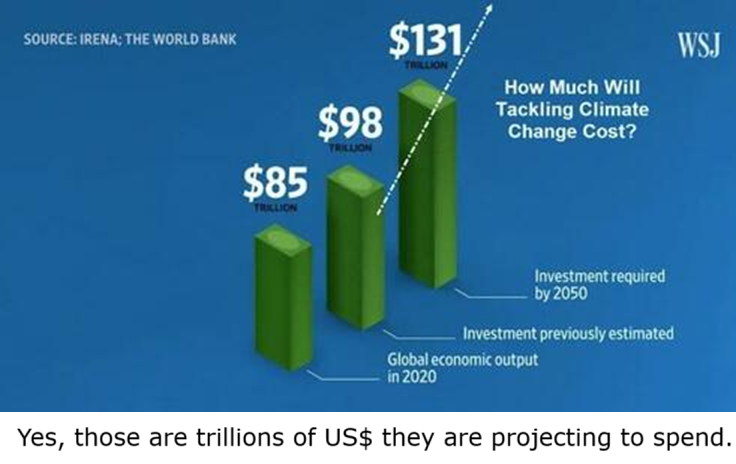
Climate science remains far from settled, yet trillions of dollars continue to be allocated toward policies aimed at mitigating extreme hypothetical warming scenarios based on potentially flawed GCM outputs. Historically, atmospheric CO2 levels have been 10 to 20 times higher than current concentrations during approximately 95% of Earth’s history since complex life emerged 600 million years ago (Davis, 2017). Notably, CO2 concentrations often lag temperature changes across different timescales, suggesting temperature fluctuations may drive CO2 variations rather than vice versa (Shakun et al., 2012; Koutsoyiannis, 2024).

Advancing climate science requires directly confronting uncertainties in detection, attribution, and modeling. Further research on unresolved issues is critical for improving climate risk assessment and developing more effective strategies for addressing future environmental challenges.


2025 Evidence of Nature’s Sunscreen

Greenhouse with adjustable sun screens to control warming.

2025 Updated Report on Global Dimming and Brightening Worldwide and in China 

Martin Wild et al published April 2025 A Perspective on Global Dimming and Brightening Worldwide and in China. Excerpts in italics with my bolds and added images.

Abstract

Worldwide radiation records suggest that the amount of sunlight received at the Earth’s surface (surface solar radiation, SSR) has not been stable over the years, but underwent significant decadal variations, popularly also known as “global dimming and brightening”. These variations have been particularly evident in China, where the SSR substantially declined from the 1960s to the 1990s (dimming), with indications for a trend reversal in the 2000s and a slight recovery (brightening) in recent years. This perspective/review paper will discuss recent updates and remaining challenges regarding our knowledge of the magnitudes, causes, and implications of these variations in SSR worldwide, with a particular emphasis on the developments in China.

Fig. 1. Qualitative tendencies in decadal SSR changes over theperiods 1950s to 1980s, 1980s to 2000, and post-2000 in different world regions that are well covered by historic SSR records.

Recent developments include the use of machine learning methods to spatially and temporally augment the limited worldwide in-situ SSR observational records (Yuan et al.,2021; Jiao et al., 2023). These methods generate spatially complete SSR datasets over the entire land surface (Fig. 2). Figure 2 shows some characteristic features of SSR trends during the 1985−2019 “brightening period”, such as the substantial brightening over Europe and the continuous dimming in India. It remains a challenge to fully assess the reliability of the trends of these machine learning-based estimations, particularly in regions that lack the constraints of in-situ radiation observations.

Fig. 2. Worldwide linear trends of the annual average SSR during the “brightening” period of 1985–2019 based on ground observations spatially augmented by machine learning methods [Reprinted from Yuan et al. (2021), © American Meteorological Society. Used with permission.]

Impacts in China

A number of studies have shown that changes in SSR have affected warming rates in China, particularly in terms of the mean and maximum 2-m air temperatures. Daily maximum temperatures were shown to increase less than daily minimum temperatures in China since the 1960s, particularly in the decades of strongest dimming, indicative of a dampening effect of SSR dimming, particularly on the daily maximum temperature warming rates most directly affected by SSR changes (Wang et al., 2012a; Du et al., 2017; Zhao et al., 2021). The evolution of daily maximum land surface (Ts-max) and 2-m air (Ta-max) temperatures averaged over China from the 1960s to 2003 is illustrated in Fig. 5 in terms of their annual means and the means of the warm and cold seasons (from Du et al., 2017).

Fig. 5. China-mean anomalies of daily maximum land surface temperature (Ts-max, blue line) and daily maximum air temperature (Ta-max, red line) for the (a) entire year, (b) warm season (May−October), and (c) cold season (November−April) with respect to the reference period 1961–90,based on 1977 stations [Reprinted from Du et al. (2017).]

Previous Post  Hard Evidence of Solar Impact upon Earth Cloudiness

Later on is a reprinted discussion of global dimming and brightness resulting from fluctuating cloud cover.  This is topical because of new empirical research findings coming out of Asia.  H/T GWPF.  A study published by Kobe University research center is Revealing the impact of cosmic rays on the Earth’s climate.  Excerpts in italics with my bolds.

New evidence suggests that high-energy particles from space known as galactic cosmic rays affect the Earth’s climate by increasing cloud cover, causing an “umbrella effect”.

When galactic cosmic rays increased during the Earth’s last geomagnetic reversal transition 780,000 years ago, the umbrella effect of low-cloud cover led to high atmospheric pressure in Siberia, causing the East Asian winter monsoon to become stronger. This is evidence that galactic cosmic rays influence changes in the Earth’s climate. The findings were made by a research team led by Professor Masayuki Hyodo (Research Center for Inland Seas, Kobe University) and published on June 28 in the online edition of Scientific Reports.

The Svensmark Effect is a hypothesis that galactic cosmic rays induce low cloud formation and influence the Earth’s climate. Tests based on recent meteorological observation data only show minute changes in the amounts of galactic cosmic rays and cloud cover, making it hard to prove this theory. However, during the last geomagnetic reversal transition, when the amount of galactic cosmic rays increased dramatically, there was also a large increase in cloud cover, so it should be possible to detect the impact of cosmic rays on climate at a higher sensitivity.

(The Svenmark Effect is explained in essay The cosmoclimatology theory)

How Nature’s Sunscreen Works (from Previous Post)

A recent post Planetary Warming: Back to Basics discussed a recent paper by Nikolov and Zeller on the atmospheric thermal effect measured on various planets in our solar system. They mentioned that an important source of temperature variation around the earth’s energy balance state can be traced to global brightening and dimming.

This post explores the fact of fluctuations in the amount of solar energy reflected rather than absorbed by the atmosphere and surface. Brightening refers to more incoming solar energy from clear and clean skies. Dimming refers to less solar energy due to more sunlight reflected in the atmosphere by the presence of clouds and aerosols (air-born particles like dust and smoke).

The energy budget above from ERBE shows how important is this issue. On average, half of sunlight is either absorbed in the atmosphere or reflected before it can be absorbed by the surface land and ocean. Any shift in the reflectivity (albedo) impacts greatly on the solar energy warming the planet.

The leading research on global brightening/dimming is done at
the Institute for Atmospheric and Climate Science of ETH Zurich,
led by Dr. Martin Wild, senior scientist specializing in the subject.

Special instruments have been recording the solar radiation that reaches the Earth’s surface since 1923. However, it wasn’t until the International Geophysical Year in 1957/58 that a global measurement network began to take shape. The data thus obtained reveal that the energy provided by the sun at the Earth’s surface has undergone considerable variations over the past decades, with associated impacts on climate.

The initial studies were published in the late 1980s and early 1990s for specific regions of the Earth. In 1998 the first global study was conducted for larger areas, like the continents Africa, Asia, North America and Europe for instance.

Now ETH has announced The Global Energy Balance Archive (GEBA) version 2017: A database for worldwide measured surface energy fluxes. The title is a link to that paper published in May 2017 explaining the facility and some principal findings. The Archive itself is at  http://www.geba.ethz.ch.

For example, Figure 2 below provides the longest continuous record available in GEBA: surface downward shortwave radiation measured in Stockholm since 1922. Five year moving average in blue, 4th order regression model in red. Units Wm-2. Substantial multidecadal variations become evident, with an increase up to the 1950s (“early brightening”), an overall decline from the 1950s to the 1980s (“dimming”), and a recovery thereafter (“brightening”).
Figure 5. Composite of 56 European GEBA time series of annual surface downward shortwave radiation (thin line) from 1939 to 2013, plotted together with a 21 year Gaussian low-pass filter ((thick line). The series are expressed as anomalies (in Wm-2) from the 1971–2000 mean. Dashed lines are used prior to 1961 due to the lower number of records for this initial period. Updated from Sanchez-Lorenzo et al. (2015) including data until December 2013.
Martin Wild explains in a 2016 article Decadal changes in radiative fluxes at land and ocean surfaces and their relevance for global warming. From the Conclusion (SSR refers to solar radiation incident upon the surface)

However, observations indicate not only changes in the downward thermal fluxes, but even more so in their solar counterparts, whose records have a much wider spatial and temporal coverage. These records suggest multidecadal variations in SSR at widespread land-based observation sites. Specifically, declining tendencies in SSR between the 1950s and 1980s have been found at most of the measurement sites (‘dimming’), with a partial recovery at many of the sites thereafter (‘brightening’).

With the additional information from more widely measured meteorological quantities which can serve as proxies for SSR (primarily sunshine duration and DTR), more evidence for a widespread extent of these variations has been provided, as well as additional indications for an overall increasing tendency in SSR in the first part of the 20th century (‘early brightening’).

It is well established that these SSR variations are not caused by variations in the output of the sun itself, but rather by variations in the transparency of the atmosphere for solar radiation. It is still debated, however, to what extent the two major modulators of the atmospheric transparency, i.e., aerosol and clouds, contribute to the SSR variations.

The balance of evidence suggests that on longer (multidecadal) timescales aerosol changes dominate, whereas on shorter (decadal to subdecadal) timescales cloud effects dominate. More evidence is further provided for an increasing influence of aerosols during the course of the 20th century. However, aerosol and clouds may also interact, and these interactions were hypothesized to have the potential to amplify and dampen SSR trends in pristine and polluted areas, respectively.

No direct observational records are available over ocean surfaces. Nevertheless, based on the presented conceptual ideas of SSR trends amplified by aerosol–cloud interactions over the pristine oceans, modeling approaches as well as the available satellite-derived records it appears plausible that also over oceans significant decadal changes in SSR occur.

The coinciding multidecadal variations in SSTs and global aerosol emissions may be seen as a smoking gun, yet it is currently an open debate to what extent these SST variations are forced by aerosol-induced changes in SSR, effectively amplified by aerosol– cloud interactions, or are merely a result of unforced natural variations in the coupled ocean atmosphere system. Resolving this question could state a major step toward a better understanding of multidecadal climate change.

Another paper co-authored by Wild discusses the effects of aerosols and clouds The solar dimming/brightening effect over the Mediterranean Basin in the period 1979 − 2012. (NSWR is Net Short Wave Radiation, that is equal to surface solar radiation less reflected)

The analysis reveals an overall increasing trend in NSWR (all skies) corresponding to a slight solar brightening over the region (+0.36 Wm−2per decade), which is not statistically significant at 95% confidence level (C.L.). An increasing trend(+0.52 Wm−2per decade) is also shown for NSWR under clean skies (without aerosols), which is statistically significant (P=0.04).

This indicates that NSWR increases at a higher rate over the Mediterranean due to cloud variations only, because of a declining trend in COD (Cloud Optical Depth). The peaks in NSWR (all skies) in certain years (e.g., 2000) are attributed to a significant decrease in COD (see Figs. 9 and 10), whilethe two data series (NSWRall and NSWRclean) are highly correlated(r=0.95).

This indicates that cloud variation is the major regulatory factor for the amount and multi-decadal trends in NSWR over the Mediterranean Basin. (Note: Lower cloud optical depth is caused by less opaque clouds and/or decrease in overall cloudiness)

On the other hand, the results do not reveal a reversal from dimming to brightening during 1980s, as shown in several studies over Europe (Norris and Wild, 2007;Sanchez-Lorenzoet al., 2015), but a rather steady slight increasing trend in solar radiation, which, however, seems to be stabilized during the last years of the data series, in agreement with Sanchez-Lorenzo et al. (2015). Similarly, Wild (2012) reported that the solar brightening was less distinct at European sites after 2000 compared to the 1990s.

In contrast, the NSWR under clear (cloudless) skies shows a slight but statistically significant decreasing trend (−0.17 Wm−2per decade,P=0.002), indicating an overall decrease in NSWR over the Mediterranean due to water-vapor variability suggesting a transition to more humid environment under a warming climate.

Other researchers find cloudiness more dominant than aerosols. For example, The cause of solar dimming and brightening at the Earth’s surface during the last half century: Evidence from measurements of sunshine duration by Gerald Stanhill et al.

Analysis of the Angstrom-Prescott relationship between normalized values of global radiation and sunshine duration measured during the last 50 years made at five sites with a wide range of climate and aerosol emissions showed few significant differences in atmospheric transmissivity under clear or cloud-covered skies between years when global dimming occurred and years when global brightening was measured, nor in most cases were there any significant changes in the parameters or in their relationships to annual rates of fossil fuel combustion in the surrounding 1° cells. It is concluded that at the sites studied changes in cloud cover rather than anthropogenic aerosols emissions played the major role in determining solar dimming and brightening during the last half century and that there are reasons to suppose that these findings may have wider relevance.

Summary

The final words go to Martin Wild from Enlightening Global Dimming and Brightening.

Observed Tendencies in surface solar radiation
Figure 2.  Changes in surface solar radiation observed in regions with good station coverage during three periods.(left column) The 1950s–1980s show predominant declines (“dimming”), (middle column) the 1980s–2000 indicate partial recoveries (“brightening”) at many locations, except India, and (right column) recent developments after 2000 show mixed tendencies. Numbers denote typical literature estimates for the specified region and period in W m–2 per decade.  Based on various sources as referenced in Wild (2009).

The latest updates on solar radiation changes observed since the new millennium show no globally coherent trends anymore (see above and Fig. 2). While brightening persists to some extent in Europe and the United States, there are indications for a renewed dimming in China associated with the tremendous emission increases there after 2000, as well as unabated dimming in India (Streets et al. 2009; Wild et al. 2009).

We cannot exclude the possibility that we are currently again in a transition phase and may return to a renewed overall dimming for some years to come.

One can’t help but see the similarity between dimming/brightening and patterns of Global Mean Temperature, such as HadCrut.

Footnote: For more on clouds, precipitation and the ocean, see Here Comes the Rain Again

It’s Summertime, Hottest Year Claims Ensue

Matthew Wielicki explains the scientific malpractice in his Financial Post article Junk Science Week: The hottest year ever?.  Excerpts in italics wtih my bolds and added images

Advocates and the media claim 2024 was the hottest year ever.
Archeological data suggest it wasn’t,
while modern data suffer from biases

An image produced by NASA and used when it declared 2024 as the warmest year on record. Photo by NASA

In 2024, mainstream media and political leaders aggressively promoted the alarming narrative that Earth had just experienced its hottest year ever recorded. National Geographic dramatically proclaimed, “2024 was the hottest year ever … and the coldest year of the rest of your life,” while the Vancouver Sun declared unequivocally, “Scientists confirm 2024 was Canada’s and world’s hottest year on record.” Canadian political figures reinforced this narrative, with prime minister Justin Trudeau characterizing the year’s warmth as an urgent call for immediate climate action.

I’m an earth science professor-in-exile. Claims such as these
immediately provoke critical skepticism.

This persistent narrative, relentlessly advanced by a powerful climate-industrial complex comprising governments, activist organizations and the media, is designed not merely to inform, but to generate a state of perpetual urgency. As global greenhouse gas (GHG) emissions continue to rise despite decades of climate policy interventions, the need to claim climate conditions are increasingly severe becomes a strategic imperative, regardless of scientific accuracy or historical context. This approach not only distorts genuine scientific inquiry but fosters anxiety and despair, particularly affecting young people already inundated with predictions of catastrophe.

The answers to four fundamental questions expose the weaknesses and biases inherent in the mainstream climate narrative:

1. Can we accurately measure historical global temperatures?

Claims about unprecedented global heat depend heavily on comparing modern temperature records, which are gathered by instrument and capture annual or monthly fluctuations, to historical temperature estimates derived from proxy data such as ice cores, tree rings, sediment layers and coral reefs. But proxy data inherently smooths out short-term fluctuations, providing generalized temperature estimates spanning centuries or millennia. This mismatch between high-resolution modern data and low-resolution historical proxies inevitably exaggerates the perceived severity of contemporary warming.

For example, widely cited reconstructions and favourites of The Intergovernmental Panel on Climate Change (IPCC) explicitly acknowledge their inability to capture temperature variability occurring over periods shorter than 300 years. The rapid temperature changes of recent decades appear unprecedented when put side by side with these smoothed historical averages. This methodological flaw significantly undermines the credibility of claims asserting that current global temperatures are historically unique or alarming.

2. Was 2024 really unprecedentedly warm?

Extensive historical and geological evidence demonstrates significant natural warming vastly exceeding modern temperatures. The Holocene Thermal Maximum (five to nine thousand years ago) saw temperatures significantly warmer than today, including in Canada. Archeological evidence, such as ancient forests revealed by retreating glaciers in the Rockies, conclusively supports periods of substantial natural warmth.

During the Eemian interglacial period (115-130 thousand years ago), Greenland experienced temperatures three to five degrees C warmer than now, despite substantially lower CO₂ concentrations in the atmosphere. These scientifically documented periods confirm that Earth’s climate naturally experiences considerable variability, rendering claims of unprecedented modern warmth scientifically untenable and historically uninformed.

3. Are we measuring the effects of CO₂ or urban heat islands

Most modern temperature records fuelling alarmist headlines originate from urban areas influenced by the Urban Heat Island Effect (UHIE). UHIE results from urban infrastructure, such as concrete, asphalt and buildings, retaining and radiating heat, significantly increasing local temperatures independent of broader climate trends. Toronto’s significant infrastructure growth has noticeably raised local temperatures, heavily skewing data. Similarly, Las Vegas’ highest recorded temperatures coincided with significant expansion around Harry Reid International Airport, illustrating the dominant role of urbanization rather than atmospheric CO₂ emissions.

Recent research indicates that up to 65 per cent of urban warming is from local urbanization rather than global greenhouse gas increases. Attributing urban heat predominantly to CO₂ emissions significantly misrepresents the true dynamics of local temperature increases.

4. Do rising CO2 levels really heat the oceans?

Recent alarmist coverage in outlets like the Financial Times highlights near-record ocean temperatures, linking them directly to rising CO₂ levels. The EU’s Copernicus programme noted that May 2025 ocean temperatures were the second highest ever recorded, with scientists raising concerns about the oceans’ diminishing capacity to absorb CO₂ and excess heat.

But this narrative critically overlooks fundamental scientific facts. Oceans possess a heat capacity orders of magnitude greater than the atmosphere. The notion that atmospheric CO₂ significantly heats ocean water directly is scientifically unfounded, as infrared radiation from CO₂ penetrates mere millimetres into the ocean’s surface, not nearly deep enough to meaningfully alter ocean temperature. Ocean temperature fluctuations are primarily driven by natural phenomena such as El Niño.

Furthermore, going back to previous warmings prior to the satellite record shows that the entire rise of 0.8C since 1947 is due to oceanic, not human activity.

Moreover, historical data on ocean temperatures is highly uncertain, relying predominantly on sparse measurements and indirect proxies. Claiming near-record ocean temperatures without acknowledging these substantial uncertainties misleads the public about the robustness and reliability of these measurements.

Critical conclusion: One thing remains certain: it will never be “too hot” in Canada, despite alarmist rhetoric suggesting otherwise. The exaggerated claims that 2024 was “the hottest year ever” are not grounded in rigorous scientific analysis but serve primarily as political and ideological propaganda. This relentless propagation of fear fosters anxiety, despair, and nihilism, especially among young people — serious consequences largely ignored by climate alarmists.

The scientific community, policy-makers and the public at large need to insist on transparency, rigour and honesty in climate discourse. Recognizing the motivations behind alarmist claims is essential to ensuring public trust and effective policy. Climate science should strive to educate, not frighten, promoting balanced understanding rather than catastrophic narratives disconnected from historical context and scientific rigour.

Matthew Wielicki, Ph.D. in geochemistry from UCLA, publishes the Substack site Irrational Fear, which provides data-driven critiques aimed at fostering a balanced and scientifically grounded understanding of climate science.

Rupert Darwall: World Leaders Took a Wrong Turn

Rupert Darwall examines when and why the world has gone wrong this century, pinpointing a fundamental error needing correction. Excerpts of the transcript are in italics lightly edited with my bolds and added images. [MM refers to the interviewer, Maggie Miller, and RD refers to Rupert Darwall.]

MM: I’m joined now by Rupert Darwall, author of The Age of Error, Net Zero and The Destruction of the West. Thank you for joining me here today. Although you’re not a speaker here at this event I feel like your book speaks to what we are talking about. So it’s important to take some time to discuss this. For those who might be unfamiliar, would you talk about your book and what are the key takeaways?

RD: Yes, going back in time a bit, I had this sensation where I didn’t understand the way things were going in the world. Perhaps other people might have a a similar kind of feeling. And then the penny dropped. We live in an age of error. And once you understood that, everything started to fall in place. As a result of that, I decided to write a book on the age of error, which is essentially what the book’s about.

MM: When you think about the age of error, when do you think it began, can you set a date to that precisely?

RD: Yes I think I can. Because in 2006 there was the meeting of the G8 which was in St Petersburg hosted by Vladimir Putin. And the leaders of the west along with Vladimir Putin signed up to a document called the St. Petersburg Principles of Energy Security. In that document the leaders of the west said that that they needed to invest trillions of dollars across all the value chain, the whole oil and gas value chain.

We can see there in the summer of 2006, the leaders of the west understood energy realism. This was a realistic response to what was happening in the first decade of the 21st century. Oil prices had been rising quite strongly. Since the 1980s there had been a two decade run of falling energy prices that started to reverse. And higher energy prices were of course causing real concern to the economy and also to energy security.

So in 2006 we can say that was energy realism. People such as the leaders of the west had their heads screwed on straight. By 2009, after the global financial crisis of 2008 and the election of Barack Obama also in 2008, we then had the L’Aquila G8 meeting. And there the leaders of the west signed up to a green recovery and the realism that you’d seen three years earlier had completely gone. So yes one can date this really quite precisely.

MM: Sounds very interesting. What would you say is the biggest error that the west has made?

RD: I think the biggest error is personified by John Kerry. People like John Kerry believe that history is over, that is the history of the rise and fall and competition of great powers is over. And now the world together faces the prospect of climate catastrophe, a planetary catastrophe. So that the world must come together, bury their rivalries. We all come together at the Paris climate conference and we agree to decarbonize.

That to my mind is the biggest error of the age because history has not ended. Geopolitics still continues. We saw that in 2014 when Vladimir Putin seized Crimea, and most of all we saw that in February 2022 when he invaded Ukraine. And the error is that by believing in the catastrophe vision of the world, you will lose the geopolitics. Because there is no way that you can decarbonize your economy and still compete in a geopolitical world. You will basically lose, the west will lose to China.

MM: So what are the consequences for America and Europe?

RD: I would distinguish between America and Europe because after the financial crisis one thing that America had one thing going for it, which was a really really big thing, that was hydraulic fracturing and horizontal drilling– the shale revolution. And that turbocharged economic growth in the years following the financial crisis. It was driven a lot by falling energy prices and by the shale revolution.

Europe on the other hand has really strongly embraced net zero. It really believes that decarbonization is the path to economic growth and that is a complete fantasy. You can’t do both. You cannot have economic growth and at the same time starve yourself of of energy.

So I think America is in a different position because of the energy revolution, and moreover there’s always been a debate in America about climate change. So there’s always been a strong trend to towards energy realism, which obviously one sees now very strongly in in the Trump administration.  Figures like Chris Wright personify energy realism and and the energy opportunity.

Europe has real real deep, deep problems, since it has drunk from the well of net zero very deeply. And it’s going to take a lot to get it off. I mean by a lot, it’s going to take very high prices, very weak economy. It simply can cannot generate the resources it needs to defend itself from a more aggressive Russia.

MM: What are you looking forward to now, what have you set your sight on?

RD: In terms of the book, I’ve written 17 chapters and the book will be 20 chapters. I’m looking forward to putting finish on chapter 20 and submitting the manuscript. Getting the book out is important because I think it speaks very strongly to the current situation we’re in.

May 2025 Two Years of Ocean Cooling Persists

The best context for understanding decadal temperature changes comes from the world’s sea surface temperatures (SST), for several reasons:
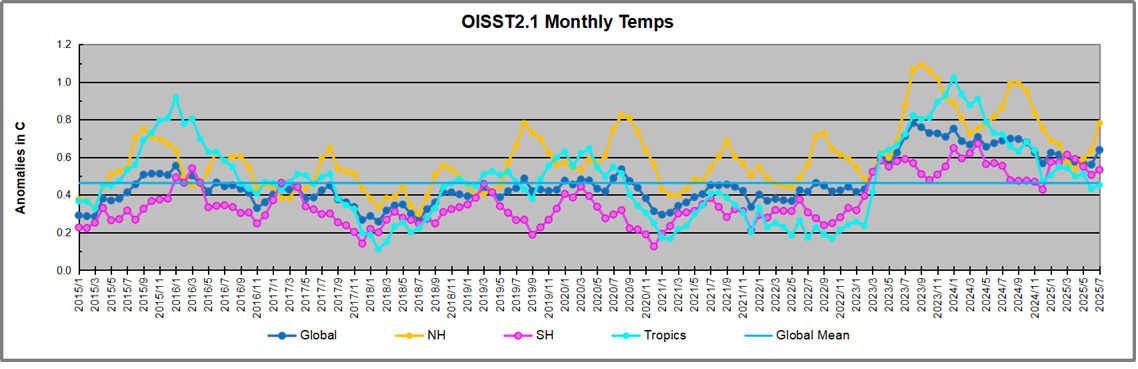
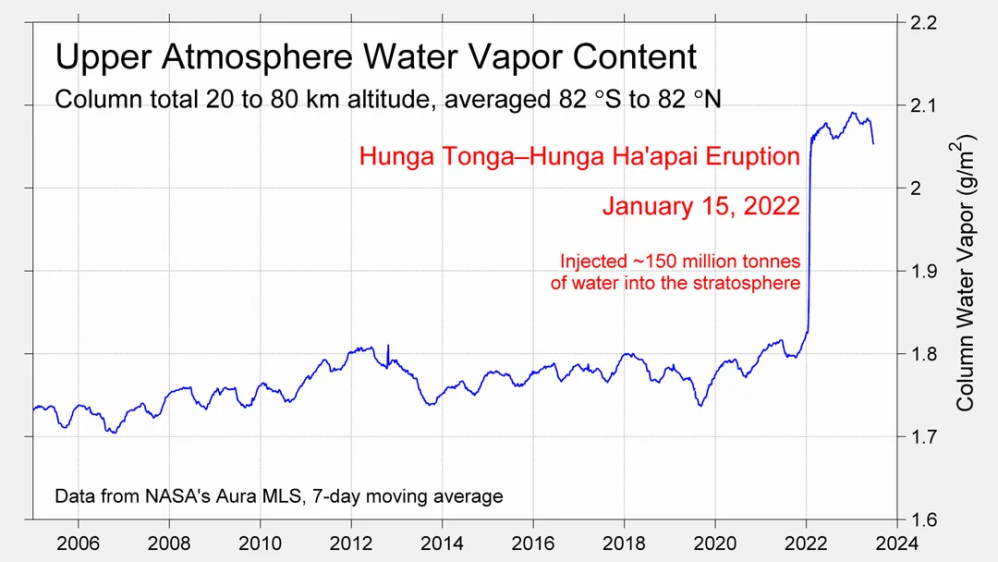
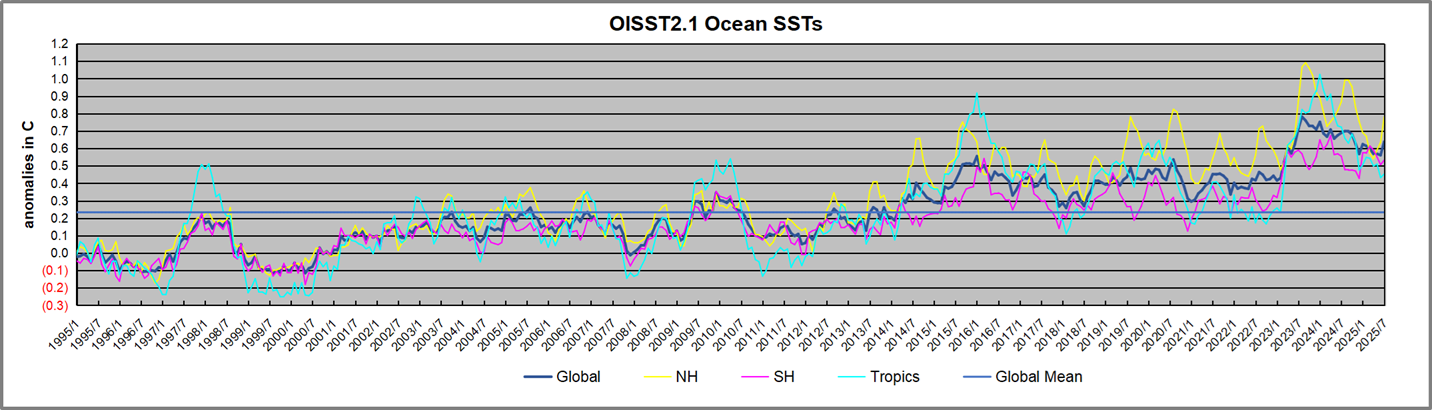
  • The ocean covers 71% of the globe and drives average temperatures;
  • SSTs have a constant water content, (unlike air temperatures), so give a better reading of heat content variations;
  • A major El Nino was the dominant climate feature in recent years.

HadSST is generally regarded as the best of the global SST data sets, and so the temperature story here comes from that source. Previously I used HadSST3 for these reports, but Hadley Centre has made HadSST4 the priority, and v.3 will no longer be updated.  HadSST4 is the same as v.3, except that the older data from ship water intake was re-estimated to be generally lower temperatures than shown in v.3.  The effect is that v.4 has lower average anomalies for the baseline period 1961-1990, thereby showing higher current anomalies than v.3. This analysis concerns more recent time periods and depends on very similar differentials as those from v.3 despite higher absolute anomaly values in v.4.  More on what distinguishes HadSST3 and 4 from other SST products at the end. The user guide for the current version HadSST4.1.1.0 is here.   The charts and analysis below is produced from the current data.

The Current Context

The chart below shows SST monthly anomalies as reported in HadSST4 starting in 2015 through May 2025. A global cooling pattern is seen clearly in the Tropics since its peak in 2016, joined by NH and SH cycling downward since 2016, followed by rising temperatures in 2023 and 2024.

Note that in 2015-2016 the Tropics and SH peaked in between two summer NH spikes.  That pattern repeated in 2019-2020 with a lesser Tropics peak and SH bump, but with higher NH spikes. By end of 2020, cooler SSTs in all regions took the Global anomaly well below the mean for this period.  A small warming was driven by NH summer peaks in 2021-22, but offset by cooling in SH and the tropics, By January 2023 the global anomaly was again below the mean.

Then in 2023-24 came an event resembling 2015-16 with a Tropical spike and two NH spikes alongside, all higher than 2015-16. There was also a coinciding rise in SH, and the Global anomaly was pulled up to 1.1°C last year, ~0.3° higher than the 2015 peak.  Then NH started down autumn 2023, followed by Tropics and SH descending 2024 to the present. After 12 months of cooling in SH and the Tropics, the Global anomaly came back down, led by NH cooling the last 8 months from its 1.3C peak in August, down to 0.8C in March and April.  Remarkably, April 2025 SST anomalies in all regions and globally are the coolest since March 2023.  May shows little change in the Global anomaly, with a SH decline offsetting an upward bump in NH.

Comment:

The climatists have seized on this unusual warming as proof their Zero Carbon agenda is needed, without addressing how impossible it would be for CO2 warming the air to raise ocean temperatures.  It is the ocean that warms the air, not the other way around.  Recently Steven Koonin had this to say about the phonomenon confirmed in the graph above:

El Nino is a phenomenon in the climate system that happens once every four or five years.  Heat builds up in the equatorial Pacific to the west of Indonesia and so on.  Then when enough of it builds up it surges across the Pacific and changes the currents and the winds.  As it surges toward South America it was discovered and named in the 19th century  It iswell understood at this point that the phenomenon has nothing to do with CO2.

Now people talk about changes in that phenomena as a result of CO2 but it’s there in the climate system already and when it happens it influences weather all over the world.   We feel it when it gets rainier in Southern California for example.  So for the last 3 years we have been in the opposite of an El Nino, a La Nina, part of the reason people think the West Coast has been in drought.

It has now shifted in the last months to an El Nino condition that warms the globe and is thought to contribute to this Spike we have seen. But there are other contributions as well.  One of the most surprising ones is that back in January of 2022 an enormous underwater volcano went off in Tonga and it put up a lot of water vapor into the upper atmosphere. It increased the upper atmosphere of water vapor by about 10 percent, and that’s a warming effect, and it may be that is contributing to why the spike is so high.

A longer view of SSTs

To enlarge image, open in new tab.

The graph above is noisy, but the density is needed to see the seasonal patterns in the oceanic fluctuations.  Previous posts focused on the rise and fall of the last El Nino starting in 2015.  This post adds a longer view, encompassing the significant 1998 El Nino and since.  The color schemes are retained for Global, Tropics, NH and SH anomalies.  Despite the longer time frame, I have kept the monthly data (rather than yearly averages) because of interesting shifts between January and July. 1995 is a reasonable (ENSO neutral) starting point prior to the first El Nino.

The sharp Tropical rise peaking in 1998 is dominant in the record, starting Jan. ’97 to pull up SSTs uniformly before returning to the same level Jan. ’99. There were strong cool periods before and after the 1998 El Nino event. Then SSTs in all regions returned to the mean in 2001-2.

SSTS fluctuate around the mean until 2007, when another, smaller ENSO event occurs. There is cooling 2007-8,  a lower peak warming in 2009-10, following by cooling in 2011-12.  Again SSTs are average 2013-14.

Now a different pattern appears.  The Tropics cooled sharply to Jan 11, then rise steadily for 4 years to Jan 15, at which point the most recent major El Nino takes off.  But this time in contrast to ’97-’99, the Northern Hemisphere produces peaks every summer pulling up the Global average.  In fact, these NH peaks appear every July starting in 2003, growing stronger to produce 3 massive highs in 2014, 15 and 16.  NH July 2017 was only slightly lower, and a fifth NH peak still lower in Sept. 2018.

The highest summer NH peaks came in 2019 and 2020, only this time the Tropics and SH were offsetting rather adding to the warming. (Note: these are high anomalies on top of the highest absolute temps in the NH.)  Since 2014 SH has played a moderating role, offsetting the NH warming pulses. After September 2020 temps dropped off down until February 2021.  In 2021-22 there were again summer NH spikes, but in 2022 moderated first by cooling Tropics and SH SSTs, then in October to January 2023 by deeper cooling in NH and Tropics.

Then in 2023 the Tropics flipped from below to well above average, while NH produced a summer peak extending into September higher than any previous year.  Despite El Nino driving the Tropics January 2024 anomaly higher than 1998 and 2016 peaks, following months cooled in all regions, and the Tropics continued cooling in April, May and June along with SH dropping.  After July and August NH warming again pulled the global anomaly higher, September through January 2025 resumed cooling in all regions, continuing February through April 2025, with little change in May.

What to make of all this? The patterns suggest that in addition to El Ninos in the Pacific driving the Tropic SSTs, something else is going on in the NH.  The obvious culprit is the North Atlantic, since I have seen this sort of pulsing before.  After reading some papers by David Dilley, I confirmed his observation of Atlantic pulses into the Arctic every 8 to 10 years.

Contemporary AMO Observations

Through January 2023 I depended on the Kaplan AMO Index (not smoothed, not detrended) for N. Atlantic observations. But it is no longer being updated, and NOAA says they don’t know its future.  So I find that ERSSTv5 AMO dataset has current data.  It differs from Kaplan, which reported average absolute temps measured in N. Atlantic.  “ERSST5 AMO  follows Trenberth and Shea (2006) proposal to use the NA region EQ-60°N, 0°-80°W and subtract the global rise of SST 60°S-60°N to obtain a measure of the internal variability, arguing that the effect of external forcing on the North Atlantic should be similar to the effect on the other oceans.”  So the values represent SST anomaly differences between the N. Atlantic and the Global ocean.

The chart above confirms what Kaplan also showed.  As August is the hottest month for the N. Atlantic, its variability, high and low, drives the annual results for this basin.  Note also the peaks in 2010, lows after 2014, and a rise in 2021. Then in 2023 the peak was holding at 1.4C before declining.  An annual chart below is informative:

Note the difference between blue/green years, beige/brown, and purple/red years.  2010, 2021, 2022 all peaked strongly in August or September.  1998 and 2007 were mildly warm.  2016 and 2018 were matching or cooler than the global average.  2023 started out slightly warm, then rose steadily to an  extraordinary peak in July.  August to October were only slightly lower, but by December cooled by ~0.4C.

Then in 2024 the AMO anomaly started higher than any previous year, then leveled off for two months declining slightly into April.  Remarkably, May showed an upward leap putting this on a higher track than 2023, and rising slightly higher in June.  In July, August and September 2024 the anomaly declined, and despite a small rise in October, ended close to where it began.  Note 2025 started much lower than the previous year and is headed sharply downward, well below the previous two years, now in May aligning with 2010.

The pattern suggests the ocean may be demonstrating a stairstep pattern like that we have also seen in HadCRUT4.

The purple line is the average anomaly 1980-1996 inclusive, value 0.17.  The orange line the average 1980-2024, value 0.38, also for the period 1997-2012. The red line is 2013-2024, value 0.67. As noted above, these rising stages are driven by the combined warming in the Tropics and NH, including both Pacific and Atlantic basins.

Curiosity:  Solar Coincidence?

The news about our current solar cycle 25 is that the solar activity is hitting peak numbers now and higher  than expected 1-2 years in the future.  As livescience put it:  Solar maximum could hit us harder and sooner than we thought. How dangerous will the sun’s chaotic peak be?  Some charts from spaceweatherlive look familar to these sea surface temperature charts.

Summary


The oceans are driving the warming this century.  SSTs took a step up with the 1998 El Nino and have stayed there with help from the North Atlantic, and more recently the Pacific northern “Blob.”  The ocean surfaces are releasing a lot of energy, warming the air, but eventually will have a cooling effect.  The decline after 1937 was rapid by comparison, so one wonders: How long can the oceans keep this up? And is the sun adding forcing to this process?

Footnote: Why Rely on HadSST4

HadSST is distinguished from other SST products because HadCRU (Hadley Climatic Research Unit) does not engage in SST interpolation, i.e. infilling estimated anomalies into grid cells lacking sufficient sampling in a given month. From reading the documentation and from queries to Met Office, this is their procedure.

HadSST4 imports data from gridcells containing ocean, excluding land cells. From past records, they have calculated daily and monthly average readings for each grid cell for the period 1961 to 1990. Those temperatures form the baseline from which anomalies are calculated.

In a given month, each gridcell with sufficient sampling is averaged for the month and then the baseline value for that cell and that month is subtracted, resulting in the monthly anomaly for that cell. All cells with monthly anomalies are averaged to produce global, hemispheric and tropical anomalies for the month, based on the cells in those locations. For example, Tropics averages include ocean grid cells lying between latitudes 20N and 20S.

Gridcells lacking sufficient sampling that month are left out of the averaging, and the uncertainty from such missing data is estimated. IMO that is more reasonable than inventing data to infill. And it seems that the Global Drifter Array displayed in the top image is providing more uniform coverage of the oceans than in the past.

uss-pearl-harbor-deploys-global-drifter-buoys-in-pacific-ocean

USS Pearl Harbor deploys Global Drifter Buoys in Pacific Ocean