Woke Capitalists: Corporate Vigilantes

Some recent reports note a disturbing trend in large and influential corporations. Having worked in and for some of these, I believe the incidents show a dangerous virus is mutating from academia to the workplace. The import of these developments is not good for free enterprise or for individual freedoms.

Warning bells in the past concerned punative efforts against some employees to silence their discomforting opinions. For example James Damore was fired by Google for saying that staffing with the most competent techies is more important than gender hiring quotas. Now it appears such events are not atypical, but reflect a systemic takeover of corporate cultures.

Rod Dreher writes at American Conservative Woke Capitalism Is Our Enemy. Excerpts in italics with my bolds.

Pro tip: whenever you hear a management type talk about “diversity” and “inclusion,” you may be certain that you are about to hear a rationale for creating a more ideologically uniform and ideologically exclusive community.

A reader has sent me internal documents from a leading global corporation having to do with its employee program to create a Diverse and Inclusive culture. I am not allowed to quote from the documents, or to identify the company, so I’m going to be delicate here in what I describe, to honor the reader’s request to protect privacy. The reader said:

It confirms what you have been saying all along. You are absolutely correct about the “soft totalitarianism” that is coming. It’s already happening, and it’s picking up speed.

The documents are pretty shocking to my eyes, because I know what I’m looking at. It is 100 percent, pure, uncut Human Resources Department cant. What’s so amazing about it — truly amazing — is that it is all about coercing people into accepting and participating in a cultural revolution by redefining the revolution’s goals and methods as good for business, and a chance for employees to exercise virtue.

This particular company’s program is far more sophisticated and thorough than anything I’ve seen before. It is totalitarian in the sense that it encompasses nearly every aspect of life in the company. From reading these documents, you would think that the purpose of this company is to shape the cultural politics and behavior of its employees. I’m not kidding you: it’s like a church organization trying to catechize and discipline its employees in true religion — and part of that discipline is urging them to police their own ranks for heretics. It even instructs employees to conduct struggle sessions within themselves to root out false beliefs that undermine Diversity and Inclusion.

Though it’s stated in happy-clappy HR jargon, it’s clear that the company is training its employees to monitor each other for signs of bias, and encouraging them to call out each other. Incredible. It’s the Stasification of the American workplace. And the program instructs employees to think and talk about Diversity and Inclusion all the time, in everything they do. Seriously, it does. If I were an employee there, I would find all this completely unnerving. I would wonder constantly if I were being monitored by my co-workers and judged for not showing enough commitment to Diversity and Inclusion. I would watch what I said, but also worry about what I did not say. It would make me a nervous wreck.

Again, I’m not going to name the company or give identifying details about the program. I am quite confident that what I’ve said here describes the internal culture many corporations are building. I’m sure many of you readers are thinking, “That sounds like where I work.” It is coercive, and it is totalitarian. It is going to create massive suspicion and mistrust within companies that do this, in part because it is going to empower members of particular groups to harass others in the workplace, to inform on others, and even to affect their salaries and impede their career advancement.

Get this: the way this particular program is set up, you don’t have to participate, but failing to do so will be noted, and it’s going to affect your pay. It’s not enough to sign up for the program in a pro forma way, and then simply be quiet about it. You are expected to be an active, vocal advocate of its principles. From what I can tell, it appears that they have the rudiments of a Chinese-style Social Credit System structure to monitor employee enthusiasm.

You might be a first-rate maker of widgets for this corporation, or a superb sales executive, manager, whatever, and you may be a diligent employee who is honest and works well with others. But if you are not 100 percent aboard the Party’s company’s ideological campaign for cultural revolution, it will go down in your employee record, and it will affect your future at the company.

When you see these documents, and realize that this is how it is inside one of the world’s leading corporations, you know perfectly well that this is quickly going to become normative in corporations, if it isn’t already. What kind of future do any of us deplorables (or our kids) have in corporate life when workplaces become communities of coerced wokeness?

What? Have you no respect for diversity?

Let me put it to you like this. If this were the US Government, and it pushed “patriotism” on its employees following the same platform and methods that this corporation is pushing “diversity and inclusion,” people would freak out at the coerciveness and invasion of privacy. And they would be right to! Imagine that you, a US government employee, were told to monitor yourself constantly to root out a lack of patriotism. How … Soviet would that feel? Well, that’s what this corporation is doing to its employees regarding diversity and inclusion.

The familiar left vs. right categories no longer serve as reliable guides to our cultural reality. The cultural left has captured the bureaucracies at American corporations. One thing we hear a lot from our friends on the left is that Big Business is conservative, and would never do anything that would hurt its bottom line. Wrong! I have seen personally how companies will do politically correct things that actually hurt their business model, but that win its management pats on the back among their social cohort. These documents I looked at today assert — assert, do not argue — that the total politicization of the company’s culture is critical to its business success … and then go on to describe a program that is almost certainly going to cause major problems with teamwork, cohesiveness, and conflict. These documents are a recipe for creating intense anxiety and suspicion within the company. It’s as clear as day. You cannot imagine why any sensible company would embrace these principles and techniques, which can only hurt its ability to compete. But there it is, in black and white.

Woke capitalism is a vanguard of unfreedom. It’s happening. We have to be prepared to resist.

My Comment

I have done consulting with enough HR departments to know that they are not power centers in companies, but are seen rather as administrative overhead. The line operations make or break the bottom line, and there the credo of middle managers still holds: “Whatever interests my boss, thrills the hell out of me.” Thus in any company where HR is going viral with social justice, diversity inclusion and the rest of it, it can only happen if HR is carrying water for the CEO and everyone knows it.

That appears to be the case, as described by Nick Dedeke in his article at Real Clear Poliitcs Is Corporate Vigilantism a Threat to Democracy? Excerpts in italicss with my bolds.

A serious issue has gained prominence in modern society the last few years: The executives and/or founders of large companies increasingly consider it their civic and moral duty to use the influences and powers of their businesses to censor or suppress political and/or inconvenient ideas they do not support or find offensive. This mindset is reflected in the following statement from PayPal CEO Daniel Schulman: “Businesses need to be a force for good in those values and issues that they believe in.” Taken in isolation, this is a very good philosophy. However, one needs to also examine the implications of it in practice.

Recently, PayPal decided to stop processing financial transactions for customers it deemed to have hateful political views. Not long ago, MasterCard and Visa refused to process any donations to David Horowitz’s Freedom Center, a conservative nonprofit. The crime? Horowitz had personal and/or political views that were judged by the credit card companies to be hateful. YouTube has banned some Prager University (PragerU) videos (PragerU is not a higher learning institution, but a nonprofit that promulgates conservative views.) Selected content from conservatives, Christian and some liberal-leaning groups has also been removed from social media and the accounts of the targets were deleted or deactivated.

The motivation for these actions is the desire of the executives of these companies to be “good” by punishing the “bad.” These executives, and their supporters, declare that their actions are protected by the laws of the United States of America, which they claim permit them to run their private businesses any way they deem fit.

Two questions need to be asked. First, does a private business have a boundary? If so, where is it? These are critical questions that need to be answered. Without defining the boundary of the modern business, we are likely going to alter, in negative ways, the civic foundations of our society. I do agree that a business should be allowed to have maximum freedom to be run as its founder sees fit. However, I also believe that the boundary of a business has to be limited to its business charter. PayPal has a charter to process payments for society; it does not have a charter to make society “good.”

I argue that many of the well-intentioned actions taken by executives of large corporations fall under what one could call corporate vigilantism. In a notable academic analysis, Les Johnston identified six criteria that are common to most vigilantism. (1) there is planning and premeditation by those engaged in such actions; (2) the actors are private citizens acting voluntarily; (3) the actors view their actions as “autonomous citizenship”; (4) the actors use or threaten to use force and pressure against targets; (5) the actors go into action to protect an established or new order from actual, potential or imputed transgressions; (6) the actors aim to control crime or other social infractions.

It should be noted that vigilantism is not new. It is likely the most popular form of justice in countries in which there are no mature civil institutions. However, vigilantism is a danger wherever it is found. There are three reasons for this. First is that it violates a basic organizing principle of society — namely, that institutions are only allowed to perform duties for which they have a societal mandate. There is no known societal law or mandate that empowers a corporate executive to be the vanguard of moral actions, choices and speech in society.

Second, vigilantism violates the essential principle of separation of powers, which is so essential to the norms of justice. In most vigilante processes, the same institution or group of people constitutes the judge, jury and executioner. Hence, the vigilante system has, by design, inherent, embedded and systemic biases.

Third, the vigilante process is not equipped to recognize its own biases. When asked about how PayPal, in collaboration with the controversial Southern Poverty Law Center, determines when to decline services to customers, Schulman told the Wall Street Journal: “We don’t always agree. We have our debates with [SPLC]. We are very respectful with everyone coming in. We will do the examination carefully. We’ll talk when we don’t agree with a finding: We understand why you think that way, but it still goes into the realm of free speech for us.” Despite this claim of evenhandedness, however, the majority of blocked customers are right-leaning groups and individuals.

A common protest is raised when one questions corporate vigilantism. People often respond by asking, “But, it is their business, isn’t it?” Yes, it is. But, society still has a role to play if and when the pursuit of private business’s self-interest is in conflict with major interests of its customers or the public. That is why regulations were enacted when we realized that private businesses were polluting rivers and other water resources. That is why the new, and stricter, European General Data Protection Regulation was enacted. That is why there is a process whereby new drugs have to be vetted and approved by a neutral party, such as the Food and Drug Administration, before they can be sold to the public. What do these actions have in common? They all involve the establishment of mechanisms that limit the authority of large organizations to exercise their freedom at the expense of the freedoms of others.

There is no debate that an executive of a company could support a political candidate or give money to any cause she/he pleases to do. The executive can also hire and fire anyone that she/he pleases. But this is quite different from what we see in corporate vigilantism. We hear about an executive of a corporation threatening to withdraw its businesses from a state because of perceived political and/or moral transgressions by people there. Or we read about an executive threatening to abandon or exclude a state from its expansion plans if and when a political organ of the state votes for the “wrong” cause or the “wrong” policy. These are some of the most dangerous kinds of politicization that can occur in a society. There is little difference between such corporate vigilantism and what we call corruption. What would you say if a politician promised to give voters money — if they vote a certain way? What would you think of a company that threatened to punish voters if they dared to vote a certain way?

We have had no laws curbing corporate vigilantism in the United States. This is because most business founders knew and/or believed that one should not mix politics and business. Unfortunately, things have changed. For a large corporation today, there is little or no penalty for using one’s near-monopolistic position to shut down the freedoms of others.

The spirit of vigilantism that makes a restaurant owner eject a customer who holds different political views is the same mindset that prompts executives of some large corporations to punish opinions, choices and actions that they do not like. The only difference is in the type and scope of harm done. Vigilantism corrupts free democratic societies, sooner or later, if action is not taken to curb it.

Nick Dedeke teaches information management courses at Northeastern University.

Activists Demand Shell Commit Harikari

CNN proudly proclaims: Climate groups threaten lawsuit to force Shell to ditch oil  Excerpts in italics with my bolds.

The groups have accused Shell of “deliberately obstructing” efforts to keep global warming well below 2 degrees Celsius, the key goal of the Paris agreement. Pressure on companies has been building since the UN warned last year that the world has only 12 years to avert a climate disaster.

The company has no concrete plans to align its business strategy with the commitments contained in the agreement,” Joris Thijssen, the director of Greenpeace Netherlands, said in a statement.

Shell spends billions on oil and gas exploration each year, with current plans to invest just 5 percent of its budget in sustainable energy and 95 percent in exploiting fossil fuels,” the groups said.

Climate Liability News has the story Shell Sued in the Netherlands for Insufficient Action On Climate Change.  Excerpts in italics with my bolds.

Seven environmental and human rights organizations in the Netherlands have filed suit against Royal Dutch Shell for failing to align its business model with the goals of the Paris Climate Agreement.

The suit, which is the first to directly challenge an oil company’s business model, was filed Friday in The Hague by Friends of the Earth Netherlands/ Milieudefensie, Greenpeace Netherlands, five other organizations and more than 17,000 Dutch citizens.

The plaintiffs are not seeking financial compensation, but are asking Shell to adjust its business model in order to keep global temperature rise below 1.5 degrees Celsius, as recommended by the United Nations Intergovernmental Panel on Climate Change (IPCC). They allege that by following a business model that it knows will not reach these goals, Shell is violating a Dutch law prohibiting “unlawful endangerment” and is violating human rights by taking insufficient action against climate change.

“If successful, the uniqueness of the case would be that Shell – as one of the largest multinational corporations in the world – would be legally obligated to change its business operations,” said Milieudefensie attorney Roger Cox, who also represented plaintiffs in the landmark Urgenda suit.

Urgenda was the first case in which a court ordered a government to reduce its emissions and the first time a court ruled that not taking sufficient action on climate change is a human rights violation.

Plaintiffs allege Shell’s current business model threatens human rights because the oil giant is knowingly undermining the world’s chances to keep warming below 1.5 degrees Celsius. They maintain that rather than guarantee emission reductions, Shell’s current plan would contribute to a much larger global temperature increase.

Shell did not immediately respond to a request for comment, but in a Dec. 2018 press release said it “aims to reduce the net carbon footprint of its energy products by around half by 2050, and by around 20% by 2035, in step with society’s drive to meet the goals of the Paris Agreement.”

Plaintiffs maintain that a reduction of the company’s carbon footprint is not the same as a reduction in total greenhouse gas emissions because the carbon footprint involves a relative reduction in carbon emissions per unit of energy produced for the market, not an absolute reduction. Shell could reach its goals by producing as many units of renewable energy as it does oil and gas and could therefore reduce its carbon intensity by half without ever having to reduce its production or trade of fossil fuels.

By using this formula, plaintiffs contend that Shell – which has announced plans to link executive pay to the targets – could reach its stated goals without reducing its carbon emissions.

They say even if Shell’s goals were specific to emission reductions, the company’s target of a 50 percent reduction by 2050 still falls short of the IPCC recommendation that carbon emissions reach net zero by mid-century.

If successful, the lawsuit will be the first in which a company is ordered to reduce emissions.

The suit should come as no surprise to Shell. As required by the Dutch legal system, the defendant organizations sent the company a liability letter last year, demanding it cut back on its oil and gas production and align its business strategy with the goals of the Paris Climate Agreement. Shell rejected those demands, saying it “strongly supports” the goals of the Paris Agreement and pointing to the company’s Sky scenario, as “a technically possible but challenging pathway” toward achieving those goals. The groups, which encouraged Dutch citizens to sign on to the suit, announced in February they intended to sue the oil giant.

According to the Carbon Majors report, which was compiled and released in 2017 by the Climate Accountability Institute, Shell ranked sixth in the world in cumulative greenhouse gas emissions between 1854 and 2010.

Plaintiffs maintain it is still possible to limit global warming to less than 1.5 degrees Celsius, but doing so will require immediate large-scale changes, including a transition to renewable energy and drastic emission reductions by Shell and other carbon polluters.

“We also expect that this [case] would have an effect on other fossil fuel companies, raising the pressure on them to change,” Cox also said that unlike previous cases which sought financial compensation for the effects of climate change, this one involves asking the judge to order Shell to ensure its activities have zero percent carbon dioxide emissions by 2050.

Methinks these folks should beware their wishes coming true:

See Also  Going Dutch: How Not to Cut Emissions


Investor/Activists Repelled

Climate Activists storm the bastion of Exxon Mobil, here seen without their shareholder disguises.

But their latest weapon of mass corporate destruction was defused by the SEC.  European energy companies were not so fortunate.  The story comes from CNN, who disapprove of the result. SEC sides with Exxon by blocking major climate vote.  Excerpts in italics with my bolds.

New York (CNN Business)ExxonMobil has dodged a climate change shareholder vote — with some help from the SEC.

The agency granted Exxon’s request to block a shareholder resolution that would have urged the oil behemoth to adopt and disclose greenhouse gas emissions targets on its business and products in line with the Paris climate accord.

The SEC ruled that the nonbinding proposal, which was backed by investors with $9.5 trillion in assets, would “micromanage” Exxon (XOM) by seeking to impose “specific methods for implementing complex policies” in place of managerial judgment.

The decision deals a blow to momentum in the investment community to coax force fossil fuel companies to come to terms with the realities conform to alarmists’ views of climate change. Exxon’s European rivals have already agreed caved in to adopt similar emissions targets.

But backers of the proposal, including the New York State pension, vowed to keep fighting for change at Exxon and other oil companies.

“We’re not going away,” New York State Comptroller Thomas DiNapoli, who runs the state’s pension fund, told CNN Business. “Don’t take a minor setback as defeat. It’s part of a longer process.”

The New York State Common Retirement Fund, which owned 10.5 million shares of Exxon as of the end of last year, led the Exxon shareholder proposal along with the Church of England’s endowment fund. DiNapoli suggested the SEC’s position was “influenced” by the Trump administration’s climate change skepticism.  “We’ve had a national administration spend a lot of time denying that climate change is a reality,” DiNapoli said.

Exxon declined to comment on the SEC ruling.

Exxon fought ‘vague’ resolution

The Exxon battle comes after DiNapoli’s office and the Church of England won a landmark victory against the world’s largest publicly traded oil company two years ago.

More than 60% of Exxon shareholders in May 2017 backed a separate proposal urging the company to do more to disclose the risk it faces from efforts to regulate carbon emissions. Six months after the rare rebuke, Exxon stopped resisting and agreed to reveal these climate risks.

Shareholder activism is on the rise, but companies are fighting back

But Exxon fought hard against this latest resolution. In letters to the agency, Exxon strongly urged SEC staff members to confirm they would not recommend punishing the company for leaving the proposal out of its annual proxy vote.

Exxon argued that the proposal is “vague and indefinite,” seeks to “micromanage the company” and has already been “substantially implemented.”

Exxon pointed to the company’s 2018 Energy and Carbon Summary as evidence that it is already doing its part to address the risks of climate change. Exxon pointed to other climate-related steps, including promises to cut emissions, research into fuel cells and biofuels and purchases of wind and solar energy.
And Exxon warned that “unilateral action” disconnected to government policy changes and consumer demand “could harm ExxonMobil’s business” and prevent the company from meeting the world’s energy needs,

European oil majors take different approach

The Exxon victory comes as major corporations are fighting to impose constraints on proxy advisory firms and what they view as “political” resolutions from activist shareholders.

In sharp contrast to US oil giants, European oil companies Royal Dutch Shell (RDSA), BP and Total (TOT) have either agreed to set emissions goals or are in the process of doing so. BP (BP) recently agreed to link the bonuses of 36,000 of its workers to climate change targets. Shell announced this week that it will quit a major US oil lobby because it disagrees with the group’s climate change policies.

The divergent approaches reflect the more urgent climate change concerns among European governments, shareholders and citizens.

U.S. Elites $$$ Funding Overthrow of Canadian Government Policy (by force and violence)

pipeline-protest
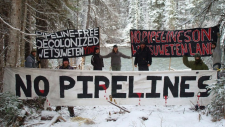
A current example of disrupting lawful development activity in Canada is the illegal protests against the LNG pipeline in BC.  Amy Judd writes at Global News RCMP arrest 14 at anti-pipeline protest in northern B.C.  Excerpts in italics with my bolds.

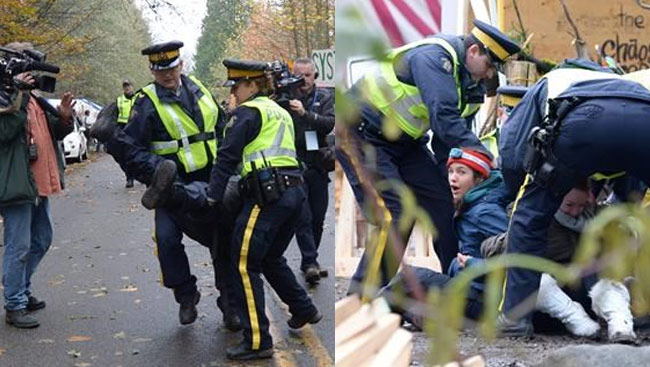
The RCMP say it has arrested 14 people Monday evening for allegedly violating the conditions of an interim court injunction requiring the removal of a blockade to a forest service road in northern British Columbia that is preventing access to a pipeline project.

The interim injunction issued by the B.C. Supreme Court in mid-December orders anyone who interferes with the Coastal GasLink project in and around the Morice River Bridge to remove any obstructions.

In statements issued today, the RCMP say they arrived on scene around 11 a.m. By 3 p.m., they entered the blockade, after a meeting with a number of hereditary elders and CGL failed to resolve the issue without police involvement.

By 6:45 p.m., they had made a number of arrests from the blockade set up by Gitdumt’en on Morice West Forest Service Road. RCMP also say they observed a number of fires being lit along the roadway by ‘unknown persons’, with large trees felled across the roadway.

Click on link below to watch video report.

https://webapps.9c9media.com/vidi-player/1.5.4/share/iframe.html?currentId=1580906&config=ctvnews/share.json&kruxId=ImoeZsch&rsid=ctvgmnews,ctvgmnewsglobalsuite&cid=%5B%7B%22contentId%22%3A1581681%2C%22ad%22%3A%7B%22adsite%22%3A%22ctv.ctvnews%22%2C%22adzone%22%3A%22embed%22%7D%7D%2C%7B%22contentId%22%3A1581852%2C%22ad%22%3A%7B%22adsite%22%3A%22ctv.ctvnews%22%2C%22adzone%22%3A%22embed%22%7D%7D%2C%7B%22contentId%22%3A1581754%2C%22ad%22%3A%7B%22adsite%22%3A%22ctv.ctvnews%22%2C%22adzone%22%3A%22embed%22%7D%7D%2C%7B%22contentId%22%3A1581731%2C%22ad%22%3A%7B%22adsite%22%3A%22ctv.ctvnews%22%2C%22adzone%22%3A%22embed%22%7D%7D%2C%7B%22contentId%22%3A1581603%2C%22ad%22%3A%7B%22adsite%22%3A%22ctv.ctvnews%22%2C%22adzone%22%3A%22embed%22%7D%7D%2C%7B%22contentId%22%3A1580971%2C%22ad%22%3A%7B%22adsite%22%3A%22ctv.ctvnews%22%2C%22adzone%22%3A%22embed%22%7D%7D%2C%7B%22contentId%22%3A1580906%2C%22ad%22%3A%7B%22adsite%22%3A%22ctv.ctvnews%22%2C%22adzone%22%3A%22embed%22%7D%7D%2C%7B%22contentId%22%3A1580884%2C%22ad%22%3A%7B%22adsite%22%3A%22ctv.ctvnews%22%2C%22adzone%22%3A%22embed%22%7D%7D%2C%7B%22contentId%22%3A1580579%2C%22ad%22%3A%7B%22adsite%22%3A%22ctv.ctvnews%22%2C%22adzone%22%3A%22embed%22%7D%7D%5D

In their statement, the RCMP dispute reports that they jammed communications in the area in order to prevent the media and public from communicating the unfolding situation to the outside world. They say the area is extremely remote, and even police had limited access to communication, other than their radios.

They also say reports that the Canadian Military were present are erroneous, saying they have deployed Tactical and Emergency Response Teams as part of their ‘measured and scalable approach to enforcing the court ordered injunction’.

RCMP say they set up a ‘temporary exclusion zone’, where the police do not allow access to anyone – media or otherwise – who is not part of the enforcement team.

The dispute centres around the GasLink pipeline project, which is intended to convey natural gas from fracking projects in the Peace Region to the future $40-billion LNG Canada plant in Kitimat.

The pipeline route travels through Wet’suwet’en First Nation territory, and the nation’s elected leaders signed a benefits agreement with the province for Coastal GasLink in 2014.

However, some Wet’suwet’en oppose the development and have established a years-long camp, known as Unist’ot’en, blockading the Morice River Bridge.

In December, a B.C. Supreme Court judge ruled in favour of Coastal GasLink, granting an injunction against demonstrators occupying the area around the bridge.

The order has since been expanded to include the Morice West Forest Service Road, where other Wet’suwet’en demonstrators have set up a second checkpoint known as the Gitdumt’en access point.

The protesters assert that the project is infringing Aboriginal title, citing the 1997 Delgamuukw Supreme Court of Canada ruling. The court found that the Wet’suwet’en had not given up title to 22,000 square km of territory, and demonstrators say those rights are represented by their hereditary chiefs.

RCMP say their first priority is safety but protesters say they are worried about what they call an “invasion.”

“It’s important for the government because they want the tax money coming in,” said Jeffery Brown, Chief Madeek, Head Chief of the Gidumt’en clan of the Wet’suwet’en First Nation.

“[It’s] important to get [the pipeline] through but even to get it through, there’s a moratorium on the coast to get that lifted and I’m sure they’re gonna try and do that, too.”

The RCMP issued a media release Sunday morning affirming its role in enforcing the injunction, and stating that police have been in dialogue with the camp in recent months about possible enforcement.

“We would like to emphasize that the RCMP respects the Wet’suwet’en culture, the connection to the land and traditions being taught and passed on at the camp, and the importance of the camp to healing,” states the release.

“Should enforcement take place, the RCMP will be prepared to ensure the safety of everyone involved — demonstrators, police officers, area residents, motorists, media and general public.”

The Wet’suwet’en are seeing support from across Canada and a number of events are being planned by groups standing in solidarity with them. Those events start Tuesday in Victoria and Vancouver.

Coastal GasLink says it consulted with hereditary chiefs for more than five years and secured 20 project agreements with elected First Nations councils all along the pipeline route.

“We understand that there are those that share different opinions so we want to continue to work with those individuals to find solutions,” Jacquelynn Benson of Coast GasLink said.

The company says seeking an injunction was a last resort.

Pipeline Protests Fueled by $$$ from Alarmist US Billionaires

From CBC News January 22, 2019  Debate grows over impact of American funding being directed towards Canadian environmental campaign.  Excerpts below in italics with my bolds.

Alberta at Noon host Judy Aldous spoke to researcher and blogger Vivian Krause, as well as award-winning Calgary author Chris Turner, Monday about the degree to which U.S. dollars are shaping the conversation we’re now having in Canada about building pipelines.

Krause has estimated that various U.S. funders have contributed in the neighbourhood of $40-million in recent years to hundreds of Canadian environmental and Indigenous groups. The goal is to help them spread a message about the need to land-lock Alberta crude through protests against the construction of new pipelines.

Krause believes those American dollars are financing a message that has turned the conversation around, adding topics like pipeline development have become toxic.

“The campaign has been devastating,” Krause said.

“I think the campaign is the reason why Northern Gateway was cancelled: Energy East, Keystone, Trans Mountain.

“And this is the same organization, same strategy, same funders that stopped the Mackenzie [Valley] gas pipeline. I think the coastal gas pipeline is also in serious trouble.

“I have no hope for any pipeline [being approved for development] until this campaign is brought to an end,” she said.

Turner, meanwhile, said that foundations such as the Rockefeller Brothers Fund, the Hewlett Foundation, and the U.S. environmental group the Tides Foundation have far less of ability to manipulate the environmental agenda in Canada than Krause suggests.

He didn’t disagree with the numbers but disputed Krause’s interpretation of them.

Krause said she isn’t opposed to the principle of funding environmental groups from outside the country. However, she said she feels there has been a disproportionate focus on the oilsands by American environmental activists, particularly considering the U.S. is now one of the top oil producers on the planet.

She also suggested that by turning up the heat on Canadian energy development, those same activists are enabling — or perhaps are motivated by — a desire to open up markets for American oil producers.

“But here’s the thing,” she added. “Guess whose oil is getting to market and is getting the highest prices? It’s not Canadian oil or gas. It’s American oil and gas.”

She asked why environmentalist don’t instead focus on “landlocking the development of American oil and gas.”

Summary

Hey PM Trudeau, how about a wall to protect Canadians from US billionaires funding the overthrow of our governments’ policies?  Hungary took the initiative to block socialist George Soros from subversive political activity in his homeland.  What are we waiting for?  Can we be a nation without controlling our borders?


California Renewables to Lose PG&E $$$


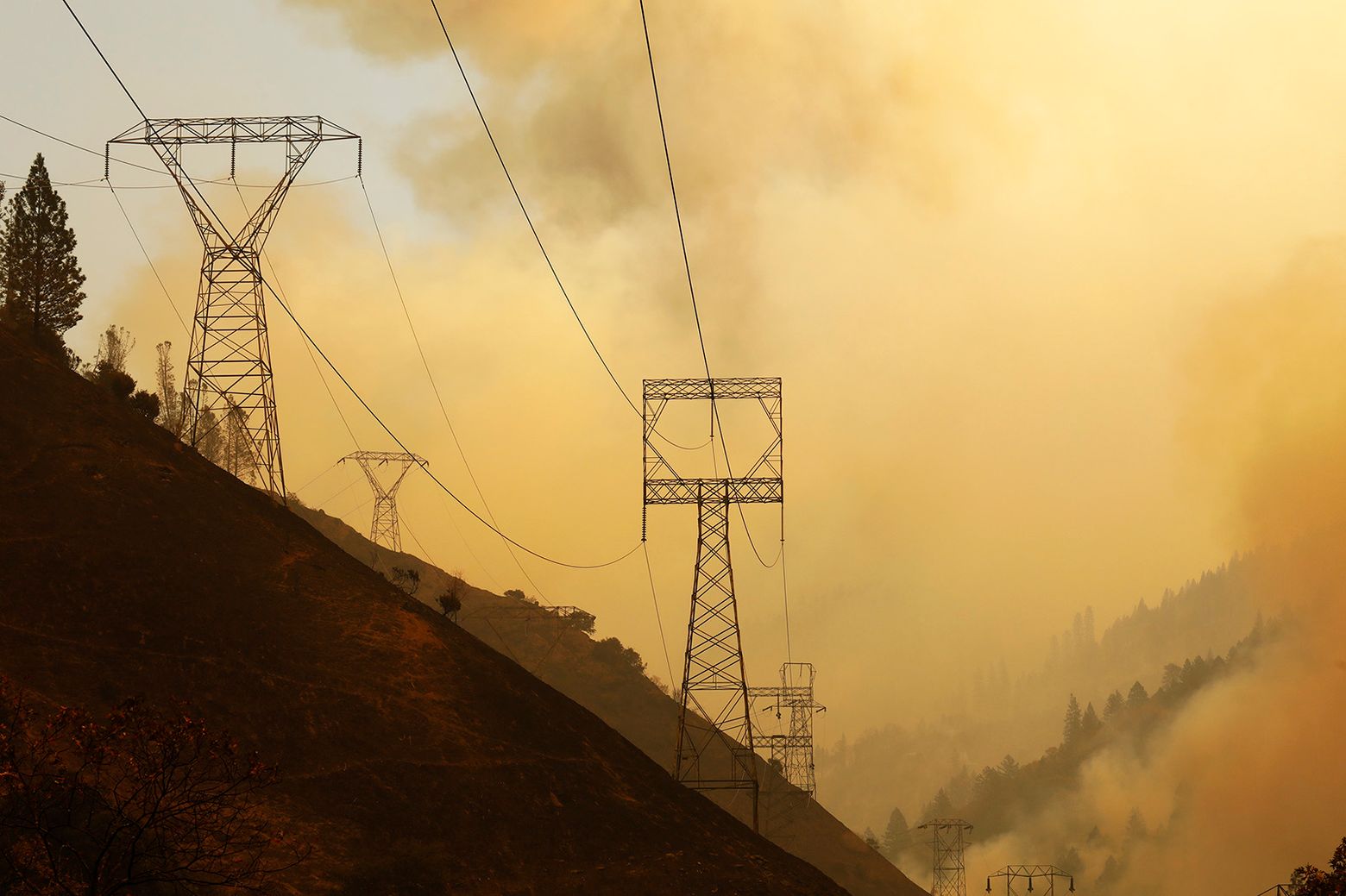
The investigation continues into the origin of the Camp fire, which some say started with a faulty PG&E wire in Pulga, California. (Carolyn Cole / Los Angeles Times / TNS)

Sammy Roth of LA Times digs deeper than others into the fallout from PG&E’s wildfire-induced bankrupcy. The article published in The Seattle Times is PG&E bankruptcy could undermine utilities’ efforts against climate change. Excerpts below with my bolds.

Solar and wind developers depend on creditworthy utilities to buy electricity from their projects under long-term contracts, but that calculus changes in a world where a 30-year purchase agreement doesn’t guarantee 30 years of payments.

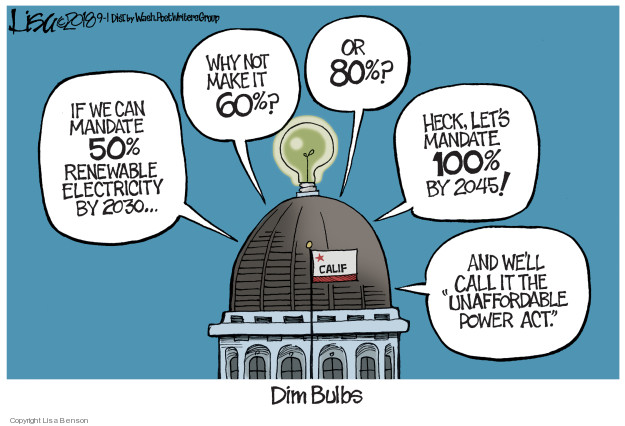
The Golden State has dramatically reduced planet-warming emissions from the electricity sector, largely by requiring utilities to increase their use of solar and wind power and fund energy-efficiency upgrades for homes and businesses. Lawmakers recently set a target of 100 percent climate-friendly electricity by 2045.

But those government mandates have depended on Pacific Gas & Electric and other utilities being able to invest tens of billions of dollars in clean-energy technologies.

The massive Topaz solar farm in California’s San Luis Obispo County, an electricity supplier to PG&E owned by Warren Buffett’s Berkshire Hathaway Energy, also saw its credit rating downgraded to junk status this month, amid fears the San Francisco-based utility won’t be able to pay its bills in full.

In the short term, PG&E might stop signing renewable-energy contracts, although contracting had already slowed in the last few years as customers departed in droves for newly established local energy providers run by city and county governments. In the long term, renewable-energy developers and their lenders may hesitate to do business with PG&E — and, potentially, with other California utilities that could also face significant future wildfire costs.

“If we’re having a couple billion dollars a year of fire damage and insurance losses, quite apart from PG&E, this is going to put the entire state of California at risk,” said V. John White, executive director of the Center for Energy Efficiency and Renewable Technologies, a Sacramento-based trade group.

Renewable-energy firms were alarmed by the news of PG&E’s impending bankruptcy filing, and it’s not hard to understand why. Solar and wind developers depend on stable, creditworthy utilities to buy electricity from their projects under long-term contracts known as power-purchase agreements. They’re able to get low-cost loans to build their projects because lenders see little to no risk of a utility defaulting on those contracts.

But that calculus changes in a world where a 30-year power-purchase agreement doesn’t guarantee 30 years of payments at the agreed-upon price, said Ben Serrurier, a San Francisco-based policy manager for solar developer Cypress Creek Renewables. There’s concern in the industry that a bankruptcy court judge could order PG&E to reduce its payments to solar- and wind-project owners to help the company pay off other debts.

WIND ENERGY: Wind turbines in the Tehachapi-Mojave Wind Resource Area near the city of Mojave, California. (Brian van der Brug / Los Angeles Times / TNS)

“Once you start questioning the sanctity of contracted revenue, you begin to introduce a new risk into renewable-energy project development. So much about project development is about reducing risk so you can reduce your capital cost,” Serrurier said.

It’s not just clean-energy investments that are at risk. In another cruel bit of irony, PG&E’s bankruptcy filing could also make it more difficult for California utilities to raise the capital needed to harden their infrastructure against wildfire, said Travis Kavulla, a former president of the National Association of Regulatory Utility Commissioners who now serves as director of energy policy at the R Street Institute, a center-right think tank.

“Bankruptcies are tough. It means people may lose their pensions or get them cut. It means people who invested in projects in California, based on what they thought was a pretty airtight business model of a regulated utility, are getting stiffed,” Kavulla said. “It could create longer-running harms where California is viewed as a market to avoid investment in.”

PG&E has lurched from crisis to crisis since 2010, when one of the company’s gas pipelines exploded in a residential neighborhood in San Bruno, killing eight people. The company was ultimately fined $1.6 billion by the state regulators and $3 million by a federal judge. Last month, the California Public Utilities Commission accused PG&E of continuing to commit pipeline-safety violations in the years after the gas pipeline explosion.

More recently, deadly wildfires have made PG&E the target of raucous protests. The utility’s infrastructure was found to have sparked or contributed to more than a dozen fires that collectively killed 22 people in 2017. State investigators have yet to determine if PG&E is also responsible for 2017’s Tubbs fire, which killed an additional 22 people, and the 2018 Camp fire, which killed 86 people and destroyed most of the town of Paradise.

Some critics have called for lawmakers to break up the massive company, which serves 16 million Californians, and replace it with smaller, government-run electric utilities. But it’s not clear how feasible that would be, or whether it would accomplish anything more than transferring PG&E’s huge liabilities to local governments.Renewable-energy developers, meanwhile, see stabilizing PG&E as an urgent priority. After a series of fires devastated Northern California in October 2017, clean-energy trade groups began urging state lawmakers to help PG&E and other utilities cope with the liability that can ensue if their infrastructure sparks a fire.

In a May 2018 letter to legislative leaders last year, representatives of the solar, wind, geothermal and biomass energy industries said California must find a way to sustain financially solvent investor-owned utilities. Failure to act, they said, “imperils our markets and progress toward our climate goals.”

Ralph Cavanagh, co-director of the energy program at the Natural Resources Defense Council, described PG&E as a “tremendous asset” for meeting the state’s climate-change targets.

He said the state’s three big investor-owned utilities — which also include Southern California Edison and San Diego Gas & Electric — are crucial to making the investments needed to meet California’s ambitious climate targets, including the 100 percent clean-energy mandate and a long-term goal of cutting greenhouse-gas emissions by 80 percent below 1990 levels by 2050.

Those investments are likely to include more solar and wind farms, large-scale batteries and other energy storage technologies, and electric vehicle chargers.

“Utilities have been essential clean-energy partners. We don’t want to have to do without them, and we shouldn’t have to do it without them,” Cavanagh said. “It would be much more difficult without them.”

Cavanagh thinks state legislators should change the law so that PG&E and other utilities aren’t held liable for fires sparked by their infrastructure unless they’re found to be negligent.

California’s new Gov. Gavin Newsom could play a key role in determining how the state responds to PG&E’s bankruptcy. At a news conference Monday, he said the state is “still committed to investing in our climate goals.”

“I do not believe, based on the information that I have, that those goals will be significantly altered in the short term as it relates to existing purchases of renewable energy. We are long-term focused on all of the existing requirements that PG&E has encumbered and embraced,” Newsom said.

The Legislature already gave the investor-owned utilities a measure of relief last year by approving Senate Bill 901, which allows them to charge ratepayers for some of the costs they may incur from the 2017 fires. But it’s unclear whether lawmakers have the appetite for another bill that will inevitably be derided as a utility bailout.

A lot could depend on how the bankruptcy court judge handles the company’s existing solar and wind contracts, with developers watching to see whether the owners of those projects keep getting paid in full.

It’s also possible the effects of PG&E’s bankruptcy may not be as serious as solar and wind developers fear.

Ravi Manghani, director of energy storage at the research and consulting firm Wood Mackenzie Power and Renewables, said existing clean-energy contracts “will likely get renegotiated,” with project owners being forced to accept lower payments. But in the long run, he said, California officials “are still committed to the renewable future, and it’s not like the region’s resource and reliability needs disappear with the bankruptcy.”

Another key factor: The investor-owned utilities aren’t the only ones buying clean energy in California.

Most new contracts in recent years have actually been signed by local energy providers known as community choice aggregators, which can be formed by city and county governments whose residents are served by an investor-owned utility. The government-run power agencies decide what kind of electricity to buy for their communities and how much to charge, while investor-owned utilities continue to operate the poles and wires.

There are 19 aggregators operating in California, including Clean Power Alliance, which will begin serving nearly 1 million homes in Los Angeles and Ventura counties in February. The aggregators have signed long-term contracts for more than 2,000 megawatts of renewable energy, according to the California Community Choice Assn.

But the community choice aggregators don’t have the financial wherewithal of the investor-owned utilities, and many of them don’t have credit ratings yet, said Matt Vespa, an attorney at the environmental group Earthjustice. He likes the aggregators but doesn’t think they alone can eliminate planet-warming carbon-dioxide emissions from California’s electric grid.

“When you’re talking about the scale of what we need to do to aggressively decarbonize … they’re not in a position to finance that,” Vespa said.

Summary

California continues to serve as a learning laboratory for misguided and futile climate policies.  This time the lesson (for those with eyes to see) is to demonstrate that renewable energy programs are parasites who feast on the financial lifeblood of their host utilities until the cash is gone.

See Also:  California: World Leading Climate Hypocrite

Sorry NYT, Climate Change Won’t Savage Big Oil


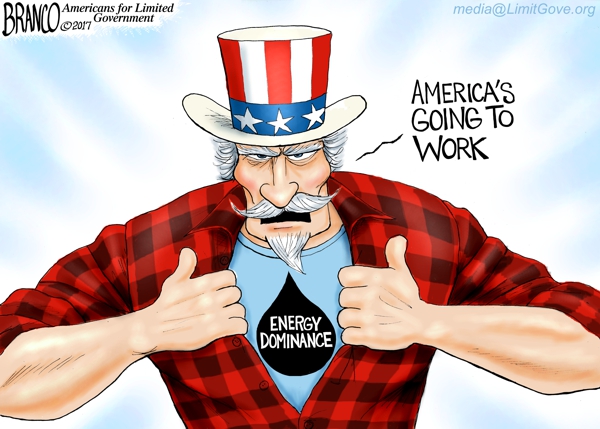
energy-dominanceLast week New York Times published Trump’s ‘Energy Dominance’ Doctrine Is Undermined by Climate Change.  (H/T Matthew Kahn) Excerpts below in italics with my bolds

“Climate change disrupts everything, including Trump’s agenda,” said Alice Hill, a research fellow at the conservative Hoover Institution think tank who served as senior director for resilience policy on the National Security Council under President Barack Obama.

When it comes to fossil fuel production, the disruptions are particularly serious. And there’s a fundamental irony at play. Even as emissions from the burning of fossil fuels are warming the planet, the consequences of that warming will make it harder to drill for oil, mine for coal and deliver fuel through pipelines.

Energy systems in the Southeast are particularly vulnerable, the report said, with some 200 power plants and oil refineries exposed to flooding from hurricanes and fiercer storm surges. Scientists estimate, if sea levels rise nationally 3.3 feet (a figure it describes as on the “high end of the very likely range” for what the country could see by 2100), it could expose dozens of power plants currently considered to be in safe zones to risks of 100-year floods. That would jeopardize about 25 gigawatts of operating power capacity, or power for about 18 million homes.

Along the Gulf Coast — home to a significant proportion of the United States oil production and refining industry — energy infrastructure faces a similar and more immediate risk. A sea level rise of less than 1.6 feet could double the number of refineries in Texas and Louisiana vulnerable to flooding by the end of the century.

Yet energy analysts cautioned against expectations that the effects of climate change will cause irreparable harm to the fossil fuel industry or make oil, gas and coal production fundamentally unattractive to investors. Sarah Ladislaw, an energy analyst at the Center for Strategic and International Studies, noted that the oil and gas sector has a long history of managing risks, including figuring out how to operate in politically unstable countries and prodding governments to loosen regulations they find too burdensome.

Climate change will add “headwinds” to fossil fuel companies, make production more costly in some areas and less competitive in others, Ms. Ladislaw said. But, she added, “If you’re waiting for climate impacts to be the end of the oil and gas industry, that’s not going to happen.”

Despite the US now leading the world in fossil fuel production, warmists dream of  bringing down the oil majors.  The scenario is expressed in all its glory in the legal documents produced  in recent years, in support of shareholder proposals meant to financially weaken Exxon, Shell, BP, etc.  But Ms. Ladislaw is correct,  too many unlikely things have to happen for this dream to come true.

Now let’s unbundle the chain of suppositions that comprise this scenario.

  • Supposition 1: A 2C global warming target is internationally agreed.
  • Supposition 2: Carbon Restrictions are enacted by governments to comply with the target.
  • Supposition 3: Demand for oil and gas products is reduced due to restrictions
  • Supposition 4: Oil and gas assets become uneconomic for lack of demand.
  • Supposition 5: Company net worth declines by depressed assets and investors lose value.

1.Suppose an International Agreement to limit global warming to 2C.

From the supporting statement to the Exxon shareholder proposal, attorney Sanford Lewis provides these assertions:

Recognizing the severe and pervasive economic and societal risks associated with a warming climate, global governments have agreed that increases in global temperature should be held below 2 degrees Celsius from pre-industrial levels (Cancun Agreement).

Failing to meet the 2 degree goal means, according to scientists, that the world will face massive coastal flooding, increasingly severe weather events, and deepening climate disruption. It will impose billions of dollars in damage on the global economy, and generate an increasing number of climate refugees worldwide.

Climate change and the risks it is generating for companies have become major concerns for investors. These concerns have been magnified by the 21st Session of the Conference of the Parties (COP 21) in Paris, where 195 global governments agreed to restrict greenhouse gas (GHG) emissions to no more than 2 degrees Celsius from pre-industrial levels and submitted plans to begin achieving the necessary GHG emission reductions. In the agreement, signatories also acknowledged the need to strive to keep global warming to 1.5 degrees, recognizing current and projected harms to low lying islands.

Yet a careful reading of UN agreements shows commitment is exaggerated:
David Campbell (here):

Neither 2°C nor any other specific target has ever been agreed at the UN climate change negotiations.

Article 2 of the Paris Agreement in fact provides only that it ‘aims to strengthen the global response to the threat of climate change … including by the holding the increase to well below 2°C’. This is an expression, not of setting a concrete limit, but merely of an aspiration to set such a limit. It is true that Article 2 is expressed in a deplorably equivocatory and convoluted language which fails to convey this vital point, indeed it obscures it. But nevertheless that is what Article 2 means.

Dieter Helm (here):

Nothing of substance has been achieved in the last quarter of a century despite all the efforts and political capital that has been applied. The Paris Agreement follows on from Kyoto. The pledges – in the unlikely event they are met – will not meet the 2C target, shipping and aviation are excluded, and the key developing countries (China and India) are not committed to capping their emission for at least another decade and a half (or longer in India’s case)

None of the pledges is, in any event, legally binding. For this reason, the Paris Agreement can be regarded as the point at which the UN negotiating approach turned effectively away from a top down approach, and instead started to rely on a more country driven and hence bottom up one.

Paul Spedding:

The international community is unlikely to agree any time soon on a global mechanism for putting a price on carbon emissions.

2: Suppose Governments enact restrictions that limit use of fossil fuels.

Despite the wishful thinking in the first supposition, the activists proceed on the basis of aspirations and reporting accountability. Sanford Lewis:

Although the reduction goals are not set forth in an enforceable agreement, the parties put mechanisms in place for transparent reporting by countries and a ratcheting mechanism every five years to create accountability for achieving these goals. U.N. Secretary General Ban Ki-moon summarized the Paris Agreement as follows: “The once Unthinkable [global action on climate change] has become the Unstoppable.”

Now we come to an interesting bait and switch. Since Cancun, IPCC is asserting that global warming is capped at 2C by keeping CO2 concentration below 450 ppm. From Summary for Policymakers (SPM) AR5

Emissions scenarios leading to CO2-equivalent concentrations in 2100 of about 450 ppm or lower are likely to maintain warming below 2°C over the 21st century relative to pre-industrial levels. These scenarios are characterized by 40 to 70% global anthropogenic GHG emissions reductions by 2050 compared to 2010, and emissions levels near zero or below in 2100.

Thus is born the “450 Scenario” by which governments can be focused upon reducing emissions without any reference to temperature measurements, which are troublesome and inconvenient.

Sanford Lewis:

Within the international expert community, “2 degree” is generally used as shorthand for a low carbon scenario under which CO2 concentrations in the earth’s atmosphere are stabilized at a level of 450 parts per million (ppm) or lower, representing approximately an 80% reduction in greenhouse gas emissions from current levels, which according to certain computer simulations would be likely to limit warming to 2 degrees Celsius above pre-industrial levels and is considered by some to reduce the likelihood of significant adverse impacts based on analyses of historical climate variability. Company Letter, page 4.

Clever as it is to substitute a 450 ppm target for 2C, the mathematics are daunting. Joe Romm:

We’re at 30 billion tons of carbon dioxide emissions a year — rising 3.3% per year — and we have to average below 18 billion tons a year for the entire century if we’re going to stabilize at 450 ppm. We need to peak around 2015 to 2020 at the latest, then drop at least 60% by 2050 to 15 billion tons (4 billion tons of carbon), and then go to near zero net carbon emissions by 2100.

Note:  In  the run up to COP24 in Katowice, IPCC stalwarts increased the ambition to 1.5C of additional warming, which translates to 430 ppm.  Presently Mauna Loa reports 407 and rising.

And the presumed climate sensitivity to CO2 is hypothetical and unsupported by observations:

3.Suppose that demand for oil and gas products is reduced by the high costs imposed on such fuels.

Sanford Lewis:

ExxonMobil recognized in its 2014 10-K that “a number of countries have adopted, or are considering adoption of, regulatory frameworks to reduce greenhouse gas emissions,” and that such policies, regulations, and actions could make its “products more expensive, lengthen project implementation timelines and reduce demand for hydrocarbons,” but ExxonMobil has not presented any analysis of how its portfolio performs under a 2 degree scenario.

Moreover, the Company’s current use of a carbon proxy price, which it asserts as its means of calculating climate policy impacts, merely amplifies and reflects its optimistic assessments of national and global climate policies. The Company Letter notes that ExxonMobil is setting an internal price as high as $80 per ton; in contrast, the 2014 Report notes a carbon price of $1000 per ton to achieve the 450 ppm (2 degree scenario) and the Company reportedly stated during the recent Paris climate talks that a 1.5 degree scenario would require a carbon price as high as $2000 per ton within the next hundred years.

Peter Trelenberg, manager of environmental policy and planning at Exxon Mobil reportedly told the Houston Chronicle editorial board: Trimming carbon emissions to the point that average temperatures would rise roughly 1.6 degrees Celsius – enabling the planet to avoid dangerous symptoms of carbon pollution – would bring costs up to $2,000 a ton of CO2. That translates to a $20 a gallon boost to pump prices by the end of this century… .

Even those who think emissions should be capped somehow see through the wishful thinking in these numbers. Dieter Helm:

The combination of the shale revolution and the ending of the commodity super cycle probably point to a period of low prices for sometime to come. This is unfortunate timing for current decarbonisation policies, many of which are predicated on precisely the opposite happening – high and rising prices, rendering current renewables economic. Low oil prices, cheap coal, and falling gas prices, and their impacts on driving down wholesale electricity prices, are the new baseline against which to consider policy interventions.

With existing technologies, it is a matter of political will, and the ability to bring the main polluters on board, as to whether the envelope will be breached. There are good reasons to doubt that any top down agreement will work sufficiently well to achieve it.

The end of fossil fuels is not about to happen anytime soon, and will not be caused by running out of any of them. There is more than enough to fry the planet several times over, and technological progress in the extraction of fossil fuels has recently been at least as fast as for renewables. We live in an age of fossil fuel abundance.

We also live in a world where fossil fuel prices have fallen, and where the common assumption that prices will bounce back, and that the cycle of fossil fuel prices will not only reassert itself but also continue on a rising trend, may be seriously misguided. It is plausible to at least argue that the oil price may never regain its peaks in 1979 and 2008 again.

A world with stable or falling fossil fuel prices turns the policy assumptions of the last decade or so on their heads. Instead of assuming that rising prices would ease the transition to low carbon alternatives, many of the existing technologies will probably need permanent subsidies. Once the full system costs are incorporated, current generation wind (especially offshore) and current generation solar may be out of the market except in special locations for the foreseeable future. In any event, neither can do much to address the sheer scale of global emissions.

Primary Energy Demand Projection

4.Suppose oil and gas reserves are stranded for lack of demand.

Sanford Lewis:

Achievement of even a 2 degree goal requires net zero global emissions to be attained by 2100. Achieving net zero emissions this century means that the vast majority of fossil fuel reserves cannot be burned. As noted by Mark Carney, the President of the Bank of England, the carbon budget associated with meeting the 2 degree goal will “render the vast majority of reserves ‘stranded’ – oil, gas, and coal that will be literally unburnable without expensive carbon capture technology, which itself alters fossil fuel economics.”

A concern expressed by some of our stakeholders is whether such a “low carbon scenario” could impact ExxonMobil’s reserves and operations – i.e., whether this would result in unburnable proved reserves of oil and natural gas.

Decisions to abandon reserves are not as simple or have the effects as desired by activists.

Financial Post (here):

The 450 Scenario is not the IEA’s central scenario. At this point, government policies to limit GHG emissions are not stringent enough to stimulate this level of change. However, for discussion purposes let’s use the IEA’s 450 Scenario to examine the question of stranded assets in crude oil investing. Would some oil reserves be “stranded” under the IEA’s scenario of demand reversal?

A considerable amount of new oil projects must be developed to offset the almost 80 per cent loss in legacy production by 2040. This continued need for new oil projects for the next few decades and beyond means that the majority of the value of oil reserves on the books of public companies must be realized, and will not be “stranded”.

While most of these reserves will be developed, could any portion be stranded in this scenario? The answer is surely “yes.” In any industry a subset of the inventory that is comprised of inferior products will be susceptible to being marginalized when there is declining demand for goods. In a 450 ppm world, inferior products in the oil business will be defined by higher cost and higher carbon intensity.

5.Suppose shareholders fear declining company net worth.

Now we come to the underlying rationale for this initiative.

Paul Spedding:

Commodity markets have repeatedly proved vulnerable to expectations that prices will fall. Given the political pressure to mitigate the impact of climate change, smart investors will be watching closely for indications of policies that will lead to a drop in demand and the possibility that their assets will become financially stranded.

Equity markets are famously irrational, and if energy company shareholders can be spooked into selling off, a death spiral can be instigated. So far though, investors are smarter than they are given credit.

Bloomberg:

Fossil-fuel divestment has been a popular issue in recent years among college students, who have protested at campuses around the country. Yet even with the movement spreading to more than 1,000 campuses, only a few dozen schools have placed some restrictions on their commitments to the energy sector. Cornell University, Massachusetts Institute of Technology and Harvard University are among the largest endowments to reject demands to divest.

Stanford Board of Trustees even said:

As trustees, we are convinced that the global community must develop effective alternatives to fossil fuels at sufficient scale, so that fossil fuels will not continue to be extracted and used at the present rate. Stanford is deeply engaged in finding alternatives through its research. However, despite the progress being made, at the present moment oil and gas remain integral components of the global economy, essential to the daily lives of billions of people in both developed and emerging economies. Moreover, some oil and gas companies are themselves working to advance alternative energy sources and develop other solutions to climate change. The complexity of this picture does not allow us to conclude that the conditions for divestment outlined in the Statement on Investment Responsibility have been met.

Update:  Universities are not the exception in finding the alarmist case unconvincing, according to a survey:

Almost half of the world’s top 500 investors are failing to act on climate change — an increase of 6 percent from 236 in 2014, according to a report Monday by the Asset Owners Disclosure Project, which surveys global companies on their climate change risk and management.

The Abu Dhabi Investment Authority, Japan Post Insurance Co Ltd., Kuwait Investment Authority and China’s SAFE Investment Company, are the four biggest funds that scored zero in the survey. The 246 “laggards” identified as not acting hold $14 trillion in assets, the report said.

Summary

Alarmists have failed to achieve their goals through political persuasion and elections. So they are turning to legal and financial tactics. Their wishful thinking appears as an improbable chain of events built upon a Paris agreement without substance.

Last word to David Campbell:

International policy has so far been based on the premise that mitigation is the wisest course, but it is time for those committed to environmental intervention to abandon the idea of mitigation in favour of adaptation to climate change’s effects.

For more on adapting vs. mitigating, see Adapting Works, Mitigating Fails

shutterstock_276290831

Balancing on a set of suppositions.


Follow the Climate Money

Open image in new tab to enlarge.

How climate finance ‘flows’ around the world is an informative article from CarbonBrief.  Excerpts below in italics followed by a comment from Bjorn Lomborg.

Climate finance is one of the bedrocks of negotiations at the United Nations Framework Convention on Climate Change (UNFCCC), including the “COP24” talks taking place this month in Katowice, Poland.

“Climate finance” refers to money – both from public and private sources – which is used to help reduce emissions and increase resilience against the negative impacts of climate change.

Rich countries have promised they will provide $100bn a year in climate finance to poorer nations by 2020. The UNFCCC’s recent biennial assessment found this sum had reached $75bn in 2016, a step forward compared to the $65bn given in 2015.

The OECD, a Paris-based intergovernmental economic organisation, asks its 36 member countries to report on their foreign aid, including climate finance. The data captures climate finance that is both bilateral (country to country) and multilateral (via international institutions) It also gives detailed information about funded projects. (The OECD calls this database “climate-related development finance” rather than strictly climate finance).

Key takeaways

  • Donor governments gave climate finance totalling $34bn in 2015 and $37bn in 2016, according to OECD estimates (note that this is not a full estimate of money counting towards the $100bn pledge – see below for more).
  • Japan was the largest donor, giving $10.3bn per year (bn/yr) on average over the two years. It was followed, in order, by Germany, France, the UK and the US.
  • India was the largest recipient on average, receiving $2.6bn/yr. It was followed, in order, by Bangladesh, Vietnam, the Philippines and Thailand
  • The single largest “country-to-country” flow was an average yearly $1.6bn from Japan to India.
  • The US was the top contributor to the multilateral Green Climate Fund (GCF) in 2016. (However, the US has now ended its support for the GCF).
  • Around $16bn/yr went to mitigation-only projects, compared to $9bn for adaptation-only projects.
    Around 42% of the finance consisted of “debt instruments”, such as loans.

Implications

It is important to note that the OECD database does not claim to capture all climate finance counting towards the $100bn. The totals of the data given here add up to $37bn, well below the $47bn the OECD recently estimated in a separate, top-down overview of public climate finance from developed to developing countries in 2016. The OECD also put public climate finance at $55bn in 2017. However, no project-level database for 2017 has been released yet.

The values represent money committed by governments or agencies on the basis of a firm written obligation and backed by available funds. Therefore, it does not represent pledges.

As the first chart above shows, not all climate finance goes straight from one country to another. Instead, a sizeable wedge goes via international institutions, such as multilateral climate funds and multilateral development banks (MDBs). The breakdown of the $5.1bn climate share of contributions to these bodies is shown in the second diagram above.

It shows, for example, that the Green Climate Fund (GCF), which was established with a mandate specifically to leverage climate finance towards the $100bn pledge, received an average $1.7bn per year in 2015 and 2016. Japan, the UK and the US contributed the most.

The Paris Agreement says that scaled-up financial resources “should aim to achieve a balance between adaptation and mitigation”. As is shown in the OECD data (and elsewhere) this is not close to being the case, with almost double the amount going to mitigation-only projects compared to adaptation-only ones.

Discussions on climate finance are currently ongoing at this year’s climate conference in Katowice, Poland, as part of the Paris “rulebook”. Sticking points include accounting rules and the extent to which developed countries should promise concrete sums of climate finance years ahead of time. Some countries are also pushing for talks to start on a new climate finance goal, due to begin in 2025.

One further complication is that all of the above numbers assess only public finance from developed to developing countries. This does not account for all of the money going towards tackling climate change, such as private finance, in-country spending or flows from one developing nation to another, such as support being offered by China. This is often referred to as “South-South” finance.

The UNFCCC biennial report gives an estimate that includes all of these flows and puts overall global climate finance at $680bn in 2015 and $681bn in 2016, a 17% increase on 2013-2014 levels. The growth was largely driven by high levels of new private investment in renewable energy, the report says.

Climate Money Could Be Better Spent

Bjorn Lomborg When it comes to climate change, let’s get our priorities straight

We must also bear in mind that global warming is not the planet’s only challenge. We often hear that it is the defining issue of our time, but it is no such thing. By the 2070s, the IPCC — the U.N. climate change panel — estimates that warming will cost between 0.2 and 2 percent of global GDP. This is certainly a problem, but not the end of world.

Speaking of climate change in catastrophic terms easily makes us ignore bigger problems, including malnutrition, tuberculosis, malaria and corruption. The World Health Organization estimates that climate change since the 1970s causes about 140,000 additional deaths each year, and toward the middle of the century will kill 250,000 people annually, mostly in poor countries. This pales in comparison with much deadlier environmental problems such as indoor air pollution, claiming 4.3 million lives annually, outdoor air pollution killing 3.7 million and lack of water and sanitation killing 760,000. Outside of environment, the problems are even bigger: Poverty arguably kills 18 million each year.

Every dollar spent on climate change could instead help save many more people from these more tractable problems. The current approach to subsidize solar and wind arguably saves one life across the century for every $4 million spent — the same expenditure on vaccinations could save 4,000 lives. Each person — and the next president — needs to decide his or her legacy.

Postscript: Financing for Climate Aid is a Fraction of the Full Cost of Climate Crisis Inc.

A fuller accounting of the climate crisis industry is more like 2,000,000,000,000 US$ per year (2 Trillion)
See Climate Crisis Inc. Update


Ontario has to Launder $1B in cap-and-trade money

CBC has the story: Ford government sitting on $1B in cap-and-trade money
Excerpts in italics with my bolds.

Environmental commissioner says by law it can only be spent on reducing greenhouse gases

Context: No one is talking about the reason Ford canceled cap and trade the first day on the job. It was to eliminate the 4.3 cents/liter gasoline tax. At the same time, spending on schemes to “fight climate change” was stopped.  By skimming a few cents off every liter sold, pretty soon you have billions of dollars in the pot. The law ending cap and trade did not reimburse gasoline retailers who had bought carbon allowances in the past, because they already passed on the cost to customers. Those who bought in advance to avoid higher carbon prices later are now caught and want the government to reimburse them, since they lost the opportunity to stick it to their customers. What a great idea is cap and trade: A market to sell a non-good at arbitrary prices paid by other people’s money. What could go wrong?

As much as $1 billion in Ontario’s cap-and-trade fund is sitting unspent, and questions are swirling about what Premier Doug Ford’s government will do with it.

The money was brought into provincial coffers under a law that says it can only be spent on measures that reduce greenhouse gas emissions. However, Ford has dismissed the money as a “slush fund,” and his government is pushing forward legislation to use some of it to cover the costs of cancelling the cap-and-trade program.

The dedicated fund for reducing greenhouse gases had a balance of $553 million at the end of March, when the last fiscal year ended, according to the province’s newly released public accounts. Another $476 million was added in May from the final cap-and-trade auction of carbon allowances, before Ford’s PCs won the election and quickly scrapped the Liberals’ climate-change plan.

That would put the account at more than $1 billion. What remains unclear is how much of that has been spent in the past six months, and how much will be used to wind up cap-and-trade.

CBC News asked the Environment Ministry for the current balance of the greenhouse gas fund, but officials did not provide an answer.

Ontario’s environmental commissioner Dianne Saxe believes there’s still $1 billion in the account because she has seen no evidence that money has been dispersed since the end of March.

Saxe — an independent officer of the Legislature like the auditor general and ombudsman — says the costs of winding up cap-and-trade ought to be small enough that the bulk of the $1 billion will remain.

“They will have quite a bit of money left,” said Saxe in an interview. “That can be money they can use to invest in [climate-change] solutions.”

She is warning the government that it cannot spend the money however it wishes, but only on initiatives to reduce carbon emissions. “That was the legal basis on which the money was collected, and that remains the law,” she said.

Liberal MPP Nathalie Des Rosiers said Monday she fears the government will not spend the money on cutting greenhouse gases but on lawsuits arising from cancelling cap-and-trade.

That fear is unfounded, said Environment Minister Rod Phillips.

“The money will be used for the purpose it was collected,” said Phillips in an interview Monday at Queen’s Park.

He declined to estimate how much of the $1 billion will remain in the fund once the cap-and-trade program is wound up. Nor did he agree that the figure will be in the hundreds of millions of dollars.

“I don’t think it would be fair to speculate at this point,” said Phillips. “We will make it clear how much money was spent and where it was spent.”

Ford made cancelling the cap-and-trade program a central election promise, calling it the “cap-and-trade carbon tax” during and after the campaign. Within days of taking power, his government shut down rebates to homeowners for making energy efficiency improvements, such as installing new windows, and ended rebates for buying electric cars. Those rebates came from the greenhouse gas reduction fund.

The government won’t be able to say how much remains in the greenhouse gas fund until all the programs wind up, said Phillips. He also said the government is allocating $5 million to compensate companies that bought cap-and-trade allowances, which are now worthless.

Phillips is promising a plan to tackle climate change this fall, including an “emissions-reductions fund” but says it will not come from a carbon-tax model.

The province is challenging Ottawa in court over the Trudeau government’s plan to impose a carbon tax on Ontario in the absence of a provincial carbon-pricing program.

Meanwhile, environmental groups led by Greenpeace are suing the province over cancelling cap-and-trade, alleging that the Ford government broke the law by failing to consult Ontarians on the move.

Climatist Revolutionaries


Obama and other Western political leaders have been saying that Climate Change is the biggest threat to modern society. I am coming around to agree, but not in the way they are thinking. I mean there is fresh evidence that we can defeat radical Islam, but radical climatism is already eroding the foundations of our modern societies.  I refer to climate alarm and activism, which has come to dominate the environmental movement and impose an agenda for social re-engineering.  At the end of this post is my understanding of their revolutionary game plan, but first a new report on the strategy and current events in the campaign.

A fresh confirmation of my insights from two years ago regarding the motives and tactics of the radical anti-fossil fuel movement is provided in The Conversation article All the battles being waged against fossil fuel infrastructure are following a single strategy Excerpts in italics with my bolds

Keep it in the ground

The overarching aim is to prevent as much new fossil fuel infrastructure as possible from being built and shutting down as many operations as possible. It’s all part of a “keep it in the ground” strategy with “it” referencing fossil fuels.

This wide-ranging attempt to block oil, gas and coal infrastructure emerged after the American political system tried and failed to deal with climate change.

Many of this movement’s rank-and-file members reached two main conclusions regarding this failure. Real climate action, they decided, would require a broad-based, grassroots social movement. And the oil, gas and coal industries’ influence over the nation’s political system, through financial donations to politicians and other activities, was to blame for the lack of climate action in the U.S.

As one movement strategist at a prominent climate advocacy organization told me, a large number of climate activists at that point became determined to bring about what they called the managed decline of the fossil fuel industries.

They are trying to expedite the demise of the oil, gas and coal businesses through a death-by-a-thousand-cuts approach that includes several strategies. One is getting investors, including university endowments and public sector pension funds, to stop investing in fossil fuel stocks and other assets. When I researched this divestment movement with journalism professor Jill Hopke, we found that activists were trying to chip away at the moral legitimacy of the oil, gas and coal industries. Another is fighting new fossil fuel infrastructure through civil disobedience and litigation.

celts-storm-exxon

Climate Activists storm the bastion of Exxon Mobil, here seen without their shareholder disguises.

The Trump effect
The keep it in the ground movement has gained a new sense of urgency during the Trump administration.

Because of this new political climate, activists have concentrated harder than ever on local actions, such as fighting pipelines and other infrastructure projects, wherever they believe they can make a difference during the Trump years. This stands in contrast to their strategy of only a few years ago that focused at least to some degree on influencing national policies.

The Climatist Game Plan

Mission: Deindustrialize Civilization

Goal: Drive industrial corporations into Bankruptcy

Strategy: Cut off the Supply of Cheap, Reliable Energy

Tactics:

  • Raise the price of fossil fuels
  • Force the power grid to use expensive, unreliable renewables
  • Demonize Nuclear energy
  • Spread fear of extraction technologies such as fracking
  • Increase regulatory costs on energy production
  • Scare investors away from carbon energy companies
  • Stop pipelines because they are too safe and efficient
  • Force all companies to account for carbon usage and risk

Progress:

  • UK steel plants closing their doors.
  • UK coal production scheduled to cease this year.
  • US coal giant Peabody close to shutting down.
  • Smaller US oil companies going bankrupt in record numbers.
  • Etc.

Collateral Damage:

  • 27,000 extra deaths in UK from energy poverty.
  • Resource companies in Canada cut 17,000 jobs in a single month.
  • Ontario green energy policy results in highest NA electricity rates and largest debt among the world’s sub-sovereign borrowers.
  • EU farmers now growing more biofuels instead of food crops.
  • Etc.

Summary:

Radical climatism is playing the endgame while others are sleeping, or discussing the holes in the science. Truly, the debate is over (not ever having happened) now that all nations have signed up to the Paris COP doctrine. Political leaders are willing, even enthusiastic dupes, while climatist tactics erode the foundations of industrial society.  Deaths and unemployment are unavoidable, but then the planet already has too many people anyway.

ISIS is an immediate threat, but there is a deeper and present danger already doing damage to the underpinnings of Life As We Know It. It is the belief in Climate Change and the activists executing their game plan.  Make no mistake: they are well-funded, well-organized and mean business.  And the recent behavior of valve-turners, acting illegally to shut off supplies of fossil fuel energy, shows they are willing to go very far to impose their will upon the rest of us.

See Also:  Upping the Stakes for Ecoterrorists

636364932821107959-170724-03-iubprotest-bp


Battle Over Climate Bias

As noted before, the left uses social pressure to force value-laden decisions onto other people. This has been going on for awhile regarding investment decisions by wealth managers, including huge pension funds. The politically correct (scientifically corrupt) bias is to divest of fossil fuel companies in hopes of ensuring a future climate favorable to humans. Now comes some push back from actuaries seeing this pressure as narrow and subversive of other important social concerns.

Chris Seekings writes in The Actuary (UK) Pensions and Lifetime Savings Association rejects climate change law for investment decisions Excerpts in italics below with my bolds.

The UK’s pension fund trade body has argued that new regulations governing how trustees invest £1.5trn in assets should exclude explicit reference to climate change.

The Pensions and Lifetime Savings Association (PLSA) said including climate change specifically in a new law could “confuse” trustees by unintentionally narrowing their focus.

This could cause them to disregard other environmental, social and governance (ESG) considerations that may be more relevant to their portfolios, such as resource depletion or human rights.

This is despite the PLSA reiterating its belief that climate change poses a substantial risk to the business models of firms in almost every sector, threatening the stability of the financial system.

“It is important that pension schemes consider risks related to climate change as part of their investment strategies, however, this is clearly not the only ESG factor to consider,” the PLSA said.

“We believe that picking out any one factor as a specific example may lead trustees to assume that is the only, or most important, factor to consider, when others might be more relevant.”

This comes in response to a consultation by the Department for Work and Pensions into new sustainability regulations for workplace pension funds, which closed on 16 July.

The PLSA also rejected proposals that would see trustees prepare a statement outlining how they take account of scheme members’ views, saying they were “neither practical nor purposeful”.

It argued that members should not be expected to be investment experts, and that trustees should invest in the best interest of members even if it “runs counter to strongly-held beliefs”.

Lawyers at ClientEarth, which co-produced a climate risk report with the PLSA in 2017, said rowing back on the “crucial” government proposals would be “hugely irresponsible”.

“Major financial institutions and world experts recognise climate risk as the most significant financial risk to the economy,” said ClientEarth finance lawyer, Alice Garton.

“Human rights abuses and resource depletion are crucial ESG issues, but what the PLSA seems to have overlooked, is that a changing climate underpins and intensifies these risks.”

ClientEarth exemplifies the alamist drive to reduce everything down to their one obsession with CO2.  It is good to see them confronted by other well-intentioned people who understand that important problems and concerns suffer from the extreme (and ineffectual) focus on fossil fuels.  Maybe some are listening to Bjorn Lomborg after all.

The UN IPCC climate train wreck is under way.