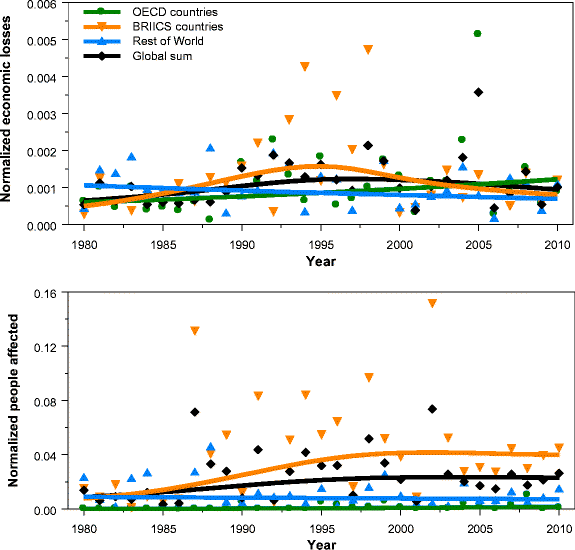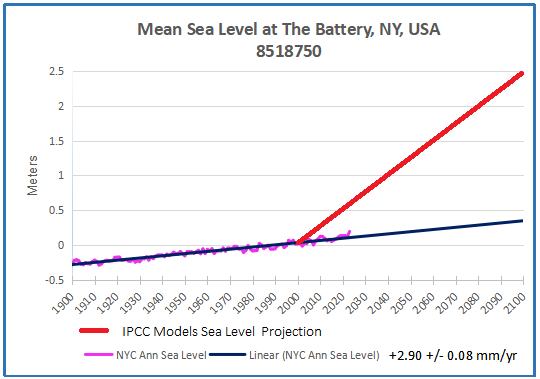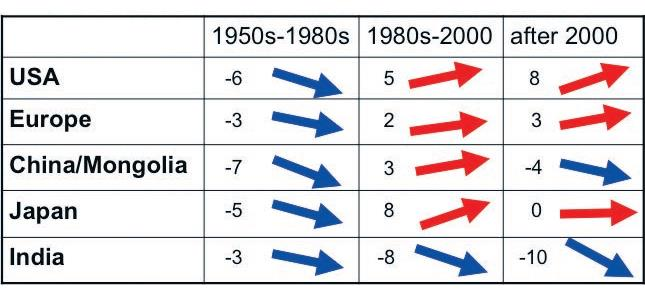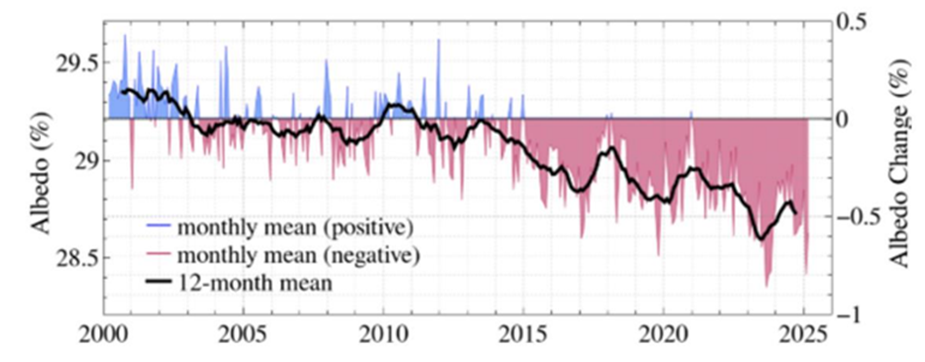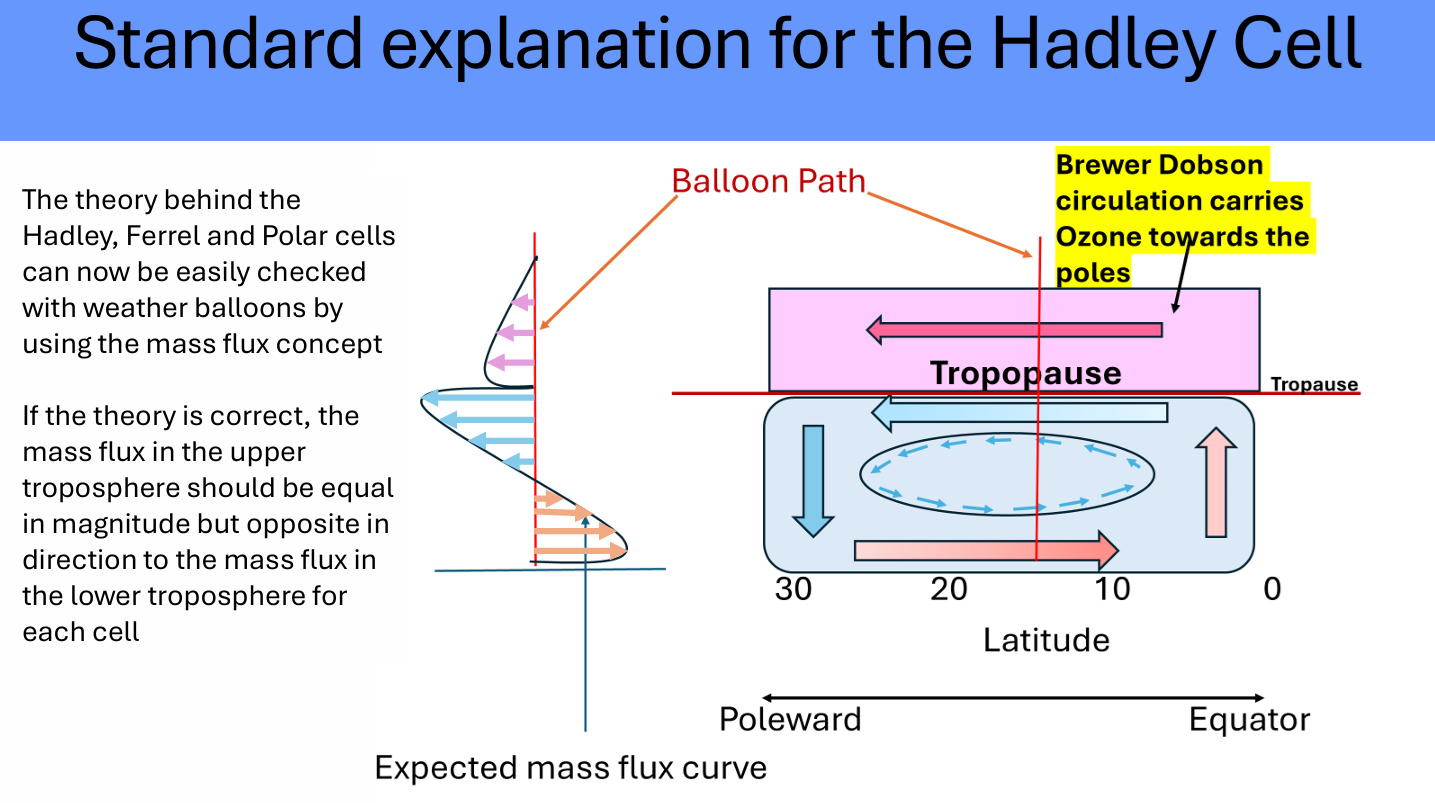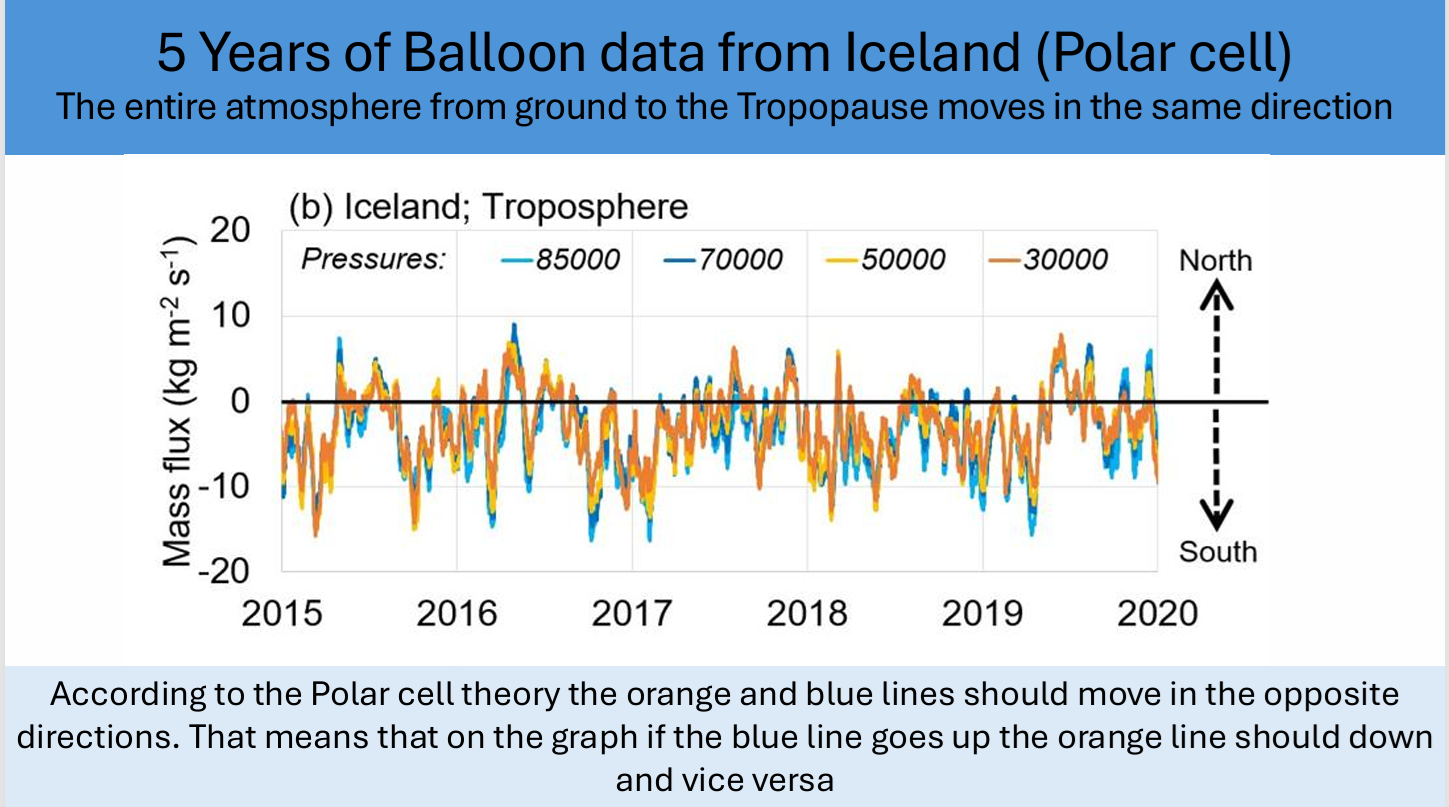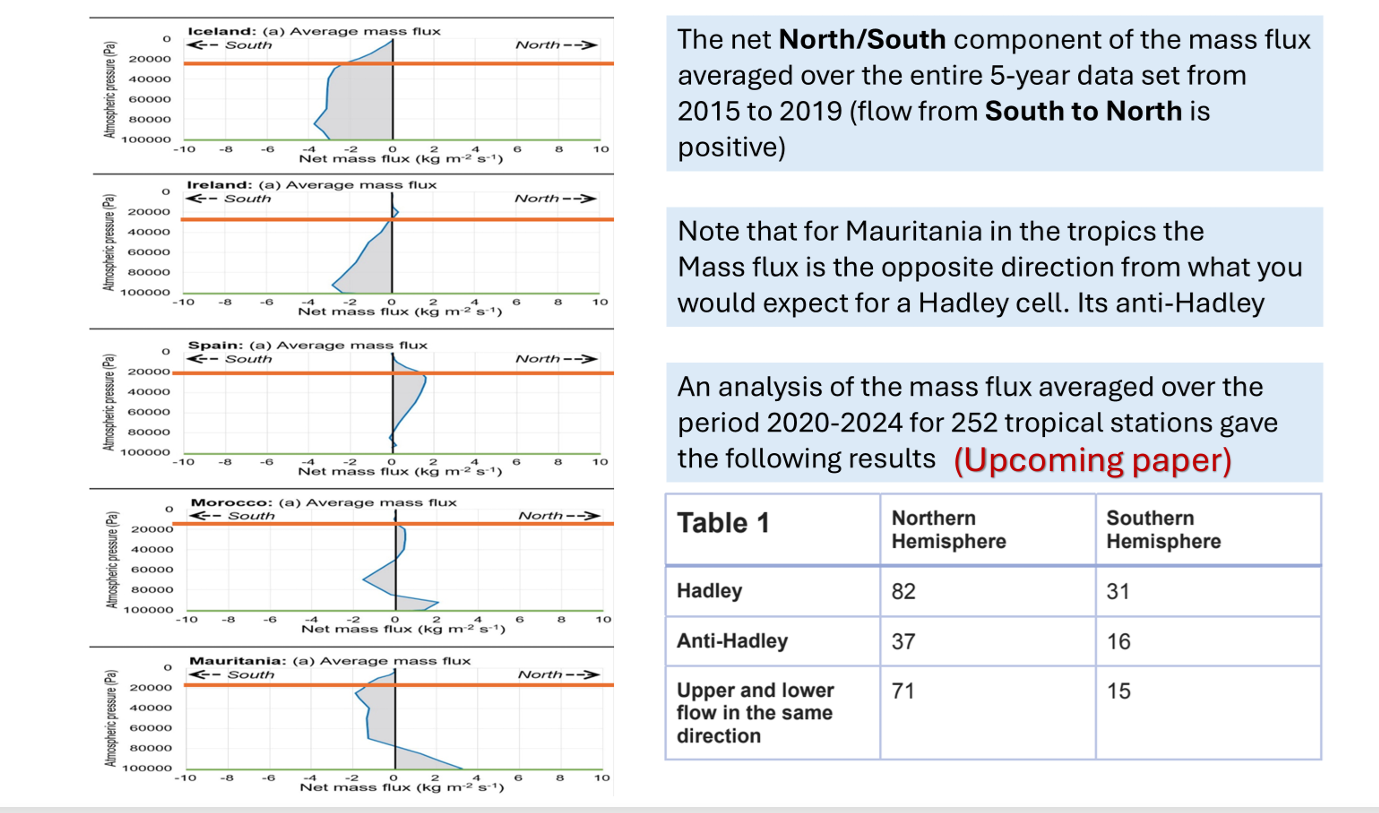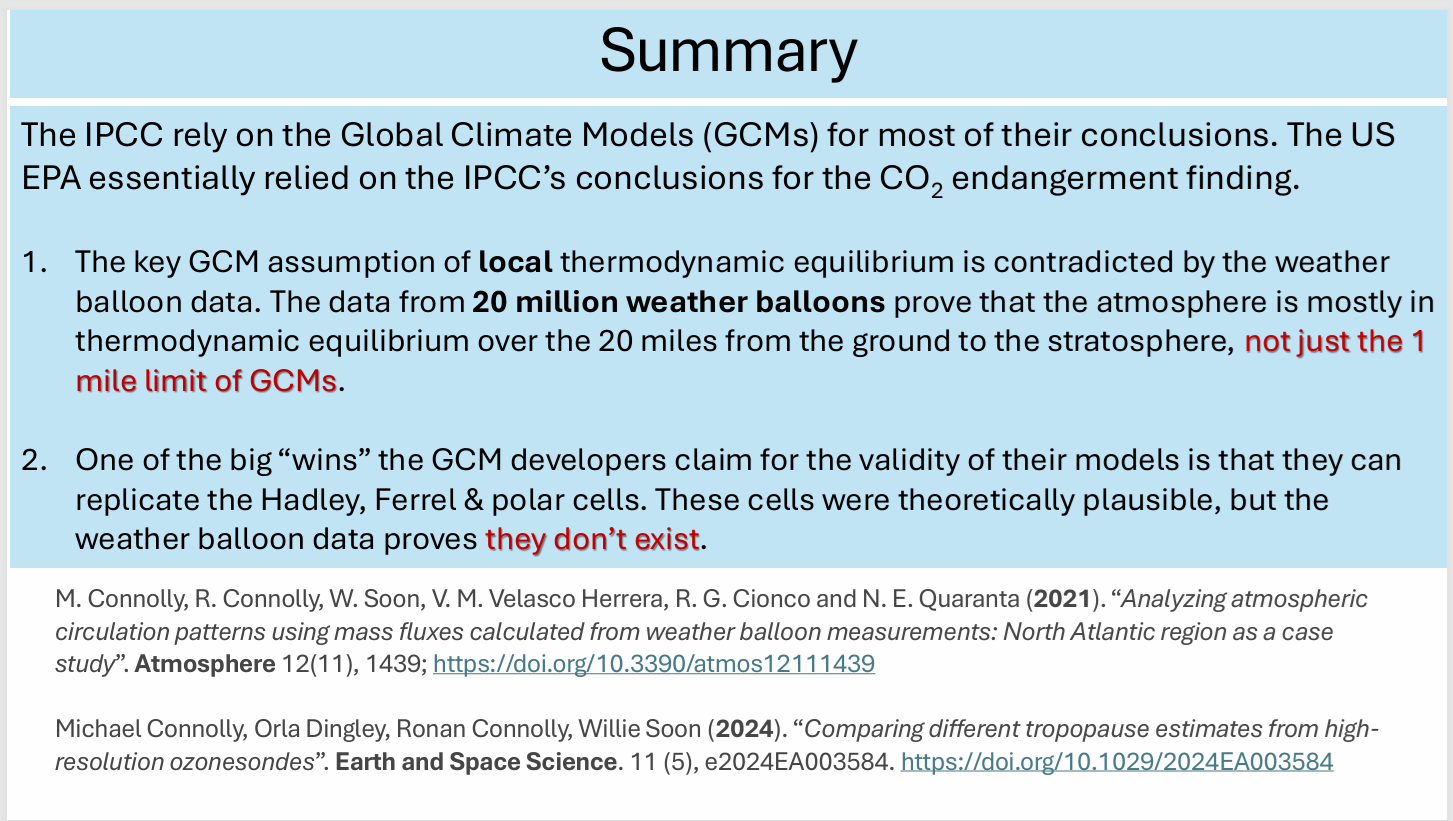
Glaciermania Strikes Again–2025 International Year of Glaciers

UN is sounding alarms about glaciers, and media is amplifying as usual.

Climate emergency: 2025 declared international year of glaciers, UN News

Climate change is shrinking glaciers faster than ever, AP

Glaciers Are Melting Twice as Fast as Predicted and We’re Not Ready,  Science News Today

1st glacier declared dead from climate change seen in before and after images, Live Science

Nearly 40% of the world’s glaciers are already doomed, CNN

Nearly Half of Earth’s Glaciers Are Already Doomed, Even Without Future Warming, SciTechDaily

World’s Melting Glaciers Threaten Food and Water Supply for 2 Billion People, Carbon Brief

Glaciers on the Brink: UN Calls for Bold Action, Climate Fact Checks

This short video puts this alarm into perspective. Additional detail is provided by Dr. John Happs in his article Glaciers And Ice Sheets: Here Today And Here Tomorrow.  Dr. Happs comments on many glaciers around the world, this post has only some excerpts in italics with my bolds and added images.

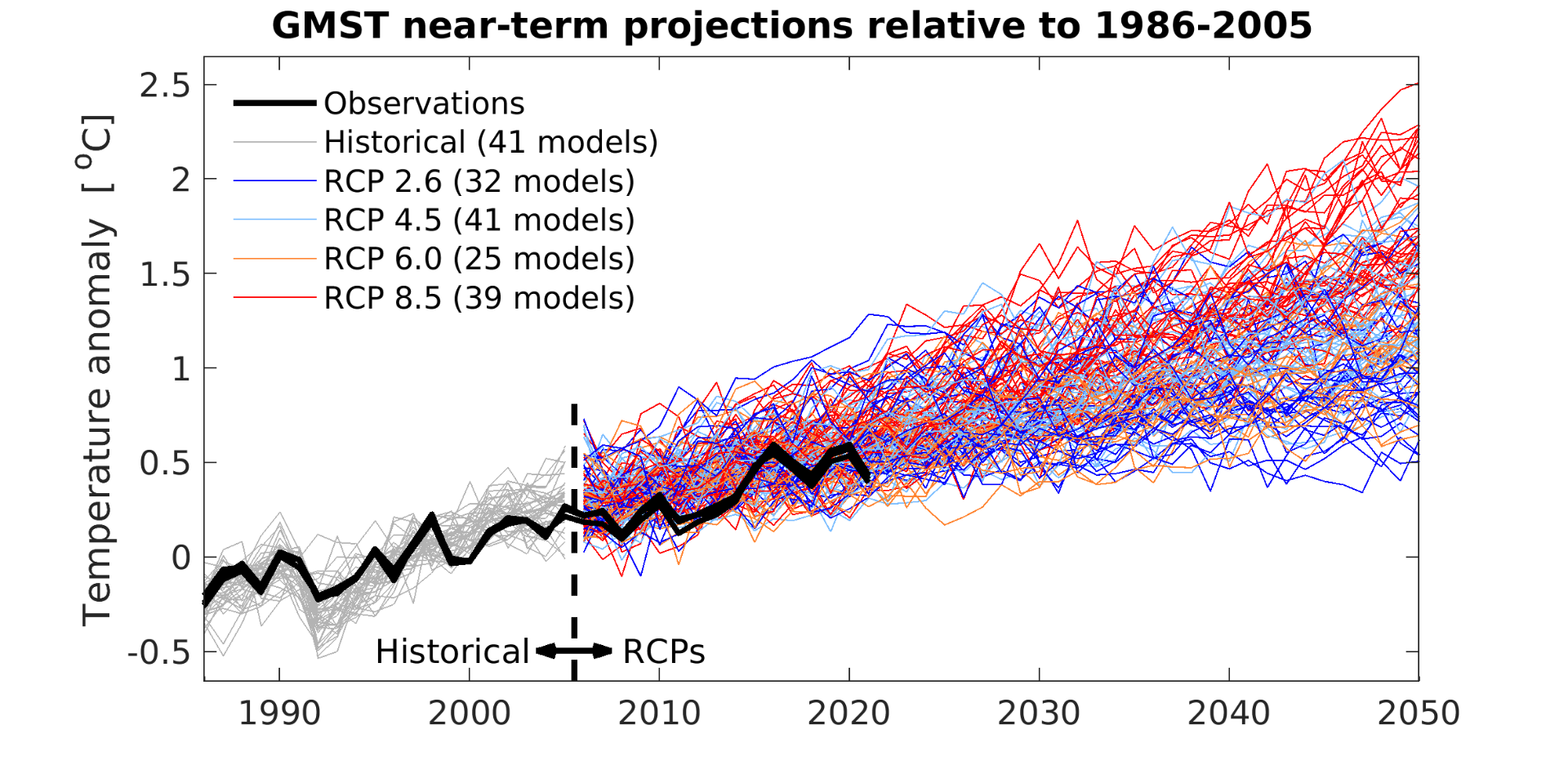
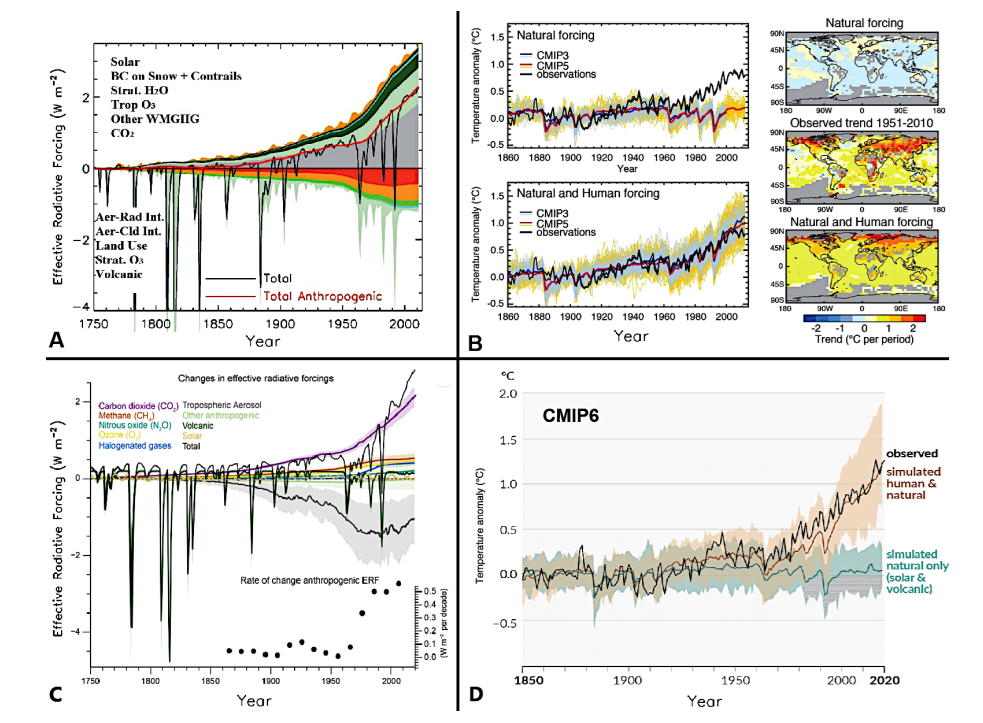
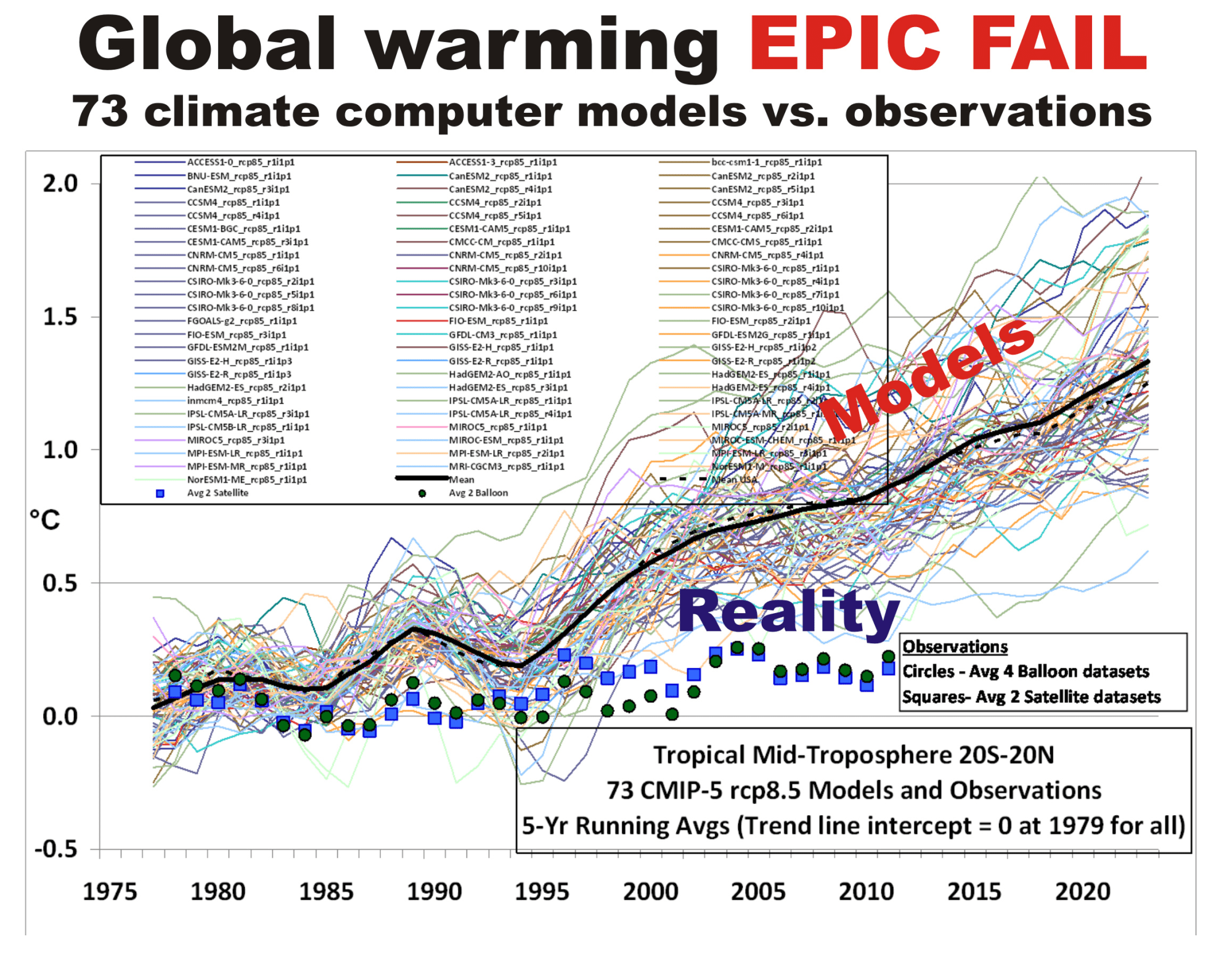
How often do the climate alarmists tell us that few glaciers still exist because of (imaginary) global warming and those that remain are rapidly melting away? Not surprisingly, the alarmists, particularly those from the media and vested interest groups, always point to the Intergovernmental Panel on Climate Change (IPCC) computer model projections, referring to one in particular–the Representative Concentration Pathway (RCP8.5.)

Even the political/ideological IPCC has sensibly branded RCP8.5 as “Highly Unlikely”

So, what are the glacier numbers?

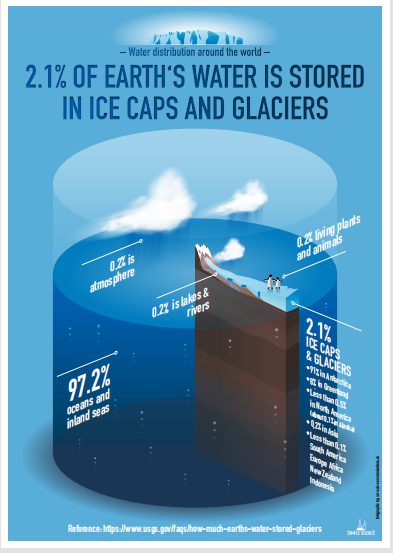
  1. There are more than 200,000 alpine/valley (land-based) glaciers and many others stemming from the ice sheets of Antarctica and Greenland.
  1. Glaciers have advanced, retreated and halted many times over the last 400,000 years being influenced not only by temperature but also by other factors, such as wind, precipitation, altitude, latitude, aspect, topography and slope angle.

Global temperature is often promoted, usually by naïve climate alarmists, as the only important input into glacier formation, growth and retreat yet, in very dry parts of Antarctica, where low temperatures are seemingly ideal for glacier growth, the small amount of net annual precipitation results in glaciers growing very slowly, or even diminishing in size.

Glaciers can also be influenced by sublimation or the transition of a substance directly from the solid to the gas phase. Glaciers can experience this process resulting in the “evaporation” of ice, exacerbated by wind action. Sublimation can be seen in the way that ice cubes left in the freezer will shrink over time.

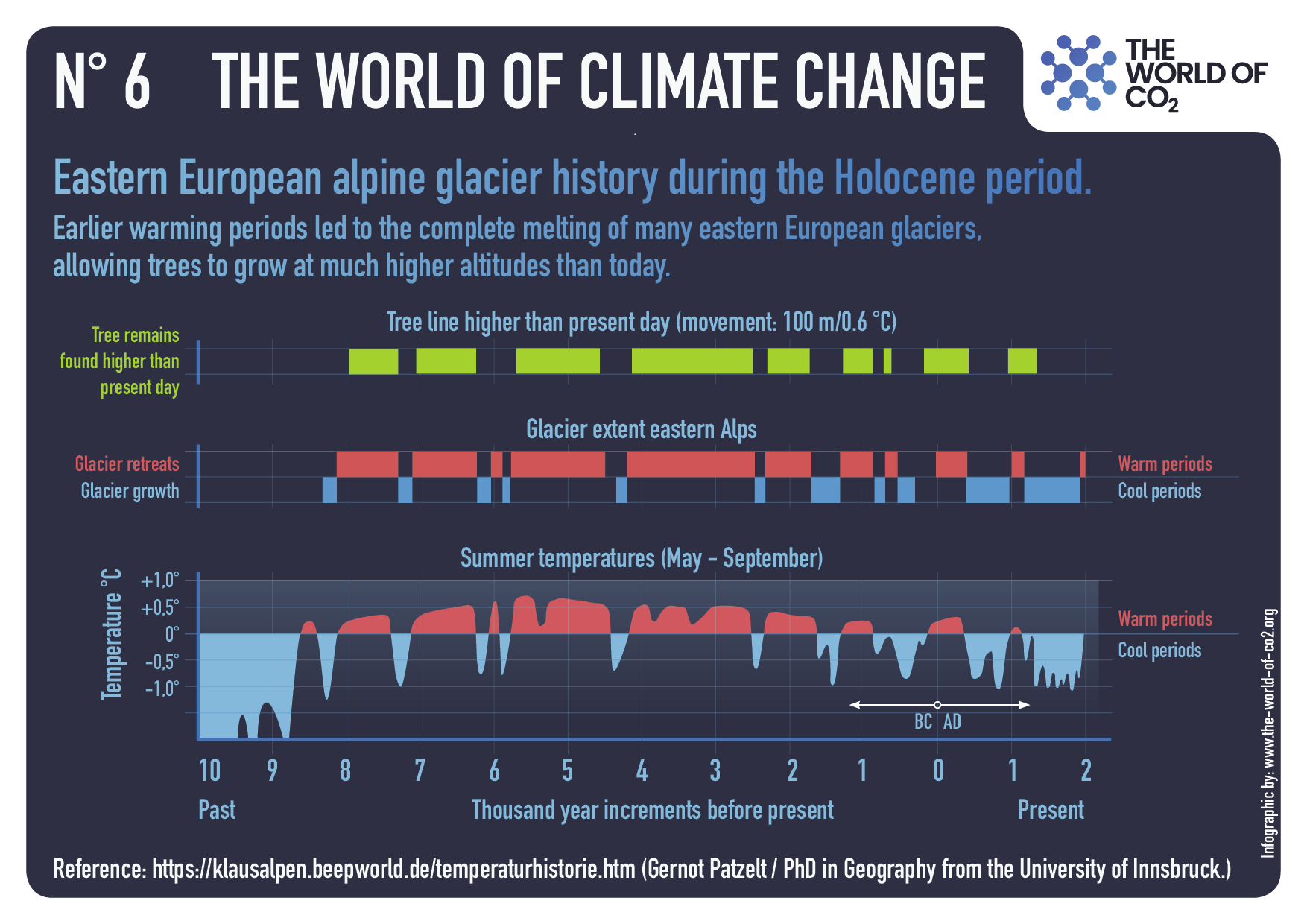
More than 18,000 glaciers have been identified across 50 World Heritage sites but this represents less than 10% of the Earth’s glaciated area. The media, climate activists and vested interest groups like to argue that all glaciers are receding because global temperature is increasing. Not surprisingly, many glaciers have been retreating since we emerged from the Little Ice Age (1250-1850), a time when many farms and houses across Scandinavia were destroyed by advancing glaciers between the 14th and 19th centuries.

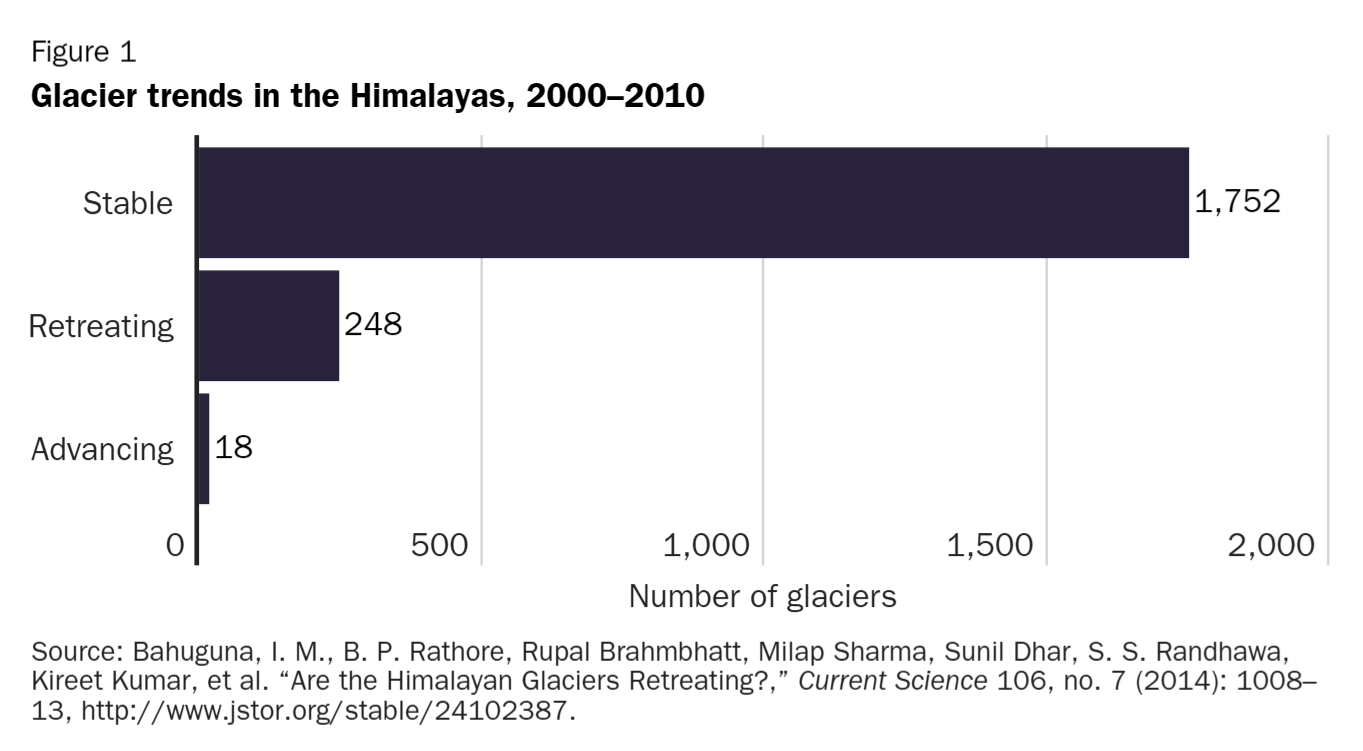
We might expect that glaciers and ice sheets would recede after the Little Ice Age yet we know that glaciers in many parts of the world are advancing, with glaciers growing in the Alps, North America, Patagonia, Antarctica, Alaska, the Himalayas, China, Iceland, Greenland, New Zealand, Norway, Antarctica and Greenland.

Where glaciers reach the sea, the media, and some tour guides, like to promote the dramatic calving-glacier image as pointing to (imaginary) global warming but fail to point out (perhaps they don’t know) that a calving glacier is the sign of an advancing inland glacier and certainly not one that is about to disappear.

In his silly, but influential, 2005 movie “An Inconvenient Truth” Al Gore said:

“Within the decade, there will be no more snows of Kilimanjaro.”

Mount Kilimanjaro is still covered in snow.  See False Alarm over the Retreat of the Himalayan Glaciers

“The speed and consequences of Himalayan glacial retreat have been grossly exaggerated by the media and environmental activists.”

A significant proportion of Himalayan glaciers are advancing. In fact, 58% of glaciers examined in the westerly Karakoram range, a chain of snowy peaks along the border of India, Pakistan and China, were stable or advancing with annual snowfall increasing. A study of Himalayan glaciers, published in the American Meteorological Society’s Journal of Climate reported that cooler summers are failing to melt winter snows, which are themselves becoming more frequent, resulting in advancing glaciers. Source: Live Science

GLACIERS/ICE SHEETS IN ANTARCTICA

The Antarctic ice sheet is the world’s largest mass of ice covering around 14 million sq. km.

Ice sheets can be described as glaciers that cover very large areas and the most obvious examples are found in Greenland and Antarctica where around two-thirds of the Earth’s fresh water is stored.

Alarming reports that the Antarctic ice sheet is rapidly melting misrepresent the science of a very complex situation. Antarctica has been ice-covered for at least 30 million years. The ice sheet holds over 26 million gigatonnes of water (a gigatonne is a billion metric tons). If it were to melt completely, sea levels would rise 60 metres. Such a change is many millennia in the future, if it happens at all, although climate alarmists will always claim that such a response is just around the corner because of (imaginary) global warming.

Modest ice loss is normal in Antarctica.  Each year in summer, more than 2,000 gigatonnes of ice is discharged in the form of melt and icebergs, while snowfall additions keep the ice mass in equilibrium.

Summary

So it is a familiar story. A complex naturally fluctuating situation, in this case glaciers, is abused by activists to claim support for their agenda. I have a lot of respect for glaciologists; it is a deep, complex subject, and the field work is incredibly challenging. And since “glacial” describes any process where any movement is imperceptible, I can understand their excitement over something happening all of a sudden.

But I do not applaud those pandering to the global warming/climate change crowd. They seem not to realize they debase their own field of study by making exaggerated claims and by “jumping the shark.”
Meanwhile real scientists are doing the heavy lifting and showing restraint and wisdom about the limitations of their knowledge.

Resources:

Redressing Antarctic Glacier Porn

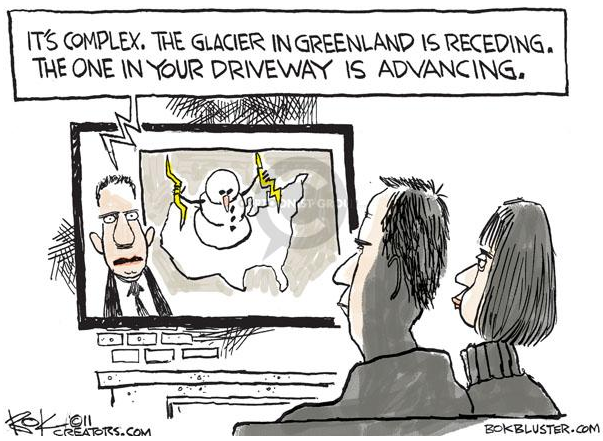
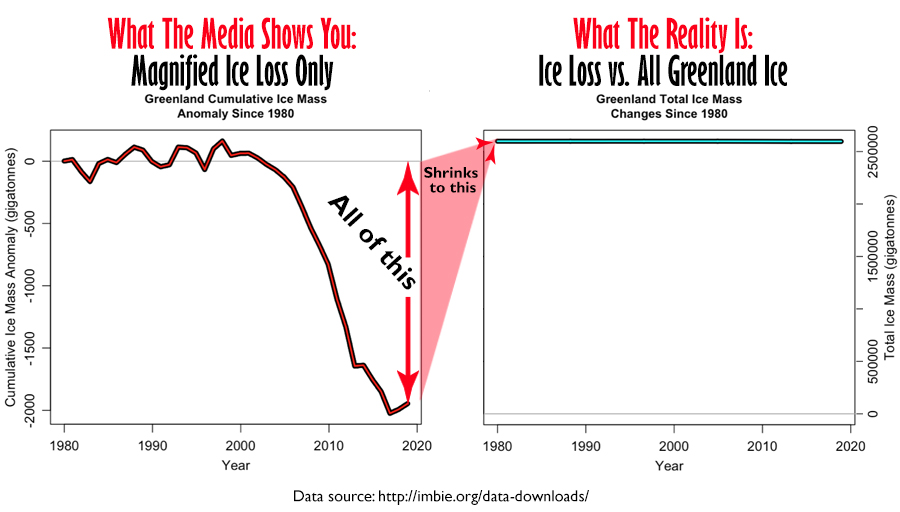
Greenland Ice Varies, Don’t Panic 2023 Update

Climatists’ Childish Reading of Polar Ice

Figure 1. A comparison of presentations of satellite data capturing Greenland’s ice mass loss. The image on the right shows changes in Greenland’s ice mass relative to Greenland’s total ice mass. Sources: The data plotted in these graphs are from the Ice Sheet Mass Balance Inter-Comparison Exercise, a joint exercise by NASA and the European Space Agency.4 Graphs originally by Willis Eschenbach. Adapted and annotated by Anthony Watts.


Javier Vinos Finds Missing Climate Puzzle Pieces

Tom Nelson interviews independent researcher Javier Vinos reporting his discoveries of facts and evidence ignored or forgotten in the rush to judgement against humanity for burning hydrocarbon fuels. When these factors are acknowledged they can be integrated into a more wholistic view of Earth’s climate activity.  For those who prefer reading, below is an excerpted transcript with my bolds along with some images and key exhibits included. TN refers to Tom Nelson and JV to Javer Vinos.

JV: For the past ten years I’ve been studying climate quite in depth with a basic focus on natural climate change, on how the climate changes naturally. I did this because I had a science blog and one day I decided I was going to talk about the science of climate and when I started to read the articles and looking for the information I became very surprised because I do molecular biology and Neuroscience that is experimental science. And climate science is not an experimental science and I was very surprised because they were claiming the evidence was there and it was not.

So I began researching it more and more until I became so involved I started writing books and telling other people what I was finding about climate.

The Scientific Method and Climate Science

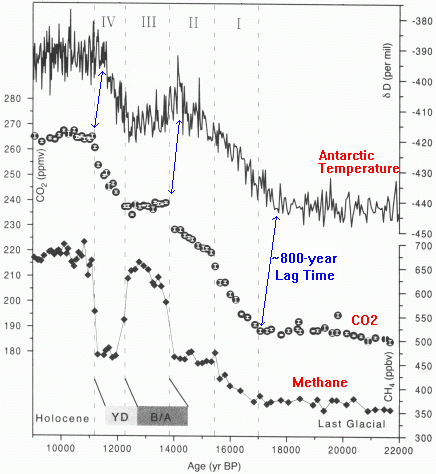
One of the elementary principles of the scientific method is that establishing a theory before examining all the evidence leads to error and confirmation bias makes us stick to it.  Has the scientific method been forgotten in the postmodern age?  It seems so, at least in climate science.  Climatology is not an experimental science which is a major handicap.  It is also a very young science compared to the mainstream Sciences of physics, chemistry, geology and biology.  The consensus was reached in 1988 almost without data and wholly based on the Greenhouse Effect and The Coincidence of temperature and CO2 during the Pleistocene in Antarctic Ice cores.

Understanding Albedo and Heat Transport

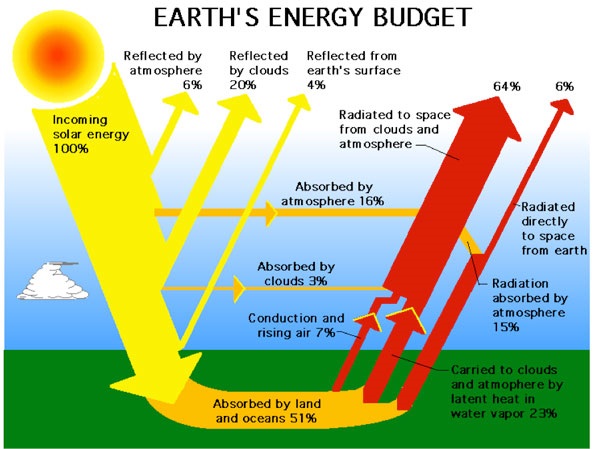
There are two absolutely essential processes in determining climate that are largely unknown.  The first is albedo or the amount of sunlight reflected back into space.  It’s crucial because it determines the amount of energy the Earth receives.  We ignore why it has the value it has, why it varies so little from year to year, why it varies so much from month to month, why both hemispheres have the same albedo and how the albedo has changed in the past.

As a result of our ignorance, models are unable to adequately reproduce the Earth albedo failing to show its small inter-annual variability, its large seasonal variability and its symmetry between the two hemispheres.   Nevertheless many scientists believe that the models are capable of predicting changes in albedo otherwise they will have to admit that the models cannot predict future climates. Small changes in albedo can produce large climate changes of natural origin and this is the basis of several alternative hypotheses to CO2.

ERBE measurements of radiative imbalance.

I have focused my research on a second essential process and this is what my book is about.  The transport of heat from the equator to the poles also known as meridional heat transport because it runs in the direction of the meridians.  There is much evidence that this is the primary cause of natural climate change.  Heat transport is also an enormously neglected process, we do not know how it works and there is no established Theory to explain it.  We also do not know how it is distributed between the atmosphere and the ocean, how it is divided among the different types of ocean currents, how it changes with the seasons, how it changes from year to year, why Antarctica receives less heat than the Arctic although it should receive more or why heat is transported from the colder hemisphere to the warmer hemisphere.

The models do not understand heat transport because no one understands it,
and that is where the evidence for most natural climate change lies.

In fact we can’t even measure it properly and if we don’t know how heat transport works, it’s obvious that the models don’t either.  They fail miserably at reproducing the amount of heat being transported and reflecting transport changes in the atmosphere and ocean, they do not even correctly reproduce the distribution line, the climatic equator where the trade winds from both hemispheres converge.  Nor do they reproduce seasonal changes since the amount of heat entering and leaving the ocean throughout the year is not known.

If no one understands heat transport, then models cannot understand it either. because they are just a product of our minds with no physical connection to reality.  Even if there are other secondary causes of climate change, including increased CO2, the evidence points to changes in heat transport as the primary way in which the climate changes.  In the end it’s like the joke about the drunk who looks under a street lamp for his lost keys because the light is better there than where he thinks he lost them.

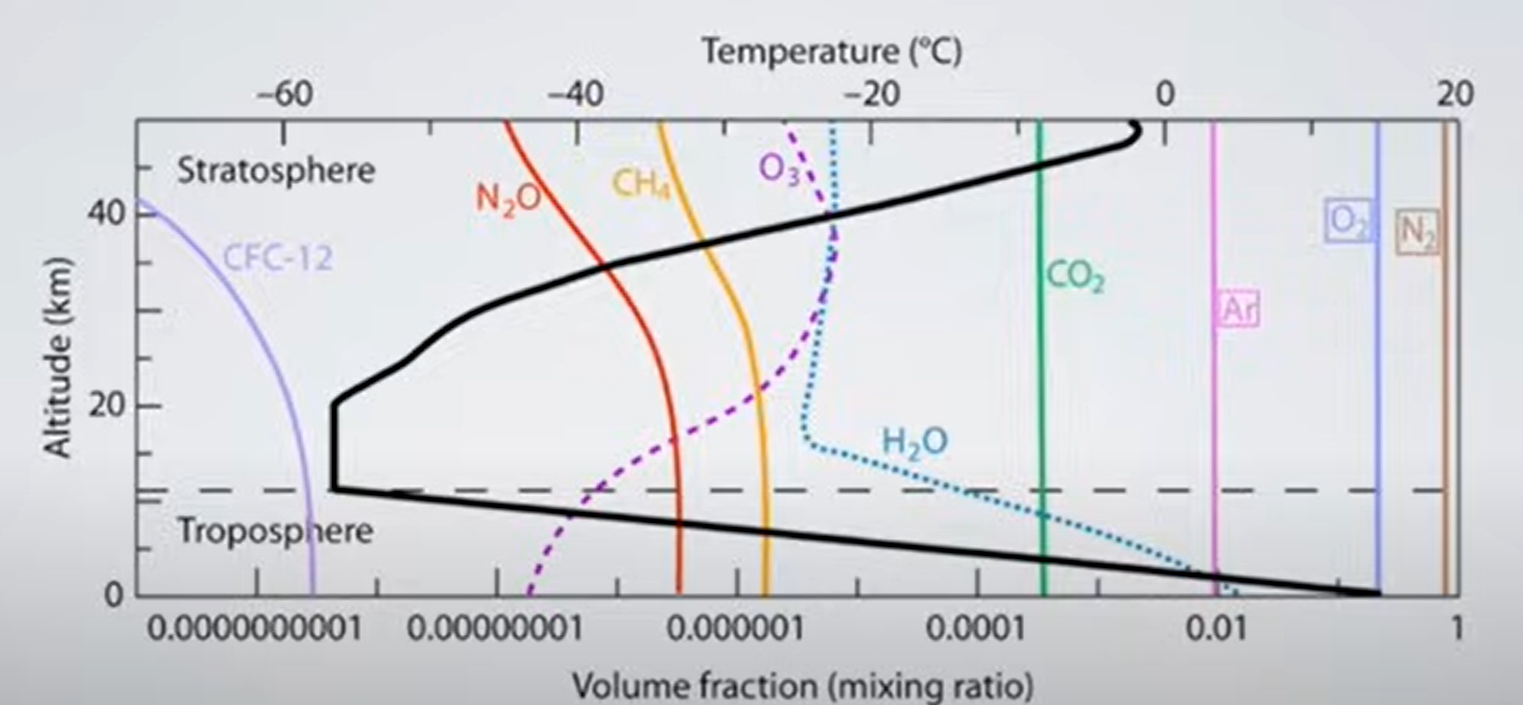
Climatologists look for the answer where the knowledge is better in the greenhouse effect. the culprits are certain gases that together make up 1% of the atmosphere.  In this graph we can see the profile of the gases that make up the atmosphere in different colors showing their abundance on the lower axis with respect to altitude on the vertical axis the gases in the squares do not absorb in the infrared.  Note that water vapor with a blue dotted line is very abundant near the surface but a thousand times less abundant in the stratosphere.  The opposite is true for ozone with a purple dust line which is almost entirely in the stratospheric ozone layer.  The thick black line is the temperature profile which in the troposphere has a positive lapse rate, that is the higher we go the colder it gets. This is fundamental to the greenhouse effect.

The Greenhouse Effect and CO2

What is the greenhouse effect?  In order to return all the energy is received from the Sun and maintain stability, the Earth must keep at a temperature of 23 degrees C below zero.

The Greenhouse Effect

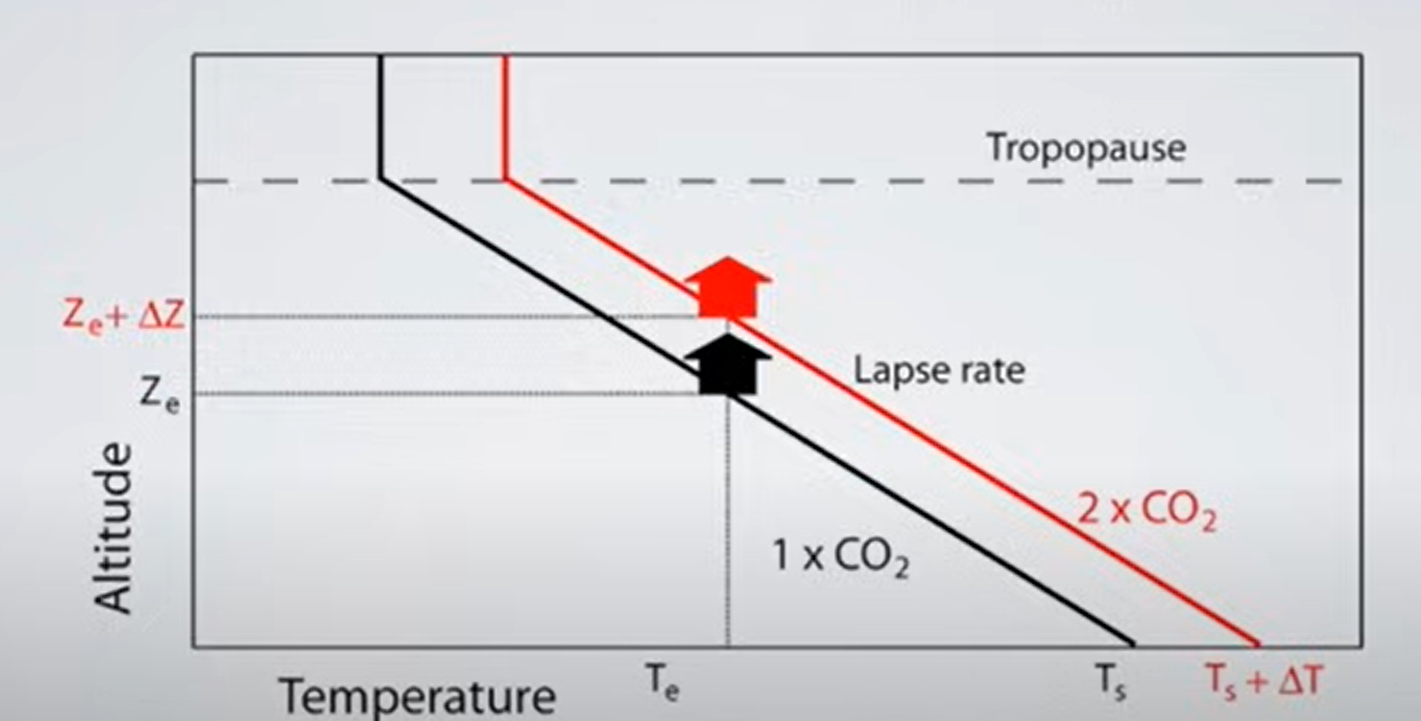
Without greenhouse gases this would be the average surface temperature instead of the current 14.5 degrees. The black line in this graph represents the temperature profile of the troposphere and the lapse rate is the slope of that line in the absence of greenhouse gases.  Infrared radiation will be emitted from the surface but greenhouse gases make the atmosphere opaque to infrared radiation, so this radiation is emitted from higher altitudes as shown by The Black Arrow.  Although in reality there is emission from all Heights including the surface the average height of emission is about 6 kilometers. The emission temperature at this height is 23° below zero but the lapse rate of about 6° per kilometer makes the surface about 37° warmer.  If we were to double the CO2 as shown in red, and everything else remains the same, the average emission height would increase by about 150 meters.   As the atmosphere becomes more opaque so the temperature at that height would be 1° cooler it would be necessary for the surface and atmosphere to warm by that degree in order for the earth to return the energy it receives from the sun which is absolutely necessary.

But in the climate system everything is interconnected and when something changes everything changes and nobody knows how much the temperature would change.  So when they tell us that we have to reduce our emissions by a certain amount to avoid some amount of warming they are lying to us because nobody knows that these gases cause the greenhouse effect.  Only the first three are really important. They are trace gases but that does not diminish their importance.  Ozone is a thousand times less abundant than CO2, but its contribution to the greenhouse effect is only five times less.

Greenhouse effect is not uniform across the planet.

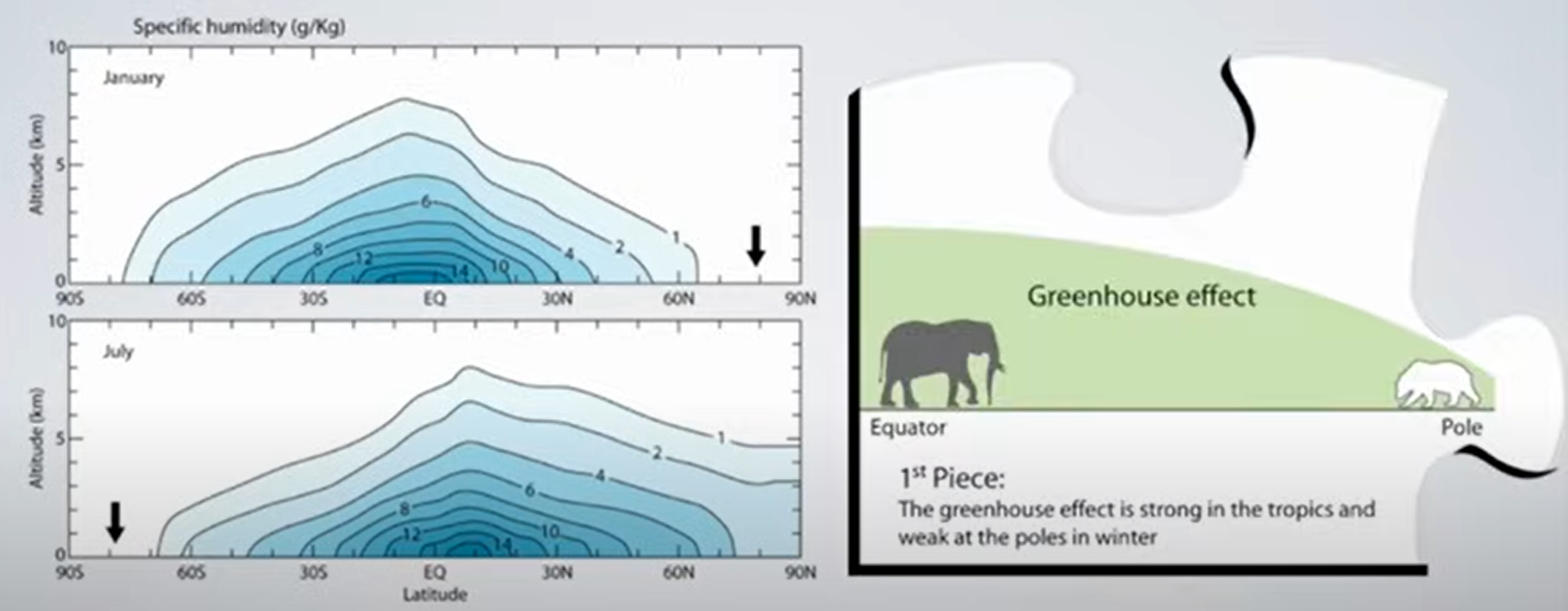
Look at water vapor in yellow.  Together with the clouds it forms, it is responsible for 3/4 of the greenhouse effect but it’s abundance varies greatly because it depends on temperature.  When the temperature drops it condenses and falls as water or snow.  Because of this the greenhouse effect is highly variable on the planet.  At the poles there is practically no water vapor or clouds in Winter. These are the places on Earth with the driest atmosphere and a much weaker greenhouse effect.  Not much attention is given to this, but it is very important, and I point out in the book it’s one of the pieces that must be used to solve the puzzle.

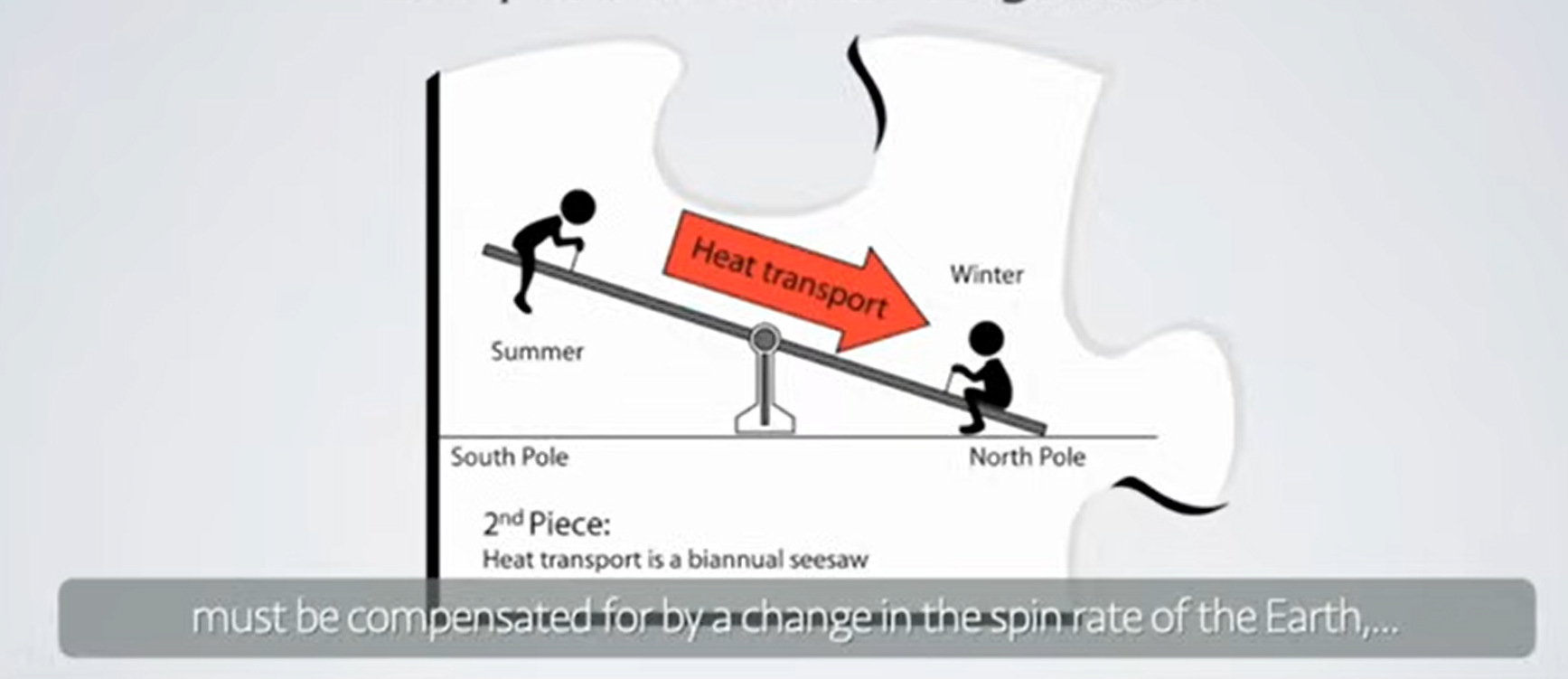
Every year has two winters, and heat transport
to the pole in winter is greater

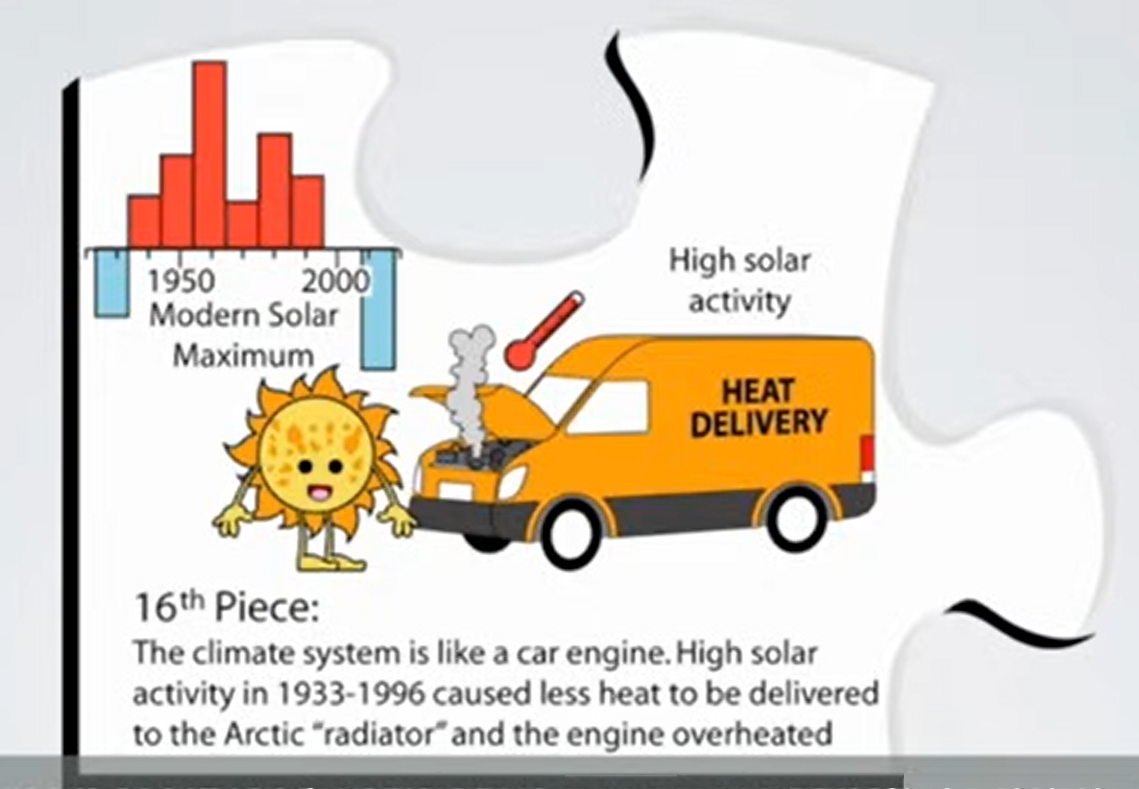
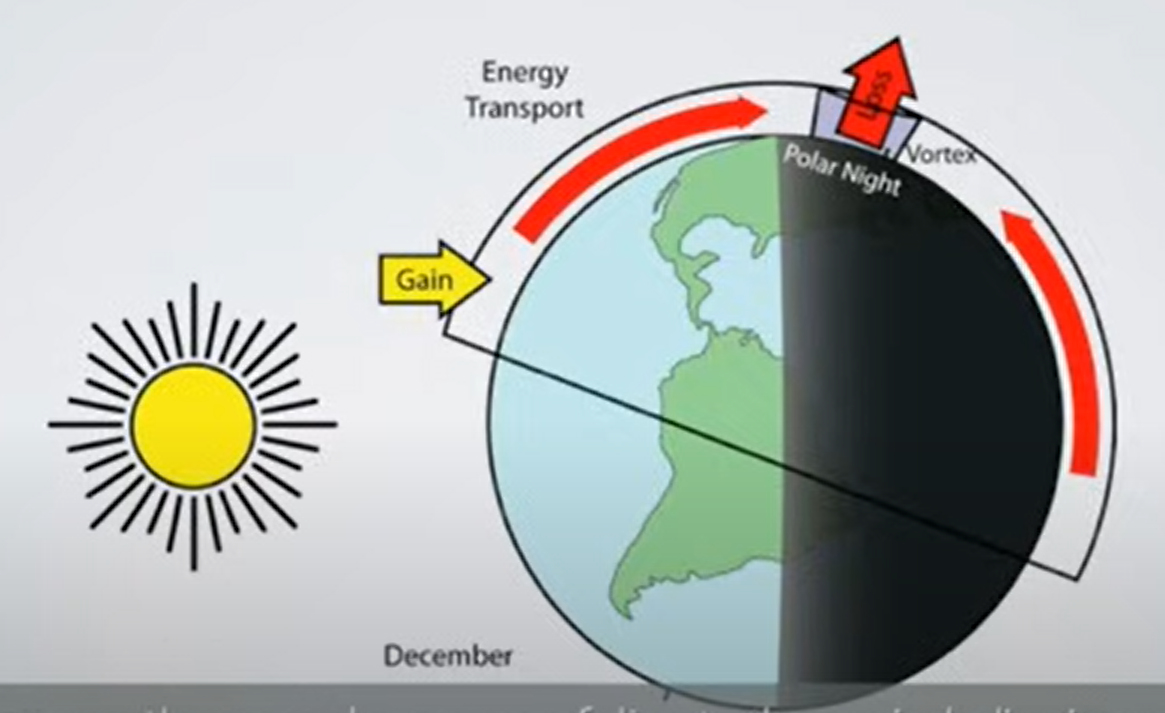
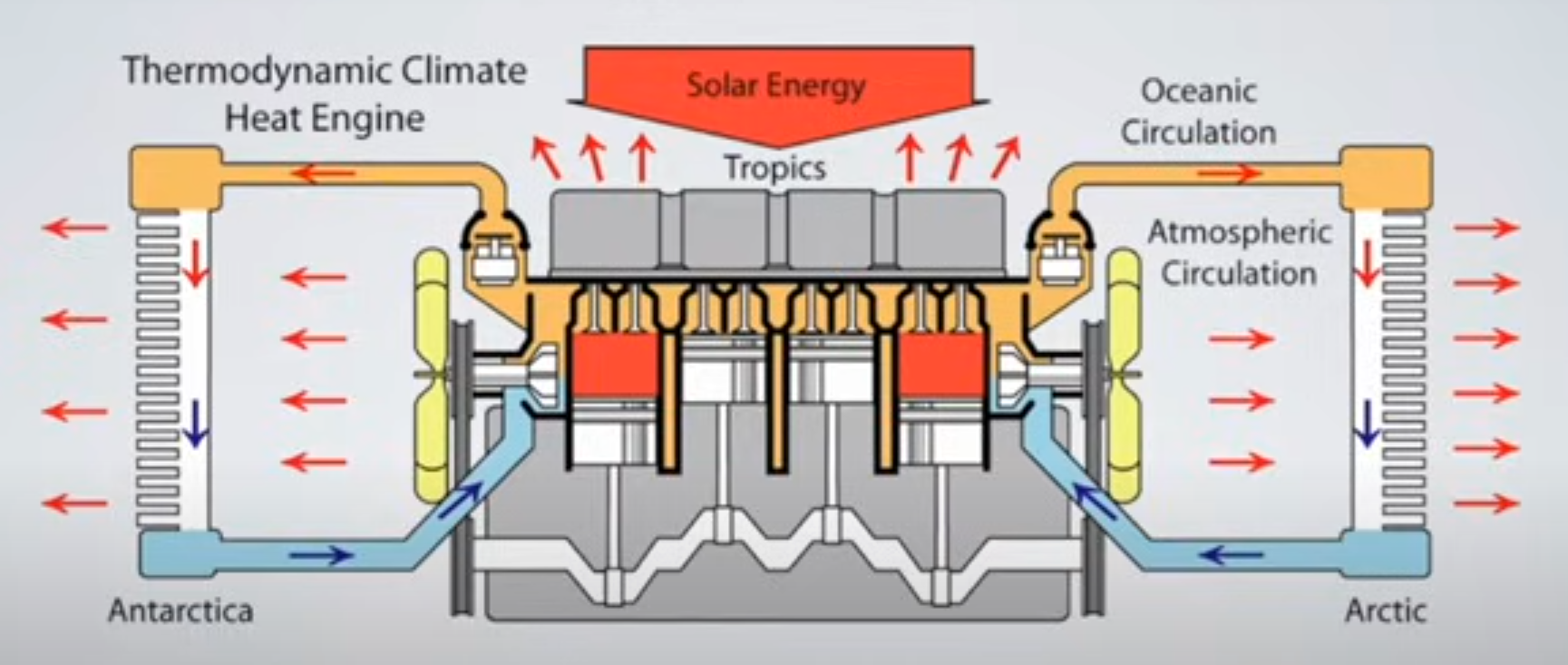
Having such a weak greenhouse effect makes it very easy for heat to escape from the earth through the poles.  The climate works like the internal combustion engine of a car; only instead of one cooling system it has two, one at each pole.  The engine block is the tropics, the hottest part because that is where most of the sun’s energy arrives.  The tropics lose heat by radiation but not enough.  The excess must be transported to the radiators to be radiated to the outside.  And this is done by a fan which is equivalent to the atmosphere and a circuit with a cooling liquid, which is equivalent to the ocean.

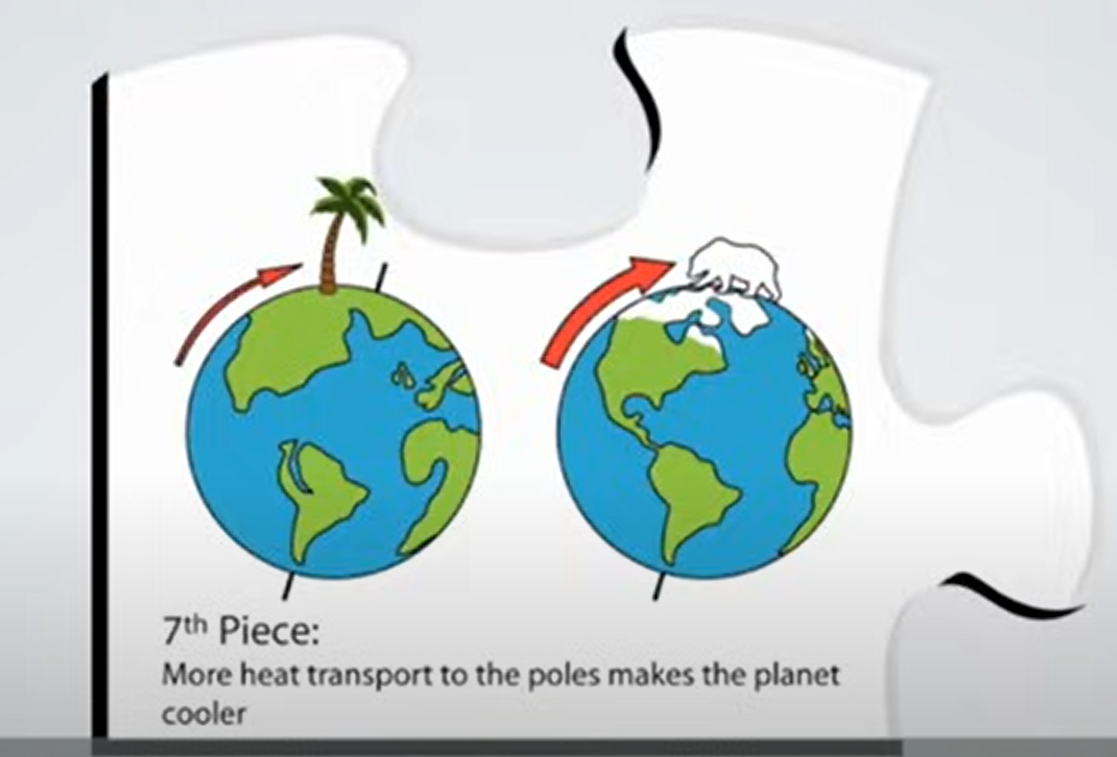
Climatologists do not see it this way, but the other way around.  For them heat transport does not change the temperature of the planet but only warms the poles.  But because of this erroneous view they encounter paradoxes that they cannot resolve. in the early Eocene, at the beginning of the age of mammals, the poles were so temperate that palm trees grew in the Arctic and frogs lived in Antarctica, indicating that the average temperature of the coldest mouth was above freezing. Climatologists do not understand how this was possible because the smaller temperature difference made the heat transport much smaller which prevented the poles from warming.

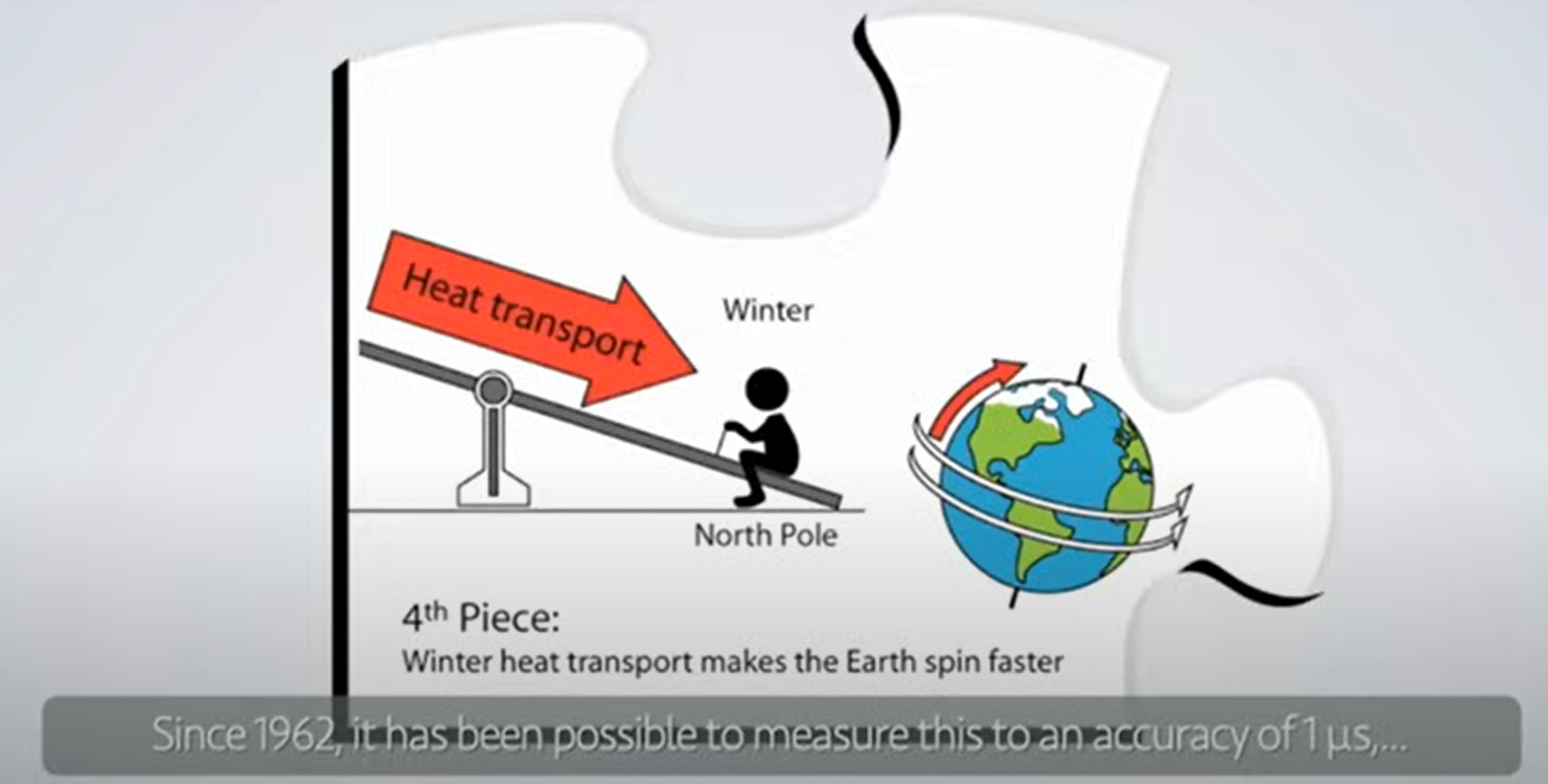
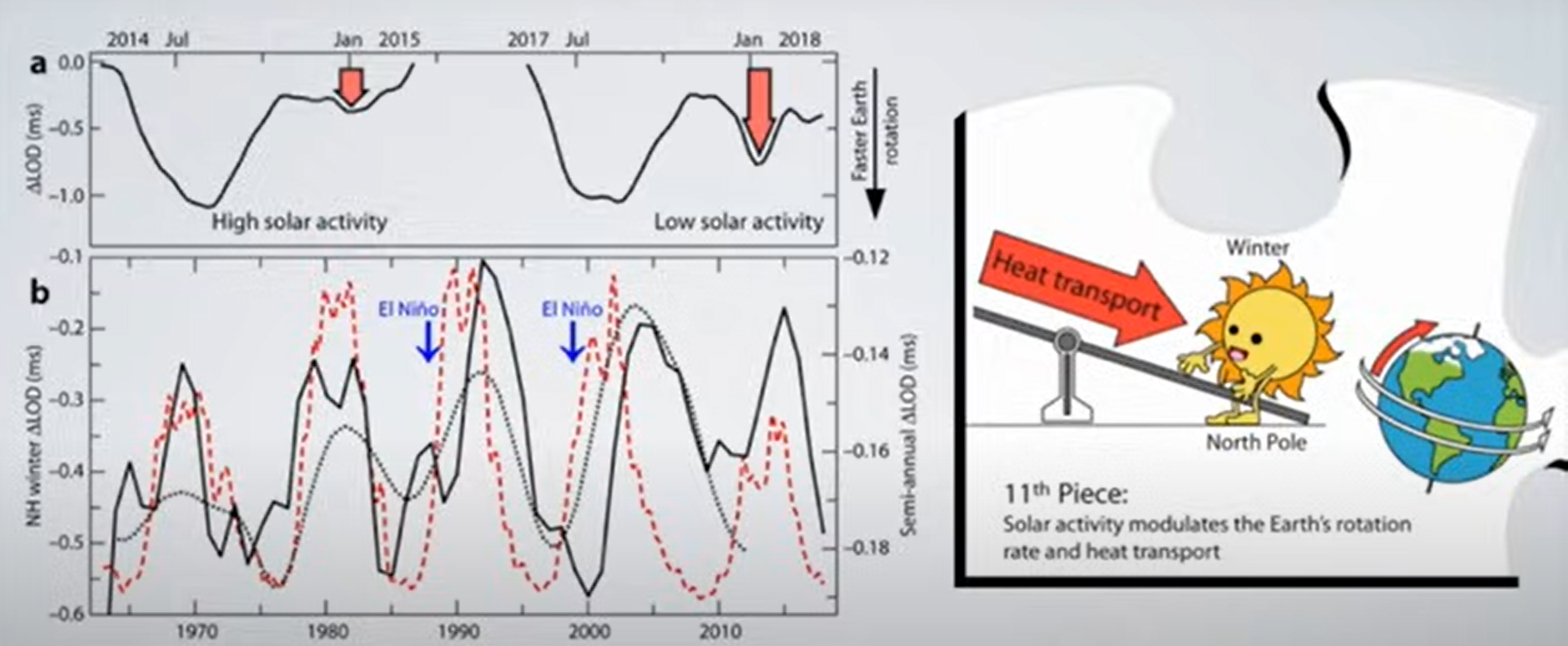
Like all paradoxes it is solved by changing the frame of reference.  It was possible because the smaller heat transport made the planet lose less heat and get warmer, which warmed the poles along with the rest. When it is winter in one hemisphere, the atmosphere transports more heat to that hemisphere.  But the atmosphere also carries angular momentum or rotational inertia since it is a conserved property.  Any change in the angular momentum of the atmosphere must be compensated for by a change in the spin rate of the earth.  Just as ice skaters increases their spin rate rate by bringing their arms closer to the body,  similar to the skater the Earth’s spin rate increases by about 1 millisecond per day as atmospheric circulation and heat transport increase in Winter.  Since 1962 it has been possible to measure this to an accuracy of one microsecond.  Thanks to the invention of the atomic clock and radio astronomy, it is possible to know the exact orientation of the Earth in space, it has been well known since the 1970s.

The Earth spins faster in winter.

The Influence of Solar Activity on Climate

That solar activity affects the Earth’s rotation has been published many times.  The phenomenon is particularly pronounced during the Boreal winter as we can see in the graph above for 2015 a year of high solar activity and 2018 with low activity.  And it is measured by the variation in milliseconds of day length.  In the lower graph we can see the solar activity represented by the sunspot cycle with a red dash line.  The black solid line shows the changes in the Earth’s rotation caused by the Boreal winter.  It shows the same cycle as the sun although the Earth’s rotation is also affected by equatorial stratospheric winds and the El Nino phenomenon.  The dotted line is from a paper published in 2014.

Everyone ignores this phenomenon especially the IPCC which says that the sun does not affect climate.  But if the sun can change the Earth’s rotation speed then it can change the climate.  My research has been like that of Sherlock Holmes looking for clues that have been missed, ignored and forgotten. Studies show the effect of the sun on the rotation of the Earth has been known for 50 years but very few people in the world know about it.

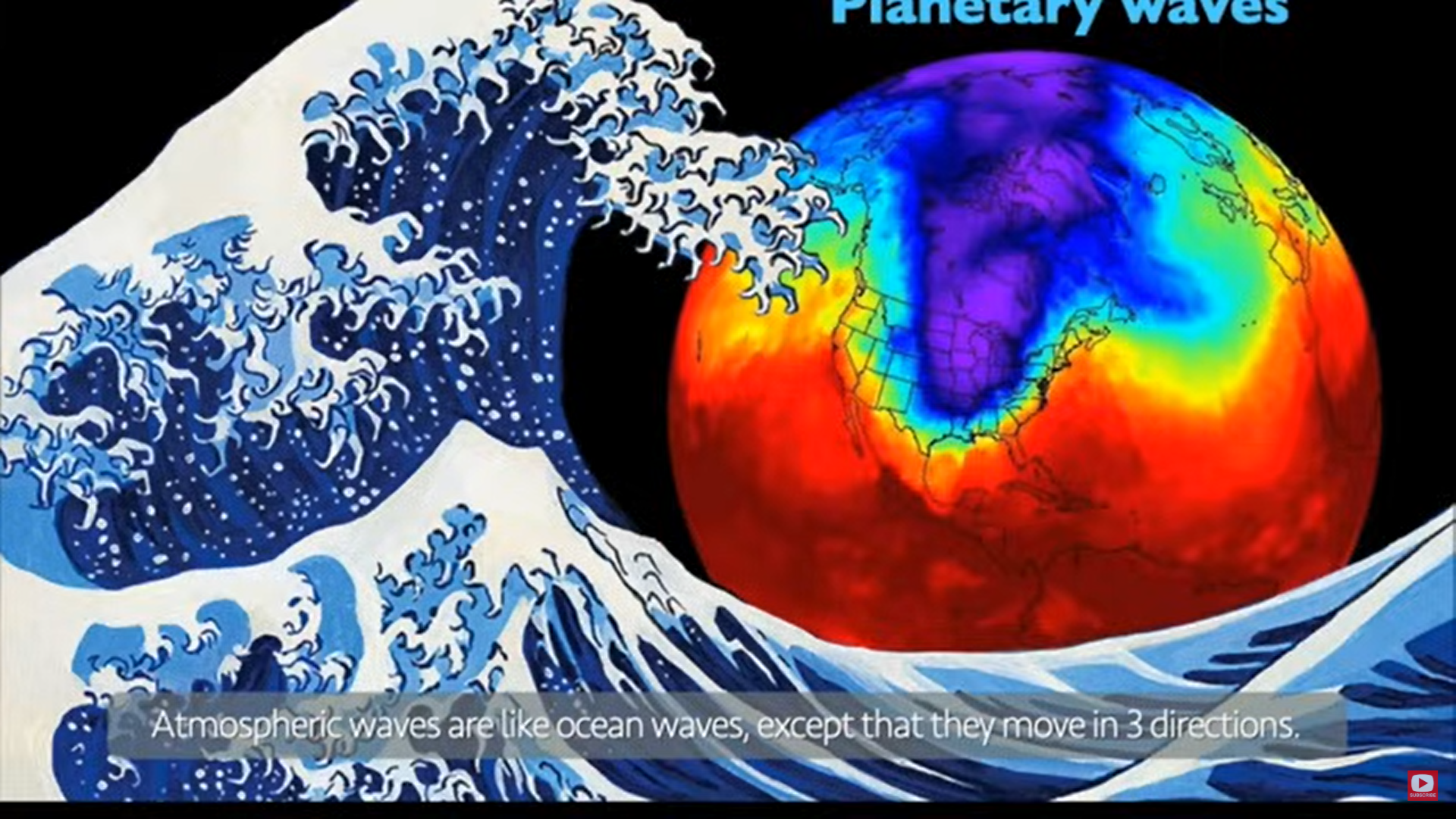
What I have learned about climate science is because I have stood on the shoulder of giants giants like the Canadian atmospheric physicist Colin Hines who explained in a 1974 paper that the sun’s effect on climate could be due to planetary waves.  It was ignored and his theory was forgotten.  Art lovers will recognize the Great Wave print by Hokusai.  Atmospheric waves are like ocean waves except that they move in three directions,  planetary waves are the largest.  Many of you will remember the tsunami that occurred in Indonesia at Christmas 2014.  It reached the coast of Africa 6,000 km away in 8 hours traveling at the speed of an airplane.  Obviously water does not travel, energy travels, and when it is released upon reaching the coast it still causes damage.

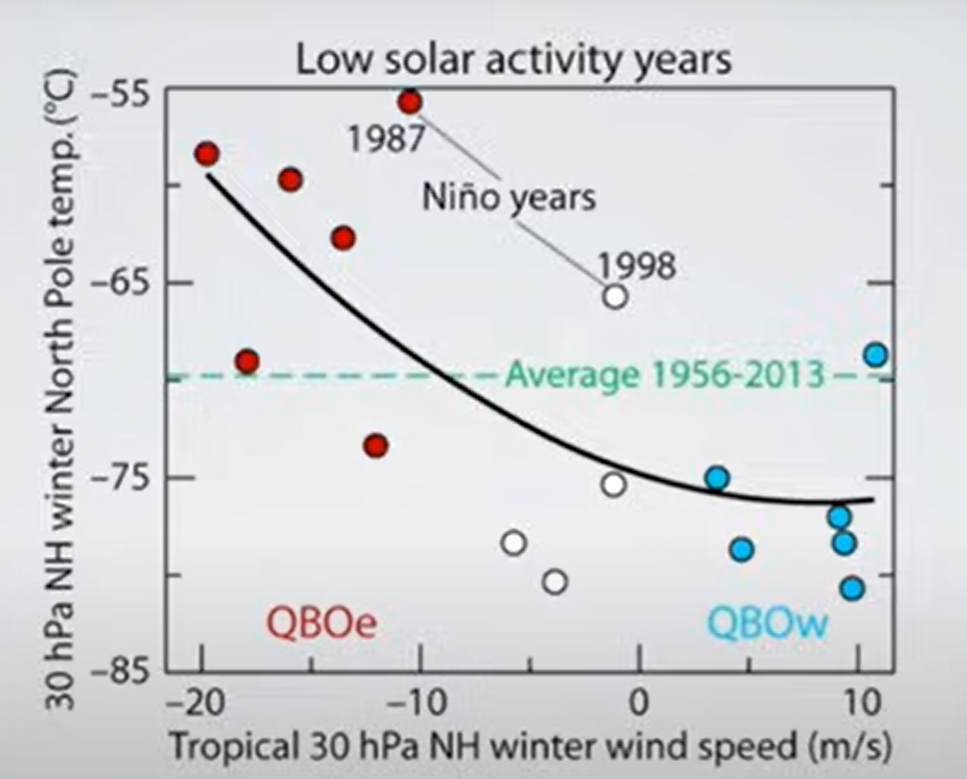
Planetary waves are atmospheric tsunamis that hit the wind walls of the polar vortex and weaken them. It worries us when cold air escapes from the interior because it produces very cold waves and storms.  But the climate is more affected by the heat that is exchanged with that cold, because the planet loses it and cannot compensate for it.  Another Giant on Whose shoulders I stood is Karin Labitzke who in 1987 found a correlation between the temperature of the Polar Stratosphere in Winter and the solar cycle. it is an extraordinary finding because in Winter the sun does not shine on the pole, it is a relationship in the dark not based on solar energy.  It is also extraordinary because it is the first proof of a solar effect on the climate after 190 years of a search began in 1800 by William Herschel the discoverer of Uranus and infrared radiation. Instead of giving her the Nobel Prize she deserved for such a fantastic discovery, her finding was ignored and she’s not even mentioned in climate books.

First evidence of the Sun’s effect on climate

Here I show only the data for years of low solar activity 30 Hectopascals is about 20 km in the stratosphere when the tropical Wind Blows from the West as shown by the blue circles.  The polar stratosphere is very cold, but when it blows from the East as shown by the red circles, the polar Stratosphere warms by about 15°.  In years of high solar activity the effect is reversed as I show in the book The El Nino phenomenon also strongly influences this effect.

For many scientists a solar effect that occurs in the dark, reverses depending on equatorial winds and depend on other phenomena is too complicated to understand and they prefer to ignore it.  But not to me because I have studied Hines.  The propagation of planetary waves into the stratosphere depends on several factors that affect the Dynamics of stratospheric circulation.

How does the Sun influence these Dynamics?

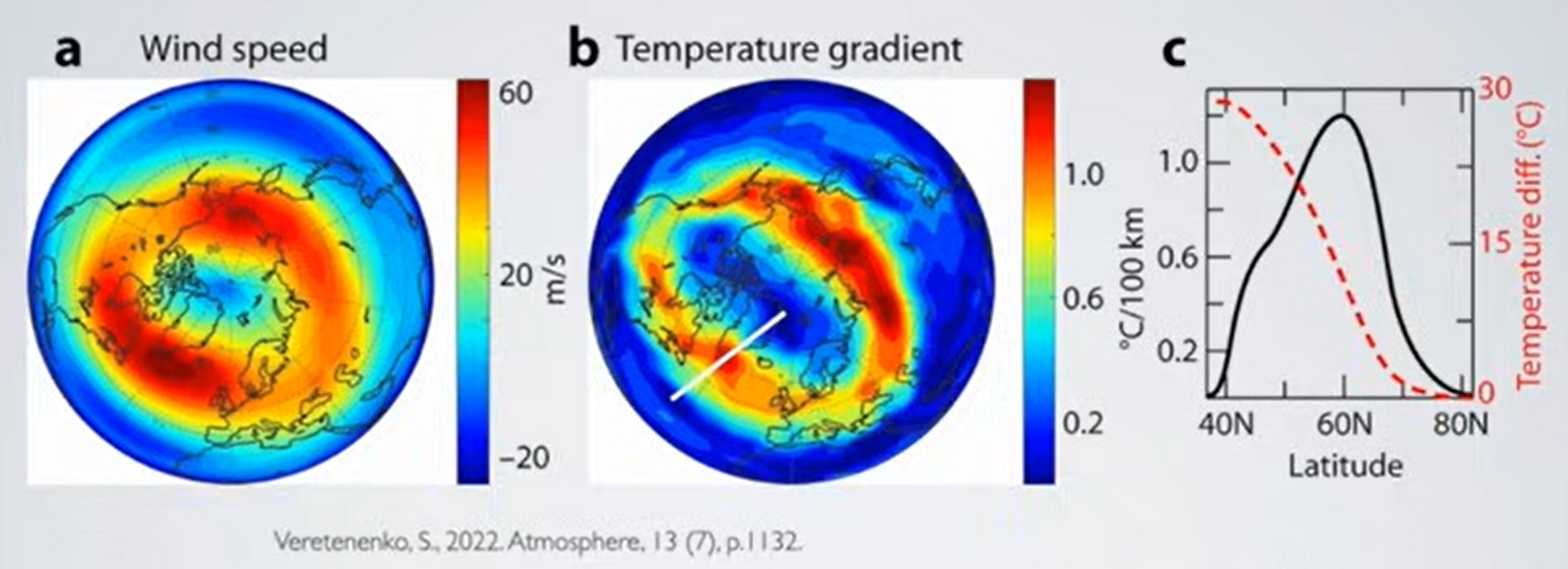
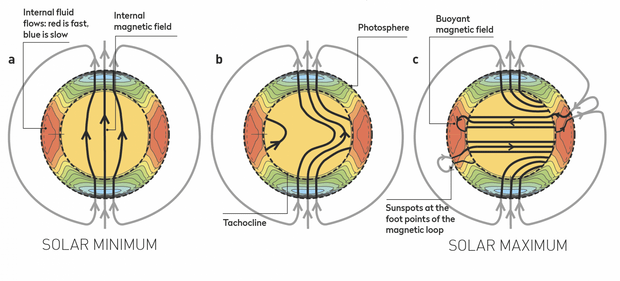
We know that solar activity affects the Earth’s rotation, heat transport and Atmospheric circulation. We also know from Labitzke for the last 35 years that it affects the temperature of the Polar Stratosphere.  And it does so as Hines said 50 years ago by affecting the propagation of planetary waves into the stratosphere.  These waves strike the polar vortex.  This is a gigantic tornado that circles the polar regions in winter with sustained wind speeds of 180 km/ hour.

Planetary waves affect climate through the Polar Vortex

Since heat is carried by the wind, the Warm Winds from the South have a hard time getting through this wall of wind creating a strong temperature gradient as shown in the second image. The black line in the graph shows the profile of this gradient which is a real wall that creates a 30° difference between its two sides as shown by the red dash line.  By weakening the vortex planetary waves allow heat to enter and cold to leave, changing the temperature of the polar region.  As we saw at the beginning, the greenhouse effect inside the vortex is very weak causing the planet to lose unrecoverable energy.

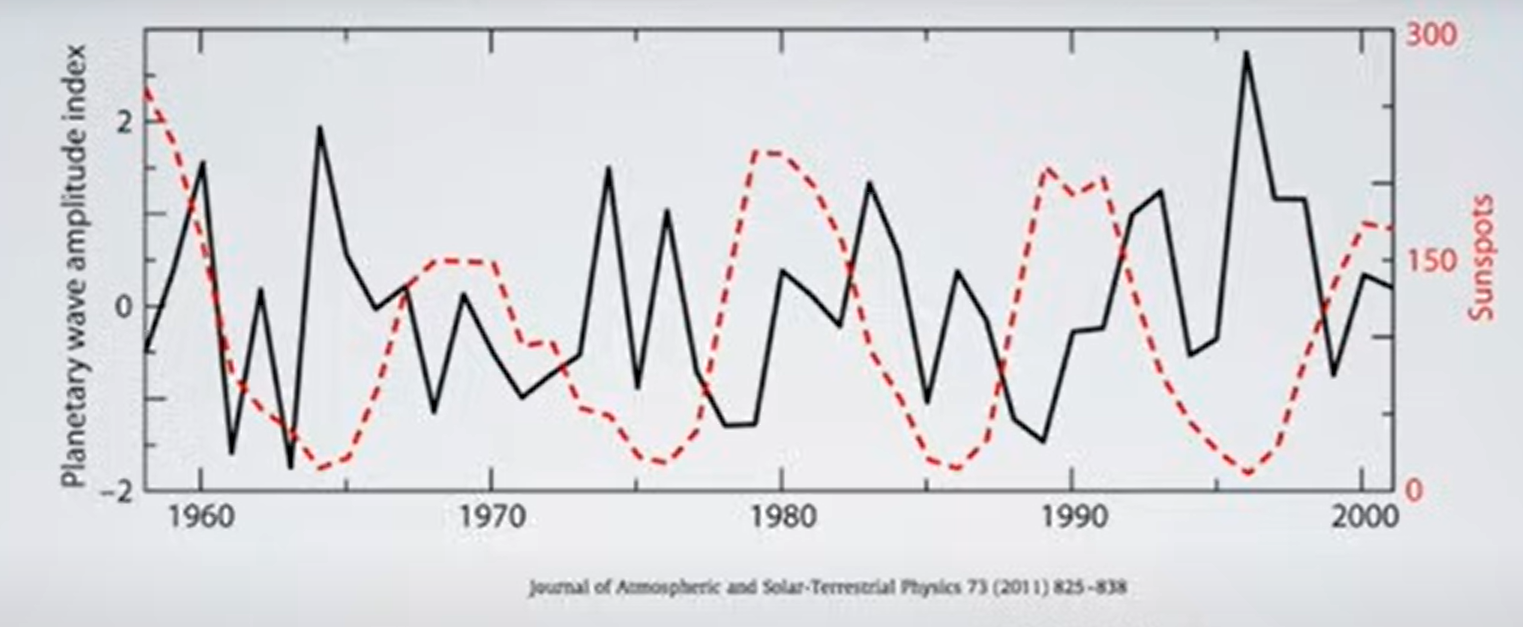
This is how the Sun affects the climate as explained by Hines and Labitzke and I am not just alone saying this, It has been shown.  The study of planetary waves in the stratosphere is extremely difficult because they are invisible and the stratosphere is little known but there is already a study based on measurements that proves it. And the intensity of the planetary waves depends on the solar cycle as its authors defend. The sawtooth appearance of the amplitude of the planetary waves is due to the effect of the tropical winds which change direction every one or two years and to the El Nino effect.

Intensity of planetary waves depends on the solar cycle

My contribution to these studies is to put all the pieces together:  the low polar greenhouse effect, and the effect of the sun on the Earth’s rotation heat transport atmospheric circulation, polar temperatures and planetary waves, and to show the effect that all this has not only on climate but also on climate change.

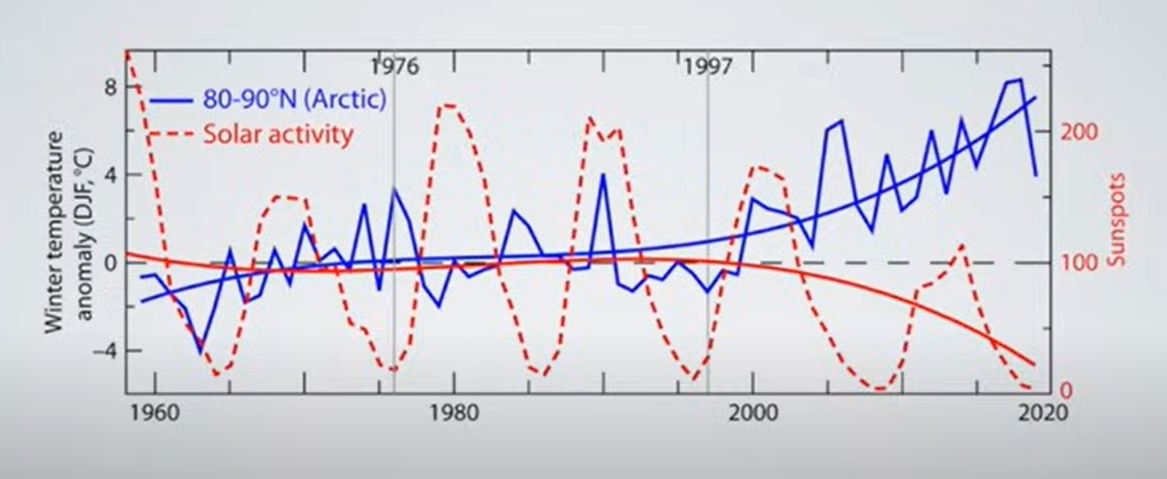
When solar activity is low, the Arctic warms

When there is low solar activity the Arctic warms as is shown in Blue by the temperature of the central Arctic according to data from the Danish meteorological Institute.  Today global warming and Arctic warming are linked in our minds.  We have forgotten that between 1976 and 1997, despite intense global warming, the Arctic not only did not warm but actually experienced a slight Cooling in its central zone.  Just as we have forgotten that the Arctic warmed in a similar way 100 years ago. It was reported at the time and there are scientific studies that support Antarctic warming a century ago similar to today’s in its effect on Greenland’s melting.

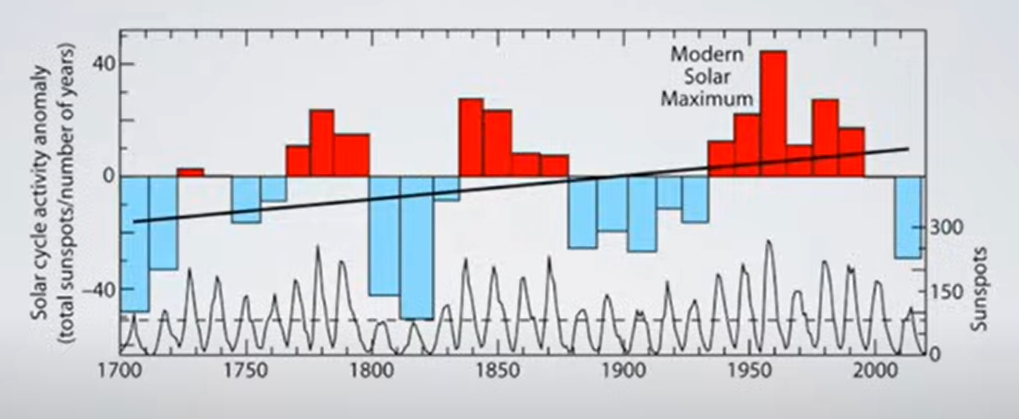
When solar activity is high, the rest of the planet warms

Why did this happen.  It is because solar activity has a cycle of about 100 years this graph shows the level of activity of each solar cycle relative to the average and we can appreciate the Centennial solar cycle shortly after 1700 1800 1900 and 2000 solar activity was below average and the Arctic warmed.  When solar activity is high the opposite happens and the Arctic cools but the rest of the planet warms because it becomes more efficient at conserving energy.

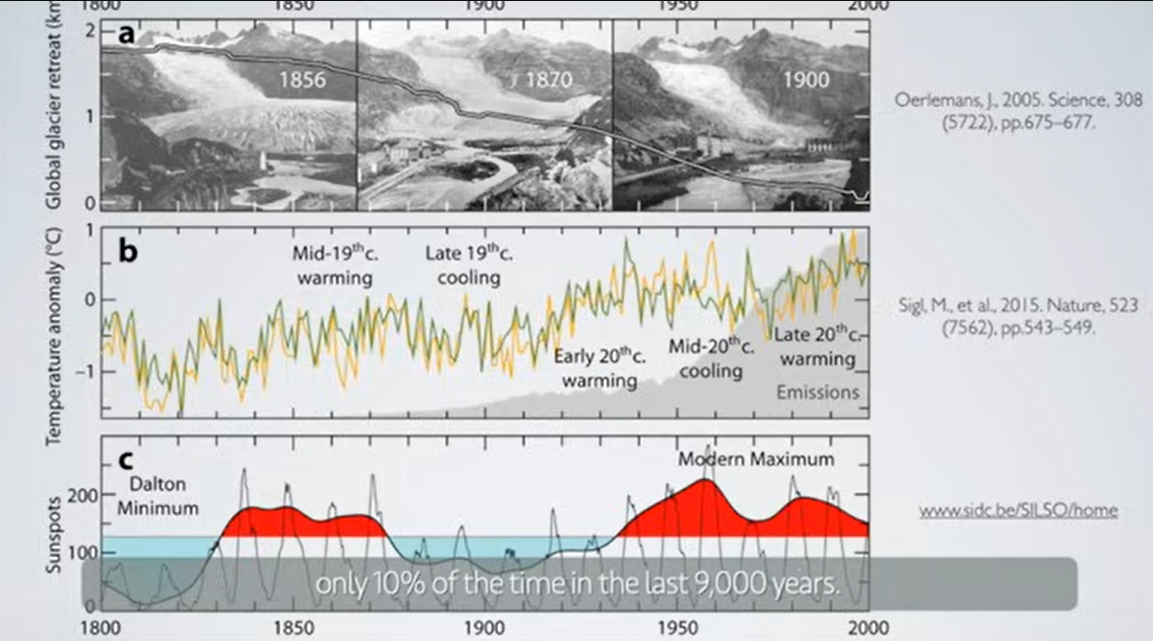
Glaciers and proxies show modern warming before CO2 emissions

The IPCC acknowledges that solar activity in the 20th century was in the top 10% of the last 9,000 years.  In the graph we can see the trend line indicating that solar activity has been increasing for the past 300 years and global warming is 200 years old.  we can see it in the behavior of glaciers which began to shrink worldwide in 1820 as shown by the line in the graph. The photos are from the Rome Glacier in Switzerland which melted enormously between 1850 and 1900.  People didn’t care, on the contrary they built hotels for tourists where the glacier used to be.

Climate proxies show the same thing.  The green line is from tree rings and the orange line is from other proxies, both showing a 30-year oscillation on a long-term warming trend.  In stark contrast, our emissions in Gray were nonexistent until 1900 and low until 1950,  the curves clearly do not match.  A much better match is obtained for solar activity shown in annual data with a thin line and a decade long smoothing that shows in red when it was above average and in blue when it was below average.

Global Warming is largely due to the Modern Solar Maximum

The modern solar maximum is the long 70-year period in the 20th century when it was above average, something that has happened only 10% of the time in the last 9,000 years.  We can therefore conclude that a reduction in the transport of heat to the polls during most of the 20th century is responsible for the planet conserving more energy and warming up contributing greatly to global warming.

And as Sherlock Holmes would say the IPCC has made a capital mistake by establishing a consensus Theory without properly examining all the evidence.  A this and much more is explained in my latest book solving the climate puzzle I want to thank three other scientists for reading my book before its publication and providing positive feedback.  They are William Happer professor emeritus of physics at Princeton University who also wrote the forward to the book,  Judith Curry professor emerita of atmospheric physics at Georgia Institute of Technology and Willie Soon research scientist at the Harvard-Smithsonian center for astrophysics.  I also want to thank Andy May, a writer I have collaborated with on many climate science web articles over the years.  The book has been written at several reading levels and divided into a large number of short chapters to make it more accessible to a general audience despite the inherent complexity of the subject.  It has been translated into five languages of which two have been published and three are in the process of being published.  There are plans to publish it in three more languages including Greta Thunberg’s.

My main interest for the past nine years has been to find out why and how the climate changes on our planet.  It is clear from the evidence that we are missing some essential processes because we don’t understand the majority of past climate changes. There are more scientists who agree on this than is usually acknowledge.  Several new theories have been developed including mine and they should be seriously considered by the IPCC because the CO2 Theory lacks sufficient evidence.  I defend my theory as having more support from evidence than the consensus one, but what is important to everybody is that on top of the IPCC’s Capital mistake of reaching a premature consensus, we don’t make the capital mistake of embarking the global economy on a planned experiment of unforeseeable consequences.

TN: You argue that climate change is largely due to natural causes and in particular you attribute a key role to high solar activity in the 20th century.  How does your theory differ from others who also argue for such a role?

JV: Well the mechanism is different. There is a lot of debate about the role of the sun in climate and over the last 30 years there has been a lot of advances in understanding how solar variability affects the stratosphere and how this effect is transmitted to the surface.  What I add is how these effects change the energy content of the climate system and thus produce climate change.  In my book I present evidence that climate is changing due to changes in the amount of heat that is being transported to the poles and the amount of solar energy that changes is not that important.  So in essence I refute the IPCC’s arguments that dismisses a solar effect on climate based on small changes in solar energy and in the trends in solar activity not being the same as temperature Trends

TN: Okay so how does your work fit with other theories like there’s the role of geothermal heat by Viterito and Kamis and the role of cosmic rays by Svensmark and Shaviv.

JV: It is good that there are all these theories because in science we should always discuss several explanations.  The important point is that the climate is always changing and it is a very complex process, so there is not a single cause for for climate change.  Many of these processes may be contributing to climate change including the the increase in CO2 and it is important to determine which ones are the most important in driving climate change.

We should continue researching and debating these processes.  Any viable Theory should provide a mechanism for changing the energy balance at the top of the atmosphere because this is what changes the energy content of the climate system.  And it should be supported by the more evidence the better.  The theory that I propose meets both requirements, while the theory that it is all due to CO2 lacks evidence.

The Role of Water Vapor and Volcanic Eruptions

TN: What do you think of Joe Bastardi’s views about the importance of water vapor in the climate?

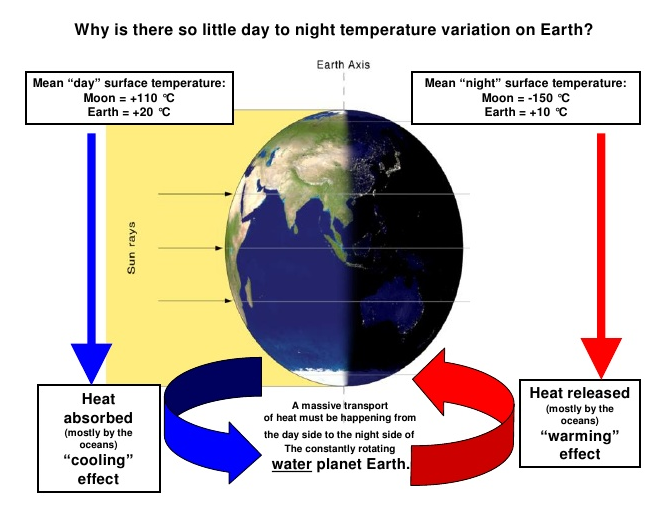
JV: I think it is fundamental because water vapor is the main greenhouse gas and what really defines the Earth is that it is a planet that has a lot of water in its three states,  And I believe that the role of water is to provide stability to The Climate system through its thermal inertia.  This is what explains that for the last 540 million years when everything has happened the temperature of planet has remain compatible with Life.  So I think none of the IPCC’s predictions is going to come true because I think the role of the water is misunderstood and it doesn’t behave the way it is expected to.  I don’t think water increases climate change,  I think it actually decreases it

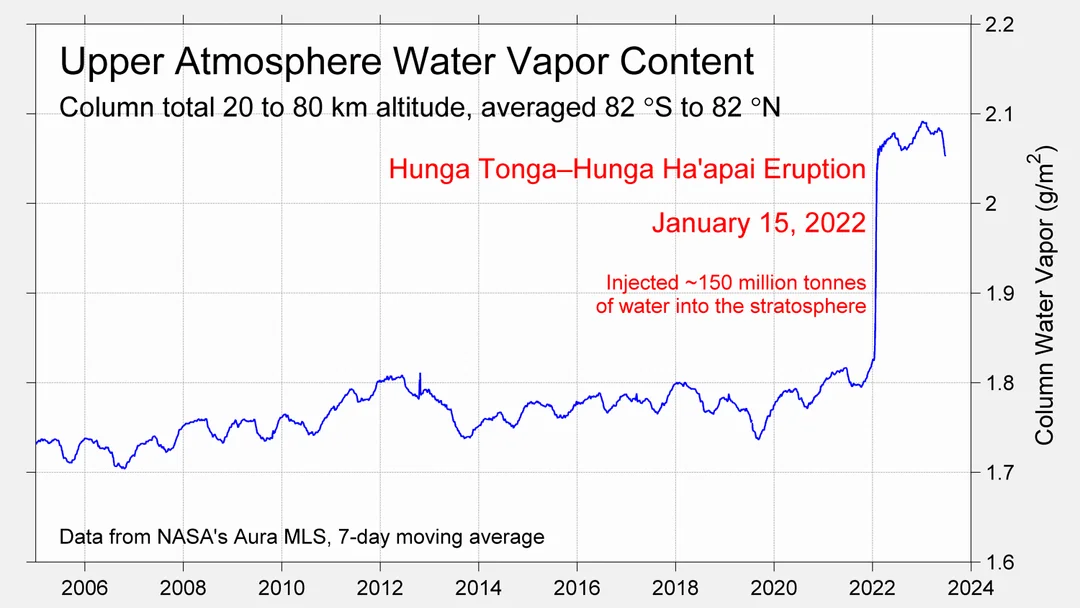
TN: What do you think about the eruption of the hunga Tonga volcano in 2022.  Is that a major reason for the recent temperature Spike?

JV: I think it is very likely.  The volcanic eruption of 2022 was very unusual in that it was underwater so it placed 146,000 tons of water vapor into the stratosphere and the stratosphere is very dry so in a single day the water vapor in the stratosphere increased by 10% and the greenhouse effect is very sensitive to changes in the stratosphere  because it is a lot less opaque to infrared radiation than the troposphere.  So the expected effect from this change as was published in January in natural climate change is a substantial increase in the warming rate so and this is what has been observed. The fact that the onset of this warming has such a delay is normal for volcanic eruptions for example the eruption of the Mount Tambora in April of 1815 produced the year without the summer more than a year later in 1816.   If this explanation is correct we should expect over the next months the warming rate should decrease substantially,  and this increased warming should disappear over the course of four to five years as the extra water vapor leaves the stratosphere.

Concluding Remarks and Future Implications

TN: So if your theory is correct what are the economic implications?

JV: Well if humans are are not primarily responsible for climate change this will have huge implications for the global economy.  We should question the energy transition in the form of urgency that is being made because it is not exempt of risk.  Even if the theory is correct, we should be aware that a lot of people will not be willing to accept it regardless of the evidence.

TN: Other than the economic implications, what are the other consequences if your theory is right?

JV: Well I think people should be very calm.  We are very lucky to be living through a warming period because cooling periods are much worse, usually accompanied by famine and epidemics. Being in a warming period is a lot better. So we should not fear climate and only be concerned when the warming period turns into a cooling period.   That will happen eventually, but we don’t expect it during the 21st century.   So essentially I think we are uh very lucky with respect to climate and as long as the cooling period doesn’t doesn’t start I think the climate is our Ally not our Enemy.


How Sun and Cosmic Rays Make Our Climate Change


Dr. Henrik Svensmark: Sun and Cosmic Rays Drive Climate, Not CO₂

Danish astrophysicist Henrik Svensmark explains how the changes in solar activity and cosmic rays can influence cloud formation and therefore our climate on Earth. Title above is link to podcast video at Freedom Research.  Below is the transcript lightly edited with my bolds and added images. FR refers to Freedom Research interviewer Hannes Sarv, and HS refers to Henrik Svensmark.

Hello, welcome. This is the Freedom Research Podcast and my name is Hannes Sarv. My guest today is a researcher from Denmark, an astrophysicist, Henrik Svensmark. He’s well known for his research on the relationship between cosmic rays and Earth’s climate. He has proposed that the variations in cosmic radiation influence cloud formation and consequently global temperature and biodiversity. Of course, we’re going to talk about climate change, cosmic rays and supernovas and how they affect Earth’s climate and biodiversity well here on Earth. So first of all, thank you, Henrik, for taking the time for this interview.

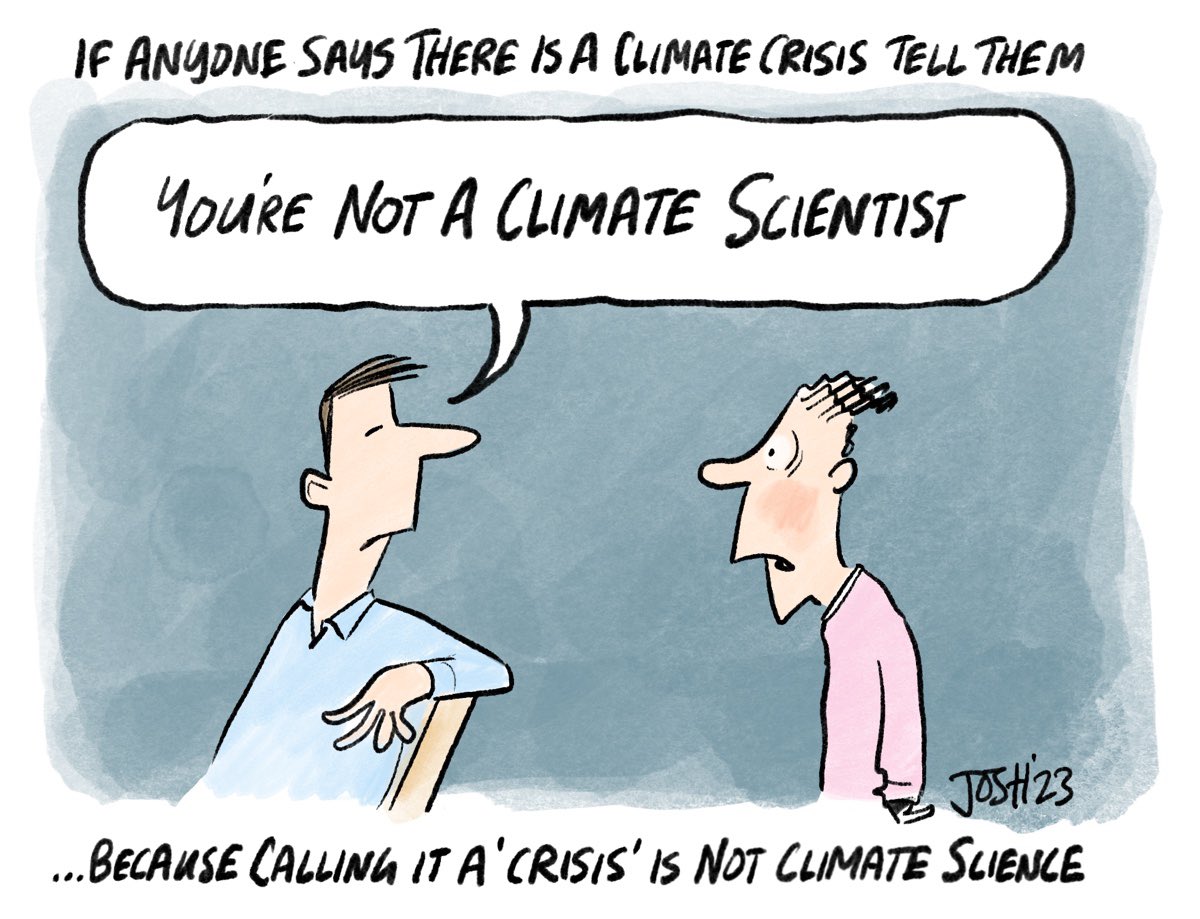
Firstly, I would actually like to ask a question. Simple, simple question, which can be puzzling, at least to a lot of people. I mean, if you’re being told that you’re living in a constant climate crisis, then probably most of the people probably fear it or they might get afraid. So if someone says to you that today there is a climate crisis. What is your answer to that?

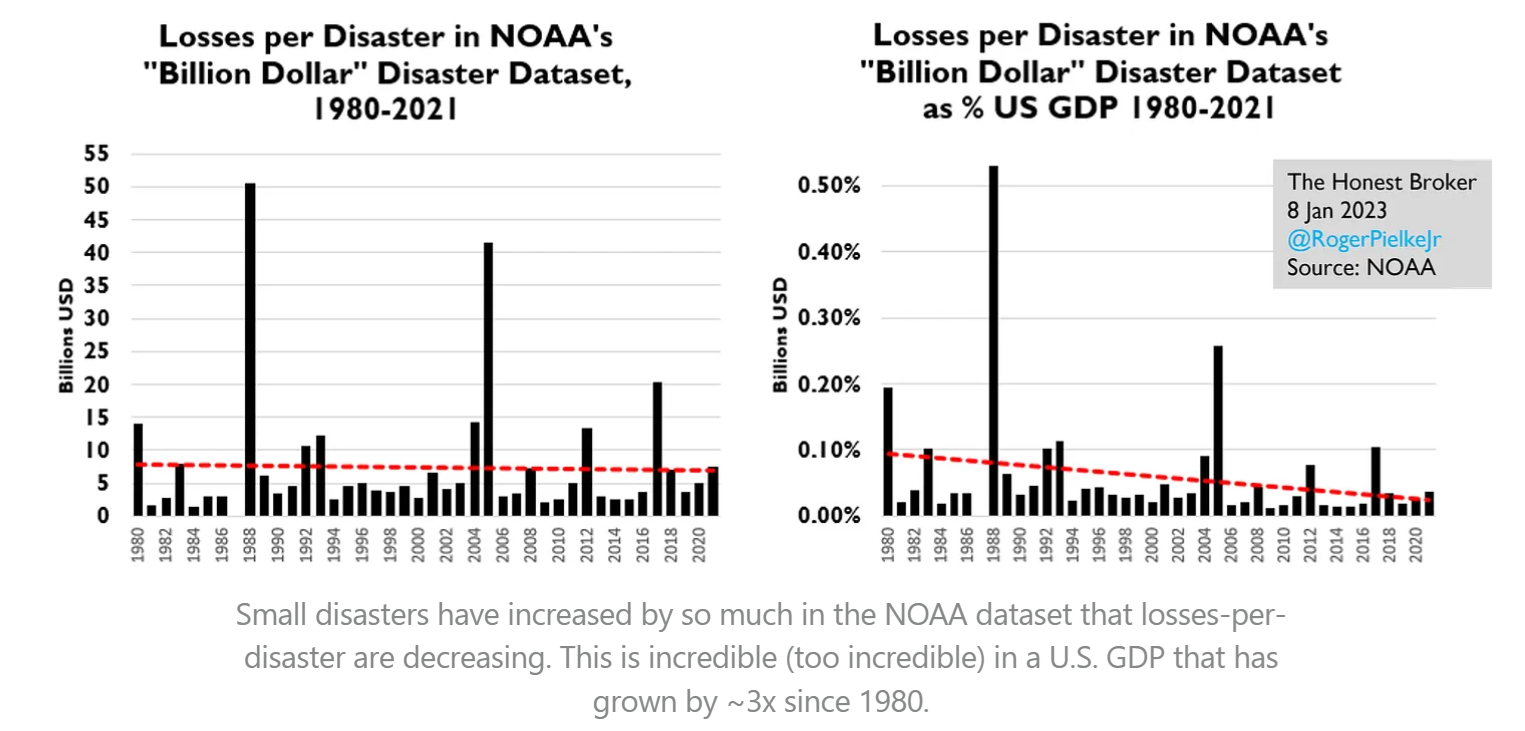
HS: Well, it’s a very political subject and the idea that the climate is in a crisis, I don’t think that that’s actually the case. It’s much less I mean, the climate disasters and so on, I mean, they’re not really increasing at all. And, of course, the temperature has gone up a little bit, but it has not, you know, made a serious crisis that we cannot handle. So, I actually think the idea that we are in a crisis is actually not correct.
FR: So you think, probably It depends on where you live, right? If the temperature goes up, it gets warmer and well, as I have understood most of the places or the larger part of the population actually benefits from higher temperatures.  What is your take?

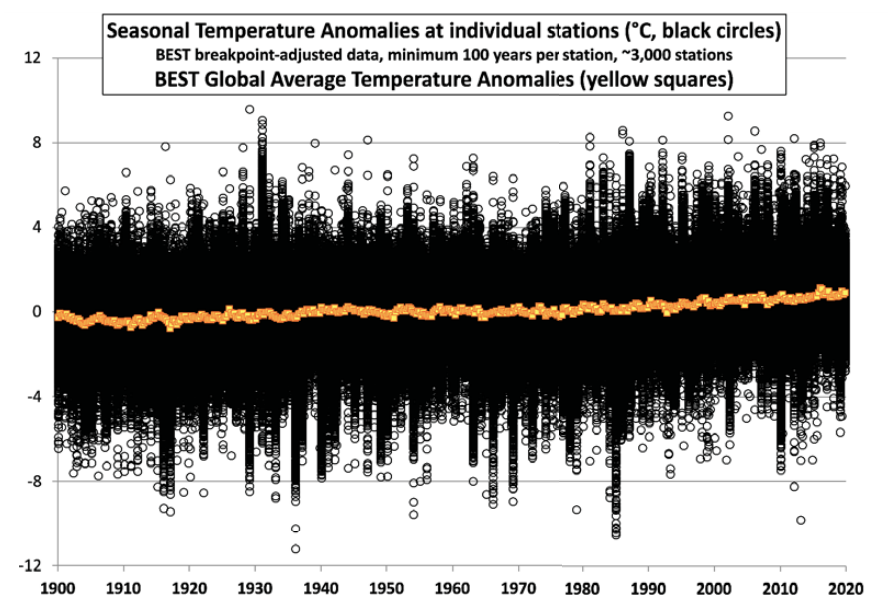
HS: Certainly, there are places where you actually benefit from it. And in many cases, it’s not because it actually gets warmer. It’s more like it’s climate’s getting milder, meaning that it’s the colder temperatures, you know, at night and in the winter that goes slightly up, which is actually a good thing.  I mean, here in Denmark, we haven’t had very severe winters for a long time. which is also good. It’s good for the economy. It’s good for many things because a cold climate is much, much worse than a warmer climate. I think that, I mean, you also know that You also talk about people, you can have people dying from warm weather, but we know that it’s mainly cold weather that is the real killer of people. I think there’s almost a factor of 10 in difference. So slightly milder weather is not a problem. I mean, it’s certainly not a disaster.
FR:This is kind of puzzling also to many people, if they’re being told that the planet is going to be inhabitable.  Then there’s talk of sea level rise and all those other apocalyptic things that make good movies. But the actual truth there is at least a bit more complex, would you say?

HS: Yes, there’s been so many claims. I think also people should get tired of all the predictions that are wrong. I mean, that there would be no ice in the Arctic and Greenland is melting and so on. And, you know, the islands in the Pacific should be subsiding because of the rising sea levels.  And it’s not really happening, any of these things. And all these predictions, which I mean, it gets everybody’s attention, of course, because we are sort of prone to react when we hear about disasters, or coming disasters. They are not really happening fortunately. I mean, it’s actually a good thing that it’s actually not occurring.
FR: So when we look at a longer time frame, it should be brought out that there have been many such crises that have threatened all life and human life. So can you just maybe make a comparison here to today’s climate?

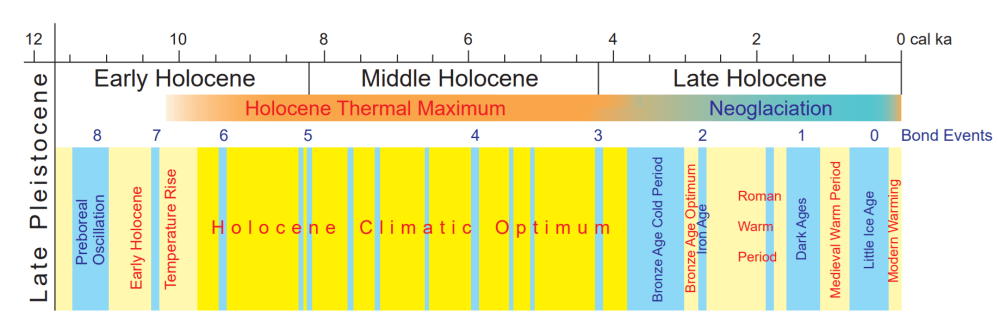
HS: When we talk about global warming, we say that the temperature might have got up by one degree or something like that. But if we look at geological time scales, the climate changes are much, much more severe. I mean, you have periods where you have glaciations, that is, ice almost down to the equator, and perhaps even most of the Earth is covered by ice, and you have periods where there’s no ice caps at all, and the temperature is much, much higher.  I mean, you have had… Beobab trees in Antarctica, and you had alligators at the latitude of Greenland.

So you have had much, much warmer, at least 10 degrees warmer climate back in time. So if we look at geological timescales, we have had enormous changes in climate. And of course, all of this is completely natural. And the question is, why did we have such big climate changes? And this is some of my work trying to understand why we have such large climate changes even back in time.

FR: So let’s talk about that. This is interesting that we’ve been told that the climate change today is anthropogenic. So let’s talk about your perspective on that and what does your research show?

HS: There’s no doubt that CO2 is a greenhouse gas and it has some effect on the temperature.The issue has to do with climate sensitivity. How big is the climate sensitivity? And it turns out that it’s probably around one degree if you double CO2.  So it’s a relatively benign effect of CO2. So, I’ve been working trying to understand why there are climate changes. When you look at climate changes, for instance, over the last 10,000 years, you can actually see that if you compare the climate changes with changes in solar activity, you actually find a very nice correlation.
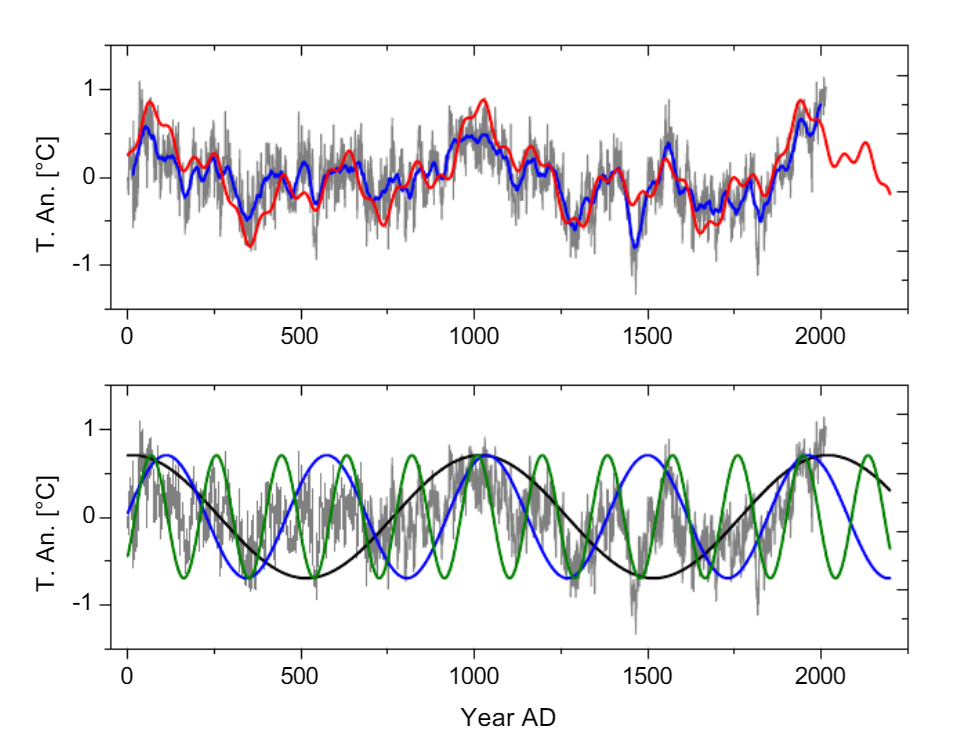
Fig. (3). (Color online) Upper panel: Global record G7 (grey), running 31 year average of G7 (blue), sine representation of G7 with three sine functions of the periods 1003, 463, and 188 years (green), with four sine functions including the period ~60 years (red), continued to AD 2200. The parameters of the sine functions are given in Table 3. The Pearson correlation between the 31 year running average of G7 and the three-sine representation (green) is 0.84, for the four-sine representation (red) 0.85. Lower panel: G7 (grey) together with the sine functions of 1003, 463, and 188 – year periods continued until AD 2200 (equal sine amplitudes for clarity) Source: Ludecke & Weiss 2019

There are so many studies that show that you had, for instance, the Little Ice Age And you have the medieval warm period. And the medieval warm period is when you had a high solar activity. The little ice age is when the solar activity was low. And the question is, why should there be such a correlation?
How can the solar activity actually affect climate? And the simplest idea that has been put forward was that the output from the sun in the form of radiation, I mean the sunlight, that is changing. But it turns out that these changes are probably too small to explain what the climate changes you’re seeing.

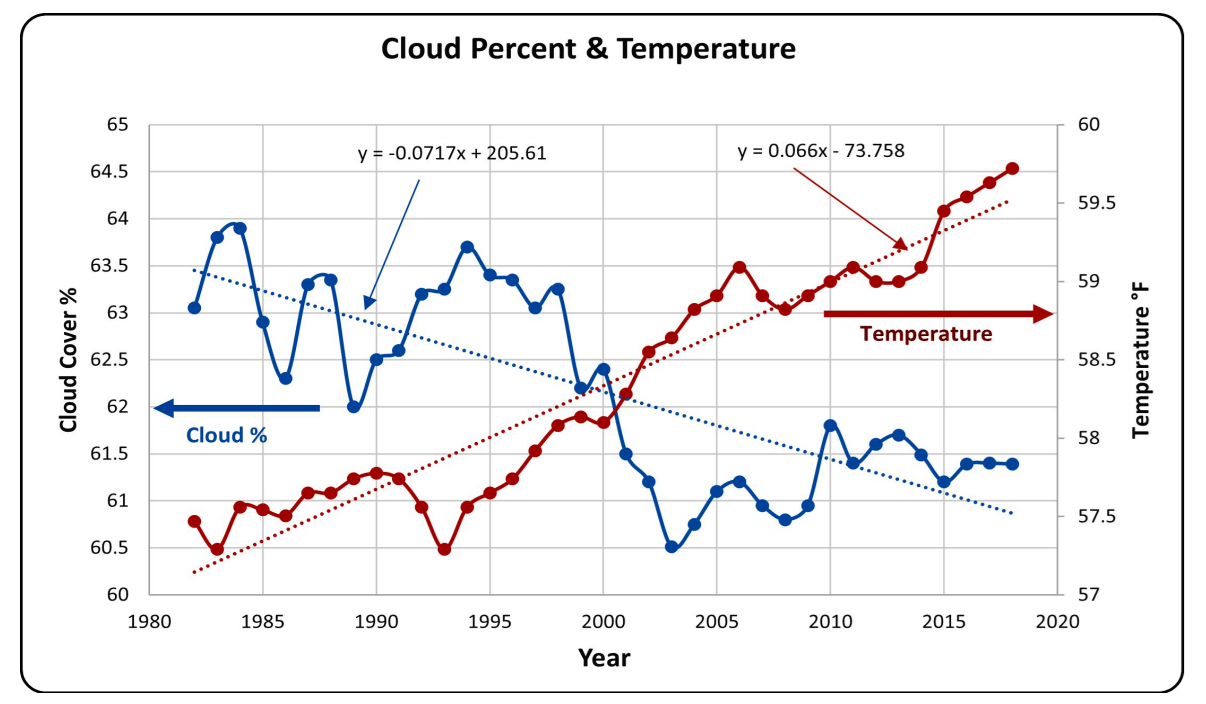
So something else is going on, something is amplifying the solar activity and the idea that I came up with this now, actually 30 years ago, was that maybe solar activity is somehow regulating the Earth’s cloud cover. And initially, I took data from satellites that looked at the Earth’s cloud cover and I looked at it over a solar cycle that’s about 11 years and compared the changes in the solar cycle with changes in the Earth’s cloud cover. There seems to be a correlation between the two. So one can say that the idea, I mean, it looked as if it was something worth pursuing. But of course, it was just a correlation at that time.

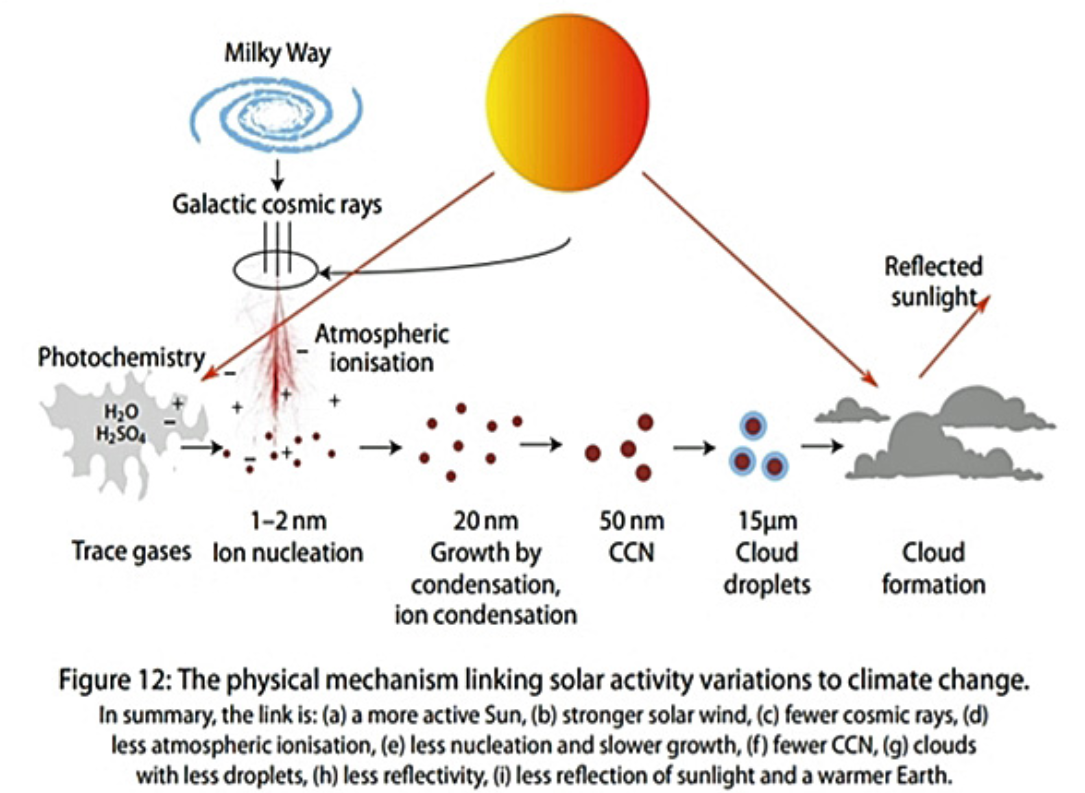
Cosmic rays interacting with the Earth’s atmosphere producing ions that helps turn small aerosols into cloud condensation nuclei — seeds on which liquid water droplets form to make clouds. A proton with energy of 100 GeV interact at the top of the atmosphere and produces a cascade of secondary particles who ionize molecules when traveling through the air. One 100 GeV proton hits every m2 at the top of the atmosphere every second.

And I couldn’t say why there should be such a connection. So the general idea has to do with the formation of clouds. How are you actually forming clouds? And it turns out it’s the ionization that is happening in the atmosphere.  There’s typically about a thousand ions per cubic centimeter. So if you have a small cubic centimeter, you might have on the order of a thousand ions per cubic centimeter. And these ions are in general mainly produced because of very energetic particles that come from the Milky Way that is outside our solar system.

And they move in through the solar wind and then enter into the top of the atmosphere, where they then ionize the atmosphere. And the story is these small ions help stabilizing small molecular clusters. So you get what we call aerosols. These very small aerosols, which then grow up to a certain size. In order to make a cloud droplet, you have to have some kind of surface on which water vapor can condense. These small aerosols are actually providing these surfaces.

Cosmic Ray, Aerosol, Cloud Link
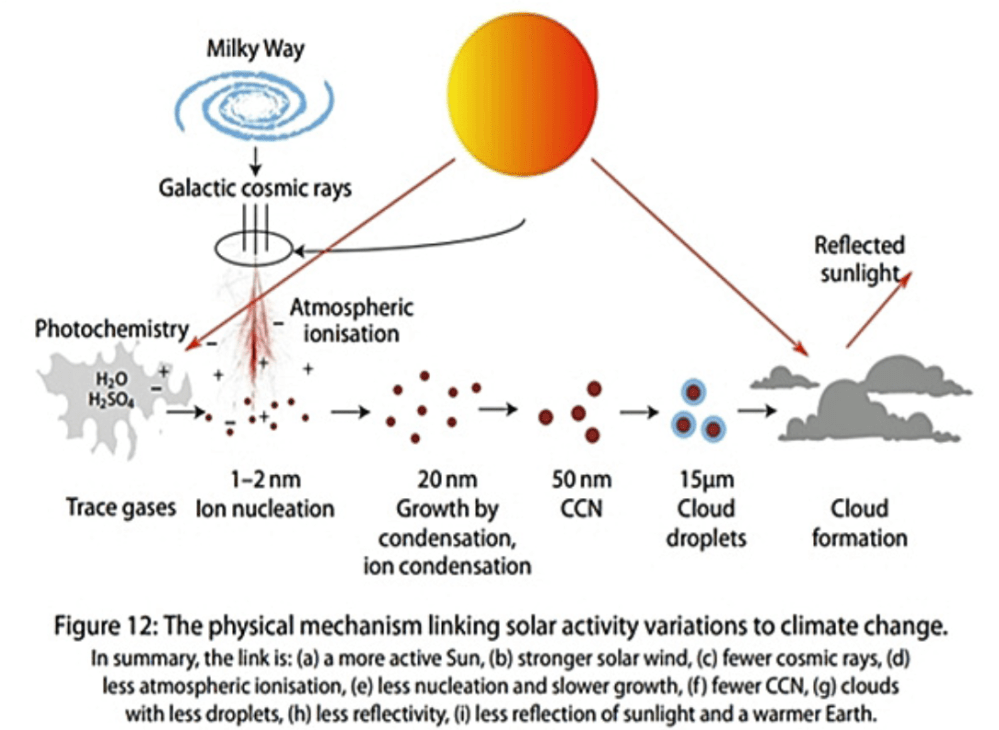
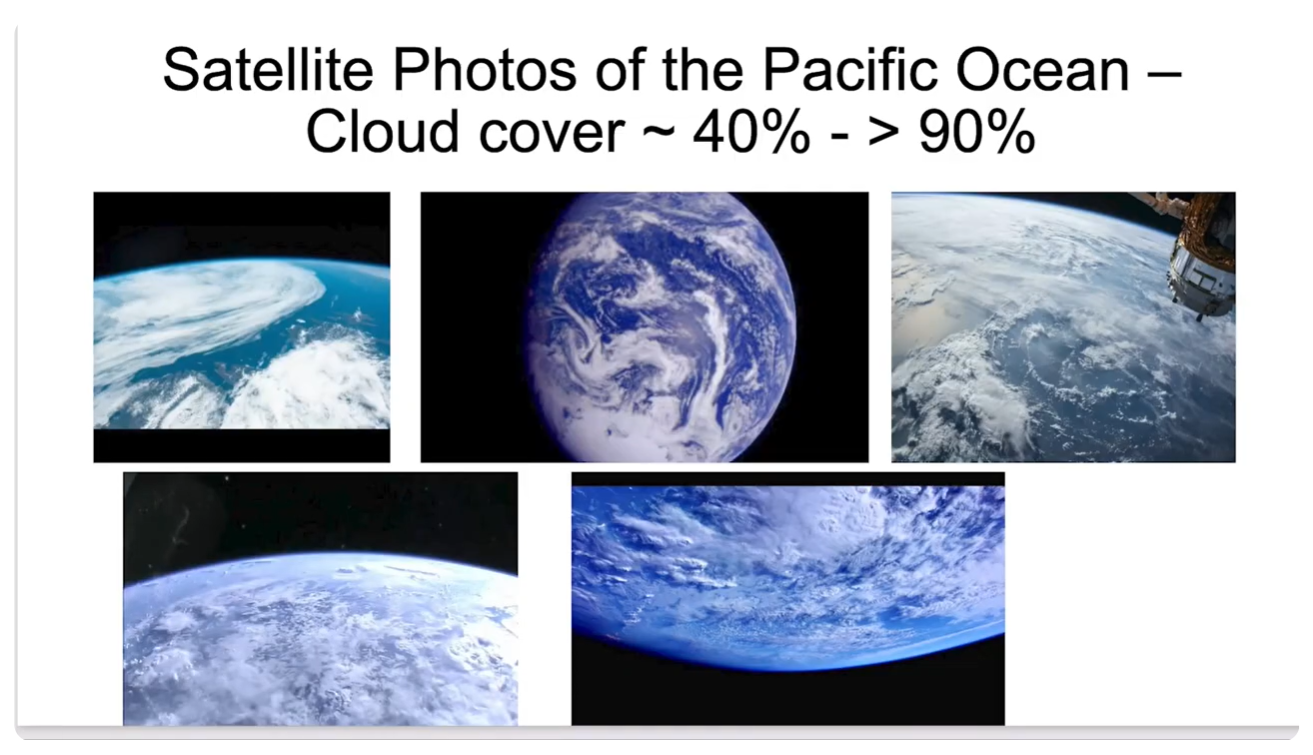
The idea is that if you have more cosmic rays coming into the atmosphere, you’re producing more of the small aerosols. They grow to become what we call cloud condensation nuclei, so they can affect the clouds, so water waves can condense and become cloud droplets. So if you have more cloud droplets, you have a more white cloud. And a more white cloud actually reflects the sunlight out to space again.
That is, of course, extremely important for the Earth’s energy balance. So that is the main idea behind the theory that I have been working on.
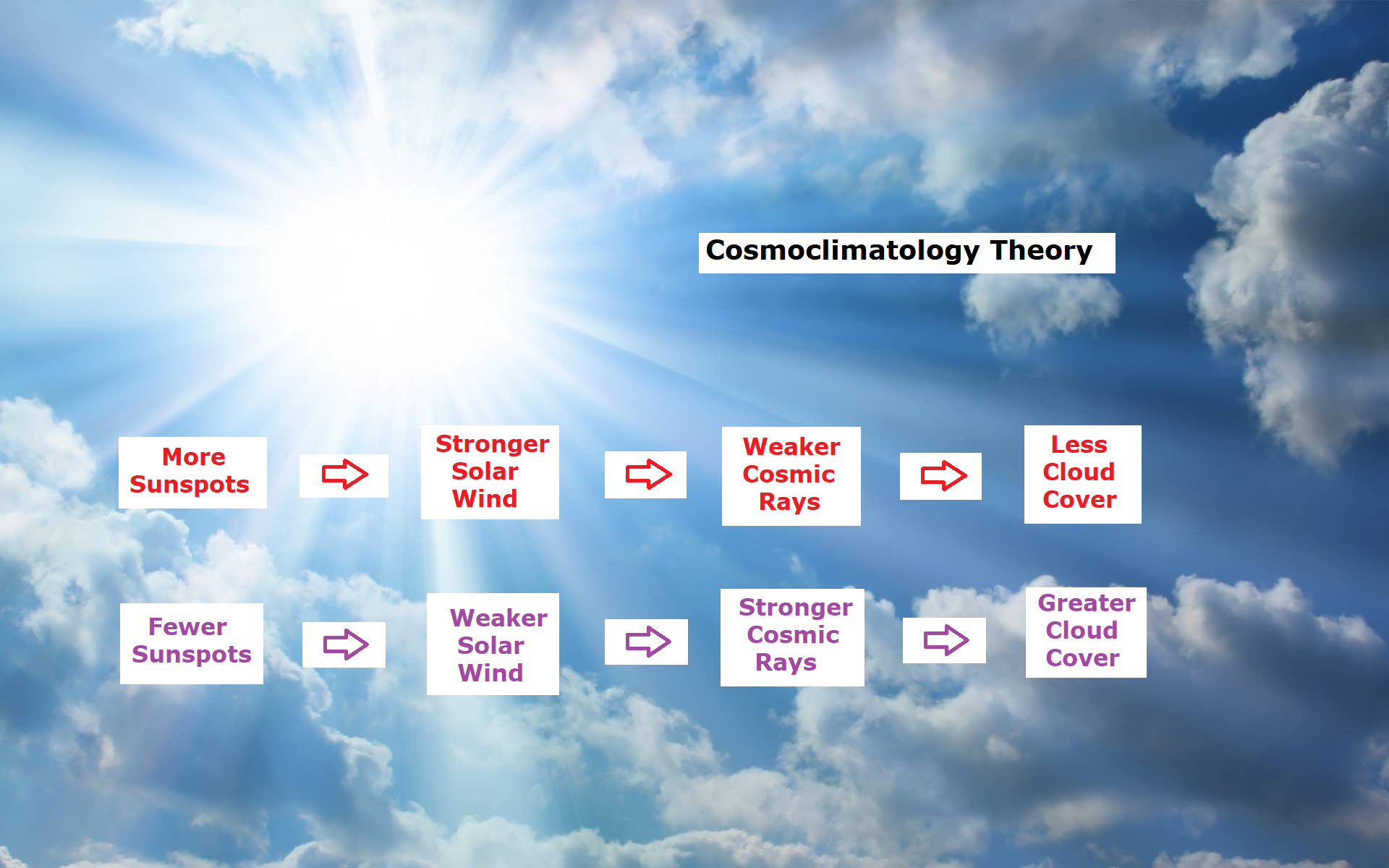
FR: Okay. And so if there is more clouds and reflect the sunlight back to space, I’m just gonna ask, I’m a lay person, not a scientist. Maybe I’m not, you know, a bit stupid question in that sense. But if it reflects more sunlight out, then well, logically, we get the cooler climate, right?

HS: Yes, exactly. Observations are one of the ways we can verify that it works. So on relatively rare occasions, there are some explosions at the sun. They’re called coronal mass ejections. It’s when the magnetic field lines sort of open up and the sun is throwing out a large magnetic plasma. And this magnetic plasma works more or less like an umbrella or a shield against the cosmic rays. So within a week, the cosmic rays are dropping, and they can drop maybe up to 30% or something like that. And that is like a natural experiment with the whole Earth.

And so you can actually then see if anything is happening with the Earth’s cloud cover. And this is something that we have investigated. So, for instance, we can also look at the aerosols that are produced after these events, and we can see that there is a big drop in the aerosols. And then we see a drop in the clouds following these events. And it’s not just the cloud fraction, it’s also the optical properties of clouds. So we can actually see changes in the cloud’s microphysics under these events.

So in some sense, we see the whole chain from the explosive events and the sun to changes in the cosmic rays to changes in the aerosols and then changes in the clouds. And there is a slight delay on a few days in the reaction. That’s simply because it takes about five days for the small aerosols to grow to become cloud condensation nuclei. So everything seems to be fitting very beautifully with respect to this idea.

FR: Okay. But, well, how frequently does it happen, what’s the correlation here? I mean, how frequently it happens to change the climate in that sense?

HS: I talked about this event with the explosions at the sun, which is something that happens during a week. So it’s too much too short to affect climate. But the solar activity modulates the cosmic rays. And that’s simply because the solar activity translates into changes in the solar wind. And the solar wind is covering the whole solar system and all the planets. That works like it’s a magnetic shield that screens against the cosmic rays.
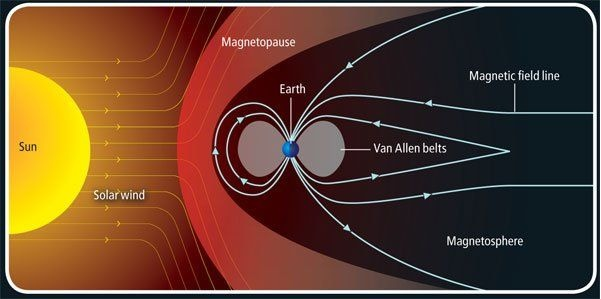
So when the solar activity is high, you can say that it’s screening better against the cosmic rays. That means you get fewer cosmic rays in to the atmosphere. So solar activity can regulate the amount of cosmic rays that comes into the atmosphere. So that regulates in the cloud cover. And we can then estimate, I mean, how much it changes the cloud cover during an 11-year cycle.

And from that, we can calculate what would be the effect on the temperature in the oceans. And there you actually see that we get about on the order of one to one and a half watt per square meter more energy in when you have a solar maximum than when you have a solar minimum.

And you can actually observe that in the ocean’s temperatures. You can see that in the heat content of the ocean. And you can even see it in the volume, because the heat goes in and out of the ocean. So when you get heat into the ocean, it expands a little bit.  So in the sea level, you can actually see an 11-year cycle in the sea level. And all of this, you can quantify how much energy goes in and out of the ocean.

And it fits very beautifully with what you expect from changes in the cloud cover over a solar cycle. And it’s interesting that the solar irradiance is almost a factor of 10 too small to explain it. So there is some kind of amplification mechanism. And the idea is that it’s clouds that are responsible for this. And this is something that you should takeway with respect to the ocean temperatures and the energy that goes in and out of the ocean he has been looking at.

FR: Okay. But how does it fit this idea? How does it fit the historical records?

Figure 4. The millennial solar-climate cycle over the past 2000 years. The anomaly in 14C production levels (black curve), a proxy for solar activity, is compared to iceberg activity in the North Atlantic (dashed blue curve), a climate proxy. The pink sine curve shows the millennial frequency. It defines two warm and two cold periods, supported by a large amount of evidence, some of which are represented by red and blue bars (see main text). Source: Javier Vinos

HS: Well,If you look at solar activity going back in time, we talked about the Little Ice Age, which is from around 1300 to 1850. And then you had the medieval warm period for 900 until maybe 1200. that these changes, they fit very beautifully with changes in cosmic rays. So when it’s cold, you have more cosmic rays coming in. And when it’s warm, you have less cosmic rays entering into the atmosphere. And we know these changes in cosmic rays because when cosmic rays enter the atmosphere, They are actually producing new elements like carbon-14, which is a radioactive form of carbon. It’s slightly heavier than carbon-12.

I guess many people know that you can use carbon-14 for dating things. But this carbon becomes CO2, the heavy form from carbon, and it goes into trees. And then you can look at the annual rings of the tree rings and measure how much carbon-14 you have relative to carbon-12.  And you can then measure that for all the tree rings going back in time and you can actually reproduce solar activity almost 20,000 years back in time. And if you look at these changes and you compare with how climate has been changing over that period, there is beautiful correlations again.

So it is near certain that there is a connection between solar activity and climate. And you can also quantify some of these changes and they are relatively big and it seems as if that, you know, changes in clouds is a very good candidate for explaining this. And when we look about the last 10,000 years, then the modulation of the cosmic rays, it’s caused by solar activity.

FR: Okay. Let me just ask you about those cosmic rays again. You did say, but again, I’m not that bright in your field. You did say it comes from Milky Way. Okay. Why does it come from there? Or what is it? What sends it here?

HS: Cosmic rays are very energetic particles. It’s mainly atomic nuclear, 90% is protons. So that’s the core of the hydrogen atom. So the energetic particles that we are interested in are mainly produced in what we call supernova. And a supernova, the case that we are interested in, is when you have a massive star that is maybe eight times or more massive than the sun. It only lives a relatively short period of time, you know, from maybe three million years to 40 million years.

So it’s a large star and it’s very heavy, and then in the process of burning, it burns so fast and it ends its life in a very, very violent explosion, which is called a supernova. And this supernova, when it explodes, it produces a shock front that is moving out from where the star was located. And this shock front, it works as, you can call it, a cosmic accelerator.

So it accelerates particles that move back and forth over this shock front and move them to extremely high energies. And the energies that you can obtain by this process is much higher than we can produce in any accelerator here on Earth artificially. And these particles, they are then moving in the interstellar space in the Milky Way.

And they are moving in the magnetic fields that are in between stars. So they are sort of moving like what we call diffusion. They are sort of randomly moving around, being bent by the magnetic fields. And then some of them will be outside, you know, arrive outside our solar system.

We have the heliosphere and then they move in and they feel the magnetic field from the sun. And some of them will then enter into the top of the atmosphere. And then you have maybe one proton that comes in with extremely high energy. And then it works a little bit like billiard ball where you have one particle hitting the molecules or the atoms in the atmosphere and it makes a shower, sort of a cascade of particles that goes down through the atmosphere. And these particles are called secondary particles. And so you can have one particle coming in that becomes millions and even billions of particles that move down through the atmosphere.

These particles are completely invisible to our naked eye.  While we are sitting here, we are penetrated by these secondary particles that go through my body and your body all the time. And so every 24 hours, maybe 20 million particles will go through your body and you don’t really experience this.  This is something that has happened since the formation of our galaxy. And of course, here on Earth, we have been showered with these particles for four and a half million years.

FR: Well, since you can explain past events with solar activity and how many cosmic rays are coming towards Earth, probably you can basically model what will happen as well, right? So, I mean, the question is, where are we now in terms of changing climate? Because I’ve also talked, for example, to Professor Zharkova. She said to me that we are entering another ice age soon.

HS: There’s no doubt that we will get an ice age. We have had a number of ice ages back in time. I don’t know if you’re talking about a real ice age or you’re talking about a little ice age, which is just a colder period.

FR: She was talking about the little ice age. I understood.

HS: So a little ice age. I know there are some predictions that the solar activity will go down and we might get a slightly colder period. I’m not sure it will be a little ice age, but it’s not something that I have looked at in any details. At the same time, of course we have had some heating from the CO2 increase in CO2. And then solar activity would then go the opposite way if the solar activity goes down. The problem with these predictions is that it’s extremely difficult to predict solar activity in the future.
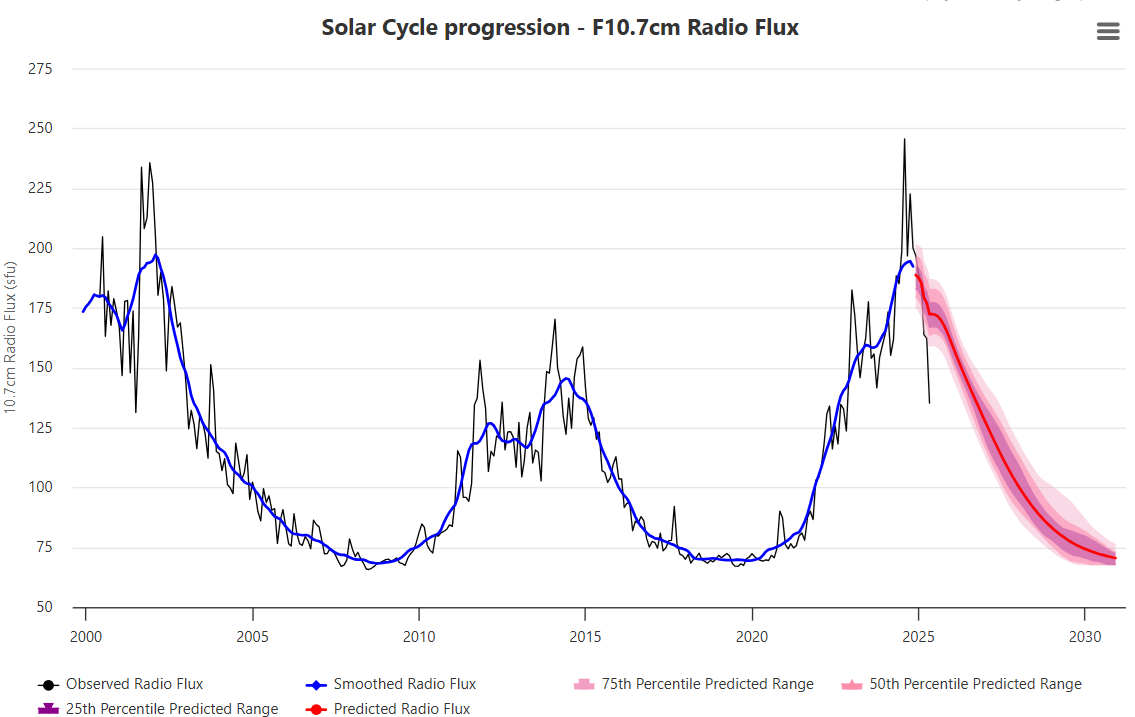
Source: spaceweatherlive

We can’t even predict the next solar cycle, whether it’s going to be high or low. There are some really amazing examples where this last solar cycle was predicted and the predictions were sort of all over the place. So it is really difficult to know because we don’t understand solar activity in a detail where we can predict what the next solar cycle will be. But that might come at some point. So something special has to happen. I think if we’re going to have a real cold period where the temperature drops by one or two degrees, that would be very special. I’m not sure that we’re going to see that, but I know that Zharkova is predicting that.

FR: Okay, yes. Anyhow, the thing is that still almost, well, all of it indicates that climate change is, there are some other factors than humans leading the climate change. But what is your opinion? What is the role of us on climate?

HS:  Oh, the anthropogenic CO2? Yeah. So as I said, it is a greenhouse gas. So you can see if you look at the outgoing long-wave spectrum, you can actually see there is a drop in the outgoing long-wave spectrum, which has to do with CO2, which means that it is a greenhouse gas.  The question is, how important is it? Is it so important that it’s changing temperature, you know, in a dramatic way? And I think there’s so much research now that seems to indicate that the climate sensitivity is on the order of, you know, one, maybe a little more than one degree for a doubling of CO2.

And that is much smaller than what you get from these climate models, which gives you between three and four degrees of that order, but at least a few times larger than what you get just from CO2 alone. Because in the climate models, the reason they get between three and four degrees is because they assume that it would be less cloudy, for instance, in the future climate. So you might have one degree from CO2, but then you get on the order of one or two degrees extra from what we call positive feedbacks. And that is something like more water vapour in the atmosphere or less clouds in a future climate.

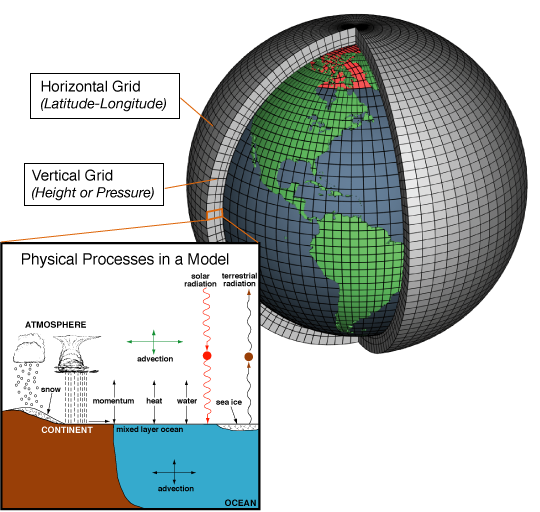
And the problem is that water vapour and clouds are really the most uncertain thing about any prediction of climate. Clouds and aerosols are really what makes climate predictions so extremely difficult. And it’s because it’s all happening at length scales that are much, much smaller than what you can resolve in climate models.  You have to remember that you have maybe, you know, 50 to 100 kilometers between two grid points in a global numerical model.

And that means that, you know, if we just take Denmark, you have maybe one or two grid points over Denmark. And in each of these grid points, you have to determine, you know, what are the clouds actually just from temperature, humidity and pressure. So you have to do some kind of a parameterization of all the physics. So you’re not resolving clouds at all, but you are trying to use, you know, temperature and pressure to say what will the cloud look like for these variables. And this is basically impossible. I mean, it’s pure guesswork.

FR: So what do you think about those climate models? I mean, are they useful then at all?

HS: Of course, they’re useful for some things, but they’re not useful to say if the climate is going up by some fractions of degrees. And I don’t think you can use them for predicting future climate.

FR: But this is what they are used for, isn’t it?

HS: Yes, but I think also that there are some kind of a consensus that climate models are not doing well, I mean, that they have real problems in predicting and saying what is going to happen in the future. So they are not a crystal ball that can tell us about the future with very much accuracy.  Well, it depends on how you ask the questions, of course, but I think just recently there were some statements from people who are doing these models saying that they were running too warm.
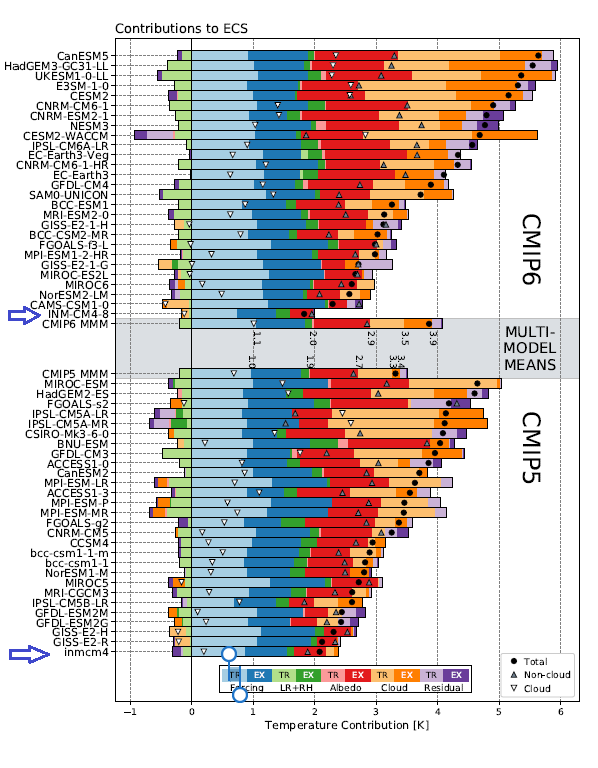
So they are, you know, exaggerating the warmth. And I think in one of them, there was because they updated their cloud scheme. So they changed the perameters of clouds. And all of a sudden, it was running slightly warmer than before. So again, it just points to the severe problem of clouds.  I should also say that if you take out clouds of the models, then the model results start agreeing with each other. Whereas when you have all the clouds in the models, then you get very different results from various models. I mean, it’s not like in particle physics where you have a standard model that you can use.

I mean, here you have a whole ensemble of the different models and they all give slightly different results. And then you make an ensemble average of all these models and try to say that that is the future. It’s, of course, not really satisfying.

FR: Of course. So what do you think about the reports that the UN IPCC puts forward, the scientific reports? Are they something that are, you know, accurate?

HS: I looked at it with respect to the things that I’m doing. One of the things that, you know, struck me was that if you look at the effect of the sun over the last hundred years, there is no effect whatsoever. I mean, it is so small that, I mean, they’re saying essentially that there’s no effect of changes in solar activity. really a shame in the sense that I mean, for instance, we see in the present climate that we’ve had over the last 50 years, you can see solar cycle variations in the ocean heat content and so on, which we talked about just before.

So the solar activity seems to be 10 times larger than what you get from solar irradiance. And in The reason that they get such a small effect of the sun is because they are only considering changes in solar irradiance, which has to do with the solar constant. The solar constant is changing, you know, about one tenth of one percent.  So that is so, so small that it does not have any effect on climate. However, the changes in… In clouds, if we take the ideas that I have been working with Nir Shaviv we will get that over the last century, over 120 years, I think at least one watt per square meter has entered because of solar activity.

Solar activity does not seem to have been completely negative as well. over the last 10 years.
So when we think about how the issue is approached, the issue of climate change in society now, well now there’s the new administration in the United States that actually approaches it somewhat different, but in the EU, for example, Mrs. von der Leyen said that she’s still determined to go to net zero and so on.

So what I mean here is the somewhat hysterical tone that this issue is approached with and also the predictions of doom. So my question is if it’s the same in the academia or not. I mean scientists are in my opinion, at least, they seem very rational and fact-based.  So, is it somewhat different in the inside, I mean, if you talk to your peers?

HS:  I usually say that climate science is not normal science. There’s so much politics involved, even in academia. There is a sort of self-censorship. It’s a bad career move to go against the idea that CO2 is the main driver or to say what i’m saying right now so it’s not good for your career to to do that it has implications, I mean first of all it’s the only research that is being financed that can be done, if you don’t get a grant or anything, you cannot do any research.

And that’s also why I think many people will not rock the boat, because it’s a good way of getting financing for the research that you want to do. However, if you try to do things which I have done, which is perceived as controversial and not according to the general ideas, it becomes very, very difficult to obtain funding and to survive in this system. And people are very emotional about this because some people think that they are trying to save the world from a disaster. And, you know they think everybody else has really bad motives, maybe hidden motives, your multinational oil companies or something like that.
So it’s really difficult to be in opposition to these ideas. So that it’s very, very difficult for me to obtain any funding. Some people are very upset, you know, if you have been invited for giving a talk and some people find out who you are. and so on. So there’s many, many strange things happening.

FR: It’s really happening, right? I mean, it has happened to you that you’re invited to give a talk to talk about your research and there are activists who are coming to cancel you. Did I understand correctly?

Antifa thugs outside Munich Conference Center at 2019 Climate Meeting.

HS: Yes. I’ve also given talks in Germany, where the whole conference had to have police protection because of the demonstrators that tried to storm the place. Another time, on the building, they printed that we were Nazis and they put glue in the locks and so on.  Yes, so one couldn’t get in. I mean, it’s just sometimes it’s very, very, very strange how emotional it is. And there’s nothing rational about it because it’s not something that you can have a discussion about. I mean, you also heard people saying that, you know, the science has been done. Now it’s only action that is needed.

FR: Yes, yes. Well, it’s being parroted all the time. I don’t know, is it 100% already or last time I checked it was 99% of climate scientists agree on something.

HS: But all of these things are simply propaganda of some kind. It has no sort of basis in reality. It’s just some talking points that are being spread out. And some people believe them and other people know that they’re not entirely correct. And that’s how it is.

But the good thing is that I tried to survive in this system. Then I started to look at very, very long timescales. And I think, I mean, maybe we should I should tell you just a few words about that, because I think it’s a completely fascinating result that has come out. Absolutely.

So we talked about these supernovas that goes off, and they are producing the cosmic rays. So you can say supernovas are the source of cosmic rays. And the interesting thing is that our solar system it is actually moving around the Milky Way galaxy. So we are in a spiral galaxy, so it’s like a flat thing.
And we are moving around the center of the galaxy, the whole solar system, within 240 million years or 230 million years it takes. Our Milky Way is a spiral galaxy. And in these spiral arms, that’s actually where you have a lot of star formation. And star formation is where you also produce the large, heavy stars that explode.
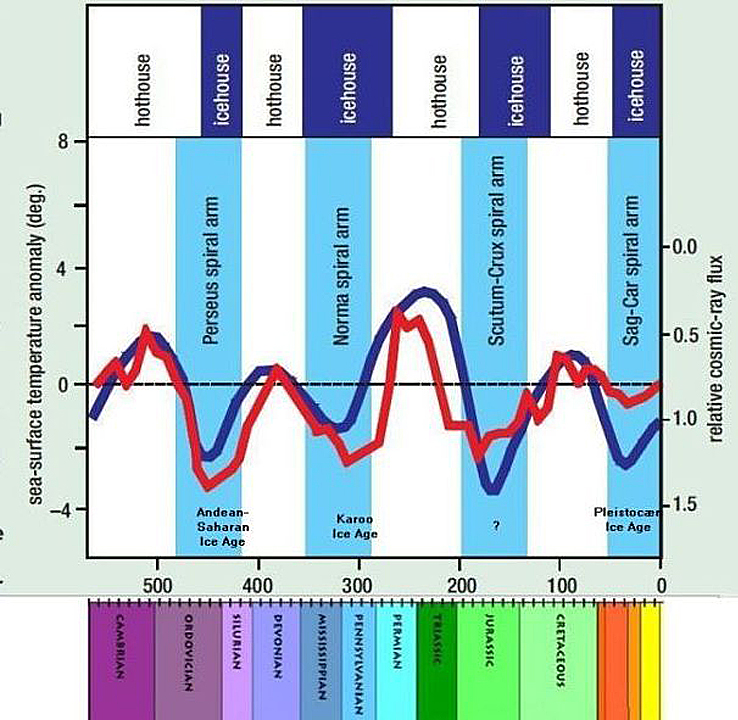
Cosmic radiation and temperature through Phanerozoic according to Nir Shaviv and Jan Veizer. Blue columns refer to Milky Way Spiral arms.

So that means that when the solar system goes through a spiral arm, it actually in an area with much higher cosmic rays, Whereas when you are in between spiral arms, you have much lower. And the changes are not 10, 20% like we have from solar activity.

Now we are talking about several hundred percent of changes in the cosmic rays. So you can say that this is a completely independent way of testing the cosmic ray climate mechanism. Because if these changes in cosmic rays are important for climate, as we see in the present time, maybe they should also be important when we go back in time. It’s something that Nir Shviv actually looked at around 2001.

And what you find is that when you are in a spiral arm, it tends to be extremely cold on Earth. So the glaciations that we have had on Earth on cold periods fit beautifully when we were in spiral arms. And when we were in between the spiral arms, it was extremely warm. The temperature changes and the climate changes we are talking about are now, you know, from what we call an ice house, that is the glaciation, very severe glaciations, that is the large ice sheets on the Earth, to where they are completely melted and, you know, the sea level has gone up maybe by 100 meters or something like that. So it’s enormous changes.

What I looked for was to see if it has implications for life on Earth. And it turns out that you can actually indirectly look at how big the biomass has been at certain times in the ocean. And that is because you can look at organic material. So when you have the ocean and you have organic material, some of the dead material falls down at the bottom. And you can actually say something about the fraction of organic carbon relative to inorganic carbon in sediments.

So when you have sedimented mountains, you can go and measure this ratio of organic carbon to inorganic carbon. And it says something about the fraction of organic material that has been buried in sediments. And it turns out when you look at this fraction as a function of time, It fits beautifully with changes in reconstructed changes in supernovae.
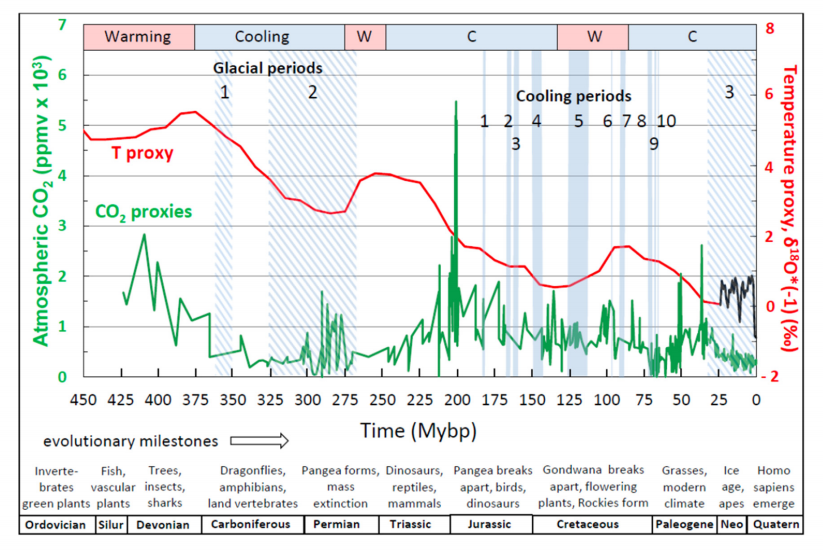
And you can actually see it in fairly high details over the last 500 million years. And it turns out that you can actually extend it. So from geology, you have this fraction of organic material almost four and a half billion years back in time. And even here, it fits beautifully with the changes in the cosmic rays that have happened over the whole history of the Earth. It’s completely astounding that you have this correlation over four and a half billion years. So it says that the biomass seems to have been following things which are thousands of light years away from our solar system.

So this star formation has actually influenced the conditions for life. And it’s even more interesting because when you bury organic material, the organic material is made because of photosynthesis. And photosynthesis, that is, you know, the algaes, the green algaes produce oxygen.  So you have CO2 and water and sunlight that becomes, you know, sugar and oxygen. But in order for the reaction not to go back again, so the oxygen becomes CO2, you actually have to take the organic material and then have the oxygen and you bury the organic material in the sediments.

That’s the way you get the oxygen. So these variations in the organic material, these variations, they are actually also the production of oxygen that we have had over the whole history of the Earth. So supernovas have therefore indirectly produced or been responsible for changing the oxygen at Earth and all complex life.  I mean, in order to get complex life, we need oxygen. So it’s really been a very important part. So it seems to say that the Earth is really a part of an ecosystem, you know, where it really involves most of the galaxy. So here we see that it fits beautifully with the changes in cosmic rays or supernova frequency over most of the history of the Earth.
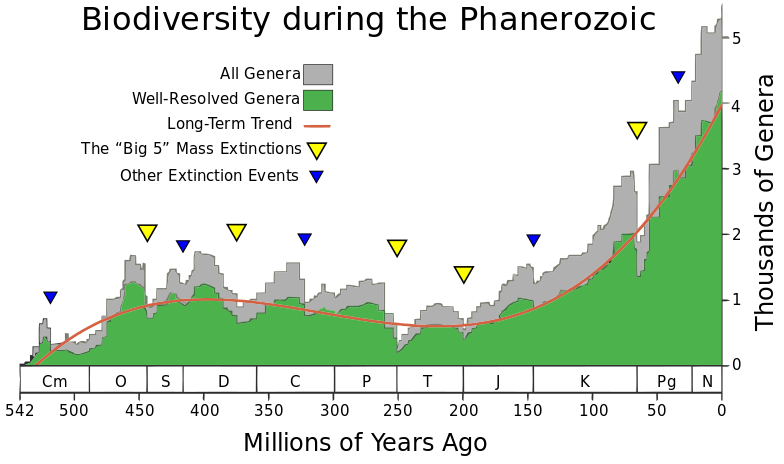
Source: Phanerozoic_Biodiversity.png Author: SVG version by Albert Mestre

I did another thing where I looked at the diversity of life, and just to cut the thing relatively short, it turns out that there’s a beautiful signal of the supernova frequency, even in the frequency, in the diversity of life, where you can see a very, very beautiful correlation over the last 500 million years. So it suggests that somehow the changes in the supernova  change the climate. And by changing the climate, if it’s colder, you have a larger temperature difference between equator and polar regions.

That means you have stronger winds. And if the wind is stronger, then you have more mixing in the oceans. And what it is mixing is the nutrients that life actually needs. I mean, a lot of the nutrients, they run out from rivers because of rain. And you have, you know, phosphorus and iron and oxygen. and other important elements for life. But they are then transported so life can uptake these nutrients. And the idea is that when you have more nutrients, then you can also have a higher diversity and you also get the higher biomass and you get more sediments. So everything seems to be connected in that way. I hope this was not too complicated.

FR: Well, I mean, yes, I think it wasn’t too complicated, but it’s really interesting to actually hear about the research, yes, and to think about the connections that you pointed out there. So, the only thing I would like to ask here is that, so it’s a hypothesis, of course, and again, how… how it is welcomed in your circles? I mean, is there any discussion about it or how it is approached?

HS: I think in geology and geologists, there’s a lot of geologists that really like it because many of them, they have seen how climate is changing over these long timescales and, you know, some of them, they know that CO2 does not appear to be the driver of climate changes on these long timescales. But I should also say that even in geology, there are people who are promoting that everything should be CO2, that CO2 is also driving climate on these very long timescales. But there are many places where it simply does not fit. So I don’t think that… I don’t think it’s a good theory.

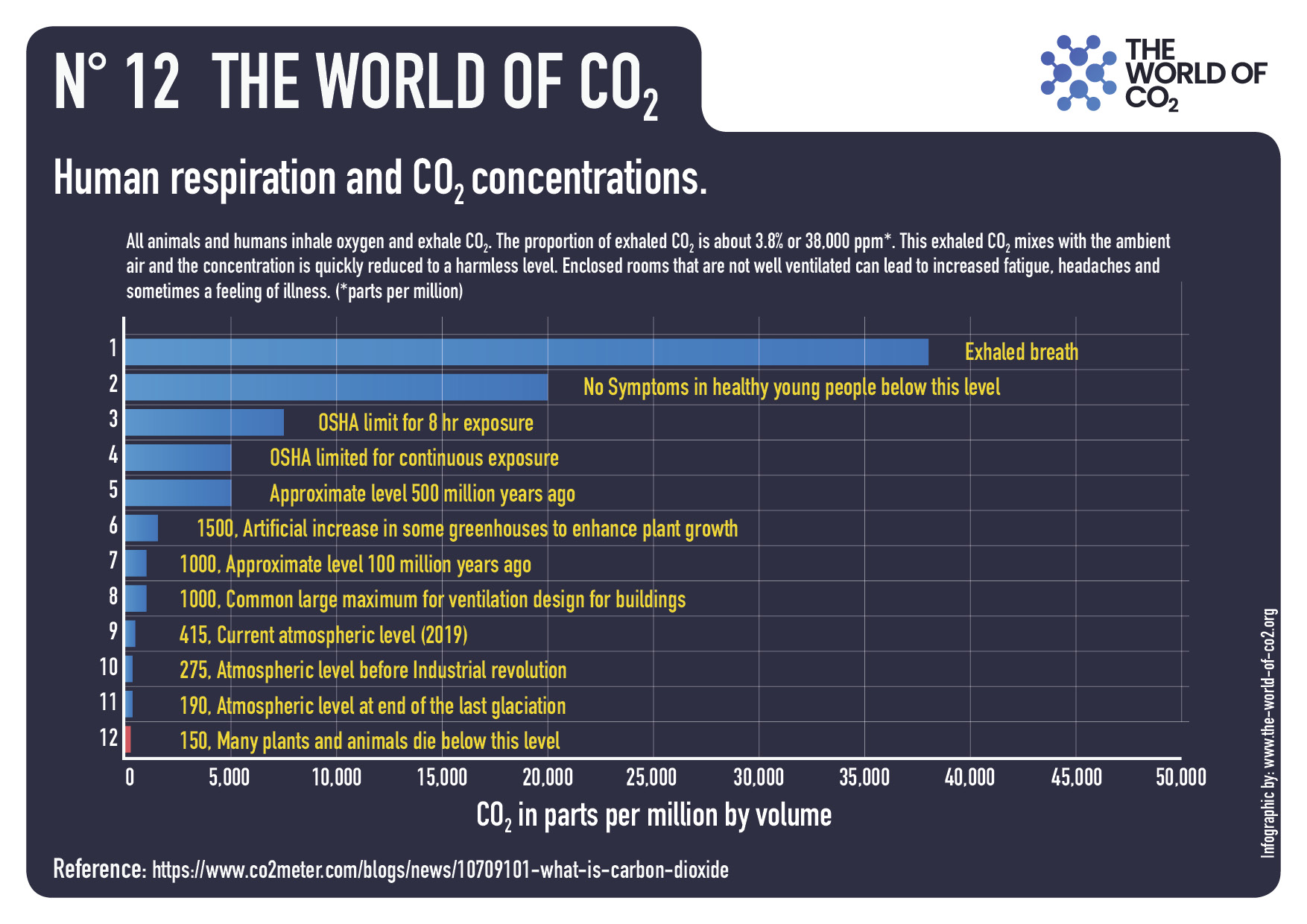
I mean, you typically hear about, for instance, having extremely high CO2 levels at the same time that you had an ice age. And there are some problems also within the last 30 million years where CO2 actually dropped a lot. There are periods where temperature actually goes up and so you don’t have this correlation over many million years and some of it is called a climate paradox. There are some problems.

FR: Yes, of course, of course. Yes. So, I mean, it has been really nice talking to you, but I can see that our time for today is almost running out. I mean, thank you really for this interesting conversations and for the insights and for talking about your research in detail.  I hope my audience also listens and can hear some, well, good ideas, but they’re not only ideas because, well, this is what science actually must look like, ask questions and try to find answers, correct?

HS: Yes, I agree, that’s what we try to do.


DOE Climate Team: Twelve Keys in Assessing Climate Change

Last week saw the release of  A Critical Review of Impacts of Greenhouse Gas Emissions on the U.S. Climate by the U.S. DOE Climate Working Group. This post provides the key points from the twelve chapters of the document, comprised of the chapter summaries plus some salient explanations.  This is a synopsis and readers are encouraged to access additional detailed information at the link in red above. I added some pertinent images along with some from the report.

Report to U.S. Energy Secretary Christopher Wright  July 23, 2025
Climate Working Group:
John Christy, Ph.D.
Judith Curry, Ph.D.
Steven Koonin, Ph.D.
Ross McKitrick, Ph.D.
Roy Spencer, Ph.D.

Introduction

This report reviews scientific certainties and uncertainties in how anthropogenic carbon dioxide (CO2) and other greenhouse gas emissions have affected, or will affect, the Nation’s climate, extreme weather events, and selected metrics of societal well-being. Those emissions are increasing the concentration of CO2 in the atmosphere through a complex and variable carbon cycle, where some portion of the additional CO2 persists in the atmosphere for centuries.

Chapter 1 Carbon Dioxide as a Pollutant

Carbon dioxide (CO2) differs in many ways from the so-called Criteria Air Pollutants. It does not affect local air quality and has no human toxicological implications at ambient levels. The growing amount of CO2 in the atmosphere directly influences the earth system by promoting plant growth (global greening), thereby enhancing agricultural yields, and by neutralizing ocean alkalinity. But the primary concern about CO2 is its role as a greenhouse gas (GHG) that alters the earth’s energy balance, warming the planet. How the climate will respond to that influence is a complex question that will occupy much of this report.

Chapter 2 Direct impact of CO2 on the Environment

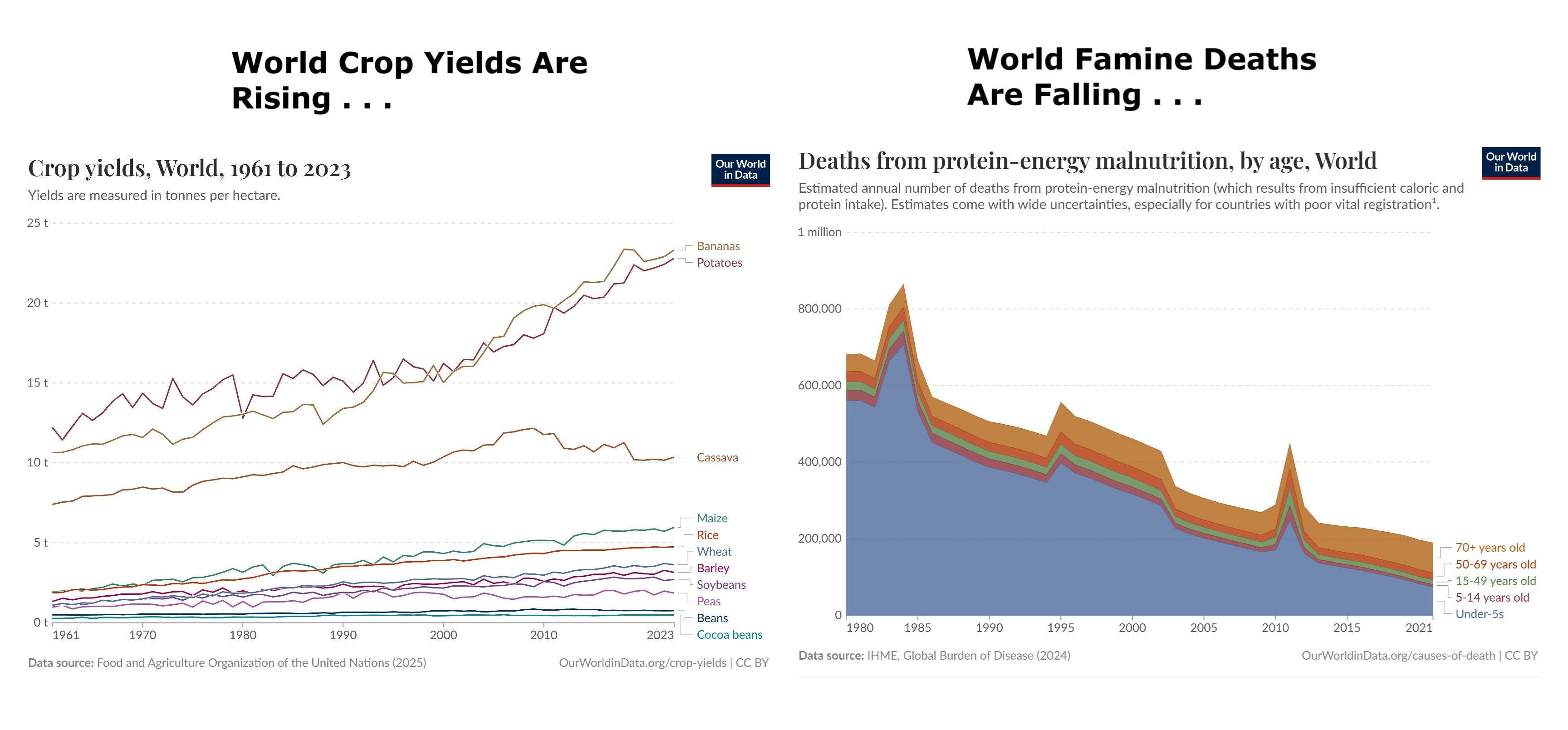
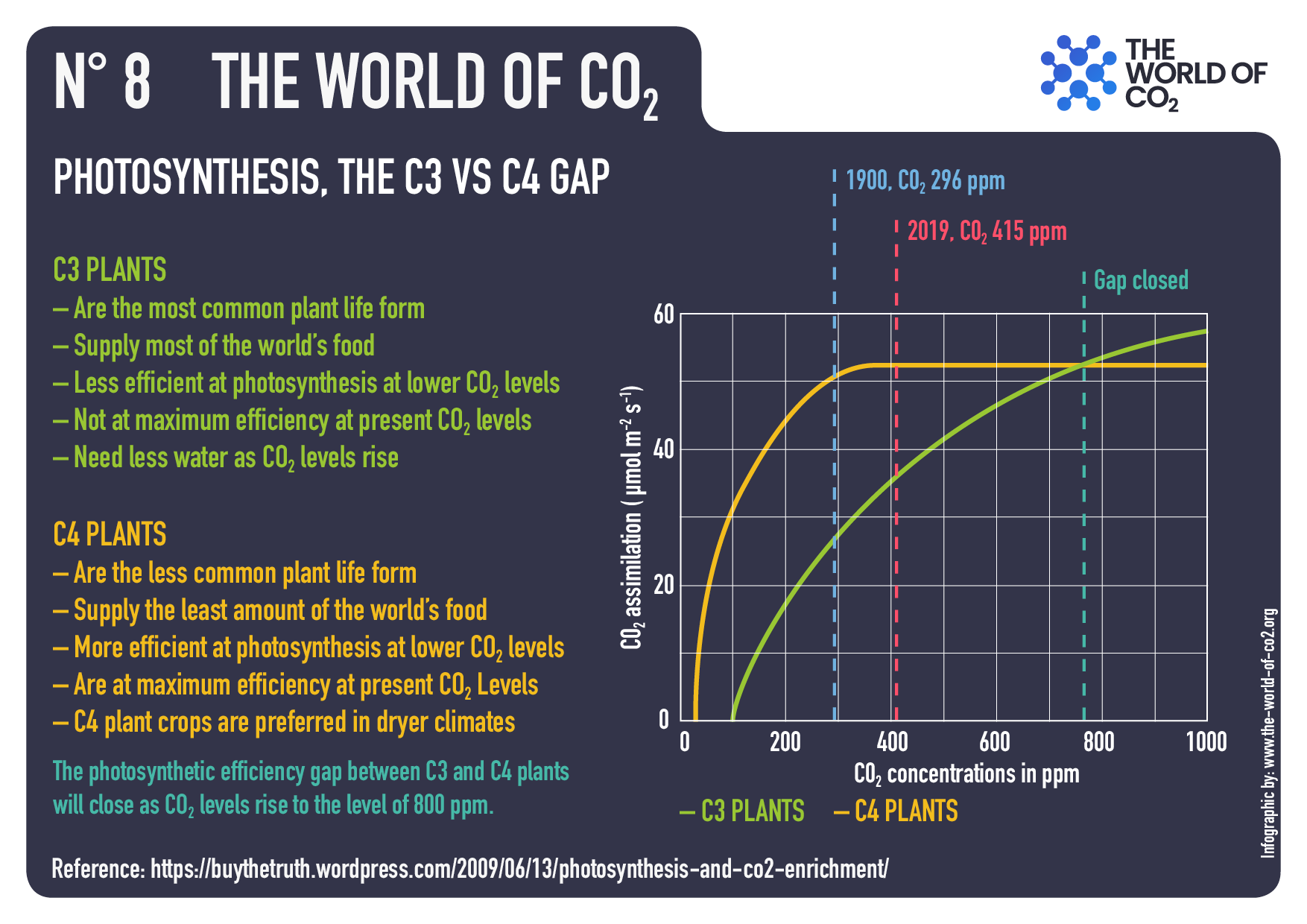
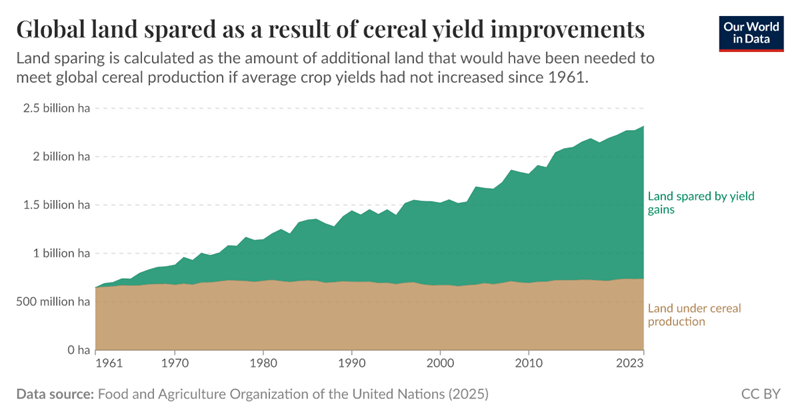
CO2 enhances photosynthesis and improves plant water use efficiency, thereby promoting plant growth. Global greening due in part to increased CO2 levels in the atmosphere is well-established on all continents. The growing CO2 concentration in the atmosphere has the important positive effect of promoting plant growth by enhancing photosynthesis and improving water use efficiency. That is evident in the “global greening” phenomenon discussed below, as well as in the improving agricultural yields discussed in Chapter 10.

The IPCC has only minimally discussed global greening and CO2 fertilization of agricultural crops. The topic is briefly acknowledged in a few places in the body of the IPCC 6th and earlier Assessment Reports but is omitted in all Summary documents. Section 2.3.4.3.3 of the AR6 Working Group I report, entitled “global greening and browning,” points out that the IPCC Special Report on Climate Change and Land had concluded with high confidence that greening had increased globally over the past 2-3 decades.

It then discusses that there are variations in the greening trend among data sets, concluding that while they have high confidence greening has occurred, they have low confidence in the magnitude of the trend. There are also brief mentions of CO2 fertilization effects and improvements in water use efficiency in a few other chapters in the AR6 Working Groups I and II Reports. Overall, however, the Policymaker Summaries, Technical Summaries, and Synthesis Reports of AR5 and AR6 do not discuss the topic.

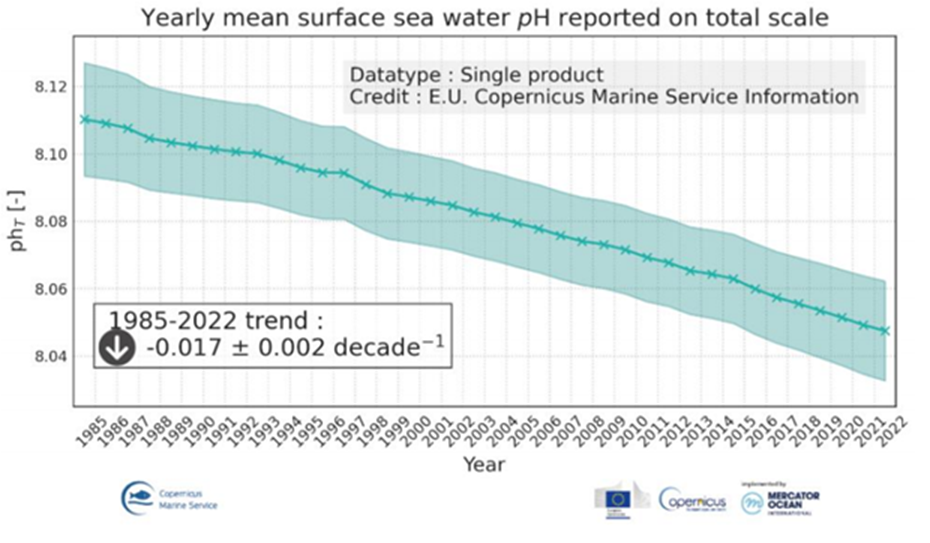
CO2 absorption in sea water makes the oceans less alkaline. While this process is often called “ocean acidification”, that is a misnomer because the oceans are not expected to become acidic; “ocean neutralization” would be more accurate. Even if the water were to turn acidic, it is believed that life in the oceans evolved when the oceans were mildly acidic with pH 6.5 to 7.0 (Krissansen-Totton et al., 2018).

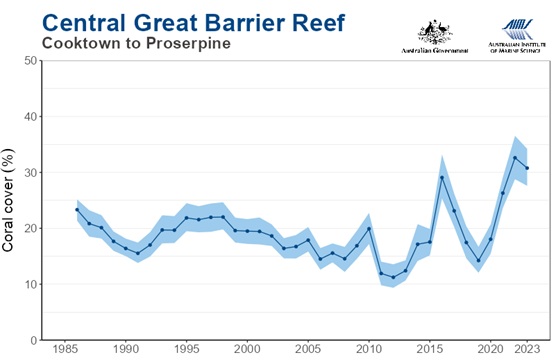
The recent decline in pH is within the range of natural variability on millennial time scales. Most ocean life evolved when the oceans were mildly acidic. Decreasing pH might adversely affect corals, although the Australian Great Barrier Reef has shown considerable growth in recent years.

It is being increasingly recognized that publication bias (alarming ocean acidification results preferred by high-impact research publications) exaggerates the reported impacts of declining ocean pH. An ICES Journal of Marine Science Special Issue addressed this problem with an article entitled, Towards a Broader Perspective on Ocean Acidification Research. In the Introduction to that Special Issue, H. I. Browman stated, “As is true across all of science, studies that report no effect of ocean acidification are typically more difficult to publish.” (Browman, 2016).

In summary, ocean life is complex and much of it evolved when the oceans were acidic relative to the present. The ancestors of modern coral first appeared about 245 million years ago. CO2 levels for more than 200 million years afterward were many times higher than they are today. Much of the public discussion of the effects of ocean “acidification” on marine biota has been one-sided and exaggerated.

Chapter 3 Human Influences on the Climate

  • The global climate is naturally variable on all time scales. Anthropogenic CO2 emissions add to that variability by changing the total radiative energy balance in the atmosphere.
  • The IPCC has downplayed the role of the sun in climate change but there are plausible solar irradiance reconstructions that imply it contributed to recent warming.
  • Climate projections are based on IPCC emission scenarios that have tended to exceed observed trends.
  • Most academic climate impact studies in recent years are based upon the extreme RCP 8.5 scenario that is now considered implausible; its use as a business-as-usual scenario has been misleading.
  • Carbon cycle models connect annual emissions to growth in the atmospheric CO2 stock. While models disagree over the rate of land and ocean CO2 uptake, all agree that it has been increasing since 1959.
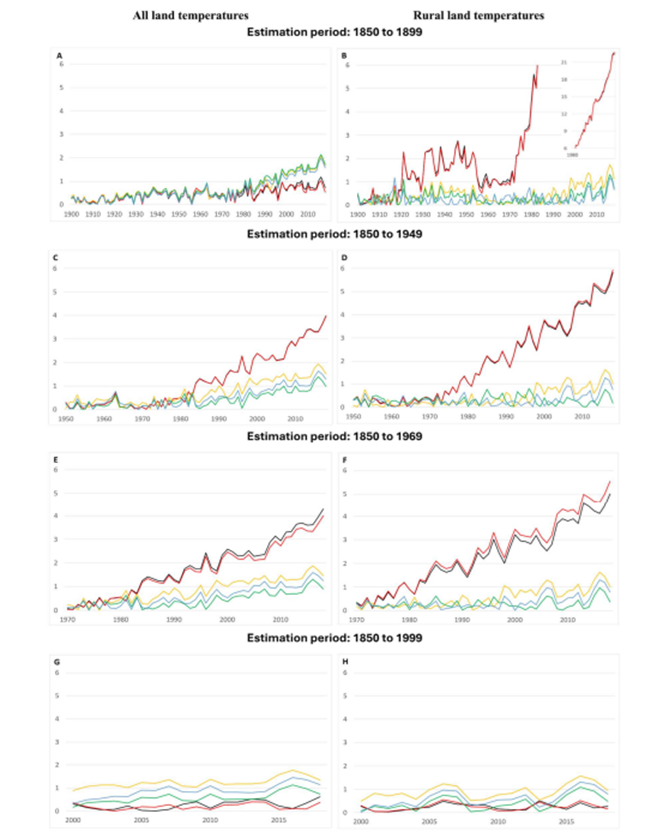
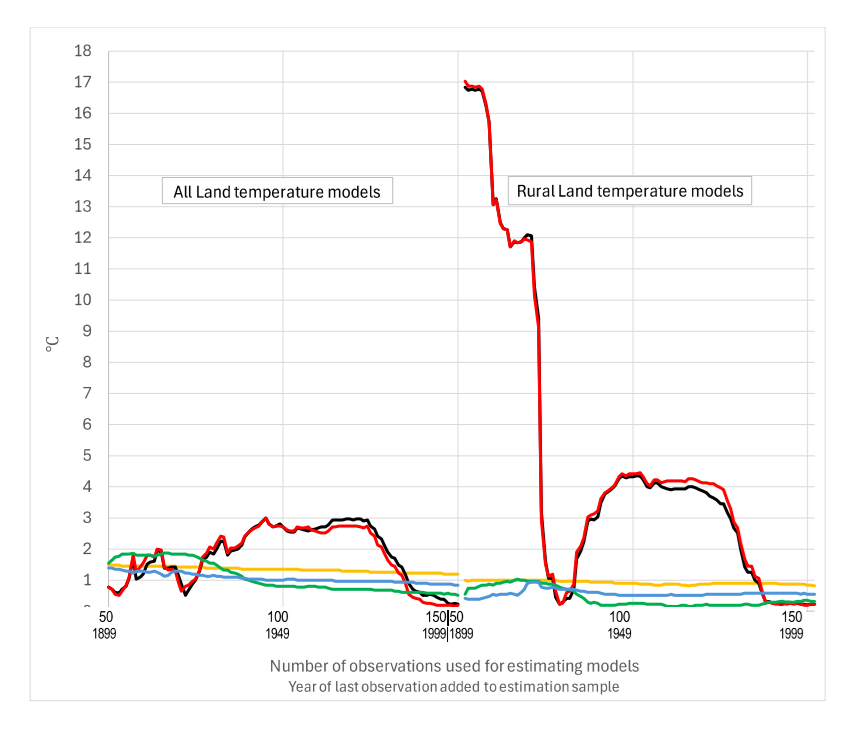
  • There is evidence that urbanization biases in the land warming record have not been completely removed from climate data sets.

There are about 850 Gt of carbon (GtC) in the Earth’s atmosphere, almost all of it in the form of CO2. Each year, biological processes (plant growth and decay) and physical processes (ocean absorption and outgassing) exchange about 200 GtC of that carbon with the Earth’s surface (roughly 80 GtC with the land and 120 GtC with the oceans). Before human activities became significant, removals from the atmosphere were roughly in balance with additions. But burning fossil fuels (coal, oil, and gas) removes carbon from the ground and adds it to the annual exchange with the atmosphere. That addition (together with a much smaller contribution from cement manufacturing) amounted to 10.3 GtC in 2023, or only about 5 percent of the annual exchange with the atmosphere.

The carbon cycle accommodates about 50 percent of humanity’s small annual injection of carbon into the air by naturally sequestering it through plant growth and oceanic uptake, while the remainder accumulates in the atmosphere (Ciais et al., 2013). For that reason, the annual increase in atmospheric CO2 concentration averages only about half of that naively expected from human emissions. The historical near constancy of that 50 percent fraction means that the more CO2 humanity has produced, the faster nature removed it from the atmosphere.

While land vegetation has been responding positively to more atmospheric CO2, uptake of extra CO2 by ocean biological processes remains too uncertain to be measured reliably.

Historical temperature data over land has been collected mainly where people live. This raises the problem of how to filter out non-climatic warming signals due to Urban Heat Islands (UHI) and other changes to the land surface. If these are not removed the data might over- attribute observed warming to greenhouse gases. The IPCC acknowledges that raw temperature data are contaminated with UHI effects but claims to have data cleaning procedures that remove them. It is an open question whether those procedures are sufficient.

The challenge in measuring UHI bias is relating local temperature change to a corresponding change in population or urbanization, rather than to a static classification variable such as rural or urban. Spencer et al. (2025) used newly available historical population archives to undertake such an analysis and found evidence of significant UHI bias in U.S. summertime temperature data.

In summary, while there is clearly warming in the land record, there is also evidence that it is biased upward by patterns of urbanization and that these biases have not been completely removed by the data processing algorithms used to produce climate data sets.

Chapter 4 Climate Sensitivity to CO2 Forcing

There is growing recognition that climate models are not fit for the purpose of determining the Equilibrium Climate Sensitivity (ECS) of the climate to increasing CO2. The IPCC has turned to data driven approaches including historical data and paleoclimate reconstructions, but their reliability is diminished by data inadequacies.

Data-driven ECS estimates tend to be lower than climate model-generated values. The IPCC AR6 upper bound for the likely range of ECS is 4.0°C, lower than the AR5 value of 4.5°C. This lowering of the upper bound seems well justified by paleoclimatic data. The AR6 lower bound for the likely range of ECS is 2.5°C, substantially higher than the AR5 value of 1.5°C. This raising of the lower bound is less justified; evidence since AR6 finds the lower bound of the likely range to be around 1.8°C.

In principle, ECS is an emergent property of GCMs—that is, it is not directly parameterized or tuned but rather emerges in the results of the simulation. Otherwise plausible GCMs and parameter selections have been discarded because of perceived conflict with an expected warming rate, or aversion to a model’s climate sensitivity being outside an accepted range (Mauritsen et al. 2012). This practice was commonplace for the models used in AR4; modelers have moved away from this practice with time. However, even in a CMIP6 model, the MPI (Max Planck Institute) modelers chose an ECS value of 3°C and then tuned the cloud parameterizations to match their intended result.

The Transient Climate Reponse (TCR) provides a more useful observational constraint on climate sensitivity. TCR is the global temperature increase that results when CO2 is increased at an annual rate of 1 percent over a period of 70 years (i.e., doubled gradually). Relative to the ECS, observationally determined values of TCR avoid the problems of uncertainties in ocean heat uptake and the fuzzy boundary in defining equilibrium arising from a range of timescales for the longer-term feedback processes (e.g., ice sheets). TCR is better constrained by historical warming, than ECS. AR6 judged the very likely range of TCR to be 1.2–2.4°C. In contrast to ECS, the upper bound of TCR is more tightly constrained. For comparison, the TCR values determined by Lewis (2023) are 1.25 to 2.0°C, showing much better agreement with AR6 values than was seen in a comparison of the ECS values.

Figure 8: Warming in the tropical troposphere according to the CMIP6 models.
Trends 1979–2014 (except the rightmost model, which is to 2007), for 20°N–20°S, 300–200 hPa.

Chapter 5 Discrepancies Between Models and Instrumental Observations

Climate models show warming biases in many aspects of their reproduction of the past several decades. In response to estimated changes in forcing they produce too much warming at the surface (except in the models with lowest ECS), too much warming in the lower-and mid-troposphere and too much amplification of warming aloft.

Climate models also produce too much recent stratospheric cooling, invalid hemispheric albedos, too much snow loss, and too much warming in the Corn Belt. The IPCC has acknowledged some of these issues but not all.

The wide range of choices made by modelers to characterize the physical processes in the models (see Box: Climate Modeling in Section 5.1 above) is seen by the large spread of trends in the middle troposphere, ±40 percent about the median (Figure 5.6). This vividly illustrates the uncertainties in attempts to model (parameterize) a complex system involving turbulence, moist thermodynamics, and energy fluxes over the full range of the tropical atmosphere’s time and space scales. The atmosphere’s temperature profile is a case where models are not merely uncertain but also show a common warming bias relative to observations. This suggests that they misrepresent certain fundamental feedback processes.
The IPCC AR6 did not assess this issue.

An important element of the expected general “fingerprint” of anthropogenic climate change is simultaneous warming of the troposphere and cooling of the stratosphere. The latter feature is also influenced by ozone depletion and recovery. AR6 acknowledged that cooling had been observed but only until the year 2000. The stratosphere has shown some warming since, contrary to model projections.

The climate models were found to poorly explain the observed trends [in Northern Hemisphere snow cover]. While the models suggest snow cover should have steadily decreased for all four seasons, only spring and summer exhibited a long-term decrease, and the pattern of the observed decreases for these seasons was quite different from the modelled predictions. Moreover, the observed trends for autumn and winter suggest a long-term increase, although these trends were not statistically significant.

Beyond the models’ ability to reproduce features of today’s climate, the critical issue for society is how well they predict responses to subtle human influences, such as greenhouse gas emissions, aerosol cooling, and landuse changes. The most crucial aspect that models must capture correctly is “feedbacks.” These occur when climate changes either amplify or suppress further warming. In general, the modeled net effect of all feedbacks doubles or triples the direct warming impact of CO₂.

Economic losses normalized for wealth (upper panel) and the number of people affected normalized for population size (lower panel). Sample period is 1980–2010. Solid lines are IRW trends for the corresponding data. EM-DAT database.

Chapter Six Extreme Weather

This chapter is concerned with detection of trends in extreme weather, while Chapter 8 considers causal attribution, with Section 8.4 specifically addressing extreme weather. If no trend is detected, then clearly there is no basis for attribution. But even where a trend is observed, attribution to human-caused warming does not necessarily follow.

With these caveats in mind, we examine the evidence for changes in selected weather and climate extremes. A recurring theme is the wide gap between public perceptions and scientific evidence. It has become routine in media coverage, government and private sector discussions, and even in some academic literature to make generalized assertions that extreme weather of all types is getting worse due to GHGs and “climate change.” Yet expert assessments typically have not drawn such sweeping conclusions and instead have emphasized the difficulty both of identifying specific trends and establishing a causal connection with anthropogenic forcing.

Most types of extreme weather exhibit no statistically significant long-term trends over the available historical record. While there has been an increase in hot days in the U.S. since the 1950s, a point emphasized by AR6, numbers are still low relative to the 1920s and 1930s. Extreme convective storms, hurricanes, tornadoes, floods and droughts exhibit considerable natural variability, but long-term increases are not detected. Some increases in extreme precipitation events can be detected in some regions over short intervals, but the trends do not persist over long periods and at the regional scale. Wildfires are not more common in the U.S. than they were in the 1980s. Burned area increased from the 1960s to the early 2000’s, however it is low compared to the estimated natural baseline level. U.S. wildfire activity is strongly affected by forest management practices.

Chapter 7 Changes in Sea Level

Since 1900, global average sea level has risen by about 8 inches. Sea level change along U.S. coasts is highly variable, associated with local variations in processes that contribute to sinking and also with ocean circulation patterns. The largest sea level increases along U.S. coasts are Galveston, New Orleans, and the Chesapeake Bay regions – each of these locations are associated with substantial local land sinking (subsidence) unrelated to climate change.

Extreme projections of global sea level rise are associated with an implausible extreme emissions scenario and inclusion of poorly understood processes associated with hypothetical ice sheet instabilities. In evaluating AR6 projections to 2050 (with reference to the baseline period 1995-2014), almost half of the interval has elapsed by 2025, with sea level rising at a lower rate than predicted. U.S.tide gauge measurements reveal no obvious acceleration beyond the historical average rate of sea level rise.

The concern over sea level rise is not about the roughly eight inches of global rise since 1900. Rather,it is about projections of accelerated rise based upon simulations of a warming climate through the 21st century. . .There is deep uncertainty surrounding projections of sea level rise to 2100 owing to uncertainties in ice sheet instabilities, particularly for the higher emissions scenarios.

In February 2022, NOAA issued its projections of sea level rise for various sites along the U.S. coast (Sweet et al., 2022). They claim that by 2050, the sea will have risen one foot at The Battery in Manhattan (relative to 2020). A one-foot rise in thirty years would be more than twice the current rate and about three times the average rate over the past century. In that historical context, NOAA’s projection is remarkable—as shown in Figure 7.6, it would require a dramatic acceleration beyond anything observed since the early 20th century. But even more noteworthy is that Sweet et al. (2022) say this rise is “locked in”—it will happen no matter what future emissions are. We should know in a decade or so whether that prediction has legs.

Chapter 8 Uncertainties in Climate Change Attribution

“Attribution” refers to identifying the cause of some aspect of climate change, specifically with reference to anthropogenic activity. There is an ongoing scientific debate around attribution methods, particularly regarding extreme weather events. Attribution is made difficult by high natural variability, the relatively small expected anthropogenic signal, lack of high-quality data, and reliance on deficient climate models. The IPCC has long cautioned that methods to establish causality in climate science are inherently uncertain and ultimately depend on expert judgement.

Substantive criticism of the main IPCC assessments of the role of CO2 in recent warming focus on inadequate assessment of natural climate variability, uncertainties in measurement of solar variability and in aerosol forcing, and problems in the statistical methods used for attribution.

As discussed in Chapter 6 natural variability dominates patterns of extreme weather systems and simplistic assertions of trend detection are frequently undermined by regional heterogeneity and trend reversals over time. Table 8.1 makes the related point that it is not currently possible to attribute changes in most extreme weather types to human influences. Taking wind as an example, the IPCC claims that an anthropogenic signal has not emerged in average wind speeds, severe windstorms, tropical cyclones or sand and dust storms, nor is one expected to emerge this century even under an extreme emissions scenario. The same applies to drought and fire weather.

The IPCC does not make attribution claims for most climate impact drivers related to extreme events. Statements related to statistics of global extremes (e.g. event probability or return times, magnitude and frequency) are not generally considered accurate owing to data limitations and are made with low confidence. Attribution of individual extreme weather events is challenging due to their rarity. Conflicting claims about the causes of the 2021 Western North America Heatwave illustrate the perils of hasty attribution claims about individual extreme events.

There are three areas of substantive criticism of the IPCC’s assessment of the causes of the recent warming: inadequate assessment of natural climate variability, inappropriate statistical methods, and substantial discrepancies between models and observations. The last is discussed in Chapter 5, while this chapter discusses the first two factors. All of these criticisms are relevant to the IPCC’s attribution of the recent warming, which also underpins extreme event attribution.

A sharp recent increase in global average temperatures has raised the question of short-term drivers of climate. One such candidate is the fraction of absorbed solar radiation which has also increased abruptly in recent years. The question is whether the change is an internal feedback to warming caused by greenhouse gases, or whether something else increased the fraction of absorbed radiation which then caused the recent warming.

Fig. 1. Qualitative tendencies in decadal SSR (Surface Solar Radiation) changes over the periods 1950s to 1980s, 1980s to 2000, and post-2000 in different world regions that are well covered by historic SSR records.
Arguably the most striking change in the Earth’s climate system during the 21st century is a significant reduction in planetary albedo since 2015, which has coincided with at least two years of record global warmth. Figure 8.2 shows the planetary albedo variations since 2000, when there are good satellite observations. The 0.5 percent reduction in planetary albedo since 2015 corresponds to an increase of 1.7 W/m2 in absorbed solar radiation averaged over the planet (Hansen and Karecha, 2025). For comparison, Forster et al. (2024) estimate the current forcing from the increase in atmospheric CO2 compared to preindustrial times to be 2.33 W/m2.

Changes in surface characteristics cannot explain this decrease in planetary albedo since 2015:

• Arctic sea ice extent has declined by about 5 percent since 1980, although following 2007 there has been a pause in the Arctic sea ice decline (England et al., 2025)

• Regarding Antarctic sea ice, the IPCC AR6 concludes that “There has been no significant trend in Antarctic sea ice area from 1979 to 2020 due to regionally opposing trends and large internal variability.” (Summary for Policymakers, A.1.5)

• Northern hemispheric annual snow cover has been slowly declining since 1967, with barely
significant trends. The data show the Northern Hemisphere has snowier winters, accompanied by more rapid melt in spring and summer.

• Global greening (Chapter 2) is contributing to the decrease in planetary albedo, as forests have a lower albedo than open lands or snow. However, there is some evidence that forests increase cloud cover (high reflectivity), which counteracts the direct albedo decrease associated with increasing forested area.

Figure 8.2. Earth’s albedo (reflectivity, in percent), with seasonality removed. From Hansen and Karecha (2025)

In summary, the decline in planetary albedo and the concurrent decline in cloudiness have emphasized the importance of clouds and their variations to global climate variability and change. A change of 1- 2 percent in global cloud cover has a greater radiative impact on the climate than the direct radiative effect of doubling CO2. While it is difficult to untangle causes of the recent trend, the competing explanations for the cause of the declining cloud cover have substantial implications for assessing the Equilibrium Climate Sensitivity and for the attribution of the recent warming. An additional 10 years of data should help clarify
whether this is a strong positive cloud feedback associated with warming or a temporary fluctuation driven by natural variability.

Chapter 9 Climate Change and US Agriculture

There has been abundant evidence going back decades that rising CO2 levels benefit plants, including agricultural crops, and that CO2-induced warming will be a net benefit to U.S. agriculture. The increase in ambient CO2 has also boosted productivity of all major U.S. crop types. There is reason to conclude that on balance climate change has been and will continue to be neutral or beneficial for most U.S. agriculture.
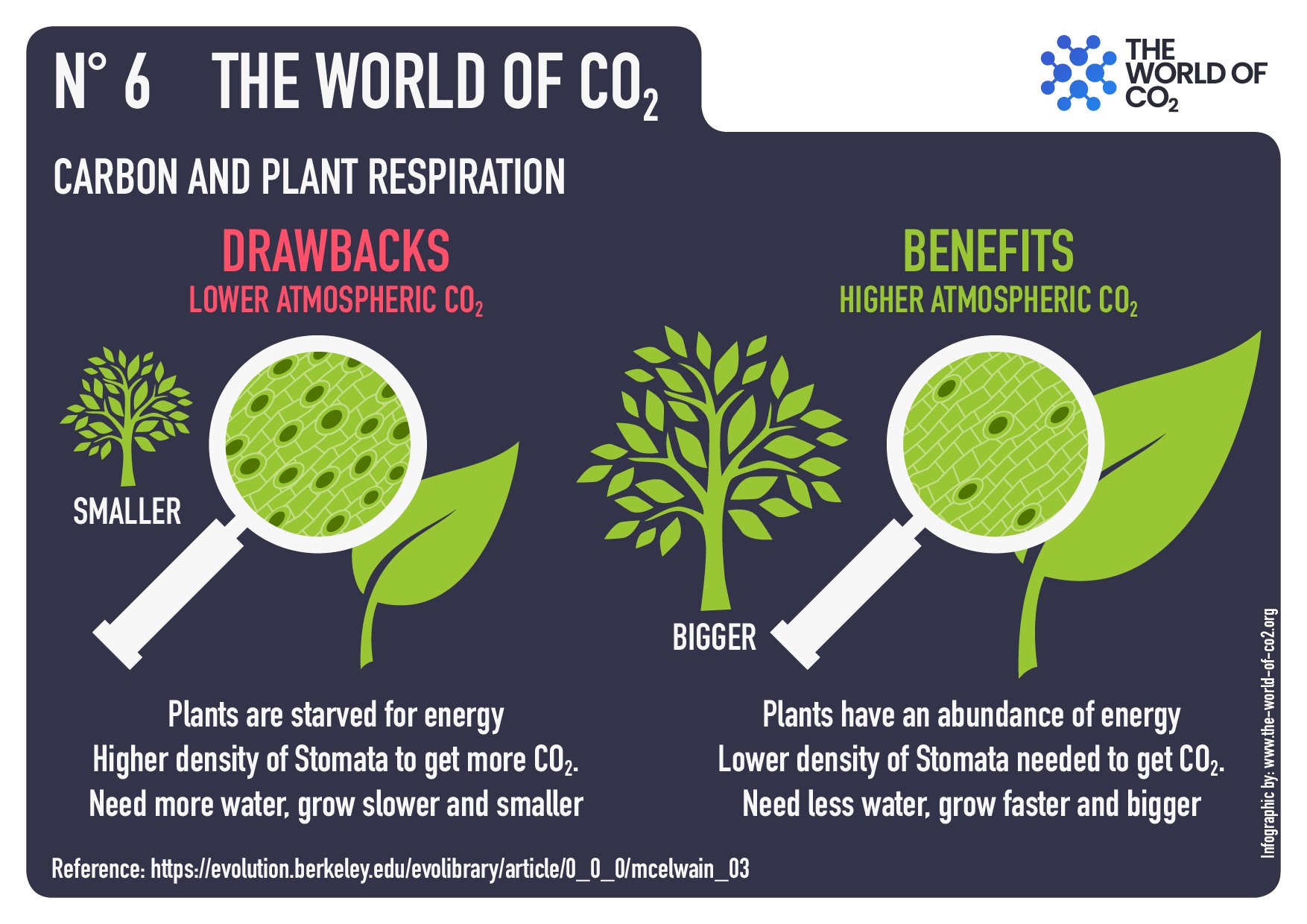
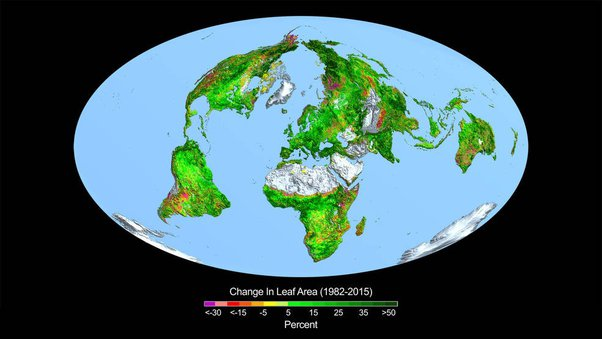
A major deficiency of all these [econometric] studies is that they omit the role of CO2 fertilization. Climate change as it relates to this report is caused by GHG emissions, chiefly CO2. The econometric analyses referenced above focus only on temperature and precipitation changes and do not take account of the beneficial growth effect of the additional CO2 that drives them. As explained in Chapter 2, CO2 is a major driver of plant growth, so this omission biases the analysis towards underestimation of the benefits of climate change to agriculture.

A 2021 report from the U.S. National Bureau of Economic Research (Taylor and Schlenker 2021) used satellite-measured observations of outdoor CO2 levels across the United States, matched to county-level agricultural output data and other economic variables. After controlling for the effects of weather, pollution and technology the authors concluded that CO2 emissions had boosted U.S. crop production since 1940 by 50 to 80 percent, attributing much larger gains than had previously been estimated using FACE experiments. They found that every ppm of increase in CO2 concentration boosts corn yields by 0.5 percent, soybeans by 0.6 percent, and wheat by 0.8 percent.

Notwithstanding the abundant evidence for the direct benefits of CO2 and of CO2-induced warming on crop growth, in 2023 the U.S. Environmental Protection Agency (EPA 2023) boosted its estimate of the Social Cost of Carbon (SCC) about five-fold based largely on a very pessimistic 2017 estimate of global agricultural damages from climate warming (Moore et al., 2017). One of the two damage models used by the EPA attributed nearly half of the 2030 SCC to projected global agricultural damages based on the Moore et al. (2017) analysis. This study was a meta-analysis of crop model studies simulating yield changes for agricultural crops under various climate warming scenarios. Moore et al. projected declining global crop yields for all crop types in all regions due to warming.

In summary, there is abundant evidence going back decades that rising CO2 levels benefit plants,including agricultural crops, and that CO2-induced warming will be a net benefit to U.S. agriculture. To the extent nutrient dilution occurs there are mitigating strategies available that will need to be researched and adapted to local conditions.

Chapter 10 Managing Risks of Extreme Weather

Trends in losses from extreme weather and climate events are dominated by population increases and economic growth. Technological advances such as improved weather forecasting and early warning systems have substantially reduced losses from extreme weather events. Better building codes, flood defenses, and disaster response mechanisms have lowered economic losses relative to GDP. The U.S. economy’s expansion has diluted the relative impact of disaster costs, as seen in the comparison of historical and modern GDP percentages. Heat-related mortality risk has dropped substantially due to adaptive measures including the adoption of air conditioning, which relies on the availability of affordable energy. U.S. mortality risks even under extreme warming scenarios are not projected to
increase if people are able to undertake adaptive responses.

There is strong evidence that people adapt to weather risks. Lee and Dessler (2023) reported that 86 percent of temperature-related deaths across 40 cities in the U.S. were due to cold-related mortality, and that due to adaptation the relative risk of death declined in hot and cold cities alike as seasonal temperatures increased. Allen and Sheridan (2018) found that short, early-season cold events were 2 to 5 times deadlier than hot events, but the mortality risk of both cold and hot extremes drops to nearly zero if the events occur late in the season.

In the context of large declines in heat-related mortality, rising temperatures are associated with a net saving of lives since they reduce mortality from cold events. AR6 Working Group 2 Chapter 16.2.3.5 (O’Neill et al. 2022) acknowledges that heat-related mortality risk is declining over time:

Heat-attributable mortality fractions have declined over time in most countries owing to general improvements in health care systems, increasing prevalence of residential air conditioning, and behavioral changes. These factors, which determine the susceptibility of the population to heat, have predominated over the influence of temperature change.

Yet the IPCC misrepresents the overall situation in its AR6 Synthesis report. Section A.2.5 of that document states: “In all regions increases in extreme heat events have resulted in human mortality and morbidity (very high confidence).” But it is silent on the larger decline of deaths during extreme cold events.

Chapter 11 Climate Change, the Economy, and Social Cost of Carbon

Economists have long considered climate a relatively unimportant factor in economic growth, a view echoed by the IPCC itself in AR5. Mainstream climate economics has recognized that CO2-induced warming might have some negative economic effects, but they are too small to justify aggressive abatement policy and that trying to “stop” or cap global warming even at levels well above the Paris target would be worse than doing nothing. An influential study in 2012 suggested that global warming would harm growth in poor countries, but the finding has subsequently been found not to be robust. Studies that take full account of modeling uncertainties either find no evidence of a negative effect on global growth from CO2 emissions or find poor countries as likely to benefit as rich countries.

Figure 11.2: Decline in U.S. GDP per degree of warming. Source: CEA-OMB (2023)

Social Cost of Carbon (SCC) estimates are highly uncertain due to unknowns in future economic growth, socioeconomic pathways, discount rates, climate damages, and system responses. The SCC is not intrinsically informative as to the economic or societal impacts of climate change. It provides an index connecting large networks of assumptions about the climate and the economy to a dollar value. Some assumptions yield a high SCC and others yield a low or negative SCC (i.e. a social benefit of emissions). The evidence for or against the underlying assumptions needs to be established independently; the resulting SCC adds no additional information about the validity of those assumptions. Consideration of potential tipping points does not justify major revisions to SCC estimates.

Although the literature refers to “estimates” of the SCC, it is not estimated in the way other economic statistics are estimated. For instance, data on market transactions including prices and quantities can be used to estimate the current inflation rate or the growth rate of per capita real Gross Domestic Product, and there are well-understood uncertainties associated with these quantities. But there are no market data available to measure many, if not most, of the marginal damages or benefits believed to be associated with CO2 emissions, so these need to be imputed using economic models.

For example, an influential component of some SCC calculations is the perceived social cost associated with a changed risk of future mortality due to extreme weather. There is no market in which people can directly attach a price to that risk. At best economists can try to infer such values by looking at transactions in related markets such as real estate or insurance, but isolating the component of price changes attributable to atmospheric CO2 levels is very difficult.

It is increasingly being argued that the SCC is too variable to be useful for policymakers. Cambridge Econometrics (Thoung, 2017) stated it’s “time to kill it” due to uncertainties. The UK and EU no longer use SCC for policy appraisal, opting for “target-consistent” carbon pricing (UK Department for Energy Security and Net Zero 2022, Dunne 2017). However, the uncertainty of SCC estimates doesn’t mean that other regulatory instruments are inherently better or more efficient. Many emissions regulations (such as electric vehicle mandates, renewable energy mandates, energy efficiency regulations and bans on certain types of home appliances) cost far more per tonne of abatement than any mainstream SCC estimate, which
is sufficient to establish that they fail a cost-benefit test.

Chapter 12 Global Climate Impact of US Emissions Policies

U.S. policy actions are expected to have undetectably small direct impacts on the global climate and any effects will emerge only with long delays.

The emissions rates and atmospheric concentrations of criteria air contaminants are closely connected because their lifetimes are short and their concentrations are small; when local emissions are reduced the local pollution concentration drops rapidly, usually within a few days. But the global average CO2 concentration behaves very differently, since emissions mix globally and the global carbon cycle is vast and slow. Any change in local CO2 emissions today will have only a very small global effect, and only with a long delay.

Consequently, any reduction in U.S. emissions would only modestly slow, but not prevent, the rise of global CO2 concentration. And even if global emissions were to stop tomorrow, it would take decades or centuries to see a meaningful reduction in the global CO2concentration and hence human influences on the climate. The practice of referring to unilateral U.S. reductions as “combatting climate change” or “taking action on climate” on the assumption we can stop climate change therefore reflects a profound misunderstanding of the scale of the issue.

Concluding thoughts

This report supports a more nuanced and evidence-based approach for informing climate policy that explicitly acknowledges uncertainties. The risks and benefits of a climate changing under both natural and human influences must be weighed against the costs, efficacy, and collateral impacts of any “climate action”, considering the nation’s need for reliable and affordable energy with minimal local pollution. Beyond continuing precise, un-interrupted observations of the global climate system, it will be important to make realistic assumptions about future emissions, re-evaluate climate models to address biases and uncertainties, and clearly acknowledge the limitations of extreme event attribution studies. An approach that acknowledges both the potential risks and benefits of CO2, rather than relying on flawed models and extreme scenarios, is essential for informed and effective decision-making.

Climate Model Assumptions Contrary to Balloon Data

Recently Michael Connolly presented the evidence contradicting assumptions built into GCMs (Global Climate Models).  This post consists of the exhibits he used, and additional Connolly comments in italics from a similar talk this month to Doctors for Disaster Preparedness. (Video embedded later in post.)

Michael Connolly:

I’m an engineer and a scientist. As an engineer, I use computer models to design and make things. As a scientist, I look at the data to see if my computer models are correct. So, what we did at the center for environmental research and earth sciences (CERES) is that we looked at the data from 20 million radio balloons.

We then asked, can we look at this data and see how we can use it to check the computer models? And we found there’s two types of balloons. One: the average weather balloon does about a 100 measurements as it goes up to the stratosphere. But the ones which measure ozone do a measurement about once every second. So you have maybe four or 5,000 measurements on each sample. But all of the climate models, and by the way, nobody in the climate model community bothered to check the data to see if their models were correct, which I find very bizarre. But what all of the model community do is they divide the earth into a number of little boxes. So on a horizontal scale the boxes are about 1,000 mi long and on a vertical scale they’re about less than a mile in height.

They then make a number of assumptions about how the air behaves within each of these boxes. So their first assumption is that the air in each box is in a state which we call thermodynamic equilibrium. which I’ll explain in a few minutes. So they assume that on a horizontal scale the air in a box is in equilibrium over a distance of a 1,000 miles. But on a vertical scale only in equilibrium for slightly less than a mile.

And they also assume that the different boxes are not in thermodynamic equilibrium with each other. Because if it turns out that the boxes are in thermodynamic equilibrium with each other, all of the assumptions of the climate models collapse because Einstein and his co-authors over a 100 years ago showed that if a system was in thermodynamic equilibrium, if you put in a greenhouse gas into that system, it would absorb more energy. But if it’s in thermodynamic equilibrium, it emits more energy. So increasing the level of greenhouse gases will increase the rate of absorption but also increase the rate of emission. So there’s no net change due to the radiation. So if it turns out that the assumption that the the different boxes aren’t in thermodynamic equilibrium is false, then the whole theory of man-made global warming collapses.

So how do we know if something is in thermodynamic equilibrium or not? Well, what you do is you take a system and you do all the measurements of the different parameters involved and if you can describe the system in what’s called an equation of state with using these parameters, then we say the state is in thermodynamic equilibrium. So in other words, obeying an equation of state is one side of the coin of being in thermodynamic equilibrium. They’re both different sides of the same coin.

So for the air, the equation of state is this. It’s called the ideal gas law. And this is the equation that’s used by the climate modelers in treating the different boxes as being in thermodynamic equilibrium. You can see down there it tells you the relationship between the different parameters, but it doesn’t tell you how much energy it would take to change the temperature of a system. For that you need to know the heat capacity of the system. And it doesn’t tell you anything about potential energy. In other words, if I take a cubic meter of air and lift it up and keep it at the same temperature and pressure, it would obey the same equation, but it would have gravitational potential energy because it takes energy to lift it up. That’s not reflected in the equation of state.

As a chemist I thought there was something dead obvious to do. The equation of state can be rewritten in a different form called the molar density form, and this form has been used by chemists for hundreds of years to determine the molecular weight of new gases. So we asked what happens if we describe the atmosphere in terms of molar density form instead of the energy form? We were the first and still the only people to have done this.

When we did that we got a big surprise. We found that if you plot the molar density versus pressure you get these two straight lines. Now this means that the atmosphere in the troposphere, that’s the lower bit, is obeying an equation of state. So that means it’s in thermodynamic equilibrium. And when you get to the tropopause it turns into another straight line. Now this is quite common in studying materials. If you can describe it in terms of one equation of state and then it changes into another equation of state, we call it a change of phase. For example, you can describe water using the gaseous water using the gas laws, but then when it turns into liquid water, you have to use a different equation of state.


Now we studied all the different weather balloons from all around the world and we found that this phenomenon occurred in all of them. The only difference was that in the tropics the change of phase occurred at a higher altitude and in the Arctic and polar regions it occurred at a lower altitude. So, when we were here in Tucson 5 years ago,  we made a video for the entire year of all of the radio balloon data for Tucson for 2018. And the reason for this video is that looking at a static graph like that, you don’t see any changes. Now, in the models that they’re using, the different boxes are isolated from each other, if you put energy into one of the boxes, it would kind of stay there. But if they’re in thermodynamic equilibrium, you put energy into one box, then all of the boxes will change because all of the energy will be distributed throughout the system. When you look at the video, the behavior of the boundary layer position moves up and down.

But also the temperature: if it moves to the right, the temperature is increasing. If it moves to the left, the temperature is decreasing. And what you will see once you watch the video, it’s all synchronized. In other words, if a change occurs, if the troposphere is warming up and the temperature is moving to the right, the tropopause moves down, the tropopause moves in the opposite direction. So in other words, when the troposphere heats up, the tropopause cools down. when the troposphere cools down the tropopause heats up and it does so in a synchronized way. So that synchronization shows that it’s thermodynamically connect connected. The idea that all of these boxes are not in thermodynamic equilibrium is contradicted by this data.  [The referenced video starts at 10 minutes into the embedded presentation below.]

So that’s the first assumption. Now looking at the second assumption.
Back in the day,  18th century or something, Hadley was looking to explain the trade winds. So he came up with this idea of what happens: The very hot temperatures landing on the equator heated up the atmosphere. here and this hot air then rose up. Then as it rose up it started to move towards the poles and as it moved towards the poles it cooled down and you got this circular phenomenon. They came up with three different types of circular cells: the Hadley cells; the Ferrel cells and the Polar cells. But all of these this theoretical stuff was based on ground measurements.

And again uh nobody bothered to check whether this is true or not. So I’ll just show how we checked it. But first of all I just want to explain what’s meant by mass flux. So if you take a square meter and you measure the air flowing through it and what weight of air that is the mass flux. So in the weather balloons they give you the speed of the air and they give you the direction in which it’s it’s going. So you can use this to calculate the mass flux. So we said fine. So can we use this to check the idea of the Hadley cells and it turns out that you can. So we did and we published a paper two years ago.

We found first of all if you take a balloon and you launch it up through one of these cells then if Hadley is correct you would expect the hot air was rising here in the tropics and that drags in the air from the colder regions and then it hits the tropopause. Now, when Hadley came up with the idea, nobody knew the tropopause existed, and it’s only 30 years before I was born that it was actually discovered. So, that’s telling something about my age.

Anyway, if you send a balloon up through the atmosphere, you would expect the mass flux flow to flow in that direction down at the lower levels. And then as you go up at some stage it would shift over and start going in the opposite directions. So since that was available that mass flux we could measure from the balloon data we did that and we got a surprise.

There was absolutely no circulation patterns at all. Instead what the atmosphere was doing. So if we point here you can see these ones are the lower ones. So you have the direction the north south direction of the mass flux. These are the ones at the lower half of the troposphere. These are the ones in the opposite half of the troposphere.

For a Hadley cell you would expect these ones to be flowing in the opposite direction to these ones. But instead what we find is they all flow in the same direction. And in a very unusual pattern. What happens is here it’s flowing south then the atmosphere slows down over a couple of days goes back and forth and so on. So instead of this circular pattern what’s happening is the whole atmosphere is moving like a giant pendulum back and forth. So we have the atmosphere going one way, then after a few days it turns around and comes back in the opposite direction. And this is for Iceland but we found the exact same thing occurred for all the different stations.

So in that published paper we we took a station from each of the different five climate types and we found the exact same sort of thing happened. Now people said: okay so maybe it’s going back and forward on a daily basis but over a period of a year it might average out. So we average the data over the five years for each of the stations.

And since we published that paper, we’ve analyzed over 250 of the weather stations in the tropics. And we found for these 82% of them are Hadley. 73 in the northern hemisphere. So the majority are not Hadley cells. And in the southern hemisphere they’re equally balanced. But the problem with even the ones that were Hadley cells is you can see here the mass flux grow flowing in this direction the area under the curve is not the same as the one up above. And if it was a proper Hadley cell, they’d have to be the same. So what we found is for none of them this worked out. So they don’t exist, right?


IPCC Climate Models Proven to Lack Predictive Ability

The recently published paper is Are Climate Model Forecasts Useful for Policy Making? by Kesten C. Green and Willie Soon. Excerpts in italics with my bolds and added images.

Effect of Variable Choice on Reliability and Predictive Validity

Abstract

For a model to be useful for policy decisions, statistical fit is insufficient. Evidence that the model provides out-of-estimation-sample forecasts that are more accurate and reliable than those from plausible alternative models, including a simple benchmark, is necessary.

The UN’s IPCC advises governments with forecasts of global average temperature drawn from models based on hypotheses of causality. Specifically, manmade warming principally from carbon dioxide emissions  (Anthro) tempered by the effects of volcanic eruptions (Volcanic) and by variations in the  Sun’s energy (Solar). Out-of-sample forecasts from that model, with and without the IPCC’s favoured measure of Solar, were compared with forecasts from models that excluded human influence and included Volcanic and one of two independent measures of Solar. The models were used to forecast Northern Hemisphere land temperatures and—to avoid urban heat island effects—rural only temperatures. Benchmark forecasts were obtained by extrapolating estimation sample median temperatures.

The independent solar models reduced forecast errors relative to those of the benchmark model for all eight combinations of four estimation periods and the two temperature variables tested. The models that included the IPCC’s Anthro variable reduced errors for only three of the eight combinations and produced extreme forecast errors from most model estimation periods. The correlation between estimation sample statistical fit and forecast accuracy was -0.26. Further tests might identify better models: Only one extrapolation model and only two of many possible independent solar models were tested, and combinations of forecasts from different methods were not examined.

The anthropogenic models’ unreliability would appear to void policy relevance. In practice, even the models validated in this study may fail to improve accuracy relative to naïve forecasts due to uncertainty over the future causal variable values. Our findings emphasize that out-of-sample forecast errors, not statistical fit, should be used to choose between models (hypotheses).

Background

In their attempts to achieve the IPCC objective of identifying a human cause for temperature changes—specifically “global warming”—the IPCC researchers have framed the problem as one of “attributing” changes in the Earth’s temperature to the respective contributions of putative anthropogenic (“Anthro”) principally carbon dioxide emissions altering the composition of the atmosphere—and natural influences—principally aerosols from volcanic eruptions altering the composition of the atmosphere (“Volcanic”), and total solar irradiance, or TSI, variations (“Solar”).

Given the task they were set, the IPCC researchers have devoted
much of their efforts into developing estimates of the Anthro variable.

The IPCC’s most recent, AR6, report (IPCC, 2021) only considered one estimate of Solar for the purpose of attribution (Matthes et al., 2017) and made no allowance for the effect of urban heat islands on the temperature measures they used (Connolly et al., 2021, 2023; Soon et al., 2023). Moreover, a study of the statistical attribution or “fingerprinting” approach used by IPCC researchers (e.g., Allen and Tett, 1999; Hasselmann, et al., 1995; Hegerl et al., 1997; Santer et al.,1995) concluded that the approach was invalid (McKitrick, 2022). The IPCC authors’ analyses failed to meet the assumptions of the method they used, and they failed to correctly implement the method.

In sum, the objective given to the IPCC researchers and the approach that they have taken suggests that plausible alternative hypotheses on the causes of terrestrial temperature changes may not have been adequately tested, as is required by the scientific method (Armstrong and Green, 2022). That concern is consistent with Armstrong and Green’s (2022) observation that government sponsorship of research can create incentives that may influence researchers’ choices of hypotheses to test and how they test them.

1.1 Alternative hypotheses on Solar

To address the first of the foregoing limitations in the IPCC attribution studies—failure to fairly test alternative TSI estimates—Connolly et al. (2021, 2023) comprehensively reviewed alternative estimates of TSI covering the 169 years from 1850 to 2018. In addition to the Matthes, et al. (2017) TSI estimates series used by the IPCC (2021)—henceforth “IPCC Solar”—Connolly et al. (2023) identified 27 alternative Solar time series.

The alternative estimates of Solar correlate quite well with the TSI used in the AR6 report—Pearson’s r values range between 0.39 and 0.97 with a median of 0.82—but the degree of TSI variation in Watts per square metre (Wm-2) differs considerably between the estimates. The ranges of the individual alternative TSI estimate series vary between 0.49 and 4.64 Wm-2, with a median range of 1.77 Wm-2, while IPCC Solar has a range of only 0.19 Wm-2.

In this study, we consider two plausible TSI reconstructions from Connolly et al. (2023). Those from Hoyt and Schatten (1993) and from Bard et al. (2000), which Connolly et al. (2023) updated to the year 20182. The former TSI record (“H1993 Solar”) was based on the so-called multiproxy—i.e., equatorial solar rotation rate, sunspot structure, the decay rate of individual sunspots, the number of sunspots without umbrae, and the length and decay rate of the 11-yr sunspot activity cycle—reconstruction of the solar irradiance history.

1.2 Alternative hypotheses on temperature estimation

The IPCC’s attribution studies do not account for the direct effects of human activities on local temperatures (heat islands)—the second weakness addressed in this study. For example, heating and cooling of building interiors, electricity generation, manufacturing, freight and transport, asphalt and concrete, and where vegetation and open water have been removed or added. Where temperature readings are taken close to such human sources of heat or absence of natural cooling, they cannot properly reflect the individual effects of human emissions of carbon dioxide, etc., that the IPCC are concerned about (their Anthro variable), the Volcanic variable, and TSI.

To address this second limitation in the IPCC attribution studies, Connolly et al. (2021, 2023) developed four alternative estimates of surface temperatures that were intended to avoid heat island effects. They were based on rural only weather station readings, sea surface temperature readings, tree-ring width measurements, and glacier length measurements. For comparison with the approach used by the IPCC, they also developed an all-land temperature estimates series for the Northern Hemisphere.

1.5 Hypotheses tested

The foregoing discussion suggests the following hypotheses, which are tested in this study.

    • H1. Forecasts from causal models will [will not] be usefully more accurate than forecasts from a naïve no-change model.
    • H2. Models using variable measures developed independently of the IPCC dangerous manmade global warming hypothesis will [will not] have greater predictive validity.
    • H3. The statistical fit of the models (adjusted-R2) will not [will] be substantively positively related to their predictive validity.
    • H4. Models using variable measures developed independently of the IPCC dangerous manmade global warming hypothesis will [will not] be more reliable.

Findings

Figure 1: Absolute Errors of NH All Land and Rural Land Temperature Forecasts to 2018 (℃) — Forecasts from four alternative models plus naïve estimates over four periods. Legend (Causal variables in models):    Black Anthro, Volcanic; Red Anthro, Volcanic, IPCC Solar;  Green B2000 Solar, Volcanic;  Blue H1993 Solar, Volcanic; Yellow Estimation sample median temperature.

3.1 Predictive validity of causal models versus naïve model [H1]

Forecast errors were larger than the benchmark errors (UMBRAE) for the IPCC Anthro models AVL and AVSL estimated with data from 1850 to 1949 and from 1850 to 1969, and for the AVR and AVSR models estimated with data from 1850 to 1899, 1850 to 1949, and 1850 to 1969. The anthropogenic warming models showed predictive validity relative the naïve model (UMBRAE less than 1.0) for only three of the eight combinations of forecast variable and estimation sample period.

3.2 Predictive validity of independent versus IPCC models [H2]

The MdAEs (median absolute error) of the forecasts from the models with IPCC’s anthropogenic and volcanic series as causal variables (AVL and AVR) and from the models that also included IPCC’s solar series (AVSL and AVSR) were greater than 1°C (roughly 2°F) for five of the eight combinations tested. The MdAEs of the forecasts from the models with B2000 solar and the volcanic series as causal variables (SBVL and SBVR) were less than 0.55°C (1°F) for all eight of the estimation periods used and temperature series being forecast combinations and for seven of the eight in the case of the models with H1993 as the solar variable (SHVL and SHVR).

3.3 Relationship between predictive validity and statistical fit of models [H3]

The correlations (sign-reversed Pearson’s r) between the accuracy of out-of-sample forecasts, as measured by UMBRAE (an error measure, hence the sign reversal), and the statistical fit of the models to the estimation data (adjusted-R2) for the causal models tested were large and negative for six (6) of the eight (8) combinations of estimation period (1850 to 1899, 1949, 1969, and 1999) used—and hence maximum forecast horizon of 119, 69, 49, and 19 years, respectively—and temperature series (NH Land and NH Rural) forecast.

3.4 Reliability of independent versus IPCC models [H4]

Charts of the results of Test 2 are presented in Figure 2 and are discussed below.

Figure 2. Median absolute errors of NH temperature forecasts 2000 to 2018 in ℃. Legend (Causal variables in models): Black Anthro, Volcanic; Red Anthro, Volcanic, IPCC Solar;  Green B2000 Solar, Volcanic;  Blue H1993 Solar, Volcanic;  Yellow Estimation sample median temperature.

The independent solar models—SBVL and SHVL, and SBVR and SHVR—perform largely as one
would expect of causal models when forecasting using known values of the causal variables.

In the case of the AVR and AVSR models—forecasting the rural land temperatures, on the right of Figure 2—the MdAEs decreased rapidly from roughly 17 times the corresponding naïve forecast errors to beat the naïve MdAE when the 76th observation (1925) was added to the estimation samples. After that observation was added, the MdAEs for the AVR and AVSR model forecasts increased rapidly with each extra observation then stayed high before rapidly declining again after the 116th observation (1965) was added to the estimation samples.

When a model of causal relationships is estimated from empirical data on valid causal variables reliably measured, one would expect forecast errors to get smaller as more observations are used in the estimation of the model’s parameters. That is what the charts in Figure 2 show in the case of the naïve benchmark model forecasts and, broadly, what can be seen in the case of the independent models SBVL, SHVL, SBVR, and SHVR, but is not seen in the case of the models using the IPCC variables: AVL, AVSL, AVR, and AVSR.

The errors of the Anthro models’ forecast errors explode well beyond 1 °C and the benchmark model errors for forecast years beyond the mid-1970s, with puzzling exceptions. Namely, forecasts from Anthro models estimated from the largest sample size in the chart—1850 to 1999—and from models estimated from the smallest sample—1850 to 1899—forecasting All Land temperatures. In those cases, involving three of the eight charts, the Anthro model errors are less than the median historical temperature benchmark model errors, and mostly less than the errors of the independent models in later years.

The explosion in Anthro model errors from the 1970s is more extreme for models estimated to forecast Rural Land temperatures. Moreover, for the models estimated using only 1850 to 1899 data, errors are larger than those of the benchmark and independent models from 1920 and, prior to 1970, without any obvious pattern.

5. Conclusions

The IPCC’s models of anthropogenic climate change lack predictive validity. The IPCC models’ forecast errors were greater for most estimation samples —often many times greater—than those from a benchmark model that simply predicts that future years’ temperatures will be the same as the historical median. The size of the forecast errors and unreliability of the models’ forecasts in response to additional observations in the estimation sample implies that the anthropogenic models fail to realistically capture and represent the causes of Earth’s surface temperature changes. In practice, the IPCC models’ relative forecast errors would be still greater due to the uncertainty in forecasting the models’ causal variables, particularly Volcanic and IPCC Solar.

The independent solar models of climate change—which did not include a variable representing the IPCC postulated anthropogenic influence—do have predictive validity. The models reduced errors of forecasts for the years 2000 to 2018 relative to the benchmark errors for all, and all but one of 101 estimation samples tested for each of the two models. One of the models (B2000 Solar) reduced errors by more than 75 percent for forecasts from models estimated from 35 of the samples—a particularly impressive improvement given that the benchmark errors were no greater than 1 °C for all but one of the estimation samples.

The independent solar models provide realistic representations of the causal relationships with surface temperatures. The question of whether the independent solar variables can be forecast with sufficient accuracy to improve on the benchmark model forecasts in practice, however, remains relevant. All in all, and contra to the IPCC reports, there is insufficient evidential basis for the use of carbon dioxide, et cetera, emissions—taken together, the IPCC’s Anthro—as climate policy variables.

Finally, this study provides further evidence that measures of statistical fit provide misinformation about predictive validity. Predictive validity can only be properly estimated when the proposed model or hypothesis is used for forecasting new-to-the-model data, and the forecasts are then compared for accuracy against forecasts from a plausible benchmark model. This important conclusion needs bearing in mind when evaluating policy models.

See Also:

Lacking Data, Climate Models Rely on Guesses

Figure 1. Anthropgenic and natural contributions. (a) Locked scaling factors,
weak Pre Industrial Climate Anomalies (PCA). (b) Free scaling, strong PCA

Climate Models Hide the Paleo Incline

The Right Climate Stuff

Not everyone is aware that the scientists and engineers who made the NASA space program successful disputed the global warming/climate change narrative promoted at the agency by people like James Hansen.

After all the slogan in the NASA workplace was that of Edward Deming, and they were only convinced by the facts rather than feelings or opinions about the future.  Many of them formed the Right Climate Stuff Foundation.

In particular Walter Cunningham explained his reasoning in an article In Science, Ignorance is not Bliss. Excerpts in italics with my bolds and added images.

NASA has played a key role in one of the greatest periods of scientific progress in history. It is uniquely positioned to collect the most comprehensive data on our biosphere.   For example, recently generated NASA data enabled scientists to finally understand the Gulf Stream warming mechanism and its effect on European weather. Such data will allow us to improve our models, resulting in better seasonal forecasts.

NASA’s Aqua satellite is showing that water vapor, the dominant greenhouse gas, works to offset the effect of carbon dioxide (CO2). This information, contrary to the assumption used in all the warming models, is ignored by global warming alarmists.

Climate understanding and critical decision making require
comprehensive data about our planet’s land, sea, and atmosphere.

Without an adequate satellite system to provide such data, policy efforts and monitoring international environmental agreements are doomed to failure. Our satellite monitoring capability is being crippled by interagency wrangling and federal budget issues. As much as a third of our satellites need replacing in the next couple of years.

NASA should be at the forefront in the collection of scientific evidence and debunking the current hysteria over human-caused, or Anthropogenic Global Warming (AGW). Unfortunately, it is becoming just another agency caught up in the politics of global warming, or worse, politicized science.

Advocacy is replacing objective evaluation of data, while
scientific data is being ignored in favor of emotions and politics.

There are excellent correlations between the regular fluctuations of the Sun and the Earth’s temperature, while scientists can not find a relationship between industrial activity, energy consumption, and global temperatures. But global warming is an issue no longer being decided in the scientific arena.

Saying the Earth is warming is to state the obvious. Since the end of the ice age, the Earth’s temperature has increased approximately 16 degrees Fahrenheit and sea levels have risen a total of 300 feet. That is certain and measurable evidence of warming, but it is not evidence of AGW—human-caused warming.

We can track the temperature of the Earth back for millennia. Knowing the temperature of the Earth, past or present, is a matter of collecting data, analyzing it, and coming up with the best answer to account for the data. Collecting such data on a global basis is a NASA forte. I believe in global climate change, but there is no way that humans can influence the temperature of our planet to any measurable degree with the tools currently at their disposal. Any human contribution to global temperature change is lost in the noise of terrestrial and cosmic factors.

Our beautiful home planet has been warming and cooling for the last 4.8 billion years. Most recently, it has been warming—be it ever so slightly—but there is nothing unusual about it! The changes and rates of change in the Earth’s temperature, just since the Industrial Revolution, have occurred many times in our climatic history. While climate scientists generally agree that the Earth’s temperature is always changing, not many of them would say that humans are responsible for those changes.

None of this is to say there are not legitimate reasons to restrict emissions of any number of chemicals into the atmosphere. We should just not fool ourselves into thinking we will change the temperature of the Earth by doing so.

In a December 2007 Senate report, 400 prominent scientists signed a letter pointing out that climate change was a well-known natural phenomenon, and that adapting to it is far more sensible than attempting to prevent it. Their ranks included experts in climatology, geology, oceanography, biology, glaciology, biogeography, meteorology, economics, chemistry, mathematics, environmental sciences, engineering, physics, and paleo-climatology.

Their message: When changes are gradual, man has
an almost infinite ability to adapt and evolve.

The fearmongers of global warming base their case on the correlation between CO2 and global temperature, even though we cannot be sure which is cause and which is effect. Historically, temperature increases have preceded high CO2 levels, and there have been periods when atmospheric CO2 levels were as much as 16 times what they are now, periods characterized not by warming but by glaciation. You might have to go back half a million years to match our current level of atmospheric CO2, but you only have to go back to the Medieval Warming Period, from the 10th to the 14th Century, to find an intense global warming episode, followed immediately by the drastic cooling of the Little Ice Age. Neither of these events were caused by variations in CO2 levels.

Even though CO2 is a relatively minor constituent of “greenhouse gases,” alarmists have made it the whipping boy for global warming (probably because they know how fruitless it would be to propose controlling other principal constituents, H2O, CH4, and N2O). Since human activity does contribute a tiny portion of atmospheric CO2, they blame us for global warming.

Other inconvenient facts ignored by the activists: Carbon dioxide is a nonpolluting gas, essential for plant photosynthesis. Higher concentrations of CO2 in the atmosphere produce bigger harvests.

In spite of warnings of severe consequences from rising seas, droughts, severe weather, species extinction, and other disasters, the U.S. has not been stampeded into going along with the recommendations of the UN Panel on Climate Change (IPCC)—so far. Even though evidence supports the American position, we have begun to show signs of caving in to the alarmists.

With scientific evidence going out of style,
emotional arguments and anecdotal data are ruling the day.

The media subjects us to one frightening image of environmental nightmare after another, linking each to global warming. Journalists and activist scientists use hurricanes, wildfires, and starving polar bears to appeal to our emotions, not to our reason. They are far more concerned with anecdotal observations, such as the frozen sea ice inside the Arctic Circle, than they are with understanding why it is happening and how frequently it has occurred in the past.

After warnings that 2007 would be the hottest year on record and a record year for hurricanes, what we experienced was the coolest year since 2001 and, by some measures, the most benign hurricane season in the Northern Hemisphere in three decades.

Even though recent changes in our atmosphere are all within the bounds of the Earth’s natural variability, a growing number of people are willing to throw away trillions of dollars on fruitless solutions. Why do we allow emotional appeals and anecdotal data to shape our conclusions and influence our expenditures with the science and technology we have available at our fingertips?

The situation is complex, but the sad state of scientific literacy in America today is partially to blame for belief in AGW. When a 2006 National Science Foundation survey found 25 percent of Americans not knowing the Earth revolves around the Sun, you know that science education is at a new low and society is vulnerable to the emotional appeal of AGW.

And don’t underestimate the role of politics and political correctness.

The public debate should focus on the real cause of global temperature change and whether we can do anything about it. Is global warming a natural inevitability, or is it AGW—human caused?

The conflict over AGW has deteriorated into a religious war; a war between true believers in human-caused global warming and nonbelievers; between those who accept AGW on faith and those who consider themselves more sensible and better informed. “True believers” are beyond being interested in evidence; it is impossible to reason a person out of positions they have not been reasoned into.

It doesn’t help that NASA scientist James Hansen was one of the early alarmists claiming humans caused global warming. Hansen is a political activist who spreads fear even when NASA’s own data contradict him.

Warming in the upper atmosphere should occur before any surface warming effect, but NASA’s own data show that has not been happening. Global temperature readings—accurate to 0.1 degree Celsius—are gathered by orbiting satellites. Interestingly, in the 18 years those satellites have been recording global temperatures, they have actually shown a slight decrease in average temperatures.

Hansen is currently calling for a reduction of atmospheric CO2 by 10 percent and a moratorium on coal-fired power plants, while claiming the Bush administration is censoring him. Other so-called scientists are saying the world must bring carbon emissions to near zero to keep temperatures from rising.

In today’s politically correct environment, many are reluctant to dispute the popular wisdom; when they do, they are frequently ignored. When NASA Administrator Michael Griffin, Hansen’s boss and a distinguished scientist in his own right, attempted to draw a distinction between Hansen’s personal and political views and the science conducted by his agency, he was soon forced to back off.

It is the true believers who, when they have no facts on their side, try to silence their critics. When former NASA mathematician Ferenc Miskolczi pointed out that “greenhouse warming” may be mathematically impossible, NASA would not allow him to publish his work. Miskolczi dared to question the simplifying assumption in the warming model that the atmosphere is infinitely thick. He pointed out that when you use the correct thickness—about 65 miles—the greenhouse effect disappears! Ergo: no AGW. Miskolczi resigned in disgust and published his proof in the peer reviewed Hungarian journal Weather. [See: The Curious Case of Dr. Miskolczi]

For nearly a decade now, there has been no global warming. Even though atmospheric CO2 has continued to accumulate—up about 4 percent in the last 10 years—the global mean temperature has remained flat. That should raise obvious questions about CO2 being the cause of climate change.

Instead, AGW enthusiasts are embracing more regulation, greater government spending, and higher taxes in a futile attempt to control what is beyond our control—the Earth’s temperature. One of their political objectives, unstated of course, is the transfer of wealth from rich nations to poor nations or, as the social engineers put it, from the North to the South, which may be their real agenda.

Climate Lemmings

In the face of overwhelming evidence for natural temperature variation, proponents of AGW are resorting to a precautionary argument: “We must do something just in case we are responsible, because the consequences are too terrible if we are to blame and do nothing.” They hope to stampede government entities into committing huge amounts of money before their fraud is completely exposed—before science and truth save the day.

Politicians think they can reverse global warming by stabilizing CO2 emissions with a cockamamie scheme of “cap and trade.” A government entity would sell CO2 allocations to those industries producing it. The trillions of dollars in new taxes and devastation to the economy would be justified by claiming it will lower the temperature of the Earth. This rationalization is dependent on two assumptions: (1) that CO2 is responsible for the cause of changes in the Earth’s temperature, and (2) a warmer Earth would be bad for humanity.

The reality is that atmospheric CO2 has a minimal impact on greenhouse gases and world temperature. Water vapor is responsible for 95 percent of the greenhouse effect. CO2 contributes just 3.6 percent, with human activity responsible for only 3.2 percent of that. That is why some studies claim CO2 levels are largely irrelevant to global warming.

Without the greenhouse effect to keep our world warm, the planet would have an average temperature of minus 18 degrees Celsius. Because we do have it, the temperature is a comfortable plus 15 degrees Celsius. Based on the seasonal and geographic distribution of any projected warming, a good case can be made that a warmer average temperature would be even more beneficial for humans.

For a tiny fraction of the trillions of dollars a cap-and-trade system would eventually cost the United States, we could pay for development of clean coal, oil-shale recovery systems, and nuclear power, and have enough left over to pay for exploration of our solar system.

By law, NASA cannot involve itself in politics, but it can surely champion the role of science to inform politicians. With so many uninformed and misguided politicians ignoring the available science, NASA should fill the void. NASA is synonymous with science. Allowing our priorities to drift away from hard science is tantamount to embracing decadence. NASA will surely suffer; and politicizing science is killing it.

I do see hopeful signs that some true believers are beginning to harbor doubts about AGW. Let’s hope that NASA can focus the global warming discussion back on scientific evidence before we perpetrate an economic disaster on ourselves.

Walter Cunningham, (1932–2023) geophysicist, fighter pilot and Apollo 7 astronaut, who flew the first test flight of the Apollo Program, Apollo 7.  In 2010, Cunningham published a short book titled “Global Warming: Facts versus Faith” His editorial was published in the Houston Chronicle on August 15, 2010,  Climate change alarmists ignore scientific methods.  (When You Don’t Have the Facts, Appeal to Public Opinion).  In 2012, he and other former astronauts and NASA employees sent a letter to the agency criticizing its role advocating a high degree of certainty that man-made CO2 is a major cause of climate change while neglecting empirical evidence that calls the theory into question.

Can You Trust an AI/ML Model to Forecast?

The latest fashion in model building is adding AI/ML (Artificial Intelligence/Machine Learning) technology to numerical models for weather forecasting.  No doubt soon there will be climate models also claiming improved capability by doing this.  A meteorological example is called Aardvark Weather and a summary is provided at Tallbloke’s Talkshop Scientists say fully AI-driven weather prediction system delivers accurate forecasts faster with less computing power.

Like all inventions there are weaknesses along with the claimed benefits.  Here’s a short list of the things that can go wrong with these new gadgets. The concerns below are listed along with some others in a paper Understanding the Weaknesses of Machine Learning: Challenges and Limitations by Oyo Jude. Excerpts in italics with my bolds.

Introduction

Machine learning (ML) has become a cornerstone of modern technological advancements, driving innovations in areas such as healthcare, finance, and autonomous systems. Despite its transformative potential, ML is not without its flaws. Understanding these weaknesses is crucial for developing more robust and reliable systems. This article delves into the various challenges and limitations faced by ML technologies, providing insights into areas where improvements are needed

Data Quality and Bias

Data Dependency

Machine learning models are highly dependent on the quality and quantity of data used for training. The performance of an ML model is only as good as the data it is trained on. Common issues related to data quality include:

Incomplete Data: Missing or incomplete data can lead to inaccurate models and predictions. Incomplete datasets may not represent the full spectrum of possible inputs, leading to biased or skewed outcomes.
Noisy Data: Noise in data refers to irrelevant or random information that can obscure the underlying patterns the model is supposed to learn. Noisy data can reduce the accuracy of ML models and complicate the learning process.

Data Bias

Bias in data can significantly impact the fairness and accuracy of ML systems. Key forms of data bias include:

Selection Bias: Occurs when the data collected is not representative of the target population. For example, if a model is trained on data from a specific demographic group, it may not perform well for individuals outside that group.
Label Bias: Arises when the labels or categories used in supervised learning are subjective or inconsistent. Label bias can skew the model’s understanding and lead to erroneous predictions.

Model Interpretability and Transparency

Complexity of Models

Many advanced ML models, such as deep neural networks, are often described as “black boxes” due to their complexity. The lack of transparency in these models presents several challenges:

Understanding Model Decisions: It can be difficult to understand how a model arrived at a specific decision or prediction, making it challenging to diagnose errors or biases in the system.
Trust and Accountability: The inability to interpret model decisions can undermine trust in ML systems, particularly in high-stakes applications such as healthcare or criminal justice. Ensuring accountability and fairness becomes challenging when the decision-making process is opaque.
Explainability:  Efforts to improve model interpretability focus on developing techniques and tools to make complex models more understandable. Techniques such as feature importance analysis, surrogate models, and visualization tools aim to provide insights into model behavior and decisions. However, achieving a balance between model performance and interpretability remains an ongoing challenge.

Generalization and Overfitting

Overfitting

Overfitting occurs when a model learns not only the underlying patterns in the training data but also the noise, resulting in poor performance on new, unseen data. This issue can be particularly problematic with complex models and limited data. Strategies to mitigate overfitting include:

Cross-Validation: Using techniques like k-fold cross-validation helps assess model performance on different subsets of the data, reducing the risk of overfitting.
Regularization: Regularization methods, such as L1 and L2 regularization, add penalties to the model’s complexity to prevent it from fitting noise in the training data.

Generalization

Generalization refers to a model’s ability to perform well on unseen data that was not part of the training set. Achieving good generalization is crucial for the practical application of ML models. Challenges related to generalization include:

Domain Shift: When the distribution of the data changes over time or across different domains, a model trained on one dataset may not generalize well to new data. Addressing domain shift requires continuous monitoring and updating of models.
Data Scarcity: In scenarios where limited data is available, models may struggle to generalize effectively. Techniques such as data augmentation and transfer learning can help address data scarcity issues.

Comment:

Many similar issues have been raised against climate models, undermining claims their outputs are valid projections of future climate states.  For example, the issue of detailed and reliable data persists.  It appears that even the AI/ML weather forecasting inventions are dependent on ERA5, which has a record of only ~40 years to use for training purposes.  I’m suspending belief in these things for now–new improved black boxes sound too much like the Sorcerer’s Apprentice.

Disney’s portrayal of the Sorcerer’s Apprentice in over his head.

Climate Scare Based on Lies

link to video: Prof. William Happer – Climate Scare Is Based on Lies

Transcript in italics with my bolds and added images (HS is interviewer Hannes Sarv, WH is William Happer)

HS: If you read about climate in the newspapers or some talk about climate on television, it will be very, very far from the truth.  We’re told that climate change is a direct consequence of human activity, particularly the burning of fossil fuels.  Year after year, you are seeing the dramatic reality of a boiling planet.

And for scientists, it is unequivocal. Humans are to blame, we’re led to believe the climate is boiling. And the accumulated amount is now trapping as much extra heat as would be released by 600,000 Hiroshima-class atomic bombs exploding. That’s what’s boiling the oceans.  Which will have disastrous effects.

But is there really a scientific consensus on man-made climate change? Over a thousand scientists dispute the so-called climate crisis. Many of them are high-ranking experts in their fields. Among them, Dr. William Happer, a respected physicist with decades of groundbreaking research, an emeritus professor at Princeton University, and a leading expert in atomic and molecular physics.  He has deep expertise in the greenhouse effect and the role of CO2 in climate change.  Dr.  Happer argues that the role of human activity and CO2 in global warming is based on flawed science and misinterpretations.

“You know, it’s dangerous to make policy on the basis of lies.”

In this interview, we’ll explore the evidence he believes has been overlooked and why it could transform our understanding of climate change.

HS: As we can see, Professor, you are still working daily in your university office. So what is it? Are you consulting younger colleagues or still involved in some research projects?

WH: Well, yes, I try to stay busy and I’m working now with a former student from Canada who’s a professor there now, William van Wijngaarden.  And we’re working now on how water vapor and clouds affect the Earth’s climate, the radiation transfer details of those.

HS:So still very much involved in climate science.

WH: Well, you know, climate is very important. It’s always been important to humanity. It’s not going to change. I think it’s been having hard times the last 50 years because of this manic focus on demonization of greenhouse gases, which have some effect on climate but not very much.

HS: We’re going to absolutely get to that. But I wanted to start from actually, I was listening to one of your speeches and presentations you held back in 2023 at the Institute of Public Affairs. And what really I think resonated with me was that you started from the notion that freedom is important.  And every generation has their own struggle for freedom and freedom is not free. So I actually wanted to start by asking you what is the state, the current state of freedom in your opinion in the world today?

WH: I think it’s really true that every generation has to struggle to maintain freedom, you know, because every generation has lots of people who don’t like freedom, you know. They would like to be little dictators, you know, and that’s always been true if you read history. And it’s not going to change.

And so I think it’s important that we educate our children to recognize that humans are imperfect and there will always be attempts to get dictatorial control over society. And, you know, our founding fathers in America represented recognize that. They just assumed that their fellow Americans would be not very perfect people, you know, with lots of flawed people, and they tried to design a system of government that would work even with flawed people. Some German philosopher put it right, you know, out of the crooked timber of mankind, no straight thing was ever made. So that’s the problem that we will always face.

HS: What about academic freedom in today’s world? I’m not only speaking about climate science, but in general.

WH: Well, you know, I think academia has always had a problem with groupthink, you know, because you’re typically all together in one small community, and your children and wives interact with each other. And so the temptations, the pressures to all think the same are very great. You know, if you don’t think the same, your kids suffer, your wife suffers, and that’s nothing new. It’s always been like that. You know, there’s a famous… American play, Who’s Afraid of Virginia Woolf? But it’s about this topic and it goes back many, many decades, you know, long before the current woke problems that we’re having in America.

HS:  So as we all know currently, there is a new administration in the United States. So what will happen now? Will the situation, in your opinion, improve or is it just, you know, the challenges are going to remain?

WH: Well, you know, we’ve just elected a new president, and he’s very vigorous and has lots of ideas, and I think that’s a good thing. We’ll see how successful he is. But, you know, our society and our government is designed to be cumbersome and unwieldy. That’s to prevent crazy things from happening too quickly.  And so the president will have to deal with that. And if the Americans support him, if the Congress supports him, he’ll be successful.

HS: Let’s move to climate science. Is there any honest discussion left? It has become so political, in my opinion, that it is really hard to have an open, a normal discussion about it.

WH: Well, I think if you go to a seminar, for example, at Princeton on climate, It’s often pretty good science. It’s not alarmist. But this is professors and students talking to each other. The further you get away from the actual research, the more alarmist and crazy it becomes.

So if you read about climate in the newspapers or listen to some talk about climate on television, it will be very, very far from the truth. And it won’t be the same thing that the professors at universities normally are talking about. But that said, you know, I think there’s been a lot of corruption because of all of the money available. You know, there are huge funds if you do research that supports the idea that there is a climate emergency which requires lots of government intervention. And if you don’t do that, you’re less likely to be funded, you know, you can’t pay your graduate students. So it’s a bad situation. It’s been very corrupting to this branch of science.

HS: Exactly how long has it been going on, this kind of situation?

WH: Well, I think it really got started in the early 90s. I was in Washington at the time as a government bureaucrat, and I could see it getting started. It was being pushed by Senator Al Gore and his allies. There were, at that time, still lots of honest scientists in academia who didn’t go along with all of the alarmism, but they’ve gradually died off and they’ve been replaced by younger people who’ve never known anything except, you know, pleasing your government sponsor with the politically correct research results that they expect.

HS: So basically they are not in a position, if they want to achieve anything in academia or make a career for themselves, they are kind of unable to stay honest even?

WH: They try to be honest, but it’s very difficult because you have to plan to educate your children. You have to maintain your family, and so that means you need money. And the only way to get money is to agree to this alarmist meme that has dominated climate scientists now for several decades.

HS: Of course it affects climate research. So what is the current state, let’s say, the current state of climate research? What’s the quality of it in your opinion?

WH: Well, I think many of the observational programs in climate science are very good. For example, satellite measurements of Earth’s properties, radiation, cloudiness, temperatures, and ground-based observations. They’re often very high-quality work, very useful, and we’re lucky to have them. There are good programs in both Europe and the United States and Japan, and China is becoming quite important nowadays, too.

I think where there’s still huge problems is in computer modeling. I don’t think most computer models mean anything. It’s a complete waste of money, but that’s what’s driving the public perception. So the public is unable to look at model results, which are not alarming at all.  But instead what they see is graphic displays from computer computations which are not tied into observations. So I think the money that’s been spent on computers, and lots of it has been spent, has been mostly wasted.

HS: Let me just understand it correctly because I’ve come to understand that these computer models are something that our current debate or the climate alarm is all based on:  That there’s going to be a warming of how many degrees and then the earth is going to be uninhabitable.  And you’re saying that those models are not things that something like that should be based on.

WH: The Earth is always either warming or cooling. It’s a rare time when it’s got stable temperature. We’re in a warming phase now. But most of the warming is probably a natural recovery from the Little Ice Age when it was much, much colder all over the world. And it began to warm up in the early 1800s.

And it continued to warm, not very fast. No one knows how long this will last. If you look over the last 10,000 years, since the end of the last glacial period, there have been many warmings and coolings similar to the one that we’re in now.

And I think understanding that is quite important, but that understanding has been put back by many, many years because of the sort of crazed focus on greenhouse gases. It’s pretty clear that greenhouse gases don’t have very much to do with these warmings. Nobody was burning fossil fuels in the year 1200-1300 when the poor Greenlanders were frozen out.

They did some pretty good farming in the southern parts of Greenland in the year 1000, the year 1100. Before long, it became just too cold to continue to do that. The same thing happened in parts of my ancestral country of Scotland. You know, you used to be able to farm the uplands of Scotland, which you can’t farm now, it’s too cold. But they’re warming up at some point, maybe you can farm them again. So anyway, the climate is just famous for being unstable.

HS: Let’s talk about those greenhouse gases. Mainly climate change today in mainstream media or by those alarmist politicians, for example, is attributed to carbon dioxide. If someone has not looked into it, this gas might seem to have something even poisonous. What is carbon dioxide? Do we need it?

WH: Well, first of all, carbon dioxide is at the basis of life on Earth. We live because plants are able to chemically transform carbon dioxide and water into sugar. And a byproduct is the oxygen that we breathe. And so we should all be very grateful that we have carbon dioxide in the atmosphere.  You know, life would die without carbon dioxide. If you look over the history of… Life on Earth, carbon dioxide has never been very stable in the atmosphere. There have been times in the past when it’s been much, much higher than today. Life flourished with five times more carbon dioxide than we have today.

And there have been times when it’s been much lower, one-half, one-third, and those were actually quite unpleasant times for life. They were the depths of the last ice ages when carbon dioxide levels dropped to below 200 parts per million, quite low compared to today. We’re at around 400.  So at the depth of the last ice age, it was about half what it is today. In some of the more verdant periods of geological history, it’s been four times, five times what it is today. So the climate is not terribly sensitive to carbon dioxide. It has some sensitivity to it.

More carbon dioxide will make it a little bit warmer. But carbon dioxide is heavily saturated, to use a technical term. You know, there’s so much in the atmosphere today that if you, for example, could double carbon dioxide, that’s 100% increase, you would only decrease the cooling radiation to space by 1%.  So 100% change in carbon dioxide only makes a 1% change in flux. And that’s because of the saturation that I mentioned. And there’s not much you can debate about that. It’s very, very basic physics. It’s the same physics that produces the dark lines of the sun and the stars. So it’s quite well understood.

And so the question is, what temperature change will a 1% change of radiation to space cause? You know, that’s radiation flux, not temperature. And the answer is it will cause an even smaller percentage change of temperature. There’s really no threat from increasing carbon dioxide or any of the other more minor greenhouse gases like methane or nitrous oxide or artificial gases like anesthetic gases. It’s all a made-up scare story.

HS: Where did this scare story come from? Why this fixation on greenhouse gases? If you explain it this way, it seems a bit even absurd to be fixated on these gases all the time.

WH: Well, you know, I’m really good with instruments and differential equations, but I’m not so good at people’s motives. And so I don’t really understand myself exactly how this has happened. I think… There are various motives, some of them fundamentally good. For example, one of the motives has been it’s hard to keep people from fighting with each other, so if we could have a common enemy like a danger to the climate, we could all join forces and defeat climate change, and then we wouldn’t be killing each other off.

So there’s nothing wrong with a motive like that, except that you have to lie.
And so, you know, it’s dangerous to make policy on the basis of lies.

So I don’t know what drives it. It’s a perfect storm of different motives. Lust for power, good motives, lust for peace. All for that. Lust for money. But I’m much more comfortable talking about, as I say, the physics of greenhouse gases and the physics of climate than what drives people.

HS: Yeah, yeah. Well, you have said that this climate change or climate alarmism today is, what was it, you prefer scam, but you are willing to settle with a hoax, is it correct?

WH: Well, this is not too serious, but you know, when someone says hoax, I think of hoax as, to some extent, a practical joke. There’s a certain amount of humor in it. For example, the Piltdown Man was a famous hoax where some brilliant Englishman doctored up a I think it was a chimpanzee skull to make it look like a human skull. And this was not too serious, but lots of learned professors wrote papers about it, you know, and it was all nonsense. But this had no aim to make a lot of money, you know, or to gain power.

It was simply, you know, a great practical joke. That’s a hoax. A scam is different. A scam is where you are deceiving people to enrich yourself, to gain power, you know, and so I think that’s a better description of what’s happening with climate than a hoax. But it’s a small detail, I don’t mind calling it a hoax.

HS: Basically, Professor, there is a lot of money involved in climate change or climate alarmism. Would it be that money is driving this as well or what is your take on that?

Yes, those are trillions of dollars they are projecting.

WH: Well, I think it’s really true that the love of money has been the root of evil as long as humanity has existed. And here we’re talking about trillions of dollars. If you really went to net zero, the economic implications would just be enormous. People would have to lower their standard of living greatly. It would cause enormous damage to the environment. You cover the world with windmills and solar panels. So… And it’s driven by money. Lots of people are making lots of money. So it’s driven by money. It’s driven by power.

And then it’s driven by poor people who fundamentally believe, you know, and that they really have been misled into thinking that there is an emergency. And you have to be sympathetic to them, you know, who wouldn’t want to save the world if the world was in danger? It is not really in danger, but many people are convinced that it’s in danger. But, you know, there’s this old saying, the road to hell is paved with good intentions, and we’re on the road to hell with net zero.

HS: Yes. Well, like you already mentioned, this crisis is often said to be linked with, for example, extreme weather events. But I don’t know, is it even clear today that we have more extreme weather events because of the warming that is happening? Or is it so?

WH: Well, if you look at the data, there’s not the slightest evidence that there’s more extreme weather today than there was 50 years ago. Even the IPCC, you know, the UN body does not claim that there is an increase in extreme weather. They say there’s really no hard evidence for that. And in fact, the evidence is that it’s about the same as the weather has always been. In my country, for example, the worst weather we had was back in the 1930s when we had the Dust Bowl and, you know… people migrating from Oklahoma to California, you know, it was a terrible time.  We’ve not had anything like that since.

HS: Of course, always to talk about floods, always to talk about hurricanes. And as I understand as well, the IPCC is not actually in their scientific reports. They are not actually saying that there are more. But they are saying something, right? So the question here is, what do you think?  You have probably looked into them a bit more than I am. So is it solid science what’s in there? Or is it also motivated the IPCC scientific reports, politically motivated, for example?

WH: You know, there’s this saying in the communications business, if it bleeds, it leads. So if you’ve got a newspaper or a television business, you have to look for disasters because that’s what people pay attention to. And so part of the problem has been the mass media, which has to have emergencies, has to have extreme events.  And the fact is usually hidden that there’s nothing unusual about an event. They try to deceive you into thinking that this has never happened.

For example, just yesterday they had four or five inches of snow in Corpus Christi, Texas. That’s a lot of snow for Corpus Christi. But, you know, if you look at the records of Corpus Christi, it’s not unusual every 20, 30 years as it happens. It’s been happening for thousands of years. But most people, you know, they’re not even 20 or 30 years of age, and so they’ve never seen this before. So it seems like the world is changing rapidly in front of their eyes, but it’s not changing really at all.

HS: Yes, they can look at it on the television, then it must be true when they are saying that it’s because of climate change, right? So this is the thing. One particular graph that is always talked about when climate is the issue is the famous Michael Mann hockey stick.

The first graph appeared in the IPCC 1990 First Assessment Report (FAR) credited to H.H.Lamb, first director of CRU-UEA. The second graph was featured in 2001 IPCC Third Assessment Report (TAR) the famous hockey stick credited to M. Mann.

WH: The graph is phony, and that’s been demonstrated by many, many people. It’s even different from the first IPCC graphs. It’s a graph of temperature versus time since about the year 2000. you know, about the year zero, you know, from the time of Christ to today.  And what it shows is absolutely no change of temperature until the 20th century when it shoots up like the blade of a hockey stick. So that’s why it’s called the hockey stick curve. So the long, flat… Part of the hockey stick is the unchanging temperature. But that was not in the first IPCC report.

Climate reconstructions of the ‘Medieval Warm Period’ 1000-1200 AD. Legend: MWP was warm (red), cold (blue), dry (yellow), wet

The first IPCC report showed that it was much warmer in Northern Europe and United States, North America, in the year 1000 than it is today. There really was a medieval warm period, which was what allowed the Norse to settle in Greenland. and have a century or two of successful agriculture there. It’s never gotten that warm again since.  It may happen, but the hockey stick curve basically erased that, so it was… It’s like these Orwellian novels. 1984, there was this… They continued to rewrite history, you know, so what was history yesterday was not history today, you know. So it was rewriting the past. There clearly was a warm period.There is evidence from all around the globe that it was much warmer in the year 1000 than today. We still have not gotten as warm as it was then.

HS: Yes, yes, and the warm period, as I understand, was followed by the Little Ice Age. So 19th century, the warming that started then is actually, it started at the end of this Little Ice Age.

Earth is still recovering from the Little Ice Age, which was the coldest period of the past 10,000 years, that ended about 150 years ago.

WH: That’s right, that’s right. For example, that’s very clear if you come to Alaska, And look at the Alaska glaciers. In particular, there’s a famous glacier bay in Alaska which was filled with glaciers in the year 1790 when it was first mapped by the British captain Vancouver. the ice came right out to the Pacific.

And already by 1800, it had receded up into the bay. Some of it was melting by 1800. And by 1850, most of the ice was gone. I’m talking about the 1800s, not the 1900s, not the present time. So it’s pretty clear from Glacier Bay that the warming began around the year 1800.  And it’s just been steadily warming since then.

HS: I have been shown another graph many times which shows a correlation between the increase of carbon dioxide in the atmosphere and the temperature rise during the last, let’s say, 150-200 years.  Yeah, it’s a correlation, of course, but is there any causation as well? Because you pointed it out as well that there is a warming effect.  Carbon dioxide has a warming effect in the atmosphere, but it’s not leading as I understand.

► Changes in global atmospheric CO2 are lagging 11–12 months behind changes in global sea surface temperature. ► Changes in global atmospheric CO2 are lagging 9.5–10 months behind changes in global air surface temperature. ► Changes in global atmospheric CO2 are lagging about 9 months behind changes in global lower troposphere temperature. ► Changes in ocean temperatures explain a substantial part of the observed changes in atmospheric CO2 since January 1980. ► Changes in atmospheric CO2 are not tracking changes in human emissions.

WH: Yeah, that’s correct. You know, you can estimate past CO2 levels by looking at bubbles in ice cores from Antarctica or from Greenland. And you can also estimate past temperatures by looking at the ratios of oxygen isotopes in the ice and the other proxies. So there are these proxy estimates of past CO2 levels and past temperature.

And they are indeed tightly correlated. When their temperature is high, CO2 levels are high, and temperature is low, CO2 levels are low. But if you look at the time dependence, in every case, first the temperature changes and then the CO2 changes. Temperature goes up, a little bit later CO2 goes up.

Temperature goes down, a little bit later CO2 goes down. So they are indeed correlated, but the cause is not CO2, the cause is temperature. So something makes the temperature change and the CO2 is forced to follow. That’s easy to understand. It’s mostly due to CO2 dissolving in the ocean. The solubility of CO2 is very temperature dependent.

So if the world ocean’s cool, they suck more CO2 out of the atmosphere. And if they warm, more CO2 can come back into the atmosphere. So there’s nothing surprising about that. The only surprise is nobody really knows why the temperature changes, but it’s certainly not CO2 causing it to change because the CO2 follows the change.

HS: It doesn’t precede it. Causes have to precede their effects.  from the same 2023 presentation that I already mentioned, that I listened. And as a member of Jason in 1982, you were one of the authors of a scientific paper that aimed to measure the effects of CO2 to global warming. The first number you got was too small. Then you just arbitrarily increased it.

WH: You’re asking, the key question is how much warming would be caused if you double carbon dioxide. That’s sometimes called the climate sensitivity or the doubling sensitivity. And the first person to seriously try to calculate that theoretically was your neighbor across the Baltic, Svante Arrhenius. He was a Swede and a very good chemist, and he was interested in this problem. He was the first one to really work on it, and his first paper was written in 1896. So the first climate warming paper was 1896 by Arrhenius, and he estimated that doubling CO2 at that time would warm the earth by around six degrees.

It was a big number. He didn’t know very much, so it was not a bad number given what he knew at the time. As he learned more, he kept bringing that number down, so the last number he published was about four degrees, and it was still going down.  So the number that we published was three degrees, this little Jason study. So it was only a little bit smaller than Arrhenius’ number. But that was because neither he nor we really knew enough about how the climate works to get a reliable answer.

And I think the only way to really get a reliable answer is from good observations over long periods of time. And we simply don’t have good enough empirical data right now to know what that is. But I’m pretty sure that doubling CO2 by itself is unlikely to cause warming of more than about one degree Celsius. You know, if you do the simplest calculation, you find that answer, it’s a bit less than one degree for doubling CO2.

And so three degrees, four degrees, the only way to get that is with enormous positive feedbacks. And so that’s what these computer models do that we’ve been talking about.  They inject feedbacks in a very obscure way so you can’t figure out what they’ve done. But it’s a supercomputer, so how could it be wrong? It must be right, it’s a computer after all. But nevertheless, it’s giving these absurd positive feedbacks. And most feedbacks in nature are not positive, they’re negative.

There’s even a law called Le Chatelier’s Principle, which is that if you perturb some chemical system or physical system, it has feedbacks. And they try to reduce the perturbation. They don’t try to make it bigger. They try to make it smaller. So climate has turned that completely on its head. It says all feedbacks in climate are positive, and if it’s negative, forget about it. You won’t get your research grant renewed next year if you put that in your proposal. So it’s a mess, and it’s going to take a long time to clean this up.

Of course, if someone is not on the right side of this net zero debate, people are starting calling him names. He’s a climate denier or climate skeptic and so on. But those ad hominem arguments are what are used in the media to shut down the arguments of even scientists.  One of them is that if you’re not a climate scientist, you’re not allowed to talk about climate.  Well, of course, that’s nonsense. Climate is really all physics and chemistry. And so anyone with a good grounding in physics and chemistry can know as much about climate as a climate scientist.

In general, climate scientists are not well educated. When I look at American universities, maybe it’s better in Estonia, but you go to a class and your education consists on how do you organize a petition to your local legislator. So that’s your knowledge as a climate scientist. You don’t have to learn physics, you don’t have to learn chemistry, you don’t have to learn electromagnetics and radiation transfer. You have to learn how to work the political process.  So it’s true that most physicists aren’t very good at that. You know, they’re quite good at physics, but they’re not very good at talking to the Congress or to the president.

HS: Yeah, yeah. So basically, climate science has become something more like a social science in that sense.

WH: Yeah, that’s right. It’s been very heavily politicized. There was something very similar to this in the Soviet Union in the field of biology. There was this Ukrainian agronomist, Lysenko, who… got the ear of the Communist Party and was supported for many decades with just crazy theories about biology, you know, you could grow peaches on the Arctic Circle if you just listen to him.  All sorts of nutty things and that there was no such thing as genes, but he had a lot of political support and so he essentially destroyed biology for a generation in the Soviet Union.  You know if you taught your class about genes, you know, Mendel’s wrinkled peas and smooth peas, you were lucky if you were only fired, you know, you could have been sent to a concentration camp and several people were condemned to death for teaching about genes. And so I think climate science is a lot more like Lysenkoism than it is normal science.

HS: Yes, well, yes, this is something that we should be able to learn from because this was the Stalin era, this was the craziest time period, absolutely. In Eastern Europe we also know a lot about that and it does seem to me as well that Löschenkism is something that is like gaslighting the public and ostracizing renowned scientists, for example, like yourself. This is something that has been done related to climate science. Or how do you feel that? Do you feel that you have been targeted by those activists, activist politicians or not?

WH: I don’t feel any pain. I don’t pay much attention to them because I have very little respect for them. The people that I respect, most of them agree with me. I’ve personally not suffered from it, perhaps just because I don’t pay attention to it. I’m older, I’m retired, so I’m not dependent on government grants.  Younger people could not do this. So people in the middle of their career have a very serious problem because they’ll lose their research funding and they won’t be able to continue their career if they don’t sign up to the alarmist Dogma.

HS: And one of the things how they shut down criticism is simply by stating that 97% of climate scientists are saying that our climate change or global warming, it is anthropogenic and you cannot argue with 97%, can you? What do you think? Is science democracy?

WH: There are some small anthropogenic effects on climate. Any big city, for example, is quite a bit warmer than the countryside. If you go 30 kilometers outside of New York City, it’s cooler. Or any other big city. So those are called urban heat island effects. So it’s clearly caused by people.

But if you look at undisturbed areas far from urban centers, there the climate is doing what it has always done. It’s warmed, it’s cooled, it’s done that many, many times over history. And there’s not the slightest sign of anything different resulting from our generation burning fossil fuels.

My own guess is that fossil fuels may have caused about close to a degree, maybe three-quarters of a degree of warming, but that’s not very much. When I got up this morning, it was minus 10 Celsius. Here in my office, it’s quite a bit warmer. One degree, you can hardly feel it.  My air conditioner doesn’t trip on and off at one degree, so it’s not a dangerous increase in temperature. Saving the planet from one and a half degree of warming is just crazy. Who cares about one and a half degree of warming? It won’t be that much anyway. But if it were, it wouldn’t matter.

HS: If the planet warms a bit, is it actually bad to us?

WH: No, of course it’s not bad. For example, I have a backyard garden, and I would welcome another week or two of frost-free growing season in the fall and in the spring. I could have a better garden, and that’s true over much of the world.  And if you look at the warming, most of the warming is in high latitudes where it’s cold. It’s where you live in Estonia, where I live in New Jersey. It doesn’t warm in India. It doesn’t warm in the Congo or in the Amazon. Even, you know, the climate models don’t predict that. They predict the warming, when it comes, will be mostly at high latitudes near the poles. And that’s where actually the warming will be good, not bad.

HS: One more question about climate science. It is being told to us that there is a consensus on anthropogenic climate change. And my question actually here is that in science, can there be a consensus? What is a consensus in science even?

WH: Well, I think you know very well that science has nothing to do with consensus. Michael Crichton was very eloquent about this. And if you don’t know about his work, you should read it. But he says when someone uses the word consensus, they’re really talking about politics, not science.

Science is determined by how well your understanding agrees with observations. If you have a theory and it agrees with observations, then the theory is probably right. But it’s right not because everybody, all your friends agree with it, it’s because it agrees with observation. You make a prediction and you do an experiment to see whether the prediction is right. If the experiment confirms it, then the theory is probably okay. It’s not okay because everybody agrees with you that your theory is right. And so that’s what the climate scientists are trying to claim, that science is made by consensus. It’s not made by consensus.  There really is a science that is independent of people. There is a reality that could care less what the consensus is. It’s just the way the world works. And that’s real science.

HS: What are your views on energy transition? Should we, you know, stop burning fossil fuels? And why, if so?

WH: Well, of course, we shouldn’t stop burning fossil fuels. We can’t stop, you know. It’s suicide. It’s economic suicide. And more than economic, it’s real suicide. People will die. You know, they tried something like that in Sri Lanka, you know, 15, 20 years ago when the extremist government came in and stopped the use of chemical fertilizer, you know, because it was unnatural. So everyone was supposed to go back to organic farming and the result was that, you know, the rice crop failed, the tea crop failed, you know, the price of food went up, people were starving in the streets. The same thing will happen if we go to net zero.

You can’t run the world without fossil fuels. We’re completely dependent on them, especially for agriculture, but transportation and many other things. There’s nothing bad about them. If you burn them in a responsible way, they cause no harm. They release beneficial carbon dioxide. Carbon dioxide really benefits the world. It’s not a pollutant at all.

HS: There is the question of how much longer will fossil fuels last. There is a finite number and for years people have wondered when will they run out and what will we do when we run out of fossil fuels. And so that’s an interesting question that’s worth talking about.

WH: It’s not an immediate problem, but sooner or later it will be a problem. My own guess, we’re talking about a century or two, not decades. But I think our descendants will have to replace fossil fuels, and my guess is that they will make synthetic hydrocarbon fuels.  No one has ever discovered a better fuel than a hydrocarbon, you know. We ourselves, you know, store energy as hydrocarbons. You know, the fat on our belly, you know, that’s a hydrocarbon. You know, so it’s really good, you know. So we can make hydrocarbons ourselves from limestone and water if you have enough energy.

There are ways to do that chemically. And so my guess is that in 200 years, that’s the way energy will be… handled. We’ll make it from inorganic carbon, limestone probably, and we’ll burn it the same way we do today. You know, we’ll make synthetic diesel, we’ll make synthetic gasoline, and continue to use internal combustion engines.  No one’s invented a better engine than an internal combustion engine.

HS: But what about nuclear energy? What are your thoughts on that?

WH: Well, nuclear energy clearly works. It makes electricity, so you can’t run your automobile on nuclear energy unless you’re stupid enough to buy an electric car. So nuclear has had some of the same problems as fossil fuels. There are these ideological foes of nuclear energy And they have two main arguments. The first argument, and one that does worry me, is that it’s not that difficult to change a nuclear commercial enterprise into a weapon. And nuclear weapons really are very, very dangerous.

So that’s one of the oppositions. But the other is completely phony, is that we can’t handle the waste. That’s not a difficult problem, actually.  It’s technically quite easy to handle the waste. For example, at a typical nuclear plant in the United States, there’s a dry cask storage yard, which is not as big as the parking lot. And it’s got a century worth of fuel. It’s perfectly safe. And you could leave it there for several centuries and nothing would happen to it.  So there’s no need to process it. You can let it sit there and, you know, in a hundred years, maybe people will regard it as a useful mine for various materials. So nuclear is fine, and I think it will play an important role for a long time in human affairs.

You know, the big dream has always been fusion, nuclear fusion energy, where you combine deuterium and tritium, you know, and make power. That’s turned out to be much, much harder than we ever thought it would be. But my guess is it’s a problem that  will eventually be solved.

Someone will have a really good new idea about how to do it. If we keep smart people working on it, someone will figure out how to do it. So I’m optimistic about the future for energy. I think humanity is going to do fine if they don’t self-destruct.

HS: Well, Professor, to kind of sum up, I would like to ask you about what is, in your opinion, what are the real problems? As I understand, and I tend to agree with you, climate change currently at least is not a real problem for humanity. But probably there are some. And what is your feeling? What are they?

Well, the problem has always been living together. How do you keep humanity from self-destructing? And that’s why I have some sympathy for the climate alarmists. They thought that having climate as a common enemy would be one way to prevent this. So you have to admit that that’s not such a bad motive.

I don’t think it’s true.  I don’t think it will work. I think it’s worse than nothing. But I guess the question is how do we keep people in a civilized society indefinitely? And As I said, I’m a lot better with differential equations and instruments than I am with this sort of a question. But just speaking personally, I think everybody should have a feeling that they’re doing something significant with their lives. So I think anything we can do in society is to let young people feel like they’re significant and they’re doing something worthwhile and useful it would be good for the whole world.


Climate Crusade Is a Dead End

This post presents the main points and exhibits from Professor de Lange’s presentation February 26, 2025.  Most images are self explanatory, with some excerpts in italics lightly edited from captions, and some added images as well. H/T Bud Bromley.

Prof. de Lange demonstrates that there is no credible climate crisis, and that there is much more to climate than CO2 alone. First, he addresses the discrepancy between satellite temperature measurements and results from climate models. Second, he shows the effect of even doubling the CO2 concentration has only minor effects, while it is in fact crucial to photosynthesis. Third, he shows that how the significant lack of experimental data on cloud composition now hampers progress in climate science. Fourth, he demonstrates that there is no convincing correlation between CO2 and temperature on a geological time scale. Fifth, he addresses global future energy supply, demonstrating that renewables are “unaffordables”, just as are untested technologies (batteries, hydrogen), and he concludes that the future has to be based on nuclear power.

1.  Natural Science and Observations versus Models

2.  Atmospheric Physics and Greenhouse Gases

Warm Surface of the earth can be viewed as a radiator in the infrared that radiates Intensity out Into the atmosphere, and again the flow of infrared energy is not interrupted. It is absorbed by the atmosphere and that’s where the clouds turn out to be extremely important. They delay the outgoing energy into the universe. In climate science we balance the yellow incoming solar energy in watts per square meter with the outgoing radiation from the surface and atmosphere. Some is reflected and some is absorbed and emitted as long wave radiation.  The imbalance is shown at the bottom as ~1 W/m2, which is a small difference between two much larger energy flows showing hundreds of W/m2. If for any reason, there is a slight change in either the incoming or outgoing flows, the imbalance would change dramatically.

The fact that Greenhouse gases play very important role in absorbing infrared radiation in the atmosphere is already 150 years old. We shall see that dependence of the temperature of the earth due to greenhouse gases is not linear, the effect on temperature is logarithmic. This is seen in the graph on the left side.

On the horizontal scale we see the frequency scale expressed in common unit in physics in wave numbers. And here we see the continuous Blue Trace results from infrared radiation that would leave the warm surface of the planet if there were no atmosphere at all. The total surface under the blue trace depends on temperature to the fourth power, very temperature dependent.

We see the effect of atmosphere greenhouse gases represented by the black line, which is a bit lower than the blue Trace. The green line shows the where the black line would be, were there to be no CO2 in the atmosphere. The red line shows that there would be little difference from doubling CO2 from 400 ppm to 800 ppm.

The role of water vapor is terribly important.  Water is the most important Greenhouse gas, but when we Go to clouds, he situation becomes much more complicated than in the absence of clouds. So clouds again are the Achilles heel of of climate Science.  As I said an increase in CO2  leads to a little more warming but the increase is logarithmic. meaning less and Less warming at higher CO2 levels.  Doubling CO2 leads to extra forcing of about 1 percent or about 3 watts per square meter.  Since 1850 when temperature measurements really started since, the planet’s surface has warmed up by about 1°C.   That is not very much, and the effect of CO2 can only be very much smaller.

3.  Scattering in Clouds

The post referenced in the exhibit is Clauser’s Case: GHG Science Wrong, Clouds the Climate Thermostat

4. Is CO2 the only and most important culprit of ‘’disastrous’’ climate change, warming in particular?

5. Supplying Energy to a Growing World Population