New Proof of HCQ Covid Effectiveness Despite FDA Bias


Greg Piper reports on untrustworthy behavior by public health officials in his article FDA downplays COVID vax overdosing as hydroxychloroquine shows more promise in European research.  Excerpts in italics with my bolds.

The Agency portrayed ivermectin as dangerous by conflating human
and livestock dosages, but didn’t take pains to warn providers
Moderna jabs have “notably more” than authorized for kids.

The FDA repeatedly told the public that an antiviral with a sterling safety record, ivermectin, should not be used to treat COVID-19 because it was also prescribed, at higher dosages, to livestock.

The agency didn’t appear to show the same concern about correctly dosing the new single-shot mRNA COVID vaccines and is now scrambling to educate healthcare providers not to give children adult-strength jabs even while denying that overdosing is a safety risk.

Its demonization of cheap, widely available antivirals to treat SARS-CoV-2 infections in higher-risk populations looks increasingly shortsighted, with two new peer-reviewed studies on hydroxychloroquine’s effectiveness when combined with azithromycin, a common antibiotic.

The Food and Drug Administration yanked emergency use authorization from HCQ in summer 2020 despite The Lancet retracting a study three weeks earlier that linked the antiviral to a higher risk of death from COVID, saying the authors could not “vouch for the veracity” of their data sources.

The New England Journal of Medicine also expressed concerns about the data integrity of the same international registry used for The Lancet study, known as Surgisphere, in an NEJM study of COVID risk in cardiovascular patients.

The FDA issued a bulletin Wednesday night warning of Moderna vaccine overdoses for children, without specifying how widely they were happening.

The agency simply said it had “become aware” that some providers didn’t know the vials contained “notably more” than the 0.25 milliliter authorized for children through age 11, and “some” may be giving kids the whole vial rather than withdrawing 0.25 mL and discarding the excess.

An agency spokesperson acknowledged but did not answer a Just the News request to explain why it appeared so much more concerned about appropriately dosing ivermectin than COVID vaccines and why it authorized the same vial for age groups with different recommended dosages.

Last week, Elsevier journal New Microbes and New Infections published its second study in a month on HCQ-azithromycin treatment. The first, by Belgian researchers, found the combination had a statistically significant advantage over the “standard of care” in 352 hospitalized patients in spring 2020.

The second study, by French researchers and formerly censored American cardiologist Peter McCullough, looked at a much larger and more diverse group over a longer window.

Among over 30,000 adults treated as inpatients or outpatients from March 2020 through December 2021 at IHU Méditerranée Infection in Marseille, about 23,000 received the combination and had a six-week all-cause mortality rate of 0.82%. The control group of about 7,000 had a rate of 4.89%.

The odds ratio of death following the combination treatment was 0.16, meaning a far lower mortality risk. (An OR above 1 means treatment and death are positively correlated.)

The adjusted OR maxed out at 0.55 after various subsamples considered sex, age, patient management, period, viral variant, vaccination status and comorbidities, they found.

Earlier randomized controlled trials of HCQ likely didn’t show a benefit because many were “published or stopped at an early stage, despite the fact that the calculated sample size of patients had not been achieved,” the paper states.

Yale epidemiologist Harvey Risch, an early proponent of HCQ against COVID and fierce critic of the feds’ demonization of the low-cost antiviral, told Just the News the French study authors “made a big mess of the analysis as published.”

But because “they made their individual subject data public” for Risch to review, “I have analyzed those data myself to come to the numerical conclusions that I will use, again showing significant mortality reduction when used in outpatients,” he wrote in an email. (The Belgian study did not include outpatients, the focus of Risch’s interest.)

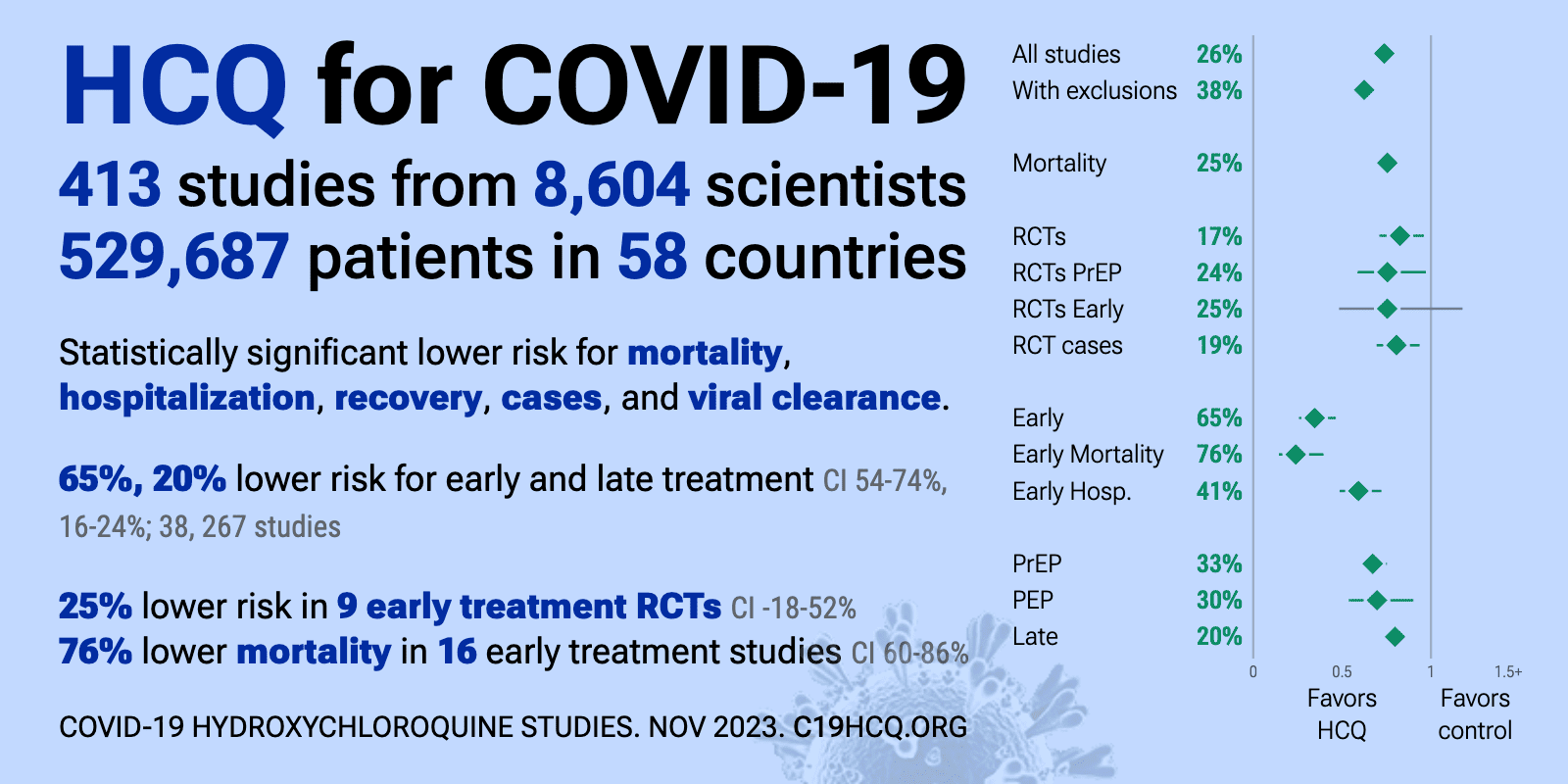
Risch shared a raft of papers showing HCQ benefits against COVID,
some in combination with azithromycin and other low-cost treatments,
mostly in peer-reviewed journals. 

Risch provided his own meta-analysis charts of the various studies on hospitalization and mortality risk and calculations on the Italian study.

Sowell Exposes Social Justice Fallacies

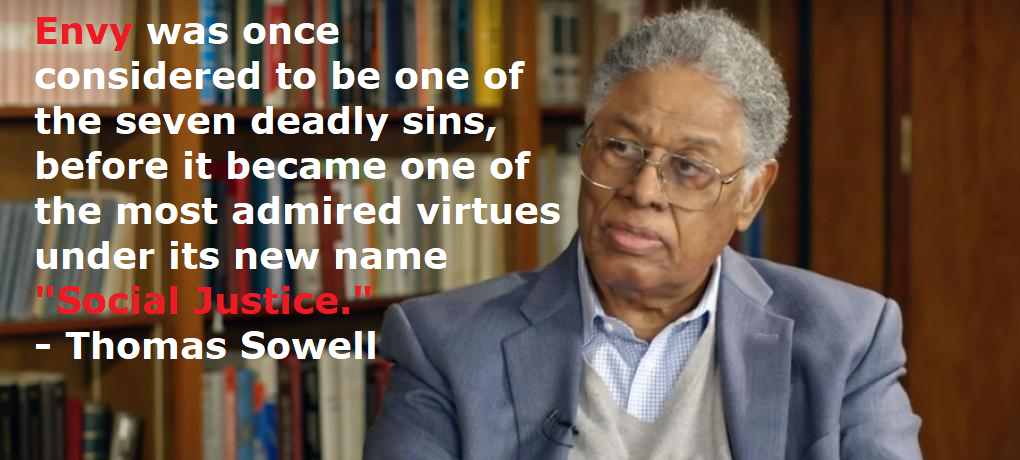
Matthew Lau reviews Thomas Sowell’s latest book Social Justice Fallacies in a Financial Post article: No sacred cows in Thomas Sowell’s takedown of social justice fallacies.  Excerpts in italics with my bolds and added images.

In his latest book, renowned economist and author demolishes
the myths that underpin the social justice movement.

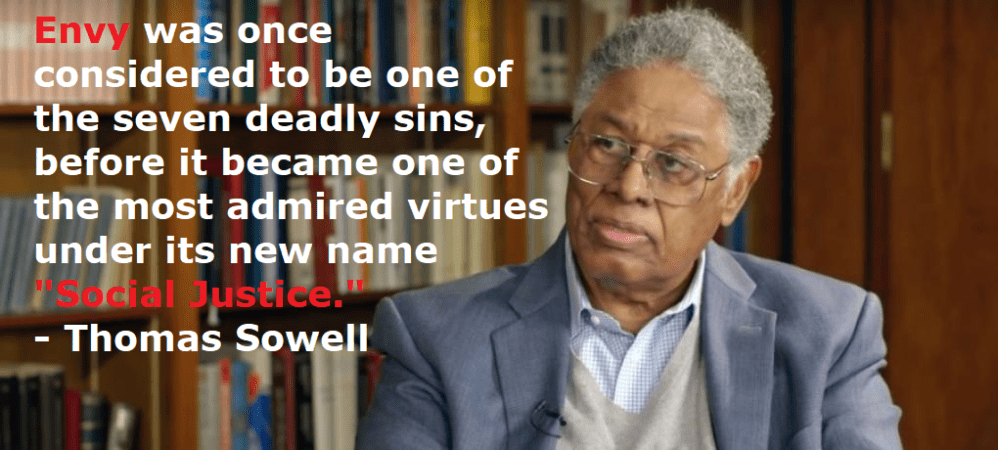
Thomas Sowell, age 93, famed economist and author of more than 40 books, last month published his latest: Social Justice Fallacies. In it he asserts plain facts such as that life is unfair and central planners are fallible, realities too often ignored or downplayed by those looking to impose top-down visions of “social justice.”
Among his targets are:

  • price controls,
  • minimum wage laws,
  • the myth that American Black poverty is due to systemic racism,
  • high marginal tax rates,
  • teachers unions’ monopoly on schooling,
  • exaggerations of income inequality by people who ignore income mobility,
  • affirmative action,
  • “sex education” in public schools (Sowell uses the scare quotes repeatedly)

To each of these and many other things, Sowell brings facts, examples, and statistics.

On the notion that the United States is a systemically racist or white supremacist society, Sowell notes that the median incomes of Americans of Chinese, Japanese, Indian and Korean ancestry are higher than those of white Americans. Citing a 2019 U.S. Census Bureau survey, he points out that “among full-time, year-round male workers, Asian Indian males earned over $39,000 a year more than white male full-time, year-round workers” — an unlikely outcome if white supremacy were pervasive.

Black family poverty has long been higher than white family poverty but, as Sowell explains, the poverty rate of Black married-couple families is consistently below the national poverty rate. “If black family poverty is caused by ‘systemic racism,’” he asks, “do racists make an exception for blacks who are married?”

Another case-closing rhetorical question from Sowell: “Are Asians ‘kept out’ of professional basketball or Californians ‘kept out’ of the National Hockey League?” In American sports, he notes, “Blacks are very over-represented in professional basketball, whites in professional tennis, and Hispanics in Major League Baseball.” There are more NHL players from Sweden than California even though Sweden is on another continent and has about one-quarter California’s population. But these facts do not mean professional sports leagues all engage in racism or other bigotry.

No affirmative action or other initiative is needed to
“correct” these unequal outcomes between groups.

If Sowell’s arguments about government economic control, race, economic disparities and other questions sound familiar, it is because he has written on these issues for decades. The same fallacies he and others have repeatedly debunked keep reappearing and need to be whacked down again and again — which Sowell continues to do.
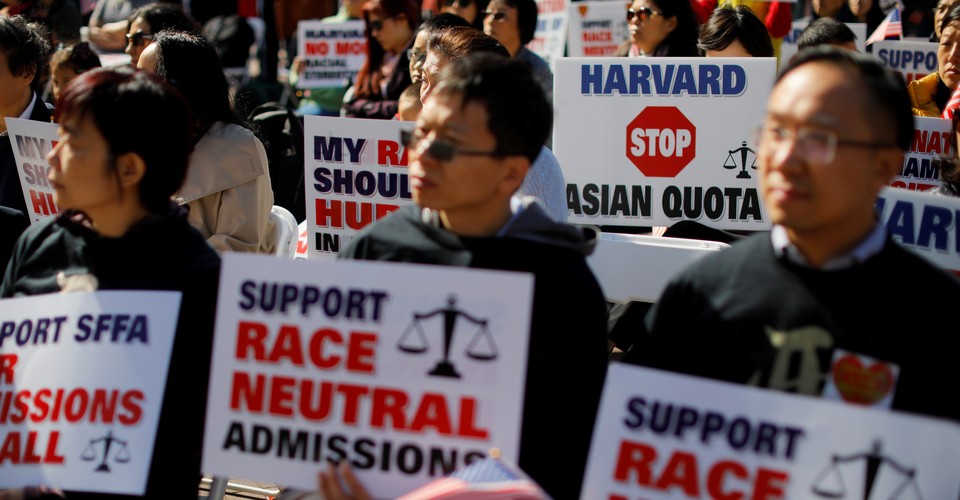
In Social Justice Fallacies, Sowell again attacks racial preferences in university admissions, arguing that admitting minority students into university programs for which they are not academically qualified does them no favours. Black students at the 80th percentile are very good students but putting them into elite programs where their classmates are in the 99th percentile sets them up for failure. Under affirmative action, Sowell writes, most Black students admitted to the University of California (Berkeley) during the 1980s failed to graduate.

Another policy that activists promote in the name of social justice, but that hurts Blacks: minimum wage laws, which the data show significantly increase Black teenage unemployment by pricing many of them out of jobs.
There are no sacred cows in Social Justice Fallacies. Sowell argues that “surrogates who introduced ‘sex education’ into public schools in the 1960s” were pre-empting parents’ decisions about when and how to teach their children about sex. He points to data showing that before such education was introduced venereal diseases and teenage pregnancies had been declining for years, but after its introduction teenage pregnancies rapidly rose and the incidence of venereal diseases either rose or declined less rapidly than before. These facts alone do not prove causation between public school “sex education” and venereal diseases and teenage pregnancies, but they are not encouraging, either.

Explaining facts and demolishing fallacies, as Sowell does, is important. When activists distort reality by fashioning narratives to justify their top-down initiatives, they often cause more harm than the original injustices (whether real or perceived) they say they want to correct.

Citing Barack Obama’s memoir, Dreams from My Father, Sowell gives the example of a young Black man who wanted to become a pilot but decided not to pursue it because he thought the Air Force would never let a Black man fly. Sowell points out this was decades after a whole squadron of Black American fighter pilots flew in World War II.

“Whoever indoctrinated this young man,” Sowell concluded,
“did him more harm than a racist could have,
by keeping him from even trying to become a pilot.”

In Addition, Thomas Sowell’s Wisdom and Scholarship on Affirmative Action

Excerpts on Affirmative Action from The Thomas Sowell Reader 
Assumptions Behind Affirmative Action

With affirmative action suddenly coming under political attack from many directions, and with even liberals backing away from it, we need to question not only its underlying assumptions but also what some of the alternatives are.

At the heart of the affirmative action approach is the notion that statistical disparities
show discrimination. No dogma has taken a deeper hold with less evidence
—or in the face of more massive evidence to the contrary.

A recent story in the Wall Street Journal revealed that more than four-fifths of all the doughnut shops in California are owned by Cambodians. That is about the same proportion as blacks among basketball stars. Clearly, neither of these disparities is due to discrimination against whites.

Nor are such disparities new or peculiar to the United States. In medieval Europe, most of the inhabitants of the towns in Poland and Hungary were neither Poles nor Hungarians. In nineteenth-century Bombay, most of the shipbuilders were Parsees, a minority in Bombay and less than one percent of the population of India.

In twentieth-century Australia most of the fishermen in the port of Freemantle came from two villages in Italy. In southern Brazil, whole industries were owned by people of German ancestry and such crops as tomatoes and tea have been grown predominantly by people of Japanese ancestry.

Page after page—if not book after book—could be filled with similar statistical disparities from around the world and down through history. Such disparities have been the rule, not the exception.

Yet our courts have turned reality upside down and treated what happens
all over this planet as an anomaly and what is seldom found
anywhere—proportional representation—as a norm.

Why are such disparities so common? Because all kinds of work require particular skills, particular experience, particular locations and particular orientations. And none of these things is randomly distributed.

Local demagogues who thunder against the fact that Koreans run so many stores in black ghettoes merely betray their ignorance when they act as if this were something strange or unusual. For most of the merchants in an area to be of a different race or ethnicity from their customers has been common for centuries in Southeast Asia, Eastern Europe, West Africa, the Caribbean, Fiji, the Ottoman Empire and numerous other places.

When German and Jewish merchants moved into Eastern Europe in the Middle Ages, they brought with them much more experience in that occupation than that possessed by local Eastern European merchants, who were often wiped out by the new competition. Even when the competition takes place between people who are racially and ethnically identical, all kinds of historical, geographical and other circumstances can make one set of these people far more effective in some activities than the others.

Mountain people have often lagged behind those on the plains below, whether highland Scots versus lowland Scots or the Sinhalese in the highlands of Sri Lanka versus the Sinhalese on the plains. The Slavs living along the Adriatic coast in ports like Dubrovnik were for centuries far more advanced than Slavs living in the interior, just as coastal peoples have tended to be more advanced than peoples of the interior hinterlands in Africa or Asia.

Some disparities of course have their roots in discrimination. But the fatal mistake is to infer discrimination whenever the statistical disparities exceed what can be accounted for by random chance. Human beings are not random. They have very pronounced and complex cultural patterns.  These patterns are not unchanging. But changing them for the better requires first acknowledging that “human capital” is crucial to economic advancement.

Those who make careers out of attributing disparities to the wickedness of other people
are an obstacle to the development of more human capital among the poor.

There was a time, as late as the mid-nineteenth century, when Japan lagged far behind the Western industrial nations because it was lacking in the kind of human capital needed in a modern economy. Importing Western technology was not enough, for the Japanese lacked the knowledge and experience required to operate it effectively.

Japanese workmen damaged or ruined machinery when they tried to use it. Fabrics were also ruined when the Japanese tried to dye them without understanding chemistry. Whole factories were badly designed and had to be reconstructed at great cost.  What saved the Japanese was that they recognized their own backwardness—and worked for generations to overcome it.

They did not have cultural relativists to tell them that all cultures are equally valid
or political activists to tell them that their troubles were all somebody else’s fault.
Nor were there guilt-ridden outsiders offering them largess.

Affirmative action has been one of the great distractions from the real task of self-development. When it and the mindset that it represents passes from the scene, poorer minorities can become the biggest beneficiaries, if their attention and efforts turn toward improving themselves.

Unfortunately, a whole industry of civil rights activists, politicians and miscellaneous hustlers has every vested interest in promoting victimhood, resentment and paranoia instead.
Affirmative Action Around the World

While controversies rage over “affirmative action” policies in the United States, few Americans seem to notice the existence or relevance of similar policies in other countries around the world. Instead, the arguments pro and con both tend to invoke history and traditions that are distinctively American. Yet group preferences and quotas have existed in other countries with wholly different histories and traditions—and, in some countries, such policies have existed much longer than in the United States.  What can the experiences of these other countries tell us? Are there common patterns, common rationales, common results? Or is the American situation unique?

Ironically, a claim or assumption of national uniqueness is one of the most common patterns found in numerous countries where group preferences and quotas have existed under a variety of names. The special situation of the Maoris in New Zealand, based on the 1840 Treaty of Waitangi, is invoked as passionately in defense of preferential treatment there as the unique position of untouchables in India or of blacks in the United States.

Despite how widespread affirmative action programs have become, even the promoters of such programs have seldom been bold enough to proclaim preferences and quotas to be desirable on principle or as permanent features of society. On the contrary, considerable effort has been made to depict such policies as “temporary,” even when in fact these preferences turn out not only to persist but to grow.

Official affirmative action or group preference policies must be distinguished from whatever purely subjective preferences or prejudices may exist among individuals and groups. These subjective feelings may of course influence policies, but the primary focus here is on concrete government policies and their empirical consequences—not on their rationales, hopes, or promises, though these latter considerations will not be wholly ignored. Fundamentally, however, this is a study of what actually happens, rather than a philosophical exploration of issues that have been amply—if not more than amply—explored elsewhere.

The resurgence of group preferences in societies committed to the equality of individuals before the law has been accompanied by claims not only that these preferences would be temporary, but also that they would be limited, rather than pervasive. That is, these programs would supposedly be limited not only in time but also in scope, with equal treatment policies prevailing outside the limited domain where members of particular groups would be given special help.

Similar reasoning was applied in the United States to both employment and admissions to colleges and universities. Initially, it was proposed that there would be special “outreach” efforts to contact minority individuals with information and encouragement to apply for jobs or college admissions in places where they might not have felt welcome before, but with the proviso that they would not be given special preferences throughout the whole subsequent processes of acceptance and advancement.

Similar policies and results have also been achieved in less blatant ways. During the era of the Soviet Union, professors were pressured to give preferential grading to Central Asian students and what has been called “affirmative grading” has also occurred in the United States, in order to prevent excessive failure rates among minority students admitted under lower academic standards. In India, such practices have been referred to as “grace marks.” Similar results can be achieved indirectly by providing ethnic studies courses that give easy grades and attract disproportionately the members of one ethnic group. This too is not peculiar to the United States. There are Maori studies programs in New Zealand and special studies for Malays in Singapore.

In the job market as well, the belief that special concerns for particular groups
could be confined to an initial stage proved untenable in practice.

Initially, the term “affirmative action” arose in the United States from an executive order by President John F. Kennedy, who called for “affirmative action to ensure that the applicants are employed, and that employees are treated during employment without regard to race, color, creed, or national origin.” In short, there were to be no preferences or quotas at all, just a special concern to make sure that those who had been discriminated against in the past would no longer be discriminated against in the future—and that concrete steps should be taken so that all and sundry would be made aware of this.

However, just as academic preferences initially limited in scope continued to expand,
so did the concept of affirmative action in the job market.

A later executive order by President Lyndon Johnson in 1968 contained the fateful expressions “goals and timetables” and “representation.” In December 1971, yet another Nixon executive order specified that “goals and timetables” were meant to “increase materially the utilization of minorities and women,” with “under-utilization” being spelled out as “having fewer minorities or women in a particular job classification than would reasonably be expected by their availability.” Affirmative action was now a numerical concept, whether called “goals” or “quotas.”

This confident pronouncement, however, presupposed a degree of control which has proved illusory in country after country. Moreover, “when and where there is social and economic inequality” encompasses virtually the entire world and virtually the entire history of the human race. A “temporary” program to eliminate a centuries-old condition is almost a contradiction in terms.

Equality of opportunity might be achieved within some feasible span of time,
but that is wholly different from eliminating inequalities of results.

Even an approximate equality of “representation” of different groups in different occupations, institutions or income levels has been a very rare—or non-existent—phenomenon, except where such numerical results have been imposed artificially by quotas. As a massive scholarly study of ethnic groups around the world put it, when discussing “proportional representation” of ethnic groups, “few, if any societies have ever approximated this description.”

In short, the even representation of groups that is taken as a norm is difficult or impossible to find anywhere, while the uneven representation that is regarded as a special deviation to be corrected is pervasive across the most disparate societies. People differ—and have for centuries. It is hard to imagine how they could not differ, given the enormous range of differing historical, cultural, geographic, demographic and other factors shaping the particular skills, habits, and attitudes of different groups.

Any “temporary” policy whose duration is defined by the goal of achieving something that has never been achieved before, anywhere in the world, could more fittingly be characterized as eternal.




Biden’s Mad Dog EPA Gone Rogue

Mario Loyola explains at Real Clear Wire EPA’s Illegal Power Play.  Excerpts in italics with my bolds and added images.

EPA’s Ambitious Gambit to Reorganize America’s Electricity

The U.S. Supreme Court’s ruling in West Virginia v. EPA last year was a historic defeat for the Environmental Protection Agency. Not only did the Court rule that the 2015 Clean Power Plan, President Obama’s signature climate regulation, was unconstitutional; it also dramatically limited EPA’s power to regulate carbon emissions under the Clean Air Act (CAA) moving forward.

That left the agency with two courses of action. It could take its lumps and focus on proposing regulations with a high chance of surviving federal court review. Or it could stake everything on a final desperate attempt to decarbonize America’s power sector, and go for the win in keeping with President Biden’s commitment to net zero carbon emissions.

On May 23, 2023, EPA chose the latter, proposing carbon emissions standards
for power plants far more ambitious than those
struck down by the Supreme Court last year.

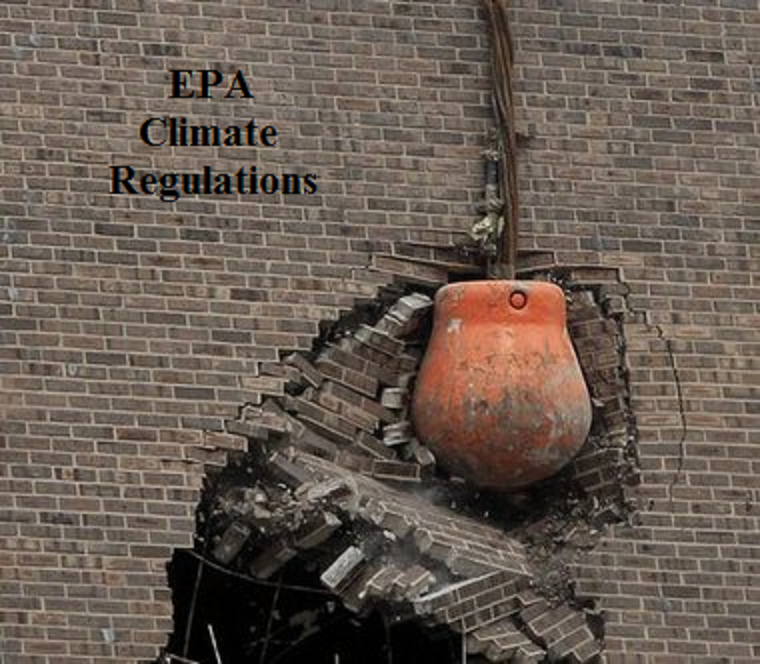
Like other EPA climate regulations, the proposed emissions standards under Section 111 of CAA are not designed to reduce emissions from standard power plants, but rather to force a rapid transition away from reliable and affordable sources of dispatchable power—natural gas and coal—to intermittent renewables and new kinds of power plants that don’t even exist yet. Together with EPA’s electric vehicle mandates, the proposed rule would be a train wreck for the American electricity grid and society as a whole, endangering economic competitiveness and energy security while yielding no measurable climate benefit.

Those hoping for a dramatic finish to Biden’s climate action will not be disappointed: the proposal has so many legal vulnerabilities that it would be a miracle nightmare if the rule survives federal court review.

Under the proposed rule, which President Biden hopes to finalize by next summer, large new or modified natural gas plants and existing coal plants would be required to virtually eliminate carbon emissions by 2038, at the latest. Under Section 111(a) “New Source Performance Standards” (NSPS), large new or modified combined-cycle natural gas plants, which currently supply roughly 30% of the nation’s electricity, would be required to achieve close to zero carbon emissions, either by implementing carbon capture and storage (CCS) to capture 90% of carbon emissions by 2035, or by switching from natural gas to 98% “green” hydrogen co-firing by 2038. In addition, under Section 111(d) emissions guidelines, existing coal plants, which currently supply more than 20% of America’s electricity, would be required to virtually eliminate carbon emissions by implementing CCS by 2035.

Interestingly, EPA declined to promulgate NSPS for coal plants because, as it explains, there are no plans to build any new coal plants in the U.S. It declined to promulgate emissions guidelines for existing natural gas plants out of concern for feasibility. Even more interesting, when EPA sent the proposed rule to the White House for regulatory review under E.O. 12866, it contained no emissions guidelines for existing plants at all, and therefore would not have applied to coal plants at all. The White House reportedly sent it back to EPA with orders to put a Section 111(d) rule for existing coal plants in the proposal. This suggests that EPA itself is not very confident in the ability of the Section 111(d) rule to survive court review.
Section 111 of CAA, the same provision at issue in West Virginia v. EPA, authorizes EPA to mandate “the degree of emission limitation achievable through the application of the best system of emission reduction which (taking into account the cost of achieving such reduction and any nonair quality health and environmental impact and energy requirements) the Administrator determines has been adequately demonstrated.”

Section 111 sets a high bar, especially after West Virginia v. EPA. The proposed rule falls woefully short. It has at least three major legal vulnerabilities, any one of which would be sufficient for a court to strike the rule down.

First, neither CCS nor green hydrogen is anywhere near “adequately demonstrated” within the meaning of Section 111.

Second, EPA has systematically ignored crucial costs and impacts that it is required to take into account in setting emissions standards under Section 111.

Third, like the “best system of emission reduction” struck down in West Virginia v. EPA, the new rule would require sweeping regulatory action and infrastructure investments entirely outside the fence line of the regulated facilities, thereby raising the “major question” doctrine’s presumption against the agency’s interpretation of the law.

The Mandated Technologies Have Not Been “Adequately Demonstrated”

Contrary to the unambiguous pronouncements of the D.C. Circuit, EPA treats Section 111 as if it were a technology-forcing provision throughout the proposed rule. For example, EPA claims that CCS has been “adequately demonstrated” for natural gas plants based on small-scale demonstrations at coal plants. But the coal demonstrations cited involve only small slipstreams (carbon captured from a small percentage of the plant’s total emissions) for use in the food industry. Moreover, the coal plant demonstrations do not involve the sophisticated combined-cycle configurations of large natural gas plants—in which the exhaust from the primary combustion cycle is used to heat the steam generator of the second cycle—that the new standards focus on.

In the several hundred pages laying out the proposed rule, EPA provides just two examples of demonstrations at natural gas plants. One, at Bellingham, Massachusetts, captured only a 10% slipstream and closed in 2005 because it was not economical. That was a decade before the Obama-era Clean Power Plan, in which EPA correctly rejected CCS as inadequately demonstrated and too costly. The other, a project at Peterhead, Scotland, is still in planning and may not even be built. Neither can be used as the basis for an adequately demonstrated BSER.
Furthermore, EPA’s CCS mandate would require a massive buildout of carbon transport and storage infrastructure, which has not been adequately demonstrated and would require sweeping investments and regulatory changes by developers and government authorities unrelated to the entities subject to regulation under Section 111 of CAA. Like the measures “beyond the fence line” of regulated entities that were struck down in West Virginia v. EPA, this massive infrastructure buildout would be beyond the ability of EPA-regulated entities to implement.

Co-firing with low-carbon hydrogen is even further from being adequately demonstrated. Nearly all hydrogen today is produced using carbon-intensive methods. Indeed, electrolysis from renewable and nuclear power produces only trivial quantities, and EPA doesn’t even bother to estimate the cost, feasibility, or time it would take to build out the vast amount of new renewable and nuclear power capacity that would be needed to make the low-GHG hydrogen a practicable option for power plants.

In short, neither CCS nor “green” hydrogen co-firing meets the Section 111 legal standards of “adequately demonstrated” BSER.

EPA Has Ignored the Proposed Rule’s Costs, as well as Its Health, Environment, and Energy Impacts

In determining that a technology is “adequately demonstrated” under Section 111, EPA must take into account the costs of the rule, as well as the health, environment, and energy impacts of the rule. Courts have interpreted this as requiring that costs be reasonable. That poses a threshold problem for EPA’s proposed rule because EPA can point to no measurable environmental benefit that would result from compliance. EPA has based all its greenhouse gas regulations on the same original 2010 Endangerment Finding, which has serious problems of its own, as William Happer and Richard Lindzen note in their July 2023 comment letter to the proposed rule. It has not been demonstrated that the sources subject to the rule make a significant contribution to a condition of air pollution that endangers human health, and the finding mentions the 2021 Technical Support Document on Social Cost of Carbon only in connection with a regulatory impact analysis that is unrelated to the requirements of CAA. Under such circumstances, there is a threshold question of whether any significant costs could be reasonable.

There are other problems with EPA’s estimate of costs and impacts.

First, its estimate of costs is highly speculative. The rule would affect a host of entities and government authorities across the whole society, the vast majority of them not subject to regulation under CAA, and EPA has little clue as to how they will adjust to the rule. If its cost estimates are off by any significant amount, regulated entities could well react by shuttering, rather than attempting to comply, which would create a situation of dangerous energy scarcity with skyrocketing prices. In parts of the country where fossil energy is restricted as a matter of policy, such as California, the electricity grid is on the verge of dangerous blackouts almost every evening in the summer.

And those restrictions are modest, compared with those now contemplated by EPA.

EPA’s most egregious failure to properly account for costs is that it subtracts the amount of federal subsidies from the cost estimate, a nominal reduction of $369 billion based on CBO’s score. That figure will likely turn out to be much greater, given the subsidies’ lack of date-certain sunset.

As for the impact on electricity prices, EPA estimates that the rule would lead to a price increase of 13%. That is almost certainly a woeful underestimate. In California, where a much milder form of renewable energy mandate has been in place for years, end-user electricity costs are twice the national average. The costs of compliance with the new rules could be far more exorbitant. As further explained below, CCS would reduce the power output of the relevant plants by at least 30%, while green hydrogen would likely be three to four times more expensive to produce and deliver as current demonstrations using natural gas.

 Given the number of factors outside EPA’s expertise and jurisdiction that would
determine how much time and money all that infrastructure would cost,
EPA’s estimates are little more than conjecture.

The Power Plant Rule Raises the Same “Major Question” as in West Virginia v. EPA

The Court held that EPA’s interpretation raised a “major question” and that, in the absence of clear congressional authorization, the claimed power exceeded EPA’s statutory authority. The Court noted that EPA’s approach to BSER allowed it to set emissions standards at whatever level the agency wanted, regardless of whether any regulated entity could feasibly comply with the new standards. The Court noted that the Clean Power Plan would result “in numerical emissions ceilings so strict that no existing coal plant would have been able to achieve them without engaging in [generation-shifting].”

EPA’s new power plant rule relies on a similarly expansive definition
of BSER to establish standards that can be met only
by shifting generation away from fossil sources.

The only way that regulated sources could comply with the rule would be if states or utilities (or other developers) would build a major interstate infrastructure for CCS and “green” hydrogen, including tens of thousands of miles of specialized pipelines, massive underground storage facilities for CO2, and large-scale facilities for the production and transport of hydrogen gas from renewable sources. Whether to develop such infrastructure is a decision totally beyond the control of regulated entities.

 The claimed power would regulate a significant portion of the American economy,
entails political impact of great significance, and intrudes on matters
that are the traditional domain of the states.

EPA’s Persistent Usurpation of Congressional Authority

EPA’s efforts to restrict greenhouse gas emissions from power plants and other sources represent a dangerous overreach of executive power. Congress never authorized EPA to regulate greenhouse gases in this expansive manner. By trying to reorganize the country’s electricity-sector limits through executive fiat, rather than the legislative process, EPA is abusing its authority and circumventing democracy.

Net zero climate policy raises novel issues that affect every American citizen
in almost every aspect of modern life. Policy requiring such
transformative change should be left to Congress.


They Swallowed It: Hook, Line and Sinker, 2 years later

Trapped

Update Sept. 2023

I take no joy in being perceptive when writing the post below in March 2021.  Because the process becoming evident back then has only gone from bad to worse.  So much more has happened in the dismantling of my birthplace USA, more extreme and unrelenting destruction of the republic.  If anything, I underestimated the virulence of people carrying out the agenda of this regime.  They have revealed themselves as:

♦  Incompetent, hired for group identity and sexual preference, not knowledge or skill;
♦  Corrupt, driven by greed from the top of the house on down; and
♦  Malicious, eagerly destroying civility and causing pain and suffering for the joy of it.

Will Americans Rally to their heritage or succumb to this craven cabal?

They Swallowed It: Hook, Line and Sinker

Many will recognize the expression for taking on an idea or proposition so deeply in your gut that, like a fish on the line, there is no escape no matter how hard you try. Jacques Parizeau, one time separatist Premier of Quebec coined a similar idiom regarding voters resisting the referendum on Quebec independence from Canada. Meeting privately with foreign diplomats, he said that in the event of a Yes vote, the result would be like a “lobster pot.” That refers to the traditional wooden traps that have a one-way gate allowing a lobster to get in, but not out.

These expressions come to mind concerning the plight of US citizens following the installing of Biden-Harris in the White House. The intention of this administration is clearly to fundamentally transform America: From “The Land of the Free, Home of the Brave,” to “The Land of the Victims, Home of the Afraid.” The movement in this direction has been a long time in the works, and was only recently triggered by the election of Trump and the leftist need to cancel the alternate ideology of “Make America Great Again.” Time will tell if those now in power are reaching too far, too fast, going for broke before the majority were caught in the pot.

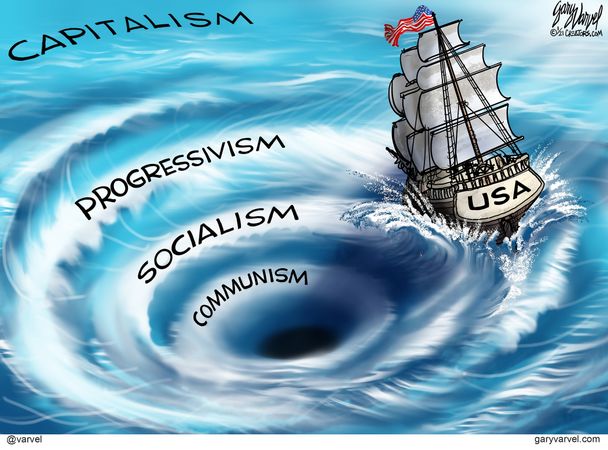
No doubt the program to undermine American global dominance has been operating for several generations. Those not familiar with the Marxist revolutionary four-stage process can read my synopsis article Four Steps to Take Down a Free Society

Pioneered by the Soviets and exported into many countries before their empire collapsed, the method is now employed by the Chinese Communist Party updated with cyber tools, along with traditional espionage tactics of honey traps and buyouts. The first stage of demoralizing involves teachers indoctrinating students to disparage their national heritage and destroy commitment to traditional social values and customs. Tom Wolfe wrote with his satirical wit and historical knowledge about the demise of liberal US academia into leftist dogma in his essay In the Land of the Rococo Marxists. My synopsis is Warmists and Rococo Marxists.

Of course the present manifestation flies under a different banner: Social Justice. And the reverent refer to George Floyd rather than Karl Marx. But Critical Race Theory is so obviously intended to divide and conquer a free and democratic society, you would have to be in a trance (claiming to be “woke”) to be taken in by it. Yet, indoctrinated children, now adults abound in the ranks of corporate management, others churning out copy for mass media or organizing activists in the streets and in cyberspace.

The protests in city streets of developed countries are coordinated and led by Social Justice Warriors indoctrinated in Western academies of higher education, after elementary school slanted teaching. If neo-Marxist progressive post-moderns take pride in this as accomplishing their agenda, consider what happened in China’s cultural revolution in the 1960s and is repeating itself in 2020. The useful dupes, like teachers, become outcasts and themselves targets for cancellation once power and control is seized. See article Teachers Beware Your Cultural Revolution Turning on You.

Have the scales yet tipped in favor of the slide into a socialist autocracy? Will Americans mount a resistance to this revolution? Depends on who and how many are on the line or trapped in lobster pots.


Railway Workers Built Canada Not Elites

Canadian troubadour Gordon Lightfoot celebrated in song the building of the transcontinental railfoad which bound together far flung provinces into a nation.  He described the working men whose manual labor and physical energy produced the foundation for Canadian economy and society.

I am reminded of a tour some years ago in the Roman Colosseum where the guide pointed out the features explaining the grandeur of the monumental structure.  At the end, he concluded: “This was all done in just eight years.  Remember, these were Romans, not Italians.”  In the same vein, I would say to Justin Trudeau, “Remember Canada was built by working men, not by woke weenies.”

Postscript: 

In 1880, the Canadian government contracted the Canadian Pacific Railroad to construct the first all-Canadian line to the West Coast. During the next five years, the company laid 4,600 kilometers of single track, uniting various smaller lines across Canada. Despite the logistical difficulties posed by areas such as the muskeg (bogs) region of northwestern Ontario and the high rugged mountains of British Columbia, the railway was completed six years ahead of schedule.

The transcontinental railway was instrumental in populating the vast western lands of Canada with settlers and providing supplies and commerce. Many of western Canada’s great cities and towns grew up around Canadian Pacific Railway stations.

So five years to build the railway, eight years to build the colosseum.
Trudeau’s been in office eight years and we’re still waiting
for permits to build needed energy infrastructure.

Biden Nanny State Coming At You

Mark Krebs exposes federal shenanigans in their war on home appliances in his Master Resource article Update: DOE Appliance Minimum Efficiency Standards.  Excerpts in italics with my bolds and added images.

“It started with gas cooking.  It will end with getting gas out of homes and business entirely, If they can. Basically, what we’re witnessing is the energy equivalent of ethnic cleansing. I’ve been saying this for years but now it should be obvious.”

The U.S. Department of Energy (DOE) under the Biden Administration has significantly accelerated the pace of minimum appliance efficiency rulemaking. With this acceleration, there has been a marked decrease in DOE’s analytical quality and transparency. The purpose of this update is to summarize:

  1.  Energy Conservation Standards for Consumer Conventional Cooking Products

2.  Energy Conservation Standards for Consumer Products; Boilers

3.  Energy Conservation Standards for Consumer Water Heaters

Note: In DOE-speak, the term ‘consumer’ means non commercial/industrial, or just residential.

Part 1: Consumer Cooking Products

On April 27, 2023, MasterResource published DOE vs. Gas Cooking: A Review of Critical Comments. On August 2, 2023, DOE reopened the docket with a “Notification of data availability and request for comment (NODA) with comments due September 1. More than 100 comments were filed.

Some commenters viewed the NODA and relatively short (30-day) comment period as a violation to the Administrative Procedures Act codified by 5 U.S.C. § 551(5)–(7) and the DOE’s “process rule” codified by 10 CFR 430 Appendix A to Subpart C. One such commenter making this case was the Institute for Energy Research (IER).

Other comments privided detailed content in opposition of DOE’s proposal for consumer cooking products.  My comments addressed what has changed since DOE determined (in 2019) that additional efficiency mandates for gas cooking appliances is not justified. In short, Biden happened. With that change, DOE resorted to a longstanding bias that any amount of net positive cash flow (greater than zero) on average was sufficient economic justification. I cited AHAM’s press release “Gas Cooking Appliances Remain at Risk Despite New DOE Data” for this NODA that succinctly justified what that amount now is:

“The revised data reduces consumer savings to just 9 cents per month.

I contend no one would freely elect to invest in anything with that kind of return-on-investment (ROI). Additionally, 9 cents per month is far less than the uncertainty range within DOE’s economic calculations.  Besides, DOE’s economic calculations typically low-ball increased maintenance costs and over-inflate fuel costs (among many other biased input assumptions).

What else has changed is that DOE cost-effectiveness now includes highly controversial benefits from reduced climate change allowed by grossly inflated social cost of carbon (SCC) avoidance and health benefits from improved indoor air quality (IAQ).

Part 2: Consumer Boilers

On September 12, 2023, DOE held a public webinar to go over its proposal for increased minimum efficiencies for residential boilers. A 59-page slide deck for that meeting is here. (If you have never read one of these slide decks, I urge you to do so. It’s a relatively painless way of getting familiar with the ‘administrative state’ going about its business of picking winners and losers.)

There were many participants representing manufacturing interests that would be adversely impacted by DOE’s proposal, and they were quite vocal about it (in a professional way of course).  But why would manufacturers want to litigate? DOE would put some of them out of business. 

Part 3: Consumer Water Heaters

On September 13, 2023, DOE held a public webinar to go over its proposal for increased minimum efficiencies for residential water heaters that lasted 3 hours. A 74-page slide deck for that meeting is here. There were nearly twice as many participants on line compared to the number of webinar participants the day before for consumer boilers; and many of the participants represented water heater manufacturers, some of which would be devastated if DOE’s proposed mandates were finalized.

One manufacturer that stood out in this regard was Rinnai America. Rinnai is the sole manufacturer of non-condensing tankless water heaters in the U.S. Rinnai’s President stated, as I recall, that DOE’s proposed ban of non-condensing water heaters would shut down Rinnai’s new factory that cost $70 million. That, of course, would devastate the many involved.

Conclusions

DOE has been (ostensibly) ‘improving’ appliance efficiency for nearly a half-century. The low hanging fruit is long gone. In many cases, DOE is doing more harm than good and using unfair tactics to maintain control and reward its minions. What we have now is relentless self-serving “mission creep” of the administrative state and its “useful idiots” that forces consumers to fund the erosion of viable energy alternatives. The passage of the Inflation Reduction Act is greatly aiding and abetting this forced transformation away from free market forces.

DOE doesn’t care what it costs to litigate. After all, DOE has the backing of the Department of Justice for such matters. In my opinion, DOE has strayed too far from any redeeming virtue that may have originally existed from the 1975 passage of EPCA. It’s past time for Congress clean up the mess it created by enacting EPCA and the numerous ambiguous loopholes that gives undeserved deference to the administrative state to interpret. A valid question is whether EPCA (and DOE for that matter) should be salvaged or scrapped.

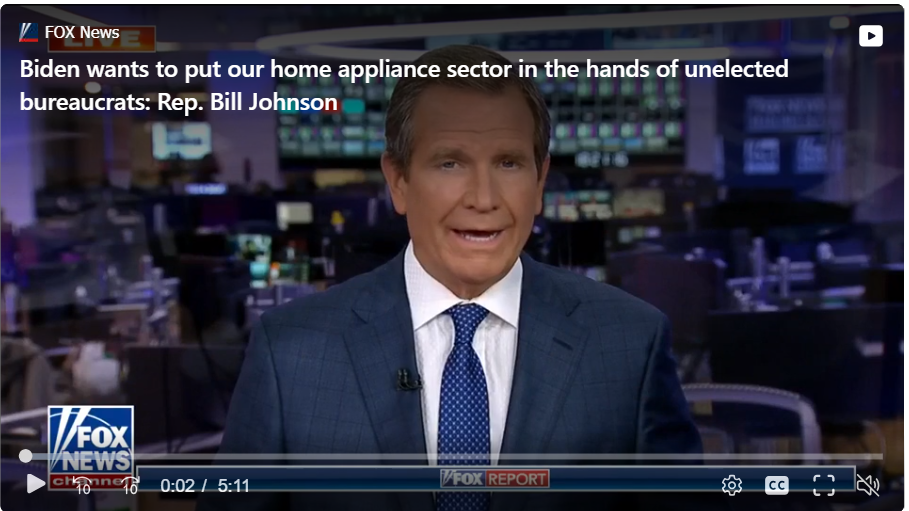
Biden’s DOE wants to eliminate alternatives to electricity. 

This fixation became apparent to all with their planned elimination of gas cooking and ran head-on with consumers that hold gas cooking near-and-dear. Consumer preferences for gas cooking was and is a major obstacle to control via societal electrification overall. As this article hopefully conveys, it started with gas cooking. It will end with getting gas out of homes and business entirely, If they can.

Postscript:

The Department of Energy (DOE) quietly promoted a top adviser to Energy Secretary Jennifer Granholm to a senior role overseeing home appliance regulations after he failed to clear Senate confirmation.

The DOE announced last week that Jeff Marootian was appointed to be the principal deputy assistant secretary of the agency’s Office of Energy Efficiency and Renewable Energy (EERE). The appointment came days after the White House withdrew his name from consideration to lead EERE as the office’s assistant secretary.

While Marootian’s nomination failed after Senate Energy and Natural Resources Committee Chairman Joe Manchin, D-W.Va., opposed him over the Biden administration’s crackdown on natural gas-powered stovetops, his appointment last week makes him the effective chief of the DOE’s EERE office.

More complete discussion on appliance war at Fox: https://www.foxnews.com/politics/experts-warn-biden-admins-water-heater-crackdown-hike-prices-reduce-consumer-choice


Social Justice Sendup

Long before BLM flash mobs, calls to “Defund the Police” and ultra-liberal prosecutors blind to BIPOC misdemeanors or even felonies, Bluesman R.L. Burnside dropped his song “Nothin’ Man,” a satirical sendup of the sappy social justice mindset. (Closed captions are an option.)

R. L. Burnside (1926-2005) Blues Hall of Fame

Ironically, Burnside Street is a major thoroughfare of Portland, Oregon, one of the cities most damaged by social justice politicians. East Burnside Street and 122nd Avenue is the most dangerous spot of the most dangerous neighborhood when it comes to shootings. (2023)

How to Get Free and Fair US Elections

The image above gets it right on the basics:  Eligible voters come to their voting station with valid ID and proof of residency, and paper trail exists to validate machine entry and processing.  But there are some subtleties around the edges requiring management.  For example, voter registration should be in advance of the voting process, and not on election day.  Why? Because there’s no time to check for fake ID or residency. Later on is a post on why there must be an election day deadline, beyond which votes cannot be added to the count.  But first a look at some international standards regarding elections and balloting.

A Practical Guide to Democratic Elections Best Practice from Office for Democratic Institutions and Human Rights (OSCE).  Below is the section on Balloting.

Right:
To Universal Suffrage, To Equal Suffrage, To Secret Ballot, To Fair Elections
Which  Guarantee the Free Expression of the Will of the People

Balloting  Best Practices:

• Voting procedures must be understandable so that voters are able to vote without difficulty

• Voting should take place in a polling station; however, other means of voting are permissible for voters who are physically unable to attend a polling station, but only where there are safeguards in place to prevent fraudulent voting

• Observers and representatives of candidates and political parties must be permitted to observe the delivery of election materials, preparation of the polling place, voting, and counting of ballots

• Members of the military should vote in the place of their permanent residency, or in a polling station near their duty station

• Voting must be in person, by secret ballot

• Voters must present adequate identification information and sign register in order to vote

• Only the voter may mark a ballot, except that a voter who requires assistance for physical reasons may be assisted by another voter who is not a member of the election administration or an observer

• Ballots and voting materials must be securely maintained before, during, and for a sufficient period of time after an election

• The entire counting process must be conducted in a transparent manner in the presence of observers and representatives of candidates, political parties, and the media

• There must be procedures for, in the presence of observers, independent verification of all elements of the counting and tabulation

• All results of voting, tabulations, and protocols must be publicly posted at the polling station and copies given to representatives of observers, and transmitted to higher levels of election commissions in a transparent manner

• Intermediate tabulations and protocols must be publicly posted at intermediate election commissions and copies given to representatives of observers

• All final voting results must be published in media as soon as possible after elections in such a manner that voters are able to check results at their polling places

• Legal measures must be in place to deter electoral fraud in the voting, counting, and tabulation processes

Navarro Report On the 2020 US Presidential Election

There is extensive evidence that the US 2020 election did not respect the above best practices.  The 2021 Navarro Report (link in red above) provides the details summarized in this table:

The detailed report includes many documented events, including evidence under the heading Outright Voter Fraud:

Fake Ballot Manufacturing and Destruction of Legally Cast Real Ballots

Fake ballot manufacturing involves the fraudulent production of ballots on behalf of a candidate; and one of the most disturbing examples of possible fake ballot manufacturing involves a truck driver who has alleged in a sworn affidavit that he picked up large crates of ballots in New York and delivered them to a polling location in Pennsylvania.  There may be well over 100,000 ballots involved, enough fake ballots alone to have swung the election to Biden in the Keystone State.

Likewise in Pennsylvania, there is both a Declaration and a photo that suggests a poll worker used an unsecured USB flash drive to dump an unusually large cache of votes onto vote tabulation machines. The resultant tabulations did not correlate with the mail-in ballots scanned into the machines.

Arguably the most flagrant example of possible fake ballot manufacturing on behalf of Joe Biden may have occurred at the State Farm Arena in Atlanta, Georgia. The possible perpetrators were caught in flagrante delicto on surveillance video. In one version of this story, poll watchers and observers as well as the media were asked to leave in the middle of the night after a suspicious water leak. Once the room was cleared, several election officials pulled out large boxes of ballots from underneath a draped table. They then proceeded to tabulate a quantity of fake manufactured ballots estimated to be in the range of tens of thousands

Finally, as an example of the possible destruction of legally cast real ballots there is this allegation from a court case filed in the United States District Court for the District of Arizona: Plaintiffs claim that over 75,000 absentee ballots were reported as unreturned when they were actually returned. These absentee ballots were then either lost or destroyed (consistent with allegations of Trump ballot destruction) and/or were replaced with blank ballots filled out by election workers or other third parties.

And so on, and so on.  All of these worst practices were employed with impact because of a fundamental illegality that disqualifies any and all elections when it occurs.  Jonathan Gault explains the problem in his American Thinker article Beware the ‘Long Count’.  Excerpts in italics with my bolds.

Though barely campaigning, unable to speak, and drawing massive crowds, measured in dozens, waving to nobody, on the rare occasions when he was able to muster the energy to leave his basement, Joe Biden remarkably received the most votes of any candidate in US history. However, his historic popularity notwithstanding, his debatable victory nevertheless still required eking out miraculously close races in the hyper-partisan Democrat strongholds of Atlanta, Milwaukee, Philadelphia, Phoenix, and Las Vegas, each of which employed the Long Count.

The Long Count is defined as counting votes well past election day.

Long Counts took place in these cities (and others) because, said the Democrats, “every vote must be counted,” even though, in many jurisdictions, early voting was available for months prior to election day on November 3, 2020.

Even with modern technology, for some reason, 21st-century Americans are unable to count votes, even over a period of two months, so we now also count votes well past election day. Therein lies the rub… However, considering that we are dealing with modern-day Bolsheviks, for whom, in their quest for unbridled power, the end justifies the means, there may still be hope.

There are numerous explanations rationalizing the leftist zeal for mail-in voting. One is most certainly to capture the dead vote. It is common knowledge that, once deceased, even lifelong Republicans flip to Democrat upon entering the grave. Another is to capture the “almost dead” vote. Those in end-of-life care are certainly entitled to vote, but they mustn’t be included if no longer lucid (as, for example, our titular head of state).

Yet another is to “enfranchise the disenfranchised,” postulating that minorities who are able to acquire driver’s licenses, get to work, catch flights, make doctor’s appointments, etc., are somehow incapable of figuring out how to vote. More useful is harvesting as many unclaimed mail-in ballots as possible. These tend to go Democrat because the “bag men” executing the fraud understand that their “elected” representatives will not enforce voter fraud laws against the co-conspirators who keep them in power.

The aforementioned notwithstanding, the real reason for mail-in voting enthusiasm is that it creates chaos, and as the events of the past four years have shown, chaos is the Bolshevik goal, and the perception of chaos is all that is needed.

My goodness! How can all that paper possibly be counted by election day? If “every vote must be counted,” the final tally must extend long after the election has concluded until ballots cease to arrive. Two weeks, six weeks, “whatever it takes.”

This drive for chaos also explains why leftists despise in-person voting. When voting in person, the votes are tallied in real-time, the polls close at the pre-appointed time, and the tallies are certified by representatives from each party and transmitted to “election central” before the end of election day. There is no Long Count. And therefore, the “bogey” cannot be identified.

The bogey is the second part of the key to voter fraud, as it represents
the vote differential between the Republican candidate and the Democrat
at the time the in-person polls close.

Using the Long Count, poll closure merely serves to determine the bogey. Once determined, the counting then continues indefinitely until enough ballots are “received” (really created, retrieved, or recounted) in order to flip the result. This explains what happened in Atlanta, Las Vegas, Milwaukee, Philadelphia, and Phoenix twice (once in 2020, during the Presidential election, and again in 2022, in the Gubernatorial election, carried out both times under the aegis of Arizona “Governor” Katie Hobbs, who, as Arizona attorney general, carried out the fraud on her own behalf after testing it out in the 2020 Presidential election).

Pennsylvania “Governor” and former Attorney General Josh Shapiro did the same after infamously tweeting in 2020 that (and I paraphrase) “there was no way that Trump could win Pennsylvania.” One wonders how the person in charge of conducting the election could know that “fact” before conducting the election. Now you know why Attorneys General have a high success rate when running for Governor.

If the Long Count is the real election integrity issue,
what can be done about it?

In 1997, the Supreme Court unanimously ruled in Foster v. Love that, as one article carefully explains, “Elections Undecided by Midnight are Void & Preempted by Federal Law.” The Court’s clear ruling must be understood to nullify long counts. At the very least, the issue must be litigated, adjudicated, confirmed, and broadly publicized before the 2024 Election to ensure that the Federal Election Commission will void election results in any jurisdiction that engages in counting past election day, ensuring that it doesn’t again occur.

Only in that way can we be certain that our next election will be an honest one. We are onto them (“Fool me once shame on you, fool me twice…” ), and therefore a “shot across the bow” is required to act as a deterrent so that Democrats don’t attempt a reprise of 2020’s and 2022’s behavior in the upcoming election. We now understand very well what is happening.

I believe that President Trump had such a commanding lead at midnight on November 3, 2020, that, had the polls closed, and counting ended at 11:59:59 pm that evening, as per Foster v Love, with no bogeys calculated nor counted toward, he would have won. And if he had won, our society, country, and, indeed, the world would right now be far safer, happier, and better places for all of mankind, and most certainly Americans.

Footnote Regarding Candidates in a Free Election

From OSCE Best Election Practices:

Candidates and Political Parties and Campaigning Best Practices

• All candidates and political parties must be treated equally before the law and on a non-discriminatory basis

• Candidates must be permitted to stand individually or as representatives of political parties

• All candidates and political parties must be provided sufficient access to media in order for voters to become adequately informed of views, programs, and opinions of the electoral contestants

• The formula for allocating media access among candidates and political parties must be fair, understandable, and capable of objective application

• Coverage by state supported or sponsored media must be neutral, unbiased, and on non-discriminatory basis

• No unreasonable limitations may be placed on the right to freedom of speech or expression

• No unreasonable limitations may be placed on the right to freedom of assembly

• No unreasonable limitations may be placed on the right to freedom of association

• All candidates, political parties, supporters, and voters must be treated on a non-discriminatory basis


Hooks for Fake Ballots: Names, Addresses


Jay Valentine explains how to block the fraudulent ballots intended for the 2024 election in his American Thinker article The Achilles Heel of Mail-In Ballot Fraud.  Excerpts in italics with my bolds and added images.

The difference between the Republican ballot operation and that of the leftists is that the leftists manufacture ballots, whereas Republicans only collect them.

Elections are for big stakes. Pretty much everything is political, and thus, who controls the Legislature gets the goodies.

If you are a government pro, you live or die according to whether your team is in power. You do what the pros do — you make sure you control your food source.

The laughable RNC “out-ballot-harvest the left” plan is one any sentient adult knows cannot work. That of course leaves out Republican state operatives, for whom hope exceeds common sense.

Leftists learned early that running out of ballots to cast on election day is like running out of beer on July 4. They took that lesson and improvised in ingenious ways.

Ballot-manufacturing appears pretty easy at first but has lots of little complexities. Mastering those complexities gives our leftist pals unlimited numbers of ballots to handle any surging MAGA candidate.

Manufacturing ballots requires two ingredients: an address and a person.

On the person side, leftists do all the obvious stuff: register college kids in droves, do voter drives in homeless shelters where vagrants come in and out, build apps and pay anyone who will sign up a few dozen new voters (Wisconsin) with no regard to whether these are eligible voters.

With these and scores of other techniques, the inventory of names aggregates.

That burgeoning list is permanent — voter integrity teams in most states report they cannot get many of these people off voter rolls even when they prove that those people are long gone. Leftists control most of the voter commission apparatus, so that inventory remains safe.

Try to get those names off the voter list, and you will be attacked by leftist press, threatened by the Justice Department, or doxed on social media.

The other ingredient for ballot-manufacturing is the address.

Addresses and voters have fundamentally different characteristics.

Addresses can be misspelled in innumerable ways yet still be considered correct. Addresses do not move — they are a plot of dirt with a number. Addresses do not have lawyers, and they do not have 40 years of leftist court opinions to protect someone challenging their authenticity.

Addresses cannot be manufactured. Voters can.

Leftists can create all the voters they want from homeless shelter lists, but they face a constraint: every voter must tie to an address. It is this constraint — fixed addresses — that is the Achilles heel for mail-in voter fraud.

Addresses conveniently have the world’s singularly most accurate, current database maintained in every county in America — the real estate property tax record. These records are consulted daily by real estate agents doing comps. Tax authorities review them monthly, ensuring they squeeze every dollar from the citizen for any improvement.

Addresses, dear reader, are the key to stopping ballot-manufacturing.

Addresses have not been analyzed at scale in granular detail — down to the square footage, the number of bedrooms, baths, year built — because the tools to do so were not there. They are now.

The Fractal team was asked by some state legislatures to compare voter rolls with real estate tax rolls. They couldn’t do it themselves — they did not have the compute power — in a major state. That is why it has never been done before.

Two adjacent counties may report similar real estate data in different fields. Each county may use different nomenclature for the same record. Records are stored in relational databases with the address field broken into multiple segments — almost impossible to easily resurrect in real time with traditional tech.

These systems were built to be accessed one file at a time, not comparing the entire database with another.   Comparing detailed property tax records — think 120 columns of info — against voter files lights up where a ballot will be mailed but not meet an eligible voter.

This week, the Fractal team ran a test. We used current relational SQL technology, of which we are masters, and Fractal to ingest the property tax roll for a major county. The Fractal system was able to finish in hours — with a real-time system giving answers in seconds. After several days, the SQL team reported the originating data from the county — in a SQL relational file — was so complicated that it would take them several weeks to prepare for real-time retrieval.

We were also able to project response times. The property tax records with Fractal were instantaneous. With SQL, complete database comparisons would take days, perhaps a full week.

Leftists continue to pad voter rolls with vagrants and other transients, but
they must tie them to an address. That is a pretty hard card to hide.

When voters are added to large apartment buildings, leftists cannot add the apartment number, or the legit resident will probably get that ballot. The trick is to mail the ballot to the main address, where it collects, and the Postal Service retrieves it for the bad guys.

Another strategy is to create an address. 126 Chestnut Street and 130 Chestnut street are contiguous properties. Our leftists create 128 Chestnut, which does not exist, and will generate a floating ballot.

Often, college dorms are used to send thousands of ballots to students who left years ago. We recounted many stories about 106-year-old voters in frat houses still casting a ballot.

Then there are the construction sites, where leftists have 224 registered voters in an apartment building — under construction. No roof, no walls, no electricity, but 224 solid votes.

In Florida, our leftist pals created an entire fake street — then moved real voters there — and when ballots were sent out, they accumulated. Innovation! Never ceases to impress!

These and hundreds of other schemes fail in a single click when the real-time real estate property rolls come into play. With that one click, one can see every address that does not exist in the property roll — yet has voters.

Another click shows every apartment building, compared with every voter record, kicking out the list, by street, of every person without that unit number — thus ineligible.

One more click, and every voter registered at a location with more than four people per 500 square feet of living space — thus challenging the county health regs — pops out.

What we have here is something of true beauty: one government database showing the nonsense in another government database. When leftists say “show me the fraud,” one needs only to do one click — “voters who voted in 2022, who the government tax records note are ineligible.”

In 2024, the leftists are pulling out all the stops. Hundreds of thousands of American voters will wake up in the 90 days before the election with strangers living in their homes, apartment buildings, the local 7-11, or the vacant field. Those are the Trump anti-votes.

The difference between 2020 and 2024 is that they will become visible months before the election. They will be challenged the week they register. Press conferences will be held on that construction site lawn, next to the cement mixer, noting that this address houses “224 real voters.”

Dare the Justice Department to intervene — the real estate tax rolls are challenging
an address, not a person. Meet the Undeliverable Ballot Database™.

Now that Fractal makes every address in any county visible, across every of those 120 or more columns, and compares them with voter rolls in seconds, from a phone, our 2024 pal Achilles may find us grabbing him by the heel — or maybe somewhere where it hurts even more!