Who Knew? Trump Tariffs Good for Environment

Melanie Collette explains a surprising and irgnored result from the trade maneuvers in her Real Clear Energy article Trump’s Tariffs Might Be the Green Policy Nobody Saw Coming.  Excerpts italics with my bolds and added images.

For all the buzz about “going green,” much of the technology touted by the Green Left to move our nation to “Net Zero” — specifically solar panels and EV batteries — comes from places where the sky is choked with smog and rivers run with industrial waste.  And while these same critics often dismiss Donald Trump’s tariffs as economic saber-rattling, in reality, the President’s policies carry significant and underappreciated environmental benefits.

Tariffs are an unlikely ally in the fight against pollution:

♦  They incentivize domestic production;
♦  tighten environmental standards, and
♦  hold foreign manufacturers accountable for environmental negligence.

In a world where environmental goals often live on paper but die in execution, tariffs provide real leverage. They shift incentives in the right direction without depending on lengthy negotiations, uncertain compliance, or idealistic assumptions about global unity.

Tariffs as Environmental Filters

By imposing tariffs on imports from countries with looser environmental regulations, Trump’s trade policy incentivizes companies to manufacture domestically, where environmental protections are stronger and enforcement is more robust. Critics call it economic nationalism, but the reality is more nuanced: the policy functions as an ecological safeguard, reducing reliance on countries like China, which is ranked as the 13th most polluted nation in the world.

China’s dominant production of rare earth elements (REE)
has led to significant environmental degradation.

The Bayan Obo mine, one of the world’s most significant REE sources, has been associated with extensive soil and water pollution. Reports indicate that the mining process yields substantial amounts of waste gas, wastewater, and radioactive residue, contaminating local ecosystems and posing health risks to nearby communities.

And here’s something most people overlook — when manufacturing stays closer to home, it’s easier to track environmental violations and enforce rules. Transparency skyrockets when the EPA, OSHA, and other regulatory agencies are just a phone call away, not an ocean apart.

This diagram shows the origin of the metals required for meeting the 2030 goals. The left side of the diagram shows the origin, based on today’s global production of metals. The right side shows the cumulative metal demand for wind and solar technologies until 2030. From study showing tonnage of Dutch demand only.

Trump’s administration is also leveraging Section 232 of the Trade Expansion Act to impose tariffs on foreign processed minerals. The goal? Reduce foreign dependence and revive domestic production of critical materials like rare earth elements, essential for clean tech and defense.

The result is a renewed focus on U.S.-based mining and processing, offering a cleaner, more transparent alternative to China’s pollution-heavy rare earth industry. A stronger domestic rare earths sector is a win for national security and the environment. Environmental accountability increases when these materials are mined and processed under U.S. regulation.

The Dirty Truth Behind “Clean” Tech

Let’s be honest: outsourcing green tech to countries with weak environmental laws doesn’t eliminate emissions, but does outsource them. This phenomenon, known as “pollution leakage,” erodes the benefits we claim to pursue.

While the West celebrates progress in so-called green energy, producing those “eco-friendly” goods is often carried out in developing world factories. More than that, this behavior masks the real cost of green technologies. Products may seem “cheap” to consumers, but their environmental impact — from polluted rivers to toxic waste — remains largely unaccounted for.

Trump’s tariff strategy encourages manufacturers to source from countries with higher environmental standards or bring production back home. Case studies show that reshoring delivers economic and environmental benefits, especially in energy and heavy industry sectors. Cleaner supply chains begin with better accountability, which tariffs are uniquely positioned to provide.

When production happens domestically, enforcing environmental controls, adopting green manufacturing processes, and implementing technological innovations like low-emission machining are easier. However, these advancements are often out of reach for foreign suppliers focused solely on cost-cutting.

Global Environmental Agreements: Big Promises, Weak Results

The mainstream media heralded the Biden administration’s return to multilateral climate agreements like the Paris Accord as ” planet-saving,” but real-world results have been underwhelming. These international frameworks lack enforcement, largely exempt the biggest emitters, and allow countries to manipulate statistics to validate their progress in achieving their commitments.

Trump’s policies emphasize sovereignty, which doesn’t mean ignoring the environment. Using trade policy to reinforce domestic environmental protections proves the two priorities are compatible.  Environmental stewardship doesn’t require surrendering control to global institutions. Sometimes it just requires enforcing the rules at home — and setting an example others can’t ignore.

A Practical Path Forward

As the U.S. continues to navigate complex environmental and economic challenges, tariffs can be part of the solution. President Trump’s tariffs protect jobs and the environment, even if critics fail to notice.

Rather than relying solely on lofty international promises, we should consider practical tools, like tariffs, that create real accountability, cleaner production, and stronger domestic resilience.

In an era of performative climate politics, tariffs might just be the unexpected, effective piece of environmental policy we’ve been missing.

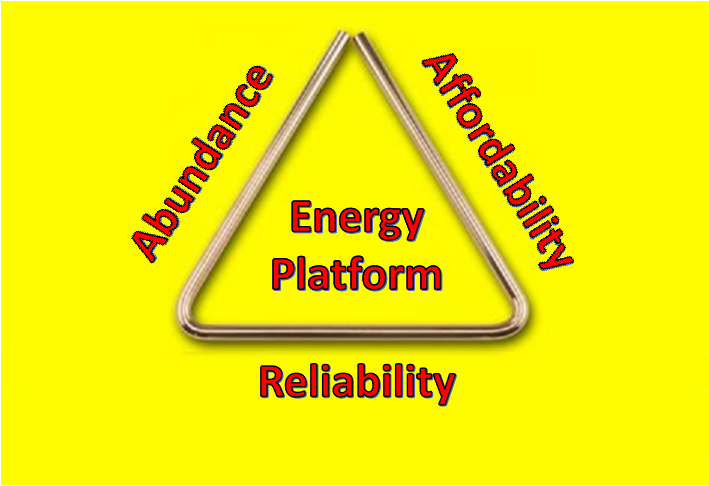
Shifting from Energy Scarcity to Energy Abundance

Prior to the Paris COP in 2015, French scientists debunked the green agenda in a White Paper drawn up by the Société de Calcul Mathématique SA  (Mathematical Modelling Company, Corp.)  The battle against global warming: an absurd, costly and pointless crusade.  The whole document is evidence-based, and on the second point concerning energy, they said this:

Chapter 2: The crusade is costly
Direct aid for industries that are completely unviable (such as photovoltaics and wind turbines) but presented as ‘virtuous’ runs into billions of euros, according to recent reports published by the Cour des Comptes (French Audit Office) in 2013. But the highest cost lies in the principle of ‘energy saving,’ which is presented as especially virtuous. Since no civilization can develop when it is saving energy, ours has stopped developing: France now has more than three million people unemployed — it is the price we have to pay for our virtue….

Finally, the world seems to be waking up to energy realities. The actual transition is away from the green imperative to make energy scarce, replaced by driving energy abundance. Kevin Killough writes, including commentary from Mark Mills of Energy Analystics, in his Just The News article:  World moves away from ‘green gospel of scarcity’ and now embraces ‘energy abundance,’ experts say

“I think we’ve gone from scarcity to abundance — from the green gospel of scarcity and its Trinitarian ESG god — to the promised land of abundance guided by the values of affordability and reliability,” David DesRosiers, conference co-chair of the RealClear Energy Future Forum, said.

In 2019, Swedish climate activist Greta Thunberg — then a high-school dropout — was invited to the U.N. Climate Action Summit in New York City. There, she would deliver her famous — or infamous, depending on who you ask — how dare you” speech, to which legacy media responded with overwhelming enthusiasm. Thunberg claimed that we were at the start of a “mass extinction,” and she admonished the world for ignoring the alleged crisis while talking “about money and fairy tales of eternal economic growth.”

What a difference six years can make. Voters elected a president in November who signed an executive order aimed at “unleashing American energy,” and Energy Secretary Chris Wright followed the president’s order with a directive to promote “energy abundance.”

This U-turn in views on energy isn’t limited to a change in administration in the U.S.

In May 2021, the International Energy Agency (IEA), which has been criticized for cheerleading emissions reductions, launched a roadmap to reach net zero by 2050, and IEA Executive Director Fatih Birol told The Guardian that “there will not be a need for new investments in oil and gas fields, or new investments in coal mines.”

At the March CERAWeek energy conference in Houston this year, Birol was calling for more investments in oil and gas.

This shift away from the de-growth fervor that was popular for over a decade was the overriding topic at the RealClear Energy Future Forum Monday. Panels of experts in engineering, data centers, mining, oil and gas, and the electricity grid discussed how this change of views has impacted various aspects of the world’s energy picture.

“I think we’ve gone from scarcity to abundance — from the green gospel of scarcity and its Trinitarian ESG god — to the promised land of abundance guided by the values of affordability and reliability,” David DesRosiers, conference co-chair and founder of the RealClear Foundation, said.

When reality hits

Mark Mills, conference co-chair and director of the National Center for Energy Analytics, discussed the role of increasing energy demand as a result of the growth of data centers and artificial intelligence. While many tech companies, such as Microsoft, embraced net-zero goals, Mills explained that the energy demands of data centers forced companies to contend with the reality that although fashionable in some circles, intermittent wind and solar power are not adequate.

“Eventually, reality rears its ugly head, and we recalibrate around what reality permits,” Mills said.

The IEA last month released an in-depth report on how the demand for electricity will be shaped by AI in the coming years. According to the report, a single data center uses as much electricity as 2 million households. Powering one of these data centers, Mills said, requires as much natural gas every day as a single Space X rocket launch.

“With myriads of data centers planned and announced, this means that lighting up the digital infrastructure will soon have the energy demands equivalent to reliably powering hundreds of millions of households,” Mills said.

Mills said, besides the energy to power these data centers, they will also require an abundance of materials. A skyscraper requires the same amount of materials to build a single giga-scale data center, which is a data center requiring 1 billion watt-hours of electricity every hour — the same amount of power consumed by approximately 1,100 homes in a month.

While some have argued that increased efficiencies will address the demand, Mills pointed out that a single smartphone operating at the energy efficiency of a 1984 computer would use more electricity than an entire city block. More efficiency won’t reduce demand for energy, he explained, it will only increase how much can be done with more energy.

The way the grid works

Energy abundance is not only producing more energy. The supply has to be reliable, the experts at the conference said. A few speakers pointed to the blackouts that gripped Spain and Portugal last month as an example of how dangerous an unreliable energy supply can be. Estimates place the death toll from the one-day event at seven people.

James Robb, CEO of the North American Electric Reliability Corporation, said that the exact cause of the event is still under investigation, but there are facts that point to the overreliance on intermittent wind and solar.

At the time of the blackout, Robb said, there was little traditional generation — coal, natural gas, hydroelectric and nuclear — operating. To make wind, solar and battery power work on the grid, it has to go through an inverter, which doesn’t have the spinning inertia of generators powered by traditional sources. Grid operators need to maintain a certain frequency of power, and when there’s a disruption, spinning inertia can absorb some of the frequency changes until things stabilize.

Federal Energy Regulatory Commission Chairman Mark Christie explained inertia as a 100-acre lake 6-inches deep. At one end is a river flowing into the lake, like power generated on the grid. At the other end is a river flowing out of the lake, which is the demand for power. To make the grid work, the water has to be kept 6-inches deep at all times.

“If that lake, at any point, becomes an inch deeper or loses an inch of depth, the lake ceases to operate. That’s the way the grid works. It has to be balanced at all times, and that’s the term frequency,” Christie said.

Robb said there are technologies that create synthetic inertia for wind and solar generators, but these are unproven at scale.

“They’re not without their issues there, and one of the big challenges we always have in the electric grid with any new technology is you can study something in the lab. You can deploy…a pilot [project] on a grid somewhere. But when you try to scale it to the level of the North American grid, which is a terawatt of generation, typically in that translation from pilot to terawatt, we discover things that we don’t understand,” Robb said.

Spain and Portugal Achieve Net Zero Accidently

Holding back

Despite many signs pointing to the overreliance on solar energy on the Iberian Peninsula grid as being the cause of the blackouts, other speakers noted that politics is often holding back more discussion on the problem of intermittency.

“It is very clear that the intermittency of wind and solar had a great deal to do with shutting down the grid, but you cannot admit that if you’re in power in Spain or Portugal. Because there are liabilities,” Terrence Keely, CEO of 1PointSix, LLC, a financial advisory firm, said.

Daniel Yergin, vice chairman of S&P Global, said that between 2022 and 2023, the world’s dependence on fossil fuels was down less than one half of one percent. Yet, he said there were still contradictions coming from leaders. As an example, he pointed to British Prime Minister Sir Keir Starmer who recently said that Britain would increase emission-reduction efforts to 2050.

“But he also said, ‘Oh, let me be clear with you, oil and gas are going to be in the mix for a long time.’ That really captures the struggle of people, of leaders, to kind of adjust to a reality that’s different from what has been the conventional wisdom,” Yergin said of Starmer.

As with any global shift in thinking on issues, some nations are slow to change — or reject it altogether. But the experts at the forum concluded generally that the so-called energy transition, and the de-growth attitudes that drove it for so long, are losing steam.

Beware Renewable Energy Trap

Terry L. Headley exposes the entanglements unheeded by carbon free activists in his Real Clear Energy article The Renewable Energy Trap: A Warning to Nations Pursuing Blind Sustainability  Excerpts in italics with my bolds and added images.

As the world increasingly shifts toward renewable energy, there is a growing risk that nations could fall into the “renewable energy trap.” This trap is the result of embracing an energy transition without fully understanding its economic, environmental, and geopolitical consequences. While renewable energy sources like wind, solar, and hydropower have been hailed as the future of global energy, nations rushing toward these technologies without a strategic plan may face grave economic and security challenges. The truth is that blind adherence to renewable energy, in its current form at least, is not the panacea many believe it to be. In fact, it could prove to be a short, green path to economic ruin for both developed and developing nations alike.

The up front gold is clear and considerable, while the end of the road is in the shadows and uncertain.

The False Promises of Renewables: Hidden Costs and Risks

The promise of renewable energy often comes with an aura of infallibility—clean, green, and limitless. However, this narrative overlooks the hidden costs of transitioning to renewable energy systems, many of which are disguised through misleading claims and incomplete accounting. For example, Germany’s “Energiewende” (Energy Transition) provides a cautionary tale of how well-intentioned policies can lead to unintended consequences.

Germany, once hailed as a leader in the renewable energy revolution, has spent over a decade investing heavily in wind and solar energy. Despite spending billions of euros, Germany has seen little reduction in its greenhouse gas emissions, and the financial burden on consumers has been significant. In 2020, Germany had the highest electricity prices in Europe, largely due to the subsidies and support provided to renewable energy companies. The country’s energy bills for consumers have surged, in part because of the costs associated with maintaining backup fossil fuel plants to ensure grid stability when wind and solar energy are insufficient.

Furthermore, Germany’s renewable energy push has led to a paradoxical reliance on coal. As has been said so many times before, when the wind isn’t blowing and the sun isn’t shining, Germany has been forced to turn back to coal-fired power plants to meet demand. Ironically, this has undermined the very environmental goals the country sought to achieve. Despite Germany’s heavy investment in renewables, it has seen a rise in coal usage due to the intermittent nature of its renewable energy sources, highlighting one of the most significant flaws of a renewable-dominant grid: reliance on fossil fuels to fill in the gaps.

Why? Because Germany must maintain at least as much baseload coal generation in reserve as it has in renewable energy generation to make sure it has electricity available at all times. The reality is that Germans are paying for the same electricity two or three times.

Rising Energy Costs and the Threat of Energy Poverty

The financial burden of renewable energy policies extends beyond Germany, affecting millions of households across the globe. One of the most significant, yet often overlooked, consequences of the renewable energy transition is the rising cost of electricity. The shift toward renewables has caused electricity prices to increase to the point where energy poverty is becoming a real issue in many countries.

Energy poverty refers to the inability of households to afford sufficient energy for heating, cooling, and powering their homes. The International Energy Agency (IEA) defines energy poverty as the lack of access to affordable and reliable energy. As the costs of renewable energy policies continue to rise, more and more households find themselves at risk of falling into energy poverty.

In the United Kingdom, for example, the government’s push for renewable energy has resulted in substantial increases in electricity prices. A report by the UK’s National Grid showed that between 2008 and 2020, the average annual energy bill for a UK household rose by 30%, with a significant portion of the increase attributed to the country’s renewable energy investments. The UK government has heavily subsidized wind and solar energy projects, but those subsidies are paid for by consumers through higher electricity bills. The result has been a situation where millions of British households struggle to keep up with the rising costs of energy.

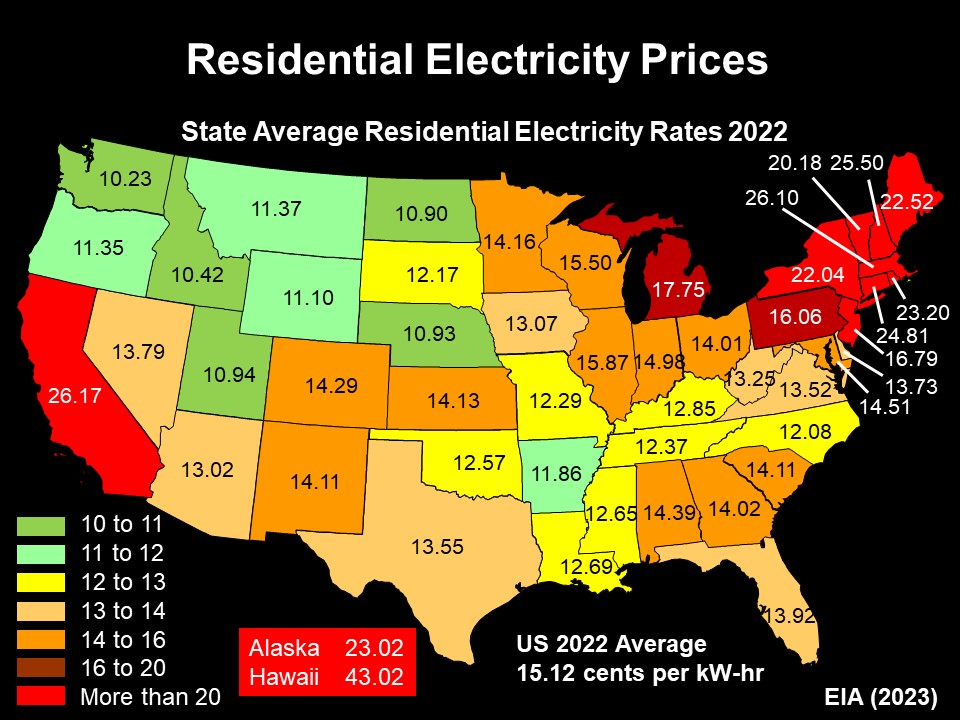
In California, energy poverty is also on the rise as the state aggressively pursues renewable energy goals. While California has invested heavily in solar power, it has failed to address the intermittent nature of renewable energy. During periods of peak demand, when solar and wind energy are insufficient, the state is forced to turn to natural gas and imported electricity, which drives up costs. California has one of the highest electricity prices in the United States, and many low-income families are feeling the impact.

According to the California Public Utilities Commission, more than 1.3 million households in the state were at risk of energy poverty in 2020. Despite the state’s focus on clean energy, many residents are unable to afford their electricity bills, forcing them to choose between paying for energy or other necessities like food and medicine.

In South Australia, another example of the renewable energy trap is evident. South Australia has aggressively pursued renewable energy policies, becoming one of the leading adopters of wind and solar power in the world. However, this shift has led to significant spikes in electricity prices. The state has faced price volatility and blackouts due to the intermittent nature of renewable energy. In 2017, South Australia experienced a widespread blackout after a storm damaged the transmission network, and the state has since struggled to maintain grid stability. The increased reliance on renewables has led to soaring electricity prices, and many households are now unable to afford basic energy needs. According to the Australian Energy Regulator, electricity prices in South Australia have risen by 50% in the past decade, and many low-income families are feeling the squeeze.

The Geopolitical Trap: Energy Dependency, Raw Materials and National Security

The renewable energy transition also raises important geopolitical concerns, particularly in the area of raw materials. Renewable energy technologies are heavily reliant on rare earth metals, lithium, cobalt, and nickel for the production of batteries, solar panels, and wind turbines. These materials are predominantly sourced from countries with less stable political environments or are monopolized by a few nations, such as China.

This creates a new form of energy dependency. For instance, the global supply chain for lithium and cobalt is largely controlled by China, raising questions about national security and the potential for price manipulation or trade disruptions. Countries that rush toward renewables without developing diversified supply chains may find themselves dependent on a handful of foreign nations for critical materials—echoing the geopolitical vulnerability that oil-dependent countries have faced for decades. This new energy dependence could undermine the goal of energy independence that many nations seek.

Moreover, the mining process for these materials is far from clean or environmentally friendly. In countries like the Democratic Republic of Congo, where much of the world’s cobalt is sourced, mining operations are linked to severe environmental degradation and human rights abuses. The environmental damage associated with mining for lithium, cobalt, and rare earth metals often goes unreported in the “green” narrative surrounding renewable energy. In many cases, the extraction of these materials results in significant water contamination, deforestation, and harmful air emissions.

The Hidden Costs: Economic Burdens and Social Inequality

Another significant issue with the renewable energy push is the way its real costs are hidden from the public. Governments often advertise the economic benefits of renewables without accounting for the financial burden on consumers. The transition to renewable energy technologies often requires substantial government subsidies, which are typically funded by taxpayers or passed onto consumers through higher utility rates. In the case of the European Union, the cost of renewable energy subsidies is often obscured by misleading accounting practices that fail to capture the true cost of maintaining grid stability.

Take California, a state that has aggressively pursued renewable energy initiatives. While solar and wind have gained in popularity, California’s reliance on intermittent renewables has led to skyrocketing energy prices and blackouts. The state has been forced to rely on natural gas plants as backup power sources, creating a contradictory energy system that still depends on fossil fuels. Additionally, the high costs of implementing renewable energy infrastructure have disproportionately affected low-income families, who are unable to afford higher utility bills.

The Crucial Role of Coal-Fired Baseload Electricity

As nations scramble to meet ambitious renewable energy goals, the role of coal-fired baseload electricity cannot be overlooked. Contrary to the widespread narrative that coal is a relic of the past, coal remains the most dependable, affordable, and scalable option for providing stable electricity in an increasingly energy-demanding world.

Baseload electricity refers to the minimum level of demand on an electrical grid over a span of time. Coal-fired power plants are uniquely capable of providing this baseload power reliably. Unlike wind and solar, which are intermittent and weather-dependent, coal-fired plants can produce electricity 24/7, irrespective of external conditions. This ensures a stable and predictable energy supply, crucial for both industrial needs and residential consumption.

Coal is also among the most affordable sources of electricity. The levelized cost of energy (LCOE)—the cost to produce electricity per megawatt-hour—is lower for coal-fired plants than for many renewable alternatives, especially when factoring in the full infrastructure and grid integration costs associated with wind and solar energy. In the U.S., for example, coal remains more cost-effective than natural gas and many renewables, particularly in regions like the Midwest, where the energy grid is more reliant on coal-fired plants.

Moreover, coal is abundant and domestically available in many countries, reducing dependence on foreign energy sources. This enhances energy security, particularly for nations that are trying to avoid the geopolitical risks associated with imported energy, including oil, natural gas, and the rare earth metals required for renewable technologies.

Conclusion: A Balanced Approach, Grounded in Reality is Essential

While renewable energy holds promise for a sustainable future, the world must proceed with caution. Nations cannot afford to fall into the renewable energy trap by embracing these technologies without considering the full spectrum of their impacts. Germany’s experience with its Energiewende shows that pushing too hard for renewables can create new environmental problems, economic burdens, and political risks. A balanced energy strategy that incorporates energy security, economic sustainability, and environmental responsibility is crucial.

Coal-fired baseload electricity remains an essential and reliable component of a balanced energy portfolio. It provides affordable, stable, and secure electricity, ensuring that nations do not risk energy poverty or grid instability as they transition to greener sources. The renewable energy revolution must be a step forward, not a leap into the unknown. By acknowledging the true costs of renewable energy and the irreplaceable role of coal, we can forge a more reliable and sustainable energy future for all.


Spain and Portugal Achieve Net Zero Accidently

Analysis of the blackout in Spain and Portugal comes in EurAsia Daily article Solar generation fell, and then the Spanish power grid collapsed: details of the blackout. Excerpts in italics with my bolds and added images.

New details are emerging why a large-scale blackout occurred in Spain, which lasted more than 10 hours and hit millions of Spaniards. The statements of the operator of the country’s energy system differ from the original version of EADaily, but point to the same reason — green energy, which failed in a crisis situation.

“The first major power outage in the era of green electricity,” Bloomberg columnist Javier Blas wrote on Twitter. He published a brief transcript of the teleconference held by the operator of the Spanish power grid Red Electrica on the blackout, from which the country is still recovering.

So, Red Electrica ruled out a cyber attack or weather as a reason. The operator presented the following course of events. At 12.33 pm, the Spanish power grid experienced a loss of generation in the south-west of the country. Most likely, these were solar power plants, but the operator is not sure yet. Indeed, most of Spain’s solar generation is located in the south-west of the country.

Location and concentration of solar power plants in Spain (left).

After milliseconds, the power system self-stabilized and began to recover. However, after a second and a half, a second wave of generation power loss occurred. Representatives of the operator did not specify whether the first wave provoked the second.

Three and a half seconds later, the instability of the energy system of the Iberian Peninsula reached a level that led to a malfunction at the interconnector with France, the power supply capacity of which was then 1 GW.

Immediately after that, another power loss of green power plants hit the power grid. The operator did not specify why this happened.

Further, the cascading power drop further destabilized the Spanish power grid, forcing every remaining power plant to be disconnected from the grid — nuclear power plants, gas and hydroelectric power plants. As a result, the generation in Spain entering the network has dropped to zero. The data shows that out of 25 GW, 10 GW remained, but the operator reported that for a brief moment the power dropped to zero.

Red Electrica stated that the presented series of events is preliminary, and so far the operator cannot make a final conclusion due to a lack of data.

This information is confirmed by the data of the operator itself and the European ENTSO-E platform. The capacity of solar power plants at 12.25−12.30 amounted to 17.8 GW — 55% of the total generation in the country. And by 12.40 it had almost tripled to 6 GW. At the same time, from 11.00 the capacity of solar power plants changed dramatically and one-time fluctuations reached 700 MW.

TSO data shows the point just after 12:30 on Monday 28 April when Spain’s electricity grid collapsed. When the collapse occurred, the Spanish electrical grid had almost 80% renewable generation, 11% nuclear, and only 3% natural gas. There was practically no base generation or physical inertia to absorb the shock that was generated. Source: Red Eléctrica

The operator’s data differ from the original version of EADaily about the failure of the interconnector with France and temperature changes, but coincide with the key reason for the blackout — green energy.

The problem of solar and wind power plants is that, unlike coal and gas generation, they do not provide synchronous inertia that stabilizes the frequency in the network. And when the frequency in the network dropped, solar power plants could not compensate for the imbalance. Their operation depends on inverters, which automatically turn off when the frequency deviates from the norm, aggravating the collapse.

The electrical system obeys the laws of physics. This obvious fact was not always taken into account when politicians took measures affecting the country’s electricity generation and transport networks. In Spain, for example, over the past decade there has been a revolution in electricity generation, which has led to the fact that renewable technologies (primarily photovoltaic and wind) now occupy a large part of the energy balance,” wrote former president of Red Electrica Jordi Sevilla in El Pais.

He noted that there is a technical problem: solar and wind energy are not synchronous energy sources, while transmission and distribution networks are designed to operate only with minimal voltage in the energy they transmit. Therefore, a sudden jump in the production of renewable generation can lead to sharp voltage fluctuations in the network, which will lead to a loss of generation and, as a result, to power outages.

“Our energy system needs investments to adapt to the technical realities of the new generation, which, in turn, should also continue to improve its own technologies and storage systems. This is a requirement of the sector (and the system operator), to which the government does not listen. The PNIEC project was developed in the office with excessive messianism regarding renewable energy sources and without taking into account the technical problems associated with such a significant change in the Spanish energy balance and its compliance with the energy system,” concluded the ex—head of the Spanish energy system operator.

Meanwhile, the Spanish Prime Minister made a new statement about the blackout.

“In his third speech in 24 hours, Pedro Sanchez clearly pointed out the ‘responsibility of private operators’ for the largest power outage in the history of Spain. He did not name names because the investigation is still ongoing, but the chief executive has thus taken the first step in a huge legal and economic battle that will begin in the coming months,” El Pais writes.

As the building notes, Pedro Sanchez seeks to neutralize attempts by the People’s Party (PP) and other conservative circles to blame the blackout on renewable energy sources.

“Sanchez claims that there is nothing to indicate that this is an explanation for what happened, and even more so that nuclear energy is the solution. Other right-wing European countries are returning to nuclear power, but Sanchez and Ogesen insist on the opposite,” El Pais noted.

At the same time, Prime Minister Sanchez himself still does not completely rule out the cyberattack version, and the government turned to Incibe (Cybersecurity Institute).

“Doubts remain. The government is not sure, but Sanchez still claims that the system is one of the best in the world, and adds that the public has behaved exemplary. At the moment, the system, restored to 99%, will work according to a safe formula, and if everything goes well, the usual formula will start working tomorrow,” El Pais writes.

Javier Blas  @JavierBlas comments:
Let’s see if I understood Spanish PM:
– we should not eliminate any hypothesis, but he has unilaterally ruled out any link to renewables;
– nuclear power plants are bad;
– we should wait to expert reports, but he contradicts the preliminary findings from the experts at the grid.
As reported by EADaily, after noon on April 28, millions of Spaniards faced problems that they did not even know about. The blackout stopped trains, planes and even buses. The extinguished traffic lights provoked chaos on the roads, and the lack of electricity in stores led to the fact that bank cards were not accepted and supermarkets were closed. Mobile communications disappeared, and hospitals served only patients in critical condition. 30 thousand police officers were brought into the capital of the country to ensure order. Spain could not even imagine such a thing.


Fast Track to Poverty: Green Energy

At his blog, Matt Ridley explains How the Green Energy Transition Makes You Poorer.
Excerpts in italics with my bolds and added images.

Crony capitalism at work

A leaked government analysis has found that Net Zero could crash the economy, reducing GDP by a massive 10% by 2030. Yet the spectacular thing about this analysis is that it expects this to happen not if Net Zero fails—but if it succeeds. In effect, it is saying that if the government really does force us to give up petrol cars, gas boilers, foreign holidays, and beef, then there would be perfectly workable things left idle, such as cars, boilers, planes, and cows. Idling—or stranding—your assets in this way is an expensive economic disaster.

Even more intriguing was the government’s economically illiterate response to the leak. A spokesman said: “Net zero is the economic opportunity of the twenty-first century, and will deliver good jobs, economic growth and energy security as part of our Plan for Change.”

Do they really think that economic growth is the same thing
as spending money? Because it isn’t.

Imagine the government saying that it is going to require the entire population to throw out all their socks and buy new ones by next Thursday. Under the logic it espouses for Net Zero, this would result in a tremendous burst of economic growth. Think of all the jobs created in the sock industry and the shops! They would be better off. Ah, but you, the consumer, would be poorer. You would have as many socks as before but less money. This is the broken window fallacy, explained by Frédéric Bastiat nearly 200 years ago: going around breaking windows makes work for glaziers but does not create growth.

Net Zero is a project to replace an existing set of technologies with another set of technologies: power stations with wind farms, petrol cars with electric cars, gas boilers with heat pumps, plane trips in the sun with caravan trips in the rain, cows with lentils. The output from these technologies is intended to be the same: electricity, transport, holidays, food.

Suppose, for the sake of argument, that these new technologies and activities require exactly as much money to build and run as the old ones. What have you gained? Less than nothing because you have retired existing devices early, losing the latter half of their lives. It would be like replacing all the socks in your drawers long before they needed replacing but with identical socks. Does that make you richer? No, poorer.

If the new technologies are more efficient than the old ones, fine. LED light bulbs use about 90% less electricity than incandescent bulbs did. So yes, it does make sense to throw out your old bulbs before they expire, stranding those assets, to save electricity and money. Is the same true of a wind farm or a heat pump? No, they are demonstrably more expensive and less reliable at producing the same electricity than the devices they are replacing. They are worse, not better.

That’s why they need subsidies. We have spent £100 billion so far subsidising “green” energy in the past few decades, money we could have spent on something else: tax cuts, for example. So, the green energy transition has made us poorer, not richer. It has given us the most expensive electricity in the entire developed world.

It has made some people richer, for sure. Dale Vince, an eco-tycoon, has made a fortune out of building unreliable energy. So have lots of fat cats in the City of London, lots of big landowners in the Highlands of Scotland, and lots of manufacturers in China. I have lost count of the number of times wealthy people have told me I am wrong to criticise the unreliable energy industry because “my son Torquil’s fund has done rather well.”

Net Zero crony capitalism is efficient at one thing:
transferring money from poor people to rich people.

This government has forgotten that its job is not to champion the interests of producers, but consumers. So did the last government, though Kemi Badenoch’s speech on Tuesday showed a welcome return to thinking about consumers. Electricity is not an end in itself; it is a means to an end, an essential input allowing us to do the one and only thing that does, really does, represent growthachieving more output with less input.

Right now, the Net Zero transition is doing the very opposite.

\


Beware: Flawed Energy Assumptions Incite Delusional Scenarios

Mark P. Mills and Neil Atkinson blow the whistle on projections written in International Energy Agency’s (IEA) latest report, the World Energy Outlook.  Below is the announcement of the report findings, key exhibits and Executive summary, excerpts in italics with my bolds and added images. Link to full study at the end.

Overview

Industry players consider the International Energy Agency’s signature annual report, the World Energy Outlook, to contain highly credible analyses. However, a new critique from the National Center of Energy Analytics experts finds the IEA’s latest scenarios on future oil demand to be problematic and potentially, dangerously wrong. 

“When it comes to policy or investment planning, there is a distinction with a critical difference when it comes to what constitutes a “forecast” (what is likely to happen) versus a “scenario” (a possibility based on assumptions). The challenge is not in determining whether the scenarios are completely factual per se, but instead whether they are factually complete,” wrote the authors in their report.

The most widely reported WEO scenario is that the world will see peak oil demand by the early 2030s. NCEA co-authors Mark P. Mills and Neil Atkinson believe that this conclusion is a prima facie case; minimally, the IEA should include business as usual (BAU) scenarios, not those based on all “high cases” or unrealistic possibilities.

Mills and Atkinson pinpoint 23 flawed assumptions used in the WEO scenarios to predict future oil demand, including:

  • IEA assumes: Corporate transition policies are real and durable. NCEA counterclaim: Myriad corporations, having earlier proclaimed fealty to “energy-transition” goals, are either failing to meet such pledges or overtly rescinding them.

  • IEA assumes: Transition financing will continue to expand. NCEA counterclaim: Alternative energy projects have become more expensive and difficult to finance, and wealthy nations are increasingly reluctant to gift huge amounts of money to the faster-growing but poorer nations, many of which have governance issues.

  • IEA assumes: China’s actions will follow its pledges. NCEA counterclaim: The scale of China’s role in present and future energy and oil markets requires scenarios that model what China is doing—and will likely do—rather than what China claims or promises.
National Energy Transition Plans

  • IEA’s assumes: The oil growth in emerging markets will be low. NCEA counterclaim: The fact of low demand in some poorer regions—e.g., Africa uses roughly one-tenth the per-capita level in OECD countries—points to the potential for very high, not low, growth in those markets.

  • IEA’s assumption: Governments will stay the course on EV mandatesNCEA’s counterclaim: Recent trends in many countries and U.S. states show policymakers weakening or reducing mandates and subsidies.

Flawed Assumptions Lead to Flawed Conclusions

Listed below is a summary of the flaws in 23 (but far from all) of the assumptions used in the WEO scenarios that are relevant to guessing future oil demand. Meaningful scenarios for planning for future uncertainties should include a range of realistic inputs, not just those that are aspirational.

Assumptions about baseline factors that affect oil forecasts

  1. Assumption: STEPS is a useful baseline.
    Flaw: The baseline scenario, rather than “business as usual,” assumes a future based on countries’ Stated Policies Scenario (STEPS), which not one country is implementing in full.
  2. Corporate transition policies are real and durable.
    Flaw:  Myriad corporations, having earlier proclaimed fealty to “energy-transition” goals, are either failing to meet such pledges or overtly rescinding them.
  3. Higher economic growth is unlikely.
    Flaw: Ignoring the possibility of higher economic growth, based on historical trends and the goals of all nations, leads to scenarios that underestimate future oil demand.
  4. Transition financing will continue to expand.
    Flaw: Alternative energy projects have become more expensive and difficult to finance, and wealthy nations are increasingly reluctant to gift huge amounts of money to the faster-growing but poorer nations, many of which have governance issues.
  5. Efficiency gains and structural changes will lower global demand for energy.
    Flaw: Long-run trends show that energy-efficiency gains make energy-centric products and services more affordable and thus do not reduce, but instead generally stimulate, rising demand.
  6. Solar and wind power are 100% efficient.
    Flaw: The WEO 2024 assertion that “most renewables are considered 100% efficient” contradicts fundamental physics and is, arguably, a silly PR-centric rhetorical flourish.
  7. China’s actions will follow its pledges.
    Flaw: The scale of China’s role in present and future energy and oil markets requires scenarios that model what China is doing—and will likely do, in fact—rather than what China claims or promises.

Assumptions regarding oil’s future

  1. The oil growth in emerging markets will be low.
    Flaw:  The fact of low demand in some poorer regions—e.g., Africa uses roughly one-tenth the per-capita level in OECD countries—points to the potential for very high, not low, growth in those markets.
  2. The EV market share will accelerate.
    Flaw:  Slowing market adoption and retrenchments in automakers’ EV plans or promises are evident, calling for scenarios that model realities that could persist.
  3. Governments will stay the course on EV mandates.
    Flaw:  Recent trends in many countries and U.S. states show policymakers weakening or reducing mandates and subsidies.
  4. China’s EV “success story” leads quickly to lower oil demand.
    Flaw:  Data point to the fact that in the real world, EV sales and gasoline consumption are both rising.

Assumptions about other transportation markets

  1. There will be significant electrification of heavy-duty trucks.
    Flaw:  There is no evidence of market adoption for any fuel option that leads to far higher capital costs and enormous degradation in performance.
  2. There will be significant electrification and fuel alternatives in aviation.
    Flaw:  There are no trends showing non-oil options for even a tiny share of the aviation market, in an industry that forecasts booming demand.
  3. There will be significant electrification and fuel alternatives for ships.
    Flaw:  The only modestly significant change in oil used for global shipping comes from the use of liquefied natural gas, another (and generally more expensive) hydrocarbon.
  4. There will be a rapid decline in oil used for Middle East power generation.
    Flaw:  Despite pledges and pronouncements, the year 2024 saw continued, and even higher, use of oil for electricity generation.
  5. The growth in petrochemicals and plastics will be slow.
    Flaw:  Slower growth is anchored in recycling enthusiasms that markets are not adopting and expectations of new recycling technologies that remain expensive or unproved.
  6. All scenarios lead to peak oil demand by ~2030.
    Flaw:  A WEO core conclusion that “combing all the high cases” leads to “global peaks for oil” by ~2030 is, prima facie, not based on all “high cases” but on unrealistic scenarios.

Assumptions regarding associated industries

  1. The supply of critical minerals will meet transition goals.
    Flaw:  Myriad studies have now documented the fact of a looming shortfall in current and expected production and of the challenges in changing that status quo.
  2. Prices of critical minerals will be low.
    Flaw:  It is fanciful in the annals of economic history to imagine that record-high demands won’t lead to far higher prices for the critical minerals needed to build EVs (as well as for wind and solar hardware).
  3. China won’t exercise minerals dominance as an economic or a geopolitical tool.
    Flaw:  China has already signaled over the past year that it is willing and able to implement export controls, or pricing power on critical minerals, where it holds significant global share.
  4. Oil and gas annual investments are adequate to avoid economic disruptions.
    Flaw:  Current levels of investment are not adequate to meet demands under business-as-usual scenarios, especially when combined with likely decline rates of extant oil fields.
  5. The future decline rate from existing oil fields will continue historical trends.
    Flaw:  The much faster decline rate in output from now-significant U.S. shale fields has altered the global average decline rate, pointing to the need for increasing investments to avoid a shortfall.
  6. OPEC will be a reliable cushion to manage oil-supply disruptions.
    Flaw:  History suggests that scenarios should include alternative possibilities to relying on OPEC to provide a cushion for meeting unexpected shortfalls in production or increases in demand.

Executive Summary: Flawed Assumptions Lead to Dangerous “Forecasts”

For decades, the International Energy Agency (IEA) was the world’s gold standard for energy information and credible analyses. Following the commitment of its member governments to the 2015 Paris Agreement climate accords, the agency radically changed its mission to become a promoter of an energy transition. In 2022, the IEA’s governing board reinforced its mission to “guide countries as they build net-zero emission energy systems to comply with internationally agreed climate goals.”

The IEA’s current preoccupation with promoting an energy transition has resulted in its signature annual report, the World Energy Outlook (WEO), offering policymakers a view of future possibilities that are, at best, distorted and, at worst, dangerously wrong.

The 2024 WEO’s central conclusion, its core “outlook,” has been widely reported as a credible forecast, i.e., something likely to happen: “[T]he continued progress of transitions means that, by the end of the decade, the global economy can continue to grow without using additional amounts of oil, natural gas or coal.”

The WEO itself states that it doesn’t forecast but has scenarios—explorations or models of possibilities, and cautions: “Our scenario analysis is designed to inform decision makers as they consider options…. [N]one of the scenarios should be viewed as a forecast.” Scenarios that usefully “inform” need to be based on realistic possibilities and assumptions. But there is one foundational assumption—one that the IEA has for decades included in its scenarios and that has been banished from the WEO: the possibility of business as usual (BAU).

Instead, the WEO’s baseline scenario now assumes that nations are undertaking their specific energy-transition plans that they promised in order to comply with the 2015 Paris Agreement, i.e., “stated policies scenario” (STEPS). Yet none of the signatories to that Agreement is fully meeting its promises, and most are a long way behind schedule. Believing something that is not true is not just problematic; it meets the definition of a delusion.
It is fanciful to forecast that, over the next half-dozen years, the growth in the world’s population and economy won’t continue a two-century-long trend and lead to increased use of the fossil fuels that today supply over 80% of all energy, only slightly below the share seen 50 years ago. The data show that the global energy system is operating essentially along BAU lines and not only far off the STEPS, but even further away from the more aggressive transition aspirations that the WEO also models.

In this analysis, we focus on highlighting 23 problematic, flawed assumptions that are relevant specifically to the WEO’s oil scenarios and the widely reported “forecast” that the world will see peak oil demand by the early 2030s (see box on pp. 4-5, Flawed Assumptions Lead to Flawed Conclusions). While other scenarios about other energy sources are critical as well, oil remains a geopolitical touchstone and the single biggest source of global energy—10-fold greater than wind and solar combined. At the very least, this analysis points to the need for real-world scenarios in general and, in the case of oil, the much higher probability that demand continues to grow in the foreseeable future and, possibly, quite significantly (below, see Global Oil Demand: Future Scenarios).

Debating the intricacies in flawed assumptions about energy scenarios is no mere theoretical exercise. The IEA’s legacy reputation continues to influence not only trillions of dollars in investment decisions but also government policies with far-reaching geopolitical consequences.

Energy Delusions: Peak Oil Forecasts


“Green” Agenda is Anything But

Steve Milloy explains the deceptive “Green Agenda” label in his Real Clear Wire article There Is Nothing Green About the ‘Green’ Agenda.  Excerpts in italics with my bolds and added images.

Now that the Democrats have lost their lock grip on power, what’s a green activist to do? It’s almost comical how the climate left is trying to cloak their agenda in terms they think will melt in Republicans’ ears. For example, Jennifer Granholm, energy secretary in the Biden administration recently penned an opinion piece arguing that President Trump is playing right into Communist China’s evil hands by killing off America’s green economy. 

Translation: The left is furious that Trump has halted the flow of billions of taxpayers’ dollars to subsidize electric vehicles that nobody wants and only the well-off can afford. The new president is killing the “green economy,” as Granholm puts it.

There is nothing green about the climate left’s solutions. 

If the climate movement was truly sincere and intellectually honest in its desire to stop actions contributing to global environmental degradation, it would stand fast against solar panels and electric vehicles. There is nothing green about the climate left’s solutions.

There is nothing environmentally friendly about using enslaved children in the Congo to mine cobalt for lithium-ion rechargeable batteries used in EVs. They labor with crude tools and bare hands, breathing in cobalt’s toxic dust in cramped pits. Runoff infused with cobalt and other chemicals contaminate the water supply. Meanwhile, on the other side of the world, green activists sit blithely unaware or unconcerned in the comfort of their own homes. They are saving the world, they smugly assure themselves, while children suffer in an environmental hellhole.

Far removed from U.S. environmental standards, Indonesia is the center of mining and refining nickel, an essential component in EV batteries. Pea soup-thick brown emissions shroud nickel smelting operations in the Indonesian island of Sulawesi as well as the coal-fired plants that fuel them. Processing waste and chemicals potentially leach into the ground. Dust residue from both ubiquitously blanket nearby communities, while waterways tainted by mining operations have red cast.

Whatever else climate activists may try to tell us,
there is nothing green going on here.

In Brazil, near the mouth of the Amazon River, a factory refines bauxite into what eventually becomes aluminum. It had been the source of aluminum in the Ford F-150 Lightening, the company’s now cancelled all-electric pickup truck. A lawsuit alleges that toxic elements, including aluminum and other heavy metals emanating from the refinery, have been responsible for cancer, birth defects, neurological dysfunction, digestive disorders, skin conditions, and increased mortality. How can an EV be called green or good for the environment when it’s making thousands of Brazilians sick?

Elsewhere in Brazil this past Christmas season, Brazilian authorities shuttered construction of an EV factory when it was discovered that its builders were working under “slavery”-like conditions. How is that a green virtue? Perhaps green dogma holds that human worth and dignity are small sacrifices that must be made for the common good.

Solar energy, long the prize pig of the climate crowd, isn’t green either.

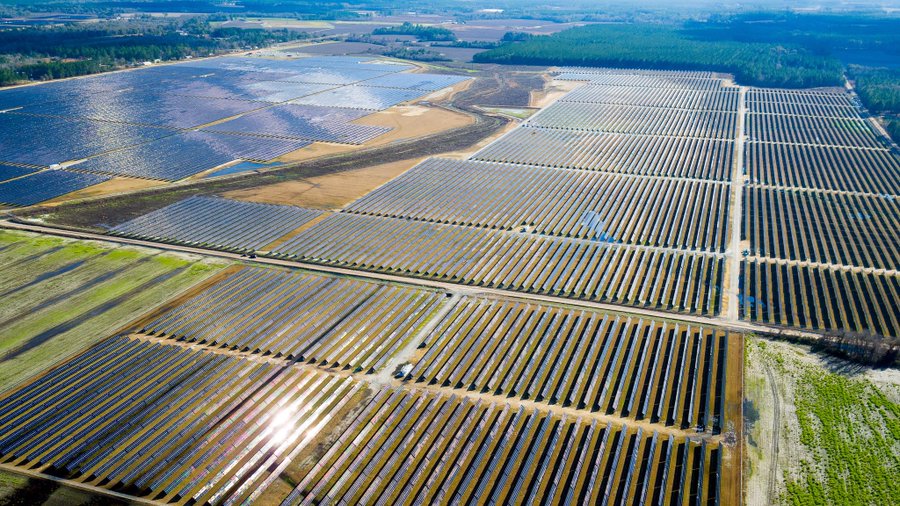
The fact that destroying forest land for solar arrays is bad for the environment should be obvious. Studies have found “the loss of carbon-dioxide gobbling forests for solar installations results in a net increase in greenhouse gas emissions.” Nor should wind farms be considered remotely green when wildlife is being killed and habitats are being disrupted. The same is true offshore, with a number of whale deaths associated with mammoth wind operations.

The same folks pushing “green” have been disingenuous from the start. In 1970, they assured us that human activity would cause an ice age by the 21st century and that we’d be under food rationing by 1980. Acid rain was a crisis until it wasn’t. Then global warming became the crisis, with much of New York City to be underwater by 2019. In 2008, Al Gore prophesized that the North polar cap would be gone in five years. It wasn’t. In 2009, UK Prime Minister Gordon Brown proclaimed,” We have fewer than 50 days to save our planet from catastrophe. Spoiler alert: We’re still here and thriving.

Their seemingly endless lies have been accompanied by Orwellian word games, moving from “global warming” to “change.” Now the Newspeak has shifted to “extreme weather and “overheating.

The truth is there is no green energy. No energy is clean. No energy is dirty. There are only challenges, solutions and tradeoffs. At the time of already high energy costs, choosing reliable, fossil fuel-backed energy is of paramount importance. Word sophistry from our friends on the left won’t change that.


Left Coast Climate Delusion Ends in Flames

Satellite images of wildfires burning in Southern California By NBC Staff • Published January 11, 2025

Holman W. Jenkins, Jr. writes in Wall Street Journal End of a Climate Delusion.  Excerpts in italics with my bolds and added images.
Amid California’s fires, voters wake up from the dream that green pork is a solution.

CO2 emitted into the atmosphere is rapidly and, for all practical purposes, uniformly distributed around the planet.
I may be stating the obvious but it needs to be pointed out. Voters and even political leaders are surprisingly poorly informed on this point. Emissions cuts in California don’t have any significant effect on California’s climate. They also have no global effect. California’s cuts are too small relative to the global whole; they also are largely illusory.

Emitting industries leave the state. They don’t stop emitting. If California imports Canadian hydro to charge its electric vehicles, consumers elsewhere have to burn more coal and gas. If Californians drive EVs, more gasoline is free to be burned by others, releasing more CO2 that influences climate change in California and everywhere else.

Green-energy subsidies do not reduce emissions. This will be news to millions of California voters. It contradicts a central tenet of state policy. It isn’t news to the actual enactors of these subsidies. A National Research Council study sponsored by congressional Democrats in 2008 concluded that such handouts were a “poor tool for reducing greenhouse gases” and called for carbon taxes instead.

Unfortunately, the incoming Obama administration quickly discovered it favored climate taxes only when Republicans were in charge. Backers would later engage in flagrant lying to promote Joe Biden’s Inflation Reduction Act, knowingly citing bogus predictions that its trillion-dollar spending profusion would reduce emissions.

A 2019 University of Oregon study had already revealed the empirical truth: Green energy doesn’t replace fossil fuels, it enables more energy consumption overall. That same year the EPA calculated that the potential emissions savings from subsidizing electric vehicles had been offset five times over by the pickup truck and SUV boom Team Obama facilitated to assure the success of its auto bailout.

American Association for the Advancement of Science study finds that of 1,500 “climate” policies announced around the world, a mere 63, or 4%, produce any reduction in emissions.

Last year, the premier journal Science put a nail in the question: 96% of policies supported worldwide as “reducing” emissions failed to do so, consisting mostly of handouts to green-energy interests.

And yet certain Journal readers still assail me with the epithet “denier.” They confuse my criticism of Democratic hypocrisy with my imagined views on climate science. As I’ve written back to many, “Don’t think politicians haven’t figured this out about you. That’s why they can give us unsustainable corporate welfare boondoggles and call it climate policy.”

A CNN moderator Saturday urged viewers to vote in an online poll on whether the California disaster should be blamed on climate change or poor leadership. Notice the non sequitur: as if climate change is an excuse for not acting against fire risk.

By all means, let politicians proclaim a “climate crisis” or any other rhetorical flourish if it helps mobilize support for public actions that actually serve a useful purpose. But a prerevolutionary situation has been building in California for two decades, starting with the Third World blackouts in late 2000 not because of any shortage of power but because of large helpings of political cowardice.

A decision in 2019 authorized yet more Third World blackouts instead of reasonably shielding utilities from lawsuit risk over fires their power lines might be accused of contributing to. One result, predictably, has been a proliferation of backyard generators, which increase fire risk.

Californians are stuck adapting in the ways left open to them. Since 2017, half a million have fled Los Angeles County.

Two social technologies might help but the state has been intent on denying itself their advantages. One is a functioning insurance market. If you can’t afford the insurance, you can’t afford the house. Get ready, instead, for a torrent of federal and state money to help residents, some of them wealthy, rebuild in high-risk fire zones.

The other is a functioning market in water. Five gallons to produce a walnut probably isn’t tenable under any realistic system of water pricing. If water were properly valued, municipalities would also rapidly discover the logic of building aquifers to capture seasonal runoff. A thousand things would change if water were priced to flow to its most highly valued uses.

Here’s another concept: Climate change can exist and yet be an insignificant variable.

In Southern California’s Mediterranean climate, anytime 100-mile-an-hour winds start blowing embers toward densely packed housing developments, a conflagration is certain. The only answer then is to have the manpower and resources ready to put fires out as quickly as they start.

I’ve written repeatedly about climate and energy policies in the Western world being a colossal example of “sophisticated state failure,” in which attempts to address complex problems yield only a succession of boondoggles and economic crises. If California voters don’t wise up now, they never will.


What Keeps “Energy Transition” Going? $ $ $

Robert Gauthier answered posting on a Quora topic How could we reverse the damage done by the “green energy” global scam that brought less efficient and highly polluting energy producing projects and high energy prices? Excerpts in italics with my bolds and added images.

Wind and solar power has provided politicians with an excuse to dispense favours—including taxpayer-funded subsidies and tax preferences to a supposedly “green” industry—while appearing to do something for the environment. And yet, despite more than two decades of massive subsidies, tax preferences and purchasing mandates from governments, wind and solar power still represent barely more than a rounding error of global energy production. In jurisdictions where renewables enjoyed strong but ill-considered political support, consumers and taxpayers now face much higher electricity bills and less-reliable power. And despite promises to the contrary, countries such as Germany, which have significantly increased wind and solar electricity production, have seen no meaningful reduction of greenhouse gas emissions.

Far from being a miracle cure-all for the shortcomings of conventional power generation, wind and solar power exaggerate the symptoms they pretend to address. Added up over the past two decades, the cumulative subsidies across the world for biofuels, wind, and solar approach about $5 trillion, all of that to supply roughly 5% of global energy.

The whole justification for the falling costs of wind generation rested on the assumption that much bigger turbines would produce more output at lower capex cost per megawatt, without the large costs of generational change. Now we have confirmation that such optimism is entirely unjustified – the whole development process has been a case of too far, too fast. Again, this was both predictable and predicted. The idea that wind turbines are immune to the factors that affect other types of power engineering was always absurd. The consequence is that both capital and operating costs for wind farms will not fall as rapidly as claimed and may not fall significantly at all. It follows that current energy policies in the West are based on foundations of sand – naïve optimism reinforced by enthusiastic lobbying divorced from engineering reality.

In the end, however, politicians cannot defy the laws of physics and economics. The promise of wind and solar power will always clash with the need for electricity that is low cost and reliable. That’s why voters routinely punish politicians who pursue flawed renewable energy policies. Rising electricity costs due to increased wind and solar power damage the economy by making businesses that consume significant volumes of electricity less competitive and by leaving less money in the pockets of consumers.

In Ontario, Canada during the run of the Green Energy Act there which attempted to replace coal and nuclear with wind and solar the upshot was a 138% increase in the price of electricity at the meter for the consumers. This led to the government that brought in this legislation to lose the next election so badly that they were no longer recognized as a party in the legislature. Naturally the government that replaced them killed the program and started refurbishing the nuclear reactor fleet there.

Unfortunately, solar and wind technologies require huge amounts of land to deliver relatively small amounts of energy, disrupting natural habitats. The real estate that wind and solar energy demand led the Nature Conservancy to issue a report last year critical of “energy sprawl,” including tens of thousands of miles of high-voltage transmission lines needed to carry electricity from wind and solar installations to distant cities.

Land required for wind farms to power London UK

Building a single 100-MW wind farm—never mind thousands of them—requires some 30,000 tons of iron ore and 50,000 tons of concrete, as well as 900 tons of nonrecyclable plastics for the huge blades. With solar hardware, the tonnage in cement, steel, and glass is 150% greater than for wind, for the same energy output

Take batteries. It is estimated that current battery manufacturing capabilities will need to be in the order of 500-700 times bigger than now to support an all-electric global transport system. The materials needed just to allow the UK to transition to all electric transport involve amounts of materials equal to 200% the annual global production of cobalt, 75% of lithium carbonate, 100% of neodymium and 50% of copper. Scaling by a factor of 50 for world transport, and you see what is now a showstopper. The materials demands just for batteries are beyond known reserves.

And that’s just one of the issues. Others include vast costs constituting a multiple of current energy costs; the environmental impact of mining and transporting huge amounts of materials; need for vast amounts of rare elements, far beyond known world reserves; incredibly huge amounts of material to recycle when facilities wear out; and on and on.

Spend enough time researching this stuff and you gradually realize that almost everything you read about green energy shows that at best it’s really a dark shade of brown.

UK Labour Caught in Own Net-Zero Trap

Rupert Darwall explains how UK Labour ensnared itself in his Spectator article  Labour has walked into a net-zero trap of its own making. Excerpts in italics with my bolds and added images.

The government’s net-zero noose draws tighter. At energy questions in the House of Commons on Tuesday, the Conservative MP Charlie Dewhirst asked the Energy Security and Net Zero Secretary Ed Miliband if the recent report by the National Energy System Operator (Neso) projected higher or lower bills under his policies. Miliband replied that Neso forecast lower overall costs. ‘It is completely logical to say that that will lead to a reduction in bills,’ he said.

Logic and historic data point in the opposite direction. Between 2009 and 2020, the average price of electricity sold by the Big Six energy companies rose by 67 per cent from 10.71p per kilowatt hour (kWh) to 17.92p per kWh. This wasn’t caused by any increase in the cost of natural gas. In fact, the average price paid by major power generators fell by 15 per cent over the period. There was, however, a spectacular explosion in the amount of wind and solar on the grid which rose from 4.5 gigawatts (GW) in 2009 to 37.95 GW in 2020.

Source: efficientbuildingsolutions.co.uk

The upward pressure on prices will only increase as Miliband pushes for more offshore wind. Earlier this week, the Financial Times reported a senior energy investment banker commenting on the hubris of the offshore wind industry, which has been hit by higher interest rates and supply chain inflation. Renewable energy projects require enormous upfront investment costs. The pay-off, its advocates argue, is that renewables have no fuel input costs. But it would be a mistake to assume they have minimal ongoing costs.

The North Sea is a harsh environment for wind turbines; fixing a defective wind turbine in the middle of the ocean is no easy matter. A 2020 forensic analysis of wind company accounts by Edinburgh University’s Professor Gordon Hughes found that Year 1 operating costs for deepwater wind projects averaged £44 per megawatt hour (MWh), rising to £82 per MWh in Year 12. Moreover, the output efficiency of wind turbines degrades at a rate of around 4.5 per cent a year. When plotted against the market price obtained for wind output, Hughes concluded:

 ‘a significant portion of wind output is expensive to produce and of no value in terms of its contribution to national wellbeing’.

Renewable subsidies are awarded in allocation rounds. The fifth allocation round (AR5), conducted under the previous government, was a dud because of rising project costs caused by higher interest rates and supply chain inflation. Coming into office, Miliband was determined to make a big splash with AR6. He threw bill payers’ money at it with a record-breaking £1.555 billion subsidy pot. The government accepted bids totalling 9.6 GW, which includes 5.34 GW of offshore wind and 3.29 GW of solar, capacity which is useless when it’s likely to be most needed to meet peak electricity demand on winter evenings.

The government gives successful bidders guaranteed prices, irrespective of how much – or, more often, how little – the market values their output. Consumers are then forced to make up the difference between the market price and the set strike price they bid for. The average strike price for AR6 was very nearly £80 per MWh. Based on Professor Hughes’s analysis of load factor decay and rising maintenance costs, there is a high risk that offshore wind becomes lossmaking well before Year 12. Floating offshore wind, which Miliband says ‘is at the heart of the government’s mission to make Britain a clean energy superpower’, was awarded an eye-watering strike price of £176 per MWh.

Larger subsidies and floating offshore wind are hardly conducive to cutting bills.

Until mid-October, the wholesale price of electricity in 2024 averaged £78.70 per MWh. The more wind and solar added at strike prices above wholesale prices mathematically drives up the amount of subsidy consumers must pay. But the cost of renewables doesn’t stop there. Because wind farms are mostly located hundreds of miles from where electricity is used, when grid connections get congested, wind farms are paid constraint payments not to generate electricity.

Decongesting all the wind power on the grid doesn’t come cheap either. Miliband’s Clean Power 2030 Action Plan, published earlier this month, envisages building twice as much new transmission infrastructure in the next five years as was built in the past decade. The faster the planned build-out, the higher the cost. It means that renewable strike prices are a floor on which constraint payments and higher network costs are added.

That’s not all. There’s a second net-zero factor driving up energy costs. Net-zero policies have been forcing conventional power stations off the grid. Britain’s dispatchable generating capacity (principally coal, gas and nuclear) peaked in 2010, by 2020 declining by 25.1 GW and shrinking dispatchable capacity by 28.5 per cent. This was mostly because 18.3 GW of coal-fired capacity was retired as Britain demonstrated its green virtue to the world by powering past coal. The problem comes when there’s insufficient wind to power the grid. That’s what happened this autumn. Unseasonably windless conditions saw wholesale electricity prices rise through October and November with a huge spike at the beginning of December.

The latest renewable lobbyist talking point is that gas sets the wholesale electricity price. The implication is that gas prices are driving up the cost of electricity. However, gas prices this year have been lower than they were in 2023. The culprit behind the surging electricity prices is not the price of gas, but politicians kicking coal off the grid and Britain not having sufficient gas-powered generating capacity to meet demand when there’s not enough wind. Vladimir Putin and Qatari gas sheikhs are not to blame for home-grown net zero policies that have left Britain with dangerously inadequate non-weather dependent generating capacity.

In this, Britain is not alone. As other countries are finding out, having more renewables on the grid destabilises the electricity market. Sweden has also had soaring electricity prices, says Ebba Busch, Sweden’s deputy prime minister and energy minister. Like Britain, Sweden has an extremely weather-dependant energy system which makes prices highly volatile, worsened by its German neighbour on the other side of Baltic. The need, Busch argues, is for ‘more dispatchable power production’.

This is politically impossible for the Starmer government. Labour is trapped by net zero and decarbonising the grid constitutes its overriding mission. So far, neither the Conservatives or Reform have stepped up. Tory leader Kemi Badenoch calls herself a net-zero sceptic and Reform’s Nigel Farage wants more nuclear. Whatever the merits of nuclear, there is no way in which new nuclear power stations can be built and commissioned fast enough to offset the retirement of Britain’s old ones, let alone substantially increasing the amount of nuclear power. They should be thinking and talking like Ebba Busch: Britain needs an emergency programme to build 20 GW of new gas-fired power stations. If that means suspending net zero, they should make the case that keeping the lights on and electricity bills down is a price worth paying.