 A divergence of 2018 surplus ice kept the July extents above average most of the month, resulting in an higher month overall. Now in August extents have slipped below average. That was to be expected since much of the surplus ice was in Hudson and Baffin bays, places that go to open water by September. The animation above shows in the last two weeks, Hudson and Baffin opened up, having lost 90% of their ice, though still above average. Note that the Canadian Archipelago in the center is still plugged with ice in several places.

On the Russian side, melting occurred strongly in Kara, Barents, and Laptev Seas, while East Siberian has been resistant. (Ignore the satellite artifact curving through an area of solid ice.) The graph below shows where things stand as of day 221 (August 9). Average is for years 2007 to 2017 inclusive.

2018 extents are slightly below 2017 and the 11-year average. while being ~500k km2 higher than 2007. SII 2018 was much lower in July, but is drawing closer, down ~200 km2 at this time. Typically in September, the two indices are quite close.

The table below shows ice extents by regions comparing 2018 with 11-year average (2007 to 2017 inclusive) and 2017.
| Region | 2018221 | Day 221 Average |
2018-Ave. | 2007221 | 2018-2007 |
| (0) Northern_Hemisphere | 6151237 | 6414532 | -263294 | 5658628 | 492609 |
| (1) Beaufort_Sea | 774280 | 734391 | 39889 | 757661 | 16619 |
| (2) Chukchi_Sea | 405431 | 469446 | -64015 | 278137 | 127294 |
| (3) East_Siberian_Sea | 861432 | 650568 | 210864 | 209194 | 652238 |
| (4) Laptev_Sea | 175683 | 353811 | -178129 | 299613 | -123931 |
| (5) Kara_Sea | 31630 | 130279 | -98649 | 211153 | -179523 |
| (6) Barents_Sea | 145 | 31684 | -31539 | 15435 | -15290 |
| (7) Greenland_Sea | 159794 | 250904 | -91110 | 266101 | -106307 |
| (8) Baffin_Bay_Gulf_of_St._Lawrence | 126914 | 89719 | 37195 | 68938 | 57976 |
| (9) Canadian_Archipelago | 567715 | 461746 | 105969 | 379942 | 187773 |
| (10) Hudson_Bay | 114683 | 98442 | 16241 | 94787 | 19896 |
| (11) Central_Arctic | 2932499 | 3142317 | -209818 | 3076391 | -143892 |
2018 is 263k km2 below average (4%). All the seas on the Euro/Russian side are in deficit except East Siberian up 210k km2. Seas on the CanAm side are all surplus, with CAA the strongest. Hudson and Baffin Bays are still slightly above average, as is Beaufort Sea.
Postscript:
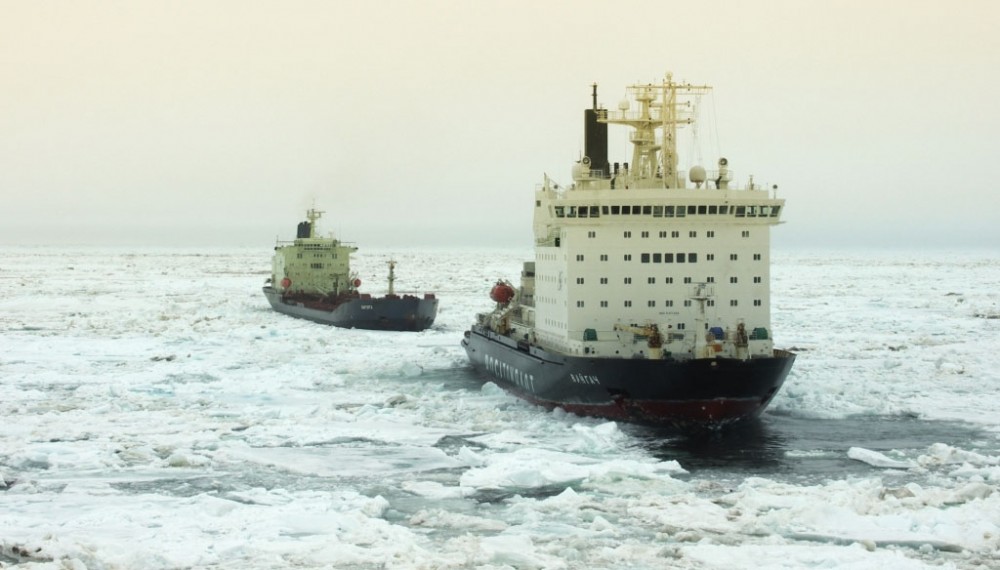
It is nuclear-powered icebreaker “Vaygach” that is escorting the west-bound convoy. Illustration photo: Rosatomflot
A convoy is breaking its way through Russian east Arctic waters July 26, 2018 reported in Barents Observer
There is thick ice on the waters as a convoy of at least four vessels is sailing with west-bound course through the East Siberian Sea. Conditions are complicated and icebreaker assistance is needed. According to the Russian Arctic and Antarctic Institute, major parts of both the Laptev Sea and the East Siberian Sea still have up to one meter thick ice. It is the first east to west crossing of the season.
Footnote on MASIE Data Sources:
MASIE reports are based on data primarily from NIC’s Interactive Multisensor Snow and Ice Mapping System (IMS). From the documentation, the multiple sources feeding IMS are:
Platform(s) AQUA, DMSP, DMSP 5D-3/F17, GOES-10, GOES-11, GOES-13, GOES-9, METEOSAT, MSG, MTSAT-1R, MTSAT-2, NOAA-14, NOAA-15, NOAA-16, NOAA-17, NOAA-18, NOAA-N, RADARSAT-2, SUOMI-NPP, TERRA
Sensor(s): AMSU-A, ATMS, AVHRR, GOES I-M IMAGER, MODIS, MTSAT 1R Imager, MTSAT 2 Imager, MVIRI, SAR, SEVIRI, SSM/I, SSMIS, VIIRS
Summary: IMS Daily Northern Hemisphere Snow and Ice Analysis
The National Oceanic and Atmospheric Administration / National Environmental Satellite, Data, and Information Service (NOAA/NESDIS) has an extensive history of monitoring snow and ice coverage.Accurate monitoring of global snow/ice cover is a key component in the study of climate and global change as well as daily weather forecasting.
The Polar and Geostationary Operational Environmental Satellite programs (POES/GOES) operated by NESDIS provide invaluable visible and infrared spectral data in support of these efforts. Clear-sky imagery from both the POES and the GOES sensors show snow/ice boundaries very well; however, the visible and infrared techniques may suffer from persistent cloud cover near the snowline, making observations difficult (Ramsay, 1995). The microwave products (DMSP and AMSR-E) are unobstructed by clouds and thus can be used as another observational platform in most regions. Synthetic Aperture Radar (SAR) imagery also provides all-weather, near daily capacities to discriminate sea and lake ice. With several other derived snow/ice products of varying accuracy, such as those from NCEP and the NWS NOHRSC, it is highly desirable for analysts to be able to interactively compare and contrast the products so that a more accurate composite map can be produced.
The Satellite Analysis Branch (SAB) of NESDIS first began generating Northern Hemisphere Weekly Snow and Ice Cover analysis charts derived from the visible satellite imagery in November, 1966. The spatial and temporal resolutions of the analysis (190 km and 7 days, respectively) remained unchanged for the product’s 33-year lifespan.
As a result of increasing customer needs and expectations, it was decided that an efficient, interactive workstation application should be constructed which would enable SAB to produce snow/ice analyses at a higher resolution and on a daily basis (~25 km / 1024 x 1024 grid and once per day) using a consolidated array of new as well as existing satellite and surface imagery products. The Daily Northern Hemisphere Snow and Ice Cover chart has been produced since February, 1997 by SAB meteorologists on the IMS.
Another large resolution improvement began in early 2004, when improved technology allowed the SAB to begin creation of a daily ~4 km (6144×6144) grid. At this time, both the ~4 km and ~24 km products are available from NSIDC with a slight delay. Near real-time gridded data is available in ASCII format by request.
In March 2008, the product was migrated from SAB to the National Ice Center (NIC) of NESDIS. The production system and methodology was preserved during the migration. Improved access to DMSP, SAR, and modeled data sources is expected as a short-term from the migration, with longer term plans of twice daily production, GRIB2 output format, a Southern Hemisphere analysis, and an expanded suite of integrated snow and ice variable on horizon. Source: Interactive Multisensor Snow and Ice Mapping System (IMS)
 Science Matters
Reblogged this on Climate Collections.
LikeLike