
A new study has fossil fuel activists twisting in the wind. The paper is Risk of increased food insecurity under stringent global climate change mitigation policy
The paper is behind a paywall, but some detail is available from carbonbrief Global carbon tax in isolation could ‘exacerbate food insecurity by 2050’ Excerpts in italics with my bolds and some comments.
The research finds that using a blanket “carbon tax” to restrict global warming to 2C above pre-industrial levels – which is the limit set by the Paris Agreement – would put an additional 45 million people at risk of hunger by 2050.
The new study, published in Nature Climate Change, zooms in on how implementing a uniform tax on greenhouse gas emissions from agriculture and other types of land use, in particular, could impact food security worldwide.
The introduction of a carbon tax could threaten food security in three main ways, the researchers say.
First, the tax would raise the cost of food production, especially for carbon-intensive products such as meat.
Second, the tax would raise the costs associated with agriculture expansion, which would lead to higher land rents.
Third, the tax would incentivise the production of biofuels – which would compete with food crops for space, further driving up land rates.
All three of these consequences could drive up food prices, which would be costly for the world’s lowest earners – who spend up to 60-80% of their income on food.
The new study compares how levels of hunger would differ in a world with climate change alone to a world with climate mitigation, including a uniform carbon tax.
The results show that a blanket carbon tax “would have a greater negative impact on global hunger and food consumption than the direct impacts of climate change”, the scientists say in their research paper.
Instead, policies that can help slash emissions from agriculture while aiding development should be prioritised, says lead author Dr Tomoko Hasegawa, a researcher at the International Institute for Applied Systems Analysis (IIASA) and Japan’s National Institute for Environment Studies. In a statement, she said:
“Carbon pricing schemes will not bring any viable options for developing countries where there are highly vulnerable populations. Mitigation in agriculture should instead be integrated with development policies.”
To understand the impacts of mitigation efforts, the researchers compared a world where warming is limited to 2C to a world where no efforts to tackle climate change are made before 2050.
The former scenario assumes that the world shifts from a reliance on fossil fuels to low-carbon sources of energy, and that a uniform carbon price is rapidly introduced “across all sectors and regions” and is steadily increased in the coming decades.
(The scenarios use three different “socio-economic pathways” to make assumptions about how factors, such as population growth, are likely to change by 2050.)
The results show that, by 2050, the risk of hunger in some of the world’s least developed countries could be higher in the scenarios with mitigation than in the scenarios without mitigation – despite the fact that these scenarios expect greater declines in crop yields.
In the scenarios without mitigation, the number of people at risk of hunger by 2050 is expected to increase by 5-56 million.
In the scenarios with mitigation, an additional 13-170 million people could face hunger. The increase in those at risk is expected to be largest in sub-Saharan Africa and parts of South Asia, including India and Bangladesh.
The charts below show the expected changes in the number of people at risk of hunger (left) and the number of calories consumed per person per day (right) by 2050 under the mitigation (RCP2.6) and “no-mitigation” (RCP6.0) scenarios.
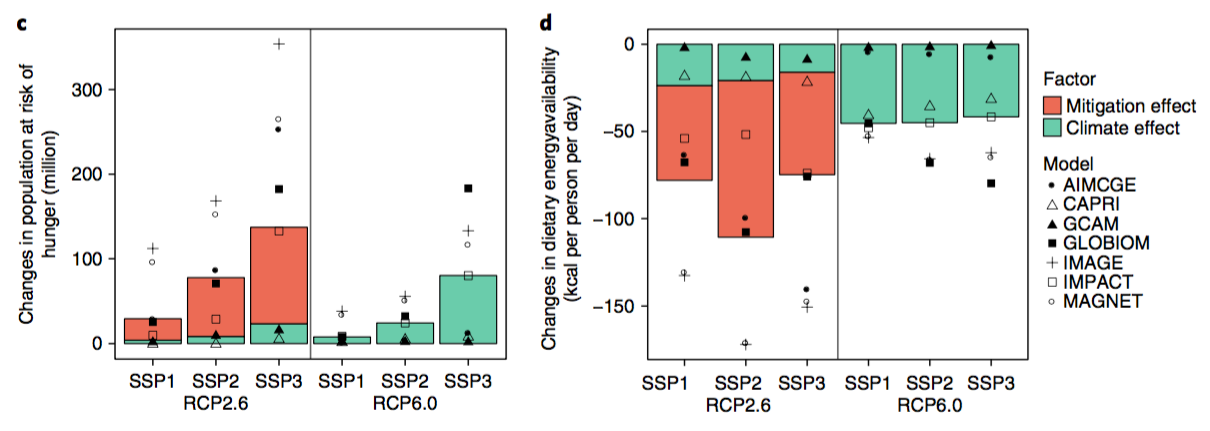
The expected changes in the number of people at risk of hunger (left) and the number of calories consumed per person per day (right) by 2050 under a mitigation (RCP2.6) and “no-mitigation” (RCP6.0) scenario. The average impacts of climate change (green) and mitigation via the introduction of a carbon tax (orange) are shown. Symbols show the results from different models Source: Hasegawa et al. (2018).
Comment Regarding Climate Direct Effects upon Food Security
The impacts shown in green are hypothetical, though assumed as baselline truth by the researchers. The supposition is: Climate change could threaten global food security by increasing the chance of staple crop failures in many parts of the world, such as across Africa and the US.

The fact is, staple crops are booming with increasing CO2 and the warm temperatures enjoyed by plants and humans alike. Some researchers have been working frantically to claim CO2 damages plant productivity, despite overwhelming evidence to the contrary. One line of attack claims CO2 doesn’t make plants grow larger in the face of other limiting conditions like moisture or soil nutrients. True enough, but reducing CO2 is not the cause or the answer when that happens. See Researchers Against CO2 for the details
Another line of attack is claiming the plants are larger but are not as nutritious. Studies showed that plants can have lower concentrations of some nutrients owing to their large size from CO2 enrichment, but the take up of soil nutrients was not diminished by more CO2 or warmth. See CO2 Destroys Food Nutrition! Not.
Summary
In their research paper, the scientists say the findings “should not be interpreted to downplay the importance of future GHG emissions mitigation efforts, or to suggest that climate policy will cause more harm than good”.
Nothing could be farther from the obvious implications of this analysis. The supposed crop failures are nowhere to be seen with every year setting new records for productivity. So the future negative effects from rising CO2 are totally speculation. While the economic impacts from taxing carbon pose a real and present danger to food security.
 H/T GWPF BENEFITS OF GLOBAL WARMING: RECORD HARVESTS REPORTED IN NUMEROUS COUNTRIES
 Science Matters
Idea that carbon dioxide is responsible for climate change started from not famous scientists Svante Arrhenius, who never look at behavior of gasses in real atmosphere, where billions of water vapor molecules HELP LIFT TO UPPER TROPOSPHERE all gasses together with their kinetic, latent and trapped infrared radiation energy. THERE energy is going to space easy than from ocean level.
Condensed water vapor created clouds, which reflect back to space direct sun radiation. Ice and snow are doing the same. IT COOL the atmosphere.
Ideas of Arrhenius were used by to fanatic from the science -James Hansen from NASA and influenced by him in 1980 Chairman Of Senate Committee – Al Gore.
They were deadly wrong but succeed in their false statements to level, when billions of people on the earth fooled by them.
As scientists of climate change, as their opponents MUST FIRST OF ALL correct this huge mistake. Otherwise all of them fooled people by unscientific arguments.
More details from Michael Ioffe mioffe_2000@yahoo.com or Amazon CASE AGAINST THE SCIENCE OF CLIMATE CHANGE.
LikeLike
Michael, you are starting to sound like a one-trick pony, plugging your argument against global warming/climate change. Point made. In the future, if you comment make it pertain to the topic.
LikeLike