UN’s Broken Climate Policy Machine

The recent UN IPCC climate report is another reminder that the UN, like a broken record,  keeps trumpeting a failed climate policy.  Richard Epstein explains in an essay at the Stanford Hoover Institution Our Latest Global Warming Scare  Excerpts in italics with my bolds.

The new alarmist UN report features bad science and worse economics.

The United Nation’s Intergovernmental Panel on Climate Change issued a special report last week predicting apocalyptic environmental consequences if the nations of the world are unable to reduce the amount of warming to 1.5° C above pre-industrial levels in the next 12 years. The IPCC report insists that meeting this target requires “rapid and far-reaching” changes—all unspecified—in a wide range of areas including land, energy, industry, buildings, transportation, and cities. These changes, the report insists, must reduce carbon dioxide emissions to about 45 percent of 2010 levels by 2030 and to a neutral level of no new carbon dioxide emissions by 2050.

Much press coverage has embraced the report’s conclusions. The New Yorker stresses the dire warningls of the IPCC report. The Guardian speaks of the “urgent changes” needed to contain climate change underneath its headline picture of a raging California wildfire. Yet it is here that the story starts to unravel from both a scientific and economic perspective. The unstated narrative behind the picture is that temperature increases due to global warming will cause environmental catastrophes. But in the case of forest fires, this claim is simply untrue: in the United States, the number of forest fires has been down by about 86 percent since 1930, and the current year ranks as the 40th highest on record. To be sure, the risks of fire today remain great but for reasons that are unrelated climate change. Higher levels of CO2 make plants more drought resistant, which increases the amount of burnable material. What matters most, however, is not temperature change, but finding the proper techniques for forest management. Yet one weakness of the IPCC report is that in its discussion of forest fires, it does not mention alternate causes.

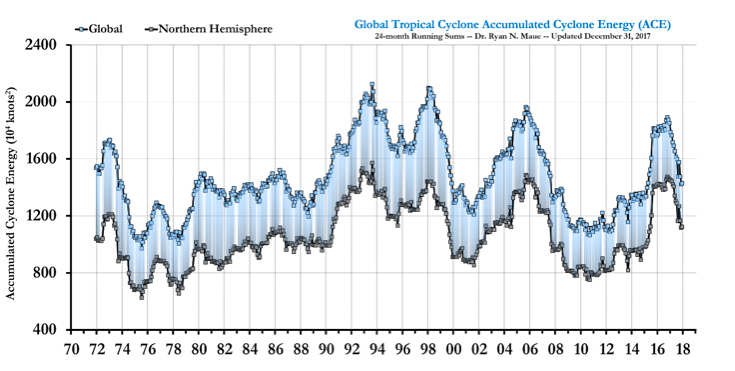
The same gap exists with respect to the frequency and severity of hurricanes. From all the recent publicity, one might think that they are rapidly on the rise. But the evidence cuts very much in the opposite direction. It is easy to find reports of major hurricanes that occurred before 1950, as with the record flooding in North Carolina in 1945. But anecdotes never tell the full story. Cato Institute scholars Patrick Michaels and Ryan Maue have demonstrated that hurricane frequency rises and falls in a cyclical manner:

There are a number of clear inferences that can be drawn from just this data set. First, there has been a steady increase in overall levels of CO2 since at least 1950. But whatever its cause, that single variable cannot explain the cyclical pattern of hurricanes. Similar cyclical patterns have been observed in measuring the extent of Arctic ice since at least 1900, including changes during the last 12 years. The same is true of sea levels, which have risen consistently over thousands of years, but not at constant rates; the rates have fluctuated several times in the past 120 years, making it difficult to find a trend. No one is quite sure why there is variability, but the overall levels of sea rise are far lower than feared ranging somewhere between 5 and 8 inches per century. The great vice of the IPCC report is that it attributes all negative environmental phenomena to climate change. It does not acknowledge the data that presents a serious challenge to the dominant orthodoxy that increases in CO2 since the onset of industrialization are the cause of temperature change and the supposed global dislocations.

The larger scientific issue is to develop an expanded theory of climate change that incorporates variables other than carbon dioxide in the equation. Globally, these include the effects of water vapor, also a greenhouse gas, and of aerosols, which tend to lower temperatures. Locally, these include recently discovered volcanic activity under the West Antarctic ice sheet, and the falling of land from the draining of aquifers. MIT climatologist Richard Lindzen recently discussed these issues in his lecture at the Global Warming Policy Foundation—“Global Warming for the Two Cultures”—which calls attention to the deep gap between scientific knowledge and popular culture. Lindzen put the role of CO2 emissions into proper perspective in order to negate the claim that changes in the level of CO2 can drive major climate changes. He pointed out that the total energy flows over the surface of the earth amount to about 200 watts per square meter. The key conclusion is: “Doubling CO2 involves a perturbation of 2% percent to this budget.” The obvious question is how that small change in an energy budget can drive the major changes to the earth’s climate that so many claim. Clearly, other factors have to be at work, including water vapor, whose effects are exceedingly difficult to model. Its distribution is uneven and uncertain over the surface of the earth, and it can take the form of different kinds of clouds with different absorption rates for heat. Water vapor both keeps radiation from the sun from coming in just as it prevents the leakage of radiation out from the system. The wide variation in temperature patterns, sea levels, and plant growth long before modern post-industrial history indicate that these forces are powerful.

At this point, CO2 seems to have a reduced role. But again, matters get more complicated. If the effect of CO2 on temperature is relatively weak, its effect on plant growth is powerful, given that CO2 and water are basic resources that plants require to live. Here the unambiguous effect is that the increase in CO2 has made plant life stronger, and has led to a major amount of global greening over the last 30 years. That increase in CO2 levels tends, moreover, to reduce temperature extremes by making land cooler in the day and warmer at night.

So why is there so much fear about the consequences of climate change? As reported by Marlo Lewis of the Competitive Enterprise Institute total fossil fuel consumption is up 55% since 1950. Total energy-related CO2 emissions is up 500 percent. Total CO2 concentration is up by about one-third. The total temperature increase during that time has been 0.65°C. But in the meantime, global life expectancy has increased from 48 years to 71.4 years. Global malaria infections are down about 37 percent, and global malaria deaths are down by 62 percent. Corn yields per acre are up 25 percent since 2000, 44 percent since 1990, and 88 percent since 1980. Global GDP is sharply up and global poverty is sharply down. And other numbers only reinforce the same trend: as Johan Norberg shows in his book Progress, all major indicators—life expectancy, income, health—are up. As basic levels of technology continue to improve, we will have cheaper production of energy and its more efficient utilization.

Things seem pretty good, so why does the IPCC think that the future is bleak? And why does it think that major transformations are needed to deal with the risks of CO2 emissions? There is no reason to think that all nations can be coaxed into a single coherent central plan to manage emissions, assuming that one even exists. At the very least, China, now the largest emitter of CO2 and India, the third largest, will both sit this one out. Yet at the same time, the United States, which has rightly ditched the Paris Accord, posted in 2017 the largest reduction in CO2 emissions of any nation by relying increasingly on natural gas as a source of energy, even as overall global CO2 levels have moved upward. As Bjorn Lomborg, the head of the Copenhagen Consensus Center, has written, it is not easy to introduce wholesale changes into any economy, and the IPCC presents no evidence that the enormous cuts in fossil fuel consumption it requires to reach its targets can realistically be made.

The first and most simple point is that fossil fuels are here to stay because over the long-haul they are more efficient than either wind or solar energy, especially now that improvements through fracking have reduced the costs of fossil fuel extraction while other improvements in technology have increased the amount of energy extracted per unit of fossil fuels. Even with massive subsidies, the efforts to produce major shifts to wind and solar have proved prohibitively expensive, given their intrinsic unreliability when the wind does not blow and the sun does not shine, and the persistent difficulty of storing such energy in a cost-effective manner. Pull out the subsidies, and these markets may survive in certain niche locations, but they will not displace fossil fuels. The far better path, therefore, is to concentrate on improving yields and reducing externalities from our best energy sources, instead of overlooking the serious externalities that wind and solar themselves can create. The simple path of steady and predictable technological improvement promises far greater returns than the measures suggested by the IPCC report.

Summary

When someone asks me, why don’t you support the fight against climate change, I give the three reasons expressed so well by french mathematicians.

Fighting Global Warming is Absurd, Costly and Pointless.

  • Absurd because of no reliable evidence that anything unusual is happening in our climate.
  • Costly because trillions of dollars are wasted on immature, inefficient technologies that serve only to make cheap, reliable energy expensive and intermittent.
  • Pointless because we do not control the weather anyway.

The prestigious Société de Calcul Mathématique (Society for Mathematical Calculation) issued a detailed 195-page White Paper that presents a blistering point-by-point critique of the key dogmas of global warming. The synopsis is blunt and extremely well documented.

Details and links at Bonn COP23 Briefing for Realists

Footnote:

Epstein’s article refers to a favorite IPCC tactic of omitting information that contradicts their alarmist narrative.  An extensive example of this sin of omission is a legal brief submitted in support of the kids suing the US government for not ensuring them a favorable climate (Juliana vs. US) to be heard later this month.  The document is deconstructed in the post Facts Omitted by Climatists

Climate Tipping Points Quiz

This post is a reblog of the Manhattan Contrarian Quiz — Climate Tipping Points Edition
October 11, 2018/ by Francis Menton. Text in italics with my bolds.

On Monday the UN IPCC came out with its latest Special Report, this one supposedly addressed specifically to the allegedly dire consequences of allowing world temperatures to increase by more than an arbitrarily-selected threshold. Here is a copy of the “Summary for Policymakers,” and here is a copy of the accompanying press release. But I urge you not to peek at those until you have taken today’s very important Manhattan Contrarian Climate Tipping Points Quiz.

Many have noted that this latest Report seems to step up the level of hysteria and shrieking about the threat of climate change to a whole new level. The gist is, we are doomed, doomed, doomed unless mankind takes immediate drastic action to reduce and then eliminate carbon emissions, because otherwise we will shortly cross the dreaded climate “tipping point.” Crossing the tipping point means that climate change will thereafter accelerate out of control, there will be no further chance of saving the planet, and all hope must be abandoned. You can see that this is very serious, at least if you give any credence to this stuff. And yet, despite the hyperbole, this report seems to be getting much less attention than prior similar predictions of the impending climate apocalypse, even if no one in the mainstream press will apply the slightest amount of critical thinking as to whether any of this makes any sense at all. As an example, the big New York Times article on the Report did not appear until Tuesday, and in the print edition ran on page A8. I guess there were plenty of things more important than the approaching end of the world to fill up the front page.

So it’s time to take the Manhattan Contrarian Climate Tipping Points Quiz. The quiz consists of nine predictions of the impending climate “tipping point,” made at various points over the past few decades. For each prediction, I have deleted the name of the predictor, the year made and the year or years that were identified as the dreaded tipping point, but have included in brackets the number of years in the future that the tipping point was said to be at the time of the prediction in question. Your task is to identify which of the predictions is the one found in the current UN materials. For extra credit, see if you can identify any of the other predictions as to the person or organization uttering the prediction, the year made, and the year said to be the date of the tipping point.

Answers below the fold.

Prediction Number 1:

[Predictor] said that without “coherent financial incentives and disincentives” we have just 96 months to avert “irretrievable climate and ecosystem collapse, and all that goes with it.” . . . He confided last night: “We face the dual challenges of a world view and an economic system that seem to have enormous shortcomings, together with an environmental crisis – including that of climate change – which threatens to engulf us all.”

Prediction Number 2:

[U]nless drastic measures to reduce greenhouse gases are taken within the next 10 years, the world will reach a point of no return, [predictor] said. He sees the situation as “a true planetary emergency.” “If you accept the truth of that, then nothing else really matters that much,” [predictor] said in an interview with The Associated Press. “We have to organize quickly to come up with a coherent and really strong response, and that’s what I’m devoting myself to.”

Prediction Number 3:

[Predictor] . . . told author Bob Reiss in [year of prediction] that New York City would be underwater in 20 years. “The West Side Highway [which runs along the Hudson River] will be under water,” [predictor] said. “And there will be tape across the windows across the street because of high winds. And the same birds won’t be there. The trees in the median strip will change.”

Prediction Number 4:

The year: [46 years after prediction]. Massive dikes around New Orleans, Miami, and New York are holding back rising sea water. Phoenix is baking in its third straight week of temperatures above 115 degrees. Decades of drought have laid waste to the once-fertile Midwestern farm belt. Hurricanes batter the Gulf Coast, and forest fires continue to black thousands of acres across the country. Science fiction? Hardly. These are the sobering global warming or “greenhouse effect” scenarios that many scientists believe may happen if we continue to pollute our environment. . . . [N]othing short of an immediate worldwide effort by governments, corporations and especially individual citizens will be needed to reverse the environmental crisis that now threatens the entire planet.

Prediction Number 5:

In [year of prediction], [predictor] told [publication] that [4 years after prediction] was “the last window of opportunity” to impose policies to restrict fossil fuel use. [Predictor] said it’s “the last chance we have to get anything approaching [numeric] degrees Centigrade,” adding that if “we don’t do it now, we are committing the world to a drastically different place.”

Prediction Number 6:

[W]arming of [numeric] deg C or higher increases the risk associated with long-lasting or irreversible changes, such as the loss of some ecosystems,” said [predictor]. . . . [L]imiting global warming to [numeric]°C would require “rapid and far-reaching” transitions in land, energy, industry, buildings, transport, and cities. Global net human-caused emissions of carbon dioxide (CO2) would need to fall by about 45 percent from [year] levels by [12 years from prediction], reaching ‘net zero’ around [32 years from prediction].

Prediction Number 7:

[Predictor] said in [year of prediction] that if “there’s no action before [5 years after prediction], that’s too late.” “What we do in the next two to three years will determine our future. This is the defining moment,” he said.

Prediction Number 8:

[Predictor] wrote in [publication] that within “as little as 10 years, the world will be faced with a choice: arable farming either continues to feed the world’s animals or it continues to feed the world’s people. It cannot do both.”

Prediction Number 9:

[Publication] reported in [year] that [predictor] says entire nations could be wiped off the face of the earth by rising sea levels if global warming is not reversed by the [year].”

Answers to Quiz:

Answer for Prediction Number 1: This famous prediction was made by the great climate scientist Prince Charles in July 2009. The 96 month (8 year) period of the prediction expired in July 2017. Does that mean that for a year plus we have already been in the state of “irretrievable climate and ecosystem collapse”?

Answer for Prediction Number 2: Again, this is a quite famous prediction, made by Al Gore at the January 2006 premier of his climate apocalypse movie “An Inconvenient Truth,” as reported at the time by CBS News. Thus, the period of the prediction expired in January 2016. I guess then that we have already reached the “point of no return” and the “true planetary emergency.” How does it feel?

Answer for Prediction Number 3: Another famous prediction, this one made in 1988 by James Hansen, then head of the branch of NASA known as GISS that collects (and fraudulently alters) world temperature data. This time the 20 year prediction period expired in 2008. Meanwhile, I went down the West Side Highway just a few days ago, and the water didn’t appear any closer to swamping it than it was back in 1988.

Answer for Prediction Number 4: This one comes from self-described all-around genius Jeremy Rifkin (“author of 20 bestselling books about the impact of scientific and technological changes on the economy, the workforce, society, and the environment.” and “advisor to the leadership of the European Union since 2000” — really, does that tell you all you need to know about what idiots the Europeans are?), and is found in an article in none other than the Poughkeepsie Journal (my hometown newspaper!) in 1989. OK, the date for the prediction (2035) hasn’t arrived yet. But, if we were going to need “massive dikes” to protect New York City by 2035, shouldn’t there be by now some evidence of the sea level going up?

Answer for Prediction Number 5: The predictor was then-head of the United Nations Foundation Timothy Wirth, and the year of prediction was 2012. That means that the date for the prediction was 2016 — or actually, in the phrasing of the prediction, the end of President Obama’s second term. The prediction appeared in ClimateWire. I guess we missed our “last chance” to save the world. Wirth is the same guy who, as a Congressman back in 1988, promoted the hearings featuring Hansen that many credit as the official launch of the global warming scare.

Answer for Prediction Number 6: Yes, this quote comes from the just-issued press release announcing the new UN Report. There were enough extraneous clues in there that probably many of you readers got it right. The number of degrees C that is said in this Report to be the brink of disaster is 1.5.

Answer for Prediction Number 7: The predictor is former UN IPCC head Rajendra Pachauri, and the year of prediction was 2007. That means that after 2012 it was “too late” to stop armageddon. Oh, well. Somehow we struggle on.

Answer for Prediction Number 8: This one comes from noted UK environmental writer George Monbiot, and appeared in the Guardian in 2002. So once again the year for the prediction was 2012. Do you recall the world making the choice somewhere 6 or so years ago between “feeding the world’s animals” and “feeding the world’s people.” I’m struggling to remember that. Perhaps I should go home and have a hamburger for dinner while I think it over.

Answer for Prediction Number 9: The prediction comes from 1989, and the year for the prediction (“entire nations . . . wiped off the face of the earth”) was 2000 — 18 years ago. The publication was the San Jose Mercury News, which attributed the prediction to UN “senior environmental official” Noel Brown. Somehow, even the Maldives seem to be doing fine here in 2018.

Here’s the incredible thing: Wouldn’t you think that making apocalyptic predictions like these that failed so completely would undermine the predictors’ reputations somehow — like maybe, they’d be considered laughingstocks? Not at all! All of these guys are still out there and going strong. OK, Pachauri was forced out of the IPCC, but over sexual harassment allegations, not failed climate predictions. He left the IPCC in 2015, which means that three years after his prediction above bombed, he was still there. Meanwhile, the IPCC had won the Nobel Peace Prize! Monbiot still writes climate doom articles for the Guardian. And you haven’t heard of Noel Brown? He retired from the UNDP, but has gone on to be President of the Friends of the United Nations.

Yes, ridiculous failed climate apocalypse predictions are the route to assured career success. The world is a funny place.

Update October 13, 2018

An interesting essay by Sean Gabb (H/T Greenie Watch) provides some additional predictions justifying our skepticism about environmentalists’ doomsday narrative.  The Environmental Scam: One Quick and Easy Response Excerpt in italics:  The entire article is informative.

Sean Gabb writes:

I now turn to the claims about global warming. I will not discuss the intricacies of how much carbon dioxide we are releasing, or what effect this may have on temperatures. I leave aside the persistent claims of scientific fraud and other corruption. As said, I am not qualified to comment on these or other matters. What I do note is that, in 2006, Al Gore

[p]atiently, and surely for the 10,000th time, [explained to The Guardian] what’s going wrong. The atmosphere is like a coat of varnish around the globe, he says. When it’s thin, as it should be, heat naturally escapes. But when it gets thicker, thanks to carbon dioxide emitted by us, it traps in the heat and the world gets warmer. “It’s cooking and wilting the most vulnerable parts of the eco-system, melting all the mountain glaciers, the north polar ice cap, parts of Antarctica, parts of Greenland.” That molten ice-water will raise sea-levels, flooding food-producing areas that all of us rely on. Eventually it will submerge whole cities, from San Francisco to Shanghai. The site of the Twin Towers will not be a memorial garden: it will be underwater.

… He agrees with the scientists who say we have 10 years to act, before we cross a point of no return.

In 2009, the Prince of Wales – advised by the “leading environmentalists Jonathon Porritt and Tony Juniper” – said we had 96 months to change our ways. After that, we faced “irretrievable climate and ecosystem collapse, and all that goes with it.”

In 2005, George Monbiot wrote in The Guardian:

Winter is no longer the great grey longing of my childhood. The freezes this country suffered in 1982 and 1963 are – unless the Gulf Stream stops – unlikely to recur. Our summers will be long and warm. Across most of the upper northern hemisphere, climate change, so far, has been kind to us.

Ten years took us to 2016. Assuming my arithmetic is correct, 96 months take us to about now. If we have really reached the “point of no return,” why have these people not yet switched to telling us “I warned you: now it’s too late”? Instead, the apocalyptic warnings continue at top volume. Oh – and English weather remains as unpredictable today as it was in 2005. In March this year, there was an inch of snow in Deal.

The point of repeating these claims is that they were not random assertions, but appear to have been made on scientific advice – scientific advice that turned out to be wrong. Whether the scientists in question were lying, or whether they advised in good faith, is less important than that they were wrong. You do not need a degree in the natural sciences to notice when predictions are falsified. It is with this in mind that I take the present claims of plastic waste in the sea, and reject them out of hand. It may be that, this time, the claims are true. But the whole burden of proof is on those making them. The burden of proof comes with the barely-rebuttable presumption that we are being fed yet another diet of alarmist falsehoods.


Dr. Indrani Roy on Natural Climate Factors

fig1_s

Figure 1. Total solar irradiance over the past three solar cycles, since 1975, varying between 1365 and 1367 W/m2. Source: NASA

A new paper by Dr. Indrani Roy is Abrupt Global Warming, Warming Trend Slowdown and Related Features in Recent Decades. The thrust of her conclusions is reported in this Science Daily article Role of ‘natural factors’ on recent climate change underestimated, research shows  Excerpts in italics with my bolds.

Pioneering new research has given a new perspective on the crucial role that ‘natural factors’ play in global warming.

The study, by Dr Indrani Roy at the University of Exeter, suggests that the natural phenomena such as solar eleven-year cycles and strong volcanic explosions play important roles in recent climate change which has been ‘underestimated’.

All existing studies focus on the rise in CO2 in the atmosphere as being the main driver of global temperature rises.

However, Dr Roy suggests that the role natural factors plays in climate change should be given more prominence. This study explores various possible areas where models miss important contributions due to these natural drivers.

The research is published in leading journal Frontiers.

Although CO2 has risen significantly since 1998, global temperature did not show any significant increase. Models however suggested a significant rise.

Dr Roy said: “So what factors are missing? It is a puzzle of recent slowdown of global warming trend or Hiatus and this study addresses that issue.”

For the study, Dr Roy looked specifically at data between 1976-96, which not only covered two full strong solar cycles and two explosive volcanic eruptions during active phases of those cycles, but which also matched a period of abrupt global warming. These data were compared with other periods.

The research highlighted the important role that a dominant Central Pacific (CP) El Nino, and its associated water vapour feedback, played in global warming within the chosen period.

volcano

Plinian column of the eruption of Sarychev (Russia) on 12 June 2009. Credit: NASA

Dr Roy suggests that the explosive volcanoes seen during this phase, which changed the sea level pressure around the North Atlantic, kick-started a ‘chain mechanism’ that played a crucial role.

Dr Roy added that the change in Indian Summer Monsoons and El Nino connection during that abrupt warming period, and a subsequent recovery thereafter, can also be explained by this ‘chain mechanism’.

Discussion of Chain Mechanism from Frontiers paper

The puzzle of global warming hiatus is discussed in many recent studies, though the underlying cause is still unexplained. Many climate features, in atmosphere and ocean including global temperature trend, suffered deviations during later two decades of the last century, so as some known teleconnection patterns. This study addresses those areas segregating the role of natural factors (the sun and volcano) to that from CO2 led linear anthropogenic influences. To analyse the combined influence of the sun and volcano (including the phasing), it separated out a period 1976–1996 that captured two full solar cycles, (number 21 and 22), where two explosive volcanos erupted (1991 and 1982) during active periods of strong solar cycles.

The possible mechanism could be initiated via a preferential alignment of NAO phase, generated by explosive volcanos. During that particular period, it identified certain deviations on various climate features, those include temperature around Niño 3.4 region (warming), North Atlantic region (cooling), AL (warming) and Eurasian snow cover (warming). The robustness of detected signal is established by analyzing different observational and reanalyses datasets. Consistent with temperature, a dominance of atmospheric water vapor content is also noticed. Interestingly, CMIP5 model ensemble (and also arbitrarily chosen individual models) fails to comply with such findings. It is also true for other models. This study indicates that water vapor being the most important GHG has major contributions for an observed abrupt rise in global temperature during that period. Overall the analysis suggests a change in CP ENSO and associated water vapor feedback plays a very important role in regulating global temperature behavior since 1976 that also includes ‘Hiatus’ period. It identified the signal of natural origin is different to that from CO2 led anthropogenic linear influence. Interestingly, models suggest a failure to detect such signals, which provides explanations for the long-standing puzzle of global warming hiatus.

My Summary:  Warmists are picking on the wrong molecule.  CO2 is plant food, H2O makes the climate.

Background from Previous post: On Solar and Climate Variability

The last solar eclipse was in 2017. The totality in the picture lasted a little more than 2 minutes, while the process lasted about 2.5 hours.

One of the great disputes in climate research is between those (IPCC) who dismiss solar cycles as a factor in climate change and those who see correlations in the past and keep seeking to understand the mechanisms. To be clear, there is considerable agreement that earth’s atmosphere can and does reduce or increase the amount of incoming solar energy (albedo effect), thereby contributing to surface warming or cooling. The science and research into the “global dimming and brightening” is discussed in the post Nature’s Sunscreen.

The above image of the eclipse is intended to remind us that humans down through history have been terrified of the sun going dark because they knew intuitively that no sun means no life. A more modern and sophisticated concern is that even slightly falling energy from the sun brings cooling, ice and death.  Quite apart from the sunscreen, this post is focused a different matter, namely that changes in the sun’s output radiation cause changes in earth climate parameters. One theory of such a mechanism is espoused by Henrik Svensmark and concerns solar particles effect upon albedo. That line of research is discussed in the post The Cosmoclimatology theory
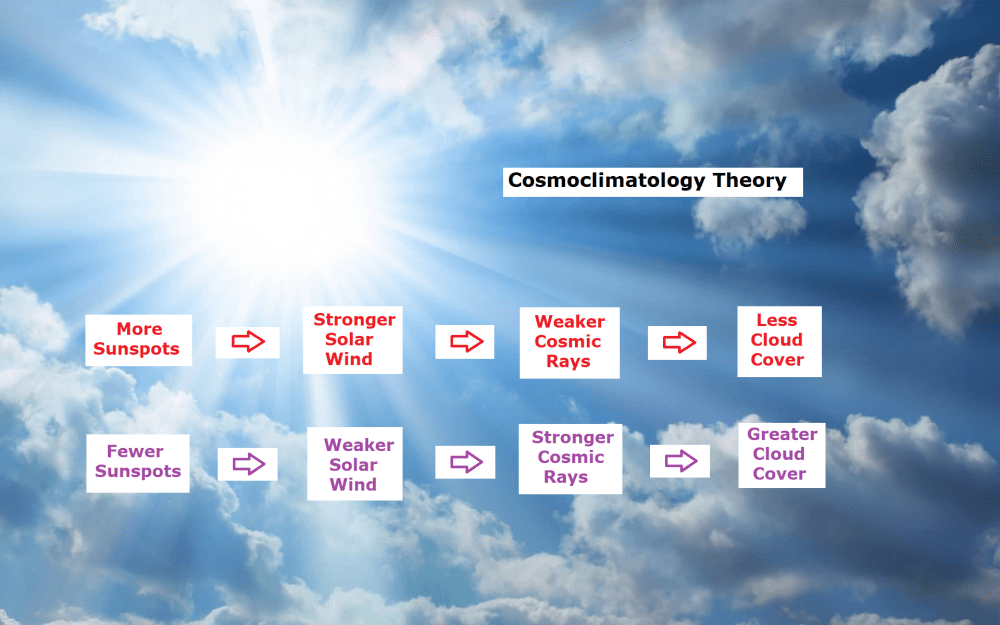
A different investigation has been advanced by Dr.Indrani Roy, her most recent publication this month being a book Climate Variability and Sunspot Activity Analysis of the Solar Influence on Climate (H/T NoTricksZone).

The book is behind a paywall, but the abstract and chapter headings indicate a comprehensive approach.

Overview Climate Variability and Sunspot Activity (2018)

This book promotes a better understanding of the role of the sun on natural climate variability. It is a comprehensive reference book that appeals to an academic audience at the graduate, post-graduate and PhD level and can be used for lectures in climatology, environmental studies and geography.

This work is the collection of lecture notes as well as synthesized analyses of published papers on the described subjects. It comprises 18 chapters and is divided into three parts: Part I discusses general circulation, climate variability, stratosphere-troposphere coupling and various teleconnections. Part II mainly explores the area of different solar influences on climate. It also discusses various oceanic features and describes ocean-atmosphere coupling. But, without prior knowledge of other important influences on the earth’s climate, the understanding of the actual role of the sun remains incomplete. Hence, Part III covers burning issues such as greenhouse gas warming, volcanic influences, ozone depletion in the stratosphere, Arctic and Antarctic sea ice, etc. At the end of the book, there are few questions and exercises for students. This book is based on the lecture series that was delivered at the University of Oulu, Finland as part of M.Sc./ PhD module.

Chapter Titles

  • Climatology and General Circulation
  • Major Modes of Variability
  • Stratosphere-Troposphere Coupling
  • Teleconnection Among Various Modes
  • Solar Influence Around Various Places: Robust Solar Signal on Climate
  • Total Solar Irradiance (TSI): Measurements and Reconstructions
  • Atmosphere-Ocean Coupling and Solar Variability
  • Ocean Coupling
  • The Sun and ENSO Connection–Contradictions and Reconciliations
  • A Debate: The Sun and the QBO
  • Solar Influence: ‘Top Down’ vs. ‘Bottom Up’
  • An Overview of Solar Influence on Climate
  • Other Major Influences on Climate
  • Sun: Atmosphere-Ocean Coupling – Possible Limitations
  • The Arctic and Antarctic Sea Ice
  • CMIP5 Project and Some Results
  • Green House Gas Warming
  • Volcanic Influences
  • Ozone Depletion in the Stratosphere
  • Influence of Various Other Solar Outputs

To better appreciate Roy’s viewpoint, two of her previous publications provide the evidence and analytical thought behind her conclusions.  Published in 2010 with J.D. Haigh was Solar cycle signals in sea level pressure and sea surface temperature  Excerpts in italics with my bolds.

Summary of SLP and SST signals

We identify solar cycle signals in the North Pacific in 155 years of sea level pressure and sea surface temperature data. In SLP we find in the North Pacific a weakening of the Aleutian Low and a northward shift of the Hawaiian High in response to higher solar activity, confirming the results of previous authors using different techniques. We also find a broad reduction in pressure across the equatorial region but not the negative anomaly in the sub-tropics detected by vL07. In SST we identify the warmer and cooler regions in the North Pacific found by vL07 but instead of the strong Cold Event-like signal in tropical SSTs we detect a weak WE-like pattern in the 155 year dataset.

We find that the peak SSN years of the solar cycles have often coincided with the negative phase of ENSO so that analyses, such as that of vL07, based on composites of peak SSN years find a La Nina response. As the date of peak annual SSN generally falls a year or more in advance of the broader maximum of the 11-year solar cycle it follows that the peak of the DSO is likely to be associated with an El Nino-like pattern, as seen by White et al. (1997). An El Nino pattern is clearly portrayed in our regression analysis using only data from second half of the last century, but inclusion of ENSO as an independent regression index results in a significant diminution of the solar signal in tropical SST, showing further how an ENSO signal might be interpreted as due to the Sun.

Any mechanisms proposed to explain a solar influence should be consistent with the full length of the dataset, unless there are reasons to think otherwise, and analyses which incorporate data from all years, rather than selecting only those of peak SSN, represent more coherently the difference between periods of high and low solar activity on these timescales.

The SLP signal in mid-latitudes varies in phase with solar activity, and does not show the same modulation by ENSO phase as tropical SST, suggesting that the solar influence here is not driven by coupled-atmosphere-ocean effects but possibly by the impact of changes in the stratosphere resulting in expansion of the Hadley cell and poleward shift of the subtropical jets (Haigh et al., 2005). Given that climate model results in terms of tropical Pacific SST can be dependent on different ENSO variability within the models, our analysis indicates that the robustness of any proposed mechanism of the response to variations in solar irradiance needs to be analyzed in the context of ENSO variability where timing plays a crucial role.

Comment on Dr. Roy’s Methodology

It is challenging to grasp this approach and results because she respects the complexity of solar and climate dynamics.  For starters, she is not mining climate data in search of 11 year periodicities as others have done.  Dr. Roy takes the dates of observed SSN maxima and minima and compares with repeated effects in climate measurements.  Many readers will know that solar cycles are only quasi-11 years long; there is considerable irregularity.

Even more importantly, SSN do not peak midway in the cycle, but can appear early on and show additional peak(s) afterward. She defines minima and maxima in terms of SSN significantly lower or higher than the mean.  So Roy’s analysis is not simplistic, but correlates all years in the datasets comparing SSN with climate measures.

Dr. Roy also diligently analyzes confounding factors such as oceanic circulations and the influence of previous years upon succeeding years (system momentum).  For example, the above study discussed solar influence on Pacific SST and SLP.  This is presented in the following image:
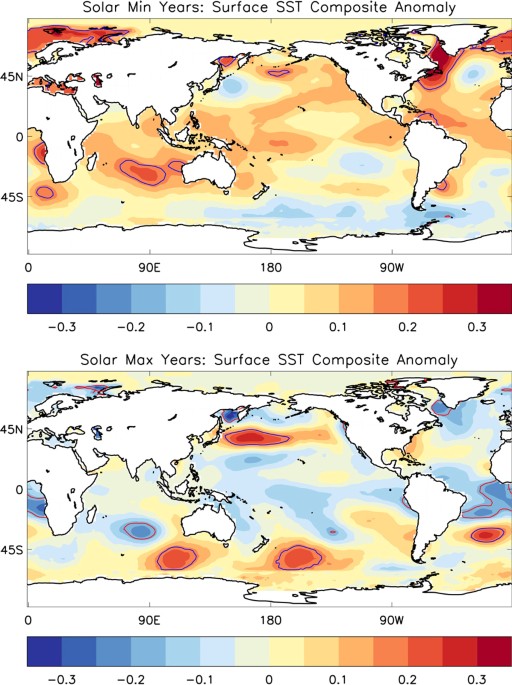
Tropical Pacific SST composites using NOAA Extended V4 (ERSST) data for solar Max (Top) and Min years (Bottom) during DJF. Levels usually significant up to 95% level are overlaid by opposite coloured contour. Plots are generated using IDL software, version 8 with the data from NOAA/OAR/ESRL PSD, Boulder, Colorado, USA, from their website at (http://www.esrl.noaa.gov/psd/).

Importantly, the analysis shows little to no solar influence upon the ENSO 3.4 ocean sector, but as the graph above shows the effect is much broader. Roy concludes that ENSO operates mostly independently of solar influence. Even more striking is the result for NH winter, showing solar minima associated with generally warmer SST and maxima generally cooler. Dr. Roy explains the solar influence in terms of two separate processes.  Bottom up is fluctuations in SSTs while top-down is UV effects upon the stratosphere extending downward expressed in SLP differentials.

For a discussion of the solar/climate mechanism there is  Solar cyclic variability can modulate winter Arctic climate by Indrani Roy  Scientific Reportsvolume 8, Article number: 4864 (2018). Excerpts in italics with my bolds.

Abstract

This study investigates the role of the eleven-year solar cycle on the Arctic climate during 1979–2016. It reveals that during those years, when the winter solar sunspot number (SSN) falls below 1.35 standard deviations (or mean value), the Arctic warming extends from the lower troposphere to high up in the upper stratosphere and vice versa when SSN is above. The warming in the atmospheric column reflects an easterly zonal wind anomaly consistent with warm air and positive geopotential height anomalies for years with minimum SSN and vice versa for the maximum. Despite the inherent limitations of statistical techniques, three different methods – Compositing, Multiple Linear Regression and Correlation – all point to a similar modulating influence of the sun on winter Arctic climate via the pathway of Arctic Oscillation. Presenting schematics, it discusses the mechanisms of how solar cycle variability influences the Arctic climate involving the stratospheric route. Compositing also detects an opposite solar signature on Eurasian snow-cover, which is a cooling during Minimum years, while warming in maximum. It is hypothesized that the reduction of ice in the Arctic and a growth in Eurasia, in recent winters, may in part, be a result of the current weaker solar cycle.

Results

In summary, for solar Min years, the warm air column is associated with positive geopotential height anomalies and an easterly wind, which reverses during Max years. Such NAM feature is clearly evident supporting the hypothesis of communicating a solar signal to Arctic via winter NAM (North Annular Mode).
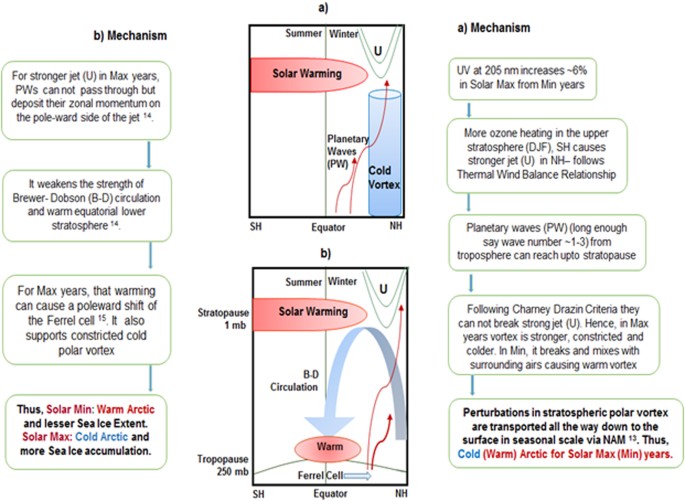
Above: Mechanism to describe the stratospheric pathway for solar cycle variability to influence the Arctic climate. Mechanisms for (a) discuss a route where perturbation in the upper stratospheric polar vortex is transported downwards and impacts the Arctic on a seasonal scale via the winter NAM (flowchart is presented on the right). Mechanisms for (b) discusses the route that involves upper stratospheric polar vortex, tropical lower stratosphere, Brewer-Dobson circulation and Ferrel cell (flowchart is presented to the left). It is created using images or clip art available from Powerpoint.

During DJF, Arctic sea ice extent suggests a strong correlation with SSN (99% significant) and even with AOD (95% significant) (Table 3a). SSN is also found to be strongly correlated with AO (95% significant). Figure 8a shows that significant correlation between Arctic sea ice extent and SSN is still present in other seasons as well. However, the correlation between SSN and AO is only significant in DJF, confirming that the possible route of solar influence on winter Arctic sea ice is via the AO. On the other hand, the influence of AO on Arctic sea ice extent is not present during winter. It is strongest during JJA, though fails to exceed a significant threshold of 95% level.
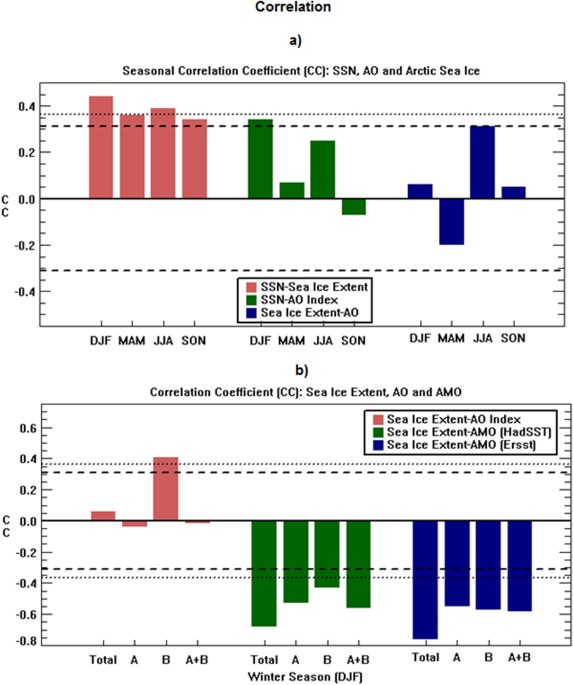
Results of Correlation Coefficient (c.c) between Sea Ice Extent and various other parameters. (a) Seasonal c.c. for four different seasons are presented using other parameters as SSN and AO, and (b) c.c. for the winter season in different regions using other parameters as AO and AMO. Significant levels of 95% and 99% using a students ‘t-test’ are marked by dashed line and dotted line respectively. Plots are prepared using IDL software, version 8.

In terms of oceanic longer-term variability, here we particularly focus on the AMO and find a strong connection between sea ice and AMO in winter, agreeing with previous studies45,46. Earlier discussions suggested that there are few differences in region A and B relating to trend (Figs S6 and S7), but correlation technique indicated a very strong anti-correlation between the winter AMO index and sea ice in all regions of our considerations (Fig. 8b)). Even using two different data sources (HadSST and ERSST) we arrive at similar results, and it is also true for overall sea ice extent. It could also be possible that, in region B, due to a strong presence of AO influence of the sun, it may mask some of the influence of the longer-term trend (seen in Fig. 2) to suggest a lesser trend, as also noted in Figs S6 and S7.

This Matters As We Reach Solar Minimum for Cycle 24
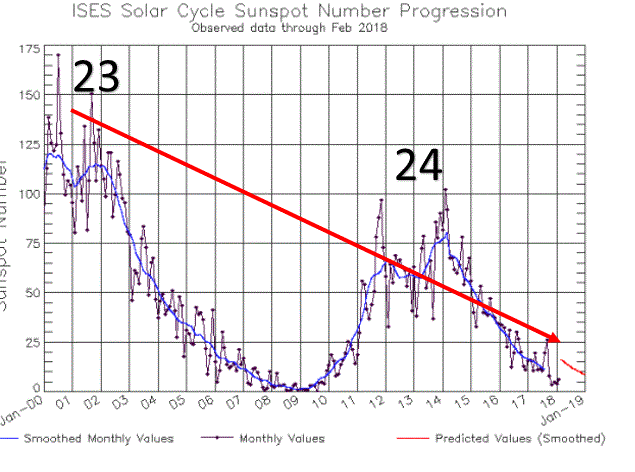
The latest observations show this solar cycle is over, perhaps the next one beginning.  With no sunspots seen since June, this is unusually quiet.

The solar surface at the moment is “Spotless” and has been for a month.

Summary

The sun is the primary source of energy in the earth/atmosphere system, but the actual role of the sun and related mechanisms to support varied regional climate responses and its seasonality around the world, are still poorly understood. Solar energy output varies in cycles, of which the 11-year cyclic variability is one of the most crucial ones. It causes differences in the amount of solar energy absorbed in the UV part of the spectrum within the upper stratosphere, varying from 6 to 8%. Such variation is believed to be one of the most important solar energy outputs to influence the climate of the earth and that knowledge of cyclic behaviour can also be used for future prediction purposes. Apart from solar UV related effects on earth’s climate, studies also identified effects related to solar particle precipitation.

Various studies have also detected an influence of the El Nino Southern Oscillation (ENSO)22 and the Pacific Decadal Oscillation (PDO) on Arctic sea ice. An association between the sun and ENSO are discussed in various research. Because of related complexities along with various linear and nonlinear couplings among major modes of variability, the role of the sun on Arctic air temperatures and sea ice extent and related mechanisms remains poorly understood/explored.

While many studies point to anthropogenic influences on the long-term sea ice decline, this study is motivated by the potential links between the sun and the surface climate through stratospheric processes. Alongside warming in the Arctic, a cooling is noticed around Eurasian sector despite continuing rise of greenhouse gas concentrations. Various modelling groups, however, made unsuccessful efforts to detect an association between Eurasian cooling and Arctic sea-ice decline. In this work, we evaluate the impact of the solar 11-year cycle, measured in terms of solar sunspot number (SSN), as a driving factor to modulate Arctic and surrounding climate. The influences of SSN on various surface parameters, such as Sea Level Pressure (SLP), Sea Surface Temperature (SST), and the polar stratosphere are well recognised. If there is indeed a link between the solar cycle and Arctic climate, it is possible that the 11-year solar cycle can be used to improve seasonal and decadal predictions of sea ice.  In the present study, we use a combination of observational and reanalysis datasets to uncover relationships between the sun’s variability and Arctic surface climate, via the modulation of NAM and downward propagation of anomaly from upper stratospheric winter polar vortex.

Our result suggests the latest rapid decline of sea ice around the Arctic in the recent winter decade/season could also have contributions from the current weaker solar cycle. The last 14 years are dominated by solar Min years and have only one Max. This is unlike other previous years, where the number of Max and Min years were evenly distributed (five each). The cumulative effect from the past 13 solar Min years could have played a role in the current record decline of the last winter, 2017. The current weaker solar cycle may also have contributions on increase in winter snow cover around the Eurasian sector.

Presenting schematics and flowcharts, we discussed mechanisms of how solar cycle variability influences Arctic climate. In the first route, perturbation in the upper stratospheric polar vortex is transported downwards and modulates the Arctic in a seasonal scale via the winter NAM. Another route was shown, which could involve upper stratospheric polar vortex, tropical lower stratosphere, Brewer-Dobson circulation and Ferrel cell. It could also reinforce the findings of the ‘Solar Max (Min) – cold (warm) Arctic’ scenario.


Minnesota Valve Turners Case Dismissed Without Necessity Defense

“Stunning”: State Court Silences Climate Experts Set to Testify in Valve Turners’ Necessity Defense Trial  “Four days before trial, for no apparent reason, the court eviscerated our defense, and essentially overruled itself.” Excerpts below in italics with my bolds.

Minneapolis October 8, 2018 In an eleventh hour decision, a Minnesota court “eviscerated” the defense of three activists—whose landmark trial began Monday for their 2016 multi-state #ShutItDown action that temporarily disabled tar sands pipelines crossing the U.S.-Canada border—by barring experts from testifying that their civil disobedience was necessary because fossil fuels are driving the global climate crisis.

While all charges against Steve Liptay, who filmed the Minnesota action, have been dropped, valve turners Emily Nesbitt Johnston and Annette Klapstein, along with their support person, Benjamin Joldersma, are still facing felony charges under Minnesota state law. Their legal team will now have to present their “necessity defense” without the slate of experts who had agreed to explain the climate crisis and the impact of civil disobedience to the jury.

This “stunning” reversal came after an appeals court ruled in April that they could present a necessity defense, a decision upheld by the Minnesota Supreme Court in June. The rulings were celebrated by climate activists and experts nationwide as courts in Washington, North Dakota, and Montana blocked requests from fellow valve turners’ on trial for the 2016 action to present such a defense.

“We were looking forward to entrusting this case to a Minnesota jury of our peers to decide after hearing expert scientists and social scientists discuss the facts of climate change and public policy,” said Klapstein, a retired attorney.

“By requiring us to establish the necessity defense, without allowing us to use our planned expert testimony to do so, the court has placed an overwhelming burden on us,” she added. “I’m baffled by the surreal nature of this court’s decision and timing.”

“Four days before trial, for no apparent reason, the court eviscerated our defense, and essentially overruled itself,” said Johnston. “It is impossible for us to properly defend ourselves without expert testimony.”

Experts that had planned to testify include climate scientists Dr. Jim Hansen, Dr. Mark Seeley, and Dr. Peter Reich; public health expert Dr. Bruce Synder; Princeton professor Dr. Martin Gilens; Harvard Law professor Lawrence Lessig; nonviolent direct action historian and Albert Einstein Institution executive director Jamila Raqib; 350.org co-founder Bill McKibben; and oil infrastructure expert Dr. Anthony Ingraffea.

Minnesota District Court Judge Robert Tiffany claimed their testimonies would be confusing to the jury, Climate Direct Action said in a statement on Monday.

“The irony is that the judge may be proving our point—we acted as we did because we know that the paralysis and myopia of the executive and legislative branches with regard to climate change mean that the political system itself must be shaken up if there is to be any hope for all of us,” Johnston noted. “We were hoping that the judiciary might show the way.”

Minnesota judge tosses charges midtrial against 3 activists 
Excerpts in italics with my bolds.

MINNEAPOLIS (AP) October 9, 2018 A Minnesota judge abruptly dismissed charges against three climate change activists during their trial on Tuesday, saying prosecutors failed to prove that the protesters’ attempt to shut down two Enbridge Energy oil pipelines caused any damage.

Clearwater County District Judge Robert Tiffany threw the case out after prosecutors rested their case and before the protesters could use their defense: that the threat of climate change from using crude oil drilled from Canadian tar sands was so imminent that the activists’ actions were not only morally right, but necessary.

The attorneys had long fought to use a “necessity defense” during the trial of the three Seattle-area residents, two of whom admitted turning the emergency shut-off valves on the northwest Minnesota pipelines in 2016 as part of a coordinated action in four states. Such a defense has been used by other activists protesting pipelines.

Their attorney, Lauren Regan, acknowledged outside the courthouse in Bagley that she and her clients were surprised that the judge granted their motion to dismiss the case. The three defendants faced felony charges involving criminal damage to critical public service facilities. They could have faced up to a year in jail, according to prosecutors.

“I’m very relieved the state of Minnesota acknowledged that we did no damage and intended to do no damage,” defendant Emily Johnston said. “I also admit that I am disappointed that we did not get to put on the trial that we hoped for.”

Clearwater County Attorney Alan Rogalla declined to comment afterward.

Climate change activists have increasingly turned to direct actions against oil and gas pipelines, with mixed legal success . Valve-turner cases in other states resulted in convictions that are under appeal. A Massachusetts judge in March cleared 13 gas pipeline protesters who used a necessity defense. While the cases generally have not set binding legal precedents, activists are hoping they help legitimize direct action as a tactic against climate change.

In the Minnesota case, Johnston and Annette Klapstein readily acknowledged turning the emergency shut-off valves on two Enbridge Energy pipelines on Oct. 11, 2016, near Leonard, about 210 miles (338 kilometers) northwest of Minneapolis. A third defendant, Ben Joldersma, called in a warning to Enbridge. Charges were earlier dropped against a fourth defendant.

They did it as part of a coordinated action by Climate Direct Action activists to shut down five Canadian tar sands crude pipelines in Minnesota, North Dakota, Montana and Washington state. A total of 11 activists were charged in the four states.

Calgary, Alberta-based Enbridge temporarily shut down the two pipelines as a precaution before any damage occurred. The company issued a statement Tuesday saying the protest was “reckless and dangerous.”

“The individuals involved in these activities claimed to be protecting the environment, but they did the opposite and put the environment and the safety of people at risk — including themselves, first responders and neighboring communities and landowners,” the company said.

The defendants insisted there was never any danger.

“We did everything in our power to make sure this was a safe action, and we did this to protect our children and all of your children from the devastating effects of climate change,” Klaptstein said at the activists’ news conference afterward.

While the judge took the unusual step of allowing allowed the necessity defense in a ruling last October, he said the defendants had to clear a high legal bar to succeed. He said the defense applies “only in emergency situations where the peril is instant, overwhelming, and leaves no alternative but the conduct in question.”

The valve turners had hoped to put climate change itself on trial by presenting expert witnesses who would have backed up their claims that climate change was making natural disasters worse, and that the threat of climate change from Canadian tar sands crude — which generates more climate-damaging carbon dioxide than other forms of oil — was so imminent that they had no legal alternatives. But they never got the chance.

Summary

I am not sure what to make of this.  The rejection of expert climatists is encouraging since the courts are in no position to judge scientific positions.  The dismissal of the charges in a way avoided a messy situation for the court.  If no damage was done, it was the easy way out to dismiss the charges before going through a show trial before a jury, and as an additional benefit preventing grandstanding by professional activists.

N. Atlantic Still Cooling in 2018

RAPID Array measuring North Atlantic SSTs.

For the last few years, observers have been speculating about when the North Atlantic will start the next phase shift from warm to cold.

Source: Energy and Education Canada

An example is this report in May 2015 The Atlantic is entering a cool phase that will change the world’s weather by Gerald McCarthy and Evan Haigh of the RAPID Atlantic monitoring project. Excerpts in italics with my bolds.
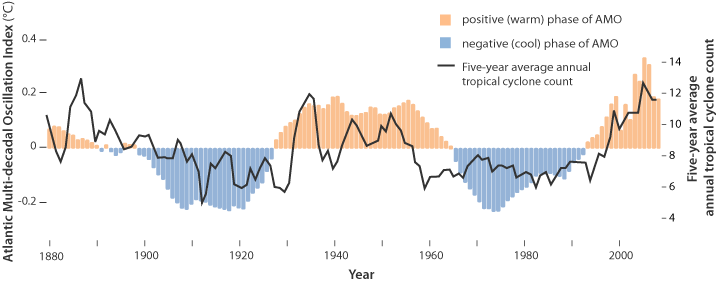
This is known as the Atlantic Multidecadal Oscillation (AMO), and the transition between its positive and negative phases can be very rapid. For example, Atlantic temperatures declined by 0.1ºC per decade from the 1940s to the 1970s. By comparison, global surface warming is estimated at 0.5ºC per century – a rate twice as slow.

In many parts of the world, the AMO has been linked with decade-long temperature and rainfall trends. Certainly – and perhaps obviously – the mean temperature of islands downwind of the Atlantic such as Britain and Ireland show almost exactly the same temperature fluctuations as the AMO.

Atlantic oscillations are associated with the frequency of hurricanes and droughts. When the AMO is in the warm phase, there are more hurricanes in the Atlantic and droughts in the US Midwest tend to be more frequent and prolonged. In the Pacific Northwest, a positive AMO leads to more rainfall.

A negative AMO (cooler ocean) is associated with reduced rainfall in the vulnerable Sahel region of Africa. The prolonged negative AMO was associated with the infamous Ethiopian famine in the mid-1980s. In the UK it tends to mean reduced summer rainfall – the mythical “barbeque summer”.Our results show that ocean circulation responds to the first mode of Atlantic atmospheric forcing, the North Atlantic Oscillation, through circulation changes between the subtropical and subpolar gyres – the intergyre region. This a major influence on the wind patterns and the heat transferred between the atmosphere and ocean.

The observations that we do have of the Atlantic overturning circulation over the past ten years show that it is declining. As a result, we expect the AMO is moving to a negative (colder surface waters) phase. This is consistent with observations of temperature in the North Atlantic.

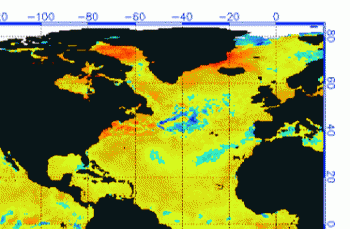
Cold “blobs” in North Atlantic have been reported, but they are usually a winter phenomena. For example in April 2016, the sst anomalies looked like this

But by September, the picture changed to this

And we know from Kaplan AMO dataset, that 2016 summer SSTs were right up there with 1998 and 2010 as the highest recorded.

As the graph above suggests, this body of water is also important for tropical cyclones, since warmer water provides more energy.  But those are annual averages, and I am interested in the summer pulses of warm water into the Arctic. As I have noted in my monthly HadSST3 reports, most summers since 2003 there have been warm pulses in the north atlantic.
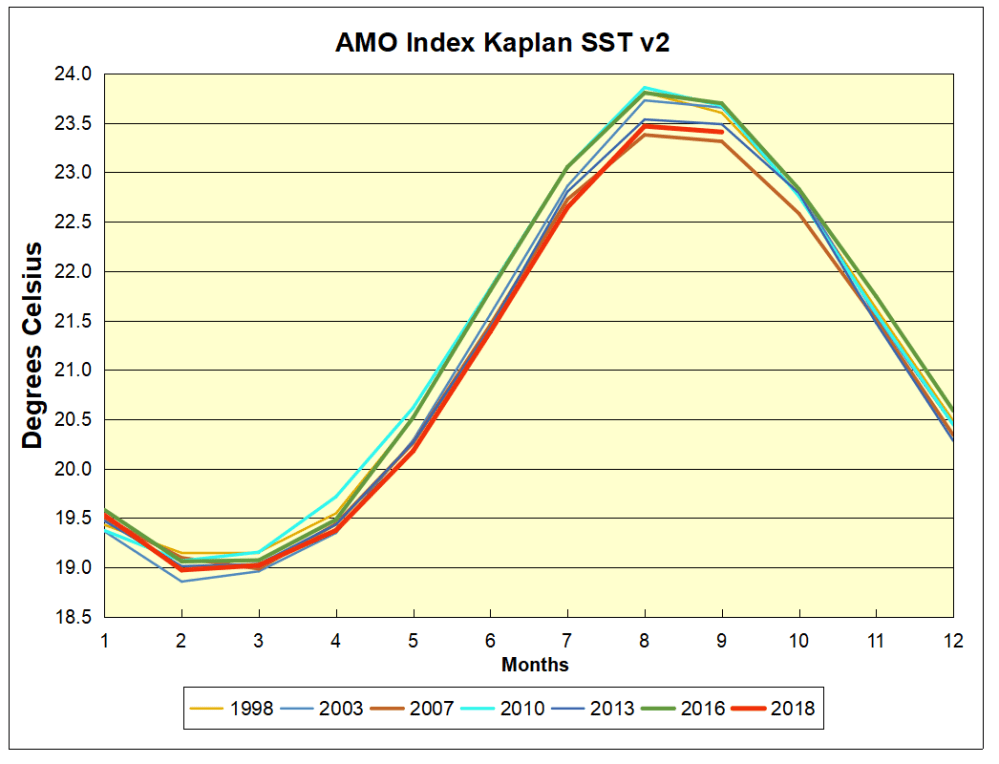
AMO September 2018The AMO Index is from from Kaplan SST v2, the unaltered and untrended dataset. By definition, the data are monthly average SSTs interpolated to a 5×5 grid over the North Atlantic basically 0 to 70N.  The graph shows warming began after 1992 up to 1998, with a series of matching years since.  September is the second hottest month in the dataset, and note the considerable drop from 2017 to August 2018.  Because McCarthy refers to hints of cooling to come in the N. Atlantic, let’s take a closer look at some AMO years in the last 2 decades.

AMO decade 092018

This graph shows monthly AMO temps for some important years. The Peak years were 1998, 2010 and 2016, with the latter emphasized as the most recent. The other years show lesser warming, with 2007 emphasized as the coolest in the last 20 years. Note the red 2018 line is at the bottom of all these tracks.  Most recently September 2018 is 0.29C lower than September 2016, and is the coolest September since 2011.

With all the talk of AMOC slowing down and a phase shift in the North Atlantic, we expect that the annual average for 2018 will confirm that cooling has set in.  Through September the momentum is certainly heading downward, despite the band of warming ocean  that gave rise to now receding European heat waves.
cdas-sflux_sst_atl_1


Climate Science, Ethics and Religion

Thanks to an insightful post at Climate Scepticism (here), we have a recent quote from former US President Obama:

“You have to believe in facts. Without facts there’s no basis for cooperation. If I say this is a podium and you say this is an elephant, it’s going to be hard for us to cooperate…I can’t find common ground if somebody says climate change is just not happening, when almost all of the world’s scientists tell us it is.”

This statement is the starting point for that poster to explore ways that even the most accomplished scientists have in the past shared beliefs that were valid only as fashionable at the time.  In this post, I want to consider first why a lawyer like Obama gets science wrong, and secondly to consider the moral and religious confusion regarding our climate.

Science is Trial And Error, not Case Law

In the legal world, cases are judged and rulings become precedent for later cases that arise.  Thus principles become established, settled facts for jurists to follow.  Scientists operate in a different world, one where experiments provide evidence that an assumption successfully predicts how things work in nature.  But that premise can be overturned by subsequent experiments, so scientific laws are always tentative.

In short, lawyers proceed by deduction, going from the accepted generality to the particular instance.  Scientists refer to generalities, but induction is their primary method of discovery.  Science proceeds from the particular to arrive at general conclusions, sometimes overturning a previous generality.

A previous post Degrees of Climate Truth was based upon work by Andy May in discussing how climate assertions can be seen in various stages of development toward scientific truth.

072516_1631_factsandthe1

In Table 1 we can see that the comparison of man-made climate change and the possibility of a man-made climate catastrophe are not really comparable to the theories of gravity and evolution. Man-made climate change is more than an idea, it is based on some observations and reasonable models of the process have been developed and can be tested. But, none of the models have successfully predicted any climatic events. Thus, they are still a work-in-progress and not admissible as evidence supporting a scientific theory.

Ethical and Religious Dimensions

Climate assertions come from people based on moral and religious frameworks.

This post is background to exploring the ethical and religious dimensions of the climate change movement. It is also important to recognize the human journey regarding morality.

Moral Models

The ethic of Good vs. Evil is a teleological paradigm, going all the way back to Plato, but still a reference for some today. This model asserts that values can be determined as eternal truths, applicable in all times and places.

Most people have moved to an ethic of Right vs. Wrong, a legal paradigm. Here morality is relative to a society that determines what is morally acceptable or not. And of course, there are variations both among different places, and within a single society over time.

Modern ethics has taken an additional step to an ethic of Responsibility vs. Irresponsibility, a contextual paradigm. Now moral behavior seeks the largest possible context: “the greatest good for the greatest number.” This can lead to some strange choices, such as suicide bombers or pro-life advocates who justify murdering abortion clinic doctors.  The perversion arises when an actor excludes some living things, or whole classes of creatures from the context of responsibility.

Summary: Climate Morality

Some climate activists/alarmists are operating with a good vs. evil model, in which their understanding of good separates people into sheep and goats.  Describing others as “deniers” shows this clearly.  And in the recent US senate supreme court nomination hearings we have an additional stark reminder that members of even advanced societies can seek to disqualify others as human beings, not simply block them from positions of responsibility.

Obama is clearly operating in the right vs. wrong model, as expected given his legalistic education.  Since laws and legal principles are relative to a social framework and heritage, social proof is all that is required for him to accept climate assertions as true.  At the same time, that mentality requires dismissing and demeaning the viewpoints contrary to the consensus. Such tribalism is contrary to scientific discourse, and in the extreme case like Rwanda the others can be considered “cockroaches” and exterminated.

It should be clear that when climate alarmists appeal to saving the planet for future generations, they are applying contextual ethics. Less obvious is the ancient religious notion that by making sacrifices, we humans can assure more favorable weather. These days, fossil fuels have become the sacrificial lamb required by Mother Nature to play nice with human beings.  In the past, people made images and worshiped them, thinking that they could control nature in that way.  These days, we make computer models whose projections are sure to scare the bejesus out of us.

See also: What’s wrong with the legal brief on climate change Facts Omitted by Climatists

mrz092215dapr_s878x638

Preview of Minnesota Pipeline Trial

pipeline-sectionalising-valves

Previous posts reported on the series of trials of climate activist “valve turners” who sabotaged pipelines transporting crude oil from Canada.  The last remaining trial proceeds on October 8, 2018 in Minnesota, and it is one where defendants will be allowed to mount a “necessity defense.”  For insight into the implications, here is a timely article Invoking the ‘Necessity Defense’ in Pipeline Sabotage Prosecutions. It was written by Troutman Sanders Pipeline Practice.  Excerpts below in italics with my bolds.

Opposition to new pipeline construction has grown in recent years, moving from public comment to litigation to physical protest and vandalism. In 2016 alone, several coordinated actions led to trespass and vandalism of pipelines and pipeline facilities in multiple states, some of which were prosecuted as felony criminal acts. The defendants in several of these cases have raised a “necessity defense” to their actions, and two courts have now allowed that defense to proceed.

The necessity defense derives from old common law (i.e., not established by statute, although many states have now codified the defense by statute). A necessity defense is not often invoked, in part because the initial element of the defense is to admit that a crime was committed. A defendant must then persuade the court that the otherwise criminal act was required to prevent a greater harm. The requisite showing is typically that (1) there was a significant threat of imminent hazard; (2) there was an immediate need to act; (3) no other alternative was available to prevent the harm; and (4) no greater harm was caused by the prohibited act(s). Examples of successful invocations of the necessity defense include commandeering a private car to carry victims to a hospital, taking food to keep a child from starving, escaping jail because it was on fire, etc. In order to use the defense successfully, the defendant bears a heavy burden to show that no practical alternative to the criminal act was available, and that the criminal act did not create a greater harm.

In a Minnesota case, four individuals were criminally charged for turning valves on a crude oil pipeline, in an attempt to stop the flow of crude oil. The defendants admitted that their acts violated state law, but then claimed the necessity defense. The trial court allowed the defendants to assert the defense and present evidence at trial of the ‘greater harm’ presented by oil pipelines, in the form of climate change. Prosecutors appealed that ruling, and on April 23, 2018, the Minnesota Court of Appeals in a split decision rejected the prosecution’s challenge and agreed that the defendants should be allowed to present the defense. Minnesota v. Klapstein, No. A17-1649 (Minn. Ct. App. Apr. 23, 2018). The dissenting judge stated that ‘there is no direct, causal connection between defendants’ criminal trespass and global warming.’ A court in Massachusetts has similarly allowed defendants who trespassed and/or vandalized pipeline property to present a necessity defense. Other courts in Montana, North Dakota and Washington have rejected the defense. See, e.g., Montana v. Higgins, DC-16-18 (Mont. Dist. Ct. Nov. 22, 2017).

Allowing defendants to present evidence in support of a necessity defense does not mean the defendants have been excused from criminal conduct; they are simply allowed to make that argument at trial. No case has yet accepted the necessity defense to exonerate criminal acts involving pipelines, although some cases have been downgraded to civil fines and resolved after a necessity defense was presented. The burden on the defense remains high, not only to show that no other practical alternative existed, but also to establish a causal connection between a specific pipeline and global climate change. The same week that the Minnesota Court of Appeals allowed a necessity defense to proceed, API and AOPL released their “2018 Annual Liquids Pipeline Report”, documenting the continuing reduction in number and scope of incidents releasing oil to the environment. Similarly, as natural gas pipelines continue to replace coal for electric generation, the amount of greenhouse gas emissions has gone down.

Pipeline opponents have turned to direct acts of vandalism targeting pipelines in the past few years, although those actions present the risk of causing an incident and may result in criminal convictions. Federal law enforcement agencies are monitoring these activities under laws related to Homeland Security and terrorism, beyond state laws for criminal trespass [see prior Pipelaws.com post on November 27, 2017]. In furtherance of that approach, the same week that Minnesota allowed pipeline activists to proceed with a necessity defense, the adjacent State of Iowa signed into law a more strict felony provision applicable to interference with pipelines and other ‘critical energy infrastructure.’ The new law is called the ‘Critical Infrastructure Sabotage’ act, and carries potential penalties of up to 25 years in prison and fines of $100,000.

Sabotage or vandalism of pipelines presents a significant risk of causing substantial harm that could result in killing or injuring people or damaging the environment. Admitting to a crime – particularly a felony criminal act – is a steep price to pay for a defense to those acts. The stakes are high, as are the consequences

Background:  Wheels of Pipeline Justice Grind Slowly.

Wheels of justice grind slow but grind fine — Sun Tzu, Art of War

An update on pipeline disruption cases is provided by Blake Nicholson, Associated Press, January 9, 2018, in Great Falls Tribune: Court cases from coordinated 2016 pipeline protest delayed. Excerpts below with my bolds.

BISMARCK, N.D. — Several court cases stemming from a coordinated pipeline protest in four states have been delayed, including one where an appeals court is deciding whether to allow two women to argue their law-breaking was necessary to prevent a greater harm.

Eleven activists with the group Climate Direct Action were arrested on Oct. 11, 2016, when they tried to either shut down pipelines in North Dakota, Minnesota, Montana and Washington state or film the attempts. The activists said they were protesting fossil fuels and supporting people demonstrating against the Dakota Access oil pipeline, which was still under construction.

The activists broke into private property and turned shutoff valves at five pipelines that moved oil from Canada to the U.S.

In Minnesota, prosecutors have asked a state appeals court to reverse a judge’s ruling that would allow two women to use the so-called necessity defense. The defense is popular among environmental activists who argue that global warming caused by fossil fuels is the greater harm, though legal experts say it’s a long-shot defense.

The appeal delayed the December trial of Seattle-area residents Emily Johnston and Annette Klapstein, who are accused of closing valves on two pipelines in northwestern Minnesota. The trial hasn’t been rescheduled, and their attorney said he doesn’t expect a resolution on the appeal until spring.

Sentencing has been delayed for two men who were barred from using necessity-defense arguments. Leonard Higgins of Portland, Oregon, was convicted in November of criminal mischief and trespassing in Montana; his January sentencing was pushed to March 20 after his attorneys asked for more time, according to court documents. Seattle resident Michael Foster also was set for sentencing this month in North Dakota but the hearing was moved to February because of a timing conflict.

A Washington state case was resolved last year when Ken Ward, of Corbett, Oregon, was convicted of burglary and sentenced to two days in jail plus community supervision and community service. He, too, wasn’t allowed to use the necessity defense.

The six other arrested activists were accused of filming the vandalism. Prosecutors dropped charges against two of them in Washington. Trials are pending for two others in Minnesota and one in Montana, and one activist is to be sentenced in North Dakota the same day as Foster.

Summary

Actually, I don’t mind them taking it slow, so long as they get it right.  Still, putting global warming on trial during this winter weather would have provided at least poetic justice, less so in springtime.

Background:

On civil disobedience by climate activists:

A Valve Turner’s Trial: Mostly guilty

Minnesota judge allows ‘necessity defense’ in pipeline case

On the Judiciary unprepared for such cases: Critical Climate Intelligence for Jurists (and others)


Cooling by Land, or Cooling by Sea?

banner-blog

With apologies to Paul Revere, this post is on the lookout for cooler weather with an eye on both the Land and the Sea.  UAH has updated their tlt (temperatures in lower troposphere) dataset for September.   Previously I have done posts on their reading of ocean air temps as a prelude to updated records from HADSST3. This month I will add a separate graph of land air temps because the comparisons and contrasts are interesting as we contemplate possible cooling in coming months and years.

Presently sea surface temperatures (SST) are the best available indicator of heat content gained or lost from earth’s climate system.  Enthalpy is the thermodynamic term for total heat content in a system, and humidity differences in air parcels affect enthalpy.  Measuring water temperature directly avoids distorted impressions from air measurements.  In addition, ocean covers 71% of the planet surface and thus dominates surface temperature estimates.  Eventually we will likely have reliable means of recording water temperatures at depth.

Recently, Dr. Ole Humlum reported from his research that air temperatures lag 2-3 months behind changes in SST.  He also observed that changes in CO2 atmospheric concentrations lag behind SST by 11-12 months.  This latter point is addressed in a previous post Who to Blame for Rising CO2?

The August update to HadSST3 will appear later this month, but in the meantime we can look at lower troposphere temperatures (TLT) from UAHv6 which are already posted for August. The temperature record is derived from microwave sounding units (MSU) on board satellites like the one pictured above.

The UAH dataset includes temperature results for air above the oceans, and thus should be most comparable to the SSTs. There is the additional feature that ocean air temps avoid Urban Heat Islands (UHI).  The graph below shows monthly anomalies for ocean temps since January 2015.

UAH Oceans 201809The anomalies over the entire ocean dropped to the same value, 0.12C  in August (Tropics were 0.13C).  Warming in previous months was erased, and September added very little warming back.

Taking a longer view, we can look at the record since 1995, that year being an ENSO neutral year and thus a reasonable starting point for considering the past two decades.  On that basis we can see the plateau in ocean temps is persisting. Since last October all oceans have cooled, with offsetting bumps up and down.

UAHv6 TLT 
Monthly Ocean
Anomalies
Average Since 1995 Ocean 9/2018
Global 0.13 0.15
NH 0.16 0.18
SH 0.11 0.13
Tropics 0.12 0.22

As of September 2018, Global ocean air temps as well as SH and SH are nearly the average since 1995.  The Tropics bumped upward last month. Globally,  in NH and the Tropics, 2018 is the coolest September since 2014. The SH ocean air temps are the coolest September since 2013

Land Air Temperatures Plunged in September.

We sometimes overlook that in climate temperature records, while the oceans are measured directly with SSTs, land temps are measured only indirectly.  The land temperature records at surface stations record air temps at 2 meters above ground.  UAH gives tlt anomalies for air over land separately from ocean air temps.  The graph updated for September is below.
UAH Land 201809

The greater volatility of the Land temperatures is evident, and also the dominance of NH, which has twice as much land area as SH.  Note how global peaks mirror NH peaks.  Thus the importance of the recent drops in NH and SH driving global land temps downward.  A table for Land temperatures is below, comparable to the one for Oceans.

UAHv6 TLT 
Monthly Land
Anomalies
Average Since 1995 Land 9/2018
Global 0.21 0.13
NH 0.23 0.10
SH 0.12 0.14
Tropics 0.14 0.24

In the longer term since 1995, Globally and in NH land temps are well below the average anomalies, while SH is nearly average, and the Tropics above average (though comprising limited surface area).

Summary

TLTs include mixing above the oceans and probably some influence from nearby more volatile land temps.  It is striking to now see NH and Global land temps dropping rapidly.  TLT measures started the recent cooling later than SSTs from HadSST3, but are now showing the same pattern.  It seems obvious that despite the three El Ninos, their warming has not persisted, and without them it would probably have cooled since 1995.  Of course, the future has not yet been written.


UN “Stretches” CO2 Goals

Several articles are in the media discussing UN meetings in progress to move the climate change goal posts from preventing 2C of warming to a goal of 1.5C additional warming. The US have questioned the plausibility of such an ambition, and this post goes into some of the reasons why. At the bottom I shall raise several skeptical points about this whole enterprise, but first we should look at the data UN uses as a trampoline for leaps of faith.

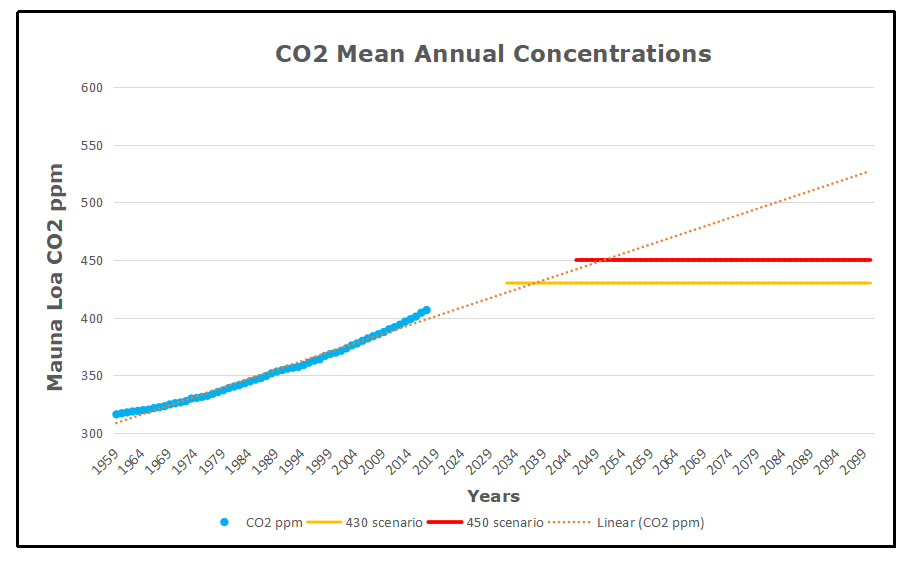
Data on Annual CO2 Concentrations

The annual average concentrations of atmospheric CO2 are reported from Mauna Loa in a dataset accessed from NOAA here. The graph below shows the record.
Note that in 1959 there was 316 ppm of CO2 according to this dataset, and in 2017 the annual average CO2 was 407 ppm. So the rise of 91 ppm over 59 years is a rate of 1.53 ppm per year. Of course the actual interannual differences vary from that average rate, and as we shall see, many recent years have exceeded 2 ppm per year additional CO2. The table below shows all years in the record that added more than 2 ppm of CO2.

Year Added ppm
1973 2.23
1988 2.38
1998 2.97
2003 2.52
2005 2.28
2006 2.1
2010 2.47
2012 2.2
2013 2.67
2014 2.13
2015 2.18
2016 3.38
2017 2.32

Note that as warming increased so also did CO2 in ppm. You can pick out El Nino years in the list, suggesting that ocean outgassing has a large impact on atmospheric CO2.

The larger point is that, for whatever reasons, the annual addition of CO2 has increased this century to a rate of 2.14 over the last 20 years.

UN Aspirational Goalposts

UN insiders have been making a simple case for some years preceding the Paris 2015 accord. IPCC has claimed that in their judgement keeping atmospheric CO2 less than 450 ppm ensures future warming will not exceed 2C. I don’t buy it, but that has been sold to Paris signatories. Now comes increasing the ambition to limit warming to 1.5C, and the same authorities translate that into a limit of 430 ppm of CO2.

These numbers and their logic can be seen in a document from Climate Analytics: Timetables for Zero emissions and 2050 emissions reductions  Excerpts in italics with my bolds.
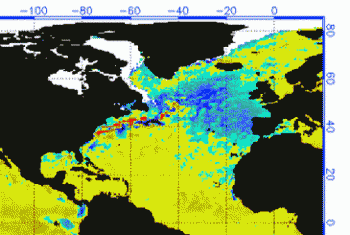
This briefing note outlines suggested time frames for reaching zero global CO2 and total greenhouse gas emissions for the ‘below 2 °C’ and ‘below 1.5 °C by 2100’ limits based on the findings of the Fifth Assessment Report of the Intergovernmental Panel on Climate Change (IPCC AR5) and the 2014 UNEP Emissions Gap Report.

Emissions scenarios leading to GHG concentrations in 2100 of about 450 ppm CO2eq or lower are likely to maintain warming below 2 °C over the 21st century relative to pre-industrial levels. These scenarios are characterized by 40% to 70% global anthropogenic GHG emissions reductions by 2050 compared to 2010, and emissions levels near zero or below in 2100.” (IPCC AR5 SYR) Information in Table SPM.1 of the IPCC AR5 SYR

“A limited number of studies provide scenarios that are more likely than not to limit warming to 1.5 °C by 2100; these scenarios are characterized by concentrations below 430 ppm CO2eq by 2100 and 2050 emission reduction between 70% and 95% below 2010.” (IPCC AR5 SYR)

UN Goals Stretch Beyond Credibility

So let’s look at these two scenarios in relation to observed CO2 in the atmosphere.

The blue line is CO2 in ppm observed at Mauna Loa.  The linear regression line shows the continuation of the 1.53 ppm per year rate projected to the end of this century.  As noted above the blue line is already exceeding the earlier rate.  The orange line shows CO2 hitting 430 ppm in 2032 at the 1.53 rate, or earlier if more recent rates continue.  For example, if the 2.14 ppm per year rate continues, 430 ppm is reached by 2028. The red 450 scenario is reached in 2045. Both scenarios presume zero additional CO2 after those dates.

UN Piles Supposition on Top of Supposition

Previous posts here have taken issue with UN IPCC assertions that rising CO2 causes temperatures to rise and that human fossil fuel emissions cause CO2 to rise.

See: Who to Blame for Rising CO2

CO2 Fluxes, Sources and Sinks

How Climate Law Relies on Paris