October Cooling by Land, or Cooling by Sea?

banner-blog

With apologies to Paul Revere, this post is on the lookout for cooler weather with an eye on both the Land and the Sea.  UAH has updated their tlt (temperatures in lower troposphere) dataset for October.   Previously I have done posts on their reading of ocean air temps as a prelude to updated records from HADSST3. This month I will add a separate graph of land air temps because the comparisons and contrasts are interesting as we contemplate possible cooling in coming months and years.

Presently sea surface temperatures (SST) are the best available indicator of heat content gained or lost from earth’s climate system.  Enthalpy is the thermodynamic term for total heat content in a system, and humidity differences in air parcels affect enthalpy.  Measuring water temperature directly avoids distorted impressions from air measurements.  In addition, ocean covers 71% of the planet surface and thus dominates surface temperature estimates.  Eventually we will likely have reliable means of recording water temperatures at depth.

Recently, Dr. Ole Humlum reported from his research that air temperatures lag 2-3 months behind changes in SST.  He also observed that changes in CO2 atmospheric concentrations lag behind SST by 11-12 months.  This latter point is addressed in a previous post Who to Blame for Rising CO2?

The October update to HadSST3 will appear later this month, but in the meantime we can look at lower troposphere temperatures (TLT) from UAHv6 which are already posted for October. The temperature record is derived from microwave sounding units (MSU) on board satellites like the one pictured above.

The UAH dataset includes temperature results for air above the oceans, and thus should be most comparable to the SSTs. There is the additional feature that ocean air temps avoid Urban Heat Islands (UHI).  The graph below shows monthly anomalies for ocean temps since January 2015.

UAH Oceans 201810

Open image in new tab to enlarge.

The anomalies over the entire ocean dropped to the same value, 0.12C  in August (Tropics were 0.13C).  Warming in previous months was erased, and September added very little warming back. In October, NH and the Tropics rose, while SH cooled, resulting in slight warming.

Taking a longer view, we can look at the record since 1995, that year being an ENSO neutral year and thus a reasonable starting point for considering the past two decades.  On that basis we can see the plateau in ocean temps is persisting. Since last October all oceans have cooled, with offsetting bumps up and down.

UAHv6 TLT 
Monthly Ocean
Anomalies
Average Since 1995 Ocean 10/2018
Global 0.13 0.17
NH 0.16 0.30
SH 0.11 0.08
Tropics 0.12 0.32

As of October 2018, NH ocean air temps as well as the Tropics are twice the long term average, SH is slightly cooler, and the Global anomaly slightly warmer.   In the Tropics and SH, 2018 is the coolest October since 2014. The Global and NH ocean air temps are the coolest October since 2013.

Land Air Temperatures Plunged in September, then Rose in October

We sometimes overlook that in climate temperature records, while the oceans are measured directly with SSTs, land temps are measured only indirectly.  The land temperature records at surface stations record air temps at 2 meters above ground.  UAH gives tlt anomalies for air over land separately from ocean air temps.  The graph updated for October is below.UAH Land 201810

The greater volatility of the Land temperatures is evident, and also the dominance of NH, which has twice as much land area as SH.  Note how global peaks mirror NH peaks.  In October air over NH and the Tropical land surfaces rose, and SH followed suit.  A table for Land temperatures is below, comparable to the one for Oceans.

UAHv6 TLT 
Monthly Land
Anomalies
Average Since 1995 Land 10/2018
Global 0.21 0.33
NH 0.23 0.33
SH 0.19 0.33
Tropics 0.18 0.39

In September land air temps were below the average since 1995.  As the table shows, in October the land air anomalies jumped up well above average, demonstrating the higher volatility of these measures.  Still last month was much cooler than October 2017 in all regions.

Summary

TLTs include mixing above the oceans and probably some influence from nearby more volatile land temps.  It is striking to now see NH and Global land temps dropping rapidly.  TLT measures started the recent cooling later than SSTs from HadSST3, but are now showing the same pattern.  It seems obvious that despite the three El Ninos, their warming has not persisted, and without them it would probably have cooled since 1995.  Of course, the future has not yet been written.


Midterms: Voters Rejected Most Climate Energy Propositions


Nevada voters passed Question 6 on Tuesday, which calls for the state to use 50 percent renewable energy by the year 2030. Supporters say Question 6 will generate hundreds of millions of dollars in economic activity and create thousands of new Nevada jobs (sic)

“Clean energy is putting Nevadans to work, with more than 25,000 strong employed in 2017,” said Ray Fakhoury, state policy manager with the national business group Advanced Energy Economy, in statement. “By increasing the state’s renewable standard, Nevada has set itself up to continue reaping the economic benefits for years to come.”

Major corporations, including casinos and data centers, have recently been investing heavily in renewable energy in Nevada. With the passage of Question 6, Alli Gold Roberts, senior manager of state policy with Ceres, said the state is “poised to continue to attract corporate renewable energy investment.”

Question 6, to boost the RPS to 50 percent, will now have to pass again in 2020 in order to become law. AEE’s Fakhoury said consumers could see benefits sooner than that. “Passing with wide support, the legislature and governor-elect should move forward in the upcoming legislative session to enact this landmark increase,” he said.

Corporate clean energy buyers invested heavily in a separate Nevada ballot measure, Question 3, which sought to deregulate Nevada’s retail electricity market, but the measure was ultimately unsuccessful. Question 3 was the subject of fierce debate. According to the Nevada Independent, it was backed by Sheldon Adelson’s Sands Corp. (Adelson also happens to be a major Republican donor) and the data company Switch, as well as many clean energy and environmental groups.

But there were also concerns about how Question 3 would affect electricity rates and clean energy adoption. The Natural Resources Defense Council, the Sierra Club, Southwest Energy Efficiency Project, and Western Resource Advocates came out against deregulating Nevada’s electricity market because of the disruption they said it would cause to the state’s clean energy progress. NV Energy also opposed Question 3, and planned to spend $30 million on defeating it.

Arizona rejects 50% RPS
Arizona voters overwhelmingly rejected Proposition 127 on Tuesday, a constitutional amendment that would have required 50 percent of the state’s electricity to come from renewable sources by 2030. It’s a significant victory for the state’s largest utility, Arizona Public Service (APS), which spent heavily to oppose the measure. California billionaire Tom Steyer’s political group NextGen America funded efforts in support of the measure.

Proposition 127 was by far the most expensive ballot initiative in Arizona state history. Opponents said the measure would increase electric bills by forcing utilities to build new solar and wind plants, which would result in the early closure of coal plants and the state’s lone nuclear plant. Supporters argued those claims were unfounded given that renewable energy resources are now competitive with fossil fuels, even when coupled with battery storage.

APS was particularly outspoken about losing the Palo Verde nuclear plant if the RPS measure passed. If that plant goes offline, the utility argued, greenhouse gas emissions in the state would rise.

While Proposition 127 has failed, Arizona regulators are still considering a proposal to increase Arizona’s RPS to 80 percent by 2050 and broaden it to also include nuclear power. APS generally supports that plan.

Colorado votes down a fracking ban
Colorado voters rejected a measure Tuesday that would have blocked new oil and gas drilling within 2,500 feet of homes, schools and other occupied areas.

Proposition 112 stemmed from complaints that fracking was encroaching on populated areas, creating health and safety concerns. An analysis showed that the measure would have blocked new oil and gas wells on 85 percent of nonfederal land in Colorado, which is America’s fifth-largest gas-producing and seventh-largest oil-producing state.

Washington state rejects a carbon price — again
Washington state has failed, once again, to pass a carbon tax. Initiative 1631, the Carbon Emissions Fee Measure, would have set a carbon fee starting at $15 per ton in 2020, rising to around $55 per ton in 2035, depending on inflation.

This is the second major election in a row in which Washington voters have rejected a ballot initiative that would put a price on carbon emissions. The first such ballot was proposed in 2016 and failed.

Tuesday’s loss may cast doubt on the broader narrative that states will lead on climate action in the absence of federal leadership, or it could signal that Americans simply aren’t ready to get behind a carbon tax. Alternatively, it could have all come down to spending. Supporters of Initiative 1631 spent at least $12 million to advance the measure, while opponents spent more than $25 million.

Source: Greentech Media  Midterms 2018: Mixed Results for the Renewable Energy Agenda

Background: Five States to Vote on Futile Climate Proposals

Global Warming Favors Rats over Cute Animals

John Robson writes at Nation Post Why will global warming kill only the cute animals?
Excerpts in italics with my bolds

Only loathsome species will flourish, according to certain studies. Why? Because ‘rat explosion’ is more alarming than ‘two degrees’

Rats! It’s global warming again. Can’t we get a break?

No, literally. Not from the warming part. It’s actually quite chilly outside and there hasn’t been any measurable planetary warming since 1999. From the rats. Big ugly swarms of them spreading disease and biting your kids.

Monday’s Post headline actually said “Explosion of rats feared as climate warms.” So the good news is rats aren’t increasing any more than temperature. The bad news is a further increase in passive-voice predictions of doom.

Before the rats reach your face I’d like to note that this “news” story is remarkable for having the plumbing on the outside. It starts “Scientists have shown that the likely 2 degrees of global warming to come this century will be extremely dangerous, but, you know, ‘2 degrees’ is hardly a phrase from horror films. How about ‘rat explosion?’ ”

Exactly. It’s openly a story about hype not science. “The physics of climate change doesn’t have the same fear factor as the biology.” So cue the Fu Manchu-style mandibles, mould and plague because “it’s the creatures multiplying in outbreaks and infestations that generate horror.”

Beach invaded by red crabs.

It’s also old news. I’ve collected quite the file of creepy-crawly global-warming scare stories over the years including “super-sized, extra-itchy poison ivy” (Ottawa Citizen 2006), “tropical and potentially lethal fungus” (Globe and Mail 2007), venomous jellyfish the size of refrigerators (MSNBC 2009), mass starvation and the extinction of humanity (Globe and Mail 2009), bigger and more frequent kidney stones (Ottawa Citizen 2008), soggy pork chops (Globe and Mail 2009), asthma, allergies and runny noses (NBC 2015) and the conflict in Darfur (Ottawa Citizen 2007). Not to mention drought and flooding and the migration of France’s fabled wine industry to … um… Scotland (all Ottawa Citizen 2007), where they’ll be pairing a fine ruby Loch Ness with rat haggis I suppose. Och aye mon.

I could go on and on. But they already did. And don’t go reading these stories and thinking they offer evidence, or rather speculation, that warmth benefits life generally.

Far from it. Virtually none of these stories has anything cute or cuddly flourishing. Unless you count stray cats in Toronto (National Post 2007). Instead it’s a strangely un-PC combination of lookism and speciesism.

If you want to be a climate alarmist without all that tedious mucking about with facts, here’s how. Make a collage of many living things. Circle everything you’d like to see, up close or from a distance, like coral reefs or polar bears. Now predict their catastrophic decline if it gets two degrees warmer. (Don’t worry about them having somehow staggered through the Holocene Climatic Optimum. Pretend it never happened and hope it’s gone in the morning.)

Now circle all the really hideous stuff. Eyes on stalks, pointy noses, smelly, slimy. Predict a huge increase. Chocolate? Gone. (Globe and Mail 2012.) Diarrhea-inducing vibrio bacteria? Coming soon to an intestine near you. (MSNBC 2011.) Zika, or crabs swarming beaches? Oh yeah. (NBC 2016.) Insomnia, insanity and suicide? You bet. (Washington Post 2017, National Post 2018, Globe and Mail 2018.) Beer? Going going … (Guardian 2018.)

Friends, scientists, countrypersons, lend me your ears before some warmth-surfing pest chews them off. Even if a rapidly warming Earth were bad for man and beast, and our fault, the initial phases, with temperatures well within the range since the last glaciation ended 12,000 years back, can’t bring only bad consequences. No wind is that ill.

Nor is it plausible that every single new study says it’s worse than scientists thought. (Especially if “the science is settled”). If it were real science somebody would occasionally discover there’s a bit more time, climate somewhere will improve in the short run, some species that doesn’t have you fumbling for the Raid will flourish briefly. But no.

Even if climate change is going to have wiped out “sea spiders as large as a dinner plate” (Ottawa Citizen 2002) it’s the tragic loss of a unique species. But mostly it’s bumble bees (NBC 2015) or the coelacanth (Ottawa Citizen 2001), which cruised through the Permian-Triassic and Cretaceous-Paleogene mass extinctions but now dangles by a rhetorical thread. Oh, and the emperor penguin gets it too (NBC 2014). Plus plankton (Globe and Mail 2000). And walruses (NBC 2014).

As for the rats, one pregnant female will send 15,000 loathsome offspring a year straight to your suburb. None of their natural enemies will flourish. And “Rats are just the beginning … populations of dangerous crop-eating insects are likely to explode … Similar horrors lurk offshore … a population explosion of purple sea urchins — ‘cockroaches of the ocean’ — is choking out other denizens of Pacific kelp forests … we’re all sharing this warming planet, and at the very least surely we can unite against a future filled with rats.”

Or one filled with imaginary horrors? No? Rats.

See also:Alarmists: Global Warming Destroys Good Bugs and Multiplies Bad Bugs

2018 N. Atlantic the Coolest

RAPID Array measuring North Atlantic SSTs.

For the last few years, observers have been speculating about when the North Atlantic will start the next phase shift from warm to cold.

Source: Energy and Education Canada

An example is this report in May 2015 The Atlantic is entering a cool phase that will change the world’s weather by Gerald McCarthy and Evan Haigh of the RAPID Atlantic monitoring project. Excerpts in italics with my bolds.

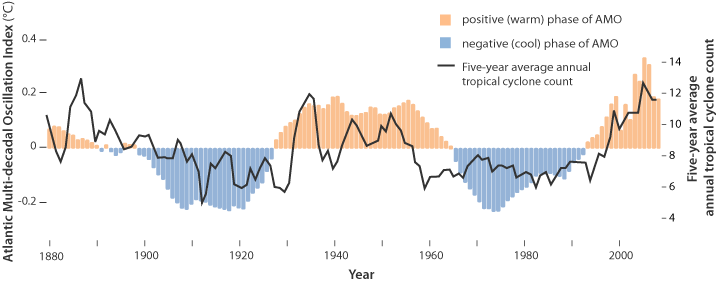
This is known as the Atlantic Multidecadal Oscillation (AMO), and the transition between its positive and negative phases can be very rapid. For example, Atlantic temperatures declined by 0.1ºC per decade from the 1940s to the 1970s. By comparison, global surface warming is estimated at 0.5ºC per century – a rate twice as slow.

In many parts of the world, the AMO has been linked with decade-long temperature and rainfall trends. Certainly – and perhaps obviously – the mean temperature of islands downwind of the Atlantic such as Britain and Ireland show almost exactly the same temperature fluctuations as the AMO.

Atlantic oscillations are associated with the frequency of hurricanes and droughts. When the AMO is in the warm phase, there are more hurricanes in the Atlantic and droughts in the US Midwest tend to be more frequent and prolonged. In the Pacific Northwest, a positive AMO leads to more rainfall.

A negative AMO (cooler ocean) is associated with reduced rainfall in the vulnerable Sahel region of Africa. The prolonged negative AMO was associated with the infamous Ethiopian famine in the mid-1980s. In the UK it tends to mean reduced summer rainfall – the mythical “barbeque summer”.Our results show that ocean circulation responds to the first mode of Atlantic atmospheric forcing, the North Atlantic Oscillation, through circulation changes between the subtropical and subpolar gyres – the intergyre region. This a major influence on the wind patterns and the heat transferred between the atmosphere and ocean.

The observations that we do have of the Atlantic overturning circulation over the past ten years show that it is declining. As a result, we expect the AMO is moving to a negative (colder surface waters) phase. This is consistent with observations of temperature in the North Atlantic.

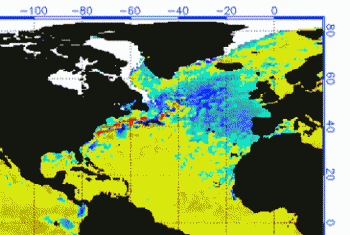
Cold “blobs” in North Atlantic have been reported, but they are usually a winter phenomena. For example in April 2016, the sst anomalies looked like this

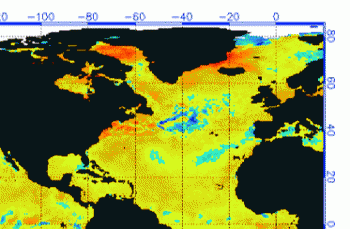
But by September, the picture changed to this

And we know from Kaplan AMO dataset, that 2016 summer SSTs were right up there with 1998 and 2010 as the highest recorded.

As the graph above suggests, this body of water is also important for tropical cyclones, since warmer water provides more energy.  But those are annual averages, and I am interested in the summer pulses of warm water into the Arctic. As I have noted in my monthly HadSST3 reports, most summers since 2003 there have been warm pulses in the north atlantic.
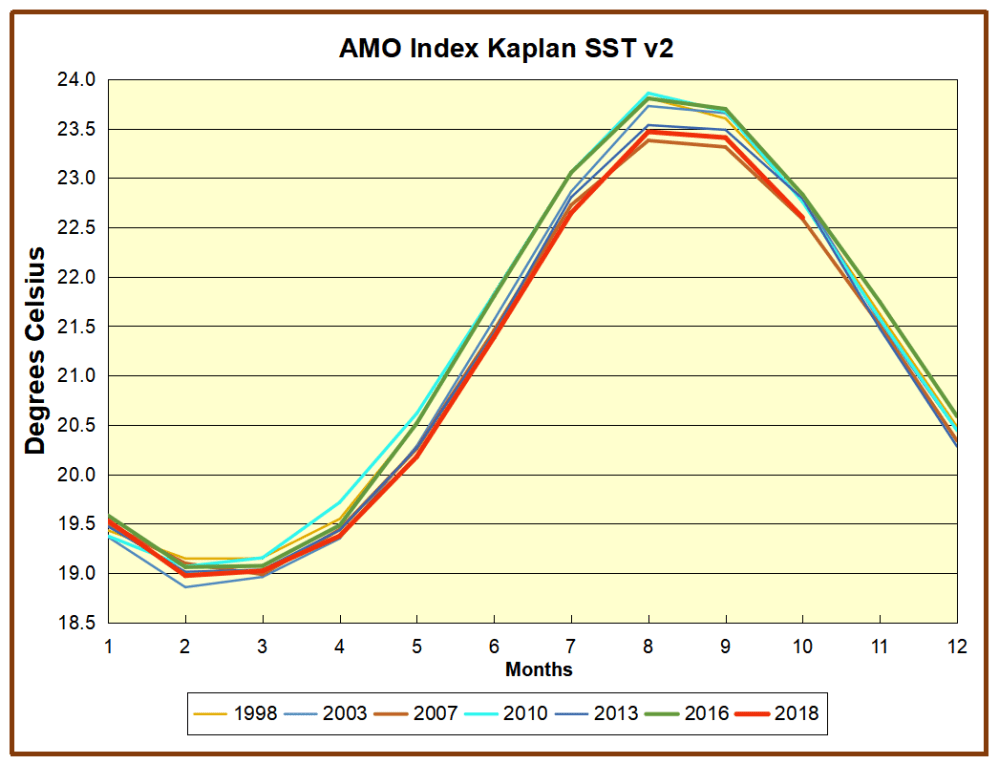
AMO October 2018The AMO Index is from from Kaplan SST v2, the unaltered and untrended dataset. By definition, the data are monthly average SSTs interpolated to a 5×5 grid over the North Atlantic basically 0 to 70N.  The graph shows warming began after 1993 up to 1998, with a series of matching years since.  October is the fourth hottest month in the dataset, and note the considerable drop from 2017 to October 2018.  Because McCarthy refers to hints of cooling to come in the N. Atlantic, let’s take a closer look at some AMO years in the last 2 decades.

AMO decade 102018

This graph shows monthly AMO temps for some important years. The Peak years were 1998, 2010 and 2016, with the latter emphasized as the most recent. The other years show lesser warming, with 2007 emphasized as the coolest in the last 20 years. Note the red 2018 line is at the bottom of all these tracks.  Most recently October 2018 is 0.29C lower than October 2017, and is the coolest October since 2011.

With all the talk of AMOC slowing down and a phase shift in the North Atlantic, we expect that the annual average for 2018 will confirm that cooling has set in.  Through October the momentum is certainly heading downward, despite the band of warming ocean  that gave rise to European heat waves last summer.cdas-sflux_ssta_atl_1


Kid’s Climate Lawsuit Update Nov. 5


img

As predicted in the previous post (reprinted below), US lawyers are following the Supreme’s lead by again asking the Ninth Circuit Court of Appeals to dismiss the case.  At the same time, one motion filed at the Oregon District Court asks for a stay of proceedings there pending a ruling by the Appeals Court.  Another motion asks the Oregon court to again consider narrowing the scope of the lawsuit.  The documents can be accessed at Columbia’s climate litigation website for Juliana vs. United States  Some excerpts in italics with my bolds, followed by the Nov. 2 post.

From Petition to Court of Appeals:

If the district court grants certification and stays all proceedings, as the Supreme Court has signaled that it should, it will obviate the need for this Court’s intervention by way of mandamus. If, however, the district court declines to grant certification (despite the Supreme Court’s clear guidance to the contrary), this Court would need to intervene to provide the pretrial appellate review contemplated by the Supreme Court. 

To be clear, the government hopes that this Court’s intervention through extraordinary relief will not be necessary. The government is doing everything in its power to persuade the district court to follow the Supreme Court’s guidance and to certify its decisions for interlocutory appeal. But if the district court declines to do so, this Court should intervene to provide the relief that the Supreme Court has expressly stated “may be available in” this Court — and that is plainly warranted given the fundamental defects in Plaintiffs’ action. ECF No. 416, at 2.

Previous Post Nov. 2, 2018:  Supremes Kick Kids Lawsuit Down the Road

Last night the US Supreme justices refused the federal government’s petition to end the Oregon district court case. The media headlines will say this action allows the case to start, but that is not what happened. The real story concerns procedural hurdles and comes from Scotusblog, not from the green industry PR department (when did yellow journalism change colors?).

Everyone knows this issue will eventually come to the Supreme Court for a ruling. Some judges in black robes will take the heat for telling the truth about the case’s fatal legal flaws. So the Supremes will allow (not prevent) the lower courts to do their job to declare the suit out of bounds. All the while they know any lower ruling will be appealed by the losing side to the top later on.

As you will see, there are probably two more procedural maneuvers before the case can proceed to address the merits, or lack thereof. Yesterday, the Supremes noted that the Ninth District Court of Appeals twice refused the fed’s petition on grounds that no longer pertain. Thus, they suggest that the Ninth take a third kick at this can, perhaps this time actually engaging the issues.

If, as everyone expects, the Ninth follows their San Francisco-based leftist leanings and summarily grants no relief, then the feds can come back to the Supremes having no longer any recourse at lower levels. BTW, two Supreme Justices said they were ready now to grant the federal petition as it stands.

Amy Howe writes truthfully Justices refuse to block climate-change trial. Excerpts below in italics with my bolds.

Tonight the Supreme Court declined to intervene to block the trial in a lawsuit filed by a group of children and teenagers who have asked a federal district court in Oregon to order the federal government to prepare and put in place a plan to phase out fossil-fuel emissions. Although the justices’ ruling formally cleared the way for a trial in the case to go forward, the court stressed that the government may be able to get the relief that it is seeking in the U.S. Court of Appeals for the 9th Circuit, and it did not foreclose the possibility that the government could return to the Supreme Court yet again.

Text of Supreme Court Order ORDER IN PENDING CASE

This afternoon’s order was the latest chapter in the climate-change lawsuit, which was originally filed in 2015, during the Obama administration. The plaintiffs contend that the federal government’s conduct has led to a “dangerous climate system,” in conflict with their constitutional right to a “climate system capable of sustaining human life.”

The federal government first came to the Supreme Court in the case last summer, asking the justices to block discovery and a trial until the U.S. Court of Appeals for the 9th Circuit could rule on the government’s request to have the case dismissed or, at the very least, put on hold. But the justices declined to step in, describing the government’s request as “premature.” At the same time, the justices acknowledged that the plaintiffs’ claims are “striking” and that there are “substantial grounds for difference of opinion” on whether those claims belong in court at all; they also emphasized that the district court should “take these concerns into account in assessing the burdens of discovery and trial, as well as the desirability of a prompt ruling on” other motions that the government had filed seeking dismissal of the plaintiffs’ claims.

With a trial looming, the government returned to the Supreme Court again last week, complaining that the district court had declined to “meaningfully narrow” the scope of the case. It asked the justices to either end the lawsuit altogether or, at a minimum, review the district court’s rulings allowing the case to go forward. Chief Justice John Roberts, who at the time handled emergency requests from the geographic area that includes Oregon, agreed to put discovery and the trial on hold temporarily to give the plaintiffs an opportunity to respond to the government’s application.

In their response, the plaintiffs urged the justices to allow the trial to go forward. They noted that most pretrial fact-finding had already been completed, with the only remaining discovery “extremely limited.” The only harm that the government has cited to justify putting the trial on hold, the plaintiffs argued, is that it would otherwise be required to “participate in the normal process of trial and await appellate consideration until after final judgment” – which, in the plaintiffs’ view, is an “ordinary” burden rather than the kind of irreparable harm necessitating emergency relief. By contrast, they suggested, stopping the trial now “will disrupt the integrity of the judiciary’s role as a check on the political branches and will irreparably harm these children.” Indeed, the plaintiffs asserted, discovery and a trial are essential because the district court can’t decide the questions presented by their lawsuit, involving the plaintiffs’ legal right to bring the lawsuit and the allocation of power between the different branches of government, until the facts have been better developed.

In a reply brief, the federal government pushed back, telling the justices that it had made every possible effort in the lower courts to avoid reaching this point, but had been unsuccessful. The government emphasized that what the plaintiffs are asking the federal courts to do is extraordinary, “nothing less than a complete transformation of the American energy system – including the abandonment of fossil fuels.” Such a request, the government continued, “has no place in federal court,” so that granting the government a reprieve from the upcoming trial would “preserve the judiciary’s essential role under the Constitution.”

The government added that, contrary to the plaintiffs’ assurances, the prospect winning on appeal after an “extensive” trial had already taken place would provide little comfort to the government, because of the enormous amount of resources that would have to be devoted to pretrial preparations and the trial itself.

In an unsigned three-page order issued tonight, the Supreme Court explained that it would block the proceedings in the district court only if the government were likely to prevail on its request for an order of the Supreme Court, in particular, requiring the district court to dismiss the case. But the government cannot meet that standard, the justices continued, because it may be able to get the relief that it is seeking in the 9th Circuit. The court acknowledged that the 9th Circuit has twice turned down requests from the government to order the district court to dismiss the case, but it reasoned that the 9th Circuit did so because of the prospect that the plaintiffs’ claims against the government might eventually be dismissed through more conventional avenues. The justices concluded that those “reasons are, to a large extent, no longer pertinent” with a 50-day trial – which had been scheduled for October 29 – looming.

The court therefore denied the federal government’s request to keep the trial on hold “without prejudice” – that is, leaving open the possibility that the dispute could return to the Supreme Court again. The justices’ earlier order putting the trial on hold temporarily, to give them time to consider the government’s request, is terminated. Justices Clarence Thomas and Neil Gorsuch indicated that they would have granted the government’s request.

Background from previous post Supreme Justice Grants Stay of Kids Lawsuit

On Friday, Chief Justice Roberts stayed the discovery and trial of Juliana vs. US, pending responses from the plaintiffs to issues raised by the defense.  Report from The News Review in italics with my bolds.

The U.S. Supreme Court on Friday granted a stay in the climate trial, Juliana v. United States, pending a response from the plaintiffs.

The Department of Justice asked the Supreme Court on Tuesday to dismiss the case brought by 21 young plaintiffs Thursday.

In a news release issued Friday afternoon, Meg Ward with Our Children’s Trust said the plaintiff’s legal team is working on its response, which it will file Monday.

The Supreme Court order states a response is due by Oct. 24.

Julia Olson, one of the lawyers representing the young plaintiffs, said the prosecution is confident that once the court receives the response the trial will proceed.

“As the Supreme Court has recognized in innumerable cases, review of constitutional questions is better done on a full record where the evidence is presented and weighed by the trier of fact,” Olson said in a news release.

The lawsuit alleges the federal government has violated young people’s constitutional rights through policies that have caused a dangerous climate.

They have said their generation bears the brunt of climate change and that the government has an obligation to protect natural resources for present and future generations.

The young people say government officials have known for more than 50 years that carbon pollution from fossil fuels was causing climate change and that policies on oil and gas deprive them of life, liberty and property. They also say the government has failed to protect natural resources as a “public trust” for future generations.

The lawsuit wants a court to order the government to stop permitting and authorizing fossil fuels, quickly phase out carbon dioxide emissions to a certain level by 2100 and develop a national climate recovery plan.

The Trump administration got a temporary reprieve on the case after also asking the 9th U.S. Circuit Court of Appeals, which rejected the request in July.

“The latest attempt to get the U.S. Supreme Court to stop the trial does not appear to be based on any new evidence or arguments. The only new element is an additional Supreme Court justice,” said Melissa Scanlan, a professor at Vermont Law School, who is not involved in the case.

Kavanaugh replaced the more moderate Anthony Kennedy.

Scanlan said the Trump administration is trying to avoid “what they’re expecting to be a 50-day trial focused on climate disruption.” The trial in Eugene was expected to wrap up in January.

CNN added this:

Solicitor General Noel Francisco asked the justice to stop any further discovery and the pending trial while the government appeals the lower court opinion.

In his filing, Francisco lambasted the suit, calling it “an attempt to redirect federal environmental and energy policies through the courts rather than through the political process, by asserting a new and unsupported fundamental due process right to certain climate conditions.”

Francisco’s language echoes some of the remarks Attorney General Jeff Sessions made before the conservative Heritage Foundation on Monday. “Judicial activism is therefore a threat to our representative government and the liberty it secures,” Sessions said. “In effect, activist advocates want judges who will do for them what they have been unable to achieve at the ballot box. It is fundamentally undemocratic.”

The filings may be welcomed by some of the justices but they also put others in an uncomfortable position, and there’s a risk of going to the well too often.

“The Supreme Court unquestionably has the authority to provide the extraordinary relief the government is seeking in these cases,” said Steve Vladeck, CNN Supreme Court analyst and professor at the University of Texas School of Law.

“That said, it tends to exercise that authority sparingly,” he added,” and there’s reason to wonder if the government, by repeatedly asking for such unusual relief, might be perceived by at least some of the justices as the boy who cried wolf.”

The text of the  US filing is PETITION FOR A WRIT OF MANDAMUS Contents:

Reasons for granting the petition

A. The government has a clear and indisputable
right to relief from the district court’s refusal to
dismiss this fundamentally misguided suit

1. The district court clearly and indisputably
erred by exercising jurisdiction over the suit
2. The district court clearly and indisputably
erred by allowing the claims to proceed
outside the binding framework of the APA
3. The district court clearly and indisputably
erred by allowing the claims to proceed on the
merits

B. The government has no other adequate means to
attain relief from a fundamentally misguided and
improper trial

C. Mandamus relief is appropriate under the
circumstances

Excerpt from page 26:

Remarkably, the district court rooted its recognition of a fundamental due process right to “a climate system capable of sustaining human life,” App., infra, 141a, in this Court’s recognition of a fundamental right to samesex marriage in Obergefell v. Hodges, 135 S. Ct. 2584 (2015). There is no relationship, however, between a distinctly personal and circumscribed right to same-sex marriage and the alleged right to a climate system capable of sustaining human life that apparently would run indiscriminately to every individual in the United States. The right recognized by the district court has no relationship to any right as “fundamental as a matter of history and tradition” as the right to marry recognized in Obergefell. Id. at 2602.

Background from previous post Supremes Looking at Kids Lawsuit

An Oregon liberal judge is determined to put climate change on trial in Juliana vs US, scheduled to start on October 29, 2018.  But now another pitfall stands in the way.  The Trump administration has asked the Supreme Court to review the legitimacy of the scope of the kids’ claims they have a right to an unchanging favorable climate provided to them by the federal government.  Here is the update from Scotusblog by Amy Howe Government returns in climate change lawsuit  Excerpts in italics with my bolds.

In July, the Supreme Court declined to intervene in a lawsuit filed by a group of 21 children and teenagers who allege that they have a constitutional right to a “climate system capable of sustaining human life.” The justices rejected the federal government’s request to block discovery and a trial until the U.S. Court of Appeals for the 9th Circuit could rule on the government’s petition seeking to have the case dismissed or, at a minimum, to block discovery and the trial temporarily. Today the Trump administration returned to the Supreme Court, asking it once again to put discovery and the trial – now scheduled for the end of October – on hold.

The case was originally filed in 2015 against the Obama administration. The plaintiffs argue that the federal government’s actions are causing a “dangerous climate system,” and they have asked a federal district court in Oregon to order various federal agencies to prepare and implement a remedial plan to phase out fossil-fuel emissions.

When the government asked the justices to step in over the summer, they rejected the request, which they described as “premature.” But the justices also seemed to express some skepticism about the “breadth” of the plaintiffs’ claims, calling them “striking” and observing that there are “substantial grounds for difference of opinion” on whether those claims belong in court at all. The justices instructed the district court to “take these concerns into account in assessing the burdens of discovery and trial, as well as the desirability of a prompt ruling on the” federal government’s other pending motions, which could result in dismissal of some or all of the plaintiffs’ claims.

The government is now back at the court, telling the justices that earlier this week the district court “declined to meaningfully narrow” the plaintiffs’ claims, instead rejecting various government motions that would have ended the case. The government is now asking the court to order the district court to “end this profoundly misguided suit” or, at the very least, review the district court’s rulings allowing the case to go forward; moreover, the government again urges, the Supreme Court should put discovery and the trial on hold while it considers these requests. There would be no real harm to the plaintiffs from doing so, the government stresses, because the plaintiffs are claiming that they have been harmed by the cumulative effects of carbon dioxide emissions over several decades.

The government’s request, signed by U.S. solicitor general Noel Francisco, goes to Chief Justice John Roberts, who currently serves as the circuit justice for the 9th Circuit. Roberts can act on the government’s application immediately or refer it to the full court.

Economist Joseph Stiglitz writes of climate change: “There is a point at which, once this harm occurs, it cannot be undone at any reasonable cost or in any reasonable period of time. Based on the best available science, our country is close to approaching that point.” Credit: Win McNamee/Getty Images

For an insight into the claims being made on behalf of the kids, here is a reprint of a previous post analyzing a brief filed by an IPCC insider.

Climatists Make Their Case by Omitting Facts

One of the world’s top economists has written an expert court report that forcefully supports a group of children and young adults who have sued the federal government for failing to act on climate change. (Source: Inside Climate News  here) Excerpts in italics with my bolds.

Stiglitz, a Columbia University economics professor and former World Bank chief economist, concludes that increasing global warming will have huge costs on society and that a fossil fuel-based system “is causing imminent, significant, and irreparable harm to the Youth Plaintiffs and Affected Children more generally.” He explains in a footnote that his analysis also examines impacts on “as-yet-unborn youth, the so-called future generations.”

But, he says, acting on climate change now—by imposing a carbon tax and cutting fossil fuel subsidies, among other steps—is still manageable and would have net-negative costs. He argues that if the government were to pursue clean energy sources and energy-smart technologies, “the net benefits of a policy change outweigh the net costs of such a policy change.”

“Defendants must act with all deliberate speed and immediately cease the subsidization of fossil fuels and any new fossil fuel projects, and implement policies to rapidly transition the U.S. economy away from fossil fuels,” Stiglitz writes. “This urgent action is not only feasible, the relief requested will benefit the economy.”

Stiglitz has been examining the economic impact of global warming for many years. He was a lead author of the 1995 report of the UN’s Intergovernmental Panel on Climate Change, an authoritative assessment of climate science that won the IPCC the 2007 Nobel Peace Prize, shared with Al Gore.

The Stiglitz expert report submitted to the court is here.

An Example of Intentional Omissions

Since this is a legal proceeding, Stiglitz wrote a brief telling the plaintiffs’ side of the story. In a scientific investigation, parties would assert theories attempting to explain all of the evidence at hand. Legal theories have no such requirement to incorporate all the facts, but rather present conclusions informed by the evidence deemed strongest and most pertinent to one party’s interests.

While the Pope accuses us with the Sin of Emissions, we counter with the Sins of Omissions by him and his fellow activists.

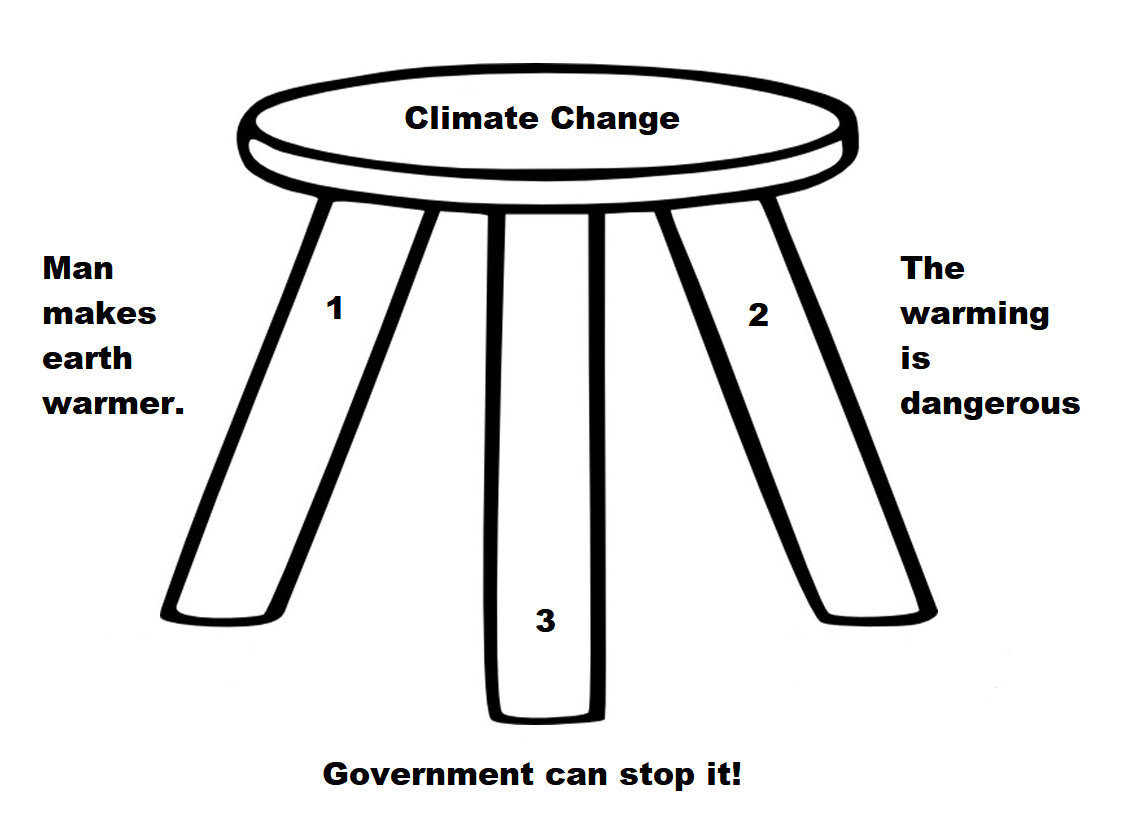
Let’s consider the Stiglitz brief according to the three suppositions comprising the Climatist (Activists and Alarmists) position. Climate change is a bundle that depends on all three assertions to be true.

Supposition 1: Humans make the climate warmer.

As an economist, Stiglitz defers to the IPCC on this scientific point, with references to reports by those deeply involved and committed to Paris Accord and other UN climate programs. In the recent California District Court case (Cities suing Big Oil companies), both sides in a similar vein stipulated their acceptance of IPCC reports as authoritative regarding global warming/climate change.

Skeptical observers must attend to the nuances of what is referenced and what is hidden or omitted in these testimonies. For example, Chevron’s attorney noted that IPCC’s reports express various opinions over time as to human influence on the climate. They noted that even today, the expected temperature effect from doubling CO2 ranges widely from 1.5C to 4.5C. No mention is made that several more recent estimates from empirical data (rather than GCMs) are at the low end or lower.

In addition, there is no mention that GCMs projections are running about twice as hot as observations. Omitted is the fact GCMs correctly replicate tropospheric temperature observations only when CO2 warming is turned off. In the effort to proclaim scientific certainty, neither Stiglitz nor IPCC discuss the lack of warming since the 1998 El Nino, despite two additional El Ninos in 2010 and 2016.

Figure 5. Simplification of IPCC AR5 shown above in Fig. 4. The colored lines represent the range of results for the models and observations. The trends here represent trends at different levels of the tropical atmosphere from the surface up to 50,000 ft. The gray lines are the bounds for the range of observations, the blue for the range of IPCC model results without extra GHGs and the red for IPCC model results with extra GHGs.The key point displayed is the lack of overlap between the GHG model results (red) and the observations (gray). The nonGHG model runs (blue) overlap the observations almost completely.

Further they exclude comparisons between fossil fuel consumption and temperature changes. The legal methodology for discerning causation regarding work environments or medicine side effects insists that the correlation be strong and consistent over time, and there be no confounding additional factors. As long as there is another equally or more likely explanation for a set of facts, the claimed causation is unproven. Such is the null hypothesis in legal terms: Things happen for many reasons unless you can prove one reason is dominant.

Finally, Stiglitz and IPCC are picking on the wrong molecule. The climate is controlled not by CO2 but by H20. Oceans make climate through the massive movement of energy involved in water’s phase changes from solid to liquid to gas and back again. From those heat transfers come all that we call weather and climate: Clouds, Snow, Rain, Winds, and Storms.

Esteemed climate scientist Richard Lindzen ended a very fine recent presentation with this description of the climate system:

I haven’t spent much time on the details of the science, but there is one thing that should spark skepticism in any intelligent reader. The system we are looking at consists in two turbulent fluids interacting with each other. They are on a rotating planet that is differentially heated by the sun. A vital constituent of the atmospheric component is water in the liquid, solid and vapor phases, and the changes in phase have vast energetic ramifications. The energy budget of this system involves the absorption and reemission of about 200 watts per square meter. Doubling CO2 involves a 2% perturbation to this budget. So do minor changes in clouds and other features, and such changes are common. In this complex multifactor system, what is the likelihood of the climate (which, itself, consists in many variables and not just globally averaged temperature anomaly) is controlled by this 2% perturbation in a single variable? Believing this is pretty close to believing in magic. Instead, you are told that it is believing in ‘science.’ Such a claim should be a tip-off that something is amiss. After all, science is a mode of inquiry rather than a belief structure.

Supposition 2: The Warming is Dangerous

Billions of dollars have been spent researching any and all negative effects from a warming world: Everything from Acne to Zika virus. Stiglitz links to a recent Climate Report that repeats the usual litany of calamities to be feared and avoided by submitting to IPCC demands. The evidence does not support these claims.

Stiglitz: It is scientifically established that human activities produce GHG emissions, which accumulate in the atmosphere and the oceans, resulting in warming of Earth’s surface and the oceans, acidification of the oceans, increased variability of climate, with a higher incidence of extreme weather events, and other changes in the climate.

Moreover, leading experts believe that there is already more than enough excess heat in the climate system to do severe damage and that 2C of warming would have very significant adverse effects, including resulting in multi-meter sea level rise.

Experts have observed an increased incidence of climate-related extreme weather events, including increased frequency and intensity of extreme heat and heavy precipitation events and more severe droughts and associated heatwaves. Experts have also observed an increased incidence of large forest fires; and reduced snowpack affecting water resources in the western U.S. The most recent National Climate Assessment projects these climate impacts will continue to worsen in the future as global temperatures increase.

Alarming Weather and Wildfires

But: Weather is not more extreme.
And Wildfires were worse in the past.
But: Sea Level Rise is not accelerating.
Litany of Changes

Seven of the ten hottest years on record have occurred within the last decade; wildfires are at an all-time high, while Arctic Sea ice is rapidly diminishing.

We are seeing one-in-a-thousand-year floods with astonishing frequency.

When it rains really hard, it’s harder than ever.

We’re seeing glaciers melting, sea level rising.

The length and the intensity of heatwaves has gone up dramatically.

Plants and trees are flowering earlier in the year. Birds are moving polewards.

We’re seeing more intense storms.

But: Arctic Ice has not declined since 2007.
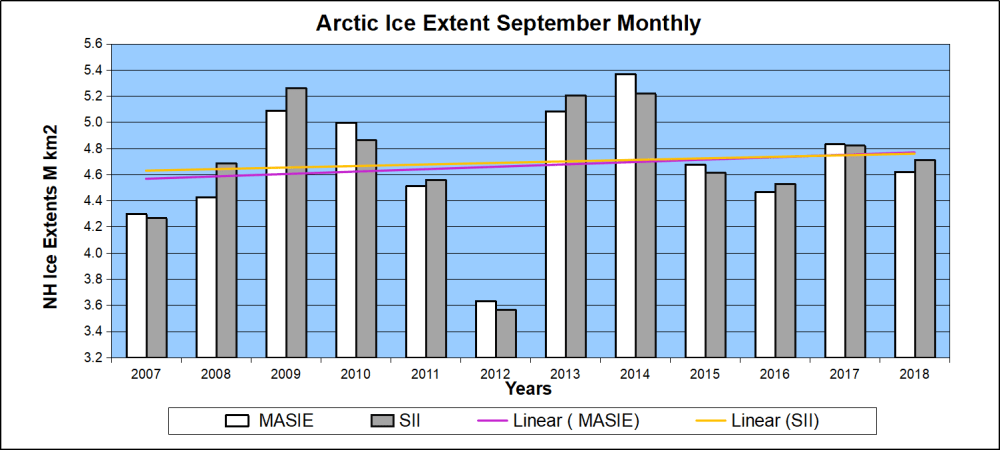
arctic-sept-2007-to-20181

But: All of these are within the range of past variability.

In fact our climate is remarkably stable.
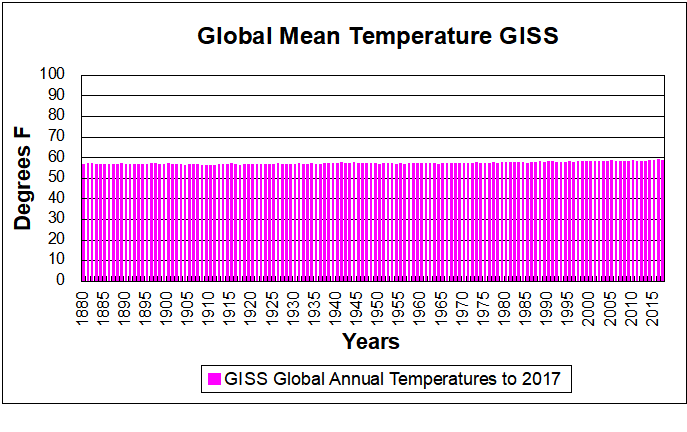
And many aspects follow quasi-60 year cycles.

Climate is Changing the Weather

Stiglitz:  Other potential examples include agricultural losses. Whether or not insurance
reimburses farmers for their crops, there can be food shortages that lead to higher food
prices (that will be borne by consumers, that is, Youth Plaintiffs and Affected Children).
There is a further risk that as our climate and land use pattern changes, disease vectors
may also move (e.g., diseases formerly only in tropical climates move northward).36 This
could lead to material increases in public health costs

But: Actual climate zones are local and regional in scope, and they show little boundary change.


But: Ice cores show that it was warmer in the past, not due to humans.

Supposition 3:  Government Can Stop it!

Here it is blithely assumed that the court can rule the seas to stop rising, heat waves to cease, and Arctic ice to grow (though why we would want that is debatable).  All this will be achieved by leaving fossil fuels in the ground and powering civilization with windmills and solar panels.  While admitting that our way of life depends on fossil fuels, they ignore the inadequacy of renewable energy sources at their present immaturity.

Stiglitz: Conclusion
The choice between incurring manageable costs now and the incalculable, perhaps even
irreparable, burden Youth Plaintiffs and Affected Children will face if Defendants fail to
rapidly transition to a non-fossil fuel economy is clear. While the full costs of the climate
damages that would result from maintaining a fossil fuel-based economy may be
incalculable, there is already ample evidence concerning the lower bound of such costs,
and with these minimum estimates, it is already clear that the cost of transitioning to a
low/no carbon economy are far less than the benefits of such a transition. No rational
calculus could come to an alternative conclusion. Defendants must act with all deliberate
speed and immediately cease the subsidization of fossil fuels and any new fossil fuel
projects, and implement policies to rapidly transition the U.S. economy away from fossil
fuels.

But CO2 relation to Temperature is Inconsistent.

But: The planet is greener because of rising CO2.

But: Modern nations (G20) depend on fossil fuels for nearly 90% of their energy.

But: Renewables are not ready for prime time.

People need to know that adding renewables to an electrical grid presents both technical and economic challenges.  Experience shows that adding intermittent power more than 10% of the baseload makes precarious the reliability of the supply.  South Australia is demonstrating this with a series of blackouts when the grid cannot be balanced.  Germany got to a higher % by dumping its excess renewable generation onto neighboring countries until the EU finally woke up and stopped them. Texas got up to 29% by dumping onto neighboring states, and some like Georgia are having problems.

But more dangerous is the way renewables destroy the economics of electrical power.  Seasoned energy analyst Gail Tverberg writes:

In fact, I have come to the rather astounding conclusion that even if wind turbines and solar PV could be built at zero cost, it would not make sense to continue to add them to the electric grid in the absence of very much better and cheaper electricity storage than we have today. There are too many costs outside building the devices themselves. It is these secondary costs that are problematic. Also, the presence of intermittent electricity disrupts competitive prices, leading to electricity prices that are far too low for other electricity providers, including those providing electricity using nuclear or natural gas. The tiny contribution of wind and solar to grid electricity cannot make up for the loss of more traditional electricity sources due to low prices.

These issues are discussed in more detail in the post Climateers Tilting at Windmills

Footnote regarding mention of “multi-meter” sea level rise.  It is all done with computer models.  For example, below is San Francisco.  More at USCS Warnings of Coastal Floodings
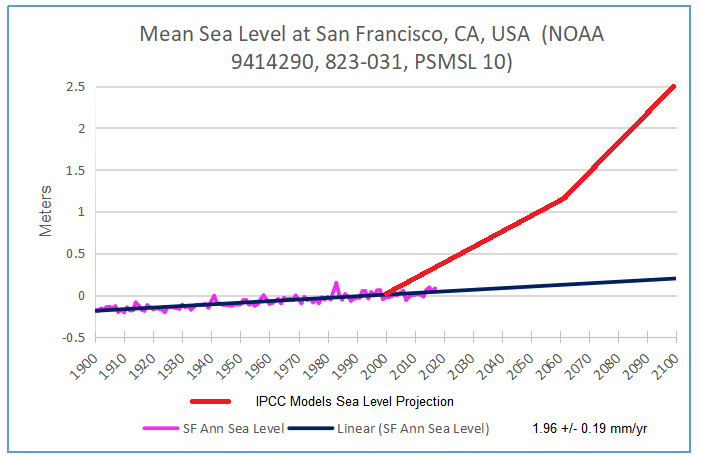
sf-ca-past-projected

dilbert-sins-of-omission-and-comission

BBC Disparages Hydropower


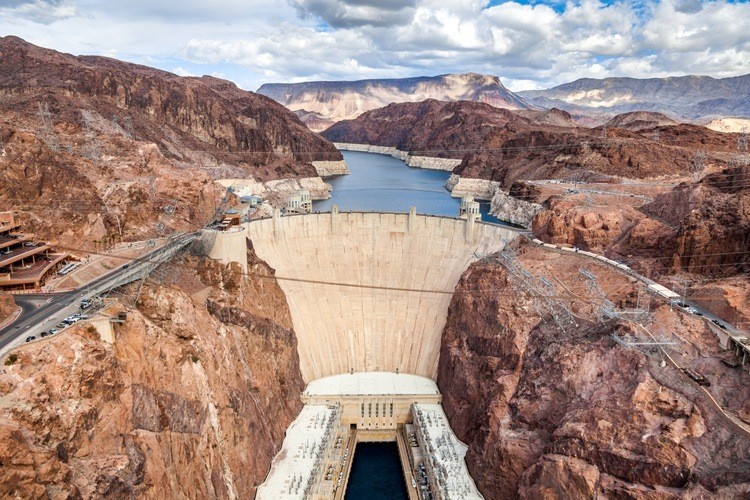
A previous post explained how methane has been hyped in support of climate alarmism/activism. Now we have an additional campaign to disparage hydropower because of methane emissions from dam reservoirs. File this under “They have no shame.” Excerpts below with my bolds.

This week BBC News published Large hydropower dams ‘not sustainable’ in the developing world by an environmental correspondent.  “Sustainable” is a code word that means “little or no change to nature”, so of course building dams is already suspect. In fact, dams provide a range of economic, environmental, and social benefits, including recreation, flood control, water supply, hydroelectric power, waste management, river navigation, and wildlife habitat.  To say dams are “unsustainable” belies their success in the developed world, and seeks to deny those benefits to other nations who want and need those benefits.

BBC News: More than 90% of dams built since the 1930s were more expensive than anticipated. They have damaged river ecology, displaced millions of people and have contributed to climate change by releasing greenhouse gases from the decomposition of flooded lands and forests.

The climate change angle may be the real motivation behind these stories.  On March 5, 2018 a study was published in Environmental Research Letters Greenhouse gas emissions of hydropower in the Mekong River Basin can exceed those of fossil fuel energy sources

“The hydropower related emissions started in the Mekong in mid-1960’s when the first large reservoir was built in Thailand, and the emissions increased considerably in early 2000’s when hydropower development became more intensive. Currently the emissions are estimated to be around 15 million tonnes of CO2e per year, which is more than total emissions of all sectors in Lao PDR in year 2013,” says Dr Timo Räsänen who led the study. The GHG emissions are expected to increase when more hydropower is built. However, if construction of new reservoirs is halted, the emissions will decline slowly in time.

Another recent example of the claim is from Asia Times Global hydropower boom will add to climate change

The study, published in BioScience, looked at the carbon dioxide (CO2), methane (CH4), and nitrous oxide (N2O) emitted from 267 reservoirs across six continents. In total, the reservoirs studied have a surface area of more than 77,287 square kilometers (29,841 square miles). That’s equivalent to about a quarter of the surface area of all reservoirs in the world, which together cover 305,723 sq km – roughly the combined size of the United Kingdom and Ireland.

“The new study confirms that reservoirs are major emitters of methane, a particularly aggressive greenhouse gas,” said Kate Horner, Executive Director of International Rivers, adding that hydropower dams “can no longer be considered a clean and green source of electricity.”

In fact, methane’s effect is 86 times greater than that of CO2 when considered on this two-decade timescale. Importantly, the study found that methane is responsible for 90% of the global warming impact of reservoir emissions over 20 years.

Alarmists are Wrong about Hydropower

Now CH4 is proclaimed the primary culprit held against hydropower. As usual, there is a kernel of truth buried beneath this obsessive campaign: Flooding of biomass does result in decomposition accompanied by some release of CH4 and CO2. From HydroQuebec:  Greenhouse gas emissions and reservoirs

Impoundment of hydroelectric reservoirs induces decomposition of a small fraction of the flooded biomass (forests, peatlands and other soil types) and an increase in the aquatic wildlife and vegetation in the reservoir.

The result is higher greenhouse gas (GHG) emissions after impoundment, mainly CO2 (carbon dioxide) and a small amount of CH4 (methane).

However, these emissions are temporary and peak two to four years after the reservoir is filled.

During the ensuing decade, CO2 emissions gradually diminish and return to the levels given off by neighboring lakes and rivers.

Hydropower generation, on average, emits 50 times less GHGs than a natural gas generating station and about 70 times less than a coal-fired generating station.

The Facts about Tropical Reservoirs

Activists estimate Methane emissions from dams and reservoirs across the planet, including hydropower, are estimated to be significantly larger than previously thought, approximately equal to 1 gigaton per year.

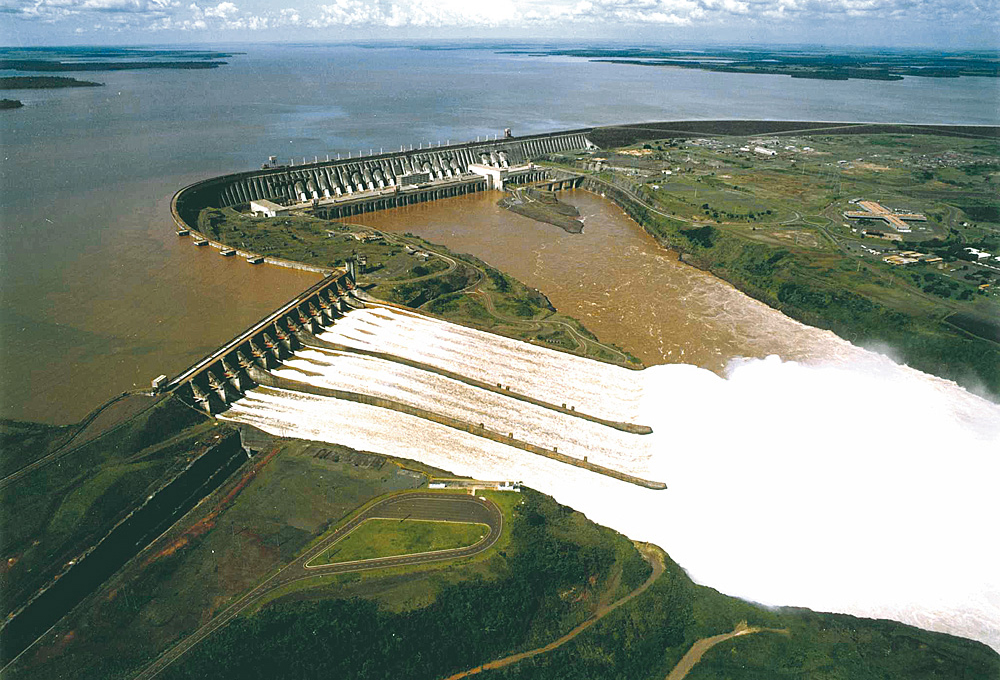
Activists also claim that dams in boreal regions like Quebec are not the problem, but tropical reservoirs are a big threat to the climate. Contradicting that is an intensive study of Brazilian dams and reservoirsGreenhouse Gas Emissions from Reservoirs: Studying the Issue in Brazil

The Itaipu Dam is a hydroelectric dam on the Paraná River located on the border between Brazil and Paraguay. The name “Itaipu” was taken from an isle that existed near the construction site. In the Guarani language, Itaipu means “the sound of a stone”. The American composer Philip Glass has also written a symphonic cantata named Itaipu, in honour of the structure.

Five Conclusions from Studying Brazilian Reservoirs

1) The budget approach is essential for a proper grasp of the processes going on in reservoirs. This approach involves taking into account the ways in which the system exchanged GHGs with the atmosphere before the reservoir was flooded. Older studies measured only the emissions of GHG from the reservoir surface or, more recently, from downstream de-gassing. But without the measurement of the inputs of carbon to the system, no conclusions can be drawn from surface measurements alone.

2) When you consider the total budgets, most reservoirs acted as sinks of carbon in the short run (our measurements covered one year in each reservoir). In other words, they received more carbon than they exported to the atmosphere and to downstream.

3) Smaller reservoirs are more efficient as carbon traps than the larger ones.

4) As for the GHG impact, in order to determine it, we should add the methane (CH4) emissions to the fraction of carbon dioxide (CO2) emissions which comes from the flooded biomass and organic carbon in the flooded (terrestrial) soil. The other CO2 emissions, arising from the respiration of aquatic organisms or from the decomposition of terrestrial detritus that flows into the reservoir (including domestic sewage), are not impacts of the reservoir. From this sum, we should deduct the amount of carbon that is stored in the sediment and which will be kept there for at least the life of the reservoir (usually more than 80 years). This “stored carbon” ranges from as little as 2 percent of the total carbon output to more than 25 percent, depending on the reservoirs.

5) When we assess the GHG impacts following the guidelines just described, all of FURNAS’s reservoirs have lower emissions than the cleanest European oil plant. The worst case – Manso, which was sampled only three years after the impoundment, and therefore in a time in which the contribution from the flooded biomass was still very significant – emitted about half as much carbon dioxide equivalents (CO2 eq) as the average oil plant from the United States (CO2 eq is a metric measure used to compare the emissions from various greenhouse gases based upon their global warming potential, GWP. CO2 eq for a gas is derived by multiplying the tons of the gas by the associated GWP.) We also observed a very good correlation between GHG emissions and the age of the reservoirs. The reservoirs older than 30 years had negligible emissions, and some of them had a net absorption of CO2eq.

Keeping Methane in Perspective

Over the last 30 years, CH4 in the atmosphere increased from 1.6 ppm to 1.8 ppm, compared to CO2, presently at 400 ppm. So all the dam building over 3 decades, along with all other land use was part of a miniscule increase of a microscopic gas, 200 times smaller than the trace gas, CO2.


Background Facts on Methane and Climate Change

The US Senate is considering an act to repeal with prejudice an Obama anti-methane regulation. The story from activist source Climate Central is
Senate Mulls ‘Kill Switch’ for Obama Methane Rule

The U.S. Senate is expected to vote soon on whether to use the Congressional Review Act to kill an Obama administration climate regulation that cuts methane emissions from oil and gas wells on federal land. The rule was designed to reduce oil and gas wells’ contribution to climate change and to stop energy companies from wasting natural gas.

The Congressional Review Act is rarely invoked. It was used this month to reverse a regulation for the first time in 16 years and it’s a particularly lethal way to kill a regulation as it would take an act of Congress to approve a similar regulation. Federal agencies cannot propose similar regulations on their own.

The Claim Against Methane

Now some Republican senators are hesitant to take this step because of claims like this one in the article:

Methane is 86 times more potent as a greenhouse gas than carbon dioxide over a period of 20 years and is a significant contributor to climate change. It warms the climate much more than other greenhouse gases over a period of decades before eventually losing its potency. Atmospheric carbon dioxide remains a potent greenhouse gas for thousands of years.

Essentially the journalist is saying: As afraid as you are about CO2, you should be 86 times more afraid of methane. Which also means, if CO2 is not a warming problem, your fear of methane is 86 times zero. The thousands of years claim is also bogus, but that is beside the point of this post, which is Methane.

IPCC Methane Scare

The article helpfully provides a link referring to Chapter 8 of IPCC AR5 report by Working Group 1 Anthropogenic and Natural Radiative Forcing.

The document is full of sophistry and creative accounting in order to produce as scary a number as possible. Table 8.7 provides the number for CH4 potency of 86 times that of CO2.  They note they were able to increase the Global Warming Potential (GWP) of CH4 by 20% over the estimate in AR4. The increase comes from adding in more indirect effects and feedbacks, as well as from increased concentration in the atmosphere.

In the details are some qualifying notes like these:

Uncertainties related to the climate–carbon feedback are large, comparable in magnitude to the strength of the feedback for a single gas.

For CH4 GWP we estimate an uncertainty of ±30% and ±40% for 20- and 100-year time horizons, respectively (for 5 to 95% uncertainty range).

Methane Facts from the Real World
From Sea Friends (here):

Methane is natural gas CH4 which burns cleanly to carbon dioxide and water. Methane is eagerly sought after as fuel for electric power plants because of its ease of transport and because it produces the least carbon dioxide for the most power. Also cars can be powered with compressed natural gas (CNG) for short distances.

In many countries CNG has been widely distributed as the main home heating fuel. As a consequence, methane has leaked to the atmosphere in large quantities, now firmly controlled. Grazing animals also produce methane in their complicated stomachs and methane escapes from rice paddies and peat bogs like the Siberian permafrost.

It is thought that methane is a very potent greenhouse gas because it absorbs some infrared wavelengths 7 times more effectively than CO2, molecule for molecule, and by weight even 20 times. As we have seen previously, this also means that within a distance of metres, its effect has saturated, and further transmission of heat occurs by convection and conduction rather than by radiation.

Note that when H20 is present in the lower troposphere, there are few photons left for CH4 to absorb:

Even if the IPCC radiative greenhouse theory were true, methane occurs only in minute quantities in air, 1.8ppm versus CO2 of 390ppm. By weight, CH4 is only 5.24Gt versus CO2 3140Gt (on this assumption). If it truly were twenty times more potent, it would amount to an equivalent of 105Gt CO2 or one thirtieth that of CO2. A doubling in methane would thus have no noticeable effect on world temperature.

However, the factor of 20 is entirely misleading because absorption is proportional to the number of molecules (=volume), so the factor of 7 (7.3) is correct and 20 is wrong. With this in mind, the perceived threat from methane becomes even less.

Further still, methane has been rising from 1.6ppm to 1.8ppm in 30 years (1980-2010), assuming that it has not stopped rising, this amounts to a doubling in 2-3 centuries. In other words, methane can never have any measurable effect on temperature, even if the IPCC radiative cooling theory were right.

Because only a small fraction in the rise of methane in air can be attributed to farm animals, it is ludicrous to worry about this aspect or to try to farm with smaller emissions of methane, or to tax it or to trade credits.

The fact that methane in air has been leveling off in the past two decades, even though we do not know why, implies that it plays absolutely no role as a greenhouse gas.

More information at THE METHANE MISCONCEPTIONS by Dr Wilson Flood (UK) here

Summary:

Natural Gas (75% methane) burns the cleanest with the least CO2 for the energy produced.

Leakage of methane is already addressed by efficiency improvements for its economic recovery, and will apparently be subject to even more regulations.

The atmosphere is a methane sink where the compound is oxidized through a series of reactions producing 1 CO2 and 2H20 after a few years.

GWP (Global Warming Potential) is CO2 equivalent heat trapping based on laboratory, not real world effects.

Any IR absorption by methane is limited by H2O absorbing in the same low energy LW bands.

There is no danger this century from natural or man-made methane emissions.

Conclusion

Senators and the public are being bamboozled by opaque scientific bafflegab. The plain truth is much different. The atmosphere is a methane sink in which CH4 is oxidized in the first few meters. The amount of CH4 available in the air is miniscule, even compared to the trace gas CO2, and it is not accelerating. Methane is the obvious choice to signal virtue on the climate issue since governmental actions will not make a bit of difference anyway, except perhaps to do some economic harm.

Give a daisy a break (h/t Derek here)

Daisy methane

Footnote:

For a more thorough and realistic description of atmospheric warming see:

Fearless Physics from Dr. Salby

November Arctic Ice Roaring Back

KL2018298to309

Russian Coastline Freezes in last Ten days

With the Canadian Arctic already frozen over, the action has moved to the Russian side.  The image above shows East Siberian and Laptev basins filling in completely.  Meanwhile on the right Kara Sea has gone from open water to nearly half of last March maximum.  Kara went from 114k km2 on day 298 to 435k km2 yesterday, 47% of March max.

Arctic2018309

The graph shows MASIE reporting ice extents totaling 9.0M km2 yesterday,  matching the 11 year average (2007 to 2017 inclusive).  Notice that 2018 lagged the average by 900k km2 on day 296 and overcame that gap in 13 days.  Presently, 2018 is tracking  300k km2 above 2007, 600k km2 more than 2012, and  1.3M km2 more than 2016. NOAA’s Sea Ice Index continutes to match MASIE through this period.

cursnow_asiaeurope20181105


The current IMS Snow and Ice Chart shows how snow is covering Siberia completely, and has spread over northern and eastern canada.  Snow cover is an important indicator for the coming Arctic and NH winter, as explained by Dr. Judah Cohen in his latest AER arctic oscillation update (here).  Excerpts in italics with my bolds.

What unfolds next with the stratospheric PV (Polar Vortex) and troposphere-stratosphere coupling could be critical for determining the average temperature for the winter (December-January-February). Currently the GFS is predicting that the vertical transfer of energy from the troposphere to the stratosphere will become relatively quiet after this week. This will allow the stratospheric PV to recover and strengthen the second half of November. If the stratospheric PV becomes relatively strong and circular in shape in early December and couples to the mid and lower troposphere, this will likely result in a mild to extremely mild pattern across much of the NH including the Eastern US and northern Eurasia. At least for the Eastern US, it will be very difficult to recover from a mild start to winter and the winter temperatures would likely average mild regardless of what transpired the remainder of winter. Across northern Eurasia including Europe I think the outcome is a little more in doubt, as we saw last winter, Northern Eurasia and Europe can still average below normal for winter even with a mild start.

However an alternate path is that the energy pulse predicted for this week is not unique but is followed by subsequent pulses that further perturb the stratospheric PV. I see no evidence of this from the latest GFS forecasts, however in my opinion the NH tropospheric circulation remains favorable for subsequent PV disruptions. I think the place to watch is Siberia. As long as Siberia remains cold further energy pulses are likely with disruption to the stratospheric PV. However if Siberia turns mild for an extended period then we should expect a relatively strong PV for at least several weeks.

I would also like to note several trends. Snow cover extent remains above normal across North America. I do believe that snow cover can foreshadow the weather and the early season cold air outbreak across Eastern North America was at least preconditioned by the extensive snow cover for the entire fall this year. As long as the snow cover remains extensive and resilient, eastern North America remains at risk for subsequent cold air or Arctic outbreaks. However in the near term snow cover advance has been most impressive across Asia and with the more extensive snow cover, cold air is building across Siberia and is predicted to become more widespread. And just as I discussed above how long the snow and cold persist across Asia could be critical for the character of the winter not just locally but even remotely including the Eastern US.


algore_ice_gone_by_2013


Taxing Carbon is Bad Economics

At Institute of Economic Affairs, IEA’s Director of Research Dr Jamie Whyte explains (here) why taxing carbon is a bad economic idea. Excerpts in italics with my bolds.

The emission of greenhouse gases – CO2 from burning fossil fuels and methane from flatulent livestock – is warming the global climate. Let’s not quibble about this scientific consensus, even if there are grounds for scepticism. The question for economists is the proper policy response.

The standard view is that greenhouse emissions are a classic negative externality, and that a Pigouvian tax should be applied. For example, farmers should pay a “fart tax” for each cow they own. This would internalise the external cost of the farts, and cows would be farmed only when the total benefits of doing so exceeded the total cost.

This is preferable to a cap-and-trade system, because the cap is arbitrary. If the price of emitting CO2 under such a scheme were to exceed the external cost (the Pigouvian tax), then too little CO2 would be emitted.

Ronald Coase’s insights about managing external costs through private bargaining are irrelevant here because no one owns the climate and, even if such rights were assigned, the owners would be so numerous and dispersed that the costs of bargaining would be prohibitive.


Climate change is a stool standing only if all three assertions are true. This post is addressing the last one.

But does anthropogenic global warming warrant a Pigouvian tax on the emission of greenhouse gases?

The first difficulty is estimating the external cost of greenhouse gas emissions and, hence, the size of the tax. Begin by noting that global warming will have benefits. Increased CO2 emissions have caused a great greening of the planet over the last 20 years. If the climate warms as predicted, vast tracts of land in Russia and Canada, now too cold for agriculture, will become arable. We should expect food to become more abundant and cheaper. More generally, the costs created by cold weather – heating, delays in construction work, etc – should decline. Many people like warm weather. They pay good money to travel to it. I would willingly pay £2,000 a year to make London five degrees warmer.

Of course, there will be costs too. Sea levels may rise, swamping some now inhabited areas. Some places may become too hot for comfortable habitation or agriculture (though these are sure to be smaller than the cold areas made usable). The number of storms may increase, destroying property and interrupting economic activity.

So what is the net cost? No one knows. They don’t even know if it is negative or positive. So they don’t know if greenhouse gas emissions should be taxed or subsidised.

This not an anti-science position. Scientists can predict physical outcomes (with varying degrees of certainty, which, in the case of climate science, is low). But they cannot predict economic outcomes. They cannot tell you the value of those physical outcomes. Global warming will have many effects – some positive, some negative – on a vast number of people with very different environmental circumstances, incomes and preferences. Anyone who claims to know the net aggregate value of global warming displays amazing overconfidence.

Some will say that ignorance itself gives us reason to impose the Pigouvian tax (at some arbitrarily chosen level, as is unavoidable given our ignorance). We should think of it as an insurance policy. The dire warnings may be true and, just in case they are, we should take measures to reduce emissions. Think of the tax as an insurance premium paid against the risk of global warming being net negative.

Yet this logic fails by simply reversing the argument. Global warming might benefit mankind. It would be a tragedy if we didn’t take the opportunity this presents. To avoid this risk, we should tax people to subsidise greenhouse gas emissions. Think of the tax as an insurance premium paid against the risk of missing out on global warming.

This ignorance argument against taxing or subsidising greenhouse gas emissions applies to many things with spill-over effects. Revealing clothes, for example. They affect people besides those who choose to wear them. Are these external effects positive or negative? The answer differs from beholder to beholder and context to context.

There is also a political problem to applying Pigouvian taxes to greenhouse gas emissions – namely, that it is likely to simply relocate emissions rather than cut them. A carbon tax applied in the US will shift (marginal) industrial production to places that don’t apply it. Carbon taxes are one of those cases where there is no point doing something unless (almost) everyone else does it too. Those who advocate applying one in their own country are implicitly committed to the idea that all other relevant countries will also apply one. But that is implausible. The gains from breaking ranks are too great.

Given our ignorance and the implausibility of a globally enforced Pigouvian tax, we should just wait and see. We can adapt to the ill-effects of global warming – relocating activities if need be or building sea defences – while taking advantage of the gains. And we can do this without incurring any immediate cost. Let future people, who will be richer than us, pay for the costs that may arise.

Patriotism vs. Multiculturalism

Thomas D. Klingenstein writes a perceptive essay at American Thinker. He sees a deeper meaning in the now familiar war between Trump and the leftist establishment in the United States. I have changed the title to broaden the issue he raises, since the struggle against multiculturalism is not limited to the American nation-state. Other elections like the recent one in Brazil, and previously Brexit are examples of the same dynamic playing out in other jurisdictions around the world. Even in Canada, one province after another is voting against typical Canadian liberal multiculturalism. This despite (or maybe because of) politically correct and photogenic PM Justin Trudeau waving every diversity and gender awareness flag, tearfully apologizing to natives, the LGBTQIA “community” and passing legislation targeting Islamophobia.

Our House Divided: Multiculturalism vs. America is by Thomas D. Klingenstein. Excerpts in italics with my bolds.

Following Trump’s lead—and Lincoln’s.

Many conservatives did not see that Trump had framed the 2016 election as a choice between two mutually exclusive regimes: multiculturalism and America. What I call “multiculturalism” includes “identity politics” and “political correctness.” If multiculturalism continues to worm its way into the public mind, it will ultimately destroy America. Consequently, the election should have been seen as a contest between a woman who, perhaps without quite intending it, was leading a movement to destroy America and a man who wanted to save America. The same contest is being played out in the upcoming midterm elections.

I realize the term “multiculturalism” is somewhat dated, but I mean to freshen it up by using it in its most comprehensive sense: a political philosophy. Multiculturalism conceives of society as a collection of cultural identity groups, each with its own worldview, all oppressed by white males, collectively existing within permeable national boundaries. Multiculturalism replaces American citizens with so-called “global citizens.” It carves “tribes” out of a society whose most extraordinary success has been their assimilation into one people. It makes education a political exercise in the liberation of an increasing number of “others,” and makes American history a collection of stories of white oppression, thereby dismantling a unifying, self-affirming narrative without which no nation can long survive.

gender

NYC recognizes 31 different gender choices

During the 2016 campaign, Trump exposed multiculturalism as the revolutionary movement it is. He showed us that multiculturalism, like slavery in the 1850’s, is an existential threat. Trump exposed this threat by standing up to it and its enforcement arm, political correctness. Indeed, he made it his business to kick political correctness in the groin on a regular basis. In countless variations of crassness, he said over and over exactly what political correctness prohibits one from saying: “America does not want cultural diversity; we have our culture, it’s exceptional, and we want to keep it that way.” He also said, implicitly but distinctly: the plight of various “oppressed groups” is not the fault of white males. This too violates a sacred tenet of multiculturalism. Trump said these things at a time when they were the most needful things to say, and he said them as only he could, with enough New York “attitude” to jolt the entire country. Then, to add spicy mustard to the pretzel, he identified the media as not just anti-truth, but anti-American.

Trump is a walking, talking rejection of multiculturalism and the post-modern ideas that support it. Trump believes there are such things as truth and history and his belief in these things is much more important than whether he always tells the truth himself or knows his history—which admittedly is sometimes doubtful.

His pungent assertion that there are “shithole” countries was an example of Trump asserting that there is truth. He was saying that some countries are better than others and America is one of the better ones, perhaps even the best. Multiculturalism says it is wrong to say this (as it was “wrong” for Reagan to call the Soviet Union “evil”). Trump is the only national political figure who does not care what multiculturalism thinks is wrong. He, and he alone, categorically and brazenly rejects the morality of multiculturalism. He is virtually the only one on our national political stage defending America’s understanding of right and wrong, and thus nearly alone in truly defending America. This why he is so valuable—so much depends on him.

His shortcomings are many and some matter, but under present circumstances what matters more is that Trump understands we are at war and he is willing to fight. In conventional times, Trump might have been one of the worst presidents we ever had; but in these most unconventional times, he may be the best president we could have had.

39c8abdfc42f1da512dbdcad89fa8936

2016 and the Meaning of America 

Most conservatives did not see Trump in 2016 as a man defending America. This was in large part because they did not see that America was in need of defending. What conservatives did see was Trump’s policies (which didn’t line up with conservative ones) and his character (which didn’t line up, period), and they concluded the country was nowhere near in bad enough shape, and Hillary Clinton not enough of a danger, to justify enthusiasm for a man so manifestly unfit for the role.

In what might be a case of everybody’s-out-of-step-but-me, many conservatives have concluded that if the electorate voted into office a man so obviously unfit to be president, there must be something wrong with the electorate.

I think the explanation for Trump’s victory is actually quite straightforward and literal: Americans, plenty of whom still have common sense and are patriotic, voted for Trump for the very reason he said they should vote for him, to put America first or, as his campaign slogan had it, “to make America great again”—where “America” was not, as many conservatives imagine, code for “white people.” In other words, the impulse for electing Trump was patriotic, the defense of one’s own culture, rather than racist.

Levin and like-minded conservatives have matters backwards. Multiculturalism, not Trumpism, is the revolution. Trump’s campaign, and its defense by his intellectual supporters, was not a call for a revolution but a call to stop a revolution. Trump’s intellectual supporters did not say things could not get worse; they said without a sharp change in course there was a good chance we shall never get back home again.

Trump’s entire campaign was a defense of America. The election was fought not so much over policies, character, email servers, or James Comey, as it was over the meaning of America. Trump’s wall was not so much about keeping foreigners out as it was a commitment to a distinctive country; immigration, free trade, and foreign policy were about protecting our own. In all these policies, Trump was raising the question, “Who are we as a nation?” He answered by being Trump, a man made in America, unmistakably and unapologetically American, and like most of his fellow citizens, one who does not give a hoot what Europeans or intellectuals think.

Clinton, in the other corner, was the great disdainer, a citizen not of America but of the world: a postmodern, entitled elitist who was just more of Obama, the man who contemptuously dismissed America’s claim to being exceptional. What she called the “deplorables” were the “anti-multiculturalists.” She was saying, in effect, that she did not recognize the “deplorables” as fellow citizens, and they were, as far as she was concerned, not part of the regime she proposed to lead.

Perhaps Trump’s most effective answer to Clinton’s and the Democrats’ multiculturalism was his attacks on political correctness, both before and after the election. Trump scolded Jeb Bush for speaking Spanish on the campaign trail. He pointed out that on 9/11 some Muslims cheered the collapse of the twin towers. He said Mexico was sending us its dregs, suggested a boycott of Starbucks after employees were told to stop saying “Merry Xmas,” told NFL owners they should fire players who did not respect the flag, expressed the view that people from what he called “shitholes” (Haiti and African countries being his examples) should not be allowed to immigrate, exposed the danger of selecting judges based on ethnicity, and said Black Lives Matter should stop blaming others.

The core idea of each of these anti-P.C. blasts, when taken in aggregate, represent a commitment to America’s bourgeois culture, which is culturally “Judeo-Christian,” insists on having but one language and one set of laws, and values: among other things, loyalty, practical experience, self-reliance, and hard work. Trump was affirming the goodness of our culture. Odd as it may sound, he was telling us how to live a worthy life. Trump is hardly the ideal preacher, but in a society where people are thirsting for public confirmation of the values they hold dear, they do not require pure spring water. Even Trump’s crass statements objectifying women did not seem to rattle Trump women voters, perhaps because it did not come as news to them that men objectify women. In other words, Trump was being a man, albeit not the model man, but what mattered was that he was not the multicultural sexless man. A similar rejection of androgyny may have been at work in the Kavanaugh hearings.

It was only a generation or so ago that our elite, liberals as well as conservatives, were willing to defend America’s bourgeois culture, American exceptionalism, and full assimilation for immigrants. Arthur Schlesinger expressed his view of assimilation this way: the “American Anglo-Saxon Protestant tradition … provides the standard to which other immigrant nationalities are expected to conform, the matrix into which they are to be assimilated.” That meant giving up one’s home culture, not necessarily every feature and not right away, but ultimately giving up its essential features in favor of American culture. In other words, there are no hyphenated Americans.

Trump understands that “diversity is our greatest strength,” which is multiculturalism boiled down to an aphorism, is exactly backwards. America’s greatest strength is having transcended race, and the one major exception was very nearly our undoing. In light of this history, the history of the world (one “tribal” war after another), and the multicultural car wreck that is Europe today, to manufacture cultural diversity is nothing less than self-immolating idiocy. Trump might not put it in these words, but he gets it. The average American gets it too, because it is not very difficult to get: it is common sense.

The Kavanaugh Hearings: Multiculturalism at Work

In exposing the dangers of multiculturalism, Trump exposed its source: radical liberal intellectuals, most of whom hang about the humanities departments (and their modern day equivalents) at our best colleges and universities, where they teach the multicultural arts and set multicultural rules. And from the academy these ideas and rules are drained into the mostly liberal, mostly unthinking opinion-forming elite who then push for open borders, diversity requirements, racism (which somehow they get us to call its opposite), and other aspects of multiculturalism.

Multicultural rules were in full force in the Kavanaugh hearings. Armed with the chapter of the multicultural creed that covers “male oppression of women,” Democrats could attack Kavanaugh with accusations conjured out of nothing. At the same time, multicultural rules required Republicans to fight with one hand behind their backs: they were forced to allow a case with no basis to go forward, could not attack the accuser, and had to use a woman to question her. Republicans reflexively accepted their assigned role as misogynists (and would have been accepting the role of racists had the accuser been black). True, Republicans had no choice; still when one is being played one needs to notice.

Had Trump tweeted, “I don’t give a rat’s ass about the sex or color of the questioner,” I suspect the majority of Americans would have applauded. After all, that is the American view of the matter. It’s not the average American who requires a woman questioner or a black one. We know that because Trumpsters have told us. It’s not typically the parents in our inner-city schools who demand teachers and administrators with skin color that matches that of their children. It’s not ordinary Mexican immigrants who are agitating to preserve their native culture. It’s the multiculturalists.

Multicultural rules flow from multiculturalism’s understanding of justice, which is based not on the equality of individuals (the American understanding) but on the equality of identity groups oppressed by white males. In the Kavanaugh hearings, the multiculturalists did not see a contest between two individuals but rather between all women who are all oppressed and all white men who are all oppressors. Americans claimed the multiculturalists violated due process and conventional rules of evidence, but from the multiculturalists’ perspective what Americans saw as violations were actually multiculturalism’s understanding of due process and rules of evidence. Americans were seeing a revolution in action.

We now find ourselves in a situation not unlike that which existed before the Civil War, where one side had an understanding of justice that rested on the principle of human equality, while the other side rested on the principle that all men are equal except black men. One side implied a contraction and ultimate extinction of slavery; the other, its expansion. It was a case of a ship being asked to go in two directions at once. Or to use Lincoln’s Biblical metaphor, “a house divided against itself cannot stand.” Lincoln did not mean that the country could not stand part free and part slave. It could, as long as there was agreement that slavery was bad and on the road to extinction. But once half the country thought slavery a good thing and the other thought it a bad thing the country could no longer stand. It was the different understandings of justice that were decisive because when there are two understandings of justice, as in the Civil War and now, law-abidingness breaks down. In the Civil War, this resulted in secession. Today, this results in sanctuary cities and the “resistance.” To get a sense of how close we are to a complete breakdown, imagine that the 2016 election, like the Bush-Gore election, had been decided by the Supreme Court. One shudders to think.

“What to do, and How to do it.”

The lesson is this: get right with Lincoln. He made slavery the non-negotiable center of the Republican party, and he was prepared to compromise on all else. Conservatives should do likewise with multiculturalism. We should make our opposition to it the center of our movement. Multiculturalism should guide our rhetorical strategy, provide a conceptual frame for interpreting events, and tie together the domestic dangers we face. We must understand all these dangers as part of one overarching thing.
This approach, however, will not work unless conservatives begin to think about politics like Lincoln did. That they do not may explain why so many of them missed the meaning of the 2016 election. This topic is complex but I think it comes down to this: As compared to Lincoln’s thinking about politics, conservative thinking tends to be too narrow (i.e., excludes too much) and too rigid.

What for Lincoln was the single most important political thing—the public’s understanding of justice—many of today’s conservatives think not important at all. It should not then be surprising why they missed, or underappreciated, the political dangers of multiculturalism with its assault on the American understanding of justice. Having missed or underappreciated multiculturalism, conservatives could not see that those attributes of Trump that in conventional times would have been disqualifying were in these times just the ones needed to take on multiculturalism. Trump was not a conventional conservative, yet his entire campaign was about saving America. This is where conservatism begins.

Education is another area that conservatives believe is less politically important than Lincoln did. Conservatives must relearn what Lincoln knew, and what, until the mid-twentieth century, our universities and colleges also knew: the purpose of higher education, in particular elite higher education, is to train future citizens on behalf of the common good. If the elite universities are promoting multiculturalism, and if multiculturalism is undermining America, then the universities are violating their obligation to the common good no less than were they giving comfort to the enemy in time of war. In such a case, the government, the federal government if need be, can rightfully impose any remedy as long as it is commensurate with the risk posed to the country and is the least intrusive option available.

Reorienting the conservative movement is a formidable undertaking, but we have a few big things in our favor: for starters, most of the country, including many who are not Trumpsters, appear to object to multiculturalism and its accompanying speech codes. In addition, multiculturalism, as with abolition, has the potential to energize the conservative movement. Conservatives, who are in the business of conserving things, come to life when there is something important to conserve because this allows them to stake out a very distinctive and morally powerful position with enough room to accommodate a broad coalition. In this case, that really important “something” is our country.

Thomas D. Klingenstein is a principal in the investment firm of Cohen, Klingenstein, LLC and the chairman of the Board of Directors of the Claremont Institute.

Supremes Kick Kids Lawsuit Down the Road


img

Last night the US Supreme justices refused the federal government’s petition to end the Oregon district court case. The media headlines will say this action allows the case to start, but that is not what happened. The real story concerns procedural hurdles and comes from Scotusblog, not from the green industry PR department (when did yellow journalism change colors?).

Everyone knows this issue will eventually come to the Supreme Court for a ruling. Some judges in black robes will take the heat for telling the truth about the case’s fatal legal flaws. So the Supremes will allow (not prevent) the lower courts to do their job to declare the suit out of bounds. All the while they know any lower ruling will be appealed by the losing side to the top later on.

As you will see, there are probably two more procedural maneuvers before the case can proceed to address the merits, or lack thereof. Yesterday, the Supremes noted that the Ninth District Court of Appeals twice refused the fed’s petition on grounds that no longer pertain. Thus, they suggest that the Ninth take a third kick at this can, perhaps this time actually engaging the issues.

If, as everyone expects, the Ninth follows their San Francisco-based leftist leanings and summarily grants no relief, then the feds can come back to the Supremes having no longer any recourse at lower levels. BTW, two Supreme Justices said they were ready now to grant the federal petition as it stands.

Amy Howe writes truthfully Justices refuse to block climate-change trial. Excerpts below in italics with my bolds.

Tonight the Supreme Court declined to intervene to block the trial in a lawsuit filed by a group of children and teenagers who have asked a federal district court in Oregon to order the federal government to prepare and put in place a plan to phase out fossil-fuel emissions. Although the justices’ ruling formally cleared the way for a trial in the case to go forward, the court stressed that the government may be able to get the relief that it is seeking in the U.S. Court of Appeals for the 9th Circuit, and it did not foreclose the possibility that the government could return to the Supreme Court yet again.

Text of Supreme Court Order ORDER IN PENDING CASE

This afternoon’s order was the latest chapter in the climate-change lawsuit, which was originally filed in 2015, during the Obama administration. The plaintiffs contend that the federal government’s conduct has led to a “dangerous climate system,” in conflict with their constitutional right to a “climate system capable of sustaining human life.”

The federal government first came to the Supreme Court in the case last summer, asking the justices to block discovery and a trial until the U.S. Court of Appeals for the 9th Circuit could rule on the government’s request to have the case dismissed or, at the very least, put on hold. But the justices declined to step in, describing the government’s request as “premature.” At the same time, the justices acknowledged that the plaintiffs’ claims are “striking” and that there are “substantial grounds for difference of opinion” on whether those claims belong in court at all; they also emphasized that the district court should “take these concerns into account in assessing the burdens of discovery and trial, as well as the desirability of a prompt ruling on” other motions that the government had filed seeking dismissal of the plaintiffs’ claims.

With a trial looming, the government returned to the Supreme Court again last week, complaining that the district court had declined to “meaningfully narrow” the scope of the case. It asked the justices to either end the lawsuit altogether or, at a minimum, review the district court’s rulings allowing the case to go forward. Chief Justice John Roberts, who at the time handled emergency requests from the geographic area that includes Oregon, agreed to put discovery and the trial on hold temporarily to give the plaintiffs an opportunity to respond to the government’s application.

In their response, the plaintiffs urged the justices to allow the trial to go forward. They noted that most pretrial fact-finding had already been completed, with the only remaining discovery “extremely limited.” The only harm that the government has cited to justify putting the trial on hold, the plaintiffs argued, is that it would otherwise be required to “participate in the normal process of trial and await appellate consideration until after final judgment” – which, in the plaintiffs’ view, is an “ordinary” burden rather than the kind of irreparable harm necessitating emergency relief. By contrast, they suggested, stopping the trial now “will disrupt the integrity of the judiciary’s role as a check on the political branches and will irreparably harm these children.” Indeed, the plaintiffs asserted, discovery and a trial are essential because the district court can’t decide the questions presented by their lawsuit, involving the plaintiffs’ legal right to bring the lawsuit and the allocation of power between the different branches of government, until the facts have been better developed.

In a reply brief, the federal government pushed back, telling the justices that it had made every possible effort in the lower courts to avoid reaching this point, but had been unsuccessful. The government emphasized that what the plaintiffs are asking the federal courts to do is extraordinary, “nothing less than a complete transformation of the American energy system – including the abandonment of fossil fuels.” Such a request, the government continued, “has no place in federal court,” so that granting the government a reprieve from the upcoming trial would “preserve the judiciary’s essential role under the Constitution.”

The government added that, contrary to the plaintiffs’ assurances, the prospect winning on appeal after an “extensive” trial had already taken place would provide little comfort to the government, because of the enormous amount of resources that would have to be devoted to pretrial preparations and the trial itself.

In an unsigned three-page order issued tonight, the Supreme Court explained that it would block the proceedings in the district court only if the government were likely to prevail on its request for an order of the Supreme Court, in particular, requiring the district court to dismiss the case. But the government cannot meet that standard, the justices continued, because it may be able to get the relief that it is seeking in the 9th Circuit. The court acknowledged that the 9th Circuit has twice turned down requests from the government to order the district court to dismiss the case, but it reasoned that the 9th Circuit did so because of the prospect that the plaintiffs’ claims against the government might eventually be dismissed through more conventional avenues. The justices concluded that those “reasons are, to a large extent, no longer pertinent” with a 50-day trial – which had been scheduled for October 29 – looming.

The court therefore denied the federal government’s request to keep the trial on hold “without prejudice” – that is, leaving open the possibility that the dispute could return to the Supreme Court again. The justices’ earlier order putting the trial on hold temporarily, to give them time to consider the government’s request, is terminated. Justices Clarence Thomas and Neil Gorsuch indicated that they would have granted the government’s request.

Background from previous post Supreme Justice Grants Stay of Kids Lawsuit

On Friday, Chief Justice Roberts stayed the discovery and trial of Juliana vs. US, pending responses from the plaintiffs to issues raised by the defense.  Report from The News Review in italics with my bolds.

The U.S. Supreme Court on Friday granted a stay in the climate trial, Juliana v. United States, pending a response from the plaintiffs.

The Department of Justice asked the Supreme Court on Tuesday to dismiss the case brought by 21 young plaintiffs Thursday.

In a news release issued Friday afternoon, Meg Ward with Our Children’s Trust said the plaintiff’s legal team is working on its response, which it will file Monday.

The Supreme Court order states a response is due by Oct. 24.

Julia Olson, one of the lawyers representing the young plaintiffs, said the prosecution is confident that once the court receives the response the trial will proceed.

“As the Supreme Court has recognized in innumerable cases, review of constitutional questions is better done on a full record where the evidence is presented and weighed by the trier of fact,” Olson said in a news release.

The lawsuit alleges the federal government has violated young people’s constitutional rights through policies that have caused a dangerous climate.

They have said their generation bears the brunt of climate change and that the government has an obligation to protect natural resources for present and future generations.

The young people say government officials have known for more than 50 years that carbon pollution from fossil fuels was causing climate change and that policies on oil and gas deprive them of life, liberty and property. They also say the government has failed to protect natural resources as a “public trust” for future generations.

The lawsuit wants a court to order the government to stop permitting and authorizing fossil fuels, quickly phase out carbon dioxide emissions to a certain level by 2100 and develop a national climate recovery plan.

The Trump administration got a temporary reprieve on the case after also asking the 9th U.S. Circuit Court of Appeals, which rejected the request in July.

“The latest attempt to get the U.S. Supreme Court to stop the trial does not appear to be based on any new evidence or arguments. The only new element is an additional Supreme Court justice,” said Melissa Scanlan, a professor at Vermont Law School, who is not involved in the case.

Kavanaugh replaced the more moderate Anthony Kennedy.

Scanlan said the Trump administration is trying to avoid “what they’re expecting to be a 50-day trial focused on climate disruption.” The trial in Eugene was expected to wrap up in January.

CNN added this:

Solicitor General Noel Francisco asked the justice to stop any further discovery and the pending trial while the government appeals the lower court opinion.

In his filing, Francisco lambasted the suit, calling it “an attempt to redirect federal environmental and energy policies through the courts rather than through the political process, by asserting a new and unsupported fundamental due process right to certain climate conditions.”

Francisco’s language echoes some of the remarks Attorney General Jeff Sessions made before the conservative Heritage Foundation on Monday. “Judicial activism is therefore a threat to our representative government and the liberty it secures,” Sessions said. “In effect, activist advocates want judges who will do for them what they have been unable to achieve at the ballot box. It is fundamentally undemocratic.”

The filings may be welcomed by some of the justices but they also put others in an uncomfortable position, and there’s a risk of going to the well too often.

“The Supreme Court unquestionably has the authority to provide the extraordinary relief the government is seeking in these cases,” said Steve Vladeck, CNN Supreme Court analyst and professor at the University of Texas School of Law.

“That said, it tends to exercise that authority sparingly,” he added,” and there’s reason to wonder if the government, by repeatedly asking for such unusual relief, might be perceived by at least some of the justices as the boy who cried wolf.”

The text of the  US filing is PETITION FOR A WRIT OF MANDAMUS Contents:

Reasons for granting the petition

A. The government has a clear and indisputable
right to relief from the district court’s refusal to
dismiss this fundamentally misguided suit

1. The district court clearly and indisputably
erred by exercising jurisdiction over the suit
2. The district court clearly and indisputably
erred by allowing the claims to proceed
outside the binding framework of the APA
3. The district court clearly and indisputably
erred by allowing the claims to proceed on the
merits

B. The government has no other adequate means to
attain relief from a fundamentally misguided and
improper trial

C. Mandamus relief is appropriate under the
circumstances

Excerpt from page 26:

Remarkably, the district court rooted its recognition of a fundamental due process right to “a climate system capable of sustaining human life,” App., infra, 141a, in this Court’s recognition of a fundamental right to samesex marriage in Obergefell v. Hodges, 135 S. Ct. 2584 (2015). There is no relationship, however, between a distinctly personal and circumscribed right to same-sex marriage and the alleged right to a climate system capable of sustaining human life that apparently would run indiscriminately to every individual in the United States. The right recognized by the district court has no relationship to any right as “fundamental as a matter of history and tradition” as the right to marry recognized in Obergefell. Id. at 2602.

Background from previous post Supremes Looking at Kids Lawsuit

An Oregon liberal judge is determined to put climate change on trial in Juliana vs US, scheduled to start on October 29, 2018.  But now another pitfall stands in the way.  The Trump administration has asked the Supreme Court to review the legitimacy of the scope of the kids’ claims they have a right to an unchanging favorable climate provided to them by the federal government.  Here is the update from Scotusblog by Amy Howe Government returns in climate change lawsuit  Excerpts in italics with my bolds.

In July, the Supreme Court declined to intervene in a lawsuit filed by a group of 21 children and teenagers who allege that they have a constitutional right to a “climate system capable of sustaining human life.” The justices rejected the federal government’s request to block discovery and a trial until the U.S. Court of Appeals for the 9th Circuit could rule on the government’s petition seeking to have the case dismissed or, at a minimum, to block discovery and the trial temporarily. Today the Trump administration returned to the Supreme Court, asking it once again to put discovery and the trial – now scheduled for the end of October – on hold.

The case was originally filed in 2015 against the Obama administration. The plaintiffs argue that the federal government’s actions are causing a “dangerous climate system,” and they have asked a federal district court in Oregon to order various federal agencies to prepare and implement a remedial plan to phase out fossil-fuel emissions.

When the government asked the justices to step in over the summer, they rejected the request, which they described as “premature.” But the justices also seemed to express some skepticism about the “breadth” of the plaintiffs’ claims, calling them “striking” and observing that there are “substantial grounds for difference of opinion” on whether those claims belong in court at all. The justices instructed the district court to “take these concerns into account in assessing the burdens of discovery and trial, as well as the desirability of a prompt ruling on the” federal government’s other pending motions, which could result in dismissal of some or all of the plaintiffs’ claims.

The government is now back at the court, telling the justices that earlier this week the district court “declined to meaningfully narrow” the plaintiffs’ claims, instead rejecting various government motions that would have ended the case. The government is now asking the court to order the district court to “end this profoundly misguided suit” or, at the very least, review the district court’s rulings allowing the case to go forward; moreover, the government again urges, the Supreme Court should put discovery and the trial on hold while it considers these requests. There would be no real harm to the plaintiffs from doing so, the government stresses, because the plaintiffs are claiming that they have been harmed by the cumulative effects of carbon dioxide emissions over several decades.

The government’s request, signed by U.S. solicitor general Noel Francisco, goes to Chief Justice John Roberts, who currently serves as the circuit justice for the 9th Circuit. Roberts can act on the government’s application immediately or refer it to the full court.

Economist Joseph Stiglitz writes of climate change: “There is a point at which, once this harm occurs, it cannot be undone at any reasonable cost or in any reasonable period of time. Based on the best available science, our country is close to approaching that point.” Credit: Win McNamee/Getty Images

For an insight into the claims being made on behalf of the kids, here is a reprint of a previous post analyzing a brief filed by an IPCC insider.

Climatists Make Their Case by Omitting Facts

One of the world’s top economists has written an expert court report that forcefully supports a group of children and young adults who have sued the federal government for failing to act on climate change. (Source: Inside Climate News  here) Excerpts in italics with my bolds.

Stiglitz, a Columbia University economics professor and former World Bank chief economist, concludes that increasing global warming will have huge costs on society and that a fossil fuel-based system “is causing imminent, significant, and irreparable harm to the Youth Plaintiffs and Affected Children more generally.” He explains in a footnote that his analysis also examines impacts on “as-yet-unborn youth, the so-called future generations.”

But, he says, acting on climate change now—by imposing a carbon tax and cutting fossil fuel subsidies, among other steps—is still manageable and would have net-negative costs. He argues that if the government were to pursue clean energy sources and energy-smart technologies, “the net benefits of a policy change outweigh the net costs of such a policy change.”

“Defendants must act with all deliberate speed and immediately cease the subsidization of fossil fuels and any new fossil fuel projects, and implement policies to rapidly transition the U.S. economy away from fossil fuels,” Stiglitz writes. “This urgent action is not only feasible, the relief requested will benefit the economy.”

Stiglitz has been examining the economic impact of global warming for many years. He was a lead author of the 1995 report of the UN’s Intergovernmental Panel on Climate Change, an authoritative assessment of climate science that won the IPCC the 2007 Nobel Peace Prize, shared with Al Gore.

The Stiglitz expert report submitted to the court is here.

An Example of Intentional Omissions

Since this is a legal proceeding, Stiglitz wrote a brief telling the plaintiffs’ side of the story. In a scientific investigation, parties would assert theories attempting to explain all of the evidence at hand. Legal theories have no such requirement to incorporate all the facts, but rather present conclusions informed by the evidence deemed strongest and most pertinent to one party’s interests.

While the Pope accuses us with the Sin of Emissions, we counter with the Sins of Omissions by him and his fellow activists.

Let’s consider the Stiglitz brief according to the three suppositions comprising the Climatist (Activists and Alarmists) position. Climate change is a bundle that depends on all three assertions to be true.

Supposition 1: Humans make the climate warmer.

As an economist, Stiglitz defers to the IPCC on this scientific point, with references to reports by those deeply involved and committed to Paris Accord and other UN climate programs. In the recent California District Court case (Cities suing Big Oil companies), both sides in a similar vein stipulated their acceptance of IPCC reports as authoritative regarding global warming/climate change.

Skeptical observers must attend to the nuances of what is referenced and what is hidden or omitted in these testimonies. For example, Chevron’s attorney noted that IPCC’s reports express various opinions over time as to human influence on the climate. They noted that even today, the expected temperature effect from doubling CO2 ranges widely from 1.5C to 4.5C. No mention is made that several more recent estimates from empirical data (rather than GCMs) are at the low end or lower.

metofffig3iIn addition, there is no mention that GCMs projections are running about twice as hot as observations. Omitted is the fact GCMs correctly replicate tropospheric temperature observations only when CO2 warming is turned off. In the effort to proclaim scientific certainty, neither Stiglitz nor IPCC discuss the lack of warming since the 1998 El Nino, despite two additional El Ninos in 2010 and 2016.

Figure 5. Simplification of IPCC AR5 shown above in Fig. 4. The colored lines represent the range of results for the models and observations. The trends here represent trends at different levels of the tropical atmosphere from the surface up to 50,000 ft. The gray lines are the bounds for the range of observations, the blue for the range of IPCC model results without extra GHGs and the red for IPCC model results with extra GHGs.The key point displayed is the lack of overlap between the GHG model results (red) and the observations (gray). The nonGHG model runs (blue) overlap the observations almost completely.

Further they exclude comparisons between fossil fuel consumption and temperature changes. The legal methodology for discerning causation regarding work environments or medicine side effects insists that the correlation be strong and consistent over time, and there be no confounding additional factors. As long as there is another equally or more likely explanation for a set of facts, the claimed causation is unproven. Such is the null hypothesis in legal terms: Things happen for many reasons unless you can prove one reason is dominant.

Finally, Stiglitz and IPCC are picking on the wrong molecule. The climate is controlled not by CO2 but by H20. Oceans make climate through the massive movement of energy involved in water’s phase changes from solid to liquid to gas and back again. From those heat transfers come all that we call weather and climate: Clouds, Snow, Rain, Winds, and Storms.

Esteemed climate scientist Richard Lindzen ended a very fine recent presentation with this description of the climate system:

I haven’t spent much time on the details of the science, but there is one thing that should spark skepticism in any intelligent reader. The system we are looking at consists in two turbulent fluids interacting with each other. They are on a rotating planet that is differentially heated by the sun. A vital constituent of the atmospheric component is water in the liquid, solid and vapor phases, and the changes in phase have vast energetic ramifications. The energy budget of this system involves the absorption and reemission of about 200 watts per square meter. Doubling CO2 involves a 2% perturbation to this budget. So do minor changes in clouds and other features, and such changes are common. In this complex multifactor system, what is the likelihood of the climate (which, itself, consists in many variables and not just globally averaged temperature anomaly) is controlled by this 2% perturbation in a single variable? Believing this is pretty close to believing in magic. Instead, you are told that it is believing in ‘science.’ Such a claim should be a tip-off that something is amiss. After all, science is a mode of inquiry rather than a belief structure.

Supposition 2: The Warming is Dangerous

Billions of dollars have been spent researching any and all negative effects from a warming world: Everything from Acne to Zika virus. Stiglitz links to a recent Climate Report that repeats the usual litany of calamities to be feared and avoided by submitting to IPCC demands. The evidence does not support these claims.

Stiglitz: It is scientifically established that human activities produce GHG emissions, which accumulate in the atmosphere and the oceans, resulting in warming of Earth’s surface and the oceans, acidification of the oceans, increased variability of climate, with a higher incidence of extreme weather events, and other changes in the climate.

Moreover, leading experts believe that there is already more than enough excess heat in the climate system to do severe damage and that 2C of warming would have very significant adverse effects, including resulting in multi-meter sea level rise.

Experts have observed an increased incidence of climate-related extreme weather events, including increased frequency and intensity of extreme heat and heavy precipitation events and more severe droughts and associated heatwaves. Experts have also observed an increased incidence of large forest fires; and reduced snowpack affecting water resources in the western U.S. The most recent National Climate Assessment projects these climate impacts will continue to worsen in the future as global temperatures increase.

Alarming Weather and Wildfires

But: Weather is not more extreme.
And Wildfires were worse in the past.
But: Sea Level Rise is not accelerating.
Litany of Changes

Seven of the ten hottest years on record have occurred within the last decade; wildfires are at an all-time high, while Arctic Sea ice is rapidly diminishing.

We are seeing one-in-a-thousand-year floods with astonishing frequency.

When it rains really hard, it’s harder than ever.

We’re seeing glaciers melting, sea level rising.

The length and the intensity of heatwaves has gone up dramatically.

Plants and trees are flowering earlier in the year. Birds are moving polewards.

We’re seeing more intense storms.

But: Arctic Ice has not declined since 2007.
arctic-sept-2007-to-20181

But: All of these are within the range of past variability.

US Wet Dry CO2revIn fact our climate is remarkably stable.

And many aspects follow quasi-60 year cycles.

Climate is Changing the Weather

Stiglitz:  Other potential examples include agricultural losses. Whether or not insurance
reimburses farmers for their crops, there can be food shortages that lead to higher food
prices (that will be borne by consumers, that is, Youth Plaintiffs and Affected Children).
There is a further risk that as our climate and land use pattern changes, disease vectors
may also move (e.g., diseases formerly only in tropical climates move northward).36 This
could lead to material increases in public health costs

But: Actual climate zones are local and regional in scope, and they show little boundary change.


But: Ice cores show that it was warmer in the past, not due to humans.

Supposition 3:  Government Can Stop it!

Here it is blithely assumed that the court can rule the seas to stop rising, heat waves to cease, and Arctic ice to grow (though why we would want that is debatable).  All this will be achieved by leaving fossil fuels in the ground and powering civilization with windmills and solar panels.  While admitting that our way of life depends on fossil fuels, they ignore the inadequacy of renewable energy sources at their present immaturity.

Stiglitz: Conclusion
The choice between incurring manageable costs now and the incalculable, perhaps even
irreparable, burden Youth Plaintiffs and Affected Children will face if Defendants fail to
rapidly transition to a non-fossil fuel economy is clear. While the full costs of the climate
damages that would result from maintaining a fossil fuel-based economy may be
incalculable, there is already ample evidence concerning the lower bound of such costs,
and with these minimum estimates, it is already clear that the cost of transitioning to a
low/no carbon economy are far less than the benefits of such a transition. No rational
calculus could come to an alternative conclusion. Defendants must act with all deliberate
speed and immediately cease the subsidization of fossil fuels and any new fossil fuel
projects, and implement policies to rapidly transition the U.S. economy away from fossil
fuels.

But CO2 relation to Temperature is Inconsistent.

But: The planet is greener because of rising CO2.

But: Modern nations (G20) depend on fossil fuels for nearly 90% of their energy.

But: Renewables are not ready for prime time.

People need to know that adding renewables to an electrical grid presents both technical and economic challenges.  Experience shows that adding intermittent power more than 10% of the baseload makes precarious the reliability of the supply.  South Australia is demonstrating this with a series of blackouts when the grid cannot be balanced.  Germany got to a higher % by dumping its excess renewable generation onto neighboring countries until the EU finally woke up and stopped them. Texas got up to 29% by dumping onto neighboring states, and some like Georgia are having problems.

But more dangerous is the way renewables destroy the economics of electrical power.  Seasoned energy analyst Gail Tverberg writes:

In fact, I have come to the rather astounding conclusion that even if wind turbines and solar PV could be built at zero cost, it would not make sense to continue to add them to the electric grid in the absence of very much better and cheaper electricity storage than we have today. There are too many costs outside building the devices themselves. It is these secondary costs that are problematic. Also, the presence of intermittent electricity disrupts competitive prices, leading to electricity prices that are far too low for other electricity providers, including those providing electricity using nuclear or natural gas. The tiny contribution of wind and solar to grid electricity cannot make up for the loss of more traditional electricity sources due to low prices.

These issues are discussed in more detail in the post Climateers Tilting at Windmills

Footnote regarding mention of “multi-meter” sea level rise.  It is all done with computer models.  For example, below is San Francisco.  More at USCS Warnings of Coastal Floodings

sf-ca-past-projected

dilbert-sins-of-omission-and-comission