Wealthy Elites Attack Their Own Roots

It is the season for Corporate annual shareholders meetings, and once again energy companies will be attacked. Wealthy individuals and institutions will again brandish knives against the energy goose that made them fortunes. Those who have benefited the most from modern society’s use of fossil fuels now resemble a cancer eating away at the heart of prosperity. It is a puzzlement why they want to stop tapping the vast supply of underground energy before its benefits reach the impoverished masses in underdeveloped countries.

An outlook on the sparring ahead is provided at CNN Business

A standoff is brewing between investors, corporate boards and federal regulators as shareholders prepare to vote on resolutions that concern human rights, corporate governance, and climate change.  Excerpts in italics with my bold.

Leveraging shareholder votes for environmental and social ends isn’t new, but such resolutions have been on the rise in recent years. Shareholders proposed 464 resolutions in 2018 compared with 407 in 2010, according to an analysis by the Sustainable Investments Institute.

Although that’s down slightly from a record of 494 resolutions in 2017, the number of proposals that were withdrawn jumped in 2018, often following quiet deals with management to accomplish some part of what the resolution called for without going to a public vote.

One key reason: Backing from the three largest asset managers in America. BlackRock, State Street, and Vanguard, taken together, are the largest shareholder in 40% of all public companies in the United States.

All three of those heavyweights have altered their shareholder voting guidelines in recent years to be more open to progressive resolutions, resulting in a series of high-profile votes in favor of them. For example, in 2017 the trio voted for resolutions requesting that ExxonMobil and Occidental Petroleum compile reports analyzing how future climate change regulations would change their businesses.

Most shareholder resolutions are technically non-binding, and completing a report on the potential impact of climate change may not seem like that big a deal. But companies see them as a first step on the road toward real limits on their activities, and ultimately their profits.

To cut back on this kind of resolution, ACCF and other trade associations formed a group called the Main Street Investors Coalition. It advocates for small-time shareholders who might lose out if “politically motivated” resolutions hurt investors’ portfolios.

Along with Nasdaq, the Business Roundtable, and the Chamber of Commerce’s longstanding Center for Capital Markets Competitiveness, the coalition has been pushing for legislation that would raise the threshold of support needed to re-submit a resolution that failed previously. They’re also asking the Securities and Exchange Commission to more tightly regulate proxy advisers.

Some changes already are taking root — including a narrower view of what’s considered fair game for proxy ballots.

In late 2017, the SEC’s staff issued a bulletin reinforcing the idea that boards of directors are better positioned to run the company’s everyday operations than are shareholders, leading to fears that climate change resolutions would be ruled out of bounds.

in early 2018, the SEC ruled in favor of the oil producer EOG Resources when the company complained that a resolution calling for greenhouse gas emissions reductions had too much to do with its “ordinary business.” Core business functions one of the categories considered off-limits for shareholders to micromanage.

Many of these resolutions are coming from Climate Action 100+, a group of 300 investors with $32 trillion in assets, including the investment arms of HSBC, Legal & General and the Church of England. For example, a resolution will be voted upon at the British Petroleum annual meeting.

In the proposal, BP is tasked with developing a business strategy in line with two of the Paris deal goals by the end of its 2019 financial year – holding temperature rises to well below 2C and reducing carbon emissions to net zero by the second half of the century.

BP has not specified what metrics and targets it might set if the resolution is passed, but they could include targets for the carbon intensity of its products and linking executives’ bonuses to carbon emission cuts.

But the company will not be setting targets any time soon for “scope 3 emissions” produced by customers using its products, such as burning petrol in a car. These emissions are much bigger than those from the company’s operations.

BP said it was not supporting a separate resolution, brought by the Dutch investor group Follow This, seeking to make BP set a goal for scope 3 emissions. The group has previously been credited with influencing Shell’s decision to set such targets.

Climate Activists storm the bastion of Exxon Mobil, here seen without their shareholder disguises.

Postscript:

The SEC rulings show the line in the sand regarding these maneuvers to shut down oil companies.  On March 12, 2018 SEC wrote EOG Resources Action Letter  allowing management to set aside an invasive shareholder resolution.

What Trillium Asset Management Demanded of EOG

Resolved: Shareholders request EOG Resources, Inc. (EOG) adopt company-wide, quantitative, time-bound targets for reducing greenhouse gas (GHG) emissions and issue a report, at reasonable cost and omitting proprietary information, discussing its plans and progress towards achieving these targets.

Whereas: The Paris Climate Agreement of 2015, agreed to by 195 countries, established a target to limit global temperature increases to 2-degrees Celsius above pre-industrial levels. To meet the 2-degree goal and mitigate the most severe impacts of climate change, climate scientists estimate it is necessary to reduce global emissions 55 percent by 2050 (relative to 2010 levels), entailing a US reduction target of 80 percent.

According to a 2015 report by Citigroup the costs of failing to address climate change could lead to a $72 trillion loss to global GDP.

EOG states: “Our safety and environmental management processes are based on a goal setting philosophy. The company sets safety and environmental expectations and provides a framework within which management can achieve safety and environmental goals in a systematic way.” Despite this philosophy, EOG has not established time-bound or quantitative emissions reductions goals. Motivated by the imperative to reduce emissions, cut costs, and/or achieve the goals of the Paris Agreement, many companies are setting goals:

• Over 300 global businesses have committed to setting GHG emissions reduction targets consistent with the 2-degree goal.
• Hess, Apache, Kinder Morgan, and Southwestern, are among EOG’s peers in the U.S. Oil and Gas sector that have set quantitative, time-bound GHG and/or methane reduction targets.
• The 10 major international oil and gas companies that constitute the Oil and Gas Climate Initiative recently announced their intention to work towards near-zero methane emissions.
• Over half of EOG’s peers in the S&P 500 have set GHG reduction targets.

Setting GHG reduction targets is frequently found to be a sound business strategy. A 2013 report by CDP, WWF, and McKinsey & Company found that companies with GHG reduction targets achieved 9% better return on invested capital than companies without targets.

Setting targets would address a common concern of investors that are increasingly attune to the risks of climate change. State Street Global Advisors recently published disclosure recommendations for oil and gas companies, wherein it states, “We view establishing company-specific GHG emissions targets as one of the most important steps in managing climate risk.”

One of the recommendations of The Task Force on Climate-related Financial Disclosures, whose members include JPMorgan Chase, UBS Asset Management, Generation Investment Management, and BlackRock, is: “Describe the targets used by the organization to manage climate-related risks and opportunities and performance against these targets.”

While EOG has implemented various emissions reduction strategies, proponents believe establishing time-bound, quantitative emissions reduction targets would serve to align new and existing initiatives, spur innovation to drive further emissions reductions, lower costs through enhanced efficiency, mitigate risk, and enhance shareholder value.

What EOG Said and SEC Confirmed:

At the outset, it bears noting that, in our December 20, 2017 and January 12, 2018 letters to the Staff (and in our website and other public disclosures), EOG acknowledges that climate change and emissions reductions are social issues of general importance. Our December 20, 2017 letter to the Staff discusses, in detail, (i) the emissions-related practices and processes that we have implemented in furtherance of the reduction of greenhouse gas emissions throughout our operations and (ii) our emissions-related quantitative disclosures (i.e., metrics) on our website which allow investors to evaluate EOG’s year-to-year reductions in emissions from our operations.

However, as stated in EOG’s letters to the Staff, it is the implementation of the proponents’ Proposal that would require EOG’s management to potentially prioritize quantitative emissions reduction targets over a wide variety of factors involved in oil and gas exploration and production operations (such as geologic formation characteristics and operational considerations), in each case at the expense of our management’s own judgment. The quantitative targets requested by the Proposal would also potentially displace or disrupt management’s judgment regarding, among other operational factors, the location, timing, and mix of production, which are at the core of EOG’s daily business decisions as an exploration and production company. EOG continues to maintain that this is the very definition of micro-management.

Note:  Wealthy climatists are also active outside the boardroom and across borders, as shown in this Canadian Broadcasting Corporation video:

See Also:  Climatist Manifesto

Climatism is eroding the foundations of free enterprise democratic societies.

 

Cold Waves and CO2

To put this year’s winter cold into perspective, there is an informative article by Jon Erdman at weather.com America’s Coldest Outbreaks January 17 2018 Excerpts with my bolds and showing CO2 concentrations at the referenced dates. Note  that temperatures are in degrees Fahrenheit.

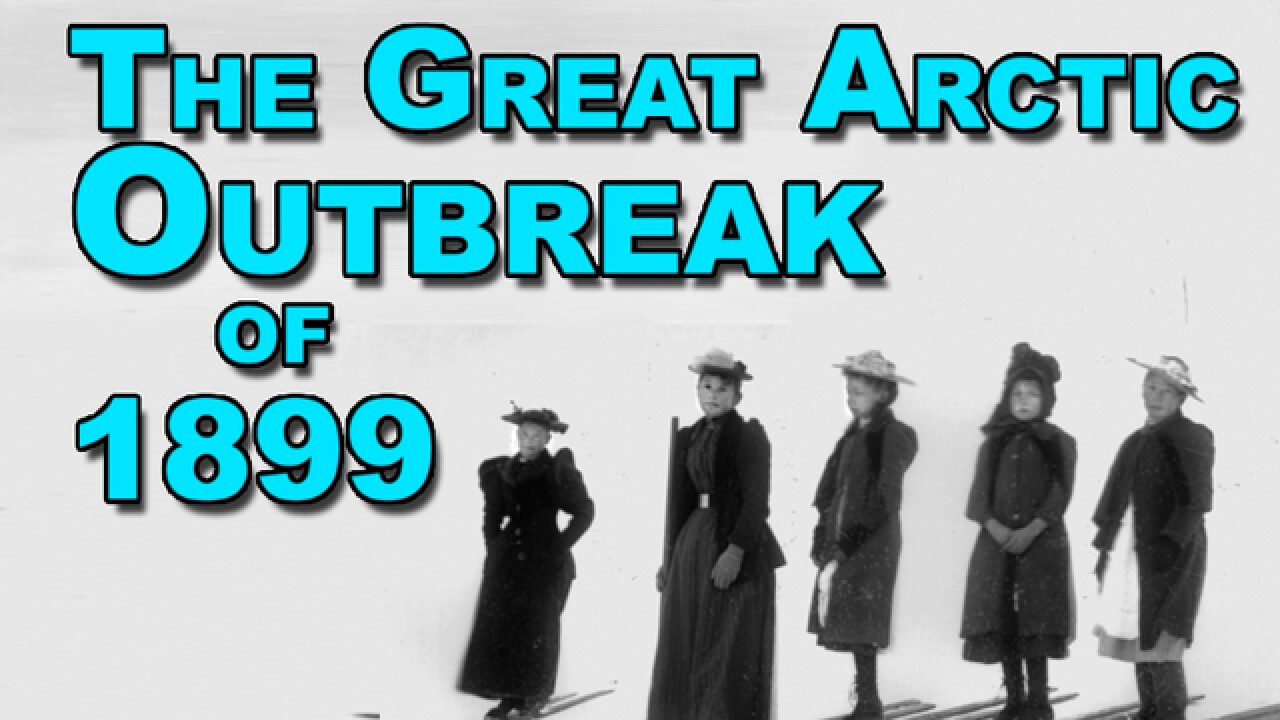
The Clear Number 1  February 1899: Atmospheric CO2 295 ppm.
The cold wave during the first two weeks of February 1899 is by far and away the gold standard for cold outbreaks in U.S. history.

What made this outbreak worthy of its lofty status was the magnitude, areal coverage and longevity of the cold.

For the first and only time on record, every state in the Union (recall, there were only 45 states at the time) dipped below zero. Subzero cold invaded parts of south-central Texas, the Gulf Coast beaches and northwest Florida.

Tallahassee, Florida, dipped to -2 degrees on Feb. 13, 1899, the only subzero low in the city’s history. This remains the all-time record low for the Sunshine State.

All-time record lows were set in a dozen states, from the Plains to the Ohio Valley, Southeast and District of Columbia. In addition to Florida, state record lows in Louisiana (-16 in Minden), Nebraska (-47 in Camp Clarke) and Ohio (-39 in Milligan) still stand today.

Dozens of cities still hold onto their all-time record low from this cold wave, including Atlanta (-9), Grand Rapids, Michigan (-24), and Wichita, Kansas (-22). Temperatures as frigid as -61 degrees (Montana), -59 degrees (Minnesota) and -50 degrees (Wisconsin) were recorded.

The Mississippi River froze solid north of Cairo, Illinois, and ice not only clogged the river in New Orleans, but also flowed into the Gulf of Mexico a few days after the heart of the cold outbreak.

Ice jams triggered floods along parts of the Ohio, Tennessee, Cumberland and James Rivers. Ice skating was the activity of choice as the San Antonio River froze.

Lacking snow cover, the ground froze to a depth of 5 feet in Chicago, damaging water, gas and other pipes.

New York City engineers found trusses on the Brooklyn Bridge had contracted 14 feet due to the cold, according to Extreme American Weather, by Tim Vasquez. Due to frozen aqueducts from Catskills reservoirs, the city of Newark was forced to draw water from other rivers and bays.

Adding insult to injury, a massive snowstorm punctuated the cold outbreak from the Gulf Coast to New England Feb. 11-14.

Cape May, New Jersey, picked up 34 inches of snow, the nation’s capital was buried by 21 inches and 15.5 inches fell in New York City, overwhelming city crews and isolating suburbs.

In Florida, snow fell in Fort Myers, Tampa saw measurable snow for one of only two times in its history, and Jacksonville picked up 1.9 inches of snow. New Orleans was blanketed by 3 inches of snow.

Here are some other notable cold outbreaks since the massive 1899 outbreak.

Winter 2013-2014 Atmospheric CO2 399 ppm

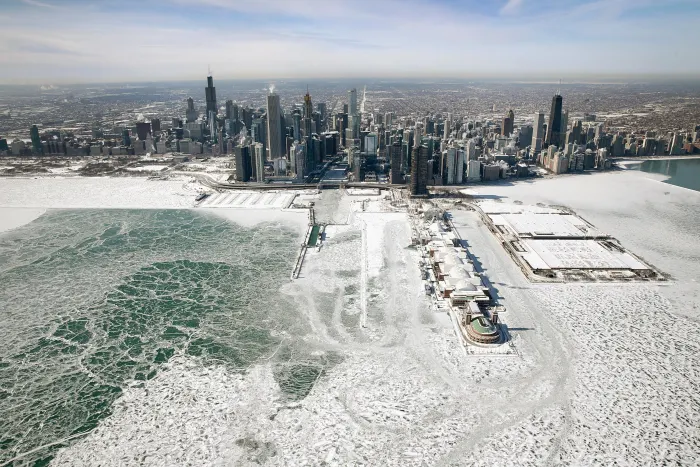
Ice builds up along Lake Michigan as temperatures dipped well below zero on January 6, 2014 in Chicago, Illinois. Chicago hit a record low of -16 degree Fahrenheit as an arctic air mass brought the coldest temperatures in about two decades into the city.
(Scott Olson/Getty Images)

– December 2013 – February 2014 was among the top 10 coldest such periods on record in seven Midwest states.

– An early January 2014 outbreak brought the coldest temperatures of the 21st century, to date, for some cities.

– The winter was among the top five snowiest on record in at least 10 major cities.

Late January-Early February 1996 Atmospheric CO2 363 ppm

– Minnesota state record: -60 degrees near Tower on Feb. 2, 1996. WCCO radio’s Mike Lynch broadcasted live from Tower that morning, during which he blew soap bubbles which then froze on the ground as a crowd watched.

– All Minnesota public schools shut down.

– Fears of natural gas shortage in northern Illinois prompted requests to reduce consumption.

Mid-Late January 1994 Atmospheric CO2 359 ppm
– 14 cities set all-time record lows, including Indianapolis (-27), Cleveland (-20) and Harrisburg, Pennsylvania (-22). Pittsburgh (-22) beat its previous all-time record set during the February 1899 outbreak.

– Both Pittsburgh (52 hours) and Cleveland (56 hours) set their record stretch of subzero cold.

– Indiana state record low set: -36 degrees at New Whiteland on Jan. 19

– 35 counties in Ohio plunged to -30 degrees or colder on Jan. 19.

– Worcester, Massachusetts, had seven straight days with subzero lows, a record stretch.

– Crown Point, New York, dipped to -48 degrees on Jan. 27.

– Coldest month on record in Caribou, Maine, with an average temperature of -0.7 degrees.

December 1990 Atmospheric CO2 356 ppm
– Most destructive freeze in California since 1949. Fifty percent of California’s citrus crop damaged.

– Record 18-day freeze streak in Salt Lake City

– 2,000 children stranded in Seattle schools due to heavy snow on Dec. 18

– Randolph, Utah, bottomed out at -45 degrees on Dec. 22.

December 1989 Atmospheric CO2 354 ppm
– All-time record lows in Kansas City (-23), Topeka, Kansas (-26), Lake Charles, Louisiana (-4), and Wilmington, North Carolina (0).

– First Christmas Day snow (trace) on record in Tallahassee. Miami had a rare freeze while Key West dipped to 44 degrees.

– 14 inches of snow fall at Myrtle Beach, South Carolina, on Christmas Eve.

– At the time, it was the fourth coldest December on record for the entire U.S.

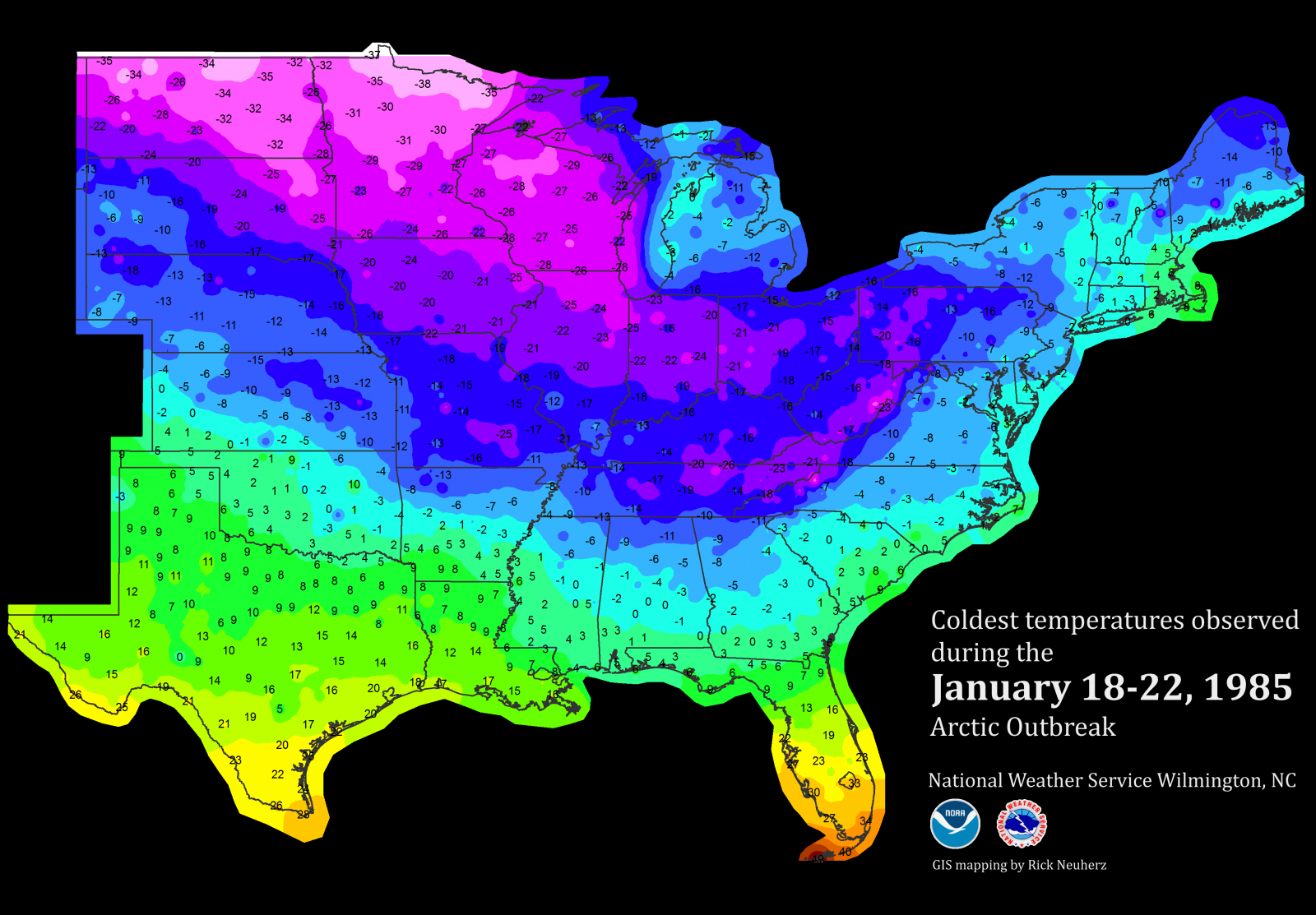
President Reagan Inauguration – Jan. 1985 Atmospheric CO2 346 ppm
Due to the cold, President Ronald Reagan takes the oath of office for his second term as President in the Capitol Rotunda on Jan. 21, 1985.

– 13.2 inches of snow in San Antonio, Texas (Jan. 12), crushed the previous 24-hour snow record, there. Austin and Houston (3 inches each) also were blanketed by this snowstorm.

– All-time record lows were set in Chicago (-27), Jacksonville, Florida (7), and Macon, Georgia (-6)

– State record lows were set in Virginia (-30 at Mountain Lake) and North Carolina (-34 atop Mt. Mitchell).

– $1.2 billion in damage to Florida’s citrus crop

– Ronald Reagan’s second inauguration was the coldest Inauguration Day on record (7 degrees). The ceremony was moved indoors and parade cancelled.

Late December 1983 Atmospheric CO2 343 ppm
– $2 billion damage to agriculture, mainly due to freezing temperatures in central and northern Florida.

– As measured using the old formula, wind chills reached 100 degrees below zero over much of North Dakota on Dec. 22.

– Williston, North Dakota tied its all-time record low (-50) on Dec. 23. (Check out the hourly observations from that day.)

– Sioux Falls, South Dakota, remained below zero from the morning of Dec. 16 until Christmas Day afternoon.

– Over 125 daily low-temperature records were broken on Christmas Day. Tampa’s Christmas Day high was only 38 degrees.

Remembering the “Freezer Bowl AFC Championship game in Cincinnati, Ohio on Jan. 10, 1982.

January 1982 Atmospheric CO2 341 ppm
– 85 deaths were attributed to the cold wave, according to the National Climatic Data Center.

– Chicago’s O’Hare and Midway Airports set all-time record lows (-26).

– Milwaukee, Wisconsin, plunged to -26 degrees on Jan. 17, their coldest temperature in 111 years.

– Montgomery, Alabama (-2), Jackson, Mississippi (-5), and Atlanta (-5) each plunged below zero.

– Snow at rush hour on Jan. 11 slickened streets, stranding motorists in Atlanta.

– Natural gas lines froze, and up to 7 million experienced brownouts, according to Tim Vasquez.

– The second coldest game in National Football League history, the “Freezer Bowl”, was played in Cincinnati, where a kickoff temperature of -9 degrees greeted the warm-weather San Diego Chargers.

– Hundreds of cases of frostbite were treated at the stadium, including Bengals quarterback Kenny Anderson’s frosbitten ear.

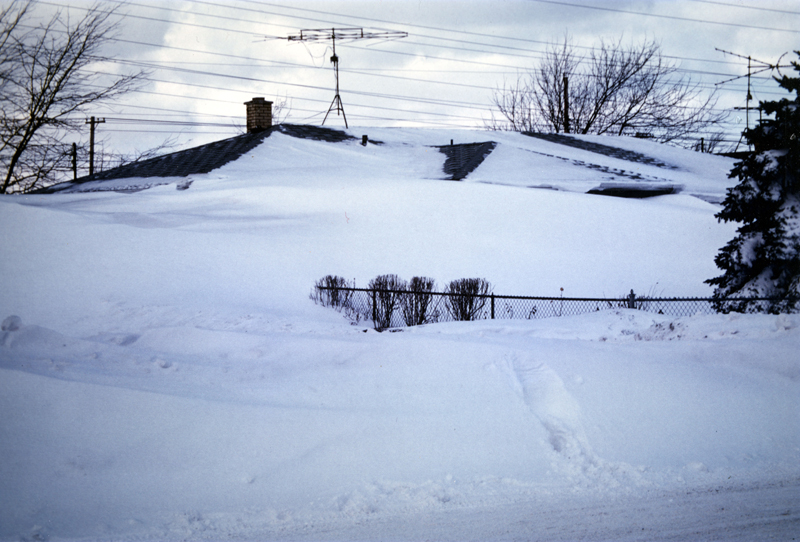
Tonawanda, New York – Post Blizzard of 1977
Photo of a house almost completely buried in snow in the aftermath of the “Blizzard of ’77” in Tonawanda, New York.  (Jeff Wurstner/Wikipedia)

January 1977 Atmospheric CO2 334 ppm
– 69 first-order weather stations shivered through their record coldest month, according to Weather Underground’s Christopher Burt.

– South Carolina state record set: -20 degrees near Long Creek

– Temperatures did not rise above freezing the entire month in a swath from eastern Iowa to western Pennsylvania northward, according to Burt.

– Snow fell as far south as Miami and Homestead, Florida, the farthest south occurrence of snow in the U.S. Two inches of snow fell in Winter Haven, Florida.

– 35 percent of Florida’s citrus crop was damaged; rolling blackouts were needed in Florida due to heavy power demand.

– President Jimmy Carter walked 1.5 miles in the Inauguration Parade with temperatures just below freezing on Jan. 20.

– The “Buffalo Blizzard of ’77” added a foot of snow to the 33 inches of snow on the ground, accompanied by wind gusts to 75 mph, producing snow drifts up to 30 feet high, paralyzing the city.

January 1949 Atmospheric CO2 311 ppm
Coldest month on record in Boise, Idaho, and Spokane, Washington.

– Coldest winter at virtually every weather station in California, Nevada, Idaho and Oregon, according to Burt.

– A series of blizzards in the Great Basin and Plains claimed 150,000 sheep and cattle, isolating ranches from Wyoming to South Dakota.

– The Army airlifted supplies to snowbound ranchers.

– Snow fell in San Diego. One of only three measurable snowfalls on record in Downtown Los Angeles, as well.

– All-time record low set in San Antonio, Texas (0 degrees).

Winter of 1935-1936 Atmospheric CO2 310 ppm
– Coldest Plains winter of record.

– Low temperatures dropped below -50 degrees on four separate days in Malta, Montana.

– Parshall, North Dakota, plunged to -60 degrees on Feb. 15, still the state record low today.

– Langdon, North Dakota, remained below zero for an incredible 41 straight days, the longest stretch on record in the Lower 48 states, according to Burt.

Winter of 2019 Atmospheric CO2 409 ppm


Ice builds up along the shore of Lake Michigan as temperatures dipped to lows around -20 degrees on January 31st, 2019, in Chicago, Illinois. Businesses and schools closed, Amtrak suspended service into the city, more than a thousand flights were canceled, and mail delivery was suspended as the city coped with record-setting low temperatures.  (Photo: Scott Olson/Getty Images)


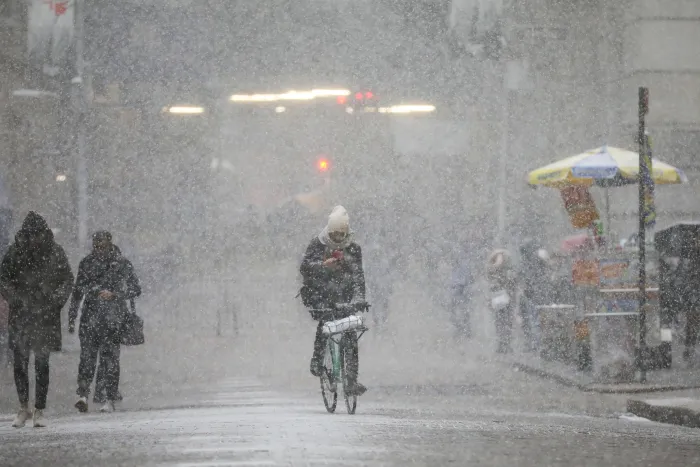
A cyclist rides through the falling snow in the Financial District, January 30th, 2019, in New York City
(Photo: Drew Angerer/Getty Images)


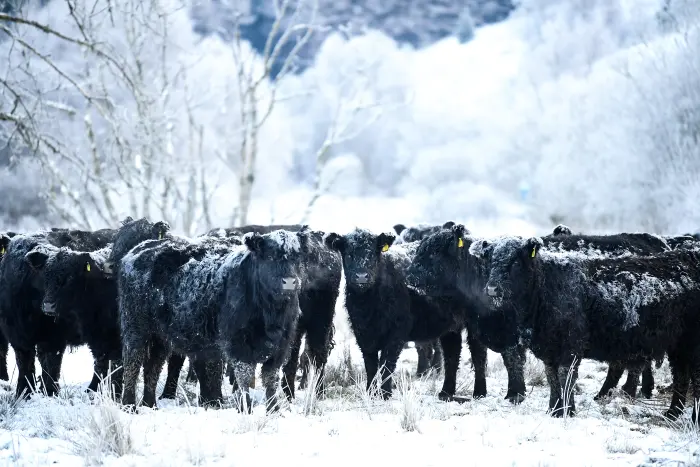
Frost forms on the back of Galloway cows on February 1st, 2019, in Crainlarich in Scotland. Temperatures plummeted to -15 degrees Celsius on the coldest night of the year. (Photo: Jeff J. Mitchell/Getty Images)

Summary

Clearly CO2 neither causes nor prevents outbreaks of arctic cold invading North America. Concerning ourselves with GHGs is no substitute for ensuring reliable, affordable energy and robust infrastructure.

Jonathan Erdman is a senior meteorologist at weather.com and has been an incurable weather geek since a tornado narrowly missed his childhood home in Wisconsin at age 7.

edc2b929c8ec9c162f76f86c1df59ec3

John Christy Named EPA Science Advisor, Eco-Freak Out Ensues

The flavor of the activist/alarmist reaction is suggested by headlines from the usual suspects.

Scientist Who Rejects Warming Is Named to EPA Advisory Board Scientific American

Wheeler Appoints Climate Denier to EPA Science Board EcoWatch

Former coal lobbyist and acting U.S. Environmental Protection Agency (EPA) Administrator Andrew Wheeler has named a climate denier to serve on the …

John Christy Was Just Named An EPA Science Adviser. His Climate Studies Have Been Repeatedly Corrected. Buzzfeed

A climate science skeptic with a history of botched research is the latest controversial addition to the Environmental Protection Agency’s Scientific Advisory Board …

Controversial climatologist John Christy, who once said scientists believed Earth was flat, to join advisory board at environment agency The Guardian

A more restrained report comes from AL.com Alabama climate change skeptic named to Trump’s EPA advisory board  Excerpts in italics with my bolds.

The Trump administration continued its reshaping of how science is evaluated at the Environmental Protection Agency with the appointment Thursday of a slew of new members to a key advisory panel.

Among the eight additions to the agency’s Science Advisory Board are a number of members whose ideas run against mainstream scientific thinking on issues that include the health effects of radiation and the modeling of Earth’s climate.

Andrew Wheeler, the acting EPA chief, added the eight new members while reinstalling eight others selected during the Obama administration. He cast the appointments as a reaffirmation of the Trump administration’s commitment to hearing scientific opinions from a diverse set of voices.

“In a fair, open, and transparent fashion, EPA reviewed hundreds of qualified applicants nominated for this committee,” Wheeler said in a statement. “Members who will be appointed or reappointed include experts from a wide variety of scientific disciplines who reflect the geographic diversity needed to represent all ten EPA regions.”

But critics of the administration see this and other moves under Wheeler and former EPA chief Scott Pruitt as part of a larger push to make the agency’s decisions more friendly to industry.

“The general makeup of the Science Advisory Board has changed significantly in the past two years,” said Genna Reed, a science and policy analyst at the Union of Concerned Scientists. “What we’re seeing is a decrease in the number of academics and a surge in the number of industry and consulting-firm members.”

With the announcement Thursday, 26 of the board’s 45 members have been appointed by the Trump administration.

The best-known new member of the panel, though, actually does work at a university. John Christy, a professor of atmospheric science at the University of Alabama in Huntsville, is perhaps the most prominent climate skeptic in all of academia.

Christy acknowledges that humans have altered Earth’s climate. But he’s a polarizing figure within the climate science community for his criticism of mainstream climate models produced by NASA and the National Oceanic and Atmospheric Administration and of scientific conclusions about the severity of global warming reached by the United Nations Intergovernmental Panel on Climate Change.

Pointing to his own analyses of satellite temperature data, which suggest that observed warming is on the lower side of projections, Christy has argued that atmospheric temperatures are less sensitive to the buildup of greenhouse gases than the majority of other climate scientists say they are.

Among the many scientific institutions that say global warming is dangerous is the EPA itself. In President Barack Obama’s first year in office, the EPA determined greenhouse gases posed a risk to public health, giving the government the legal justification it needed to try to curb emissions from cars, coal plants and other sources.

Christy, Alabama’s state climatologist, takes issue with EPA’s “endangerment finding.”

“I, as well as many others, am very skeptical of the basis of many of these findings, like the endangerment finding,” Christy said in an interview Thursday.

He said he believes the EPA’s reliance on what he regards as faulty climate models have led it to issue misguided rules for polluters. “If you use bad models,” he said, “you’re likely to come up with bad regulations.”

Christy is often called on by Republicans leery of government climate regulations to testify before Congress. At a 2015 House Science Committee hearing, Christy described the study of climate change as a “murky” science. “We do not have laboratory methods of testing our hypotheses as many other sciences do,” he said in his written remarks. “As a result, what passes for science includes opinion, arguments-from-authority, dramatic news releases, and fuzzy notions of consensus generated by preselected groups.”

Michael Mann, a climatologist at Pennsylvania State University who has testified opposite Christy before lawmakers, has argued that Christy’s findings have become “a central pillar in the case for climate change denial” despite the fact they have “been shown to be an artifact of faulty computations.”

The advisory board will also now include Brant Ulsh, a health physicist at M.H. Chew & Associates whose work focuses on low-dose radiation.

In the past, the EPA has maintained there is some risk of cancer from any exposure to radiation. But Ulsh argues the way the government has modeled the health effects of small amounts of radiation exposure at places like nuclear power plants overplays that risk.

“Right now we spend an enormous effort trying to minimize low doses,” Ulsh told the Associated Press last year. “Instead, let’s spend the resources on minimizing the effect of a really big event.”

Another new panelist is Richard Williams, an independent consultant and former Food and Drug Administration official who has praised the Trump administration for cutting regulations.

In the fall of 2017, Pruitt upended the agency’s key advisory groups, announcing plans to jettison scientists who have received EPA grants.

The move set in motion a potentially fundamental shift, one that could change the scientific and technical advice that historically has guided the agency as it crafts environmental regulations.

“It is very, very important to ensure independence, to ensure that we’re getting advice and counsel independent of the EPA,” Pruitt told reporters at the time.

He estimated that the members of three different committees – the Scientific Advisory Board, the Clean Air Science Advisory Committee and the Board of Scientific Counselors – had collectively accepted $77 million in EPA grants over the past three years. He noted that researchers would have the option of ending their grant or continuing to advise EPA, “but they can’t do both.”

Suspicion Confirmed: Climate Change is Racist

The Hill has the story: European colonizers’s mass slaughter of Native Americans caused first major change in climate Excerpts in italics with my bolds.

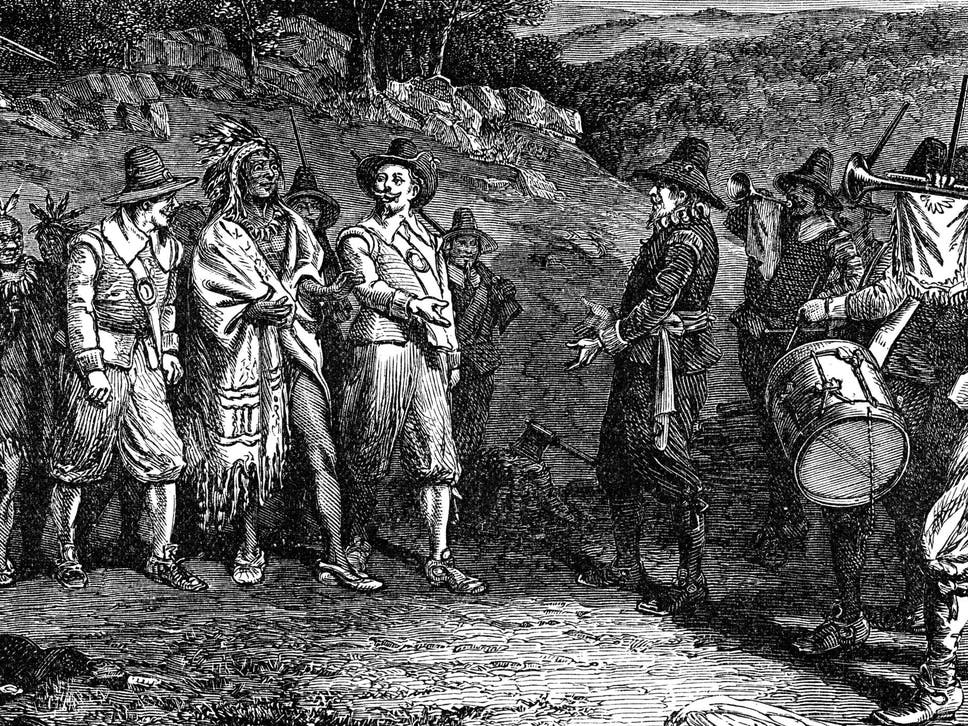
A new study found that European colonizers who arrived in the Americas killed so many indigenous people that it caused the first major change in the Earth’s climate.

The new study, conducted by researchers at the University College London, found that by killing nearly 56 million indigenous people over the course of roughly 100 years, European settlers caused large areas of farmland to go abandoned and reforest.

The study said the new swath of vegetated land, which CNN reported was roughly the size of France at the time, caused a massive decrease of in carbon dioxide (CO2) in the atmosphere then.

Levels of carbon in the atmosphere had changed so much that it caused the planet to experience a global chill in 1610, that is now known as the Little Ice Age, researchers said.

“CO2 and climate had been relatively stable until this point,” UCL Geography Professor Mark Maslin, one of the co-authors behind the study, told CNN on Friday. “So, this is the first major change we see in the Earth’s greenhouse gases.”

Maslin told CNN that he and the team of researchers conducted the study by examining archaeological evidence, historical data and analyzing Antarctic ice, which can trap atmospheric gas and reportedly reveal the quantity of carbon dioxide that was in the atmosphere long ago.

He said a combination of all of the above showed researchers how the reforestation that was brought on by the mass slaughter of indigenous people in the Americas led to the global chill.

“The ice cores showed that there was a larger dip in CO2 (than usual) in 1610, which was caused by the land and not the oceans,” Alexander Koch, the lead author of the study, told CNN.

“For once, we’ve been able to balance all the boxes and realize that the only way the Little Ice Age was so intense is … because of the genocide of millions of people,” Maslin added.

Summary

There you have, all wrapped up with a bow on top. The Little Ice Age was caused by too little CO2, from too many trees because white men killed too many natives. Talk about connecting the dots.  Did those white guys think they could get away with it?  Thankfully, wildfires are solving the excessive forests problem.  Oh wait.

From the Encyclopedia Virginia:  The Little Ice Age and Colonial Virginia

The Little Ice Age refers to a period beginning about AD 1300 and lasting until the middle of the eighteenth century in which the average worldwide temperature may have cooled by as much as 0.1 degrees Celsius. Despite its name, this period “was far from a deep freeze,” the scholar Brian Fagan, writing in 2000, has argued. “Think instead of an irregular seesaw of rapid climatic shifts, driven by complex and still little understood interactions between the atmosphere and the ocean.” Some climate scientists contend that the term “Little Ice Age” is an exaggeration; others dispute the beginning and ending dates. (Historians have suggested that severe weather during the American Civil War may have been an effect of the Little Ice Age.) But nearly all agree that the seventeenth century—when the English founded the Virginia colony at Jamestown—was one of the coldest in the last thousand years.

The cause or causes of this cooling is subject to vigorous debate. Scientists have pointed to the Maunder Minimum, a period between 1645 and 1715 when the number of observed sunspots decreased, indicating a reduced level of solar activity; however, opponents of this theory argue that the resulting decline in solar irradiation was not sufficient to cause the Little Ice Age. During this cooling period, the tilt of the earth’s axis also changed. Such changes may profoundly affect ocean circulation, which, in turn, affects climate. Still other scientists have suggested that volcanic eruptions—such as one in the southern Philippines in 1642—may have had an impact on the cooling, causing chemical reactions in the atmosphere that blocked or redirected sunlight.

The extreme weather wreaked terrible consequences on both the Indians and Europeans in Virginia. As the Spanish Jesuit pointed out, Indian populations decreased during times of drought, likely because of the scarcity of food. Such scarcities also led to conflict—among Indian communities and between the Indians and Europeans. The English at Roanoke had neither the intention nor the ability to feed themselves off the land, and a cold winter and drought conditions led them to place pressure on the Algonquian-speaking Indians of Ossomocomuck to share their already depleted supplies. This, in turn, led to warfare. Indian towns were destroyed and a weroance, or chief, beheaded.

While the Little Ice Age affected the entire world, leaving significant numbers of people to subsist on little food, its impact on Virginia was particularly sharp. It raised the stakes for both Indians and Europeans, making survival more difficult and conflict more likely.

Conclusion: It seems once again, climatists have got cause and effect reversed.

2019 AMOC Update: Oceans Moderate Climate Threat

Update Feb.1, 2019 New Publication from M.S. Lozier et al. 

f1.medium

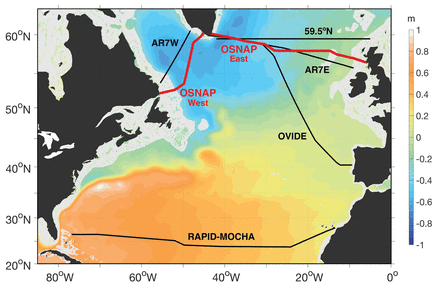
The article is A sea change in our view of overturning in the subpolar North Atlantic which is reporting on the first 21 months of observations from the newly installed OSNAP array described in a previous post from a year ago (reprinted below).  The article is paywalled, but the main findings are provided at a Science Daily article European waters drive ocean overturning, key for regulating climate.  Excerpts in italics with my bolds.

Summary:
An international study reveals the Atlantic meridional overturning circulation, which helps regulate Earth’s climate, is highly variable and primarily driven by the conversion of warm, salty, shallow waters into colder, fresher, deep waters moving south through the Irminger and Iceland basins. This upends prevailing ideas and may help scientists better predict Arctic ice melt and future changes in the ocean’s ability to mitigate climate change by storing excess atmospheric carbon.

190131143344_1_540x360

New research shows the Atlantic meridional overturning circulation, which regulates climate, is primarily driven by waters west of Europe.
Credit: Carolina Nobre, WHOI Media

In a departure from the prevailing scientific view, the study shows that most of the overturning and variability is occurring not in the Labrador Sea off Canada, as past modeling studies have suggested, but in regions between Greenland and Scotland. There, warm, salty, shallow waters carried northward from the tropics by currents and wind, sink and convert into colder, fresher, deep waters moving southward through the Irminger and Iceland basins.

Overturning variability in this eastern section of the ocean was seven times greater than in the Labrador Sea, and it accounted for 88 percent of the total variance documented across the entire North Atlantic over the 21-month study period.

“Overturning carries vast amounts of anthropogenic carbon deep into the ocean, helping to slow global warming,” said co-author Penny Holliday of the National Oceanography Center in Southampton, U.K. “The largest reservoir of this anthropogenic carbon is in the North Atlantic.”

“Overturning also transports tropical heat northward,” Holliday said, “meaning any changes to it could have an impact on glaciers and Arctic sea ice. Understanding what is happening, and what may happen in the years to come, is vital.”

MIT’s Carl Wunsch and other outside experts said the study was helpful, but pointed out that 21 months of study is not enough to know if this different location is temporary or permanent.

[Note: The comment about oceans taking up CO2 could be misleading.  The ocean contains dissolved CO2 amounting to 50 times atmospheric CO2.  Each year about 20% of all CO2 in the air goes into the ocean, replaced by outgassing CO2.  The tiny fraction of atmospheric CO2 from humans is exchanged proportionately.  Henry’s law applies to the water/air interface, so that a warmer ocean absorbs slightly less, and a colder ocean absorbs slightly more CO2.  The exchange equilibrium is hardly disturbed by the little bit of human produced CO2.  Thus the ocean serves as a massive buffer against human emissions.]

Previous Post: AMOC 2018:  Not Showing Climate Threat

myrtle_jc174_small

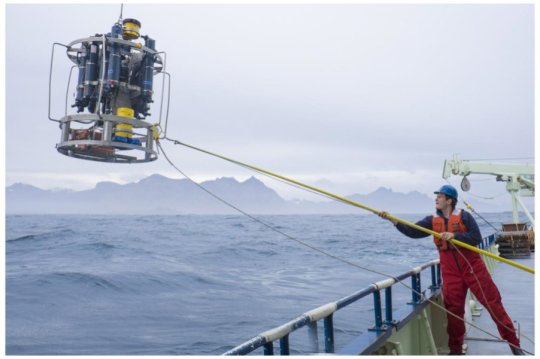
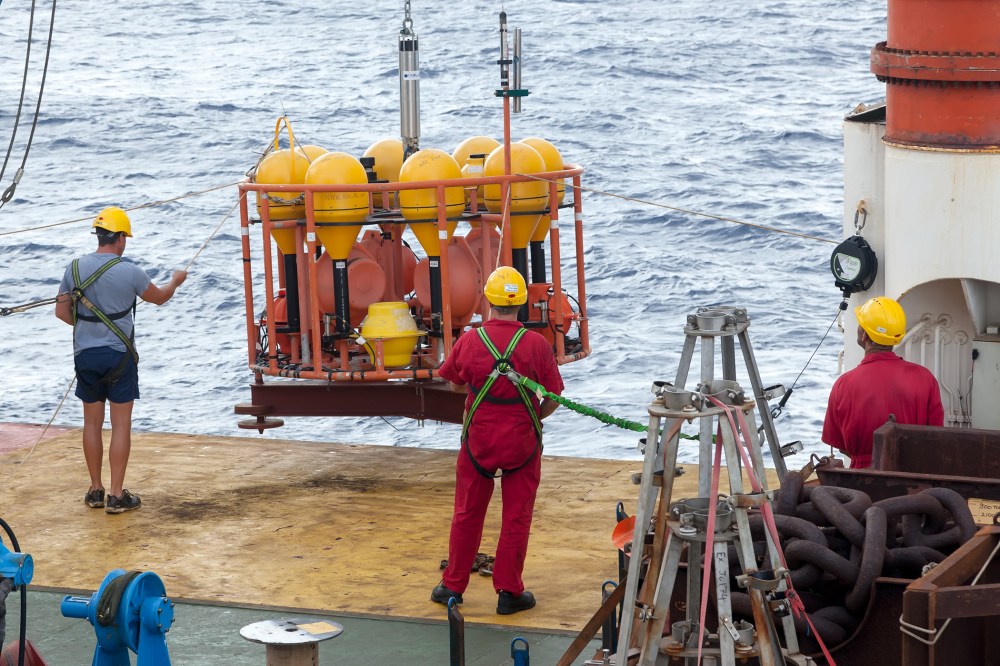
The RAPID moorings being deployed. Credit: National Oceanography Centre.

The AMOC is back in the news following a recent Ocean Sciences meeting.  This update adds to the theme Oceans Make Climate. Background links are at the end, including one where chief alarmist M. Mann claims fossil fuel use will stop the ocean conveyor belt and bring a new ice age.  Actual scientists are working away methodically on this part of the climate system, and are more level-headed.  H/T GWPF for noticing the recent article in Science Ocean array alters view of Atlantic ‘conveyor belt’  By Katherine Kornei Feb. 17, 2018 . Excerpts with my bolds.

The powerful currents in the Atlantic, formally known as the Atlantic meridional overturning circulation (AMOC), are a major engine in Earth’s climate. The AMOC’s shallower limbs—which include the Gulf Stream—transport warm water from the tropics northward, warming Western Europe. In the north, the waters cool and sink, forming deeper limbs that transport the cold water back south—and sequester anthropogenic carbon in the process. This overturning is why the AMOC is sometimes called the Atlantic conveyor belt.

bams-d-16-0057.1-f1

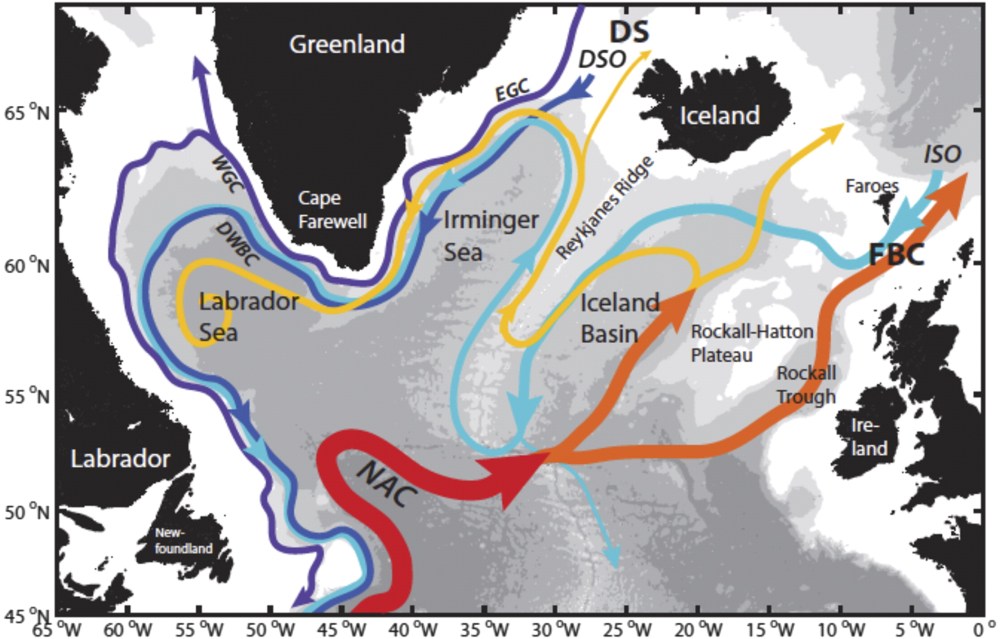
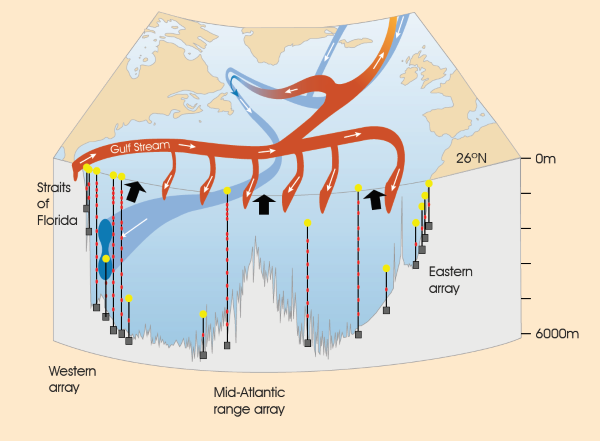
Fig. 1. Schematic of the major warm (red to yellow) and cold (blue to purple) water pathways in the NASPG (North Atlantic subpolar gyre ) credit: H. Furey, Woods Hole Oceanographic Institution): Denmark Strait (DS), Faroe Bank Channel (FBC), East and West Greenland Currents (EGC and WGC, respectively), NAC, DSO, and ISO.

Last week, at the American Geophysical Union’s (AGU’s) Ocean Sciences meeting here, scientists presented the first data from an array of instruments moored in the subpolar North Atlantic. The observations reveal unexpected eddies and strong variability in the AMOC currents. They also show that the currents east of Greenland contribute the most to the total AMOC flow. Climate models, on the other hand, have emphasized the currents west of Greenland in the Labrador Sea. “We’re showing the shortcomings of climate models,” says Susan Lozier, a physical oceanographer at Duke University in Durham, North Carolina, who leads the $35-million, seven-nation project known as the Overturning in the Subpolar North Atlantic Program (OSNAP).

bams-d-16-0057.1-f2

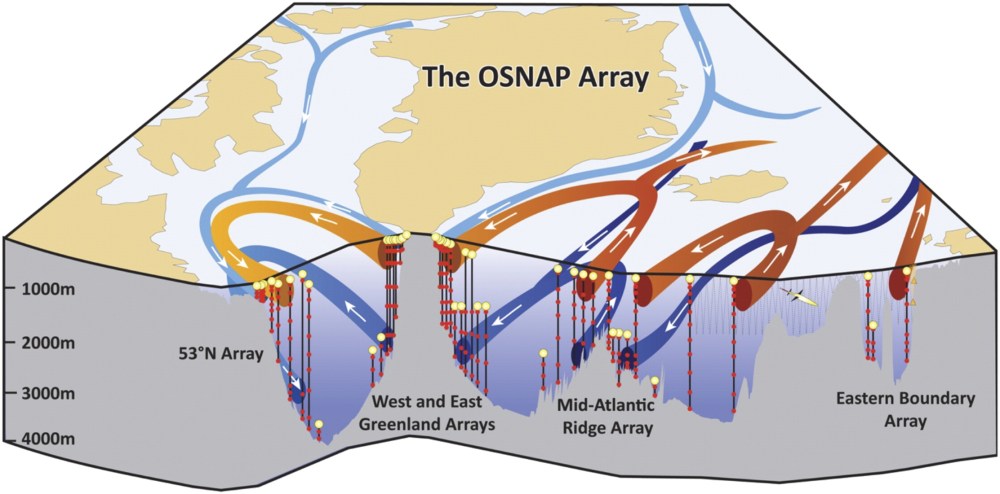
Fig. 2. Schematic of the OSNAP array. The vertical black lines denote the OSNAP moorings with the red dots denoting instrumentation at depth. The thin gray lines indicate the glider survey. The red arrows show pathways for the warm and salty waters of subtropical origin; the light blue arrows show the pathways for the fresh and cold surface waters of polar origin; and the dark blue arrows show the pathways at depth for waters that originate in the high-latitude North Atlantic and Arctic.

The research and analysis is presented by Dr. Lozier et al. in this publication Overturning in the Subpolar North Atlantic Program: A New International Ocean Observing System Images above and text excerpted below with my bolds.

For decades oceanographers have assumed the AMOC to be highly susceptible to changes in the production of deep waters at high latitudes in the North Atlantic. A new ocean observing system is now in place that will test that assumption. Early results from the OSNAP observational program reveal the complexity of the velocity field across the section and the dramatic increase in convective activity during the 2014/15 winter. Early results from the gliders that survey the eastern portion of the OSNAP line have illustrated the importance of these measurements for estimating meridional heat fluxes and for studying the evolution of Subpolar Mode Waters. Finally, numerical modeling data have been used to demonstrate the efficacy of a proxy AMOC measure based on a broader set of observational data, and an adjoint modeling approach has shown that measurements in the OSNAP region will aid our mechanistic understanding of the low-frequency variability of the AMOC in the subtropical North Atlantic.

Fig. 7. (a) Winter [Dec–Mar (DJFM)] mean NAO index. Time series of temperature from the (b) K1 and (c) K9 moorings.

Finally, we note that while a primary motivation for studying AMOC variability comes from its potential impact on the climate system, as mentioned above, additional motivation for the measure of the heat, mass, and freshwater fluxes in the subpolar North Atlantic arises from their potential impact on marine biogeochemistry and the cryosphere. Thus, we hope that this observing system can serve the interests of the broader climate community.

Fig. 10. Linear sensitivity of the AMOC at (d),(e) 25°N and (b),(c) 50°N in Jan to surface heat flux anomalies per unit area. Positive sensitivity indicates that ocean cooling leads to an increased AMOC—e.g., in the upper panels, a unit increase in heat flux out of the ocean at a given location will change the AMOC at (d) 25°N or (e) 50°N 3 yr later by the amount shown in the color bar. The contour intervals are logarithmic. (a) The time series show linear sensitivity of the AMOC at 25°N (blue) and 50°N (green) to heat fluxes integrated over the subpolar gyre (black box with surface area of ∼6.7 × 10 m2) as a function of forcing lead time. The reader is referred to Pillar et al. (2016) for model details and to Heimbach et al. (2011) and Pillar et al. (2016) for a full description of the methodology and discussion relating to the dynamical interpretation of the sensitivity distributions.

In summary, while modeling studies have suggested a linkage between deep-water mass formation and AMOC variability, observations to date have been spatially or temporally compromised and therefore insufficient either to support or to rule out this connection.

Current observational efforts to assess AMOC variability in the North Atlantic.

The U.K.–U.S. Rapid Climate Change–Meridional Overturning Circulation and Heatflux Array (RAPID–MOCHA) program at 26°N successfully measures the AMOC in the subtropical North Atlantic via a transbasin observing system (Cunningham et al. 2007; Kanzow et al. 2007; McCarthy et al. 2015). While this array has fundamentally altered the community’s view of the AMOC, modeling studies over the past few years have suggested that AMOC fluctuations on interannual time scales are coherent only over limited meridional distances. In particular, a break point in coherence may occur at the subpolar–subtropical gyre boundary in the North Atlantic (Bingham et al. 2007; Baehr et al. 2009). Furthermore, a recent modeling study has suggested that the low-frequency variability of the RAPID–MOCHA appears to be an integrated response to buoyancy forcing over the subpolar gyre (Pillar et al. 2016). Thus, a measure of the overturning in the subpolar basin contemporaneous with a measure of the buoyancy forcing in that basin likely offers the best possibility of understanding the mechanisms that underpin AMOC variability. Finally, though it might be expected that the plethora of measurements from the North Atlantic would be sufficient to constrain a measure of the AMOC within the context of an ocean general circulation model, recent studies (Cunningham and Marsh 2010; Karspeck et al. 2015) reveal that there is currently no consensus on the strength or variability of the AMOC in assimilation/reanalysis products.

Atlantic Meridional Overturning Circulation (AMOC). Red colours indicate warm, shallow currents and blue colours indicate cold, deep return flows. Modified from Church, 2007, A change in circulation? Science, 317(5840), 908–909. doi:10.1126/science.1147796

In addition we have a recent report from the United Kingdom Marine Climate Change Impacts Partnership (MCCIP) lead author G.D. McCarthy Atlantic Meridional Overturning Circulation (AMOC) 2017.

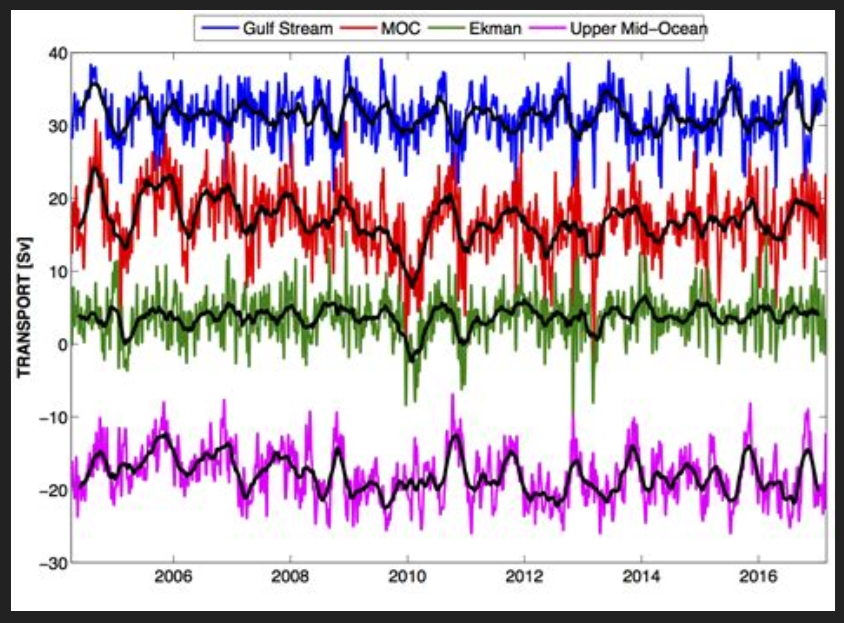
Figure 1: Ten-day (colours) and three month (black) low-pass filtered timeseries of Florida Straits transport (blue), Ekman transport (green), upper mid-ocean transport (magenta), and overturning transport (red) for the period 2nd April 2004 to end- February 2017. Florida Straits transport is based on electromagnetic cable measurements; Ekman transport is based on ERA winds. The upper mid-ocean transport, based on the RAPID mooring data, is the vertical integral of the transport per unit depth down to the deepest northward velocity (~1100 m) on each day. Overturning transport is then the sum of the Florida Straits, Ekman, and upper mid-ocean transports and represents the maximum northward transport of upper-layer waters on each day. Positive transports correspond to northward flow.

The RAPID/MOCHA/WBTS array (hereinafter referred to as the RAPID array) has revolutionized basin scale oceanography by supplying continuous estimates of the meridional overturning transport (McCarthy et al., 2015), and the associated basin-wide transports of heat (Johns et al., 2011) and freshwater (McDonagh et al., 2015) at 10-day temporal resolution. These estimates have been used in a wide variety of studies characterizing temporal variability of the North Atlantic Ocean, for instance establishing a decline in the AMOC between 2004 and 2013.

Summary from RAPID data analysis

MCCIP reported in 2006 that:

  • a 30% decline in the AMOC has been observed since the early 1990s based on a limited number of observations. There is a lack of certainty and consensus concerning the trend;
  • most climate models anticipate some reduction in strength of the AMOC over the 21st century due to increased freshwater influence in high latitudes. The IPCC project a slowdown in the overturning circulation rather than a dramatic collapse.
  • And in 2017 that:
  • a substantial increase in the observations available to estimate the strength of the AMOC indicate, with greater certainty, a decline since the mid 2000s;
  • the AMOC is still expected to decline throughout the 21st century in response to a changing climate. If and when a collapse in the AMOC is possible is still open to debate, but it is not thought likely to happen this century.

And also that:

  • a high level of variability in the AMOC strength has been observed, and short term fluctuations have had unexpected impacts, including severe winters and abrupt sea-level rise;
  • recent changes in the AMOC may be driving the cooling of Atlantic ocean surface waters which could lead to drier summers in the UK.

Conclusions

  • The AMOC is key to maintaining the mild climate of the UK and Europe.
  • The AMOC is predicted to decline in the 21st century in response to a changing climate.
  • Past abrupt changes in the AMOC have had dramatic climate consequences.
  • There is growing evidence that the AMOC has been declining for at least a decade, pushing the Atlantic Multidecadal Variability into a cool phase.
  • Short term fluctuations in the AMOC have proved to have unexpected impacts, including being linked
    with severe winters and abrupt sea-level rise.

Background:

Climate Pacemaker: The AMOC

Evidence is Mounting: Oceans Make Climate

Mann-made Global Cooling

2019 Update Scafetta vs. IPCC: Dueling Climate Theories

In one corner, Darth Vader, the Prince of CO2, filling the air with the overwhelming sound of his poison breath. Opposing him, Luke Skywalker, a single skeptic armed only with facts and logic.

OK, that’s over the top, but it’s what came to mind while reading a new paper by Nicola Scafetta in which he goes up against the IPCC empire. And Star Wars came to mind since Scafetta’s theory involves astronomical cycles. The title below links to the text, which is well worth reading.  Some excerpts follow in italics with my bolds. H/T GWPF

CMIP5 General Circulation Models versus a Semi-Empirical Model Based on Natural Oscillations

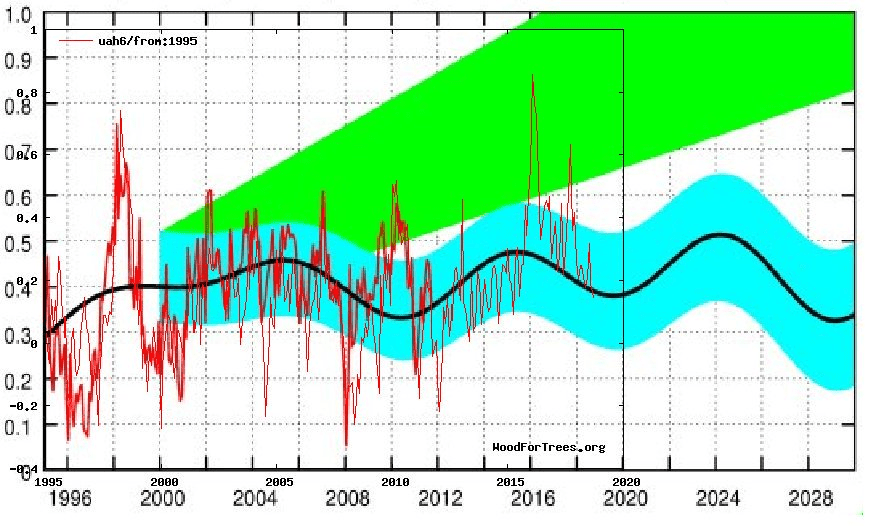
Updated 2019:  Graph Comparing Scafetta Model with UAHv6

H/T Tallbloke for providing this image:

scafetta and UAH1995to2018

Green area is range of forecasts from CMIP5 models.  Turquoise  area is forecast from Scafetta astronomical climate model.

Scafetta comes out swinging: From the Abstract

Since 1850 the global surface temperature has warmed by about 0.9 oC. The CMIP5 computer climate models adopted by the IPCC have projected that the global surface temperature could rise by 2-5 oC from 2000 to 2100 for anthropogenic reasons. These projections are currently used to justify expensive mitigation policies to reduce the emission of anthropogenic greenhouse gases such as CO2.

However, recent scientific research has pointed out that the IPCC climate models fail to properly reconstruct the natural variability of the climate. Indeed, advanced techniques of analysis have revealed that the natural variability of the climate is made of several oscillations spanning from the decadal to the millennial scales (e.g. with periods of about 9.1, 10.4, 20, 60, 115, 1000 years and others). These oscillations likely have an astronomical origin.

In this short review I briefly summarize some of the main reasons why the AGWT should be questioned. In addition, I show that an alternative interpretation of climate change based on the evidences that a significant part of it is due to specific natural oscillations is possible. A modeling based on such interpretation agrees better with the climatic comprehensive picture deduced from the data.

The Missing Hot-Spot

It has been observed that for the last decades climate models predict a hot-spot, that is, a significant warming of a band of the upper troposphere 10 km over the tropics and the equator. The presence of this hot-spot is quite important because it would indicate that the water-vapor feedback to radiative forcing would be correctly reproduced by the models.

However, this predicted hot-spot has never been found in the tropospheric temperature records [20,21]. This could only be suggesting either that both the temperature records obtained with satellite measures and balloons have been poorly handled or that the models severely fail to properly simulate the water-vapor feedback. In the latter case, the flaw of the models would be fatal because the water-vapor feedback is the most important among the climate feedbacks.

Without a strong feedback response from water vapor the models would only predict a moderate climate sensitivity to radiative forcing of about 1.2 oC for CO2 doubling instead of about 3 oC. Figure 8 compares the observed temperature trend in the troposphere versus the climate model predictions: from Ref. [21]. The difference between the two record sets is evident.

scafettafig8

Figure 8. Comparison between observed temperature trend in the troposphere (green-blue) versus the climate model predictions (red). From Ref. [21].

Observations Favor Scafetta’s Model Over GCM Models

I have proposed that the global surface temperature record could be reconstructed from the decadal to the millennial scale using a minimum of 6 harmonics at 9.1, 10.4, 20, 60, 115 and 983 years plus a anthropogenic and volcano contribution that can be evaluated from the CMIP5 GCM outputs reduced by half because, as discussed above, the real climate sensitivity to radiative forcing appears to be about half of what assumed by the current climate models. The figure highlights the better performance of the solar–astronomical semi-empirical model versus the CMIP5 models. This is particularly evident since 2000, as shown in the inserts.

scafettavscmip

Figure 12 [A] The four CMIP5 ensemble average projections versus the HadCRUT4 GST record (black). [B] The solar– astronomical semi-empirical model. From Ref. [4] Left axis shows temperature anomalies in degrees Celsius.

Forecast Validation

In 2011 I prepared a global surface temperature forecast based on a simplified climate model based on four natural oscillations (9.1, 10.4, 20 and 60 year) plus an estimate of a realistic anthropogenic contribution [25]: for example, see Refs. [33,34,35] referring to the 60-year cycle. Figure 13 compares my 2011 forecast (red curve) against the global surface temperature record I used in 2011 (HadCUT3, blue curve) and a modern global surface temperature record updated at June/2016 (RSS MSU record, black line, http://www.remss.com/measurements/upper-air-temperature).

The RSS MSU record, which is a global surface temperature estimate using satellite measurements, was linearly rescaled to fit the original HadCUT3 global surface temperature record for optimal comparison. Other global temperature reconstructions perform similarly. Note that the HadCUT3 has been dismissed in 2014. Figure 13 also shows in green a schematic representation of the IPCC GCMs prediction since 2000 [25].

scafettaforecast082016

Left axis shows temperature anomalies in degrees Celsius.

Figure 13. Comparison of the forecast (red-yellow curve) made in Scafetta (2011) [25] against (1) the temperature record used in 2011 (HadCRUT3, blue curve), (2) the IPCC climate model projections since 2000 (green area), (3) a recent global temperature record (RSS MSU record, black line, linearly re-scaled to match the HadCRUT3 from 1979 to 2014). The temperature record has followed Scafetta’s forecast better than the IPCC ones. In 2015-2016 there was a strong El-Nino Pacific Ocean natural warming that caused the observed temperature peak.

Summary

The considerations emerging from these findings yield to the conclusion that the IPCC climate models severely overestimate the anthropogenic climatic warming by about two times. I have finally proposed a semi-empirical climate model calibrated to reconstruct the natural climatic variability since Medieval times. I have shown that this model projects a very moderate warming until 2040 and a warming less than 2 oC from 2000 to 2100 using the same anthropogenic emission scenarios used by the CMIP5 models: see Figure 12.

This result suggests that climatic adaptation policies, which are less expensive than the mitigation ones, could be sufficient to address most of the consequences of a climatic change during the 21st century. Similarly, fossil fuels, which have contributed significantly to the development of our societies, can still be used to fulfill our energy necessities until equally efficient alternative energy sources could be determined and developed.

Scafetta Briefly Explains the Harmonic oscillation theory

“The theory is very simple in words. The solar system is characterized by a set of specific gravitational oscillations due to the fact that the planets are moving around the sun. Everything in the solar system tends to synchronize to these frequencies beginning with the sun itself. The oscillating sun then causes equivalent cycles in the climate system. Also the moon acts on the climate system with its own harmonics. In conclusion we have a climate system that is mostly made of a set of complex cycles that mirror astronomical cycles. Consequently it is possible to use these harmonics to both approximately hindcast and forecast the harmonic component of the climate, at least on a global scale. This theory is supported by strong empirical evidences using the available solar and climatic data.”

Update Nov. 20, 2017.  Scafetta graph to June 2017

cooling-vs-warming-forecasts-scafetta-2017

From Natural climate variability, part 2: Interpretation of the post 2000
temperature standstill, Scafetta et al. 2017

Footnote: Scafetta is not alone.  Dr. Norman Page has a new paper going into detail about forecasting climate by means of  solar-astronomical patterns.

The coming cooling: Usefully accurate climate forecasting for policy makers