A Critical Framework For Climate Change
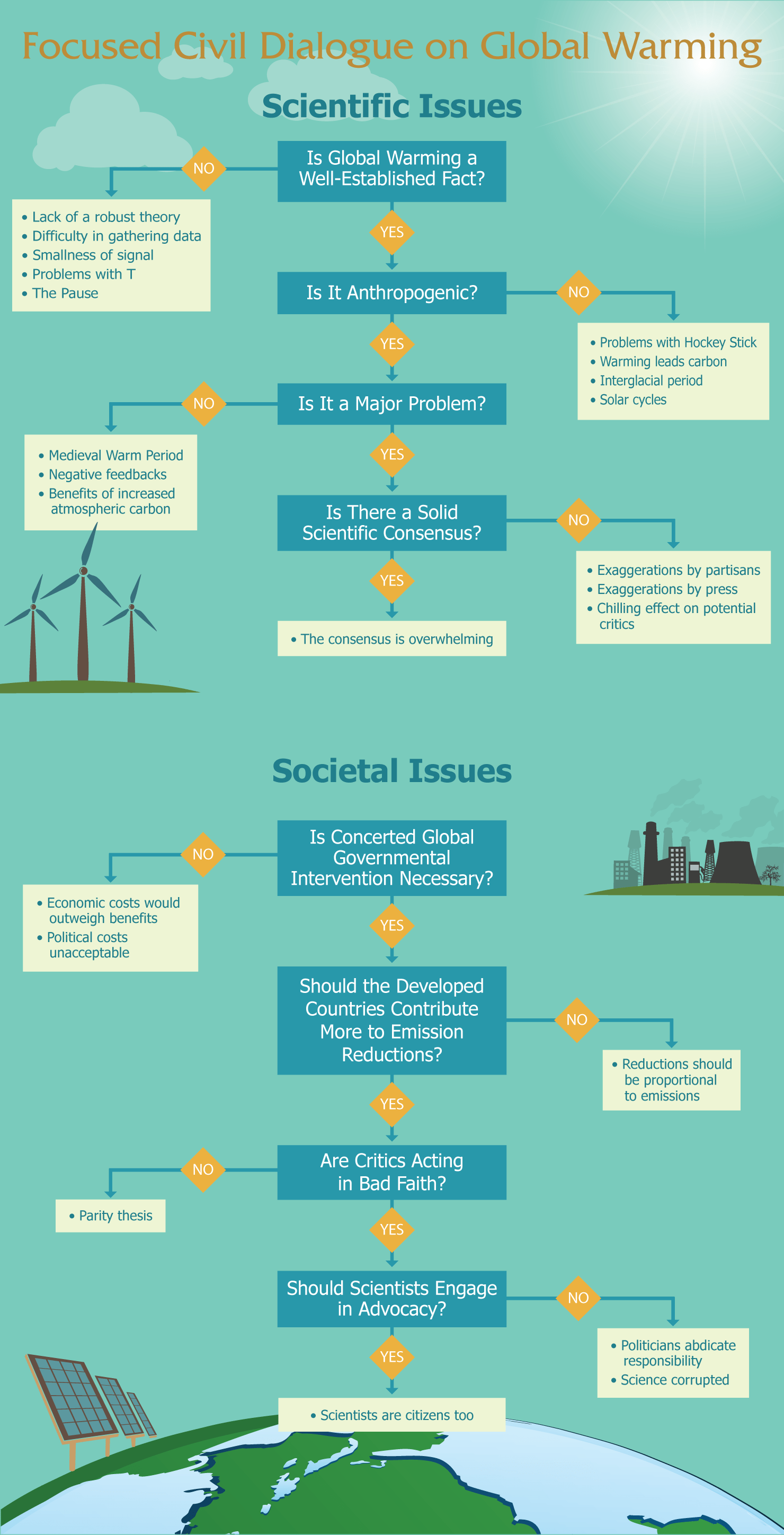
This dialogue framework was proposed for a debate between William Happer and David Karoly sponsored by The Best Schools. As you can see it reads like an high hurdle course for alarmists/activists. There are significant objections at every leap in connecting the beliefs.
Happer’s Statement: CO₂ will be a major benefit to the Earth
Earth does better with more CO2. CO2 levels are increasing
Atmospheric transmission of radiation: Tyndall correctly recognized in 1861 that the most important greenhouse gas of the Earth’s atmosphere is water vapor. CO2 was a modest supporting actor, then as now.
Radiative cooling of the Earth: Clouds are one of the most potent factors controlling Earth’ s surface temperature.
The Schwarzschild equation: The observed intensity I of upwelling radiation comes from the radiation emitted by the surface and by greenhouse gases in the atmosphere above the surface. The rate of change of the intensity with altitude is given by the Schwarzschild equation.
Logarithmic forcing by CO2: The intensity for a doubling of CO2 concentrations from the present value of 400 ppm to 800 ppm makes little difference, and simply leads to a slight broadening of the width of the band.
Convection: Radiation, which we have discussed above, is an important part of the energy transfer budget of the earth, but not the only part.
Numerical Modeling: Predictions about what more CO2 will do to the Earth’s climate are based on numerical modeling of the fluid flows in the atmosphere and oceans. Including water vapor, clouds, and precipitation further complicates the modeling considerations outlined above. Climate model builders have a hard job.
Equilibrium Climate Sensitivity: If increasing CO2 causes very large warming, harm can indeed be done. But most studies suggest that warmings of up to 2 K will be good for the planet. More than a century after Arrhenius, and after the expenditure of many tens of billions of dollars on climate science, the official value of S still differs little from the guess that Arrhenius made in 1912: S = 4 K. Could it be that the climate establishment does not want to work itself out of a job?
Overestimate of S: Contrary to the predictions of most climate models, there has been very little warming of the Earth’s surface over the last two decades. If one assumes negligible feedback, where other properties of the atmosphere change little in response to additions of CO2, the doubling efficiency can be estimated to be about S = 1 K. The much larger doubling sensitivities claimed by the IPCC, which look increasingly dubious with each passing year, are due to “positive feedbacks.”
Benefits of CO2: More CO2 in the atmosphere will be good for life on planet earth. Few realize that the world has been in a CO2 famine for millions of years — a long time for us, but a passing moment in geological history.
More bogeymen: The earth has stubbornly refused to warm nearly as much as demanded by computer models. To cope with this threat to full employment, the climate establishment has invented a host of bogeymen, other supposed threats from more CO2. One of the bogeymen is that more CO2 will lead to, and already has led to, more extreme weather, But extreme weather is not increasing. We also hear that more CO2 will cause rising sea levels to flood coastal cities, large parts of Florida, tropical island paradises, etc.
Climate Science: Too much “climate research” money is pouring into very questionable efforts, like mitigation of the made-up horrors mentioned above. It reminds me of Gresham’s Law: “Bad money drives out good.”
Summary
The Earth is in no danger from increasing levels of CO2. More CO2 will be a major benefit to the biosphere and to humanity.
Karoly’s Statement: Climate change is harming nature and humanity
1. Observed global warming is beyond reasonable doubt
2. Increases in greenhouse gases are due to human activity
3. Most of the observed global warming since the mid-twentieth century is due to human activity
4. Global warming will continue over the twenty-first century
5. Many adverse impacts result from global warming
6. Substantial reductions in greenhouse gas emissions are needed to minimize dangerous global warming
Summary
The key points presented above are just a small fraction of the vast body of evidence that support the scientific conclusions on global warming accepted by all the scientific Academies and by all the governments around the world.
Science has established that it is virtually certain that increases of atmospheric CO2 due to burning of fossil fuels will cause climate change that will have substantial adverse impacts on humanity and on natural systems. Therefore, immediate stringent measures to suppress the burning of fossil fuels are both justified and necessary.
Happer’s detailed response to Karoly on climate change
Dr. Karoly begins his Statement, not with evidence to support the title, “Climate change is harming nature and humanity,” but with a summary of what happened in the “21st Conference of Parties to the United Nations Framework Convention on Climate Change in December of 2015.” What a mouthful!
As I pointed out in my Interview and Statement, there is no scientific evidence that global greenhouse gas emissions will have a harmful effect on climate. Quite the contrary, there is very good evidence that the modest increase in atmospheric CO2 since the start of the Industrial Age has already been good for the Earth and that more will be better.
Some climate scientists, including Dr. Karoly, are doing praiseworthy work. I especially admire high-quality, year-by-year measurements of properties of the atmosphere and oceans. But if they have doubts about climate hysteria, most practicing climate scientists keep these to themselves because of the ferocity of the attacks they know will come to those who question the party line.
In my Interview, I mentioned the attacks on me by Greenpeace. No wonder there is a consensus of climate scientists, or that few scientists from other fields are willing to question the established dogma! Even though creative scientists are not greatly impressed by them, claims of consensus work wonders with educated elites.
A brief discussion of those key points of Dr. Karoly’s Statement with which I disagree:
3. “The observed large-scale increase in surface temperature across the globe since the mid-twentieth century is primarily due to human activity, the increase of greenhouse gases in the atmosphere, and other impacts on the human climate system.” This statement is based on excessive faith in computer models.

Trends in global mean surface temperature. a. 1993-2012. b. 1998-2012. Histograms of observed trends (red hatching) are from 100 reconstructions of the HadCRUT4 dataset. Histograms of model trends (grey bars) are based on 117 simulations of the models, and black curves are smoothed versions of the model trends. The ranges of observed trends reflect observational uncertainty, whereas the ranges of model trends reflect forcing uncertainty, as well as differences in individuals model responses to external forcings and uncertainty arising from internal climate variability.
4. “There will continue to be significant global warming over the 21st century with its magnitude depending on the emissions of greenhouse gases from human activities.” Again, this is a statement based on computer models. No one knows how the temperature of the Earth will change over the twenty-first century. It is just as likely that the Earth will cool, since whatever mechanism caused the Little Ice Age could act again and could overwhelm the small warming expected from increased CO2. In both my Statement and my Interview, I pointed out how much most models overestimated the warming of the Earth since the year 2000, when there was a hiatus or pause in warming, which may not be over yet.
5. “There are substantial adverse impacts on human and natural systems from global warming.” I disagree. I don’t know of a single adverse impact that can be confidently ascribed to more CO2. There are plenty of phony claims of damage, which quickly fall apart when scrutinized.
6. “Rapid, substantial, and sustained reductions in greenhouse gas emissions from human activities are needed to slow global warming and stabilize global temperature at a level that would minimize dangerous human influence on the climate system.” I disagree. We are being exhorted to “reduce our carbon footprint,” although to Dr. Karoly’s credit, he does not use this silly slogan. To the extent that “carbon footprint” includes soot (small particles of elemental carbon), and CO, carbon monoxide molecules, I would be glad to be part of the crusade.
General Comments
My Statement had 64 citations. I, too, cited many government reports, including those of the IPCC, but I also cited at least 16 peer-reviewed papers by independent scientific researchers. Dr. Karoly’s overwhelming focus on government reports looks like fully developed groupthink. Or maybe it is better described by the old Russian proverb:
Сила есть, ума не надо.
We have power, no need for intelligence.
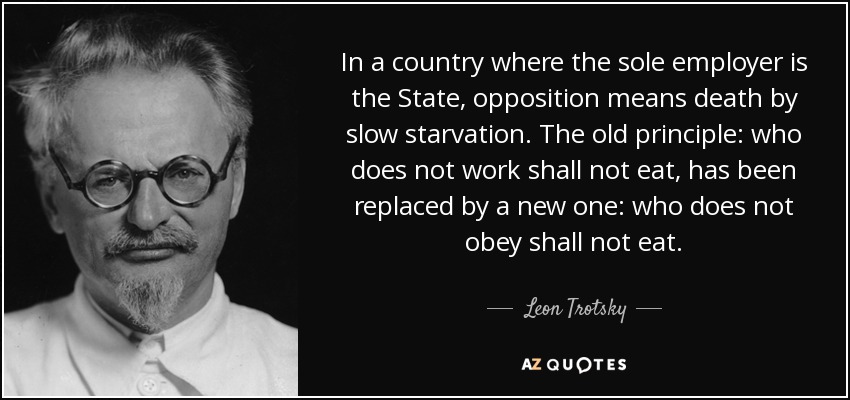
Trotsky refers to the old principle which St. Paul states in 2 Thessalonians chapter 3:10 “We gave you this rule: if a man will not work, he shall not eat.” And before that Deuteronomy 25:4: “Do not muzzle an ox while it is treading out the grain.”
Enormous imagination has gone into showing that increasing concentrations of CO2 will be catastrophic. Cities will be flooded by sea-level rises that are 10 or more times bigger than even the IPCC predicts. There will be mass extinctions of species; billions of people will die; “tipping points” will render the planet a desert.
If you wrote down all the ills attributed to global warming, you would fill up a very thick book. And all of this despite the fact that in the history of higher life forms on Earth (the Phanerozoic), CO2 levels were four or more times higher than today, but life nevertheless flourished at least as abundantly on land and in the sea as it does today. It’s an ill wind, indeed, that blows no good.
In summary, Dr. Karoly is a good scientist who means well. But he lives in an echo chamber of like-minded people who are convinced that they are saving the world.

The scholars of the floating island of Laputa had much in common with many promoters of global-warming alarmism


 Science Matters