
Above I posted Modern Educayshun on the dangers of PC-enforced monotonic diversity (“It’s OK if you don’t look like us, as long as you think like us.”). I must now reference a much more encouraging report of the state of these affairs at my alma mater, Stanford, one of the earliest schools to stop teaching Western Civ, and the cradle of global warming/climate change alarmism. Excerpts in italics with my bolds.
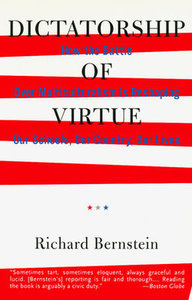
Journalist Richard Bernstein’s 1994 book, Dictatorship of Virtue, was among the first on the rise of political correctness. Twenty-five years later, he returns to Stanford University to take stock of the forces unleashed — and those kept in check. His recent article is Culture War and Peace at Stanford: The PC Uprising 25 Years On
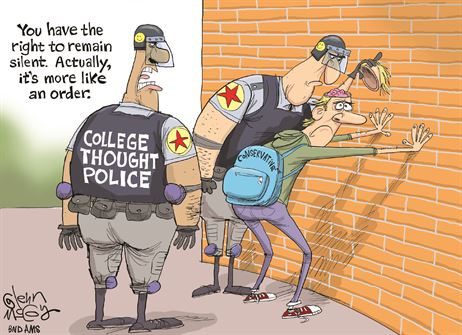
In the decades since, there’s been plenty of righteous indignation expressed: the campus thought police demanding (and often getting) protection from anything they deem to be offensive; informal limits on free speech; reckless accusations of racism, sexism, and homophobia; violent demonstrations against conservative speakers. It goes on.
Such episodes and events often get wide attention. And I was expecting to find a deeply fraught atmosphere at Stanford. Instead, what I found there, 25 years after my book’s publication, was not the brute triumph of a narrow, politically correct orthodoxy but a far more subtle and peaceful outcome to those battles. To be sure, the liberal-left, identity-politics forces for change have scored great gains. They are now established in the departments whose creation they demanded, while things like the Western-civ requirement remain discarded.

But I also found that things have calmed down. The day-to-day mood is less explosively acrimonious than it was a quarter-century ago, in part because those who want to concentrate on identity politics now have their places. But they are contained there. They haven’t shut the rest of the place down, and the rest of the place – perhaps a not silent but discreet and quiet majority – goes about its business delivering a pretty good education to students.
The composition of its student body, moreover, is very different from decades past. About 36% of undergraduates are listed as “white.” Half of the 7,000 or so undergraduates are women; 11% are foreigners; nearly 18% are “first gens,” the first in their families to attend college. The arithmetic of this suggests that only a little more than 21% of the undergraduate student body is made up of the type of student that dominated in the era of mandatory core courses in the Western canon – white males whose parents were college educated.
But in addition to their single Thinking Matters class, which is just a fragment of an undergraduate’s time at Stanford, students have to take 11 quarter-length classes in what’s called Ways of Thinking/Ways of Doing, aka WAYS, and here is where the fashionable trends in identity politics, race, gender, sexuality, class, and their “intersectionality,” as the current term has it, become thick and heavy.
There are dozens and dozens of courses in WAYS, and the diversity theme is omnipresent — “Race and Gender in Silicon Valley,” “Ethnicity, Race, and Identity in Performance Cultures,” “Introduction to Comparative Queer Literary Studies,” “Race, Gender, and Sexuality in Contemporary American Film,” and “Introduction to Intersectionality” (readings drawn “chiefly from black feminist scholars”).

And it would seem from course enrollment figures and the choice of majors that while courses in “Engaging Diversity” may be required, they’re not where students are putting their main effort.
According to the Office of the Provost, in the graduating class of 2017 (the last for which these statistics are available) 274 students got computer science degrees, 382 in one or another engineering program, 40 in English, nine in Comparative Studies in Race and Ethnicity, and two in Feminist, Gender and Sexuality Studies.
Berman, the Thinking Matters director, noted the irony that while fierce ideological conflicts get most of the ink, the real problem now may be the lack of intellectual passion among students. Over lunch at the student union, sitting at an outdoor terrace looking over Stanford’s hacienda-like sandstone campus, he told me, “There’s a growing belief among students and their parents alike that a college education is direct preparation for a job, rather than an opportunity to deepen one’s personality or to create engaged, thinking citizens.” The challenge is to entice students largely interested in other things back into the humanities.
“The right question isn’t ‘Why aren’t our students reading the Federalist Papers?’ It’s ‘Why are our students primarily doing problem sets without reading much of anything at all?’ ” he said.
Footnote: No, my parents were not rich Hollywood stars who bought me a place at Stanford. In fact I was a diversity admission, being a kid with good grades from an ordinary middle-class family, and needed to fill the quota for entrants from the state of Arizona.
 Science Matters