Climate Change NOT as Advertised

Just before the Trudeau government imposed its Carbon Tax, it did a PR release advertising all the bad things we are doing to the planet, changing the temperature and weather by burning fossil fuels. Several skeptics pushed back (see links at end). This post is a synopsis of a complete rebuttal from Friends of Science. The whole document is interestingly written and presented, with only a few of many telling points highlighted here.

Climate Change Your Mind. Responding to the Canadian government’s “Canada’s Changing Climate Report” CCCR2019  Excerpts in italics with my bolds and headers

Federal Government says: Both past and future warming in Canada is, on average, about double the magnitude of global warming.

Friends of Science say: CCCR2019 used a reference frame that began in a cooler solar minimum and ended in a higher temperature El Nino period.

The CCCR2019 report uses 1948 as a reference point, a time when temperatures dropped significantly. Referring to this low period as a starting point gives a skewed comparison. In addition the referenced period from 1986 to 2005 ends with an El Nino year, where naturally-caused high temperatures were recorded. This gives a false impression that Canada is ‘warming faster than the rest of the world.’

Moreover, in the above graph all five major datasets show that since 2002, temperatures have Flatlined. This is despite a significant rise in carbon dioxide (CO2), shown by the upper squiggly line in the graph. The squiggles represent the seasonal rise in carbon dioxide during winter, when the great plains and forests are covered by snow, and the uptake of carbon dioxide by plants through spring and summer.

Federal Government says: Canada’s climate has warmed and will warm further in the future, driven by human influence.

Friends of Science say: CO2 Influence is not Seen in Canadian Temperature Records.

Canada has a seasonal range from cold to warm temperatures of 50°Celsius in the near land surface air temperature record. Using the recorded daily temperature minimums (TMIN) and maximums (TMAX) from 1900 to 2013 results in the red and blue colored graph above. A black line in the middle range shows the global temperature anomaly, indicating a tiny rise. At the bottom of the scale in the blue, it is clear there is a reduction in minimum temperatures (meaning overall it is less cold during coldest periods) of about 5°Celsius, but this is at the coldest end of the scale. There is no corresponding rise in the temperature maximum (which would mean hotter during the hottest times), which one is led to believe from the CCCR2019 report.

If carbon dioxide (CO2) was causing warming, it should have been visible in an increasing daytime maximum high, but there is no evidence of it.

Federal Government says: The effects of widespread warming are evident in many parts of Canada and are projected to intensify in the future.

Friends of Science say: Climate Models do not Reflect Observations.

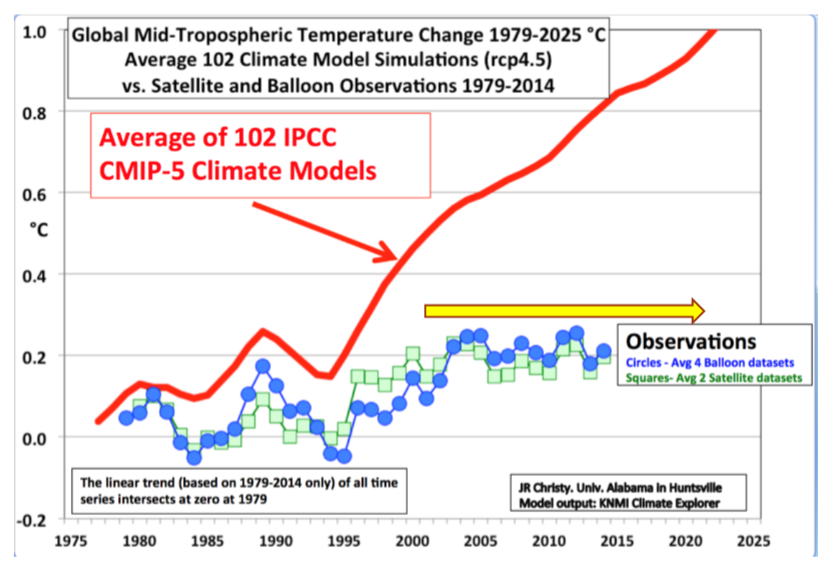
If we are to rely on climate models for setting policy, we should expect that the models closely match observations. As you can see above, based on 102 model runs for the IPCC, the models project significant warming; the reality is that both satellite data and thousands of weather balloon records show that global warming has flatlined despite a significant rise in carbon dioxide emissions from human industry. The models did not predict this ‘hiatus. The theory of Anthropogenic Global Warming says carbon dioxide from human emissions drives warming – that is the impetus for the efforts to implement carbon taxes or invent ways to restrict or mitigate carbon dioxide emissions. The theory is flawed, as you can see above.

Federal Government says: Because of climate change, Canadians must face a ‘new reality’ that events such as spring flooding will be happening more and more frequently.

Friends of Science say: No evidence supports claiming seasonal or urban flooding is unusual.

As Dr. Madhav Khandekar, former WMO regional expert, past Environment Canada research scientist of 40 years, past IPCC expert reviewer, peer-reviewer and author of more than 150 peer-reviewed papers says that seasonal flooding in Canada is typically a combination of early warm temperatures over heavy snowpack and ice jams on rivers. If there are warm temperatures while the snowpack is still firm, the water rapidly pools and there is no open land to absorb the run-off. The flood waters often back-up, exacerbated by ice jams on rivers. This is a common occurrence throughout history, and little seems to be done by residents or municipalities to prepare for this reality. Since so many homes are on potential flood plains in Canada, shouldn’t building standards reflect this fact and municipalities require that new homes be elevated to mitigate potential damage?

CCCR2019 highlights the catastrophic southern Alberta/City of Calgary flood of 2013 as ‘probably’ caused by Anthropogenic Global Warming. This claim ignores the evidence that Calgary had eight of its worst floods prior to 1933. Had the CCCR2019 panel looked at the Calgary Public Library website or visited the Glenbow Museum, they could have seen the evidence for themselves.

Federal Government says: Coastal flooding is expected to increase in many areas of Canada due to local sea level rise.

Friends of Science say: Canadian coastlines are challenged by subsidence or erosion, not related to human-caused global warming.

Natural Resources Canada map shows regional uplift or subsidence.

However much of Canada is quite stable. In fact, due to the melting of the ice age glaciers, much of Canada’s land is in the process of isostatic rebound – a subtle, slow rise as the earth rebounds from the tremendous pressure of the kilometers of ice that once overlay our country.

CCCR2019 presumes that sea level rise from melting Greenland or Antarctic ice sheets will cause sea level rise issues to certain coastal areas in Canada, but this is not a foregone conclusion. Even if large masses of Greenland were to melt, the interior of Greenland is shaped as a bowl that would retain much of the meltwater.

As CCCR2019 notes, many northern regions of Canada are facing challenges due to permafrost melt and some communities face eroding coastlines. This may be seen as sea level rise, but it is due to subsidence or erosion, neither of which are related to human-caused global warming. In previous generations, northern residents were nomads, their ancestors simply moved camp to the most advantageous place for fishing, hunting or seasonal camping. Rather than proposing greenhouse gas emission targets, perhaps a more practical thing would be to design housing for northern communities that can be relocated. As more and more permafrost melts, more carbon dioxide and more methane will be released, however, a carbon tax will not stop that from happening. These are natural cycles. We must adapt.

Summary

Who  are you going to trust: Federal Government or Friends of Science?  Consider the evidence.

Footnote:

See also Climate Hearsay

About Canadian Warming: Just the Facts


NYT Maple Syrup Story Not Fit to Print

Journalists are finally exposing the rot inside the news mass media. Sharyl Attkisson resigned as an investigative corespondent from CBS News and wrote at Epoch Times How Media Narratives Became More Important Than Facts. Excerpt in italics with my bolds.

I was among the first to really pay attention to the increasingly effective operations to shape and censor news—the movements to establish narratives rather than follow facts—and to see the growing influence of smear operations, political interests, and corporate interests on the news.

We agree there is terrific journalism being committed on a daily basis at organizations from The New York Times to local news stations. However, we agree that national media has also largely become co-opted by powerful interests who understand how to direct the news landscape in a way that services certain narratives and agendas.

Case in Point Global Warming vs. Maple Syrup

Eric Felten describes how this works in his article at Real Clear Investigations Why This NY Times Maple Syrup Story Tastes Odd. His exquisite takedown of a recent NYT essay linking AGW to maple syrup should be gracing a page in the NY Times, except for narrative being the mission, not truth. Excerpt below in italics with my bolds.

Climate change is at it again, ruining everything good. This time around it’s maple syrup that is at risk, according to the New York Times, which on Saturday had the alarming headline, “Warming Climate May Slow the Flow of Maple.” Or at least it would be alarming if it weren’t for the tell-tale word “may.” If a warming climate were actually slowing the flow of the sap that makes for syrup, you can be sure the Times would declare it clearly. To say it “may” slow the flow suggests that it isn’t actually happening, at least not yet.

King Philippe and Queen Mathilde of Belgium sample maple syrup in Ottawa last year.

But one would hate to be unfair to Kendra Pierre-Louis, the reporter who typed up the doom and gloom for the Times. Perhaps she has evidence supporting her warning of dire syrup consequences—statistics, even. Let’s see how she marshals her facts and makes her case.

“In fact, climate change is already making things more volatile for syrup producers,” Pierre-Louis laments in her front-page article. “[M]aple production fell by 54 percent in Ontario and by 12.5 percent in Canada over all.” The cause was “an unusually warm spring.” Well that’s some pretty compelling data, or would be if it were from 2018, or perhaps 2017 or even 2016. But no, that’s not even close. To find a year in which there was unseasonably warm weather that affected the maple crop, Pierre-Louis had to go all the way back to 2012, which is the year the Times cites as the “fact” for climate change’s impact on syrup producers. The Times finds room to return to that year again later in the article.

Isn’t it a bit odd that the New York Times cites 2012 for its evidence of climate change? After all, were the paper looking for a bad production year, the most recent one would be a perfect example: 2018 was an off year for maple syrup production in Quebec, the province that produces the vast majority of Canadian syrup. In 2016 Canada produced a record 12.16 million gallons of maple products; 2017 was another banner year, with Canada delivering a new record of 12.51 million gallons. But last year was a relatively bad one, with maple production falling in Canada to 9.8 million gallons, a significant drop — indeed, a drop more substantial than that in 2012. And yet for some perplexing reason, the Times fails to mention the drop in 2018, let alone the statistics showing record production in the previous years.

If we’re worried about maple syrup production, wouldn’t you think that the recent decline would be more newsworthy, or at the very least worth including in the article, if not making it the lede?

It doesn’t take much digging to find what’s wrong with 2018 as an example of climate change hobbling the syrup trade. Yes, weather was to blame for 2018’s bad results. It just wasn’t the right sort of weather. Here’s how Halifax Today reported on last year’s maple results: “Quebec — which produces about 72 per cent of the world’s maple syrup — produced 40.4 million litres, down 22.4 percent from 2017 due to unusually late snow and cold.”

Unusual cold? That’s right. As the official government Statistics Canada explains in its report on “Maple products, 2018,” in “Quebec, production was hurt by unusually late snow and cold, while the decrease in New Brunswick was the result of a long and severe winter followed by a short spring.” This year could prove to be another disappointment for Canadian maple farmers. In late February Canada’s CBC reported, “Local syrup farms say the recent cold temperatures are leaving taps dry.” Could it be that the New York Times neglected to mention the maple syrup decline of 2018 and the slow start to 2019 because the reductions were caused by abnormal cold rather than warming?

One should find that hard to believe. Because for that to be true, one would have to believe that the Times is willing to cherry-pick data in an effort to mislead its readers. Surely the newspaper of record has more respect for itself than to play such a cheap trick on its customers. RealClearInvestigations reached out to the Times’s reporter via her website for comment but received no response.

The evidence piles up that the Times is playing fast and loose with the facts. Take the suggestion by the Times that climate change is limiting the number of days when maple trees can be successfully tapped. “More Narrow Window for Syrup Production,” reads the newspaper’s sub-headline. The weather determines the sap flow, after all, and University of Vermont “sugar maple expert” Mark Isselhardt told the Times that “[e]very day that you don’t get sap flow has the potential to really impact the total yield for that operation.”

But is the production window actually narrowing?

Surely the sugar maple expert at the University of Vermont, in telling the Times about the window when sap is ripe for collecting, had at his fingertips the latest data, which are readily available. The USDA’s National Agricultural Statistics Service keeps figures — helpfully broken down by state — on maple syrup production in the United States. Among the information collected are data on the “Maple Syrup Season,” that elusive window. The figures for the last four years are readily available. In 2015, the season for the U.S. as a whole was 26 days. In 2016 it was 33 days. In 2017 it was 37 days and in 2018 the window expanded again, this time to 42 days. The figures for Vermont — which we can assume our University of Vermont maple expert is particularly familiar with — show the state’s maple syrup season widening: 26 days in 2015; 44 days in 2016; 46 days in 2017; and 52 days in 2018.

What about the suggestion in the New York Times that the production window is not only shrinking, but moving, as climate change causes “season creep”? The newspaper quotes the executive director of the New York Maple Producers Association, who says that when she was a kid, 50 years ago, the start of the tapping season was mid-March. “This year,” according to the Times, “they were tapping in late January.”

Were they really? In upstate New York, the last week in January this year was marked by brutally cold temperatures. A normal high temperature for late January in Buffalo is 31 degrees. Though there were days in that ballpark during the month — and one mid-month day actually made it to 47 degrees — late January was for the most part frigid. The high temperature in Buffalo Jan. 30 was 11 degrees. On the 31st the thermometer peaked at 7 degrees.

This last winter’s extreme cold persisted well into February in Canada, where the deep freeze kept the maple sap from flowing. It wasn’t until the middle of March that sap started to trickle from the trees north of the border.

How did the New York Times get things so wrong? Is it carelessness? Or is there an ideological agenda at play, one that requires the reporting and writing to lead to a preestablished conclusion? On Twitter, the NYT reporter calls herself Kendra “Gloom is My Beat” Pierre-Louis. That is no doubt a gesture at self-aware humor. But it also suggests that her reporting is skewed: If you see gloom as your beat, by definition you ignore information that doesn’t advance the narrative of impending doom. And then there is the larger institutional bias. Pierre-Louis is officially a “climate reporter” for the Times; she leads NYT-branded “student journeys” to places such as Iceland (cost: $8,190 per high-schooler for 15 days) to teach the risks of a warming planet. In other words, the Times has a business built in part around Pierre-Louis that depends on her being a warning voice on warming.

Those sounding the alarm about climate change do a lot of fretting over what may happen 50 to 100 years from now. Fair enough — or at least it would be if those delivering the warnings were in more of a habit of playing it straight. It would be much easier to credit their predictions of future catastrophes if they were more honest about what is actually, observably, happening right now.

Footnote:

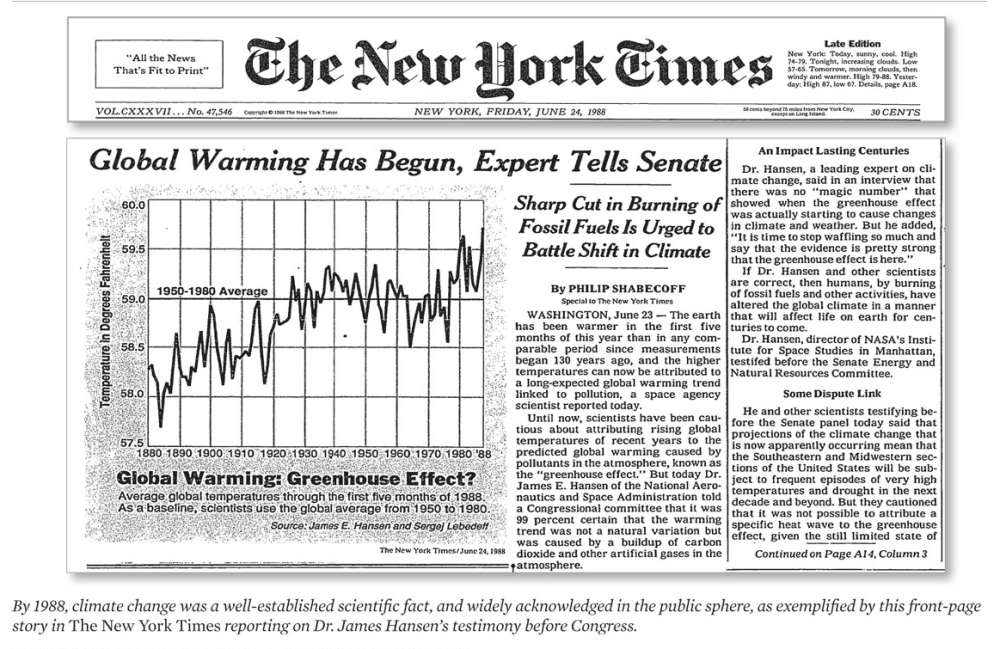
It should be noted that the NY Times has a long history of botching science stories, including but not limited to climate change. Bernie Lewin gives several examples in his book on environmental scares, and of course it was NYT who headlined the global warming claims of Jim Hansen.  When objective historians look back on these fear-mongering days, NY Times will be seen as a leading traitor against the public interest.

See Progressively Scaring the World (Lewin book synopsis)

Rise and Fall of CAGW


Woke Capitalists: Corporate Vigilantes

Some recent reports note a disturbing trend in large and influential corporations. Having worked in and for some of these, I believe the incidents show a dangerous virus is mutating from academia to the workplace. The import of these developments is not good for free enterprise or for individual freedoms.

Warning bells in the past concerned punative efforts against some employees to silence their discomforting opinions. For example James Damore was fired by Google for saying that staffing with the most competent techies is more important than gender hiring quotas. Now it appears such events are not atypical, but reflect a systemic takeover of corporate cultures.

Rod Dreher writes at American Conservative Woke Capitalism Is Our Enemy. Excerpts in italics with my bolds.

Pro tip: whenever you hear a management type talk about “diversity” and “inclusion,” you may be certain that you are about to hear a rationale for creating a more ideologically uniform and ideologically exclusive community.

A reader has sent me internal documents from a leading global corporation having to do with its employee program to create a Diverse and Inclusive culture. I am not allowed to quote from the documents, or to identify the company, so I’m going to be delicate here in what I describe, to honor the reader’s request to protect privacy. The reader said:

It confirms what you have been saying all along. You are absolutely correct about the “soft totalitarianism” that is coming. It’s already happening, and it’s picking up speed.

The documents are pretty shocking to my eyes, because I know what I’m looking at. It is 100 percent, pure, uncut Human Resources Department cant. What’s so amazing about it — truly amazing — is that it is all about coercing people into accepting and participating in a cultural revolution by redefining the revolution’s goals and methods as good for business, and a chance for employees to exercise virtue.

This particular company’s program is far more sophisticated and thorough than anything I’ve seen before. It is totalitarian in the sense that it encompasses nearly every aspect of life in the company. From reading these documents, you would think that the purpose of this company is to shape the cultural politics and behavior of its employees. I’m not kidding you: it’s like a church organization trying to catechize and discipline its employees in true religion — and part of that discipline is urging them to police their own ranks for heretics. It even instructs employees to conduct struggle sessions within themselves to root out false beliefs that undermine Diversity and Inclusion.

Though it’s stated in happy-clappy HR jargon, it’s clear that the company is training its employees to monitor each other for signs of bias, and encouraging them to call out each other. Incredible. It’s the Stasification of the American workplace. And the program instructs employees to think and talk about Diversity and Inclusion all the time, in everything they do. Seriously, it does. If I were an employee there, I would find all this completely unnerving. I would wonder constantly if I were being monitored by my co-workers and judged for not showing enough commitment to Diversity and Inclusion. I would watch what I said, but also worry about what I did not say. It would make me a nervous wreck.

Again, I’m not going to name the company or give identifying details about the program. I am quite confident that what I’ve said here describes the internal culture many corporations are building. I’m sure many of you readers are thinking, “That sounds like where I work.” It is coercive, and it is totalitarian. It is going to create massive suspicion and mistrust within companies that do this, in part because it is going to empower members of particular groups to harass others in the workplace, to inform on others, and even to affect their salaries and impede their career advancement.

Get this: the way this particular program is set up, you don’t have to participate, but failing to do so will be noted, and it’s going to affect your pay. It’s not enough to sign up for the program in a pro forma way, and then simply be quiet about it. You are expected to be an active, vocal advocate of its principles. From what I can tell, it appears that they have the rudiments of a Chinese-style Social Credit System structure to monitor employee enthusiasm.

You might be a first-rate maker of widgets for this corporation, or a superb sales executive, manager, whatever, and you may be a diligent employee who is honest and works well with others. But if you are not 100 percent aboard the Party’s company’s ideological campaign for cultural revolution, it will go down in your employee record, and it will affect your future at the company.

When you see these documents, and realize that this is how it is inside one of the world’s leading corporations, you know perfectly well that this is quickly going to become normative in corporations, if it isn’t already. What kind of future do any of us deplorables (or our kids) have in corporate life when workplaces become communities of coerced wokeness?

What? Have you no respect for diversity?

Let me put it to you like this. If this were the US Government, and it pushed “patriotism” on its employees following the same platform and methods that this corporation is pushing “diversity and inclusion,” people would freak out at the coerciveness and invasion of privacy. And they would be right to! Imagine that you, a US government employee, were told to monitor yourself constantly to root out a lack of patriotism. How … Soviet would that feel? Well, that’s what this corporation is doing to its employees regarding diversity and inclusion.

The familiar left vs. right categories no longer serve as reliable guides to our cultural reality. The cultural left has captured the bureaucracies at American corporations. One thing we hear a lot from our friends on the left is that Big Business is conservative, and would never do anything that would hurt its bottom line. Wrong! I have seen personally how companies will do politically correct things that actually hurt their business model, but that win its management pats on the back among their social cohort. These documents I looked at today assert — assert, do not argue — that the total politicization of the company’s culture is critical to its business success … and then go on to describe a program that is almost certainly going to cause major problems with teamwork, cohesiveness, and conflict. These documents are a recipe for creating intense anxiety and suspicion within the company. It’s as clear as day. You cannot imagine why any sensible company would embrace these principles and techniques, which can only hurt its ability to compete. But there it is, in black and white.

Woke capitalism is a vanguard of unfreedom. It’s happening. We have to be prepared to resist.

My Comment

I have done consulting with enough HR departments to know that they are not power centers in companies, but are seen rather as administrative overhead. The line operations make or break the bottom line, and there the credo of middle managers still holds: “Whatever interests my boss, thrills the hell out of me.” Thus in any company where HR is going viral with social justice, diversity inclusion and the rest of it, it can only happen if HR is carrying water for the CEO and everyone knows it.

That appears to be the case, as described by Nick Dedeke in his article at Real Clear Poliitcs Is Corporate Vigilantism a Threat to Democracy? Excerpts in italicss with my bolds.

A serious issue has gained prominence in modern society the last few years: The executives and/or founders of large companies increasingly consider it their civic and moral duty to use the influences and powers of their businesses to censor or suppress political and/or inconvenient ideas they do not support or find offensive. This mindset is reflected in the following statement from PayPal CEO Daniel Schulman: “Businesses need to be a force for good in those values and issues that they believe in.” Taken in isolation, this is a very good philosophy. However, one needs to also examine the implications of it in practice.

Recently, PayPal decided to stop processing financial transactions for customers it deemed to have hateful political views. Not long ago, MasterCard and Visa refused to process any donations to David Horowitz’s Freedom Center, a conservative nonprofit. The crime? Horowitz had personal and/or political views that were judged by the credit card companies to be hateful. YouTube has banned some Prager University (PragerU) videos (PragerU is not a higher learning institution, but a nonprofit that promulgates conservative views.) Selected content from conservatives, Christian and some liberal-leaning groups has also been removed from social media and the accounts of the targets were deleted or deactivated.

The motivation for these actions is the desire of the executives of these companies to be “good” by punishing the “bad.” These executives, and their supporters, declare that their actions are protected by the laws of the United States of America, which they claim permit them to run their private businesses any way they deem fit.

Two questions need to be asked. First, does a private business have a boundary? If so, where is it? These are critical questions that need to be answered. Without defining the boundary of the modern business, we are likely going to alter, in negative ways, the civic foundations of our society. I do agree that a business should be allowed to have maximum freedom to be run as its founder sees fit. However, I also believe that the boundary of a business has to be limited to its business charter. PayPal has a charter to process payments for society; it does not have a charter to make society “good.”

I argue that many of the well-intentioned actions taken by executives of large corporations fall under what one could call corporate vigilantism. In a notable academic analysis, Les Johnston identified six criteria that are common to most vigilantism. (1) there is planning and premeditation by those engaged in such actions; (2) the actors are private citizens acting voluntarily; (3) the actors view their actions as “autonomous citizenship”; (4) the actors use or threaten to use force and pressure against targets; (5) the actors go into action to protect an established or new order from actual, potential or imputed transgressions; (6) the actors aim to control crime or other social infractions.

It should be noted that vigilantism is not new. It is likely the most popular form of justice in countries in which there are no mature civil institutions. However, vigilantism is a danger wherever it is found. There are three reasons for this. First is that it violates a basic organizing principle of society — namely, that institutions are only allowed to perform duties for which they have a societal mandate. There is no known societal law or mandate that empowers a corporate executive to be the vanguard of moral actions, choices and speech in society.

Second, vigilantism violates the essential principle of separation of powers, which is so essential to the norms of justice. In most vigilante processes, the same institution or group of people constitutes the judge, jury and executioner. Hence, the vigilante system has, by design, inherent, embedded and systemic biases.

Third, the vigilante process is not equipped to recognize its own biases. When asked about how PayPal, in collaboration with the controversial Southern Poverty Law Center, determines when to decline services to customers, Schulman told the Wall Street Journal: “We don’t always agree. We have our debates with [SPLC]. We are very respectful with everyone coming in. We will do the examination carefully. We’ll talk when we don’t agree with a finding: We understand why you think that way, but it still goes into the realm of free speech for us.” Despite this claim of evenhandedness, however, the majority of blocked customers are right-leaning groups and individuals.

A common protest is raised when one questions corporate vigilantism. People often respond by asking, “But, it is their business, isn’t it?” Yes, it is. But, society still has a role to play if and when the pursuit of private business’s self-interest is in conflict with major interests of its customers or the public. That is why regulations were enacted when we realized that private businesses were polluting rivers and other water resources. That is why the new, and stricter, European General Data Protection Regulation was enacted. That is why there is a process whereby new drugs have to be vetted and approved by a neutral party, such as the Food and Drug Administration, before they can be sold to the public. What do these actions have in common? They all involve the establishment of mechanisms that limit the authority of large organizations to exercise their freedom at the expense of the freedoms of others.

There is no debate that an executive of a company could support a political candidate or give money to any cause she/he pleases to do. The executive can also hire and fire anyone that she/he pleases. But this is quite different from what we see in corporate vigilantism. We hear about an executive of a corporation threatening to withdraw its businesses from a state because of perceived political and/or moral transgressions by people there. Or we read about an executive threatening to abandon or exclude a state from its expansion plans if and when a political organ of the state votes for the “wrong” cause or the “wrong” policy. These are some of the most dangerous kinds of politicization that can occur in a society. There is little difference between such corporate vigilantism and what we call corruption. What would you say if a politician promised to give voters money — if they vote a certain way? What would you think of a company that threatened to punish voters if they dared to vote a certain way?

We have had no laws curbing corporate vigilantism in the United States. This is because most business founders knew and/or believed that one should not mix politics and business. Unfortunately, things have changed. For a large corporation today, there is little or no penalty for using one’s near-monopolistic position to shut down the freedoms of others.

The spirit of vigilantism that makes a restaurant owner eject a customer who holds different political views is the same mindset that prompts executives of some large corporations to punish opinions, choices and actions that they do not like. The only difference is in the type and scope of harm done. Vigilantism corrupts free democratic societies, sooner or later, if action is not taken to curb it.

Nick Dedeke teaches information management courses at Northeastern University.

False Beliefs about Human Genes

Carl Zimmer writes at Skeptical Inquirer Seven Big Misconceptions About Heredity. Excerpts in italics with my bolds

It’s been seven decades since scientists demonstrated that DNA is the molecule of heredity. Since then, a steady stream of books, news programs, and episodes of CSI have made us comfortable with the notion that each of our cells contains three billion base pairs of DNA, which we inherited from our parents. But we’ve gotten comfortable without actually knowing much at all about our own genomes.

If you want to get your entire genome sequenced—all three billion base pairs in your DNA—a company called Dante Labs will do it for $699. You don’t need whole genome sequencing to learn a lot about your genes, however. The 20,000 genes that encode our proteins make up less than 2 percent of the human genome. That fraction of the genome—the “exome”—can be yours for just a few hundred dollars. The cheapest insights come from “genotyping”—in which scientists survey around a million spots in the genome known to vary a lot among people. Genotyping—offered by companies such as 23andMe and Ancestry—is typically available for under a hundred dollars.

Thanks to these falling prices, the number of people who are getting a glimpse at their own genes is skyrocketing. By 2019, over twenty-five million worldwide had gotten genotyped or had their DNA sequenced. At its current pace, the total may reach 100 million by 2020.

There’s a lot we can learn about ourselves in these test results. But there’s also a huge opportunity to draw the wrong lessons.

Many people have misconceptions about heredity—how we are connected to our ancestors and how our inheritance from them shapes us. Rather than dispelling those misconceptions, our growing fascination with our DNA may only intensify them. A number of scientists have warned of a new threat they call “genetic astrology.” It’s vitally important to fight these misconceptions about heredity, just as we must fight misconceptions about other fields of science, such as global warming, vaccines, and evolution. Here are just a few examples.

Misconception #1: Finding a Special Ancestor Makes You Special

You can join the Order of the Crown of Charlemagne if you can prove that the Holy Roman Emperor is your ancestor. It’s a thrill to discover we have a genealogical link to someone famous—perhaps because that link seems to make us special, too.

But that’s an illusion. I could join the Mayflower Society, for example, because I’m descended from a servant aboard the ship named John Howland. Howland’s one claim to fame is that he fell out of the Mayflower. Fortunately for me, he got fished out of the water and reached Massachusetts. But I’m not the only fortunate one; by one estimate, there are two million people who descend from him alone.

Mathematicians have analyzed the structure of family trees, and they’ve found that the further back in time you go, the more descendants people had. (This is only true of people who have any living descendants at all, it should be noted.) This finding has an astonishing implication. Since we know Charlemagne has living descendants (thank you, Order of the Crown!), he is likely the ancestor of every living person of European descent.

Misconception #2: You Are Connected to All Your Ancestors by DNA

But genetics do not equal genealogy. It turns out that practically none of the Europeans who descend from Charlemagne inherited any of his DNA. All humans, in fact, have no genetic link to most of their direct ancestors.

The reason for this disconnect is the way that DNA gets passed down from one generation to the next. Every egg or sperm randomly ends up with one copy of each chromosome, coming either from a person’s mother or father. As a result, we inherit about a quarter of our DNA from each grandparent—but only on average.

If you go back a few generations more, that contribution can drop all the way to zero. . . While it is true that you inherit your DNA from your ancestors, that DNA is only a tiny sampling of the genes in your family tree.

Even without a genetic link, though, your ancestors remain your ancestors. They did indeed help shape who you are—not by giving you a gene for some particular trait, but by raising their own children, who then raised their own children in turn, passing down a cultural inheritance along with a genetic one.

Misconception #3: Ancestry Tests Are as Reliable as Medical Tests

Millions of people are getting ancestry reports based on their DNA. My own report informs me that I’m 43 percent Ashkenazi Jewish, 25 percent Northwestern European, 23 percent South/Central European, 6 percent Southwestern European, and 2.2 percent North Slavic. Those percentages sound impressive, even definitive. It’s easy to conclude that ancestry reports are as reliable as stepping on a scale at the doctor’s office to get your height and weight measured.

That is a mistake, and one that can cause a lot of heartbreak. To estimate ancestry, researchers compare each customer to a database of thousands of people from around the world. . . They can identify stretches of DNA that are likely to have originated in a particular part of the world. While some matches are clear-cut, others are less so. As a result, ancestry estimates always have margins of error—which often go missing in the reports customers get.

These estimates are going to get better with time, but there’s a fundamental limit to what they can tell us about our ancestry. . . Researchers are getting glimpses of those older peoples by retrieving DNA from ancient skeletons. And they’re finding that our genetic history is far more tumultuous than previously thought. Time and again, researchers find that the people who have lived in a given place in recent centuries have little genetic connection to the people who lived there thousands of years ago. All over the world, populations have expanded and migrated, coming into contact with other populations. . . If you want to find purity in your ancestry, you’re on a fool’s errand.

Misconception #4: There’s a Gene for Every Trait You Inherit

Mendel is a great place to start learning about heredity but a bad place to stop. There are some traits that are determined by a single gene. Whether Mendel’s peas were smooth or wrinkled was determined by a gene called SBEI. Whether people develop sickle cell anemia or not comes down to a single gene called HBB. But many traits do not follow this so-called Mendelian pattern—even ones that we may have been told in school are Mendelian.

Consider your ear lobes. For decades, teachers taught that they could either hang free or be attached to the side of our heads. The sort of ear lobes you had was a Mendelian trait, determined by a single gene. In fact, our ear lobes typically fall somewhere between the two extremes of strongly attached to fully free. In 2017, a team of researchers compared the ear lobes of over 74,000 people to their DNA. They looked for genetic variants that were common in people at either end of the ear-lobe spectrum. They pinpointed forty-nine genes that appear to play a role in determining how attached they are to our heads. There well may be more waiting to be discovered.

The genetics of ear lobes is actually very simple compared to other traits. Studying height, for example, scientists have identified thousands of genetic variants that appear to play a role. The same holds true for our risk of developing diabetes, heart disease, and other common disorders. We can’t expect to find a single gene in our DNA tests that determines whether we’ll die of a heart attack. Nor should we expect easy fixes for such complex diseases by repairing single genes.

Misconception #5: The Genes You Inherit Explain Exactly Who You Are

Take, for example, a recent study on how long people stay in school. Researchers examined DNA from 1.1 million people and found over 1,200 genetic variants that were unusually common either in people who left school early or in people who went on to college or graduate school. They then used the genetic differences in their subjects to come up with a predictive score, which they then tried out on another group of subjects. They found that in the highest-scoring 20 percent of these subjects, 57 percent finished college. In the lowest-scoring 20 percent, only 12 percent did.

But these results don’t mean that how long you stayed in school was determined before birth by your genes. Getting your children’s DNA tested won’t tell you if you should save up money for college tuition or not. Plenty of people in the educational attainment study who got high genetic scores dropped out of high school. Plenty of people who got low scores went on to get PhDs. And many more got an average amount of education in between those extremes. For any individual, these genetic scores make predictions that are barely better than guessing at random.

This confusing state of affairs is the result of how genes and the environment interact. Scientists call a trait such as how long people stay in school “moderately heritable.” In other words, a modest amount of the variation in education attainment is due to genetic variation. Lots of other factors also matter, too—the neighborhoods where people live, the quality of their schools, the stability of their family life, their income, and so on. What’s more, a gene that may have an influence on how long people stay in school in one environment may have no influence at all in another.

Misconception #6: You Have One Genome

According to this assumption, you will find an identical sequence of DNA in any cell you examine. But there are many ways in which we can end up with different genomes within our bodies.

Fairchild is known as a chimera. She developed inside her mother alongside a fraternal twin. That twin embryo died in the womb, but not before exchanging cells with Fairchild. Now her body was made up of two populations of cells, each of which multiplied and developed into different tissues. In Fairchild’s case, her blood arose from one population, while her eggs arose from another.

It’s unclear how many people are chimeras. Once they were considered bizarre rarities. Scientists became aware of them only in cases such as Lydia Fairchild’s, when their mixed identity made itself known. In recent years, researchers have been carrying out small-scale surveys that suggest that perhaps a few percent of twins are chimeras, but the true number could be higher. As for chimeric mothers, they may be the rule rather than the exception. In a 2017 study, researchers studied brain tumors taken from women who had sons. Eighty percent of them had Y-chromosome-bearing cells in their tumors.

Chimerism is not the only way we can end up with different genomes. Every time a cell in our body divides, there’s a tiny chance that one of the daughter cells may gain a mutation. At first, these new aberrations—called somatic mutations—seemed important only for cancer. But that view has changed as new genome-sequencing technologies have made it possible for scientists to study somatic mutations in many healthy tissues. It now turns out that every person’s body is a mosaic, made up of populations of cells with many different mutations.
Misconception #7: Genes Don’t Matter Because of Epigenetics

The notion that our genes are our destiny can trigger an equally false backlash: that genes don’t matter at all. And very often, those who push against the importance of genetics invoke a younger, more tantalizing field of research: epigenetics.

Our cells use many layers of control to make proper use of their genes. They can quickly turn some genes on and off in response to quick changes in their environment. But they can also silence genes for life. Women, for example, have two copies of the X chromosome, but in early development, each of their cells produces a swarm of RNA molecules and proteins that clamp down on one copy. The cell then only uses the other X chromosome. And if the cell divides, its daughter cells will silence the same copy again.

One of the most tantalizing possibilities scientists are now exploring is whether certain epigenetic “marks” can be inherited not just by daughter cells but by daughters—and sons. If people experience trauma in their lives and it leaves an epigenetic mark on their genes, for example, can they pass down those marks to future generations?

If you’re a plant, the answer is definitely yes. Plants that endure droughts or attacks by insects can reprogram their seeds, and these epigenetic changes can get carried down several generations. The evidence from animals is, for now, still a mixed bag. . . But skeptics have questioned how epigenetics can transmit these traits through the generations, suggesting that the results are just statistical flukes. That hasn’t stopped a cottage industry of epigenetic self-help from springing up. You can join epigenetic yoga classes to rewrite your epigenetic marks or go to epigenetic psychotherapy sessions to overcome the epigenetic legacy you inherited from your grandparents.

Land and Sea Temps: April Southern Exposure

banner-blog

With apologies to Paul Revere, this post is on the lookout for cooler weather with an eye on both the Land and the Sea.  UAH has updated their tlt (temperatures in lower troposphere) dataset for April.   Previously I have done posts on their reading of ocean air temps as a prelude to updated records from HADSST3. This month also has a separate graph of land air temps because the comparisons and contrasts are interesting as we contemplate possible cooling in coming months and years.

Presently sea surface temperatures (SST) are the best available indicator of heat content gained or lost from earth’s climate system.  Enthalpy is the thermodynamic term for total heat content in a system, and humidity differences in air parcels affect enthalpy.  Measuring water temperature directly avoids distorted impressions from air measurements.  In addition, ocean covers 71% of the planet surface and thus dominates surface temperature estimates.  Eventually we will likely have reliable means of recording water temperatures at depth.

Recently, Dr. Ole Humlum reported from his research that air temperatures lag 2-3 months behind changes in SST.  He also observed that changes in CO2 atmospheric concentrations lag behind SST by 11-12 months.  This latter point is addressed in a previous post Who to Blame for Rising CO2?

The April update to HadSST3 will hopefully appear later this month (March is yet to be posted).  In the meantime we can look at lower troposphere temperatures (TLT) from UAHv6 which are already posted for April. The temperature record is derived from microwave sounding units (MSU) on board satellites like the one pictured above. This month also involved a change in UAH processing of satellite drift corrections, including dropping one platform which can no longer be corrected. The graphs below are taken from the new and current dataset.

The UAH dataset includes temperature results for air above the oceans, and thus should be most comparable to the SSTs. There is the additional feature that ocean air temps avoid Urban Heat Islands (UHI).  The graph below shows monthly anomalies for ocean temps since January 2015.

Click on image to enlarge.

April ocean air temps rose in all regions, putting them back comparable with January 2019.  NH warming was slight, while stronger warming in SH and the Tropics pulled up the Global average.  The temps this April are warmer than 2018, nearly matching 2017, and of course much lower than 2016.

Land Air Temperatures Tracking Downward in Seesaw Pattern

We sometimes overlook that in climate temperature records, while the oceans are measured directly with SSTs, land temps are measured only indirectly.  The land temperature records at surface stations record air temps at 2 meters above ground.  UAH gives tlt anomalies for air over land separately from ocean air temps.  The graph updated for April is below.

The greater volatility of the Land temperatures was evident earlier, but has calmed down recently. Also the  NH dominates, having twice as much land area as SH.  Note how global peaks mirror NH peaks.  In January 2019 all Land air temps were close but have now diverged.  In April both SH and the Tropics warmed (comparable to ocean temps), but the much larger NH land surface cooled, pulling the Global anomaly down.  The Tropical land air temps could not be more different from a year ago, yet the Global is about the same.

TLTs include mixing above the oceans and probably some influence from nearby more volatile land temps.  Clearly NH and Global land temps have been dropping in a seesaw pattern, now more than 1C lower than the peak in 2016.  TLT measures started the recent cooling later than SSTs from HadSST3, but are now showing the same pattern.  It seems obvious that despite the three El Ninos, their warming has not persisted, and without them it would probably have cooled since 1995.  Of course, the future has not yet been written.


The Poisonous Tree of Climate Change

This post was triggered by noticing an event in April that had escaped my attention.  It seems that serial valve turner Ken Ward was granted a new trial by the Washington State Court of Appeals, and he is allowed to present a “necessity defense.”  This astonishingly bad ruling is reported approvingly by Kelsey Skaggs at Pacific Standard Why the Necessity Defense is Critical to the Climate Struggle. Excerpt below with my bolds.

A climate activist who was convicted after turning off an oil pipeline won the right in April to argue in a new trial that his actions were justified. The Washington State Court of Appeals ruled that Ken Ward will be permitted to explain to a jury that, while he did illegally stop the flow of tar sands oil from Canada into the United States, his action was necessary to slow catastrophic climate change.

The Skaggs article goes on to cloak energy vandalism with the history of civil disobedience against actual mistreatment and harm.  Nowhere is it recognized that the brouhaha over climate change concerns future imaginary harm.  How could lawyers and judges get this so wrong?  It can only happen when an erroneous legal precedent can be cited to spread a poison in the public square.  So I went searching for the tree producing all of this poisonous fruit. The full text of the April 8, 2019, ruling is here.

A paper at Stanford Law School (where else?) provides a good history of the necessity defense as related to climate change activism The Climate Necessity Defense: Proof and Judicial Error in Climate Protest Cases Excerpts in italics with my bolds.

My perusal of the text led me to the section where the merits are presented.

The typical climate necessity argument is straightforward. The ongoing effects of climate change are not only imminent, they are currently occurring; civil disobedience has been proven to contribute to the mitigation of these harms, and our political and legal systems have proven uniquely ill-equipped to deal with the climate crisis, thus creating the necessity of breaking the law to address it. As opposed to many classic political necessity defendants, such as anti-nuclear power protesters, climate activists can point to the existing (rather than speculative) nature of the targeted harm and can make a more compelling case that their protest activity (for example, blocking fossil fuel extraction) actually prevents some quantum of harm produced by global warming. pg.78

What?  On what evidence is such confidence based?  Later on (page 80), comes this:

Second, courts’ focus on the politics of climate change distracts from the scientific issues involved in climate necessity cases. There may well be political disagreement over the realities and effects of climate change, but there is little scientific disagreement, as the Supreme Court has noted.131

131 Massachusetts v. E.P.A., 549 U.S. 497, 499 (2007) (“The harms associated with climate change are serious and well recognized . . . [T]he relevant science and a strong consensus among qualified experts indicate that global warming threatens, inter alia, a precipitate rise in sea levels by the end of the century, severe and irreversible changes to natural ecosystems, a significant reduction in water storage in winter snowpack in mountainous regions with direct and important economic consequences, and an increase in the spread of disease and the ferocity of weather events.”).

The roots of this poisonous tree are found in citing the famous Massachusetts v. E.P.A. (2007) case decided by a 5-4 opinion of Supreme Court justices (consensus rate: 56%).  But let’s see in what context lies that reference and whether it is a quotation from a source or an issue addressed by the court.  The majority opinion was written by Justice Stevens, with dissenting opinions from Chief Justice Roberts and Justice Scalia.  All these documents are available at sureme.justia.com Massachusetts v. EPA, 549 U.S. 497 (2007)

From the Majority Opinion:

A well-documented rise in global temperatures has coincided with a significant increase in the concentration of carbon dioxide in the atmosphere. Respected scientists believe the two trends are related. For when carbon dioxide is released into the atmosphere, it acts like the ceiling of a greenhouse, trapping solar energy and retarding the escape of reflected heat. It is therefore a species—the most important species—of a “greenhouse gas.” Source: National Research Council:

National Research Council 2001 report titled Climate Change: An Analysis of Some Key Questions (NRC Report), which, drawing heavily on the 1995 IPCC report, concluded that “[g]reenhouse gases are accumulating in Earth’s atmosphere as a result of human activities, causing surface air temperatures and subsurface ocean temperatures to rise. Temperatures are, in fact, rising.” NRC Report 1.

Calling global warming “the most pressing environmental challenge of our time,”[Footnote 1] a group of States,[Footnote 2] local governments,[Footnote 3] and private organizations,[Footnote 4] alleged in a petition for certiorari that the Environmental Protection Agency (EPA) has abdicated its responsibility under the Clean Air Act to regulate the emissions of four greenhouse gases, including carbon dioxide.  Specifically, petitioners asked us to answer two questions concerning the meaning of §202(a)(1) of the Act: whether EPA has the statutory authority to regulate greenhouse gas emissions from new motor vehicles; and if so, whether its stated reasons for refusing to do so are consistent with the statute.

EPA reasoned that climate change had its own “political history”: Congress designed the original Clean Air Act to address local air pollutants rather than a substance that “is fairly consistent in its concentration throughout the world’s atmosphere,” 68 Fed. Reg. 52927 (emphasis added); declined in 1990 to enact proposed amendments to force EPA to set carbon dioxide emission standards for motor vehicles, ibid. (citing H. R. 5966, 101st Cong., 2d Sess. (1990)); and addressed global climate change in other legislation, 68 Fed. Reg. 52927. Because of this political history, and because imposing emission limitations on greenhouse gases would have even greater economic and political repercussions than regulating tobacco, EPA was persuaded that it lacked the power to do so. Id., at 52928. In essence, EPA concluded that climate change was so important that unless Congress spoke with exacting specificity, it could not have meant the agency to address it.

Having reached that conclusion, EPA believed it followed that greenhouse gases cannot be “air pollutants” within the meaning of the Act. See ibid. (“It follows from this conclusion, that [greenhouse gases], as such, are not air pollutants under the [Clean Air Act’s] regulatory provisions …”).

Even assuming that it had authority over greenhouse gases, EPA explained in detail why it would refuse to exercise that authority. The agency began by recognizing that the concentration of greenhouse gases has dramatically increased as a result of human activities, and acknowledged the attendant increase in global surface air temperatures. Id., at 52930. EPA nevertheless gave controlling importance to the NRC Report’s statement that a causal link between the two “ ‘cannot be unequivocally established.’ ” Ibid. (quoting NRC Report 17). Given that residual uncertainty, EPA concluded that regulating greenhouse gas emissions would be unwise. 68 Fed. Reg. 52930.

The harms associated with climate change are serious and well recognized. Indeed, the NRC Report itself—which EPA regards as an “objective and independent assessment of the relevant science,” 68 Fed. Reg. 52930—identifies a number of environmental changes that have already inflicted significant harms, including “the global retreat of mountain glaciers, reduction in snow-cover extent, the earlier spring melting of rivers and lakes, [and] the accelerated rate of rise of sea levels during the 20th century relative to the past few thousand years … .” NRC Report 16.

In sum—at least according to petitioners’ uncontested affidavits—the rise in sea levels associated with global warming has already harmed and will continue to harm Massachusetts. The risk of catastrophic harm, though remote, is nevertheless real. That risk would be reduced to some extent if petitioners received the relief they seek. We therefore hold that petitioners have standing to challenge the EPA’s denial of their rulemaking petition.[Footnote 24]

In short, EPA has offered no reasoned explanation for its refusal to decide whether greenhouse gases cause or contribute to climate change. Its action was therefore “arbitrary, capricious, … or otherwise not in accordance with law.” 42 U. S. C. §7607(d)(9)(A). We need not and do not reach the question whether on remand EPA must make an endangerment finding, or whether policy concerns can inform EPA’s actions in the event that it makes such a finding. Cf. Chevron U. S. A. Inc. v. Natural Resources Defense Council, Inc., 467 U. S. 837, 843–844 (1984). We hold only that EPA must ground its reasons for action or inaction in the statute.

My Comment: Note that the citations of scientific proof were uncontested assertions by petitioners.  Note also that the majority did not rule that EPA must make an endangerment finding:  “We hold only that EPA must ground its reasons for action or inaction in the statute.”

From the Minority Dissenting Opinion

It is not at all clear how the Court’s “special solicitude” for Massachusetts plays out in the standing analysis, except as an implicit concession that petitioners cannot establish standing on traditional terms. But the status of Massachusetts as a State cannot compensate for petitioners’ failure to demonstrate injury in fact, causation, and redressability.

When the Court actually applies the three-part test, it focuses, as did the dissent below, see 415 F. 3d 50, 64 (CADC 2005) (opinion of Tatel, J.), on the State’s asserted loss of coastal land as the injury in fact. If petitioners rely on loss of land as the Article III injury, however, they must ground the rest of the standing analysis in that specific injury. That alleged injury must be “concrete and particularized,” Defenders of Wildlife, 504 U. S., at 560, and “distinct and palpable,” Allen, 468 U. S., at 751 (internal quotation marks omitted). Central to this concept of “particularized” injury is the requirement that a plaintiff be affected in a “personal and individual way,” Defenders of Wildlife, 504 U. S., at 560, n. 1, and seek relief that “directly and tangibly benefits him” in a manner distinct from its impact on “the public at large,” id., at 573–574. Without “particularized injury, there can be no confidence of ‘a real need to exercise the power of judicial review’ or that relief can be framed ‘no broader than required by the precise facts to which the court’s ruling would be applied.’ ” Warth v. Seldin, 422 U. S. 490, 508 (1975) (quoting Schlesinger v. Reservists Comm. to Stop the War, 418 U. S. 208, 221–222 (1974)).

The very concept of global warming seems inconsistent with this particularization requirement. Global warming is a phenomenon “harmful to humanity at large,” 415 F. 3d, at 60 (Sentelle, J., dissenting in part and concurring in judgment), and the redress petitioners seek is focused no more on them than on the public generally—it is literally to change the atmosphere around the world.

If petitioners’ particularized injury is loss of coastal land, it is also that injury that must be “actual or imminent, not conjectural or hypothetical,” Defenders of Wildlife, supra, at 560 (internal quotation marks omitted), “real and immediate,” Los Angeles v. Lyons, 461 U. S. 95, 102 (1983) (internal quotation marks omitted), and “certainly impending,” Whitmore v. Arkansas, 495 U. S. 149, 158 (1990) (internal quotation marks omitted).

As to “actual” injury, the Court observes that “global sea levels rose somewhere between 10 and 20 centimeters over the 20th century as a result of global warming” and that “[t]hese rising seas have already begun to swallow Massachusetts’ coastal land.” Ante, at 19. But none of petitioners’ declarations supports that connection. One declaration states that “a rise in sea level due to climate change is occurring on the coast of Massachusetts, in the metropolitan Boston area,” but there is no elaboration. Petitioners’ Standing Appendix in No. 03–1361, etc. (CADC), p. 196 (Stdg. App.). And the declarant goes on to identify a “significan[t]” non-global-warming cause of Boston’s rising sea level: land subsidence. Id., at 197; see also id., at 216. Thus, aside from a single conclusory statement, there is nothing in petitioners’ 43 standing declarations and accompanying exhibits to support an inference of actual loss of Massachusetts coastal land from 20th century global sea level increases. It is pure conjecture.

The Court ignores the complexities of global warming, and does so by now disregarding the “particularized” injury it relied on in step one, and using the dire nature of global warming itself as a bootstrap for finding causation and redressability.

Petitioners are never able to trace their alleged injuries back through this complex web to the fractional amount of global emissions that might have been limited with EPA standards. In light of the bit-part domestic new motor vehicle greenhouse gas emissions have played in what petitioners describe as a 150-year global phenomenon, and the myriad additional factors bearing on petitioners’ alleged injury—the loss of Massachusetts coastal land—the connection is far too speculative to establish causation.

From Justice Scalia’s Dissenting Opinion

Even on the Court’s own terms, however, the same conclusion follows. As mentioned above, the Court gives EPA the option of determining that the science is too uncertain to allow it to form a “judgment” as to whether greenhouse gases endanger public welfare. Attached to this option (on what basis is unclear) is an essay requirement: “If,” the Court says, “the scientific uncertainty is so profound that it precludes EPA from making a reasoned judgment as to whether greenhouse gases contribute to global warming, EPA must say so.” Ante, at 31. But EPA has said precisely that—and at great length, based on information contained in a 2001 report by the National Research Council (NRC) entitled Climate Change Science:

“As the NRC noted in its report, concentrations of [greenhouse gases (GHGs)] are increasing in the atmosphere as a result of human activities (pp. 9–12). It also noted that ‘[a] diverse array of evidence points to a warming of global surface air temperatures’ (p. 16). The report goes on to state, however, that ‘[b]ecause of the large and still uncertain level of natural variability inherent in the climate record and the uncertainties in the time histories of the various forcing agents (and particularly aerosols), a [causal] linkage between the buildup of greenhouse gases in the atmosphere and the observed climate changes during the 20th century cannot be unequivocally established. The fact that the magnitude of the observed warming is large in comparison to natural variability as simulated in climate models is suggestive of such a linkage, but it does not constitute proof of one because the model simulations could be deficient in natural variability on the decadal to century time scale’ (p. 17).

“The NRC also observed that ‘there is considerable uncertainty in current understanding of how the climate system varies naturally and reacts to emissions of [GHGs] and aerosols’ (p. 1). As a result of that uncertainty, the NRC cautioned that ‘current estimate of the magnitude of future warming should be regarded as tentative and subject to future adjustments (either upward or downward).’ Id. It further advised that ‘[r]educing the wide range of uncertainty inherent in current model predictions of global climate change will require major advances in understanding and modeling of both (1) the factors that determine atmospheric concentrations of [GHGs] and aerosols and (2) the so-called “feedbacks” that determine the sensitivity of the climate system to a prescribed increase in [GHGs].’ Id.

“The science of climate change is extraordinarily complex and still evolving. Although there have been substantial advances in climate change science, there continue to be important uncertainties in our understanding of the factors that may affect future climate change and how it should be addressed. As the NRC explained, predicting future climate change necessarily involves a complex web of economic and physical factors including: Our ability to predict future global anthropogenic emissions of GHGs and aerosols; the fate of these emissions once they enter the atmosphere (e.g., what percentage are absorbed by vegetation or are taken up by the oceans); the impact of those emissions that remain in the atmosphere on the radiative properties of the atmosphere; changes in critically important climate feedbacks (e.g., changes in cloud cover and ocean circulation); changes in temperature characteristics (e.g., average temperatures, shifts in daytime and evening temperatures); changes in other climatic parameters (e.g., shifts in precipitation, storms); and ultimately the impact of such changes on human health and welfare (e.g., increases or decreases in agricultural productivity, human health impacts). The NRC noted, in particular, that ‘[t]he understanding of the relationships between weather/climate and human health is in its infancy and therefore the health consequences of climate change are poorly understood’ (p. 20). Substantial scientific uncertainties limit our ability to assess each of these factors and to separate out those changes resulting from natural variability from those that are directly the result of increases in anthropogenic GHGs.

“Reducing the wide range of uncertainty inherent in current model predictions will require major advances in understanding and modeling of the factors that determine atmospheric concentrations of greenhouse gases and aerosols, and the processes that determine the sensitivity of the climate system.” 68 Fed. Reg. 52930.

I simply cannot conceive of what else the Court would like EPA to say.

Conclusion

Justice Scalia lays the axe to the roots of this poisonous tree.  Even the scientific source document relied on by the majority admits that claims of man made warming are conjecture without certain evidence.  This case does not prove CAGW despite it being repeatedly cited as though it did.

Footnote:  

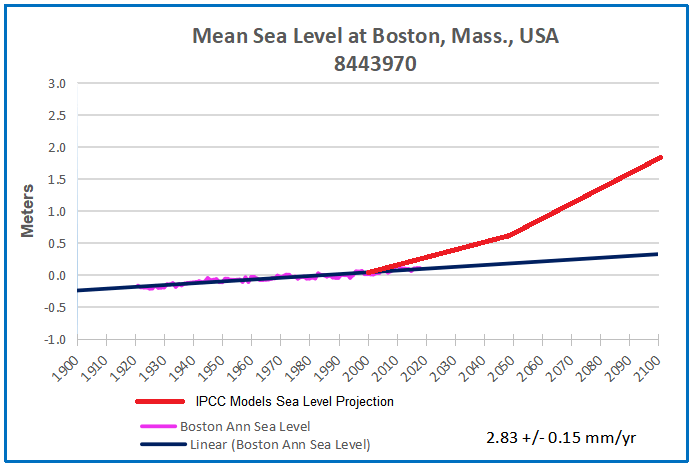
Taking the sea level rise projected by Sea Change Boston, and through the magic of CAI (Computer-Aided Imagining), we can compare to tidal gauge observations at Boston:


Pacific, Not Arctic Ice Melting April 30

The image above shows the disappearing ice in the two Pacific basins over the last 16 days of April.  Okhotsk on the left melted steadily, losing 400k km2 of ice during this period, with only 260k km2 or 20% of its March maximum remaining. Bering Sea on the right actually gained 150k km2 ice extent up to 315k km2, before losing 215k km2 in the last four days, with only 100k km2 of ice left.

Meanwhile the Arctic core, Russian ice shelves and Canadian Archipelago remain frozen  The image above shows ice extent waxing and waning at the margins, especially in Bafffin Bay left of Greenland, and in Greenland Sea in the center.  Barents Sea on the right ended up about the same as it started this period.

The graph below shows how the April Arctic extents compared to the 12 year average and to some years of interest.
MASIE shows NH ice extents 800k km2 below the 12 year average at both the beginning and end of April.  SII ended the month slightly higher.  At this point 2019 is also tracking below 2018 and 2007.  The deficit is mostly due to open water in the Pacific basins.
The green line shows the average NH extents excluding Bering and Okhotsk ice,  The purple line shows the same for 2019, excluding B&O ice.  On day 90, the 12 year average included 1.7M km2 of B&O ice, which dropped to 0.9M by day 120.  In contrast 2019 started the month with 1.3M km2 of B&O ice, with only 0.3M left at month end.  As the table below will show, the over all deficit to average is 800k km2, and 550k km2 is due to Bering and Okhotsk melting.

Region 2019120 Day 120 
Average
2019-Ave. 2007120 2019-2007
 (0) Northern_Hemisphere 12845831 13636708 -790876 13108068 -262237
 (1) Beaufort_Sea 1070463 1068049 2414 1059189 11273
 (2) Chukchi_Sea 908742 957319 -48578 949246 -40504
 (3) East_Siberian_Sea 1082230 1085731 -3500 1080176 2054
 (4) Laptev_Sea 897845 891192 6653 875661 22184
 (5) Kara_Sea 921837 912762 9075 864664 57173
 (6) Barents_Sea 564996 551830 13166 396544 168452
 (7) Greenland_Sea 544988 647270 -102283 644438 -99450
 (8) Baffin_Bay_Gulf_of_St._Lawrence 1128210 1256132 -127923 1147115 -18905
 (9) Canadian_Archipelago 853337 847923 5414 838032 15305
 (10) Hudson_Bay 1255410 1243542 11868 1222074 33336
 (11) Central_Arctic 3245152 3237039 8114 3241034 4118
 (12) Bering_Sea 100108 515469 -415361 475489 -375381
 (13) Baltic_Sea 9715 22746 -13032 14684 -4969
 (14) Sea_of_Okhotsk 261111 396325 -135214 295743 -34632

Other than B&O losing ice, the other sizeable deficits to average are coming from Baffin Bay and Greenland Sea.  Of course, all of these basins will be ice-free as usual before September.

Drift ice in Okhotsk Sea at sunrise.