N. Atlantic Keeps Cool Oct. 2019

RAPID Array measuring North Atlantic SSTs.

For the last few years, observers have been speculating about when the North Atlantic will start the next phase shift from warm to cold. Given the way 2018 went and 2019 is following, this may be the onset.  First some background.

. Source: Energy and Education Canada

An example is this report in May 2015 The Atlantic is entering a cool phase that will change the world’s weather by Gerald McCarthy and Evan Haigh of the RAPID Atlantic monitoring project. Excerpts in italics with my bolds.

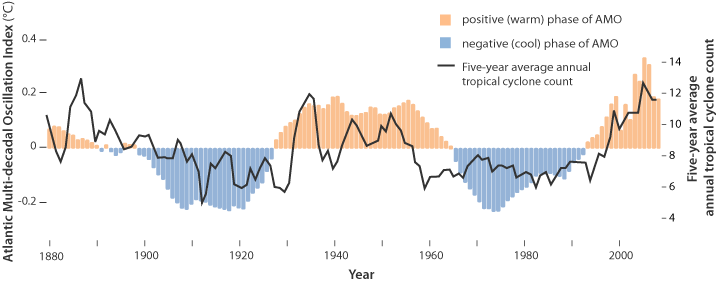
This is known as the Atlantic Multidecadal Oscillation (AMO), and the transition between its positive and negative phases can be very rapid. For example, Atlantic temperatures declined by 0.1ºC per decade from the 1940s to the 1970s. By comparison, global surface warming is estimated at 0.5ºC per century – a rate twice as slow.

In many parts of the world, the AMO has been linked with decade-long temperature and rainfall trends. Certainly – and perhaps obviously – the mean temperature of islands downwind of the Atlantic such as Britain and Ireland show almost exactly the same temperature fluctuations as the AMO.

Atlantic oscillations are associated with the frequency of hurricanes and droughts. When the AMO is in the warm phase, there are more hurricanes in the Atlantic and droughts in the US Midwest tend to be more frequent and prolonged. In the Pacific Northwest, a positive AMO leads to more rainfall.

A negative AMO (cooler ocean) is associated with reduced rainfall in the vulnerable Sahel region of Africa. The prolonged negative AMO was associated with the infamous Ethiopian famine in the mid-1980s. In the UK it tends to mean reduced summer rainfall – the mythical “barbeque summer”.Our results show that ocean circulation responds to the first mode of Atlantic atmospheric forcing, the North Atlantic Oscillation, through circulation changes between the subtropical and subpolar gyres – the intergyre region. This a major influence on the wind patterns and the heat transferred between the atmosphere and ocean.

The observations that we do have of the Atlantic overturning circulation over the past ten years show that it is declining. As a result, we expect the AMO is moving to a negative (colder surface waters) phase. This is consistent with observations of temperature in the North Atlantic.

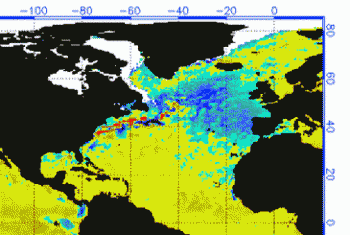
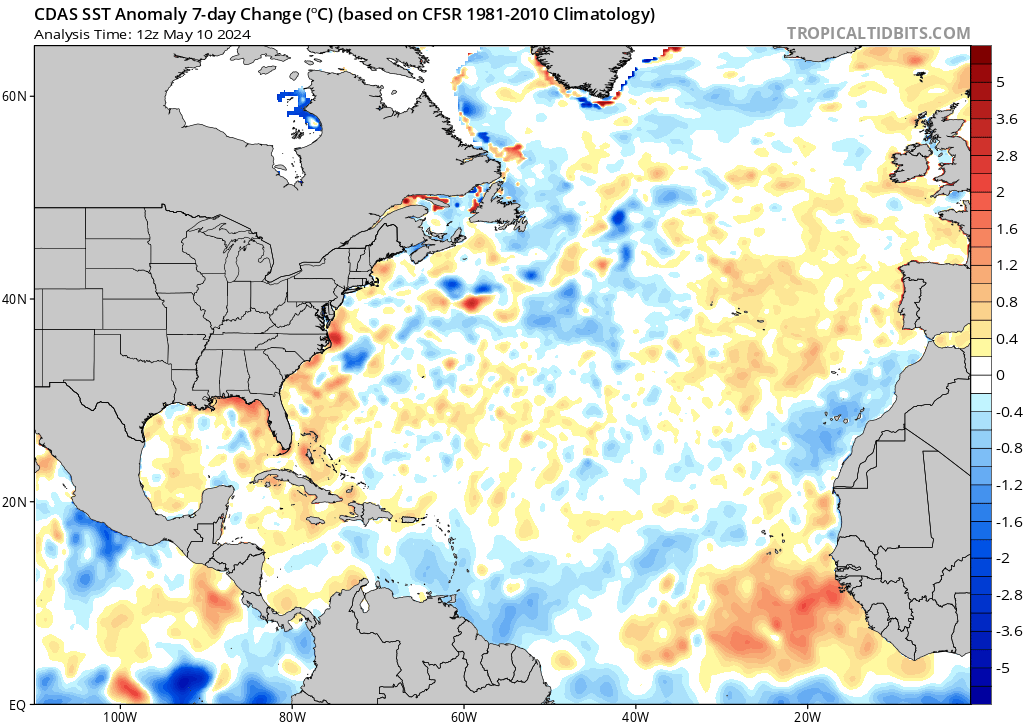
Cold “blobs” in North Atlantic have been reported, but they are usually winter phenomena. For example in April 2016, the sst anomalies looked like this

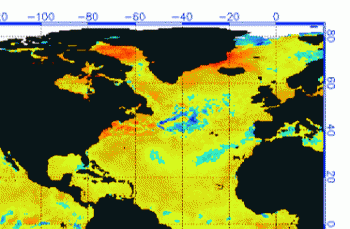
But by September, the picture changed to this

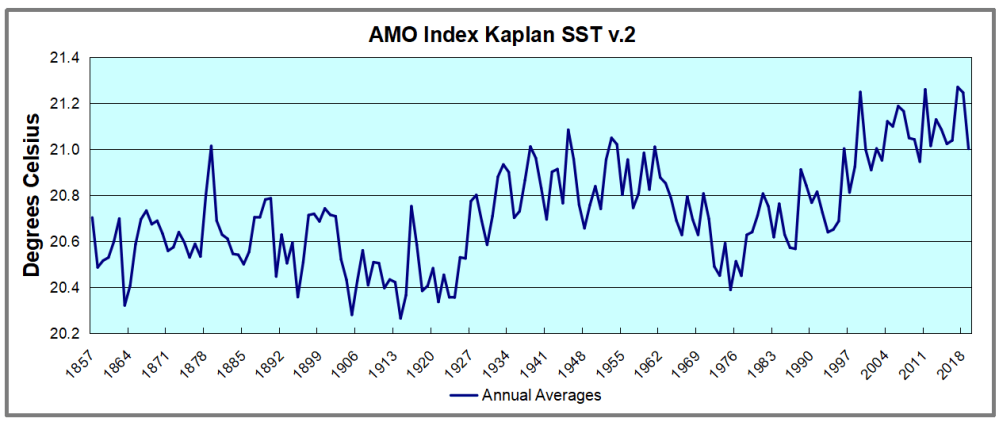
And we know from Kaplan AMO dataset, that 2016 summer SSTs were right up there with 1998 and 2010 as the highest recorded.

As the graph above suggests, this body of water is also important for tropical cyclones, since warmer water provides more energy.  But those are annual averages, and I am interested in the summer pulses of warm water into the Arctic. As I have noted in my monthly HadSST3 reports, most summers since 2003 there have been warm pulses in the north atlantic.


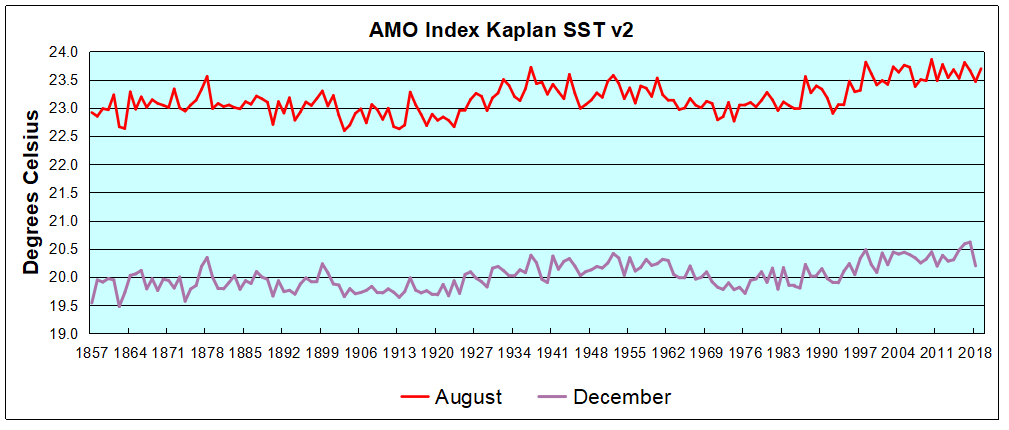
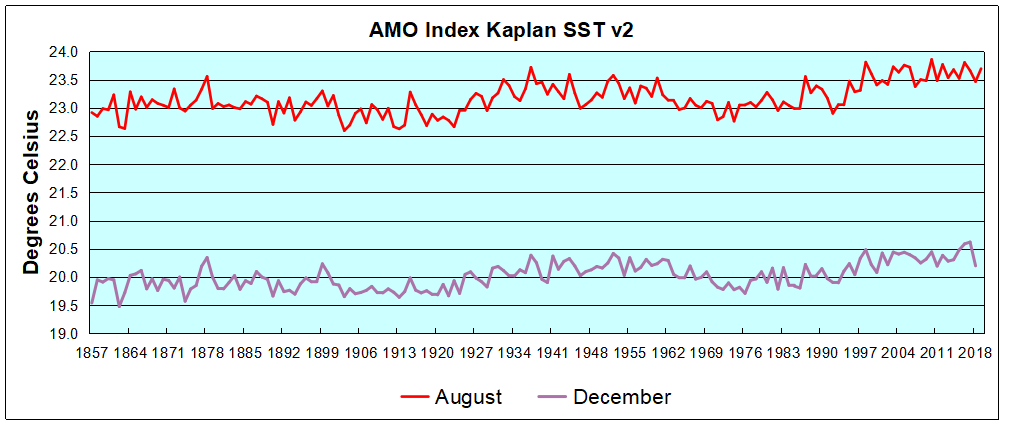
The AMO Index is from from Kaplan SST v2, the unaltered and not detrended dataset. By definition, the data are monthly average SSTs interpolated to a 5×5 grid over the North Atlantic basically 0 to 70N.  The graph shows the warmest month August beginning to rise after 1993 up to 1998, with a series of matching years since.  December 2016 set a record at 20.6C, but note the plunge down to 20.2C for  December 2018, matching 2011 as the coldest years  since 2000.
October 2019 confirms the summer pulse weakening, along with 2018 well below other recent peak years since 2013.  Because McCarthy refers to hints of cooling to come in the N. Atlantic, let’s take a closer look at some AMO years in the last 2 decades.

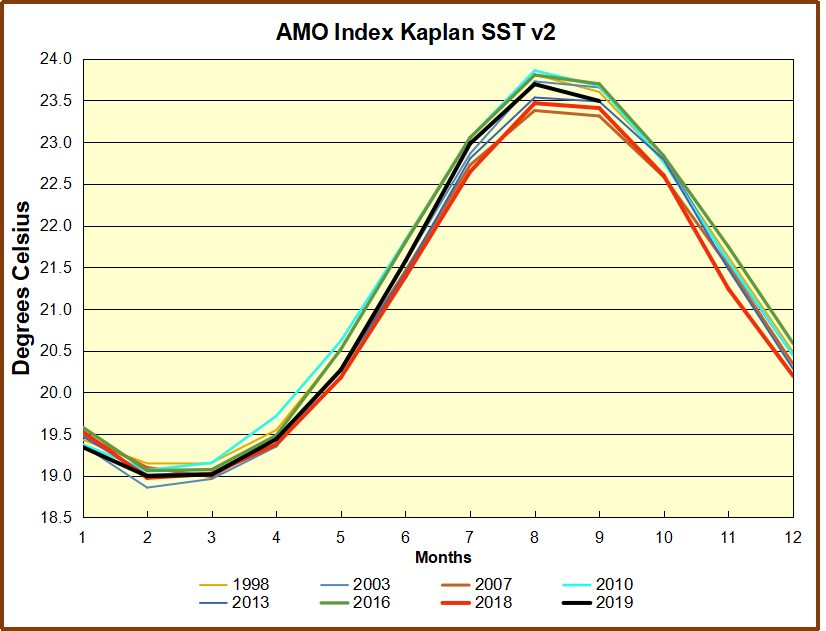
This graph shows monthly AMO temps for some important years. The Peak years were 1998, 2010 and 2016, with the latter emphasized as the most recent. The other years show lesser warming, with 2007 emphasized as the coolest in the last 20 years. Note the red 2018 line was at the bottom of all these tracks.  The short black line shows that 2019 began slightly cooler than January 2018, then tracked closely before rising in the summer months, though still lower than the peak years. Now in October 2019 is again tracking close to 2018 as the coolest years in the North Atlantic.

amo annual122018


Polar Bears Are Alright (How Dare You Say That!)

Polar bear walking the streets in Norilsk, Russia © Reuters / Stringer

Helen Buyniski writes an op ed at Russia Today The REAL inconvenient truth: Polar bears thriving in spite of climate change, but saying this gets scientists fired.  Others have covered this disgraceful episode, but the article provides some important details and European perspective. Excerpts in italics with my bolds.

Polar bears have become the poster child for climate change, their population supposedly devastated by shrinking ice cover. But when one zoologist disproved the myth, she came under the inquisition of the climate church.

Zoologist and polar bear expert Susan Crockford was shunned by the academy for her insistence that despite the polar bear’s status as a climate change icon, the warming planet had actually caused the species to thrive. She did not deny climate change – merely the idea that it was harming the bears.

After losing her contract as an adjunct professor at Canada’s University of Victoria, where she worked for 15 years, she has been vindicated by a report from northern Canada confirming her theory that polar bears are climate change’s beneficiaries, rather than its victims.

Footage of an emaciated polar bear, captioned “this is what climate change looks like,” yanked at the world’s heartstrings when it was posted on National Geographic in 2017. Eight months later, the publication changed the caption to “this is what starvation looks like,” admitting there was no way to tell why the bear was starving. But it wasn’t the first sick bear to be pressed into service for the environmentalist cause, and it won’t be the last. Climate change’s PR team may have made an unfortunate choice in elevating the polar bear to icon status.

© Reuters / Mal Langsdon

The Inuit groups who actually live with the bears in northern Canada seem to agree with Crockford’s claim that bear populations are increasing, as documented in a court affidavit by the director of wildlife management for the Nunavik Marine Region Wildlife Board. Faced with cuts to their bear-hunting quota by an environment ministry concerned with population numbers, Nunavut residents have seen an “increase in the polar bear population and a particularly notable increase since the 1980s,” the director attested.

Nor are the (plentiful) bears suffering or sickly: “Nunavik Inuit report that it is rare to see a skinny bear and most bears are observed to be healthy,” the affidavit continued. Locals are, however, reportedly concerned about outside perception of declining polar bear numbers, fueled by groups like the World Wildlife Federation (WWF), which explicitly described the bears as the “poster child for the impacts of climate change on species.”

Crockford has been saying for years that bear populations are either growing or stable – even though they may go down in some habitats, they increase in others. She does say starvation is the most common cause of death for adult bears, but there are many factors that could lead them to the state captured by National Geographic – from too many bears, straining food supplies and leaving slower hunters out-competed; to broken jaws, other injuries, and disease.

But as ice cover decreases, she claims, polar bears thrive. The ringed seals that are one of their primary food sources multiply in the warmer water, and polar bear populations have been steady or on the rise since 2005, all predictions of doom aside.

Polar bear populations hit record highs in 2018, Crockford revealed in last year’s State of the Polar Bear report, whose publication by the climate skeptic Global Warming Policy Foundation was sparsely noted outside fellow-traveler sites like Climate Depot. Despite sea ice depletion to levels not expected until 2050, which was supposed to decimate two thirds of the bear population, the animals are thriving.

In fact, they’re thriving too much, according to the humans who have to live with them. The Nunavut government sounded the alarm last year: “Inuit believe there are now so many bears that public safety has become a major concern… the polar bear may have exceeded the coexistence threshold.” Two locals were killed in bear attacks in the region. Nor is Canada the only habitat affected – in 2017, they laid siege to the Siberian town of Ryrkaypiy, invading human homes and terrifying the locals.

Even the WWF has softened its predictions of a polar bear apocalypse, admitting that only one of the 19 bear populations are in decline as of 2017 while two are increasing and seven are stable. Yet the International Union for Conservation of Nature insists the numbers will plummet 30 percent by 2050, linking population decline with dwindling sea ice.

Crockford’s view – even though it’s based on years of research and previous studies – is considered heretical and scorned by climate doomsayers, for whom no deviation from orthodoxy is permitted, even when the facts do not match the propaganda.

The University of Victoria declined to renew her contract in May this year after 15 years of employment despite having promoted her work in the past. The school’s speakers’ bureau, which had sent her out for ten years to give lectures to schools and adult groups, dropped her like a hot potato in May 2017 after a vague outside complaint about her “lack of balance” allegedly triggered a kafkaesque cascade of deplatforming culminating in her removal. The school did not deny the reason she was let go was because of her heretical polar bear science, but would not confirm it either.

global-warming-inquisition

Misrepresenting thriving wildlife populations as a harbinger of their doom is nothing new for nature photographers and documentarians – David Attenborough’s depiction of suicidal walruses plummeting from cliffs “because of climate change” was recently exposed as less than the whole truth.Walruses ‘hauled out’ on land are spooked easily and will plummet from cliffs in their rush to return to the safety of the water. These stampedes can be triggered by polar bears, who do so deliberately in order to feast on the dead walruses left trampled or smashed at the cliff bottom, or by overhead planes (or the drones used for documentary filming).

One of the most notorious examples of phony wildlife tragedy gave rise to the myth of suicidal, cliff-jumping lemmings. A 1958 Disney nature documentary captured the little creatures marching off a precipice, seemingly to their doom, teaching viewers a valuable lesson about blindly following a leader, but that scene was staged by the filmmakers for the sake of added drama.

Climate change proponents may not be staging mass animal suicide to convince the public, but their effort to torpedo the career of a scientist for reasons unrelated to the integrity of her research is equally unprofessional. The climate change debate must be had in good faith by scientific professionals on all sides, with participants free to voice their research-based dissent with prevailing orthodoxy, or it is not science but doctrine.


SSTs NH Cooling in October

The best context for understanding decadal temperature changes comes from the world’s sea surface temperatures (SST), for several reasons:

  • The ocean covers 71% of the globe and drives average temperatures;
  • SSTs have a constant water content, (unlike air temperatures), so give a better reading of heat content variations;
  • A major El Nino was the dominant climate feature in recent years.

HadSST is generally regarded as the best of the global SST data sets, and so the temperature story here comes from that source, the latest version being HadSST3.  More on what distinguishes HadSST3 from other SST products at the end.

The Current Context

The chart below shows SST monthly anomalies as reported in HadSST3 starting in 2015 through October 2019.
A global cooling pattern is seen clearly in the Tropics since its peak in 2016, joined by NH and SH cycling downward since 2016.  In 2019 all regions had been converging to reach nearly the same value in April.

Then  NH rose exceptionally by almost 0.5C in the over four summer months, in August exceeding previous summer peaks in NH since 2015.  Now that warm NH pulse is reversing.  Meanwhile the SH and Tropics cooled with an upward bump in October.  Despite the rise in SH, the global anomaly changed little due to NH cooling.

Note that higher temps in 2015 and 2016 were first of all due to a sharp rise in Tropical SST, beginning in March 2015, peaking in January 2016, and steadily declining back below its beginning level. Secondly, the Northern Hemisphere added three bumps on the shoulders of Tropical warming, with peaks in August of each year.  A fourth NH bump was lower and peaked in September 2018.  As noted above, a fifth peak in August 2019 exceeded the four previous upward bumps in NH.

And as before, note that the global release of heat was not dramatic, due to the Southern Hemisphere offsetting the Northern one.  The major difference between now and 2015-2016 is the absence of Tropical warming driving the SSTs.

The annual SSTs for the last five years are as follows:

Annual SSTs Global NH SH  Tropics
2014 0.477 0.617 0.335 0.451
2015 0.592 0.737 0.425 0.717
2016 0.613 0.746 0.486 0.708
2017 0.505 0.650 0.385 0.424
2018 0.480 0.620 0.362 0.369

2018 annual average SSTs across the regions are close to 2014, slightly higher in SH and much lower in the Tropics.  The SST rise from the global ocean was remarkable, peaking in 2016, higher than 2011 by 0.32C.

A longer view of SSTs

The graph below  is noisy, but the density is needed to see the seasonal patterns in the oceanic fluctuations.  Previous posts focused on the rise and fall of the last El Nino starting in 2015.  This post adds a longer view, encompassing the significant 1998 El Nino and since.  The color schemes are retained for Global, Tropics, NH and SH anomalies.  Despite the longer time frame, I have kept the monthly data (rather than yearly averages) because of interesting shifts between January and July.

Open image in new tab to enlarge.

1995 is a reasonable (ENSO neutral) starting point prior to the first El Nino.  The sharp Tropical rise peaking in 1998 is dominant in the record, starting Jan. ’97 to pull up SSTs uniformly before returning to the same level Jan. ’99.  For the next 2 years, the Tropics stayed down, and the world’s oceans held steady around 0.2C above 1961 to 1990 average.

Then comes a steady rise over two years to a lesser peak Jan. 2003, but again uniformly pulling all oceans up around 0.4C.  Something changes at this point, with more hemispheric divergence than before. Over the 4 years until Jan 2007, the Tropics go through ups and downs, NH a series of ups and SH mostly downs.  As a result the Global average fluctuates around that same 0.4C, which also turns out to be the average for the entire record since 1995.

2007 stands out with a sharp drop in temperatures so that Jan.08 matches the low in Jan. ’99, but starting from a lower high. The oceans all decline as well, until temps build peaking in 2010.

Now again a different pattern appears.  The Tropics cool sharply to Jan 11, then rise steadily for 4 years to Jan 15, at which point the most recent major El Nino takes off.  But this time in contrast to ’97-’99, the Northern Hemisphere produces peaks every summer pulling up the Global average.  In fact, these NH peaks appear every July starting in 2003, growing stronger to produce 3 massive highs in 2014, 15 and 16.  NH July 2017 was only slightly lower, and a fifth NH peak still lower in Sept. 2018.

The highest summer NH peak came in 2019, only this time the Tropics and SH are offsetting rather adding to the warming. Since 2014 SH has played a moderating role, offsetting the NH warming pulses. (Note: these are high anomalies on top of the highest absolute temps in the NH.)

What to make of all this? The patterns suggest that in addition to El Ninos in the Pacific driving the Tropic SSTs, something else is going on in the NH.  The obvious culprit is the North Atlantic, since I have seen this sort of pulsing before.  After reading some papers by David Dilley, I confirmed his observation of Atlantic pulses into the Arctic every 8 to 10 years.

But the peaks coming nearly every summer in HadSST require a different picture.  Let’s look at August, the hottest month in the North Atlantic from the Kaplan dataset.
The AMO Index is from from Kaplan SST v2, the unaltered and not detrended dataset. By definition, the data are monthly average SSTs interpolated to a 5×5 grid over the North Atlantic basically 0 to 70N. The graph shows warming began after 1992 up to 1998, with a series of matching years since. Because the N. Atlantic has partnered with the Pacific ENSO recently, let’s take a closer look at some AMO years in the last 2 decades.
This graph shows monthly AMO temps for some important years. The Peak years were 1998, 2010 and 2016, with the latter emphasized as the most recent. The other years show lesser warming, with 2007 emphasized as the coolest in the last 20 years. Note the red 2018 line is at the bottom of all these tracks. The short black line shows that 2019 began slightly cooler, then tracked 2018, then rose to match previous summer pulses, before dropping down in September.

Summary

The oceans are driving the warming this century.  SSTs took a step up with the 1998 El Nino and have stayed there with help from the North Atlantic, and more recently the Pacific northern “Blob.”  The ocean surfaces are releasing a lot of energy, warming the air, but eventually will have a cooling effect.  The decline after 1937 was rapid by comparison, so one wonders: How long can the oceans keep this up? If the pattern of recent years continues, NH SST anomalies may rise slightly in coming months, but once again, ENSO which has weakened will probably determine the outcome.

Footnote: Why Rely on HadSST3

HadSST3 is distinguished from other SST products because HadCRU (Hadley Climatic Research Unit) does not engage in SST interpolation, i.e. infilling estimated anomalies into grid cells lacking sufficient sampling in a given month. From reading the documentation and from queries to Met Office, this is their procedure.

HadSST3 imports data from gridcells containing ocean, excluding land cells. From past records, they have calculated daily and monthly average readings for each grid cell for the period 1961 to 1990. Those temperatures form the baseline from which anomalies are calculated.

In a given month, each gridcell with sufficient sampling is averaged for the month and then the baseline value for that cell and that month is subtracted, resulting in the monthly anomaly for that cell. All cells with monthly anomalies are averaged to produce global, hemispheric and tropical anomalies for the month, based on the cells in those locations. For example, Tropics averages include ocean grid cells lying between latitudes 20N and 20S.

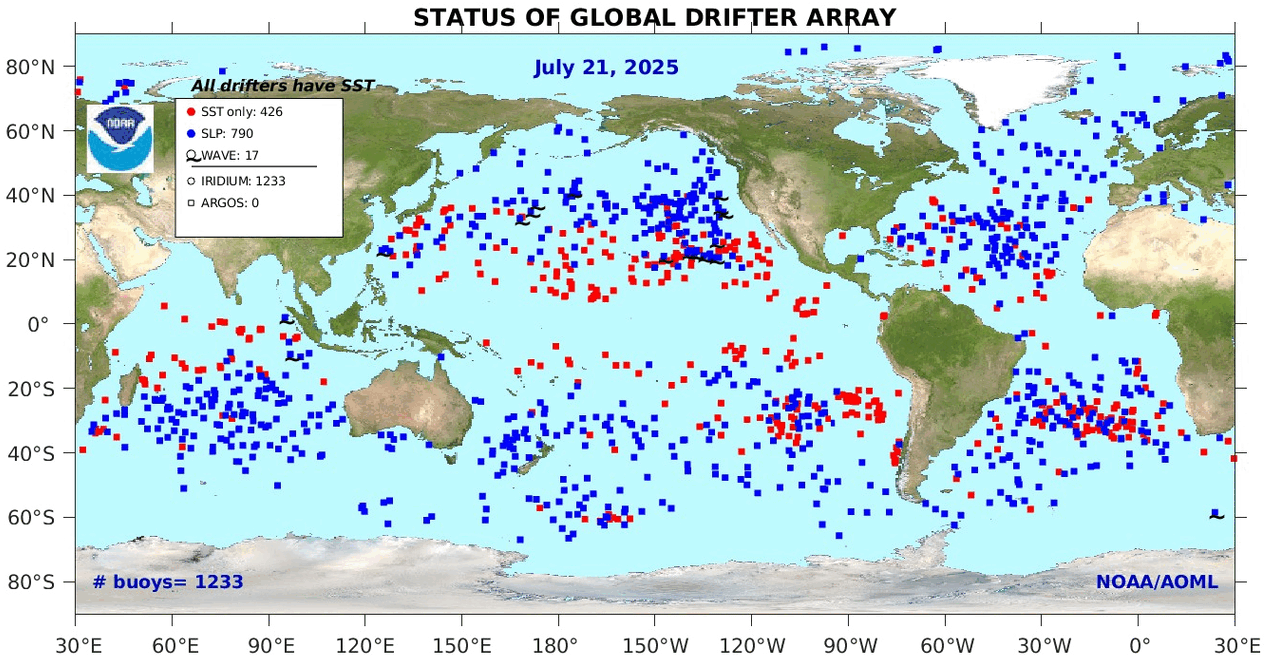
Gridcells lacking sufficient sampling that month are left out of the averaging, and the uncertainty from such missing data is estimated. IMO that is more reasonable than inventing data to infill. And it seems that the Global Drifter Array displayed in the top image is providing more uniform coverage of the oceans than in the past.

uss-pearl-harbor-deploys-global-drifter-buoys-in-pacific-ocean

USS Pearl Harbor deploys Global Drifter Buoys in Pacific Ocean

New York AG’s Disgraceful Exxon Trial

The New York Post Editorial Board reviews the New York Attorney General’s blundering performance before the Judge in their investor fraud case against Exxon.  Their article is New York AG’s office totally disgraced itself in the Exxon trial.  Excerpts in italics with my bolds.

Closing arguments finished up Thursday in the People of New York v. ExxonMobil — a trial that has utterly disgraced the people’s representatives, prosecutors from the state Attorney General’s Office.

Time and again, state Supreme Court Justice Judge Barry Ostrager chided the prosecution — for being unprepared, for indulging in “agonizing, repetitious questioning about documents that are not being disputed”; for pretending a witness was an expert when she wasn’t; for presenting an expert (paid $1,050 an hour) who wouldn’t stop “rambling” and more.

At one point, he snapped: “OK, that’s the fifth time that he has given you the same answer.” At another, he all but accused the state of manipulating Exxon’s stock price on the basis of false information — in a trial where the state was trying to show that Exxon was doing that.

In a final bit of self-disgrace, late Thursday the prosecutors dropped two of their three main charges — the ones that required proving intent.

All that’s left is a charge under the Martin Act, which allows for criminal guilt for an accidental misrepresentation that might mislead the public. But the state failed to even produce any clear evidence that Exxon ever misled the public in any respect, even inadvertently.

That’s a huge comedown for a prosecution that opened under the banner “#ExxonKnew.”

To be clear, the main blame for this debacle falls on disgraced former AG Eric Schneiderman, who started the whole thing as an exercise in headline-hunting back in 2015. He handed off the actual work to subordinates who repeatedly revised the entire theory of the case — that is, the wrong they claimed Exxon had committed — with the charges growing less explosive every time.

They originally claimed Exxon had suppressed research — when in fact its scientists have always published freely, and the company has openly discussed the risks of climate change and so on in its annual reports and on its website.

Then they suggested the company had deceived investors by “overstating” its assets by “trillions.” But it turned out Exxon had clearly disclosed all the relevant info.

Finally, they claimed it used one risk-assessment standard in public, another in private. But the Securities and Exchange Commission cleared Exxon on that front before this trial even opened.

It seems the prosecutors feared it would just be too humiliating to admit they had nothing, and hoped they’d somehow stumble on . . . something.

Still, Thursday’s final retreat, dropping most charges at the very end, was a shocker. It left the judge dismissing those charges “with prejudice,” so the state can never refile them. And Exxon’s infuriated lawyers say those claims “have cost in many respects the most severe reputation harm to the company and to the executives,” so they want still stronger sanctions.

Judge Ostrager has 30 days to issue a decision. The prosecutors are surely praying he’ll find the Martin Act gives them so much leeway that he actually has to find Exxon guilty. If so, it’ll be a blaring alarm to businesses to have nothing to do with New York, because they have no hope of a fair break here.

Otherwise, the judge should explore every possible option for censuring the state’s attorneys — whose abuse of power here has been utterly mind-blowing.

Background from Previous Post

A legal summary of this week’s proceedings comes from Seth Kerschner Laura Mulry article at White & Case
Trial Concludes for Exxon in New York Climate Change Investor Fraud Case. Excerpts in italics with my bolds.

Overview

In New York Supreme Court, Exxon was on trial for allegedly misleading investors about the business costs of climate change. The central allegation was that Exxon fraudulently used two distinct sets of metrics to calculate financial risks relating to climate change: one that was shared with investors and another that was used internally. New York State alleged that the practice exposed investors to greater risks than Exxon had disclosed and inflated the company’s value. Exxon maintained that it made accurate disclosures about the two cost metrics to investors, that the state was conflating the two metrics, and that there was no material impact to Exxon regardless of which metric it applies. The state is seeking between $476 million and $1.6 billion as the basis for a shareholder restitution fund, among other relief. The outcome of the case could have significant implications going forward on (i) how companies disclose and internally account for climate change risks and (ii) the outcomes of future climate change litigation.

(Left) New York Attorney General Barbara Underwood announced her office’s lawsuit against Exxon for climate fraud. October 24, 2018. (Right) Attorney General of New York, Letitia James took over January 6, 2019 and has also opened a civil investigation into President Donald Trump’s business dealings.

The bench trial commenced on October 22, 2019 and was the first lawsuit to go to trial in the United States that addresses how companies manage and disclose climate change-related risks. The New York Attorney General (NYAG) filed the civil lawsuit against Exxon Mobil Corporation (Exxon) in October 2018; it was the culmination of an investigation by NYAG that began in 2015. NYAG alleged statutory and common law securities fraud claims, however, in its closing remarks on November 7, 2019, NYAG dropped two of the four fraud claims. NYAG’s remaining claims include alleged violations of the state’s Martin Act, one of the strictest anti-fraud laws in the country that does not require an intent to defraud or knowledge of fraud for there to be a violation of the law, and a persistent fraud claim. NYAG requests injunctive relief, damages, disgorgement of all amounts gained as a result of the alleged fraud, and restitution.
NYAG asserted that Exxon engaged in a “longstanding fraudulent scheme” to deceive investors by providing misleading statements that (i) Exxon was effectively managing risks posed by regulations to address climate change, such as carbon taxes, and (ii) such regulations did not pose a significant risk to the company. NYAG asserted that Exxon’s internal practices were inconsistent with these statements, were undisclosed to investors, and exposed the company to greater risk from climate change regulation than investors were led to believe.

According to the NYAG complaint, Exxon used internal climate change cost projections that differed from publicly-disclosed projections and are in alleged violation of US Generally Accepted Accounting Principles. Exxon claimed NYAG is trying to show a false discrepancy by conflating two cost projections that serve different purposes. NYAG claimed that Exxon provided misleading statements to investors in reports that Exxon drafted in response to shareholder proposals and resolutions requesting information about climate change-related risks, its 2015 Corporate Citizen Report, and in its 2014 and 2016 proxy statements, among other public documents. NYAG asserted that Exxon’s alleged climate cost misrepresentations are material to the company’s investors, who include public pension funds in New York and around the United States that hold billions of dollars of Exxon stock.

To account for the impact of future climate change regulations, Exxon stated that it “rigorously and consistently” applied an escalating proxy cost of carbon dioxide and other greenhouse gases (together, GHGs) to its business, according to NYAG’s complaint. NYAG claimed, however, that Exxon’s GHG proxy cost representations were materially false and misleading because Exxon did not in fact apply the GHG proxy cost it represented to investors in its business decisions. NYAG claimed that, in projecting its future costs for purposes of making investment decisions, conducting business planning, and assessing oil and gas reserves, Exxon applied either (i) an undisclosed, lower set of GHG proxy costs in its internal corporate guidance, (ii) an even-lower cost based on existing climate regulations that held flat for decades into the future or (iii) no GHG-related costs at all. Exxon maintained that it made accurate disclosures about the two cost metrics to investors and claimed that NYAG is manipulating the content of such disclosures to make it appear as though Exxon misled the public.

The linchpin of the case may rest on whether Exxon conflated two distinct climate change cost projections. Exxon’s publicly-disclosed GHG proxy cost assumed carbon costs would be significantly higher than the internal GHG cost estimate. Exxon did not dispute that it used two distinct projections for the future impacts of climate regulations and argued that each had a legitimate business purpose: the publicly-disclosed GHG proxy cost was used to project global energy demand (and future prices) and the GHG cost was a proprietary internal number used to evaluate investment opportunities. Exxon representatives, including former Chairman and CEO Rex Tillerson, testified that Exxon’s publicly-disclosed GHG proxy cost represented a “macro level” assessment of climate change mitigation policies that Exxon expects to see adopted around the world, from fuel efficiency standards in the United States to carbon taxes in Europe, and was used in a data guide used by the company. Exxon’s position is that the different, lower GHG costs that Exxon used internally represented “micro level” direct costs and capital projects at specific Exxon facilities and were informed by a more limited set of regulations applicable to specific projects. Exxon has contended in court that the publicly-disclosed GHG proxy cost, which is a purported demand-side estimate of how future regulations, like a carbon tax, would depress global demand for oil, is only one part of its climate cost calculations. NYAG argued that Exxon obfuscated differences in the two accounting projections and a reasonable investor had every reason to believe that Exxon was using the two sets of costs interchangeably.

Exxon maintains that there was and would be no impact on its value or finances, including corporate earnings, regardless of whether it applied a higher or lower GHG cost estimate. Exxon asserted that NYAG failed to identify a specific oil or gas project investment decision that would have been swayed by applying the higher GHG proxy cost and that the practice of having two distinct cost metrics had no impact on how investors assessed the company.

Richard Auter, the head of the Exxon audit team at PricewaterhouseCoopers (PwC), testified that (i) he was not aware of any attempt by Exxon to conceal or manipulate the two cost metrics and (ii) GHG proxy costs do not have a material impact on Exxon’s financial health. Mr. Auter stated that the publicly-disclosed GHG proxy costs “were part of management’s planning and budgeting process, but they do not reflect real costs in many situations.”

NYAG claimed that Exxon’s failure to employ the publicly-disclosed GHG proxy costs was most prevalent in its projections for investments with high GHG emissions. Applying the publicly-disclosed GHG proxy costs to these investments would have had a particularly significant negative impact on the company’s economic and financial projections and assessments, according to NYAG. NYAG alleged that using the lower cost estimate for future GHG costs made projects with high GHG emissions look more attractive than those projects would have looked if the higher GHG proxy cost were applied. NYAG stated that Exxon chose not to use the higher, publicly-disclosed GHG proxy costs in connection with 14 oil sands projects in Canada, which allegedly resulted in understating costs in the company’s cash flow projections by more than $25 billion. Bitumen from oil sands is harder to extract and then must be upgraded into synthetic crudes, so the extraction process from oil sands projects typically emits higher GHG emissions than other oil and gas upstream operations. NYAG claimed that, while corporate estimates projected GHG prices continuing to rise up to $80 per ton in 2040, Exxon planners in Canada applied a cost estimate that held flat at $24 per ton through to the end of the assets’ projected life (decades into the future) and didn’t apply to all of the assets’ GHG emissions.

Throughout the three-year probe and trial, NYAG claimed that Exxon senior management sanctioned the alleged fraudulent conduct, including Mr. Tillerson. NYAG stated that Mr. Tillerson knew for years that the company’s GHG proxy cost representations were misleading, but allowed the gap between the two cost metrics to persist. NYAG alleged that, in May 2014, Exxon’s corporate greenhouse gas manager gave a presentation to the company’s senior management, including Mr. Tillerson, that warned that the way the company had been accounting for climate risks was misleading and recommended aligning the cost metrics in evaluating investments. NYAG asserted that, after Exxon revised its internal guidance, Exxon’s planners realized that applying the increased GHG proxy cost figures would result in severe consequences to its economic and financial projections, such as “massive GHG costs” and “large write-downs” (i.e., reductions in estimated volume) of company reserves. NYAG claimed that, when confronted with the negative impacts from applying GHG proxy costs in a manner consistent with the company’s representations to investors, Exxon’s management directed the company’s planners to adopt what an Exxon employee allegedly called an “alternate methodology.” NYAG claimed that Exxon then applied only the existing GHG-related costs presently imposed by governments (i.e., legislated costs) and assumed that those existing costs would remain in effect indefinitely into the future, contrary to the company’s repeated representations to investors that it expects governments to impose increasingly stringent climate regulations in the future. By applying this “alternate methodology,” NYAG alleged that Exxon (i) avoided the significant write-downs it would have incurred had it abided by its stated risk management practices and (ii) failed to take into account significant GHG costs resulting from expected climate change regulation.

Climate Activists storm the bastion of Exxon Mobil, here seen without their shareholder disguises.

Exxon’s counsel argued that certain of NYAG’s key Exxon investor witnesses are politically-motivated and bought the company’s stock with the sole purpose to lobby the company on climate change issues. Exxon noted that one such investor, the New York City comptroller’s office, supports efforts to divest from fossil fuels.

In its closing remarks, NYAG abruptly dropped its common law fraud and equitable fraud claims. Exxon’s counsel responded that NYAG dropped the claims for strategic purposes before the judge could rule against them due to a lack of evidence and indicated that the two dropped claims caused severe reputational harm to the company and its executives, including Mr. Tillerson in particular. Exxon’s counsel stated that Exxon and its officials deserved a ruling to clear their reputations. The court dismissed the two claims with prejudice and invited Exxon’s counsel to submit post-trial briefing on whether Exxon had a right to a stipulation stating that NYAG lacked evidence to prove the dismissed fraud claims at trial.

Exxon and other energy companies are also the subject of other climate change lawsuits brought by (i) local and state governments seeking damages to help pay for the costs imposed by rising seas and extreme weather caused by climate change and (ii) children and non-profit organizations that claim that the federal and state governments are responsible for preventing and addressing the consequences of climate change. [For more information on climate change litigation see links at end.]

The Commonwealth of Massachusetts Attorney General commenced an investigation of Exxon in 2015 similar to that of NYAG’s and filed a lawsuit against Exxon on October 24, 2019 for alleged violations of Massachusetts’ investor and consumer protection laws relating to the company’s climate change-related disclosure and advertising. Exxon has fought the New York and Massachusetts investigations in courtrooms. In a New York federal court, a judge earlier this year rejected Exxon’s plea to block the dual investigations. Exxon has argued that the states’ attorneys general were violating Exxon’s First Amendment right to free speech relating to climate change. Exxon has asserted that the claims are politically-motivated, targeting energy companies to be held accountable for climate change.

The three-week bench trial in New York began on October 22, 2019 and the parties have until November 18, 2019 to file post-trial submissions. The presiding Justice Barry Ostrager has said that he will issue a ruling within 30 days after such submission deadline, with a verdict expected sometime in mid-December. NYAG requested that the court (i) enjoin Exxon from violating New York law, (ii) direct a comprehensive review of Exxon’s failure to apply a proxy cost consistent with its representations and the economic and financial consequences of that failure, (iii) award damages caused, directly or indirectly, by the fraudulent and deceptive acts, (iv) award disgorgement of all amounts obtained in connection with the alleged violations of law and all amounts by which Exxon has been unjustly enriched, (v) award restitution of all funds obtained from investors in connection with or as a result of the alleged fraudulent and deceptive acts, and (vi) award the state its costs and fees, including attorney’s fees.

The decision reached in this case is likely to be cited in future climate change litigation. If Exxon prevails, litigation over companies’ climate change-related disclosure could wane.

Companies should be on alert that they could be scrutinized by shareholders, governmental officials, and the public for how they disclose and internally account for climate change-related risks. It may be prudent for companies to align publicly-disclosed climate-related metrics and methodologies with their internal climate-related risk management and accounting practices. At a minimum, companies should ensure that their public disclosure is not misleading and consider any appropriate disclosure on internal climate-related metrics used in business decisions or in the preparation of publicly-disclosed financial information.

The case is People of the State of New York v. ExxonMobil Corp., case number 452044/2018, in the Supreme Court of the State of New York, County of New York. NYAG’s October 24, 2018 complaint can be found here. Exxon’s October 7, 2019 pre-trial memorandum can be found here.

Click here to download PDF.

Background:  Inside “Blame Big Oil” Litigation

Legal Calamity: Climate Nuisance Lawsuits

Critical Climate Intelligence for Jurists (and others)


To Be a Man, Or Not to Be (Fight Degendering)

This article is an update on the continuing assault by gender ideologues on young males’ masculinity.  Spencer Klavan writes at the American Mind Be a Man. Excerpts in italics with my bolds.

Gender theorists know what they are doing when they target children. We should know what we’re doing when we fight back.

 In August of 2018, the American Psychological Association issued its first-ever “Guidelines for Psychological Practice with Boys and Men,” of which the first directive is that psychologists should “strive to recognize that masculinities are constructed based on social, cultural, and contextual norms.” In other words, treatment of boys and men should begin from the premise that manhood is culturally contingent and therefore alterable. The goal of therapeutic practice then becomes “to help boys and men over their lifetimes navigate restrictive definitions of masculinity and create their own concepts of what it means to be male.”

Graduate programs in psychology cannot gain accreditation or train students for licensing without the APA’s official imprimatur. It stands to reason that schools will feel strongly encouraged, at the very least, to conform their instruction with what the Association dictates. Not that institutions of higher learning typically need such encouragement: at Stony Brook University in New York, for example, the Center for the Study of Men and Masculinities is dedicated to deconstructing “traditional” manhood. Their website offers resources such as an article on “academic efforts to decode men.” It is to these resources that one is directed via hyperlink if one attempts to access any discussion thread about manhood which has been deemed toxic by the major chat website, Reddit.


Professional ideologues, then, are making their best efforts to train biological males out of their natural impulses toward strength, endurance, physical courage, and emotional self-control.

Boys who find themselves lacking in these characteristics—as every young man does at some point in his development—typically experience a sense of inadequacy. Traditionally, caring adults have tried to alleviate that inadequacy by helping boys grow into themselves—by helping them attain the masculinity that is their birthright but not yet their achievement. The new diagnostic recommendation, however, is to treat all such feelings of self-reproach as needless impositions from an outmoded worldview in need of radical deconstruction.

What conservatives typically emphasize in response is that biological sex does matter, that men’s yearnings to be manly are indeed authentic and spontaneous. This is entirely true. But it misses something, something that Aristodemus knew: there is also a part of gender which is learned and taught. We experience certain natural ambitions, but then we build societies and traditions which honor and channel those ambitions. Most boys are born with an interest in fighting and competing, but no boy is born knowing how to play football or hold a gun. We school one another, generation to generation, in the ways of manhood.

Therefore if you train impressionable boys to disassociate themselves from their sex, they will indeed lose the sense of grounding and orientation that comes with proper instruction—they will indeed become “feminized” like the children of Cumae. That is why the efforts to degender our society are often focused on children. Public schools now teach gender theory using cartoon characters as diagrams. Little girls wearing male clothing were cheered on national television in October of this year at the Democrats’ “Equality Town Hall.” In the same month a seven-year-old boy was very nearly subjected by court order (subsequently amended) to hormonal alteration by a mother who encourages him to consider himself female. If it sounds alarmist to say that “gender theorists are coming for your children,” good. They are coming, and it is alarming.


The answer to this is not only to insist that “male” and “female” are real, natural categories: it is also to acknowledge that one natural component of those categories is aspiration. There is nothing harmful in exhorting a boy to “be a man.” If he is not yet—and no boy is—he will be told by activists and perhaps his teachers that he does not need to be. But the longings of his heart will tell him that he should, that he can. It is the business of gender theory to extinguish those longings. It should be our business to defend them at all costs.

Update: Climate Hail Mary by Broke Cities

Previous post is reprinted later on.  This update is an article at Issues and Insights last week by Horace Cooper The Shameless Hypocrisy Of Cities Suing For Climate Change ‘Damages’.   Excerpts in italics with my bolds.

North and South American natives once spoke of the mythical El Dorado, a sacred city made entirely of gold. History records that conquistadors embarked on expeditions throughout the Americas in pursuit of El Dorado and legendary riches. Ultimately their quests yielded nothing but misery and loss.

Conquistador Francisco Vázquez de Coronado went through Arizona seeking in vain untold golden treasures to make them all rich.

A modern-day parallel exists among several municipal governments and Rhode Island, which have set out on an equally unrealistic quest for a modern-day “jackpot justice” – a scheme to reap billions from several energy companies.

Using an already discredited “public nuisance” legal claim, Rhode Island and several cities have filed lawsuits that blame all of Earth’s climate change on a few profitable energy companies. The suits allege that, by producing oil, these energy companies have contributed to climate change, which, they argue, may cause damage to their communities in the future. Their cases, incidentally, fail to mention the large amounts of fossil fuels used by these same cities for public transportation, municipal airports, city buildings, and public improvement projects.

sierra-2018-11-internationalcarboncourt-wb

Litigants point to a July ruling in which an activist Rhode Island judge overturned a previous decision to move Rhode Island’s climate change case to federal court. Having watched federal courts dismiss many of these claims outright, the plaintiffs believe they have a better chance of success in lower, state courts. Baltimore was also successful in blocking a motion to move its lawsuit to federal court.

Still, climate litigants would be wise to keep the champagne firmly corked as these recent rulings in Rhode Island and Baltimore will likely be overturned. In North Dakota earlier this year, a similar nuisance case against Purdue Pharma was dismissed by a judge who found the plaintiffs failed to meet the required burden of proof. Moreover, the courts reviewing the Oklahoma case are likely to take a more skeptical view of the nuisance tactic, which has generally fared poorly on appeal. For example, a nuisance suit against lead paint manufacturers initially succeeded, only to fail on appeal in 2009, ironically before the Rhode Island Supreme Court.

A major driver of legal precedent denying the use of nuisance ordinances comes from an Obama-era Supreme Court ruling. In the 8-0 American Electric Power v. Connecticut decision in 2011, the U.S. Supreme Court ruled that corporations cannot be sued for greenhouse gas emissions because the Clean Air Act specifically tasks the Environmental Protection Agency and Congress with the proper regulatory authority. Put another way, only the executive and legislative branches – not the judicial branch – may regulate and impose climate change policy. That precedent was properly cited last year when New York City’s climate lawsuit was bounced out of court. Also last year, a federal judge dismissed Oakland and San Francisco’s lawsuit for being outside the court’s authority.

In addition to the utter lack of legal substantiation, these lawsuits reveal how these municipalities are speaking out of both sides of their mouths. In one setting they downplay risks of climate change and in other settings they pretend the risks have never been higher.

Consider San Francisco’s 2017 municipal bond offering which reassuringly told potential investors, “The City is unable to predict whether sea-level rise or other impacts of climate change or flooding from a major storm will occur, when they may occur, and if any such events occur, whether they will have a material adverse effect on the business operations or financial condition of the City and the local economy.” Yet in its multi-billion-dollar climate lawsuit, the city went full-on Chicken Little, warning, “Global warming-induced sea level rise is already causing flooding of low-lying areas of San Francisco.”

The example isn’t isolated. Marin County, California’s lawsuit alarmingly asserted that there’s a 99-percent risk of an epic climate-change-related flood by 2050. But a municipal bond offering to potential investors failed to warn of any potential climate change dangers claimed within its lawsuit. San Mateo County’s prospectus advising bond investors that it’s “unable to predict whether sea-level rise or other impacts of climate change or flooding from a major storm will occur” didn’t stop it from forecasting a 93-percent chance cataclysmic flood by 2050 in its lawsuit against oil companies. The examples go on.

Aside from the shameless hypocrisy of mayors wooing potential investors while claiming pending climate disaster in court, the motivation behind these lawsuits is clear. Many cities filing lawsuits against energy companies are financial train wrecks, seeking billions to offset their mismanagement. Huge legal awards – enough to make their fiscal troubles vanish – have a powerful allure.

The prospect of jackpot justice has fogged their judgment just as surely as the conquistadors who vainly searched for El Dorado.

If anything, the mayors of Oakland, New York, San Diego, and others are seeking pots of Fool’s Gold. These greedy politicians should stop abusing the legal system, wasting taxpayer dollars, and put a halt to their fantasy gold-digging.

Previous Post:  Climate Hail Mary by Inept Cities

Some cities in desperate financial straits due to their own mismanagement are hoping to bail out by suing oil companies. Several are in California where the current governor blames droughts, fires and mudslides on climate change. So Governor Brown is a role model for all politicians how to scapegoat nature instead of taking responsibility for their own failings as leaders. As I have long said, COP stands not only for UN Conference of Parties, but also for the ultimate political COP-Out. (Note: A “Hail Mary” is a desperate football pass into the end zone as the game ends.)

A recent editorial in the Washington Times exposes the ruse Big talk at City Hall isn’t likely to replace oil, natural gas and coal Excerpts below with my bolds.

The civic shakedown of the oil and gas producers continues, and the frenzy has spread to California. Mayor Bill de Blasio of New York started it in January when he said he would seek billions of dollars in reparations from five major companies, including Exxon, BP and Chevron.

“It’s time for Big Oil to take responsibility for the devastation they have wrought,” he said, “and to start paying for the damage they have done.” He blames the devastation from the 2012 Superstorm Sandy on climate change, “a tragedy that was wrought by the actions of the fossil-fuel companies.” The Sierra Club and other radical environmental groups couldn’t have said it better. These greens have long sought to shut down the oil and coal-mining companies.

San Francisco, Oakland and Los Angeles now threaten similar lawsuits to extort money from the reliable producers of cheap energy. These cities claim that the forest fires and mudslides that devastated Southern California were caused by greenhouse gas emissions. Coal companies are now joining the mayor’s conspiracy. Forest fires in the West? Hurricanes in the East? Heaven forfend. Surely that never happened before.

Many big cities have been living beyond their means for years, running up billion dollar pension liabilities. Someone has to pay the tab for the fiscal hangover, and extortion may be the way to require others to pay the bills. What better target than Big Oil? Attempting extortion has got so out of hand that Richmond, Calif., one of whose largest employers is a large oil refinery, is eager to join the extortion racket.

Even if every American energy company shut down entirely — which may be the hidden agenda here — the enormous increase in carbon emissions from China and India alone would swamp the effects of American fossil-fuel production and consumption. If global warming was actually causing forest fires and hurricanes, Mayor de Blasio should be suing China, not British Petroleum.

Even more fraudulent is that New York City, Oakland, San Francisco and other plaintiffs have been burning fossil fuels for decades to provide power for their cities. Exxon only drills the oil. It’s the cities of New York, San Francisco and Oakland that burn it and send the carbon into the atmosphere. And what about the police cars, trucks, buses, ambulances and thousands of other city-owned vehicles? They use the fuels that Exxon and Chevron produce, and even the batteries in electric vehicles that must be frequently recharged use recharging stations powered mostly by fossil fuels. In the first six months of 2017 more than 70 percent of all the electricity produced in the United States came from coal and natural gas.

Fossil fuel starvation diets are available to all. But the mayors know very well that without cheap and abundant oil, coal and natural gas, their cities and the commerce that springs from there would come to a grinding halt. The schools, factories, shelters, shopping centers, restaurants, apartment buildings and skyscrapers would shut down without the energy from the oil and gas produced by the companies the mayors are suing. The cities wouldn’t survive for a day. Big talk, like oil, gas and coal, is cheap. It’s too bad that all that hot air at City Hall can’t be harnessed to produce electricity. If it could, there’s enough of it to put oil, gas and coal companies out of business.


Harnessing hot air for a useful purpose.

See also Is Global Warming A Public Nuisance?

New York Vs. Exxon Trial Hearings End

A legal summary of the proceedings comes from Seth Kerschner Laura Mulry article at White & Case
Trial Concludes for Exxon in New York Climate Change Investor Fraud Case. Excerpts in italics with my bolds.

Overview

In New York Supreme Court, Exxon was on trial for allegedly misleading investors about the business costs of climate change. The central allegation was that Exxon fraudulently used two distinct sets of metrics to calculate financial risks relating to climate change: one that was shared with investors and another that was used internally. New York State alleged that the practice exposed investors to greater risks than Exxon had disclosed and inflated the company’s value. Exxon maintained that it made accurate disclosures about the two cost metrics to investors, that the state was conflating the two metrics, and that there was no material impact to Exxon regardless of which metric it applies. The state is seeking between $476 million and $1.6 billion as the basis for a shareholder restitution fund, among other relief. The outcome of the case could have significant implications going forward on (i) how companies disclose and internally account for climate change risks and (ii) the outcomes of future climate change litigation.

(Left) New York Attorney General Barbara Underwood announced her office’s lawsuit against Exxon for climate fraud. October 24, 2018. (Right) Attorney General of New York, Letitia James took over January 6, 2019 and has also opened a civil investigation into President Donald Trump’s business dealings.

The bench trial commenced on October 22, 2019 and was the first lawsuit to go to trial in the United States that addresses how companies manage and disclose climate change-related risks. The New York Attorney General (NYAG) filed the civil lawsuit against Exxon Mobil Corporation (Exxon) in October 2018; it was the culmination of an investigation by NYAG that began in 2015. NYAG alleged statutory and common law securities fraud claims, however, in its closing remarks on November 7, 2019, NYAG dropped two of the four fraud claims. NYAG’s remaining claims include alleged violations of the state’s Martin Act, one of the strictest anti-fraud laws in the country that does not require an intent to defraud or knowledge of fraud for there to be a violation of the law, and a persistent fraud claim. NYAG requests injunctive relief, damages, disgorgement of all amounts gained as a result of the alleged fraud, and restitution.

NYAG asserted that Exxon engaged in a “longstanding fraudulent scheme” to deceive investors by providing misleading statements that (i) Exxon was effectively managing risks posed by regulations to address climate change, such as carbon taxes, and (ii) such regulations did not pose a significant risk to the company. NYAG asserted that Exxon’s internal practices were inconsistent with these statements, were undisclosed to investors, and exposed the company to greater risk from climate change regulation than investors were led to believe.

According to the NYAG complaint, Exxon used internal climate change cost projections that differed from publicly-disclosed projections and are in alleged violation of US Generally Accepted Accounting Principles. Exxon claimed NYAG is trying to show a false discrepancy by conflating two cost projections that serve different purposes. NYAG claimed that Exxon provided misleading statements to investors in reports that Exxon drafted in response to shareholder proposals and resolutions requesting information about climate change-related risks, its 2015 Corporate Citizen Report, and in its 2014 and 2016 proxy statements, among other public documents. NYAG asserted that Exxon’s alleged climate cost misrepresentations are material to the company’s investors, who include public pension funds in New York and around the United States that hold billions of dollars of Exxon stock.

To account for the impact of future climate change regulations, Exxon stated that it “rigorously and consistently” applied an escalating proxy cost of carbon dioxide and other greenhouse gases (together, GHGs) to its business, according to NYAG’s complaint. NYAG claimed, however, that Exxon’s GHG proxy cost representations were materially false and misleading because Exxon did not in fact apply the GHG proxy cost it represented to investors in its business decisions. NYAG claimed that, in projecting its future costs for purposes of making investment decisions, conducting business planning, and assessing oil and gas reserves, Exxon applied either (i) an undisclosed, lower set of GHG proxy costs in its internal corporate guidance, (ii) an even-lower cost based on existing climate regulations that held flat for decades into the future or (iii) no GHG-related costs at all. Exxon maintained that it made accurate disclosures about the two cost metrics to investors and claimed that NYAG is manipulating the content of such disclosures to make it appear as though Exxon misled the public.

The linchpin of the case may rest on whether Exxon conflated two distinct climate change cost projections. Exxon’s publicly-disclosed GHG proxy cost assumed carbon costs would be significantly higher than the internal GHG cost estimate. Exxon did not dispute that it used two distinct projections for the future impacts of climate regulations and argued that each had a legitimate business purpose: the publicly-disclosed GHG proxy cost was used to project global energy demand (and future prices) and the GHG cost was a proprietary internal number used to evaluate investment opportunities. Exxon representatives, including former Chairman and CEO Rex Tillerson, testified that Exxon’s publicly-disclosed GHG proxy cost represented a “macro level” assessment of climate change mitigation policies that Exxon expects to see adopted around the world, from fuel efficiency standards in the United States to carbon taxes in Europe, and was used in a data guide used by the company. Exxon’s position is that the different, lower GHG costs that Exxon used internally represented “micro level” direct costs and capital projects at specific Exxon facilities and were informed by a more limited set of regulations applicable to specific projects. Exxon has contended in court that the publicly-disclosed GHG proxy cost, which is a purported demand-side estimate of how future regulations, like a carbon tax, would depress global demand for oil, is only one part of its climate cost calculations. NYAG argued that Exxon obfuscated differences in the two accounting projections and a reasonable investor had every reason to believe that Exxon was using the two sets of costs interchangeably.

Exxon maintains that there was and would be no impact on its value or finances, including corporate earnings, regardless of whether it applied a higher or lower GHG cost estimate. Exxon asserted that NYAG failed to identify a specific oil or gas project investment decision that would have been swayed by applying the higher GHG proxy cost and that the practice of having two distinct cost metrics had no impact on how investors assessed the company.

Richard Auter, the head of the Exxon audit team at PricewaterhouseCoopers (PwC), testified that (i) he was not aware of any attempt by Exxon to conceal or manipulate the two cost metrics and (ii) GHG proxy costs do not have a material impact on Exxon’s financial health. Mr. Auter stated that the publicly-disclosed GHG proxy costs “were part of management’s planning and budgeting process, but they do not reflect real costs in many situations.”

NYAG claimed that Exxon’s failure to employ the publicly-disclosed GHG proxy costs was most prevalent in its projections for investments with high GHG emissions. Applying the publicly-disclosed GHG proxy costs to these investments would have had a particularly significant negative impact on the company’s economic and financial projections and assessments, according to NYAG. NYAG alleged that using the lower cost estimate for future GHG costs made projects with high GHG emissions look more attractive than those projects would have looked if the higher GHG proxy cost were applied. NYAG stated that Exxon chose not to use the higher, publicly-disclosed GHG proxy costs in connection with 14 oil sands projects in Canada, which allegedly resulted in understating costs in the company’s cash flow projections by more than $25 billion. Bitumen from oil sands is harder to extract and then must be upgraded into synthetic crudes, so the extraction process from oil sands projects typically emits higher GHG emissions than other oil and gas upstream operations. NYAG claimed that, while corporate estimates projected GHG prices continuing to rise up to $80 per ton in 2040, Exxon planners in Canada applied a cost estimate that held flat at $24 per ton through to the end of the assets’ projected life (decades into the future) and didn’t apply to all of the assets’ GHG emissions.

Throughout the three-year probe and trial, NYAG claimed that Exxon senior management sanctioned the alleged fraudulent conduct, including Mr. Tillerson. NYAG stated that Mr. Tillerson knew for years that the company’s GHG proxy cost representations were misleading, but allowed the gap between the two cost metrics to persist. NYAG alleged that, in May 2014, Exxon’s corporate greenhouse gas manager gave a presentation to the company’s senior management, including Mr. Tillerson, that warned that the way the company had been accounting for climate risks was misleading and recommended aligning the cost metrics in evaluating investments. NYAG asserted that, after Exxon revised its internal guidance, Exxon’s planners realized that applying the increased GHG proxy cost figures would result in severe consequences to its economic and financial projections, such as “massive GHG costs” and “large write-downs” (i.e., reductions in estimated volume) of company reserves. NYAG claimed that, when confronted with the negative impacts from applying GHG proxy costs in a manner consistent with the company’s representations to investors, Exxon’s management directed the company’s planners to adopt what an Exxon employee allegedly called an “alternate methodology.” NYAG claimed that Exxon then applied only the existing GHG-related costs presently imposed by governments (i.e., legislated costs) and assumed that those existing costs would remain in effect indefinitely into the future, contrary to the company’s repeated representations to investors that it expects governments to impose increasingly stringent climate regulations in the future. By applying this “alternate methodology,” NYAG alleged that Exxon (i) avoided the significant write-downs it would have incurred had it abided by its stated risk management practices and (ii) failed to take into account significant GHG costs resulting from expected climate change regulation.

Climate Activists storm the bastion of Exxon Mobil, here seen without their shareholder disguises.

Exxon’s counsel argued that certain of NYAG’s key Exxon investor witnesses are politically-motivated and bought the company’s stock with the sole purpose to lobby the company on climate change issues. Exxon noted that one such investor, the New York City comptroller’s office, supports efforts to divest from fossil fuels.

In its closing remarks, NYAG abruptly dropped its common law fraud and equitable fraud claims. Exxon’s counsel responded that NYAG dropped the claims for strategic purposes before the judge could rule against them due to a lack of evidence and indicated that the two dropped claims caused severe reputational harm to the company and its executives, including Mr. Tillerson in particular. Exxon’s counsel stated that Exxon and its officials deserved a ruling to clear their reputations. The court dismissed the two claims with prejudice and invited Exxon’s counsel to submit post-trial briefing on whether Exxon had a right to a stipulation stating that NYAG lacked evidence to prove the dismissed fraud claims at trial.

Exxon and other energy companies are also the subject of other climate change lawsuits brought by (i) local and state governments seeking damages to help pay for the costs imposed by rising seas and extreme weather caused by climate change and (ii) children and non-profit organizations that claim that the federal and state governments are responsible for preventing and addressing the consequences of climate change. [For more information on climate change litigation see links at end.]

The Commonwealth of Massachusetts Attorney General commenced an investigation of Exxon in 2015 similar to that of NYAG’s and filed a lawsuit against Exxon on October 24, 2019 for alleged violations of Massachusetts’ investor and consumer protection laws relating to the company’s climate change-related disclosure and advertising. Exxon has fought the New York and Massachusetts investigations in courtrooms. In a New York federal court, a judge earlier this year rejected Exxon’s plea to block the dual investigations. Exxon has argued that the states’ attorneys general were violating Exxon’s First Amendment right to free speech relating to climate change. Exxon has asserted that the claims are politically-motivated, targeting energy companies to be held accountable for climate change.

The three-week bench trial in New York began on October 22, 2019 and the parties have until November 18, 2019 to file post-trial submissions. The presiding Justice Barry Ostrager has said that he will issue a ruling within 30 days after such submission deadline, with a verdict expected sometime in mid-December. NYAG requested that the court (i) enjoin Exxon from violating New York law, (ii) direct a comprehensive review of Exxon’s failure to apply a proxy cost consistent with its representations and the economic and financial consequences of that failure, (iii) award damages caused, directly or indirectly, by the fraudulent and deceptive acts, (iv) award disgorgement of all amounts obtained in connection with the alleged violations of law and all amounts by which Exxon has been unjustly enriched, (v) award restitution of all funds obtained from investors in connection with or as a result of the alleged fraudulent and deceptive acts, and (vi) award the state its costs and fees, including attorney’s fees.

The decision reached in this case is likely to be cited in future climate change litigation. If Exxon prevails, litigation over companies’ climate change-related disclosure could wane.

Companies should be on alert that they could be scrutinized by shareholders, governmental officials, and the public for how they disclose and internally account for climate change-related risks. It may be prudent for companies to align publicly-disclosed climate-related metrics and methodologies with their internal climate-related risk management and accounting practices. At a minimum, companies should ensure that their public disclosure is not misleading and consider any appropriate disclosure on internal climate-related metrics used in business decisions or in the preparation of publicly-disclosed financial information.

The case is People of the State of New York v. ExxonMobil Corp., case number 452044/2018, in the Supreme Court of the State of New York, County of New York. NYAG’s October 24, 2018 complaint can be found here. Exxon’s October 7, 2019 pre-trial memorandum can be found here.

Click here to download PDF.

Background:  Inside “Blame Big Oil” Litigation

Legal Calamity: Climate Nuisance Lawsuits

Critical Climate Intelligence for Jurists (and others)
 

Energy is Life

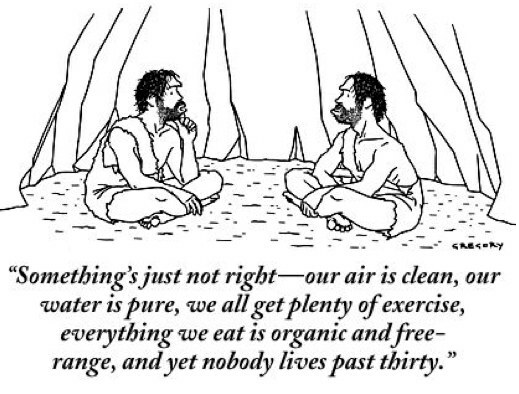
cavemen not right

From the earliest days of human life, we have always known that our lives depend on the energy we can gain and apply to meet our needs.  It is obvious around the world that in places where energy is scarce and expensive, human labor is cheap and people live in poverty.  Where energy is cheap and available, people earn a much higher standard of living.  These realities have escaped the notice of today’s policymakers, obsessed with their fear of CO2.   Derrick Hollie writes at Real Clear Energy ‘Affordable and Reliable’ Energy Makes Life Possible. Excerpts in italics with my bolds.

In the United States, we have an abundance of affordable and reliable energy. But some of us take having access to energy for granted. We expect to plug in and charge our mobile devices, flip a light switch and click on the television. And without fail, it all works. It’s not until our power—and our way of life—is interrupted that most of us think about energy and where it comes from.

California’s recent blackout revealed that having reliable electricity is an economic privilege, and interviews from across the state suggest those less affluent continue to have more losses and were disproportionately forced off the grid.

As it is, Californians already pay among the highest rates in the U.S. for their power, and unfortunately these costs are projected to rise even more. These increases often have a higher burden on low-income households that already struggle to keep up with rising cost, leading many down the path to energy poverty. The issue plagues not only California residents, but many more across the country including in Pennsylvania, where utility rates for customers are much higher than neighboring states. In Georgia a study finds energy consumption among the highest in America, and in New Mexico a new state law will increase cost to consumers, with the most negative impacts felt by lower income families who spend a larger share of their monthly income on energy.

The irony is that each state listed has an abundance of natural resources that can be accessed. But lawmakers, caving to environmentalist and special interest groups that don’t speak for the poor, continue to put forth expensive policy ideas like the Green New Deal that promote false hope and unrealistic outcomes for those who already grapple each month to make ends meet.

I recently had an opportunity to speak with several residents of Richmond, Virginia, who face these challenges. And it breaks my heart to see a single mother who must decide on whether to feed her children or pay the electric bill. That’s a choice no American citizens should have to make.

Today we use more energy than ever before, and to keep up with the growing demand, we need an approach that makes better use of what we have, especially if it can lower costs, create jobs and increase funding to critical services we rely on like roads, emergency management, and education.

A recent Shale Crescent USA study shows end users have saved $1.1 trillion over the past 10 years due to increased natural gas production that has reduced the price of natural gas in the United States. Meanwhile California, rich with its own natural resources, increased its crude oil imports from foreign countries from 5% in 1992 to 57% in 2018. This is a glaring example of hypocrisy, and here’s why. Booming shale production helped the U.S. overtake Saudi Arabia and Russia to become the world’s top oil exporter for the first time ever this year. How can our natural resources be worthy enough to supply other countries, but not good enough for us here at home?

We need market-oriented energy policy that will allow America to keep exploring and developing our resources safely, and to follow the example of environmental stewardship set by areas like Port Fourchon, Louisiana. The port serves as a major oil and gas hub on the Gulf Coast with some of the largest boat and marine companies in the world operating from there. It’s also a commercial and fishing Mecca that continues to amaze scientists and researchers from around the world.

During the California blackout, many residents were not able to cook and relied on flashlights and oil-burning lamps for lighting. San Jose Mayor Sam Liccardo urged residents to be “safe and not to drive in blacked-out areas.” We live in the 21st Century in the richest country in the world, and nobody here should be without electricity. Affordable energy makes us better and more resilient.

And the truth is, nature doesn’t give us what we need to survive—we must create it through energy development. Fossil fuels have allowed us to create a life that Americans have grown to appreciate, thanks to innovations from pharmaceuticals to agriculture to mobile devices.

We are better off now than ever before, and politicians shouldn’t deny our comfort and prosperity to the least fortunate among us.


See also Social Benefits of Carbon

Ungrateful Millennials Richer than Rockefeller


October Ocean Air Temps Cooling, Land to Follow

banner-blog

With apologies to Paul Revere, this post is on the lookout for cooler weather with an eye on both the Land and the Sea.  UAH has updated their tlt (temperatures in lower troposphere) dataset for October.  Previously I have done posts on their reading of ocean air temps as a prelude to updated records from HADSST3. This month also has a separate graph of land air temps because the comparisons and contrasts are interesting as we contemplate possible cooling in coming months and years.

Presently sea surface temperatures (SST) are the best available indicator of heat content gained or lost from earth’s climate system.  Enthalpy is the thermodynamic term for total heat content in a system, and humidity differences in air parcels affect enthalpy.  Measuring water temperature directly avoids distorted impressions from air measurements.  In addition, ocean covers 71% of the planet surface and thus dominates surface temperature estimates.  Eventually we will likely have reliable means of recording water temperatures at depth.

Recently, Dr. Ole Humlum reported from his research that air temperatures lag 2-3 months behind changes in SST.  He also observed that changes in CO2 atmospheric concentrations lag behind SST by 11-12 months.  This latter point is addressed in a previous post Who to Blame for Rising CO2?

After a technical enhancement to HadSST3 delayed March and April updates, May was posted early in June, hopefully a signal the future months will also appear more promptly.  For comparison we can look at lower troposphere temperatures (TLT) from UAHv6 which are now posted for October. The September data had appeared questionable, but UAH has now validated those numbers. The temperature record is derived from microwave sounding units (MSU) on board satellites like the one pictured above. Recently there was a change in UAH processing of satellite drift corrections, including dropping one platform which can no longer be corrected. The graphs below are taken from the new and current dataset.

The UAH dataset includes temperature results for air above the oceans, and thus should be most comparable to the SSTs. There is the additional feature that ocean air temps avoid Urban Heat Islands (UHI).  The graph below shows monthly anomalies for ocean temps since January 2015.After a June rise in ocean air temps, all regions dropped back down to May levels in July and August.  A spike occured in September, which has now been erased by plummeting ocean air temps in the Tropics and SH. NH ocean air also cooled slightly, but the Global drop was driven by the much greater SH ocean area.

Land Air Temperatures Tracking Downward in Seesaw Pattern

We sometimes overlook that in climate temperature records, while the oceans are measured directly with SSTs, land temps are measured only indirectly.  The land temperature records at surface stations sample air temps at 2 meters above ground.  UAH gives tlt anomalies for air over land separately from ocean air temps.  The graph updated for October is below.
Here we have freash evidence of the greater volatility of the Land temperatures, along with an extraordinary departure by SH land.  Despite the small amount of SH land, it spiked in July, then dropped in August so sharply along with the Tropics that it pulled the global average downward against slight warming in NH.  Now the last two months NH has risen to match SH, while the Tropics dropped (very small land area),  The overall pattern shows global land temps tend to follow NH temps, except for this recent rise led by SH.

The longer term picture from UAH is a return to the mean for the period starting with 1995:

TLTs include mixing above the oceans and probably some influence from nearby more volatile land temps.  Clearly NH and Global land temps have been dropping in a seesaw pattern, more than 1C lower than the 2016 peak, prior to these last 2 months. TLT measures started the recent cooling later than SSTs from HadSST3, but are now showing the same pattern.  It seems obvious that despite the three El Ninos, their warming has not persisted, and without them it would probably have cooled since 1995.  Of course, the future has not yet been written.

High Stakes Impeachment Poker

Charles Lipson is a respected U. of Chicago political scientist who writes disapassionately and insightfully about the zero sum impeachment game under way in Washingston DC. He provides multiple perspectives in his article published at Real Clear Politics: The Democrats’ High-Risk Gamble on Impeachment. Excerpts in italics with my bolds and images.

Democrats and Deep State Are All In

The Democrats’ activist base considers Donald Trump fundamentally unfit to hold office. Their impeachment drive is really about this damning judgment, not about any specific act such as withholding Ukrainian aid or wanting to fire Special Counsel Robert Mueller. They say Trump is erratic, narcissistic, self-serving, and unforgivably gauche. He cozies up to dictators and would like to become one himself. Every day, he tramples the presidency’s historic norms. Surely the voters who put him there made a catastrophic error, or, rather, the antiquated Electoral College did. In short, Trump is not just a bad president — the worst in modern history — he is an illegitimate and dangerous one, at home and abroad.

Their harsh view is no masquerade. It is sincere, deeply held, and shared by most elected Democrats. Many, perhaps most, career civil servants agree and consider the president only nominally their boss. That’s why they consider it their constitutional duty to hold him in check. That’s why former heads of the CIA openly praised the “Deep State,” why former FBI Director James Comey wanted his agents to monitor the president in the White House itself. If that means targeting Trump and his key aides for disguised FBI interviews or leaking classified phone calls, so be it. The fight over the Deep State is partly about this profound distrust of Trump (and his distrust of them) and partly about the president’s rising opposition to a century of progressive legislation, executive orders, and court decisions, which grant extensive power to government bureaucrats.

This revulsion is the backdrop to the Democrats’ impeachment effort and the earlier appointment of a special counsel. The crucial point is this: Democrats see the actions they have investigated for three years less as specific crimes and more as steadily accumulating evidence of Trump’s unfitness for office and his repeated violation of his oath, as they understand it. “Democrats of all stripes look at Donald Trump’s business and personal history and see a man who serially does not follow laws and therefore should not be president,” said one well-informed Democrat. For his party, “Ukraine is a big deal because it confirms this view.”

Pelosi Is Playing Several Angles

Although House Speaker Nancy Pelosi shares those sentiments, she is too shrewd, too experienced to be carried away by her party’s most rabid voices. She is also too vulnerable to ignore them. The loudest voices come from deep-blue districts, but she needs to win purple ones, too, to keep her majority. That’s why impeachment has twin goals: to appease the party’s activist base (in Congress and the primaries) and to win the general election by damaging Trump and his Republican allies.

There are other possible goals. One is to sink moderate Senate Republicans in close 2020 races, which could flip control if Democrats win in Maine, Colorado, Arizona, and North Carolina and hold onto other seats. Another is keeping Joe Biden’s rivals, particularly Sen. Elizabeth Warren, frozen in Washington for a Senate trial during the early primaries. National Democrats, led by Pelosi, are deeply worried that Warren, if she is the nominee, will not only lose the presidency but cost them heavily down the ballot. A third is to distract from Inspector General Michael Horowitz’s upcoming report on possible surveillance abuse by senior Obama appointees.

Still, Pelosi’s highest priorities are retaining her position as speaker and, if possible, retaking the White House. Only then would winning the Senate give the Democrats true governing power.

Enormous Downside Risk

The downside of this impeachment gamble is painfully obvious. Without substantially more evidence against Trump, Democrats cannot win overwhelming public support and, without that, they won’t come close to the two-thirds vote in the Senate needed to remove the president. If the upper chamber doesn’t convict, voters are bound to ask why Democrats have spent the past four years on this fruitless quest and neglected their other duties. What legislative accomplishments can they highlight for voters next November? Hardly any. Only a big sign saying “The Resistance.”

How well is this gamble going? Still too early to tell. Recent polls show about half the country now favors impeachment and removal, but, significantly, the president’s numbers are about 10 percentage points better in vital swing states. Rank-and-file Republicans and their officeholders are still solidly behind the president. The big unknown is what effect public hearings and a Senate trial will have.

To remove a president, the Democrats need strong bipartisan support, both among voters and in Congress. They don’t have it. One big problem is that so many Democrats and their media allies have cried “wolf” before. Indeed, they have cried it continually since Trump was elected. The second problem is House Democrats have conducted the inquiry behind closed doors and withheld the transcripts for weeks (only now, under pressure, are they beginning to release them). They’ve made up the rules as they go, refusing to let Republicans call witnesses, refusing to let the president’s lawyers ask questions or even observe the process. Why? No good answers have been provided, nor for why the investigation is being held in a secure room by the Intelligence Committee. Hiding it in the basement is a sad metaphor for what should be a public process. After all, the materials are not classified, and the Judiciary Committee has handled every previous impeachment. The more partisan the process, the less bipartisan and legitimate the outcome.

Republicans See A Rigged Witch Hunt in Process

To Republicans, the impeachment drive looks less like a somber, quasi-judicial proceeding and more like something concocted by Dean Wormer to expel John Belushi’s “Bluto” Blutarsky and Delta House from Faber College. The House rules are ad hoc inventions. The secret hearings, scheduled by Chairman Adam Schiff, can continue as long as he wants, calling only his witnesses. He will then write a report, saying the evidence was appalling and unrefuted, and hand everything over to the Judiciary Committee to conduct public hearings. If Chairman Jerrold Nadler’s previous hearings are any guide, they will quickly descend into an ugly street brawl.

It’s not hard for Republicans to attack this whole process as fundamentally unfair. They say, rightly, that it violates the most basic tenets of Anglo-Saxon jurisprudence:

    • Accusations must be specific and backed by clear evidence;
    • All evidence and accusations must be presented in open court;
    • Rules of procedure must be fixed and unbiased, not arbitrary and ad hoc;
    • The accused is presumed innocent and must be given full rights to see all the evidence, confront the accusers, and rebut all charges, including cross-examining witnesses, challenging documents, and presenting exculpatory evidence.

None of these rules has applied to this impeachment inquiry, at least not yet.

Although impeachment is a political act, it is still governed by the constitutional requirement limiting it to “high crimes and misdemeanors,” such as treason and bribery. The Framers specifically rejected a proposal to include “malfeasance in office,” fearing it would open the process to vague charges and transform our system of divided powers into a unified parliamentary system, controlled by Congress.

White House Has to Play Both Short and Long Game

The White House cannot expect to win this battle solely by condemning it as unfair. It must ultimately frame a persuasive, substantive rebuttal to the charges leaking out of Schiff’s committee. That means convincing the public the president is innocent or, as Bill Clinton did, convincing them the charges are not serious enough to overturn an election. Trump can also say the election is so near that we should let voters decide for themselves.

For the moment, however, the White House is wise to concentrate on the unfair process. The public can assess whether those leading the inquiry are even-handed or hell-bent to remove the president. Are they giving him and his supporters a fair chance to present their side? Americans understand these basic rules. We treasure them as bulwarks of our democratic freedom. The House majority breaks them at its peril.

See also post Conrad Black: Trump is Holding the Cards