Update on Global Gene Therapy Mass Experiment

Just published Innate immune suppression by SARS-CoV-2 mRNA vaccinations: The role of G-quadruplexes, exosomes, and MicroRNAs Stephanie Seneffa et al. Excerpts in italics with my bolds.
Highlights
♦ mRNA vaccines promote sustained synthesis of the SARS-CoV-2 spike protein.
♦ The spike protein is neurotoxic, and it impairs DNA repair mechanisms.
♦ Suppression of type I interferon responses results in impaired innate immunity.
♦ The mRNA vaccines potentially cause increased risk to infectious diseases and cancer.
♦ Codon optimization results in G-rich mRNA that has unpredictable complex effects.
Overview
The mRNA SARS-CoV-2 vaccines were brought to market in response to the public health crises of Covid-19. The utilization of mRNA vaccines in the context of infectious disease has no precedent.
The many alterations in the vaccine mRNA hide the mRNA from cellular defenses and promote a longer biological half-life and high production of spike protein. However, the immune response to the vaccine is very different from that to a SARS-CoV-2 infection.
In this paper, we present evidence that vaccination induces a profound impairment in type I interferon signaling, which has diverse adverse consequences to human health. Immune cells that have taken up the vaccine nanoparticles release into circulation large numbers of exosomes containing spike protein along with critical microRNAs that induce a signaling response in recipient cells at distant sites.
We also identify potential profound disturbances in regulatory control of protein synthesis and cancer surveillance.
These disturbances potentially have a causal link to neurodegenerative disease, myocarditis, immune thrombocytopenia, Bell’s palsy, liver disease, impaired adaptive immunity, impaired DNA damage response and tumorigenesis. We show evidence from the VAERS database supporting our hypothesis.
We believe a comprehensive risk/benefit assessment of the mRNA vaccines questions them as positive contributors to public health.
Conclusions
In this paper, we call attention to three very important aspects of the safety profile of these vaccinations. First is the extensively documented subversion of innate immunity, primarily via suppression of IFN-α and its associated signaling cascade. This suppression will have a wide range of consequences, not the least of which include the reactivation of latent viral infections and the reduced ability to effectively combat future infections.
Second is the dysregulation of the system for both preventing and detecting genetically driven malignant transformation within cells and the consequent potential for vaccination to promote those transformations.
Third, mRNA vaccination potentially disrupts intracellular communication carried out by exosomes, and induces cells taking up spike glycoprotein mRNA to produce high levels of spike-glycoprotein-carrying exosomes, with potentially serious inflammatory consequences.
Should any of these potentials be fully realized, the impact on billions of people around the world could be enormous and could contribute to both the short-term and long-term disease burden our health care system faces.
In the end, billions of lives are potentially at risk, given the large number of individuals injected with the SARS-CoV-2 mRNA vaccines and the broad range of adverse outcomes we have described. We call on the public health institutions to demonstrate, with evidence, why the issues discussed in this paper are not relevant to public health, or to acknowledge that they are and to act accordingly. Furthermore, we encourage all individuals to make their own health care decisions with this information as a contributing factor in those decisions.
The Implications
Joseph Shepherd takes it from there in his American Thinker article How the COVID Vaccines Kill
With each passing day, the news connected to the COVID shots grows worse. That the injections don’t prevent COVID — or even its spread — has been known for months, and post-injection problems encompass almost everything that can go wrong with a body.
“Not a single organ, not a single bodily function, is unharmed” after one of these shots, said Arne Burkhardt, a professor of forensics at Reutlingen’s Pathological Institute.
So little has been written about why “side effects” such as myocarditis have popped up that one can’t help but wonder: Does anybody understand how these shots work?
In the space below, let’s pick three of the harshest complications and explore how COVID shots could be driving the mechanics of each.
1 – Myocarditis
The pale-yellow fluid of the Pfizer or Moderna vial contains billions of microscopic fat globs called lipid nanoparticles. Each is an incredibly tiny envelope, used to conceal the novel drug: messenger RNA. Once injected, the combination of nanoparticles and mRNA becomes a well-camouflaged predator.
According to Pfizer’s own data, less than half the nanoparticles stay in the arm where they were injected. Most slip through tiny cracks in muscle tissue and enter the bloodstream. Venous blood speeds them to the heart, which pumps and disperses them to the entire body.
Depending on the level of exercise, from 5 to 25% of these particles wind up in coronary circulation. Why is this important? Consider the rather large number of nanoparticles that must slip into human heart tissue: 50 to 250 million out of each billion that enter the veins of the arm.
Coronary circulation branches into microscopic capillaries that rush nutrients to heart muscle cells. And since the nanoparticles designed by Pfizer and Moderna masquerade as triglycerides, heart muscle cells are apt to snatch them out of circulation as food.
Now imagine the shock for any hard-charging heart cell that engulfs one of these particles. Expecting a meal, the cell unwraps the envelope, and voilà! Freshly unveiled messenger RNA seizes the cell’s protein-generating apparatus, forcing out a known toxin — the COVID spike protein.
Very soon, with urgent biochemical signals, the afflicted cell telegraphs news of its hijacking to the immune system, which will marshal what it takes to destroy the cell.
An immune-mediated attack on heart muscle cells is, of course, the very essence of myocarditis.
Foreign RNA takes control of a cell’s protein production, transforming these cells into enemies of the body, and the immune system converts them into useless scar tissue. The process is irreversible, as heart muscle cells do not regenerate.
According to CDC, myocarditis from COVID jabs is “rare” and “mild,” but where is the evidence for this proclamation? Pfizer’s data shows every shot — at least in part — entering the bloodstream, so CDC has interesting notions about the word “rare.” Clinical myocarditis is never “mild.” A phenomenon that kills thousands of heart muscle cells is better classified as “serious” or “severe.” And even if the subject doesn’t die right away, how is that person not permanently injured? And how is the process not cumulative with each subsequent jab?
Given that about 40% of CDC income comes from vaccine patents and products, how can we be assured these experts are not self-serving?
2 – Vascular Damage and Heart Attack Risk
Now let’s turn attention from lipid nanoparticles to their end-product, the COVID spike protein. Having been forced into production by messenger RNA, spike protein peels off cell membranes and drops into general circulation. From there, it stabs and deactivates ACE-2 protein, which is displayed on the innermost lining of blood vessels.
Deactivating ACE-2 has enormous consequences for the body: Its loss leads to oxidative stress on blood vessels, putting the patient at risk for organ damage and blood clots over time.
Can oxidative stress persist for months, or even longer? A study of spike-injected hamsters showed that damaged ACE-2 was not replaced by mammalian cells. Either the cells never sensed that ACE-2 was “spiked” or didn’t generate a signal to replace spiked ACE-2 with a fresher version. To put it a more scientific way: Injected spike protein down-regulated ACE-2, probably for as long as the cells stayed alive.
Does any of this apply to humans? Using the PULS lab score to study a large group of at-risk patients, investigators found that future risk for heart attack remained almost triple two and a half months after two mRNA shots.
3 – Neurodegenerative Disease
Is the COVID jab really associated with premature Alzheimer’s and Parkinson’s disease? Evidence continues to mount, and spike protein is once again the culprit. Circulating spike targets the brain in a variety of ways:
♦ by exposing brain cells to unnecessary toxins through crowbar-like effects on the blood-brain barrier.
♦ by inducing susceptible proteins to misfold and become pathogenic.
♦ by attacking ACE-2 protein-rich environments in the brain.
♦ by forcing mitochondria (the energy-producing organelles of cells) into less efficient processes, so that injured brain cells take on the eerie characteristics of cancer and Alzheimer’s cells.
Long-term outlook
Messenger RNA technology has been around for over 20 years, and multiple vaccines have been attempted. Each failed because the experimental animals failed to thrive.
Last February, spike protein was found to inhibit type 1 interferon, the powerful regulator of the immune system. Hindering type 1 interferon reduces the body’s ability to defend against:
(1) malignancies
(2) autoimmune diseases
(3) viral infections
Over the next year, we will continue to observe how impaired interferon affects the great COVID shot experiment. But while we study the pathology, let us further develop the mechanisms associated with mRNA injections, so that new approaches to the injuries they inflict may be devised.



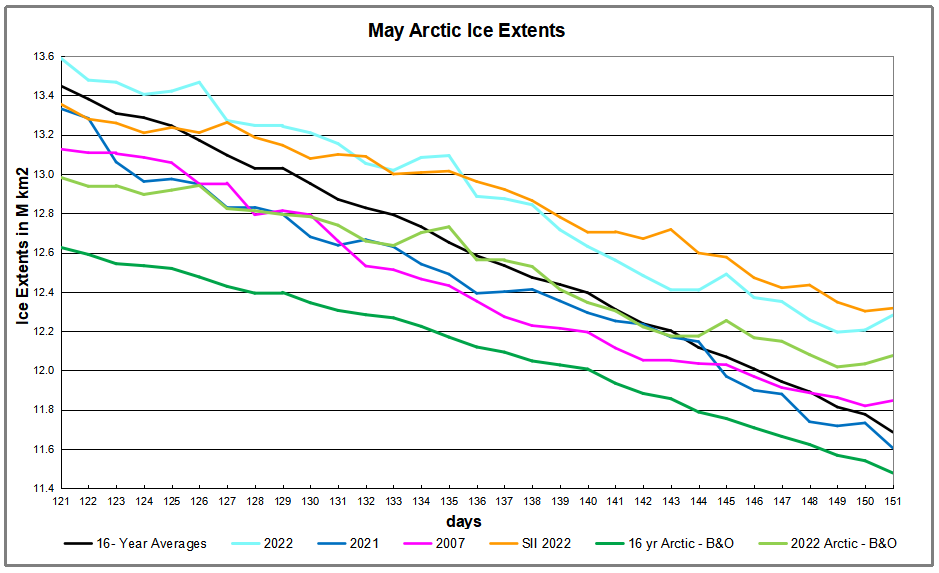
 The table below shows the distribution of Sea Ice on day 151 across the Arctic Regions, on average, this year and 2020.

 Science Matters