There’ll Be Hell to Pay
Adam Mill writes at American Greatness There’s Going to Be Hell to Pay.  Excerpts in italics with my bolds and added images.

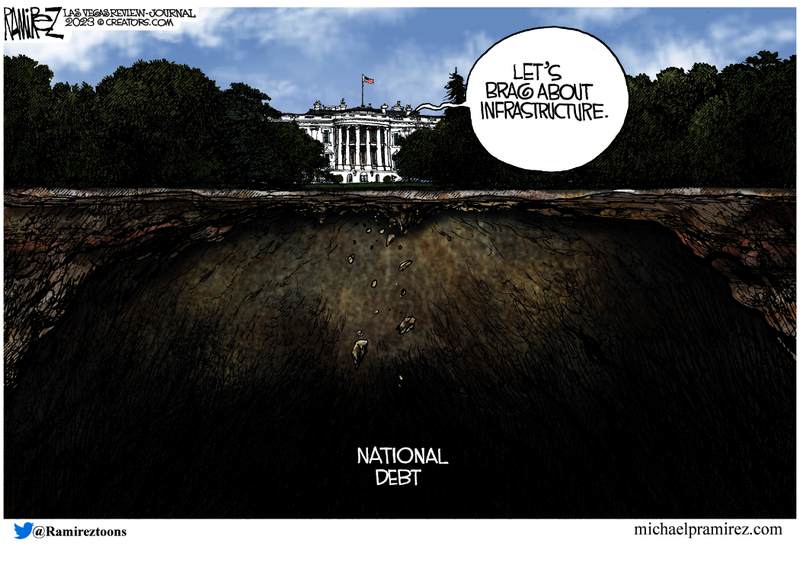
America is piling up civilization-ending debts, and the people incurring them for the sake of feel-good social priorities will be justifiably cursed when the consequences finally come.
It’s just a matter of how long the U.S. Government can stall before the bill finally comes due. Let’s start with the math.  The U.S. national debt now exceeds $31.5 trillion. On the day Joe Biden took office, the average interest rate on this debt was around 1.61 percent and interest payments were a mere $549 billion a year. Since then, higher spending and higher interest rates have accelerated the problem at breakneck speed. As older bonds with the historic low interest rates mature and disappear, they are replaced with the higher interest rate bonds now being issued. According to the St. Louis Federal Reserve, the annualized interest rate cost in December reached an eye-popping $853 billion.

The older, lower interest rate bonds have kept the average at around 2 percent, still much higher than normal. Econofact.org estimates that “most of the current government debt will mature within the next three years,” which means that the federal government will soon be financing most of its $31.5 trillion debt at market rates-which are approaching 4 to 5 percent.   We’re looking at a total annual interest bill of over $1 trillion in the very near future. By comparison, the total tax revenue collected by the U.S. government in 2023 is projected to be $4.6 trillion.

As soon as next year, interest will consume approximately one-fifth
or even a quarter of all government revenue.

That’s not the bad news.

The bad news is that we’re fast approaching the point at which we have to accelerate borrowing just to keep up with the interest payments. The treasury has to find buyers for its whopping $1.4 trillion in deficit spending. And for now, the Federal Reserve is saying it will not buy more treasuries, even to replace the maturing treasuries that roll off its portfolio.

Until recently, the dollar’s resilience made it possible for the government to effectively fund operations with money from the printing press. But inflation, the offspring of deficit spending, has begun to collect its due from the public. As interest payments claim increasingly more and more of the budget, the government must borrow more to make up the difference, thus accelerating the growth of the debt and inflation. This leads to still higher interest rates which lead to higher interest payments requiring even more borrowing

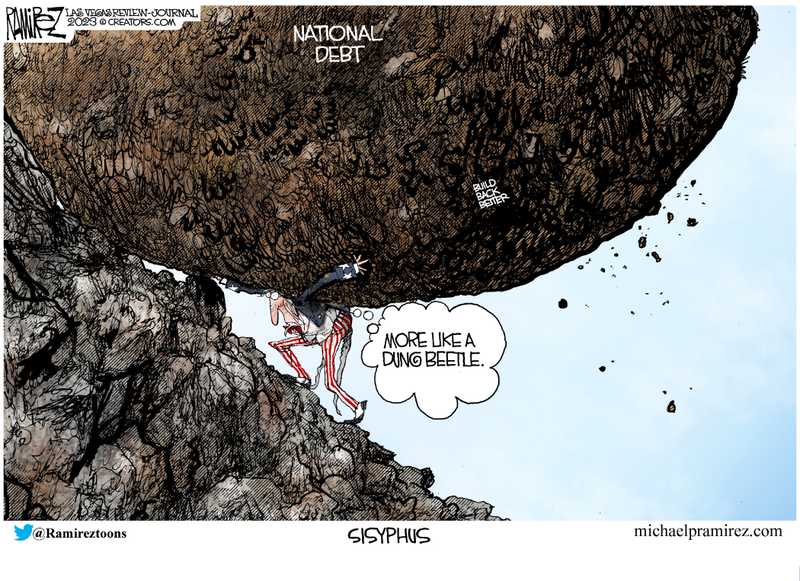
When you have to borrow money to pay interest on existing debt, you’re in big trouble.

Entitlements such as Social Security, Medicaid, and Medicare, make up the vast majority of the budget. Every year, the bills get bigger as drugs get more expensive and the Social Security Administration indexes existing payments to keep up with inflation.

It’s hard to say exactly when or how the federal budget will hit some sort of wall. But the scenario I consider most likely is that inflation will reignite as the Federal Reserve backs off its interest rate increases. Get ready to go long for single-digit inflation.

Unfortunately, the same geniuses who enabled politicians to run up these irresponsible debts will also be in charge of helping politicians set inflation-fighting policies. For the Left, the go-to tools never work but will always be tried because of political ideology. These include wage and price controls, tax increases, and criminalizing market pricing as “price gouging” or “hoarding.” As taxes go up and the government attempts to regulate its way out of inflation, economic output falls. If the fall is drastic enough, it can have a counterinflationary effect. But only after inflicting extreme misery on working Americans.

In the 1980s, Reagan’s formula of low taxes, less regulation, and higher interest rates created the conditions to dramatically reverse the Carter economic malaise, an era often compared to the present. While really smart economists will argue that the economy is totally dependent on government spending, this is sophistry. Government spending degrades efficient and wealth-enhancing transactions. The government gets its money by taking value out of a legitimate economic transaction and redistributing it to a political objective. Low-interest rates encourage scams and enable marginal businesses to chug along.

Profit, not borrowed money, is the key to economic revival. Produce things that legitimately add to the stock of goods and services, and you will increase national income. Shift money around with loans and government grants, and you will idle otherwise productive resources as people chase free money.

Economic freedom isn’t about helping the rich. If anything, the opposite is true. During the economic expansion that followed Reagan’s reforms, income inequality fell. The percentage of low-income houses fell from 27 percent in 1980 to 25.3 percent in 1989. In contrast, economic inequality increased under Obama’s economic policies.

The dirty little secret of leftist economic theories is that they benefit powerful people who are in a position to influence economic meddling. Who do you think got most of the COVID relief money?

Historians will scratch their heads and wonder why Americans spent so much time obsessing over Ukraine and gender identity while the debt piled up to catastrophic levels. Unfortunately, the people who govern us simply refuse to adhere to basic rules of fiscal discipline. Through ignorance or craven corruption, they continue aggressively driving up debt to unprecedented levels. These are civilization-ending debts and the people incurring them for the sake of feel-good social priorities will be justifiably cursed when the consequences finally come.


SCOTUS and Climate Free Speech

Donald J. Kochan writes at The Hill Climate change consumer deception lawsuits threaten free speech. Will the Supreme Court take note? Excerpts in italics with my bolds and added images

Courts are increasingly taking a close look at the validity of climate change lawsuits against oil producers. And for good reason: These cases severely test the boundaries of court jurisdiction, the breadth of tort law, the protections of due process and even the sanctity of free speech.

As one example of this scrutiny, last Oct. 3, the U.S. Supreme Court signaled a serious interest in the proper forum and scope for climate change litigation.

In Suncor Energy (U.S.A.) Inc. v. Board of County Commissioners of Boulder County, the Supreme Court invited the solicitor general of the United States to weigh in, even though the United States is not a party to the litigation. The federal government is invited to file a brief with an official legal opinion of the federal government about the questions presented regarding the role of federal and state courts and the scope of federal and state common law for evaluating lawsuits alleging climate change injuries from fossil fuel production and consumption. These invitations are rare.

All of the cases similar to Suncor percolating across the country are focused on suing companies for the effects of climate change. Yet, each of these lawsuits also tack on “consumer deception” and related “greenwashing” claims. Both categories get a lot of attention, but the latter deserves special inspection.

These so-called deception claims sometimes allege that the companies downplayed the impacts of climate change despite that there is no affirmative duty to share everything you know, especially when consumers in the market have access to the same information.

Other times the greenwashing claims allege that the companies should not have been allowed to advertise about efforts they are making toward developing cleaner energy because these efforts were not as robust as the plaintiffs would have liked. Indeed, in several cases, the plaintiffs have essentially stated that these companies should not have been allowed to speak about their environmental successes because the only clean fossil fuel is no fossil fuel.

These consumer deception lawsuits are direct attacks on rights to speak
and the corollary rights to not be compelled to speak.
But there should be no climate change exception to free speech.

In 2019, Justice Samuel Alito penned an important dissenting opinion from a decision by the Supreme Court not to hear an appeal in National Review, Inc. v. Mann. He saw the denial as a lost opportunity to underscore that traditional and ordinary principles protecting free speech to promote discourse should apply within climate change discussions specifically.

Justice Alito noted that “To ensure that our democracy is preserved and is permitted to flourish, this Court must closely scruti­nize any restrictions on the statements that can be made on important public policy issues. Otherwise, such restrictions can easily be used to silence the expression of unpopular views.”

Efforts to restrict how one speaks about climate change are precisely such “immensely important” cases where close scrutiny should apply. Justice Alito observed that “Climate change has staked a place at the very center of this Nation’s public discourse. Politicians, journalists, academics, and ordinary Americans discuss and debate various aspects of climate change daily—its causes, extent, urgency, consequences, and the appropriate policies for addressing it. The core purpose of the constitutional protection of freedom of expression is to ensure that all opinions on such issues have a chance to be heard and considered.”

These viewpoints are prescient in light of the climate deception
and greenwashing allegations in front of the court today.

Advertising itself has a long history as protected and beneficial speech. It is seen as critical to providing information to the market. It helps consumers make intelligent and well-informed decisions. It is not misleading to say that an attribute of a product is that it is better or cleaner today than it was yesterday.

Furthermore, if we were to say that companies are prohibited from advertising that they’ve improved simply because they have not eliminated all harmful aspects of their products, we would disincentivize the very improvements that those fighting to combat climate change wish to see. Advertising lets one benefit from the investment they make in improving a product, which in turn incentivizes the investment.

Thus, if these deception claims are successful in court, shutting down speech because the quality is not perfect in the eyes of some advocates becomes the enemy of the good.

Free speech is an invaluable thing with a fragility that counsels constant vigilance for its protection. Against those truths, we should be concerned when the very court system entrusted to protect speech is at risk of instead becoming weaponized to punish or chill it.


Background Post with entire Dissenting Opinion Justice Alito Finds Chinks in Mann’s Legal Armor


Cognitive Climate Games

Robert Bradley at Master Resource reports on how cognitive dissonance can be pushed below the level of awareness in his article “Cognitive Dissonance” and Climate Change: A Takedown.  Excerpts in italics with my bolds and added images.

Sometimes a rebuttal on social media is just too good to not memorialize. This one concerns a post about “Cognitive Dissonance” in reference to a 49-minute Apple Podcast, “Hidden Brain: When You Need It to Be True.” Its synopsis states:

When we want something very badly, it can be hard to see warning signs that might be obvious to other people. This week, we revisit a favorite episode from 2021, bringing you two stories about how easy it can be to believe in a false reality — even when the facts don’t back us up.

The upshot (see below) is that since we know climate science is settled and the verdict is a crisis (ahem), psychological explanations are necessary to understand why so many of us (the silent majority?) are not in anguish and demanding a transformation of modern life (like crying Peter Kalmus).

Susan Krumdieck, Research Director, Islands Centre for Net Zero, interpreted “When You Need It to Be True” as follows:

Cognitive Dissonance is a phenomena those of us in Energy Transition need to understand and develop ways to deal with in ourselves and others.

The first big dissonance was 40 years ago when the belief that scientific observations warning of environmental damage would cause the necessary change. I still want it to be true. But I look at data and evidence to determine what is most likely. And then I investigate how changes can work and how different people play a part.

Purposeful questions about assumptions is necessary. Questioning widely held assumptions about what can and can’t be done in what timeframe by whom means you are awake to facts.

This story about people believing alien guardians were going to come save them from the destruction of the earth should be of interest.

To which I commented:

I see ‘Cognitive Dissonance’ as the problem with climate alarmism and forced energy transformation. Waste, futile –and a mindset geared toward unnecessary ‘climate anxiety’.

But a comment before mine was the real takedown. Stated Richard Lyon of Lyon Energy Futures Ltd.:

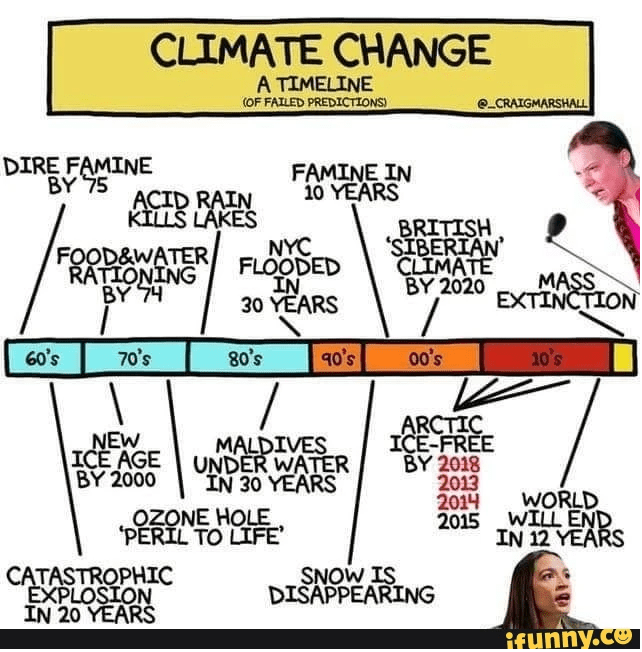
Thanks, Susan. One of the first warnings 40 years ago was from prominent climate catastrophist Paul Ehrlich that “everyone will disappear in a cloud of blue steam by 1989”.

Since then, we’ve thrilled to warnings that the oceans would be “As dead as Lake Erie by 1980” (Ehrlich, 1970), that there would be a new Ice Age in 10 years (NASA, 1971), that England would cease to exist by 2000 (Ehrlich, 1971), that there was “no end in sight of the cooling trend” (New York Times, 1978), that the Maldives would be “completely underwater in 30 years (1989), that UK snowfalls were a thing of the past (University of East Anglia, 2000), that Britain would be “Siberian” by 2025 (Pentagon, 2004), that the Arctic would be ice free by 2013/2014/2016/2018 (Gore, US Navy, NASA), etc.

What you note as “warnings” 40 years ago are more accurately labelled as falsified speculations produced by climate models observably unfit for duty.

That is producing severe Cognitive Dissonance in an industry that depends on the hypothesis being true that there is a climate crisis, and is manifesting itself most visibly in the proliferation of what Lakatos proposes as “Auxiliary Theory” in his account of pseudoscience – “theory to explain the failure of the theory”

Bravo … And here we are where Richard Lyons (et al.) are arguing and winning the intellectual debate, while the alarmist believers of a Cognitive Dissonance are stuck in their own … cognitive dissonance. Message to Susan Krumdieck, who has bought into the climate alarm. Check your premises rather than try to find psychological explanations for the world not heeding the climate alarm.

Start with the time series data with each weather extreme,
as well as the satellite data on global warming.


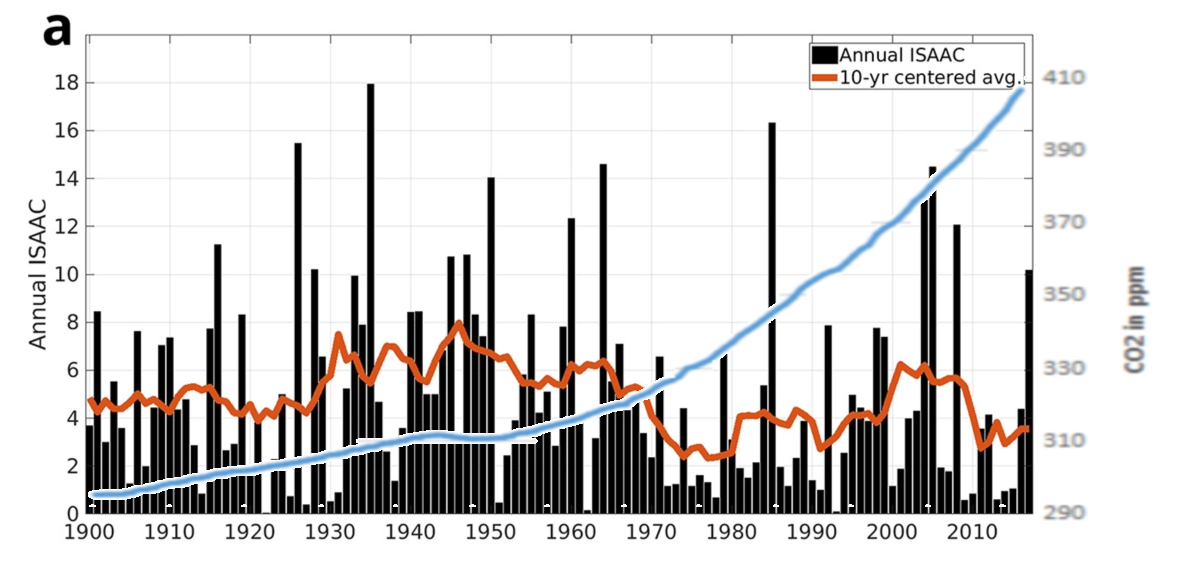
[The graph above shows exhibit 2a from Truchelut and Staehling overlaid with the record of atmospheric CO2 concentrations.  From NOAA combining Mauna Loa with earlier datasets.]
To determine Integrated Storm Activity Annually over the Continental U.S. (ISAAC) from 1900 through 2017, we summed this landfall ACE spatially over the entire continental U.S. and temporally over each hour of each hurricane season. We used the same methodology to calculate integrated annual landfall ACE for five additional geographic subsets of the continental U.S.

Climate optimism, anyone?

Update on Sovereign Election Fraud in US

Jay Valentine explains the threat in his American Thinker article Your Government Wants to Keep You from Seeing Voter Rolls.  Excerpts in italics with my bolds and added images.

The narrative about “free, safe, secure elections” changed 180 degrees since November 2022.  Almost nobody is crazy enough to say America has free, fair elections.

After Kari Lake and Adam Laxalt, the most wimpish George Bush RINO hesitates to say “elections are fair.”

Since our team processed billions of election roll “snapshots” taken since 2020, we run the largest election database in the world.  We concluded that U.S. elections are rigged by both parties, and they are rigged with the active help of election officials or their acquiescence.

Sovereign fraud — institutional election fraud by your government, first discussed on American Thinker — is real.  We have the data to prove it!

Fractal technology and vigilant election integrity teams in 2022 pulled back the curtain on much of this rigging — reported at www.Omega4America.com.

Why was the election fraud, which existed years before Trump became a candidate, so invisible?

Election officials of both parties do not want pesky citizens looking at voter rolls.  We know this because we have been in the room with them, virtually, demonstrating the most egregious voter roll anomalies, and they just refuse to see them.

Let’s get into just how virulent, common, widespread is the hiding of election registration info from you — the citizen.  How much does a voter roll cost?  Yeah, dollars.  In some states, it is free.  Download it, or pay a modest fee and get a CD of the entire election roll every 30 days.

In Alabama, $30,000.  You pay Alabama $30,000 for a copy of your election roll. In Wisconsin, $12,500. Why so much?  Is it a profit center? 

Well, in Alabama, they have scores of voters older than Julius Caesar — some registered in the last couple of years using a birthdate around the time St. Paul was proselytizing.  Think maybe there is a data roll cleaning problem there?

Wisconsin has voter IDs with hidden characters. 

You can find over 180,000 Wisconsin voters with the same voter ID.  Oops!  They aren’t the same IDs.  They are actually different — but you cannot tell with your software because the Wisconsin Election Commission uses a hidden character inserted that is invisible to you.  We made them admit it!

Go to our website, www.Omega4America.com, and read the expert witness reports.

In some states, you cannot get the voter roll unless you are a candidate or political party.  If you let anyone else see it, you can be prosecuted — Virginia and California.

There is North Carolina.  They insert control characters into election rolls so citizens have a hard time combining necessary rolls for analysis.

Creating databases with incorrectly inserted control characters shows one of two motivations:  massive incompetence or sinister intent.  You decide.

Our analysis of the various states, about 20 or so we have seen, is that the level of database competency is less than 8th-grade in most.  Let me state that clearly: in almost every state where we processed the election rolls, the level of database competence, from a secretary of state, spending millions of dollars a year — is less than high school level.

If the amount of undeniably false information in every state election database we have seen existed in a public company, the CEO, under Sarbanes Oxley rules, would probably go to jail.

How do you check a database?  Download it.  To what do you compare it?

Here’s an idea!  Let’s compare the county voter registration files with the state voter files.  They ought to reconcile, with a little float for registrations in transit.  Nope!  In state after state, there is a 5- to 10-percent difference between those two sets of ostensibly identical data.

Let’s check the state voter rolls with the county tax rolls.  After all, an address is an address.  The reconciliation between the voter roll and the tax roll shows hundreds into thousands of addresses that cannot, by law, house a voter.  Yet those addresses house thousands — regularly over 200,000 anomalies in a single state.

In 2022, we learned that election rolls have internal motionwaves of registrants who swell the roll up to election time — then gently slide back into the sea.

In Nevada and Arizona, we ran the rolls for several months.  Our graphical analysis shows the graph of people living in R.V. parks, hotels, other transient locations slowly rise to peak at election time, then disappear 30–60 days later.

Since we snapshot data — comparing every voter roll with every previous roll — the snapshots show mass migration to the election date, then mass de-migration afterward. This was never visible before Fractal technology, but now it is, from a phone.  Pretty soon we are going to visualize this and put up on the website for all to see.

Let’s not pick on Nevada — we see it in most states.  Harris County, Texas rivals Nevada.

If voter rolls aren’t opaque enough with hidden characters (Wisconsin), inserted control characters (North Carolina), prohibitive costs (Alabama, Wisconsin) or stupid laws that you can be prosecuted for looking at voter rolls if you are not an approved species (Virginia, California), we have a new trend.

Make it a crime to look at voter rolls!  Make it a crime to go door-to-door for election canvassing. 

Criminalize the audit of the criminalization of election rolls!  That’s a double-criminalization!  What does that mean?  Think we are kidding?  Welcome to New Mexico.

Among the army of unsung heroes, giving up jobs, risking safety to fight election fraud — which, dear reader, means they are fighting for your most cherished freedom — is David Clements in New Mexico. 

David is an attorney, professor of law, all-around patriot.  You will catch him on some obscure podcast, from his parked car on a roadside on the way to an election integrity event in the middle of nowhere.

Professor Clements, in a recent interview, reported how New Mexico is legislating to criminalize election integrity efforts.  They want to make it a felony to clean voter rolls.  Go door-to-door to see why the empty construction site has 27 registered voters?  In New Mexico, they want to put you in jail for it!

Guess which party is doing this.  Not much of a guess, is it?

While we are just data guys, we cannot hold back our admiration for guys like Clements, Seth Keshel, and an anonymous army of voter integrity teams fighting against bipartisan, government-funded, supported, and enforced phantom voter fraud.

We are stunned by the lack of support by the Republican wealthy class for these guys.  If they were leftists, trying to scam voter rolls, there would be an entire infrastructure in place to support them.  They might get book deals!

Alas, since they are patriots, the wealthy class stands aside. Well, we aren’t.  The Fractal team is giving patriots — of any party — the disruptive tools to clean voter rolls.

When you have better technology than the government, it does even things up a bit!


Intellect Applied to Climate Change

Rex Murphy writes at  National Post  If CBC cared about diversity, it would host Jordan Peterson global warming talk Excerpts in italics with my bolds and added images.

There is no other issue over the past 20 and probably 30 years that has more obtained the attention of the world’s press than global warming.

I know there have been others. But none has had such a continuous and insistent presence.

No other issue has had the sweet, soft, giddy support of the big networks, the great corporations, the trendy school boards, every mad virtue-signalling politician (the chieftain of which is Prime Minister Justin Trudeau), and the whole wide and multitudinous, amoeba-replicative (and dreadful) NGOS — think of the various foundations, of which I nominate the Suzuki Foundation as the Canadian prince of these dull harrying grouplets — as global warming.

I am aware I am using the old and opportunistically discarded
brand-name here: global warming.

Global warming was the term du jour when the thesis was we were heading into thermal crisis, the snow caps were to disappear, glaciers would go all water in the next 30 years or so, skiers would stare down snow-clean slopes, the seas would swamp New York and Tokyo, and children would weep at bared un-snowed hill-slides.

Alas. Snow kept falling. Seas refused to swell to city-destroying levels. Some winters remained … cold. Ski slopes had snow. And children still in all their sweet joy sledded down the still snow-blanketed hills.

Imagine — the planet’s weather refused to follow Greenpeace’s furious warnings.

Elizabeth May’s hothouse weepings, the latest bulletins from various second-tier folk singers, and people who slept on multimillion-dollar yachts on the French Riviera who deplored those who drove pickup trucks in Northern Alberta.

It was for naught. The Earth has its own ideas. And may probably continue to have them. Presuming the cosmos itself doesn’t go woke.

So it was obvious that “global warming,” the doomster’s environmental tagline required what the communication shops call a “re-branding.” And there being no set more adjusted to the miracles of communications management than the herd of apocalyptic global warming warriors, they — perhaps with much polling, and certainly with much cuteness — changed the brand to “climate change.”

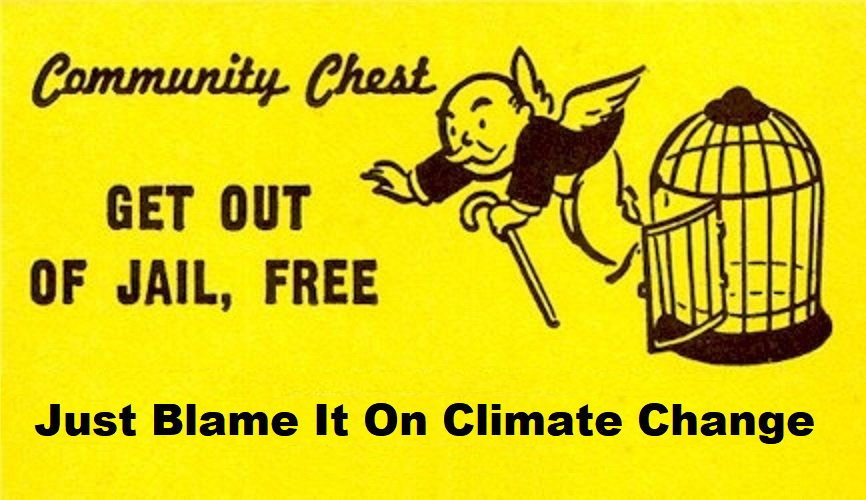
Climate change. There’s a conceptual “get out of jail” brand.

A useful digression: I come from dear, sweet Newfoundland. And I know this will not mean much for you who are not from my province — but I grew up in Placentia Bay.

In Placentia Bay the climate changes every six minutes. And on rough days, every four. Climate change is a beautiful redundancy. It always changes. And if it didn’t … well, it wouldn’t be climate.

So the new brand of “climate change” had this going for it — it gave a blanket rationale for every twitch and tingle or every “weather event” of any kind, wet or cold, hot or dry, a justification under its pure and infinitely elastic designation.

And every TV station, every “weather specialist” was on board with pointing
to “climate change” as the universal cause.

CBC and TV Ontario kept up the silly surmise, having aired Al Gore’s ridiculous, abysmally ignorant An Inconvenient Truth as if it was a script from Sinai, not on stone tablets of course, but “verified” by the “scientists” at the Academy Awards.

Climate change as a brand and a switch-name has gone unchallenged by the main media. Most of them have endorsed a silence on respectable, authoritative, independent and resolute minds who offer more than a different view, but a neutral, rational, and science-based contesting opinion on what has become more of a doxology than matter for exchange, debate, and informed challenge.

Consider Dr. Richard Lindzen. His qualifications on atmospheric science are superb. He is not a “culture warrior.” He is not “political.” He is a great thinking mind — that last term is a very high compliment.

He recently gave a long — nearly two hours — interview with Jordan Peterson, on “climate change,” all conducted with great calm and a backand-forth that followed no script. It was, to my view, one of the cleanest discussions of this issue I have seen.

Dr. Lindzen has the authority of real knowledge on this topic, and therefore his reasonings are worth full and wide attention.

The interview is a model of intellectual exchange, something long lost on our big networks with their fixed views and hollow coverage.

Dr. Lindzen is a font of clear thought, non-agenda-driven deliberation, and direct statement.

It would be a wild wish to see Peterson’s interview with Dr. Lindzen on CBC or TVO. It would break the hearts of their morning agenda meeting attendees. And would threaten their “diversity” and climate change mandates, which are, apparently, whatever the Suzuki foundation and Steven Guilbeault think are correct must be correct.

Watch this interview, even if you are committed to “global warming” theorizations.

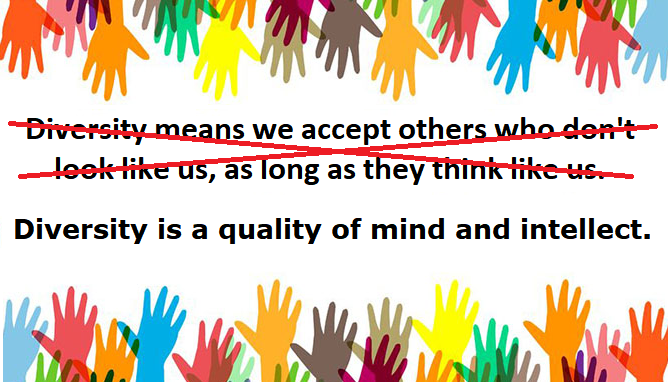
And, to Ms. Catherine Tait, CBC president currently wandering the great Canadian landscape arguing CBC’S relevance and point. Here’s a thought: diversity is a quality of mind and intellect. It is not a submission to current faddishness.

Try airing the interview with Dr. Lindzen as an experiment with diversity of thought.

It may be a strange thing to say, but a broadcaster, subsidized and leaning on past glories, should earn its present-day respect by looking around and giving a glimpse at opinions and perspectives outside the glass case of its own treasured ever-so-correct eidolons of virtue-speak.

Zero Warming: January 2023 Starts Cold

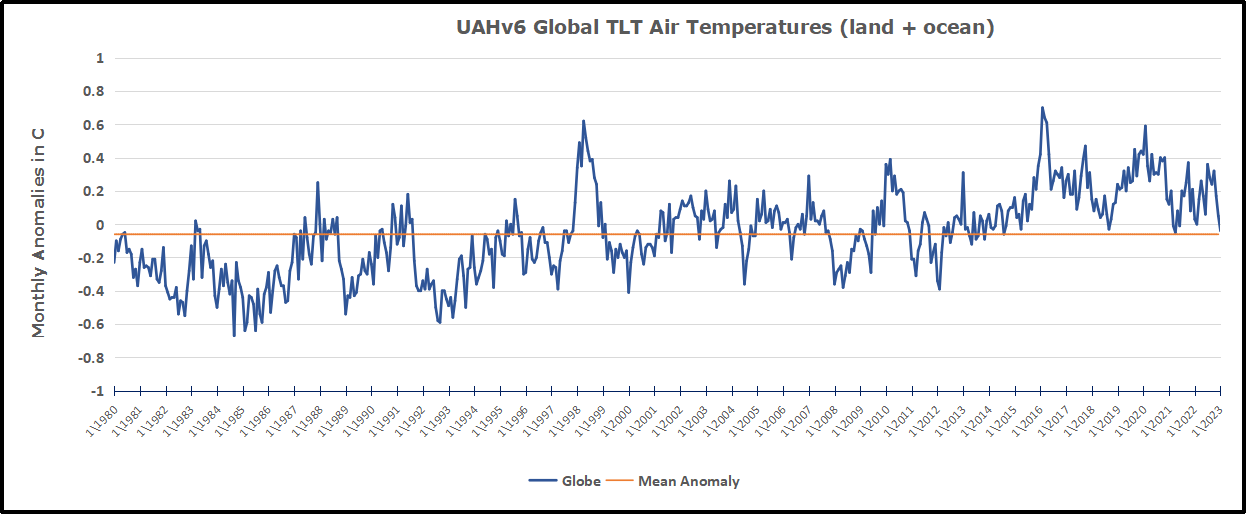
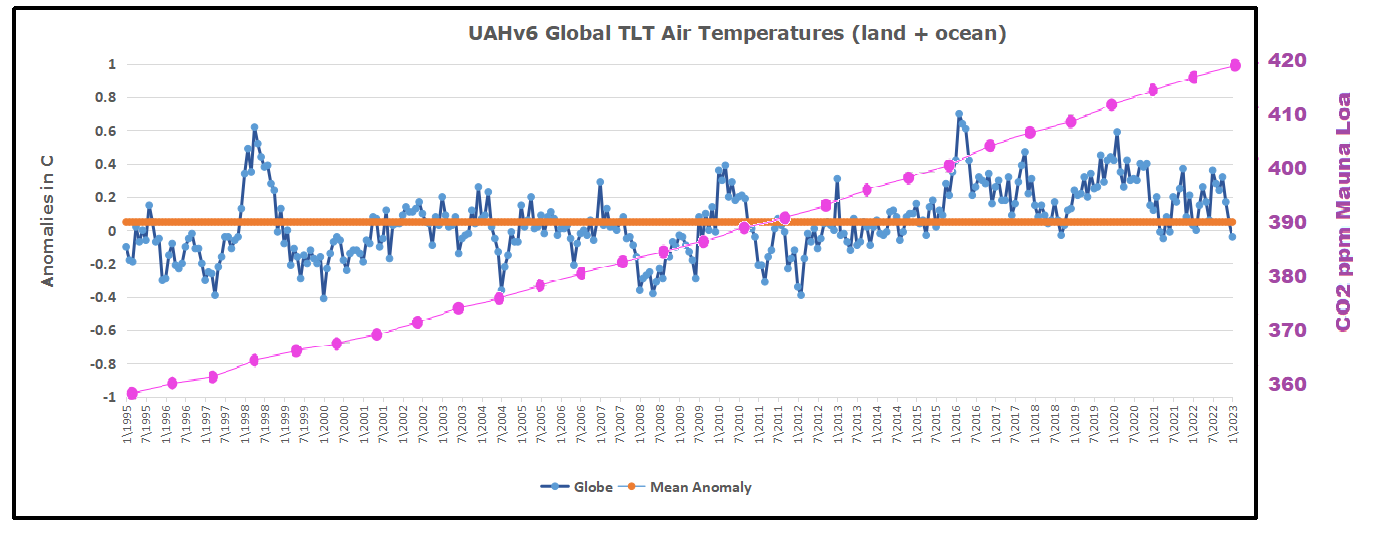
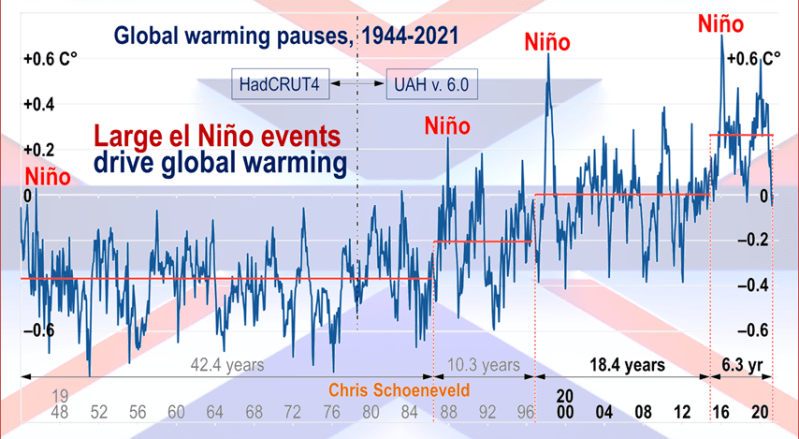
The post below updates the UAH record of air temperatures over land and ocean.  But as an overview consider how recent rapid cooling  completely overcame the warming from the last 3 El Ninos (1998, 2010 and 2016).  The UAH record shows that the effects of the last one were gone as of April 2021, again in November 2021, and in February and June 2022  Now at year end 2022 and continuing into January 2023 we have again global temp anomaly lower than average since 1995. (UAH baseline is now 1991-2020).

For reference I added an overlay of CO2 annual concentrations as measured at Mauna Loa.  While temperatures fluctuated up and down ending flat, CO2 went up steadily by ~60 ppm, a 15% increase.

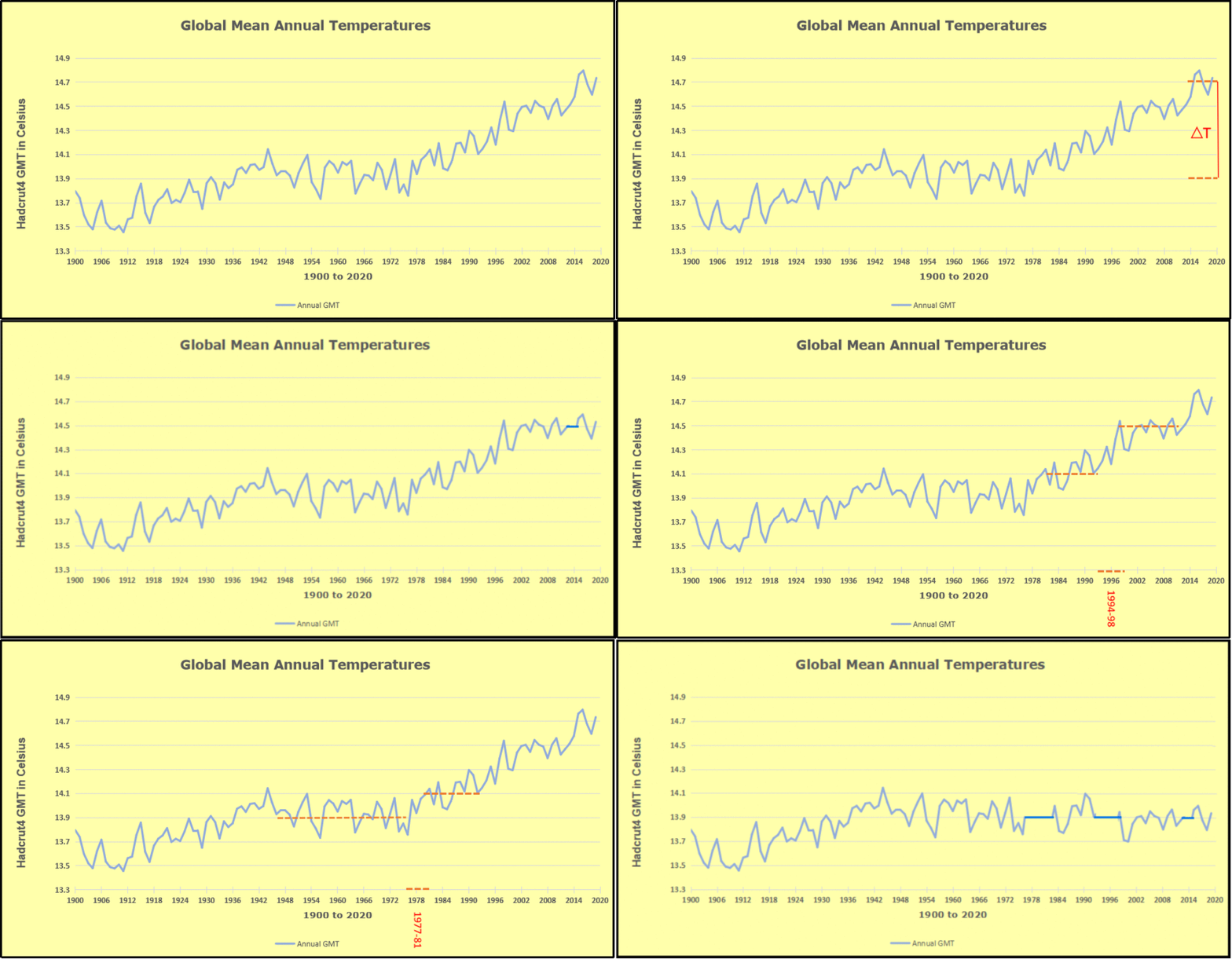
Furthermore, going back to previous warmings prior to the satellite record shows that the entire rise of 0.8C since 1947 is due to oceanic, not human activity.

gmt-warming-events

The animation is an update of a previous analysis from Dr. Murry Salby.  These graphs use Hadcrut4 and include the 2016 El Nino warming event.  The exhibit shows since 1947 GMT warmed by 0.8 C, from 13.9 to 14.7, as estimated by Hadcrut4.  This resulted from three natural warming events involving ocean cycles. The most recent rise 2013-16 lifted temperatures by 0.2C.  Previously the 1997-98 El Nino produced a plateau increase of 0.4C.  Before that, a rise from 1977-81 added 0.2C to start the warming since 1947.

Importantly, the theory of human-caused global warming asserts that increasing CO2 in the atmosphere changes the baseline and causes systemic warming in our climate.  On the contrary, all of the warming since 1947 was episodic, coming from three brief events associated with oceanic cycles. 

Update August 3, 2021

Chris Schoeneveld has produced a similar graph to the animation above, with a temperature series combining HadCRUT4 and UAH6. H/T WUWT

image-8


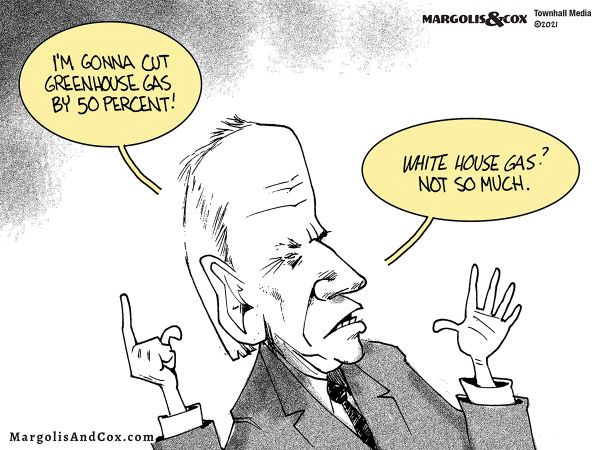
mc_wh_gas_web20210423124932

See Also Worst Threat: Greenhouse Gas or Quiet Sun?

January Update  Cooler Land and Sea 

banner-blog

With apologies to Paul Revere, this post is on the lookout for cooler weather with an eye on both the Land and the Sea.  While you will hear a lot about 2020-21 temperatures matching 2016 as the highest ever, that spin ignores how fast the cooling set in.  The UAH data analyzed below shows that warming from the last El Nino was fully dissipated with chilly temperatures in all regions. After a warming blip in 2022, land and ocean temps dropped again with 2023 starting below the mean since 1995.

UAH has updated their tlt (temperatures in lower troposphere) dataset for January 2023. Posts on their reading of ocean air temps this month came ahead of updated records from HadSST4.  I have previously posted on SSTs using HadSST4 Ocean Temps Dropping November 2022 This month also has aO separate graph of land air temps because the comparisons and contrasts are interesting as we contemplate possible cooling in coming months and years. Sometimes air temps over land diverge from ocean air changes.  However, in January temps in all land and ocean regions dropped sharply.

Note:  UAH has shifted their baseline from 1981-2010 to 1991-2020 beginning with January 2021.  In the charts below, the trends and fluctuations remain the same but the anomaly values change with the baseline reference shift.

Presently sea surface temperatures (SST) are the best available indicator of heat content gained or lost from earth’s climate system.  Enthalpy is the thermodynamic term for total heat content in a system, and humidity differences in air parcels affect enthalpy.  Measuring water temperature directly avoids distorted impressions from air measurements.  In addition, ocean covers 71% of the planet surface and thus dominates surface temperature estimates.  Eventually we will likely have reliable means of recording water temperatures at depth.

Recently, Dr. Ole Humlum reported from his research that air temperatures lag 2-3 months behind changes in SST.  Thus the cooling oceans now portend cooling land air temperatures to follow.  He also observed that changes in CO2 atmospheric concentrations lag behind SST by 11-12 months.  This latter point is addressed in a previous post Who to Blame for Rising CO2?

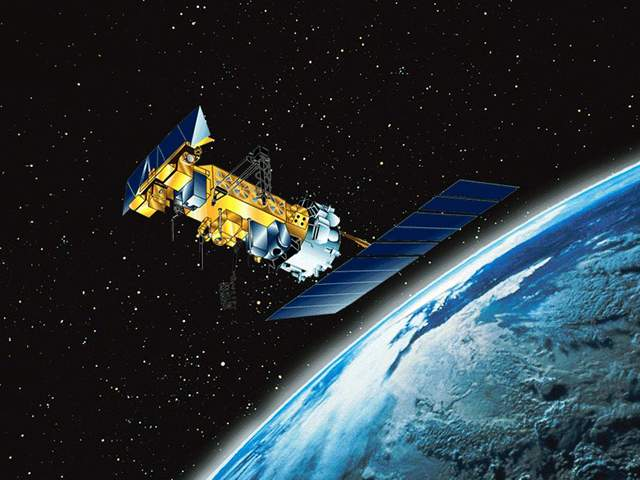
After a change in priorities, updates are now exclusive to HadSST4.  For comparison we can also look at lower troposphere temperatures (TLT) from UAHv6 which are now posted for January.  The temperature record is derived from microwave sounding units (MSU) on board satellites like the one pictured above. Recently there was a change in UAH processing of satellite drift corrections, including dropping one platform which can no longer be corrected. The graphs below are taken from the revised and current dataset.

The UAH dataset includes temperature results for air above the oceans, and thus should be most comparable to the SSTs. There is the additional feature that ocean air temps avoid Urban Heat Islands (UHI).  The graph below shows monthly anomalies for ocean air temps since January 2015.

Note 2020 was warmed mainly by a spike in February in all regions, and secondarily by an October spike in NH alone. In 2021, SH and the Tropics both pulled the Global anomaly down to a new low in April. Then SH and Tropics upward spikes, along with NH warming brought Global temps to a peak in October.  That warmth was gone as November 2021 ocean temps plummeted everywhere. After an upward bump 01/2022 temps reversed and plunged downward in June.  After an upward spike in July, ocean air everywhere cooled in August and also in September.   Now in January 2023, sharp cooling everywhere brought all regions into negative territory. 

Land Air Temperatures Tracking Downward in Seesaw Pattern

We sometimes overlook that in climate temperature records, while the oceans are measured directly with SSTs, land temps are measured only indirectly.  The land temperature records at surface stations sample air temps at 2 meters above ground.  UAH gives tlt anomalies for air over land separately from ocean air temps.  The graph updated for January is below.

Here we have fresh evidence of the greater volatility of the Land temperatures, along with extraordinary departures by SH land.  Land temps are dominated by NH with a 2021 spike in January,  then dropping before rising in the summer to peak in October 2021. As with the ocean air temps, all that was erased in November with a sharp cooling everywhere.  After a summer 2022 NH spike, land temps dropped everywhere, and in January, a NH upward bump offset further cooling in SH and Tropics to leave Global land anomaly unchanged. 

The Bigger Picture UAH Global Since 1980

The chart shows monthly Global anomalies starting 01/1980 to present.  The average monthly anomaly is -0.06, for this period of more than four decades.  The graph shows the 1998 El Nino after which the mean resumed, and again after the smaller 2010 event. The 2016 El Nino matched 1998 peak and in addition NH after effects lasted longer, followed by the NH warming 2019-20.   An upward bump in 2021 was reversed with temps having returned close to the mean as of 2/2022.  March and April brought warmer Global temps, later reversed, and with the sharp drops in Nov., Dec. and now January temps, there is no increase over 1980.

TLTs include mixing above the oceans and probably some influence from nearby more volatile land temps.  Clearly NH and Global land temps have been dropping in a seesaw pattern, nearly 1C lower than the 2016 peak.  Since the ocean has 1000 times the heat capacity as the atmosphere, that cooling is a significant driving force.  TLT measures started the recent cooling later than SSTs from HadSST3, but are now showing the same pattern.  It seems obvious that despite the three El Ninos, their warming has not persisted, and without them it would probably have cooled since 1995.  Of course, the future has not yet been written.


Climate Critical Intelligence Q & A


H/T David Wojick and CFACT

Doctors for Disaster Preparedness are concerned to be ready for real disasters and not be distracted by irrational fears like global warming/climate change. They have provided a useful resource for people to test and deepen their knowledge of an issue distorted for many people by loads of misinformation and exaggerations.

From David Wojick:

A new lesson set called the Climate Change IQ (CCIQ) provides a good skeptical critique of ten top alarmist claims. The format is succinct and non-technical. Each alarmist claim is posed as a question, followed by a short skeptical answer, which is highlighted with a single telling graphic.

Then there is a link to a somewhat longer answer, which in turn includes links to a few online sources of more information. Each lesson is also available in a printable PDF version, suitable for classroom use. This compact format is potentially very useful.

CCIQ comes from a long-standing skeptical group called the Doctors for Disaster Preparedness (DDP). Despite the name, DDP gives attention to pointing out scares that are not disasters waiting to happen. Not surprisingly climate alarmism gets a lot of this attention.

The ten topic questions are wide ranging, including the following. Each speaks to a popular pro-alarmist news hook.

Is climate change the most urgent global health threat?

Are government-sponsored climate scientists the only credible sources of information relating to climate-change policy?

Is the increase in atmospheric CO2 making wildfires worse?

Why can’t all States emulate California’s proposed “clean” energy standards?

What would happen if atmospheric CO2 concentration dropped by half, say to less than 200 ppm?

Are human CO2 emissions acidifying the oceans and endangering shell-making animals?

Will Manhattan and Florida soon be under water if humans do not curtail use of “fossil fuels”?

Do 97% of climate scientists agree that catastrophic climate change will result if humans do not curtail use of “fossil fuels”? (This one includes the dynamite John Christy graph showing the rapidly growing divergence of climate model global temperature forecasts with real world observations.)

Is Arctic ice disappearing?

And the number 1 CCIQ question: Would lowering atmospheric CO2 prevent or mitigate hurricanes?

Note:  Each question title links to a pdf with a longer answer and references. Question 1 link is in red above as an example.  See the CCIQ questionnaire for links to all 10 pdfs

Check it out. Inquiring minds want to know.

Footnote:

“The reason some of us are skeptical about man-made global warming, or climate change, isn’t that we’re in “denial” or the pay of Big Oil. It’s the alarmists’ long run of lurid failed predictions. The models “run hot.” Arctic ice hasn’t vanished. The coral hasn’t died. We haven’t been overrun by rats and super-itchy poison ivy.”  John Robson National Post Canada

Testimonial: No Climate Emergency

Recently OAN’s Stella Escobedo interviewed Dr. Matthew Weilicki concerning his joining the declaration against any climate “emergency.”  The video can be accessed by clicking on the red link above.  Below I provide a transcript with my bolds along with some exhibits. SE refers to Stella Escobedo and MW to Matthew Weilicki

SE:  Well, you have probably heard that climate change is an existential threat and we need to do something about it right away. The World Economic Forum was just held in Davos, Switzerland, with discussions of the climate crisis front and center. Biden has persuade Democrats in Congress to provide hundreds of billions of dollars to fight climate change.

But there are hundreds of scientists around the world who say there is no climate emergency. In fact, they have signed the World Climate Declaration. And one of the biggest things they say is climate science should be less political. And I’d like to welcome to the show Dr. Matthew Weilicki. He’s currently a professor in the Department of Geological Sciences at the University of Alabama. Dr. Weilicki., thank you so much for joining us.

MW: Thank you. Thank you for having me.

SE: Of course..So before we get started, Dr. Weilicki, I want you to tell our viewers a little bit about your educational background and why you’re educated enough to to have this conversation and to talk about this topic.

MW:  Yes, absolutely. So my original bachelor’s degree is actually biochemistry and cellular biology. I worked in four novel vaccine companies for them through my original degree, and I went on to kind of shift gears and I went and got a Ph.D. in geochemistry from UCLA. And because I don’t really work in climate science per se, and I also don’t work in oil and gas exploration, I am an Earth scientist that uses a lot of the same tools that both of these types of fields will use. But I felt that I could take an objective look in and offer my expert opinion without really having any kind of, you know, any sort of motivation on either side. And I thought that would allow me to take an objective view. But the background that I have is very similar to the way that we try to identify what the climate looked like in the past, which is mainly through geochemistry.

SE: So, Dr. Weilicki, you are one of more than a thousand scientists who have signed this petition that says there is no climate emergency. Explain why you say that.

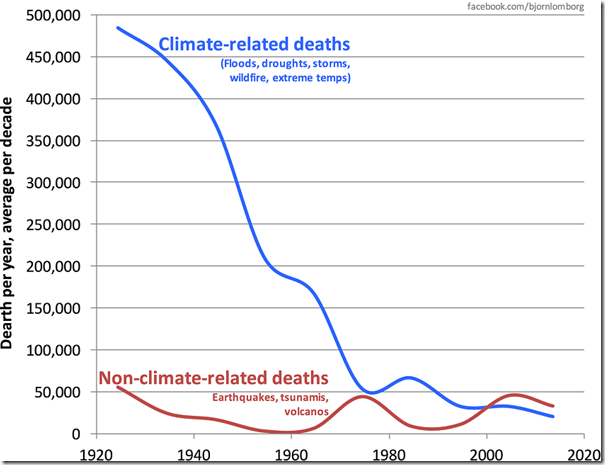
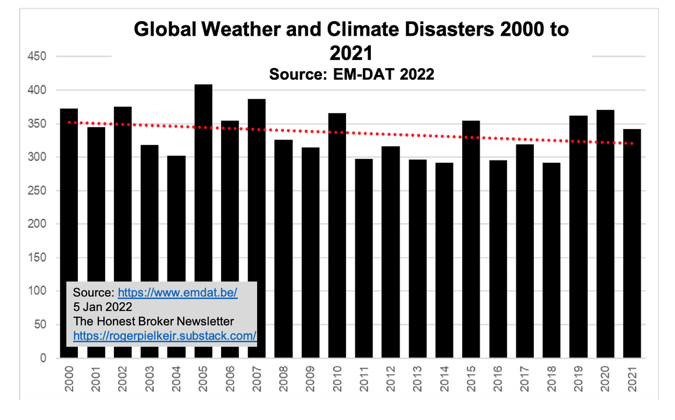
MW:  I think if we take an objective look at the data, it’s very difficult to see any metric that would allow us to explain the state of the climate as in an emergency or in a crisis, as you commonly hear. If we look at, for example, human lives lost from natural disasters, I ask my students this all the time and they are convinced that there has been significantly more lives being lost in natural disasters today than over the last hundred years. Let’s say that number has decreased by something like 97%.

Source: Bjorn Lomborg

And so it’s clear. And the graphic you’re showing now, another question that I ask is how often are how many natural disasters are occurring? And so these students are usually freshmen and sophomores and things like that. And I ask them these questions about about the state of the climate. And I’m noticing that they have the exact wrong view of what’s happening. They’re convinced that more people are dying, more disasters are happening. And if you look at the empirical evidence, the data just doesn’t support that claim. And I think that the mental health effects are really damaging to these young people.

Source: Roger Pielke, Jr.

SE: Well, any time we do have massive flooding, heat waves or wildfires, as you just mentioned, we’re constantly being told it is climate change. Even the World Meteorological Organization has legitimized it. What are your thoughts on that?

MW: This is really part of the problem. This is this is why I blame these organizations. I don’t blame these young people for for believing this. I think if I was in my twenties, I would probably believe that the world is in catastrophe mode. But, you know, these these constant catastrophizing of weather events, weather is not climate. And to to harp and to take advantage of every extreme event to try to push your narrative is so disingenuous.

And these are smart people. They know that weather is not climate. Climate is very different. We’re talking about long term trends and variability in weather patterns and to try to catastrophize a single flood or a single hurricane and make the claim that if we didn’t burn fossil fuels or if we lowered atmospheric greenhouse gas emissions, somehow the flood wouldn’t have occurred or the hurricane wouldn’t have occurred. That is absurd. We know in the geologic record that these events happen. Sometimes they happen worse more than other times. But these happen. This is not has nothing to do with the amount of atmospheric greenhouse gas in the atmosphere.  This is a much larger issue.

And to suggest that we wouldn’t have extreme weather if we could just change
one trace gas in the atmosphere is absolutely not scientific.

SE: Well, you have so many smart people like yourself who are speaking up saying there is no climate emergency. And yet do you feel like people like yourself are getting any real attention? In fact, many scientists get defunded for speaking out, get called climate deniers. How do you respond to that?

MW:  Yes, absolutely. I think that’s such a it’s such a derogatory term. It’s. Clearly trying to link people that are skeptical about climate and making questions about science with Holocaust deniers. I was born in Poland, just a few hours from the gates of Auschwitz. I lost many family members in the Holocaust. To try to link me because I have questions about science to denying the Holocaust is absolutely disingenuous. It’s an ad hominem attack because people realize that the empirical evidence doesn’t support what they’re saying and how catastrophize they’re trying to make the climate and such. They don’t want to discuss the actual data, so they’d rather label you a name and try to deplatform you or defund you. And, you know, I find it to be a very disingenuous way of having a scientific discussion.

SE: You know, just a few days ago, you announced you’re leaving the university and a post on Twitter. I saw you say some of it is personal family related. But you also mentioned it’s no longer a place that embraces freedom of exchanging ideas. Can you elaborate?

MW:  Yes. My life dream was to be a professor. My father was a professor ever since I was about 12 years old. And we made a pretty big sacrifice by moving from all of our families in California. We moved to Alabama because I really wanted to pursue this career, and I really started to realize pretty quickly that it wasn’t the way that my father remembered it. And when we would have discussions and this rise of illiberalism, that’s what I like to call it, this idea, these ideological ideas, the fact that there are certain things that are undiscussed that you can’t discuss.

What I was talking about was DEI, diversity, equity and inclusion.
And even having a discussion about this is very similar to climate.

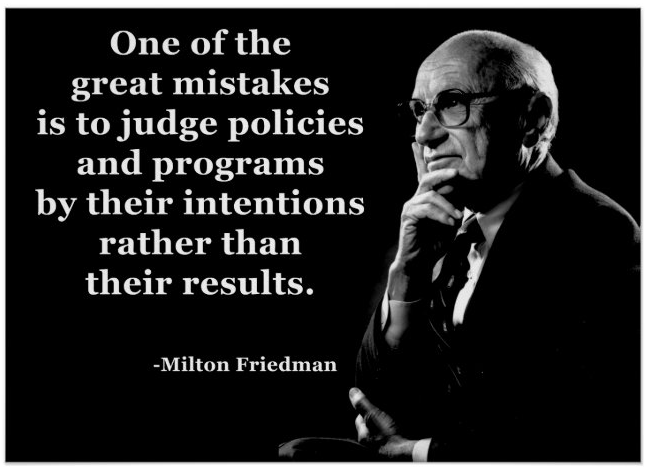
If you just want to look and investigate whether something that’s probably has good intentions like inclusivity. I understand it’s a noble cause, but if we don’t look at the outcomes, it’s very difficult to figure out whether this is having the intent that we want. And I started to realize that just speaking out about some of these things was really enough to get you labeled, you know, a certain degree bigotry term, whichever one it is, a denier or sometimes even a racist, because you’re having questions about the outcomes of some of these diversity equity inclusion policies.

And it was clear to me once I made my my Twitter thread, I was attacked by faculty members from all over the place, even UA, calling me a racist. They tried to link me to some anti-Semitic writings that happened on the sidewalk somewhere on campus. It just made it prove to me very clearly that if you have genuine questions and you see negative impacts on students, even bringing that up is, is is, you know, paradigm to being a heretic and you get ostracized and people call you out. And so that’s definitely one of the reasons that made it easier for me to start walking away from from this profession.

SE: Well, you’re not alone. And it’s unfortunate that this is happening. It’s happening in your industry. It’s happening to parents who are speaking out, you know, for their children in schools. So it’s unfortunate. But I do hope that this doesn’t push smart people like you completely out of science. Dr. Weiliki, thank you so much for being here.

Dr. Matthew M. Weilicki Homepage

Footnote:


Background   

Click to access WCD-version-100122.pdf


Feb. 1, 2023 Arctic Ice Lagging in Bering and Barents

In January, most of the Arctic ocean basins are frozen over, and so the growth of ice extent slows down.  According to MASIE January on average adds 1.255M km2, and this year it was 1.205M.  However, February started with a deficit of  246k km2 under the 17 year average.  The few basins that can grow ice this time of year tend to fluctuate and alternate waxing and waning, which appears as a see saw pattern in these images.

The last two weeks of January 2023 Arctic ice extents waffled with little growth, resulting in a deficit to average of 385k km2, or ~3% of total NH ice extent. The graph below shows the ice recovery for January  2023, the 17-year average and several recent years.

The graph (cyan) shows end of January 2023 a 385k km2 deficit to average, with little accumulation since Jan. 18.  2023 is comparable to 2021, and slightly higher than 2018.  SII (Sea Ice Index) dropped well below MASIE this month showing 327k km2 lower extent than MASIE yesterday.

January Ice Growth Despite See Saws in Atlantic and Pacific

As noted above, this time of year the Arctic adds ice on the fringes since the central basins are already frozen over.  The animation above shows the Okhotsk (upper left) and Bering (lower left) see saw.  Okhotsk doubled its extent to reach 95% of its last maximum, while Bering waffled up and down, ending the month ~100k km2 higher and 62% of its max.

On the right, Atlantic side Barents at the top fluctuated and added `150k km2, ending at 49% of its max.  On the lower right, Baffin Bay, and Greenland Sea (center right) show another see saw.  Greenland Sea waffled with little extent added, remaining at 89% of max, while Baffin Bay steadily added 370k km2 to reach 70% of maximum.

The table below presents ice extents in the Arctic regions for day 31 (Jan. 31) compared to the 17 year average and 2018.

Region 2023031 Day 31 Average 2023-Ave. 2018031 2023-2018
 (0) Northern_Hemisphere 13996981 14382814 -385833 13792271 204710
 (1) Beaufort_Sea 1070966 1070313 654 1070445 521
 (2) Chukchi_Sea 966006 965970 36 965971 35
 (3) East_Siberian_Sea 1087137 1087054 83 1087120 18
 (4) Laptev_Sea 897845 897821 23 897845 0
 (5) Kara_Sea 926860 918191 8668 895363 31497
 (6) Barents_Sea 390711 580354 -189643 481947 -91236
 (7) Greenland_Sea 687900 602566 85334 501411 186490
 (8) Baffin_Bay_Gulf_of_St._Lawrence 1267760 1335679 -67919 1406903 -139142
 (9) Canadian_Archipelago 854843 853342 1501 853109 1734
 (10) Hudson_Bay 1260903 1260762 141 1260838 66
 (11) Central_Arctic 3192568 3211378 -18810 3184817 7751
 (12) Bering_Sea 521005 655768 -134763 382207 138798
 (13) Baltic_Sea 33096 64178 -31083 41714 -8618
(14) Sea_of_Okhotsk 806160 819543 -13383 704398 101762

The table shows that most of the deficit to average (2.7%) appears in Bering and Barents seas, with smaller deficits in Baffin Bay and Okhotsk.  These four peripheral regions are the only remaining regions with additional ice extent to add.

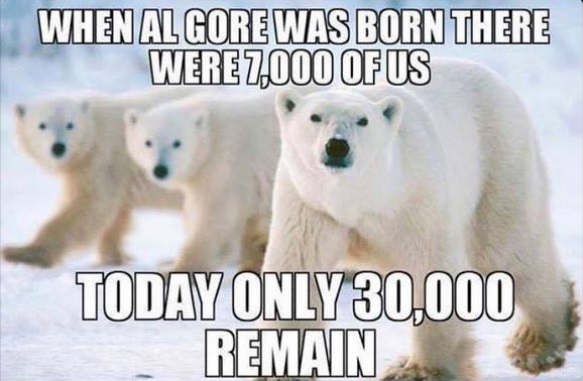
The polar bears have a Valentine Day’s wish for Arctic Ice.

welovearcticicefinal

And Arctic Ice loves them back, returning every year so the bears can roam and hunt for seals.

Footnote:

Seesaw accurately describes Arctic ice in another sense:  The ice we see now is not the same ice we saw previously.  It is better to think of the Arctic as an ice blender than as an ice cap, explained in the post The Great Arctic Ice Exchange.

“Sustainability, Inclusiveness” Is Nanny State Dictating to Business

Matthew Lau explains at Financial Post Forget ‘sustainable and inclusive’: Get back to profit.  Excerpts in italics with my bolds and added images

Business community must re-focus its efforts on fulfilling
its real social responsibility: increasing profits

“Sustainable and inclusive growth,” like “corporate social responsibility,” is a loaded phrase. Both are based on subversive policies and ideas, but because nobody wants to be accused of supporting un-sustainability or corporate social ir-responsibility they often go unopposed.

That’s a mistake: both badly need opposing.

Just as preachers of corporate social responsibility advocate a form of socialism, those calling for “sustainable and inclusive” economic growth are proposing government economic planning. When activists say “sustainable and inclusive growth” what they really mean is that they, through the government intervention they invariably recommend, should dictate where economic growth takes place, in which sectors and for whose benefit.

It should surprise no one that the federal government splashes buzzwords like “sustainability” and “inclusiveness” all over its communications in trying to sell its inordinately expensive, not to mention dumb, economic programs to the voting public. It is more difficult to understand why the business community follows the government’s lead in advocating central economic planning and masking it behind “sustainability,” “inclusiveness” and other slick marketing words.

One reason for this unfortunate tendency of the business community may be that government expansion into business has completely blurred the lines between the two. Nor does it help that many business leaders come from government and bring with them far too rosy views of government economic planning instead of — as would be far more appropriate — a clear understanding of the tendency of government officials to act in their own rather than the public interest, the undisciplined wastefulness and inefficiency of government programs and the fatal conceit of top-down economic organization.

Two such business leaders are former federal cabinet ministers Anne McLellan (Liberal) and Lisa Raitt (Conservative), who now co-chair the Coalition for a Better Future. The coalition, which today includes 142 of Canada’s most influential business groups, industry associations, think tanks, and non-profits, was formed in 2021 with the goal of “a more inclusive, sustainable, and prosperous Canada.” Their ordering of the adjectives is telling: “prosperous” comes last. Also telling is Raitt’s declaration that business, government, and community and Indigenous voices must build “a shared economic vision” to achieve this Canada.

Widespread and sustainable economic growth does not come from consolidating
business and government visions, plans, interests and objectives.

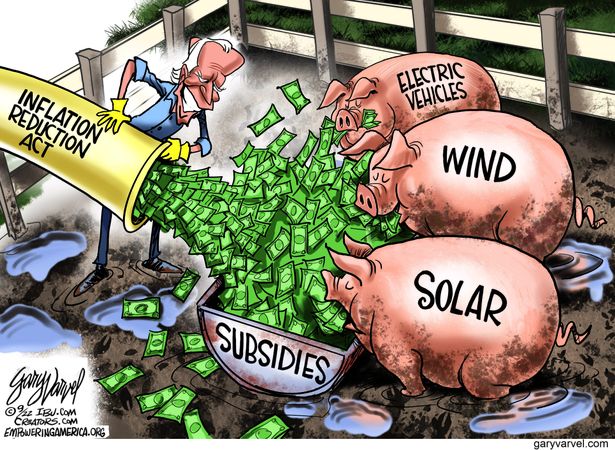
The Coalition for a Better Future, McLellan and Raitt recently wrote in the FP, “believes any growth agenda needs to be inclusive and environmentally sustainable in order to be viable.” After correctly identifying the dearth of private-sector investment as one reason for lagging productivity and growth, they go on to propose alarmingly bad solutions. They call Joe Biden’s misleadingly-named Inflation Reduction Act (US $499 billion in government spending, of which $391 billion is on climate change) a “welcome impetus to global climate transition efforts” that is “already siphoning Canadian capital south of the border,” suggesting their preferred way to increase growth and capital investment is for government to sink many tens or even hundreds of billions of dollars more into the global warming project.

Government economic plans should also, according to McLellan and Raitt, include “enabling and incentivizing business to deliver on big projects in key sectors such as critical minerals, clean energy and green manufacturing.” But government dictating which sectors should receive “incentives” invariably directs capital from economically productive uses to relatively unproductive but politically favoured uses — these days, anything involved in “sustainability.” The push for government-guided “inclusiveness” is similarly bad. When people with political power get to decide whom to include as beneficiaries of government-granted economic privilege and benefits, the greatest privilege and benefits invariably flow to … people with political power. This is not a sensible way to help those at the bottom of society.

If there is to be any real productivity growth or economic improvement in Canada, the business community must re-focus its efforts on fulfilling its real social responsibility — increasing profits — and reject government preaching about supposedly “sustainable and inclusive” matters that are in fact mostly unsustainable and economically destructive.

How Well is Government Doing Directing the Canadian Economy?

What’s driving this? A previous blog explained how growth in real per capita GDP is the sum of: (a) growth in output per hour worked (“labour productivity”) and (b) growth in hours worked per head of population (“labour utilisation”). Of the two components, productivity growth is the more important determinant of future living standards because it is limited only by the pace of technological change and the ability of businesses and workers to adapt to it. In contrast, labour utilisation growth has a natural ceiling based on demographics, labour force participation, and there being only so many hours people can or will work per year.

The OECD finds that Canada’s prospects for real per capita GDP growth over 2020-2030 are poor because of feeble expected growth in output per hour worked (labour productivity, see Figure 1b) and a slight drag from hours worked per head of population (labour utilization, see Figure 1c).

Source:  Business Council of British Columbia  OECD predicts Canada will be the worst performing advanced economy over the next decade…and the three decades after that