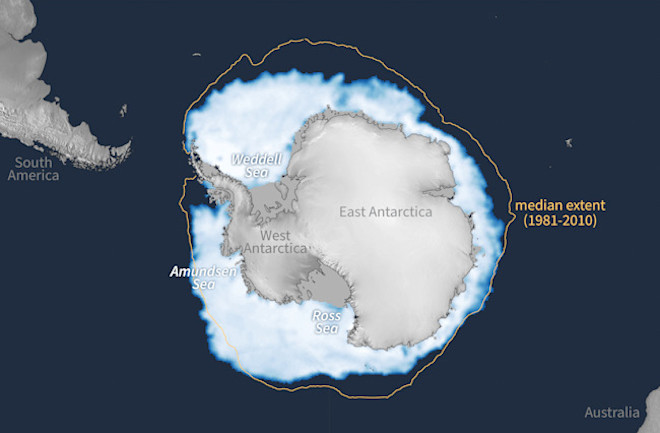
Antarctic sea ice concentration on June 27, 2023, with white representing solid ice and dark blue representing open ocean. The median ice edge for 1981–2010 is drawn in orange. (Credit: Map by NOAA Climate.gov, based on data from the National Snow and Ice Data Center)
One of the more measured current reports of Antarctic sea ice is at Discover Antarctic Sea Ice Reaches a “Record-Smashing Low”. Excerpts in italics with my bolds.
The sea ice extent is nearly a million square miles
below the long-term average for late June.
Some scientists believe that what we’ve seen since 2022 may be signaling a significant and potentially long-lasting change. As Ted Maksym, a climate scientist and polar oceanographer at the Woods Hole Oceanographic Institution, put it in a recent story in Wired:
“Now there’s this question about: Have we got into a regime shift? A few of us are sort of speculating that that may be true, where the variability in Antarctic sea ice has changed and we might see these low sea ice extents for some time.”
But Maksym also says he and his colleagues are “watching with bated breath” to see if things will return to normal — and they could. Scientists just don’t know.
That’s because the Antarctic is a very different environment than the Arctic — in a way that complicates drawing firm conclusions. The latter consists of an ocean surrounded by land, whereas the former is a giant landmass surrounded by oceans.
Sea ice around Antarctica is affected by a host of complex factors,
including shifts in ocean currents and sea and air temperatures.
Given how remote, forbidding and large Antarctica is, observations of these factors have been relatively sparse. Moreover, the record of satellite observations of sea ice dates only to 1979, making it difficult to separate out a human-caused signal from natural variability. And the sparseness of data, and the complexity of myriad factors, have made modeling of Antarctic sea ice very challenging.
Bottom line: Scientists haven’t seen anything like what’s been happening to Antarctic sea ice in the past two years. But it will take time to know whether a dramatic shift truly has occurred, and more research to tease out the role of anthropogenic climate change in what’s happening.
Background Annual Cycle of Antarctic Sea Ice

Firstly, the annual minimum average is ~2.5 M km2 vs. an average maximum of ~17.5 M km2. So the sea ice extent each year nearly disappears. Secondly, since 2010, some years were well above the 1981-2010 average, and obviously there were likely many prior years below average. Which suggests this may be a return to the mean, or not, as the experts say.
Previously, Antarctic Sea Ice Grew Steadily
Robot Sub Finds Surprisingly Thick Antarctic Sea Ice Nov. 24, 2014
Antarctica’s ice paradox has yet another puzzling layer. Not only is the amount of sea ice increasing each year, but an underwater robot now shows the ice is also much thicker than was previously thought, a new study reports.
The discovery adds to the ongoing mystery of Antarctica’s expanding sea ice. According to climate models, the region’s sea ice should be shrinking each year because of global warming. Instead, satellite observations show the ice is expanding, and the continent’s sea ice has set new records for the past three winters. At the same time, Antarctica’s ice sheet (the glacial ice on land) is melting and retreating.
Measuring sea ice thickness is a crucial step in understanding what’s driving the growth of sea ice, said study co-author Ted Maksym, an oceanographer at the Woods Hole Oceanographic Institution in Massachusetts. Climate scientists need to know if the sea ice expansion also includes underwater thickening.
“If we don’t know how much ice is there is, we can’t validate the models we use to understand the global climate,” Maksym told Live Science. “It looks like there are significant areas of thick ice that are probably not accounted for.”

The Antarctic sunlight illuminates the surface of the sea ice, intensifying the effect of the fracture lines, Oct. 2003. (NSIDC, University of Colorado)
Theory: Climate Change Increases Antarctic Sea Ice Extent
From AP Oct. 10, 2012 Increase in Antarctic ice may be sign of climate change. Excerpts in italics with my bolds.
While the Arctic is open ocean encircled by land, the Antarctic — about 1.5 times the size of the U.S. — is land circled by ocean, leaving more room for sea ice to spread. That geography makes a dramatic difference in the two polar climates.
The Arctic ice responds more directly to warmth. In the Antarctic, the main driver is wind, Maksym and other scientists say. Changes in the strength and motion of winds are now pushing the ice farther north, extending its reach.
Those changes in wind are tied in a complicated way to climate change from greenhouse gases, Maksym and Scambos say. Climate change has created essentially a wall of wind that keeps cool weather bottled up in Antarctica, NASA’s Abdalati says.
And the wind works in combination with the ozone hole, the huge gap in Earth’s protective ozone layer that usually appears over the South Pole. It’s bigger than North America.
It’s caused by man-made pollutants chlorine and bromine, which are different from the fossil fuel emissions that cause global warming. The hole makes Antarctica even cooler this time of year because the ozone layer usually absorbs solar radiation, working like a blanket to keep the Earth warm.
And that cooling effect makes the winds near the ground stronger and steadier,
pushing the ice outward, Scambos says.
University of Colorado researcher Katherine Leonard, who is on board the ship with Maksym, says in an email that the Antarctic sea ice is also getting snowier because climate change has allowed the air to carry more moisture.
Does Sea Ice Growth or Decline Negate or Confirm Climate Change? No.
From LA Times August 29, 2014 Does Antarctic sea ice growth negate climate change? Scientists say no. Excerpts in italics with my bolds.
This year, Antarctic sea ice has expanded its frigid reach with unprecedented speed, setting records in June and July. By the time spring punctures the long Antarctic night, 2014 stands a decent chance of topping 2012 and 2013, which each broke records of maximum total ice extent.
In fact, since scientists started making satellite observations in the late 1970s, they have watched winter sea ice around Antarctica swell slowly but indisputably, despite predictions that it should shrink.
This poses a puzzle that climate scientists struggle to explain:
How can sea ice grow in a warming world?
Climate skeptics have pounced on this apparent discrepancy, citing it as proof that climate change isn’t real, or at least that scientists don’t completely understand it. But those who study Antarctic sea ice say their curious observations shouldn’t shake anyone’s confidence. Dramatic changes in temperature, sea level and extreme weather around the world are proof enough the planet is warming, they say; the only question is how these changes affect the Antarctic as they ripple through the climate system.
“Climate is a complicated thing,” said Ted Maksym, an oceanographer at the Woods Hole Oceanographic Institute in Massachusetts. “Understanding how these kinds of changes play out in different regions is tricky business.”
The westerly winds blow fierce and constant around Antarctica, isolating the continent in a kind of permanent polar vortex. Scientists think they exert the most direct control over the state of Antarctic sea ice.
Ice requires cold temperatures to form, and winds help it grow by blowing it around the polar ocean. When the ice moves, new water is exposed to the chilly air, creating an opportunity to make more ice.
But it’s not quite as simple as more wind, more ice.
“It makes no sense to talk about a circumpolar average,” Stammerjohn said. “There’s so much regional variability.”
The Ross Sea, which faces New Zealand, has seen a dramatic increase in peak ice extent and 80 more days of ice cover since 1979, when satellites began tracking changes. But along the Antarctic Peninsula, which stretches toward the tip of South America, the ice-covered season in the Bellingshausen Sea is three months shorter than it was 35 years ago.
Scientists say sea ice and continental ice are probably responding to the same forces — namely, changes in ocean circulation and winds. However, they also influence each other. Sea ice helps buffer ice shelves, the floating tongues of glacial ice that dam the ice sheets and keep them from spilling irreversibly into the sea. It also keeps warm ocean waters trapped beneath a frozen lid, insulating the ice sheet from their destructive heat.
In the long run, however, scientists expect Antarctic sea ice to decline everywhere.
That it hasn’t done so yet suggests there’s still much to learn about the region.

Antarctic Sea Ice Grows to All-Time Record High: NSIDC October 09, 2014
 Science Matters
Reblogged this on Climate Collections.
LikeLike