US Justice On Display


















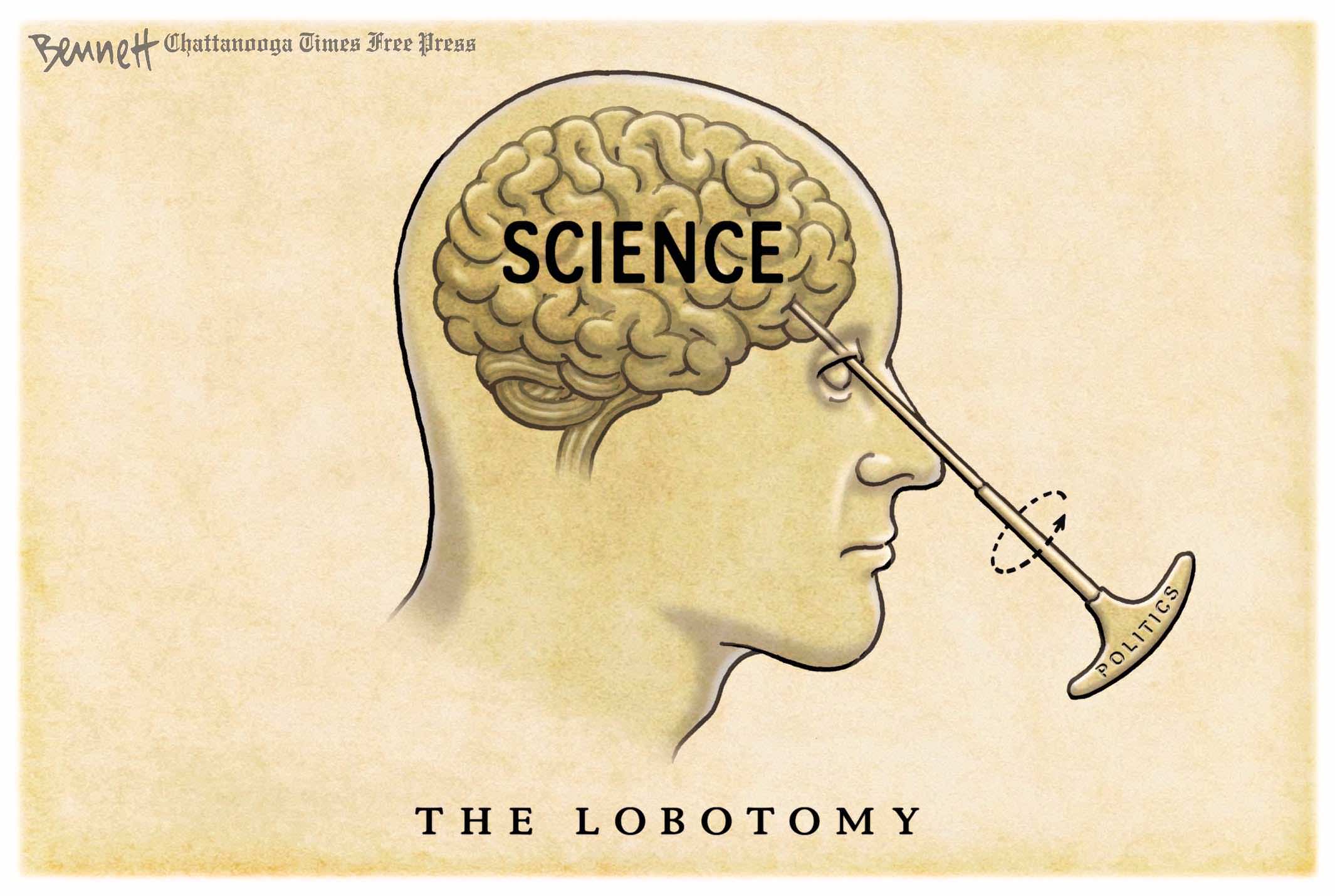
John Ray posted on his blog an update of climatists power play against scientific facts contrary to their beliefs. The saga is about the Alimonte et al. (2022) analysis of extreme weather events and the lack of evidence to attribute them to global warming. In italics with my bolds Ray’s post is:
The very gradual process of global warming that we have seen so far has produced no direct ill-effects that we can see. Crops are more abundant than ever and some Pacific islands are growing rather than shrinking. So “extreme events” are the last refuge of the warmists. Bad weather generally is routinely branded as an extreme event and is attributed to global warming without any shred of evidence for the link.
Any causal statement requires controls.
You have to show that the “caused” event would not have happened without the “cause” specified. But that would require you to show what would have happened WITHOUT global warming — and that is impossible.
Single events might or might not be due to some influence or other but you have no way of showing what the influence was. It is known as the “attribution” problem and is in principle unsolvable where the event is a “one-off”, a hurricane, for instance. You have to have variations in the causal condition to correlate with the alleged caused condition. Would this hurricane have happened in the absence of global warming? We cannot know. We can only surmise. And a surmise is no proof.
So the attribution of individual extreme events to global warming is LOGICALLY false. It CANNOT be shown as be fact. But science is at ease with hypotheses so it remains a hypothesis that COULD be true even if proving it is currently impossible.
And an hypothesis can be tested in various ways. It is commonly tested by asking if it generates accurate predictions. And it could be held as preliminary support for an hypothesis that the incidence of extreme events has systematically increased as the globe has warmed. Is there a correlation? So has it? There are some claims to that effect but how well-founded are they? Have extreme events in fact become more frequent?
A recent study has addressed that hypothesis. They have looked at a big range of reports about extreme events and asked are such events becoming more frequent. For each of a range or event extremes they have gathered published information about whether such events are increasing in frequency over time. An abstract of the report concerned is given below.
It finds no evidence that any extreme event has become more frequent.
So the claimed connections are not only logically false
but they are empirically false too.
The study was published 18 months ago and various climate skeptics have quoted it approvingly. That approval has eventually got under the skin of the Warmists so they have tried to discredit the research concerned. And their antagonism to the paper has borne fruit. The paper was “withdrawn” by its publisher, which counts as evidence that it is faulty.
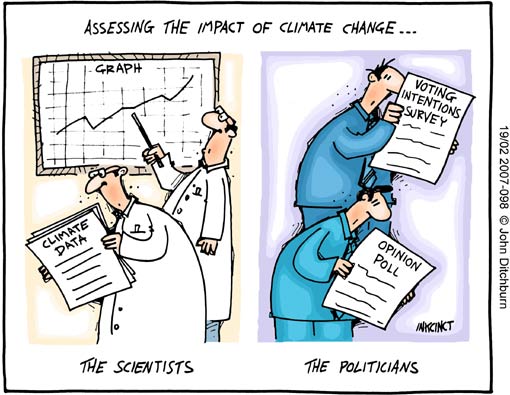 But is it faulty? A much quoted attack on the paper in “The Guardian” lists a whole array of orthododox Warmists who say it is faulty but detailed evidence of the faults is conspicuously missing. No detailed numbers are quoted and the issue is entirely a matter of numbers. The Guardian makes clear that orthodox scientists disagree with the paper but does not give chapter and verse why. Link to The Guardian below:
Note that some of the attacks from Warmists are of the most intellectually discreditable kind: “Ad hominem” attacks — attacking the motives of the authors rather than the evidence they put forward
And that none of the critics quote the detailed numbers is a major scientific fault.
If a scientist disagrees with the conclusions of a particular paper — as I have often done — he goes over the ground covered by the paper and shows where it went wrong. In this case the paper at issue is a meta-analysis so the data behind it is readily available. Its conclusions are readily tested by repeating the meta-analysis in some more cautious way. Nobody seems to have attempted that. “Do better” is the obvious retort to the Warmists but none seem even to have attempted that.

The next link takes you to an extensive discussion of whether the paper deserved withdrawal:
https://rogerpielkejr.substack.com/p/thread-extended-peer-review-of-the/comments
A critical assessment of extreme events trends in times of global warming
Gianluca Alimonti et al.
Abstract
This article reviews recent bibliography on time series of some extreme weather events and related response indicators in order to understand whether an increase in intensity and/or frequency is detectable. The most robust global changes in climate extremes are found in yearly values of heatwaves (number of days, maximum duration and cumulated heat), while global trends in heatwave intensity are not significant. Daily precipitation intensity and extreme precipitation frequency are stationary in the main part of the weather stations. Trend analysis of the time series of tropical cyclones show a substantial temporal invariance and the same is true for tornadoes in the USA. At the same time, the impact of warming on surface wind speed remains unclear. The analysis is then extended to some global response indicators of extreme meteorological events, namely natural disasters, floods, droughts, ecosystem productivity and yields of the four main crops (maize, rice, soybean and wheat). None of these response indicators show a clear positive trend of extreme events. In conclusion on the basis of observational data, the climate crisis that, according to many sources, we are experiencing today, is not evident yet. It would be nevertheless extremely important to define mitigation and adaptation strategies that take into account current trends.

A 2015 study by 22 scientists from around the world found that cold kills over 17 times more people than heat. Thus the planet’s recent modest warming has been saving millions of lives.
Springer website reports the paper retracted August 23, 2023. The article was revised by the authors and published at Environmental Hazards journal on August 3, 2023 as reported at Taylor & Francis online
Is the number of global natural disasters increasing?
We analyze temporal trends in the number of natural disasters reported since 1900 in the Emergency Events Database (EM-DAT) from the Center for Research on the Epidemiology of Disasters (CRED). Visual inspection suggests three distinct phases: first, a linear upward trend to around mid-century followed by rapid growth to the turn of the new century, and thereafter a decreasing trend to 2022. These observations are supported by piecewise regression analyses that identify three breakpoints (1922, 1975, 2002), with the most recent subperiod 2002–2022 characterized by a significant decline in number of events. A similar pattern over time is exhibited by contemporaneous number of geophysical disasters – volcanoes, earthquakes, dry landslides – which, by their nature, are not significantly influenced by climate or anthropogenic factors. We conclude that the patterns observed are largely attributable to progressively better reporting of natural disaster events, with the EM-DAT dataset now regarded as relatively complete since ∼2000. The above result sits in marked contradiction to earlier analyses by two UN bodies (FAO andUNDRR), which predicts an increasing number of natural disasters and impacts in concert with global warming. Our analyses strongly refute this assertion as well as extrapolations published by UNDRR based on this claim.

Fearing a climate emergency without this being supported by data, means altering the framework of priorities with negative effects that could prove deleterious to our ability to face the challenges of the future, squandering natural and human resources in an economically difficult context, even more negative following the COVID emergency. This does not mean we should do nothing about climate change: we should work to minimize our impact on the planet and to minimize air and water pollution.
Whether or not we manage to drastically curtail our carbon dioxide emissions in the coming decades, we need to reduce our vulnerability to extreme weather and climate events. Leaving the baton to our children without burdening them with the anxiety of being in a climate emergency would allow them to face the various problems in place (energy,agricultural-food, health, etc.) with a more objective and constructive spirit, with the goal of arriving at a weighted assessment of the actions to be taken without wasting the limited resources at our disposal in costly and ineffective solutions.
How the climate of the twenty-first century will play out is a topic of deep uncertainty. We need to increase our resiliency to whatever the future climate will present us.We need to remind ourselves that addressing climate change is not an end in itself, and that climate change is not the only problem that the world is facing. The objective should be to improve human well-being in the twenty-first century, while protecting the environmentas much as we can. And it would be a nonsense not to do so: it would be like not taking care of the house where we were born and raised.
Tony Thomas describes the climate scoundrels and their machinations at the Quadrant: How Science is Done These Days
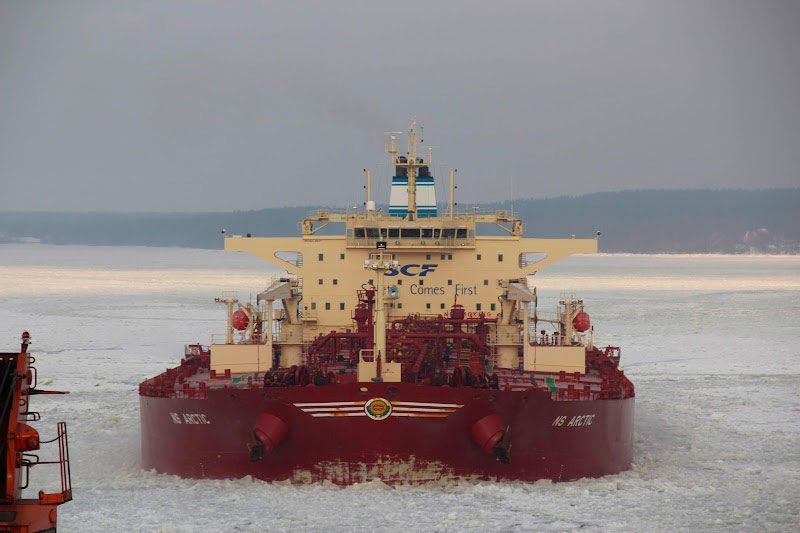
Oil tanker NS Arctic sailing in icy waters. Photo: Dmitry Lobusov, icebreaker captain for Rosatomflot
With the warmer water temperatures in the North Atlantic this summer, we can expect lower Arctic sea ice extents. But maybe not. Barents Observer reports A month after they set out on Arctic voyage, two Russian oil tankers still battle with sea-ice. Excerpts in italics with my bolds.
The ships that are loaded with more than 200,000 tons of oil
might have been surprised by ice pack in the East Siberian Sea.
The Primorsky Prospect and NS Arctic on the 12th and 14th of July respectively set out from St.Petersburg with course for the Chinese ports of Dalian and Rizhao. They were to arrive at destinations by the middle of August. That schedule is now significantly postponed. Shipping data show that the ships will make it to the Chinese ports no earlier than 26th of August.
Although the tankers both have ice classification Arc3, their voyage across the Laptev Sea and East Siberian Sea have been marred with troubles with the sea-ice. For several days, the tankers were at standstill off the New Siberian Islands, and later also in the southern part of the East Siberian Sea.
Nevertheless, the long and icy voyage of the two oil tankers raises new questions about the actual benefits of sailing on the Northern Sea Route, as well as security in the area.
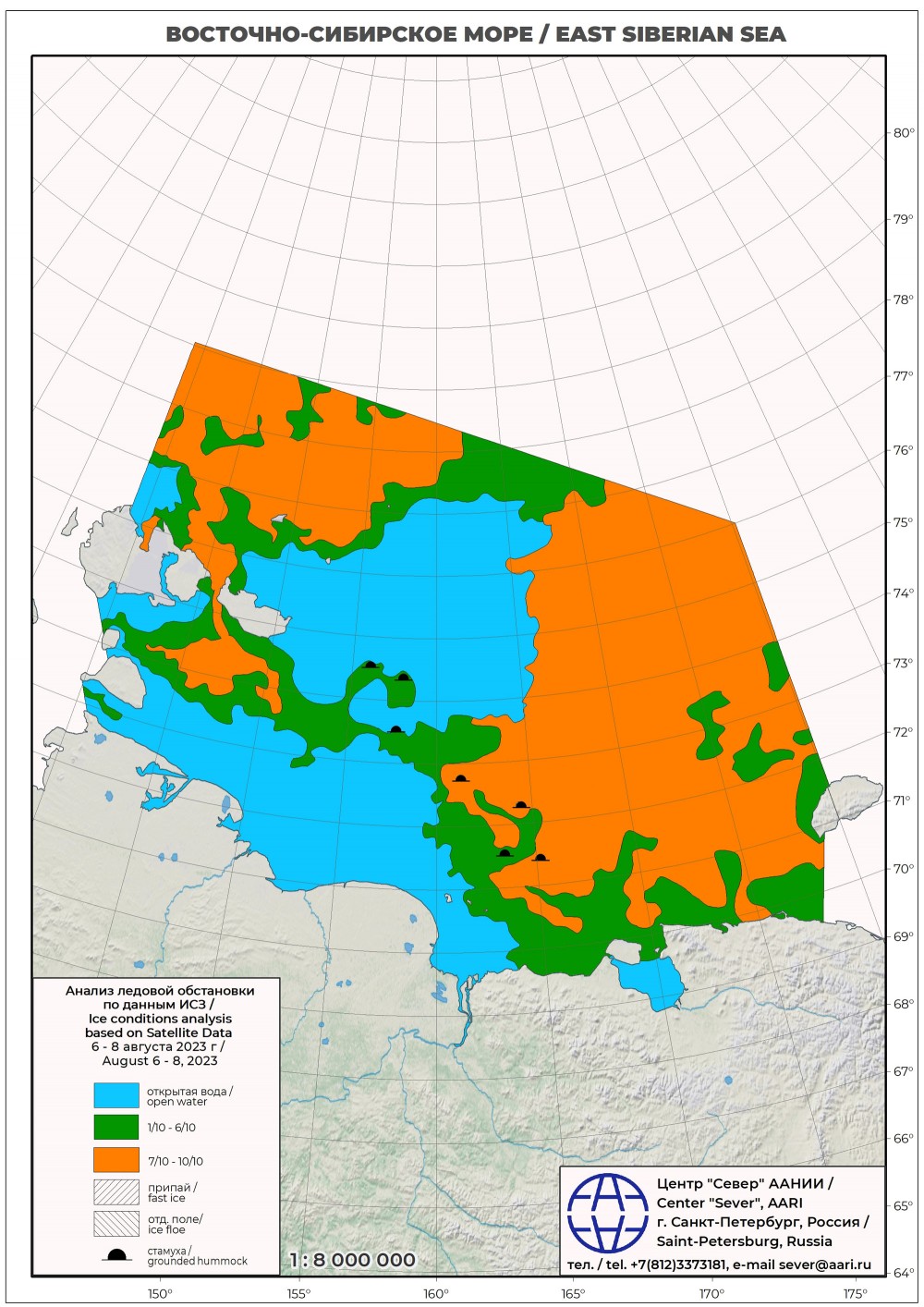
Sea-ice in thee East Siberian Sea in period 6-8th of August 2023. Map by Arctic and Antarctic Research Institute
Both the NS Arctic and Primorsky Prospect have ice classification Arc3, but neither of them have permission to sail independently through the most complex parts of the Northern Sea Route in anything but light ice conditions. Growing parts of the East Siberian Sea are ice-free. But changes can quickly occur in this region and a sudden emergence of ice pack might have taken the ships by surprise.
But in medium ice conditions, the ships are obliged to hire icebreaker escort. It is not clear to what extent the tankers have made it into medium ice conditions. But ice maps from the Russian Arctic and Antarctic Research Institute show that major parts of the East Siberian Sea have a white sheet.
“Perhaps the wind has pushed the ice pack towards the coast, increasing the concentration locally so that there’s no longer continuous green strip along the coast?” an anonymous industry expert says to the Barents Observer.
According to the expert, there appears to be no imminent risk for a dangerous situation.
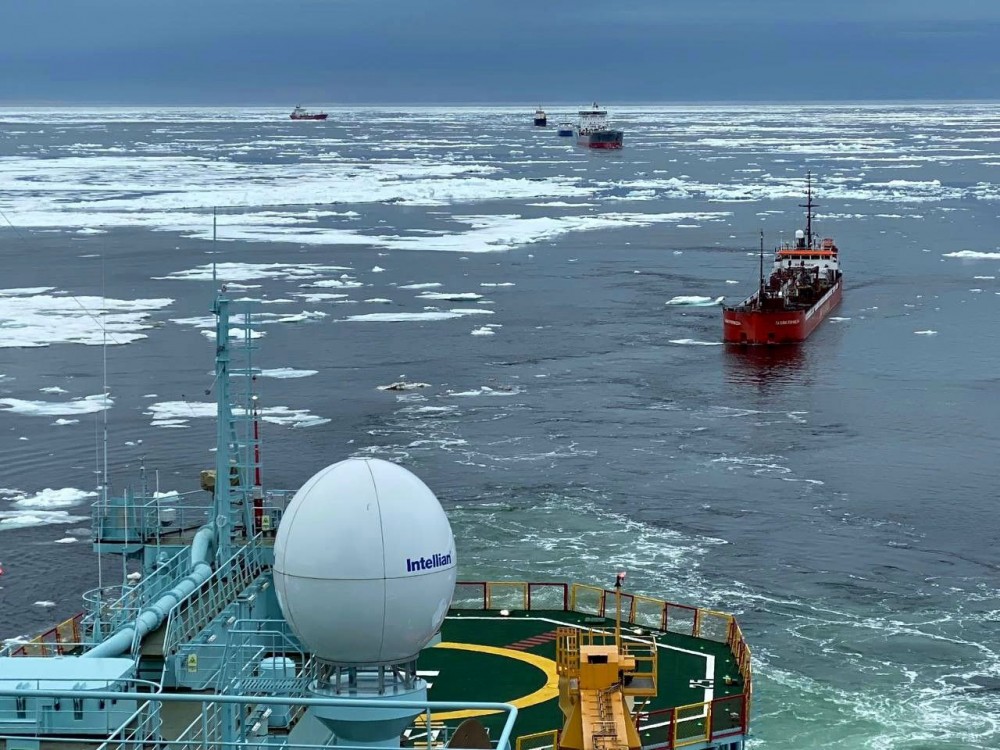
Nuclear icebreaker Sibir escorts ships through the Vilkitsky Strait. Photo: Rosatom/Kirill Razin
One year time lapse of precipitable water (amount of water in the atmosphere)
from Jan 1, 2016 to Dec 31, 2016, as modeled by the GFS.The Pacific
ocean rotates into view just as the tropical cyclone season picks up steam.
Lately the media refers increasingly to how important is the water cycle in our climate system. Unfortunately, as usual, the headlines confuse cause and effect. For example, Climate change has a dramatic impact on the global water cycle, say researchers. from phys.org. How perverse to position climate change as an agent rather than the effect from water fluxes in the ocean and atmosphere. The headline misleads entirely (written by scientists or journos?) as the beginning texts shows (in italics with my bolds).
For Christoph Schär, ETH Zurich’s Professor of Climate and Water Cycle, “global warming” is not quite accurate when it comes to describing the driver of climate change. “A better term would be ‘climate humidification,'” he explains. “Most of the solar energy that reaches the Earth serves to evaporate water and thereby drives the hydrological cycle.” Properly accounting for the implications of this is the most challenging task of all for climate modelers.
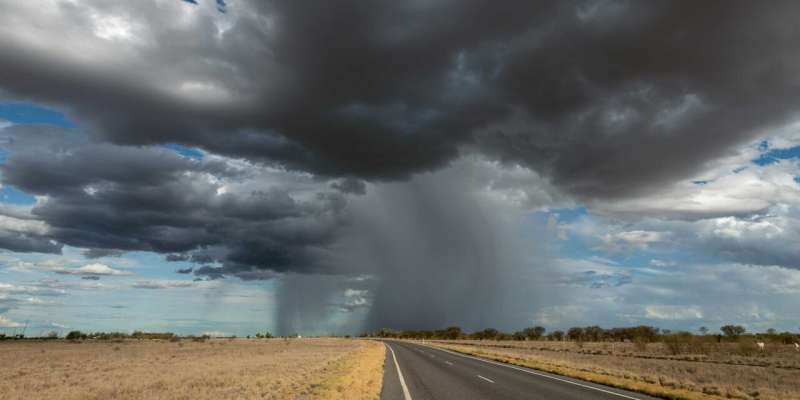
In order to build a global climate model, grid points spaced around 50 to 100 kilometers apart are used. This scale is too coarse to map small-scale, local thunderstorm cells. Yet it is precisely these thunderstorm cells—and where they occur—that drive atmospheric circulation, especially in the tropics, where solar radiation is highest.
The workaround, at present, is to add extra parameters to the model in order to map clouds. “But predicting future climate change is still pretty imprecise,” Schär says. “If we don’t know how many clouds are forming in the tropics, then we don’t know how much sunlight is hitting the earth’s surface—and hence we don’t know the actual size of the global energy balance.”
Even worse from NewScientist How we broke the water cycle and can no longer rely on rain to fall. What hubris and how preposterous to claim our puny CO2 emissions have upset hydrology. The lack of correlation is obvious to those who care to look:
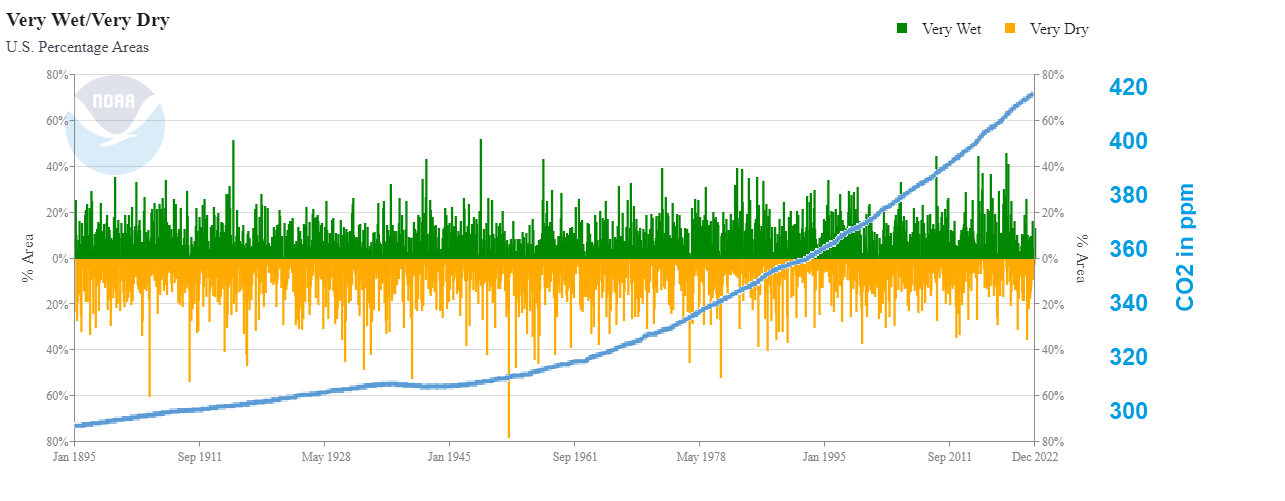
The climatist paradigm is myopic and lopsided. A previous post below provides a cure for those whose vision is impaired by the IPCC consensus view of climate reality.
E.M. Smith provides an helpful critique of a recent incomplete theory of earth’s climate functioning in his Chiefio blog post So Close–Missing Convection and Homeostasis. Excerpts in italics with my bolds and added images.
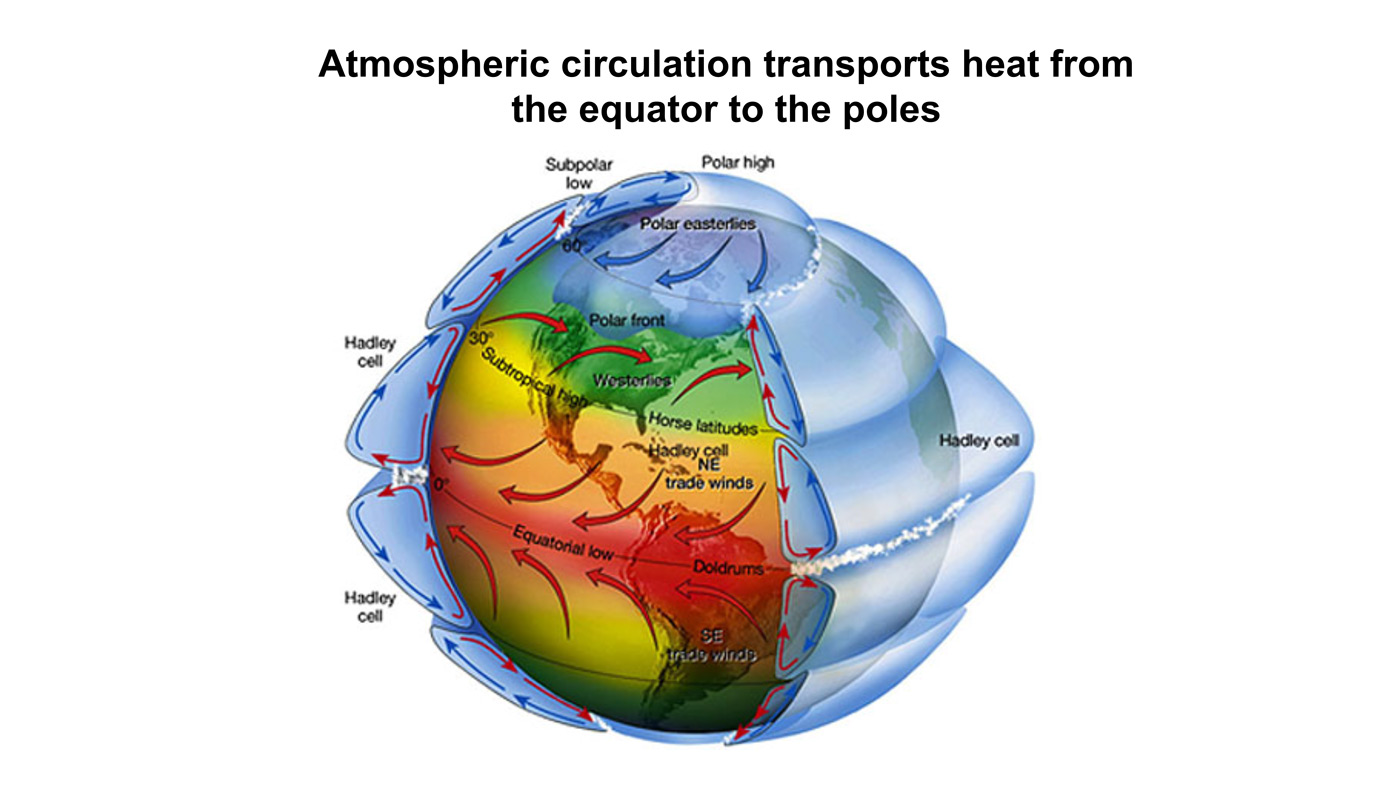
It is Soooo easy to get things just a little bit off and miss reality. Especially in complex systems and even more so when folks raking in $Millions are interested in misleading for profit. Sigh.
Sabine Hosenfelder does a wonderful series of videos ‘explaining’ all sorts of interesting things in and about actual science and how the universe works. She is quite smart and generally “knows her stuff”. But… It looks like she has gotten trapped into the Radiative Model of Globull Warming.
The whole mythology of Global Warming depends on having you NOT think about anything but radiative processes and physics. To trap you into the Radiative Model. But the Earth is more complex than that. Much more complex. Then there’s the fact that you DO have some essential Radiative Physics to deal with, so the bait is there. However…
It is absolutely essential to pay attention to convection in the lower atmosphere
and to the “feedback loops” or homeostasis in the system.
The system acts to restore its original state. There is NO “runaway greenhouse” or we would have never evolved into being since the early earth had astoundingly high levels of CO2 and we would have baked to death before getting out of our slime beds as microbes.
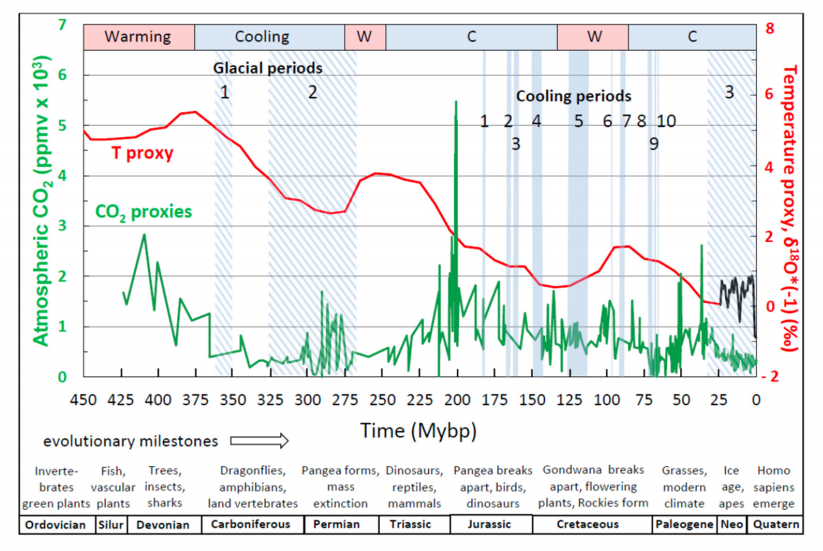
Figure 16. The geological history of CO2 level and temperature proxy for the past 400 million years. CO2 levels now are ~ 400ppm. Source: Davis, W. J. (2017).
OK, I’ll show you her video. It is quite good even with the “swing and a miss” at the end. She does 3 levels of The Greenhouse Gas Mythology so you can see the process evolving from grammar school to high school to college level of mythology. But then she doesn’t quite make it to Post-Doc Reality.
Where’s she wrong? (Well, not really wrong, but lacking…)
I see 2 major issues. First off, she talks about the “lower atmosphere warming”. Well, yes and no. It doesn’t “warm” in the sense of getting hotter, but it does speed up convection to move the added heat flow.
In English “heating” has 2 different meanings. Increasing temperature.
Increasing heat flow at a temperature.
We see this in “warm up the TV dinner in the microwave” meaning to heat it up from frozen to edible; and in the part where the frozen dinner is defrosting at a constant temperature as it absorbs heat but turns it into the heat of fusion of water. So you can “warm it up” by melting at a constant temperature of frozen water (but adding a LOT of thermal energy – “heat”) then later as increasing temperature once the ice is melted. It is very important to keep in mind that there are 2 kinds of “heating”. NOT just “increasing temperature”.
In the lower atmosphere, the CO2 window / Infrared Window is already firmly slammed shut. Sabine “gets that”. Yay! One BIG point for her! No amount of “greenhouse gas” is going to shut that IR window any more. As she points out, you get about 20 meters of transmission and then it is back to molecular vibrations (aka “heat”).
So what’s an atmosphere to do? It has heat to move! Well, it convects. It evaporates water.
Those 2 things dominate by orders of magnitude any sort of Radiative Model Physics. Yes, you have radiation of light bringing energy in, but then it goes into the ocean and into the dirt and the plants and even warms your skin on a sunny day. And it sits there. It does NOT re-radiate to any significant degree. Once “warmed” by absorption, heat trying to leave as IR hits a slammed shut window.

The hydrological cycle. Estimates of the observed main water reservoirs (black numbers in 10^3 km3 ) and the flow of moisture through the system (red numbers, in 10^3 km3 yr À1 ). Adjusted from Trenberth et al. [2007a] for the period 2002-2008 as in Trenberth et al. [2011].
Our planet is a Water Planet. It moves that energy (vibrations of atoms, NOT radiation) by having water evaporate into the atmosphere. (Yes, there are a few very dry deserts where you get some radiative effects and can get quite cold at night via radiation through very dry air, but our planet is 70% or so oceans, so those areas are minor side bars on the dominant processes). This water vapor makes the IR window even more closed (less distance to absorption). It isn’t CO2 that matters, it is the global water vapor.
What happens next?
Well, water holds a LOT of heat (vibration of atoms and NOT “temperature”) as the heat of vaporization. About 540 calories per gram (compared to 80 for melting “heat of fusion” and 1 for specific heat of a gram of water). Compare those numbers again. 1 for a gram of water. 80 for melting a gram of ice. 540 for evaporating a gram of water. It’s dramatically the case that evaporation of water matters a lot more than melting ice, and both of them make “warming water” look like an irrelevant thing.
Warming water is 1/80 as important as melting ice, and it is 1/540 th as important as evaporation of the surface of the water. Warming air is another order of magnitude less important to heat content.
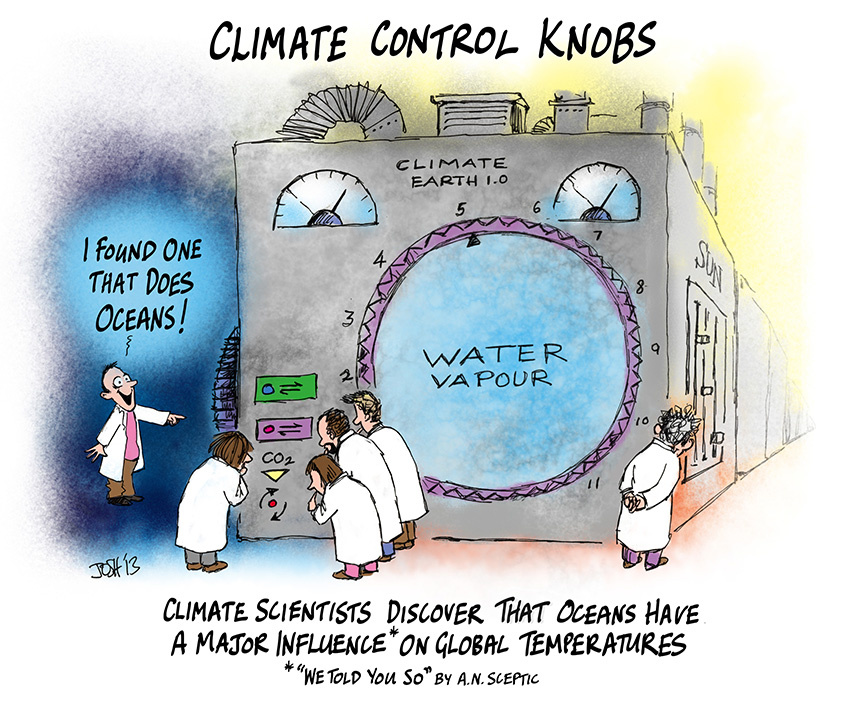
So to have clue, one MUST look at the evaporation of water from the oceans as everything else is in the small change.
Look at any photo of the Earth from space. The Blue Marble covered in clouds. Water and clouds. The product of evaporation, convection, and condensation. Physical flows carrying all that heat (“vibration of atoms” and NOT temperature, remember). IF you add more heat energy, you can speed up the flows, but it will not cause a huge increase in temperature (and mostly none at all). It is mass flow that changes. The number of vibrating molecules at a temperature, not the temperature of each.
In the end, a lot of mass flow happens, lofting all that water vapor with all that heat of vaporization way up toward the Stratosphere. This is why we have a troposphere, a tropopause (where it runs out of steam… literally…) and a stratosphere.
What happens when it gets to the stratosphere boundary? Well, along the way that water vapor turns into water liquid very tiny drops (clouds) and eventually condenses to big drops of water (rain) and some of it even freezes (hail, snow, etc.). Now think about that for a minute. That’s 540 calories per gram of heat (molecular vibration NOT temperature, remember) being “dumped” way up high in the top of the troposphere as it condenses, and another 80 / gram if if freezes. 620 total. That’s just huge.
This is WHY we have a globe covered with rain, snow, hail, etc. etc. THAT is all that heat moving. NOT any IR Radiation from the surface. Let that sink in a minute. Fix it in your mind. WATER and ICE and Water Vapor are what moves the heat, not radiation. We ski on it, swim in it, have it water our crops and flood the land. That’s huge and it is ALL evidence of heat flows via heat of vaporization and fusion of water.
It is all those giga-tons of water cycling to snow, ice and rain, then falling back to be lofted again as evaporation in the next cycle. That’s what moves the heat to the stratosphere where CO2 then radiates it to space (after all, radiation toward the surface hits that closed IR window and stops.) At most, more CO2 can let the Stratosphere radiate (and “cool”) better. It can not make the Troposphere any less convective and non-radiative.
Then any more energy “trapped” at the surface would just run the mass transport water cycle faster. It would not increase the temperature.
More molecules would move, but at a limit on temperature. Homeostasis wins. We can see this already in the Sub-Tropics. As the seasons move to fall and winter, water flows slow dramatically. I have to water my Florida lawn and garden. As the seasons move to spring and summer, the mass flow picks up dramatically. Eventually reaching hurricane size. Dumping up to FEET of condensed water (that all started as warm water vapor evaporating from the ocean). It is presently headed for about 72 F today (and no rain). At the peak of hurricane season, we get to about 84 or 85 F ocean surface temperature as the water vapor cycle is running full blast and we get “frog strangler” levels of rain. That’s the difference. Slow water cycle or fast.
IF (and it is only an “if”, not a when) you could manage to increase the heat at the surface of the planet in, say, Alaska: At most you would get a bit more rain in summer, a bit more snow in winter, and MAYBE only a slight possible, of one or two days that are rain which could have been snow or sleet.
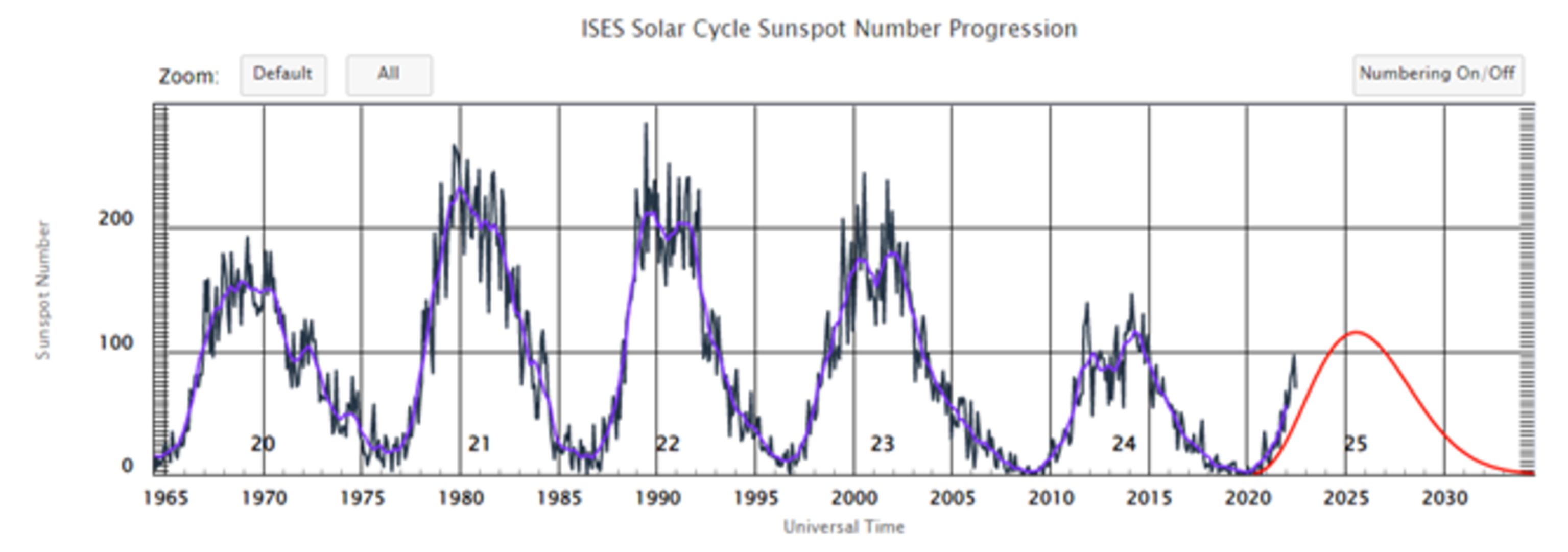
Then there’s the fact that natural cycles swamp all of that CO2 fantasy anyway. The Sun, as just one example, had a large change of IR / UV levels with both the Great Pacific Climate Shift (about 1975) and then back again in about 2000. Planetary tilt, wobble, eccentricity of the orbit and more put us in ice ages (as we ARE right now, but in an “interglacial” in this ice age… a nice period of warmth that WILL end) and pulls us out of them. Glacials and interglacials come and go on various cycles (100,000 years, 40,000 years, and 12,000 year interglacials – ours ending now, but slowly). The simple fact is that Nature Dominates, and we are just not relevant. To think we are is hubris of the highest order.
See Also Bill Gray: H20 is Climate Control Knob, not CO2
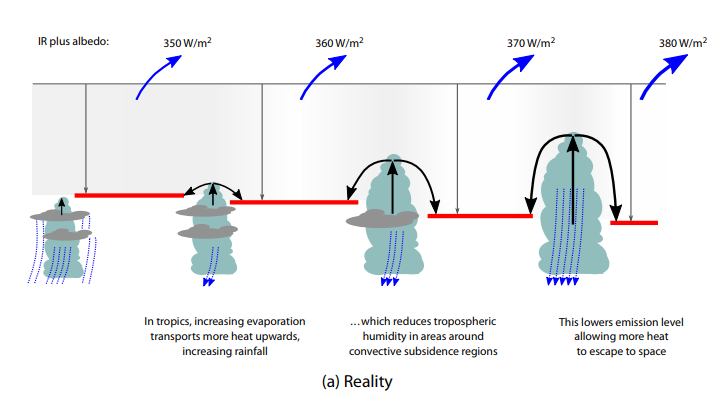
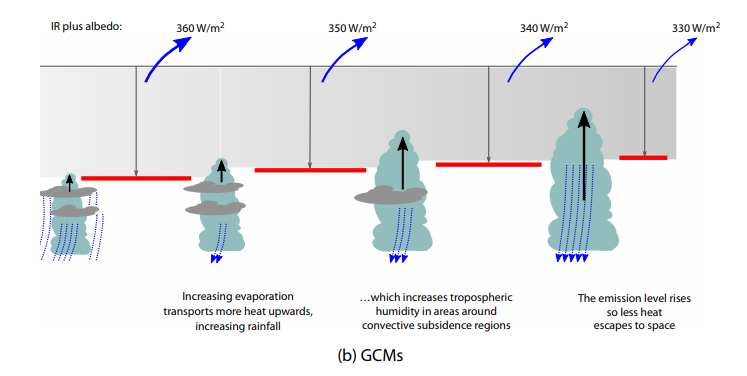
Figure 9: Two contrasting views of the effects of how the continuous intensification of deep cumulus convection would act to alter radiation flux to space. The top (bottom) diagram represents a net increase (decrease) in radiation to space
There are two main reasons why investigators are skeptical of AGW (anthropogenic global warming) alarm. This post intends to be an antidote to myopic and lop-sided understandings of our climate system.

Myopia is a failure of perception by focusing on one near thing to the exclusion of the other realities present, thus missing the big picture. For example: “Not seeing the forest for the trees.” AKA “tunnel vision.”
2. CO2 Alarm is Lopsided: CO2 forcing is too small to have the overblown effect claimed for it. Other factors are orders of magnitude larger than the potential of CO2 to influence the climate system.

Lop-sided refers to a failure in judging values, whereby someone lacking in sense of proportion, places great weight on a factor which actually has a minor influence compared to other forces. For example: “Making a mountain out of a mole hill.”
The best context for understanding decadal temperature changes comes from the world’s sea surface temperatures (SST), for several reasons:
HadSST is generally regarded as the best of the global SST data sets, and so the temperature story here comes from that source. Previously I used HadSST3 for these reports, but Hadley Centre has made HadSST4 the priority, and v.3 will no longer be updated. HadSST4 is the same as v.3, except that the older data from ship water intake was re-estimated to be generally lower temperatures than shown in v.3. The effect is that v.4 has lower average anomalies for the baseline period 1961-1990, thereby showing higher current anomalies than v.3. This analysis concerns more recent time periods and depends on very similar differentials as those from v.3 despite higher absolute anomaly values in v.4. More on what distinguishes HadSST3 and 4 from other SST products at the end. The user guide for HadSST4 is here.
The chart below shows SST monthly anomalies as reported in HadSST4 starting in 2015 through July 2023. A global cooling pattern is seen clearly in the Tropics since its peak in 2016, joined by NH and SH cycling downward since 2016.
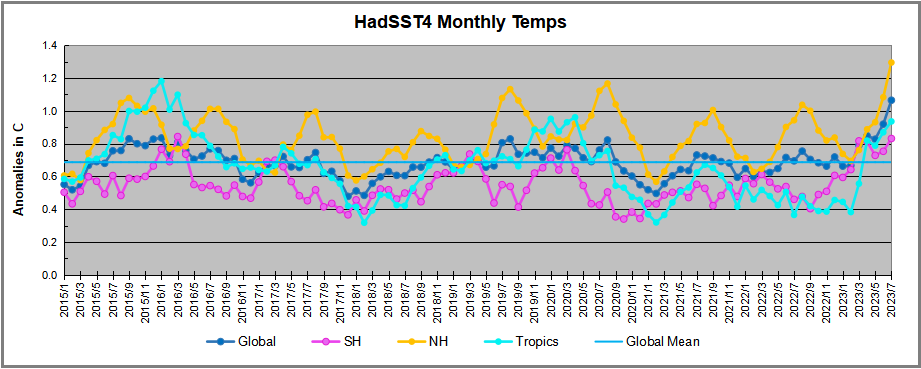
Note that in 2015-2016 the Tropics and SH peaked in between two summer NH spikes. That pattern repeated in 2019-2020 with a lesser Tropics peak and SH bump, but with higher NH spikes. By end of 2020, cooler SSTs in all regions took the Global anomaly well below the mean for this period. In 2021 the summer NH summer spike was joined by warming in the Tropics but offset by a drop in SH SSTs, which raised the Global anomaly slightly over the mean.
Then in 2022, another strong NH summer spike peaked in August, but this time both the Tropic and SH were countervailing, resulting in only slight Global warming, later receding to the mean. Oct./Nov. temps dropped in NH and the Tropics took the Global anomaly below the average for this period. After an uptick in December, temps in January 2023 dropped everywhere, strongest in NH, with the Global anomaly further below the mean since 2015.
Now comes El Nino as shown by the upward spike in the Tropics since January, the anomaly more than doubling from 0.38C to 0.94C. Now in July 2023, all regions rose, especially NH up from 0.7C to now 1.3C, pulling up the global anomaly to a new high for this period.
The climatists have seized on this unusual warming as proof of their Zero Carbon agenda, without addressing how impossible it would be for CO2 warming the air to raise ocean temperatures. It is the ocean that warms the air, not the other way around. Recently Steven Koonin had this to say about the phonomenon confirmed in the graph above:
El Nino is a phenomenon in the climate system that happens once every four or five years. Heat builds up in the equatorial Pacific to the west of Indonesia and so on. Then when enough of it builds up it surges across the Pacific and changes the currents and the winds. As it surges toward South America it was discovered and named in the 19th century It is well understood at this point that the phenomenon has nothing to do with CO2.
Now people talk about changes in that phenomena as a result of CO2 but it’s there in the climate system already and when it happens it influences weather all over the world. We feel it when it gets rainier in Southern California for example. So for the last 3 years we have been in the opposite of an El Nino, a La Nina, part of the reason people think the West Coast has been in drought.
It has now shifted in the last months to an El Nino condition that warms the globe and is thought to contribute to this Spike we have seen. But there are other contributions as well. One of the most surprising ones is that back in January of 2022 an enormous underwater volcano went off in Tonga and it put up a lot of water vapor into the upper atmosphere. It increased the upper atmosphere of water vapor by about 10 percent, and that’s a warming effect, and it may be that is contributing to why the spike is so high.
A longer view of SSTs
Open image in new tab to enlarge.
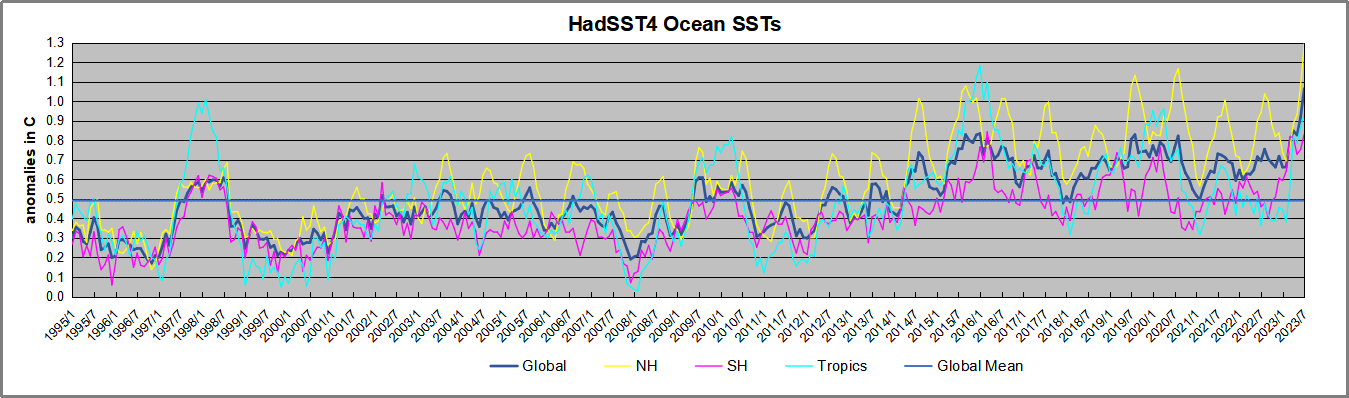
The graph above is noisy, but the density is needed to see the seasonal patterns in the oceanic fluctuations. Previous posts focused on the rise and fall of the last El Nino starting in 2015. This post adds a longer view, encompassing the significant 1998 El Nino and since. The color schemes are retained for Global, Tropics, NH and SH anomalies. Despite the longer time frame, I have kept the monthly data (rather than yearly averages) because of interesting shifts between January and July.1995 is a reasonable (ENSO neutral) starting point prior to the first El Nino.
The sharp Tropical rise peaking in 1998 is dominant in the record, starting Jan. ’97 to pull up SSTs uniformly before returning to the same level Jan. ’99. There were strong cool periods before and after the 1998 El Nino event. Then SSTs in all regions returned to the mean in 2001-2.
SSTS fluctuate around the mean until 2007, when another, smaller ENSO event occurs. There is cooling 2007-8, a lower peak warming in 2009-10, following by cooling in 2011-12. Again SSTs are average 2013-14.
Now a different pattern appears. The Tropics cooled sharply to Jan 11, then rise steadily for 4 years to Jan 15, at which point the most recent major El Nino takes off. But this time in contrast to ’97-’99, the Northern Hemisphere produces peaks every summer pulling up the Global average. In fact, these NH peaks appear every July starting in 2003, growing stronger to produce 3 massive highs in 2014, 15 and 16. NH July 2017 was only slightly lower, and a fifth NH peak still lower in Sept. 2018.
The highest summer NH peaks came in 2019 and 2020, only this time the Tropics and SH were offsetting rather adding to the warming. (Note: these are high anomalies on top of the highest absolute temps in the NH.) Since 2014 SH has played a moderating role, offsetting the NH warming pulses. After September 2020 temps dropped off down until February 2021. In 2021-22 there were again summer NH spikes, but in 2022 moderated first by cooling Tropics and SH SSTs, then in October to January 2023 by deeper cooling in NH and Tropics.
Now in 2023 the Tropics flipped from below to well above average, while NH has produced a summer peak with July higher than any previous year. In fact, the summer warming peaks in NH have occurred in August or September, so this July number is likely to go even higher.
What to make of all this? The patterns suggest that in addition to El Ninos in the Pacific driving the Tropic SSTs, something else is going on in the NH. The obvious culprit is the North Atlantic, since I have seen this sort of pulsing before. After reading some papers by David Dilley, I confirmed his observation of Atlantic pulses into the Arctic every 8 to 10 years.
Through January 2023 I depended on the Kaplan AMO Index (not smoothed, not detrended) for N. Atlantic observations. But it is no longer being updated, and NOAA says they don’t know its future. So I find only the Hadsst AMO dataset has data through April. It differs from Kaplan, which reported average absolute temps measured in N. Atlantic. “Hadsst AMO follows Trenberth and Shea (2006) proposal to use the NA region EQ-60°N, 0°-80°W and subtract the global rise of SST 60°S-60°N to obtain a measure of the internal variability, arguing that the effect of external forcing on the North Atlantic should be similar to the effect on the other oceans.” So the values represent differences between the N. Atlantic and the Global ocean.
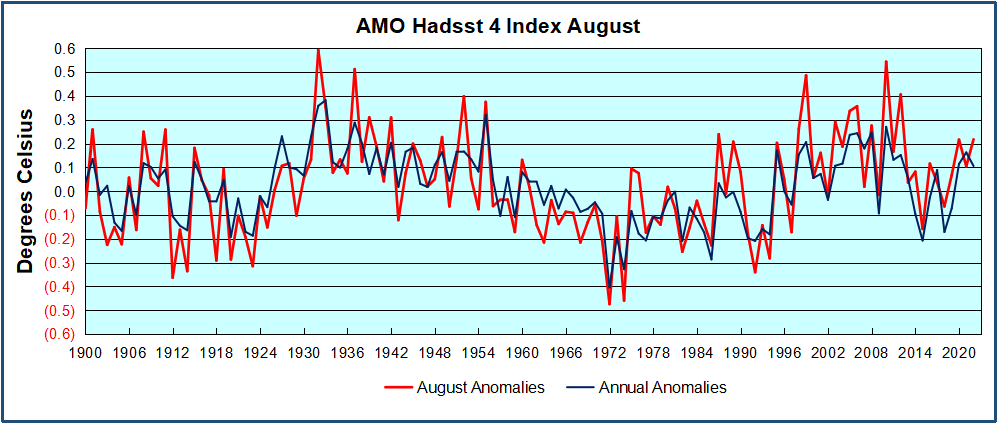
The chart above confirms what Kaplan also showed. As August is the hottest month for the N. Atlantic, its varibility, high and low, drives the annual results for this basin. Note also the peaks in 2010, lows after 2014, and a rise in 2021. An annual chart below is informative:
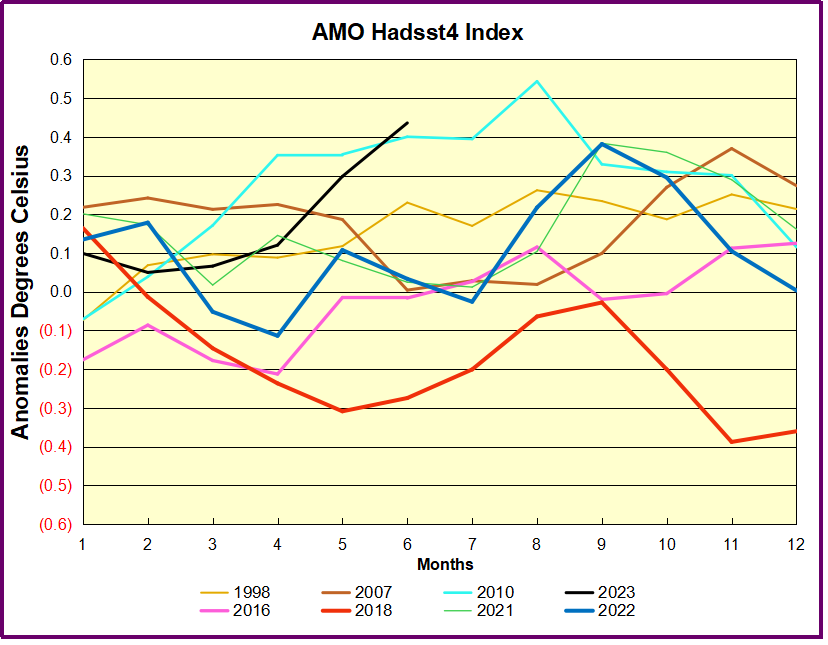
Note the difference between blue/green years, beige/brown, and purple/red years. 2010, 2021, 2022 all peaked strongly in August or September. 1998 and 2007 were mildly warm. 2016 and 2018 were matching or cooler than the global average. 2023 started out slightly warm, and now in May and June has spiked to match 2010.
The pattern suggests the ocean may be demonstrating a stairstep pattern like that we have also seen in HadCRUT4.
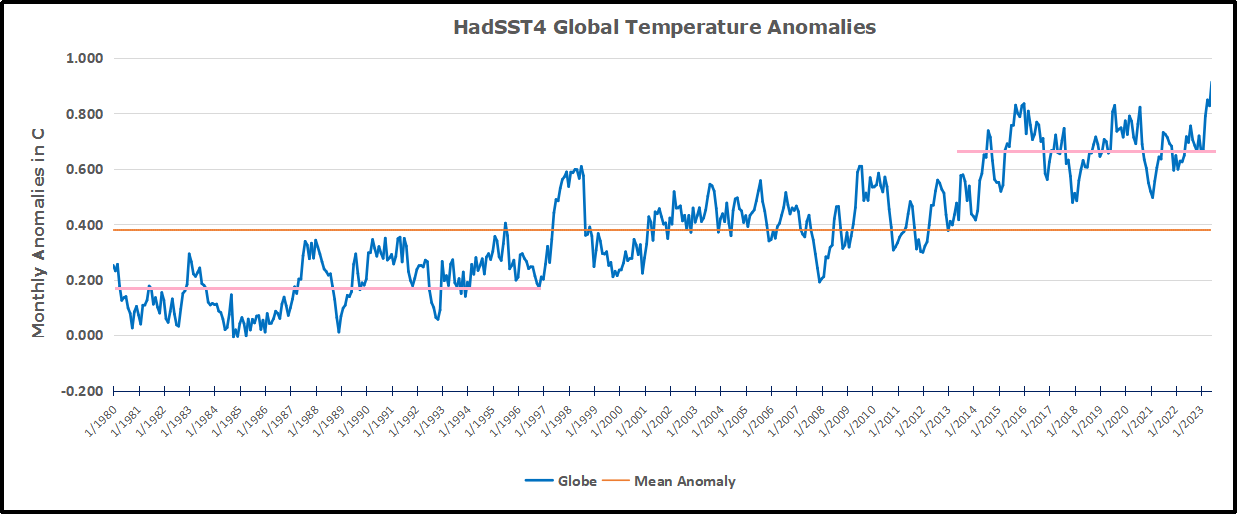 The purple line is the average anomaly 1980-1996 inclusive, value 0.18. The orange line the average 1980-202306, value 0.38, also for the period 1997-2012. The red line is 2013-202306, value 0.64. As noted above, these rising stages are driven by the combined warming in the Tropics and NH, including both Pacific and Atlantic basins.
Summary
The oceans are driving the warming this century. SSTs took a step up with the 1998 El Nino and have stayed there with help from the North Atlantic, and more recently the Pacific northern “Blob.” The ocean surfaces are releasing a lot of energy, warming the air, but eventually will have a cooling effect. The decline after 1937 was rapid by comparison, so one wonders: How long can the oceans keep this up?
Footnote: Why Rely on HadSST4
HadSST is distinguished from other SST products because HadCRU (Hadley Climatic Research Unit) does not engage in SST interpolation, i.e. infilling estimated anomalies into grid cells lacking sufficient sampling in a given month. From reading the documentation and from queries to Met Office, this is their procedure.
HadSST4 imports data from gridcells containing ocean, excluding land cells. From past records, they have calculated daily and monthly average readings for each grid cell for the period 1961 to 1990. Those temperatures form the baseline from which anomalies are calculated.
In a given month, each gridcell with sufficient sampling is averaged for the month and then the baseline value for that cell and that month is subtracted, resulting in the monthly anomaly for that cell. All cells with monthly anomalies are averaged to produce global, hemispheric and tropical anomalies for the month, based on the cells in those locations. For example, Tropics averages include ocean grid cells lying between latitudes 20N and 20S.
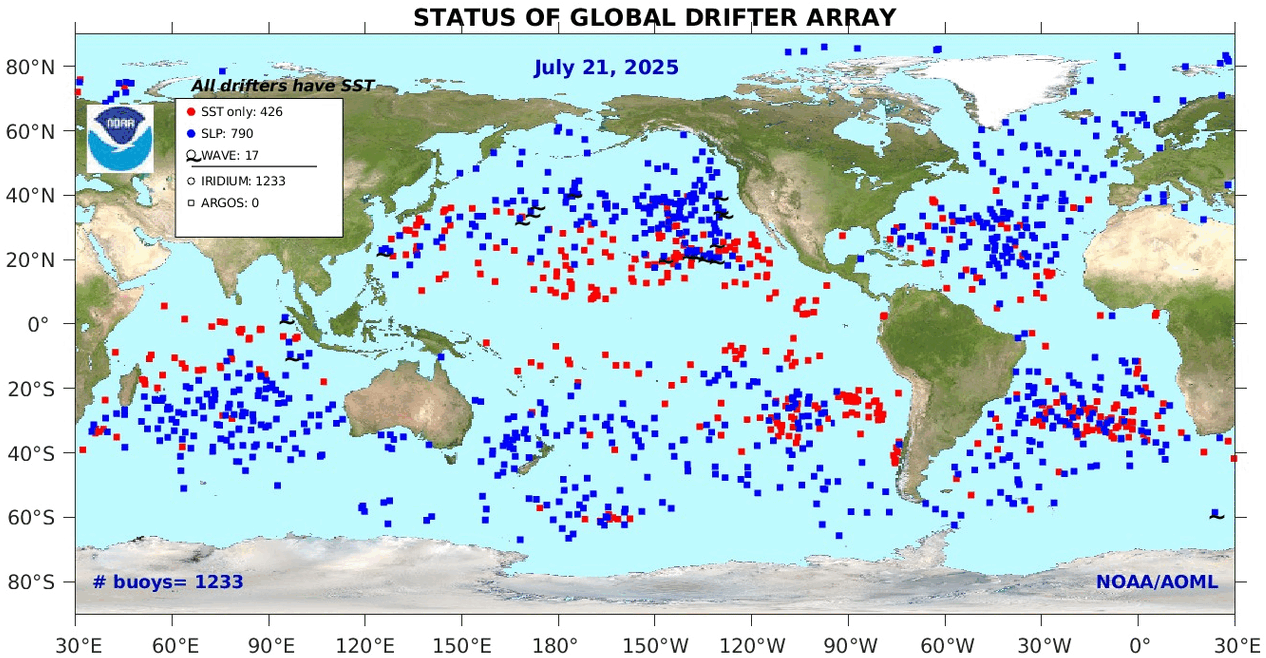
Gridcells lacking sufficient sampling that month are left out of the averaging, and the uncertainty from such missing data is estimated. IMO that is more reasonable than inventing data to infill. And it seems that the Global Drifter Array displayed in the top image is providing more uniform coverage of the oceans than in the past.
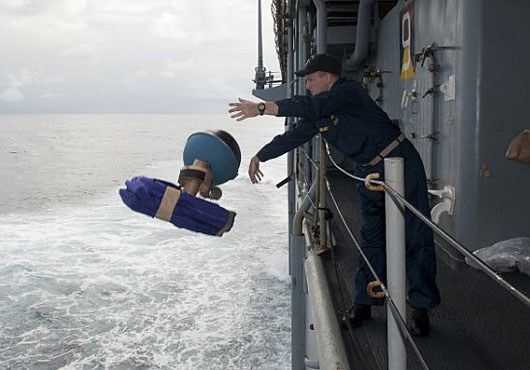
USS Pearl Harbor deploys Global Drifter Buoys in Pacific Ocean
Steven Koonin shared his honest and wise perspective on global warming/climate change in the interview above. For those who prefer reading, an excerpted transcript from the closed captions provides the highlights in italics with my bolds and added images.
PR: Welcome to uncommon knowledge; I’m Peter Robinson. Now a professor at New York University and a fellow at the Hoover Institution, Steven Koonin received a Bachelor of Science degree at Caltech and a doctorate in physics at MIT during a career in which he published more than 200 peer-reviewed scientific papers and a textbook on computational physics. Dr Koonin rose to become Provost of Caltech. In 2009 President Obama appointed him under Secretary of science at the Department of Energy a position Dr Koonin held for some two and a half years. During that time he found himself shocked by the misuse of climate science in politics and the press. In 2021 Dr Koonin published Unsettled. What climate science tells us, what it doesn’t and why it matters.
In Unsettled you write of a 2014 workshop for the American physical society, which means it’s you and a bunch of other people who I cannot even begin to follow. Serious professional scientists such as you and several colleagues were asked to subject current climate science to a stress test: to push it, to prod, to test it to see how good it was. From Unsettled I’m quoting you now Steve:
“ I’m a scientist; I work to understand the world through measurements and observations. I came away from the workshop not only not only surprised but shaken by the realization that climate science was far less mature than I had supposed.”
Let’s start with the end of that. What had you supposed?
SK: Well I had supposed that humans were warming the globe; carbon dioxide was accumulating in the atmosphere causing all kinds of trouble, melting ice caps, warming oceans and so on. And the data didn’t support a lot of that. And the projections of what would happen in the future relied on models that were, let’s say, shaky at best.
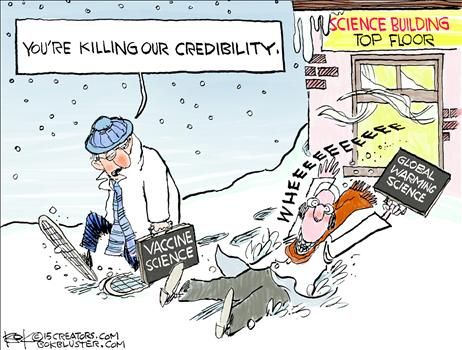
PR: All right. Former Senator John Kerry is now President Biden’s special Envoy for climate. Let me quote from John Kerry in a 2021 address to the UN Security Council:
“Net zero emissions by 2050 or earlier is the only way that science tells us we can limit this planet’s warming to 1.5 degrees Celsius. Why is that so crucial? Because overwhelming evidence tells us that anything more will have catastrophic implications. We are Marching forward in what is tantamount to a mutual suicide pact.”
Overwhelming evidence science tells us. What’s wrong with that?
SK: Well you should look at the actual science which I suspect that Ambassador Kerry has not done. The U.N puts out assessment reports every five or six years. Those are by the IPCC the Intergovernmental Panel for Climate Change and are meant to survey, assess and summarize the state of our knowledge about the climate. The most recent one came out about a year ago in 2022, the previous one in 2014 or so.
Those reports are massive to read; the latest one is three thousand pages and it took 300 scientists a couple years to write. And you really need to be a scientist to understand them. I have a background in theoretical physics, I can understand this stuff. But still it took me a couple years to really understand what goes on. Now Ambassador Kerry and other politicians certainly have not done that.
Likely he’s getting his information from the summary for policy makers, or more likely for an even further boiled down version. And as you boil down the good assessment into the summary, into more condensed versions, there’s plenty of room for mischief. That Mischief is evident when you compare what comes out the end of that game of telephone with what the actual science really is.
PR: All right: what we know and what we don’t. Let’s start with what we know. I’m quoting you again Steve from Unsettled “Not everything you’ve heard about climate science is wrong.” In particular you grant in this book two of the central premises or conclusions of climate science that the Press is always telling us about. here’s one and again I’m going to quote you:
“Surely we can all agree that the globe has gotten warmer
over the last several decades.”
SK: No debunking. In fact it’s gotten warmer over the last four centuries Now that’s a different assertion, but it’s equally supported by the assessment reports. We’ll have to come back to that because the time scale is important. It’s one thing to say this about in my own lifetime the the the climate of the the surface of this planet, and it’s an entirely different thing to say beginning 150 years before this nation was founded temperatures began to rise.
PR: Yes, it’s a different statement but it’s equally true and has some bearing on the warming that we’ve seen over the last century. Here’s the premise that you do grant again I’m going to quote Unsettled
“There is no question that our emission of greenhouse gases in particular CO2 is exerting a warming influence on the planet.” We’re pumping CO2 into the atmosphere, CO2 is a greenhouse gas it must be having some effect of course.”
Absolutely that’s as far as you’re willing to go. But then you say so actually those are pretty two benign premises that you grant: the Earth has been warming and it’s been warming for a long time. CO2 is a greenhouse gas and it must be having some effect it’s coming from human activities and it’scoming from Humanity, mostly fossil fuels. Now now on to what we don’t know okay again from Unsettled
“Even though human influences could have serious consequences for the climate, they are small in relation to the climate system as a whole. That sets a very high bar for projecting the consequences of human influences.”
That is so counter to the general understanding that informs the headlines, particularly this hot summer we’ve had . So explain that.
SK: Human influences as described in the IPCC are a one percent effect on the radiation flow–the flow of heat radiation and sunlight in the atmosphere. That means your understanding had better be at the one percent level or better if you’re going to predict how the climate system is going to respond. And the one percent makes sense because the changes in temperature we’re talking about are three degrees Kelvin right whereas the average temperature of the earth is about 300 degrees Kelvin.
PR: So human influences are a one percent effect on a complicated chaotic multi-scale system for which we have poor observations You seem to you seem to quite relaxed about the original science
SK: The underlying science is expressed in the data and expressed in the research literature the journals the research papers that people produce the conference proceedings and so on. The IPCC takes those and assesses and summarizes them and in general it does a pretty good job at that level. And there’s not going to be much politics in that although they might quibble among themselves about adjectives and adverbs; this is extremely certain or this is unlikely or highly unlikely and so on. But by and large it’s pretty good, this is done by fellow Professionals in a professional manner
Now things begin to go wrong. The next step is because nobody who isn’t deeply in the field is going to read all that stuff, so there is a formal process to create a summary for policy makers which is initially drafted by the governments not by the scientists. Well it’s not of course all of them, there’s some subcommittee to do the summary for policy makers and that gets drafted and passed by the scientists for comment. In the end it’s the governments who have approved the summary for policy makers line by line and that’s where the disconnect happens.
For the disconnect I’ll give you an example. Look at the most recent report and the summary for policy makers is talking about deaths from extreme heat incremental deaths and it says that you know extreme heat or heat waves have contributed to uh mortality okay and that’s a true statement But they forgot to tell you that the warming of the planet decreases the incidence of extreme cold events. And since nine times as many people around the globe die from extreme cold than from extreme heat, the warming from the planet has actually cut the number of deaths from extreme temperatures by a lot. That’s not in there at all.
So the statement was completely factual, but factually incomplete
in a way meant to alarm, not to inform.

And then John Kerry stands up and gives a speech. Maybe he read the SPM I don’t know or his staff read it and probably some of their talking points. And so you get Kerry saying that, you get the Secretary General of the U.N Gutierrez saying, we’re on a highway to climate hell with our foot on the accelerator. But they’re Preposterous of course, even by the IPCC reports they’re Preposterous. The climate scientists are negligent for not speaking up and saying that’s not okay.
PR: Another one of the things going wrong you write about in a way that I have never seen anyone write about computer models. I have never seen anybody make computer models interesting. So congratulations Steve you did something special as far as I know in the entire Corpus of English language.
Here I’m going to quote from a piece you published in the Wall Street Journal not long ago:
“Projections of future climate and weather events rely on models
demonstrably unfit for the purpose.”
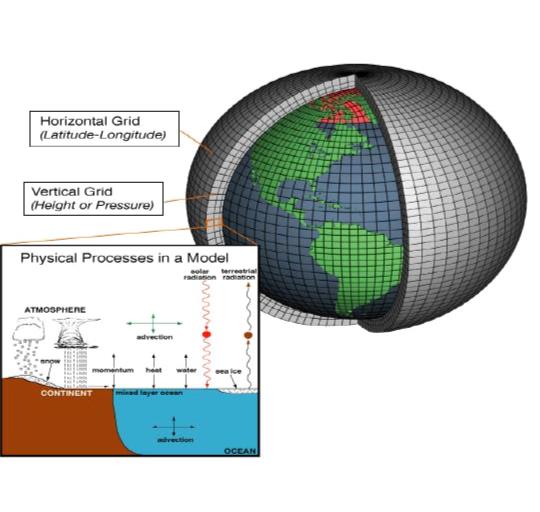
SK: Well, to make a projection of future climate you need to build this big complicated computer model which is really one of the grand computational challenges of all time.
This is not something I wrote a textbook in 1980s when the first PCS came out about how to do modeling on computers with physics. I do know what I’m talking about okay. And then you have to feed into the model what you think future emissions are going to be and the IPCC has five or six different scenarios, High emissions ,low emissions. If you take a particular scenario and feed it into the roughly 50 different models that exist that are developed by groups around the world
So Caltech has a model, Harvard has a model, yeah Oxford. But the Chinese have several models, the Russians and so on. When you feed the same scenario into those different models you get a range of answers. The range is as big as the change you’re trying to describe itself okay, And we can go into the reasons why there is that uncertainty, and in the latest generation of models about 40 percent of them were deemed to be too sensitive to be of much use.
.PNG)
Too sensitive meaning that when you add the carbon dioxide in and the temperature goes up too fast compared to what we’ve seen already. So that’s really disheartening the world’s best models are trying as hard as they can, and they get it very wrong at least 40 percent of the time.
This is not only my assessment you can look at papers published by Tim Palmer and Bjorn Stevens who are serious modelers in the consensus. And their own phrases are that these models are not fit for purpose. at least at the regional or more detailed Global level .
PR: Quoting Unsettled again, and this is one of the most astonishing passages in the book. Writing about the effects of the increases in computing power over the years:
“Having better tools and information to work with should make the models more accurate
and more in line with each other. This has not happened.
The spread in results among different computer models is increasing.”
This one you’re going to have to explain to me. As our modeling power, as our processing power increases, we should be closing in on reliable conclusions and yet they seem to be receding faster than we can approach them. if I got that correct that’s right how can that be
SK: Because as the models become more sophisticated that means either you made the boxes a little bit smaller in the model the grid boxes so there are more of them or you made more sophisticated your description.
The whole globe is sort of divided into 10 million slabs really. The average size of a grid box in the current generation is 100 kilometers 60 miles okay and within that 60 miles there’s a lot that goes on that we can’t describe explicitly in the computer because clouds are maybe five kilometers big and Rain happens here and not there within the grid box we can’t describe all that.
One day we’ll be able to , but not really very soon and let me explain why. The current grid boxes are 100 kilometers so you might say well why not make them 10. well suddenly the number of boxes has gone up by a hundred okay so you need a hundred times more powerful computer but it’s worse than that because the time steps have to be smaller also because things shouldn’t move more than a grid box in one time step and so the processing power actually goes up as the cube of the grid size and so if you want to go from 100 kilometers to 10 kilometers that’s a factor of 10. the processing power required goes up by a factor of a thousand and it’s going to be a long time before we got a computer that’s a thousand times more powerful than what we have.
PR: You and I are speaking in the middle of August I just started collecting headlines thinking I’ll just read this to Steve and see what he says about it.
CBS News this past May “Scientists say climate change is making hurricanes worse.”
Koonin in Unsettled: “Hurricanes and tornadoes show no changes attributable to human influences.”
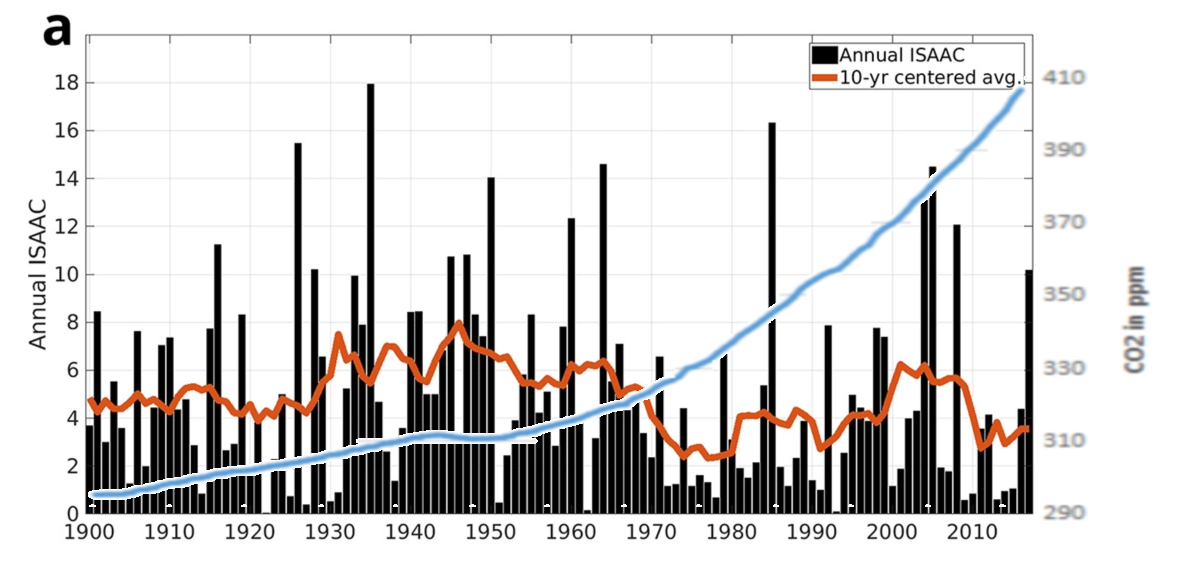
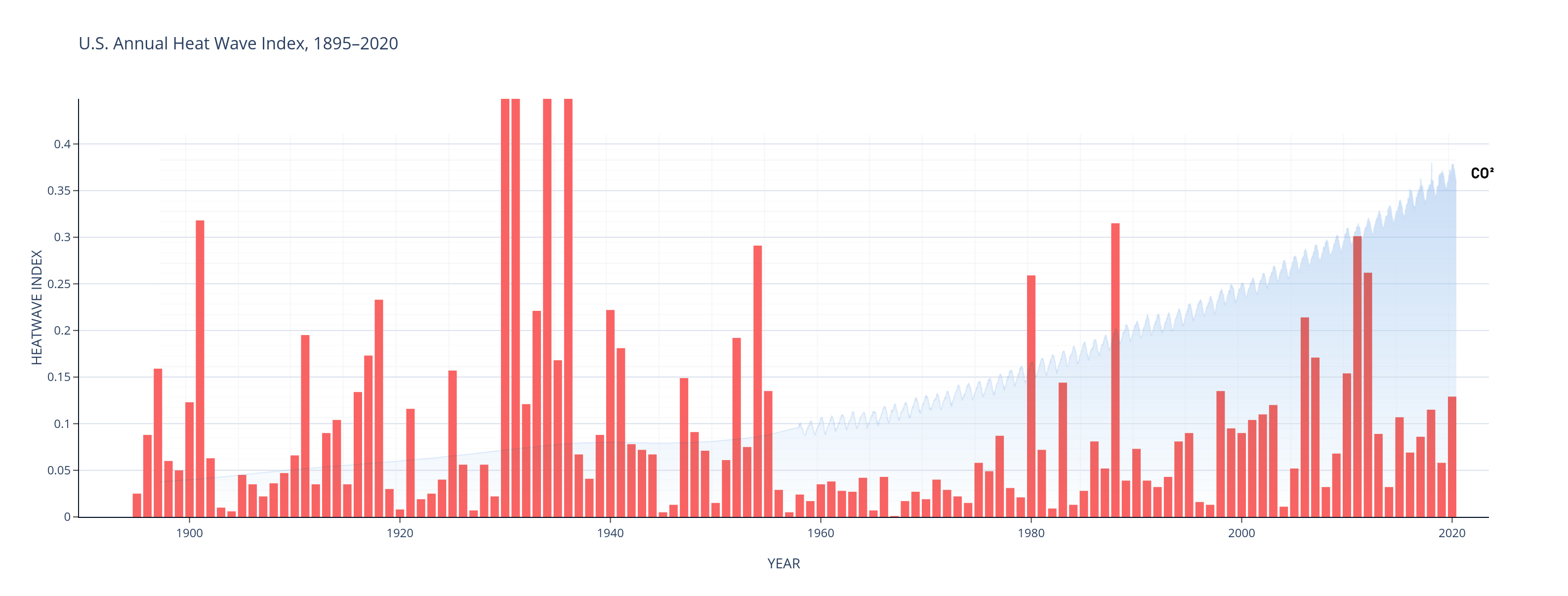
[The graph above shows exhibit 2a from Truchelut and Staehling overlaid with the record of atmospheric CO2 concentrations. From NOAA combining Mauna Loa with earlier datasets.]
To determine Integrated Storm Activity Annually over the Continental U.S. (ISAAC) from 1900 through 2017, we summed this landfall ACE spatially over the entire continental U.S. and temporally over each hour of each hurricane season. We used the same methodology to calculate integrated annual landfall ACE for five additional geographic subsets of the continental U.S.
SK: Well you know what science does CBS know? The media gets their information from reporters who have no or very little scientific training. (PR: you mean you didn’t graduate people from Caltech who went to work there?) Probably one or so and they do a good job. But they have reporters on a climate beat who have to produce stories the more dramatic the better: If it bleeds It leads. and so you get that kind of stuff I quote
When I say something about hurricanes, I quote right from the IPCC reports and it doesn’t say that at all. Actually the most recent report said it based on a paper which was subsequently corrected
PR: Floods here’s a 2020 headline this is from an article or press release published by the UN environment program quote climate change this is the U.N now not the IPCC but it is a U.N agency:
UNEP: “Climate change is making record-breaking floods.”
Steve Koonin in Unsettled: “We don’t know whether floods globally are increasing, decreasing or doing nothing at all.”
SK: I would say the U.N needs to be consistent and and they should check their press release against the IPCC reports before they say anything.
When I wrote unsettled I tried very hard to stick with the gold standard which was the IPCC report at the time or the subsequent research literature I had available to me when I wrote the book only the fifth assessment report which came out in 2014 as we’ve discussed.
The sixth assessment report came out about a year ago and I’m proud to say there’s essentially nothing in there now that needs to be changed in the paperback edition. I will do an update of course but the paperback edition is not going to be totally rewritten.
PR: All right agriculture. Here’s a 2019 headline
New York Times: “Climate change threatens world’s food supply United Nations warns.”
Steve Koonin in Unsettled: “Agricultural yields have surged during the past Century even as the globe has warmed. And projected price impacts from future human induced climate changes through 2050 should hardly be noticeable among ordinary market dynamics.”

SK: It’s not what I said but what the IPCC said. Take current media and almost any climate story, I can write a very effective counter-– it’s like shooting fish in a barrel. I’ve got I’ve actually gotten to the point where I say oh no not another one do I have to do that too. So this is endemic to a media that is ill-informed and has an agenda to set.
The agenda is to promote alarm and induce governments to decarbonize.
I think that probably the primary agenda is to get clicks and eyeballs but and you know there are organizations it’s wonderful there’s an organization called Covering Climate Now which is a non-profit membership organization it’s got the guardian it’s got various other media NPR I believe and their mission is to promote the narrative. They will not allow anything to be broadcast or written that is counter to the narrative The Narrative is: We’ve already broken the climate.
PR: These are headlines in July of 2023. This is last month here as you and I tape this.
New York Times on July 6th: ” Heat records are broken around the globe as Earth warms fast from north to south. Temperatures are surging as greenhouse gases combined with the effects of El Nino.“
New York Times on July 18: “Heat waves grip three continents as climate change warms Earth. Across North America, Europe and Asia hundreds of millions endured blistering conditions. A U.S official called it a threat to all humankind.”
Wall Street Journal on July 25th: “July heat waves nearly impossible without climate change study says. Record temperatures have been fueled by decades of fossil fuel emissions.”
New York Times on July 27th; “This looks like Earth’s warmest month, hotter ones appear to be in store. July is on track to break all records for any month scientists say, as the planet enters an extended period of exceptional warmth.”
Unsettled came out in April 2021 so we will forgive you not knowing in April 2021 what would happen last month July of 2023. But now July 2023 is in the record books, and doesn’t it prove that climate science is settled?
SK: That statement together with all those headlines confuse weather and climate. So weather is what happens every day or maybe even every season; climate the official definition is a multi-decade average of weather properties. That’s what the IPCC and another U.N agency, the World Meteorological organization (WMO) says.
We have satellites that are continually monitoring the temperature of the atmosphere and they report out every month what the monthly temperature is or more precisely what the monthly temperature anomaly is namely how much warmer or colder is it than the average what would have been expected for that month. We have data that go back to about 1979. so we have good monthly measures of the global temperature on the lower atmosphere for 40 something years.
You see month-to-month variations of course but a long-term Trend that’s going up no question about it. I I won’t get the number exactly right, but it’s going up at about 0.13 degrees per decade all right. That’s some combination of natural variability and greenhouse gases. Human influences are more general and then every couple years you see a sharp Spike going up, and that’s El Nino. It’s weather, and so it goes up and then goes back down.
So there’s a long-term Trend which is greenhouse gases and natural variability and then there’s this natural Spike every once in a while, but an eruption goes off you see something, El Ninos happen you see something. And so on the last month in July there was another Spike in the anomaly the anomalies about as large as we’ve ever seen but not unprecedented okay
The real question is why did it Spike so much right?
Nothing to do with CO2
CO2 is kind of the well human influences a kind of the base on which this uh phenomenon occurs so because the the CO2 even if you stipulate that CO2 is causing some large proportion of this warming, it’s a slow steady process you would not expect to see spikes you wouldn’t expect to see sudden step functions absolutely not all right and there are various reasons people hypothesize we don’t know yet why we’ve seen the spike in the last month
PR: You better take just a moment to explain what is El Nino
SK: El Nino is a phenomenon in the climate system that happens once every four or five years heat builds up in the equatorial Pacific to the west of Indonesia and so on and then when enough of it builds up it kind of surges across the Pacific and changes the currents and the winds uh as it surges toward South America all right it was discovered in the 19th century and it kind of well understood at this point 19th century means that phenomenon has nothing to do with CO2.
Now people talk about changes in that phenomena as a result of CO2 but it’s there in the climate system already and when it happens it influences weather all over the world we feel it we feel it it gets Rainier in Southern California for example and so on so we had it we we have been in the opposite of an El Nino, a La Nina for the last 3 years, part of the reason people think the West Coast has been in drought and it is Shifting.
It has now shifted in the last months to an El Nino condition that warms the globe and is thought to contribute to this Spike we have seen. But there are other contributions as well one of the most surprising ones is that back in January of 22 an enormous underwater volcano went off in Tonga and it put up a lot of water vapor into the upper atmosphere. It increased the upper atmosphere of water vapor by about 10 percent, and that’s a warming effect and it may be that that is contributing to why the spike is so high. so you’re let me go
PR: Back to New York since you spent you spent July there. I happened to visit in July and we have Canadian wildfires and the Press telling us that the wildfires are because of climate change. And for the first time anybody I know could remember smoke is so heavy and it gets blown into New York And this sky feels as though there’s a solar eclipse taking place for three days it’s so dark in New York
Meanwhile New York is hot it’s really hot and we’re reading reports that Europe is hot and there’s sweltering even in Madrid, a culture built around heat in the midday where they take siestas. Even in Madrid they don’t quite know how to handle this heat and it’s perfectly normal for people to say wait a minute this is getting scary. It feels for the first time as though the Earth is threatening, it’s unsafe in New York of all places where you didn’t have to worry about earthquakes. But the other thing you didn’t have to worry about was breathing the air, but suddenly you can’t breathe the air it feels uncomfortable it’s scary. And you’re saying and your response to that is what?
SK: So we have two responses. First we have a very short memory for weather. Go back in the archives or the newspapers and you can read from even the 19th century on the East Coast descriptions of so-called yellow days when the atmosphere was clouded by smoke from Canadian fires. So look at the historical record first and if it happened before human influences were significant you got a much higher bar to clear to say that’s CO2.
Secondly, there’s a lot of variability. Here in California we had two decades of drought and the governor was screaming New Normal. New Normal. And then what happened last year: historical record torrential rains because people forgot about the 1860 some odd event where the Central Valley was under many feet of water.
PR: So climate is not weather and the weather can really fool you. all right Steve some last questions. From Unsettled:
“Humans have been successfully adapting to changes in climate for millennia.
Today’s society can adapt to climate changes whether they are
natural phenomena or the result of human influences.”
So you draw the distinction between adapting to climate change on the one hand and the John Kerry approach on the other which is trying to stop climate change. Explain that distinction and why you favor one over the other
SK: Okay. I would take issue though with your description of Kerry’s approach. It’s not trying to stop climate change, it’s to reduce human influences on the climate. Because the climate will keep changing even if we reduce emissions carry the night okay then I would even dream all right go ahead.
Let me talk about adaptation a little bit and give you some examples that are probably not well known, at least it wasn’t really known to me until I looked into it. If you go back to 1900 and you look from 1900 till today the globe warmed by about 1.3 degrees Celsius. That’s This Global temperature record that everybody more or less agrees upon . And before we get to the consequences, the other statement is that the IPCC projects about the same amount of warming over the next hundred years. You might ask what’s going to happen over the next hundred years as that warming happens.
We can look at the past to get some sense of how we might fare,
okay not perfect, but a good indication.
Since 1900 until now:
♦ The global population has gone up by a factor of five, we’re now 8 billion people.
♦ The average lifespan or life expectancy went from 32 years to 73 years
♦ The GDP per capita in constant dollars went up by a factor of seven
♦ The literacy rate went up by a factor of four
♦ The nutrition etc etc
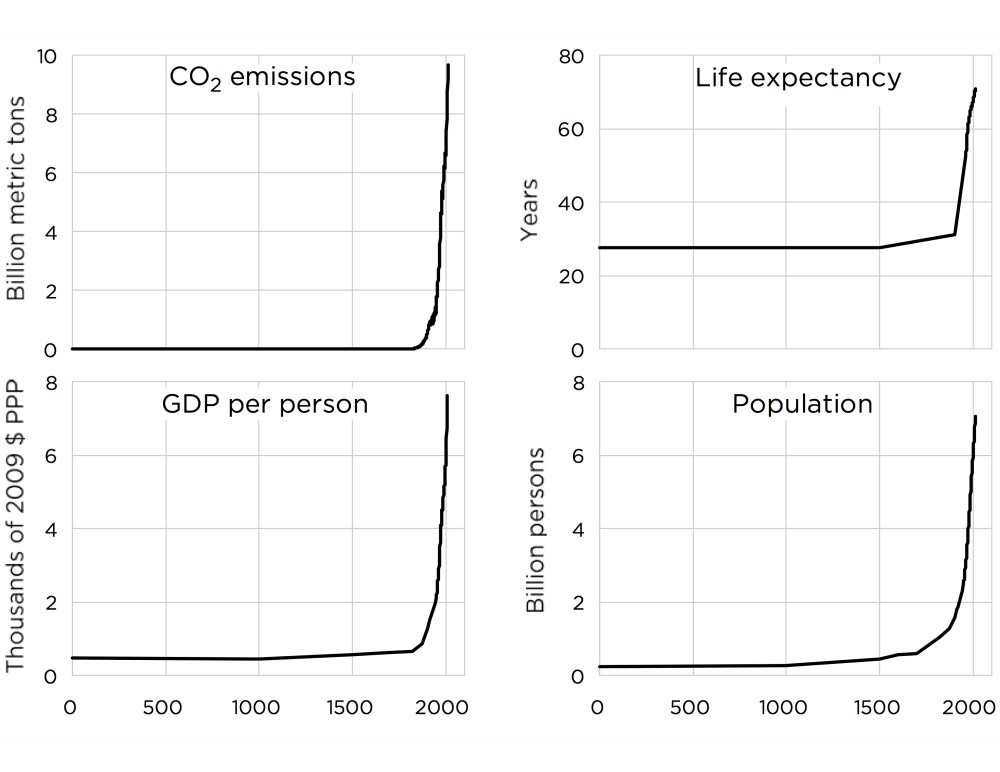
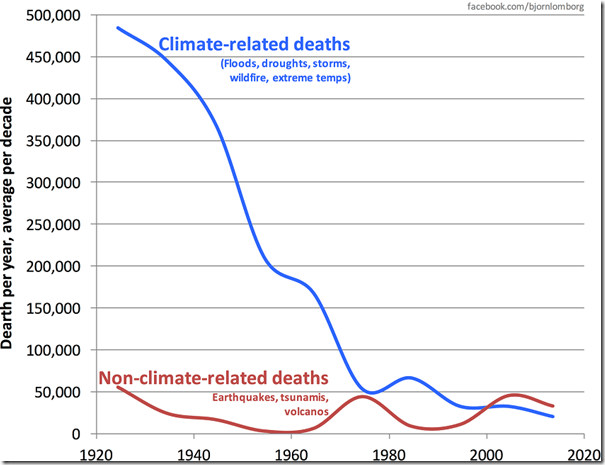
The greatest flourishing of human well-being ever as the globe warmed by 1.3 degrees. And the kicker of course is that the death rate from extreme weather events fell by a factor of 50, due to better prediction, better resilience of infrastructure, and so on. So to think that another 1.3 or 1.4 whatever degrees over the next century is going to significantly derail that beggars belief.
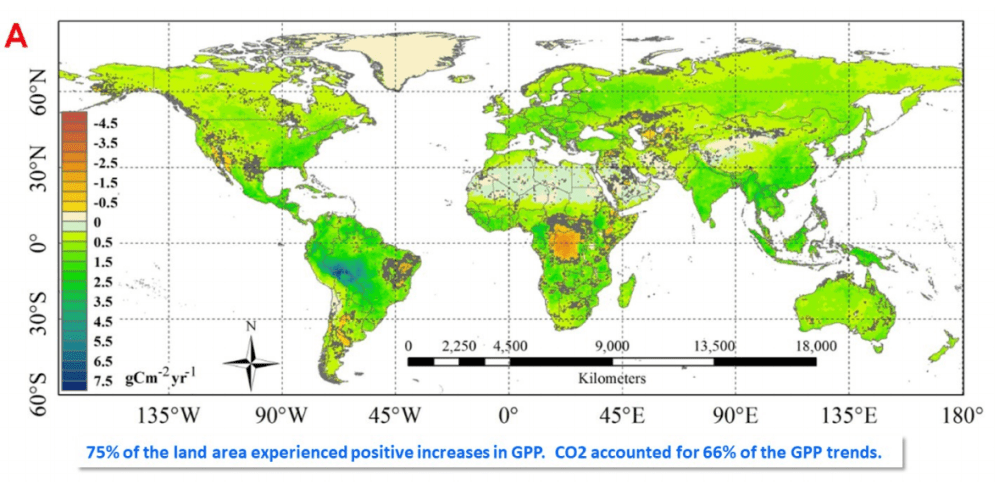
Okay so not an existential threat perhaps some drag on the economy a little bit; the IPCC says not very much at all. So the notion that the world is going to end unless we stop Greenhouse Gas Energy is just nonsense. This is not a mutual suicide pact, not at all.
PR: On August 16th of last year a year ago President Biden signed legislation that included some 360 billion of climate spending, at least the Biden Administration claimed it was climate spending over the next decade. President Biden:
“The American people won and the climate deniers lost and the inflation reduction act takes the most aggressive action to combat climate change ever.”
Curiously enough, they called it the inflation reduction act while it seems to have prompted inflation rather than reduced it. Good legislation or not?
SK: It would be if it focused on useful adaptation, but it’s aimed at mitigation by and large, namely reducing emissions. I think there are parts of it that are good in particular the spur to innovate. New technologies are the only way we’re going to reduce emissions if that is the goal. We need to develop Energy Technologies that are no more expensive than fossil fuels technologies
PR: But our low emission or zero emission goals? Let’s take that one. Because here I have the Provost of Caltech, let’s ask what tech what we can reasonably hope and what we cannot reasonably hope. Can we reasonably hope you and I are talking after 10 days after the internet went crazy with some claim of cold fusion, no it was room temperature superconductivity. Is this a problem we can crack?
SK: So I think it’s going to be really difficult there is one existing solution and that’s nuclear power fission right we know about Fusion separately Fission exists yes uh it can be done right; it’s more expensive than other methods, because of the regulatory order and it’s got a large lead time, but also because at least in the U.S we build every plant to a custom design. So one of the things I helped catalyze when I was in the department of energy was small modular reactors. These are about a tenth the size of the big ones, you can build them in a factory put them on a flatbed truck and this is not a crazy dream. Venture money is going on and there are companies that are on the verge of putting out a test deployment of of commercially constructed power plants.

So why isn’t John Kerry going to one of these hot new startups and doing a photo shoot? I don’t follow Ambassador okay, but you know the nuclear word that is a political hot potato in some quarters. Not to get too much into politics, but I think there is a faction of the left wing that just sees that as anathema and not a solution at all. Meanwhile the Chinese are doing it.
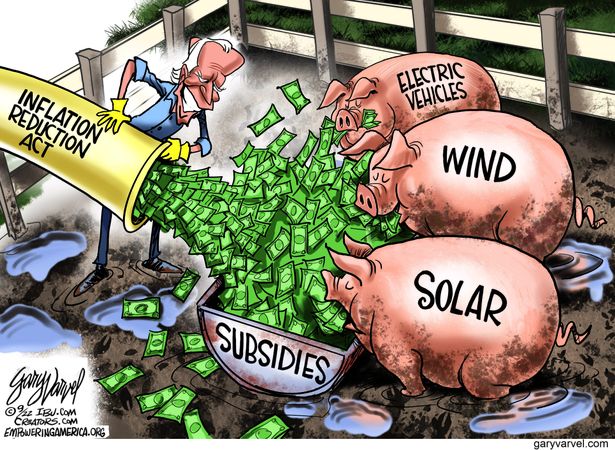
So I like the technology parts of the IRA I do not like the subsidies for wind and solar. One of the things you didn’t mention was I was Chief scientist for BP the oil company for five years. So I learned the energy industry. I never had to make any money in it, but I helped to strategize and kind of systematize thinking for them. So I know from the inside about subsidies to solar and wind. Everybody thinks that’s a solution, but of course wind and solar are intermittent sources of electricity: solar obviously doesn’t produce at night or when it’s cloudy, wind does not produce when the wind doesn’t blow. If you’re going to build a grid that’s entirely wind and solar you better have some way of filling in the times when they’re not producing.
Now if it’s only eight hours or 12 hours you’re trying to fill in, not so hard you can build batteries and so on. But if you need to fill in a couple weeks such as times in Europe, Texas and California when the wind has become still and the solar is clouded out. So you need something else right and that might be batteries although I think that’s unlikely. Gas with carbon capture or nuclear is going to be at least as capable as the wind and solar and since the wind and solar feeds are the cheapest the backup system is going to be more expensive, so you wind up running two parallel systems making electricity at least twice as expensive.

So I say that wind and solar can be an ornament on the real electrical system
but they can never be the backbone of the system.
Let me explain the biggest problem in trying to reduce emissions is not the one and a half billion people in the developed world; it’s the six and a half billion people who don’t have enough energy. And you’re telling them that because of some vague distant threat that we in the developed world are worried about, that they’re going to have to pay more for energy or get more less reliable sources. They should be able to make their own choices about whether they’re willing to tolerate whatever threat there might be from the climate versus having round-the-clock lighting, having adequate Refrigeration, having transportation and so on. Millions of people in India, six and a half billion people worldwide right absolutely they’re energy starved.
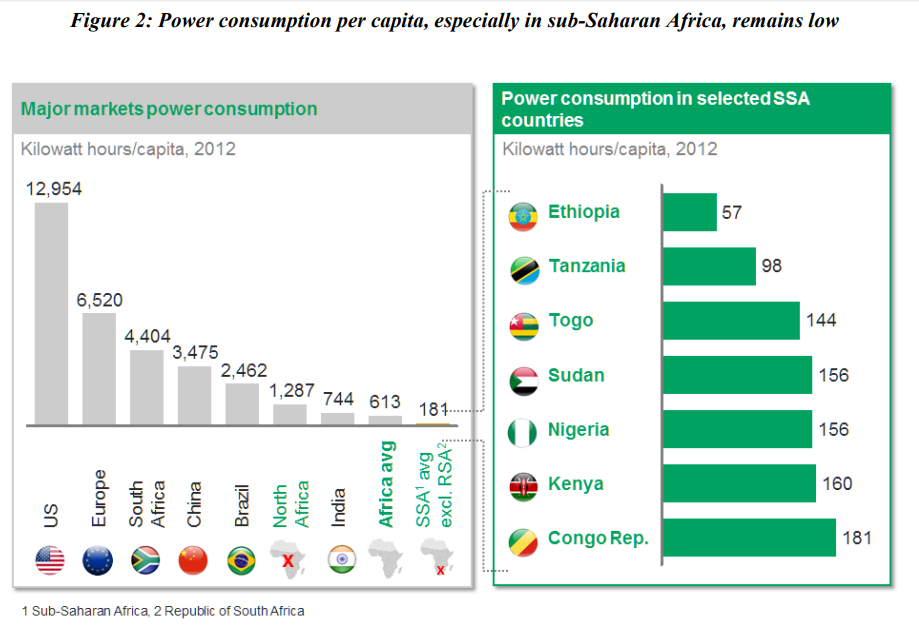
Three billion people on the planet of the 8 billion use less electricity every year than the average U.S refrigerator. So first fix that problem, which is existential and immediate and solvable, and then we can talk about some vague climate thing that might happen 50 years from now.
But scientists must tell the truth, absolutely completely lay it all out,
and we’re not getting that out of the scientific establishment.
PR: Unsettled has been out for more than two years now how have your colleagues responded?
SK: Many colleagues who are not climate scientists say thanks for writing the book it gives me a framework to think about these things and points me to some of the problems that we’re seeing in the popular discussion. I got some rather awful reviews from mainstream climate scientists which disappointed me. Not because they found anything wrong in the book, they didn’t. But the quality of the discussion, the ad hominem attacks, the putting words in my mouth and so on, that wasn’t so good. Their argument was, Steve Koonin you’re one of us ; you shouldn’t be saying this. It may be true but you shouldn’t be saying it. Steve how could you?
First of all I’ve been involved in science advice in other aspects of public policy particularly National Defense together with some Stanford former colleagues now passed on. And I was taught that you tell the whole truth and you let the politicians make the value judgments and the cost Effectiveness trade-offs. My sense of that balance is no better than anybody else’s, but I can bring to the table the scientific facts. If you trust democracy, you trust people to elect politicians who can over time make a mistake here, they’ll make a mistake there.
But over time you trust them. Now there are colleagues who say: No don’t tell them the truth we can’t trust them to make the right decision. That’s fundamentally what’s going on. I know scientists who know better than everybody else, and you know it’s even worse because these are scientists in the developed world. And if you ask the scientists in Nigeria or India and so on, you get a very different values calculus, that the primary concern is getting enough energy for folks.

PR: According to a Harris poll in January 2022 a little over a year year and a half ago now 84% of teenagers in the United States agree with both of the two following statements. they agree with:
♦ Climate change will impact everyone in my generation through Global political instability.
♦ If we don’t address climate change today it will be too late for future Generations making some parts of the planet unlivable.
John Kerry, Al Gore, Greta Thunberg and on and on, and countless voices warning that climate change represents a genuine danger to life on the planet. And now millions of Young Americans are really scared. Surely this has some role to play in what we see the the suicidal ideation and the increasing unhappiness.

SK: I’m sure there are all kinds of social factors but surely this is part of what’s going on. There are two immoralities here. One is the immoral treatment of the developing World which we talked about. The other immorality is scaring the bejesus out of the younger generation. And it’s doubly dangerous because it’s mostly in the west and not in China or India. I’ve tried. I go out and talk in universities and of course the audiences I talk to tend to be quantitative and factually driven. So the minds get opened up if the eyes get opened up.
I think in the U.S the problem will eventually solve itself because the route we are headed down is starting to impact people’s daily lives. Electricity is getting more expensive, you won’t be able to buy an internal combustion car in 10 or 15 years. If you’re here in California, people are going to say wait a second, as they already are in Europe, in UK , Germany, France. And I think there will be a falling down to Earth of all of this at some point and we will get more sensible.
PR: Let’s say your audience now is not a colleague of yours but is an 18 to 24 year old American pretty bright, maybe in college maybe not, but bright. Reads newspapers or at least reads them online. Speaking to that person speaking to an American kid or young adult: Do you need, do they need to be scared?
SK: No absolutely not. I would quote the 1900 to now flourishing as an example. And I would say, you probably believe that hurricanes are getting worse, and then point them to the IPCC line. And say you know you were misinformed about that by the media, don’t you think that there are other things about which you’ve been misinformed. You can read the book and find out many of them, and then go ask your climate friends how come it says one thing in the IPCC report but you’re telling me something else.

Vic Hughes explains in his American Thinker article The Blunt Truth about Global Warming Models. Excerpts in italics with my bolds and added images.
I may be one of the first scientists in the country to know that
predicting long-term temperatures is not possible.
Almost 50 years ago, while in grad school, I had a contract from an Army research lab to use a state-of-the-art models to predict long-term temperatures. I quickly realized that the goal of the project, to forecast accurately the temperature long-term, was impossible because small errors in data inputs could result in huge forecasts errors. Equally important was that errors compounded so quickly that it caused the error ranges to explode. The results were junk.
As an example, what good is a temperature forecast with an error range
of plus or minus one hundred degrees?
I give university speeches to scientists and tell them: if you ever see some data or forecasts, your first question has to be “what’s the error range?” If you don’t know the error range, the data are almost useless. It’s not coincidental that the Climate Mafia don’t highlight this problem
So what about modern technology solving these problems? These error problems are still true today. It’s not that the long-term temperature forecasts are wrong; it’s that they can’t be right. All global warming modelers know this, or they are incredibly stupid, or they just lie about it for money or power.
When the U.N. Intergovernmental Panel on Climate Change made even a pretense of being science-based, they used to admit it. From the 2001 IPCC Third Assessment Report:
“The climate system is a coupled non-linear chaotic system, and therefore
the long-term prediction of future climate states is not possible.”
The weather is a coupled, non-linear chaotic system. Chaos theory says very small changes in inputs can result in totally different outcomes. This concept is counterintuitive for most people. We intrinsically think that if you’re a little off at the beginning, you should be a little off at the end. Try that on a mountain trail next to a cliff.
The Climate Mafia know that this is true, but they still want money and power. They argue that even though you can’t make a real temperature forecast, they can create a completely bogus forecasting approach, where they take a bunch of different climate models that don’t agree (so much for settled science) and combine their outputs. They then say voilà: we have a correct prediction, and they use pseudo-statistics to get around the error problem. The way I visualize it is, if you take a bunch (an ensemble sounds more scientific) of wrong answers and then combine them, that is the right answer. Absurd.

Since your input data are critical to forecasting the Chaotic Future, fully understanding past temperatures is also critical. The Climate Mafia create the entirely bogus concept of an “average Earth temperature” to create a bogus base data set for their bogus models. The Warming Scammers like to use a garbage temperature history that starts about 1850. The Scammers say that their temperatures increased since 1850, just coincidentally at the end of a three-hundred-year cooling cycle, represent the rise of the industrial pollution age. In 1850, and even in 1950, only a small percentage of world’s population could even be considered close to industrialized. Look at India, Africa, and China then: almost medieval energy use patterns until really recently. Humans have been around in their current form for many tens of thousands of years. To say the weather since the 1850s is representative of anything from a statistical perspective is a joke.
So what kind of temperature data do we have since 1850?
With oceans and ice caps covering over 80+% of the world’s surface, we have virtually no reliable long-term data on any of that, other than the last few decades. Even then, you are talking about a relatively small number of measuring devises in all those places. (Do you check the weather a few hundred miles away to know if you need an umbrella?) How about the temperature trends in deserts, on mountains, in the middle of Africa, South America, Siberia — at sea level, a hundred feet elevation, a thousand feet elevation? The data are so bad in all of the Southern Hemisphere — half the globe — that there are only a few datasets even close to reliable since the 1850s. There are almost no real, reliable, and complete long-term data globally, and particularly none reliable enough to create model of a chaotic system entirely dependent on very accurate input data.
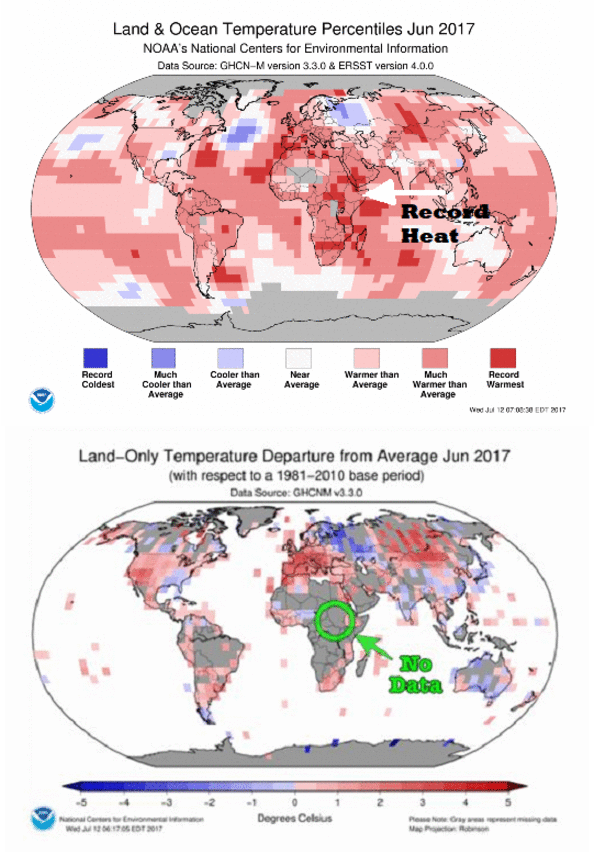
The concept of “average Earth temperature” is critical to their bogus forecasting, but because we think “average” generally means something useful, it gets a mental pass. As an example, describe the “average” human.
Let me offer a thought experiment. What is the average temperature
of your house within one degree?
How many sensors, with what degree of accuracy reading the temperature, how often, would you need to know the average temperature within one degree? One sensor won’t do it. Would ten sensors (a hundred? a thousand?) be needed to cover the ceilings, floors, six feet up, each corner of every room, near every doors and window and heat source, measuring the temperature every hour, minute, second for a period of years, to get an average temperature within one degree? How do you weight a gauge in a big room versus a small one, or in the ceiling versus the floor?
If we can’t even figure out the long-term average temperature of one building, it is complete hubris to think we can create accurate enough global temperature inputs to predict 100 years out.
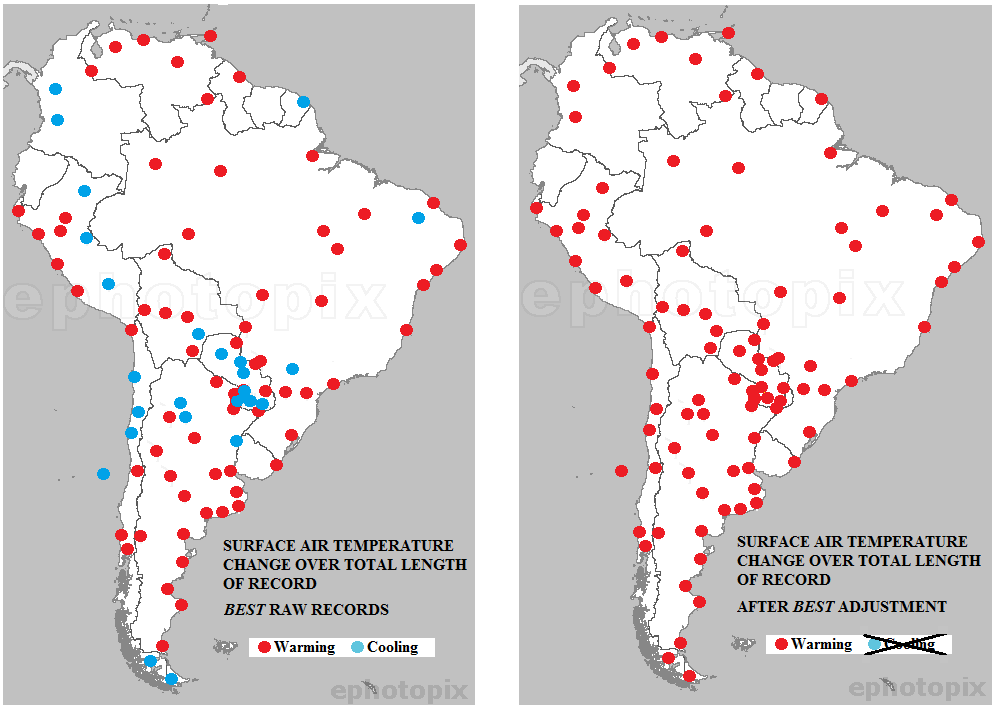
I won’t even get into outright data fraud, like lowering the hot 1930s or selectively changing input locations to make the current temperatures look hotter. The data are bad enough on their own. Using faulty data to predict the future creates faulty forecasts. Garbage in, garbage out.
Perhaps the greatest part of the Global Warming Scam is that it requires a complete disregard for common sense. We all know that weather forecasters can’t predict next week’s weather within 1 degree, but the Scammers push the lie that they can predict the temperature a hundred years from now within a degree or two. That literally defies credulity.
More importantly, say you had perfect data and a perfect model. How could we possibly know what impact that will have? Another thought experiment: How much will temperatures vary where you live today? Ten degrees? Twenty degrees? Thirty? How much does it vary in a year? For most of the U.S., that number might be 50 degrees, a 100 degrees. So plants and animals have adapted to 20-degree temperatures changes in a day or 100-degree temperature changes in a year.
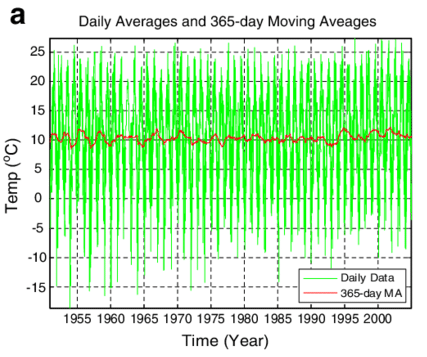
Daily average temperature variability of Bolu City, Turkey, and its 365-day moving average.
Somehow a 1- or 2-degree temperature change in a hundred years
is going to take them out? That’s ridiculous.
Finally, when somebody offers me a forecast, my first question is, how right have your other forecasts been? We are now in the third or fourth ten-year period of the last forty years when the world is going to end in ten years. That tells you all you need to know about global warming forecasting.
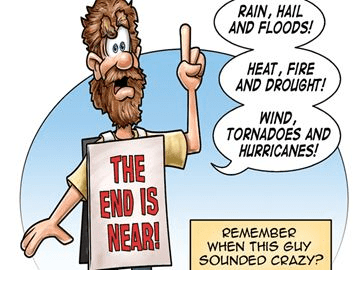
The fact that any counter-narratives have to be censored is also damning. A final fact to consider is one my mother taught me at a young age: when the other side starts calling you names (deniers, anti-vaxxers), you know they have lost the argument.
And yet we should totally restructure society based on those impossible models. This was probably the greatest scientific lie in history, and people believed it. After that, selling the lie that even though mRNA vaccines have never worked in thirty years and generally killed all their test subjects but are now safe and effective for humans, including babies, after two months of limited testing, is child’s play. Joseph Goebbels, a proponent of the “Big Lie,” would be proud about both lies.
Before we restructure the world based on models, we must realize they can’t be right.
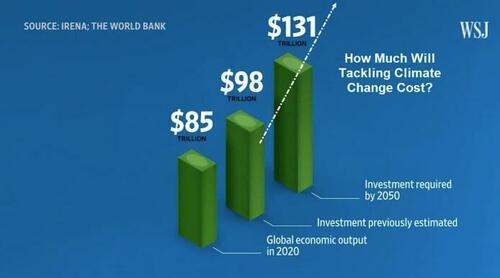
The blue background obscures these are estimates of TRILLIONS of Dollars.
A lot of people diss Trump for his Warp Speed project. It’s true that he was victimized as were we all by Fauci, Birx and the others forcing mRNA shots on us. Overlooked is that fact that one real Covid vaccine resulted from that project, though it took longer because actual vaccines involve a rigorous process. As explained below, the jabs from Pfizer, Moderna and the others meet all the elements defining a gene therapy treatment, and none of the elements defining a vaccine: most notably that a vaccine prevents a virus from making you ill or a transmitter.
Now that the covidians are starting to hype the Eris variant as a reason for more shots and draconian restrictions, it’s good to know there is an option to injecting more experimental genetic material into your body.
Novavax’s updated COVID-19 vaccine candidate shows promise against emerging subvariants
Novavax has announced that its updated protein-based COVID-19 vaccine candidate induced neutralising responses against emerging subvariants, including ‘Eris’, in animal studies.
COVID-19 infections and hospitalisations have been on the rise in the US, Europe and Asia, and a growing number of cases have been attributed to the EG.5 subvariant, dubbed ‘Eris’.
The fast-spreading strain, which is another descendant of Omicron, was classified as a ‘variant of interest’ by the World Health Organization earlier this month and its global incidence is increasing.
For the fall season, COVID vaccine makers are gearing up with updated shots that target the omicron subvariant XBB.1.5. Both Moderna and Pfizer have said their shots show promise against Eris too.
As well as EG.5.1, Novavax’s XBB candidate has also been shown to generate immune responses against XBB.1.16.6, and XBB.1.5, XBB.1.16 and XBB.2.3 subvariants.
The company outlined that it is “in the process” of submitting applications for its XBB.1.5 COVID-19 vaccine candidate to regulatory authorities globally.
If approved, the vaccine would be the only protein-based non-mRNA option available in key markets for autumn vaccination campaigns.
Last month, Novavax’s COVID-19 vaccine, Nuvaxovid, was granted full marketing authorisation in the EU for use as a primary series in individuals aged 12 years and older, and as a booster dose in adults aged 18 years and older.
The protein-based vaccine, which was originally granted a conditional marketing authorisation in the EU for these indications, contains the SARS-CoV-2 spike protein and Matrix-M adjuvant to enhance immune response and stimulate high levels of neutralising antibodies.
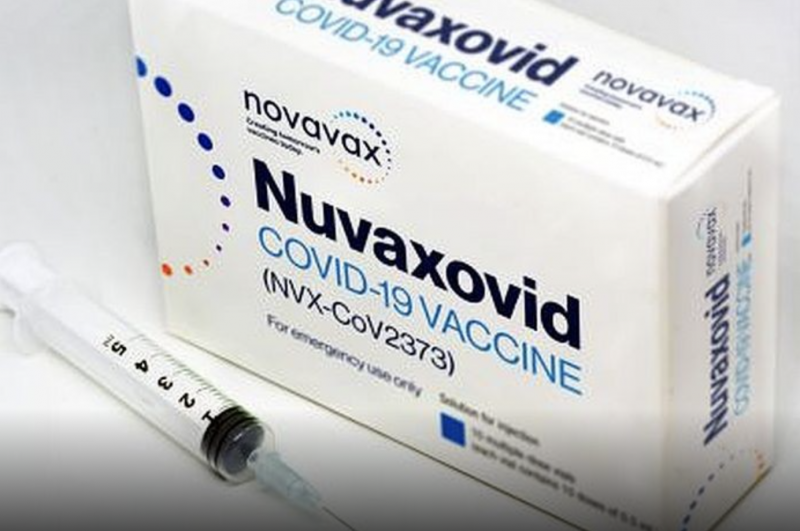
Ok, my hand was forced because we booked a transatlantic cruise for November, after which the company informed us proof of a Covid booster shot would be required to board the ship in Civitavecchia (Rome). My blood test last December showed plenty of antibodies and I’ve tested negative for Sars CV2 many times. For reasons described later on, I do not want more gene therapy experimentation in my body. Fortunately, Novavax is now approved and available, and I got boosted with a real vaccine shot yesterday in Montreal where I live.
How is Novavax different than the other COVID-19 vaccines in the U.S.?
Though COVID vaccines may utilize different delivery mechanisms, the end result is the same: cells in the body recognize that a spike protein (the spikes you see sticking out of the coronavirus in pictures) doesn’t belong, and the immune system reacts by activating immune cells and producing antibodies to attack the real virus if you get exposed.
But, unlike the other vaccines, Novavax directly injects a version of the spike protein, along with another ingredient that also stimulates the immune system, into the body, leading to the production of antibodies and T-cells. (It injects a version of the spike protein that has been formulated in a laboratory as a nanoparticulate that does not have genetic material inside and cannot cause disease.)
“I often tell people, imagine an eggshell without an egg in it. That’s what it is,” Dr. Wilson says.
The Novavax vaccine is a traditional one compared to the other vaccines. Its technology has been used before in vaccines to prevent such conditions as shingles, human papillomavirus, and DTaP (diphtheria, tetanus, and pertussis), among others.
Has the Novavax vaccine been authorized outside of the U.S.?
Yes. The Novavax coronavirus vaccine (brand names: Nuvaxovid and Covovax) is already being used to prevent the coronavirus in 40 other countries, including Canada.
Novavax is based in Maryland, and the vaccine was developed in the U.S. in 2020 with support from the federal government program Operation Warp Speed, but it’s progress was slowed by manufacturing difficulties. Finally, in November 2021, countries around the world, starting with Indonesia and the Philippines, later followed by the United Kingdom, began granting authorizations for the vaccine.
Novavax applied to the FDA for authorization in January of this year.
Europe Approves Novavax’s COVID-19 Vaccine Booster For Adults
My discomfort with mRNA shots is multiple: The trial data from Pfizer and Moderna is still being withheld; the trial period was too short to reveal any long-term side effects; the companies were given total immunity from liability for damage to people injected with their products. And, they unscrupulously trashed effective generic viral treatments like Hydroxychloroquine and Ivermectin to protect their vaccine payday. A more detailed analysis is below.
From Joseph Mercola writing at Bright Health News COVID-19 ‘Vaccines’ Are Gene Therapy Excerpts in italics with my bolds.
Not a vaccine in the medical definition, the COVID-19 ‘vaccine’ is really an experimental gene therapy that does not render immunity or prevent infection or transmission of the disease.
♦ mRNA “vaccines” created by Moderna and Pfizer are gene therapies. They fulfill all the definitions of gene therapy and none of the definitions for a vaccine. This matters because you cannot mandate a gene therapy against COVID-19 any more than you can force entire populations to undergo gene therapy for a cancer they do not have and may never be at risk for
♦ mRNA contain genetic instructions for making various proteins. mRNA “vaccines” deliver a synthetic version of mRNA into your cells that carry the instruction to produce the SARS-CoV-2 spike protein, the antigen, that then activates your immune system to produce antibodies
♦ The only one benefiting from an mRNA “vaccine” is the vaccinated individual, since all they are designed to do is lessen clinical symptoms associated with the S-1 spike protein. Since you’re the only one who will reap a benefit, it makes no sense to demand you accept the risks of the therapy “for the greater good” of your community
♦ Since mRNA “vaccines” do not meet the medical and/or legal definition of a vaccine — at least not until the CDC redefined “vaccine” — marketing them as such is a deceptive practice that violates the law that governs advertising of medical practices
♦ SARS-CoV-2 has not even been proven to be the cause of COVID-19. So, a gene therapy that instructs your body to produce a SARS-CoV-2 antigen — the viral spike protein — cannot be said to be preventive against COVID-19, as the two have not been shown to be causally linked
Illegal to Promote mRNA Products without Evidence of Safety and Effectiveness
The lack of completed human trials also puts these mRNA products at odds with 15 U.S. Code Section 41. Per this law,[13][14] it is unlawful to advertise “that a product or service can prevent, treat, or cure human disease unless you possess competent and reliable scientific evidence, including, when appropriate, well-controlled human clinical studies, substantiating that the claims are true at the time they are made.”
Here’s the problem: The primary end point in the COVID-19 “vaccine” trials is not an actual vaccine trial end point because, again, vaccine trial end points have to do with immunity and transmission reduction. Neither of those was measured.
What’s more, key secondary end points in Moderna’s trial include prevention of severe COVID-19 disease (defined as need for hospitalization) and prevention of infection by SARS-CoV-2, regardless of symptoms.[15[16] However, Moderna did not actually measure rate of infection, stating that it was too “impractical” to do so.
That means there’s no evidence of this gene therapy having an impact on infection, for better or worse. And, if you have no evidence, you cannot fulfill the U.S. Code requirement that states you must have “competent and reliable scientific evidence … substantiating that the claims are true.”
Making matters worse, both Pfizer and Moderna eliminated their control groups by offering the real vaccine to any and all placebo recipients who want it.[17] The studies are supposed to go on for a full two years, but by eliminating the control group, determining effectiveness and risks is going to be near impossible.
Here, it’s worth noting that there are many different treatments that have been shown to be very effective against COVID-19, so it certainly does not qualify as a disease that has no cure. For example, research shows the antiparasitic ivermectin impairs the SARS-CoV-2 spike protein’s ability to attach to the ACE2 receptor on human cell membranes.[19]
It also can help prevent blood clots by binding to SARS-CoV-2 spike protein. This prevents the spike protein from binding to CD147 on red blood cells and triggering clumping.[20]
It makes sense, then, that gene therapy should be restricted to incurable diseases, as this is the only time that taking drastic risks might be warranted. That said, here’s how the U.S. Food and Drug Administration defines gene therapy:[21]
“Human gene therapy seeks to modify or manipulate the expression of a gene or to alter the biological properties of living cells for therapeutic use. Gene therapy is a technique that modifies a person’s genes to treat or cure disease. Gene therapies can work by several mechanisms:
I’ve written many articles detailing the potential and expected side effects of these gene therapy “vaccines.”
The take-home message here is that these injections are not vaccines. They do not prevent infection, they do not render you immune and they do not prevent transmission of the disease. Instead, they alter your genetic coding, turning you into a viral protein factory that has no off-switch. What’s happening here is a medical fraud of unprecedented magnitude, and it really needs to be stopped before it’s too late for a majority of people.
If you already got the vaccine and now regret it, you may be able to address your symptoms using the same strategies you’d use to treat actual SARS-CoV-2 infection. And, last but not least, if you got the vaccine and are having side effects, please help raise public awareness by reporting it. The Children’s Health Defense is calling on all who have suffered a side effect from a COVID-19 vaccine to do these three things:[32]
Footnote:
Quebec, where I live, will make Novavax available starting again in September.
A lesson from Canada on how the left uses insults about trivia to disract from all the damage done by their misguided policies. The photo above comes from a Star article: Justin Trudeau’s Liberals see lowest approval rating since they formed government, poll shows. Brief excerpt below
Ottawa, August 9, 2023– Justin Trudeau may have shaken up the Liberals’ front bench, but a new poll suggests he remains on shaky ground with voters.
Results from a new Abacus Data survey provided exclusively to the Star suggests that if an election were held today, 37 per cent of Canadians would vote Conservative, compared to 28 per cent for the Liberals.

So how do Trudeau’s press lapdogs at the subsidized CBC respond: Pierre Poilievre drops the glasses as part of an image revamp. And the acid is thrown by Tristin Hopper at the National Post: Nice try pretending you’re not a poindexter’: Inside the thoughts of Poilievre’s discarded glasses. Some excerpts of the poison:
Dear Diary: ‘Unfortunately for me, mainstream Canadian women voters apparently like
politicians who conceal their need for corrective vision appliances’

OK, these are those nice Canadians after all. They’re not dropping indictments on the Conservative or blaming him for wildfires. Still, like journos on the extreme left everywhere, they label the Conservative as Alt-Right, dangerous and irresponsible. But what are they covering up while ignoring the deep, growing unpopularity of this regime?
Here’s a hint from that same issue of National Post: Liberal net-zero scheme heralds dark era of ever-growing government. Excerpts in italics with my bolds and added images.
Minister of Environment and Climate Change Steven Guilbeault speaks to media in Toronto on Aug. 10, 2023. PHOTO BY ARLYN MCADOREY / THE CANADIAN PRESS
The draft clean electricity regulations, released last week, serve as a warning that neither the provinces nor industry nor common sense will stand in the way of the federal government’s commitment to meeting the radical emissions targets agreed to in Paris in 2015. Whether the Liberals will successfully force power grids to achieve net zero by 2035 is far from certain, but one thing seems clear:
The climate agenda has put the final nail in the coffin of deregulation.
Big government is here to stay.

The draft regulations were immediately attacked by the premiers of Alberta and Saskatchewan as being “unconstitutional” and “unachievable.” Although there have been varying estimates of how much the transformation will cost — with Environment Minister Steven Guilbeault disingenuously claiming Canadians will save money by switching away from fossil fuels (which his carbon tax has artificially inflated in price) — there can be little question that it would be an expensive undertaking for the Prairie provinces.

Unlike British Columbia, Manitoba, Quebec and Newfoundland, they are not endowed with the geographical features that permit an abundance of hydroelectricity. Nor do they have a legacy of nuclear power, like Ontario does. Saskatchewan currently relies on fossil fuels for more than three-quarters of its electricity supply.
Alberta also relies heavily on fossil fuels, but is considerably greener than a decade ago. The province had planned to phase out coal generation by 2030, but has managed to make the transition ahead of schedule (something that’s almost unheard of in government), with its last coal plant due to be decommissioned later this year.
Lost in all this is any discussion of fostering competitive markets to spur innovation and bring down prices, or of limiting the size and scope of government. In the 1970s and early ’80s, governments were faced with many of the same challenges as they are today: inflation was rampant, economies were stagnating and crime was a blight on many cities. This spurred a wave of deregulation in many western countries, including Canada, which opened up sectors such as telecom and air travel, driving down prices, increasing choice and reinvigorating the economy.
In this country, both Alberta and Ontario experimented with electrical deregulation, with varying degrees of success. Ontario’s competitive market opened in 2002, but was short-lived, with the government quickly succumbing to political pressure over rising prices that were largely caused by unrelated factors. Alberta also caved to pressure that resulted in numerous market interventions before prices had time to stabilize, but was largely successful at creating a competitive electrical generation market and giving consumers some choice on the retail side.
But a competitive market is antithetical to the type of overbearing control
the Trudeau Liberals are looking to exert over electrical generation.
Not only will the new clean electricity regulations dictate what type of generators can be used, preventing companies and governments from striking a balance between the environment and affordability, they represent the latest change in a constantly shifting, and increasingly murky, set of environmental regulations that will only serve to scare away investors.

Not content to let the carbon tax incentivize market players to find ways to reduce emissions, the government has also imposed industry-specific emissions caps on oil and gas, introduced clean fuel standards, banned the sale of new gas-powered vehicles by 2035 and made it virtually impossible to build new energy infrastructure, all while giving tens of billions of taxpayer dollars to favoured industries to produce products demanded by governments, rather than consumers.

Ottawa’s ever-changing rules do not provide the type of stability businesses need to make long-term investments — not just in energy and electrical generation, but in other sectors of the economy, as well. This is likely one of the reasons why Canada has seen a sharp decline in gross business investment since the Liberals took office in 2015.

The contemporary push to displace competitive markets with central planning comes at a time in which clear price signals could serve an important role in the energy transition. Many Canadian households and small businesses are charged for electricity based on the time of day, with prices dropping overnight and hitting a peak in the afternoon or early evening. But those traditional time-of-use patterns are quickly changing, and governments have significant concerns about the coming influx of electric vehicles overloading the grid.
Instead of harnessing the power of competitive markets as a force for good, however, the Liberals have chosen to increase the size of centralized bureaucracies and dictate how individuals, businesses and even other levels of government conduct their affairs. It’s a strategy that’s limiting individual freedom, subverting provincial autonomy, constraining the economy and making life increasingly unaffordable.
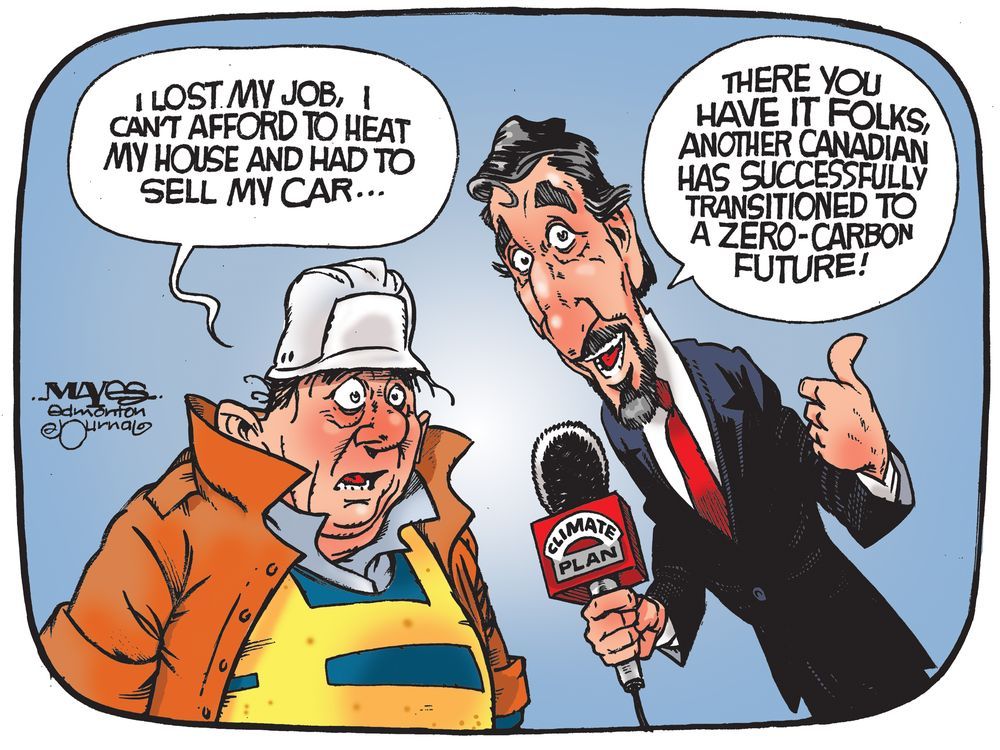
The notion that CO2 from human activities causes global warming has multiple flaws, many of which have been dissected and rebutted here and elsewhere. But The Big Lie is to fundamentally misrepresent how Earth’s climate system works. Richard Lindzen explains in the above interview with Jordan Peterson. For those who prefer reading I provide a transcript from the closed captions in italics with my bolds and added images.
JP: When you started to object to the narrative, back say in ‘92, To what narrative were you objecting and on what grounds were you objecting?
RL: You’re touching on something that took me a while to understand. You know Goebbels famously said: If you tell a big enough lie and repeat it often enough, it’ll become the truth. there’s been a lot of that in this. But there are aspects of establishing the narrative, that is, what makes something the truth that I hadn’t appreciated.
So the narrative was the climate is determined by a greenhouse effect
and adding CO2 to it increases warming. And moreover besides CO2
the natural greenhouse substances–water vapor, clouds, upper level clouds–
will amplify whatever man does.
Now that immediately goes against Le Chatelier’s principle which says: If you perturb a system and it is capable internally of counteracting that, it will. And our system is so capable.
So that was a little bit odd. You began wondering, where did these feedbacks come from? Immediately people including myself started looking into the feedbacks, and seeing whether there were any negative ones, and how did it all work?
But underlying it, and this is what I learned: if you want to get a narrative established, the crucial thing is to pepper it with errors, questionable things. So that the critics will seize on those and not question the basic narrative.

The basic narrative was that climate is controlled by the greenhouse effect. In point of fact the earth’s climate system has many regions, but two distinctly different regions. There are the tropics roughly minus 30 to plus 30 degrees latitude, and the extra Tropics outside of plus or minus 30 degrees.
They have very different dynamics, and this is the crucial thing for the Earth by the way. And this is a technicality and much harder to convey than saying that greenhouse gases are a blanket or that 97 percent of scientists agree.
This is actually a technical issue. The Earth rotates. Now people are aware that we have day and night, but there is something called the Coriolis effect. When you’re on a rotating system it gives rise to the appearance of forces that change the winds relative to the rotation. So at the pole the rotation vector is perpendicular to the surface, while at the equator it’s parallel to the surface:it’s zero.
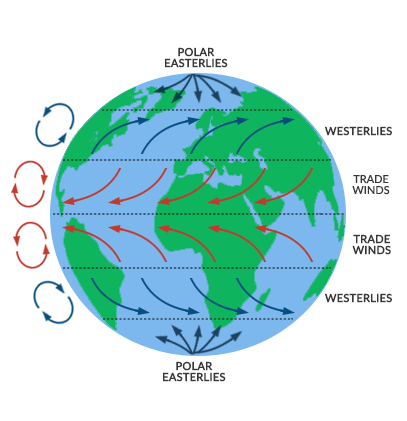
And this gives you phenomenally different Dynamics. So where you don’t have a vertical component to the rotation, vector motions do what they do in the laboratory in small scales. If you have a temperature difference, it acts to wipe it out.
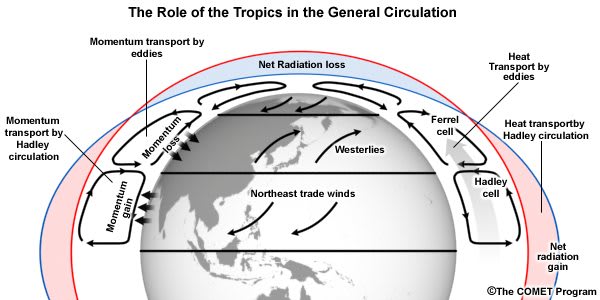
Figure 11. Most sunlight is absorbed in the tropics, and some of the heat energy is carried by air currents to the polar regions to be released back into space as thermal radiation. Along with energy, angular momentum — imparted to the air from the rotating Earth’s surface near the equator — is transported to higher northern and southern latitudes, where it is reabsorbed by the Earth’s surface. The Hadley circulation near the equator is largely driven by buoyant forces on warm, solar-heated air, but for mid latitudes the “Coriolis force” due to the rotation of the earth leads to transport of energy and angular momentum through slanted “baroclinic eddies.” Among other consequences of the conservation of angular momentum are the easterly trade winds near the equator and the westerly winds at mid latitudes.
And so if you look at the tropics the temperatures at any surface are relatively flat: they don’t vary much with latitude. On the other hand you go to the mid Latitudes, in the extra Tropics the temperature varies a lot between the tropics and the pole. We know that about how temperatures are cold at high Latitudes. And if you look at changes in climate in the Earth’s history, what they show is a Tropics that stays relatively constant, and what changes is the temperature difference between the tropics and the pole.

During the Ice Age it was about 60 degrees Centigrade, today it’s about 40. During 50 million years ago something called the eocene the difference was about 20. So that’s all a function of what’s going on outside the tropics. Within the tropics the greenhouse effect is significant but what determines the temperature change between the tropics and the pole has very little to do with the greenhouse effect.
It is a dynamic phenomenon based on the fact that a temperature difference with latitude generates instabilities. These instabilities take the form of the cyclonic and anticyclonic patterns that you see on the weather map. You can see the tropics are very different from even a casual look at a weather map.
The systems that bring us weather travel from west to east at latitudes outside the tropics. Within the tropics they travel from east to west. The prevailing winds are opposite in the two sections.
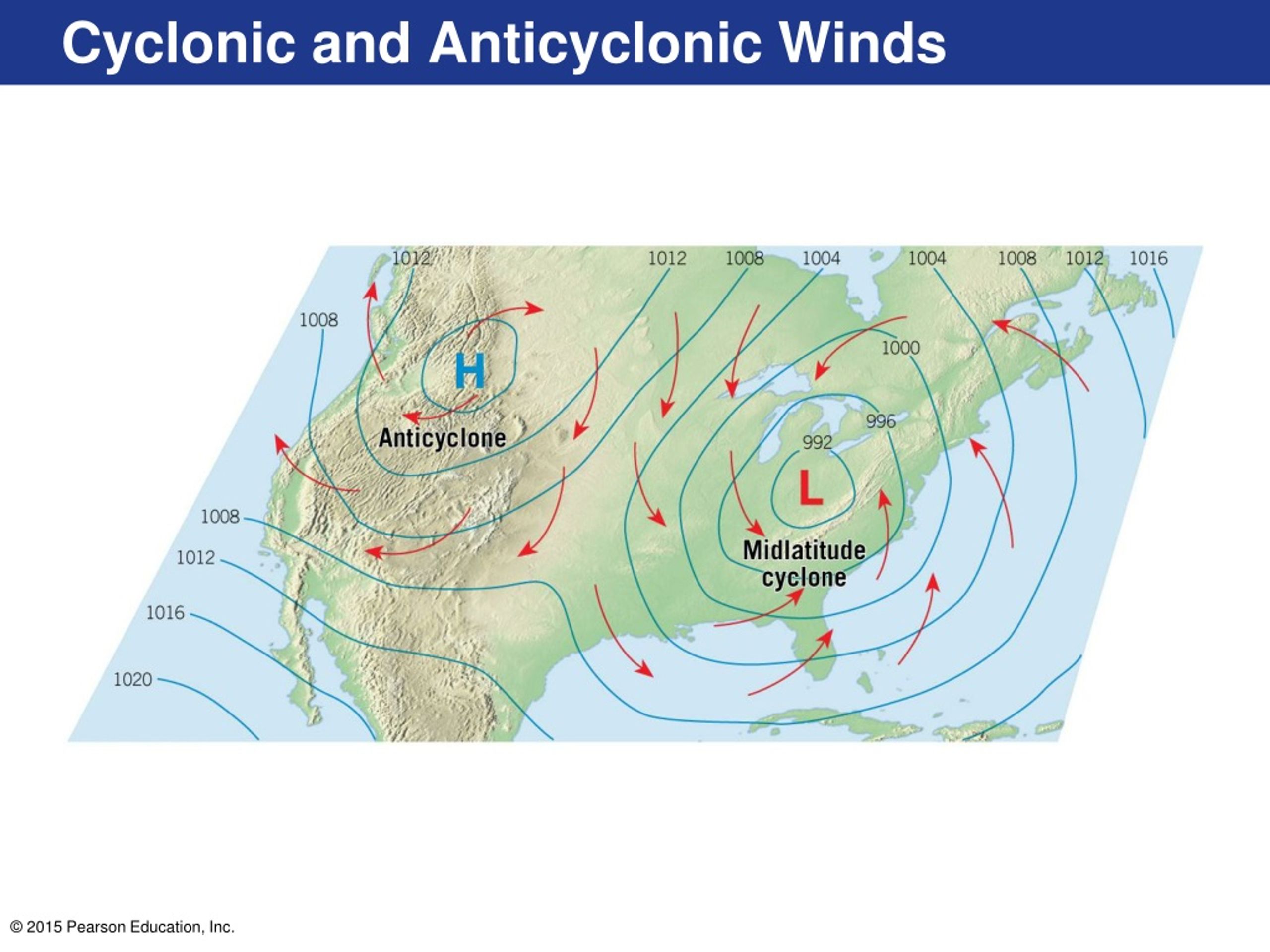
Sometimes people say that changes due to the greenhouse effect are amplified at the poles. That is not true: there’s no physical basis for that Statement. All they do is determine the starting point for where the temperature changes in mid-latitudes and that’s determined mainly by Hydrodynamics.
Okay that’s complicated to explain to someone and yet it’s the basis for those claims of seemingly large significance of these small numbers. You know they’re saying if Global mean temperature goes up one and a half degrees it’s the end. That’s based on it getting much bigger at high latitudes and determining that. But all one and a half degrees at the equator would do or in the greenhouse part of the Earth is change the temperature everywhere by one and a half degrees, which for most of us is less than the temperature change between breakfast and lunch.
See Also

 Science Matters