Arctic “Amplification” Not What You Think
HT to Dr. David Whitehouse writing at GWPF regarding a recent study claiming Arctic Amplification is causing a wavey polar vortex, resulting in winter warming and cooling extremes.  His critique is Extreme cold snaps and global warming: A speculative explanation.

This post is challenging the notion of Arctic Amplification itself.  The term is bandied about with the connotation that man-made global warming is multiplied in the Arctic and responsible for weather extremes.
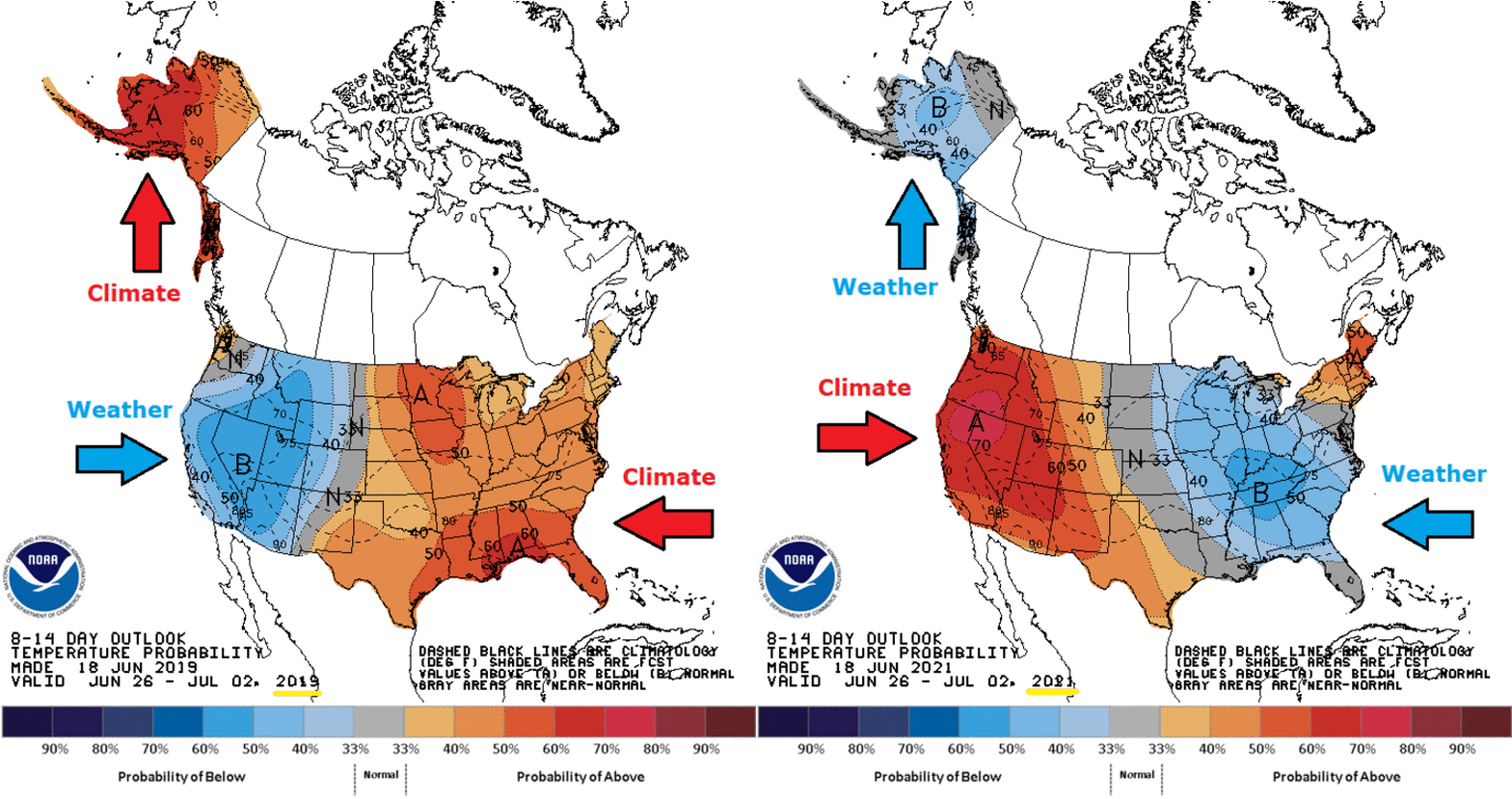
As the animation above shows, there have been in recent years alternating patterns of unusually cold or warm weather in the Northern Hemisphere.  There are several problems in the attempt to link these events to global warming/climate change, i.e. claiming causation from a slow increase in baseline global average temperatures.

  1. Arctic Amplification is an artifact of Temperature Anomalies
  2. Arctic Surface Stations Records Show Ordinary Warming
  3. Arctic Warmth Comes from Meridional Heat Transport, not CO2

Clive Best provides this animation of recent monthly temperature anomalies which demonstrates how most variability in anomalies occur over northern continents.

1. Arctic Amplification is an artifact of Temperature Anomalies

Beyond the issues with the measurements and the questionable adjustments, there is a more fundamental misconception about air temperatures in relation to “climate change.” Clive Best does a fine job explaining why Global Mean Temperature anomalies do not mean what people think. Below is my synopsis of his recent essay entitled Do Global Temperatures make sense? (link)

Background: Earth’s Heat Imbalance

ERBE measurements of radiative imbalance.

The earth’s temperature at any location is never in equilibrium. It changes daily, seasonally and annually. Incoming solar radiation varies enormously especially near the poles which receive more energy per day in summer than the equator.

The earth cools primarily by moving heat from hot tropical regions towards high latitudes where net IR radiation loss cools the planet, thus maintaining a certain temperature profile.

Key Point: GMT Anomalies Are Dominated by the Highest Latitudes

The main problem with all the existing observational datasets is that they don’t actually measure the global temperature at all. Instead they measure the global average temperature ‘anomaly’. . .The use of anomalies introduces a new bias because they are now dominated by the larger ‘anomalies’ occurring at cold places in high latitudes. The reason for this is obvious, because all extreme seasonal variations in temperature occur in northern continents, with the exception of Antarctica. Increases in anomalies are mainly due to an increase in the minimum winter temperatures, especially near the arctic circle. 

To take an extreme example here is the monthly temperature data and calculated anomalies for Verkoyhansk in Siberia. Annual temperatures vary from -50C in winter to +20C in summer. That is a seasonal range of 70C each year, and a year to year anomaly variation of ~8C is normal. The only global warming effect evident is a slight increase in the minimum winter temperatures since 1900. That is not due to any localised enhanced greenhouse effect but rather to an enhanced meridional heat transport. Temperatures in equatorial regions meanwhile have only ~4C seasonal variations, and show essentially no warming trend.

2. Arctic Surface Stations Records Show Ordinary Warming
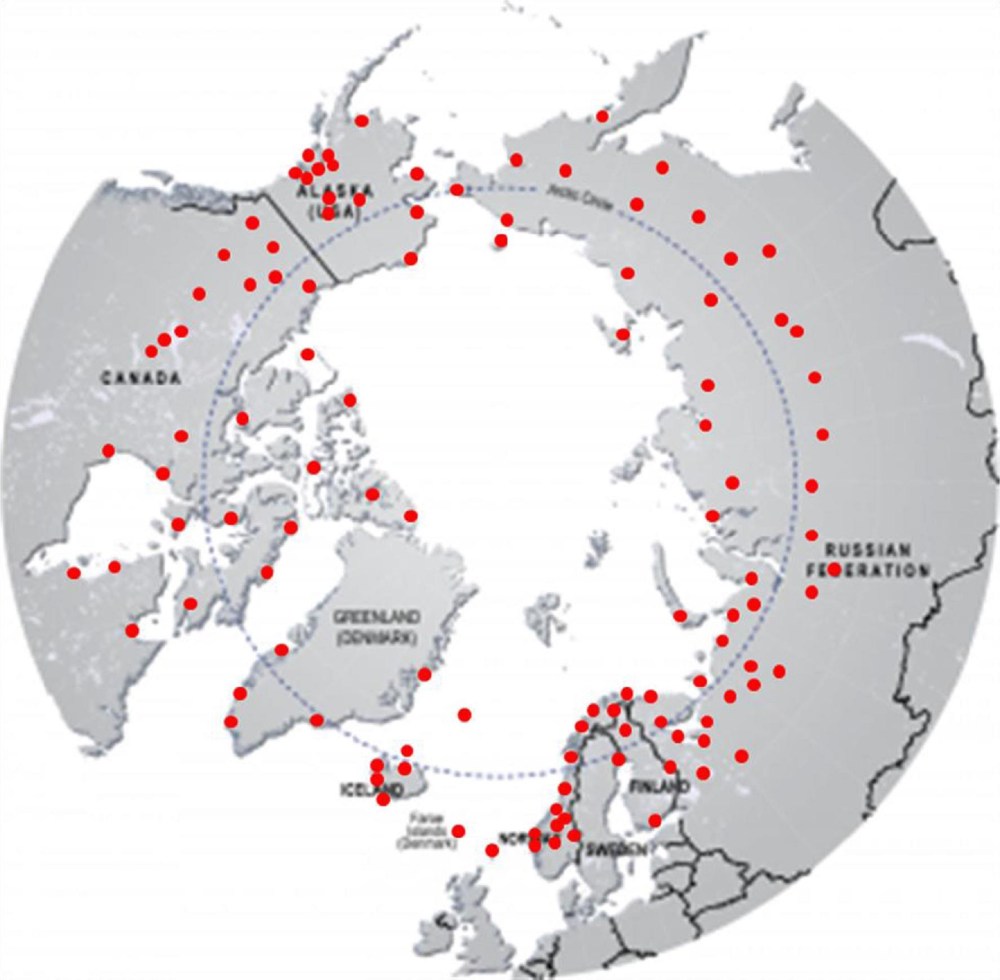
Locations of 118 arctic stations examined in this study and compared to observations at 50 European stations whose records averaged 200 years and in a few cases extend to the early 1700s

A recent extensive analysis of Northern surface temperature records gives no support for Arctic “amplification” fears.

The Arctic has warmed at the same rate as Europe over the past two centuries. Heretofore, it has been supposed that any global warming would be amplified in the Arctic. This may still be true if urban heat island effects are responsible for part of the observed temperature increase at European stations. However, European and Arctic temperatures have remained closely synchronized for over 200 years during the rapid growth of urban centres.

And the warming pattern in Europe and the Arctic is familiar and unalarming.

Arctic temperatures have increased during the period 1820– 2014. The warming has been larger in January than in July. Siberia, Alaska and Western Canada appear to have warmed slightly more than Eastern Canada, Greenland, Iceland and Northern Europe. The warming has not occurred at a steady rate. Much of the warming trends found during 1820 to 2014 occurred in the late 1990s, and the data show temperatures levelled off after 2000. The July temperature trend is even slightly negative for the period 1820–1990. The time series exhibit multidecadal temperature fluctuations which have also been found by other temperature reconstructions.

The paper is: Arctic temperature trends from the early nineteenth century to the present W. A. van Wijngaarden, Theoretical & Applied Climatology (2015).  My synopsis: Arctic Warming Unalarming

3. Arctic Warmth Comes from Meridional Heat Transport, not CO2

Key Point: Heat Distribution Changes, not Global Temperatures

Rising CO2 levels modify that radiation imbalance profile slightly. Surface temperatures in the tropics are not really warming at all. Any excess heat induces more clouds and more convection while surface temperatures remain constant. What really happens is that the meridional radiation profile changes. Slightly more heat is transported polewards so that hot places are shifting more heat to cold places which are doing the warming. If CO2 levels stop rising then a new temperature and radiation profile would rather quickly be reached. This is then called ‘climate change’ but any such changes are concentrated in colder regions of the world. The global ‘temperature’ itself is not changing, but instead the global distribution of temperature is changing.

Key Point: More Atmospheric Heat means Warming in the Coldest Places

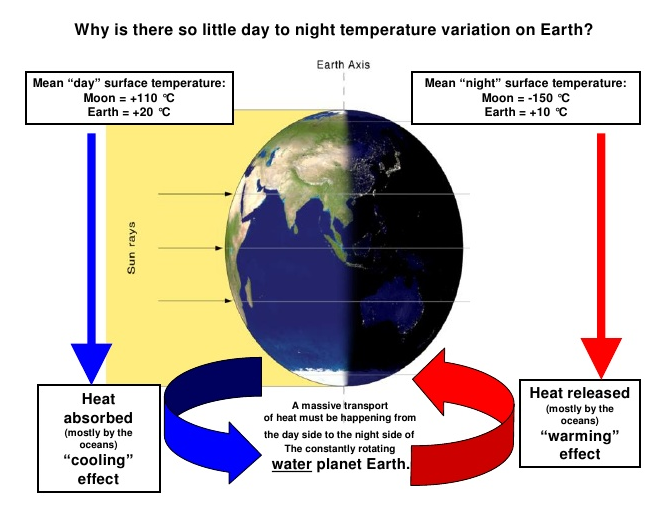
Temperatures at the poles during 6 months of darkness would fall well below -150C if there was no atmosphere, similar to the moon. Instead heat is constantly being transported from lower latitudes by the atmosphere and ocean and so that temperatures never fall much below -43C. If more heat is transported northwards than previously, then minimum temperatures must rise, and this is what we observe in individual measurements.

Long term changes in temperature anomalies occur mainly in northern continents in winter months. This is not because the earth as a whole is warming up but rather that meridional heat transport from the equator to the poles has increased and the largest effect on ‘anomalies occurs in winter. The average absolute temperature of the earth’s surface is unknown. Basing the evidence for climate change on the 150 year trend in global averaged temperature anomalies still biases the result towards higher latitudes where most of the stations are located.

Summary

When heat is released into the atmosphere from the oceans, it is transported toward the poles to dissipate into space. Places in higher latitudes are warmed, not by radiative effects of greenhouse gases in those locales, but by the incursion of warmer air from the equator.

What happens if more CO2 is added into the atmosphere? No one knows, but there are many opinions, a popular one being that more heat is retained in the atmosphere. But in that case, that additional heat will be shed by the planet in exactly the same manner: transport to the poles with slightly less extremely cold air at the higher latitudes.

Why in the world would we pay anything to prevent a little bit of warming in the world’s coldest places?

Clive Best takes the analysis further and relates to work by Christopher Scotese in a later post Fact: Future Climate Will Be Flatter, not HotterMore explanation at The Climate Water Wheel
Resources:  Bill Gray: H20 is Climate Control Knob, not CO2

No, CO2 Doesn’t Drive the Polar Vortex (Updated)

Quantifying Natural Climate Change

Update September 24, 2022 Richard Lindzen Weighs In

H/T Not A Lot of People Know That

London, 23 September – A prominent climate scientist has warned that the picture of climate change presented in the IPCC’s narrative is simplistic, ill-conceived, and undermined by observational evidence.
In a new 
discussion paper, Professor Richard Lindzen of the Massachusetts Institute of Technology (MIT) points out that the official picture, focusing narrowly on carbon dioxide as a warming agent, becomes implausible when applied to the details of the climate system.  According to Lindzen,

“If you are going to blame everything on carbon dioxide, you have to explain why, on all timescales, temperatures in the tropics are extremely stable while those in high latitudes are much more variable. The IPCC’s story is that small amounts of greenhouse warming near the equator are ‘amplified’ at high latitudes. But neither theory nor data support the idea of amplification.”

Instead, says Lindzen, this pattern – of stable tropical temperatures and fluctuating ones in high latitudes – is mostly a function of natural processes in the atmosphere and oceans; in other words, changes in oceanic and atmospheric currents that transport heat poleward while drawing varying amounts of heat out of the tropics.  These changes in transport affect the tropics, but they are not determined by the tropics.

“The changes in the earth’s so-called temperature are mainly due to changes in the temperature difference between the tropics and the poles – at least for major changes.  The changes in tropical temperature, which are influenced by greenhouse processes, are a minor contribution.”

Richard Lindzen: An assessment of the conventional global warming narrative (pdf)
 

Climate Hype Backfires on Greens

Mark Higgie reports Europe’s summer of climate hysteria in Spectator Australia.  Excerpts in italics with my bolds and added images.

But voters continue to move against the Green tide

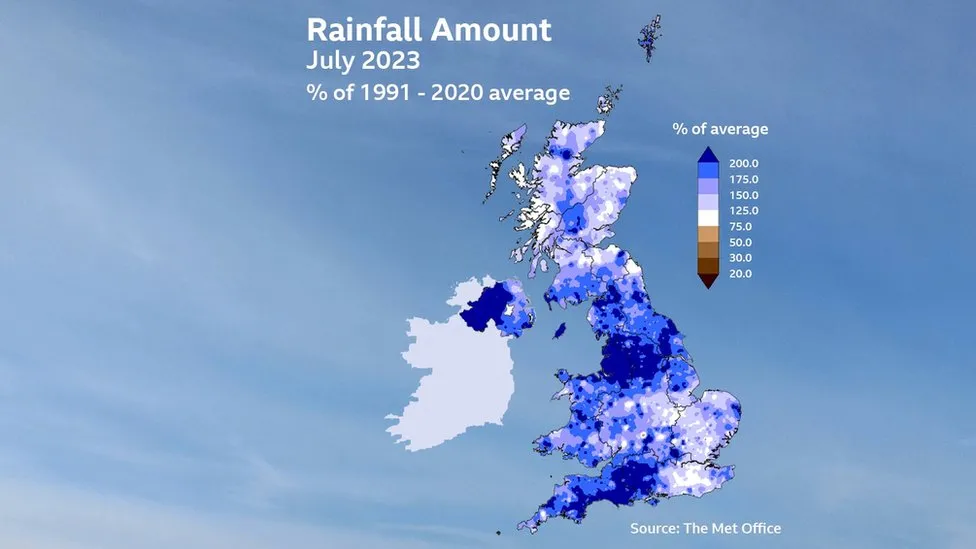
If the British weather were a person with bank accounts, it would by now likely find itself, like Nigel Farage, ‘de-banked’ for political incorrectness. While the BBC has gone into hysterics over the hot summer in southern Europe, further north the British weather has stubbornly refused to co-operate with the Green warming narrative. Temperatures for much of the summer have barely reached those of a winter’s day in Canberra. Much of the British media has tied itself in knots trying to explain why, if the world just had its hottest July ever, and is, in the words of UN Secretary-General Gutteres, ‘boiling’, everyone in Britain is wearing jumpers and has the heating on.

Where has UK summer gone?

As the media have pulled out all the stops to stir climate fear, Australians will recognise echoes of the ABC’s coverage of the 2019-20 bushfires – especially the silence about revelations that Europe’s recent ‘wildfires’ were fuelled by Green-tinged failures to backburn and were started in many cases by arsonists.

Sadly a watershed moment has been reached: you can no longer trust
Europe’s weather forecasts and readings.

Many of the BBC’s forecasts in mid-July for southern Europe proved wildly exaggerated. For example, on 18 July, it reported Sardinia was expected that day to see a high of 46 degrees and that ‘there are warnings that extreme heat could continue for a further 10 days’. In fact, Sardinia peaked at 40 and temperatures then fell steadily to the low-30s over the following week.

Much of the hyperbole appears to have been based on a swifty pulled by the European Space Agency (ESA), on which many media outlets rely for weather forecasts. On 13 July it issued a press release claiming that the ‘air temperature’ of Sardinia and Sicily was ‘expected’ to climb to 48 degrees, ‘potentially the hottest temperatures ever recorded in Europe’. In Sicily in fact it never went above 35 degrees. Unusually, the 13 July ESA press release, updated five days later, claimed that land temperatures in the 40s and 50s had been recorded across southern Europe in the previous days. The standard measurement of temperature is that of the air, made two metres above the ground. Land temperatures will of course always be many degrees higher, as anyone who has walked barefoot on a concrete footpath in summertime Australia will know. The ESA’s 48 degree forecast of the ‘air’ temperature in southern Italy was obviously an error – in reality it was the forecast land temperature.

The forecast was never corrected, went unnoticed by most in the media
and was repeated around the world.

When the weather map went crazy in Arizona

Yet despite the unrelenting propaganda, European voters continue to defy the climate lobby’s plan to make them colder and poorer. Voters over the past year have given the Green-left a bloody nose at virtually every opportunity – in national and regional elections in Italy, Sweden, Finland, Greece and Germany. The Netherlands might join that list after elections later this year – the Farmer-Citizen Movement recently came out of nowhere against the government’s Green jihad on farming and is on course to influence policy as the country’s equal-largest party. Meanwhile in Spain, the elections in July saw a major swing to the right against the ultra-eco Socialists, even if it wasn’t enough this time to unseat them.

By contrast Britain’s left defeated the Tories at two of last month’s three by-elections – largely because grumpy Conservative voters failed to turn out. But the result which has had the most political impact is the Tories’ surprise retention of Boris Johnson’s former seat in outer London, Uxbridge and South Ruislip. Fought more or less solely on London’s Labour Mayor Sadiq Khan’s planned expansion of the city’s ‘Ultra Low-emission Zone’ (ULEZ) – which would mean owners of older cars would be hit with green levies – it has allowed the Tories to glimpse a possible path to victory at next year’s general election.

While ULEZ is not directly related to the net-zero agenda, it has only now dawned on the Tories that while the vast majority of Britons want a cleaner environment, they oppose Green measures involving cost and/or inconvenience. A recent YouGov poll found that while net zero in principle attracted 70 per cent support, if net zero entailed ‘costs for ordinary people’, support fell to just over a quarter.

Since Uxbridge, Prime Minister Sunak has suddenly started portraying himself as ‘pro-motorist’, now opposing ULEZ-like schemes across the country and the proliferation of 20mph speed limits. He’s also suddenly approving new North Sea oil and gas development projects, while attacking Labour as eco-fanatics in bed with extremists like Just Stop Oil.

Over 40 Tory MPs and peers have told Sunak they want him to go further and to defer Boris Johnson’s ban on the sale of new petrol and diesel cars from 2030 – a planned measure opposed by 83 per cent of Tory members, according to an opinion poll. Sunak and other members of the Tory establishment for the moment flatly reject this.

If the opinion polls don’t shift, panic could lead the Conservatives to shift more dramatically on their net-zero policies. The obvious options are to delay the looming bans on non-electric cars and gas boilers. An even bolder move would be to announce a referendum on net zero, as championed by Nigel Farage and the Daily Telegraph. That would provoke meltdown by much of the British establishment but isn’t inconceivable.

Global Warming Boils in August

SCIENCE   Global Warming Mysteriously Spikes Every Year Between June And August, Experts Say Aug 12, 2023 · BabylonBee.com

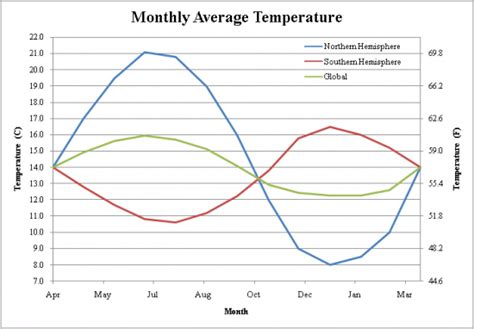
WASHINGTON, D.C. — The White House National Climate Task Force reported today that NASA scientists have discovered a mysterious spike in global warming every year between June and August.

“We’re completely stumped,” said Bob McMahon, White House National Climate Task Force spokesman. “Our satellite data confirms global warming keeps happening in America during these same months, almost like clockwork. Even stranger, global warming seems to hit South America in different months. Bizarre.”

Mr. McMahon went on to detail evidence of a massive rise in temperature occurring every year between the months of June and August, noting that in some places temperatures even reach over 100 degrees. “This year’s global warming is shaping up to be just as hot as last year’s,” said Mr. McMahon. “We don’t know why climate change strikes during these months, but we suspect it’s all the extra carbon emissions from people using air conditioning.”

Despite the compelling evidence, some scientists still disputed Mr. McMahon’s findings. “If the globe gets so hot every August, why am I sitting here wearing a sweater?” asked climate scientist Rachel Evanson. “And why am I having my husband carry around an extra coat and scarf? Ugh, it’s freezing in here.”

At publishing time, the Climate Task Force had decided to take action by making Google Maps tell people it’s really hot outside whenever they ask for directions.

Footnote:

They could start by not fixating on the Northern Hemisphere–


Montana Judge Answers Kids’ Climate Prayer

From Climate Change, Holy Government Deliver us!

As many know, a Montana Judge ruled in favor of the kids in Held vs Montana.  I & I Editorial Board summed up the proceedings in an article Is This The Most Asinine Sentence Ever Written About ‘Climate Change’? Excerpts in italics with my bolds

District Court Judge Kathy Seeley ruled in favor of several young plaintiffs – ranging in age from 5 to 22 – saying they “have a fundamental constitutional right to a clean and healthful environment, which includes climate as part of the environmental-support system.”

As proof of the harm the plaintiffs are suffering, the order has a list of horribles that includes:

  • “Olivia expressed despair due to climate change.”
  • “Badge is anxious when he thinks about the future that he, and his potential children, will inherit.”
  • “Grace … is anxious about climate change.”
  • “Mica gets frustrated when he is required to stay indoors during the summer because of wildfire smoke.”

(Perhaps the judge should have ruled against the adults who are filling these poor children’s minds with climate alarmist fantasies, but that’s another story.)

In any event, it was up to the crack reporters and editors at the once respectable Associated Press to come up with what is perhaps the most asinine sentence ever written about this issue.

“The ruling following a first-of-its-kind trial in the U.S.,” the AP reported, “adds to a small number of legal decisions around the world that have established a government duty to protect citizens from climate change.”

“A government duty to protect citizens from climate change”?
Think about that for a minute.

Someone should take these AP reporters aside and explain to them a basic fact of life: The climate is always changing. Always. Sometimes for the worse. Sometimes for the better.

They might go on to explain to these reporters that the best way to deal with an ever-changing climate isn’t to wish change away, or pretend that denying a drilling permit will make one iota of difference, but to encourage human ingenuity and prosperity.

That’s how you deal with a climate that is always changing. By adapting to it. It’s why deaths from naturally occurring disasters such as earthquakes, hurricanes, and so on, have steadily fallen as mankind has become smarter and more prosperous.

The escape from accountability card widely used by politicians, currently played by Hawaii’s governor regarding Maui debacle.

Childish Appeal to Government to Fix Climate

The nearly religious appeal to government to fix the “climate problem” is childlike, even in the mouths of progressive politicians.  James L. Payne writes at the The Foundation for Economic Education How to Talk to Children about Climate Change.  Excerpts in italics with my bolds.

If in coming years we hope to curb the naive governmental interventions that bring so much ruin to the world, we need to address this belief in the efficacy of government.

We smile at seeing those young faces waving placards out in the rain, urging action on the problem of climate change. But our smile is tinged with frustration, with the feeling that the youngsters live in another dimension and that we don’t know how to reach them intellectually.

How They See It

The natural impulse is to want to explain how crushingly complicated is this issue. First, we point out, there is the uncertainty about the connection between human-released CO2 and storms, floods and fires, and all the other bad things that might happen. Then we want to explain that cutting down on CO2 is not easy, that everyone will have to make great sacrifices.

One has to weigh the different possible benefits that might come from stopping (or slowing) global warming against the costs of trying to counter it. This cost-benefit analysis involves a bundle of economic and moral questions. (For a good overview of the complexities of the climate change issue, read former NASA scientist Roy W. Spencer’s 2008 book Climate Confusion.) For example, would saving butterfly X from extinction (assuming we could guarantee it) counterbalance the harm done to the working poor by taking $1,000 a year from each of them in a carbon tax? And so on.

However, I think this impulse to debate the complexities of the issue is misguided. The activists do not base their position on reasoning and calculations. The Climate Kids don’t come to their demonstrations pushing wheelbarrows full of cost-benefit analyses. Most of them don’t even know what cost-benefit analysis is. More importantly, they don’t think they need to know about it.

This is because, in their way of looking at the world, it is not their responsibility to fix society’s problems. That task belongs to a higher power, to government. Their mission is simply to beseech this higher power to act. Once it decides to act, they believe, government has all the expertise needed to make the correct calculations and the ability to craft policies that solve the problem without significantly hurting anybody—well, anybody except the very rich.

We should not be all that surprised by their deep, instinctive trust of government. It is a social predisposition, one that affects all of us to some degree. The belief in government’s wisdom and power is imparted to children very early in life as an article of faith, like the belief in Santa Claus. As children grow up, they begin to notice that government has flaws and that political leaders are not as wise as originally supposed. As a result, their faith in government declines somewhat, so that by age 30, as traditional wisdom has it, most people grow somewhat skeptical about government’s ability to cure the world’s problems.

But not everyone, and especially not today’s climate activists. Faced with a staggeringly complex cost-benefit analysis that has most of us (older) folks scratching our heads, they are brimming with certainty that catastrophe is coming, and government can fix whatever is wrong.

Government Can’t Save the Planet

We were given a telling illustration of this simplistic faith earlier this year when 29-year-old US Representative Alexandria Ocasio-Cortez presented her “Green New Deal” proposal. This House resolution mentions dozens of dangers and problems that she believes to be connected with climate change, from mass migrations, wildfires, and the loss of coral reefs to declining life expectancy, wage stagnation, and the racial wealth divide.

How are these all problems to be solved? Ms. Ocasio-Cortez does not propose any specific law or regulation. She does not advocate, let’s say, a 16 percent carbon tax and assure us that, according to her calculations, this measure will save 61 percent of the coral reefs, and prevent 53 percent of wildfires while reducing the income of the poor by only 8.2 percent.

Like the schoolchildren demonstrating in the street, she leaves the task of figuring out the specific answers to a higher power. Indeed, her resolution begins with this appeal to the higher power: “It is the duty of the Federal Government to create a Green New Deal.” Thus runs the thoughtless faith in government, a faith so deep that even an activist who literally is the government herself looks to “government” to solve problems she can’t begin to analyze.

testers-will-become-extinct-600x330

If in coming years we hope to curb the naive governmental interventions that bring so much ruin to the world, we need to address this belief in the efficacy of government. We need to urge our young idealists to remember that government is not a god with magical powers to fix any problem we notice but an imperfect agency composed of fallible human beings. One way to begin this conversation is to pose this question: “Given what you know about the people who have been in charge of government, is it reasonable to expect, in the future, a high level of rationality and responsibility from government?”

Dr. James L. Payne is a research fellow at the Independent Institute and author. He earned his PhD in political science from the University of California at Berkeley, and he has taught political science at a number of universities including Yale University.

Summary

As the stool above shows, the climate change package sits on three premises. The first is the science bit, consisting of an unproven claim that observed warming is caused by humans burning fossil fuels. The second part rests on impact studies from billions of research dollars spent uncovering any and all possible negatives from warming. And the third leg is climate policies showing how governments can “fight climate change.”

It has warmed since the Little Ice Age with many factors involved, most of which are orders of magnitude more powerful than CO2.  Secondly, the last 1.5C of warming was a boon to humans and nature, and the next 1.5C will likely also benefit the world.  Finally it is naive to believe in government fixing the climate to prevent further warming.  Expensive, intermittent wind and solar power is the proposed solution, which accounts for just 2% of global energy consumed, and has proven disastrous anywhere it has been tried.  In the meantime the children are appeased by declaring a “climate emergency.”  Wake up and get real.

Time to Ban EVs

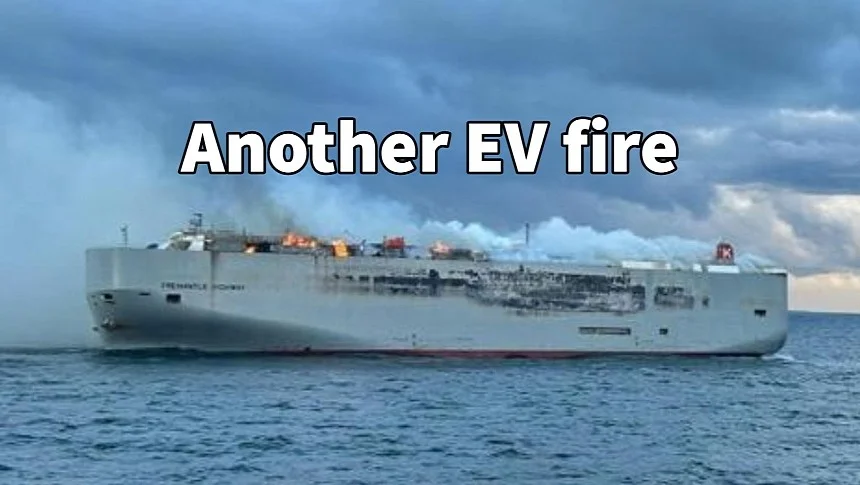
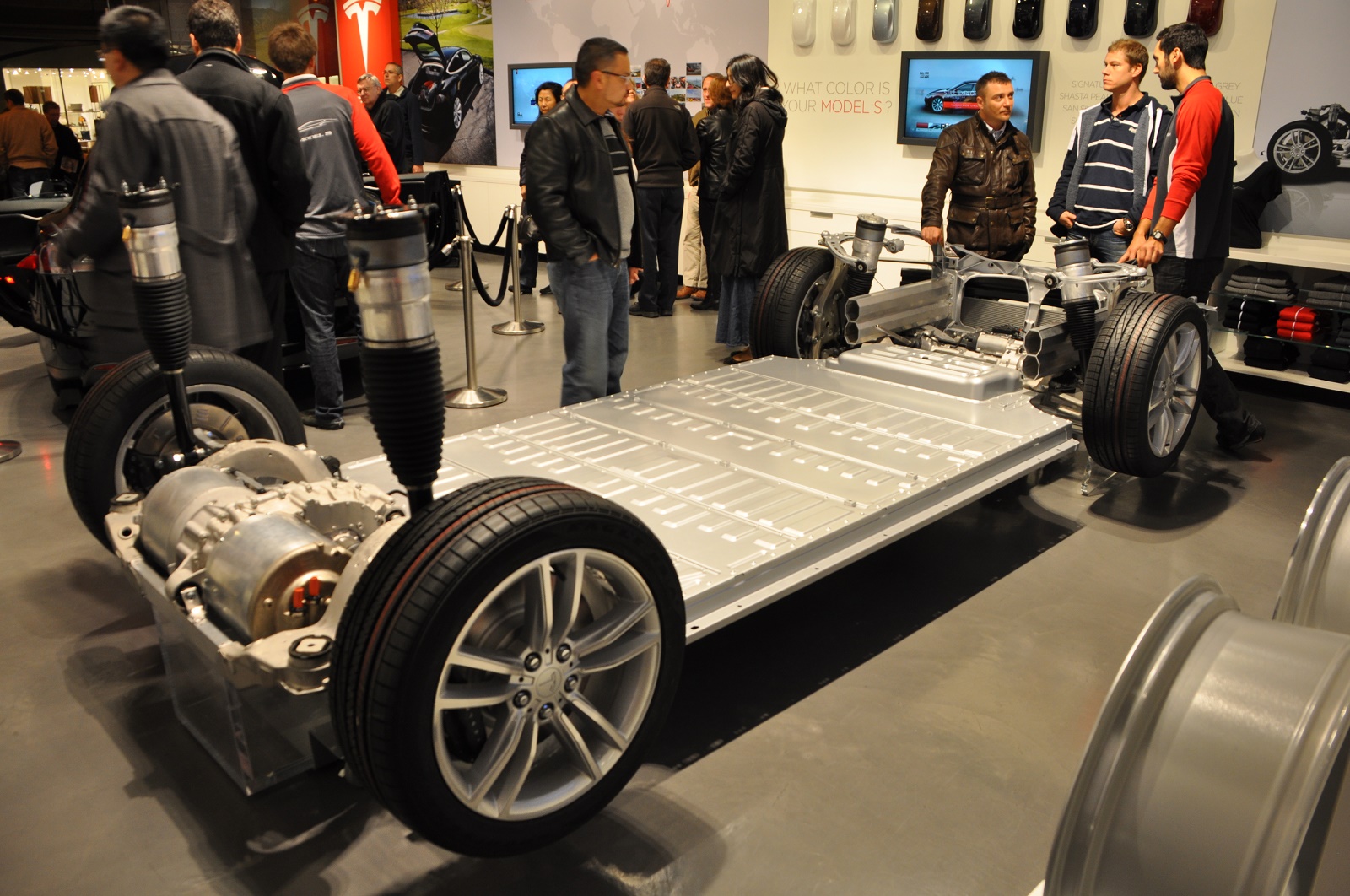
The Fremantle Highway cargo ship burns uncontrollably in the Netherlands’ waters after a major fire erupted onboard. The vessel carried about 3,000 vehicles, including 25 EVs, from Bremerhaven (Germany) to Port Said (Egypt). The ship has been abandoned and is expected to sink. July 26, 2023

Stephen Moore makes the case in his BPR article Is it time to ban electric vehicles?.  Excerpts in italics with my bolds and added images

The New York Fire Department recently reported that so far this year there have been 108 lithium-ion battery fires in New York City, which have injured 66 people and killed 13. According to FDNY Commissioner Laura Kavanagh, “There is not a small amount of fire, it (the vehicle) literally explodes.” The resulting fire is “very difficult to extinguish and so it is particularly dangerous.”

Not only cars: Lithium bicycle batteries are responsible for 22 fires in New York, 2 deaths this year (Feb. 24, 2023)

Last year there were more than 200 fires from batteries from e-bikes, EVs and other devices.

A fire ignited at an e-bike shop and killed four people near midnight on the morning of June 20. Two individuals were left in critical condition. The fire commissioner has warned New Yorkers that such devices could be very dangerous and typically explode in such a way that renders escape impossible.

FDNY also reports that in just three years, lithium-ion battery fires have surpassed those started by cooking and smoking as the most common causes of fatal fires in New York City. It’s happening all over the country as these blazes have become commonplace. Cars and e-bikes are randomly blowing up in driveways and garages.
NYC going after pizza oven emissions. You’d have to burn a pizza stove 849 years to equal one year of John Kerry’s private jet

Now let’s be honest: 13 deaths in a city the size of New York with some 8 million people is hardly an epidemic. Regulations should always be based on a cost versus benefit calculation, or there would be no cars at all.

And yet the same scaremongers on the left who have zero tolerance and want bans for small risks when it comes to everything from swimming pool diving boards, gas stoves, plastic straws, vaping, fireworks and so on, have a surprisingly high pain threshold when it comes to people dying or suffering critical injured from “green” electric battery fires.

1960 Chevrolet Corvair

Or consider this: In 1965, Ralph Nader almost single-handedly helped ban the popular Chevrolet Corvair — famous for its engine placed in the back trunk of the car. Nader’s bestselling shock book “Unsafe at Any Speed” declared the car was deadly. But there was no real evidence of that claim, and to this day there are no reliable statistics on how many passengers — if any — died in Corvairs from rear-end accidents.

What is indisputable is that EVs will cause far more deaths than Corvairs ever did.

One other example: There have been more fatalities in just one city in a single year from lithium-ion batteries in cars than all the people who died from the 1979 Three Mile Island nuclear plant accident — which was zero.

Yet, after the accident, thanks to the environmentalists’ fear campaign (with the help of the blockbuster anti-nuke movie “The China Syndrome”), no domestic nuclear plants were built for three decades. That is despite the fact that nuclear plants emit no greenhouse gases.

But with EVs, the greens are pushing aside any concerns about the collateral damage of deaths and injuries. Biden wants to mandate that nearly ALL new cars sold in the U.S. be EVs by 2032. If that happens, many thousands of Americans may die or will be inured from electric vehicle fires.

All this is especially hypocritical because once upon a time the left’s mantra was “no trading blood for oil.” Now they are willing to trade blood in exchange for getting Americans to stop using oil. An irony of all this is that because of all the energy needed to produce windmills, solar panels and electric batteries, new studies are showing that the reduction in greenhouse gas emissions to this “net zero” transition is close to zero. It turns out, green energy causes some pollution, too.

For the record, I’m not in favor of the government banning EVs or e-bikes or just about anything. I just believe that we should make policy decisions based on real and factual risk assessments, not false scares and sensationalism.

As for the future of EVs, maybe it’s time for Ralph Nader
to write a sequel to “Unsafe at Any Speed.”

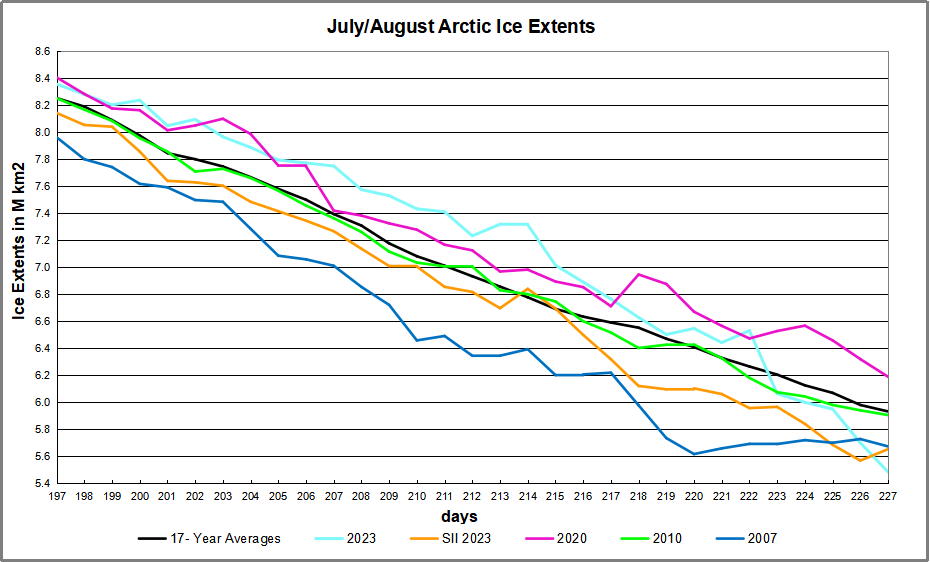
Arctic Ice Surplus Wiped Out in 5 Days? Mid August 2023


An incredible turn of events in Arctic Ice extent reporting in the last five days.  As the chart above shows, it is not unusual in August to have sharp downturns in ice extents.  However, the 2023 drop is unprecedented and looks suspiciously like an adjustment to bring MASIE in line with SII.  Note that for 25 days, MASIE showed much more ice than SII, ranging as much as +622k km2 on August 1 and +572k km2 on day 222. Moreover, those two days were in surplus to MASIE 17 year average:  +460k km2, and + 265k km2 respectively.

Then on day 223 MASIE dropped 466k km2, unprecendented for a single day.   And further declines resulted a five day total loss exceeding 1 Wadham, 1.05M km2.  In just five days, a surplus of  +265k turned into a deficit of -448k.  And MASIE is now 170k lower than SII. 

I have asked for an explanation and am awaiting a reply from NSIDC.

The table for day 227 shows a distribution of ice extent across the Arctic regions, in comparison to 17 year average and 2007.  2023 was 448k km2 below average, or 8% of total extent.

Region 2023227 Day 227 Average 2023-Ave. 2007227 2023-2007
 (0) Northern_Hemisphere 5483921 5932184  -448263  5673110 -189189 
 (1) Beaufort_Sea 508614 724117  -215503  770413 -261799 
 (2) Chukchi_Sea 477947 429182  48765  260048 217899 
 (3) East_Siberian_Sea 336549 569134  -232585  172718 163831 
 (4) Laptev_Sea 327171 238108  89064  292592 34579 
 (5) Kara_Sea 149411 95286  54126  201115 -51703 
 (6) Barents_Sea 10737 24019  -13282  17324 -6587 
 (7) Greenland_Sea 221710 229025  -7315  316155 -94445 
 (8) Baffin_Bay_Gulf_of_St._Lawrence 50784 58004  -7220  86165 -35380 
 (9) Canadian_Archipelago 289715 418748  -129033  375984 -86268 
 (10) Hudson_Bay 44528 67445  -22917  91653 -47125 
 (11) Central_Arctic 3066518 3077985  -11466  3087687 -21168 

The table shows the bulk of the deficit appears in Beaufort and East Siberian seas and CAA, with smaller surpluses in Chukchi, Laptev and Kara seas.

Illustration by Eleanor Lutz shows Earth’s seasonal climate changes. If played in full screen, the four corners present views from top, bottom and sides. It is a visual representation of scientific datasets measuring Arctic ice extents and snow cover.

Antidote for CO2 Hysteria

Preeminent physicist Freeman Dyson (1923-2020) put the CO2 obsession in sharp focus in his foreward to CARBON DIOXIDE  The good news by Indur M. Goklany (2015). Excerpts in italics. with my bolds.

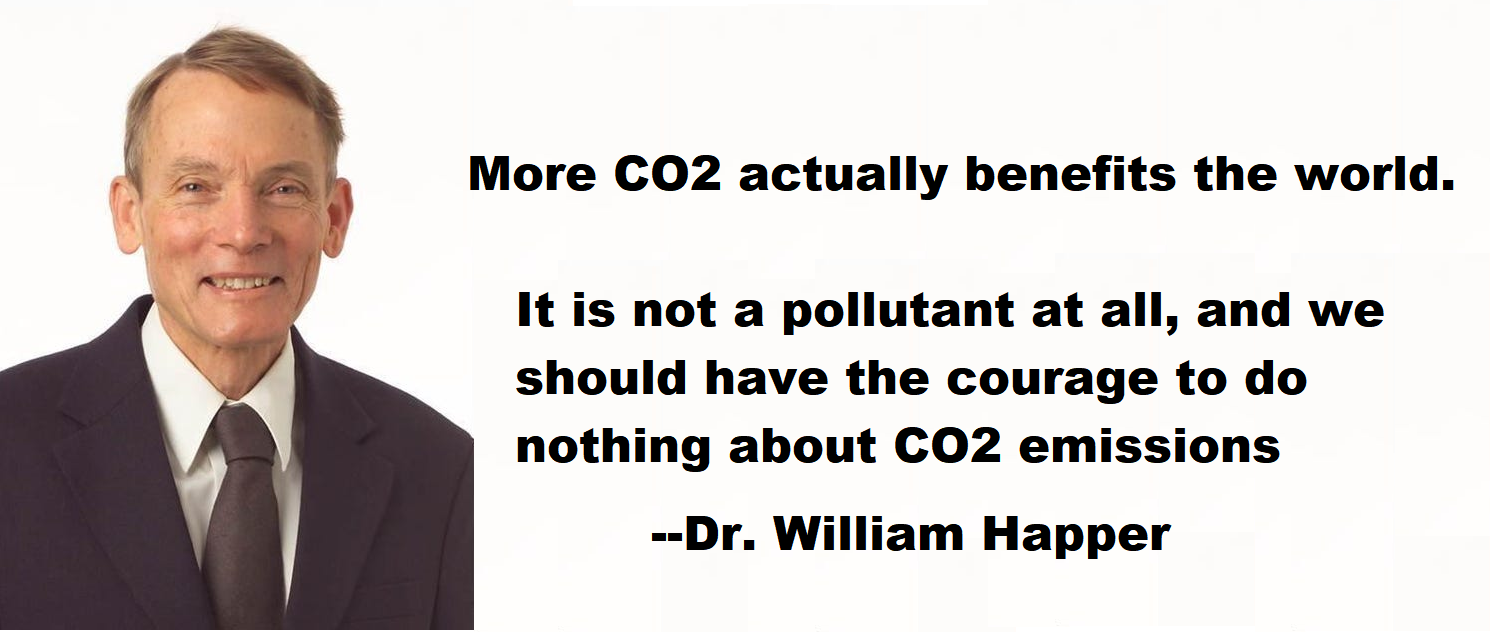
To any unprejudiced person reading this account, the facts should be obvious: that the non-climatic effects of carbon dioxide as a sustainer of wildlife and crop plants are enormously beneficial, that the possibly harmful climatic effects of carbon dioxide have been greatly exaggerated, and that the benefits clearly outweigh the possible damage.

The people who are supposed to be experts and who claim to understand the science are precisely the people who are blind to the evidence. Those of my scientific colleagues who believe the prevailing dogma about carbon dioxide will not find Goklany’s evidence convincing. . .That is to me the central mystery of climate science. It is not a scientific mystery but a human mystery. How does it happen that a whole generation of scientific experts is blind to obvious facts?

Synopsis:  More CO2 Good, Less CO2 Bad

Gregory Wrightstone explains at CO2 Coalition More Carbon Dioxide Is Good, Less Is Bad.  Excerpts in italics with my bolds and added images.

People should be celebrating, not demonizing, modern increases in atmospheric carbon dioxide (CO2). We cannot overstate the importance of the gas. Without it, life doesn’t exist.

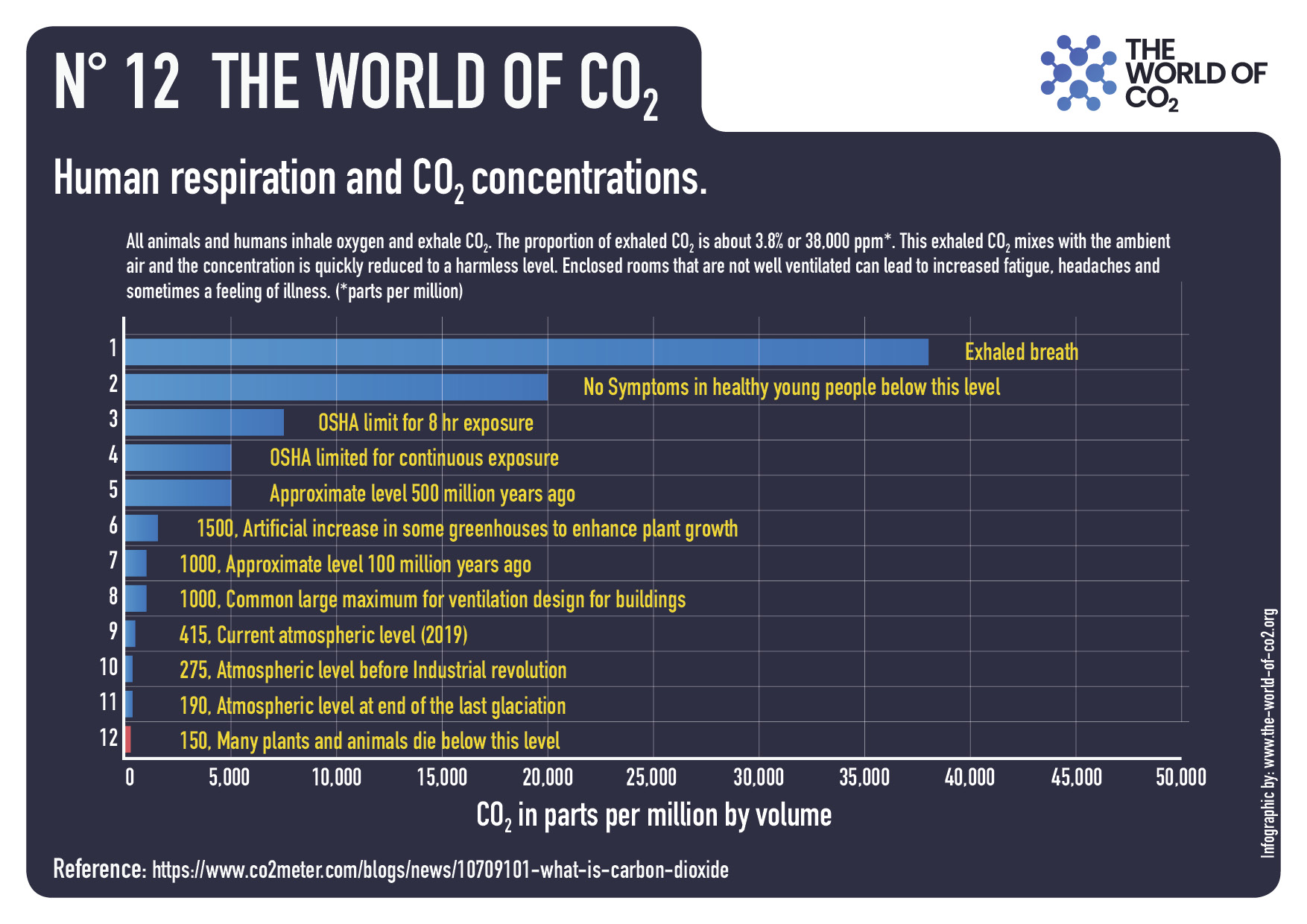
First, a bit of history: During each of the last four glacial advances, CO2’s concentration fell below 190 parts per million (ppm), less than 50 percent of our current concentration of 420 ppm. When glaciers began receding about 14,000 years ago – a blink in geological time – CO2 levels fell to 182 ppm, a concentration thought to be the lowest in Earth’s history.

Line of Death

Why is this alarming? Because below 150 ppm, most terrestrial plant life dies. Without plants, there are no animals.

In other words, the Earth came within 30 ppm in CO2’s atmospheric concentration of witnessing the extinction of most land-based plants and all higher terrestrial life-forms – nearly a true climate apocalypse. Before industrialization began adding CO2 to the atmosphere, there was no telling whether the critical 150-ppm threshold wouldn’t be reached during the next glacial period.

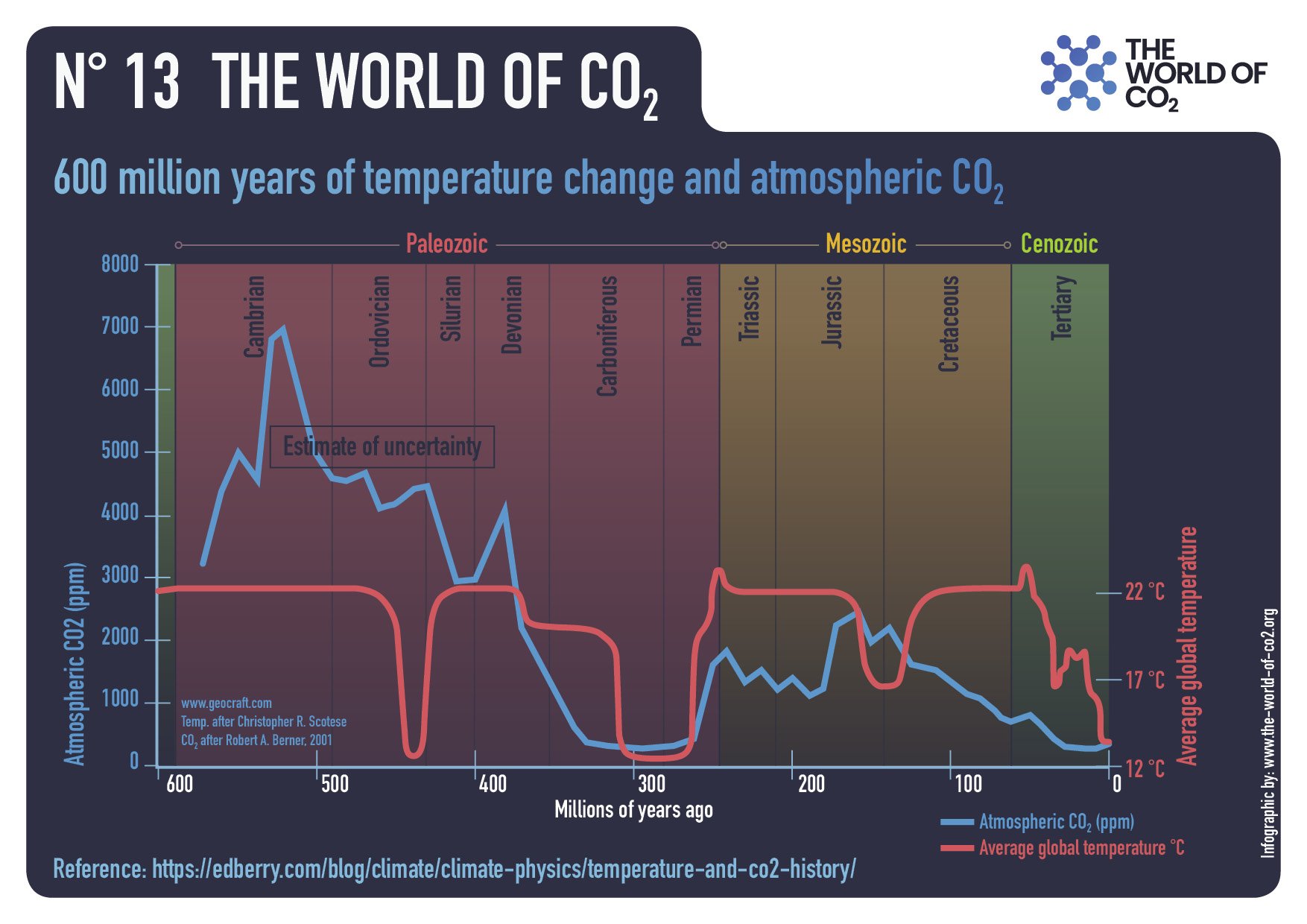
Contrary to the mantra that today’s CO2 concentration is unprecedentedly high, our current geologic period, the Quaternary, has seen the lowest average levels of carbon dioxide since the end of the Pre-Cambrian Period more than 600 million years ago. The average CO2 concentration throughout Earth’s history was more than 2,600 ppm, nearly seven times current levels.

Beneficial CO2 Increases

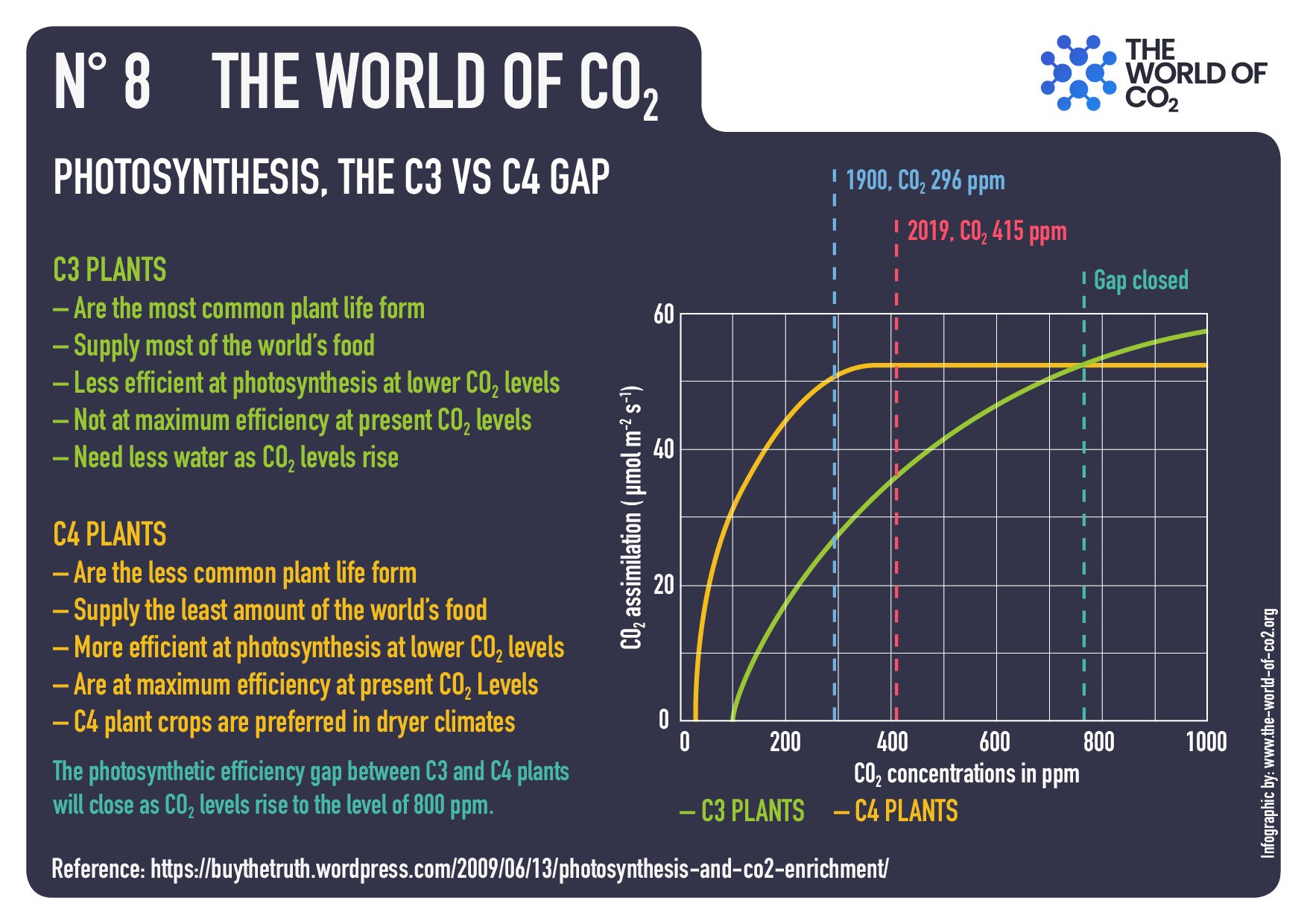
CO2 increased from 280 ppm in 1750 to 420 ppm today, most of it after World War II as industrial activity accelerated. The higher concentration has been beneficial because of the gas’s role as a plant food in increasing photosynthesis.

Its benefits include:

— Faster plant growth with less water and larger crop yields.

— Expansion of forests and grasslands.

— Less erosion of topsoil because of more plant growth.

— Increases in plants’ natural insect repellents.

A summary of 270 laboratory studies covering 83 food crops showed that increasing CO2 concentrations by 300 ppm boosts plant growth by an average of 46 percent. Conversely, many studies show adverse effects of low-CO2 environments.

For instance, one indicated that, compared to today, plant growth was eight percent less in the period before the Industrial Revolution, with a low concentration of 280 ppm CO2.

Therefore, attempts to reduce CO2 concentrations are bad for plants, animals and humankind.

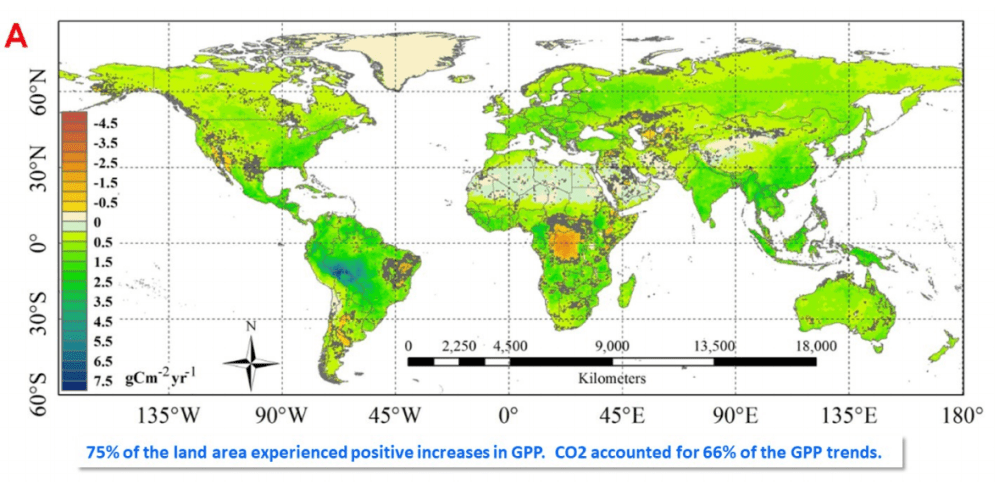
Data reported in a recent paper by Dr. Indur Goklany, and published by the CO2 Coalition, indicates that up to 50 percent of Earth’s vegetated areas became greener between 1982-2011.

Researchers attribute 70 percent of the greening to CO2 fertilization from of fossil fuel emissions. (Another nine percent is attributed to fertilizers derived from fossil fuels.)

Dr. Goklany also reported that the beneficial fertilization effect of CO2 – along with the use of hydrocarbon-dependent machinery, pesticides and fertilizers – have saved at least 20 percent of land area from being converted to agricultural purposes – an area 25 percent larger than North America.

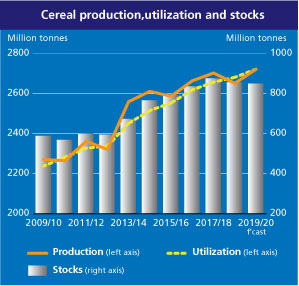
The amazing increase in agricultural productivity, partly the result of more CO2, has allowed the planet to feed eight billion people, compared to the fewer than 800,000 inhabitants living a short 300 years ago.

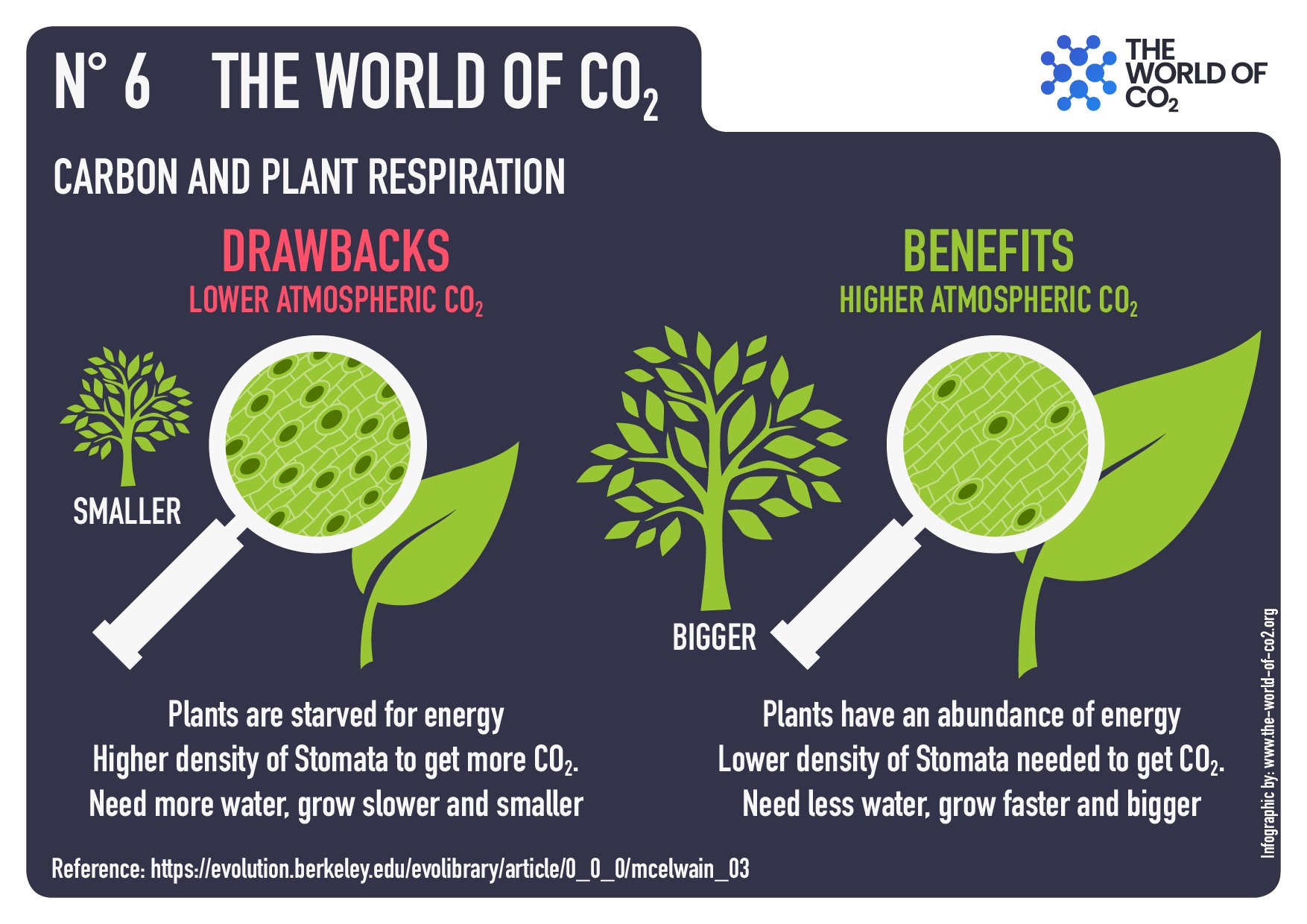
More CO2 in the air means more moisture in the soil. The major cause of water loss in plants is attributable to transpiration, in which the stomata, or pores, on the undersides of the leaves open to absorb CO2 and expel oxygen and water vapor.

With more CO2, the stomata are open for shorter periods, the leaves lose less water, and more moisture remains in the soil. The associated increase in soil moisture has been linked to global decreases in wildfires, droughts and heat waves.

Exaggeration of CO2’s Warming Effect

Alarm over global warming stems from exaggerations of CO2’s potential to retain heat that otherwise would radiate to outer space. As with water vapor, methane and nitrous oxide, CO2 retains heat in the atmosphere by how it reacts to infrared portions of the electromagnetic spectrum.

However, the gas has saturated to a large extent within the infrared range, leaving relatively little potential for increased warming.

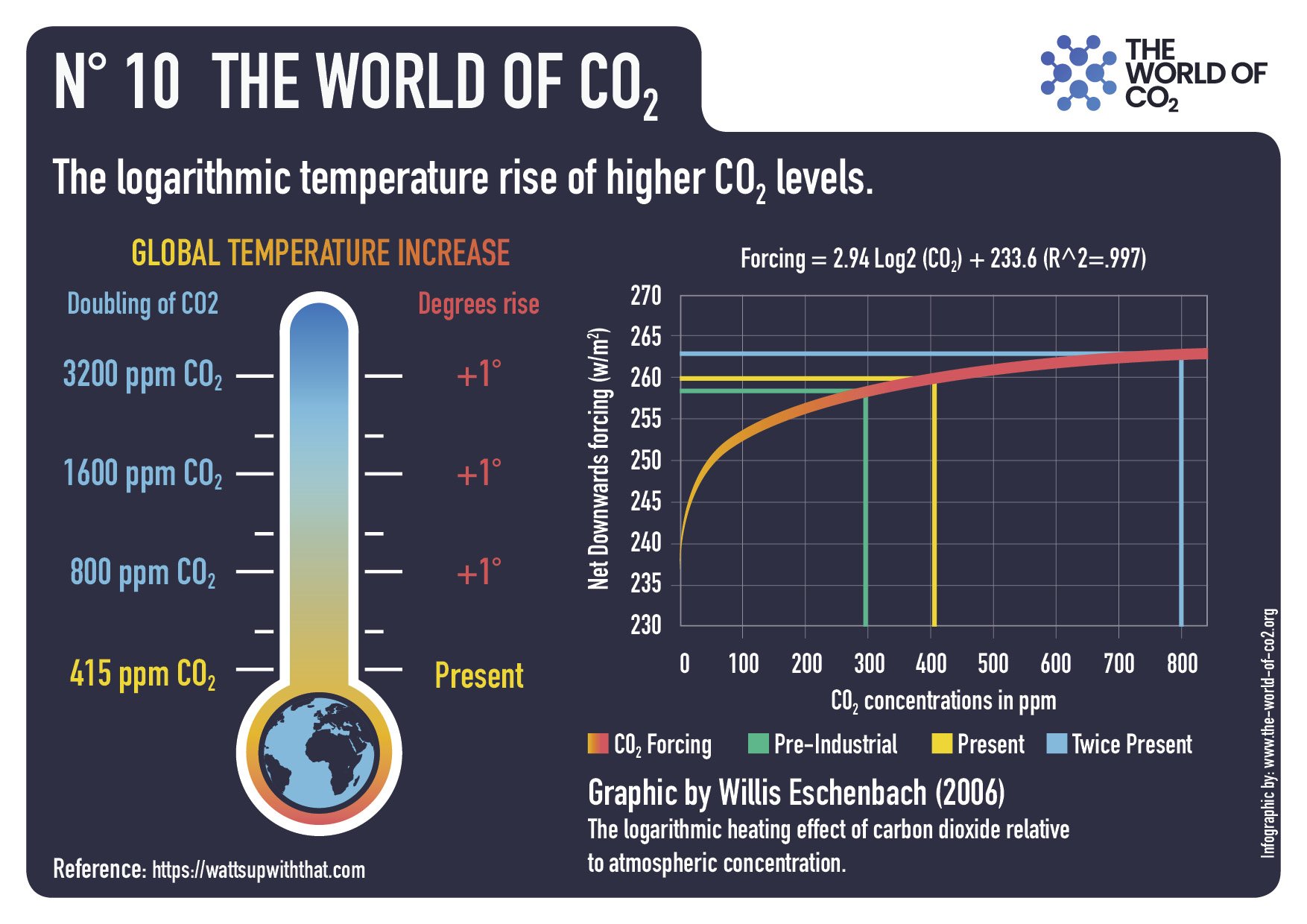
Both sides of the climate debate agree that the warming effect of each molecule of CO2 decreases significantly (logarithmically) as the concentration increases.

This is one reason why there was no runaway greenhouse warming when CO2 concentrations approached 20 times that of today. This inconvenient fact, despite its importance, is rarely mentioned because it undermines the theory of a future climate catastrophe.

A doubling of CO2 from today’s level of 420 ppm – an increase estimated to take 200 years to attain – would have an inconsequential effect on global temperature.

Pennsylvania’s solar-powered fossil fuels

CO2 being liberated today from Pennsylvania coal was removed from the atmosphere by the photosynthesis of trees that fed on sunlight and carbon dioxide and then died to have their remains accumulate in the vast coal swamps of the Carboniferous Period.

Pennsylvania Marcellus and Utica shale hydrocarbons being exploited today were also the likely hydrocarbon source of shallower reservoirs producing since the late 1800s.

The source of those hydrocarbons was algae remains that gathered on the bottom of the Ordovician and Devonian seas.

Like the coal deposits, the algae used solar-powered photosynthesis and CO2 (the algal blooms were likely fueled by regular dust storms) to remove vast amounts of CO2 from the air and lock it up as carbon-rich organic matter.

The provenance of these hydrocarbons spawns two novel ideas. First, there is a strong case that these are solar-powered fuels.

Second, the sequestering of carbon during the creation of the hydrocarbons lowered atmospheric concentrations of CO2 to sub-optimum levels for plants. Therefore, the combustion of today’s coal and gas is liberating valuable CO2 molecules that are turbocharging plant growth.

The plain fact of the matter is that the modest warming of less than one degree Celsius since 1900, combined with increasing CO2, is allowing ecosystems to thrive and humanity to prosper.

Additional information on CO2’s benefits and related topics are available at CO2Coalition.org, which includes a number of publications and resources of interest.

Forget Reason and Science, It’s “Global Boiling” Now

Christopher Lingle explains in his AIER article “Global Boiling”: An Assault On Reason and Science.  Excerpts in italics with my bolds and added images.

An interesting and troubling double standard is applied to the acceptability of individual actions and those of political agents. An individual declaring an emergency when none exists, e.g., shouting “fire” in a crowded cinema, would lead to rightful punishment, yet public officials can do so without attracting the same scrutiny.

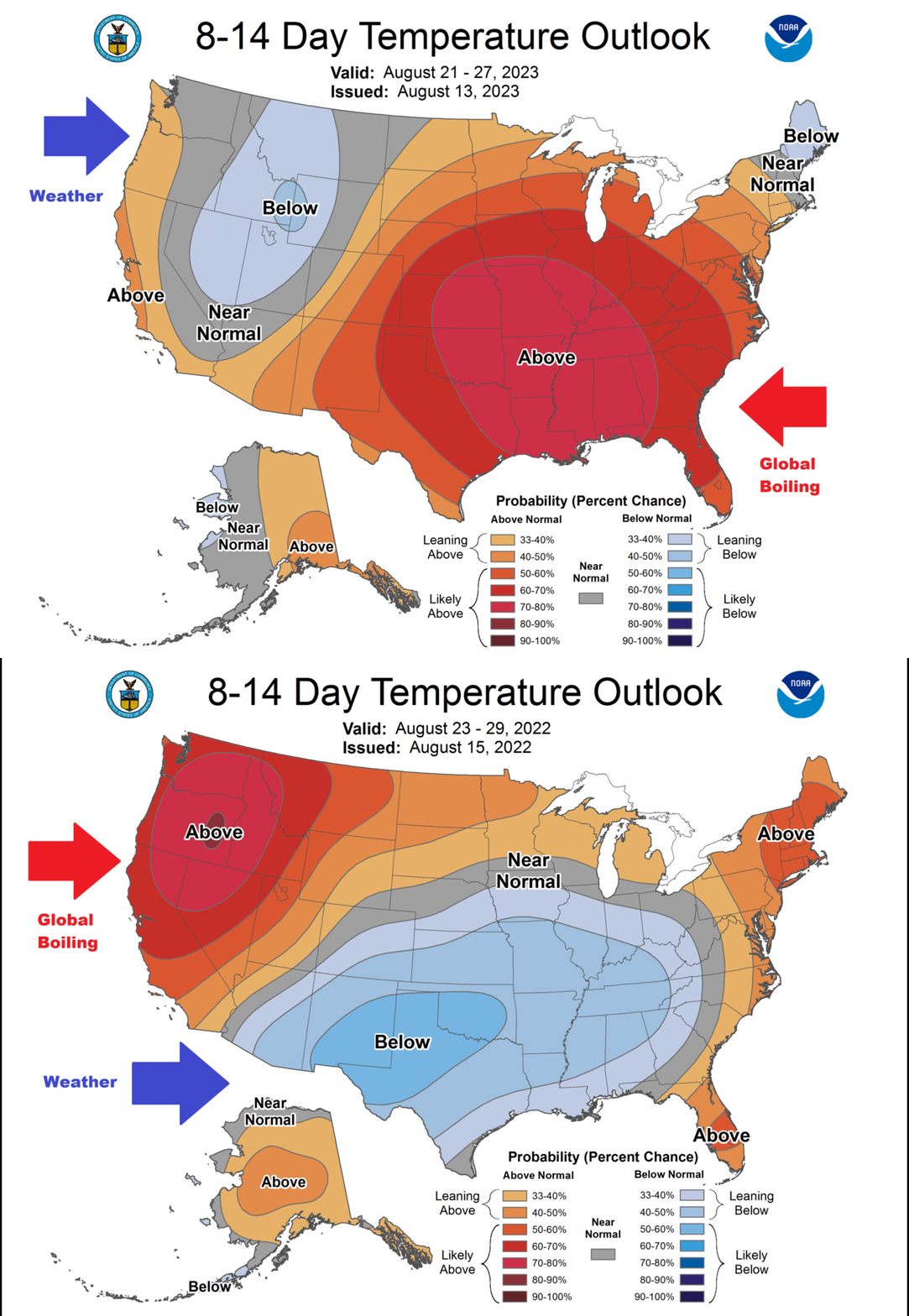
According to United Nations Secretary-General António Guterres, “the era of global warming has ended” and “the era of global boiling has arrived.” Of course, this statement was made with little or no sense of perspective or the possibility that any sensible human would challenge or refute it.

This comment is the latest reference relating to what is and has been going on with the weather and climate. After the warming showed a slowdown; climate change became the operative term, but this was found to be insufficiently alarming.

In turn, climate action became the necessary antidote to a “climate emergency” or “climate crisis.” Having gone full circle, with the focus back to the fetish with high temperatures during a seasonal, localized and predictable heatwave, the assertion is that we are in the midst of climate boiling.

Even with no knowledge of science, per se, recipe books point out that “boiling” occurs when water is heated to 212º Fahrenheit (100º Celsius) at sea level. For his part, it may be that the UN Boss knows that water will boil at lower temperatures at higher elevations, but he is unlikely to have been at such altitudes in his native Portugal to observe a boiling point close to recent global averages.

Although it is common for references regarding current weather to be over-stated, it does not necessarily indicate changes or trends in climatic conditions. Besides the notion of “boiling” temperatures, headlines that suggest current temperatures are “scorching” or “scalding” indicate a misunderstanding of what those terms mean.

It might be that using fear and pandering to ignorance is better than coercion to impose a narrative. Persuasion in search of cooperative arrangements is surely what should be expected of a liberal, representative democracy, but this is threatened just as much by “Left” as well as “Right” populism.  It turns out the use of extreme terms in the climate debate is not about either exaggeration or hyperbole, since exaggeration or hyperbole requires there be an element of truth in statements.

Terms used to express the effect of high temperatures on the human body
are misleading, disingenuous, and factually untrue.

Ginning up fear is a well-known technique of propaganda to support a narrative, as is the case of reports of momentary weather conditions as though they presage eventual or irrevocable climatic changes. An example of how an isolated weather event is portrayed as if it were evidence of a generalized view of overall conditions can be seen in a recent report on National Public Radio.
Noting the measurements of a single water temperature sensor in Manatee Bay, near the Everglades National Park, reached 101.1 degrees, the data were declared to be “startling” as if they reflected high average temperatures in the Florida Bay area. It went on to declare that “scorching” temperatures “could” pose a major risk to coral and other marine life.

It is noteworthy that the word “could” in this context has no real content since such conditional expressions provide no insight into or substantiation of the likelihood of the referred event. Supporters of this narrative expect most citizens to be uncurious and to willingly accept assertions of political officials for the purpose of misleading or frightening them, so they submit to whatever remedial public policies are imposed.

In all events, there was no data to support the claim of “startling” water conditions in the rest of Florida Bay. Further, the claim that the temperatures are “scorching” is confusing, at best, since injury from water burns is commonly known as scalding.

Concerning scalding, second degree burns can occur from exposure for 3 seconds to water of 140°F, while a third degree burn requires at least 5 seconds of exposure at same temperature. As it is, the temperature of sea water measured from a single buoy off the Florida coast far from those temperatures and is variable over the course of 24 hours, up to 10 degrees less at night.

Of course, the heat in the ambient air is also far away from what would be “boiling” or “scorching” temperatures. But it turns out that there is no “settled science” on the maximum ambient temperatures that will cause heat distress.

In fact, more is known about the effect of low ambient temperatures on the human body. If the temperature falls below the lower limit, 82.4º Fahrenheit (28º Celsius), more energy is used to hold internal temperature at the optimum, and if temperatures are too low, shivering occurs causing involuntary muscular contractions to generate heat.

Thermoregulation of body temperature is necessary to sustain human life and survival of human cells to thrive rather than to overheat or die. The human body engages in homeostasis to maintain balance by keeping core internal temperature within a safe range, no matter what temperatures are outside the body, otherwise organ failures might occur.

Results of research conducted at the University of Roehampton indicates ambient temperatures exceeding 104º Fahrenheit (40º Celsius) might cause some humans to be unable to shed excessive heat so that body functions become abnormal. It points out that there is a “thermoneutral” zone of temperatures within which the body has no need to increase metabolic rate or use more energy to achieve the normal core temperature of 98.6º Fahrenheit (37º Celsius).

While high temperatures can impact cardiovascular health (e.g., during heatwaves or while fighting fires), it is not a matter of climate change. Blood clotting (i.e., thrombogenesis) can occur from exposure to long and uninterrupted exposure to extreme heat, but it depends on individuals’ physical characteristics and conditions.

Of course, few people are exposed to extremely high temperatures for lengthy periods,
and if so, there are many evasive actions they can undertake to protect themselves.

In all events, it is widely known that the biggest killer from extreme temperatures is from exposure in the low ranges of thermometer readings, even in Africa and Asia.

On the left, Lancet stretched the heat axis to make the numbers look larger in their presentation.

Unfortunately, the promotion of the “climate narrative” has been successful in inducing citizens to ignore how their liberties and rights are in jeopardy from the imposition of repressive public policies that are being answered as a solution. While Germans are being subjected to adopt expensive heat pumps, Americans are beingchided for using gas ranges and the likelihood they might be banned from future installation.

Alas, citizens have lost sight of the original intent behind the move from autocratic monarchy to democracy, which was to secure the rights of all citizens and support private property as the basis for human liberty and personal dignity.

Gas stoves just the thin end of the wedge.

While the American republic was founded to put a brake on political power and limit arbitrary rule, democracy is now presented as an “all-or-nothing” game such that any curbs on democratic governance will lead to its disappearance.

Most recently, governments around the world have found that frightening their citizens would induce them to accept, even applaud, repressive policies in exchange for the promise that individual citizens would be shielded from a single virus. The loss of rights and freedom in response to the fear conjured up during the COVID-19 pandemic is a harbinger of what will be claimed as necessary to avert the existential threat to humanity from extreme weather and changing climate.


Australians: Look Hard Before Leaping

Peta Credlin exposes the radical plans of Australian politicos in her Spectator video ‘Insanity’: Cost of net-zero energy policies becoming clearer.

For those prefering to read the commentary, below is a transcript from the closed captions in italics with my bolds and added images.

In the Sunday papers I highlighted the growing Insanity of closing down coal-fired power stations when there’s no reliable alternative supply. And the fact that the Albanese government is planning to bring the same emissions obsession that’s given us some of the world’s highest power prices to other sectors of the economy.

Like housing, like farming meaning the food on your table, and like transport. It is a real worry these so-called sectoral plans, emission specific plans for each industry sector. Well they’re now being drawn up by the Climate Change Authority as part of the government’s ambition to announce yet more emissions reductions for 2035 on top of the 43 % they’ve already legislated for 2030.

Gas Stoves just the thin end of the wedge.

So that means:

♦  smaller herds and higher meat prices;
♦  bans on gas cooktops and heaters;
♦  forcing people to swap to expensive electric cars or use only public transport.

And the cost of these policies is finally becoming clearer. Ten days ago a group of experts Net Zero Australia have estimated the cost of getting to a 43 % reduction by 2030, as I said already legislated, will cost us 1.5 trillion dollars, that’s trillion with a t, not billion. These are experts from Melbourne, Queensland University and Princeton in the US. Now 1.5 trillion dollars is two-thirds of our annual GDP and this report says we need to find that in order to achieve these legislated targets due in just seven years time.

And that’s assuming that it’s actually feasible to build all the renewable energy required and all those extra transmission lines to get this decentralized intermittent power around to where we need it.  Now forget for a moment that Labor’s 83 % renewable energy target makes scant provision for Backup,  backup for when the wind doesn’t blow and of course the sun doesn’t shine. But we still need power 24/7.

Not only is this climate Crusade ruinously expensive,
but it’s also going to be Mission Impossible.

Australians might be broadly in favor of cutting emissions to do something about climate change, but it’s far from clear that we’re ready to pay all the extra costs. And it’s certain that more and more people are unhappy about what this means for them in practice.

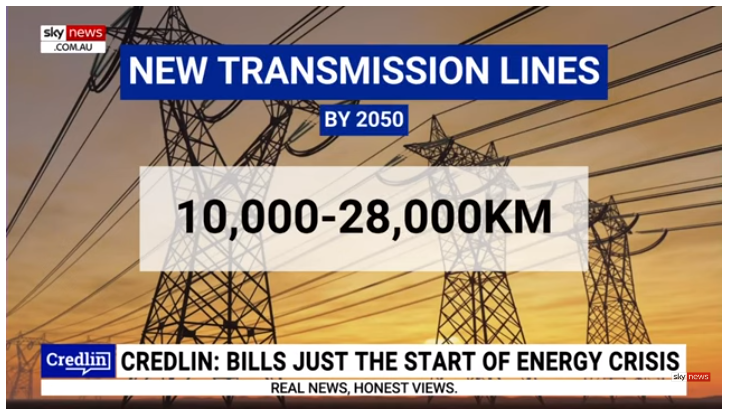
We need somewhere between 10 to 28 000 kilometers of these new transmission lines. Towers some of them up to 80 meters tall, as high as the pylons on the Sydney Harbor Bridge. All built through national park lands or across prime agricultural land for Labor’s green dream to work. And as you’ll hear a little later on the show, Australian Farmers well you’re on the carpet despite some of the bribes being offered up to two hundred thousand dollars per kilometer for individual land holders.

Now that’s one of the reasons why the Hume link, just one of these new transmission lines is way behind schedule and already three billion dollars over budget. But without these new transmission lines, Hume Link in particular, well Snowy 2.0 is already years behind schedule and billions over budget. it just won’t work

I’ve been saying this for years, and you’ve been saying it as well: This is energy Madness. Why on Earth are we spending billions and billions of dollars in borrowed money just to take us back to the Dark Ages. It beggers belief.

A costly expansion of the Snowy hydro power storage scheme rests on transmission upgrades to succeed. (Supplied: Snowy Hydro)


Stop the Carbon Capture Insanity

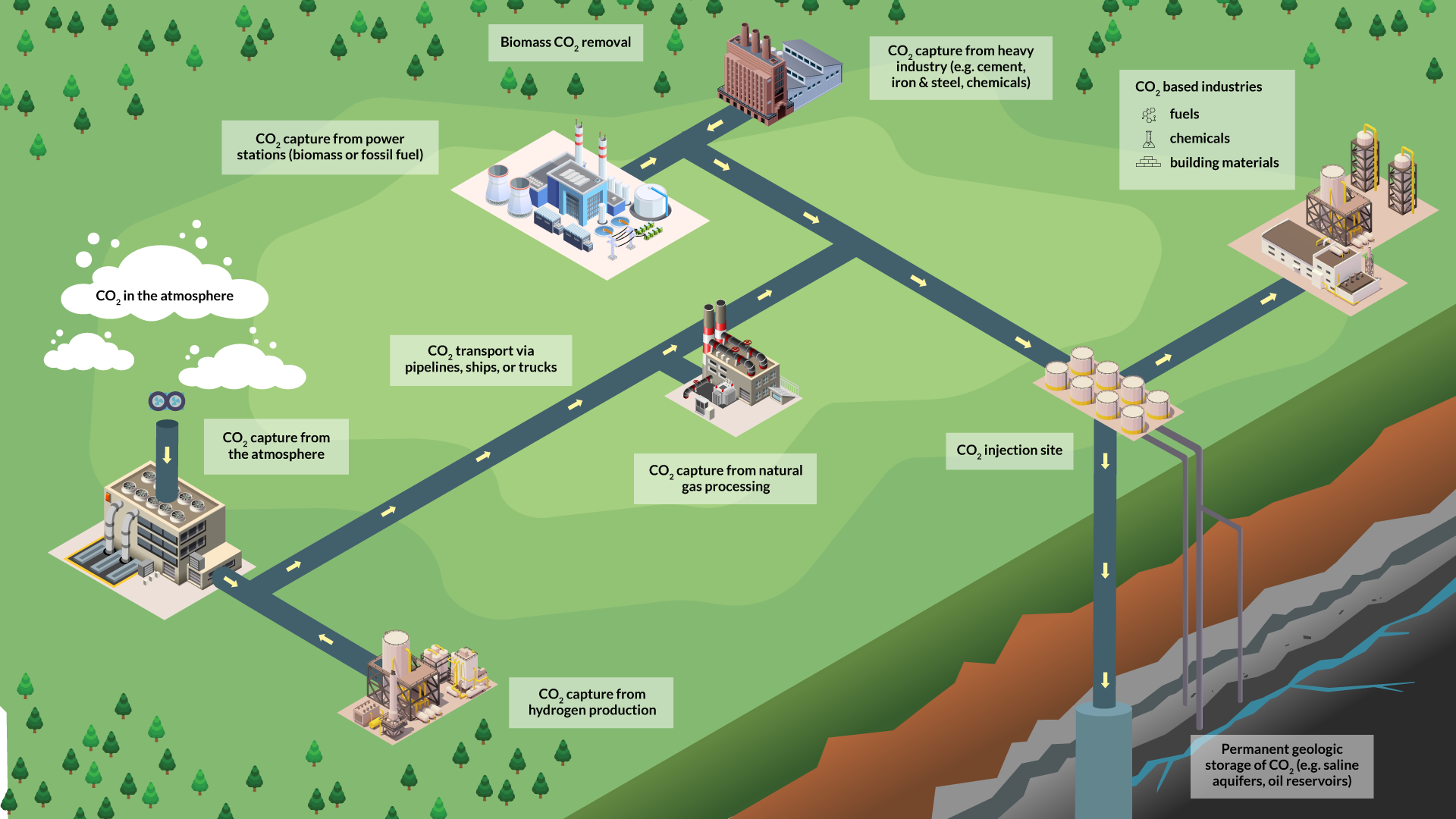
From the geniuses who brought you the missnamed IRA spending spree, a new push to suck plant food (CO2) out of the air to “fight global warming.”   The insanity is doubled:  Billions are wasted in an effort to deprive the biosphere of essential CO2.  LA Times How the Biden administration is pouring billions into technology that sucks carbon from the air.  Excerpts in italics with my bolds.

The Biden adminstration is funding projects by Occidental Petroleum and Climeworks that will remove carbon dioxide from the air. The Climeworks plant in Hinwil, Switzerland, above, filters carbon dioxide from the air above a garbage incineration plant. (Climeworks)

Some Might Call it a Ruse

The technology is “essentially a giant vacuum that can suck decades of old carbon pollution straight out of the sky,” Energy Secretary Jennifer M. Granholm told reporters. “If we deploy this at scale, this technology can help us make serious headway toward our net-zero emission goals.”

Once operational, the hubs are expected to remove more than 2 million metric tons of carbon dioxide a year from the atmosphere, the equivalent of taking nearly half a million gas-powered cars off the road, Granholm said. Additional projects are expected to be announced next year, the Energy Department said.

Critics worry that carbon capture is too untested to be a reliable tool in fighting climate change. And some opponents see carbon capture efforts as a way to extend the life of facilities that produce or use fossil fuels.

Background:  Wasting Money on Carbon Capture

Robert Bryce explains in his Real Clear Energy article Carbon Capture Didn’t Make Sense 12 Years Ago And It Doesn’t Make Sense Now.  Excerpts in italics with my bolds and added images.
It appears the reconciliation bill that includes some $370 billion in energy-related spending is going to become law. The measure includes a panoply of tax credits for alternative energy technologies, including incentives for electric vehicles, hydrogen, energy storage, and of course, billions of dollars in tax credits for wind and solar energy.

The measure also includes, according to the Congressional Budget Office, some $3.2 billion in tax credits for carbon capture and sequestration, a technology that has plenty of supporters but precious little in the way of commercially successful projects. Back in 2018, Al Gore blasted CCS, calling it “nonsense” and an “extremely improbable solution.”

The new tax credits for CCS remind me that I published a piece in the New York Times on May 12, 2010, about the technology. In looking back, the piece is still relevant today. In fact, I wouldn’t change a word of it. Furthermore, my prediction about the difficulty of siting the pipelines needed to move the CO2 has already come true. For proof, see this August 6, Wall Street Journal article about the opposition to a proposed CO2 pipeline in Iowa.

In any case here’s my 12-year-old take on why CCS is a bad bet:

On Wednesday, John Kerry and Joseph Lieberman introduced their long-awaited Senate energy bill, which includes incentives of $2 billion per year for carbon capture and sequestration, the technology that removes carbon dioxide from the smokestack at power plants and forces it into underground storage. This significant allocation would come on top of the $2.4 billion for carbon capture projects that appeared in last year’s stimulus package.

That’s a lot of money for a technology whose adoption faces three potentially insurmountable hurdles: it greatly reduces the output of power plants; pipeline capacity to move the newly captured carbon dioxide is woefully insufficient; and the volume of waste material is staggering. Lawmakers should stop perpetuating the hope that the technology can help make huge cuts in the United States’ carbon dioxide emissions.

1. An Energy Intensive Process

Let’s take the first problem. Capturing carbon dioxide from the flue gas of a coal-fired electric generation plant is an energy-intensive process. Analysts estimate that capturing the carbon dioxide cuts the output of a typical plant by as much as 28 percent.

Given that the global energy sector is already straining to meet booming demand for electricity, it’s hard to believe that the United States, or any other country that relies on coal-fired generation, will agree to reduce the output of its coal-fired plants by almost a third in order to attempt carbon capture and sequestration.

2. Costly Pipelines for a Waste Gas

Here’s the second problem. The Pacific Northwest National Laboratory has estimated that up to 23,000 miles of new pipeline will be needed to carry the captured carbon dioxide to the still-undesignated underground sequestration sites. That doesn’t sound like much when you consider that America’s gas pipeline system sprawls over some 2.3 million miles. But those natural gas pipelines carry a valuable, marketable, useful commodity.

By contrast, carbon dioxide is a worthless waste product, so taxpayers would likely end up shouldering most of the cost. Yes, some of that waste gas could be used for enhanced oil recovery projects; flooding depleted oil reservoirs with carbon dioxide is a proven technology that can increase production and extend the life of existing oilfields. But the process would be useful in only a limited number of oilfields — probably less than 10 percent of the waste carbon dioxide captured from coal-fired power plants could actually be injected into American oilfields.

3. Impossibly Massive Scale

The third, and most vexing, problem has to do with scale. In 2009, carbon dioxide emissions in the United States totaled 5.4 billion tons. Let’s assume that policymakers want to use carbon capture to get rid of half of those emissions — say, 3 billion tons per year. That works out to about 8.2 million tons of carbon dioxide per day, which would have to be collected and compressed to about 1,000 pounds per square inch (that compressed volume of carbon dioxide would be roughly equivalent to the volume of daily global oil production).

In other words, we would need to find an underground location (or locations) able to swallow a volume equal to the contents of 41 oil supertankers each day, 365 days a year.

There will also be considerable public resistance to carbon dioxide pipelines and sequestration projects — local outcry has already stalled proposed carbon capture projects in Germany and Denmark. The fact is, few landowners are eager to have pipelines built across their property. And because of the possibility of deadly leaks, few people will want to live near a pipeline or an underground storage cavern. This leads to the obvious question: which members of the House and Senate are going to volunteer their states to be dumping grounds for all that carbon dioxide?

For some, carbon capture and sequestration will remain the Holy Grail of carbon-reduction strategies. But before Congress throws yet more money at the procedure, lawmakers need to take a closer look at the issues that hamstring nearly every new energy-related technology: cost and scale.

Footnote:  The project is not only impractical, its deluded objective is to deprive the biosphere of plant food.

See also:  Carbon Capture Boondoggle