
“Climate change” is in the news daily, with each featured story getting an attention-grabbing sensationalist headline. The frenzy is at its peak now because it’s the time of year for tropical storms and wildfires.
However, to appreciate that these stories are pure narratives,
it’s a good time to consider the facts behind
the so-called “greenhouse gases.”
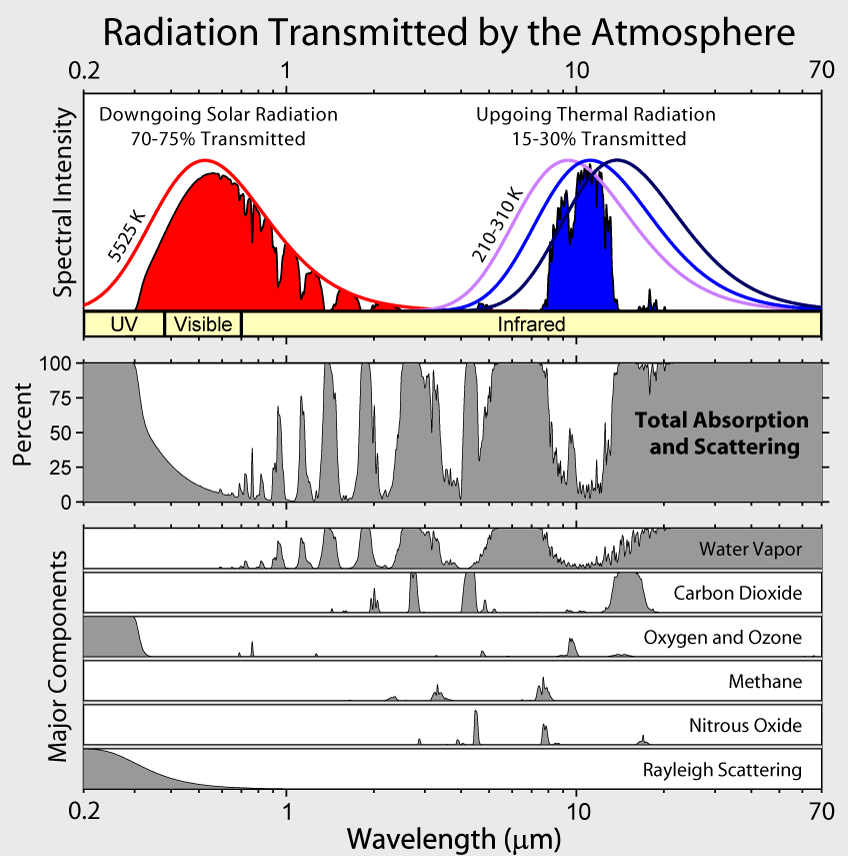
Several atmospheric gases, including carbon dioxide, methane, and water vapor, absorb light in the infrared region. These are collectively known as the “greenhouse gases” because absorbing infrared energy warms up the air—hence the name greenhouse effect.
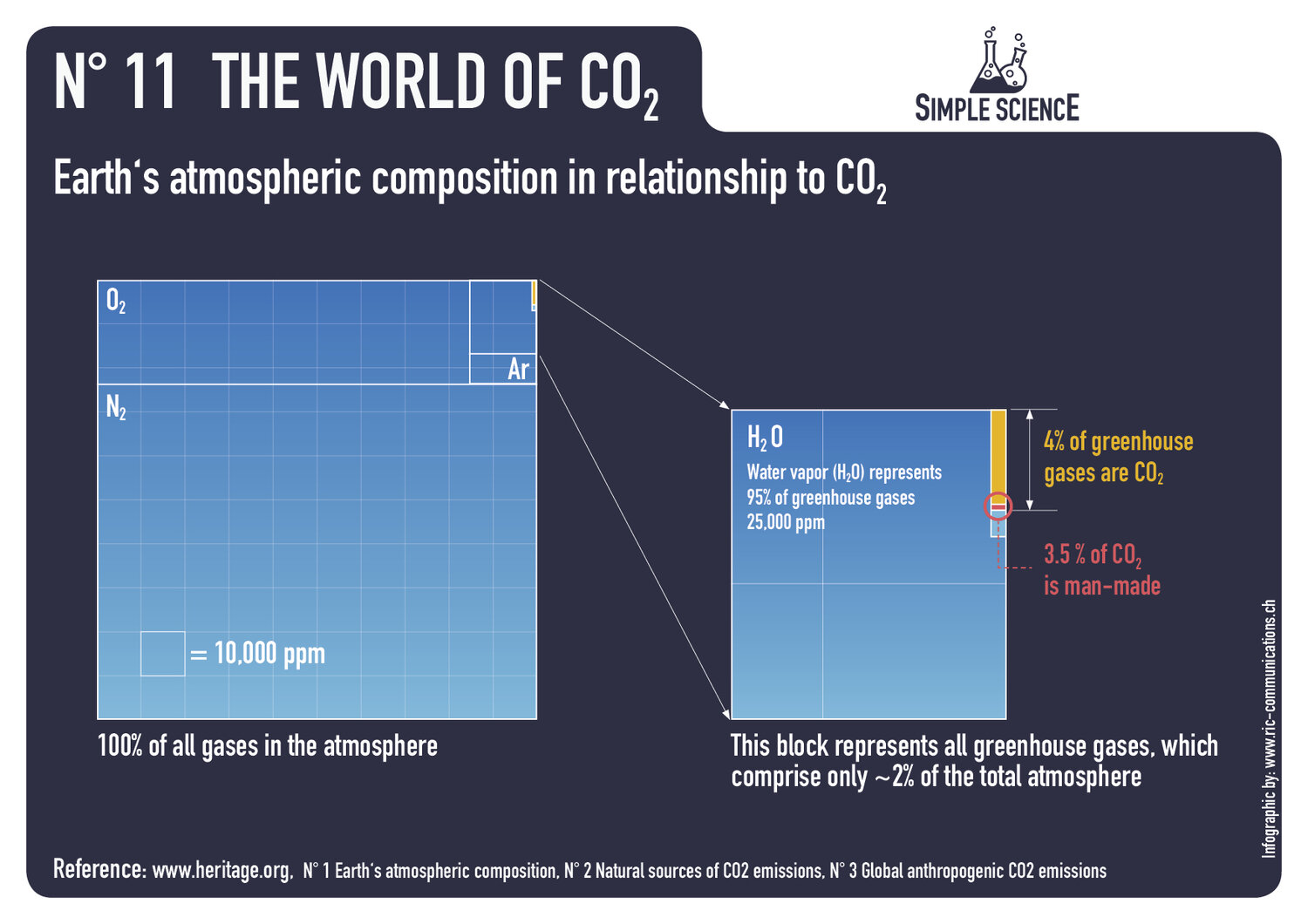
Carbon dioxide, on a per-molecule basis, is six times as effective an absorber as water is. However, that’s offset by the fact that carbon dioxide is only about 0.04% of the atmosphere (400 parts per million). This means that, overall, it’s much less important than water vapor in terms of its ability to warm the atmosphere.
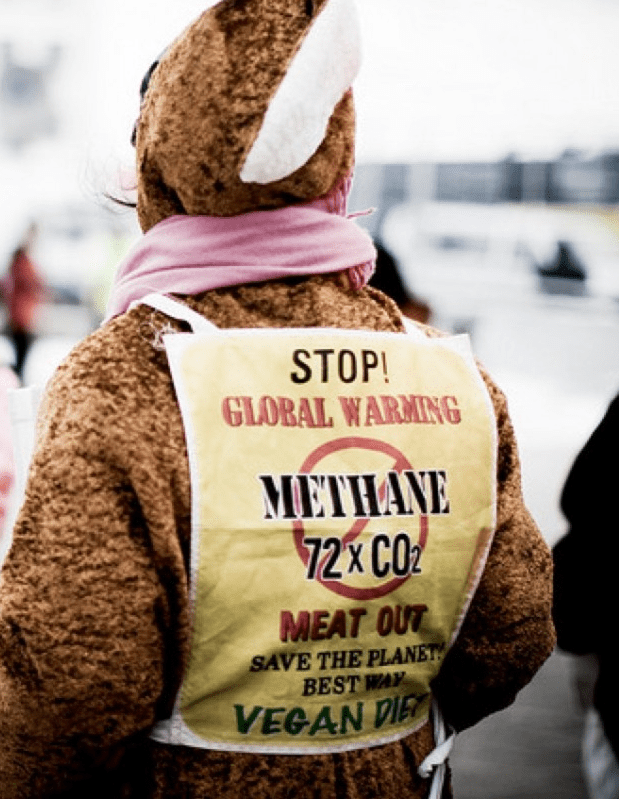
And then there’s methane. Pound-for-pound methane can trap 25 times more heat than carbon dioxide. However, there are two reasons why scientists say it will never significantly contribute to global warming. Primarily, it is by far the rarest of the green house gases. [Note that weight is the wrong metric for radiation properties of gases, volume is what matters. The 25 times CO2 is exaggerated because CH4 molecular weight is only 16 compared to 44 for CO2.]
But there is another reason why we will probably never have to worry about methane being a major contributor to global warming: Methane’s narrow absorption bands, at 3.3 microns and 7.5 microns , perfectly match…water’s! Did you catch that? It’s worth emphasizing: “The ratio of the percentages of water to methane is such that the effects of methane are completely masked by water.”
Nor is methane a cow problem that humans can remediate by going meatless. Instead, wetlands and termites are the real methane producers: “When it comes to methane, another greenhouse gas, termites are responsible for 11 percent of the world’s production from natural sources. Seventy-six percent comes from wetlands…”

Image: Termites in a wetland by AI.
Many studies have attributed a methane spike to soaring emissions from tropical wetlands, predominantly in Africa. “A ‘significant change’ in tropical weather ascribed to human-caused climate change has led wetlands to get bigger and more plants to grow there, thus leading to more decomposition — a process that produces methane.”
You noted, of course, how the quoted language blames methane on human-caused climate change. Yet this same “human-caused” climate change is also blamed for transforming lush Hawaii into an arid ticking time bomb that, in the summer of 2023, erupted into a devastating inferno. Moreover, it seems like it wasn’t that long ago when environmentalists were ardent supporters of wetlands.
Meanwhile, ignoring the predominance of naturally occurring methane, a band of climate fanatics wants to eliminate traditional farming and ranching because they are sources of methane, primarily from ruminant livestock and paddy rice. Rice growing produces methane gas by feeding microbes that live under the rice paddies. Cattle produce methane during their digestive process.
In Ireland, farmers may be forced to kill some of their livestock to meet government requirements:
Greenhouse gas emissions in Ireland’s agriculture industry must be reduced by 25 per cent by 2030. This is part of the country’s latest Climate Action Plan, which pledges to halve overall carbon emissions by 2030 and reach net zero by 2050.
Current initiatives to cut methane gas emissions from domestic livestock like cows and pigs by culling them, a potentially famine-inducing policy, fail to take into account the sheer volume of feral animals. For example, in Australia, “there is 10 times the number of feral pigs … than domestic.”
By some estimates, Australia contains “ 400,000 wild horses,
five million donkeys, 150,000 water buffalo, one million camels,
and 24 million feral pigs—in comparison,
the United States contains just six million feral pigs.”
To put things in perspective, let’s go back to the lowly termites. Consider that, in 1992, “it was estimated that the digestive tracts of termites produce about 50 billion tons of CO2 and methane annually. That was more than the world’s production from burning fossil fuel.”
In 1982, the journal Science published an article titled “Termites: A Potentially Large Source of Atmospheric Methane, Carbon Dioxide, and Molecular Hydrogen.” Here is the key sentence: “The estimate gross amount of carbon dioxide produced is more than twice the net global input from fossil fuel production.”
That same year, the New York Times ran an article titled: “Termite gas exceeds smokestack pollution.”
None of this information stops the Biden administration. In November 2021, it “proposed regulations on methane emissions by the U.S. oil and gas industry, at a direct cost of more than $1 billion annually, to deal with a nonexistent problem.”
Wouldn’t it be nice if a little science got through to
the policy-makers behind so-called “climate science”?
See Also:
 Science Matters
Excellent points. Basic science tells us the “greenhouse effect” is loaded with major problems in the real world.
Beyond that, however, the evidence in nature clearly demonstrates that neither carbon dioxide nor methane is a discernible climate change force. Yet, the IPCC “policymakers” claim it is a powerful force. It’s all part of the narrative.
How do we know CO2 and CH4 aren’t climate change forces? Well, in order to be a climate change force (and what we’re talking about is temperature change), there has to be a causative relationship between atmospheric CO2 change and global average surface temperature (GAST) change. Yet when the best datasets available (contemporary records since 1880 and geologic evidence going back 550 million years) are examined for the relationship between changing CO2 and changing GAST, it turns out that the two variables are uncorrelated. That means changing CO2 cannot be any force for changing GAST. It’s all in the data. The rest is noise. If the past half billion years of evidence invalidates climate change theory, then there is no basis for the current climate change narrative and any “carbon reduction” programs are not only unsupportable, they are a gross waste of precious resources.
It is clear as a bell that the climate change narrative is a political ploy for control over the people.
Seems the IPCC really stands for Intergovernmental Panel of Climate Clowns. Alternately, the last “C” could stand for “Charlatans”.
LikeLike
“They only come to their senses slowly, and one by one.” Will that be fast enough to stop funding the gravy train?

LikeLiked by 1 person
Ron, with your excellent site, we might just prevail. The People seem to be catching on… the big question, can they get their government to represent THEM and not special interests?
We shall see.
LikeLike
Thought you might like a colorized version of the radiation transmission chart (I created it for my book, “Looking Out the Window”). Love that IPCC cartoon.
Let me know and I’ll send it by reply email.
LikeLike
Sure Bob.
rclutz@videotron.ca
LikeLike