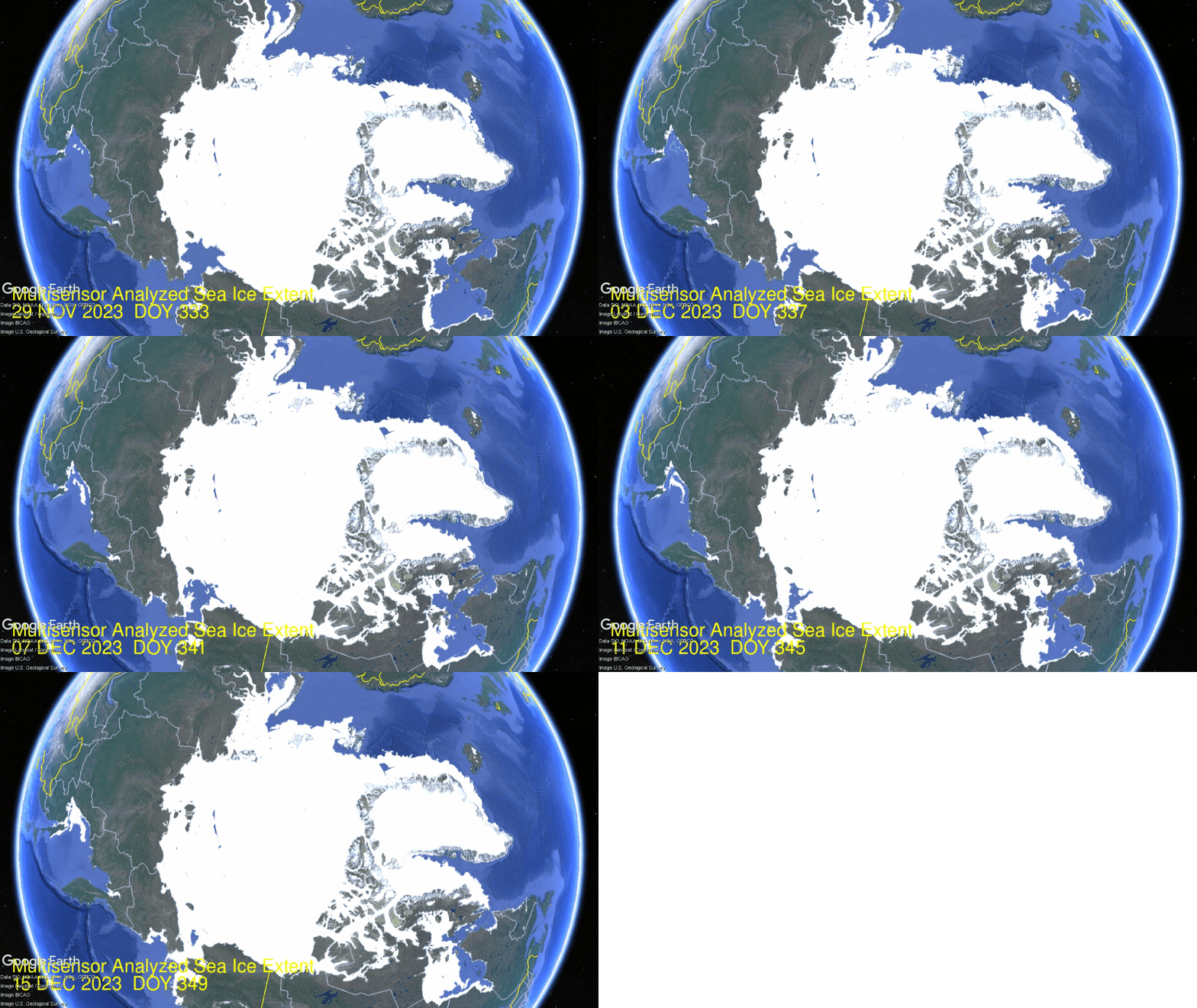
As COP28 began, Arctic ice extrent grew rapidly and by its end the Arctic was completely normal. On lower left, Chukchi sea filled in and below Bering sea started serious freezing. Lower right Hudson Bay more than doubled up to 800k km2, 2/3 of its maximum extent. Center right Baffin Bay grew to 45% of max.
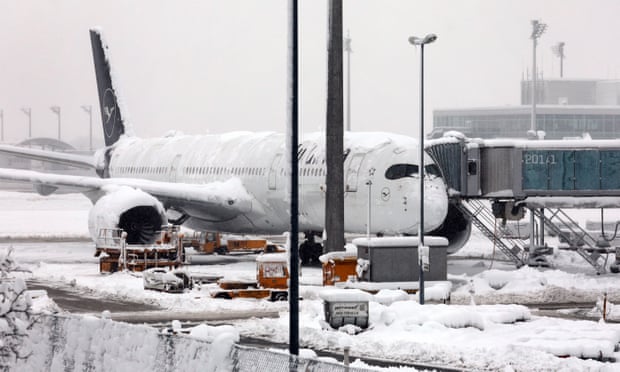
A Lufthansa aircraft at the snow-covered Munich airport on Saturday. Photograph: Karl-Josef Hildenbrand/AP
Coincidently, COP28 also triggered heavy snow bringing chaos to southern Germany causing Munich to suspend flights to anywhere, including Dubai.
The graph below shows the gains in ice extent mid-November to Mid December for 2023, the 17 year average and some other recent years, as well as SII (Sea Ice Index)
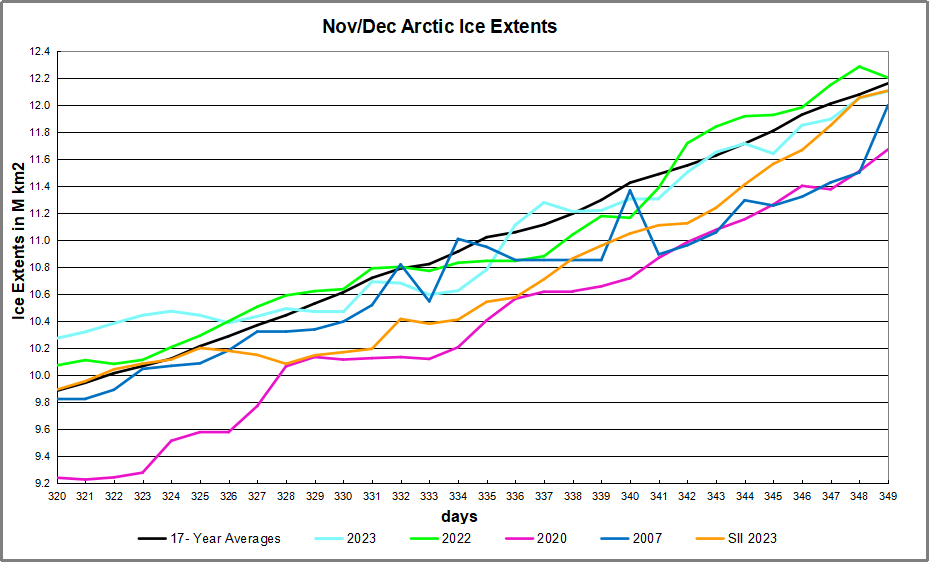
MASIE showed 2023 and 2022 tracking the 17 year average and ending very close together. 2007 fluctuated a lot, well below average in December before rising at the end. SII tracked ~400k km2 lower most of this period, before rising to match MASIE in the last few days.

The table below shows the distribution of ice in the Arctic Ocean basins.
| Region | 2023349 | Day 349 | 2023-Ave. | 2007349 | 2023-2007 |
| (0) Northern_Hemisphere | 12104311 | 12162108 | -57797 | 12000124 | 104187 |
| (1) Beaufort_Sea | 1070966 | 1070103 | 863 | 1069711 | 1255 |
| (2) Chukchi_Sea | 948805 | 934827 | 13978 | 796459 | 152347 |
| (3) East_Siberian_Sea | 1087137 | 1086539 | 598 | 1077192 | 9945 |
| (4) Laptev_Sea | 897845 | 897835 | 9 | 897845 | 0 |
| (5) Kara_Sea | 826874 | 847433 | -20559 | 842174 | -15300 |
| (6) Barents_Sea | 370088 | 335870 | 34218 | 285179 | 84909 |
| (7) Greenland_Sea | 688238 | 546548 | 141690 | 571916 | 116322 |
| (8) Baffin_Bay_Gulf_of_St._Lawrence | 819365 | 824803 | -5438 | 852443 | -33079 |
| (9) Canadian_Archipelago | 854860 | 853420 | 1440 | 852556 | 2304 |
| (10) Hudson_Bay | 800760 | 1101080 | -300320 | 1248305 | -447546 |
| (11) Central_Arctic | 3212059 | 3204043 | 8016 | 3192331 | 19728 |
| (12) Bering_Sea | 226652 | 236725 | -10073 | 93340 | 133312 |
| (13) Baltic_Sea | 55323 | 11920 | 43403 | 10353 | 44970 |
| (14) Sea_of_Okhotsk | 231640 | 200090 | 31550 | 206342 | 25297 |
Note that Arctic ice now exceeds 12M km2, or 80% of last March maximum. As shown in the table above, the main deficit to average is in Hudson Bay, likely to be overcome with the current rapid growth. Offsetting are surpluses elsewhere, mostly in Greenland sea, along with Barents and Baltic seas.

 Science Matters