In chemistry, a litmus test is a strip of paper that turns red or blue when dipped into a liquid. Red shows the liquid is acid, while blue shows it is alkaline. The analogy in this context: Being able to openly discuss and challenge climate claims shows how healthy or toxic is the discourse in an institution or social circle.
The difference between toxic and healthy discussion spaces is indicated by this quote from eminent physicist Richard Feynman:.

Dr. Matthew Wielicki shares his personal experiences with these spaces in a brief video. I provide a transcript from the closed captions lightly edited for reading. He explains how being able to freely discuss and debate climate claims signals an air of social freedom, in the absence of which living things die like canaries in coal mines. Text is in italics with my bolds and added images.
[An Aside: Soviet Humor:
Q: What is the difference between the Constitutions of the US and USSR? Both of them guarantee freedom of speech.
A: Yes, but the USA Constitution also guarantees freedom after the speech. (Passé?)]
Climate change is tricky.There’s a disconnect between what
the science says and what is the narrative in the mainstream media.
My name is Matthew Wielicki and this is my story. I am a former faculty member in the department of geological Sciences at the University of Alabama. I have a doctorate in Geology and Earth Science and I am the author of Irrational Fear substack. I was born in southern Poland at a time when Poland was under the sphere of influence of the Soviet Union and a communist government. And my parents made the decision to immigrate to Chicago, like all good Polish people do; that’s the Ellis Island for Polish people of Chicago.
Then eventually I grew up in Fresno California where we received political Asylum and eventually citizenship. I grew up on a college campus Cal State University Fresno. My father was a faculty member there at the school of business, my mother was in information technology and staff. I would ride my scooter around campus after school every day. It was something that I fell in love with. It was a place where there were these Warriors that battled in the playing field of ideas, and then they would go and have dinner together. And they would chat and be friendly, so it was this beautiful place of just intellectual discussion.
So I pretty much decided I was going to be an academic when I was 10 or 12. I was always intrigued by science. My original degrees were biochemistry and cellular biology. I was what was called a geochronologist: Geo being Rock, chronology being kind of the ages. I received my PhD from the Department of Earth Planetary and Space Sciences at UCLA. Then I was offered a 10 year track position at the Department of Geological Sciences at the University of Alabama. Taking that faculty position in Alabama was my dream, and so I was absolutely excited. I was a little nervous moving our family from California to Alabama. That’s a pretty big move but you know we were excited.
It was definitely something I wanted to do but I noticed that the campus that I grew up on and the one that my father and I would talk about was different. College campuses have always been meritocracies, we have GPA, we give grades. Now there was a shift from performance and ability to what I would say are immutable characteristics; meaning what you look like, or maybe your background or your race. And those are things that students don’t have any control over.
And so there was this disconnect from what I remembered, where it was this competition of ideas and everybody was on an equal playing field. And if your idea was better than your competitor’s idea, then your ideas would win. Bnd now it seemed that the ideas didn’t matter as much as characteristics of the students to appease funding agencies or whatever it was. One of the first things was they got rid of the GRE: this is The Graduate Requirement Exam. so in the name of equity they removed an entrance exam, and so I was now left with trying to understand someone’s life story from an essay without having any standardized metric to compare them to.
So I would bring this up in faculty meetings and it was clear
that they were checking a box. There were certain things
that we couldn’t discuss in Academia.
In Earth Sciences if you speak about climate change that is one of these taboo subjects. And climate change is tricky: there’s a disconnect between what the science says and what is the narrative in the mainstream media. What I would call activist scientists have been kind of pushing the narrative in the media which is doing so much damage to mental health. Climate anxiety is probably the number one anxiety issue for the college students that I talk to. And the science does not support that fear.

I think that fear is irrational, climate is a very convenient way for governments and institutions to get involved in nearly every aspect of a citizen’s life. And if you are basing your life decisions, like whether or not to have children, whether or not to raise a family, whether or not to make sacrifices today such that maybe in a decade or so you’re going to be in a better position. If you think that the planet is going to end, you don’t make those sacrifices.
I definitely love the Earth and humans have an influence on the climate and on their environment. And we should minimize that but the notion that our policy changes today will have some dramatic impact on future temperatures or weather in general is untrue. But if you speak out against it, you’re essentially a pariah in this community.
In my introductory geology class, I gave a a two-day lecture about climate realism as what I called it. The students were were were amazingly refreshed to hear that the planet wasn’t going to end in 10 or 12 years but faculty members were a little uncomfortable with it. If you push out scientists that disagree with your narrative, this isn’t an open discussion. This isn’t about finding the truth but rather silencing those that disagree with you, so that you can continue to push your narrative.
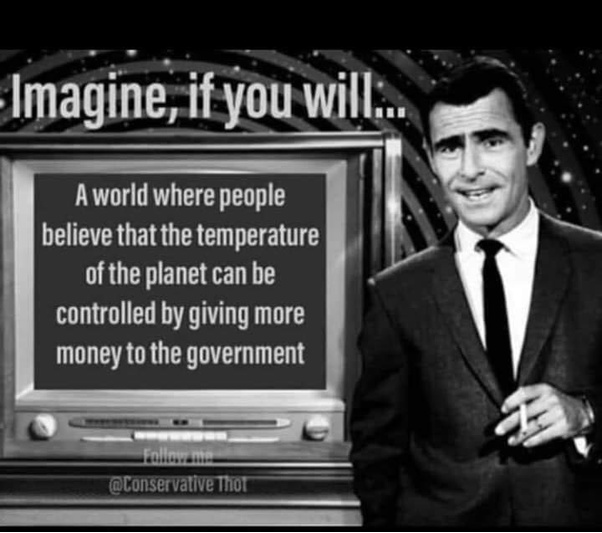
I started to publish a little bit more on social media, and the moment that those stories gained any traction, faculty members in the University of Alabama were making posts that I was was committing violence, that I was putting their jobs and their safety in Jeopardy because I was asking questions. So I decided to leave during Covid. It just wasn’t that dream job that I had been thinking about my entire life. It wasn’t this beautiful place of exchanging ideas that I wanted it to be. I don’t think I would have been able to stay if I chose to stay. I doubt that I would have been awarded tenure if I chose to stay because I had been so vocal.
The data is very clear: there is no metric that we can call the current state of the climate a crisis or an emergency or a breakdown. They’re trying to elicit fear. When people are afraid they are most vulnerable to changing their behaviors. I grew up in a household that was very aware of some of the mistakes of a communist type of government: centralized planning and the removal of the free exchange of ideas.
That makes me more vocal because I see that we’re making the same mistakes that my parents always told me we should never go down this road. It’s the lack of tolerance for ideas, what I call illiberalism; the idea that if you question certain aspects of the government or certain ideologies that you are no longer a good citizen. But if you haven’t lived it you don’t know that these are mistakes. Science is supposed to be about the discovery of the truth and the most important aspect of that is the ability to discuss. I want young people to be hopeful for their future. We should realize that there’s going to be challenges; climate will change but that shouldn’t be a reason to think that your future isn’t hopeful.
Messaging to Make Anxious Children (Example by Canada Federal Government)
What are Dissenting Scientists Saying (Clintel example)
Climate Crisis = Big Government (Example by Canada Federal Government)
These short videos from Trudeau Govt. are airing often on all TV channels and paid for by taxpayers. And yet the last time Canadians were honestly asked about Global Warming, here’s how they responded (buried in the appendices of the survey report).
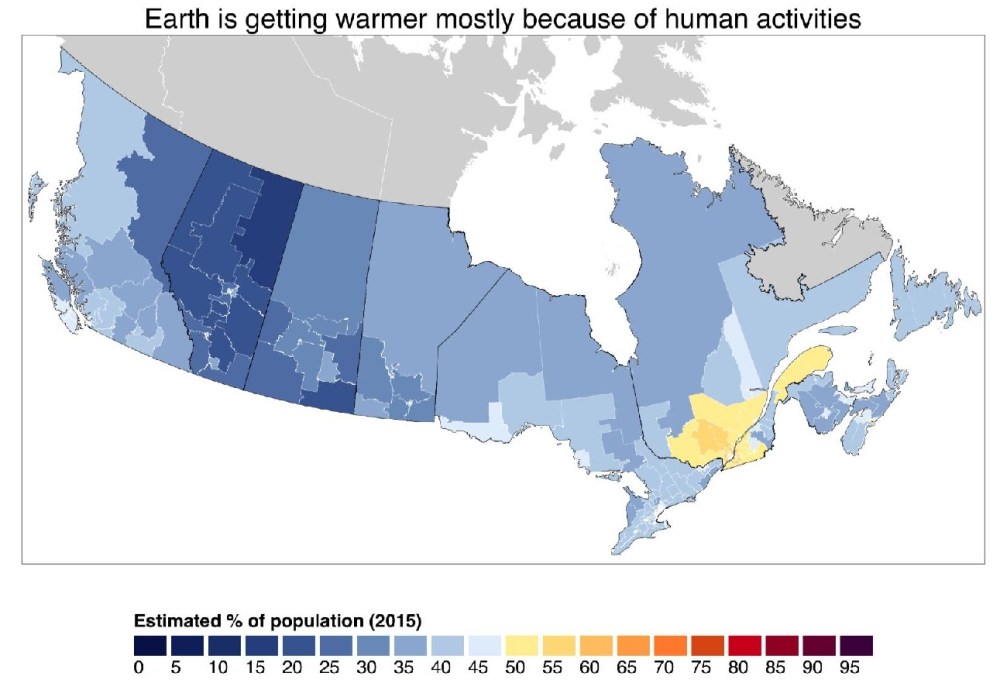
Yes, the map shows I am living in a hotbed of global warming believers around Montreal; well, it is 55%, as high as it gets in Canada. So Trudeau is not listening to more than half of Canadians, but instead using their money to promote his own WEF inspired agenda to change their minds.
Wielicki is warning about a governmental takeover
that is far advanced in North America.
 Science Matters
Like the Feynman quote.
Karl Popper observes that we may sometimes falsify
a hypothesis but proving it is more uncertain.
LikeLike