Insane War on Plastics Resumes
fo1cdfdc8b76_hcs3-2d291-2-e1598902719247-1447x1536-1
FINALLY – the Truth about Plastics & the Environment


You’ve no doubt seen the scary headlines about “Worse Than We Thought™” plastics that have made modern food and hygiene possible and indispensable.

Massive new study uncovers 4,000 toxic chemicals in plastic, The Independent UK

More than 4,000 plastic chemicals are hazardous, report finds, Nature

How Plastic Can Harm Your Health, Consumer Reports

Dangerous chemicals found in recycled plastics, making them unsafe, The Conversation

Chemicals in plastics far more numerous than previous estimates, Reuters

Researchers surprised at levels of toxicity in standard plastic products, phys.org

Etc, Etc Etc.

So it’s time to refresh public understanding and appreciation for the role of plastics for our modern lifestyles and well being, and dispell the alarms generated as part of the anti-hydrocarbon cult.

I became aware of this research and video presentation The Great Plastics Distraction  (H/T Patrick Moore).  For those who prefer reading a text to watching a video, I prepared a transcript of the talk below in italics with my bolds added.

My name is Dr Chris DeArmitt and I’m going to tell you about plastics and the environment.

But first i’m going to start with a story. I once read a wonderful book called Factfulness, and it told a story about how important it is that we act based on facts. Before the early 1990s parents were advised to place their infants to sleep on their front, contrary to advice from clinical research. If they had listened to that scientific evidence then they might have prevented over 10,000 infant deaths in the UK and at least 50,000 infant deaths in Europe, the USA and Australasia. But they didn’t listen. In fact it took decades for doctors to change their advice even when the data was so clear that thousands more died unnecessarily.

This talk aims to reset the way we think about plastics in the environment by showing that our current beliefs don’t match reality. The science tells us the exact opposite of what we’re being told online. And the reason it’s important to know the truth is that when we ignore the facts and the science we end up destroying the very thing we set out to protect.

Here’s an outline of the topics we will cover. First a summary of what we believe now. Then a look at what the evidence tells us, and finally we examine reasons why these two things don’t match up.

We all recognize that we can’t believe everything we see in the media. Traditional media is less reliable than it used to be and social media is even worse. Here’s a study that shows us some numbers. Only 20 percent of people believe in the local news and only four percent of people strongly believe in social media. So we all know that we can’t trust the usual sources of information that we use. And yet that’s where our information is coming from.

So how bad is the accuracy of this information? Well they did a study on millions and millions of tweets and they found out that the lies are 70% more likely to be spread than the truth. That means that we absolutely cannot trust anything we hear on social media. Why? Because the lies are more sensational and sound newer than the truth. The truth’s too boring and even when the truth is spread it never really catches up with the lies.

That’s part of what I’m trying to address here. So what are the consequences of being told all of these lies online? Well it turns out that if you repeat a lie enough times people believe it, and it doesn’t matter how smart you are or how good you are at critical thinking, everybody’s susceptible to this. They’ve done large studies on it.

PlasticsParadox1

So these lies that we’re being told all the time sound like the truth because they sound familiar after a while, and we end up becoming brainwashed. And you’ll notice on all the slides that I’m presenting here there’s a little text at the bottom which (I don’t know if you can see it) here at the bottom of the page. “Every time I say something because I’m a scientist I support it with scientific evidence.” That means that there are giant scientific studies to prove what I’m saying and that’s the opposite to what you hear online. When you see something online they just claim something sensational with zero proof. Everything I say here and everything I say in my book is proven.

I just mentioned my book The Plastics Paradox. Let me tell you a little bit about that. I’ve made it my personal mission to collect and read hundreds of scientific articles to uncover the truth. I didn’t go around looking for articles that supported a pre-existing opinion. I went out and found every single piece of information I could. And why me? Well for one thing my kids were being taught lies at school and I found that totally unacceptable. So I decided to go and find the information to present to the teachers and it mushroomed into the book.

Also I’m a leading PhD. polymer scientist, so I’m uniquely qualified for this task. As a scientist I do not make, market or sell plastics. Some people say that they can’t trust a plastics expert to talk about plastics. And I find that interesting. I ask them whether they refuse to speak to a medical expert when they’re sick. Or if they’re sick do they ask a car mechanic for an opinion or a journalist. Of course you go and ask a medical expert when you want a medical opinion. So when you want an opinion about the technical details of plastics, go and ask a doctor in plastics. And that’s me.

Some of my friends ask me why I’ve devoted thousands of hours and thousands of dollars of my own money to this topic when it’s not my job. I sometimes ask myself the same question. This is why. I’m a professional scientist so I believe we should base our opinions and our actions on fact not fiction. Everything we do has an impact on the environment so we have two choices: Either we have to go and move back into caves or we can continue to enjoy the modern lifestyle we love so much while making choices that minimize our impact.

PlasticsParadox2

How do we do that? Well life cycle analysis is the only proven and accepted way to know what is green and what is less green. It considers all environmental impacts. That means raw materials, the manufacturing of a product, the transporting the product, the function of the product in use (for example driving your car around), repairing the product, and also waste and recycling. Companies, governments and environmental groups all rely on life cycle analysis: It’s standardized and also peer-reviewed for consistency and to make sure that nobody cheats. Any system can be improved upon but if we were to abandon life cycle analysis then we’d have to toss a coin to decide what’s green? It’s better to use a tool that’s good but imperfect than to have no tool at all.

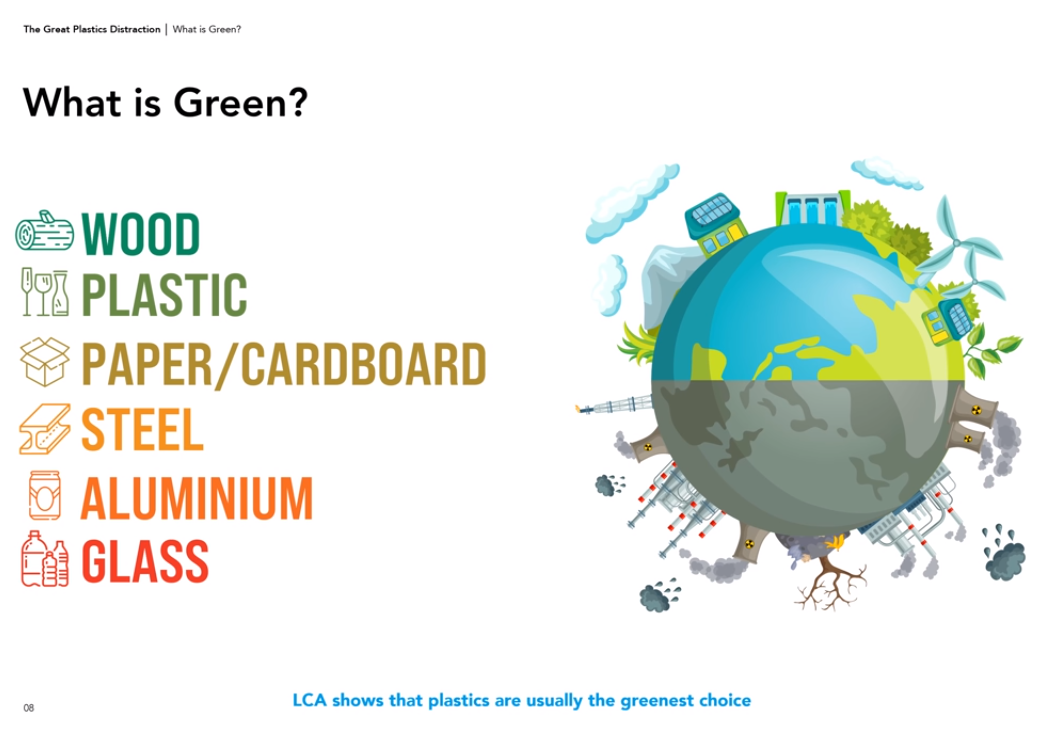
The outcome of a life cycle analysis depends on many things including the geographical location that you’re considering so there’s no universal answer. However if you read a hundred of these life cycle analyses, the geographical aspects start to cancel out and average out. And you get some trends. So here are the trends that I’ve noted after reading a bunch of these life cycle analyses. If you can make something out of a hunk of wood, that’s usually the greenest option. So for example, wood decking and wine corks are examples where wood is greener than plastic.
PlasticsParadox3

But most things can’t be made out of wood, so plastic is then usually the greenest choice.  Paper is sometimes greener than plastic, but usually it isn’t. Examples where plastic are greener include shopping bags or grocery bags. I found 24 life cycle analyses on grocery bags and plastics coming out greener in every single case, in every country no matter where they analyzed it. In 24 studies plastic bags were greener than paper bags and not a single case saying the opposite so here we are banning something which is categorically proven to be the greenest option. Banknotes is another example. A lot of bank notes are made of plastic and they’re proven to be greener than the paper ones because they last so much longer.  And mailer envelopes is another example.

Steel, aluminium and glass are far worse due to the extreme heat and the energy needed to make them, and their density which increases the impact of transportation. So these are the general trends that we see.

PlasticsParadox4

Here’s a quick summary of what I discovered when writing The Plastics Paradox and reading all the science. As I said, all of this is soundly proven and you’ll find all the citations in the book and on the website. Statements I quote are verbatim so I copy and paste the statements from the scientific articles to make sure that there’s no spin on it. And as i said it’s all cited so you can check it yourself. If this information is different to what you’ve heard online or in the press, that’s because this is the first time you’ve actually heard the truth backed by hard data and presented by a professional scientist instead of some hack.

Now I want to show you some very very powerful new information I discovered after the book was published. So part of the reason for this talk is to zoom out and not just focus on plastics but look at the overall picture. I was reading a book about materials and the environment and I was absolutely shocked to my core when I turned the page and saw this pie chart on the left.

PlasticsParadox5

The pie chart shows that plastics are only about one percent of the material we use. All we hear about all day long is plastic, as if it were the only material, and we’re drowning in plastic. And now i suddenly discover from this book that plastics are less than one percent. I found this information so incredible that i decided to double and triple check it. And when i did I found out that a number was actually wrong. It’s actually too high: The amount of plastics we use is only 0.4 percent of materials. You can check this yourself using siri and alexa and google to ask: What’s the annual global consumption of plastics; what’s the annual global consumption of materials? And then work out the percentage.
PlasticsParadox6

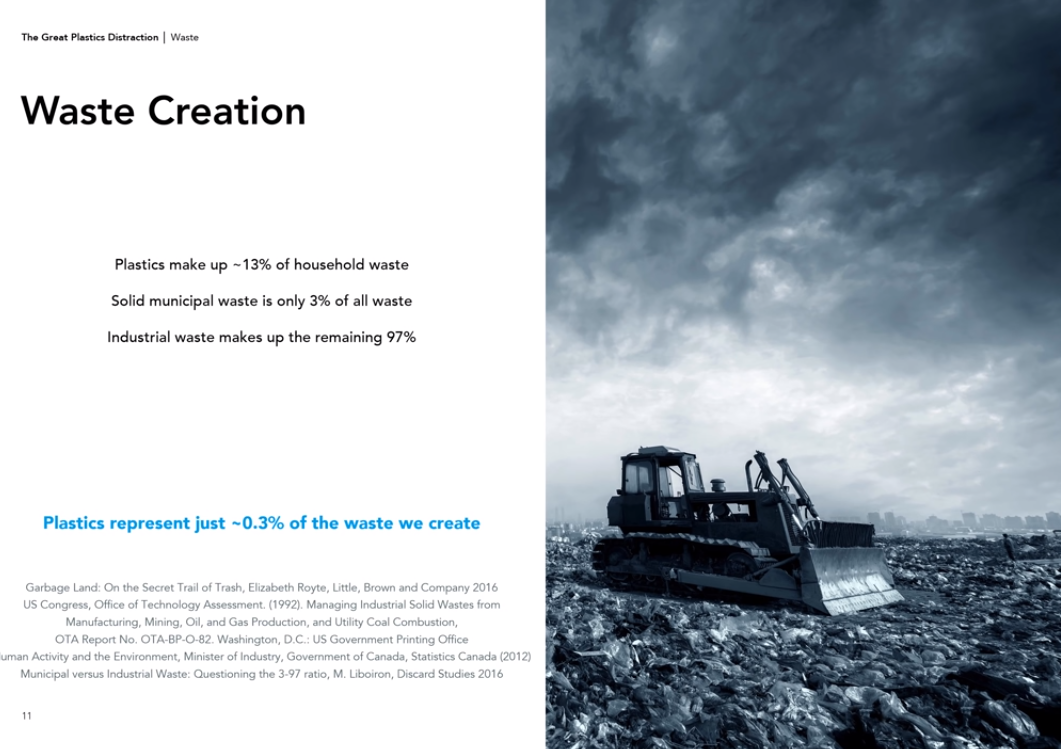
This is absolutely shocking to hear that we’re obsessing about plastics and it’s 0.4 percent of our problem. So based on that finding I decided to do a little bit more digging. We’re told every day that we’re drowning in plastic waste. Of course no data is ever given. So I decided to go and check the data on how much of this waste is actually plastic. In the book I already found out that 13% of household waste is plastic and about 10 percent of what goes into a landfill is plastic. What i didn’t know then was that household waste is just 3% of all waste; the other 97% is industrial waste. So it turns out that plastic waste is 13% of 3%, which is 0.3% of all waste. So once again we’re told online without evidence that plastic is the cause of all of our worries and it turns out to be 0.3 percent of the waste problem.

And as we saw in The Plastic Paradox book and on the website plastics have actually dramatically reduced waste on top of that. So we’re obsessing about a tiny fraction of the problem. There’s no way we can solve the world’s problems by putting a hundred percent of our effort into 0.3 of a problem.

We hear about plastic in the oceans all the time. In the book I explained there are no huge floating islands, they just don’t exist. Scientists say they don’t exist; the man who discovered the gyres also say that they don’t exist. And there’s no soup either; it’s just been all dramatized for the sake of getting your money out of your pockets by certain environmental groups and journalists who don’t care about the facts. It turns out even in these gyres the maximum amount of plastic that you is about one game die if you were to take a game die from monopoly and put it in an olympic-sized swimming pool. that would be too much.
PlasticsParadox7

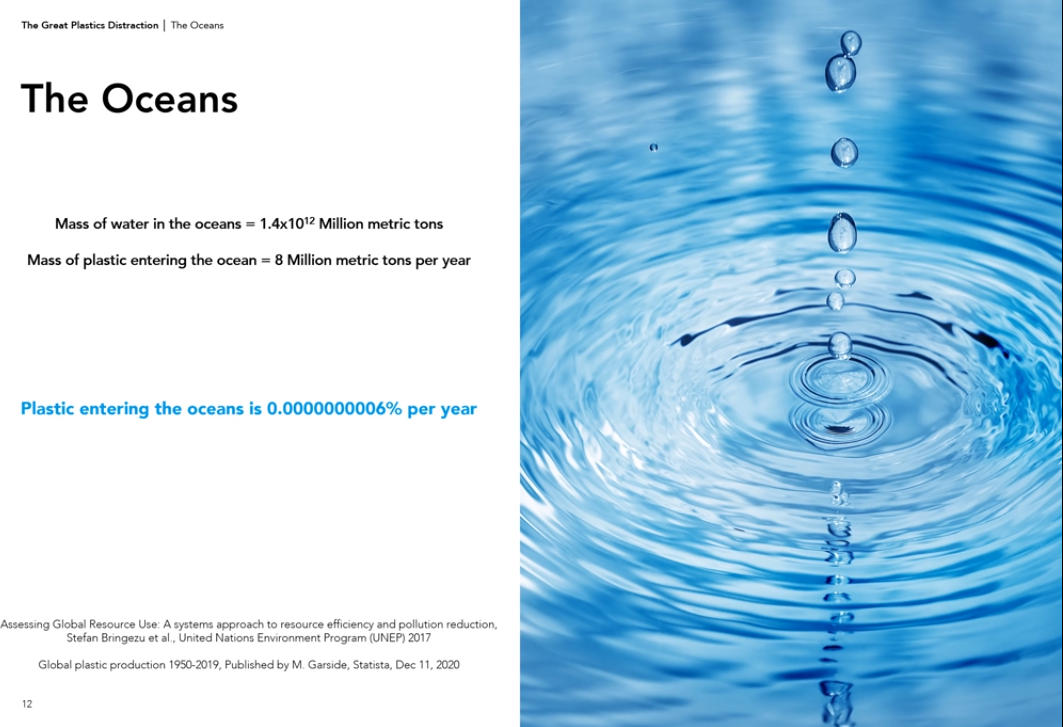
I decided to check how much plastic is actually entering the ocean. We see and hear big numbers but we don’t know what it means. It’s very hard to conceptualize these numbers. So it turns out that the amount of plastic entering the oceans is this tiny tiny number I can’t even say it, but the percentage is many many zeros with a six at the end. Clearly I’m not saying there should be plastic in the oceans, but the number is rather small compared to what we’ve been led to believe. No, there will not be more plastic than fish in the sea; that was debunked as well.

I showed that last slide to a friend and he said it would be more meaningful to compare the amount of solid sediment being washed into the oceans from rivers to the amount of plastic. So once again i went looking for the scientific data and I was able to find it. Plastics make up about 0.05 percent of the solid sediment being dumped into our oceans and rivers. It’s mainly polyethylene polypropylene polyethylene terephthalate and polystyrene; which means the plastics that we eat our food out of every day, so they’re not very much of a concern from a health point of view.

Interestingly there are also massive amounts of deadly chemicals, munitions and even nerve gas in the ocean, but no one talks about that. I wonder why they would rather focus on plastics and ignore the things which are actually proven to be toxic. So-called environmental groups are very keen to bring out the turtle pictures. There’s even a famous video of a turtle with a brown cylinder of some kind in its nose; but there was never any evidence that it was made of plastic.  They never analyzed it when they were doing the video; in fact they thought it was a worm, as you can hear in the video soundtrack. They say, “Oh, is it a worm, is it a worm?” and then afterwards they suddenly declare it’s plastic without any analysis whatsoever.
PlasticsParadox8

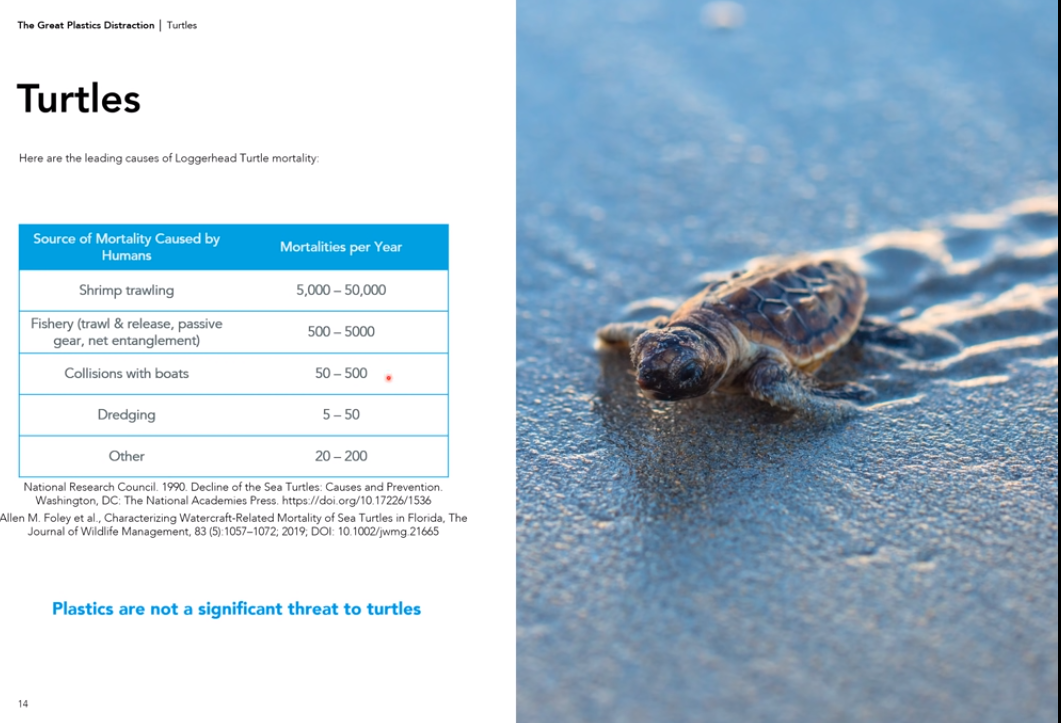
If you’re concerned about turtles you should be looking at these statistics on the left hand side because I looked up turtle mortality rates and here they are. You can see that shrimp trolling accounts for up to 50,000 turtle deaths; fishery is up to 5000; collisions with boats up to 500; dredging up to 50; and other 200. And nothing at all about plastics. So that’s interesting isn’t it? If you do care about turtles, and you’re not just trying to get sympathy votes out of people and pry their money out of their pockets in terms of donations, then you would be looking at these causes of death which are the actual things that turtles suffer. But they’d rather focus on plastics because it suits their purposes.

As well as turtles we hear a huge amount about whales. I saw another article today about whale deaths, so I decided to look up the many studies on whale deaths. And once again I’ve quoted them all. From the scientific studies quoted the causes of whale deaths: entanglement in fishing gear; natural causes, and vessel strikes where boats hit them. So why are they incessantly telling us that plastics are harming whales when not one single one of these articles even had a mention of the word plastic or bag. These are multi-decade studies with thousands and thousands of whale deaths listed and not one mention of plastic or bag.

I find it absolutely reprehensible a while ago several newspapers covered a story saying that there were these massive amounts of micro plastic raining down on our national parks. They said it was several tons of microplastic deposited every year and I thought wow, that’s hard for me to imagine; let me work it out as a percentage, for example, of dust that’s deposited. So I went and found some studies on that; and i can tell you it’s a lot of work to look up all of these studies. The environmental groups like to argue with you and they like to come out with these claims, and they produce no studies whatsoever. And I’ve been working on my own with no funding, and I’ve turned up all of these studies and double checked and triple checked everything. How much hard work it is to actually check the facts, when it’s easier to spout nonsense.
PlasticsParadox9

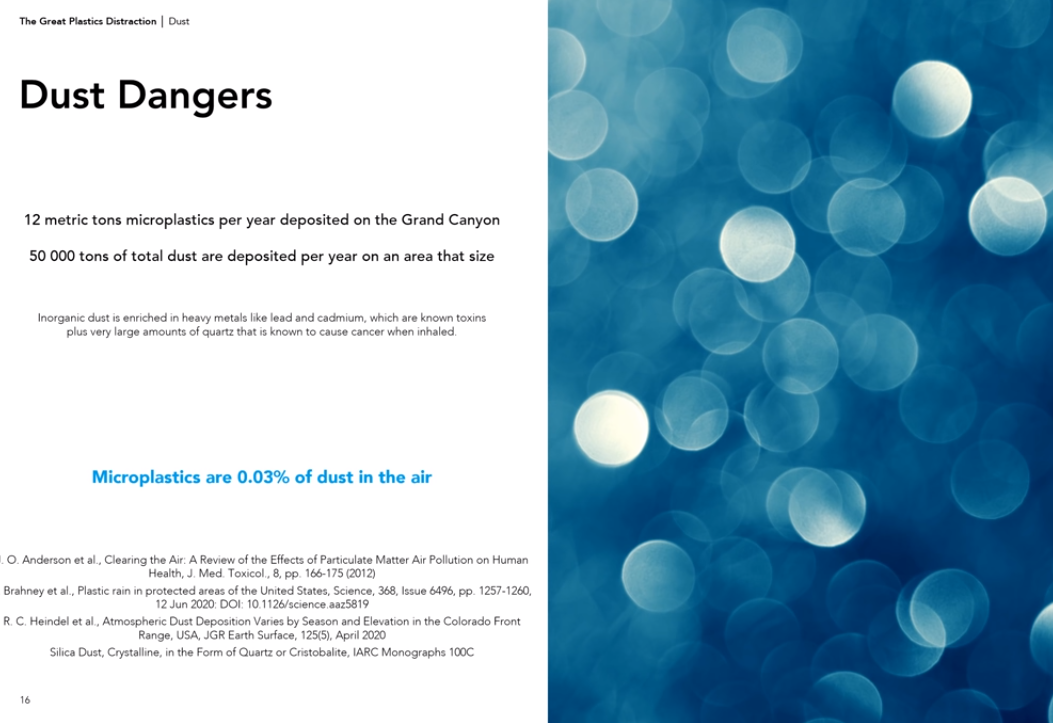
So anyway let’s look at the grand canyon. You can calculate there’ll be 12 tons per year of microplastic dust on the grand canyon and that sounds like a lot. And it is a lot, but it depends on how big the grand canyon is. So i went and checked that and correlated that with the total amount of dust that would be deposited on an area that size which is 50 000 tons a year; meaning that microplastics make up 0.03% of all the dust deposited per year. So instead of hearing this tonnage number which means nothing to us, while the actual percentage is rather small. I’m not saying it should be there but again it’s safe plastics like polyethylene polypropylene and things we eat our food out of. But what’s the rest of this dust made of? The 99.97% in large proportion is quartz which is known to cause cancer; it’s also made up of a large amount of heavy metals such as lead and cadmium which are known to be toxic.

So isn’t it interesting that people would rather focus on 0.03% of safe material because it’s plastic and easy to demonize, and totally ignore things which are known to be toxic and known to cause cancer and are being breathed in in giant quantities.

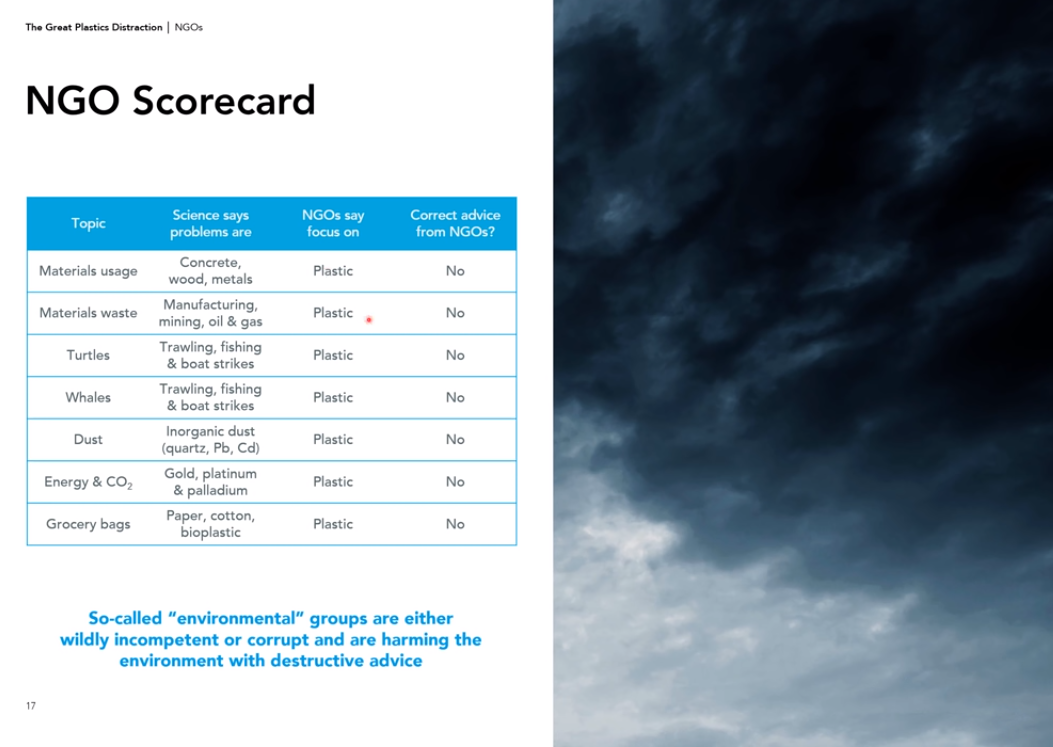
There’s an example where ignoring the science leads you in the wrong direction.  Here I’ve put together an NGO scorecard to see how well these so-called environmental groups are doing at telling us what’s green and what isn’t and what to do. In The Plastics Paradox book as you saw I showed that pretty much everything they’ve told us is untrue; meaning that the science says the exact opposite. And in this talk we’ve zoomed out a little bit to look at the bigger picture. And we found that if we were worried about materials use, concrete, metal and woods would be the things we would focus on.
PlasticsParadox10

But instead these non-governmental organizations want us to talk about plastics. If we’re worried about material waste we will be focused on manufacturing, mining, oil and gas, but instead they want us to focus on plastics. If we were worried about turtles we would be worried about trawling, fishing and boat strikes, but they want us to concentrate on plastic instead. If we’re worried about whales we’ll be looking at trawling, fishing and boat strikes, but instead they want us to talk about plastic. If we were worried about dust we’d be worried about this inorganic dust which contains quartz and heavy metals, but instead they want us to look at plastic. If we were worried about materials that use giant amounts of energy and create co2, we would be worried about gold, platinum and palladium, but they want us to talk about plastic instead. And when it comes to grocery bags, if we’re worried about things that cause harm we’d be looking at paper, cotton and bio plastic bags, but instead they want us to focus on plastic bags which are proven in every single study to be the greenest.

So if we look at how well these so-called environmental groups are doing, they’re not doing very well at all. In fact I can’t find a single area where they’re given evidence which helps the environment or matches the evidence and the science. This means one of two things: Either they’re wildly incompetent, in which case they don’t deserve our funding and our donations. Or they’re actually corrupt, in which case they also don’t deserve our funding and our donations.

How do we know which one of these two things it is? Well, it’s impossible to know somebody’s intent without being inside their mind, but recently there have been some very interesting books by former environmental group members. And they’ve come out and said, I’m ashamed to have been a part of this group. They’re just corrupt and they’re just telling you lies and scaring you to get your donations. So there are insider reports like Confessions of a Greenpeace Dropout by Patrick Moore; and there’s Apocalypse Never by Michael Schellenberger. You can find several other books along those lines regarding environmental groups where former members have left ashamed and embarrassed, and published books explaining that these guys are just trying to rip you off.
PlasticsParadox11

So here are the conclusions.
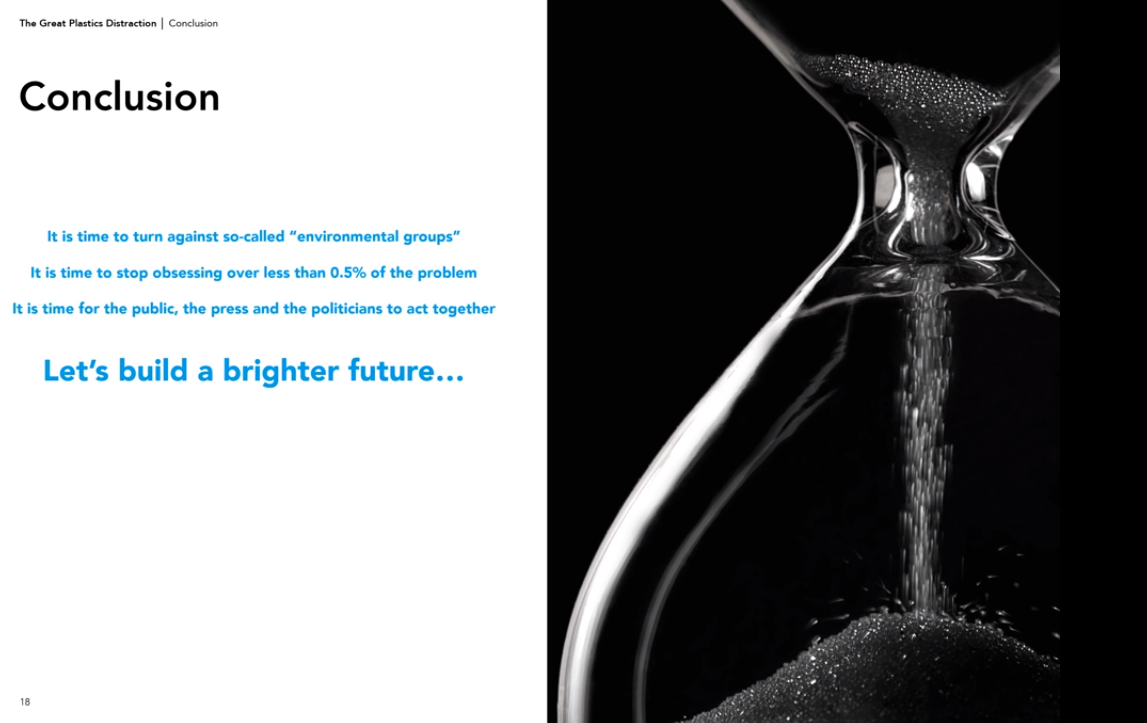
We’ve been lied to again and again by groups keen to enrage us and trick us out of our money.
We need to start basing our opinions and our policies on facts and evidence.
Let’s focus on cleaning up the environment by making wise choices

And if you want to do that please tell your friends about the truths you’ve learned today.
If you know a reporter please tell them;
If you know a CEO or a politician, then please tell them.
And if you know Bill Gates or Oprah Winfrey, so we can get some publicity for the truth, then please tell them.

As you’ve seen facts don’t catch up with lies. We need every bit of help we can get because the lies are already in people’s brains. They spread farther and faster than the truth and we’re playing catch up. We really need to make an impact if we’re ever going to change people’s minds. Stop making stupid policies and stop enriching these groups that are lying to us.

The Plastics Paradox book was written so that people could get the story. But all the information is at plasticsparadox.com. And it’s important for you to know I’m not trying to make money out of this presentation. All this information, all the peer-reviewed science is available for free at plasticsparadox.com. No registration; I’m not selling you one thing. All I’m doing as a professional scientist is telling you it’s time to look at the facts and start making progress instead of pedaling backwards.

Sadly some people are so passionately against plastics that they don’t care about the facts. They prefer to attack me online for example and that’s a shame because well-intentioned people are making harmful choices due to bad information. Just like the story about those infant deaths that we told in the beginning. So if you care about making progress please remember what we’ve said here. Go and visit the website and tell anyone you know who’s an influencer that we’ve got to redress this and start to create a brighter future together.

Thank you very much for your time.

Footnote: 

Dr. DeArmitt wondered about why activists target plastics when they are trivial compared to other problems.  To many of us, the answer is obvious:  Plastics are derived from oil and gas, and therefore anathema to climatists.  Fear of climate change is the driving bias behind efforts to demonize plastics, as well as many other products that make modern life possible.
 

Elites’ Empty Climate Policies

Randall G. Holcombe writes at Independent Institute President Biden’s Climate Aspirations.  Excerpts in italics with my bolds and added images.  H/T John Ray

Most of what the political class calls policies are
really aspirations with no policy content.

They are feel-good statements that promote goals most people would support, with no associated policies that would move toward those goals. The following is an example.

The White House’s web page for the National Climate Task Force (skip down to the section “President Biden’s Actions to Tackle the Climate Crisis”) lists emissions goals for 2030, 2035, and 2050, well after President Biden will have left office, even if he serves out a second term. These are aspirations and aspirations that would have to be met by his successors, letting the president off the accountability hook.

What prompted me to write about this subject was this article titled “Biden’s scaled-back power rule raises doubts over US climate target,” which reports on an actual policy. The Biden administration has decided to exclude natural gas power plants from upcoming emissions standards.   The key point in this example is that the president’s actual policy works against the president’s stated goals.

Further down, the website lists the Biden administration’s accomplishments toward fulfilling his climate aspirations. They include a record number of electric vehicles and charging stations, new solar and wind projects, and supporting domestic manufacturing of clean energy technologies.

Those may be good things, but they are
things the private sector is doing.

“Support” isn’t a policy; it’s an attempt to take political credit for private sector action. If these things count as accomplishments, they are private sector accomplishments, not Biden administration accomplishments.

The website also credits the Biden administration for finalizing the strongest vehicle emissions standards in American history and proposing more robust standards for greenhouse gas and air pollution emissions. Those are not policies; they are aspirations. Should those aspirations be realized, it will be because the private sector has figured out how to reduce its emissions.

As the political season ramps up this year, notice that the “policies”
that politicians will propose are not really policies at all; they are aspirations.

They say, “Here are some good things I would like to accomplish if I am elected,” but they don’t say how they intend to accomplish them. They amount to feel-good slogans rather than actual public policies.

Most people will be in favor of mitigating climate change,
reducing crime, securing the border, and reducing the budget deficit.

Those are feel-good aspirations. Fewer people will favor specific policies aimed at realizing those aspirations. That’s why politicians talk about aspirations rather than specific policies. That’s also why those aspirations often fail to be realized.

The aspirations are popular; the policies to accomplish them are less so.
That’s why the Biden administration is enacting a policy
that works against his own stated goals
.

Footnote:  Climate and Energy Policies No Relation to Climate Mitigation

When it comes to controlling weather and climate, it’s actually worse than the author says.  What policies there are serve only to destroy society’s energy platform with no discernable impact on the supposed problem.

Climatists Mistake Means for Ends


America’s Energy Scam Exploiting Humanity

Ronald Stein’s article at Eurasia Review is America’s Energy Scam: A Deliberate Exploitation Of Humanity That Only Increases Emissions.  Excerpts in italics with my bolds and added images.  H\T John Ray

America is aggressively pursuing “green” electricity and actively phasing out of crude oil to reduce emissions generated in America by deliberately increasing worldwide exploitations of humanity, environmental degradation, and increased emissions.

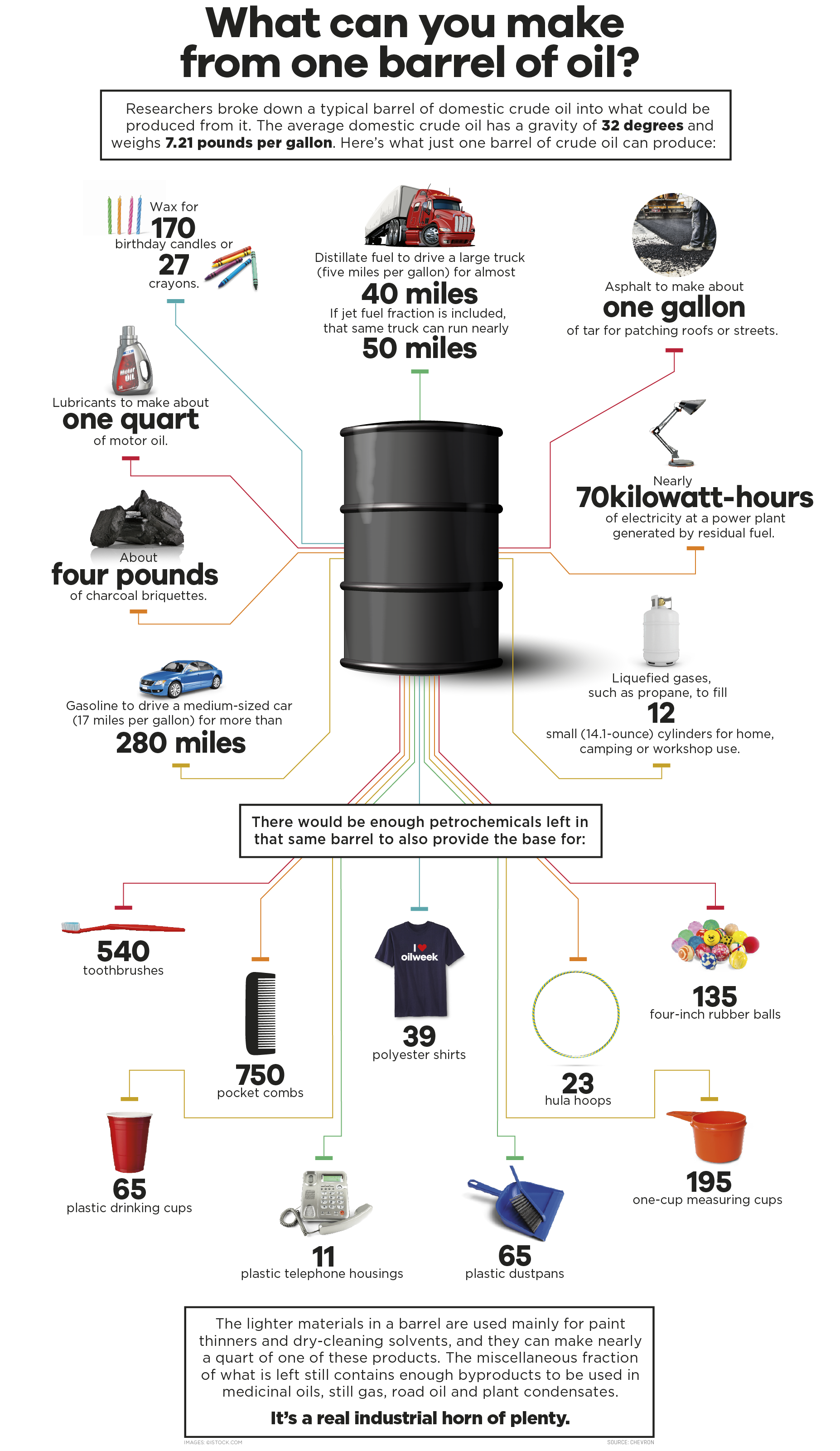
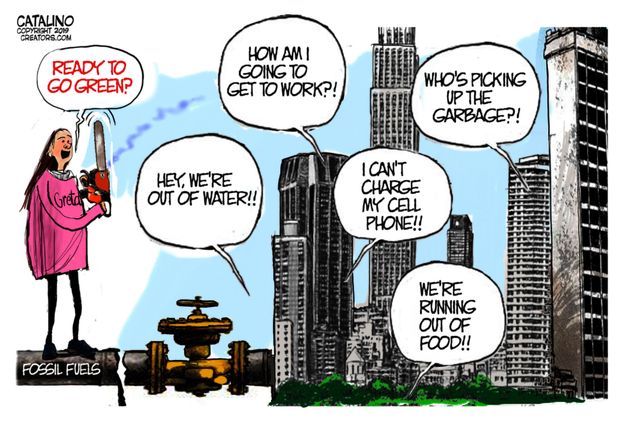
California Governor Gavin Newsom, President Joe Biden, and world leaders are not cognizant enough to know that wind turbines and solar panels only generate occasional electricity and are unable to manufacture tires, cable insulation, asphalt, medicines and the more than 6,000 products now made from the petrochemical derivatives manufactured from crude oil.

Without a replacement for those petrochemical derivatives manufactured from crude oil, phasing out oil would phase out the Medical Industry, Militaries, Transportation, Communications, and the Electrical Power industries, none of which existed before the 1800’s.

Climate changes may impact millions, but without fossil fuels and the infrastructures and products we have today that did not exist before 1800’s, we may lose BILLIONS from diseases, malnutrition, and weather-related deaths.

Eradicating the world of crude oil usage would ground the 20,000 commercial aircraft, and more than 50,000 military aircraft in the world and leave the 50,000 merchant ships tied up at docks and discontinue the military and space programs! Without a backup plan to replace crude oil, the 8 billion on this planet will face the greatest threat to humanity without jets, merchant ships, and space programs.

America’s climate policies being introduced are particularly harmful for developing countries. America is probably the most environmentally controlled county in the world, but by deliberately relying on poorer developing countries for our fuels and products, we are “leaking” to other countries:

    • Leakage of emissions to countries with minuscule environmental laws.
    • Leakage of the exploitations of people with yellow, brown, and black skin to counties with minuscule labor laws.
    • Leakage of environmental degradation to landscapes in developing countries where there are minuscule environmental laws.

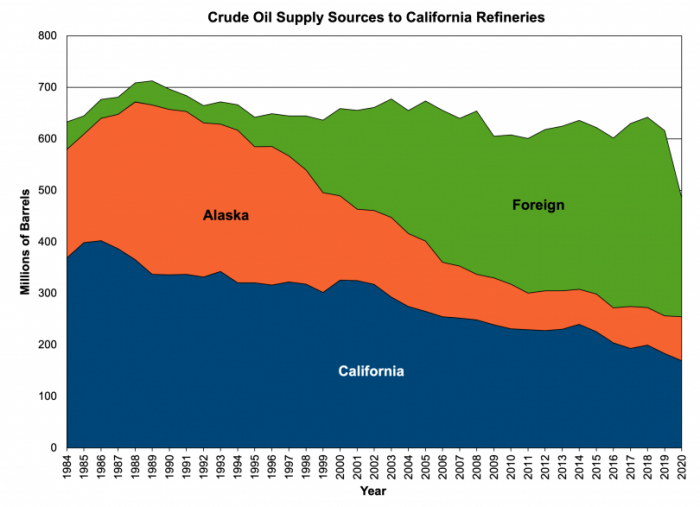
In the aftermath of the 1973 oil crisis in 1977, the Department of Energy was established to lessen our dependence on foreign oil but today, with its 14,000 employees and a $48 billion dollar budget the D.O.E. continues to remain dead silent and has allowed California, the 4th largest economy in the world to increase imported crude oil from 5 percent in 1992 to almost 60 percent today of total consumption

For the past 25 years the amount of oil supplied to California’s refineries has essentially held steady at around 660 million barrels per year, but the source of the supply has changed drastically. In 1995, nearly all of that oil came from within California’s borders and Alaska. Today, the majority of the oil comes from foreign imports as data from the state’s Energy Commission shows.

California is home to 9 International airports, 41 Military airports, and 3 of the largest shipping ports in America. California’s growing dependency on other nations is a serious national security risk for America!

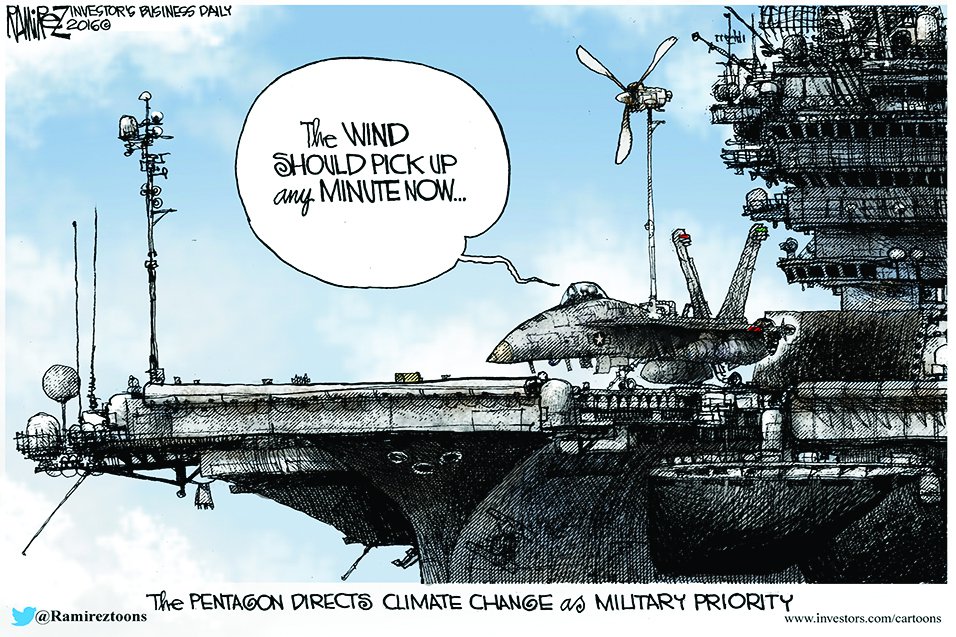
China’s Xi Jinping and Russia’s Vladimir Putin are great War historians. As World War I and II historians, Russia, China, and OPEC know, the country that controls the minerals, crude oil, and natural gas, controls the world!  It’s shocking that of all the Generals that report to President Biden (Army, Navy, Marines, Air Force, Space Program), NONE have asked the President how are we going to run our military ships, planes, vehicles, and supply products to our troops WITHOUT oil?

It’s a no-brainer that an attack on the ports at San Francisco, Los Angeles, or Long Beach could paralyze the American economy with huge reductions in fuels for California’s in-state infrastructures and stagnate the supply chain of products for the entire country.

Meanwhile, California continues to constantly reduce in-state refining capacity that refines fuels and petrochemicals for the materialistic demands of society and continue its growing dependency on foreign oil.

A few notes about ELECTRICITY:

  • Everything that needs electricity, like the basic light bulb, computers, iPhones and iPads, televisions, washing machines, X-ray equipment, etc., are all made with the oil derivatives manufactured from crude oil.
  • Every method of generating electricity, like wind turbines, solar panels, hydroelectric, nuclear, coal, and natural gas power plants all exist only because all the parts and components of the generation system are made with the oil derivatives manufactured from crude oil.

Renewables, like wind turbines and solar panels, only generate occasional electricity from inconsistent breezes and sunshine, but manufacture no products for society. 

Fossil fuels, on the other hand, manufacture everything for the 8 billion living on this planet, i.e., products, and transportation fuels.

And MOST importantly today, there is a lost reality that the primary usage of crude oil  is NOT for the generation of electricity, but to manufacture derivatives and fuels which are the ingredients of everything needed by economies and lifestyles to exist and prosper. Energy realism requires that the legislators, policymakers, and media that demonstrate pervasive ignorance about crude oil usage understand the staggering scale of the decarbonization movement. 

The ruling class and powerful elite have yet to identify the replacement for the oil derivatives that are the basis of more than 6,000 products and all the fuels for the merchant ships, aircraft, military, and space programs that support the 8 billion living on this planet?

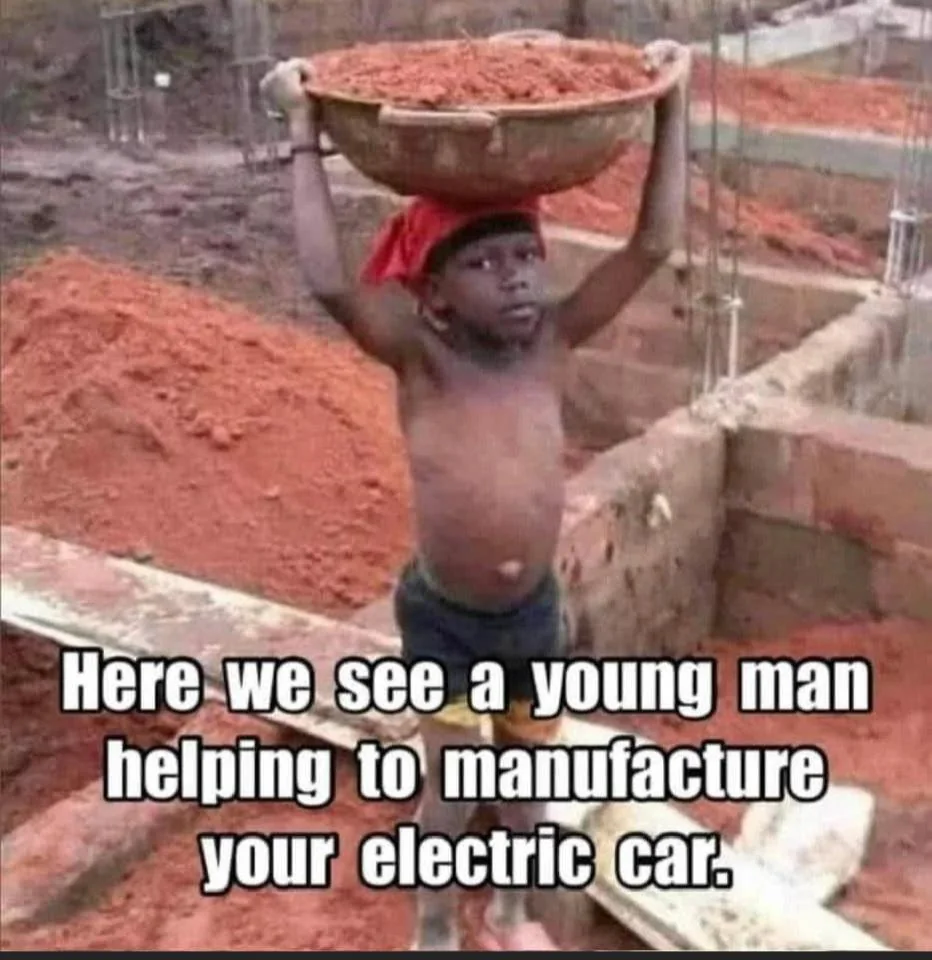
The American government provides incentives and tax deductions to transition society to EV’s, but those incentives are financial incentives for the continuation of Child Labor and Ecological Destruction “Elsewhere”. Is it ethical and moral to provide financial support to the developing countries that are mining for exotic minerals and metals to build EV batteries for Americans? 

We’ve become a very materialistic society over the last 200 years, and the world has populated from 1 to 8 billion because of all the products and different fuels for planes, ships, trucks, cars, military, and the space program that did not exist before the 1800’s. Until a crude oil replacement is identified, the world needs a back-up plan that replaces crude oil that will support the manufacturing of the products of our materialistic society.

Today’s materialistic world cannot survive without crude oil!  Conversations are needed to discuss the difference between just ELECTRICITY” from renewables, and the “PRODUCTS” that are the basis of society’s materialistic world. Wind turbines and solar panels are themselves MADE from oil derivatives, and only generate occasional electricity but manufacture NOTHING for society.

How dare the ruling class, powerful elite, and media, avoid energy literacy conversations about the “Elephant in the Room”, as the end of crude oil that is manufactured into all the products and transportation fuels that built the world to eight billion people, would be the end of civilization as “unreliable electricity” from breezes and sunshine cannot manufacture anything.

Background Post

Four Ways Net Zero Ruins Us


2024 El Nino Collapsing

Meteorologist Cliff Mass explains at his blog El Nino’s Collapse Has Begun.  Excerpts in italics with my bolds, added images and ending comment.

The entire character of this winter has been characterized by a strong El Nino.

El Nino impacts have included low snowpack over Washington State, huge snowpack and heavy precipitation over California, and warm temperatures over the Upper Plains states.

However, El Nino’s days are numbered and
its decline is proceeding rapidly right now.

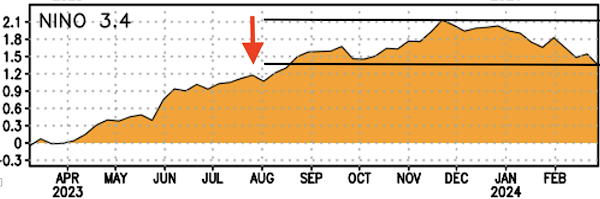
First, consider the critical measure of El Nino: the sea surface temperatures in the central tropical Pacific (see graph above showing the Nino 3.4 area). The warmth of this El Nino peaked in late November (about 2.1°C above normal) and is now declining fairly rapidly (currently at roughly 1.3°C above normal).

But the cooling is really more dramatic than that:
a LOT of cooling has been happening beneath the surface!

To demonstrate this, take a look at subsurface temperatures (the difference from normal) for the lowest 300 m under the surface for a vertical cross-section across the Pacific (below).

On 8 January, there was a substantial warm layer extending about 100 m beneath the surface.

But look at the same cross-section on 27 February.

Wow–what a difference! The warm water has dramatically cooled, with only a thin veneer of warmth evident for much of the Pacific. Rapidly cooling has occurred beneath the surface and this cool water is about to spread to the surface.

If you really want to appreciate the profound cooling take a look at the amount of heat in the upper ocean for the western tropical Pacific (below, the difference from normal is being shown).

A very, very dramatic change has occurred. The heat content of the upper ocean peaked in late November and then plummeted. Declined so much that the water below the surface is now COOLER than normal.

El Nino fans will be further dismayed to learn that models are going for a continuous decline….so much so that they predict a La Nina next year!

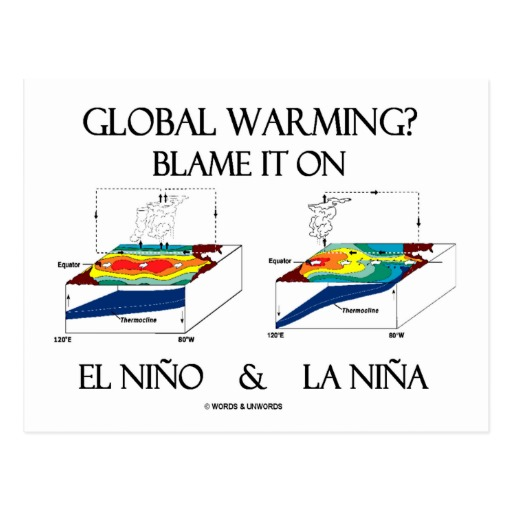
My Comment: Why this shift from El Nino to La Nina matters

Global temperatures typically increase during an El Niño episode, and fall during La Niña.  El Niño means warmer water spreads further, and stays closer to the surface. This releases more heat into the atmosphere, creating wetter and warmer air.

Air temperatures typically peak a few months after El Niño hits maximum strength, as heat escapes from the sea surface to the atmosphere.

In 2021, the UN’s climate scientists, the IPCC, said the ENSO events which have occurred since 1950 are stronger than those observed between 1850 and 1950.  But it also said that tree rings and other historical evidence show there have been variations in the frequency and strength of these episodes since the 1400s.

The IPCC concluded there is no clear evidence that Climate Change™ has affected these events.

CO2 Coalition Does Climate Reveal in Wyoming

The CO2 Coalition article is CO2 Coalition Takes the Science to Wyoming.  Excerpts in italics with my bolds and added images.

Wyoming has vast resources of coal, oil and natural gas. With 40% of the nation’s coal resources, the state has been the United States’ top producer since 1986, primarily from the Powder River Basin located in the northeastern part of the state. It is also a national leader in the production of oil and natural gas, ranking in the top 10 in production of both products. 

Yet, even though the Wyoming economy is heavily dependent on the mining and extraction of fossil fuels, its governor, Mark Gordon, has adopted a strong “decarbonization” policy. The science tells us that this is not a winning strategy for the people of Wyoming. 

The CO2 Coalition believes that public policy on such matters should be driven by scientific review and analysis, not political agendas. To provide such an analysis, we have produced this report, Wyoming and Climate Change: CO2 Should Be Celebrated, Not Captured

We also sent a team of climate experts from the CO2 Coalition,  including Dr. William Happer, Dr. Byron Soepyan and Gregory Wrightstone to Wyoming to provide the facts concerning the huge benefits of carbon dioxide. This team presented the science at a hearing of the Wyoming Senate Agriculture Committee (pictured above.)

The team also presented accurate science regarding Wyoming’s climate to students at Gillette College, Laramie County Community College, and at the University of Wyoming.

Temperature Data Shows Good News for Wyoming

Data for Wyoming contradict the 4th National Climate Assessment (NCA4) assertion that “the frequency and intensity of extreme high temperature events are virtually certain to increase.”

Our data analysis shows that high daily temperatures peaked during the Dust Bowl years of the 1930s and have been in a 90-year decline. This is confirmed by reviewing the percentage of days that were reported to be hotter than 100°F (37.8°C) by Wyoming temperature stations. There is no discernible increase, and the largest numbers occurred in the first half of the 20th century when CO2 levels were 70% of recent measurements.

There has been, however, a beneficial increase in the minimum nighttime temperatures, which has led to a lengthening of the Wyoming growing season. Since the late 1800s, these nighttime temperatures have increased about 2°F (1.1°C).

The slight increase of about 1.2°F (0.7°C) in the average temperature
in the last 120 years is being driven by reductions in extreme cold
rather than increases in extreme heat.

Full Report:  Wyoming and Climate Change

Conclusion From Full Report 

The recent proposal by Wyoming Governor Mark Gordon to use “carbon capture” to achieve what he terms “negative net zero” (Gordon 2021) is based on a flawed theory that increasing CO2 in the atmosphere is leading to harmful effects on Wyoming’s environment and its people. Within this report, we have documented that modest warming and increasing carbon dioxide are clearly beneficial for the Cowboy State’s ecosystems and citizenry.

The data tell us the following:

• Current levels of carbon dioxide are at near historically low concentrations.
• Adjustments to historic temperature records have artificially amplified modern warming.
• Wyoming temperatures have increased a modest 1.2°F (0.7°C) since 1895.
• Heat waves peaked in the 1930s and have been in slight decline since that period.
• Nightime low temperatures have increased, lengthening growing seasons.
• Precipitation data, while varying greatly from year-to-year, show no increasing or decreasing trend.
• Droughts are not increasing in Wyoming.
• Severe weather and natural disasters are declining.
• Agricultural production, globally and in Wyoming, is thriving due to modest warming and more CO2.
• Vegetation in Wyoming and around the world is increasing.
• Greenhouse-induced warming that would be averted (< 0.003°F) by eliminating Wyoming’s CO2 emissions would be too small to measure and achieved, if at all, at enormous cost.
• Models used to project future temperatures significantly overpredict the amount of warming in coming decades.

CO2 Should Be Celebrated, Not Captured

Decarbonizing Religion Delusional

“Climate Activism is a Religion” – Marian Tupy.  H/T Raymond.  Excerpted transcript below in italics with my bolds and added images.

“The planet is infected with us we’re all gonna die. Isn’t that all true and and correct?

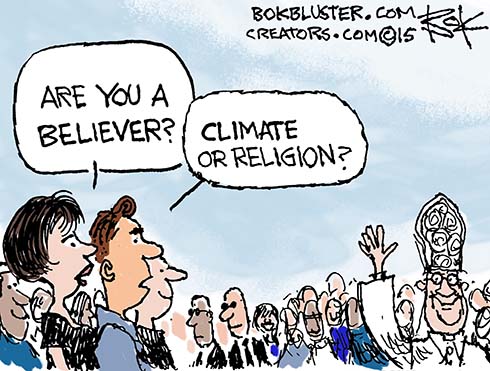
It’s certainly not true and actually the history of the relationship between population growth and abundance of Natural Resources is much more complex than people realize. It’s very interesting to see how extreme environmentalism maps onto Christian theology. On the one hand you’ve got your Garden of Eden: that’s the world before industrialization. You have your Devils: fossil fuel CEOs and people like that. You have your Saints, Greta Thunberg. Your Priesthood is the IPCC scientists. And of course you even have indulgences like back in the days before Reformation. Where you are allowed to fly around the world on a private jet, so long as you give a few thousand pounds or dollars to a green cause. All those sins are simply washed away. And one of the fundamental features of any religion is apocalypse, the end of days.

What we are saying is that if the world is going to end. it will certainly not end because we will run out of Natural Resources. The British energy problems are not an outcome of physical limits on fossil fuels or energy that can be produced in the world. They are an outcome of stupid decisions made by your politicians for the last 20 years.

Context

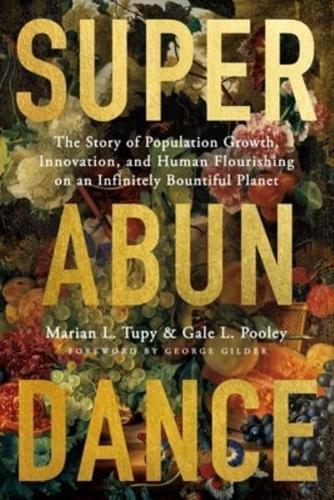
Our guest today is the editor of humanprogress.org, a senior fellow at the center for Global liberty and prosperity, whose latest book is called super abundance the story of population growth Innovation and human flourishing on an infinitely Bountiful Planet. Marian Tupy, welcome to triggeronometry. Please tell everybody who you are and what brings you to be sitting here talking to us

It starts with my birth in Czechoslovakia socialist republic. When I was a child my parents moved to South Africa. Later I went to Great Britain and studied at Saint Andrews University. I’ve been in Washington DC at the Cato Institute which is a Libertarian think tank for the last 20 years. And as you mentioned I run a website called viewingprogress.org which is basically just a website trying to document and promote the notion that the world is improving along many different dimensions of human well-being. That led me to writing a book about population and Innovation and natural resources.

Well speaking of all of that Marian, the the self-evident truth that everyone’s been completely persuaded about for the last God knows how many years is the planets overpopulated,  humans are the virus infecting the planet. We’re all gonna die, and as we die we’re gonna make everything terrible. Marion why is it that so many people think that overpopulation is a real danger for our planet and the future of the human race?

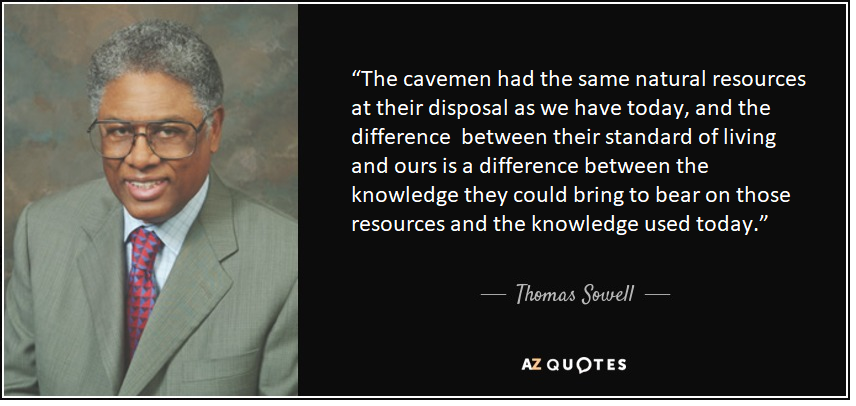
I think it’s because the notion of finitude of atoms which is absolutely true. It is common sense and intuitive to say: If you have the finite quantity of atoms but you are increasing the people using those atoms then at some point you must run out. But this ignores a very fundamental difference between human beings and other animals. We are animals who are capable of planning forward and we are animals capable of innovating out of our problems through human knowledge. So American Economist Thomas Sowell has a famous quote:

An example is iPhone, a great way of dematerializing our the world. In other words we are saving a lot of atoms that we don’t have to put into television sets, into cameras, into Maps, into campuses, into calculators and all those other things. Instead we put it on this device. I hope it goes some way into explaining why the number of atoms in the world is actually not a limiting factor for how much of value we can create.

I think that if we are looking at the source of discomfort and a sense of dejection about the future, it may come from the fact that in Britain you cannot build that many houses. Or rather you refuse to build that many houses because of governmental policy. I’m not bashing Britain I’ve spent five years in your beautiful country and I love it and we have the same problem in the United States. it’s not that all of these people living in the cities are concerned about overpopulation, just that they’ve decided that you’re not going to build in my backyard.

It’s policy driven rather than driven by some sort of fundamental physical lack of space.

People still need a search for the transcendental; they still need to commit their lives to a meaning, to some sort of a heroic vision of themselves. What is it that they are trying to accomplish with their lives aside from going to work? And I think that many people especially in secular societies have embraced Extreme Environmentalism as a substitute for religion. um it’s very interesting to see how extreme environmentalism maps onto Christian theology. So I think that there are religious overtones to environmentalism. And the number of apocalyptic movies has been growing every decade since the 1950s, even though the world has improved along very many different dimensions: we live longer, we live healthier lives, we are much richer, poverty is collapsing around the world.

But with every decade the number of apocalyptic movies is actually increasing with one exception and it was 1990s because of the peaceful resolution of the Cold War.

Whatever your view on fossil fuels, whether or not you believe that emitting ever more CO2 in the atmosphere is a problem, clearly the timeline and the plan that our politicians have invented is completely unrealistic. We are not paying a price for there being too little oil or gas or uranium in the world. We are paying a penalty for politicians forcing us into energy consumption patterns which were completely unrealistic. The book tells you that there is plenty to be used for hundreds of thousands of years. We are never going to run out of these energy sources or natural resources, but yes as a society we could certainly decide not to use them and simply to shut off the lights and close the door on Western Civilization. That choice is not going to be forced on us by physical limits of the planet.

I think there is a reasonable chance that we have seen Peak apocalyptic environmentalism, for two reasons. One is that half of the world, the underdeveloped or developing world is never going to buy into our nonsense. We just have to stop thinking that and don’t even pretend that people in India and China and Bangladesh and Africa, which are still very poor are simply going to start using windmills. It’s just not going to happen for decades, if ever. They would have to be at a completely different level of Economic Development to start playing around with wind farms and whatever. So they’re going to be reliant on oil and natural gas for a long long way to come. And even that is better than using biofuels in order to power their own societies.

So that’s one half of the population; the second half are the advanced economies like yours and our economies, which are by and large democratic. And I do not believe that with any level of brainwashing coming from Whitehall or from Greta or people who glued themselves to roads or whatever. I don’t think any level of that kind of propaganda and brainwashing will make the good people in the United Kingdom to decide that this is the future they’re going have. In other words democracy is going to win. And if it’s not going to be the Tory party which changes the green policies and the green New Deal or Net Zero, or it’s going to be somebody else. And the sooner the British political establishment awakes to the fact that the British people are suffering and their living standards are collapsing, the less likely it is that you will have a really nasty party emerging that will do it for them.

I have a concern about the democracies we still have here in the West. If our center right and center left simply refuses to acknowledge that by government design lives of our people are getting worse, somebody else is going to fill that void, and that is something I want to avoid.

The reason why the public in this country and in yours holds the politicians in utter contempt is precisely because they see the level of hypocrisy that is going on in in both societies. You see them constantly raising taxes on air travel but they themselves fly around on private jets or first class which is much more carbon intensive. You see them telling you to drive you know little EVs while they enjoy being driven around in SUVs as big as a house. You see them telling you that the world is going to be swallowed up by by the oceans while at the same time they’re buying beachfront properties.

They basically think that we are so stupid and they think that can they can basically freak us out to an extent where where any kind of policy can be can be implemented. And to that extent I was actually impressed with some of the work done in the UK by the former head of your Supreme Court Jonathan Sumption, who was deeply concerned about the kind of public reaction to covid; you know, you end up with a Chinese virus but also with a Chinese Society. If people can be freaked out enough that the world is going to implode, they would be willing to part with their civil liberties and their basic freedoms.

On the other hand all of these apocalyptic predictions have been wrong in the past. And if you again put a date on it, you say that we only have five or ten years left on the planet left, when that time expires we will be wondering why we should be believing these people. What sort of credibility do they have? Do they also realize just how extraordinarily damaging it it to our institutions? How are we supposed to believe the leadership in our societies when they get these calls wrong time and time again.

They complain about populism when they are the causes of populism because
they keep on saying things which are obviously not true.

In this book we looked at 18 different data sets with some of them going back to 1850, and we looked at hundreds of Commodities: Goods, finished goods, Services, food, fuel etc. We found that for every one percent increase in population we had one percent decrease in the price of all of these Goods, services and commodities. That tells us that human beings on average are more producers than they are consumers; that we are really able to produce more wealth than we consume, otherwise you would see the opposite: With every one percent increase in population you would see an increase in prices with greater scarcity. But that is not the fact.

We are very divided in Western countries and so while remaining optimistic: How do we manage some of the trade-offs of these technological developments? Because it seems to me in social communication, cultural programs and entertainment and particularly social media are areas where everyone knows there’s a big problem but no one quite knows what to do about it.

Any technology developed by the human brain can be can be used for good and evil. A baseball bat can be used to hit a baseball and it can be used to to bash you to death, not to mention guns and um anything else, knives and on. So what you do with your Technologies also matters. I think that any new technology from gramophones to bicycles was first met with a wall of negativism. Once it was thought writing of novels was supposed to lead to mental collapse throughout the Western World. Television, radio, all of these things were considered to be potentially world-ending events, but that didn’t happen

When it comes to social media, I don’t like them and I don’t partake. I left Facebook in 2012 when I realized that it was making me unhappy. Because what I was putting up on Facebook was a curated picture of my life, and what I was consuming was a curated picture of my life. So basically I was posting lies in consuming lies, and once I realized that I left Facebook. That was a choice, a choice which can be made independently by any number of all 8 billion people

I think that what we are going through right now is a period of adjustment to a new technology but that period of adjustment will resolve itself. You know it took us 50 years to figure out that drinking and driving was not a good idea. Now it’s sort of been internalized into us that cars are much better operated when you are sober, but it took time to to to to to square the human brain with this new technology. That will probably happen with social media as well or at least I hope that people are going to realize that much of it is simply unreal, what is making them unhappy, and they could be spending their time doing better things than than being on social media. We’ll probably figure it out in the way that we have figured it out with novels and bicycles and radio and television.

I’m basically a follower of the Enlightenment. I aspire to the ideals of the Enlightenment and one of the main features of the Enlightenment was freedom of speech. We are not putting enough emphasis on the way that freedom of speech is being destroyed by our governments, by the media, by cancel culture. Freedom of speech is not only necessary in order to produce new inventions and Innovations but also to produce new ideas. In this country we need a lot of reforms because the country is not functioning very well. Things won’t improve if ideas that I propose are canceled just because they seem too outrageous. In the same way in the United Kingdom, you need to undertake a lot of reforms and what if somebody tells you that your proposal for, let’s say, NHS reform is somehow unspeakable.

We need to preserve freedom of speech, it’s absolutely fundamental and we should be talking more about people getting canceled for joking uh for expressing wrong ideas and also for having peculiar forms of behavior. and that’s important because as we discuss in our book a lot of people on whom we rely for some of the most important Innovations and inventions in the world are also very peculiar people.

I’m rationally optimistic about the future just just to just to clarify that. So long as we don’t have a massive war caused by politicians, so long as we’re able to innovate without a precautionary principle, so long as we are able to freely speak and publish and research. And so long as we have the free markets which can tell us which inventions and Innovations are valuable and which inventions and Innovations are not valuable.

Environmentalism Perverted by Climatism

J. Scott Turner explains how the roots of environmental stewardship were poisoned, resulting in the perverted modern decarbonization movement.  His Spectator Australia article is Environmentalism: from concern about clean air to throwing soup at the Mona Lisa.  Excerpts in italics with my bolds and added images.  H/T John Ray

Garrett Hardin was a professor of biology and environmental studies at UC Santa Barbara. His “commons” was a metaphor drawn from the traditional English practice of shared grazing and agricultural land to which all members of a community had access. Commons were inherently prone to abuse, Hardin argued, because every user of the commons will exploit it to maximize personal benefit without regard to the other users, leading ultimately to the collapse of the commons as a useful resource.

Hardin extended the metaphor of the commons to include all natural resources, including the air, water, other species, even the entire Earth. The tragedy of Hardin’s expansive commons was the inexorable march to environmental doom, driven by the folly of human freedom. “No technical solution” could halt its march, no ingenious tinkering could fix the problem. Rather, Hardin asserted that the juggernaut could only be arrested through “mutual coercion, mutually agreed upon.” To save ourselves, we would have to give up many freedoms we take for granted, specifically “relinquishing the freedom to breed.”

Hardin’s “Tragedy of the Commons” is perhaps the most influential paper
ever to come out of the field of ecology.

Within its six pages were sown the seeds that have grown into the vast industry that is modern environmentalism. If you’ve ever wondered how environmentalism got from simple concern for clean air and water and preservation of wilderness and its wonderful creatures, to Greta Thunberg, Extinction Rebellion and throwing soup at the Mona Lisa, it was Garrett Hardin who drew the map.

Hardin’s path to the tragedy of the commons was itself mapped out by the English economist and cleric, Thomas Malthus. When Thomas Carlyle famously cast economics as the “dismal science” — a “dreary, desolate… quite abject and distressing science” — it was Thomas Malthus he had in mind. Malthus’s economic philosophy was one of finitude and futility. Human populations always grew faster than could the food supply, he asserted, leading inexorably to famine, disease, perpetual poverty and war: the “Malthusian catastrophe.” Malthus’s economics stands in marked contrast to that of his near-contemporary Adam Smith’s more hopeful economics of free trade, free markets and the inscrutable “invisible hand” that would guide societies to prosperity and liberty. The history of economics has been a long contention between these two competing ideas.

Malthusian economics considered people to be aimless particles pushed this way and that by powerful and indifferent forces. People are considered to have no agency whatsoever, or whatever agency they might have, encompass no other sentiment but selfishness. The only way out of the Malthusian catastrophe would be restraint of human nature, through “mutual coercion mutually agreed upon,” as Garrett Hardin put it. Tyranny

A big part of Malthus’s appeal at the time was his mathematical argument, which imparted a faux certainty to his claims. Charles Darwin and Alfred Russell Wallace both were inspired by Malthus’s mathematics, for example, however, Malthus’s mathematics were simplistic and naïve and failed to account for the fact that humans do, in fact, have individual agency — and that the range of moral sentiments was far wider than mere selfishness.

Nevertheless, Malthusianism continues to find devoted acolytes wherever simplistic and naive mathematical presumptions reign. Presently, it is climate change that fits that bill, and it is climate change where the Malthusian tragedy of the commons is again rearing its head — no, having its head propped up, Weekend at Bernie’s style — by a group of twenty-three scholars (they always seem to come in packs) in the prestigious pages of Proceedings of the National Academy of Sciences. There, they call for a “new paradigm” (that buzzword) to stave off the tragedy of the Anthropocene “planetary commons.”

Their new paradigm goes beyond mere governments managing common resources, like sea-floor mineral prospecting. Rather, they are advocating a more ambitious program to take control of the “biophysical systems” that impart resiliency to the Earth’s function. These systems include the atmosphere, hydrosphere (oceans, lakes, rivers and aquifers), the biosphere (encompassing all of the Earth’s biota), the lithosphere (all terrestrial ecosystems, and the cryosphere — ice and snow). Exerting such control, they say, will require “mobilization of efforts at an unprecedented scale, including future research” (read spending), which can only be done through a “nested Earth system governance approach.” This will mean “[adjusting] notions of state sovereignty and self-determination,” taking on “obligations and reciprocal support and compensation schemes … comprehensive stewardship obligations and mandates,” all with the aim to protect “Earth-regulating systems in a just and inclusive way.” You get the idea: “following the science” means a world government that subordinates those pesky notions of self-government and national sovereignty.

Doomsday scenarios are nothing new in the genre of “climate action.” Usually, such contributions bristle with weasel words such as “may,” “possibly,” “perhaps” and the ilk (e.g. the impending extinction of insects). Not so the planetary commons paper, which bristles with alarmist certitude. We are driving the Earth toward dangerous instability, rapidly pushing us past “tipping points” where the Earth will be plummeted irreversibly into disaster, making the Earth inhospitable to life itself. We are sinners in the hands of an angry goddess.

The whole thing is a house of cards, which a little digging will expose. Let’s begin with that word in the title: “Anthropocene.” What does it mean? It sounds science-y, but in fact “Anthropocene” is a neologism proposed in 2000 that demarcates the past 250 years from the Holocene, the geological epoch that began around 11,000 years ago, and which encompasses the rise of modern humans. It is no accident that the Holocene-Anthropocene boundary is set at 250 years before the present: it coincides with the beginning of the Industrial Revolution.

The Anthropocene is the stand-in for the eschatological End Times.
Like the End-Times, it is defined by a basket of horrors and portents:

♦  An order-of-magnitude increase in erosion and sediment transport associated with urbanization and agriculture;
♦  marked and abrupt anthropogenic perturbations of the cycles of elements such as carbon, nitrogen, phosphorus and various metals together with new chemical compounds;
♦  environmental changes generated by these perturbations, including global warming, sea-level rise, ocean acidification and spreading oceanic “dead zones”;
♦  rapid changes in the biosphere both on land and in the sea, as a result of habitat loss, predation, explosion of domestic animal populations and species invasions; and
♦  the proliferation and global dispersion of many new “minerals” and “rocks” including concrete, fly ash and plastics, and the myriad “technofossils” produced from these and other materials.

No mention is made, of course, of the dramatic reductions of poverty, extensions of life spans, improved agricultural productivity, cleaner air and water, safer environments that also mark the Industrial Revolution. Those are Hardin’s “technical solutions,” to be dismissed as the false consciousness that merely delays the springing of the Malthusian trap. We best be wary.

The Anthropocene is not a scientific term: it is an entirely political construction. Being able to sell it as scientific has long been a coveted tool to advance the climate change agenda. This has meant a long march through the institutions that govern geological nomenclature. That effort came to fruition in 2019, at a meeting of the International Union of Geological Sciences in Cape Town, where a vote was taken to formally recognize the Anthropocene as a geological epoch. It passed by a supermajority of 88 percent in favor, which by the rules of the Society, closed off the matter from further debate. What was the actual vote? Thirty-three individuals voted to recognize the Anthropocene, and four dissented. Was this scientific consensus? Technically it was, but we keep in mind the deceptive power of percentages: the 2022 membership of the Geological Society of America totaled 18,096. Remember these figures the next time we hear about a scientific “consensus.”

With the Anthropocene established as a formal geological epoch, the door was opened for climate activists to advance a political agenda masquerading as “science.” The planetary commons paper, for example, asserts that we have already passed six of nine “tipping points,” putting us THIS CLOSE to catastrophe. That sounds dire, to be sure. But just what determines a tipping point, and how do we know we’re past it? One of the references cited in support of this claim is a paper (with many of the same authors as the planetary commons paper) which defines the “safe operating space” for the nine variables.

What determines the limits of the “safe operating space”?
Why, it’s the presumed conditions prior to the Anthropocene!

The circle is thereby closed: the politically-defined Anthropocene is used to set the politically defined “safe operating space” for the Earth, which sets the course for “navigating” through the perilous Anthropocene. Follow the science! The agenda is clear: reverse the Industrial Revolution and return civilization to the illusory halcyon of the Holocene. This is the climate change echo chamber at work: a collection of mutually-reinforcing arbitrary presumptions dressed up in a science-y costume.

It would be amusing were it not for the costume being flashy enough to take in the mid-wit rubes that constitute our present-day ruling class. Danger lurks there, which was expressed eloquently 264 years ago by Adam Smith in his 1759 Theory of Moral Sentiments:

The man of system, on the contrary, is apt to be very wise in his own conceit; and is often so enamored with the supposed beauty of his own ideal plan of government, that he cannot suffer the smallest deviation from any part of it… He seems to imagine that he can arrange the different members of a great society with as much ease as the hand arranges the different pieces upon a chess-board. He does not consider that the pieces upon the chess-board have no other principle of motion besides that which the hand impresses upon them; but that, in the great chess-board of human society, every single piece has a principle of motion of its own, altogether different from that which the legislature might choose to impress upon it. If those two principles coincide and act in the same direction, the game of human society will go on easily and harmoniously, and is very likely to be happy and successful. If they are opposite or different, the game will go on miserably, and the society must be at all times in the highest degree of disorder.

Garrett Hardin was, in his time, also a “man of system,” and it’s worth remembering that our last flirtation with the tragedy of the commons did not end well, especially not for Garrett Hardin himself, who now seems to be somewhat of an embarrassment to our present-day presumptive “persons of system.” We seem to have learned nothing since 1968, or for that matter, since 1759.

Will history repeat, this time as farce? Or will it be tragedy?

See Also 

Don’t Buy “Planetary Boundaries” Hype

Warning: Earth Day Became Polluted