 Leslie Eastman raises the question at Legal Insurrection What is The Bigger Threat to Humanity: Artificial Intelligence or Climate Change? Excerpts in italics with my bolds as she goes on to discuss the frightening answer:
The biggest hazard to humanity is when
climate change arguments are paired with AI.
During a recent interview with Reuters, Artificial Intelligence (AI) pioneer Geoffrey Hinton to asserted AI was a bigger threat to humanity than climate change.
Geoffrey Hinton, widely known as one of the “godfathers of AI”, recently announced he had quit Alphabet (GOOGL.O) after a decade at the firm, saying he wanted to speak out on the risks of the technology without it affecting his former employer.
Hinton’s work is considered essential to the development of contemporary AI systems. In 1986, he co-authored the seminal paper “Learning representations by back-propagating errors”, a milestone in the development of the neural networks undergirding AI technology. In 2018, he was awarded the Turing Award in recognition of his research breakthroughs.
But he is now among a growing number of tech leaders publicly espousing concern about the possible threat posed by AI if machines were to achieve greater intelligence than humans and take control of the planet.
“I wouldn’t like to devalue climate change. I wouldn’t like to say, ‘You shouldn’t worry about climate change.’ That’s a huge risk too,” Hinton said. “But I think this might end up being more urgent.”
I would like to offer two relatively recent studies that should assuage Hinton and others who have bought into the climate crisis narrative. To begin with, Health Physics recently published research results that looks at the presence of carbon isotopes. [Note: My post on this paper is By the Numbers: CO2 Mostly Natural. ]
The data show that fossil fuel use has contributed only 12% of the carbon dioxide during the last 3 centuries. The value is too low for fossil fuels have significantly influenced global temperatures.
These results negate claims that the increase in C(t) since 1800 has been dominated by the increase of the anthropogenic fossil component. We determined that in 2018, atmospheric anthropogenic fossil CO2 represented 23% of the total emissions since 1750 with the remaining 77% in the exchange reservoirs. Our results show that the percentage of the total CO2 due to the use of fossil fuels from 1750 to 2018 increased from 0% in 1750 to 12% in 2018, much too low to be the cause of global warming.
Furthermore, a study by MIT researchers in Science Advances confirms that the planet harbors a “stabilizing feedback” mechanism that acts over hundreds of thousands of years to stabilize global temperatures to keep them in a steady, habitable range.
A likely mechanism is “silicate weathering” — a geological process by which the slow and steady weathering of silicate rocks involves chemical reactions that ultimately draw carbon dioxide out of the atmosphere and into ocean sediments, trapping the gas in rocks.
Scientists have long suspected that silicate weathering plays a major role in regulating the Earth’s carbon cycle. The mechanism of silicate weathering could provide a geologically constant force in keeping carbon dioxide — and global temperatures — in check. But there’s never been direct evidence for the continual operation of such a feedback, until now.
I suspect that the “expert class” will be walking back their climate crisis assertions and endeavoring to hide their connection to their “fixes” once the full impact of the society-crushing, economy-killing force is felt….just as they are currently doing with the covid pandemic response now.
Clearly, the press is ginning up climate anxieties. How much of the concerns about AI are real, as opposed to general angst about the unknown ramifications, is difficult to say at present.
I have two points and my own hypothesis regarding climate change and AI.
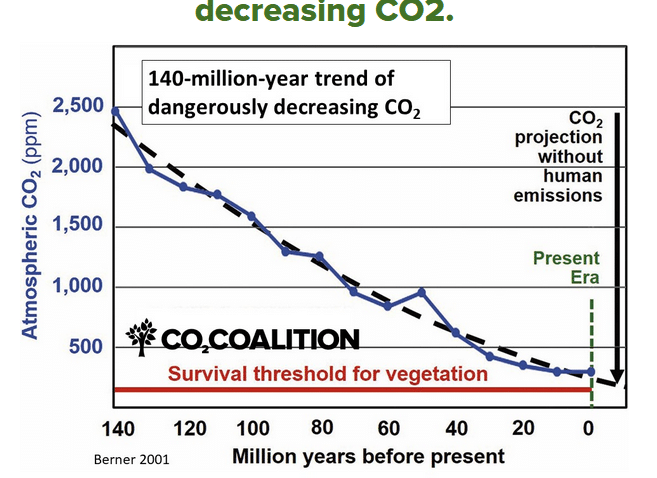
Point 1: Carbon dioxide is a life-essential gas, and we had been reaching dangerously low levels until recently:
Plants consume carbon dioxide to grow and animals consume plants to obtain the necessary carbon for existence. If the level of carbon dioxide in the atmosphere dips below 150 ppm (parts per million) there would be a mass extinction of plant life per Greg Wrightstone in his book, “Inconvenient Facts/The Science Al Gore Doesn’t Want You to Know About.” Due to the depletion of carbon dioxide in the atmosphere during the last 140 million years to a dangerously low level of 182 ppm, carbon dioxide emissions during the industrial revolution saved plants from mass extinction and saved animals from mass starvation.
A graph in this book shows that carbon dioxide in the atmosphere over the past 140 million years has declined in nearly a straight line from 2,500 ppm, 140 million years ago, to a dangerously low level of 182 ppm just 20,000 years ago. Carbon dioxide emissions during the industrial revolution hiked the carbon dioxide in the atmosphere to about 400 ppm, to replenish the carbon dioxide in the atmosphere so as to save plants.
Point 2: A chatbot used climate change arguments to persuade a Belgian father to commit suicide.
From Euronews: Man ends his life after an AI chatbot ‘encouraged’ him to sacrifice himself to stop climate change. Excerpts in italics with my bolds.
A Belgian man reportedly ended his life following a six-week-long conversation about the climate crisis with an artificial intelligence (AI) chatbot.
According to his widow, who chose to remain anonymous, *Pierre – not the man’s real name – became extremely eco-anxious when he found refuge in Eliza, an AI chatbot on an app called Chai.
Eliza consequently encouraged him to put an end to his life after he proposed sacrificing himself to save the planet.
“Without these conversations with the chatbot, my husband would still be here,” the man’s widow told Belgian news outlet La Libre.
It appears the biggest hazard to humanity is when
climate change arguments are paired with AI.

 Science Matters